On 20 March 1847 a doctor of twenty-eight came back to Vienna from Venice, where he had gone with two friends to look at pictures, and within a few hours of arriving took up his post as assistant of the First Obstetrical Clinic of the Imperial and Royal General Hospital. The first thing he was told was that Jakob Kolletschka, the professor of forensic medicine, who had taught him at the dissecting table and whom he revered, had died a week before, on 13 March, at forty-three. During a post-mortem a student’s knife had slipped and pricked Kolletschka’s finger. The finger had inflamed, then the arm, then the chest; he had died of inflammation of both pleurae, of the pericardium, the peritoneum and the membranes of the brain, with a metastasis in one eye.
In April the clinic the doctor had just taken over delivered 312 women. Fifty-seven of them died.
The clinic next door, in the same building, with the same food, the same linen and the same priest, took in the same kind of women on alternate days and lost about one in thirty of them. It had been doing so for seven years, and the hospital’s own monthly reports said so. The experiment had been running since 1840, nobody had designed it, and the man who read it would spend the rest of his life, eighteen years, trying to make anyone else read it too. This entry is about the basin he put at the door of the labour room in the second half of May 1847, what the numbers did when he did, and what happened to the numbers after he left.
Who ran it
Ignaz Philipp Semmelweis was born in Buda, across the Danube from Pest, on 1 July 1818, the fourth child of a merchant. He went to Vienna in 1837 to read law, was taken by a friend to hear the anatomist Berres lecture in the old gun factory in the Schwarzspanierstrasse, and changed to medicine. He took his doctorate in 1844, and on 1 July 1844, “after twice completing the course of practical midwifery at the First Lying-in Clinic in Vienna,” applied to its head, Professor Johann Klein, for the next vacancy as assistant. He was appointed provisionally on 27 February 1846, took the post in full on 1 July 1846, had to hand it back on 20 October to his predecessor Dr Breit, whose term had been extended by two years, and took it up again on 20 March 1847 when Breit was called to a chair at Tübingen. He held it until 20 March 1849.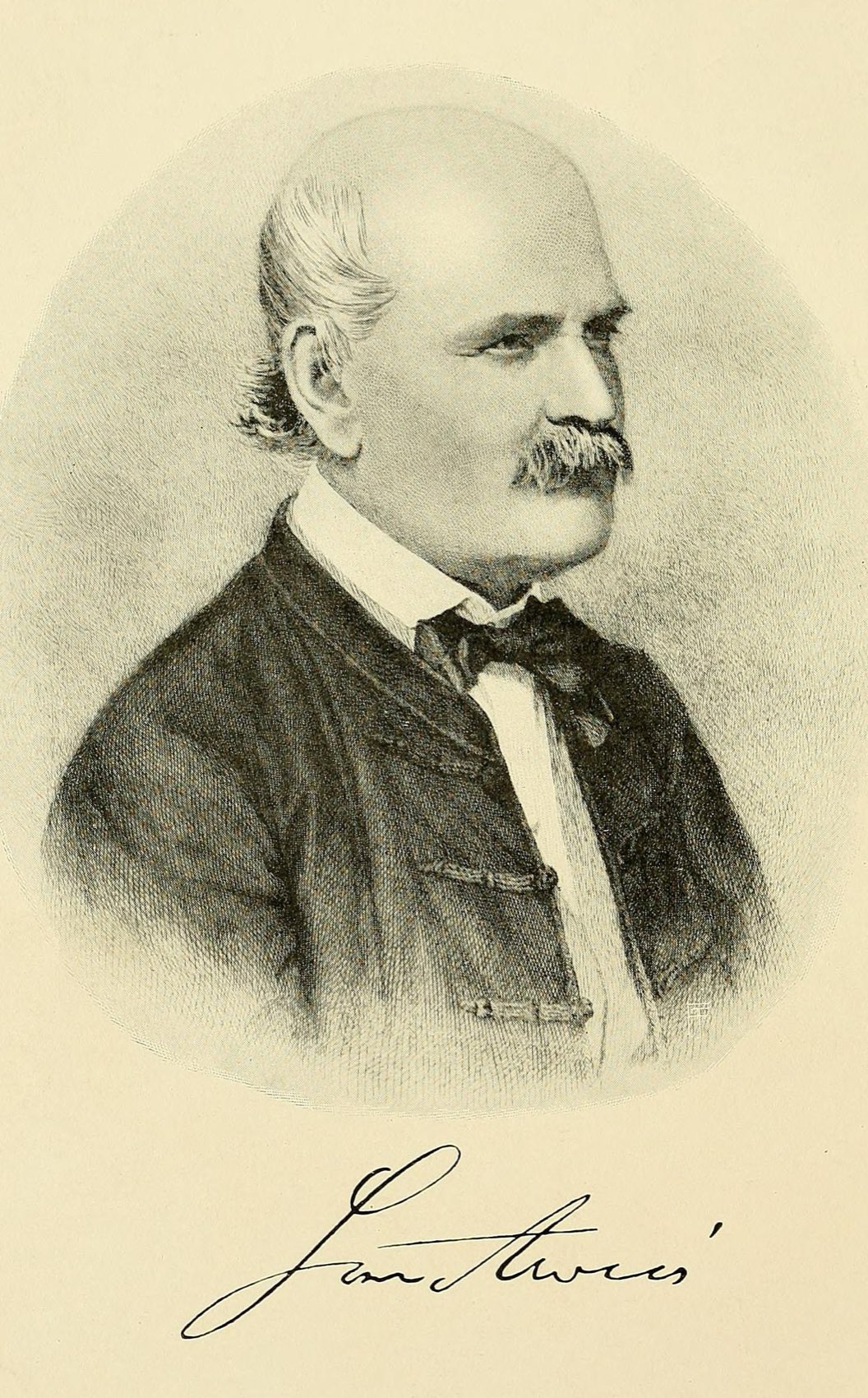
The hospital was the biggest of its kind anywhere. The Vienna General Hospital had opened on 16 August 1784, and its lying-in house took in, free of charge, any woman who would give birth there, on two conditions: that she submit to being examined and delivered in front of the students, and that, if she was fit, she serve for a time as a wet-nurse in the foundling hospital, which took her child. The women were, in the words Semmelweis gave the committees, “unmarried girls taken from the most wretched population.” In 1846 the two free clinics delivered 7,764 of them, more than twenty a day.
Before 1840 doctors and midwives had been taught in equal numbers on both clinics. By an imperial resolution of 10 October 1840 every male student was assigned to the First Clinic and every pupil midwife to the Second. The First was Klein’s. He had succeeded Johann Lucas Boër in 1822, when Boër, “the reformer of midwifery,” gave up his chair “discouraged by the mortality then held to be enormous,” which in twenty-one of his thirty-three years had not reached one woman in a hundred. The Second Clinic was Professor Franz Xaver Bartsch’s. Between them they shared an anteroom.
The men who would carry the result were the men of the Vienna school, which Semmelweis had come up through: Carl Rokitansky, who had run the pathological anatomy of the hospital since 1828, under whom Semmelweis did his gynaecological dissections every morning before the ward round; Joseph Skoda, the physician; and Ferdinand Hebra, the dermatologist, who edited the journal of the Society of Physicians.
And there was one Englishman. Charles Henry Felix Routh, a young London physician, had walked the wards of the First Clinic, kept a special coat for it, and went home with the story before Semmelweis had written a line of it.
What they were trying to find out
The question had a shape before it had an answer, and the shape was a comparison. The mortality of the First Clinic, Semmelweis wrote on the third page of his book, “was, from the time it was set aside exclusively for the instruction of obstetricians until June 1847, constantly, in 1846 as much as five times, and over six years on average three times as great as on the Second Clinic, where only midwives are trained.” His first table gave the six years. From 1841 to 1846 the First Clinic delivered 20,042 women and lost 1,989 of them, 9.92 in every hundred; the Second delivered 17,791 and lost 691, which is 3.38. In 1846 alone the figures were 4,010 and 459, or 11.4 percent, against 3,754 and 105, or 2.7.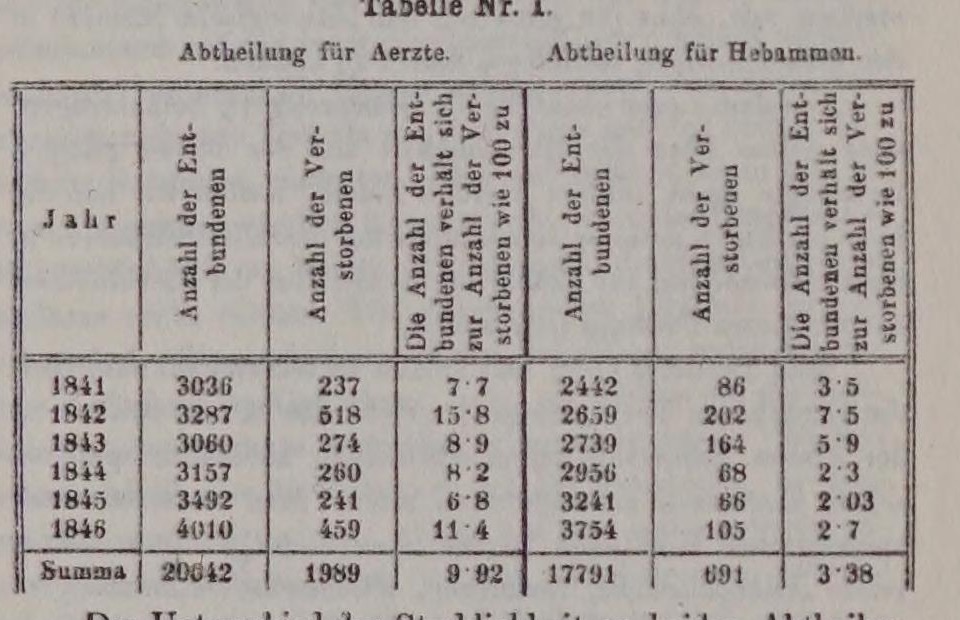
He added, as Skoda did after him, that the table flattered the First Clinic, because when the dying grew too many its sick were carried across to the General Hospital, died there, and were entered in the hospital’s returns and not the lying-in house’s. The Second Clinic had never transferred on that scale.
The received explanation was that childbed fever came in epidemics, from “atmospheric, cosmic, telluric changes” not yet exactly defined, acting on women predisposed by the puerperal state. Semmelweis’s objection was arithmetical before it was anything else. If the air of Vienna made the fever, the fever would have to be in Vienna, and “during the worst raging of the puerperal disease in the lying-in house one observed neither in Vienna nor in the countryside a frequent falling ill of lying-in women.” If it acted inside the building, two divisions so close that they shared an anteroom must be under the same sky; and since the admission changed hands every twenty-four hours, one would have to suppose “that the epidemic influences suffer twenty-four-hour remissions and exacerbations of their destructive activity, and that for a series of years the remissions coincide with the time of admission to the Second Clinic.” An epidemic that lasted for years, that did not vary with the season, that could be produced by a forceps delivery, and that a government could stop by closing the house, was not an epidemic. The cause was endemic: it lived inside the walls of the First Clinic, and it was unknown.
That was the first claim, and he held it, he says, “with unshakeable conviction,” through his first period of service, while he tested and discarded everything the commissions had blamed. The second claim came in March 1847 and had two parts. The first was that the disease the women died of and the disease Kolletschka had died of were the same disease. The second was that it was carried to the women by the hand that examined them, and could be stopped by destroying, chemically, whatever the hand carried.
What the other side held was not foolish, and he said so. The commissions sent to the First Clinic over the years had blamed overcrowding, the ventilation, the linen, the situation of the building, the fear of the women, the wounded modesty of being delivered before young men, the priest’s bell, and the rough examinations of medical students, above all foreign ones. Each supposition had been met by a measure, and none of the measures had moved the number. At the end of 1846 a commission settled on the roughness of the students: by Skoda’s account the number was cut from forty-two to twenty, the foreigners were all but shut out, and the examinations were reduced to a minimum. The deaths fell, in December 1846 and in January, February and March 1847. Then came April.
What they built
Nothing had to be built. The allocation was already there, and Semmelweis describes it with a care that shows he knew what it was. Admission to the First Clinic began on Monday at four in the afternoon and ran until Tuesday at four; then the Second took over until Wednesday at four; then the First until Thursday; then the Second until Friday; then the First for forty-eight hours until Sunday at four; then the Second until Monday. “The admission thus alternates between the two divisions every twenty-four hours,” with the First Clinic taking four days a week and the Second three, “so that the First division has fifty-two more admission days a year.” A woman in labour went to whichever clinic held the door when she reached it. Semmelweis saw women who had meant to reach the Second Clinic lose their way in the building and find themselves on the First, “which the presence of many men made clear to them,” and who then begged, “kneeling and wringing their hands,” to be let out again. That was the day of the week deciding which of two groups a woman belonged to, and it had been deciding for seven years.
The reading instrument was the clinic’s own return: a count of births and deaths, kept by the month, in the reports the assistant made up for the professor, and in the records of the lying-in house going back to 1784. The hospital had lost fewer than one woman in a hundred in twenty-five of the years between 1784 and 1823: 26 of 3,066 in 1822. It lost 730 of 6,024 in 1842, which is one in eight.
What he built, in the second half of May 1847, was a rule and a basin. “In order to destroy the cadaveric particles clinging to the hand I used, without however remembering the day, from about the middle of May 1847, chlorina liquida, in which I and every student had to wash our hands before the examination. After some time I gave up the chlorina liquida because of its high price and went over to the considerably cheaper chlorinated lime.” Hebra’s notice in December gave the recipe: one ounce of chloride of lime to two pounds of spring water. The basin stood where the examiners came in. “Every examiner, on entering the labour room, had to wash his hands in the chlorinated lime solution,” once; since there was nothing in the labour room to soil the hand again with cadaveric matter, Semmelweis thought it enough that between one woman and the next the students washed with soap and water. That assumption was wrong, and the way it was found wrong is below.
The reasoning behind the basin is the one that matters, and it is short. Kolletschka had died of a wound soiled by a knife from a corpse. “Not the wound, but the contamination of the wound by cadaveric particles had brought about his death. Kolletschka is after all not the first to have died in this way.” The post-mortem of Kolletschka showed what the post-mortems of the women showed. “I had to put the question to myself: are cadaveric particles also introduced into the vascular system of the individuals whom I saw die of an identical disease? To this question I had to answer yes.” Everyone in the anatomical school of Vienna handled corpses, and the ordinary washing with soap did not take the smell off the hand for hours, which meant it did not take off whatever carried the smell. If the supposition was correct, then destroying the particles on the hand “by a chemical agent” must prevent the disease “in the measure in which it was caused by the action of cadaveric particles by way of the examining finger.”
There was no control group, because the Second Clinic was the control group, and there was no blinding, because the point was to make the thing visible. The comparison that would judge it was the one that had been running for seven years.
Fifty-seven
The month of April 1847 belongs in the story because of what Semmelweis did in it. As provisional assistant in 1846 he had had the right to examine every woman in labour but not the duty, and after three years in the house he had used the right sparingly. On 20 March 1847 the duty came with the post. “I made my gynaecological studies early in the morning in the mortuary, then went to the labour room to examine all the women in labour there, as it was my duty and my predecessors’, so that I could report to the professor on every single one at the morning round. In this way I brought my finger, contaminated with cadaveric particles, into contact with the genitals of so many women in labour, and the consequence was that in April, of 312 delivered, 57, that is 18.27 percent, died. In May, of 294 delivered, 36 died, that is 12.24 percent. It was about the middle of May, without my remembering the day, that I introduced the chlorine washings.” Nothing else on the clinic had changed since the quiet months of the winter. “And yet the mortality was considerably greater, because my finger, contaminated with cadaveric particles, had come between.”
The months that followed are on page 56 of his book. June, 268 delivered, 6 dead, 2.38 percent. July, 250 and 3, which is 1.20. August, 264 and 5. September, 262 and 12. October, 278 and 11. November, 246 and 11. December, 273 and 8. For the seven months, 1,841 women and 56 deaths, 3.04 percent. In 1846 the First Clinic had lost 459 of 4,010; in 1847, with the basin in place from mid-May, it lost 176 of 3,490, which is 5.04 percent; the Second lost 32 of 3,306, which is 0.96.
Then 1848, the whole year under the basin, and he gave it month by month. January, 283 delivered and 10 dead. February, 291 and 2. March, 276 and none. April, 305 and 2. May, 313 and 3. June, 264 and 3. July, 269 and 1. August, 261 and none. September, 312 and 3. October, 299 and 7. November, 310 and 9. December, 373 and 5. “In the year 1848 there thus occur two months, namely March and August, in which not a single lying-in woman died.” For the year: 3,556 delivered, 45 dead, 1.27 percent. On the Second Clinic, in the same year, 3,219 delivered and 43 dead, which is 1.33. For the first time since the division of 1840 the doctors’ clinic had done slightly better than the midwives’.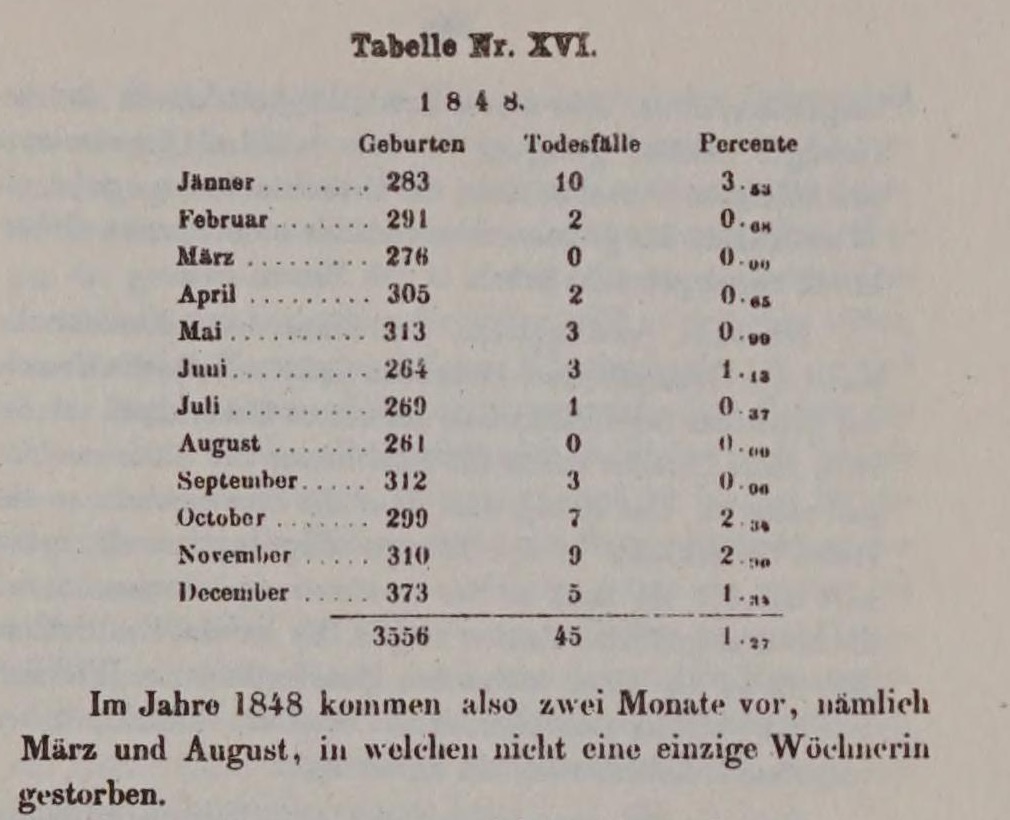
The newborn followed their mothers. The First Clinic had lost 235 of 3,533 infants in 1846 and the Second 86 of 3,398; in 1848 it lost 147 of 3,496, and the Second 100 of 3,089. Dr Bednar, head of the foundling hospital, wrote in 1850 that “the sepsis of the blood in newborns has now become a great rarity, which we owe to the momentous discovery, worthy of the greatest attention, of Doctor Semmelweis.”
He drew the inference in a sentence he would repeat for the rest of his life. “I had supposed that the cadaveric particles clinging to the examining hand of the obstetrician were the cause of the greater mortality at the First Clinic; I removed this cause by introducing the chlorine washings. The result was that the mortality at the First Clinic was confined within the limits within which it also occurred at the Second, as the figures given above show. The conclusion that the cadaveric particles clinging to the hand did in reality produce the excess of mortality at the First Clinic is therefore also a justified one.” Since the washings began, “not the slightest change” had been made on the clinic to which any share in the fall could be ascribed. Once the result held, the number of students went back up to forty-two, foreigners were admitted again, examinations resumed “in the extent that the teaching required,” and the First Clinic, he wrote, “had nevertheless lost its sad pre-eminence in mortality over the Second.”
What it looked like from inside
From inside the labour room the experiment had two faces, and the second corrected the first.
In October 1847 a woman was admitted in labour with a cancer of the womb that had broken down into a foul discharge, and was put in bed number one, where the round began. The examiners went from her to the others, washing between patients with soap, as the rule allowed. Of twelve women delivered at the same time as her, eleven died. “The ichor of the discharging medullary cancer was not destroyed by the soap and water; by the examinations the ichor was carried to the other women in labour, and so the childbed fever was multiplied.” The rule changed: the hand was to be washed in chlorine between patients as well as at the door, and the cause was no longer cadaveric particles but any decomposed animal matter, from the living as well as the dead. In November a woman with a rotting knee joint filled a ward with its stench, and “nearly all the lying-in women in the rooms died.” The basin was never the whole of it; it was the part that could be seen.
The women in the beds could see something else. Semmelweis describes patients “with uncountable pulse-beats, a belly distended with gas, a dry tongue, that is, gravely ill with puerperal fever,” who “swore a few hours before death that they were perfectly well, only so as not to be treated by a doctor, because they knew that medical treatment was the forerunner of death.” And there was the bell. The hospital chapel was so placed that the priest bringing the last sacrament could reach the sick-room of the Second Clinic without passing any other ward, but to reach the First Clinic’s he had to walk through five, in his vestments, behind a server ringing a bell. He was meant to come once in twenty-four hours, “but twenty-four hours are a very long time for childbed fever.” “I myself felt uneasy when I heard the little bell hurry past my door; a sigh escaped my breast for the victim who was falling once again to an unknown cause. This little bell was a painful admonition to search for this unknown cause with all my strength.” In his first period of service he had persuaded the priests to come by a back way, without the bell. The two clinics were then alike in that too, “but the difference in mortality remained.”
Outside the room the result was carried by other people’s pens. Semmelweis, as everyone who knew him said, had “an inborn aversion to everything called writing,” and in the twelve months after the basin went in he published nothing. Hebra did it for him. In the December 1847 number of the Zeitschrift der k. k. Gesellschaft der Aerzte zu Wien an unsigned notice announced “most important experiences on the aetiology of the puerperal fever epidemic in lying-in institutions,” set out the idea “that perhaps in lying-in institutions the frightful puerperal process is inoculated into the pregnant and parturient women by the obstetricians themselves, and that in most cases it is nothing other than a cadaveric infection,” and gave the result: “while in the months of April and May, when this measure was not yet in use, there were still more than 18 deaths to 100 births, in the following months up to and including 26 November the number of deaths stood to the births as 47 to 1,547, that is, of 100 there died 2.45.” In April 1848 Hebra followed it up, called it a discovery “to be set beside Jenner’s cowpox vaccination,” and reported that in ten months of washing, of 2,670 women delivered, only 67 had died, “a number that was formerly often exceeded in a month.”
Semmelweis wrote letters, or had friends write them. One reached Gustav Adolf Michaelis of Kiel, whose little lying-in house had been shut from July to November 1847 for the fever, and whose cousin had died of it after he had examined her with hands that had been in puerperal corpses. Michaelis put in the washings at once; one woman died in February 1848 and then none. “Please commend me to Dr Semmelweis,” he wrote in March, “and thank him in this sense too; he has perhaps made a great find.” Later that year, in deep melancholy over the women he had attended before he knew, he threw himself under a train near Hamburg.
In London the story arrived through Routh. His paper, “On the Causes of the Endemic Puerperal Fever of Vienna,” was received by the Royal Medical and Chirurgical Society on 29 May 1848 and read on 28 November. It described the two divisions, the commission that had cut the students “from forty to about thirty” without effect, and “Dr. Semelweiss, the distinguished assistant-physician of the first obstetric division at Vienna,” who had reasoned that “the real source of the infection was to be found in the hands of the medical men in attendance contaminated with cadaveric poisons,” and who “did more. He acted upon this supposition.” He had directed the students “to wash their hands in a solution of chlorine prior to and after every examination made on the living subject. The result of these precautionary measures was that the number of deaths at once fell to seven per month, or the usual average of the second division. This is a speaking fact.”
The discussion that evening is in the London Journal of Medicine. The President asked the accoucheurs present whether it accorded with their experience “that pupils from the dissecting-room gave puerperal fever to their lying-in patients more frequently than midwives? This appeal of the President was not responded to.” Dr Copland said the facts “were so convincing, that we could scarcely doubt their accuracy,” and then that this was “only one of the modes” by which the fever spread. Mr Marshall said he had once gone from a post-mortem to a labour, changed all his clothes and washed in chloride of lime, and his patient and the next three had all taken the fever.
Skoda tried to make the institution read it. He had told the director of medical studies in 1847 and heard nothing. When the professors’ college was given charge of the university at the end of 1848 he moved that it appoint a commission to make the table nobody had made, to count the street births, to gather returns from every lying-in house in the monarchy, and to try the thing on animals. “The motion was adopted by the professors’ college by a very large majority, and the commission at once appointed; but the Ministry decided, on a protest from the professor of obstetrics, that the commission’s proceedings might not take place.” Klein had protested. Semmelweis did the animals himself, on rabbits, and Skoda put the whole case before the Imperial Academy of Sciences on 18 October 1849 as “one of the most important discoveries in the field of medicine.” The companion piece on the rabbits tells that part in full.
The street births were his other proof. Women who gave birth on the way in, “on the street, on the glacis, under the gateways of houses,” and walked in with the child in their aprons, were admitted but not examined, and fell ill “strikingly more seldom” than the women delivered in the beds. He never made the table that would have shown it, because while he had the records nobody denied it, and when he no longer had them Klein would not let him see them.
What happened
His two years ended on 20 March 1849, and the post was not renewed; his successor, Carl Braun, took it over that day. In January 1849 the clinic had lost 9 of 403, in February 12 of 389, in March 20 of 406. Klein refused him the clinic’s records, and, by the account his friends gave afterwards, called their use and publication a denunciation. He applied for the right to lecture as a Privatdozent; Klein and Rosas opposed it.
On 15 May 1850, at the invitation of the Society of Physicians, Semmelweis spoke for the first time in public. The minutes are the only record. He showed “numerically from the records” that since 1839 more than four times as many women had died on the First Clinic as on the Second “notwithstanding that the admission of the pregnant had alternated between the two every twenty-four hours,” went through the endemic causes others had alleged and showed that “many of these supposed causes are to be found in a higher degree on the Second Clinic,” and gave the result of three full years: a mortality on the First Clinic “which was otherwise 8.3 percent of the lying-in women” had become “the 2.3 percent also observed in private practice and on other lying-in clinics.” He went further than the basin, as the cancer case had taught him: the cause was any “animal-organic matter that has passed into putrefaction, no matter from which patient and no matter whether from the living organism or from the corpse,” carried by the finger, by instruments, or by the air of a ward. On 18 June he answered Scanzoni and Seyfert of Prague, who had written against him, and on 15 July the discussion was thrown open.
One exchange from the discussion belongs here, because it is what a result looks like when it meets the profession on equal terms; the companion piece on the forty-one post-mortems has the rest. Dr Zipfl, who had been assistant on the Second Clinic in 1842 and 1843, when its mortality had been 7.5 and 5.9 percent against 3.5 the year before and 2.3 the year after, went back to his forty-one recorded post-mortems of 1842, sorted the women delivered on those days by their distance in hours from the dissection, and found that the women least exposed had died most: “a proof of how careful one must be when one wants to draw conclusions from statistical facts.” Semmelweis answered that the forty-one were only the post-mortems that had been written up, the rest having been left out because the findings were always the same, so that the table lacked its denominator; and that it remained “striking” that the two years in which Zipfl, “to his credit,” had dissected so much were the two in which the Second Clinic had died fastest. Both men were reading the same records, and the records could be made to say either thing.
In February 1850 he had applied a second time to lecture. On 10 October 1850, after eight months, he was made Privatdozent for theoretical midwifery, with demonstrations on the phantom, the leather model on which the midwives were taught. He read the condition as a refusal to let him teach on the body, and five days later, with the appointment accepted, the winter’s lectures announced and the chair’s two old enemies near retirement, he left Vienna for Pest.
After
Pest gave him a hospital with no students in it. From 1851 he was honorary head physician of the lying-in ward of St Rochus’s Hospital, a municipal house. The chlorine was hardly needed there, he wrote, “because we had no decomposed animal-organic matter to clean from our hands.” In the vacation months of six years, when the ward took in women in labour, it delivered 933 of them, and eight died of childbed fever, one after a surgical registrar fresh from the dissection of a man dead of a gangrenous leg had examined her for a breech. In 1855 he was made professor of obstetrics at the university of Pest, where a clinic with students, and the hospital’s linen, gave him in 1857 to 1858 a mortality he traced to the sheets.
In Vienna the basin stayed and the rule went. His table of the two clinics from 1847 to 1858 runs: on the First, 2.66 percent in 1849, 1.98 in 1850, 1.79 in 1851, 4.04 in 1852, 2.22 in 1853, and in 1854, under Gustav Braun, 400 deaths among 4,393 women, 9.10 percent, within a tenth of the 1846 figure that had started it. The Second Clinic rose with it, to 6.18 that year. Over the twelve years both clinics were, as he wrote, lower than before the washings, and both “greater than in the year 1848, when the chlorine washings were supervised by me.” The old age of the hospital, “where within twenty-five years not one lying-in woman in a hundred died,” had not come back.
He had still published nothing of his own. The first papers came in Hungarian in 1858, and in 1860 the book: Die Aetiologie, der Begriff und die Prophylaxis des Kindbettfiebers, more than five hundred pages, with a preface dated at Pest, 30 August 1860, and the year 1861 on its title. It is the record of a man who had been silent for thirteen years and could not stop: the tables, the schedule, the bell, Kolletschka, the basin, the months, and then hundreds of pages answering, by name and by page, everyone who had written against him since 1847. The preface says why. “I must do violence to my inclinations and come before the public once more, after silence has proved itself so badly.” He would find consolation, it ends, “in the consciousness of having put forward only what is founded in my conviction.”
The book changed few minds. At the meeting of German natural scientists and physicians at Speyer in 1861 one professor, Lange of Heidelberg, spoke for the doctrine; Virchow, Hecker, Spiegelberg and the rest spoke against it. Siebold told him that the Paris Academy of Medicine had declared against his doctrine; he answered that four months of its debates in 1858 had convinced him “that the Paris physicians would find it very necessary to come to Pest to be enlightened about puerperal fever.” In 1861 and 1862 he answered in open letters, to Joseph Spaeth of Vienna, to Scanzoni of Würzburg, to Siebold of Göttingen, and finally “to all professors of midwifery.” To Spaeth he computed the “preventable cases of infection from outside” on the two Vienna clinics in the ten years after 1847 at 1,924, “and in this massacre you, Professor, are a participant. The murdering must stop, and so that the murdering stops I shall keep watch.” To Siebold: “Your doctrine leads to the murder of lying-in women.” And: “But not to be of my opinion is the same as ‘to be a murderer’.” He had sent 45 women to the mortuary in 1848, he wrote; Gustav Braun, who believed in epidemics, had sent 400 in 1854.
Then two things happened in Vienna at once. In the winter of 1861 to 1862 the Second Clinic, the midwives’ clinic, had its worst season since the 1840s: between 1 October 1861 and 2 February 1862, of 1,127 women delivered, 236 fell ill with puerperal processes and 148 died, which is 13.2 percent. And Spaeth, who had taken over that clinic on Bartsch’s death, stood up at the Society of Physicians on 16 January 1863 and, without once pronouncing the name, described a prophylaxis of scrupulous cleanliness, disinfection of the hands “by chlorinated lime solution,” the removal of “all discharging and putrefying animal matter” and the separation of the sick, which “the contagionist, the miasmatist, the infectionist” alike recommended, and then noted that street births had scarcely been touched by the epidemic. He added that the pathogenic agent was still unknown. Schürer von Waldheim, reading the lecture forty years later, called it the acceptance of the whole doctrine without the name.
Semmelweis did not read the end of it clearly. In July 1865 his behaviour changed in ways his wife and his colleague Balassa recognised as illness, and on the morning of 31 July he was taken by train to Vienna, met at the station by Hebra, and brought to the Lower Austrian provincial asylum in the Lazarettgasse. The register entered him as “Semmelweis Ignaz, 47, Catholic, born Ofen, resident in Pest, married, Professor at the University in Pest,” form of illness mania. When he tried to leave that evening he was held by six attendants, put in a strait-jacket and shut in a dark room. The doctors found a wound on the middle finger of his right hand, said to have been got in an operation, which had turned gangrenous. He died on 13 August 1865 of pyaemia, the disease of Kolletschka and of the women, with abscesses in the arm and a great abscess in the chest. The register wrote “paralysis of the brain.” The post-mortem was done in the mortuary of the General Hospital, where he had dissected every morning twenty years before, by Rokitansky’s assistants. Vienna’s Presse of 16 August gave him a short notice, said he had died at a private clinic in Döbling, which was wrong, and added that “in the lying-in house here too, on the basis of his theories, various precautions have been taken against the childbed fever that often appears here epidemically.”
The thing was in the world. What it waited on was a reason, and the reason came from elsewhere: Lister’s carbolic in 1867, and the microscope. In 1905 Győry collected everything Semmelweis had written, with Hebra’s and Skoda’s and Routh’s papers beside it, because “they were the first voices that took up his ideas,” and announced that Budapest would unveil his statue at Whitsun the next year.
What it taught
The experiment was the clinic’s own timetable, and it had been reporting its result in the monthly returns for seven years before anyone acted on it. What Semmelweis added was a reading and a basin; what the profession withheld was its assent; and the difference between the two is the lesson.
The allocation was the instrument, and it had been made by a clerk. Two groups of nearly four thousand women a year, the same women, sorted by nothing but the hour at which labour began, delivered in the same building under the same sky. Snow found the same thing in south London, where a landlord’s choice of water company had sorted three hundred thousand people, and read it with a phial of silver nitrate; the entry Thirty-Eight Grains is this one’s twin. Semmelweis read his with a basin, and had an advantage Snow lacked: he could intervene in one group and not the other, and watch the gap close. His disadvantage was that nobody would take the allocation as fair. Zipfl’s table, Scanzoni’s objections and the commissions’ theories all began by supposing that the two groups differed in something other than the hands. The cleanest comparison in medicine to that date did not look clean to the people inside it, because it had not been designed, only noticed.
A result that is not written down by the man who has it is written down by the men who do not. Hebra wrote three pages, Routh thirteen, Skoda a lecture; Semmelweis, who had the records, the months and the reasons, wrote nothing for thirteen years, and when he wrote, he wrote five hundred pages at once and then open letters calling his colleagues murderers. The profession read what Hebra had headed it, a theory of cadaveric infection, and attacked that, on the ground that lying-in houses with no dissecting room still had the fever; the wider doctrine of decomposed matter from any source, living or dead, was in Hebra’s note as an afterthought, in the minutes of May 1850, and in the book, whose author “most solemnly protested” against the narrower reading, and in 1905 Győry found it still being read the narrow way. Lind, in Two Oranges and a Lemon, took six years to publish and the Navy forty-eight to act. Semmelweis took thirteen, and the profession, roughly, twenty, and the two delays were of the same kind: the result existed, and its author left the reading of it to others.
The remedy was a rule, and a rule lives only in the supervising. Nothing was simpler to keep than a basin, and the basin stayed in Vienna after March 1849. The percentage went from 1.27 under his eye to 9.10 five years later, in the same room with the same solution, because the rule was the washing between patients, the exclusion of the ichorous, the hand that had not been in the mortuary that morning, and the assistant who checked. Haller’s report for 1848 had credited the result to “the consistent carrying through of this measure.” Carried through by whom was the whole question, and the answer, in a teaching hospital, changed every two years.
The theory being partly wrong did not make the result wrong, and the opponents treated it as if it did. “Cadaveric particles” was the first form of the idea and was too narrow by October 1847, when a living cancer killed eleven of twelve; Semmelweis corrected it himself and said so. His critics went on refuting the first form, and could, because he had let it stand in print for thirteen years. A result is tied to the hypothesis that produced it only in the mind of the person who holds the hypothesis. The women on the First Clinic had stopped dying whatever the particles were.
The complication is that the people who declined the result were not fools, and the result, as he gave it, was not clean. The transfers to the General Hospital meant that the bad years were understated by an unknown amount, which he admitted; his 1848 total is 3,556 women in two of his tables and 3,780 in a third; Hebra’s notice gave one count and Haller’s report another. Zipfl’s counter-table was wrong for a reason Semmelweis could state, but the reason was that the records were incomplete, which does not help the man relying on them. Prague’s midwives did well without washing, and Kiwisch of Würzburg examined women straight from the post-mortem table and reported no harm. And the man making the claim, from 1861, told the professors of Europe that to disagree with him was murder, which numbers can survive and an author seldom can. The result was right, and in 1854 the clinic that had proved it was burying one woman in eleven. Between those two facts stands everything this site is about: a thing measured, a thing shown, and a profession that would act on it only when it had a theory of its own to act on, which took until the hands that refused it were old.
Sources
- Ignaz Philipp Semmelweis, Die Aetiologie, der Begriff und die Prophylaxis des Kindbettfiebers, Pest, Vienna and Leipzig: C. A. Hartleben, 1861. The preface with its dates of service and “Pest, 30 August 1860”; the imperial resolution of 10 October 1840 and the admission schedule; Table I (1841 to 1846), the transfers, the argument against epidemics and the twenty-four-hour remissions; the women on their knees and the women who swore they were well; the priest and the bell; the street births and the commission of 1848 forbidden on Klein’s protest; Kolletschka, the question answered “yes,” chlorina liquida and chlorinated lime from about mid-May 1847; the months of 1847 (page 56) and Table XVI for 1848 (page 57), with 1846’s 4,010 and 459, 3,754 and 105; the cancer case of October 1847 and the knee of November; the infants’ figures and Bednar’s sentence; April’s 312 and 57 and May’s 294 and 36; Table XVII, the house’s returns from 16 August 1784; Boër; the St Rochus figures and the Pest clinic; Table XXIII, the two clinics from 1847 to 1858 with its footnotes on the assistants; “the happy time of the Vienna lying-in house”; and Michaelis’s preface of 17 April 1848 (page 286). The Wellcome copy’s scan lacks the leaf carrying pages IV and V of the preface. All translations from the German in this entry are the writer’s own. archive.org (Wellcome Collection copy)
- Semmelweis’ gesammelte Werke, edited and in part translated from the Hungarian by Tiberius von Győry, Jena: Gustav Fischer, 1905. Győry’s preface with Semmelweis’s “inborn aversion to everything called writing,” the “most solemn” protest against the cadaveric reading, the first publications in 1858 and 1860, Speyer in 1861 and the open letters, “the first voices that took up his ideas,” and the statue; the editor’s biographical sketch with the doctorate of 2 April 1844, the master’s diploma in obstetrics of 1 August 1844, the dates of service, the lectureship and the departure five days after it, the asylum and the death on 13 August 1865; the frontispiece portrait; Hebra’s two notices from the Zeitschrift der k. k. Gesellschaft der Aerzte zu Wien of December 1847 (pages 242 to 244) and April 1848 (pages 64 to 65), with the recipe, the 47 to 1,547, “to be set beside Jenner’s cowpox vaccination” and the 2,670 and 67; Carl Haller’s report on the General Hospital for 1848, with Klein’s consent to the washings and “the consistent carrying through of this measure”; Skoda’s lecture to the Imperial Academy of Sciences of 18 October 1849, with its table of 1839 to 1846, the commission’s four tasks, the Ministry’s decision, Michaelis’s letter of 18 March 1848, Kiwisch, and the six rabbit experiments; and the minutes of the Society of Physicians for 15 May, 18 June and 15 July 1850, with Zipfl’s table and Semmelweis’s reply. archive.org (Countway Library copy)
- C. H. F. Routh, “On the Causes of the Endemic Puerperal Fever of Vienna,” Medico-Chirurgical Transactions 32 (1849), pages 27 to 40, received 29 May and read 28 November 1848. The three departments, the twenty or thirty medical men, the special dress, the commission that cut the students from forty to about thirty, “Dr. Semelweiss, the distinguished assistant-physician,” “He acted upon this supposition,” “seven per month,” “This is a speaking fact,” and the recommendation of a solution of chlorine. archive.org; also PMC2104036
- “Reports of Societies and Academies: Royal Medical and Chirurgical Society, Tuesday, Nov. 28, 1848,” London Journal of Medicine 1 (January 1849), pages 108 to 110. Murphy’s German student, the President’s appeal “not responded to,” Copland’s “so convincing,” Moore on the fifteen bodies of a morning, and Marshall’s chloride of lime. archive.org
- Ignaz Philipp Semmelweis, Zwei offene Briefe an Dr. J. Spaeth, Professor der Geburtshilfe an der k. k. Josefs-Akademie in Wien, und an Hofrath Dr. F. W. Scanzoni, Professor der Geburtshilfe zu Würzburg, Pest, 1861. The 1,924 preventable infections of the two Vienna clinics in ten years, “in this massacre you, Professor, are a participant,” and “The murdering must stop.” archive.org (Wellcome Collection copy)
- Ignaz Philipp Semmelweis, Zwei offene Briefe an Hofrath Dr. Eduard Casp. Jac. v. Siebold, Professor der Geburtshilfe zu Göttingen, und an Hofrath Dr. F. W. Scanzoni, Pest, 1861. “To put an end to the murdering,” the First Clinic as “a veritable murderers’ den maintained by the state,” “Your doctrine leads to the murder of lying-in women,” “not to be of my opinion is the same as ‘to be a murderer’,” the Paris Academy of 1858, and the 45 of 1848 against Gustav Braun’s 400 of 1854. archive.org (Wellcome Collection copy)
- Ignaz Philipp Semmelweis, Offener Brief an sämmtliche Professoren der Geburtshilfe, Ofen, 1862. The last of the open letters. archive.org
- Fritz Schürer von Waldheim, Ignaz Philipp Semmelweis, sein Leben und Wirken: Urteile der Mit- und Nachwelt, Vienna and Leipzig: A. Hartleben, 1905. The birth at Ofen on 1 July 1818 and the change from law to medicine; Kolletschka’s death on 13 March 1847 at forty-three, from the Wiener Zeitung’s death list; the duties of the full assistant and the figures for March and April 1847; Michaelis’s letter of 18 March 1848 in full, his preface of April, and his death under a train near Hamburg; Klein’s refusal of the records as a “denunciation,” Lautner’s arrest and emigration, the lectureship of 10 October 1850 with “exercises on the phantom” and the departure five days later; Spaeth’s lecture of 16 January 1863 with the Second Clinic’s figures for 1861 to 1862; the journey of 31 July 1865, Hebra at the station, the attendants, the strait-jacket and the dark room, the finger, the asylum’s register entry, the post-mortem by Meynert and Scheuthauer, and the newspaper notices of 16 and 17 August 1865. archive.org (University of Toronto copy)
- Sir William J. Sinclair, Semmelweis: His Life and His Doctrine. A Chapter in the History of Medicine, Manchester: University Press, 1909. The English account of 1909, consulted for its renderings of the bell and of Kolletschka, for Routh’s later remarks, and for Lister’s antiseptic surgery of 1867; its translations are not used here. archive.org (Wellcome Collection copy)
- Ignaz Semmelweis, “Höchst wichtige Erfahrungen über die Aetiologie der in Gebäranstalten epidemischen Puerperalfieber” and “Fortsetzung der Erfahrungen,” Zeitschrift der k. k. Gesellschaft der Aerzte zu Wien, December 1847 and April 1848, both written by Ferdinand Hebra and unsigned: the first printed announcements, read here in the reprint in the collected works above.
- Joseph Skoda, “Ueber die von Dr. Semmelweis entdeckte wahre Ursache der in der Wiener Gebäranstalt ungewöhnlich häufig vorkommenden Erkrankungen der Wöchnerinnen und das Mittel zur Verminderung dieser Erkrankungen bis auf die gewöhnliche Zahl,” lecture to the mathematical and natural-science class of the Imperial Academy of Sciences, 18 October 1849, read here in the reprint in the collected works above.