On the morning of Thursday 16 December 1976, David Sencer, the director of the Center for Disease Control in Atlanta, held a conference call with twenty people from the National Institutes of Health, the Bureau of Biologics and the state health departments. It was his third such call in four days. The subject was a count. Two days earlier his agency had put out a press release saying that 54 cases of Guillain-Barré syndrome, a paralysis that climbs the body from the legs, had been reported from ten states since the start of October, and that 30 of the 54 had received a swine flu shot between one and thirty days before the paralysis began. The callers agreed to recommend a one-month suspension of the National Influenza Immunization Program while the link was investigated. Sencer telephoned his superior, Theodore Cooper, the Assistant Secretary for Health, and found him at lunch in the White House staff mess with James Cavanaugh of the Domestic Council. The Secretary of Health, Education, and Welfare, David Mathews, was at another table. Cooper excused himself and put a call through to Jonas Salk, who was reached in Paris and concurred without enthusiasm. Then the three of them walked down the hall to President Ford, who, in the words of the two men who reconstructed the day for the next Secretary, “heard them out, sighed and agreed.”
That afternoon Cooper announced the suspension, “in the interest of safety of the public, in the interest of credibility, and in the interest of the practice of good medicine.” More than forty million Americans had been vaccinated in ten weeks against an influenza that, in the ten months since it was found, had infected nobody outside one Army camp in New Jersey. The programme never restarted.
The count that stopped it was, by the time the epidemiologists finished with it, just under one case of paralysis for every hundred thousand people vaccinated. That number is the whole of this entry. It was produced by the one instrument in the programme that worked as designed, and it was the first time in the history of mass vaccination that such an instrument had been read quickly enough to stop anything.
Who ran it
The programme was conceived in Atlanta, sold in Washington and run through the fifty states, and the people in it are best introduced in that order.
Sencer had directed the Center for Disease Control since 1966. Richard Neustadt and Harvey Fineberg, the Harvard professors who wrote the official history of the affair for the Department of Health, Education, and Welfare in 1978, called him “an able, wily autocrat with a devoted staff. The CDC was wholly his.” Under him were Walter Dowdle, who ran the laboratories; William Foege, assistant director for operations; Donald Millar, who would run the immunization programme itself; and Michael Hattwick, who would build its surveillance system. Beside the CDC stood two sister agencies: the Bureau of Biologics in the Food and Drug Administration, under Harry Meyer, which licensed and tested vaccines, and the National Institute of Allergy and Infectious Diseases, where John Seal ran the field trials. Outside the government sat the Advisory Committee on Immunization Practices, in form an independent panel, in fact, as Neustadt and Fineberg put it, “almost a part of CDC, nominated, chaired and staffed at Sencer’s discretion.” Among its members and guests in 1976 were Edwin Kilbourne of Mount Sinai, the country’s best-known influenza virologist; Reuel Stallones, dean of the public health school at the University of Texas; and Russell Alexander of the University of Washington, who asked the question nobody answered.
In Washington the chain ran from Sencer to Cooper, a cardiac surgeon by training and Assistant Secretary for Health; from Cooper to Mathews, who had been president of the University of Alabama until the previous August and was, Neustadt and Fineberg report, known in the Public Health Service as “the phantom”; and from Mathews to the White House, where Cavanaugh, James Lynn and Paul O’Neill at the Office of Management and Budget, and the chief of staff Richard Cheney stood between him and Gerald Ford. Ford was the first president never elected to national office, had been in the job nineteen months, and was in the middle of a fight with Ronald Reagan for his party’s nomination.
The virus itself was found by two other sets of people. At Fort Dix, New Jersey, Colonel Joseph Bartley, the post’s chief of preventive medicine, and the Army’s Walter Reed Institute of Research, under Philip Russell and Franklin Top, investigated the camp. Martin Goldfield, the New Jersey state epidemiologist, ran the laboratory that first noticed something it could not identify, and investigated the civilians around the camp; he later became the programme’s most public dissenter.
What they were trying to find out
The hypothesis had two parts, and the second was never separated from the first.
The first was that the virus isolated at Fort Dix was the next pandemic strain, and in particular that it was the virus of 1918 come back. The reasoning is set out in the memorandum Sencer wrote on 13 March, which became the government’s decision paper. “The virus is antigenically related to the influenza virus which has been implicated as the cause of the 1918-1919 pandemic which killed 450,000 people–more than 400 of every 100,000 Americans.” “The entire U.S. population under the age of 50 is probably susceptible to this new strain.” “Severe epidemics, or pandemics, of influenza occur at approximately 10 year intervals.” The last pandemic had been Hong Kong flu in 1968, and Kilbourne had written in the New York Times on 13 February, the very day the CDC laboratory identified the Fort Dix virus, that pandemics came every eleven years and the next was due.
The second part was that the United States could be vaccinated before the virus arrived. “There is no medical epidemiologic basis for excluding any part of the population,” the memorandum said; it was “socially and politically unacceptable to plan for less than 100 percent coverage,” and so “any recommendations for action must be directed toward the goal of immunizing 213 million people in three months (September through November 1976). The nation has never attempted an immunization program of such scope and intensity.”
What nobody wrote down was a probability. The Office of Management and Budget’s list of uncertainties for the President, prepared for 22 March, put it in one sentence: “HEW epidemiologists have stated that the probability is ‘unknown.’” Cooper refused to put a number on it, though once, Neustadt and Fineberg record, “he offered ‘one to 99.’” The members of the advisory committee did have numbers in their heads, and told the two historians later: “Most seem to have thought privately of likelihoods within a range from two to twenty percent; each was prepared to bet, however, with nobody but himself.” Mathews, after one meeting with Sencer, wrote to the Budget Director that “the projections are that this virus will kill one million Americans in 1976.” Between the committee room and the Secretary’s office, two to twenty percent had become a certainty, and spread had become severity.
There was a third claim folded inside the second, which was that the vaccine’s own harms would be small enough not to matter. “We are aware of no case in the medical literature of a fatality clearly attributable to killed-virus influenza vaccine,” Cooper’s status report told the President in July. “There is no known vaccine that is safer.” Hattwick, building the surveillance system, thought otherwise, and said so to the historians: “We knew there would be some neurological complications. What we didn’t know was just how frequently they would occur.”
What they built
The outbreak that started it was small, fast and, by the time anyone outside the Army understood it, over.
Training at Fort Dix had stopped for Christmas and resumed on 5 January 1976 with several thousand new recruits in a cold snap; the wind chill, the Army’s investigators wrote later, ran from zero to minus 43 degrees Fahrenheit. Respiratory illness went through the barracks. On 28 January Goldfield suggested influenza and asked for throat washings; of 19 specimens, seven grew the A/Victoria virus that was going round the whole country that winter and three grew something the state laboratory could not type. On 4 February, after leaving his sick bed for a forced five-mile night march, Private David Lewis collapsed and died, and a swab from his trachea grew a fifth untypable virus. On the evening of 12 February Dowdle told Sencer that four of the unknowns had the haemagglutinin of swine influenza. A meeting at the CDC on Saturday the 14th agreed on surveillance and, for the moment, on silence. Five days later, fearing leaks, Sencer held a press conference, and the 1918 pandemic was mentioned in answer to a question. The New York Times headline on 20 February was “U.S. Calls Flu Alert On Possible Return of Epidemic Virus.”
What the surveillance found, in the following weeks, was a camp epidemic that had already burned out. The Army’s serology counted thirteen cases of illness with the new virus, twelve basic trainees and one office worker, five with virus isolated and eight by blood test, admitted to hospital between 19 January and 9 February; Lewis was the only death. By 28 February the Morbidity and Mortality Weekly Report could say that of 1,321 single blood samples collected at Fort Dix, 273, or 21 percent, carried antibody to the swine antigen, and that “no new cases of A/Swine-like influenza at Fort Dix, nor suspect cases in the civilian New Jersey population, have been reported.” The Army’s final estimate, published in 1977 and restated by the same authors in 2006, was that about 230 recruits had been infected, or about 142 if only the virologically confirmed cases were counted as true; the figure that reached Washington in March was “as many as 500.” Thirty-nine recruits in the reception centre who gave blood between 21 and 27 February had no antibody then and none five weeks later; the cohort that began training on 1 March had none. Around the camp, Goldfield’s laboratory documented 301 A/Victoria infections in New Jersey between 9 January and 19 March, including ten deaths, and not one of the swine virus. “A/New Jersey virus was detected only from January 19 to February 9,” the Army authors wrote, “and did not spread beyond Fort Dix.”
That was the state of the evidence on 10 March, when the advisory committee met in Atlanta. Dowdle described the mood to the historians: “It was clear we could not say the virus would spread. But it was clear that there had been human-to-human spread at Fort Dix … But the current disappearance of the virus did not prove that. Flu could do strange things. Six weeks was a short time. We had to report our fundamental belief that a pandemic was indeed a possibility.” The committee concurred. Sencer’s own account of the afternoon has Stallones summing up: “If we believe in preventive medicine we have no choice.”
Alexander, who was there, wanted to know something else. The Times reporter Harold Schmeck, observing, gave Neustadt and Fineberg his notes: Alexander asked “at what point do we stop going on with our preparations to immunize everybody and turn to stockpiling instead–what point in terms both of progress of our preparations and progress of the disease.” He asked this seriously, Schmeck said. “It was not answered.” The minutes recorded only that “the production of vaccine must proceed and that a plan for vaccine administration be developed.”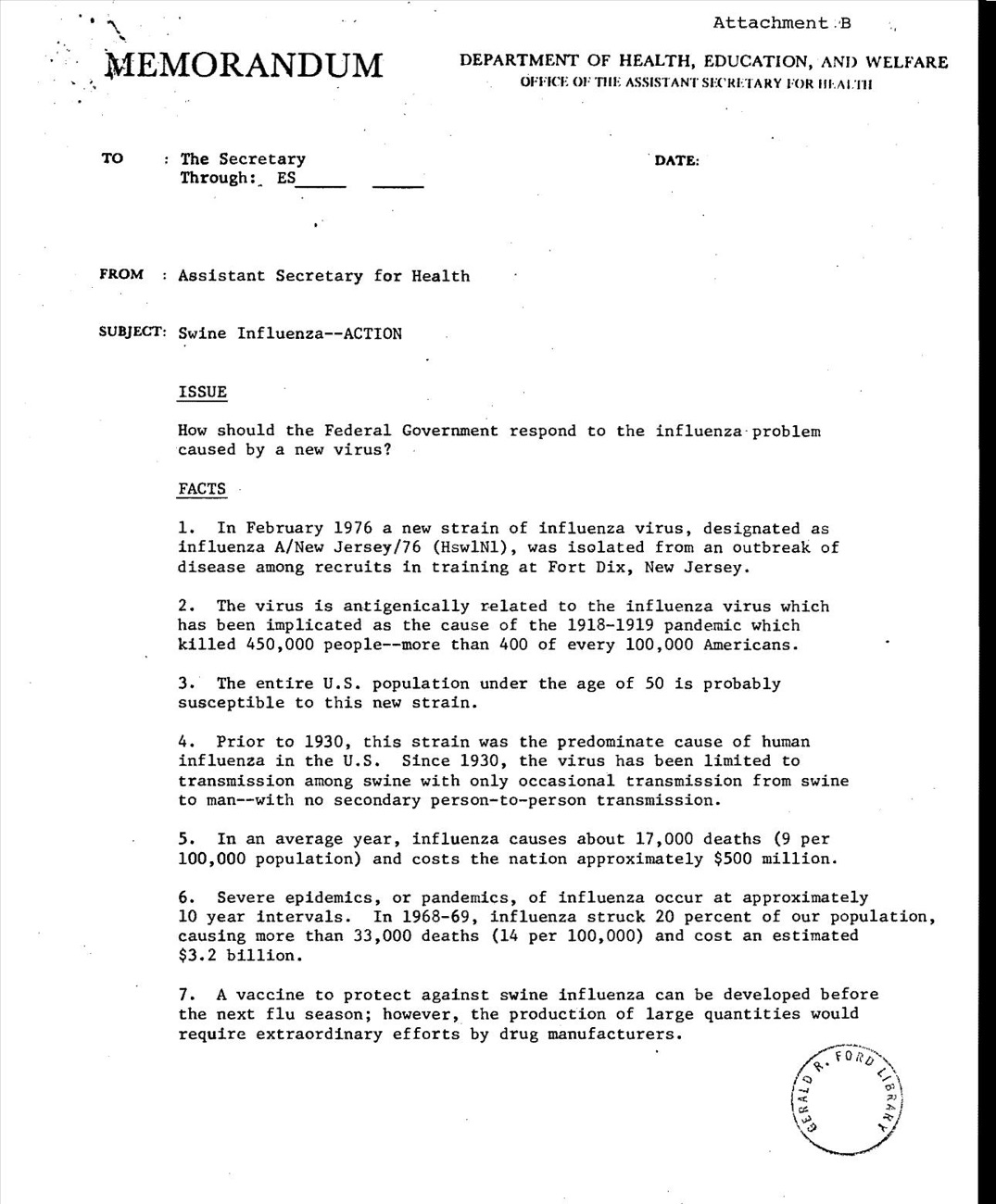
Sencer went home and wrote nine pages. The memorandum was addressed from Cooper to Mathews, and it was built to be impossible to refuse. Seven “Facts,” eight “Assumptions,” and four “Alternative Courses of Action,” three of them framed to be rejected. Assumption three: “The situation is one of ‘go or no go’. If extraordinary measures are to be undertaken there is barely enough time to assure adequate vaccine production and to mobilize the nation’s health care delivery system … A decision must be made now.” Against doing nothing: “The Administration can tolerate unnecessary health expenditures better than unnecessary death and illness, particularly if a flu pandemic should occur.” The recommended fourth course, a combined federal, state and private programme, would cost about $134 million, $100 million of it for vaccine at fifty cents a dose. The deadline was real and it belonged to the manufacturers: vaccine is grown in fertilised eggs, the roosters that sire the eggs are slaughtered when the season’s run is done, and the companies had to be told within about two weeks whether to keep them.
Sencer took the paper to Washington on Monday 15 March and put it to Mathews. James Dickson, standing in for Cooper, who was in Cairo, remembered the moment: “He said to me, ‘What’s the probability?’ I said, ‘Unknown.’ From the look on Mathews’ face when I said that, you could take it for granted that this decision was going to be made.” Mathews himself told the historians why: “You can’t face the electorate later, if it eventuates, and say well, the probability was so low we decided not to try, just two or five percent, you know, so why spend the money.” One of Ford’s aides put the same thought more bluntly: “There is no way to go back on Sencer’s memo. If we tried to do that, it would leak. That memo’s a gun to our head.”
Ford met his advisers on 22 March and asked for the scientists. On Wednesday 24 March, at 3:30 in the afternoon, he met them in the Cabinet Room: Salk and Albert Sabin, Kilbourne, Stallones, Maurice Hilleman of Merck, the vaccine companies, state and county health officers, the American Medical Association. Alexander was not invited. Sencer briefed; Salk urged mass immunization; Ford asked for a show of hands, and all hands went up; he asked for dissent and got silence; he offered to wait in the Oval Office for anyone who wanted to dissent in private, and nobody came. At 4:50 he went to the press room with Salk and Sabin beside him.
“One month ago, a strain of influenza sometimes known as swine flu was discovered and isolated among Army recruits at Fort Dix, New Jersey,” he said. “This virus is very similar to one that caused a widespread and very deadly flu epidemic late in the First World War. Some older Americans today will remember that 548,000 people died in this country during that tragic period.” He had been advised “that there is a very real possibility that unless we take effective counteractions, there could be an epidemic of this dangerous disease next fall and winter here in the United States. Let me state clearly at this time, no one knows exactly how serious this threat could be. Nevertheless, we cannot afford to take a chance with the health of our Nation.” He asked Congress for $135 million “for the production of sufficient vaccine to inoculate every man, woman, and child in the United States,” directed Mathews to make it available from September to November, and asked “each and every American to make certain he or she receives an inoculation this fall.”
At the briefing that followed, Mathews said that the advisory committees “could not give us a probability description” but had recommended “in the strongest terms” that the government proceed. Sabin then said the thing that is the clearest statement of the bet anyone made that day: “It is very important to realize that this is a most difficult decision that has an aspect of your damned if you do and you’re damned if you don’t … In other words, you are preparing for a potential attack that might never happen. This is what the Defense Department is doing, too.”
Congress voted the money in three weeks, 354 to 12 in the House and 61 to 7 in the Senate, and Ford signed the appropriation, $135,064,000, on 15 April. On 2 April Sencer gathered the state health officers in Atlanta to hand them the plan: the federal government would buy 200 million doses and the states would put them into arms, with jet injectors, school halls and volunteers. Goldfield stood up in the meeting and opposed it, and said on CBS that night: “There are as many dangers to going ahead with immunizing the population as there are withholding.” He was not forgiven. Alexander wrote Sencer a letter instead: “I, for one, do not agree that it need necessarily be carried out, unless there was another swine outbreak … There still seems to be time to be cautious if there is no further evidence of significant swine outbreaks by September.”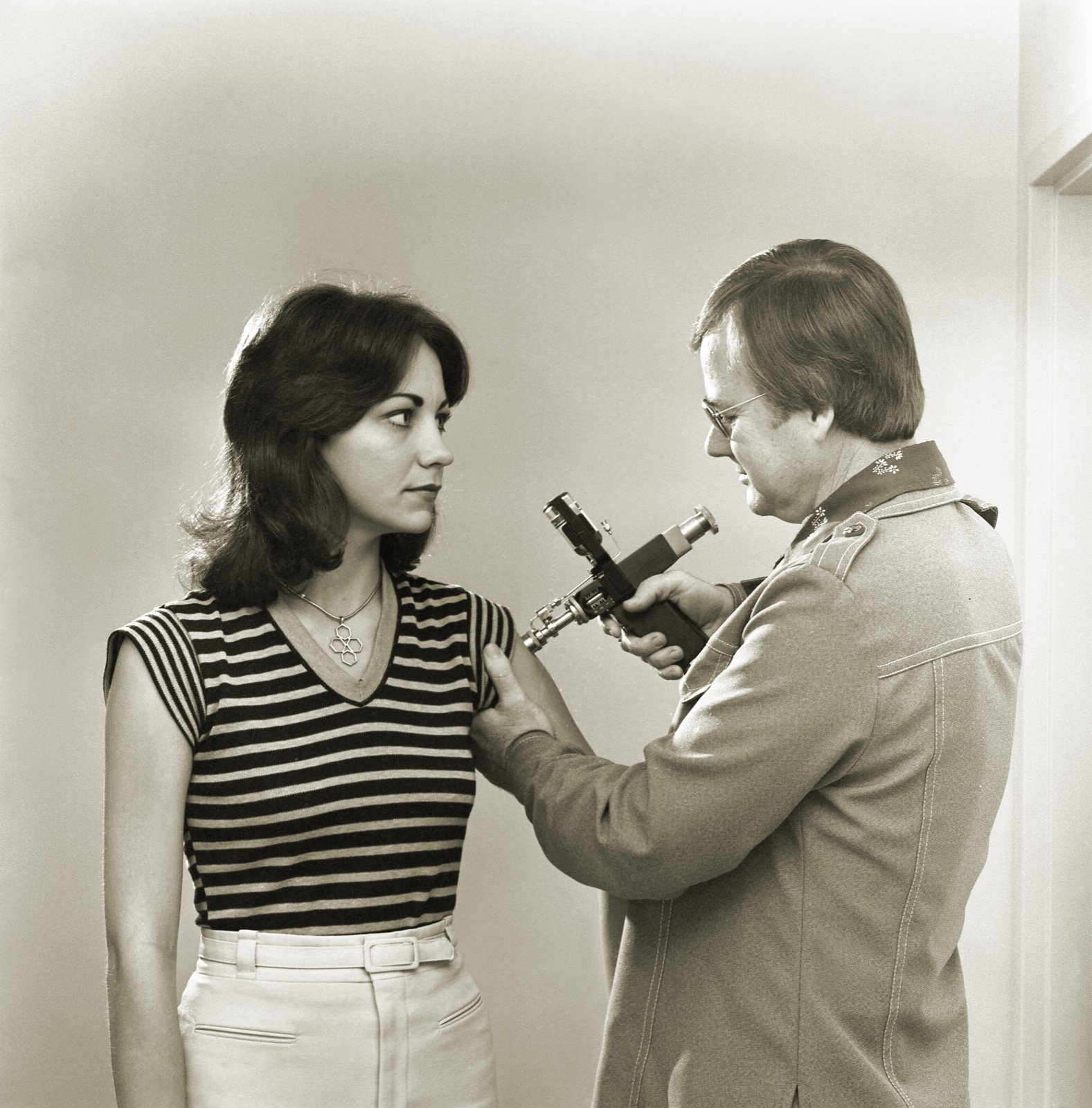
What the CDC built in Atlanta that spring was three things. A chart of every task and bottleneck in the programme, which Millar hung on the wall. A set of state plans, sixty-three of them, funded by $26 million in grants. And a surveillance centre, Hattwick’s, computerised, manned around the clock, “with all the verve and the devotion of a war room on alert.” It was built to be first to see the pandemic arrive and to measure what the vaccine did. “What mattered to us was knowing exactly what was going on,” Hattwick said. “That’s how we measured success.” Before the first shot was given, his staff computed from national mortality tables how many people of each age would be expected to die of heart attacks and strokes in any 24 hours, so that when some of them died the day after a vaccination the number could be compared with something.
The field trials began on 21 April with about 3,000 volunteers, later 5,200, the largest ever run for a vaccine before licensing. They showed in June that a single dose of 200 units protected adults over 24 with almost no reaction, that whole-virus vaccine gave children fever and sore arms, and that split-virus vaccine gave children nothing at all, not even antibody. Nobody had thought to test two doses. Children were set aside pending new trials. “What we’re telling mothers for the next two months,” Sencer told a television reporter on 22 June, “is that as scientists we don’t know what to tell them.”
Then, on 25 June, Leslie Cheek of the American Insurance Association told Meyer, Sencer and Millar on a conference call that no casualty insurer would cover the manufacturers of swine vaccine after 30 June, and that none could be found anywhere. The manufacturers stopped bottling. By late July 100 million doses sat in bulk in vats, “unpooled, unbatched, unvialed, and unlabeled.” The House health subcommittee under Paul Rogers, which did not believe the insurers, refused an indemnification bill on 1 July. Ford met Mathews on 19 July and asked Cooper whether anything had changed since March; Cooper said no, a pandemic remained “possible” with probability “unknown,” and Ford told the press that the government would find a way “either with or without the help of Congress.”
What broke the deadlock was a different disease. On 2 August the press reported that men who had attended an American Legion convention in Philadelphia were dying of a pneumonia nobody could name, and for four days swine flu was a possible cause. A bill drafted that weekend, under which every claim arising from the programme would be filed against the United States under the Federal Tort Claims Act, went through the Rogers subcommittee on 3 August. On 5 August the CDC announced that whatever was killing the Legionnaires, it was not influenza, and the full committee sat on the bill; Ford said he was “very dumbfounded.” The Senate passed it by voice vote on 10 August, the House passed it the same day under a rule that allowed no amendments, and Ford signed it on 12 August as Public Law 94-380. The insurers then covered the manufacturers against their own negligence, for premiums that came to $8.5 million, and never paid a claim. The law took effect with the fiscal year, on 1 October. Nobody could be vaccinated before that.
Go or no go
The programme that started on 1 October was not the programme announced on 24 March. The manufacturers had delivered about 25 million doses by then, not 200 million; the General Accounting Office calculated afterwards that if the virus had come, there was vaccine for 12 percent of the population on 1 October and for 53 percent by 1 December. In the first ten days a little over a million people received a shot.
On Monday 11 October, at one clinic of the Allegheny County Health Department in Pittsburgh, three people in their seventies, all with heart disease, died within hours of being vaccinated from the same lot. A wire-service reporter picked up the story from a local paper; the county coroner, Cyril Wecht, told CBS the next day that a bad batch “is definitely one possibility that must be considered”; the county suspended its programme, nine states followed, and the wire services began counting the dead. The CDC counted too. By 18 October it had 41 reports of people who had died within 48 hours of a shot: all chronically ill, from thirteen lots and all four manufacturers, and in number “less than one-fourth the number anticipated to be coincidentally associated on a statistical basis.” Across 65 Pennsylvania counties, 77,000 doses of the Pittsburgh lot had gone into people over 65 that Monday and four of them had died within a day, a rate of 5 per 100,000 against the 17 per 100,000 that the state’s own mortality tables predicted for any day. The Bureau of Biologics retested the vials and found nothing. The investigation is told in the companion piece “Lot A”.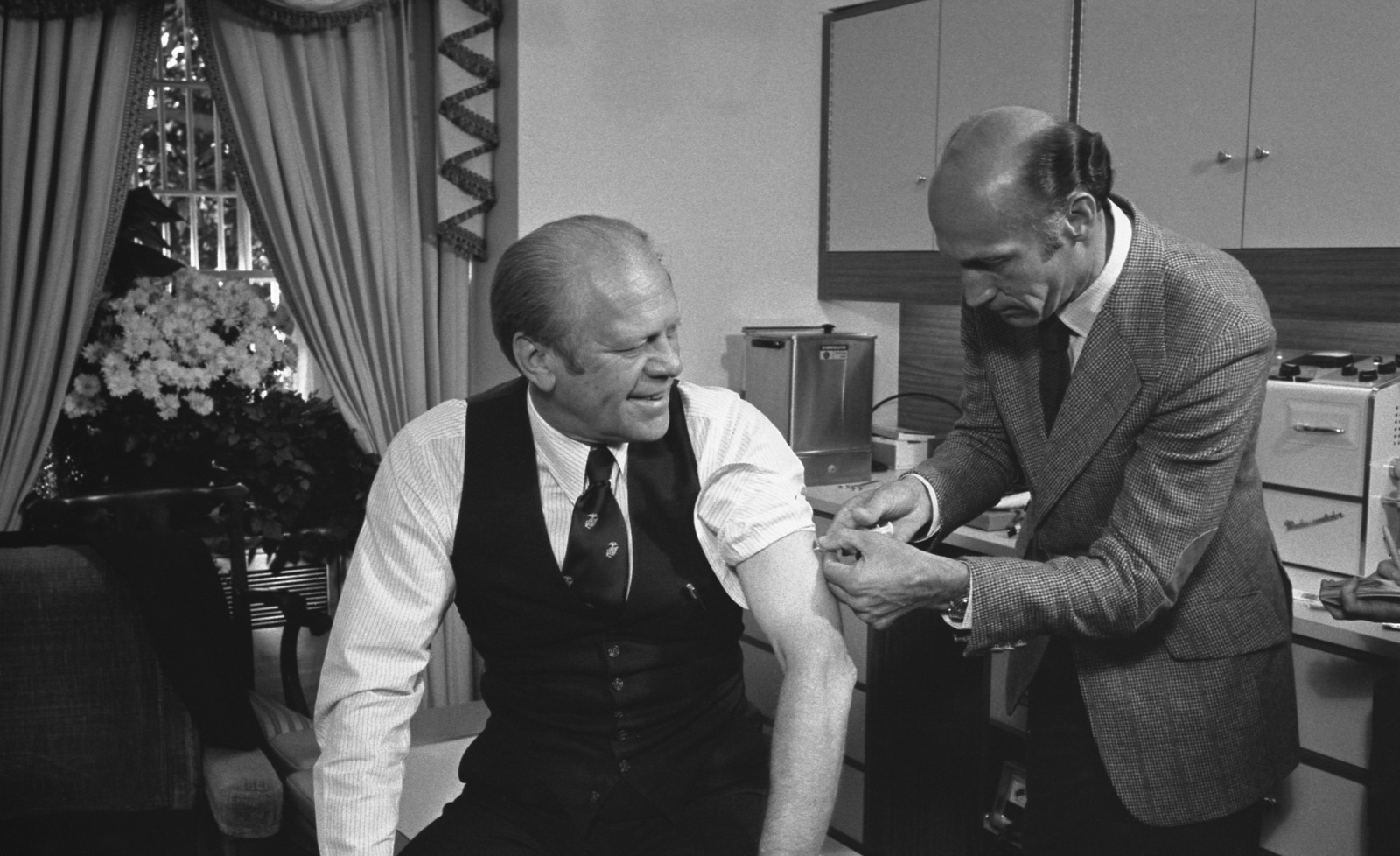
On 14 October Ford and his family were vaccinated in front of the television cameras, Cooper gave the press the laboratory results and complained of a “body count mentality,” and the states resumed. Walter Cronkite told his radio audience that “many people are left with the distinct impression that the vaccine may be fatal.” Neustadt and Fineberg thought the whole week “perfectly predictable: the coincident deaths in some city, the wire services, the nearby mini-cameras, the eager coroner,” and that the states should have been briefed for it months before; Cooper said as much to CBS the same day.
Despite Pittsburgh, and in part because of it, the numbers rose. During the week of the deaths 2.4 million people were vaccinated; in the second week of November, 6.4 million. Then they fell, to 2.3 million in the second week of December. Children were still out: on 15 November the advisory committee finally recommended two doses of split vaccine for the healthy young, and announced at the same time that only 8 million such doses existed, enough for 4 million of the 57 million children in the country. The acceptance rate ran from 80 percent of adults in Delaware to about 10 percent in New York City and Houston. And there was no swine flu. A 32-year-old man in Concordia, Missouri, seroconverted in November with no trace of a pig and no sign of having given it to anyone; a 23-year-old hog farmer in Wisconsin and a 13-year-old farm boy in December got it from their own sick pigs. The virus that had been expected to come back in the autumn did not come back.
What it looked like from inside
Minnesota was one of the conscientious states; nearly two-thirds of its eligible adults were vaccinated. In the third week of November a physician there reported to his local health authority a patient who had developed an ascending paralysis after a flu shot. He had just heard, from a cassette tape prepared for the continuing education of family practitioners, that Guillain-Barré syndrome was a possible side-effect. The state’s immunization programme officer, Denton Peterson, telephoned the CDC’s surveillance centre and spoke to one of its physicians, who, Neustadt and Fineberg record, “expressed no interest in this single case.” Peterson searched the literature and found earlier case reports. “We felt we were sitting on a bomb,” he told them. Within a week three more cases, one fatal, had been reported to him, two of them by a neurologist who said he had seen the complication of flu vaccine during his residency. Peterson called again. That day the surveillance centre was being told by telephone of three cases in Alabama, and the next day of one in New Jersey.
Now the CDC took it seriously. Guillain-Barré syndrome was, by the estimate in use at the time, a disease of about 5,000 cases a year in the United States, with more than fifty “antecedent events” recorded before it, among them viral infections, injections and, Sencer and Millar noted thirty years later, “being struck by lightning.” It had no test. The question was arithmetical: were there more cases among the vaccinated than among the unvaccinated, allowing for how many had been vaccinated and for how long, and was the excess real or an artefact of people looking harder? Four states, Alabama, Colorado, Minnesota and New Jersey, surveyed every practising neurologist and every reported case with onset after 30 September. On 11 December the investigation was extended to eleven states. On 13 December Sencer held his first conference call with the outside experts; the consensus that day was that the programme should not be halted. On 14 December the press release went out with the 54 cases. On 15 December the second call. On 16 December the third, and the lunch in the staff mess, and the President’s sigh.
The special issue of the Morbidity and Mortality Weekly Report for 24 December laid out what the four states had found. Twenty-four states had reported 172 cases of the syndrome with onset between 1 October and 22 December: 99 in vaccine recipients, with six deaths, 67 in people who had not been vaccinated, with one death, and six unknown. Of 60 vaccinated cases for which the dates were known, 48 had fallen ill between eight and 28 days after the shot. In the four surveyed states the rate among the vaccinated was 1.69 cases per million person-weeks and among the unvaccinated 0.23; the relative risk was 7.35, ranging from 1.32 in Colorado to 36 in Alabama. “On the basis of these preliminary data,” the report said, “the U.S. Public Health Service temporarily suspended the National Influenza Immunization Program on December 16.”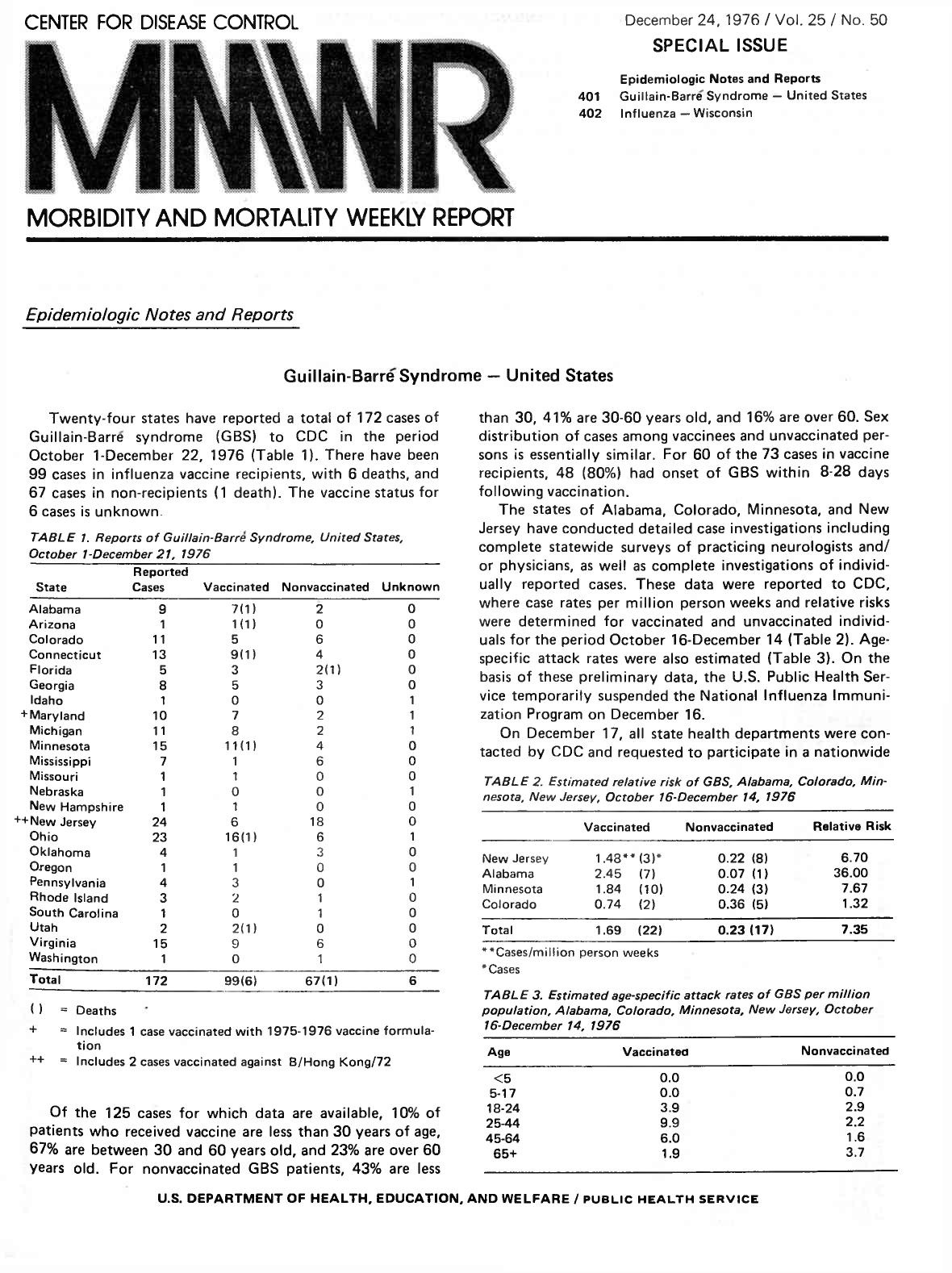
What it looked like from inside the CDC was a trap of the agency’s own making. The statistical association, Neustadt and Fineberg found, “did not convince them all.” But a different thought struck everybody, “sensitized by their long summer”: until the risk was established it could not be put on the consent form that the August law required every vaccinee to sign, and a vaccine with an unstated risk could not be given. “After everything that had already happened, everybody took that to mean virtual termination. Even the least imaginative could conjure up the television shots of victims in their beds, wheel chairs, and respirators.” Had the swine flu been in the country, the calculation would have run the other way, and everyone knew it. Sencer and Millar wrote in 2006: “Had H1N1 influenza been transmitted at that time, the small apparent risk of GBS from immunization would have been eclipsed by the obvious immediate benefit of vaccine-induced protection against swine flu. However, in December 1976, with [more than] 40 million persons immunized and no evidence of H1N1 transmission, federal health officials decided that the possibility of an association of GBS with the vaccine, however small, necessitated stopping immunization.”
The Rogers subcommittee held an emergency hearing that afternoon. Kennedy’s held one on 17 December, at which the chairman said the programme was dead and Cooper agreed it would be hard to start again; Foege gave the committee a first estimate that the incidence among the vaccinated was about four times normal. Five days later Harry Schwartz, who had written every New York Times editorial against the programme since February, wrote under his own name an article headed “Swine Flu Fiasco.”
What happened
The count kept rising as the states looked. By 31 December, 47 states had reported 571 cases with onset since 26 September, 291 of them vaccinated, 261 not, and the relative risk was holding “between 8 to 14 for vaccinees.” The advisory committee met on 29 December and again on 14 January 1977 and concluded that there was an association, that the risk was about one case in 100,000 to 200,000 vaccinations, that the risk of death was about one in two million, and that with no swine flu anywhere in the world the monovalent vaccine should stay in the refrigerator while the bivalent doses, which carried the Victoria strain, might be released to the elderly and the chronically ill. Cooper, with three days of his tenure left, declined to decide.
Joseph Califano, President Carter’s new Secretary, decided it instead, in public. On 7 February 1977, with an outbreak of Victoria flu in a Florida nursing home and television cameras in the room, an ad hoc panel heard Sencer present the data and recommended releasing the bivalent vaccine to high-risk groups and nothing else. The same afternoon Califano confirmed that he wanted a new director at the CDC: Sencer had “been at CDC for 16 years and director for 10 years. I think it’s important that institutions be rejuvenated and revitalized.” On 11 March another panel recommended Victoria vaccine for high-risk groups in the coming winter and no swine vaccine for anyone, and that was the end. About 157 million doses had been made, of 200 million ordered; the appropriation had been spent to about $100 million.
The surveillance went on after the programme stopped, and the final count was published by Lawrence Schonberger and seven colleagues at the CDC in the American Journal of Epidemiology in August 1979. Between 1 October 1976 and 31 January 1977, every state, the District of Columbia and Puerto Rico had reported 1,098 patients with Guillain-Barré syndrome. Of these 532 had been vaccinated with the swine vaccine before their paralysis began, 543 had not, 15 had been vaccinated after it began and eight were unknown. “When compared to the unvaccinated population, the vaccinated population had a significantly elevated attack rate in every adult age group. The estimated attributable risk of vaccine-related GBS in the adult population was just under one case per 100,000 vaccinations. The period of increased risk was concentrated primarily within the 5-week period after vaccination, although it lasted for approximately 9 or 10 weeks.” The case-fatality rate among adults, the CDC’s surveillance report added, was 5.9 percent, the same among the vaccinated as among the unvaccinated. In 1984, after a court order released the case summaries, Alexander Langmuir and four colleagues went through them again, excluded the doubtful diagnoses, and found that cases with “extensive” paralysis fell after vaccination in a pattern “closely approximated by a lognormal curve, suggesting a causal relationship,” and that the number attributable to the vaccine was between 211 and 246, or about five cases per million vaccinated. The programme had vaccinated, by the CDC’s final tally, 48,101,019 people, including the armed forces; “more than 40 million” in Neustadt and Fineberg’s account of the civilian programme; “45 million in 10 weeks” in Sencer and Millar’s.
The claims came in under the August law: 31 of them, for $1.2 million, by 30 December 1976; 104, for almost $11 million, by 4 February 1977; claims and suits worth more than $300 million by 31 March 1977. The General Accounting Office told Congress on 27 June 1977 that total costs “may far exceed the $135 million appropriated,” that “in a sense, HEW lost its gamble,” and that “when decisions must be based on very limited scientific data, HEW should establish key points at which the program should be formally reevaluated.” The later totals, some thousands of claims and payments running into the tens of millions of dollars, I have seen only in secondary accounts and do not give here.
After
Califano asked Neustadt and Fineberg in February 1977 to find out what had happened, for his own use. Their report, The Swine Flu Affair: Decision-Making on a Slippery Disease, was delivered in June 1978, and its foreword listed seven features of the decision, beginning with “Overconfidence by specialists in theories spun from meagre evidence” and “Premature commitment to deciding more than had to be decided.” Its verdict on the question that matters most was plain: “We believe that in the absence of manifest danger, all-out action was a mistake. One can, of course, start manufacturing more vaccine at the first hint of a killer. But one cannot reasonably stick it into people without more concrete evidence than anybody had at any time in 1976.” And its summary of what the programme had nonetheless done was equally plain: “More than 40 million civilians were inoculated, twice the number ever reached before in one flu season. A notable surveillance system was developed, better than anything before. A serious side-effect of influenza vaccination, Guillain-Barré syndrome, occasionally fatal, was tracked by that system and remains under investigation.”
The men who ran it never accepted the first verdict. In 2006, when an avian influenza was thought to be coming, Sencer and Millar wrote their own reflections in the CDC’s journal. They conceded the mistakes of presentation: the President’s meeting and press conference “were mistakes,” and they called the surveillance system “NIIP’s Trojan horse.” But on the decision itself they held their ground: “When lives are at stake, it is better to err on the side of overreaction than underreaction … In 1976, the federal government wisely opted to put protection of the public first.” Ford had told the historians the same: “I think you ought to gamble on the side of caution. I would always rather be ahead of the curve than behind it.”
The virus never explained itself. Where A/New Jersey/76 came from, why it moved through nine training companies in January and stopped in the first week of February, and whether the A/Victoria strain that was sweeping the same barracks simply outran it, the Army’s investigators said in 2006 they still did not know. The next pandemic influenza, when it came in 2009, was a swine-origin H1N1 after all, and was mild.
What it taught
The programme is usually told as a story about a pandemic that never came. It is more useful told as a story about instruments, because it had two, and the difference between them is the lesson.
The decision was bundled to a deadline that belonged to only part of it. The roosters gave the manufacturers two weeks to decide whether to make vaccine. Nothing gave anyone two weeks to decide whether to inject it. Sencer’s memorandum rolled production, planning, immunization and surveillance into one “go or no go,” and from then on every review, in June when the children dropped out, in July when the insurers walked away, in September when the doses fell short, was a review of whether to continue, never of whether to start. Alexander’s question on 10 March was the only attempt to build a second decision into the first, and the chair let it drop. The historians’ lesson, and the General Accounting Office’s, is the same: a decision taken on thin evidence needs a written statement of what evidence, arriving when, would reverse it.
“Unknown” is not a probability, and it cannot fall. The men who knew the most carried numbers in their heads of two to twenty percent and declined to say them aloud, because saying a number is unscientific and a layman might misunderstand it. What they said instead was “a strong possibility” and “probability unknown,” and the words did their work: by the time they reached the Secretary the chance had become “will kill one million Americans,” and by the time they reached the President they had become a show of hands. Then, in July, with no case anywhere in the world for five months, Ford asked whether anything had changed and was told, correctly, that nothing had, because “unknown” in March and “unknown” in July are the same word. A stated probability could have been revised downward week by week. An unstated one could only be confirmed.
The first instrument spoke in February and the programme was designed not to hear it. By the week of the advisory committee the Army’s serology already showed what its published papers would show in 1977: the last isolate came from the soldier who died on 4 February, the last case was admitted on 9 February, the reception-centre cohorts of late February and 1 March had no antibody, and the civilian surveillance around the camp found only Victoria. Dowdle said it in the room: the virus had disappeared. The committee’s answer was that disappearance proved nothing, and in a strict sense that was true; 1918 had had a mild spring wave before its killer autumn. But the absence of spread was evidence, the only evidence there was going to be before September, and the plan carried no provision for weighing it. A hypothesis that treats every negative reading as “not yet” has no instrument at all.
The second instrument worked, and it worked against the people who built it. Hattwick’s surveillance centre was built to catch the pandemic and to prove the vaccine safe. It caught instead a rare paralysis at a rate of about one in a hundred thousand, and it caught it within five weeks of the first telephone call from Minnesota, in time for a conference call, a lunch and a President’s sigh. No vaccination campaign had ever been stopped by its own count before. The complication is the one Sencer and Millar insisted on. The count could only stop the programme because the pandemic had not come. Had the swine flu been in the country, one case of paralysis in a hundred thousand would have been a price, not a verdict, and the same instrument would have been read as proof that the vaccine was safe enough. An instrument tells you what happened. Whether it is a reason to stop depends on what else is happening, and in December 1976 nothing else was.
The lesson, then, is not that they should have waited, though they probably should. It is that they built one instrument to catch the thing they feared and read the other, the one that could have told them the thing they feared was not coming, as if it were silent. The one that worked was the one they did not want to hear.
Sources
- Richard E. Neustadt and Harvey V. Fineberg, The Swine Flu Affair: Decision-Making on a Slippery Disease, U.S. Department of Health, Education, and Welfare, 1978. The narrative from Fort Dix to Califano, the interviews with Sencer, Dowdle, Dickson, Mathews, Meyer, Alexander, Stallones, Hattwick, Peterson, Ford and the others, the quotations from Schmeck, Cheek, Cronkite, Wecht, Millar, Schwartz and Califano (all of these at second hand through this report), the chronology, the seven features and the verdict. Read in the National Academies Press reprint on archive.org, and also on the NCBI Bookshelf. archive.org, NCBI Bookshelf
- “Swine Influenza–ACTION,” memorandum from the Assistant Secretary for Health to the Secretary, prepared by David Sencer, 13 March 1976; and James Lynn’s briefing for the President’s meeting of 22 March 1976 with its Attachment A, “Uncertainties Surrounding a Federal Mass Swine Influenza Immunization Program.” White House Central Files, Gerald R. Ford Presidential Library. The Facts, Assumptions, four alternatives, $134 million and “go or no go.” fordlibrarymuseum.gov
- Gerald R. Ford, “Remarks Announcing the National Swine Flu Immunization Program,” 24 March 1976, 4:50 p.m., the Briefing Room. The American Presidency Project. presidency.ucsb.edu
- Press conference of David Mathews, Jonas Salk, Albert Sabin, Theodore Cooper and David Sencer, the Briefing Room, 24 March 1976, 4:57 to 5:25 p.m.; and the White House fact sheet of the same day. Gerald R. Ford Presidential Library. Mathews on the committees, Sabin’s “damned if you do.” press conference, fact sheet
- James Cannon’s briefing for the President’s meeting of 24 March 1976, with the list of participants, and Cavanaugh’s memorandum on congressional notification. James M. Cannon Files, Gerald R. Ford Presidential Library. fordlibrarymuseum.gov
- Theodore Cooper, “The National Influenza Immunization Program: Status Report, July 20, 1976–ACTION,” and David Mathews’s memoranda to the President of 20 July 1976, with the briefing for the meeting of 22 July. The 76 million doses in freezers, Merrell’s eggs, the ten options, “no known vaccine that is safer.” Gerald R. Ford Presidential Library. fordlibrarymuseum.gov
- Center for Disease Control, Morbidity and Mortality Weekly Report, vol. 25: “Influenza–United States,” 21 February 1976, p. 55 (the four isolates and eleven cases); 28 February 1976, p. 63 (twelve cases, 273 of 1,321 sera); “Influenza–United States,” 26 March 1976, p. 92; 22 October 1976 (the Pittsburgh clinic and the 41 deaths); special issue, 24 December 1976, pp. 401 to 402, “Guillain-Barré Syndrome–United States” (172 cases, relative risk 7.35, the suspension); and “Follow-up on Guillain-Barré Syndrome–United States,” 7 January 1977, p. 430 (571 cases, the ACIP of 29 December). CDC Stacks. 21 February, 28 February, 26 March, 22 October, 24 December, 7 January 1977
- Center for Disease Control, Influenza Surveillance Report No. 91, 1975-1976 (July 1977) and No. 92, September 1976-June 1977 (1981). The Fort Dix summary; the 200 million doses and “over 48 million people”; the Guillain-Barré investigation and the 1,098 cases; the 48,101,019 vaccinated and 4,733 adverse reports; and the full investigation of the Pittsburgh clinic of 11 October, with the expected death rate of 17 per 100,000. CDC Stacks. No. 91, No. 92
- Comptroller General of the United States, The Swine Flu Program: An Unprecedented Venture in Preventive Medicine, report HRD-77-115 to the Congress, 27 June 1977. “HEW lost its gamble,” the recommendation of formal re-evaluation points, 157 million doses, 25 million by 1 October and 112 million by 1 December, the $135,064,000 budget, the $100.2 million spent, claims over $300 million. gao.gov
- David J. Sencer and J. Donald Millar, “Reflections on the 1976 Swine Flu Vaccination Program,” Emerging Infectious Diseases 12, no. 1 (January 2006), pp. 29 to 33. “45 million in 10 weeks,” the Trojan horse, the December reasoning, the lessons and “better to err on the side of overreaction.” wwwnc.cdc.gov
- Joel C. Gaydos, Franklin H. Top, Richard A. Hodder and Philip K. Russell, “Swine Influenza A Outbreak, Fort Dix, New Jersey, 1976,” Emerging Infectious Diseases 12, no. 1 (January 2006), pp. 23 to 28. The thirteen cases, the 230 and 142, the cohorts, 19 January to 9 February, the 301 Victoria infections, and the unanswered questions; summarising the four papers by the same authors in the Journal of Infectious Diseases 136, supplement, December 1977. wwwnc.cdc.gov
- Lawrence B. Schonberger, Dennis J. Bregman, John Z. Sullivan-Bolyai and others, “Guillain-Barre syndrome following vaccination in the National Influenza Immunization Program, United States, 1976–1977,” American Journal of Epidemiology 110, no. 2 (August 1979), pp. 105 to 123; read in abstract only. The 1,098 patients, the 532, and “just under one case per 100,000 vaccinations.” PubMed
- Alexander D. Langmuir, Dennis J. Bregman, Leonard T. Kurland, Neal Nathanson and Maurice Victor, “An epidemiologic and clinical evaluation of Guillain-Barré syndrome reported in association with the administration of swine influenza vaccines,” American Journal of Epidemiology 119, no. 6 (June 1984), pp. 841 to 879; read in abstract only. The lognormal curve, the 211 to 246 cases, and 4.9 to 5.9 per million. PubMed
- Public Law 94-380, the National Swine Flu Immunization Program of 1976, approved 12 August 1976. archive.org
- The congressional hearings of 1976, which I could not read: Swine Flu Immunization Program, supplemental hearings before the Subcommittee on Health and the Environment of the House Committee on Interstate and Foreign Commerce, 28 June, 20 and 23 July and 13 September 1976, Serial No. 94-113; the Senate Subcommittee on Health’s hearings of 1 April and 5 August 1976; and Suspension of the Swine Flu Immunization Program, 1976, Senate Subcommittee on Health, 17 December 1976. Cooper’s and Waxman’s words from them are quoted here as Neustadt and Fineberg quote them. HathiTrust record, HathiTrust record
- Gerald R. Ford Presidential Library, “Swine Flu Immunization Program, 1976,” the photograph series A8922, A8923, A9259, B0981, B1030 and B1874, with the Library’s statement that White House photographs are in the public domain. fordlibrarymuseum.gov
- CDC Public Health Image Library, PHIL 8365, “an adult female receiving a vaccination” with a jet injector during the 1976 campaign, content provider CDC/Robert E. Bates, public domain. wwwn.cdc.gov