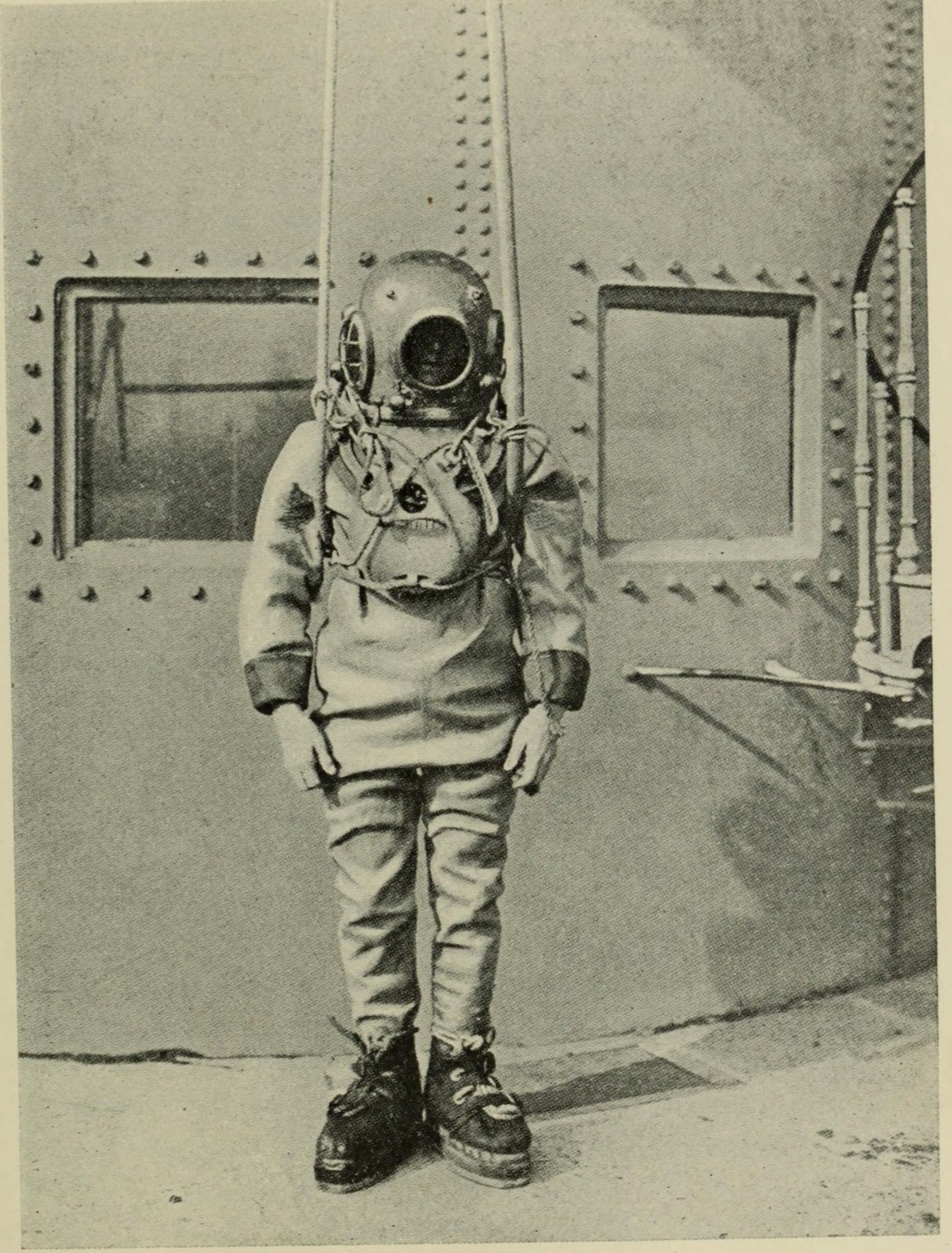
At eight minutes past eleven on the morning of Friday 31 August 1906, on the deck of the torpedo gunboat HMS Spanker, anchored at the entrance of Loch Striven in the Firth of Clyde, the front glass of a diver’s helmet was screwed home. Half a minute later the diver was under water. At nine minutes past he was at 80 feet. At ten and three-quarter minutes past, two minutes after he had left the surface, he was sitting on the shot at the end of the rope, on a bottom of soft mud, and the gauge on the pump read 216 feet. “There was no light on the bottom,” the committee’s diary says. Six men were on each of three pumps, in reliefs of five minutes, keeping thirty revolutions a minute. The diver took samples of the air in his helmet. At a quarter past eleven he was called up, and at twenty past he was at 90 feet, where he stopped.
He had come up 126 feet in four minutes. Then he waited three minutes, and went up to 70 feet, and waited five, and went up to 52. There were seven stops in all. At four and a half minutes past noon he was on deck, after fifty-six minutes in the water, and nothing was wrong with him. The depth, measured on the shot-rope against the ship’s standard, was just over thirty-five fathoms, or 210 feet. The diver was Lieutenant Guybon Damant, Royal Navy, aged twenty-five, who three weeks before had never been deeper than nineteen fathoms. In the afternoon Gunner Catto made the same dive. The London Mail called it “a record for the British Isles and probably for the world.”
The stop at 90 feet is the number to keep. It was not chosen because 90 feet was a round figure. It is a little less than half the absolute pressure at 210, and the rule that a diver may come straight up to half the pressure on him, and must then go slowly, had been worked out that summer, in a steel chamber in a yard in Chelsea, on goats.
Who ran it
John Scott Haldane was born in Edinburgh on 2 May 1860, qualified in medicine there in 1884, and by 1906 was a Fellow of New College, Oxford, and the country’s authority on the air men breathe in bad places. He had gone down mines after explosions to find out what killed the men who survived the blast, and had shown it was carbon monoxide. He experimented on himself in sealed chambers as a matter of routine. His method was always the same: find the gas, measure it, and then ask what the body does with it.
The Admiralty’s trouble with its divers was of that kind, and it came to him through a committee. Haldane wrote in 1922 that “owing to the difficulties frequently experienced by divers in attempts to work at depths over about 12 fathoms a Committee, including myself as the physiological member, was appointed by the British Admiralty to investigate the whole subject of the difficulties and dangers associated with deep diving.” The year was 1905 or 1906; the sources give both. Its naval members, as far as the published record names them, were Staff Surgeon Oswald Rees, and a young gunnery lieutenant who had taken the divers’ course because gunnery officers were put in charge of divers. Guybon Chesney Castell Damant had been born on the Isle of Wight on 25 July 1881, had gone to sea as a cadet in 1896, and had joined the gunnery school at Portsmouth in 1905. He was spare, about eleven stone, and interested in the sea bottom for its own sake. He volunteered to be the committee’s diver, and became its co-author.
The animal work needed a pathologist, and it found one at the Lister Institute of Preventive Medicine in Chelsea. Arthur Edwin Boycott was twenty-nine, a Hereford man, Oxford-trained, with a taste for snails and for counting things. It needed a chamber, and that came as a gift: Ludwig Mond, the chemical manufacturer, gave the Institute a steel pressure chamber large enough to hold men. The money came from the Admiralty and from the firms whose men worked under pressure in caissons and tunnels, John Aird and Son, S. Pearson and Son, Price and Reeves, and the late Basil Ellis. E. W. Moir of Pearson’s, who had built the first medical air-lock on the Hudson River tunnel in 1889, lent his experience. The naval diver who worked beside Damant was Gunner A. Y. Catto, who “had much previous experience in diving work, but had never dived beyond 23 fathoms.”
That was the whole team: a physiologist, a pathologist, a surgeon, a lieutenant, a gunner, and a herd.
What they were trying to find out
There were two questions, and the committee took them in order.
The first was why divers at twelve fathoms and more became useless. “It appeared that men who attempted to make any serious exertion when at depths of over about 12 fathoms often became unconscious or greatly exhausted,” Haldane wrote. He had the divers take sample bottles down with them and blow helmet air into them, and the bottles came up with two or three per cent of carbon dioxide. A diver’s pump delivered a volume of air measured at the surface, and at three atmospheres that volume was a third of itself in the helmet; the carbon dioxide he breathed out had nowhere to go. Three per cent at eleven fathoms is nine per cent at the surface, “so no wonder the divers became unconscious.” Many of the pumps leaked at the piston rings and nobody tested them. The committee’s answer was arithmetic: the pump must deliver one and a half cubic feet a minute for every atmosphere of pressure on the diver, the gauges must be tested, and the pumps must be tested for leakage before every dive. Once that was done, Haldane said, “no discomfort whatsoever was experienced at a depth of even 35 fathoms.”
The second question was the one that killed people, and it was the committee’s own to answer, because nobody had. From the earliest days of diving it had been known that a man who came up from deep water might feel faint within minutes and be dead within a few more, or might lose the use of his legs. Paul Bert had shown in 1878 that the cause was bubbles: nitrogen dissolved in the blood and tissues under pressure comes out of solution when the pressure is taken off, as it does in a bottle of soda water when the cork is drawn. Bert’s remedy, and every government’s since, was to come up slowly and evenly. The Royal Navy’s divers “were officially enjoined to descend and come up at a slow and even rate of about 5 feet per minute, but many serious or fatal cases were occurring in spite of this.” The best authorities on the Continent, Heller, Mager and von Schrötter, had calculated that a uniform ascent at twenty minutes an atmosphere would always be safe.
Haldane did not believe the uniform rate was safe or sensible, and his reason was a calculation. The body is not one tank filling with nitrogen; it is many, filling at different speeds. The blood leaving the lungs is saturated at once. A part of the body with a rich blood supply fills in minutes; fat, which Vernon had just shown takes up about six times as much nitrogen as blood, fills over hours; and tunnel men knew that a three-hour shift was safer than an eight-hour one, which meant that something in them was still filling after three hours. So a man coming up at a uniform rate from a deep dive was, for most of the ascent, still taking up nitrogen in his slow parts while losing it from his fast ones, and reached the surface with the slow parts more loaded than when he started up. “It is needlessly slow at the beginning and usually dangerously quick near the end.”
Against that he set a fact that everyone in compressed-air work knew: a man can come straight up from an atmosphere of excess pressure, about 33 feet of sea water, however long he has been down, and nothing happens. Bubbles need a supersaturation of more than that to form. Haldane’s hypothesis was that what mattered was not the drop in pressure but the ratio. “Hence it seemed probable that, if it is safe to decompress suddenly from two atmospheres of absolute pressure to one, it would be equally safe to decompress from four atmospheres absolute to two, from six atmospheres absolute to three, etc.” If that was true, a diver could be brought at once to half his absolute pressure, where the nitrogen would leave his body at the fastest safe rate, and then up by stages, each longer than the last, so that no part of him was ever more than about twice as saturated as the air he was breathing.
It was two claims, and the paper that came out of it said so. One was that the body tolerates a halving of the absolute pressure anywhere on the scale. The other was that the body can be modelled as a set of parts that half-saturate in five, ten, twenty, forty and seventy-five minutes, and that a safe ascent can be calculated from that model. The first could be tested in a chamber. The second could only be tested by calculating a table, sending a man down on it, and seeing whether he came up.
What they built
The chamber was “a short segment of a boiler of 1 inch plate resting on its side.” Inside it measured seven and a half feet long by seven wide and seven high, 336 cubic feet, enough “to hold 3 or 4 persons comfortable” or a small herd. It had an oval manhole at one end and a bolted plate at the other for bulky things, three windows of stout glass, each fitted so that if the glass broke a rubber-faced plug fell into the hole, an air-lock for passing in food, a telephone, electric light, heaters, and a fan. The largest valve, in the floor, would take the pressure from 100 pounds to nothing in under a minute. A gas engine drove the compressor, which could raise the pressure only about two pounds a minute, and that was too slow to imitate a diver going down; so the Admiralty lent a multitubular air reservoir of twenty-two cubic feet, charged to seventy atmospheres, which could be blown into the chamber to give 75 pounds in five and a half to six and a half minutes. Two spring gauges showed the pressure, one of them from inside.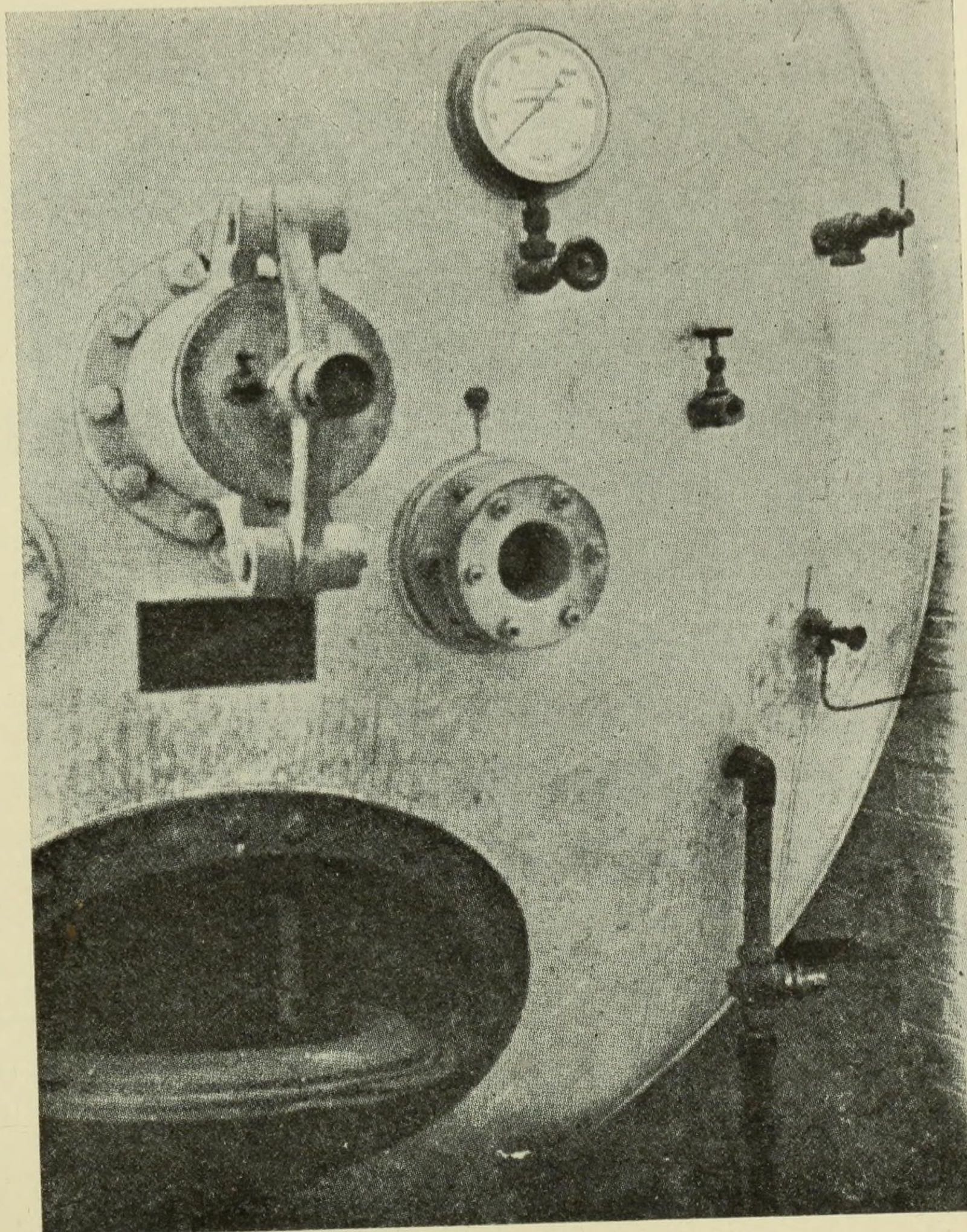
The animals were the second instrument, and the choice of them was the first finding. A few trials were made with rabbits, guinea-pigs, rats and mice, and they were almost useless, because small animals do not get the bends. A mouse circulates its blood so fast that its nitrogen is gone before a bubble can form; the paper records that “we have indeed failed to produce any symptoms at all in mice on decompression in less than a minute after one hour’s exposure at 75 lbs., an experience invariably fatal to goats.” The thing being studied was the slowness of a large body, and a large body was needed to study it. Goats were chosen “chiefly because they were the largest animals which could be conveniently dealt with and which could be obtained in considerable numbers.” They weighed a quarter to a third of a man, so their blood went round about two-thirds faster per pound, which could be allowed for; and they showed the small symptoms, which a mouse could not. The paper is exact about their merits: “Goats, while they are not perhaps such delicate indicators as monkeys or dogs, and though they are somewhat stupid and definitely insensitive to pain, are capable of entering into emotional relationships with their surroundings, animate and inanimate, of a kind sufficiently nice to enable those who are familiar with them to detect slight abnormalities with a fair degree of certainty.”
“The animals, 85 in number, used in the present experiments were a mixed collection of ordinary English goats of no particular breed.” About half were female. They weighed from 10 to 80 kilograms, the average rather less than 20. All were adult. Two died of pneumonia and two of diarrhoea, which was for a while an epidemic until the corn was stopped. The post-mortems turned up lungworms, a liver fluke, a bony tumour in an adrenal gland, and once a surgical needle in a lung; none of it, the authors judged, had anything to do with compressed air.
The method was simple. Five to eight goats went into the chamber at a time; the pressure was raised, the chamber shut, and nothing ventilated until decompression began, the goats’ own carbon dioxide rising about half a per cent an hour. Then the pressure was let down, by whichever route was being tested, and the goats were let out to run about in the yard and were watched for half an hour or more. The watching was the measurement, and it had its own technique. “During the breeding season it is advisable to keep the males and females separate, and, by removing any sources of interest, to allow the animals to fall into a state of meditative boredom. Under these circumstances, trivial symptoms are easily detected which are not made the subject of objective demonstration by animals engaged with their appetites.”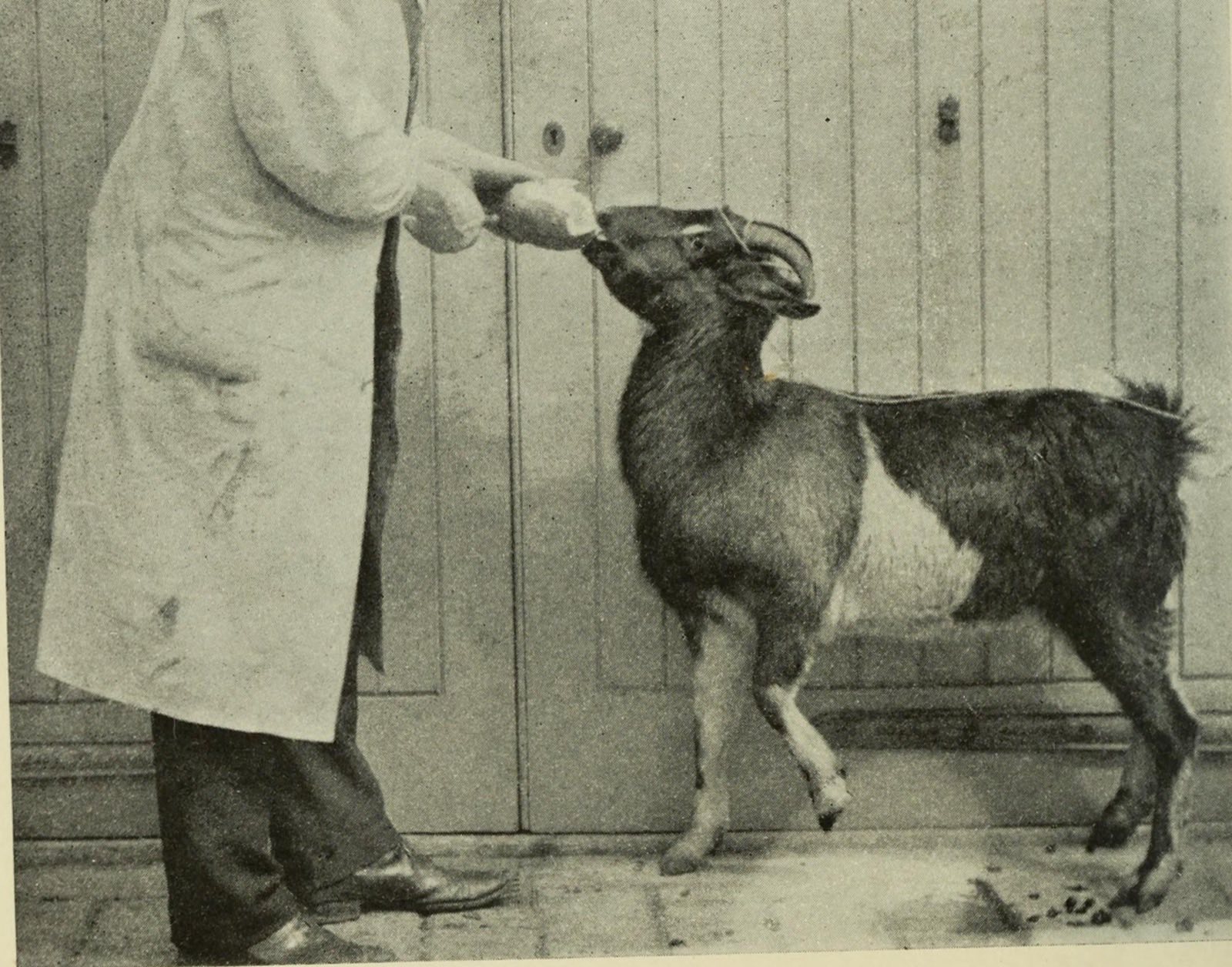
The symptoms were sorted into kinds. The commonest was a leg, usually a foreleg, “held up prominently in the air,” the animal “evidently loth to bear weight upon it,” which the authors took to be the goat’s version of the tunnel man’s “bends.” In the last 110 cases, seventy were in one foreleg, twenty-eight in one hind leg, and twelve in two legs; fifty on the right and forty-eight on the left. Bends came on about a quarter of an hour after a fast decompression and were gone in an hour or two. Worse were the paralyses, of the hind legs or all four, some of which passed in an hour and some of which did not pass; and the laboured breathing that meant bubbles had filled the right side of the heart and the lungs; and death, which came within minutes when it came. At post-mortem the bubbles were in the veins, in the fat, in the fluid of the joints and in the white matter of the spinal cord.
For the men there was the ordinary diving dress of the Royal Navy, a copper helmet screwed to a corselet, a canvas dress, an air-pipe and a life-line with a telephone wire in it, and the pumps that had so often been short of wind. For the committee’s sea trials there was the Spanker, a torpedo gunboat of 1889, and a recompression chamber for the deck, which was tested on the ship’s Whitehead torpedo charging column and found to take 40 pounds in three minutes and leak one pound a minute. Haldane and Rees shut themselves in it at 30 pounds to see that it worked.
Seventy-five pounds to twenty-seven
The goats went into the chamber in June 1906. The first series, through June and July, was 164 experiments on thirty-four animals, and the paper is frank about it: “the procedures adopted were, through ignorance, so ill-devised that no very definite results were obtained.” Five goats died in it. What the first series taught was the shape of the problem. “It soon appeared from the preliminary experiments that the individual variability of the animals was very large—larger indeed than the difference between many of the modes of decompression which it was desired to examine.” Some goats got the bends every time and some never did, and the ones that never did were not the big ones or the small ones or the males or the females in any way that could be predicted. “It was therefore clear that either an enormous number of animals had to be employed or the experiments had to be so framed as not to produce fatal results.” Eighty-five goats were not an enormous number. So the design was turned round: each batch was given the gentlest treatment first and worked up to the harshest, so that the same animals went through many combinations and the count of deaths was kept low, and the authors argued that if even the selected survivors of a herd were made ill by a schedule, the whole herd would have been worse.
The standard exposure became 75 pounds above atmospheric, which is six atmospheres absolute and the pressure at 168 feet of sea water, reached in about six minutes, for periods from a few minutes to four hours, and occasionally eight. From that came the first thing the tables needed, which was how fast a goat fills. Up to about ten minutes at 75 pounds, nearly every goat could be let out in a minute and show nothing; at fifteen minutes, a sudden decompression gave severe symptoms; the symptoms grew worse up to two hours and then stopped getting worse. A goat was full in about three hours. Scaled for the slower circulation of a man, a man would be full in about five, and the slowest part of him would half-fill in seventy-five minutes.
Then the ratio. Goats taken to 75 pounds and held there were dropped suddenly to 27 or 24 pounds, which is a fall of about fifty pounds, more than three atmospheres, and about 2.3 to one in absolute pressure. “A sudden drop of about 50 lbs. from 75 lbs. positive to 27 or 24 lbs. positive has been made about 200 times altogether in the course of these experiments without producing any symptoms.” In one series the goats were kept at 24 pounds for an hour after the drop and watched carefully, then dropped again to 17, and watched again: nothing. The same goats were then dropped by the same fifty pounds, but from 51 pounds to atmospheric, a ratio of 4.4 to one, “with very disastrous results,” and a drop from 45 pounds to six below atmospheric was worse. Haldane’s figures for the second group in 1922 were that a fifth escaped, a fifth died, a third had severe symptoms and a third had bends. The same fall in pressure was harmless at one end of the scale and lethal at the other. The claim had been that the ratio was what counted, and the goats said so.
The second claim was tested goat against goat. The animals used for a calculated stage decompression after fifteen minutes at 75 pounds, four minutes to 60 feet of equivalent depth, then two minutes at 60, three at 40, five at 30, seven at 20 and ten at 10, were on alternate days given a uniform decompression in the same thirty-one minutes. By stages, in thirty-four decompressions of eighteen goats, there were five cases of bends and nothing worse. Uniformly, in thirty-six decompressions, “one died, two were paralysed, one had indefinite general symptoms of a severe character, and in 11 other cases ‘bends’ occurred, besides two doubtful cases.” Twelve goats decompressed uniformly over ninety minutes after the same exposure did worse than the goats decompressed by stages in a third of the time. Across seven groups of paired experiments the ratio of goats escaping altogether was about eight to five in favour of stages, and when the authors scored the symptoms, bends one, death six, the uniform method came out at fifty against two. Two of the stage schedules had been meant to be safe, and were: thirty minutes at 75 pounds and sixty-eight minutes of stages gave no illness in fourteen goats; three hours and two and a quarter hours of stages gave two cases of bends in fourteen. The rest of the stage schedules had been made deliberately too short, so that there would be symptoms to compare.
Before any man was dropped through half his pressure under water, the goats’ schedules were tried on men in the chamber. Between 25 and 31 July 1906 Damant and Catto went into the Chelsea chamber seven times, to 39, 50, 55, 60, 67, 74 and 80 pounds, the last being six and two-fifths atmospheres absolute, for from an hour at the lowest pressure to twelve minutes at the highest, and came out by stages in from twenty-four to fifty-one minutes, the compressor kept running and the two men kept in the chamber for half an hour afterwards so that they could be put back under pressure at once. “In view of the results with goats, the occurrence of decompression symptoms seemed probable in the more severe experiments. No symptoms were, however, observed, except considerable itching of the skin of the fore-arms where it was uncovered.” Then they went to Scotland.
What it looked like from inside
The Spanker came into Rothesay Bay, on the Isle of Bute, at about seven in the evening of Monday 20 August 1906, and was met by Haldane, Rees and Catto. Tuesday went on the pumps. Every pump was tested by lowering the free end of its hose to 200 feet on a lead-line, heaving round until the air flowed free, and stopping to read the gauge, which had been specially graduated and was tested against the sea itself. In the afternoon both divers went to fifteen fathoms for an hour and came up in eighteen minutes with two stops. On Wednesday they went to twenty-three fathoms, on Thursday to twenty-five, and on Friday the ship was taken through the Kyles of Bute to Loch Riddon, where there were twenty-seven fathoms, and Catto spent nineteen and a half minutes under the ship’s bottom looking at a damaged propeller before coming up. Saturday was twenty-nine fathoms. On Monday 27 August, in thirty and a half fathoms by the lead, Catto was on the bottom at 180 feet in a minute and a half and found it needed the pumps at thirty-two revolutions and great exertion by the hands to keep them there; he came up in six stops, doing “gymnastic exercises” at the first. Damant followed in the afternoon to 186 feet in one minute twenty seconds.
What a diver felt at that depth, when the air was right, was very little. The committee’s pumps were giving them, by Haldane’s reckoning, more than they could use, and the samples from the helmet showed the carbon dioxide well under three per cent. The divers, the diary says, “were perfectly comfortable in moving about on the bottom.” What they had felt at Portsmouth, when the air was short, was different, and the committee had measured that too. At 139 feet with the carbon dioxide in his helmet at 4.28 per cent of an atmosphere, Damant could keep up the lifting of a 56-pound weight seven feet a minute for eight minutes and no longer. A sample taken from the helmet of a diver named Watkins, an inspector, at the moment he was about to signal for more air, showed ten per cent, and the committee judged he “was probably on the verge of losing consciousness.” The ascent was managed from the deck: the diver was stopped by signal on his breast-rope, the pumps were stopped so that the gauge would read true, the gauge was tapped, and “there was never the slightest difficulty in stopping him at the right point within a foot or two.” At each stop he was to keep his arms and legs moving.
On Tuesday 28 August it went wrong in the ordinary way. Catto went down in thirty fathoms at seventeen minutes past two with a wire hawser to shackle on to a sinker. He found the sinker, tied his distance line to it, and went back for the hawser, which was lying in bights; he got inside the coils, and in feeling for the end of the wire fouled his own life-line. At half past two he was called up and could not come. It was twenty minutes before he cleared himself. The pumps could not be kept above twenty-four revolutions a minute, and that was not enough air for a man struggling in the dark, “so that he was almost overcome by the excess of CO2.” He had been twenty-eight and three-quarter minutes in thirty fathoms, most of it working hard. He was brought up in nine stops over an hour and a half, which is twice what the table for an ordinary dive would have given him, and had no ill effects. On Thursday he went down again at the same place and shackled the hawser on in four minutes, in bright sun, with the pumps at twenty-four to thirty.
In the chamber at Chelsea it looked like this. Through the windows the goats could be watched fairly well, except at the moment that mattered, because “fog of course completely blocked the view during the actual moments of rapid decompression,” and the air that had been warmed by compression went suddenly and bitterly cold. Then the manhole was opened and the goats ran out into the yard. Some of them, the authors came to know, would hold up a leg within a quarter of an hour whatever was done to them, and some would never do it. Leonard Hill, who read the committee’s report closely and did not agree with all of it, put it in his book of 1912: “the oldest, largest, and fattest goat, ‘Pa,’ was very resistant, while one of the smallest and thinnest animals, ‘Little Billy,’ was soon prostrated with paralysis.” Nannies were more apt to severe symptoms than billies; four of the five deaths in the second series were pregnant females, fat with the winter. There is a footnote to a table of small animals that says of one group, “The details were eaten by a goat.”
What happened
The committee reported in 1907, as a blue-book, with the tables in it and a rewritten Diving Manual for the Royal Navy to go with it. There were two tables. The first gave, for every depth to 204 feet, the longest time a diver might spend from the surface to the start of his ascent, and the stops on the way up, so arranged that he could always be back on deck within about half an hour. The second was for the diver who could not keep to the first, because he was fouled, or the tide held him, or the work could not be left; it gave the stops after any length of stay, and they were long. Both were calculated so that until near the surface no part of the diver should be more than twice as saturated as the air he breathed. The full account of the work on the goats, with the theory, the protocols and the diary of the Spanker, was published by Boycott, Damant and Haldane in June 1908 in the Journal of Hygiene, under the title “The Prevention of Compressed-Air Illness.” It is 101 pages long, and it is honest about what it does not know. Of the halving rule: “Whether the law holds good for pressures much exceeding six atmospheres is still doubtful, as no experimental data exist.”
The first table’s limits were kept, and nobody using it was hurt. The second was proved in the only way a table of that kind can be. “A very unfortunate accident which occurred recently has shown only too clearly that this is not the case,” the paper says of the suggestion that its long stops were longer than they needed to be. Divers were raising a torpedo boat that had sunk in twenty-five fathoms. They were working in spells of twenty minutes and coming up by stages in thirty-two, by the first table, “which was the only one then in use,” and no one had shown a symptom. One diver’s life-line went over a spar of the wreck one way and his air-pipe the other, and he could not reach either to clear it; a second diver could not free him against the tide. He was down two and a half hours before the tide slackened. Rees and Damant brought him up by stages over two and a half hours, which was what they then believed enough after a long stay at that depth. He was forty-nine, heavily built, with an inch of fat over the trunk, and too exhausted to climb; he hung on the life-line through the stops, and on deck could hardly have been kept in the water longer. He had no paralysis. He was put to bed on the gunboat with hot bottles, seemed better in the morning and was moved to hospital, which made him worse; he became restless, then delirious, and died about twenty-four hours after he had come up. At the post-mortem there were bubbles in the right side of the heart, in the veins of the liver and bowel, in the coronary vessels, and in the fat of the mesentery. The authors drew the conclusion that their own second table, with its stops of hours, was “none too long, even for a man of ordinary build,” and that the thing to guard against was the long stay itself.
Hill, whose own method was slow uniform decompression with exercise, gave the committee its due and its criticism in the same preface. The report “contains the important contributions of John Haldane to this subject,” he wrote, but “the mathematical calculations on which the Admiralty table of stage decompression is founded have never been published, and so cannot be critically examined,” and “the engineer considers the long periods fixed by the Admiralty Committee unpractical.” For tunnel work, where men were under pressure for hours and the pressures were lower, he thought the Admiralty’s periods about twice as long as they needed to be. For divers he did not dispute them.
After
The tables crossed the Atlantic in a few years. In 1912 the United States Navy gave Chief Gunner George Stillson a programme to test and refine them, and on 5 November 1914 one of his divers, Chief Gunner’s Mate Drellishak, went to 274 feet in The Race, in Long Island Sound, for five minutes on the bottom and eighty minutes coming up. Stillson’s report of 1915 reprinted the two Admiralty tables, “carefully tried out and found to be safe and practical.” That spring the submarine F-4 sank off Honolulu in fifty fathoms, and Stillson’s divers were sent for. On 14 April 1915 Frank Crilley went down a steel cable to the submarine at 288 to 306 feet, stayed fourteen minutes, and came up a ladder in nine stops over an hour and three-quarters, wet, cold and well. On 17 April William Loughman got foul at 250 feet and was there three hours before Crilley freed him; brought to 100 feet, “in spite of all telephone instructions,” he climbed the ladder on his own to 40 feet and collapsed. On deck he was unconscious, not breathing, without a pulse. He was put in the recompression chamber with two surgeons and Crilley, and the pressure run up to 75 pounds; one of the surgeons burst both eardrums. “Patient suddenly recovered as pressure reached 75 pounds.” It took the rest of the day and a relapse at 20 pounds to get him out, and weeks to get over the pneumonia that the oxygen had given him, and he lived.
By 1922 Haldane could write that in the twelve years since the method went into the Navy, “deep diving has been conducted with comfort and safety to the divers, so that compressed-air illness has now practically disappeared except in isolated cases where from one cause or another the regulations have not been carried out.” Damant had tried, with a chamber on deck, shortening the last tedious stops; the divers began to get the bends, and the chamber went back to being an emergency. “I calculated the tables with great care on the theoretical lines borne out by the experiments and in the light of all the available evidence from human experience; and it appears that the times cannot be cut down without risk of trouble.” Damant was made the Navy’s Inspector of Diving in 1907, retired in 1911, was recalled in 1914, and between 1917 and 1924 led the divers who took 44 tons of gold out of the wreck of the Laurentic in Lough Swilly, all but twenty-five of 3,211 bars. He died in 1963. Boycott became a professor of pathology and died in 1938. Haldane died in Oxford in 1936, a few days after coming back from the oil refineries of Persia, where he had gone to find out why men were dying of heat.
The model outlived its authors. In the 1930s the United States Navy’s divers, going deeper and longer, found that a ratio of two to one was more than the fast parts of the body would stand on a deep dive and less than the slow parts needed, and gave each part its own ratio; the tables of 1937, and every set since, have been built by adjusting Haldane’s compartments rather than by replacing them. A diver with a computer on his wrist today is carrying the goats’ arithmetic, revised.
What it taught
The experiment worked, which makes it rare on this site, and so the lesson is in how, and in where its edges were.
The instrument has to be the right size. Haldane’s first finding was not about pressure but about mice. The thing he wanted to measure was the slowness with which a large body gives up a gas, and a mouse was too fast to show it; dogs needed twice the pressure of men; goats, at a quarter of a man’s weight, were the smallest animal that could stand in for him, and even then the result had to be scaled. The failure to get the bends in a mouse was a true result about mice, and would have been a false one about divers.
The halving rule was tested where it would be used, and marked where it had not been. The goats were dropped through the ratio at six atmospheres, which is the pressure at 168 feet, and the men were dropped through it in the chamber at 80 pounds, and then under water at 210 feet, in that order, each step a little beyond the last and none of them far beyond. And the paper wrote down the edge: above six atmospheres, “no experimental data exist.” Fifty years later the Navy that inherited these tables put a habitat on the bottom at 610 feet in one step from 205 and found the edge the hard way; that story is Six Hundred Feet. The committee of 1906 went from fifteen fathoms to thirty-five in eleven days, a fathom or two at a time, and that is the whole difference.
The variation was bigger than the effect, and the design was changed to live with it. A herd of eighty-five, with Pa at one end and Little Billy at the other, could not be split into groups large enough to see the difference between two schedules. So the same animals were put through both, as their own controls, and the schedules were run from mild to harsh so that the susceptible ones survived to be compared. That is a weaker design than the one the authors would have chosen with a thousand goats, and they said so, and said what it could still prove. An experiment that reports its own weakness is worth more than one that reports a clean result it did not earn.
The table that nobody had needed was the one that killed a man. For the ordinary dive the first table was never wrong. The diver who died was the one the ordinary dive did not describe: fouled for two and a half hours at twenty-five fathoms, fat, forty-nine, exhausted, hanging on a line because he could not climb. The committee had a second table for him, but it was not yet in use, and the two and a half hours they gave him by their best judgement were not enough. The paper’s response was to make the second table longer still and to say so in print. Every schedule is written for the dive it imagines, and the man who is killed is the one it did not.
A calculation that cannot be checked is a claim. Hill’s objection stands in the record beside the result: the arithmetic behind the Admiralty table was never published. The tables worked, and the model has been revised ever since by people measuring what it got wrong. Haldane’s answer, in 1922, was that he had calculated them with great care and that they could not be shortened without trouble, which was true and was not a proof. The goats had tested the ratio and the comparison of methods; nobody has ever tested the compartments, because there is nothing in a body that corresponds to them. What the divers have been using for a century is a rule that was true enough, inside the range where it was tried.
Check the story before you learn from it. The committee was appointed in 1905 by one account and 1906 by another. The record dive was to 210 feet on the shot-rope, 216 on the gauge with the pumps stopped, and 220 with them going. The chamber was Haldane’s in 1907 by the encyclopaedia and in use from June 1906 by the paper. The diver who died is nameless in the record, and so is his torpedo boat. What stands without argument is that eighty-five goats of no particular breed were taken to six atmospheres some hundreds of times in a yard in Chelsea, that the rule drawn from them was tried on two men in the same chamber and then in a Scottish loch, that both men came up, and that the first time the rule met a case it had not been drawn for, it was found short by a margin that a post-mortem measured in bubbles.
Sources
- A. E. Boycott, G. C. C. Damant and J. S. Haldane, “The Prevention of Compressed-Air Illness,” Journal of Hygiene 8 (3), June 1908, pp. 342 to 443. The theory, the chamber, the eighty-five goats and their symptoms, the results of Series I to IV, the human experiments of July 1906 (Appendix I), the diary of HMS Spanker reprinted from the committee’s report (Appendix II), the protocols, the tables, and the death of the fouled diver. Read in the volume on archive.org; the figure plates are from the same scan. archive.org
- Report of a Committee appointed by the Lords Commissioners of the Admiralty to consider and report upon the conditions of Deep-Water Diving, HMSO, 1907. Not reached; its diary and its tables are reprinted in the 1908 paper, and its findings on the air supply and on the goats are quoted by Hill (1912), from whom the passages on Watkins’s sample, Damant’s work test and the variability of the animals are taken at second hand.
- J. S. Haldane, Respiration, Yale University Press, 1922, chapter XIII. The committee’s appointment and the carbon dioxide finding, the Navy’s old rule of five feet a minute, the halving argument, the figures for the 4.4 to one drop, the chamber tests on Damant and Catto, the twelve years’ experience, the shortened stops, and the F-4 dives at Honolulu. archive.org
- Leonard Hill, Caisson Sickness and the Physiology of Work in Compressed Air, Edward Arnold, 1912. The preface on the unpublished calculations and the engineer’s view; the committee’s helmet-air samples and work test (pp. 50 to 53); the committee’s statement on variability and the goats Pa and Little Billy (p. 214); the Spanker diary (pp. 221 to 224). archive.org
- “Dive of 210 Feet. Record in British Navy Experiments,” from the London Mail, reprinted in the New Hampshire Farmer and Weekly Union, Manchester, 10 October 1906, p. 7. The record and the soda-water explanation. loc.gov
- George D. Stillson, Report on Deep Diving Tests, Bureau of Construction and Repair, Navy Department, Washington, 1915. The adoption of the tables, the rule on descent, the 274-foot dive of 5 November 1914. archive.org
- G. R. W. French, “Diving Operations in Connection with the Salvage of the U.S.S. F-4,” United States Naval Medical Bulletin 10 (1), 1916. Crilley’s dive of 14 April 1915 and Loughman’s fouling, collapse and recompression on 17 April. archive.org
- Wikipedia, “John Scott Haldane,” “Guybon Chesney Castell Damant,” “Arthur Boycott,” “HMS Spanker (1889)” and “History of decompression research and development,” for birth and death dates, Damant’s training and later career, the Laurentic gold, and the revisions of the tables from the 1930s. en.wikipedia.org