On 10 July 1889, in the grounds of the Great Military Hospital at Weltevreden, the European quarter of Batavia, a strong cock fell ill. It walked unsteadily, then sat back on its hocks, then fell on its side and could not get up. Its comb went blue-red, its neck bent back, its head was drawn in, and its breathing slowed. It was put in a pen by itself and three days later it was dead. It was one of about six chickens that the government’s new laboratory kept in a well-built hen-house on its plot, and in February all six had been injected with cultures of bacteria grown from the blood of a man who had just died of beriberi. The laboratory existed to find the microbe of beriberi. A cock with paralysed legs, and then a hen, and then another, looked like what it was looking for.
Nobody in the laboratory connected the sick birds with the fact that since 10 June its keeper had been feeding them a remainder of cooked rice from the hospital’s kitchen, fetched each day the day after it was boiled. On 20 November the rice stopped. On 22 November the last chicken died. After that no new bird fell ill, and the sick ones recovered. The director wrote it down in the laboratory’s report for the year: “There was thus a striking coincidence between the rice feeding and the epizootic.” The report was printed in Batavia in 1890.
The man who wrote that sentence spent the next seven years proving what the coincidence meant for chickens, and reading it, for men, as a poison in the rice and its antidote in the husk. It took five years more for his successor to look at the same birds and say that the husk held something the body could not do without; and the word for such a thing did not exist until 1912. The chickens, the prison tables and the husk are the instruments of this entry. The lesson is in how long it took the people holding them to hear what they said.
Who ran it
Christiaan Eijkman was born on 11 August 1858 at Nijkerk in Gelderland, the seventh child of a schoolmaster. He trained at the military medical school in Amsterdam as a medical officer for the army of the Netherlands Indies, took his doctorate on 13 July 1883 with a thesis on the polarisation of nerves, and sailed for Java the same year. He served at Semarang, at Tjilatjap on the south coast and in Sumatra, caught malaria, and was invalided home in 1885. The illness made his career. On leave he worked in Forster’s laboratory in Amsterdam and then in Robert Koch’s in Berlin, and in Berlin he met Cornelis Pekelharing, professor of pathology at Utrecht, and Cornelis Winkler, its lecturer in neurology, who were on their way to the Indies with a government commission on beriberi. In September 1886 the Minister of Colonies instructed him, a provincial paper reported, “to continue those studies with a view to the fight against beri-beri,” and by December he was posted to Weltevreden as the commission’s assistant.
The commission went home in the summer of 1887. Before it left, Pekelharing proposed that the laboratory it had been given in the Military Hospital be kept on, and the Bataviaasch Nieuwsblad of 17 August 1887 named the men in view for it: “Dr C. Eijkman, already charged with the continuation of the beri-beri investigation begun by Prof. Pekelharing, and J. W. F. J. van Eecke.” Eijkman was director of the Laboratory for Pathological Anatomy and Bacteriology from 15 January 1888 to 4 March 1896, and at the same time head of the school that trained Javanese doctors. He was twenty-nine when he took it. It was still, in his own later words, “housed provisionally and in a very makeshift manner at the military hospital,” run by the civil government inside an army building. That arrangement is the whole of the next part of the story.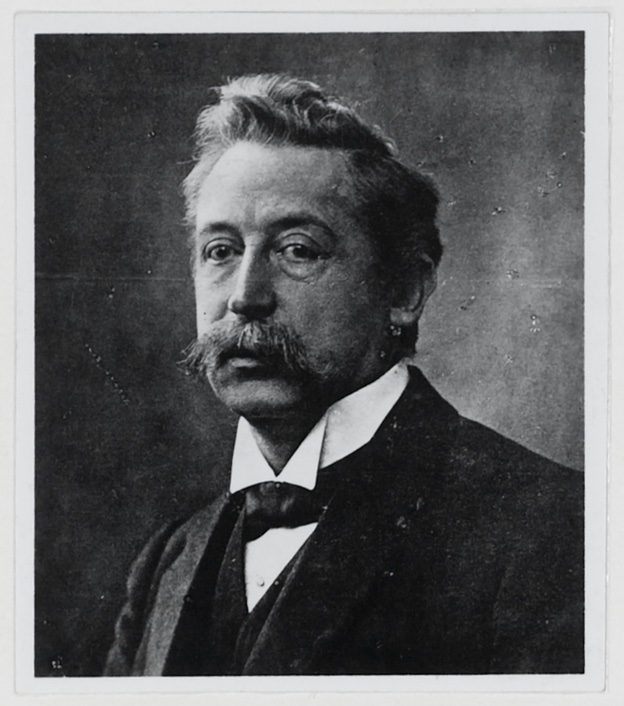
Adolphe Vorderman was fourteen years older. Born at The Hague on 12 December 1844, he had gone out to the Indies as a naval medical officer in 1866, joined the civil medical service in 1871, spent ten years at Sumenep on Madura, and from 1890 was its inspector for Java. In 1896 his department was the one that inspected the native prisons.
Gerrit Grijns, born at Leerdam on 28 May 1865, was an army medical officer who had been attached to the laboratory in Eijkman’s time, had been called away to the Lombok war in 1894, and whose detachment ran out early in 1895. In July 1896, with Eijkman gone, the government ordered him back to the chickens.
What they were trying to find out
Beriberi in the 1880s was a disease of the Dutch army’s war in Atjeh, at the northern tip of Sumatra. Native troops went up the line fit and came down in six weeks unable to march; Eijkman remembered an army doctor who had lost eighteen soldiers to it in one hospital in one day. It filled the native prisons and the native hospitals, where men admitted with a broken bone died of a disease they had not come in with. It paralysed the legs first, then the body, and in its wet form drowned the heart in dropsy. It was worst among people fed under constraint: soldiers, sailors, prisoners, coolies.
In 1886 the home government sent out Pekelharing and Winkler to find its nature and its cause. Winkler settled the first question quickly: the disease was a degeneration of the peripheral nerves, a polyneuritis, as Bälz and Scheube had found in Japan. The cause was the age’s question, and the age’s answer was a microbe. The commission’s report, in the English translation of 1893, says of the micrococcus it had grown from patients’ blood that “nobody knows better than we do that this is but the first step in the proper direction,” and a page later that “it seems scarcely possible to us, we say, that this micrococcus can be rejected as the cause of beri-beri.” The translation is mine, as are all those from the Dutch in this entry; the originals are in the Sources.
So the question Eijkman was left with in January 1888 was which microbe, and the chickens of February 1889 were part of that programme.
There was a competing theory, and Eijkman knew it. In 1879 van Leent, of the Indies navy, had argued that a one-sided rice diet, poor in protein and fat, lay behind beriberi, and had fed native sailors a European ration with some success. The commission had dismissed this on the ground that malnutrition could not be supposed to destroy nerves; something would have to act on the nerves directly. In Japan, Takaki had reached van Leent’s conclusion by a harder road. The training ship Riujo had come home to Shinagawa on 15 October 1883 from “a voyage of 271 days” with 169 cases of beriberi among 376 men and 25 dead. Takaki had the navy’s ration changed that November, sent the Tsukuba over the same route in 1884 on the new diet, and got back “the good report (‘no beri-beri’).” He put the cause in the proportion of protein to carbohydrate. He had changed the right thing for the wrong reason, and had a cured navy to show for it; the reason, which Eijkman could test, was wrong, and that made the navy easier to discount. The companion piece “The navy that was cured first” tells that story.
Folded inside the question of cause is the one that decides this entry. If a diet produced the disease, what kind of thing was wrong with the diet? Every theory of polyneuritis a doctor of 1889 could hold said that nerves degenerate because something attacks them: lead, arsenic, alcohol, or the products of bacteria. There was no category for a nerve that fails because something is absent. The experiment that follows produced, for seven years, results that would only fit a category nobody had.
What they built
The laboratory’s chicken work began as an infection experiment and only became a feeding experiment when the infection experiment collapsed. The report for 1889 sets it out in order.
The six birds injected in February stayed well for months. In July the cock died, and the laboratory did what it was built to do: it took blood from the heart while the auricles were still beating, cultured it, got five kinds of bacteria, injected the cock’s blood under the skin of another cock, and put a hen in the pen where the cock had died. Those two fell ill forty and twenty-nine days later, and their nerves were degenerate. So the laboratory bought ten new chickens, injected them with the blood of the dead, and penned them with six untreated birds as controls; five more were injected with blood from a living patient and paired with controls in bamboo cages. The first cases came on 23 and 24 September, and “within a few days the disease had already taken on such an extent that not a single experimental animal was spared, neither those which had been injected with blood, nor those which served as controls.” A fourth series of twenty birds, caged singly from 5 October, went the same way; the first to sicken was a control, and the cultures from the dead gave nothing, or several species at once.
The only hypothesis left in the infection family was that the laboratory’s ground was infected, since nearly every chicken on it sickened whether injected or not. So the laboratory moved its next experiment to another site, which could be taken as clean. “Scarcely had this been begun when the striking phenomenon presented itself that on the laboratory’s plot the disease suddenly came to a halt. There were no further deaths, the sick animals recovered, and no further new cases were observed.” The laboratory had lost its material. “At the same time, however, attention fell on something that had so far escaped us, namely the food.”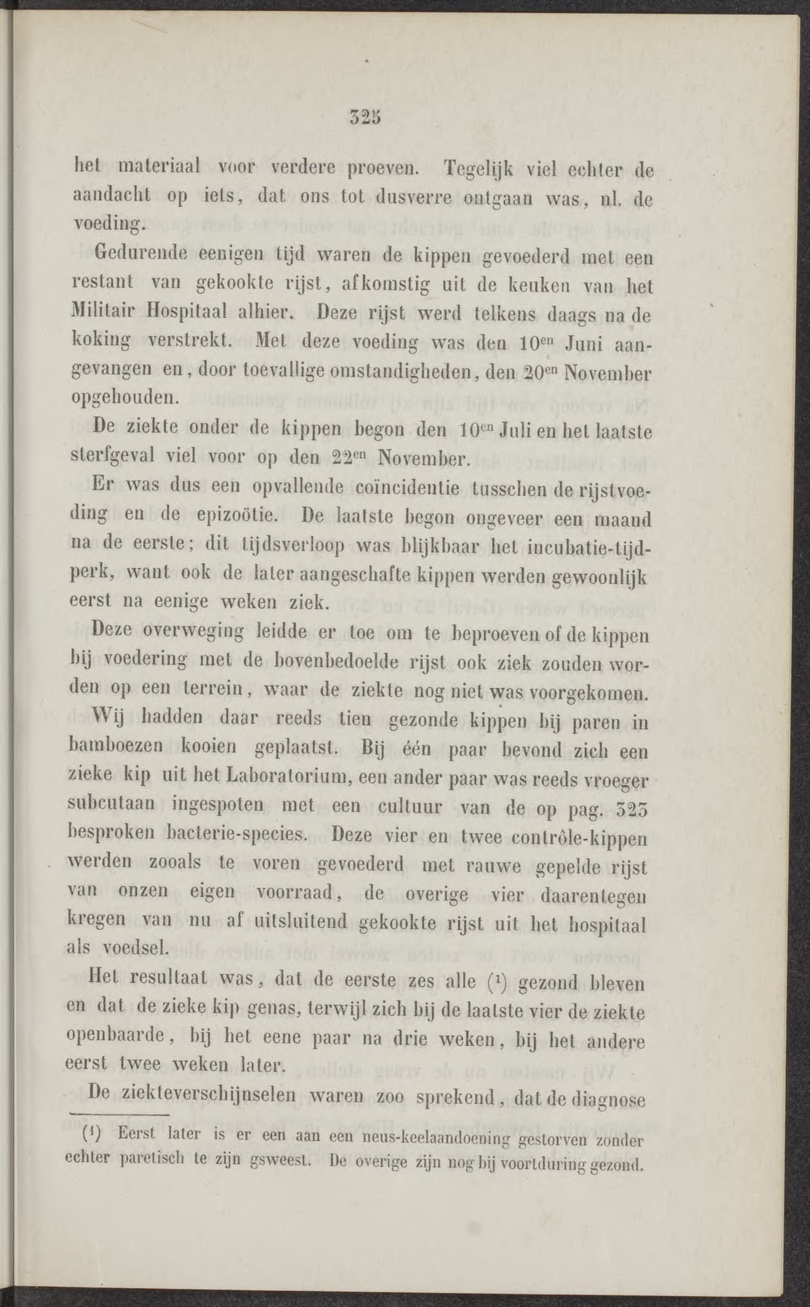
Then the feeding experiments, which are the thing Eijkman actually built. On the clean site ten healthy birds were already in bamboo cages in pairs. Six were kept on the laboratory’s ordinary feed, raw husked rice; four were given nothing but the hospital’s cooked rice. The six stayed well and a sick bird among them recovered; the four fell ill, one pair after three weeks, the other two weeks later. Then he reversed it: the sick birds were put back on raw rice “as a proof of the sum,” and “from the day that the chickens, instead of the cooked rice from the hospital, were fed with the ordinary chicken feed (raw rice), they steadily improved.” He repeated it, and this time killed the birds and found the degenerate fibres. Then he fed the same hospital rice raw to some birds and freshly cooked to others: the raw stayed well, the cooked sickened. “It is therefore beyond reasonable doubt that the cause of the disease lies in the feeding with cooked rice.”
The apparatus was never more than this: a hen-house, bamboo cages, a kitchen’s leftovers, the laboratory’s own grain, and a microscope. What made it an instrument was the pairs, birds that got the suspect food beside birds that did not. Over the next six years he varied the food and the chickens answered every time. He boiled the rice in distilled water in a porcelain dish, with wooden and glass bowls to rule out metal, after Fiebig had suggested the hospital’s well water was the poison: all four birds sickened. He had unhulled white rice pounded fresh each day under his eye, to answer Gelpke’s idea that stored milled rice went bad: they sickened. He fed the ordinary “red rice” that the laboratory had always used as feed, hulled but not polished, for a year and longer: no bird fell ill, and sick birds recovered on it. He fed sago from Ambon, tapioca and the starch of the sugar palm: they sickened. He fed potato starch: they did not. He fed raw lean meat alone: they recovered. He fed meat with the starch: they fell ill later, and in excellent condition. He let two birds starve on a little raw rice: they died on the fourteenth and eighteenth day without a trace of paralysis and without a degenerate fibre. He fed monkeys cooked rice for years: they stayed well.
The variable that mattered came out of the red rice. The difference between red and white, he found, appeared only with hulling. Red rice, sold as animal feed, lost its coarse outer husk in the pounding and kept its inner coat, a thin skin round the kernel, red in that variety, which the Dutch called the silver skin and which millers took off white table rice to make the grains smooth and pearl-white. “The difference between red and white rice with regard to the results of the feeding experiments bears no relation to the difference in rice variety, but to whether or not the silver skin has been retained.” A cock made ill by cooked table rice recovered and stayed well on raw half-hulled white rice, “which has thus not been stripped of the silver skin.” Fine bran cured; coarse husk did not.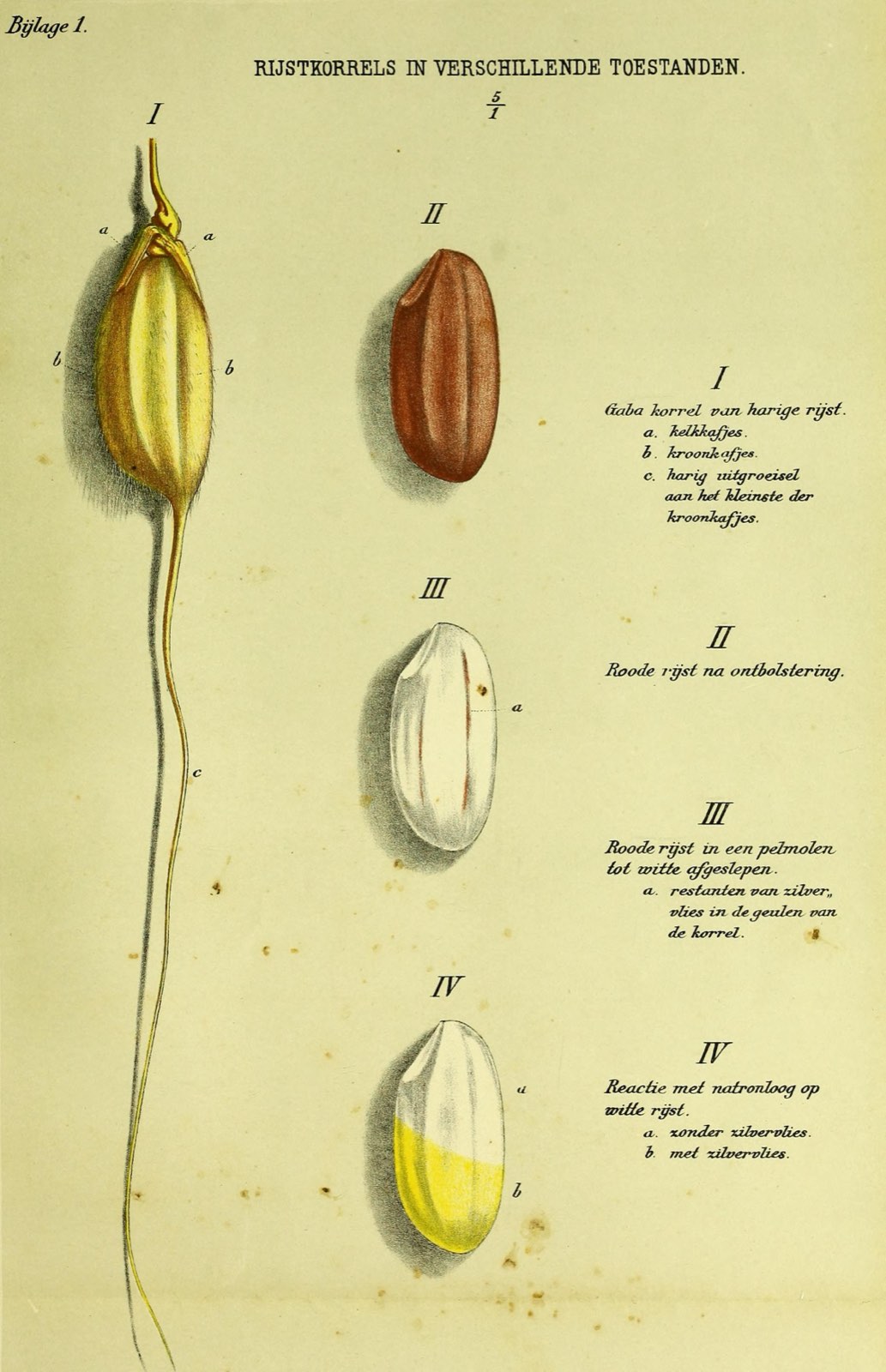
The twentieth of November
The turning point of the story is a day on which nothing was decided by anyone who understood it. There are three accounts of it.
The report for 1889, written within weeks, says the feeding of cooked hospital rice began on 10 June and “through chance circumstances” stopped on 20 November. The paper of 1896 says it had begun on 10 June “but already on the 20th of November the supply had been stopped for reasons independent of us.” The Nobel lecture of 1929, forty years on, tells the story that every history has told since: “The laboratory keeper – as I afterwards discovered – had for the sake of economy fed the chickens on cooked rice which he had obtained from the hospital kitchen. Then the cook was replaced and his successor refused to allow military rice to be taken for civilian chickens.” The lecture gives the dates as 17 June to 27 November. The two papers printed in Batavia, when the keeper and the cook were still in the building, give 10 June and 20 November, and the last death on 22 November. The entry follows the papers.
A cook who did not know there was an experiment ended it. The laboratory had designed a trial with ten injected birds and six controls, and the trial had failed, because the controls fell ill; the cook, by stopping one variable in the whole population at once, ran the trial the laboratory had not thought to design, with the entire flock as the treated arm and November as the control. Eijkman’s merit, and it is the whole of his merit in that year, is that when his material vanished he asked why, and found a date.
He also set down, in the same report, what the finding could mean, and his list is the hinge of everything after. Polyneuritis, he wrote, was either toxic or infectious, and on the view of Rosenheim and Leyden “all forms of polyneuritis are in the last instance to be regarded as toxic.” He first thought of a poison carried in with the rice; but raw hospital rice did not cause the disease, and fresh-cooked did, so it was not in the grain and not made by keeping. A poison made in the gut was the next thought. Then, to his credit, he wrote the other possibility down: the chickens had grown thin before they went lame, and “a priori it is not improbable that a defective diet will entail nutritive disturbances in the nerves as well as in other organs.” He tested it the only way his categories allowed, by starving two birds, and the starved birds did not get polyneuritis. “Whether, however, a hypothetical poison or inanition plays the chief part must for the time being be left open.” Between a poison and starvation there was no third word, and he left the question where his vocabulary left it.
What it looked like from inside
The second paper, in 1892, dealt with the nerves and put the cause off: the study had been continued, the laboratory reported, “but as regards the aetiology it has not yet led to a conclusive result.” The third was written in the winter of 1895 to 1896 by a man who knew he was leaving. “For reasons of a personal nature,” Eijkman wrote in its first paragraph, “we shall not in the coming years be in a position to continue these investigations, which have now occupied us for more than six years.” He was ill, and the directorship ended on 4 March 1896. The paper, fifty-five pages and some fifty numbered experiments, is the fullest statement of how he read what he had found.
He had, by 1896, two explanations for the silver skin, and he wrote them both down. “The fact that the retention of the coat, or even only of the innermost part of it, takes away the rice’s harmfulness, we thought we could explain in two ways. Either the coat protects the grain against the penetration of lower organisms from the alimentary canal and thereby prevents the abundant formation of harmful fermentation products, or else it contains substances which are indispensable for the preservation of life and health and which are absent from the kernel, or present in insufficient quantity.” He tested the first by cooking and grinding the half-hulled rice to expose it, and it stayed harmless. “This proved not to be the case,” he wrote, “so that only the second explanation remained.” That is the deficiency hypothesis, in Eijkman’s own words, in 1896, with the alternative ruled out by experiment.
He did not keep it. Four pages later his summary of the position is this, and the second point is the one that stuck:
“1. Completely hulled rice, that is the kernel, produces polyneuritis in fowls fed on it. 2. In the silver skin the rice grain possesses an agent that neutralises the harmful action of the kernel, as well as a remedy against polyneuritis that has already broken out. 3. The quantity of that agent present in the rice grain is not so great that any considerable part of it can be taken away without danger. 4. The silver skin is distinguished from the other parts of the grain by a high content of nitrogenous substances and nutritive salts.”
A remedy that neutralises a harmful action is an antidote, and an antidote implies a poison. What drove him there was starch. Every starch he tried, except potato starch, made the birds ill, and meat protected them, so for a while it had looked like a simple want of protein and salts. Then the birds fed meat with their starch fell ill too, later and fat. So it was not inanition, and not protein, and not salts; and if the chickens were starving of nothing, then on the only theory of nerves he had the disease was toxic and the starch was the vehicle. “What alone we can at the moment deduce from our experiments with certainty is that the origin of the disease is bound to the presence of amylum in the food. This is a conditio sine qua non.” And: “Taking our stand on the generally accepted position that polyneuritis is of toxic origin, we must consequently hold that the amylum is the carrier of a toxic substance, or that this arises from it, whether in the alimentary canal (through the action of lower organisms?) or through the chemical processes of metabolism. In the coats of the rice grain, more particularly it seems in the part bordering on the kernel, the silver skin, there would have to be a substance or substances by which the poison is directly or indirectly rendered harmless, or, as the case may be, its formation prevented.”
He went further, and the further he went the closer he came without arriving. Meat protected, so meat must hold the protective substance too; “and from this it could at once follow that this substance is a normal constituent of the animal body, a constituent however which, on feeding with the harmful starch, is gradually used up and thus lost to the body, with which the occasion for the outbreak of the disease would be given.” That is a description of a vitamin store running down. It is written as an account of an antidote being consumed by a poison. He preferred the picture of starchy food fermenting in the crop, where chickens keep it for hours in the warm, with one of the products acting as a nerve poison. Then he reported, in the same paper, that extracts of crop contents gave chickens nothing. The poison would not come out of the crop. He kept the poison.
And he kept the separation of the chickens from the disease he had been sent to study. “There are no facts known which compel one to bring the origin of beri-beri into such immediate connection with food as proved to be the case with the polyneuritis of fowls.” Beriberi came and went with seasons and places and buildings, as infections do; the monkeys had not caught it from rice; identity was “on good grounds to be doubted.” But a remedy for the chicken disease might serve against “a murderous disease like beri-beri, against which we have so far stood fairly powerless,” and a trial was worth running. He had tried for two years to get one, had asked for the native crew of a warship and been refused. In the end, in the first weeks of 1896, the city hospital for natives at Batavia, the Stadsverband, let him divide its beriberi patients into two halves, one fed cooked red rice and the other the usual white table rice, and watch. He left after six weeks. The patients on red rice were doing well, but so were the others.
It is the first thing he had built for men, and it is a controlled trial, and the man who built it had no theory in which it could succeed. When the Indies press announced that autumn that he had found the cure, he told the weekly Insulinde: “I state at the outset that it is by no means claimed by me that the remedy against beri-beri has already been found.” After five months the trial still showed nothing either way. What gave him “the most courage” was something else, which he had seen a few days before he sailed.
What happened
Vorderman had come to see him. The inspector had read the chicken papers and remembered what he had noticed on his rounds: he had never met beriberi in a prison where red rice was the staple, and he had seen white rice served in every prison where it was. Rather than say so, he wrote to every head of local government in Java and Madura asking two things, the staple food of the prisoners and whether beriberi occurred among them, “without however hinting at a possible connection between these two factors.” A few days before Eijkman’s departure he could show him the table. In 63 prisons where the authorities said white rice was served, beriberi occurred in 34, or 54 per cent; in 27 where red rice was the staple, it occurred in 1, or 3.7 per cent. On 18 March 1896 the Director of Education, Religion and Industry, in a letter marked secret, ordered Vorderman to visit the prisons himself.
What he built in the next five months was a survey designed by a man who did not trust himself. He set out on 6 April 1896, went round Java and Madura prison by prison, and finished on 12 September. The purpose of the journey was kept from the heads of local government, so that the Chinese contractors who supplied the food would not show other rice than they usually delivered. In every prison he took a sample of the rice from the contractor’s store and sealed it. The samples went to the laboratory at Weltevreden labelled with letters and numbers and were sorted there by H. F. Roll, the acting director, and Grijns, who did not know which prison they came from. Only after every prison had been put in its rice column were the beriberi figures, checked against the prison registers, handed over to be set beside it. “The value of the result obtained in this impartial way,” he wrote, “is undeniably increased by the fact that the statistics obtained cover a number of not less than exactly 100 prisons and 281,878 prisoners.” The companion piece “The hundred prisons” has the method and every count.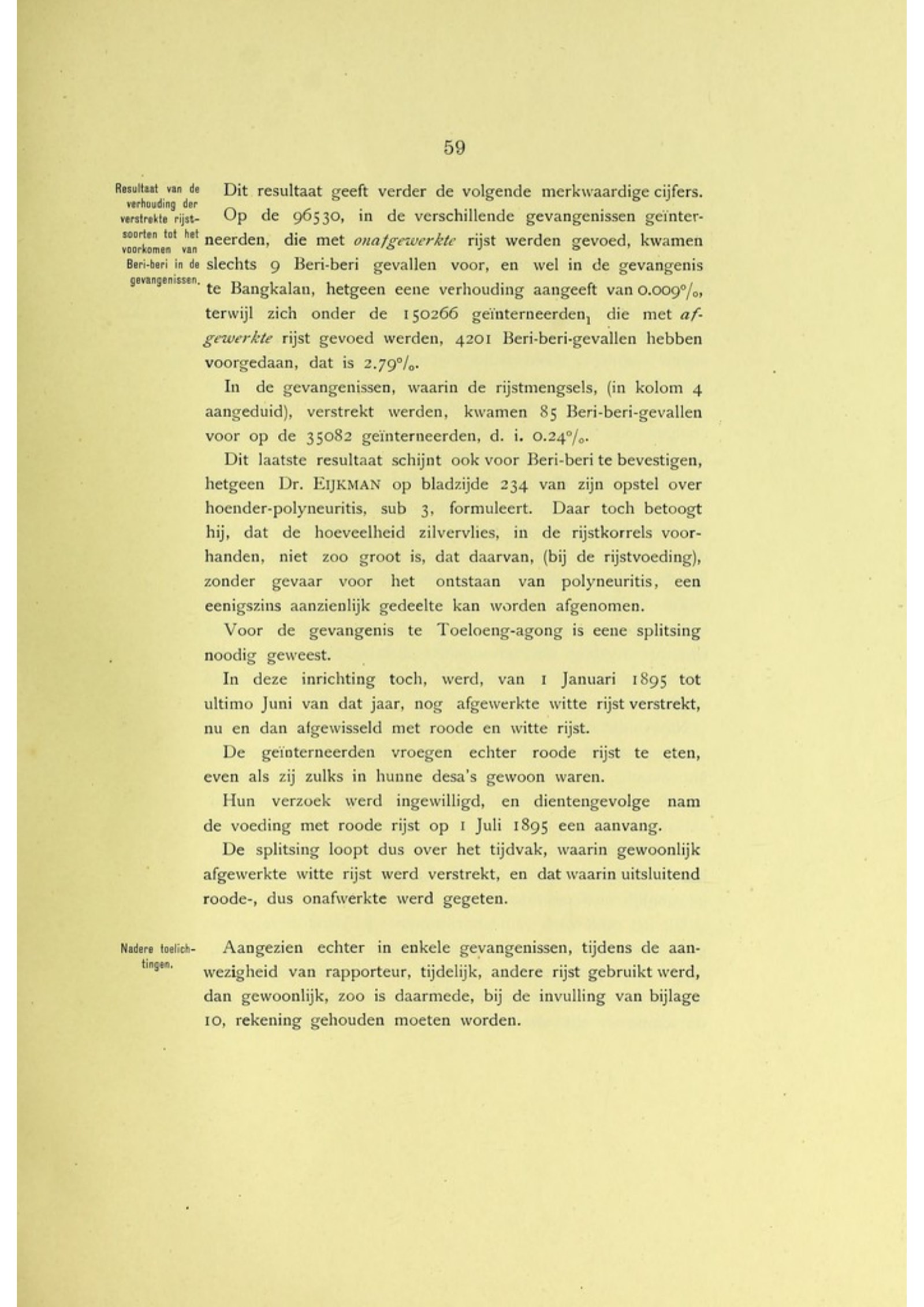
The result is on page 59. “Among the 96,530 prisoners in the various prisons who were fed with unpolished rice, only 9 cases of beri-beri occurred, and those in the prison at Bangkalan, which gives a ratio of 0.009 per cent, while among the 150,266 prisoners who were fed with polished rice 4,201 cases of beri-beri occurred, that is 2.79 per cent.” In the prisons that served mixtures there were 85 cases among 35,082, or 0.24 per cent. By prison rather than by man: of 37 prisons on unpolished rice, beriberi occurred in 1; of 13 on mixtures, in 6; of 51 on polished rice, in 36. The hundred prisons are 101 in that count because the gaol at Toeloeng-agong had changed its rice on 1 July 1895 and had to be split in two. The Soerabaja papers had blamed imported rice and stale rice; Vorderman found that neither had any particular influence. The thing that had was whether the grain had kept its skin.
Roll put the first count into the laboratory’s journal in October 1896, in a note on the last page of Eijkman’s paper as it went to press. In Holland, Eijkman put the finished survey before the Royal Academy of Sciences in the summer of 1897, and the arithmetic he gave it is the one the histories use: one prisoner in 10,000 with beriberi on half-hulled rice, one in 416 on mixtures, one in 39 on polished rice. He told the Academy the chickens had been “almost a check experiment” to this. In his Nobel lecture he rounded it to “no less than 101 prisons with almost 300,000 inmates” and a ratio “some 300 times greater.” Vorderman’s own page gives 100 prisons, 281,878 men, and 2.79 divided by 0.009, which is 310. The entry uses Vorderman’s figures.
Then the thing that the figures did not do. “Vorderman’s remarkable results,” Eijkman said in 1929, “did not at once find recognition and were received with scepticism and adverse criticism in some quarters.” The quarters were the Indies newspapers and the Dutch ones, and for two years the beriberi question was fought in them as a question of which kind of poison rice contained: imported grain, stale grain, or, as the Amsterdam doctor E. van Dieren had it, rice as such. A red-rice trial begun in the Soerabaja prison in July 1896 nearly died in January 1897 over a contract that forbade “foreign” rice; in the summer of 1897 the army boiled rice bran into the soup of a depot battalion of 1,600 men and the Java-Bode called it “an absurd experiment”; and Eijkman, from Utrecht, corrected everyone at once. The companion piece “The paper war” follows it.
Under the noise, the thing the entry is about was happening in print. On 5 February 1897 De Locomotief reported the Amsterdam medical circle’s debate on van Dieren and added a note from its correspondent, van Sandick, who had interviewed Eijkman: nothing in the interview, he wrote, showed “that Dr Eijkman believes that beri-beri arises from the food and is not an infectious disease. He has, in our opinion, not expressed himself on this at all. He has only communicated that he has found in the silver skin of the rice a remedy against his chicken disease, and he hopes, on account of the analogy of symptoms between that chicken disease and beri-beri, that this silver skin will also be a remedy against beri-beri.” That was exact. In 1898, in the laboratory’s journal, Eijkman answered those who wanted the government to buy the prisoners meat, and said where he still stood. “Although I believe that an investigation in the direction indicated by the infection theory still has the best chance of success,” he wrote, the difficulties met in the chicken disease were “little suited to make us all too optimistic.” The Stadsverband trial, he now said, had “proved nothing, neither pro nor contra,” because the controls had got better too. What mattered in practice he put in one sentence: “The main thing is that the grains are in possession of the silver skin.” He costed the alternative. The native soldiers, sailors and prisoners the government fed numbered between forty and fifty thousand; at six cents a head a day for a richer ration “one already arrives at a total of round about a million guilders a year,” while the right rice cost nothing. The man who had the remedy, the dose, the cost and the hundred prisons still thought the disease was probably an infection, and said so in the year the Academy heard his figures.
After
Grijns had started in July 1896 with an instruction to find out what the tannin in red rice did, and ignored it: “I should not hold myself anxiously to the letter of that instruction.” In the laboratory’s report for 1897 he set down five conclusions from repeating Eijkman’s experiments. The chicken disease was not caused by a poison formed in the grain during storage; rice stored in the native way and pounded free of its silver skin immediately before use produced polyneuritis “just as quickly and surely” as rice stored in the European way; the proportions of protein, fat and carbohydrate could not predict it; it was “very improbable” that a specific poison in rice caused it; and it was improbable that the protection of the silver skin rested on a single substance. He then fed birds for years on things that were not rice: on katjang hidjoe, the green gram; on potato starch and milk sugar with meat; on meat preparations with no carbohydrate at all. Polyneuritis appeared on diets with no starch in them, and was prevented by foods that held none either. The one variable Eijkman had made the conditio sine qua non was not necessary.
His paper of 1901, a hundred and eight pages in the laboratory’s journal, says what that leaves. The results, he wrote, “give the right to exclude a harmful constituent present in the food.” An explanation “can in my opinion be sought in only two directions. Either one can think of a deficit, of a partial hunger, or one can suppose that there is an agent distributed in nature that exercises a degenerating influence on the nerves, and that it depends on the nature of the food whether the peripheral nervous system possesses enough resistance to withstand this influence.” He named the third possibility, the one Eijkman had held: a nerve poison formed in the gut “and an antidote that neutralises that poison or at least its action.” Against it he set his own birds, which had fallen ill on pure protein diets with no starch for a gut to ferment, and a principle: “there is to my mind something hazardous in assuming so widely distributed an antidote, since we find no single example of this among the known antitoxins.” For the partial hunger he argued from the small blood supply of nerves that whatever they needed was needed in small amounts, that it might therefore have escaped chemical analysis, that a reserve would be used up before symptoms came, so that there would be an incubation period, and that total starvation would free the substance from the muscles and so, paradoxically, protect. Every one of those predictions was later found to be true of thiamine. He called the unknown things, “without any prejudice,” the protective substances, and concluded: “There occur in various natural foods substances which cannot be dispensed with without serious harm to the peripheral nervous system. The distribution of these substances over the various foodstuffs is a very unequal one.” Of those he had tested, the green gram and the pigeon pea were richest, “polished rice the poorest.”
The reading changed nothing in the prisons that year. In the Nobel lecture Eijkman recorded that “the alteration in the catering regulations for prisoners, suggested after my departure by Vorderman and Grijns, in the long run did not meet with the necessary cooperation of the authorities.” Vorderman died at Batavia in 1902. Then, Eijkman said, “new encouragement came from British India”: Fletcher’s trial in the Kuala Lumpur asylum in 1907, Fraser and Stanton’s on Malay road-gangs, and in 1910 the resolution of the Far Eastern Association of Tropical Medicine at Manila that beriberi “is associated with the continuous consumption of white (polished) rice as the staple article of diet.” In 1912 Casimir Funk gave the class of such things a name. In 1926 Jansen and Donath, in the laboratory at Batavia, crystallised the substance from rice bran and sent Eijkman forty milligrams of it; two milligrams in a kilogram of polished rice protected his pigeons. In 1929 he shared the Nobel Prize with Frederick Gowland Hopkins “for his discovery of the antineuritic vitamin.” He was too ill to go to Stockholm and sent the lecture. He died at Utrecht on 5 November 1930. Grijns, nominated in 1926 and 1927, was not named; he had left the Indies in 1917 for a chair at Wageningen, and died in 1944.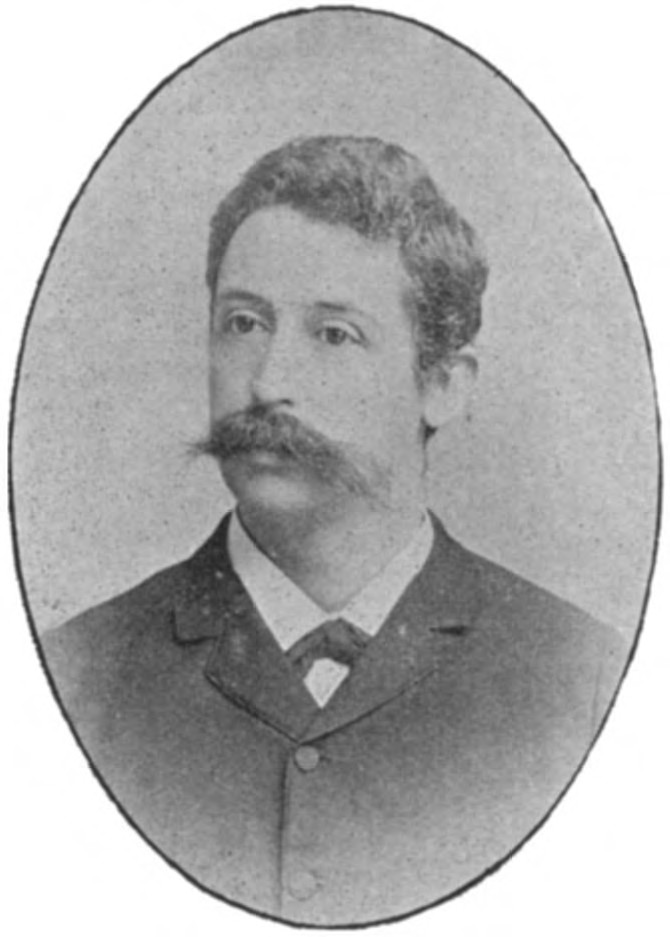
The lecture of 1929 is honest about the gap it closes. The meat experiments, Eijkman said, had shown that “an antineuritic principle must have been present in the meat, i.e. in the animal organism, but that this principle was gradually used up while the chickens were being fed on a starch diet.” He had written that sentence in 1896, and in 1896 the principle had been an antidote. He also recorded what it had cost to carry the chickens to the prisons without a theory to carry them in: “I was therefore accused of not being logical, a reproach which I am happy to pass over without comment.”
What it taught
The experiment in the hen-house at Weltevreden did what an experiment is for, and did it in 1889. One kind of food made chickens lame, another cured them, and the trials of the next six years isolated the part of the grain that mattered to within a skin. Nothing in the result was wrong. What was wrong was the sentence in which it was read, and the sentence was supplied by the reader’s profession, not by the birds.
A result can only be read in the categories the reader has, and a right result may have no category. In 1889 a nerve could be poisoned or infected; it could not be starved of one thing while fed on everything else. Eijkman wrote the deficiency explanation down in 1896, tested its rival, found the rival false, and still summarised the silver skin as “an agent that neutralises the harmful action of the kernel,” because the starch experiments left him with a disease that was not starvation and a profession that said all polyneuritis was toxic. The same paper describes a protective substance stored in the animal body and used up on a starch diet. That is a vitamin, described by a man who did not have the word, and filed under antidotes.
The hypothesis you were sent with is the one you will test longest. The laboratory was built to find a microbe, and the chickens were injected with a dead man’s blood before they were ever fed. When the controls fell ill, the hypothesis moved to the ground; when the ground cleared, it moved to the food; and even in 1898, with the hundred prisons on his desk, Eijkman thought the infection theory “still has the best chance of success” for beriberi itself. He had abandoned it for the chickens in 1889 and kept it for the men, because the men’s disease came and went with seasons and buildings, as infections do. So did the rice contracts.
An observation at scale can settle what to do before anyone can say why. Vorderman’s survey had no theory in it. It had a question put without hinting at the answer, a classification made blind, statistics withheld until the classification was fixed, and 281,878 men. It gave the same answer as the chickens, 310 times over, in a form a government could act on: serve the other rice. The regulations were not changed for years all the same, partly because the men who had the evidence still disagreed about what it meant. The Japanese navy had done the same thing in 1884 for a reason that was wrong, and been cured; Eijkman, who could show the reason was wrong, discounted the cure.
Someone has to read the instrument again. Grijns was given the same birds, the same cages and a smaller instruction, and the thing he did that Eijkman had not was to take away the starch. When polyneuritis appeared on a diet of nothing but meat preparations, the poison had no vehicle, and the only account left was absence. His paper of 1901 then predicted that the missing substance would be needed in tiny amounts, would have escaped the chemists, and would show an incubation period as the body’s store ran down. All of that was true.
The complication is that the wrong reading produced the right remedy. Eijkman’s antidote was the silver skin; Grijns’s missing substance was the silver skin; the prisoners who ate half-hulled rice did not get beriberi whichever was right. Eijkman’s refusals were also sound: he would not announce a cure from six weeks in a ward, nor spend a million guilders on protein without a controlled trial. The years were lost not to carelessness but to the fact that the result was true in a world that had no place to put it, and the people who had to act waited for the place to be made. It was made in print in 1901, named in 1912, crystallised in 1926, and honoured in 1929 in the name of the man who had held the instrument first, and had told the Academy, thirty-two years before, that the chickens were right and that he did not know why.
Sources
- C. Eijkman, “Polyneuritis bij hoenderen,” section VI of Verslag over de onderzoekingen verricht in het Laboratorium voor Pathologische Anatomie en Bacteriologie te Weltevreden gedurende het jaar 1889, Geneeskundig Tijdschrift voor Nederlandsch-Indië 30 (1890), pages 295 to 334. Read in full in the KITLV copy on Delpher. The six chickens infected in February, the cock of July, the injection series of September and October, the controls, the cultures, the move to clean ground, the kitchen rice from 10 June to 20 November and the disease from 10 July to 22 November, the feeding pairs, the schema of toxic neuritis, the starved birds, and the sentence left open. Translated here by the author of this entry: “Er was dus een opvallende coïncidentie tusschen de rijstvoeding en de epizoötie”; “Nauwelijks hiermede aangevangen, deed zich het opvallend verschijnsel voor, dat op het erf van het Laboratorium de ziekte plotseling tot staan kwam … Tegelijk viel echter de aandacht op iets, dat ons tot dusverre ontgaan was, nl. de voeding”; “Het is derhalve aan geen redelijken twijfel onderhevig, dat de oorzaak der ziekte schuilt in de voedering met gekookte rijst”; “Of echter een hypothetisch vergift, dan wel de inanitie de hoofdrol speelt, moet voorloopig in het midden gelaten worden.” Delpher
- C. Eijkman, “Polyneuritis bij hoenderen (Vervolg),” Geneeskundig Tijdschrift voor Nederlandsch-Indië 32 (1892), pages 353 to 362, with the laboratory’s report for 1891 in the same volume (“De studie der Polyneuritis bij hoenderen werd ook dit jaar weder voortgezet, doch leidde, wat de aetiologie betreft, nog niet tot een afdoend resultaat”). Read in the Harvard copy on archive.org. archive.org
- C. Eijkman, “Polyneuritis bij Hoenders. Nieuwe Bijdrage tot de Aetiologie der Ziekte,” Geneeskundig Tijdschrift voor Nederlandsch-Indië 36 (1896), pages 214 to 269, with H. F. Roll’s note “tijdens het afdrukken (Oct. 1896)” at page 269. Read in full on archive.org and checked against the page images. The resumé, the “reasons of a personal nature,” the distilled water, Gelpke’s objection, the red and white rice, the two explanations (“Of het hulsel beschermt de korrel … óf wel het bevat stoffen, die voor het behoud van het leven en de gezondheid onmisbaar zijn en in de zaadkern niet of in onvoldoende hoeveelheid voorhanden zijn … zoodat alleen de tweede verklaring overbleef”), the four conclusions at page 234 (“In het zilvervliesje bezit de rijstkorrel een middel dat de nadeelige werking van de zaadkern neutraliseert, zoowel als een geneesmiddel tegen reeds uitgebroken polyneuritis”), the starch, meat and potato experiments, “Dit is een conditio sine qua non,” the toxic reading (“Ons op het algemeen aangenomen standpunt stellende, dat polyneuritis van toxischen oorsprong is, moeten wij het er bij gevolg voor houden, dat het amylum de drager is van een giftstof …”), the protective substance used up (“een bestanddeel echter, dat bij voeding met het schadelijke zetmeel gaandeweg verbruikt wordt”), the crop, the monkeys, “Er zijn geen feiten bekend, welke er toe dringen om het ontstaan van beri-beri zoo onmiddellijk in verband te brengen met de voeding,” and Roll’s 52, 37 and 12 prisons. Translated by the author of this entry. archive.org
- Geneeskundig Tijdschrift voor Nederlandsch-Indië 31 (1891), the laboratory’s report for 1890: the two possibilities, inanition and a poison carried with the rice, and the reply to Fiebig’s well-water theory. archive.org
- H. F. Roll, “Beknopt verslag betreffende de werkzaamheden, verricht in het Laboratorium voor pathologische Anatomie en Bacteriologie te Weltevreden gedurende het jaar 1897,” Geneeskundig Tijdschrift voor Nederlandsch-Indië 38 (1898), pages 122 to 132: Grijns’s five conclusions (“de geheel op Inlandsche wijze bewaarde rijst … geeft bij voedering even snel en zeker polyneuritis gallinarum, als de op Europeesche wijze bewaarde”; “het is zeer onwaarschijnlijk, dat het ziek worden der hoenders veroorzaakt wordt door een specifiek, in de rijst voorkomend, vergif”). In the same volume, C. Eijkman, “Nogmaals beri-beri en voeding,” pages 277 to 284: “Hoewel ik geloof, dat een onderzoek in de richting, door de infectietheorie aangewezen, nog altijd de meeste kans van slagen heeft”; the Stadsverband trial (“die proefneming bewees nu niets, noch pro noch contra”); “Hoofdzaak is, dat de korrels in het bezit zijn van het zilvervliesje”; the forty to fifty thousand government boarders and “een totaal van om en bij een millioen gulden ‘sjaars”; the navy, Japan and the Straits. Translated by the author of this entry. archive.org
- G. Grijns, “Over polyneuritis gallinarum,” Geneeskundig Tijdschrift voor Nederlandsch-Indië 41 (1901), pages 3 to 110. Read in the KITLV copy on Delpher: the introduction (“Toen in Juli 1896 de Regeering mij opdroeg …”), the salts, the fresh-pounded rice, the green gram and meat diets, and pages 44 to 49: “Of men kan denken aan een deficit, aan een partieelen honger, óf men kan zich voorstellen, dat er een agens in de natuur verspreid is …”; the antidote (“Ook ligt in het aannemen van een zoozeer verspreid tegengift m.i. iets gewaagds, daar wij hiervan bij de bekende antitoxinen geen enkel voorbeeld aantreffen”); the “protective stoffen”; and the conclusion: “Er komen in verschillende natuurlijke voedsels stoffen voor, die zonder belangrijke schade voor het perifere zenuwstelsel niet kunnen worden gemist. De verspreiding dezer stoffen over de verschillende voedingsmiddelen is eene zeer ongelijkmatige.” Translated by the author of this entry. Delpher
- A. G. Vorderman, Onderzoek naar het verband tusschen den aard der rijstvoeding in de gevangenissen op Java en Madoera en het voorkomen van beri-beri onder de geïnterneerden, Batavia: Javasche Boekhandel en Drukkerij, 1897. Read from the Wellcome Collection’s scan (Public Domain Mark): the introduction and Eijkman’s visit (pages 1 to 3), the letter inquiry and its 63 and 27 prisons (page 2), the secret commission of 18 March 1896 and the journey of 6 April to 12 September (pages 2 to 3), the blind classification by Roll and Grijns and the 100 prisons and 281,878 prisoners (page 58), the result (page 59: “Op de 96530, in de verschillende gevangenissen geïnterneerden, die met onafgewerkte rijst werden gevoed, kwamen slechts 9 Beri-beri gevallen voor …”), the Toeloeng-agong split, the treatment of the statistics (pages 88 to 91), and the closing “Waarde van Eijkman’s hoenderproeven” (pages 114 to 115). Translated by the author of this entry. Wellcome Collection, archive.org
- C. A. Pekelharing and C. Winkler, Beri-beri: Researches concerning its Nature and Cause and the Means of its Arrest, translated by James Cantlie, Edinburgh: Young J. Pentland, 1893 (from the French edition, Utrecht, 1888). Pages 141 and 142, the micrococcus: “nobody knows better than we do that this is but the first step in the proper direction” and “it seems scarcely possible to us … that this micrococcus can be rejected as the cause of beri-beri.” Read in part, from the Wellcome Collection’s scan. Wellcome Collection
- Christiaan Eijkman, “Antineuritic Vitamin and Beriberi,” Nobel Lecture, 1929, sent in writing because he was too ill to travel; from Nobel Lectures, Physiology or Medicine 1922–1941, Amsterdam: Elsevier, 1965. The Atjeh war and the eighteen soldiers, van Leent, Takaki, the commission, the laboratory keeper and the cook, the dates 17 June to 27 November, the 101 prisons and “some 300 times,” the authorities’ lack of cooperation, Jansen and Donath, and “I was therefore accused of not being logical.” Quoted briefly. nobelprize.org
- “Christiaan Eijkman, Biographical,” from Nobel Lectures, Physiology or Medicine 1922–1941: birth at Nijkerk, the military medical school, the doctorate of 13 July 1883, Semarang, Tjilatjap and Padang Sidempoean, the malaria, Forster and Koch, the posting with Pekelharing and Winkler, and the directorship from 15 January 1888 to 4 March 1896. nobelprize.org
- Baron Takaki, “On the Preservation of Health amongst the Personnel of the Japanese Navy and Army,” Lectures I and II, The Lancet, 19 and 26 May 1906. The Riujo’s return on 15 October 1883 “after a voyage of 271 days,” the change of diet ordered on 29 November 1883, the Tsukuba’s voyage of 1884, and “the good report (‘no beri-beri’).” 19 May, 26 May
- Yoshifumi Sugiyama and Akihiro Seita, “Kanehiro Takaki and the control of beriberi in the Japanese Navy,” James Lind Library, 2013, also in Journal of the Royal Society of Medicine 106 (2013). The crews, cases and deaths of the Riujo (376, 169, 25) and the Tsukuba (333, 14, none), at second hand. jameslindlibrary.org
- Jan P. Vandenbroucke, “Adolphe Vorderman’s 1897 study on beriberi: an example of scrupulous efforts to avoid bias,” James Lind Library, 2012, also in Journal of the Royal Society of Medicine 106 (2013), and the library’s record of Vorderman’s report with its translated key passages. The design of the survey read against the report itself. jameslindlibrary.org, record
- Krzysztof Pietrzak, “Christiaan Eijkman (1856–1930),” Journal of Neurology 266 (2019), pages 2893 to 2895, open access. Eijkman’s death at Utrecht on 5 November 1930. The article’s birth year of 1856 differs from the Nobel biography’s 1858, which the entry follows. doi:10.1007/s00415-018-9162-7
- Zutphensche Courant, 22 September 1886: Eijkman’s instruction from the Minister of Colonies (“heeft van den Minister van Koloniën de opdracht ontvangen, die studiën met het oog op de bestrijding der beri-beri voort te zetten”). Het Vaderland, 8 January 1887, the mail from Batavia of 3 December 1886: “Geplaatst: de off. van gez. 2e kl. Dr. C. Eijkman te Weltevreden.” Bataviaasch Nieuwsblad, 17 August 1887: the laboratory to be kept on, with Eijkman and van Eecke in view. De Locomotief, 25 October 1887: Pekelharing’s letter of 21 July 1887 (“waren wij, toen wij Atjeh verlieten, omtrent den aard van de beri-beri wel tot zekerheid gekomen, maar moesten we ons met betrekking tot de oorzaak van de ziekte nog tot vermoedens bepalen”). Translated by the author of this entry; all on Delpher. 1886, 1887 January, 1887 August, 1887 October
- “Dr. C. Eykman over de Beri-Beri,” De Locomotief, 21 November 1896, reprinting the interview in Insulinde: “Ik stel voorop dat volstrekt niet door mij beweerd wordt, het middel tegen beri-beri reeds te hebben gevonden”; the laboratory report for 1889 and “sedert zeven jaren”; the warship refused; the Stadsverband trial “in het begin van dit jaar” with the patients “in twee helften verdeeld”; the six weeks and five months; and Vorderman’s first list. Translated by the author of this entry. Delpher
- “Beri-Beri in Indische Gevangenissen,” De Locomotief, 5 February 1897: the Amsterdam medical circle’s debate of 3 December 1896 on van Dieren, and van Sandick’s note (“Hij heeft alleen medegedeeld dat hij in het zilvervliesje van de rijst een geneesmiddel heeft gevonden tegen zijn kippenziekte …”). “Wetenschappelijk Allerlei: De Aard der Rijstvoeding en de Beri-Beri,” De Locomotief, 12 July 1897: Eijkman’s address to the Royal Academy, “almost a check experiment,” and the one in 10,000, one in 416 and one in 39. Translated by the author of this entry. 5 February, 12 July
- “Dedak voor de soldaten,” Java-Bode, 2 September 1897 (“De proef met dedak in het leger is eene onzinnige proef”), and “De stand van het beri-beri-vraagstuk,” Bataviaasch Nieuwsblad, 10 September 1898, from the Indische Gids, summarising Eijkman’s “Beri-beri en voeding” of 1898 on the Dutch and Japanese navies and the Straits prisons. Translated by the author of this entry. 2 September 1897, 10 September 1898
- The figures. The photograph of Eijkman is Leiden University Libraries, KITLV 15344, “C. Eijkman, vermoedelijk te Weltevreden,” released by the library under CC BY 4.0 and dated by it about 1900. hdl.handle.net/1887.1/item:785470, Wikimedia Commons. The portrait of 1898 is from Onze Hoogleeraren, Rotterdam: Nijgh and Van Ditmar, 1898, an anonymous work, scanned by the Digital Library for Dutch Literature. Wikimedia Commons. The two pages of Vorderman’s report are from the Wellcome Collection’s scan, above; the page of the 1890 journal is from the KITLV copy on Delpher.
