In the third week of August 1854 a physician of Sackville Street, Piccadilly, came home in the evenings with small glass phials in his pockets. Each held a little water from a house south of the river in which someone had died of cholera, and on the cover of each he had written the address. At home he added a solution of nitrate of silver. A gallon of water from the Lambeth Company, which took it out of the Thames at Thames Ditton, above the tide, gave up 2.28 grains of chloride of silver, which meant that it held about a grain of common salt. A gallon from the Southwark and Vauxhall Company, which drew its water at Battersea Fields, below the outfalls of the London sewers, gave 91 grains, which meant 37.9 grains of salt. He did not need a balance. The cloud in the glass was so much heavier on the one side that, in his words, the two waters “could be at once distinguished without any further trouble.”
The phials were not the experiment. The experiment had been running for two years over about three hundred thousand people, and nobody had designed it. The phials were how one man, with the help of one other, read the result.
Down to 12 August there had been forty-four deaths from cholera in the two sub-districts of Kennington. He found that thirty-eight of the houses took the Southwark and Vauxhall water, four took the Lambeth water, and two had pump-wells of their own. Three weeks later, on the evening of Thursday 7 September, the same man stood before the Board of Guardians of St James’s, Westminster, and told them about a pump in Broad Street. The handle came off the next morning, and that is the story the world kept. This entry is about the pipes.
Who ran it
John Snow was born at York in 1813, the eldest son of a farmer. At fourteen he was apprenticed to William Hardcastle, a surgeon of Newcastle upon Tyne, and when cholera came to the Tyne in the winter of 1831 to 1832 Hardcastle sent him, at eighteen, to the Killingworth colliery to attend the miners. In the summer of 1836 he walked from Liverpool through Wales to London, and that October entered the Hunterian School of Medicine in Windmill Street. By 1854 he lived and practised in Sackville Street, had given chloroform to the Queen at the birth of Prince Leopold the year before, and was Vice-President of the Medical Society of London, which made him its President in 1855. His friend Benjamin Ward Richardson, who wrote his memoir, said of his cholera work that “wherever cholera was visitant, there was he in the midst.”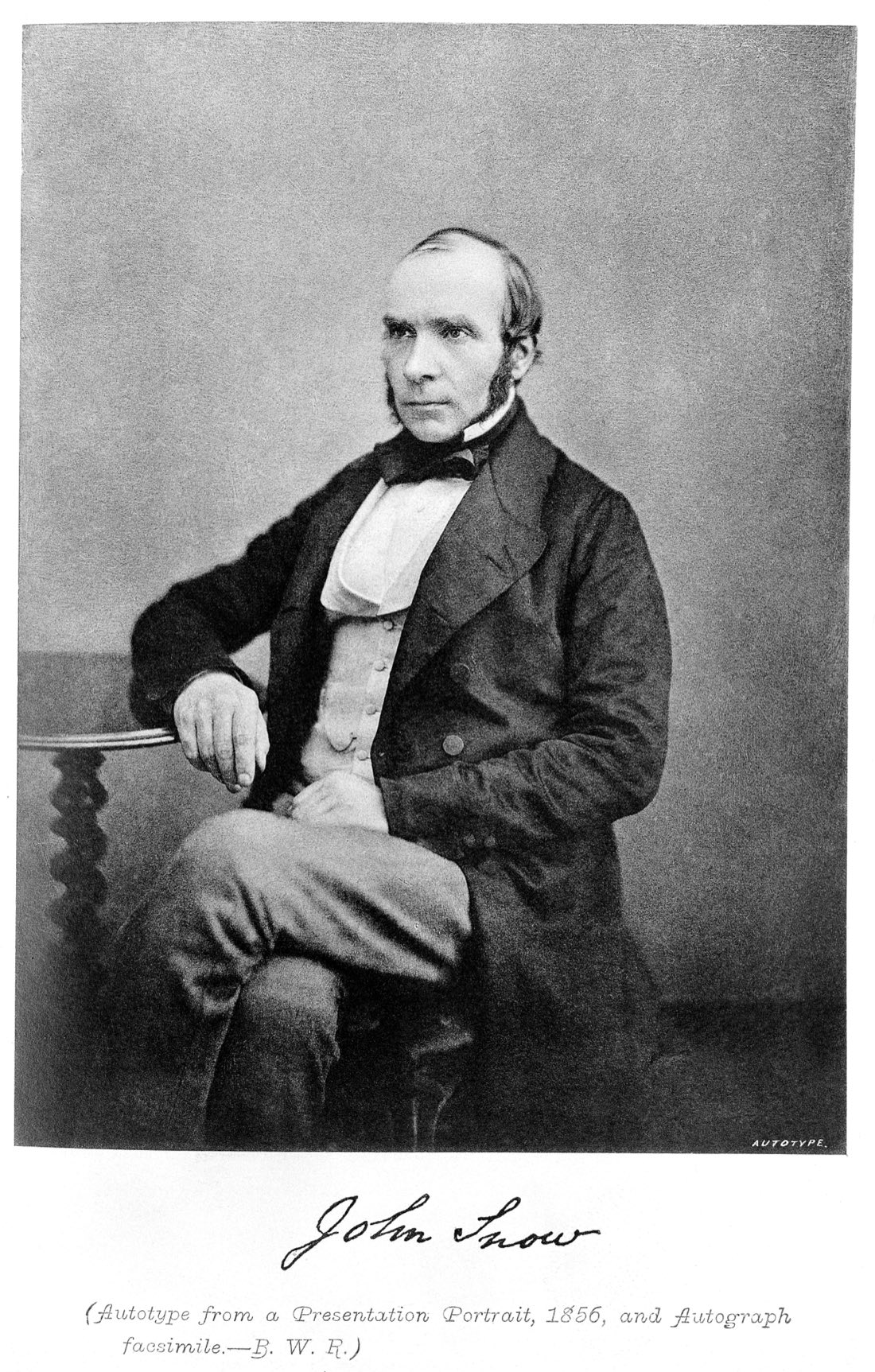
In August 1849 he had published “a slender pamphlet,” as he called it later, with the title On the Mode of Communication of Cholera. It argued that cholera was a disease of the gut and not of the blood, that whatever caused it was swallowed, that it multiplied inside the patient and came out in the evacuations, and that the evacuations reached other people by soiled hands, by food, and by water. The argument from water rested on two local outbreaks and on the observation that the districts supplied from the sewage-laden parts of the Thames were the districts that died. It did not rest on anything that could be called a trial.
The second man was John Joseph Whiting, a licentiate of the Apothecaries’ Company, “a medical man” and nothing more in Snow’s account, whom Snow engaged to walk Bermondsey, Rotherhithe, Wandsworth and the other districts that had only one company’s water. Richardson says that when Snow found the work beyond one man “he paid for qualified labour.” Nothing else about Whiting survives in the sources for this entry.
The third was William Farr, “the accomplished head of the Statistical Department of the General Register Office,” in The Lancet’s phrase, who wrote the Registrar-General’s Weekly Return of Births and Deaths in London and his annual letters. Farr gave Snow the addresses, printed his first results, and then took the inquiry over.
The fourth was John Simon, Medical Officer of the General Board of Health, who with Neil Arnott, William Baly, Farr and Richard Owen formed the Board’s Committee for Scientific Inquiries during the epidemic, and who in 1856 repeated the comparison with the Board’s own numbers.
And there were the two companies. The Lambeth Waterworks Company had drawn its water from the Thames opposite Hungerford Market, in the middle of London, until 1852, when it moved its works upstream to Thames Ditton, above the reach of the tide and of the sewers. The Southwark and Vauxhall Water Company drew at Battersea Fields, “about half-a-mile above Vauxhall Bridge,” where the river was tidal and received the drainage of the town. A clause that had kept the two companies’ pipes apart was repealed in 1834, and for years after that they were, in Snow’s words, “in active competition,” laying mains down the same streets and canvassing the same houses. The Metropolis Water Act of 1852 required every company to leave the tidal Thames within three years. Answering a circular from the Registrar-General in October 1853, the Southwark and Vauxhall Company promised that its new works would be running by September 1854. They were not, and the Battersea water ran through the epidemic.
What they were trying to find out
The hypothesis is in Snow’s own words, and he stated it as two claims. The first was that cholera “is communicated by the morbid poison which produces it being accidentally swallowed,” that the poison “increases in the interior of the alimentary canal by a process of reproduction, and passes off, to cause the disease in other persons who may take it into the stomach.” The second was that water was one of the ways it travelled, and the way that carried it furthest: that the evacuations of cholera patients, “passing down the sewers into the rivers from which the water supply of many towns was obtained,” could reproduce the disease at the far end of a pipe.
He knew what he was asking people to believe, and he said so. He wanted the inquiry done by his own hand, he wrote, “in order that I might have the most satisfactory proof of the truth or fallacy of the doctrine which I had been advocating for five years. I had no reason to doubt the correctness of the conclusions I had drawn from the great number of facts already in my possession, but I felt that the circumstance of the cholera-poison passing down the sewers into a great river, and being distributed through miles of pipes, and yet producing its specific effects, was a fact of so startling a nature, and of so vast importance to the community, that it could not be too rigidly examined, or established on too firm a basis.”
The question had a sharper form in the south of London, because something had already been noticed there. When cholera returned in the autumn of 1853, Farr printed a table in the Weekly Return of 26 November showing that the twelve sub-districts supplied only by the Southwark and Vauxhall Company had lost 114 people in every 100,000, while the sixteen supplied by both companies had lost 60. In 1849 the mixed districts had suffered rather worse than the others. So the claim to be tested in 1854 was narrower and harder than the doctrine of 1849: if the fall in the mixed districts was the Lambeth water’s doing, then the whole of the fall should belong to the Lambeth houses, “whilst the houses supplied with the water from Battersea Fields would suffer the same mortality as they would if the improved supply did not exist at all.”
The other side of the argument had its own account of the same districts, and it was not a foolish one. The Board of Health’s doctrine, as Simon summarised it in 1856, was that the unknown cause of epidemic cholera “acts after the manner of a ferment, that it therefore takes effect only amid congenial circumstances, and that the stuff out of which it brews poison must be air or water abounding with organic impurity.” On that view dirty water could make a district worse without being the thing that carried the disease; it predisposed. Farr had found in 1849 that mortality fell as the ground rose above the river, and called it a law. Baly, in the College of Physicians’ report, had asked why, if water mattered, two districts with the same Chelsea water had lost 28 and 68 in 10,000, and two with the same Southwark water 100 and 181. These were serious questions. Snow’s answer was that nobody had yet looked at the right unit. The district was too coarse; the house was the unit, and in Lambeth, Southwark and Newington the houses had been shuffled.
What they built
He built nothing. That is the point of the entry, and he was the first to say it. “As there is no difference whatever, either in the houses or the people receiving the supply of the two Water Companies, or in any of the physical conditions with which they are surrounded, it is obvious that no experiment could have been devised which would more thoroughly test the effect of water supply on the progress of cholera than this, which circumstances placed ready made before the observer.”
What the circumstances had made was described in the paragraph that every account of this story quotes, and it should be quoted here in full, because the entry turns on how precisely he understood what he had been given:
“The experiment, too, was on the grandest scale. No fewer than three hundred thousand people of both sexes, of every age and occupation, and of every rank and station, from gentlefolks down to the very poor, were divided into two groups without their choice, and, in most cases, without their knowledge; one group being supplied with water containing the sewage of London, and, amongst it, whatever might have come from the cholera patients, the other group having water quite free from such impurity.”
And then the sentence that turned a thing noticed into a thing to be done: “To turn this grand experiment to account, all that was required was to learn the supply of water to each individual house where a fatal attack of cholera might occur.”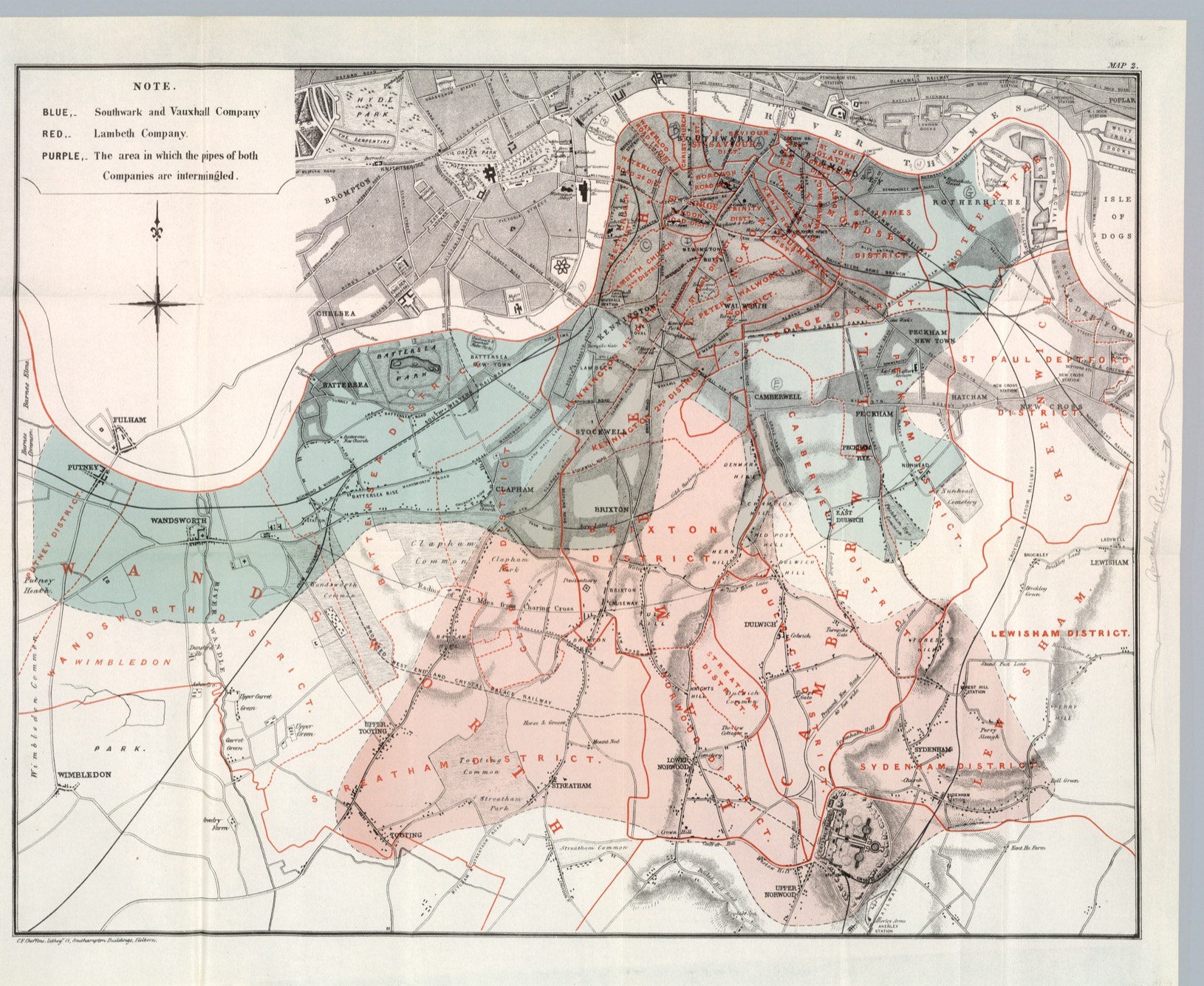
The mixing was as close as a mixing can be. “The pipes of each Company go down all the streets, and into nearly all the courts and alleys. A few houses are supplied by one Company and a few by the other, according to the decision of the owner or occupier at that time when the Water Companies were in active competition. In many cases a single house has a supply different from that on either side. Each Company supplies both rich and poor, both large houses and small; there is no difference either in the condition or occupation of the persons receiving the water of the different Companies.” Nobody had sorted these people. A landlord’s choice twenty years earlier, when two companies’ canvassers had knocked on the same door, had sorted them.
He had let the autumn of 1853 go by: “I regret that, in the short days at the latter part of last year, I could not spare the time to make the inquiry.” When cholera came back in July 1854 he went to the General Register Office and asked for the addresses of everyone dying of cholera in the districts where the two supplies were intermingled. Some were already printed in the Weekly Return; the rest he was allowed to copy. He began, he says, “about the middle of August,” with the two Kennington sub-districts.
Then came the problem that the design did not solve, which was that the thing to be read was not written anywhere. “There were very few instances in which I could at once get the information I required. Even when the water-rates are paid by the residents, they can seldom remember the name of the Water Company till they have looked for the receipt. In the case of working people who pay weekly rents, the rates are invariably paid by the landlord or his agent, who often lives at a distance, and the residents know nothing about the matter. It would, indeed, have been almost impossible for me to complete the inquiry, if I had not found that I could distinguish the water of the two companies with perfect certainty by a chemical test.”
The test worked because the summer was dry, the river was low, and the tide carried sea water further up than usual, so that the Battersea water was brackish and the Ditton water was not. He learned later from Mr Quick, the company’s engineer, that this happened after any long dry spell. In August and September the difference was so gross that he could carry it home in a phial. He used the look of the water too, “especially if it was observed as it came in, before it had entered the water-butt or cistern,” and the hour at which it came in, once he had learned when each company’s turncocks visited a street. “These points were, however, not relied on, except as corroborating more decisive proof, such as the chemical test, or the Company’s receipt for the rates.”
A return made to Parliament gave the number of houses each company supplied in 1853: 40,046 for the Southwark and Vauxhall Company and 26,107 for the Lambeth Company. It did not give the number in any district, so the inquiry had to cover every district either company reached, or the deaths could not be set against the houses. Snow took every sub-district the Lambeth pipes entered, which was all of the mixed ground. Whiting took the ground that had only Battersea water, where the question was simpler: company’s water, or a pump, or the river. Whiting’s part ran for the first four weeks of the epidemic, from 8 July to 5 August. Snow’s ran to 26 August.
And he published the raw material. The 334 deaths of the first four weeks were reprinted from the Weekly Return in an appendix to his book, “as a guarantee that the water supply was inquired into, and to afford any person who wishes it an opportunity of verifying the result.”
Fourteen to one
In the four weeks to 5 August there were 334 deaths from cholera in the districts the two companies supplied. In 286 of them the house where the attack began took the Southwark and Vauxhall water. In 14 it took the Lambeth water. In 22 the people had dipped a pail into the Thames, in 4 they used a pump-well, in 4 a ditch, and in 4 the source could not be found.
Set against the houses, 286 deaths in 40,046 houses is 71 in every 10,000; 14 in 26,107 is 5. “The cholera was therefore fourteen times as fatal at this period, amongst persons having the impure water of the Southwark and Vauxhall Company, as amongst those having the purer water from Thames Ditton.”
He put the figure beside the whole city. In those four weeks only 563 people died of cholera in the whole of London, and more than half of them were customers of one water company that supplied about one house in eight. The rest of London, without the Battersea water, lost 9 in every 10,000 houses. The Lambeth houses, standing in the same streets as the worst-hit houses in the capital, lost 5 in 10,000: less than the rest of London, which had no such neighbours.
As soon as he had the Kennington figures he took them to Farr, “who was much struck with the result,” and at Farr’s suggestion the registrars of all the south districts were ordered, from 26 August, to return the water supply of the house in every death from cholera. Snow carried his own inquiry to that date so that the two would join.
For the seven weeks to 26 August, with Whiting’s share of the last three weeks computed in the same proportion as his first four, there were 1,263 deaths in Southwark and Vauxhall houses and 98 in Lambeth houses: 315 and 37 in every 10,000 houses, against 59 for the rest of London. “The mortality in the houses supplied by the Southwark and Vauxhall Company was therefore between eight and nine times as great as in the houses supplied by the Lambeth Company; and it will be remarked that the customers of the Lambeth Company continued to enjoy an immunity from cholera greater than the rest of London which is not mixed up as they are with the houses supplied by the Southwark and Vauxhall Company.”
He sent the first table to the Medical Times and Gazette, which printed it on 7 October 1854, with a sentence that says what he still lacked: “I hope shortly to learn the number of houses in each subdistrict supplied by each of the water companies respectively.” He was never given those numbers. Someone else was.
What it looked like from inside
From the road, the inquiry was a man with a notebook asking a widow which company she paid, being told that the landlord saw to it, and asking instead for a little of the water from the butt. In the Southwark and Vauxhall houses people had taken to tying a piece of linen over the tap. “In two hours, as the water came in, about a tablespoon of dirt was collected, all in motion with a variety of water insects, whilst the strained water was far from being clear. The contents of the strainer were shown to me in scores of instances.” It was the autumn of a drought: from 5 August, for more than five weeks, less than a third of an inch of rain fell at Greenwich, and the river in London became, in his phrase, “a kind of prolonged lake, the same water passing twice a day to and fro through London, and receiving the excrement of its two millions and more of inhabitants.”
At the General Register Office the inquiry looked different, and the Weekly Return is the place to watch it. On 14 October 1854 Farr printed two things side by side. The first was Snow’s result, with his method: “Dr. Snow, who has devoted much time to the investigation, having procured from this office the addresses of the persons who died of cholera in Kennington and some other sub-districts, states, as the result of an inquiry from house to house where the pipes of the Lambeth Water Company are intimately mixed with those of the Southwark Company, that, in the 7 weeks ending August 26th, of 600 deaths from cholera, 475 have happened in houses supplied by the Southwark Company; 89 in houses supplied by the Lambeth Company; 13 in houses supplied by pumps, wells, and springs; 8 in houses which derived their water directly from the Thames and from ditches.”
The second was what the registrars had found when they were told to ask the same question, and it shows what the question cost. The householders “were often ignorant of the source of supply, as the water rate in the worst districts is paid by the landlord. The information was thus not obtained in 766 out of 3805 instances; but it was stated that in 3039 instances 2284 deaths occurred in houses supplied with the impure Thames water, 294 in the houses supplied by the Lambeth Company with the purer filtered Thames water. The disparity was observed week after week in the progress of the epidemic.” Against the houses: 57 deaths in every 1,000 Southwark and Vauxhall houses in six weeks, and 11 in every 1,000 Lambeth houses.
Farr printed it with a reason and a reservation. “It is deemed right at once to state these facts now the epidemic is declining; but the important inquiry can only be made complete in all its parts by the Board of Health, who have requested the respective companies to furnish street lists in every sub-district of the houses that they supply, with which the facts in the Registers of Deaths may be compared.” The street lists were the numbers Snow had hoped for. They went to the Board.
Snow added the registrars’ seven weeks to his own: 2,353 deaths in Southwark and Vauxhall houses against 302 in Lambeth houses, 537 and 115 in every 10,000 houses, “nearly five times.” Over the fourteen weeks to 14 October the two populations had lost 153 and 26 in every 10,000 living, in a city whose rate was 43. The gap narrowed as the epidemic went on, which Snow had expected, since once the disease was in the streets it spread by the ordinary means, hand to food, from Battersea houses to Ditton houses next door. It never closed.
Farr’s own summing-up came in the Return’s survey of the year. The pipes were so intermingled, he wrote, “that neither the Informants nor the Registrars knew in 803 cases out of 4,059 whether the house in which the death from cholera occurred obtained its water from the Lambeth or the Southwark Company. The officers of the latter company themselves have stated that they experience almost insuperable difficulties in distinguishing the houses which they supply in every street. It is therefore evident, that in the general character of the houses, the means of the householders, the density of the population, and the elevation of their dwellings, the difference is not considerable. The water supply is the chief element in which there is an evident difference … And what is the result?”
The result, over ten weeks, was 313 deaths in the 26,107 Ditton houses and 2,443 in the 40,046 Battersea houses. “The deaths in the latter districts exceeded by nearly 2,000 the deaths that would have occurred if cholera had only been as fatal as it was in the houses that derived their water from Ditton.” And in every district, week by week, “the balance of mortality is heaviest in every district and in every week against the impure water, to an extent that leaves little room for doubt on the mind.”
In the middle of all this, on 1 September, 143 people were attacked in the streets round Golden Square, on the north side of the river, with nothing to do with Battersea at all. Snow left the south for a fortnight. He spoke to the Guardians on 7 September and the pump handle came off on the 8th, by which day the attacks had fallen to twelve; he wrote himself that they “had so far diminished before the use of the water was stopped, that it is impossible to decide” whether the well had still been active. The companion piece on the pump takes that story to its end. Here it matters because it was the thing the public saw, and because the committee that examined it declined to be persuaded by it while the pipes sat in the Registrar-General’s own tables.
What happened
The second edition of On the Mode of Communication of Cholera, “much enlarged,” carried a preface dated 11 December 1854 and came out from John Churchill early in 1855: 162 pages and two maps. Richardson says Snow spent more than two hundred pounds on it “and realized in return scarcely so many shillings.”
The first notice it got from the profession’s leading journal was not a review of the book. In the spring of 1855 Snow told the parliamentary committee on the Public Health and Nuisances Removal Bills, on behalf of the trades that boiled bones and rendered fat, that the smell of them did not cause disease, because, as The Lancet summarised him, “animal matters are only injurious when swallowed.” The leading article of 23 June 1855 began with “the perverse, crotchetty, or treasonable behaviour” of certain of medicine’s own disciples. “Why is it, then, that Dr. Snow is so singular in his opinion? Has he any facts to show in proof? No! but he has a theory, to the effect that animal matters are only injurious when swallowed!” And then: “The fact is, that the well whence Dr. Snow draws all sanitary truth is the main sewer. His specus, or den, is a drain. In riding his hobby very hard, he has fallen down through a gully-hole and has never since been able to get out again.” The water was granted him, as a joke: “Smell it you may, breathe it fearlessly, but don’t eat it.” A week later the same column called him “the physician retained by the great dirt and effluvium interest.”
The same journal, in the same weeks, printed him fairly. On 4 June 1855 he read a paper to the Epidemiological Society, and The Lancet of 7 July reported it at length, with his answer to the air: “the comparatively genteel and airy districts of Clapham and Kennington, which were chiefly supplied with water by the Southwark and Vauxhall Company, suffered very much more in the late epidemic than the districts of Lambeth by the river side crowded with poor people, and sprinkled over with offensive factories, but receiving chiefly the new and improved supply of water from the Lambeth Company.” Dr Rogers, in the discussion, praised his “indefatigable industry,” and added “even if he did not really prove the soundness of his theory.” In November the journal reviewed the book together with the St James’s report and said the two “must exert considerable influence on sanitary reform.”
The official answer came on 14 July 1855, in the report of the Board of Health’s Committee for Scientific Inquiries. Its judgment on the Lambeth supply was “It is the best, but it is not good.” The Southwark and Vauxhall and Chelsea waters “greatly surpass the others in badness”; Hassall had found in the Southwark and Vauxhall cisterns “fragments of altered muscular fibre,” which came from the sewage. The Committee did “not hesitate to speak of this contamination as one that may have exercised great influence on the spread of cholera among the population.” But the sentence stood inside the doctrine of the ferment, in which polluted water and polluted air were alike the material on which the epidemic influence worked, and the reserve was explained a year later by Simon himself: “from the absence of circumstantial proof, we were unable to speak of the danger as an evil demonstrated and measured.” The one piece of circumstantial proof the Committee had asked for, the comparison of deaths with the companies’ street lists, was not ready, and the report went out without it. “In one important particular this Report was of necessity incomplete.”
On Broad Street the Committee was not reserved. “After careful inquiry, we see no reason to adopt this belief. We do not find it established that the water was contaminated in the manner alleged.” If the pump had done anything, it was because its impure water had “participated in the atmospheric infection of the district.”
In the appendix, Robert Dundas Thomson, who had done the chemistry, looked at the Registrar-General’s figures and went as far as a chemist could. Since the two companies “supply contiguous houses throughout the same district,” to the same kind of people, and since the Southwark houses had lost nearly 2,000 more than they would have at the Lambeth rate, “it is impossible to avoid drawing the conclusion, that the Southwark water must at least have had a more predisposing influence in the production of the disease.” Whether it held “the seeds of the disease” or merely bred a predisposition, he could not decide. “Exclusive theories are objectionable.”
The St James’s vestry’s own committee, on which Snow and the curate Henry Whitehead sat, reported in July 1855 that the outbreak “was in some manner attributable to the use of the impure water of the well in Broad Street,” and in support quoted Farr’s sentence about the balance of mortality on the south side. A parish vestry had read the pipe. The Board of Health had not yet.
After
The Board read it on 13 May 1856, when Simon sent his Report on the Last Two Cholera-Epidemics of London, as Affected by the Consumption of Impure Water to the President of the Board. The street lists had come in. The Board’s clerks had matched every cholera death in nine south London districts, in 1849 as well as in 1854, against the company that supplied the house. “It was not village against village,” Simon wrote; the districts held about a fifth of London.
His numbers were the Board’s, not Snow’s. In the 24,854 houses the Lambeth Company supplied, with about 166,906 people, there had been 611 cholera deaths in 1853 to 1854, which is 37 in every 10,000 living. In the 39,726 Southwark and Vauxhall houses, with about 268,171 people, there had been 3,476, which is 130. He took forty-five streets in which the two mains ran side by side and the houses were split exactly, 1,517 to each company, “divisible, as it were, into two populations, each the exact counterpart of the other, except in the one particular of water-supply. One of these populations lost 57 persons by cholera; the other lost 164.”
Then he did what Snow could not, because the Board had the 1849 deaths for the same houses. In 1849 both companies had pumped from the middle of the town, and the Lambeth water had been the worse. In those same houses the Lambeth tenants had lost 1,925 in 1849 and 611 in 1854; the Southwark and Vauxhall tenants 2,880 and 3,476. In the forty-five streets the Lambeth side had gone from 164 deaths to 57 and the Southwark side from 95 to 164. “In the one population (notwithstanding a generally lighter invasion of the disease) the cholera death-rate rose from 118 to 130: in the other it fell from 125 to 37. And what was the only discoverable difference of condition between these two populations? The one had improved its water-supply to comparative excellence; the other drank from even a filthier source than before.”
He called it what Snow had called it, and at greater length. “An experiment, at which mankind would have shuddered if its full meaning could have been prefigured to them, has been conducted during two epidemics of cholera on 500,000 human beings. One half of this multitude was doomed in both epidemics to drink the same fecalized water, and on both occasions to illustrate its fatal results; while another section, freed in the second epidemic from that influence which had so aggravated the first, was happily enabled to evince by a double contrast the comparative immunity which a cleanlier beverage could give.” From it he drew the arithmetic of the dead: of the 3,476 Southwark and Vauxhall tenants who died in 1854, “two-thirds would have escaped if their water-supply had been like their neighbours’,” and of the far larger number who died in 1849, two-thirds also, “if the Metropolis Water Act of 1852 had but been enacted a few years earlier.” He reminded his readers that the company’s directors had lately told a parliamentary committee that their water was “unexceptionably good.”
And then, having measured it, he said what the measurement was not allowed to mean. “The inquiry has of necessity been restricted. It did not pretend to determine whether putrefiable drinking-water is a stronger or a weaker morbific influence than impure air or defective nourishment.” The result, he wrote, gave “a new proof” to the water half of the Board’s doctrine and “an indirect confirmation” to the rest, and “it entirely consists with the facts here set forth to maintain that, under the specific influence which determines an epidemic period, fecalised drinking-water and fecalised air equally may breed and convey the poison.” The Broad Street pump he set aside as of “at least an exceptional character,” because all London’s shallow wells were foul and a professor in Munich, inquiring into that city’s wells, “found himself unable to attribute to the well-waters any causative relation to the epidemic.” The professor was Max von Pettenkofer, who would still be saying so in 1892, when he drank a glass of cholera broth to prove it; that story is told in One Cubic Centimetre.
Snow answered in October 1856, in the Journal of Public Health, with Simon’s house counts in his hands at last. He noted where the Board’s lists had gone wrong, and that its method, which left out every street in which nobody had died, ran every rate about a ninth too high on both sides. Then he set his own deaths against the Board’s denominators, sub-district by sub-district, and got the same answer a fourth time: in every district the two companies both entered, more than three to one, “and the general result shows a proportion of ninety-one to eighteen, or more than five to one.” The companion piece on the numbers sets all the counts side by side.
By then the comparison had ended, because the thing being compared had gone. Simon noted in May 1856 that the Southwark and Vauxhall Company, “in obedience to the Metropolis Water Act, has abandoned its former very objectionable source of supply, and for the last few months has been distributing a water, nearly or quite identical in quality” with the Lambeth Company’s. The experiment was turned off by the same Act that had set it running.
On Thursday 10 June 1858, at his desk in Sackville Street, writing his book on chloroform, he was found on the floor trying to get back into his chair, with no power in his left arm and leg. He died at three in the afternoon of Wednesday 16 June, aged forty-five. In The Lancet a month later J. G. French, who had sat with him on the St James’s committee, wrote that “since the days of Jenner no physician has rendered more important service to mankind than Dr. Snow,” and then, in the same letter: “If Dr. Snow ever inferred too much from the facts which he so laboriously collected, at least he perceived the fallacies of that theory, propounded by Mr. Chadwick, which referred to fetid odours as the dwelling-place of cholera.” Even his defender, in the summer of his death, opened with the possibility that he had inferred too much.
What it taught
The experiment was already running when he found it, and it ran on after he died. What he contributed was the reading, and the reading is the lesson.
The instrument was the pipe, and the pipe had to be read at the door. Three hundred thousand people had been sorted by a landlord’s choice of water company, as cleanly as a lottery would have sorted them, and the two groups lived in the same streets under the same sky. The Registrar-General had every death and its address. The companies had every house they served. Nobody had put the two lists together, because the pipe does not announce itself: the widow did not know, the landlord lived elsewhere, and the company’s own officers said that in some streets they could not tell their houses from the other company’s. Snow read it with a rate-receipt, a phial, and the hour of the turncock. The registrars, told to ask the same question, got no answer in a fifth of the cases. An experiment that nobody designed still has to be read by somebody, and the reading is the work.
A count is not a rate. Two hundred and eighty-six deaths against fourteen proves nothing on its own; the Southwark and Vauxhall Company might have supplied twenty houses for every one of the other’s. The return to Parliament turned the count into 71 and 5 in every 10,000, and the inquiry had to be stretched over every district either company touched, and a second man hired, to make that division honest. Snow asked publicly for the house counts by sub-district and did not get them for two years. When Simon’s clerks had them, the rate came out at 130 against 37, and in forty-five streets split exactly in half, 164 against 57. The denominator moved the number and never moved the answer.
A measurement does not decide what it means. Farr printed Snow’s result in October 1854 and his own in December, and wrote that it left “little room for doubt on the mind.” The Board’s chemist read the same table and concluded that the water had “at least” a “more predisposing influence.” Simon measured it to the last house, called it an experiment at which mankind would have shuddered, computed that two-thirds of the dead need not have died, and in the next breath declared that foul air “equally may breed and convey the poison.” The same numbers supported, in the same year, a man who said water carried the disease, a man who said water predisposed to it, and a committee that said the Broad Street well had merely participated in the atmosphere. The arithmetic was never in dispute. What stood between it and its meaning was the requirement that it fit a theory of air before it could count, and the theory was not Snow’s to remove.
The complication is that the people who preferred the air were not fools, and the pipe did not need them to be. Simon’s report did more with the data than Snow could, because the Board had the lists and the 1849 deaths. The Act that moved the intakes above Teddington was passed in 1852 by people who thought bad water bred cholera in a general way, before any of this was measured; the remedy came before the proof. And Snow was reading an instrument whose scale he could not fully see: his denominators were company-wide totals, his seven weeks relied on Whiting’s four, and the returns that confirmed him had a fifth of their cases blank. The experiment was conclusive and every reading of it was imperfect, which is the ordinary condition of evidence.
What was not ordinary was the size of the thing and the cheapness of the reading. Thirty-eight grains of salt in a gallon of water told a man at a street door which of two groups of a hundred and fifty thousand people he was looking at. The groups had been made for him by an accident of commerce, and the result was lying in the Registrar-General’s returns. He walked round and picked it up. Nobody who disagreed with him ever walked round after him to show that he had picked it up wrong. They agreed with the number and declined to be moved by it, which is a thing that numbers, on their own, have never been able to prevent.
Sources
- John Snow, On the Mode of Communication of Cholera, second edition, much enlarged, London: John Churchill, 1855. The preface of 11 December 1854 with its thanks to the Registrar-General; the history of the two companies, the move to Thames Ditton in 1852 and the repeal of 1834; the Registrar-General’s table of 26 November 1853; Baly’s objection; the passages quoted on the ready-made experiment, the three hundred thousand, the intimate mixing, the regret over 1853, the “startling” doctrine, the Kennington beginning, Farr’s order of 26 August, the trouble of the inquiry, the chloride test with its 2.28 and 91 grains, the phials, the turncocks and the receipts, Whiting and his districts, the 334 deaths and their appendix, the 40,046 and 26,107 houses, 71 and 5, the 563 deaths in London, Tables IX, X and XI, the strainer, the drought and the “prolonged lake,” the salt and Mr Quick, and the Broad Street interview of 7 September with the admission that the attacks had already diminished. archive.org (Wellcome Collection copy)
- John Snow, Cholera and the Water Supply in the South Districts of London in 1854, reprinted from the Journal of Public Health for October 1856, London: T. Richards, 1856. The 1849 summary, the 300,000 “divided into two groups by no other circumstance than the difference of water supply,” the receipts, “nearly forty grains,” Whiting’s share and its four weeks, Farr’s continuation from 27 August, the three periods with 107 and 8, 977 and 84, 916 and 180 per 100,000, the criticism of Simon’s house lists and the one-ninth, the quotation from the Medical Times and Gazette of 7 October 1854, and “ninety-one to eighteen.” archive.org (Wellcome Collection copy)
- Weekly Return of Births and Deaths in London, published by authority of the Registrar-General, volume for 1854. The notice of the Lambeth Company’s water in the return for the week ending 2 September; the return of 14 October 1854 (pages 431 to 433) with the Southwark and Vauxhall Company’s promise of September 1854 and its failure, the Bermondsey and Lambeth comparison with 1849, Dr Snow’s 600 deaths, the registrars’ difficulties and their 3,805 deaths with 766 unknown, 57 and 11 per 1,000 houses, the table of houses and population, and “It is deemed right at once to state these facts”; and the survey in the “Health of London” supplement (pages 514 to 515) with the 803 unknown of 4,059, the company’s “almost insuperable difficulties,” “And what is the result?”, the 313 and 2,443 deaths in ten weeks, the “nearly 2,000,” and “the balance of mortality is heaviest in every district and in every week against the impure water.” archive.org
- Seventeenth Annual Report of the Registrar-General of Births, Deaths, and Marriages in England, London, 1856: the Registrar-General’s letter on the cholera epidemic of 1853 to 1854, with the circular to the water companies of October 1853, the finding that cholera found London “as regards water, in the situation in which it left it” except for the Lambeth Company, the warning that in 1854 “every parish, except those which the Lambeth Company supplies, may receive waters as bad as those of 1849,” and the residual mortality “fairly referable to the impurity of the water.” archive.org
- John Simon, Report on the Last Two Cholera-Epidemics of London, as Affected by the Consumption of Impure Water; Addressed to the Rt. Hon. the President of the General Board of Health by the Medical Officer of the Board, London: HMSO, 1856, dated 13 May 1856. The Committee for Scientific Inquiries and its members, the incomplete report of 14 July 1855, the “filthiest stuff ever drunk by a civilized community,” “It was not village against village,” the 24,854 and 39,726 houses with their populations and deaths and the rates of 37 and 130, the forty-five streets with 1,517 houses each and 57 against 164 (Table V, with 164 against 95 in 1849), the rates of 125 and 37 and 118 and 130, “An experiment, at which mankind would have shuddered,” the two-thirds, the directors’ “unexceptionably good,” the reserve of 1855, the Broad Street “exceptional character” and Pettenkofer’s Munich inquiry, the Southwark and Vauxhall Company’s new supply, “It did not pretend to determine,” the ferment doctrine quoted from the Committee’s report, and “fecalised drinking-water and fecalised air equally may breed and convey the poison.” archive.org (Wellcome Collection copy)
- General Board of Health, Medical Council, Report of the Committee for Scientific Inquiries in relation to the Cholera-Epidemic of 1854, London: HMSO, 1855. Hassall’s and Thomson’s examinations of the companies’ waters, “It is the best, but it is not good,” the Southwark and Vauxhall and Chelsea waters that “greatly surpass the others in badness,” the muscular fibre and the faecal contamination of the cisterns, the Committee’s finding on the Broad Street well (“we see no reason to adopt this belief”) and its participation in “the atmospheric infection of the district”; and, in the appendix, R. D. Thomson’s report on the chemical quality of the waters with the “nearly 2,000,” “a more predisposing influence,” and “Exclusive theories are objectionable.” archive.org (Wellcome Collection copy)
- Cholera Inquiry Committee, Report on the Cholera Outbreak in the Parish of St. James, Westminster, during the Autumn of 1854, presented to the Vestry July 1855, London: John Churchill, 1855. The Committee’s unanimous finding that the outbreak “was in some manner attributable to the use of the impure water of the well in Broad Street,” its quotation of the Registrar-General’s “balance of mortality,” the members’ names including Snow, Whitehead, Lankester and French, and the adoption on 25 July and 9 August 1855. archive.org (Wellcome Collection copy)
- The Lancet, January to June 1855: the leading article of 23 June 1855 on “The Public Health and Nuisances Removal Bill: Dr. Snow’s Evidence,” with “crotchetty, or treasonable,” “so singular in his opinion,” “the main sewer,” “his specus, or den, is a drain,” the gully-hole, “Smell it you may, breathe it fearlessly, but don’t eat it,” and “The only thoroughly scientific witness examined was Dr. Farr”; the leading article of 30 June 1855 with “the physician retained by the great dirt and effluvium interest” and Farr as “the accomplished head of the Statistical Department of the General Register Office”; and Snow’s remarks at the Medical Society of London, where he presided in 1855. archive.org
- The Lancet, July to December 1855: the report of the Epidemiological Society’s meeting of 4 June 1855 in the issue of 7 July, with Snow’s paper “On the Communication of Cholera through the Medium of Water,” the 652 deaths, Clapham and Kennington against riverside Lambeth, and Dr Rogers’s “even if he did not really prove the soundness of his theory”; and the review of Snow’s book and the St James’s report in the issue of 24 November 1855 (“must exert considerable influence on sanitary reform”). archive.org
- The Lancet, July to December 1858: the letters “The Late Dr. Snow” from V. Hooper Attree (17 July 1858) and from J. G. French (24 July 1858), with “since the days of Jenner” and “If Dr. Snow ever inferred too much from the facts which he so laboriously collected.” archive.org
- Benjamin Ward Richardson, “The Life of John Snow, M.D.,” the memoir prefixed to John Snow, On Chloroform and Other Anaesthetics: Their Action and Administration, London: John Churchill, 1858. The birth at York in 1813, Hardcastle and Killingworth, the vegetarian years, the walk to London in 1836 and the Hunterian School, the chloroform to the Queen at the birth of Prince Leopold in 1853, “wherever cholera was visitant, there was he in the midst,” “he paid for qualified labour,” the £200 and the shillings, and the illness and death of 10 to 16 June 1858. Richardson gives the birthday as 15 June 1813; later biographers give 15 March, and this entry names only the year. archive.org
- John Snow, On the Mode of Communication of Cholera, first edition, London: John Churchill, August 1849: the “slender pamphlet,” for the doctrine as it stood before the inquiry. archive.org (Wellcome Collection copy)