On 30 October 1930, at a point on the Greenland ice sheet that the German expedition had named Eismitte, “Ice-Middle”, 400 kilometres from the west coast and about 3,000 metres above the sea, the thermometer stood at 54 degrees below zero and three dog sledges came in from the west. They had been forty days on the way. There were twenty dogs left, and the sledges carried no provisions; the last load had been left in the snow ten kilometres short of the station. On one of them was the leader of the expedition, Alfred Wegener, who would be fifty in two days. On another was the meteorologist Fritz Loewe, every one of whose toes was frozen. On the third was a Greenlander of twenty-two from the Uummannaq district named Rasmus Villumsen. The two men who met them, Johannes Georgi and Ernst Sorge, had been living since 5 October in a hole they had dug in the firn, and had expected nobody. They had written in September that if no supplies reached them by 20 October they would leave the station on foot.
The figures are from the telegram Georgi sent from Eismitte on 13 May 1931, the first full account to reach Germany, and the telegram goes on. After a day and a half of rest, Wegener and Villumsen left again for the coast with two sledges, seventeen dogs and 135 kilograms of food for men and dogs. The provisions at the station, stretched, would last three men until the end of May. Wegener intended to travel up to twenty kilometres a day. The two men set out on skis. The relief party that reached Eismitte in May found Wegener’s sledge 255 kilometres from the west station and his skis standing in the snow at 189. “That is the last,” the telegram says, “that has been seen of the explorer.”
Who ran it
Alfred Wegener was born in Berlin on 1 November 1880, took a doctorate in astronomy and turned to meteorology, and went to Greenland first in 1906, as the meteorologist of the Danish Danmark expedition to the north-east coast. In 1912 and 1913 he crossed the ice sheet with the Danish captain J. P. Koch, from east to west at 77 degrees north, after wintering on the ice edge; it was the longest crossing yet made. In between, in January 1912, he had given the lecture on the drift of the continents for which he is remembered, and which has nothing to do with this story except that it made him, in 1930, better known than most professors of meteorology. He had been a professor at Graz, in Austria, since 1924, and he was forty-nine.
The expedition was his. Its official name was the Deutsche Grönland-Expedition Alfred Wegener, and its money came from the Notgemeinschaft der Deutschen Wissenschaft, the emergency association that funded German research through the hard years of the Republic. In 1929 he had taken three men to the west coast of Greenland for a summer to find a way up on to the ice: Johannes Georgi, forty, a meteorologist of the Deutsche Seewarte at Hamburg; Fritz Loewe, thirty-four, a meteorologist of the aeronautical observatory at Lindenberg near Berlin; and Ernst Sorge, thirty, a schoolteacher of mathematics and physics in Berlin and a mountaineer. They found the glacier they needed at Kamarujuk, in the Uummannaq district at 71 degrees north, climbed it with dogs and ponies, and went 209 kilometres in on to the ice. Wegener wrote the summer up in a book, Mit Motorboot und Schlitten in Grönland, with chapters by the other three, and it came out in the autumn of 1930 while he was on the ice.
The main expedition sailed from Copenhagen on 1 April 1930 in the Danish ship Disko, about twenty Germans with Icelandic ponies, dogs, a hundred tons of stores and two machines that nobody had used in the Arctic before. Karl Weiken, a geodesist, led the survey; Rupert Holzapfel was the meteorologist of the West Station; Kurt Herdemerten, who had been to Spitsbergen, ran the transport up the glacier; Curt Schif, an engineer from Württemberg, had charge of the motor sledges, with the mechanics Franz Kelbl and Manfred Kraus. A separate party went to the east coast at Scoresby Sound. Georgi was to run the station in the middle, and Sorge, with him, was to study the ice. The Greenlanders of the Uummannaq district drove the dogs and led the ponies, and one of them, Rasmus Villumsen, was twenty-two years old and from the settlement of Ukkusissat.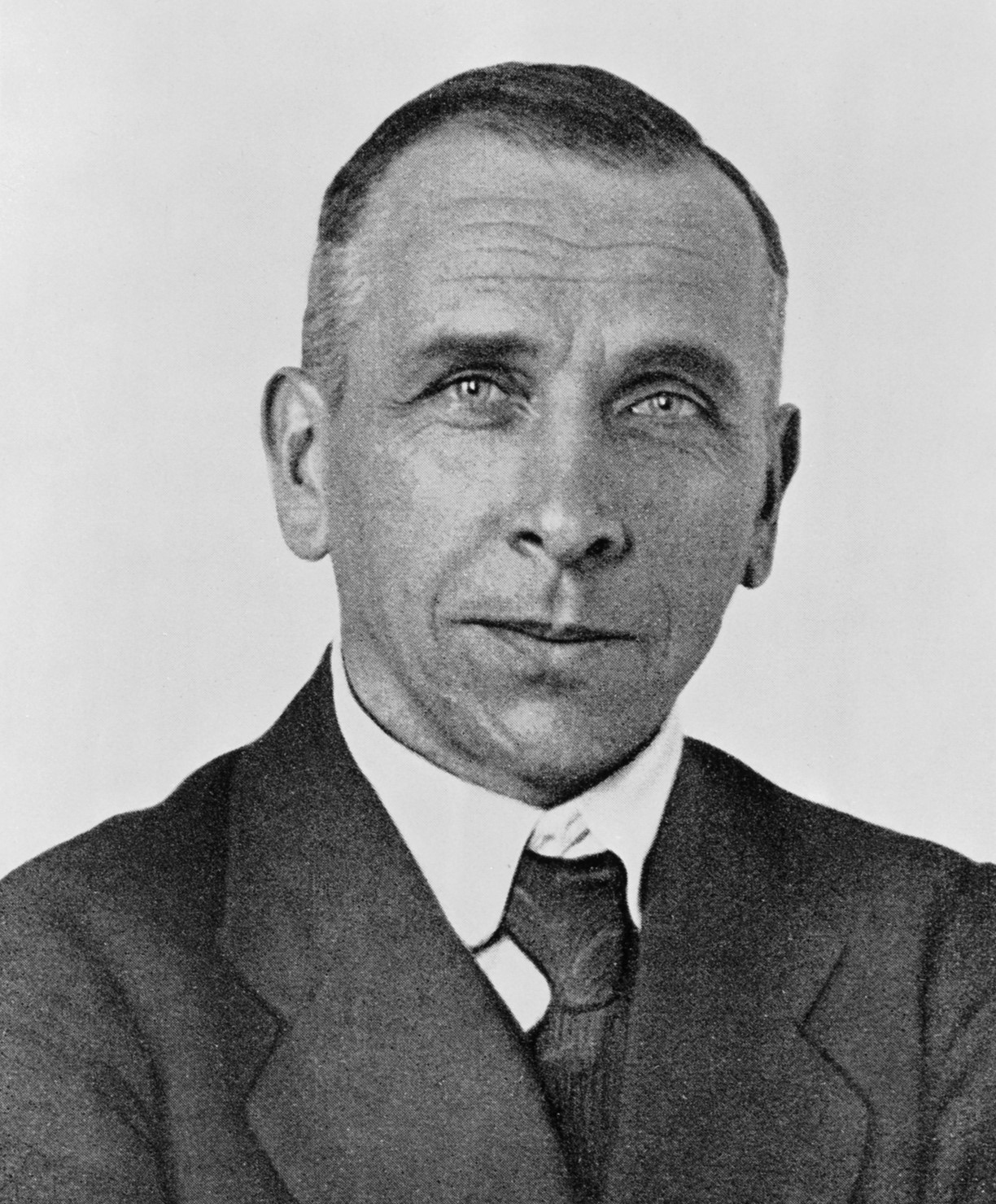
What they were trying to find out
The plan, as the Kiel journal Polarforschung summarised it in June 1931, was “to set up stations on the west coast, in the middle and on the east coast of Greenland, which were to carry out meteorological and aerological observations under a common programme (from 1 August 1930 to 1 August 1931)”. The three stations lay on one parallel, 71 degrees north. Nobody had ever wintered on the Greenland ice sheet, let alone in the middle of it, and nobody knew what the weather there was like through a year. What was suspected was that the ice sheet made its own weather, a dome of cold air that spilled down its sides into the weather of Europe and North America. A cable to the New Zealand press in June 1930 put Wegener’s purpose in a sentence: “he will endeavour to learn what effect the cold air centre with its violent storms has on the climate of western Europe and North America”.
That was the meteorology. The second question was the ice itself. How thick was it? The expedition took explosives and seismographs, so that the echo of a charge from the rock beneath could be timed, a method that Sorge had tried for the first time in 1929. With the thickness, the height of the surface and the area, the mass of the ice could be reckoned, and with the yearly fall of snow in the middle, measured through a winter, and the melting at the edge, measured with stakes, something could be said about whether the ice sheet was growing or shrinking. Those were the two claims of the experiment: that a year of readings at three stations across the ice would give its weather and its mass.
There was a third claim, which nobody wrote down as one, because it was a matter of logistics rather than of science. It was that the middle station could be supplied for a winter. Eismitte was to be 400 kilometres from the edge of the ice, at a height where the air had two-thirds of its weight at the sea, in a place where the snow never melted. Two or three men were to live there from August to August with a house, instruments, fuel and food, and everything they used had to be carried in. Dog sledges could do it, at twenty or thirty kilometres a day over a round trip of 800. Wegener’s answer was the machine. He had two propeller-driven motor sledges built in Finland, where such things ran on the sea ice of the Gulf of Bothnia: six metres long, two wide, a plywood cabin for two on a steel frame, a Siemens aero-engine behind driving a propeller. They were christened Schneespatz, “Snow Sparrow”, and Eisbär, “Polar Bear”. They were to carry the heavy things, the house and the paraffin and the instruments, 400 kilometres in and come back the same day or the next, and they had never been run on the snow of an ice sheet.
What they built
The ice held the ship up. The Disko reached the Uummannaq district in early May and could not get through to Kamarujuk; a radio telegram from Wegener printed in the Süddeutsche Zeitung in September says the expedition “was held up there for seven weeks by impenetrable barricades of ice”, and that only at the end of June, “with the help of dynamite blasting”, did they break through to the glacier in the schooner Hvidfisken. Everything then had to go up the Kamarujuk glacier on the backs of ponies, from the fjord to the edge of the ice at a place they called Scheideck, 950 metres up. “The glacier is in motion. New crevasses are forming,” Wegener’s telegram says. “One horse has fallen to its death.” The West Station was built there at the top of the glacier, and from there the ice ran east, rising, for 400 kilometres to the point chosen for the middle.
Georgi went in first, by dog sledge, and reached the 400-kilometre mark on 30 July 1930. He began his observations and stayed. A second dog-sledge party under Loewe reached him in August and went back. A third left the West Station on 30 August, “three members of the expedition, seven Greenlanders and ten dog sledges”, Wegener telegraphed, and reached Eismitte on 13 September with Sorge, who was to stay too. In those three trips, by Wegener’s own reckoning in his diary, about 2,700 kilograms had been carried in. What had not been carried in was the house, and most of the paraffin.
The motor sledges had been expected to carry those. They were not yet running. The engines and the hulls had been got up the glacier in pieces and assembled at Scheideck, and on 31 August Wegener, Schif, Kelbl and Kraus had tried for the first time to drive them loaded on to the ice, and had turned back after four hours in fog and snowstorm. “The motor sledges as such have proved themselves well and are intact,” the telegram says. “We are now waiting for better weather.” Then it snowed.
Wegener’s diary for the first week of September is the record of what the machines could and could not do, kept by the man who had staked the station on them, in a tent at the edge of the ice; it is given day by day in The sledges. On 2 September twenty centimetres of new snow lay over the whole ice sheet. “The introduction of propeller sledges into polar research is really a hard birth,” he wrote, “and we must be glad if we succeed at all in getting everything necessary 400 kilometres in.” On 3 September: “If only Georgi and Sorge had taken fewer instruments and more food and their house! I fear it will take its revenge that I left the matter to Georgi, at his urging.” On 4 September they drove into the drift, were stopped on the steepest slope at full throttle, and came home with the whole load. That evening he did the arithmetic.
“It could be that in this way only one trip in to 400 comes off in the course of September. What then? There are still some 4,000 kilograms of things lying here, partly at 25 kilometres, that are supposed to go in.” Next summer’s food, the explosives and Kraus’s winter stores could be struck off. “That still leaves 2,500 kilograms, an incomprehensibly large quantity for two men, when one considers that about 2,700 kilograms must already be in there from the three dog journeys. … So one more dog-sledge journey (Weiken, Loewe, 500 kilograms) and at least two trips with the propeller sledges, each with 1,000 kilograms, have to be made: that is the minimum programme. … The danger that our station Eismitte fails is painfully great.” The same evening he wrote down why: engines of 100 horsepower against 150 in the Finnish sledges they were copied from, heavier hulls loaded with freight, and a thousand metres of climb in the first fifty kilometres. “It was a colossal mistake of Hansen’s to think it would be enough all the same.”
On 5 September the sledges were tried in earnest, made eighty kilometres with overheating engines and a cracked oil tank, and came home in the dark. The next morning he wrote the sentence that decided the autumn. “What now? Now the catastrophe is here. It is impossible to equip the central firn station in the way intended.” The range of the machines, he worked out, “is only half as great as calculated, and therefore Georgi lies far too far off for them. If he were at 200 kilometres things would be quite different.” A dog-sledge journey had to be organised at once, big enough to carry the necessary things by itself. “Yes, the question has really come to me whether Georgi and Sorge can hold the station through the winter, or whether they must be taken back with this last dog-sledge journey.” He answered it in the same entry. “We cannot take the station’s crew back! That would be a catastrophe for the programme, small as it is.” Then: “Whatever it costs! Yes, that is easily said! Where to get the sledges (we need 15!), where the people, and all of it in the greatest haste! This is the greatest and most fatal crisis the expedition has gone through.”
The communiqué he typed for the press on 8 September, after a fine run, reached the German papers on 27 September under the headline “At 70 kilometres an hour into the white desert”; by then he had been six days on the ice with the dogs. The last page of the diary that survives is dated 10 September, at Scheideck. “The weather is magnificent.” The diary he kept after that went with Villumsen, and has never been found.
Fifteen sledges
What forced the relay was a sheet of paper. When the third dog-sledge party left Eismitte in September, Georgi and Sorge sent a note back with it. The West Station’s radio message of 11 December 1930, sent by Weiken from the coast through Godhavn and printed in Germany two days later, gives its content: the two men “had informed the last dog-sledge group, which had reached the central station ‘Eismitte’ in August, that they would give up the station ‘Eismitte’ on 20 October if they received no further material for the winter and no scientific instruments. If no further dog-sledge group should arrive by 20 October, they both intended to set out for the West Station with hand sledges only. Wegener considered this journey with hand sledges in winter impracticable and dangerous. He therefore decided to undertake himself, with Dr Loewe and 13 Greenlanders, at the end of September, a further dog-sledge journey to supply the station ‘Eismitte’.” Two men hauling their own sledges out of the middle of Greenland in November were in his judgement dead men, and the note said they would start on a date.
The message reached him on the ice edge at the moment the machines had just told him they could not do the job, and his answer, as the diary shows, was to go himself. The loads were paraffin for heating and the instruments for Sorge and Georgi; so Schif told a reporter in Copenhagen in December, having met the column on his own way back from the 200-kilometre depot. The leader, Schif said, “was thoroughly confident”. There were fifteen sledges, about 2,000 kilograms of load by Georgi’s later count, Wegener, Loewe and thirteen Greenlanders; Schif remembered fifteen Greenlanders, and the discrepancy is in the sources. They left the West Station on 21 September. Wegener, Weiken’s message says, “hoped to carry out this journey (400 kilometres) in 30 days, that is to arrive at the central station in the middle of October”.
The snow that had stopped the propeller sledges stopped the dogs too. At the depot at 62 kilometres nine of the Greenlanders turned back, “because of the bad sledge track”. Wegener reached 151 kilometres only on 6 October, sixteen days out, at under ten kilometres a day. “Through new snow and drifting snow the speed of travel had been reduced to a minimum. Carrying out the load journey was wholly impossible. Wegener left the loads where they were and sent back three more Greenlanders, who reached us safely on 15 October and brought us these last news of Wegener’s journey.” Georgi’s telegram says the same from the other end: “The daily march fell at times to 5 kilometres.” With the three went a message from Wegener to the West Station: a party should expect him at the 62-kilometre depot on 21 November, or at the latest on 1 December.
Three men went on. “Wegener, Loewe and the Greenlander Rasmus continued the journey without payload, with ample provisions, in order to reach the station ‘Eismitte’ in any case,” Weiken reported. “Wegener wanted to prevent the plan of Georgi and Sorge to leave the central station on 20 October with hand sledges.” The supply journey had become a rescue, and a rescue of two men who had already decided not to leave. Georgi’s telegram explains why Wegener went on past the date: to fill the emergency depot at 200 kilometres, “since Wegener reckoned that Georgi and Sorge would leave the station ‘Eismitte’ on 20 October with hand sledges to return to the west”. From 180 kilometres the surface improved; by 24 October they had covered 335; “although the cold sank to 54 degrees, Wegener marched on, in order to meet Dr Sorge and Dr Georgi in any case”. On 30 October they came in.
“Georgi and Sorge had however not marched off on 20 October,” the telegram says, “because the murderous cold and the bad sledge track held them back. Besides, having lived until then in a tent that gave insufficient protection for the polar winter, they had found a firn cave that offered them good winter quarters.” The dates matter. Georgi and Sorge had gone underground on 5 October, two weeks before their own deadline, and the relay that was to have reached them by 20 October had at that point still been 250 kilometres away, with three men and twenty dogs and nothing to deliver. When it arrived it brought two mouths and seventeen dogs’ worth of hunger to a station that was short, and one of the mouths could not leave. “Wegener and the Greenlander Rasmus were on their arrival at ‘Eismitte’ in the best of health,” Georgi reported. “Dr Loewe’s toes had all been frozen in the terrible cold.”
What it looked like from inside
The station was a hole. Georgi had been alone from 30 July to 13 September, and in that time, his report of 8 May 1931 says, he had “already dug out, at about 2 metres’ depth in the firn, a room for the station barometer, and protected the entrance against drifting snow with a circular wall of firn blocks about 2 metres high”. Sorge, when he came, dug a second room for the ice-thickness measurements, and when those were put off to the summer the two men moved into it, on 5 October, because the tent, at 40 below and with frost forming on everything inside, “was becoming increasingly unhealthy”. Curtains of sacks and reindeer skins kept the cold out, a hole ten centimetres wide through the roof let the air in, the bunks were cut from the firn, the table was a provision box, and the lamps were “improvised from tins and from photographic plates”.
The arithmetic of the winter is in the same report, in Georgi’s own figures. “Provisions were present in sufficient quantity. Even when, from the last sledge journey of Wegener, Loewe and the Greenlander Rasmus, which arrived here on 30 October 1930 at minus 54 degrees, Dr Loewe had to be left behind with frozen feet, no shortage of provisions arose, since every provision box reckoned for 28 portions could be stretched by 2. The stock of paraffin allowed a daily consumption of 1 litre for heating, cooking and light. It soon turned out that no separate heating was possible with this, so that the paraffin stove was retired. But the two lamps and the warmth given off by the cooker while meals were prepared were enough to keep the room temperature at a level which, if not comfortable, was bearable. It was on average 20 to 15 degrees below zero at the floor, 10 to 3 below at table height, and 5 below to zero just under the roof, so that sitting at the table, or any work, was only possible in a sleeping bag.” Three men, one litre a day, and the stove put away: that is what the ledger came to.
Then Loewe. “A particular and unforeseen difficulty arose, naturally, from the condition of our comrade Loewe. We did succeed, by massage, in saving the feet themselves, but all the toes of the right foot and four toes of the left had to be amputated. The amputation of the fifth toe on the left was impossible for lack of anaesthetics and must be done later by the doctor at Uummannaq. The surgical instruments were a pocket knife, tin shears and a hand saw.” The ground moved too. “Since Christmas we have noticed a continual considerable sinking of the roof of our living room. Objects we kept on boxes against the wall were crushed; in the end we had to deepen the floor several times to keep the room usable.” With up to three metres of new snow on the surface, the roof, “weight about 20,000 kilograms”, was in danger of coming in, and they built a pillar of firn in the middle of the room to slow it; it sank, Georgi’s telegram adds, seven centimetres a month.
The readings were kept through all of it. Georgi’s telegram lists them: “complete registrations of air pressure, humidity, temperature, and radiation measurements”, twelve pilot balloons to thirteen kilometres and ten captive balloons to 4,500 metres, and Sorge’s shaft, “built in 5 months to 15 metres’ depth”. It ended with the division of labour for the spring: “Georgi remains alone at the station ‘Eismitte’, where he has been since August of last year. Dr Sorge takes over the search for Wegener.”
What the three men talked about, Sorge wrote in August 1931, was not whether Wegener should stay. “In view of the whole situation and because of the tail wind to be expected on the way out, Wegener was very confident, indeed positively cheerful. We were even able to celebrate his 50th birthday on 1 November. He reckoned on daily marches averaging 20 kilometres. That all five of us could have wintered at ‘Eismitte’, if with severe stretching of the food, was hardly mentioned in the conversations, as if it were out of the question. Having made the connection with ‘Eismitte’ by his bold journey, he was impatient now to devote himself to directing the scientific work at the West Station.” Sorge gave the ledger of the return as exactly as Georgi had given the ledger of the winter. “The provision outfit of the two was very ample. One provision box of 55 kilograms’ weight, supplemented by a bag of two kilograms of naval biscuit and twenty bars of chocolate, had to last two men at least 20 days. Two boxes of pemmican of together 80 kilograms’ content lasted, reckoning 15 dogs, ten days. Further provisions were in depots along the route. Besides, on the way the dead dogs could if need be be fed to the rest or serve as human food.” The plan was to run both sledges to 200 kilometres, then go on with one, Villumsen driving and Wegener on skis.
The one instrument the station did not have was a transmitter. The set meant for it, Schif said in December, “was left behind in favour of more vital materials, so that Wegener himself can have no radio contact”. From 1 November, when the two men went over the horizon to the west, nobody at Eismitte or at the coast could know anything about them until a sledge came through in the spring, and Weiken’s message of 11 December said so: certainty about the fate of all five men “before the end of April 1931 is impossible”.
What happened
At the coast they waited where Wegener had told them to. Weiken, Kraus and two Greenlanders reached the 62-kilometre depot on 21 November, the first of the dates in Wegener’s message, and stayed there until 7 December, the week beyond the second date. Then they came home under the northern lights in a day. “Since up to now no party has returned from the station ‘Eismitte’,” Weiken radioed, “we assume that Wegener, Loewe, Georgi, Sorge and the Greenlander Rasmus have stayed there to winter. The provisions suffice for five men until May 1931.” That was what the ledger said should have happened.
At Eismitte the winter went by. “From the middle of April on,” Sorge wrote, “we looked ever more often to the west, from where the first sledge journey must come.” On 7 May at midday two black dots appeared on the western horizon and came on very fast. “One look through the telescope was enough: they were the propeller sledges! Soon we heard the hum of the propellers too.” Kelbl and Kraus had brought the machines 400 kilometres on the hard spring snow, the trip they could not make in September; seven dog sledges under Weiken came in behind them that night. Sorge recognised Kraus at the door. “We fell on each other’s necks and both asked at the same moment: ‘Is Wegener here?’ But no answer came.” Then: “Our thoughts came back again and again to the one thing: if Wegener had lived to see this! His bold ideas, the wintering in the centre of Greenland and the propeller sledge as a transport sledge on the inland ice, had been realised.” Loewe went out on 9 May in a propeller sledge, two days to the coast. Georgi stayed, alone again, to finish the year. Sorge and Weiken started west on 10 May with the dogs and searched as they went.
The search was a reading of the route, and it is told in full in The grave. At 255 kilometres lay Wegener’s sledge: from here the two men had gone on with one sledge, and had lost dogs faster than they had planned, and Wegener must have been on skis. At 200 kilometres the emergency pemmican had been taken. At 189 kilometres stood the skis, three metres apart, in line with the prevailing wind, a broken piece of Wegener’s ski stick between them. On 12 May they dug down, and a metre under the surface they came on a tent site, and in it a man “very carefully sewn into two sleeping-bag covers”. “Who, remained doubtful until we saw Wegener’s face: open eyes, a friendly expression, as always in life.” He was fully dressed, his boots padded and dry, no rime in his beard; “therefore Wegener cannot have frozen to death”, Sorge wrote. “By every sign Wegener died in the tent, but probably not in sleep, painlessly, perhaps of heart failure as a result of the great exertions of skiing.” In his pockets were a wallet, letters, and a watch that had stopped at 11.57. There were no diaries and nothing of Villumsen’s. They sewed him up again as he had been, built a vault of firn blocks over him, set the skis back in their holes with a black flag on each, and left at once.
Villumsen’s trail ran on to the west and stopped: camps at 171 and 175 kilometres, and at 155, “as the last trace, a camp of several dogs. All later depots were untouched.” He had probably, Sorge thought, lost the marked route to the north, as dogs bear to the right in a south-east wind. He had buried his companion with a care that Sorge’s report records in every line, taken the diaries, perhaps to deliver them, and gone on alone with what dogs he had, and he was twenty-three on 17 November. He was never found. “Thus we had certainty about Wegener’s death,” Sorge wrote, “but the particular circumstances that led to it are still unknown.” The date is not known either; the expedition’s histories put it about the middle of November.
Wegener’s brother Kurt, a meteorologist too, came out to take over the expedition, and the programme ran on to its date. Georgi kept the station through the summer, for the last ten weeks of it alone, and the record closes on 6 August 1931. The seismic shots were fired. “The ice-thickness measurements,” Polarforschung reported in December, “gave in the middle about 2,700 metres at 3,000 metres above sea level, that is a height of the rock floor of about 300 metres above the sea”; Sorge’s own figure, in the account the Alfred Wegener Institute gives, was 2,600. “The great Greenland high that was expected,” the same note said, “does not lie in Greenland’s middle but east of it.” All three parties were home by November 1931, and Else Wegener’s book of the expedition, Alfred Wegeners letzte Grönlandfahrt, with chapters by Georgi, Sorge, Loewe and the others, came out in the spring.
After
The station’s own readings were published in 1935, in the fourth of the seven volumes of the expedition’s scientific results, and they are the instrument that spoke. Georgi’s hourly observations at Eismitte were put into the PANGAEA data archive in 2007, 26,292 values of pressure, temperature, humidity and radiation from 1 August 1930 to 6 August 1931. Read off that file, the year in the middle of Greenland had a mean temperature of 30 degrees below zero. August 1930 averaged minus 17, October minus 35, November, the month the two men were on the ice, minus 43; February 1931 was the coldest month at about minus 47, and July the warmest at minus 11. The lowest reading is 64.8 degrees below zero, on 20 March 1931, and the highest, on 9 July, is 1.8 below. Nobody had known it, and the station that was never properly supplied measured it to the hour.
Sorge’s shaft gave the other number. In fifteen metres of firn he found the layers of each year’s snow and measured their density and temperature down the hole, and from the way the density increased with depth he drew the rule that was published in 1935 and is called Sorge’s law: that in a cold ice sheet where the snowfall does not change, the density of the firn at a given depth stays the same from year to year, so that a profile of density is also a measure of how much snow falls. The yearly accumulation at Eismitte was about 110 millimetres of water, most of it in winter. Every ice core since has been dated on the back of that observation.
The experiment was not read as a success in Germany, and the question of who had killed Wegener was asked for seven years. Georgi had asked for the supplies; Georgi’s note had set the date; Georgi had pressed, in Wegener’s own diary, to be left in charge of the middle station. Kurt Wegener and Herdemerten said so in print, and the family said so in private. Georgi answered in his own book, Im Eis vergraben, in 1933. The dispute went to court and was settled in 1937 with an agreement that neither side would carry it on in public. In 2000 the historian Cornelia Lüdecke went through the archives and set against the memorial address of 1931, which had blamed the weather, the Notgemeinschaft’s funding, the misjudgements of the leader and of some of the members, and the lack of radio, and concluded “that no single individual can be blamed for Wegener’s death”, and that Georgi had been made the scapegoat. Loewe, who had lain in the cave for the winter and lost nine toes, was dismissed from his observatory as a Jew in 1934, went to England and then to Australia, where he founded the country’s first university meteorological institute, and died in 1974. Sorge died in 1946, Georgi in 1972.
The rest of the data waited. In 2023 a team led by Jakob Abermann of Graz went back to the expedition’s seven volumes and to the fjord at Kamarujuk, and wrote that “the large amount of data collected by Wegener’s 1930–1931 expedition has seen little use in science ever since”, and that “only the work done at Eismitte” had received broader attention. The firn that Sorge measured at ten metres’ depth in the middle, which held steady at 28.2 degrees below zero through the first half of 1931, is the fixed point against which the warming of the ice sheet’s interior is now measured. Villumsen’s name is on a plaque at the school in Ukkusissat, put up in 1994 at Loewe’s suggestion “in constant grateful remembrance”, and since 2023 on a building of the Alfred Wegener Institute at Bremerhaven, which carries the leader’s name on everything else.
What it taught
The station did its work. That is the first thing to say, because the story is told as the death of a great man and it was also a year of observations in a place where none had been made, kept to the hour by two men and then three in a hole in the snow with one litre of paraffin a day. The Greenland high was found, and found to be somewhere else; the ice was measured, 2,700 metres of it, give or take, on rock near sea level; and a rule for reading the years in the firn came out of Sorge’s shaft that has outlived everything else the expedition did.
A plan is only as strong as the machine it has never tried. Everything about Eismitte rested on two sledges that had run on the flat sea ice of Finland and never on the snow of an ice sheet, with engines of 100 horsepower chosen by a calculation that the diary calls “a colossal mistake”, for loads twice what the Finnish sledges carried, up a slope of a thousand metres in fifty kilometres. Their range, Wegener wrote on 6 September, was half what had been calculated, so that “Georgi lies far too far off for them”. The station had been placed by the machine’s promise and not by its performance. The propeller sledges did reach Eismitte, at the beginning of May, on a surface that had set hard over the winter; and in December 1931 Polarforschung could record “the first practical success in the use of motor sledges in the polar regions”. The test had been run seven months late.
The ledger speaks before the station does. On 4 September Wegener wrote down what was in and what was out: 2,700 kilograms in, 4,000 still to go, 2,500 of it necessary, one dog trip and two machine trips as “the minimum programme”, and “the danger that our station Eismitte fails is painfully great”. Two days later: “Now the catastrophe is here.” That is the instrument speaking, in the hand of the man who had built it, three weeks before anyone set out. What he did with it was to turn the shortfall into a journey and carry it himself, with fifteen sledges that the snow reduced to three, and arrive with nothing. The ledger had said the station could not be supplied that autumn, and it was not. The supplies the relay delivered were two more men.
A deadline from the far end is a different instrument from a supply figure at the near end. Georgi and Sorge’s note said: 20 October, or we walk. It was a reasonable thing for two men in a tent at 40 below to write in September, and it was the only message the coast had, because the transmitter meant for the middle had been left behind for “more vital materials”. Wegener’s whole autumn was an answer to a date. The date passed with the relay 250 kilometres short, and the two men did not walk, because the cold had got worse and they had found a cave. The message had been overtaken by the facts at both ends, and neither end could tell the other. A station without a channel out sends its last message at the moment it is least informed.
The arithmetic of the return was done too, and it was done by the same man. Sorge’s report gives it in kilograms: 55 for two men for twenty days, 80 of pemmican for fifteen dogs for ten, and the dead dogs to be eaten. Wegener had computed on 20 kilometres a day with the wind behind him, and he had computed that three men at Eismitte could be fed to the end of May and five could not, except “with severe stretching”, which “was hardly mentioned in the conversations, as if it were out of the question”. He had said in September that the station must be held whatever it cost, and on 1 November he paid the cost, at fifty, with a companion of twenty-two who paid it too. The complication the record will not let go of is that the sum was right. The station was held. The three men inside lived. The readings were kept to 6 August. What the sum did not include was the two men who left, and it was the leader who left them out.
Keep the readings. Georgi stayed, alone from 30 July to 13 September and alone again through June and July 1931, so that the year would be a year. The record closes on the date it was planned to, and seventy-six years later it was put on a server where anyone can read the night of 20 March 1931 off it. The men who kept it were blamed, exiled and forgotten; the data were not used for ninety years, and then they were. That is the part of the experiment that worked, and it worked because the people in the hole did their job after the plan that put them there had failed.
Check the story before you learn from it. Wegener left the West Station on 21 September by Georgi’s telegram and the expedition’s own journal; some later accounts say 22 September. He took thirteen Greenlanders by Weiken’s message, and fifteen by Schif’s memory. Eismitte lay 400 kilometres in by the expedition’s own marker, 401 or 402 in the later literature, at 3,000 metres by the telegram and 3,010 by the calculation Loewe printed in 1964. The lowest temperature was 65 below by the telegram and 64.8 by the hourly record. The ice was 2,700 metres thick by Polarforschung and 2,600 by Sorge’s own sounding. He died about the middle of November, on no day anyone can name. What the record supports without argument is the plan, the diary of the first week of September, the note, the fifteen sledges, the three that arrived, the litre a day, the two sledges and seventeen dogs that left on his birthday, the skis at 189 kilometres, and the year of readings. That is enough to learn from.
Sources
- Alfred Wegener, Tagebücher, April to September 1930, Deutsches Museum Archiv, Munich, NL 001/014, pages 128 to 158: the entries of 2 to 10 September 1930 on the propeller sledges, the supply arithmetic, “Jetzt ist die Katastrophe da” and “Wir brauchen 15!”. Scanned and transcribed by the Rachel Carson Center’s exhibition The Wegener Diaries (Christian Kehrt, 2013); the English in this entry is my own translation from the German transcript, checked against the exhibition’s. The German of the passages quoted: “Die Einführung der Propellerschlitten in die Polarforschung ist wirklich eine schwere Geburt” (2 September); “Die Versorgung Georgis Station wird immer schwieriger … Wenn nur Georgi und Sorge weniger Instrumente und mehr Lebensmittel und ihr Haus mitgenommen hätten! Ich fürchte, es wird sich rächen, daß ich die Sache auf Georgis Drängen ihm überlassen habe” (3 September); “Bleiben immer noch 2500 kg, eine für 2 Mann unbegreiflich große Menge, wenn man berücksichtigt, daß doch durch die 3 Hundereisen schon etwa 2700 kg drinnen sein müssen … das ist das Minimalprogramm … die Gefahr, daß unsere Station Eismitte mißglückt, ist peinlich groß” and “ist ein Riesenfehler von Hansen gewesen, daß er meinte, es reicht trotzdem” (4 September); “Was nun? Jetzt ist die Katastrophe da. Es ist unmöglich, die zentrale Firnstation in der vorgesehenen Weise auszurüsten” and “Woher die Schlitten nehmen (Wir brauchen 15!) woher die Menschen, und das alles in größter Eile! Das ist die größte und fatalste Krise, die die Expedition durchgemacht hat” and “Aber ihre Reichweite ist eben nur halb so groß wie kalkuliert, und daher liegt Georgi für sie viel zu weit ab” (6 September). environmentandsociety.org, transcript PDF
- Alfred Wegener, radio telegrams from Kamarujuk, September 1930, as printed in the Süddeutsche Zeitung (Stuttgart), 18 September 1930, p. 9 (“Deutsche Grönlandexpedition. Pferde stürzen in Gletscherspalten”: the seven weeks in the ice, the glacier, the attempt of 31 August, the third transport of 30 August, Georgi alone), and the Hallische Nachrichten, 27 September 1930, p. 3 (“Mit 70 Stundenkilometern in die weiße Wüste”: the first runs of 5 September, 500 kilograms a sledge, 70 kilometres an hour). My translation. Read on the Deutsches Zeitungsportal of the Deutsche Digitale Bibliothek. 18 September, 27 September
- Karl Weiken, radio message from the West Station, 11 December 1930, via Godhavn, as printed in the Süddeutsche Zeitung, 13 December 1930, p. 6, and the Dresdner Neueste Nachrichten, 13 December 1930, p. 3: Georgi and Sorge’s note about 20 October, the thirteen Greenlanders, the nine who turned back at 62 kilometres, the three sent back from 151 kilometres on 6 October, Wegener’s message about 21 November and 1 December, the wait at the 62-kilometre depot, “Der Proviant genügt für fünf Mann bis Mai 1931”, and “Gewißheit … vor Ende April 1931 unmöglich”. My translation; the two printings were read against each other where the OCR differs. Süddeutsche Zeitung, Dresdner Neueste Nachrichten
- Curt Schif, interviewed in Copenhagen, Süddeutsche Zeitung, 15 December 1930, p. 13: the meeting with the column 43 kilometres out, “Er war durchaus zuversichtlich”, the loads of paraffin and instruments, the eight days stuck at the 200-kilometre depot, the house that could not be taken in, the transmitter left behind, and camp as the better arithmetic. My translation. Süddeutsche Zeitung
- Johannes Georgi, telegram from Station Eismitte, 13 May 1931, as printed in the Badische Presse (Karlsruhe), 16 May 1931, p. 1 (“Spuren von Wegener”): the arrival on 30 October after forty days with three sledges and twenty dogs and no provisions, the fifteen sledges and 2,000 kilograms of 21 September, the three Greenlanders who turned back at 151 kilometres, the 200-kilometre depot and the 20 October reckoning, 335 kilometres by 24 October, 54 below, the firn cave, Loewe’s toes, the departure after a day and a half with two sledges, seventeen dogs and 135 kilograms, the sledge at 255 and the skis at 189 kilometres, the readings, the balloons, Sorge’s shaft, and Peter Freuchen’s comment from Politiken. My translation. Badische Presse
- Johannes Georgi, “Sieben Monate in der Eishöhle”, report dated Station Eismitte, 8 May 1931, as printed in the Hallische Nachrichten, 30 July 1931, p. 3: Georgi’s time alone from 30 July to 13 September, the move underground on 5 October, the room, the lamps, the boxes of 28 portions stretched by two, the litre of paraffin a day and the stove retired, the temperatures at floor, table and roof, the amputation with pocket knife, tin shears and hand saw, the sinking roof and the pillar. My translation. Hallische Nachrichten
- Ernst Sorge, “Wie wir Wegener fanden. Erste authentische Darstellung der Forschertragödie im Grönland-Eis”, as printed in the Dresdner Neueste Nachrichten, 19 August 1931, p. 3: the departure of 1 November with two sledges and seventeen dogs, the provisions in kilograms, the fiftieth birthday, “als ob es gar nicht in Frage käme”, the arrival of the propeller sledges on 7 May and the dog sledges that night, the search, the sledge at 255, the skis at 189, the grave, the watch at 11.57, the trail of Villumsen to 155 kilometres. My translation. Dresdner Neueste Nachrichten
- Archiv für Polarforschung, “Die Deutsche Inlandeis-Expedition 1929/31”, Polarforschung 1 (1), 30 June 1931, p. 1 (the plan of three stations and the programme of 1 August 1930 to 1 August 1931, the fourth transport of 21 September with Loewe and thirteen Eskimos, the last news of 16 October, the departure of 1 November after a day and a half, the causes considered); Max Grotewahl, “Wegener-Expedition zurück”, Polarforschung 1 (2), 31 December 1931, p. 5 (the first practical success of motor sledges, the ice thickness of about 2,700 metres at 3,000 metres, the Greenland high east of the middle); Arnulf Scholz, “Bericht über den Stand der Polarforschung”, Polarforschung 2 (1), 30 June 1932, pp. 1–3 (the return to Copenhagen in November 1931 and Else Wegener’s book). My translation. Open access from the Alfred Wegener Institute. 1931 (1), 1931 (2), 1932
- Johannes Georgi, Hourly meteorological observations at station Eismitte during the Greenland Expedition of Alfred Wegener, PANGAEA, 2007 (data of 1935), doi:10.1594/PANGAEA.604003, CC BY 3.0: 26,292 hourly values of pressure, temperature, humidity and global radiation, 1 August 1930 to 6 August 1931, at 71.18° N, 39.94° W, 3,010 metres. The means and extremes in this entry are computed from the file’s temperature column, which has small gaps; the published monthly means in the expedition’s results differ from them by a few tenths of a degree. doi.pangaea.de
- Evening Post, Wellington, 4 August 1930, “Seeking Air Route” (the cold air centre, the airship route, 5,000 feet of ice) and 21 May 1931, “German Explorer: Body Found in Greenland” (the cable from Berlin of 20 May). Read through the DigitalNZ API. 4 August 1930, 21 May 1931
- Fritz Loewe, “Das grönländische Inlandeis nach neuen Feststellungen”, Erdkunde 18 (3), 1964, pp. 189–202: the table of ice-sheet stations with Eismitte at 71° 11′ N, 39° 56′ W, 3,010 metres, the West Station at 950 metres, the first seismic soundings of 1929 to 1931, and the gravity estimate of 3,000 metres of ice. erdkunde.uni-bonn.de
- Anker Weidick, “Final destination of ‘Schneespatz’ and ‘Eisbär’, the propeller sledges of Wegener’s last Greenland expedition”, Polarforschung 44 (1), 1974, pp. 89–91: the Finnish builder, the dimensions, the Siemens Sh-12 engine of 112 horsepower, Scheideck at 972 metres, the sledges left in 1931, found in 1965 and salvaged in 1973. epic.awi.de
- Cornelia Lüdecke, “Lifting the veil: the circumstances that caused Alfred Wegener’s death on the Greenland icecap, 1930”, Polar Record 36 (197), 2000, pp. 139–154. Paywalled; the abstract, which gives the memorial address of 1931, the Notgemeinschaft, the misjudgements, the lack of radio, “no single individual can be blamed for Wegener’s death” and Georgi as scapegoat, is open. cambridge.org
- Cornelia Lüdecke, “Zum 50. Todestag von Fritz Loewe (1895–1974)”, Polarforschung 92, 2024, pp. 15–24, CC BY 4.0: Loewe’s toes, the winter in the sleeping bag, his leadership until Kurt Wegener arrived, his dismissal in 1934 and the years in England and Australia. polf.copernicus.org
- Jakob Abermann, Baptiste Vandecrux, Sebastian Scher, Kirsty Löffler, Felix Schalamon, Andreas Trügler, Robert Fausto and Wolfgang Schöner, “Learning from Alfred Wegener’s pioneering field observations in West Greenland after a century of climate change”, Scientific Reports 13, 7583, 2023, CC BY 4.0: “has seen little use in science ever since”, the 15-metre pit, the ten-metre firn temperature of −28.2 °C, the 110 millimetres of accumulation, the glacier’s retreat, Sorge’s law. pmc.ncbi.nlm.nih.gov
- Alfred Wegener, with Johannes Georgi, Fritz Loewe and Ernst Sorge, Mit Motorboot und Schlitten in Grönland, Velhagen & Klasing, Bielefeld and Leipzig, 1930: the preface of October 1929 with the four men’s ages and posts, and the summer of 1929. Digitised by the Universitätsbibliothek Paderborn, CC BY 4.0. digital.ub.uni-paderborn.de
- German Wikipedia, “Rasmus Villumsen” (his birth on 17 November 1907 at Upernavik Kujalleq, his home at Ukkusissat, the plaque of 1994 and the building of 2023, citing the Upernavik Museum’s genealogy, the Uummannaq church book and Ulrich Wutzke’s catalogue of 1998) and “Johannes Georgi (Meteorologe)” (the accusations by Kurt Wegener and Herdemerten and the settlement of 1937, citing Jutta Voß, “Johannes Georgi und Fritz Loewe. Zwei Polarforscherschicksale nach ‘Eismitte’”, Polarforschung 62, 1992, pp. 151–161). Used for those facts only. Villumsen, Georgi
- Else Wegener and Fritz Loewe (eds.), Alfred Wegeners letzte Grönlandfahrt, Brockhaus, Leipzig, 1932; Johannes Georgi, Im Eis vergraben, Müller, Munich, 1933 (English, Mid-Ice, 1934); Kurt Wegener (ed.), Wissenschaftliche Ergebnisse der Deutschen Grönland-Expedition Alfred Wegener 1929 und 1930/1931, seven volumes, Brockhaus, Leipzig, 1933 to 1940, including Georgi, Holzapfel and Kopp, Meteorologie: das Beobachtungsmaterial, 1935. The fuller accounts and the printed record of the readings; none could be reached online, and nothing is quoted from them here.
- Figure: “Alfred Wegener ca. 1924–30”, Bildarchiv Foto Marburg, Aufnahme-Nr. 426.294, Bildindex object 20550837, reproduced on Wikimedia Commons as an anonymous work published before 1931, public domain in its country of origin and in the United States. commons.wikimedia.org
