On Saturday 14 May 1796, at Berkeley in Gloucestershire, a country surgeon took matter from a sore on the hand of a dairymaid and put it into the arm of a boy. The surgeon was Edward Jenner, three days short of forty-seven. The dairymaid was Sarah Nelmes, who had caught the cowpox from her master’s cows that month through a scratch from a thorn. The boy was about eight years old. In the account Jenner printed two years later he has no name, only a number, and the whole of the operation is one sentence: the matter “was inserted, on the 14th of May, 1796, into the arm of the boy by means of two superficial incisions, barely penetrating the cutis, each about half an inch long.”
On the seventh day the boy had a pain under his arm. On the ninth he “became a little chilly, lost his appetite, and had a slight head-ach,” and spent a restless night. On the tenth he was well. Then, on 1 July, Jenner did the thing that made it an experiment. He took fresh matter from a smallpox pustule and inoculated the boy with it, in several places on both arms. “No disease followed,” he wrote. The arms showed only what the arms of a person who had already had the smallpox show. Some months later he did it again, with the same result.
That is the whole of Case XVII in An Inquiry into the Causes and Effects of the Variolæ Vaccinæ, printed for the author in London in June 1798, seventy-five pages in quarto at seven shillings and sixpence, with four coloured plates. The book has twenty-three cases. Sixteen are people who had caught the cowpox from cows and could not afterwards be given the smallpox. Six more, from the spring of 1798, are children inoculated one from another. Case XVII is the only one in which the cowpox was put into a person on purpose and then tested, and for two years it was the only one there was. There was no second boy, and no child given the smallpox matter without the cowpox first, except in the sense that every inoculator in England had been doing that for seventy years. When the paper was laid before the President of the Royal Society in 1797, the advice that came back, as Jenner’s biographer recorded it, was that he “ought not to risk his reputation by presenting to the learned body anything which appeared so much at variance with established knowledge, and withal so incredible.”
The boy’s name was James Phipps. He was the son of Jenner’s gardener. He lived until 1853, and the smallpox matter was put into his arms, by one account, about twenty times. It never took. This entry is about the one subject, the instrument he was read with, and what travelled under his name.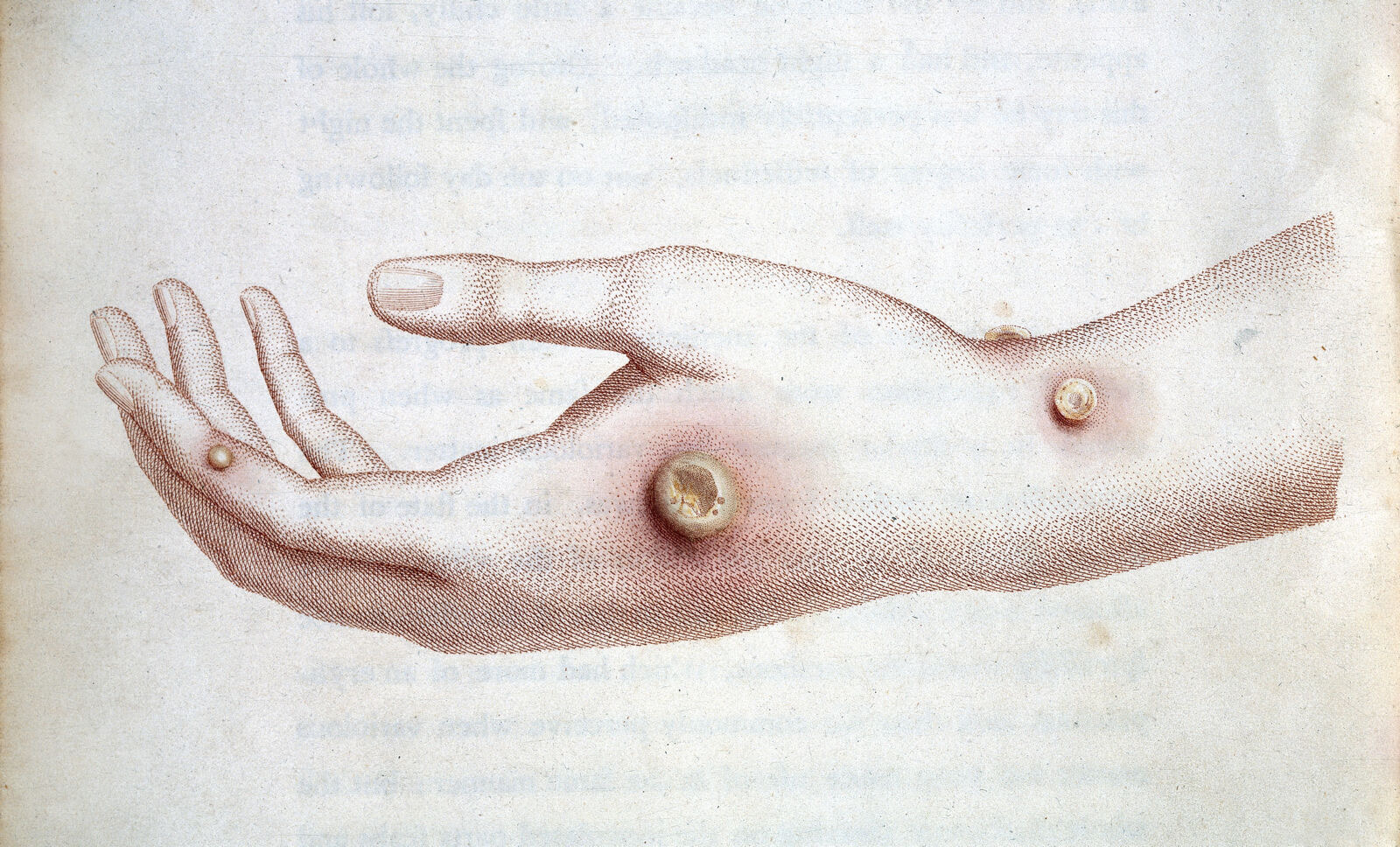
Who ran it
Edward Jenner was born in the vicarage at Berkeley on 17 May 1749, the third son of the vicar, who died when the boy was five. He was sent to school at Wotton-under-Edge and Cirencester, apprenticed to a surgeon named Ludlow at Sodbury, and then, for two years, lived in London in the house of John Hunter as a pupil. Hunter taught him the habit that the Phipps case rests on. “I think your solution is just,” Hunter wrote to him, about hedgehogs, in a letter of 2 August: “but why think, — why not try the experiment?” Jenner went home to Berkeley in 1773 and practised there for the rest of his life. He sent Hunter specimens, dissected cuckoos, and in 1788 the Royal Society printed his paper on the cuckoo’s habit of throwing its foster-siblings out of the nest, for which it elected him a fellow in 1789. That is the credit he was later told not to risk.
The cowpox came to him with the practice. “My attention to this singular disease was first excited,” he wrote in 1801, “by observing, that among those whom in the country I was frequently called upon to inoculate, many resisted every effort to give them the Small Pox. These patients I found had undergone a disease they called the Cow Pox, contracted by milking Cows affected with a peculiar eruption on their teats.” He meant inoculation with the smallpox itself, variolation, which had been practised in England since the 1720s and had become common in the country after the Suttons made it cheap and mild in the 1760s. “All the older farmers declared they had no such idea in their early days,” Jenner noted, because until the Suttons nobody had put the dairymaids to the test. The surgeons knew it too. John Fewster of Thornbury, ten miles away, had been inoculating with Sutton from 1768; a farmer who would not take the smallpox had told him, “I have had the Cow-pox lately to a violent degree, if that’s any odds.” Fewster did nothing more. Jenner belonged to a medical society that met at the Ship at Alveston, and raised the subject so often that, as he told his biographer, the members “threatened to expel him if he continued to harass them with so unprofitable a subject.”
In 1788 he carried a drawing of a milker’s hand to London. Everard Home, who saw it, told the House of Commons in 1802 that “Dr. Jenner proposed to Mr. Hunter the vaccine inoculation as a mode of preventing the small-pox,” and that Hunter’s opinion “was, that Dr. Jenner should prosecute the inquiry, as it was too new for him to form an opinion upon.” The same year Jenner married Catherine Kingscote. Their first son, Edward, was born in January 1789, and in November, by his biographer’s account, Jenner inoculated the baby with matter from what the country called the swinepox. “He sickened on the 8th day: a few pustules appeared; they were late and slow in their progress, and small.” Then, over the next three years, “variolous matter was carefully inserted into his arms at five or six different periods, without the slightest inflammation being excited in the part.” The method of Case XVII had been tried on his own child seven years before Phipps.
The other two people in the experiment appear in the book as a hand and a number. Sarah Nelmes was “a dairymaid at a Farmer’s near this place”, Case XVI, whose pustule “was so expressive of the true character of the Cow Pox” that Jenner had it drawn for the first plate. James Phipps was “a healthy boy, about eight years old”, chosen, the text says, “the more accurately to observe the progress of the infection.” The Berkeley museum that now occupies Jenner’s house records him as the son of Jenner’s gardener, Christopher Phipps. Neither the boy nor his father is recorded as having been asked.
What they were trying to find out
The hypothesis was two claims, and Jenner stated them on the second page of the book.
The first was the dairy’s belief, made exact. “What renders the Cow-pox virus so extremely singular, is, that the person who has been thus affected is for ever after secure from the infection of the Small Pox; neither exposure to the variolous effluvia, nor the insertion of the matter into the skin, producing this distemper. In support of so extraordinary a fact, I shall lay before my Reader a great number of instances.” Those are the sixteen cases. They are not experiments. Nobody chose who would milk an infected cow. What Jenner added was the second half of each: he found the people, satisfied himself that they had never had the smallpox, and inoculated them with it.
The second claim was his own, and it was the one the boy was for. He had told his friend Edward Gardner of it in March 1780, Gardner said in 1802, “declaring his full and perfect confidence that it might be continued in perpetuity by inoculation from one human being to another, in the same way that the small-pox was.” Could the disease be taken from the milker’s hand, put into a child who had never seen a cow, and protect the child? And could it then be taken from that child and put into the next? If so, the cows could be dispensed with, and the thing could be carried anywhere a lancet and a thread could go. That is what Jenner meant when he wrote to Gardner on 19 July 1796 that he had “at length accomplished what I have been so long waiting for, the passing of the Vaccine Virus from one human being to another by the ordinary mode of inoculation.”
Folded round both claims was a theory, and the book opens with the theory, not the cases. “There is a disease to which the Horse, from his state of domestication, is frequently subject. The Farriers have termed it the Grease. It is an inflammation and swelling in the heel, from which issues matter possessing properties of a very peculiar kind, which seems capable of generating a disease in the Human Body (after it has undergone the modification which I shall presently speak of), which bears so strong a resemblance to the Small Pox, that I think it highly probable it may be the source of that disease.” A man dresses a horse’s heels, milks the cows with the matter on his fingers, the cows take it on their teats, the maids take it from the cows: “Thus the disease makes its progress from the Horse to the nipple of the Cow, and from the Cow to the Human Subject.” Jenner believed it, could not demonstrate it, and said so at the end: “although I have not been able to prove it from actual experiments conducted immediately under my own eye, yet the evidence I have adduced appears sufficient to establish it.” The experiment on Phipps could not touch the theory, any more than Lind’s oranges could touch his theory of damp air in Two Oranges and a Lemon. It is the first thing in the book, and it was the first thing the critics went for.
What they built
The apparatus was a lancet, a thread or a quill, and a child. The instrument was something else. It was variolation, the inoculation of the smallpox itself, and it had been read for seventy years.
Put smallpox matter into the skin of someone who has never had the smallpox, and a known sequence follows: a red spot by the third or fourth day, a vesicle, swelling in the armpit, fever about the eighth day, and then the eruption, usually mild, sometimes not. Put the same matter into someone who has had the smallpox, and nothing follows but a local inflammation that comes quickly and dies away. Every inoculator knew both readings, because every inoculator had seen both. Jenner’s observation, in a footnote to Case IV, was that the second reading was not simply nothing. “It is remarkable that variolous matter, when the system is disposed to reject it, should excite inflammation on the part to which it is applied more speedily than when it produces the Small Pox. Indeed it becomes almost a criterion by which we can determine whether the infection will be received or not.” The protected arm answered in a different way from the unprotected one, and the difference could be seen on the fourth or fifth day. That was the gauge. The experiment put a new disease into a boy and then held the gauge against his arm.
The sixteen cases were the calibration. Joseph Merret had the cowpox in 1770 and was inoculated with his family at the general inoculation at Berkeley in April 1795: “though the variolous matter was repeatedly inserted into his arm, I found it impracticable to infect him with it.” Mary Barge, inoculated in 1791, had had the cowpox thirty-one years before. Jenner was explicit that the series depended on knowing who had already had the smallpox, and on where he was: “here, where population is thin, and where such an event as a person’s having had the Small Pox is always faithfully recorded, no risk of inaccuracy in this particular can arise.”
What the design did not have is as plain as what it did. One boy received the cowpox. No second boy was given the smallpox matter without it, to show on the same day with the same matter what the unprotected reading looked like; Jenner did not need one, in his own view, but the reader of the paper had only his word for the state of the matter on 1 July. The test itself was dangerous in a way the book does not dwell on: had the cowpox not protected the boy, the inoculation would have given him the smallpox, which was the point, and which variolation did, under the best management, sometimes fatally. And the one quantity the second claim turned on, whether the cowpox could go from the boy to a second child, was not tried, because there was no second child to try it on; Jenner “selected” one boy, and then the cowpox left the dairies.
He had also written down, without naming it, what would count as a failure. A footnote explained that cows had other sores on their teats, “of a much milder nature than those which arise from that contagion which constitutes the true Cow Pox”, which milkers caught and which gave no protection. A person who had had “the cowpox” and then took the smallpox had had the wrong cowpox. Jenner had met such cases, he wrote in 1801, and they had nearly stopped him: a person who had milked an infected cow “and had thereby apparently gone through the disease in common with others, was liable to receive the Small Pox afterwards. This, like the former obstacle, gave a painful check to my fond and aspiring hopes.” His answer was that the matter, like smallpox matter, “was liable to undergo progressive changes”, and that taken too late from the sore it would make a sore without making a change. Every failure, from then on, had a place to go.
The first of July
Jenner wrote the result to Gardner from Berkeley on 19 July 1796. “A boy of the name of Phipps was inoculated in the arm from a pustule on the hand of a young woman who was infected by her master’s cows. Having never seen the disease but in its casual way before; that is, when communicated from the cow to the hand of the milker, I was astonished at the close resemblance of the pustules, in some of their stages, to the variolous pustules. But now listen to the most delightful part of my story. The boy has since been inoculated for the small pox which, as I ventured to predict, produced no effect. I shall now pursue my experiments with redoubled ardour.”
The printed version is drier, and says what he saw. The cowpox incisions ran “much the same as when produced in a similar manner by variolous matter”, the fluid in them “rather a darker hue”, the redness round them “more of an erysipelatous look”, and “the whole died away (leaving on the inoculated parts scabs and subsequent eschars) without giving me or my patient the least trouble.” Then: “In order to ascertain whether the boy, after feeling so slight an affection of the system from the Cow-pox virus, was secure from the contagion of the Small-pox, he was inoculated the 1st of July following with variolous matter, immediately taken from a pustule. Several slight punctures and incisions were made on both his arms, and the matter was carefully inserted, but no disease followed. The same appearances were observable on the arms as we commonly see when a patient has had variolous matter applied, after having either the Cow-pox or the Small-pox. Several months afterwards, he was again inoculated with variolous matter, but no sensible effect was produced on the constitution.”
Years later, telling the story to Parliament, he admitted what the letter had not: “as the indisposition attending it was barely perceptible, I could scarcely persuade myself the patient was secure from the small-pox. However, on his being inoculated some months afterwards, it proved that he was secure.” The illness of the ninth day had been so slight that the man who had predicted the result doubted it until the gauge was read.
One more sentence in the book belongs to the first of July. The boy, “while the experiment was going forward,” had “slept in a bed with two children who never had gone through either that disease or the Small-pox, without infecting either of them.” Jenner cited it to show that the cowpox did not spread through the air. It also means that for seven weeks in the summer of 1796 the experiment had, without anyone calling them that, two controls in the same bed, and that nobody read them.
“Here my researches were interrupted till the spring of the year 1798,” the next sentence says. The spring of 1797 was dry, the horses’ heels did not crack, and there was no cowpox in the dairies. Jenner wrote to a friend on 2 August 1797 that he had “sent a messenger to Bristol, in vain, to procure the true virus. I even procured a young horse, kept him constantly in the stable, and fed him with beans in order to make his heels swell, but to no purpose.” The one experiment stood alone for twenty-two months.
What it looked like from inside
He had meant it for the Royal Society. In June 1797 he wrote that he had “shown a copy of my intended paper on the cow-pox to our friend Worthington, who has been pleased to express his approbation of it, and to recommend my publishing it as a pamphlet instead of sending it to the Royal Society.” What happened at the Society is known only from his biographer John Baron, who had it from Jenner and put it late in the second volume, where it would not be prominent. “When the subject was laid before the President, Jenner was given to understand, that he should be cautious and prudent; that he had already gained some credit by his communications to the Royal Society, and ought not to risk his reputation by presenting to the learned body anything which appeared so much at variance with established knowledge, and withal so incredible.” The President was Sir Joseph Banks, who had handled the cuckoo paper. Baron did not know “whether Sir Joseph had any secret advisers” and said the matter had been “managed somewhat uncourteously”, and his conclusion is exact: “Jenner was deterred from presenting his paper to the Royal Society.” There was no submission and no referee; the President had been sounded, and the answer was that one boy was not enough for the Philosophical Transactions.
The men who said so were not fools, and one of them had said it a year earlier in writing. John Haygarth of Chester, who had published a plan for exterminating the smallpox by isolation and inoculation, was told of the cowpox by Jenner’s friend Worthington and replied on 11 August 1796, when Phipps had been tested six weeks: “Your account of the cow-pox is indeed very marvellous: being so strange a history, and so contradictory to all past observations on this subject, very clear and full evidence will be required to render it credible.” He went on: “The author should admit nothing but what he has proved by his own personal observation, both in the brute and human species.” And: “If a physician should adopt such a doctrine, and much more, if he should publish it upon inadequate evidence, his character would materially suffer in the public opinion of his knowledge and discernment.” Jenner took the second sentence as a rule; the book admits only what he saw. The third is the Royal Society’s advice, from a friend.
Jenner’s own fear was the same. Riding with Gardner on the road between Gloucester and Bristol, Baron says, he had laid out the whole scheme and asked him to keep it to himself, “for should any thing untoward turn up in my experiments I should be made, particularly by my medical brethren, the subject of ridicule — for I am the mark they all shoot at.”
What he did instead of a control was more cases. The cowpox came back in March 1798, from a mare with sore heels at a dairy in the next parish. On 16 March he inoculated John Baker, five, from a servant who had dressed the mare, and William Summers, five and a half, from the cow. Baker went through the slight illness and could not be tested: he “unfortunately died of a fever at a parish workhouse”, the next year’s pamphlet says, “before I had an opportunity of observing what effects would have been produced by the matter of Small Pox.” From Summers the disease went on 28 March to William Pead, eight; from Pead on 5 April to “several children and adults”, among them Hannah Excell, seven; from Excell on 12 April to four more, among them Jenner’s second son, Robert, eleven months, who “did not receive the infection”; and from Mary Pead to J. Barge, seven. Then the test. Summers was inoculated with smallpox matter “from a fresh pustule” and “the system did not feel the effects of it in the smallest degree.” Pead and Barge were inoculated by Jenner’s nephew Henry, who reported inflamed incisions on the second day and none by the sixth, and then wrote the sentence that is the first control in the whole book: “To convince myself that the variolous matter made use of was in a perfect state, I at the same time inoculated a patient with some of it who never had gone through the Cow-pox, and it produced the Small-pox in the usual regular manner.” The control was for the matter, not the children, and it was the nephew’s idea. “These experiments afforded me much satisfaction,” Jenner wrote; “they proved that the matter in passing from one human subject to another, through five gradations, lost none of its original properties.”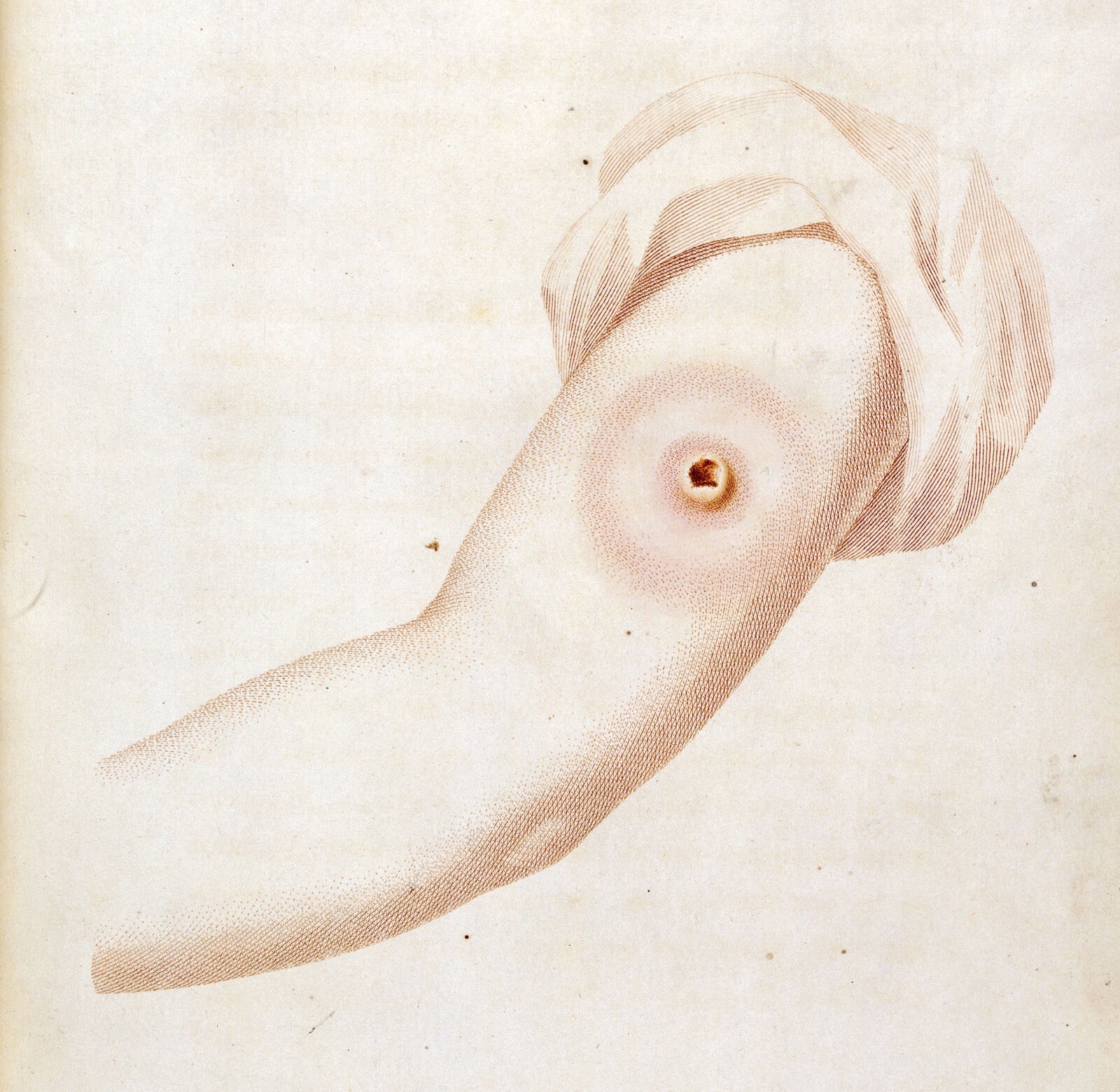
He then went to London with the manuscript, from 24 April to 14 July 1798, to show the disease to the profession, and could not. “It will scarcely be believed,” Baron wrote, “that with all his efforts and those of his friends, he was unable during the period of nearly three months that he continued in the metropolis, to procure one person on whom he could exhibit the vaccine disease.” The dedication to Caleb Parry of Bath was dated 21 June, and the book came out at the end of the month, from a printer in Soho, at the author’s expense. The epigraph on the title page is from Lucretius: what can be more certain to us than the senses themselves, by which we mark the true and the false?
The first person in London to try it was Henry Cline, surgeon to St Thomas’s, to whom Jenner had left some of Hannah Excell’s matter dried on a quill and kept three months in a sealed tube. At the end of July Cline put it into the hip of a child who had a diseased hip-joint, meaning to turn the pustule into an issue for the joint. On 2 August he wrote: “The cow-pox experiment has succeeded admirably. The child sickened on the seventh day; and the fever, which was moderate, subsided on the eleventh day.” Then: “I have since inoculated him with small-pox matter in three places, which were slightly inflamed on the third day, and then subsided. Dr. Lister, who was formerly physician to the Small-pox Hospital, attended the child with me, and he is convinced that it is not possible to give him the small-pox.” Cline tried to carry the disease on to three more children, and on 18 August had “the mortification of finding that the infection has not taken.” He thought the practice promised “one of the greatest improvements that has ever been made in medicine”, and offered to guarantee Jenner ten thousand pounds a year if he would move to Grosvenor Square. Jenner would not.
The first attack came from a man who knew the smallpox better than anyone in Europe. Jan Ingenhousz, who had inoculated the Imperial family at Vienna, was staying at Bowood in Wiltshire in October 1798, read the book, asked the first surgeon he met, and wrote to Jenner on the 12th. A farmer at Whitley near Calne had caught the cowpox badly thirty years before, been inoculated for the smallpox when the sores were dry, “and a great many small-pox came out, and he communicated the infection to his father, who died of it.” This fact, “of which I obtained the knowledge from the very first man to whom I addressed myself”, should make Jenner “inquire farther on the subject, before you venture finally to decide in favour of a doctrine, which may do great mischief should it prove erroneous.” Jenner’s reply is the inside of the experiment in two sentences. “Should it appear in the present instance that I have been led into error, fond as I may appear of the offspring of my labours, I had rather strangle it at once than suffer it to exist, and do a public injury.” And then the rule the boy had been read by, made general: “I conceive it would be prudent, until further inquiry has thrown every light on the subject which it is capable of receiving, that (like those who were the objects of my experiments) all should be subjected to the test of variolous matter who have been inoculated for the cow-pox.” The farmer at Whitley, he explained, had had the spurious disease.
What happened
George Pearson, physician to St George’s, took up the book that autumn, wrote to practitioners all over the country, and in November 1798 published what they had sent him. He gave Jenner “the justest title” to the discovery and “would not pluck a sprig of laurel from the wreath that decorates his brow”, and then took the first chapter apart. The horse-grease theory, he wrote, “has no better support, than the coincidence in some instances of the prevalence of the two diseases in the same farm”. Sir Isaac Pennington wrote from Cambridge that in two parishes with three thousand milch cows and cart-horses “much liable to the scratches or grease”, nobody had heard of the cowpox. Dr Parr of Exeter thought the book “a libel on his own neighbourhood”. Fewster of Thornbury wrote that he did “not see any great advantage from inoculation for the Cowpox”. Everyone had a theory of the cowpox; only one of them had a boy.
Then London found a cow. On Sunday 20 January 1799 William Woodville, physician to the Smallpox Hospital, was told that the cowpox had broken out among the two hundred cows of a dairy in Gray’s Inn Lane. He inoculated seven people from the teats on the Monday, and on Friday 25 January brought Banks, Pearson and the rest to the cowshed with Jenner’s book, “and upon comparing your figure with the disease it was allowed by all to be a very faithful representation”. By May he had inoculated about six hundred people, most of them in the Smallpox Hospital, and had put the gauge to “upwards of 400” of them: “none were affected with the Small-pox”.
Something else had happened to three-fifths of them. They had broken out in pustules, some in a few, Ann Bumpus in 310, “all of which suppurated”. Jenner had written that in the cowpox “no pustules appear”. Pearson wrote to him on 15 February: “You will be astonished at our talking of eruptions, but it now appears in Dr. Woodville’s cases that as many have eruptions on the body as have them only in the parts inoculated.” A child he had inoculated from one of Woodville’s patients had gone through what looked “exactly as the inoculated small-pox”, with convulsions on the ninth day. What Woodville had done, because he had “then had no proof” that the cowpox would protect, was to inoculate his first patients with smallpox matter in the other arm on the fifth day, in a hospital whose wards were full of the smallpox, and to carry the next inoculations on from their arms. Jenner told him in the end, in a word Woodville did not like, that the matter had been contaminated.
The stock went out anyway. Pearson told the Commons in 1802 that he had “issued a printed letter, directed to upwards of 200 practitioners in different parts of the kingdom, containing thread impregnated with cow-pox matter”, and that two thousand cases had been reported back by the summer of 1799. A surgeon named Jordan told the same committee that matter sent to him from the hospital as vaccine “proved to be variolous”, and that since then he armed his own lancets. Woodville sent Jenner a thread from Ann Bumpus. Jenner inoculated twenty people with it in Gloucestershire, and another surgeon 140, “without producing any pustules which maturated”; passed through a few country arms, the thing from the Smallpox Hospital had become the thing from Berkeley again, and nobody could say what it had been in between. The question of which disease the first two thousand Londoners had actually been given was never settled, and the companion piece “Gray’s Inn Lane” follows it through the letters.
Jenner’s answer to every failure was the doctrine of the spurious cowpox and the state of the matter, set out in a second pamphlet in 1799 and a third in 1800. The true disease, taken at the right time, protected for life; a sore that did not, had not been the true disease, or had been taken too late. The doctrine was correct about the London stock. It was also a doctrine that could not lose, and the critics said so. William Goldson, a surgeon at Portsea, published in 1804 the cases of children he had vaccinated in 1800 and 1801 who, inoculated with the smallpox on 5 June 1804, had arms that inflamed, and one who “was attacked with fever, attended with delirium.” Jenner’s reply, in a letter of that year, went back to the boy: “Phipps, too, the boy on whom I made my first trial more than eight years ago, has again been put to the trial with impunity.” And he added a sentence that quietly changed the instrument: “I will just remark that the fairest of all tests is exposure to variolous contagion; this is the natural test, inoculation is not.” Benjamin Moseley of Chelsea Hospital wrote the next year that the cowpox, “Like a brutal foe to mankind, it treacherously disarms us; leaves us defenceless; lulls us into imaginary security, — and then exposes us to assassination.” The critics are followed in “The objections”.
Meanwhile the count went up. “An hundred thousand persons, upon the smallest computation, have been inoculated in these kingdoms,” Jenner wrote in May 1801, and “it now becomes too manifest to admit of controversy, that the annihilation of the Small Pox, the most dreadful scourge of the human species, must be the final result of this practice.” In March 1802 he petitioned the House of Commons. A committee under Admiral Berkeley examined Home, Cline, Pearson, Woodville, Gardner and forty others, and heard that the kingdoms lost perhaps 36,000 or 45,000 people a year to the smallpox. The report came up on 2 June 1802. The chairman moved ten thousand pounds and said he did not think it enough; Sir Henry Mildmay moved twenty thousand; the House divided, and ten thousand stood, “Ayes, 59. Noes, 56. — Majority, 3.” In 1807, on a second petition, it voted twenty thousand more, sixty to forty-seven.
After
James Phipps grew up in Berkeley. Baron, riding with Jenner about 1818, passed him on the road. “Oh! there is poor Phipps,” Jenner said, “I wish you could see him; he has been very unwell lately, and I am afraid he has got tubercles in the lungs. He was recently inoculated for small-pox, I believe for the twentieth time, and all without effect.” In October 1818 Baron found a plan of a cottage on Jenner’s table: “that is for poor Phipps; you remember him: he has a miserable place to live in; I am about to give him another.” The cottage was built and its garden stocked with roses from Jenner’s own shrubbery. It stands in Church Lane. Jenner also showed Baron, hanging in the coach-house, the hide of the cow from which Sarah Nelmes had taken her sore. “Send it to the British Museum,” Baron said.
Jenner walked to Ham to order fuel for the poor on Friday 24 January 1823, was found insensible on his library floor the next morning, and died about three o’clock on the morning of Sunday 26 January. Phipps was at the funeral. He was buried in St Mary’s churchyard, a stone’s throw from the cottage, on 25 April 1853.
The claim of “for ever” did not hold. In the course of the nineteenth century it became plain that the protection wore off and that revaccination was needed. The identity of the thing itself held out longer. The virus that was passed arm to arm and then calf to calf for two centuries is not the cowpox; it was named vaccinia and it matches no virus found in a cow. In 2017 a vial of American vaccine made in 1902 was sequenced in Berlin, and the closest match was the horsepox. Jenner’s theory of the grease, the part of the book that nobody could confirm and that Pearson took apart first, may have been the nearest thing in it to the truth. The last natural case of smallpox was in 1977, and on 8 May 1980 the World Health Assembly declared the disease gone from the world: the annihilation Jenner had announced as “too manifest to admit of controversy” in 1801, 179 years later.
What it taught
Begin with what was shown, because something was. A boy who had been given the cowpox did not take the smallpox when it was put into both his arms, twice in 1796, again five years later, and, by Jenner’s own count, some twenty times in his life. Six children in 1798 did not take it either. Four hundred Londoners in 1799 did not take it. The result was true. Almost everything else in the book, and most of what was said about it for the next ten years, was argument about what the result was evidence of, and that argument is what the case teaches.
The experiment was the test, not the inoculation. A farmer in Dorset, Benjamin Jesty, had scratched cowpox into his wife and sons with a darning-needle in 1774, and the London institute that honoured him for it in 1805 had to inoculate him and his son with the smallpox first to show that it had worked. Fewster had the fact in 1768 and let it go. What Jenner added on 1 July 1796 was the reading: a mild disease given deliberately, then the known instrument held to the arm. Without the first of July, the fourteenth of May is a man scratching a child.
With a sample of one, the control lives in the history of the instrument. Jenner had no second boy because, in his own mind, he had seventy years of inoculated arms. The protected reading and the unprotected reading were the two commonest sights in his practice, and the footnote to Case IV says he could tell them apart on the fourth day. That is a real control, and it is also an invisible one: it existed in the inoculator’s experience and nowhere on the page. The nephew who, in 1798, inoculated an unprotected patient with the same matter put one sentence of it on the page, and that sentence is the only place in the book where a reader can check the gauge rather than take the author’s word for it. The Royal Society’s advice was not wrong. It was the advice of readers who could not see the instrument.
A result that cannot fail is not the same as a result that is right. The doctrine of the spurious cowpox was correct: there were other sores on cows’ teats, the matter did decay in the pustule, and the London stock was contaminated. It also meant that every failure proved the matter had been wrong rather than the claim, and so the claim of “for ever” went untested for thirty years. Goldson’s children in 1804 were read as badly vaccinated. Some of them probably were. The doctrine could not tell.
The thing that was shipped was not the thing that was tested. What Phipps received was a dairymaid’s sore. What two hundred practitioners received from London in 1799 was a thread charged in a smallpox hospital from the arms of patients who had been inoculated with the smallpox in the other arm on the fifth day, and one surgeon found it was the smallpox. Jenner’s result travelled under Jenner’s name in a form Jenner had never tested. Lind’s rob is the same lesson in a china bowl.
The theory on page one was not tested by the experiment on page thirty-two, and the critics knew which page to read. Pearson, Pennington and Parr went for the grease, where Jenner had the least evidence and the most confidence; Ingenhousz went for the dairy stories. Neither touched the boy.
The complication is that it worked. One boy, read with an instrument the reader had to take on trust; a theory of origin that was ridiculed and may have been nearly right; a claim of lifelong protection that was wrong; a stock that for its first year in London was partly the disease it was meant to prevent; and a doctrine that explained away every failure. Out of that came the one disease human beings have removed from the world. The experiment was sound, the inference ran far beyond it, and what finally made the inference good was not Case XVII but the four hundred at the Smallpox Hospital, the two thousand on Pearson’s threads, and the hundred thousand of 1801: a sample that nobody designed, and that would have been impossible without the one boy. A Dozen Healthy Infants is the same number with the opposite ending, and the difference is not the design, which was no better. It is that Jenner’s instrument had been calibrated on a continent of arms before he held it to one, and that he kept holding it there, on the same arm, for twenty years, and told everyone to do the same.
Sources
- Edward Jenner, An Inquiry into the Causes and Effects of the Variolæ Vaccinæ, a Disease Discovered in Some of the Western Counties of England, Particularly Gloucestershire, and Known by the Name of the Cow Pox, London: printed for the author by Sampson Low, 1798. The dedication to Parry of 21 June 1798; the grease; “for ever after secure”; the sixteen casual cases and their inoculations; the footnotes on the spurious cowpox and on the “criterion”; Case XVI (Sarah Nelmes) and Case XVII (the boy, 14 May and 1 July 1796); the children of March and April 1798; Henry Jenner’s control; “five gradations”; the two children in the bed; the dry spring of 1797; the closing paragraph. Read in the Project Gutenberg transcription from the Posner copy at Carnegie Mellon and checked against the Wellcome scans. gutenberg.org, archive.org
- Edward Jenner, Further Observations on the Variolæ Vaccinæ, or Cow Pox, London, 1799. John Baker’s death at the workhouse; the state of the matter; the two children inoculated from the London thread; the eighteen at Eastington; the eruptions in London. archive.org
- Edward Jenner, A Continuation of Facts and Observations Relative to the Variolæ Vaccinæ, or Cow Pox, London, 1800. The reply to the London eruptions. archive.org
- Edward Jenner, The Origin of the Vaccine Inoculation, London, 1801. “My attention to this singular disease”; the farmers’ old opinion; the painful check; “I could scarcely persuade myself”; the hundred thousand; “the annihilation of the Small Pox”. archive.org
- John Baron, The Life of Edward Jenner, M.D., vol. 1, London: Colburn, 1827. Birth, Ludlow, Hunter and “why not try the experiment”; the Alveston society and the threat to expel him; Fewster; the Gardner conversation; the swinepox inoculation of his son in November 1789; Haygarth’s letter of 11 August 1796; Nelmes and Phipps named; the letter to Gardner of 19 July 1796; the intention to publish in the Philosophical Transactions; Worthington’s advice of June 1797; the horse fed on beans; the review at Rudhall; the London visit of 1798; Cline’s letters of 2 and 18 August 1798; Farquhar’s ten thousand a year; “a gilded butt”; Ingenhousz’s letter of 12 October 1798 and Jenner’s reply; Woodville’s letter of 25 January 1799 and Jenner’s reply; Pearson’s letter of 15 February 1799; the Wachsel anecdote; “contaminated”; the petition of 1802, the Committee’s three questions, the debate and the division of 59 to 56. Quotations from Jenner’s, Gardner’s, Haygarth’s, Cline’s, Ingenhousz’s, Woodville’s and Pearson’s letters are at second hand through Baron. archive.org
- John Baron, The Life of Edward Jenner, M.D., vol. 2, London: Colburn, 1838. The Royal Society’s advice (“so much at variance with established knowledge, and withal so incredible”) and “Jenner was deterred”; the vote of 1807, 60 to 47; the letter of 1804 on Goldson, Phipps “put to the trial with impunity” and “the natural test”; the hide in the coach-house, the cow at Bradstone, “poor Phipps” and his twentieth inoculation, the cottage of October 1818; Jenner’s last days and death on 26 January 1823. archive.org
- George Pearson, An Inquiry Concerning the History of the Cowpox, Principally with a View to Supersede and Extinguish the Smallpox, London, 1798. “The justest title” and the sprig of laurel; the grease theory’s “no better support”; Sir Isaac Pennington’s letter of 14 September 1798; Dr Parr’s “libel”; Fewster’s letter of 11 October 1798 to Rolph on his practice from 1768 and “no great advantage”. archive.org
- William Woodville, Reports of a Series of Inoculations for the Variolæ Vaccinæ, or Cow-Pox, London, 1799. The Gray’s Inn Lane dairy, its two hundred cows and Sarah Rice; the visit of 24 January 1799; the seven inoculated on 21 January; the smallpox inoculated on the fifth day; the new lancets; Ann Bumpus’s 310 pustules and the Gloucestershire trials of her stock; “about 600” inoculated and “upwards of 400” tested without smallpox. archive.org
- The Evidence at Large, as Laid before the Committee of the House of Commons, Respecting Dr. Jenner’s Discovery of Vaccine Inoculation, London, 1805. Jenner’s statement of the Phipps case and the footnote on the test five years later; Home on the drawing of 1788 and Hunter’s opinion; Farquhar on Cline’s offer; Pearson on the threads sent to upwards of 200 practitioners and the 2,000 cases; Gardner on March 1780; Jordan on the matter that “proved to be variolous”; the bills of mortality and the estimates of 36,000 and 45,000 deaths a year; Admiral Berkeley’s motion. archive.org
- William Goldson, Some Recent Cases of Small Pox Subsequent to Vaccination, Portsea, 1804. The Fuller children vaccinated in 1800 and inoculated with smallpox on 5 June 1804; the girl inoculated in April 1804 “to try whether time had weakened its prophylactic powers”. archive.org
- Benjamin Moseley, A Treatise on the Lues Bovilla, or Cow Pox, second edition, London, 1805. “Like a brutal foe to mankind”. archive.org
- Wellcome Collection, “The hand of Sarah Nelmes infected with the cowpox”, glass-plate photograph of Plate I of the 1798 Inquiry, M0009446, and “Jenner, An inquiry into the causes & effects”, Plate III opposite page 38, L0031742; both released CC BY 4.0. The two figures. wellcomecollection.org, wellcomecollection.org
- Dr Jenner’s House, Museum and Garden, Berkeley, “James Phipps’ Cottage, Church Lane”. Phipps as the son of Jenner’s gardener Christopher Phipps, the leasehold of the cottage, and his burial on 25 April 1853 aged sixty-six. jennermuseum.com
- Stefan Riedel, “Edward Jenner and the history of smallpox and vaccination,” Proceedings (Baylor University Medical Center), vol. 18 no. 1 (January 2005), pages 21 to 25. Revaccination, the eradication campaign, the last case in 1977 and the declaration of 8 May 1980. pmc.ncbi.nlm.nih.gov
- Livia Schrick, Clarissa R. Damaso, José Esparza and Andreas Nitsche, “An Early American Smallpox Vaccine Based on Horsepox,” New England Journal of Medicine, vol. 377 (12 October 2017), pages 1491 to 1492. The 1902 vial sequenced in Berlin and its match to the horsepox. doi.org
- “Benjamin Jesty,” Wikipedia, and the Gold Hill Museum, Shaftesbury, “The Unsung Dorset Pioneer of Vaccination Against Smallpox”. Jesty’s inoculation of his wife and sons in 1774 and his examination and testimonial from the Original Vaccine Pock Institution in 1805; general references used for those points only. en.wikipedia.org, goldhillmuseum.org.uk
- “Edward Jenner,” Wikipedia. His election to the Royal Society in 1789 and his marriage in 1788; a general reference used for those points only. en.wikipedia.org
How this entry came about
Written in one unattended session on 21 October 2026 under the standing rules in _ideas/OVERNIGHT.md, from the open sources above. The Inquiry, Jenner's three later pamphlets, Pearson, Woodville, Goldson, Moseley, the 1802 evidence and both volumes of Baron were read in full or in the relevant parts on archive.org; the Gutenberg transcription of the Inquiry was used for quotation, with its corrected errata, and the Wellcome scans for the plates.
Decisions under the rules. Figures (rule 1): two, both plates of the 1798 first edition, a publication before 1930, taken from the Wellcome Collection's own photographs, whose catalogue entries carry a CC BY 4.0 release checked through the Collection's API; the Pead plate is cropped of its blank margins and nothing is upscaled; an engraved portrait of Jenner in the same collection was left out because its record shows no licence. Length (rule 2): a first draft of 7,400 words was cut to the limit by moving the London trials of 1799 into one companion piece and the objections of 1796 to 1805 into a second, each under 3,000 words. Sources (rule 3): every letter of Jenner, Gardner, Haygarth, Cline, Ingenhousz, Woodville and Pearson is quoted as Baron prints it, and the Sources bullet says so; Fewster's letter was checked against Pearson's own printing; Hunter's "why not try the experiment" is from Baron's transcript of a letter dated only "August 2d". The date (rule 4): set at 05:30 with minutes when the text was final, because every whole hour of 21 October up to 10:00 already carried an entry on main, the writer ahead had taken 04:45, and a later hour would have been future-dated; this follows the night's earlier entries at 01:30, 02:30, 02:45, 03:45 and 04:30. Title (rule 5): "Case Seventeen", unused. Narration: the first render queue was stopped after a minute, before anything had rendered, to fix a dangling reference and a Roman numeral the voice reads as "Roman fifteen", and restarted; the render gate's load ceiling was raised from 30 to 90 for this run, as an earlier writer had raised it to 60 tonight, because the machine's load of 50 to 70 came from another account's file and media daemons with no narration running (rule 10). A planned second companion on the twenty-three cases of the Inquiry was dropped in the writing and replaced by one on the objections; the entry's links were changed to match.
Numbers that sources disagree on. Baron says Jenner's son Edward was "about one year and a half old" when inoculated with swinepox in November 1789, but gives his birth as 24 January 1789, which makes him ten months; the entry gives neither age. Woodville's letter of 25 January says he inoculated six persons on the Monday, his printed Reports say seven; the entry follows the printed figure. The Commons evidence gives the kingdoms' smallpox deaths as 36,000 in one witness's calculation and 45,000 in the chairman's motion; both are given. The Jenner Museum gives Phipps's age at burial as sixty-six and the Science Museum his dates as 1788 to 1853; the entry gives the burial age. Phipps's presence at Jenner's funeral on 3 February 1823 rests on the Wikipedia article on him and is stated without a source bullet of its own.
Not reached: the Royal Society's own records for 1797, which Baron does not cite and which the entry does not claim exist; the 1802 Committee's Report as printed in the Commons journals (its findings are given through Baron's abstract and the evidence volume); Fewster's 1765 communication to the Medical Society of London, known here only through his 1798 letter; Jesty's 1805 testimonial, known through secondary accounts. The ODNB and the Fisher biography are paywalled and were not used. The checker's remaining WARN lines are the narration lines and the NEJM address, which answers 403 to scripts and opens in a browser.