On a day in the first week of December 1919 that nobody wrote down, in a small dark room in the Phipps Psychiatric Clinic of the Johns Hopkins Hospital in Baltimore, a baby of eight months and twenty-six days was set on a mattress on a table. A young woman in front of him moved her hand until he turned to look at it. A man behind him swung a hammer at a steel bar four feet long and three-quarters of an inch thick, hung so that it rang. “The child started violently,” the laboratory notes say, “his breathing was checked and the arms were raised in a characteristic manner. On the second stimulation the same thing occurred, and in addition the lips began to pucker and tremble. On the third stimulation the child broke into a sudden crying fit. This is the first time an emotional situation in the laboratory has produced any fear or even crying in Albert.”
The baby weighed twenty-one pounds. In the three months that followed he was brought back to the room five more times, and on the last of them, the day his mother took him out of the hospital, he was a year and twenty-one days old. The paper that reported what was done to him in between is fourteen pages long, appeared in the February 1920 number of the Journal of Experimental Psychology, and has been in the textbooks ever since, where it is the proof that fear is learned. Its second paragraph begins: “Experimental work has been done so far on only one child, Albert B.”
Four years later the man with the hammer wrote the sentence that every student of psychology has heard: “Give me a dozen healthy infants, well-formed, and my own specified world to bring them up in and I’ll guarantee to take any one at random and train him to become any type of specialist I might select.” He never had a dozen. He had one, for a winter, and he never found out what became of him. Neither, for ninety years, did anyone else. When people did go looking, two babies born in the same week to two wet nurses in the same building both fitted the description, and the search for which of them it had been took up more careful measurement than the experiment ever had. This entry is about the number that was printed on the first page and read by nobody: one.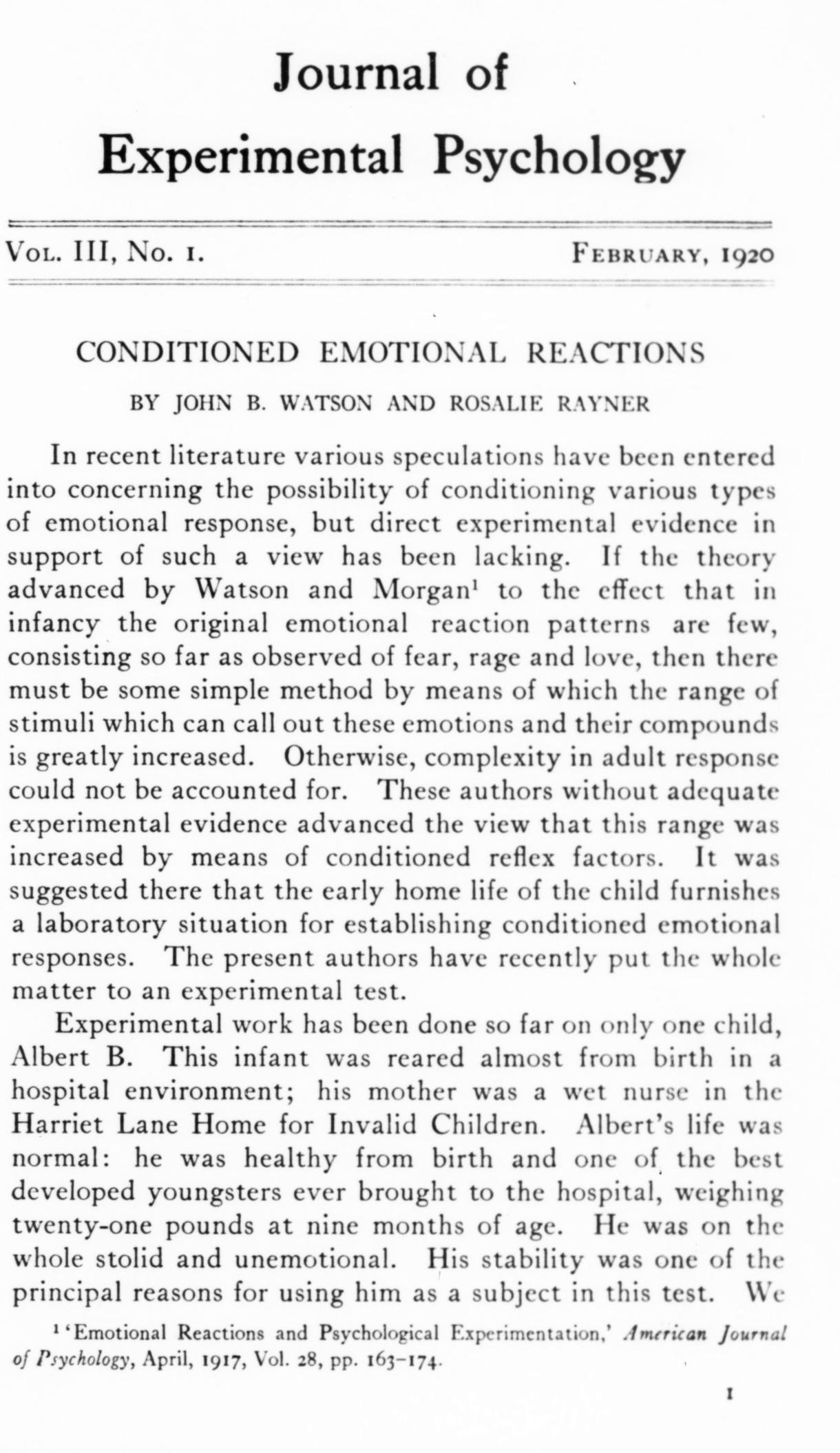
Who ran it
John Broadus Watson was born in January 1878 near Greenville, South Carolina, and took his doctorate at the University of Chicago in 1903 with a thesis on the learning of white rats. In 1908 Johns Hopkins made him a professor, and in 1913 he gave the lecture that named a school: “Psychology as the behaviorist views it is a purely objective experimental branch of natural science. Its theoretical goal is the prediction and control of behavior.” He edited the Journal of Experimental Psychology, which he had founded in 1915, and his laboratory was housed in the Phipps Clinic under its director, the psychiatrist Adolf Meyer. By 1917 he had moved from rats to babies, and that spring, with J. J. B. Morgan, he published the theory that the experiment was built to test. He came back from the army to Baltimore in December 1918.
Rosalie Rayner was born in Baltimore in September 1898, took her degree at Vassar in June 1919, and in the last days of September began as Watson’s graduate assistant. She was twenty-one. She is the woman in the film whose moving hand the baby was made to follow. In 1920 their affair became public, and in October, when he would not end it, Johns Hopkins made him resign. The Albert paper was the last research of his academic career. He went into advertising with J. Walter Thompson in New York, married Rayner when the divorce was through, and for the rest of his life wrote about children from an advertising office. Rayner died in 1935, aged thirty-six. Watson died in 1958. Late in life he burned his papers, saying, by his biographer’s account, “When you’re dead, you’re all dead.”
The third person in the room is the one the paper names least. The Harriet Lane Home for Invalid Children was the hospital’s paediatric building, opened in 1912, and like other hospitals of its time it kept wet nurses in residence, young unmarried women whose milk fed the sick infants on the wards and whose own babies lived there with them. Watson had been using those babies since 1918. His 1919 textbook describes three of them, “splendid, healthy types” of 165, 126 and 124 days, whose “mothers were the wet nurses belonging to the hospital”, and who were interesting precisely because they “had never been out of the hospital and had never seen an animal.” A corridor joined the Home to the Phipps Clinic, so a baby could be carried to the laboratory without going out into the winter air. On 12 January 1920 Watson wrote to the president of the university that paying the mothers a dollar a visit was straining his budget.
Albert B. was one of these babies. He “was reared almost from birth in a hospital environment; his mother was a wet nurse in the Harriet Lane Home for Invalid Children. Albert’s life was normal: he was healthy from birth and one of the best developed youngsters ever brought to the hospital, weighing twenty-one pounds at nine months of age. He was on the whole stolid and unemotional. His stability was one of the principal reasons for using him as a subject in this test. We felt that we could do him relatively little harm by carrying out such experiments as those outlined below.” That is everything the paper says about who he was. His mother is not named, not described, and not recorded as having been asked.
What they were trying to find out
The hypothesis had been printed in April 1917, in the American Journal of Psychology, and it was two claims.
The first was about what a baby is born with. “After observing a large number of infants, especially during the first months of life, we suggest the following group of emotional reactions as belonging to the original and fundamental nature of man: fear, rage, and love.” Each had its own native trigger. Fear was called out by two things only, “To suddenly remove from the infant all means of support, as when one drops it from the hands to be caught by an assistant,” and “By loud sounds.” Everything else that people said babies feared, Watson and Morgan denied. “It is often stated that children are instinctively afraid in the dark (Thorndike). While we shall advance our opinion with the greatest caution, we have not so far been able to gather any evidence to this effect.” The 1919 textbook put the three Harriet Lane babies in front of “a very lively, friendly black cat”, a pigeon, a rabbit, a white rat and a dog in a dark room, and reported that they reached for every one of them.
The second claim was about how the rest of fear arrives. If a newborn fears only noise and falling, and an adult fears the dark, snakes, mice, the woods and the water, then “there must be some simple method by means of which the range of stimuli which can call out these emotions and their compounds is greatly increased.” The method proposed was Pavlov’s: the conditioned reflex. A fear would attach itself to whatever happened to be present when the native trigger fired, and “the early home life of the child furnishes a laboratory situation for establishing conditioned emotional responses.” The 1920 paper is honest that this had been asserted “without adequate experimental evidence”. The experiment was to supply it.
The paper then states what it will test, as four numbered questions. First: “Can we condition fear of an animal, e.g., a white rat, by visually presenting it and simultaneously striking a steel bar?” Second: “If such a conditioned emotional response can be established, will there be a transfer to other animals or other objects?” Third: “What is the effect of time upon such conditioned emotional responses?” Fourth: “If after a reasonable period such emotional responses have not died out, what laboratory methods can be devised for their removal?” The first three were answered on Albert. The fourth was not answered at all, and the reason it was not is the hinge of the story.
What they built
The apparatus was a steel bar and a hammer, a mattress on a table “in a small, well-lighted dark-room”, a basket with a white rat in it, and a set of things to show a baby: a rabbit, a dog, a monkey, masks with hair and without, a sealskin coat, cotton wool, a package of wooden blocks, burning newspaper. The method was the one from the 1919 textbook: present each object suddenly and record what the child does. Those presentations, the “emotional tests that have become a part of our regular routine”, were the baseline. At nine months Albert reached for everything. “At no time did this infant ever show fear in any situation. These experimental records were confirmed by the casual observations of the mother and hospital attendants. No one had ever seen him in a state of fear and rage. The infant practically never cried.”
There was also a camera. Through October and November 1919 Watson lobbied the president of the university, Frank Goodnow, for $450 to buy a thousand feet of motion-picture film, arguing in a letter of 13 November that “such a work has never hitherto been undertaken.” The money was approved on 19 November. On 5 December he thanked Goodnow and said he was “waiting for a warm spell to start in on the work.” The baseline session with Albert, at eight months and twenty-six days, was filmed; so were the later ones. The film was cut together, titled Experimental Investigation of Babies, and sold through the C. H. Stoelting Company of Chicago from 1923: five minutes of Albert in thirty-four clips, silent, from one camera, the only instrument from the experiment that survives. The paper calls it “a permanent record”.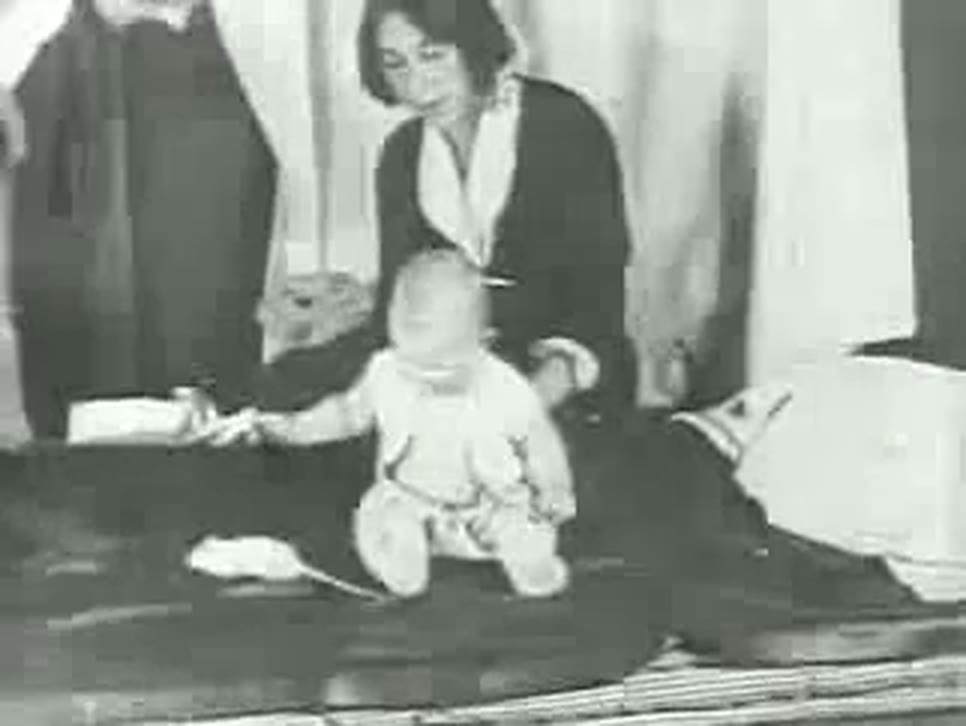
What the design did not have is as plain as what it did. There was one subject. There was no second infant shown the rat without the bar, and no second infant given the bar without the rat. The blocks served as a check that the fear had not spread to the whole room, but the blocks were a toy Albert liked, not a neutral object. There was no scale of fear, only words: “whimpered”, “fell over”, “crawled away”, “negative”. And the one quantity the experiment could not do without, time, was set by the hospital and not by the scientists: Albert’s mother was due to leave, and the paper says that “in view of the imminence of Albert’s departure from the hospital we could not make the interval longer than one month.”
The paper also records the moment of choosing to go on. “At first there was considerable hesitation upon our part in making the attempt to set up fear reactions experimentally. A certain responsibility attaches to such a procedure. We decided finally to make the attempt, comforting ourselves by the reflection that such attachments would arise anyway as soon as the child left the sheltered environment of the nursery for the rough and tumble of the home.” The baseline was in early December. The conditioning did not begin until Albert was “eleven months, three days of age”, which on the reconstruction below was 13 February 1920. Nobody has explained the two months’ wait; the university closed for Christmas, and Watson’s marriage was coming apart.
Eleven months, ten days
The first attempt took two blows. “White rat suddenly taken from the basket and presented to Albert. He began to reach for rat with left hand. Just as his hand touched the animal the bar was struck immediately behind his head. The infant jumped violently and fell forward, burying his face in the mattress. He did not cry, however.” Then: “Just as the right hand touched the rat the bar was again struck. Again the infant jumped violently, fell forward and began to whimper.” And the entry that closes the day: “In order not to disturb the child too seriously no further tests were given for one week.”
A week later, at eleven months and ten days, the rat came out of the basket without the sound. “There was steady fixation but no tendency at first to reach for it. The rat was then placed nearer, whereupon tentative reaching movements began with the right hand. When the rat nosed the infant’s left hand, the hand was immediately withdrawn. He started to reach for the head of the animal with the forefinger of the left hand, but withdrew it suddenly before contact.” The blocks were offered and he banged them about as usual. Then the bar, five more times, with the rat in his hand each time: “Started, then fell over immediately to right side. No crying.” “Fell to right side and rested upon hands, with head turned away from rat. No crying.” “Same reaction.” Between the third and fourth, the rat alone: “Puckered face, whimpered and withdrew body sharply to the left.” Then the bar twice more, and the second of those is the first time in the whole sequence that the baby cried at the joint presentation: “Started violently and cried, but did not fall over.”
The eighth trial is the one in every textbook. “Rat alone. The instant the rat was shown the baby began to cry. Almost instantly he turned sharply to the left, fell over on left side, raised himself on all fours and began to crawl away so rapidly that he was caught with difficulty before reaching the edge of the table.”
“This was as convincing a case of a completely conditioned fear response as could have been theoretically pictured,” the authors wrote. “In all seven joint stimulations were given to bring about the complete reaction.” Seven is the number the experiment is known by. Two of them had been given the previous week and had produced a flinch and a whimper. The other five, and the crying, came in a single sitting, interleaved with four presentations of the rat alone. The paper adds a sentence that is easy to miss: “It is not unlikely had the sound been of greater intensity or of a more complex clang character that the number of joint stimulations might have been materially reduced.” The bar, in other words, was not as frightening as they had hoped.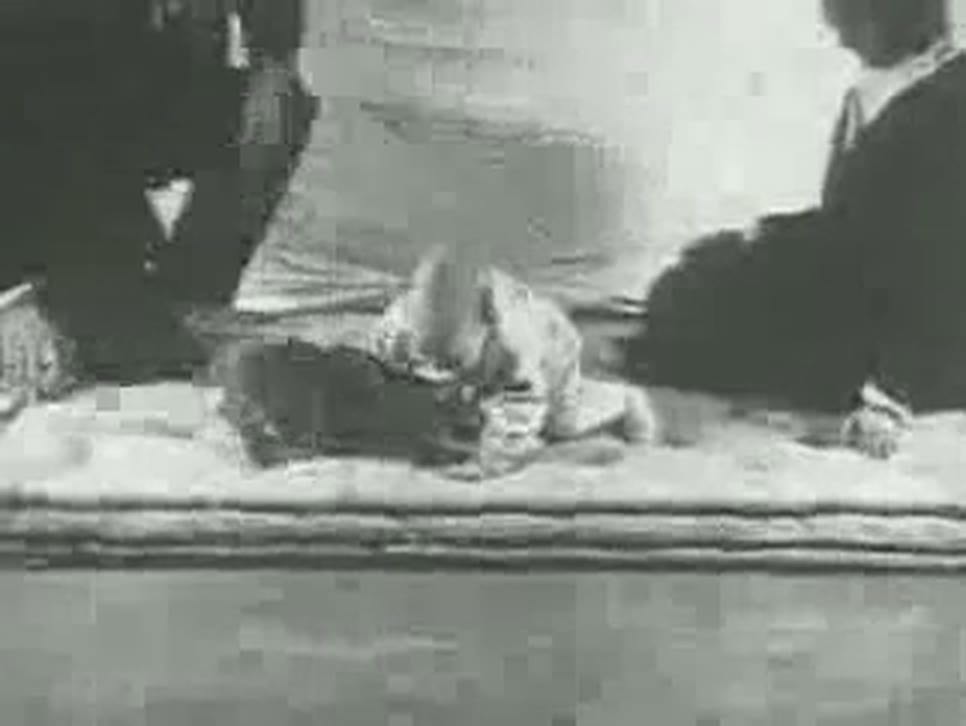
What it looked like from inside
The inside of the experiment is the laboratory notes, which the paper prints in full and which the companion piece, “The notes”, gives entire. They are not the notes of a clean result. They are the notes of two people trying, over four sittings, to keep a response alive that kept fading.
Five days after the crawl, at eleven months and fifteen days, the rat alone made him whimper and turn away, and the second time made him scurry “as rapidly as possible”. Then came the transfer tests, each new object sprung on him once. “Rabbit alone. The rabbit was suddenly placed on the mattress in front of him. The reaction was pronounced. Negative responses began at once. He leaned as far away from the animal as possible, whimpered, then burst into tears. When the rabbit was placed in contact with him he buried his face in the mattress, then got up on all fours and crawled away, crying as he went. This was a most convincing test.” The dog “did not produce as violent a reaction as the rabbit”; Albert shrank back and did not cry until the animal was brought to his head as he lay down. A sealskin coat, Rayner’s by the later accounts, made him fret and crawl. Cotton wool in a paper package he kicked away, then played with the paper, “avoiding contact with the wool itself”. And then the test that the textbooks never print. “Just in play W. put his head down to see if Albert would play with his hair. Albert was completely negative. Two other observers did the same thing. He began immediately to play with their hair.” The fear of fur had transferred to the head of the man who struck the bar and not to the heads of the two women. “W. then brought the Santa Claus mask and presented it to Albert. He was again pronouncedly negative.”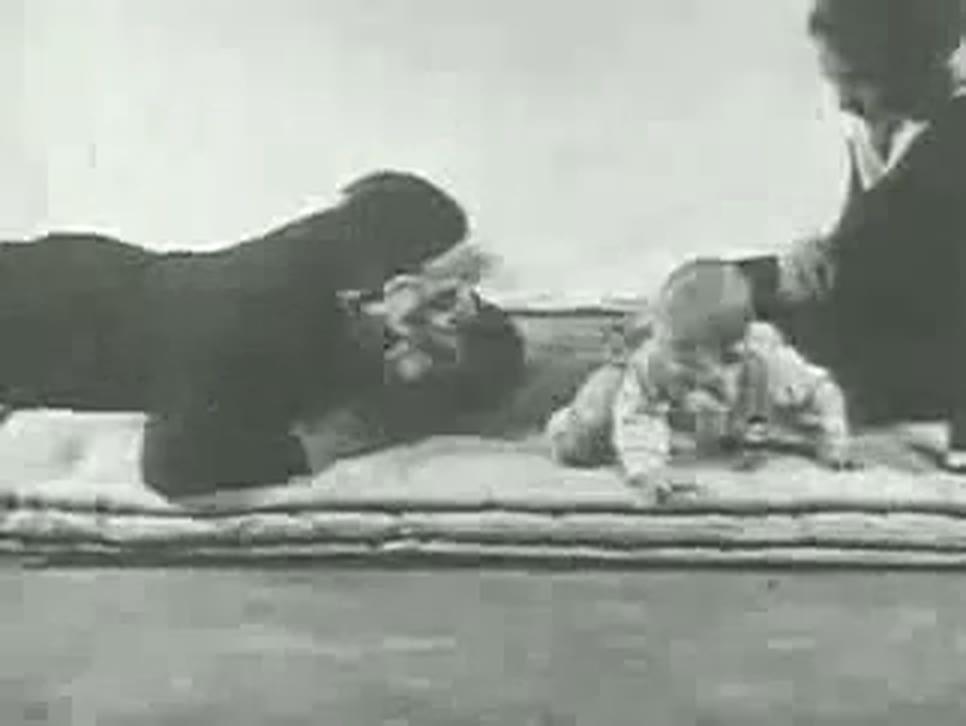
Five days after that, at eleven months and twenty days, the rat alone produced only “withdrawal of the whole body, bending over to left side, no crying”, and the notes say: “The response was much less marked than on first presentation the previous week. It was thought best to freshen up the reaction by another joint stimulation.” The bar was struck with the rat on his hand. Then, for the first time, the rabbit and the dog were paired with the bar directly, “to freshen the reaction”, before the whole set was carried into “the large well-lighted lecture room belonging to the laboratory” and tested again under the skylight with four people present. In the big room the rat alone drew “No sudden fear reaction” and had to be freshened again. The rabbit made him fall over backwards. The dog, “which had not barked before, barked three times loudly when only about six inches from the baby’s face. Albert immediately fell over and broke into a wail that continued until the dog was removed. The sudden barking of the hitherto quiet dog produced a marked fear response in the adult observers!”
Then a month with no emotional tests, during which Albert came to the laboratory every week for tests of handedness, imitation and “general development”, and the last session, at a year and twenty-one days, which was also filmed. The mask: “When his hand was forced to touch it, he whimpered and cried. His hand was forced to touch it two more times.” The rat: “He allowed the rat to crawl towards him without withdrawing. He sat very still and fixated it intently.” When it was let crawl against his chest he “covered his eyes with both hands.” The rabbit: he pushed it away with his feet, “wailing ‘da da’”, then after a minute “reached out tentatively and slowly and touched the rabbit’s ear with his right hand, finally manipulating it.” When the experimenter laid his hand on the animal’s back, “Albert immediately withdrew his hand and began to suck his thumb.” The thumb is in the paper’s closing observations: “Again and again while the motion pictures were being made at the end of the thirty-day period, we had to remove the thumb from his mouth before the conditioned response could be obtained.”
The historian Ben Harris, who found the film in an unmarked box under a stairwell at the University of Michigan, summarised what the notes and the footage show: “With lots of work they got Albert to cry sometimes and to exhibit a sort of approach-avoidance conflict when they would spring upon him various stimuli.” He also noted how the stimuli were sprung: “they sometimes tossed animals at him, sometimes shoved things like Rosalie’s sealskin coat at him, and their method of ‘presenting’ him with a Santa Claus mask was to have Watson put it on and crawl toward Albert at eye level.”
What happened
The paper’s own conclusion from the last day is cautious and then is not. “These experiments would seem to show conclusively that directly conditioned emotional responses as well as those conditioned by transfer persist, although with a certain loss in the intensity of the reaction, for a longer period than one month. Our view is that they persist and modify personality throughout life.”
Then the fourth question. “Unfortunately Albert was taken from the hospital the day the above tests were made. Hence the opportunity of building up an experimental technique by means of which we could remove the conditioned emotional responses was denied us.” The month of weekly visits had not been used for it. Instead the paper lists what they would have tried: habituation by constant exposure; feeding him sweets as the animal appeared; building “constructive” play around the object; and, between those two, “trying to ‘recondition’ by showing objects calling out fear responses (visual) and simultaneously stimulating the erogenous zones (tactual). We should try first the lips, then the nipples and as a final resort the sex organs.” The paper ends with a joke about psychoanalysts: “The Freudians twenty years from now, unless their hypotheses change, when they come to analyze Albert’s fear of a seal skin coat - assuming that he comes to analysis at that age - will probably tease from him the recital of a dream which upon their analysis will show that Albert at three years of age attempted to play with the pubic hair of the mother and was scolded violently for it.”
What the hospital’s own record says about that last day is one line in a medical file, read ninety-four years later: “Mother suddenly decided to leave the hospital.”
The issue of the journal that carried the paper is dated February 1920, though the ages in it run to the end of March; a library copy carries a receipt stamp of August 1920, and as editor Watson could set the date and skip the referees, and no record of any review has been found. In October he was gone from the university, and the experiment, which the paper had presented as the first of a series, was over. “The experiments I discussed in my last lecture were completed in 1920,” he told a lecture audience in 1924. “Until the fall of 1923 no further experiments were undertaken.”
He went on telling it, and the telling changed, which the companion piece “Five tellings” follows line by line. In the Scientific Monthly of December 1921 the third blow on the bar at nine months now made the baby “crawl away as rapidly as possible with head averted”, which the 1920 notes do not say. In Behaviorism in 1924 the bar had become “about one inch in diameter and three feet long”, the baby weighed twenty-one pounds “at eleven months” instead of nine, the rat was one “which he had played with for weeks” instead of one “confronted suddenly and for the first time”, and the infant who in 1920 “practically never cried” had become one of whom “we never saw him cry until after our experiments were made!” The child “taken from the hospital” in 1920 was by 1924 “shortly afterwards adopted by an out-of-town family”, a detail no record has confirmed and which sent the later searchers the wrong way. The “convincing case” of 1920 had become “this proof of the conditioned origin of a fear response”, and in the same book, pages later, the dozen healthy infants. The sentence after that boast is the one nobody quotes: “I am going beyond my facts and I admit it, but so have the advocates of the contrary and they have been doing it for many thousands of years.”
The fourth question was finally answered by someone else, with someone else’s child. In the autumn of 1923 a Rockefeller grant to Teachers College let Watson, now a consultant from his advertising office, set up fear studies at the Heckscher Foundation in New York, where about seventy children lived, and a graduate student, Mary Cover Jones, “conducted all of the experiments and wrote up all of the results”. In December 1924 she published the case of Peter, aged two years and ten months, who “was afraid of a white rat, and this fear extended to a rabbit, a fur coat, a feather, cotton wool, etc., but not to wooden blocks and similar toys.” “At sight of the rat, Peter screamed and fell flat on his back in a paroxysm of fear.” Jones wrote that “this case, which seemed almost to be Albert grown a bit older, was discovered in our laboratory”. Over three months, with other children present who were not afraid, and then with the rabbit brought a little nearer each day while Peter ate, she took him through seventeen steps from “Rabbit anywhere in the room in a cage causes fear reactions” to “Lets rabbit nibble his fingers.” Peter’s fears had come from a home she described in a paragraph as bleak as anything in the literature; nobody had conditioned them in a laboratory, and nobody knew how they had begun. Jones’s paper is the beginning of behaviour therapy. It, too, has a sample of one, and says so: “The study is still incomplete.”
After
Nobody repeated the experiment. Harris’s account mentions the psychologist Horace English, who tried to make his own son afraid of a duck decoy by the same method and could not. What was repeated was the story. In 1979 Harris, then a young lecturer who had discovered that he had been teaching his students a version in which the fear was conditioned to a rabbit, went through forty years of textbooks and published the result in the American Psychologist under the title “Whatever Happened to Little Albert?”, calling the study a piece of “social science folklore”. He found Hans Eysenck, in 1965, making Albert a “motherless orphan” who was “quite fond of white rats” and ended with “a severe rat phobia”; textbooks in which the rat was a pet, the rabbit was white, the fur coat was white, and Watson had removed the fear before the child went home; and, later, a television course that showed two conditioned babies where there had been one. Harris’s title was a joke about the discipline. The discipline took it literally.
The literal answer came thirty years later, in the same journal, in 2009. Hall Beck of Appalachian State University, with Sharman Levinson of the American University of Paris, started from the only dates the paper gave, Albert’s ages, and the only external anchor, Watson’s letters about the film. If the baseline was shot about 5 December 1919 at eight months and twenty-six days, then Albert had been born in the first half of March 1919. The federal census of 2 January 1920, taken in the middle of the experiment, listed 379 people living at the Johns Hopkins Hospital, every one but the superintendent as an “inmate”, and no one under fourteen. Three women were “foster mothers”, the only occupation that could cover a wet nurse: Pearl Barger, Ethel Carter and Arvilla Merritte. Carter, the one Black woman in the district, had given birth in August, and the baby on the film is white. Barger’s surname began with B, but no record of a baby could be found. Merritte was twenty-two, and the hospital’s register of births showed an unnamed boy born to her on 9 March 1919, with a father, William Merritte, of whom no other trace was found, and a maiden name, Irons, that could be followed. Her grandson Gary Irons, when Beck wrote to him, knew the name she had given the boy: Douglas. He became the paper’s third author. A colourised portrait of a baby had turned up in his grandmother’s trunk when she died in 1988. A specialist at the Armed Forces Institute of Pathology compared it with stills from the film and reported that “the two photographs could be the same individual.” Beck reckoned the odds that another wet nurse’s child would be male, white and born in the right fortnight at one in 104, and concluded: “After 89 years, psychology’s lost boy has come home.”
Douglas Merritte had died on 10 May 1925, aged six, of hydrocephalus. His gravestone, in a churchyard in Carroll County, Maryland, reads “Douglas, Son of Arvilla Merritte, March 9, 1919 to May 10, 1925.” “Our search of seven years,” Beck wrote, “was longer than the little boy’s life.”
Three years later Beck and Irons, with the psychologist Alan Fridlund and a paediatric neurologist, William Goldie, published a sequel in History of Psychology. Douglas’s medical file had been found. It showed, they wrote, that he “suffered from congenital obstructive hydrocephalus, iatrogenic streptococcal meningitis/ventriculitis, and retinal and optic nerve atrophy”: his head had been swelling since the spring of 1919, a physician had noted in November that he “does not appear to see, does not follow objects”, and an X-ray in the first week of December, the week of the baseline, “showed ‘very marked hydrocephalus’”. Goldie, shown the film without being told whose it was, saw an infant who did not look at the adults and scooped at blocks instead of picking them up. The authors concluded that Albert had been a neurologically damaged child, that Watson must have known, and that his description of a healthy baby was false: “The evidence is circumstantial, but the data strongly support the premise that Watson knowingly misrepresented Albert’s medical condition.” On the mother, they wrote: “Voluntary consent, as we understand the term today, was not possible to give or to withhold.” A psychology magazine quoted Fridlund on “the likelihood of scientific fraud”.
Then the other baby was found. Russell Powell and Nancy Digdon of MacEwan University in Edmonton, with Harris and a professional genealogist in Maryland, Christopher Smithson, went back to the census and to Pearl Barger, who was sixteen. A family history posted online recorded a Pearl Barger marrying a Charles Martinek, who went by Martin, in 1921; the Baltimore birth index recorded a child born to a Pearl and Charles Martin in 1919, two years before the wedding; the 1940 census found Charles Martin with a son “William A.”, twenty-one. William Albert Martin, known all his life as Albert, had died in 2007. With his niece’s support, the hospital’s privacy board let the lead author read his medical file, which was still in the archives. Pearl Barger had been employed as a wet nurse in the Harriet Lane Home from 14 May 1919 to 31 March 1920. Her son’s name on the intake form was “Albert (W) Barger”. His birth date in the file was 10 March 1919, one day after Douglas Merritte’s. On 5 December 1919, at eight months and twenty-five days, he weighed twenty-one pounds fifteen ounces; at nine months, twenty-two pounds six. The file called him “very well developed, very well nourished” and, in December, “active and bright”; it noted measles in late January and a cough in February, and at discharge judged him in “excellent condition”. He left the hospital on 31 March 1920, at twelve months and twenty-one days, exactly the age the paper gives for the last session, with the note “Mother suddenly decided to leave the hospital.” Douglas Merritte’s file, read by the same author with his nephew’s permission, showed a baby who weighed fourteen pounds fourteen ounces at nine months, who was discharged on 24 March 1920 at twelve months and fifteen days, “Mother took child away against advice”, and who in August 1920 “seems to be totally blind as he takes no notice of objects.”
William Albert Martin grew up with his mother and stepfather, who never told him he had been born out of wedlock or spent his first year in a hospital. He worked as a salesman for an airline, loved reading and music, and died before anyone thought to ask him about a rat. His niece told the researchers that he “had an aversion to dogs and to animals in general”, strong enough that the family dogs were shut in another room when he visited, and that he “very much disliked the sound of barking and would sometimes clasp his hands over his ears when he heard it.” He had also, she remembered him saying, seen his own dog killed in an accident as a boy. The paper that reported all this, in the American Psychologist in 2014, ended by calling the question of whether the experiment had left anything in him “a fittingly ambiguous outcome for a poorly designed and poorly reported experiment conducted almost a century ago.” Beck and his co-authors had answered the first doubts in 2010 under the title “The Evidence Supports Douglas Merritte as Little Albert”, and the two identifications still stand in print side by side; the Merritte one, with the fraud attached to it, had reached the textbooks before the Barger paper was out. Harris, who had refereed the 2009 paper and advised against publishing it, wrote in 2011 that its authors were “likely to have picked the wrong mother and child”, and that the myth of a found Albert was, like the others, instructive.
What it taught
Begin with what was shown, because something was. A placid baby who reached for every animal put in front of him was, after a week and seven blows on a steel bar, crying and crawling away from a white rat; five days later he cried at a rabbit and shrank from a dog, a fur coat and a mask; a month later, without reinforcement, some of that remained and some had faded. That is one child’s record, taken down by the people who had an interest in the result, and read against the film it is not nothing. It is also not a law. Everything else the experiment is said to have proved was put there afterwards, by its author and then by his readers.
The sample size was printed on the first page, and it was the one number nobody read. “Experimental work has been done so far on only one child.” Every quantity in the paper, seven blows, five days, thirty-one days, is a quantity about Albert. The paper never claims more. The lectures did, and the textbooks did, and a sentence about a dozen healthy infants became the summary of an experiment on one. The honest half of that sentence, “I am going beyond my facts and I admit it,” was dropped because it did not fit on a slide. When a result rests on one subject, the whole of it rests on who that subject was, and that is the other thing the paper did not record.
With a sample of one, identity is a variable, and the century-long hunt was an attempt to measure it. If the baby was Douglas Merritte, hydrocephalic and nearly blind, then the sluggish child on the film was not “stolid” but ill, the baseline was not a baseline, and the author was lying. If the baby was Albert Barger, twenty-two pounds and “active and bright”, then the film shows what the paper says and the fraud evaporates. The two readings cannot both be true and the experiment contains nothing to decide between them. So the deciding was done with a birth register, a census sheet, a medical file’s weights and a discharge date, which is to say with the controls the experiment never had, found in the hospital’s own records a corridor away. Two babies born a day apart to two wet nurses in one building both matched the paper. A design that cannot tell its own subject from the child in the next cot cannot tell its result from chance.
The notes and the story parted company in the author’s own hands. The 1920 notes are a record of fading and freshening: a response that had to be restruck at eleven months and twenty days, that drew “no sudden fear reaction” under the skylight, that at a year and twenty-one days let the rat crawl against the baby’s chest. The 1921 and 1924 retellings tidied the bar, the weight, the crying and the rat, and added an adoption. None of the changes was large and all of them ran one way. The textbooks did not corrupt a clean record; they continued a process the author had begun, and each writer since has supplied the ending the design lacked, a phobia for Eysenck, a cure for the hopeful, a fraud for the indignant.
The instrument that travelled was the film, and it was made to persuade. Watson asked for $450 of film because “such a work has never hitherto been undertaken,” and the five minutes of Albert are the reason the study is remembered when a hundred better ones are not. Those same five minutes were later read as proof that the baby was impaired and then as proof that he was not; the authors of the second reading noted that a paediatrician shown home films of normal infants of that age had diagnosed autism in eight of fifteen. A record made to show an audience a result is not the same thing as a record made to let a sceptic check it, and the Albert film is the first kind.
The one measurement that would have settled it was the one the design gave away. The fourth question, how to remove a fear, was the only question whose answer would have helped the child, and the only one with a built-in control, since a fear that could be removed by one method and not another would have said something about what fear was. It was not asked because the hospital’s calendar, not the laboratory’s, set the length of the study, and because the month that was available went on handedness and imitation. The answer came four years later from Mary Cover Jones and a boy named Peter, whose fears nobody had made. The field’s lasting result came from the sequel, on a different child, by a different experimenter, and it too was a sample of one.
The complication is that the second claim, the one the experiment could not establish, was broadly right. Fears do attach to things present when fear is felt; children do generalise; a frightened child can be brought to a rabbit a foot at a time while eating. The method Jones used on Peter is, in its descendants, the standard treatment for phobias a century later, and it would not exist without the question Watson asked. A bad experiment pointed the right way, and that is the hardest kind to learn from, because its fame seems to vindicate it. What it does not vindicate is the reading. One baby, one winter, two experimenters who wanted a result, a record that softened each time its author told it, and a film cut to convince: those are the facts on page one, and the thing the textbooks proved from them was that fear is learned. The thing the babies proved, in the end, was how much a science will do to find out who its one subject was, once it is too late to ask him.
Sources
- John B. Watson and Rosalie Rayner, “Conditioned Emotional Reactions,” Journal of Experimental Psychology, vol. 3 no. 1 (February 1920), pages 1 to 14. The whole of the experiment: Albert’s description, the four questions, the sound test at eight months and twenty-six days, the laboratory notes of the five later sessions, the departure, the four untried methods, the thumb, and the Freudian joke. Quoted from the journal scan; the Classics transcription has “had been done” where the printed page has “has been done”. archive.org, psychclassics.yorku.ca
- John B. Watson and J. J. B. Morgan, “Emotional Reactions and Psychological Experimentation,” American Journal of Psychology, vol. 28 no. 2 (April 1917), pages 163 to 174. The three native emotions, the two triggers of fear, and the dark. archive.org
- John B. Watson, Psychology from the Standpoint of a Behaviorist, Philadelphia: Lippincott, 1919, chapter VI. The three Harriet Lane babies, “splendid, healthy types”, the black cat, and “any moving furry animal”. archive.org
- John B. Watson, “Psychology as the Behaviorist Views It,” Psychological Review, vol. 20 (1913), pages 158 to 177. The opening sentences. psychclassics.yorku.ca
- John B. Watson and Rosalie Rayner Watson, “Studies in Infant Psychology,” The Scientific Monthly, vol. 13 no. 6 (December 1921), pages 493 to 515. The zoo, “stolid and phlegmatic disposition”, the retold sound test with the crawl, “one or two combined stimulations”, thunder and the dark, and “not yet completed”. archive.org
- John B. Watson, Behaviorism, New York: Norton, 1924 (the 1925 printing read), lectures VII, VIII and IV. “Since 1918”, the bar of three feet, twenty-one pounds at eleven months, the rat “he had played with for weeks”, “we never saw him cry”, “a far more prolific goose”, the adoption, the Heckscher Foundation and Mary Cover Jones, and “Give me a dozen healthy infants” with the sentence that follows it. archive.org
- John B. Watson, “Experimental Studies on the Growth of the Emotions,” in Carl Murchison, ed., Psychologies of 1925, Worcester: Clark University Press, 1926. The same retelling in a second place. archive.org
- Mary Cover Jones, “A Laboratory Study of Fear: The Case of Peter,” Pedagogical Seminary, vol. 31 (December 1924), pages 308 to 315. Peter, the seventeen steps, the taxi and the dog, feeding, “still incomplete”, and Peter’s home; “Accepted for publication by John B. Watson”. psychclassics.yorku.ca
- John B. Watson, Experimental Investigation of Babies, motion picture, shot 1919 to 1920 and distributed by the C. H. Stoelting Company, Chicago, 1923; the Albert sequences, about 200 seconds, in the copy on Wikimedia Commons from which the three stills above are taken. Public domain in the United States as a work published before 1930. commons.wikimedia.org
- Hall P. Beck, Sharman Levinson and Gary Irons, “Finding Little Albert: A Journey to John B. Watson’s Infant Laboratory,” American Psychologist, vol. 64 no. 7 (October 2009), pages 605 to 614. Watson’s return and resignation, the film’s cost and the letters to Goodnow, the dollar a visit, the dating of the sessions, the receipt stamps, the census of 2 January 1920 and the three foster mothers, Arvilla and Douglas Merritte, the portrait, the forensic comparison, “1 in 104”, the gravestone, and “psychology’s lost boy”. In copyright; quoted briefly from the copy on the first author’s university site. appstate.edu
- Alan J. Fridlund, Hall P. Beck, William D. Goldie and Gary Irons, “Little Albert: A Neurologically Impaired Child,” History of Psychology, vol. 15 no. 4 (2012), pages 302 to 327. Douglas Merritte’s medical file, the X-ray of early December 1919, the film analysis, the charge of misrepresentation, and the sentence on consent. In copyright; quoted briefly from the copy in Appalachian State’s repository. appstate.figshare.com
- Russell A. Powell, Nancy Digdon, Ben Harris and Christopher Smithson, “Correcting the Record on Watson, Rayner, and Little Albert: Albert Barger as ‘Psychology’s Lost Boy’,” American Psychologist, vol. 69 no. 6 (2014), pages 600 to 611; read in the authors’ manuscript in the MacEwan University repository. Pearl Barger, the Martinek family history, the 1940 census, Albert Barger’s medical file with its weights, health notes and discharge, Douglas Merritte’s file with its weights and discharge, the reconstruction of the session dates, the film re-analysis, William Albert Martin’s life and his dislike of dogs, and “a fittingly ambiguous outcome”. Quotations from the two medical files are at second hand through this paper. roam.macewan.ca
- Nancy Digdon, Russell A. Powell and Christopher Smithson, “Watson’s Alleged Little Albert Scandal: Historical Breakthrough or New Watson Myth?”, Revista de Historia de la Psicología, vol. 35 no. 1 (March 2014), pages 47 to 60. Watson’s move to Hopkins and his forced resignation, the press reaction to the 2012 paper, including Fridlund’s words in the Monitor on Psychology and the Chronicle sentence, both at second hand, the misdiagnosis study, and the “new myth”. Open access. journals.copmadrid.org
- Ben Harris, “Letting Go of Little Albert: Disciplinary Memory, History, and the Uses of Myth,” Journal of the History of the Behavioral Sciences, vol. 47 no. 1 (2011), pages 1 to 17. The 1979 article and its title, the film under the stairwell, the tossed animals and the mask, Eysenck’s orphan, Seligman’s blocks, the 1988 textbook and the doubled sample, English’s duck decoy, the refereeing of the 2009 paper, and “the wrong mother and child”. In copyright; quoted briefly. appstate.edu
- Ben Harris, “Whatever Happened to Little Albert?”, American Psychologist, vol. 34 no. 2 (February 1979), pages 151 to 160. The survey of the retellings; its phrase “social science folklore” is quoted here at second hand through Powell and his co-authors, as no open copy was found. doi.org
- Psychology’s Feminist Voices, “Rosalie Rayner,” York University. Her birth in Baltimore in 1898, Vassar, her death in 1935. feministvoices.com
- Hall P. Beck, Sharman Levinson and Gary Irons, “The Evidence Supports Douglas Merritte as Little Albert,” American Psychologist, vol. 65 no. 4 (2010), pages 301 to 303. The reply to the first doubts; known here only by its title, from the 2014 paper’s reference list.
- “John B. Watson,” Wikipedia. Watson’s dates and places of birth and death, his Chicago doctorate of 1903, and J. Walter Thompson; a general reference used for those points only. en.wikipedia.org
- Wikimedia Commons, File:Little_Albert_experiment_(1920).webm. The copy of the film, 322 by 242 pixels, from which the stills were taken; the frames here are enlarged three times. commons.wikimedia.org
How this entry came about
The entry was written in one session on 20 October 2026 from the open sources above. Watson's birth and death dates and his Chicago doctorate are the standard ones and were checked against the biographical sketches in the 2009 and 2014 papers. The dates given for the sessions (13 February, 20 February, 25 February, 1 March and 31 March 1920) are those that follow from Albert Barger's recorded birthday of 10 March 1919 and the ages in the paper, as Powell and his co-authors worked them out; if the baby was Douglas Merritte, each falls one day earlier.