In February 1930, in sixty-seven schools in the mining and steel towns of Lanarkshire, five doctors and seventeen nurses spent ten school days weighing and measuring twenty thousand children. Each child stood against a rod graduated in feet, inches and eighths, in stockinged feet, and was read to the nearest eighth of an inch. Each child then stepped onto a new weighing machine, fitted with a fine adjustment, and was read to the nearest ounce. “All of the children were weighed without their boots or shoes and wearing only their ordinary indoor clothing. The boys were made to turn out the miscellaneous collection of articles which is normally found in their pockets, and overcoats, mufflers, etc., were also discarded. Where a child was found to be wearing three or four jerseys — a not uncommon experience — all in excess of one were removed.”
Half of those children were about to receive three-quarters of a pint of milk every school morning for four months. The other half were to receive nothing, and to be weighed again in June, so that the difference between the halves would show what the milk had done. Before a single churn had reached a single school, the half that would get no milk was already, on average, about a pound heavier and half an inch taller than the half that would. The report that said so was dated December, and said it on page thirteen, and went on.
On the twenty-first of the month the log book of High Blantyre Public School recorded the arrangements for weighing the hundred children there who were to receive the milk. That is the spine of this story: the largest feeding experiment ever run on children, built to be “authoritative for the whole country,” carried through in a year by people who did everything they were asked and one thing more, and read afterwards by three of the best statisticians alive, who could agree on what had gone wrong and on nothing else.
Who ran it
The Department of Health for Scotland was a year old. It had replaced the Scottish Board of Health at the start of 1929, and its chief medical officer, J. Parlane Kinloch, had inherited from the Board a programme of feeding milk to school children and measuring them. The programme had two medical officers. Gerald Leighton, Medical Officer (Foods), was sixty-one, an Edinburgh graduate who had written the standard books on British snakes and lizards before he wrote the standard handbook on meat inspection, had been Edinburgh’s inspector of abattoirs and dairies, and had co-authored the Board’s earlier milk test. Peter McKinlay, Medical Officer (Statistics), was twenty-eight, a Clydebank doctor with a Glasgow MD, who in the course of 1930 would leave to become Superintendent of Statistics at General Register House in Edinburgh, a post he held for thirty years.
The experiment was theirs to design and the Education Authority of the County of Lanark’s to carry out. Its chief medical officer, Dr John Macintyre, was in executive charge, with five assistant school medical officers, seventeen school nurses, and the head teachers of sixty-seven schools. The milk was collected and delivered by two trade bodies, the Scottish Milk Agency and the Certified and Grade A (T.T.) Milk Producers.
The money came from the Empire Marketing Board, set up in 1926 to sell the Empire’s produce to Britain, which spent much of its budget on research. It gave 5,000 pounds and “approved its purpose and scope and the selection of Lanarkshire as a suitable area.” The Central Advisory Committee of the Distress in Mining Areas (Scotland) Fund gave 2,000 pounds, and the dairy trade 477 pounds and four shillings. The whole cost, “Student” would write a year later, was about 7,500 pounds. The scheme was explained to the public at an inaugural meeting in Hamilton by the Under-Secretary of State for Scotland, Thomas Johnston, who would be asked about it in the House of Commons before the year was out.
The people who read the result had nothing to do with running it. Stephen Bartlett was a research worker at the National Institute for Research in Dairying at Shinfield, near Reading. Ronald Fisher was the statistician at Rothamsted Experimental Station, forty-one, whose rule that the plots of a field trial must be assigned by chance was still being argued over. William Sealy Gosset was fifty-five and the head experimental brewer at Guinness’s brewery in Dublin, which allowed him to publish statistics only under a pseudonym; the world knew him as “Student.” Karl Pearson, seventy-four, still edited Biometrika and still ran the Galton Laboratory at University College London, where Ethel Elderton had worked under him for a quarter of a century. Between April 1931 and October 1933 those five would publish four readings of the same twelve tables.
What they were trying to find out
The report states its purpose as one question and, in its prefatory note, as a second.
The first question was whether milk made children grow. By 1930 the answer was thought to be known. Harold Corry Mann had fed a pint of milk a day to boys in a Barnardo’s home at Woodford and reported in 1926 that they grew faster than boys on the home’s ordinary diet. The Scottish Board of Health had then run its own test from late 1926 to 1928 on about 1,400 children in day schools in six Scottish towns and in Belfast, with whole milk, separated milk, a biscuit of the same calories or nothing, and had found that the milk-fed children grew faster on either kind of milk. But Kinloch’s note names the flaw: “This previous test was open to the criticism that the striking improvement in the nutrition of the children who received the additional ration of milk was due not to the milk alone but in some measure to improved home conditions — food, sleep, and regulation of life — which might follow from the close surveillance which was kept over the children under test.” Lanarkshire was to be the test without surveillance, “conducted under conditions that eliminate this criticism and on a larger scale than any previous test.”
The second question was new. All the milk would be of one official grade, Grade A (Tuberculin Tested), from herds free of tuberculosis, bulked at one depot so that every child drank the same milk; and half of it would be pasteurised. Whether heating milk destroyed something that made children grow was a live argument in 1930, between the public health doctors who wanted every drop of Scotland’s milk pasteurised against bovine tuberculosis and the dairymen who said heating spoiled it. The Lanarkshire experiment would be, the report says, “for the first time, as far as we are aware,” a test “on a very large scale of the nutritional value of raw tubercle-free milk as opposed to that same milk when pasteurised.”
Behind both questions was a third thing, which the report does not call a question. The Education (Scotland) Act of 1930 had just given local authorities the power to supply milk to school children, and Kinloch’s note ends by saying what the experiment was for: “it would be difficult to exaggerate the importance of the new powers. Their universal exercise by all the local authorities would affect about 800,000 children (the total school population in Scotland), and by improving their physical and mental well-being, would have a powerful influence in improving the quality of the Scottish race.” And by raising the demand for graded milk, “it would lead to the rapid elimination of tuberculosis from the dairy herds of Scotland.”
What they built
The size of the experiment was fixed by the milk. “The extent of the investigation was conditioned by the amount of tubercle-free milk available,” and the department found that enough could be had to give ten thousand children three-quarters of a pint each a day. The twenty-six herds, in Lanark, Ayr, Dumfries, Aberdeen, Renfrew and Kirkcudbright, sent between twenty and 125 gallons apiece by rail to the producers’ depot in Glasgow, where it arrived in the evening and was bulked. Half went raw into churns holding each school’s allowance and into cold store. The other half was heated to 145 degrees Fahrenheit for half an hour, cooled at once, churned and stored the same way. From six in the morning motor lorries carried the churns to the sixty-seven schools in time for the milk to be given out between half past ten and eleven. One of the two authors visited the depot several times a week and read the pasteurising charts; the bulked milk and each herd’s milk were sampled weekly, and the county’s own staff sampled it again at the schools. Over the four months 205 samples were taken at the depot, averaging 3.7 per cent fat and 18,304 bacteria to the cubic centimetre.
Because a school could not be trusted to keep two kinds of milk apart among two hundred children every morning, no school got both: in each school one set of children drank one milk and an equal number drank nothing. The report never says how many schools were of each kind.
The schools were “all situated in industrial and densely populated parts of the county, but not specially selected on account of the distress prevalent in any special area.” “At the period of this investigation, unemployment was rife throughout the district, and it was estimated that approximately one-third of the children came from homes where the parents were entirely unemployed or only partially employed.” Each school supplied between two hundred children (a hundred feeders and a hundred controls) and four hundred, aged five to twelve. Before the feeding began the school medical officers visited every school and explained the scheme to the head teachers.
Then the head teachers chose the children. The report’s account is the paragraph the story turns on:
“The selection of the actual children, however, was left to the head teacher in each school, to whom it was explained that the selected children should be a representative group of all, and not the most ill-nourished or of any other outstanding character. In the same way it was explained to the teachers that the ‘controls’ should also be representative of the average child. Likewise it was laid down that the sexes should be, as far as possible, balanced in each age group. As a matter of fact, the teachers selected the two classes of pupils, those getting milk and those acting as ‘controls,’ in two different ways. In certain cases they selected them by ballot and in others on an alphabetical system. In any particular school where there was any group to which these methods had given an undue proportion of well-fed or ill-nourished children, others were substituted in order to attain a more level selection. The school medical officers were definitely of opinion that each school had furnished a very fair average of its ordinary scholars, both as regards the children receiving the milk and also as regards the ‘controls.’”
Every child had a card: yellow for raw milk, pink for pasteurised, white for a control, with name, address and date of birth, and room for two weights and two heights. The weighing was done as the opening of this entry describes, in ten school days in February and nine and a half in June, by teams of a doctor and a nurse or two nurses, each team taking its own schools in the same rotation both times, and each school weighed both times on the same machine. At the schools the churn was stirred with a plunger before the milk was ladled into mugs or tins, so that the cream was shared; the head teachers could choose their own hour so long as it was before noon, and most chose half past ten. In June the cards, twenty thousand of them, went to Edinburgh.
A more level selection
McKinlay began by throwing cards away: every child absent on the day of the final weighing, which was most of the loss; every child without a date of birth; a few whose names did not settle their sex; the obvious errors; and the handful over twelve. That left 17,159 children, sorted into three groups and then by sex and year of age into forty-two cells.
Then, “first of all,” he asked whether the groups had been alike to begin with. Tables 1 and 2 of the report give the average initial weight and height of each cell; Tables 3 and 4 give the differences between the groups, with their probable errors. The controls were heavier than the feeders in every cell but one and taller in every cell but one, and the report says so in one sentence: the control groups “were, at the beginning of the experiment, slightly, though in many instances, significantly heavier and taller.” Six-year-old boys who were to get pasteurised milk weighed, on average, a pound and ten ounces less than six-year-old boys who were to get nothing; ten-year-old girls, two and a quarter pounds less. The two milk groups differed from each other by much less and in no constant direction.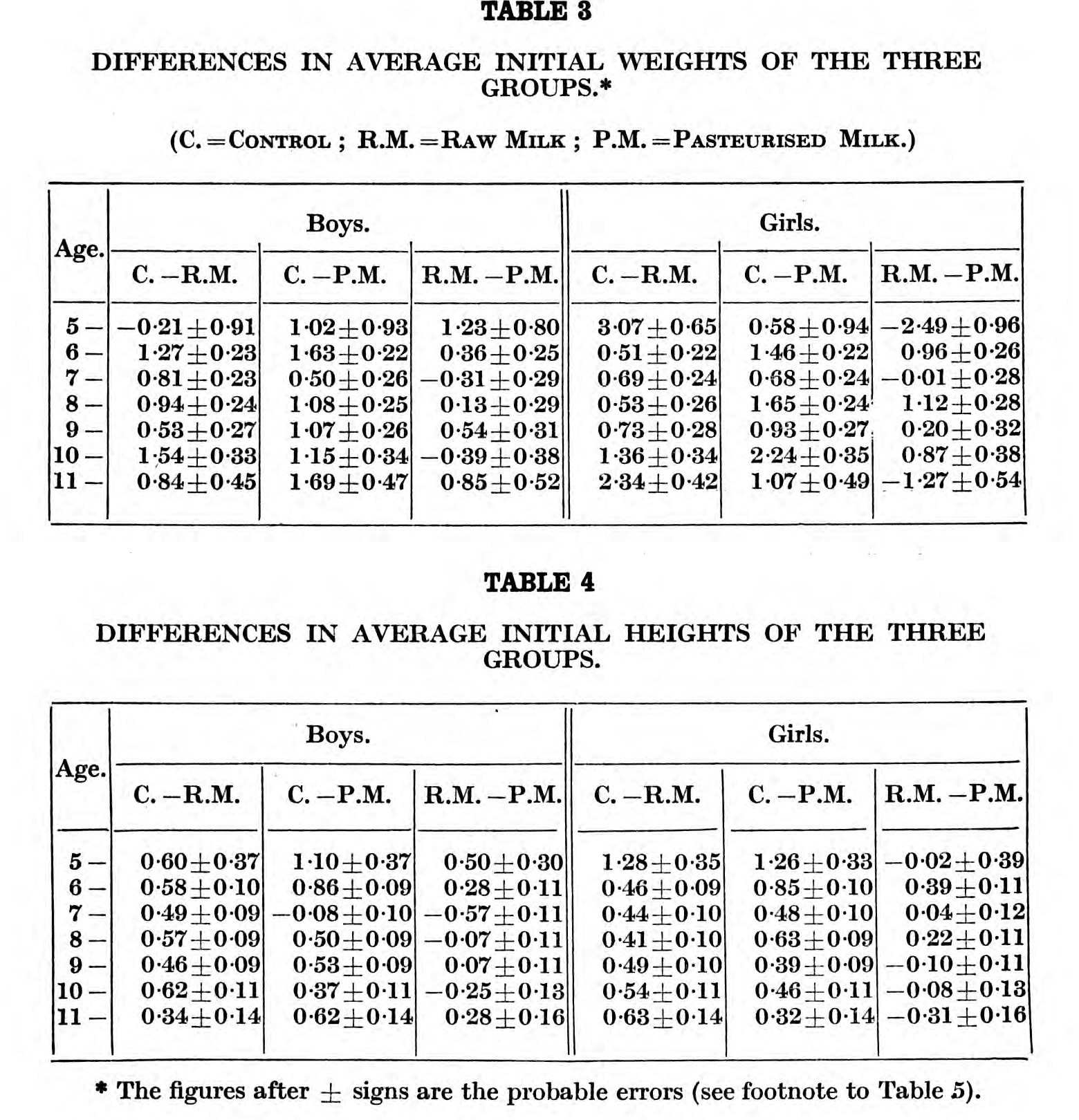
The report then argued that this did not matter. It computed, for the controls, the correlation between a child’s weight in February and the weight it put on by June, and between its height and its growth in height, and found the coefficients small and of no constant sign. “The change of weight and height, within the period of experiment is, therefore, substantially independent of initial measurements, so that within certain limits it would appear that the selection which does exist within the groups is insufficient to nullify the comparison.” The children the teachers had moved were, by this argument, lighter and shorter but not different.
So compared, the milk had worked. Seven-year-old boys on no milk put on about eleven ounces in four months; on raw milk about fifteen, and on pasteurised milk more than fifteen. Ten-year-old boys on no milk put on seven ounces; on raw milk, thirteen and a half. In height the controls grew about three-quarters of an inch at every age and the feeders up to a tenth of an inch more. “With few exceptions the differences are in favour of the milk-fed groups,” and above the age of seven every one was, and most were larger than their probable errors would allow by chance. Between raw and pasteurised milk the differences were “small, non-uniform and statistically in the majority of cases quite insignificant”: three of fourteen weight comparisons reached the conventional line, two for raw milk and one for pasteurised, and in height the raw-milk boys had “a uniform though very small advantage.”
One paragraph considered the clothes. “The children were weighed in indoor clothes and at the commencement of the inquiry in February the weather was cold, and compared with the end of the inquiry, in a hot spell in June, the amount of clothing might possibly have been somewhat more. This, however, would operate presumably to an equal degree in each group, so that the comparability of feeders and controls is unaffected.”
The conclusions were three sentences. “The influence of the addition of milk to the diet of school children is reflected in a definite increase in the rate of growth both in height and weight.” The younger children had not, as everyone believed, gained more than the older. And: “In so far as the conditions of this investigation are concerned the effects of raw and pasteurised milk on growth in weight and height are, so far as we can judge, equal.”
Kinloch’s prefatory note, dated December 1930, went further than the authors had. “The results, read along with the results of the previous Scottish test, are conclusive on the main issue. They demonstrate that the addition of milk to the diet of children has a striking effect in improving physique and general health and increasing mental alertness.” On Tuesday, December 9, in the House of Commons, John McGovern, the Labour member for Glasgow Shettleston, asked the Secretary of State for Scotland “whether he is prepared to provide for a milk allowance for all children of unemployed parents, in view of the results derived from the Lanarkshire experiment?” Johnston answered that the new Education Act let local authorities supply milk. McGovern pressed: would he send the results to every local authority and advise them to copy it? “I cannot advise that a like scheme should be put into operation. We are printing in full the results of that experiment, and it will be available to the public very shortly.” It came out early in 1931, a pamphlet of twenty pages. Nature abstracted it on March 21, and two days later a newspaper in Wellington, New Zealand, where the same argument about pasteurising was running, printed its conclusions under the headline “A Great Experiment.”
What it looked like from inside
Macintyre described the parents. “Some resented what they chose to regard as a charity, others that their children had been singled out as ill-nourished and in need of additional sustenance. There were others, again, who objected to their children being ‘experimented upon,’ but, on the whole, the scheme was received with an enthusiasm which was quite surprising.” The commoner complaint ran the other way: “keen disappointment was frequently expressed that more of the children were not included in the category of ‘feeders.’” A head teacher put it in a sentence that tells you how that school had chosen: “Some of the parents were disappointed but none were dissatisfied with the result of the ballot.”
The children had names for themselves. “At the commencement of the test, when the selection of the ‘feeders’ and ‘controls’ had to be made, there was almost universal regret that all could not be included in the former category. When, however, the scheme was fully explained to the children, the ‘drys’ took the decision in a sporting spirit and concealed their chagrin very successfully. On the other hand, the ‘wets’ did not show any marked desire to exult over their successes in the ballot; but rather seemed to evince a sincere sympathy for those who had been unsuccessful. The great majority of the children genuinely liked the milk and were truly sorry when the test was completed.”
In the last fortnight the head teachers were asked to write down what they had seen. They had no figures, and “so it is not surprising to find that they could not observe any appreciable increase in height or weight amongst those receiving the milk.” What they had seen was something else: after six or eight weeks “the appearance of the milk feeders showed quite an obvious improvement,” especially in the younger children and “those who were least well-off,” an increase “in the bloom of their cheeks and the sleekness of their skins.” The feeders became “more boisterous and more difficult to control.” One wrote: “in the playground buoyancy and pugnacity are developing to an alarming extent.” One girl had gained so much vitality “that she told her teacher ‘she could now fight her brother,’ a feat which before was impossible.” And in nearly every school the feeders came to school more regularly, and kept coming. The report prints these “as matters of interest, without laying undue stress upon them.”
What the report could not show from inside was the moment it turned on, because nobody wrote it down. It happened in sixty-seven head teachers’ rooms in February, when a ballot or the alphabet had produced a list, and the head teacher, who knew every child on it and which fathers were at the pit and which were not, saw that it had put too many of the thin ones on the dry side, or too many of the well-fed ones on the wet, and did what the instructions permitted. The parents’ letters tell you what was in the room: a milk ration was “a charity,” and to be given it was to be “singled out as ill-nourished.” The head teachers had been told to make the two lists representative and had been told nothing about what representative was for.
What happened
Bartlett read the report at Shinfield and did a sum the authors had not done. Their fourteen cells by age and sex were small, and the probable error of each comparison large in proportion; but the gains in the milk groups were much the same at every age, he argued, so the cells could be added. Added, the raw-milk children had gained fourteen ounces, the pasteurised thirteen and the controls ten, and the raw-milk advantage in height, about a thirtieth of an inch, was “nearly six times the probable error, which is undoubtedly significant.” He published this in the Ministry of Agriculture’s journal in April 1931: “In the light of these figures, it seems impossible to conclude that raw and pasteurized milk are equal in their effect on growth in weight and height.” On April 18 Nature printed a letter from Fisher and Bartlett together, “Pasteurised and Raw Milk,” which reproduced the two tables and said the report’s conclusion on the two milks was open to some question. Fisher had not seen the cards; the regrouped tables were Bartlett’s, and the letter’s weight was Fisher’s name.
The letter reached Dublin. On July 14 Gosset wrote to Karl Pearson that he was going through the official report and the Nature note; on July 23 he sent Pearson a draft; Pearson sent back comments on the 26th and Gosset answered them on the 30th; the proofs went back on August 18, and the paper appeared in the December number of Biometrika as “The Lanarkshire Milk Experiment,” by “Student.” It is nine pages long and begins with the courtesy that everything after it has to be read against: “It need hardly be said that to carry out an experiment of this magnitude successfully requires organisation of no mean order and the whole business of distribution of milk and of measurement of growth reflects great credit on all those concerned.”
He found four defects. The first he excused: no school had both milks, “probably necessary for administrative reasons,” but it meant the two milks had been tried on two sets of children who need not have been alike. The second was the paragraph about the head teachers, which he quoted, and then: “So far so good, but after invoking the goddess of chance they unfortunately wavered in their adherence to her.” The substitution “is just the sort of after-thought that most of us have now and again and which is apt to spoil the best laid plans. In this case it was a fatal mistake, for in consequence the controls were, as pointed out in the Report, definitely superior both in weight and height to the ‘feeders’ by an amount equivalent to about 3 months’ growth in weight and 4 months’ growth in height.” “It would seem probable that the teachers, swayed by the very human feeling that the poorer children needed the milk more than the comparatively well to do, must have unconsciously made too large a substitution of the ill-nourished among the ‘feeders’ and too few among the ‘controls’ and that this unconscious selection affected, secondarily, both measurements.”
The third was the clothes. The report had said the February jerseys would weigh equally on both groups, and that was true only if the groups had been drawn by chance. If the feeders were the poorer children they had less to take off in June, and the controls’ loss of winter clothing would be subtracted from the controls’ growth and not from theirs. Drawn against age, the June weights dipped below any line of growth: “The weights at the end of the experiment are too low.” Older children, he thought, “wear about 1 lb. more clothes in February than they do in June,” and the milk’s apparent effect on weight ran from a tenth of the controls’ gain in the youngest children to three-quarters of it in the oldest, “who obviously did” shed clothes. The fourth defect was that the controls of the raw-milk schools and of the pasteurised-milk schools had been lumped together, so that, “with only 67 schools, at best 33 against 34, in a district so heterogeneous both racially and socially,” neither milk group had a proper control at all. It could still be put right, “for the figures for the different schools must still be available in the archives.”
The report’s first conclusion, that milk made children grow, “was probably true”; the feeders had gained eight to ten per cent more height than the controls and thirty to forty-five per cent more weight, and a substantial part of the first and a small part of the second were likely enough the milk’s doing. But “the conclusion is, however, shifted from the sure ground of scientific inference to the less satisfactory foundation of mere authority and guesswork by the fact that the ‘controls’ and ‘feeders’ were not randomly selected.” The third, that the two milks were equal, Fisher and Bartlett had already challenged, and Student would not go with them either: “again it is a matter of guess and authority — I would be very chary of drawing any conclusion from these small biased differences. That is not to say that there is no difference between the effect of raw and pasteurised milk — personally I believe that there is and that it is in favour of raw milk — but that this experiment, in spite of all the good work which was put into it, just lacked the essential condition of randomness which would have enabled us to prove the fact.”
Then he said what to do instead, and this is the part that outlived the argument. If it had to be done again on the same “spectacular scale,” the teachers should choose the children in pairs of the same age and sex, “as similar in height, weight and especially physical condition (i.e. well or ill nourished) as possible,” and a coin should be tossed for each pair to say which child got the milk; each school should if possible have both milks; someone should weigh the clothes. And if only the two milks were in question, “it would be possible to obtain much greater certainty at an expenditure of perhaps 1–2 per cent. of the money and less than 5 per cent. of the trouble”: among twenty thousand children there would be at least 160 pairs of twins, of whom perhaps fifty pairs would be identical, and “the error of the comparison between them may be relied upon to be so small that 50 pairs of these would give more reliable results than the 20,000 with which we have been dealing.” The footnote to the money reads: “This is a serious consideration: the Lanarkshire experiment cost about £7500.” His summary was a sentence: the experiment, “though planned on the grand scale, organised in a thoroughly business-like manner and carried through with the devoted assistance of a large team of teachers, nurses and doctors, failed to produce a valid estimate of the advantage of giving milk to children and of the difference between raw and pasteurized milk.” The companion pieces “The goddess of chance” and “Fifty pairs of twins” give his paper in full, and what became of his proposals.
The Department did what it could. It lent the cards, all of them, to Karl Pearson, “most willingly and courteously,” and Elderton sorted them by sex, year of birth and height and went looking for pairs: a control and a feeder of the same height to the eighth of an inch, the same weight to a few ounces, the same age to a month or two. “The work of sorting and pairing took much time.” It yielded about 340 pairs of each sex for each milk against its controls, and her paper in the Annals of Eugenics in October 1933 is the only analysis ever made from the children rather than the averages. It found what the report had found, more weakly: paired children given milk grew a little more than their controls, between a twentieth and an eighth of an inch in four months, and the weights were so erratic that a fifth of the control boys and a quarter of the control girls had lost weight between February and June, so that “one wishes more than ever that the children had been weighed without clothes.” Raw against pasteurised, pair by pair, “there is no evidence that raw milk has an advantage over pasteurised or pasteurised over raw in increasing growth when the two are directly compared on this selected material.” Pearson, in an appendix, found that “raw milk undoubtedly accelerated the growth of stature,” and in girls more than pasteurised had, which he could not explain. Elderton’s last conclusion was Student’s: she “heartily” endorsed pairs and the coin, “it is the method I have tried in this paper, but the weakness in my work is that the undergrown and overgrown children have been omitted, and that no knowledge of the general physical condition of the children was available.” The companion piece “The twelve tables” follows the four readings figure by figure.
In June 1934 the British Medical Journal told its readers that because of criticism “from certain quarters” all the figures had been sent to University College London for re-examination by an independent authority, and that Dr Elderton had reached substantially the same conclusions as the Department.
After
The policy had not waited. In England the dairy trade’s National Milk Publicity Council had been selling a third of a pint in schools at the retail price since 1927. In October 1933 the Milk Marketing Board came into being, with a guaranteed price and a surplus to find a market for, and in 1934 Walter Elliot, the Minister of Agriculture, took the trade’s scheme into the state. The Milk Act received the royal assent on July 31, 1934, and in October the Milk in Schools Scheme began: a third of a pint for a halfpenny, the difference found by the Board and the Treasury, and free to children whose authorities would pay. In its first months it reached 2,600,000 children in England and Wales and 300,000 in Scotland, nearly half the pupils of the elementary schools. It was meant to last eighteen months, was renewed every year until 1944, when school milk became permanent, became free in 1946 and was withdrawn from the over-sevens in 1971. The historian of the scheme, Peter Atkins, concluded that the market for liquid milk weighed more with the men who made it than the growth of children; the Lanarkshire report had supplied the second argument.
The experiment did get done again, and the people who did it had read Student. A Milk Nutrition Committee was set up in 1934 under Lord Astor to test the scheme as it ran, with an expert sub-committee under John Boyd Orr whose members included Peter McKinlay for Scotland. Atkins, who read its files, wrote that “there was a concern that the scientific planning of the survey should allow for a better sampling frame than had been available in Lanarkshire, no doubt because of the painful memory of the criticisms that had come from statisticians at that time.” Between 1934 and 1937, in Luton, Wolverhampton, Burton-on-Trent, Huddersfield and Renfrewshire, 8,435 children were taken class by class and counted off, the first to a biscuit group, the second to a third of a pint of pasteurised milk, the third to two-thirds of a pint pasteurised, the fourth to two-thirds of a pint raw, “before the children were medically examined and no account was taken of their physical condition or social or economic status.” Every school had all four groups and both milks. The final report, published at Shinfield in 1939, found that milk made children grow in proportion to the amount, and that “no constant differences could be detected between the growth-promoting effects of 2/3 pint pasteurised and 2/3 pint raw milk in either height, weight or chest circumference.” Of 1930 it said that Leighton and McKinlay “were unable to detect any significant difference in the average rate of growth of the two groups,” and “the present test confirmed these findings.” Nobody could tell them whether 1930 had been right by luck.
Gosset became head brewer of the whole of Guinness in September 1937 and died of a heart attack on October 16 of that year, aged sixty-one. His last paper argued against Fisher’s insistence on random arrangement in field trials; on Lanarkshire the two men had been on the same side, and the paper that said so became, in the textbooks of the trade, the standard illustration of what a kind teacher can do to a controlled experiment. Karl Pearson died in 1936, Leighton in 1953, McKinlay in 1972. The cards were still in existence in 1988. In 2022 the statistician Stephen Senn went back through Student’s paper and found that it had missed nothing that mattered, and that the serious loss was the pooling of the two sets of controls, which threw away the only fair comparison the design contained. “By the standards of modern randomised trials,” he wrote, “the study is inadequate.” It was not, he added, clearly worse than the observational studies epidemiology is built on.
Whether a third of a pint of milk a day made British children taller was asked again. A study of six- and seven-year-olds in England and Scotland in the years 1972 to 1976 found that “the drinking of free school milk did not increase the growth rate” of children who were by then fed at home. It had been a question about hunger, and the hunger had gone.
What it taught
The experiment was built to be too big to argue with, and it was argued with for nine years by people who agreed that the milk had probably worked. The milk was graded and sampled, the children were weighed to the ounce, the report was out within the year, and the result could not be read, because at the one step that decided everything the design had said “ballot or alphabet” and then “others were substituted.”
The kindness was the bias. Nobody in Lanarkshire did anything wrong by the standards of Lanarkshire. The head teachers were handed a list made by chance, saw that chance had been unjust, and put it right; the instructions allowed it, and the parents who thought a milk ration was a charity for the ill-nourished were telling the truth about the town. Student’s word for the result was “unconscious,” and the complication is that the bias ran with the hypothesis: the children who most needed milk got it, grew most, and shed fewest clothes in June, so that every error pointed the same way and the true effect, which was probably real, cannot be separated from the pity that chose who would receive it. An experiment on people in need has to decide beforehand what it will do when the fair allocation looks unfair, because someone on the spot will decide for it.
A chance allocation stops being one the moment it is improved. The report’s authors could see in their own Tables 3 and 4 that the groups were unequal before the milk, and they argued from small correlations that the inequality did not matter. The argument was sound only if the children had been chosen for their size, and they had been chosen for their need, which the tables did not record. What is adjusted by eye cannot be adjusted back by arithmetic.
Twenty thousand is not a substitute for a fair fifty. The size of the experiment was fixed by the milk supply, and the cost of 7,500 pounds was what Student’s footnote called a serious consideration. His fifty pairs of identical twins at a fiftieth of the price were not a joke: error comes from the design and not from the count. The 1934 committee took the lesson, counted its children off by fours before any doctor had looked at them, put both milks in every school, and got a result that nobody has had to re-read.
The thing that did not matter under chance mattered without it. The report’s paragraph on the February jerseys was correct for the experiment that had been designed, in which the controls and the feeders would have worn the same clothes, and wrong for the one that had been run. That is the shape of the damage a broken randomisation does: it does not add one error, it removes the guarantee that a hundred small errors cancel, and every one has then to be argued separately, by people who were not there.
The question was answered by the people who were going to answer it anyway. Kinloch’s note said what the experiment was for, and it was not the two milks: it was 800,000 children, the powers under the new Act, and the herds. McGovern asked the Commons for the milk before the report was printed; the Milk Act of 1934 was passed for the Marketing Board’s surplus as much as for any child; the raw-milk question was settled, as Elderton said it would have to be, on tuberculosis and not on growth. What the flaw changed was the next experiment, and the method, which is where the lessons of an experiment usually go.
Check the story before you learn from it. The experiment is 20,000 children in its title and 17,159 in its text, and its first table’s counts add to 17,214; the most recent re-reading of it prints 18,214, by a slip of one digit. Nobody knows how many of the sixty-seven schools had which milk; Student guessed thirty-three and thirty-four. What the record supports without argument is the paragraph about the head teachers, the two tables of initial differences, the June dip in the weights, and the sentence in which a brewer in Dublin told a government department, with every courtesy, that its largest experiment had answered a question it had not been designed to ask, which was how a thousand decent people allocate a kindness.
The experiments beside this one on the shelf make the pattern plainer. In Three Menus the design was right and the clock was wrong: thirty-six men on a factorial plan answered the question in full for a war that had ended. In Eighteen Hundred Boxes the data went into a warehouse and were read thirty years late. Lanarkshire had the clock and the warehouse both in order: everything was done in a year, and the cards were read three times within three. The flaw was in the one thing that twenty thousand measurements could not record, which was how they had been assigned, and no quantity of reading recovers that.
Sources
- Gerald Leighton and Peter L. McKinlay, Milk Consumption and the Growth of School Children: Report on an Investigation in Lanarkshire Schools, Department of Health for Scotland, HMSO, Edinburgh, 1930, with the prefatory note by J. Parlane Kinloch dated December 1930. The money, the milk supply and sampling, the selection paragraph, Macintyre’s account of the weighing and of the parents and children, the teachers’ opinions, Tables 1 to 12 and the three conclusions. Crown copyright, expired; the scan is HathiTrust’s, from the University of Wisconsin’s copy. gwern.net, HathiTrust
- “Student” (W. S. Gosset), “The Lanarkshire Milk Experiment,” Biometrika 23 (3–4), December 1931, pp. 398–406. Every quotation attributed to him, the four defects, the percentage table, the pairs, the twins, the cost. gwern.net, doi:10.2307/2332424
- Stephen Bartlett, “Nutritional Value of Raw and Pasteurized Milk,” Journal of the Ministry of Agriculture 38 (1), April 1931, pp. 60–64. The regrouped tables, “about 5 to 1,” “nearly six times the probable error,” and the conclusion. Read in archive.org’s scan of the volume. archive.org
- R. A. Fisher and S. Bartlett, “Pasteurised and Raw Milk,” Nature 127, April 18, 1931, pp. 591–592. Only the opening paragraph, which Nature shows without a subscription, was read; the letter’s argument and its words “open to some question” are given as Student, Pollock and Senn report them. doi:10.1038/127591c0
- John Taylor, “Milk Tests in Lanarkshire Schools,” Nature 127, March 21, 1931, p. 466, the abstract of the report; its first paragraph only. doi:10.1038/127466a0
- Ethel M. Elderton, “The Lanarkshire Milk Experiment,” with an appendix by Karl Pearson, Annals of Eugenics 5 (3–4), October 1933, pp. 326–338. The loan of the cards, the pairing, Tables I to IV, the lost weight, the conclusions, and Pearson’s probabilities. gwern.net, doi:10.1111/j.1469-1809.1933.tb02098.x
- House of Commons, Oral Answers, “Unemployment (Milk Allowance),” December 9, 1930, Hansard vol. 246, cols. 198–199: McGovern’s questions and Johnston’s answers. hansard.parliament.uk
- “A Great Experiment: Milk as a Food,” Evening Post, Wellington, March 23, 1931, and “Milk for Children: Effect on Growth,” Evening Post, July 17, 1934, the latter reporting the British Medical Journal of June 2, 1934 on the re-examination at University College London. Read through the DigitalNZ full-text service; the pages are on Papers Past. Papers Past, 1931, Papers Past, 1934
- Milk Nutrition Committee, Milk and Nutrition: New Experiments Reported to the Milk Nutrition Committee, Part IV: The Effects of Dietary Supplements of Pasteurised and Raw Milk on the Growth and Health of School Children (Final Report), National Institute for Research in Dairying, Shinfield, 1939. The committee’s membership, the counting-off by fours, the 8,435 and 6,097 children, the five towns, the conclusions and its sentence on Lanarkshire. Wellcome Collection’s scan, Public Domain Mark. wellcomecollection.org
- Stephen Senn, “Student and the Lanarkshire milk experiment,” European Journal of Epidemiology 38, 2023, pp. 1–10. The chronology of Gosset’s letters to Karl Pearson, from chapter five of Egon Pearson’s Student: A Statistical Biography of William Sealy Gosset (1990); the pupil counts from the report’s Table 1; “open to some question”; the cards in 1988; the modern reading. PMC9867657
- Jon Pollock, “Two controlled trials of supplementary feeding of British school children in the 1920s,” Journal of the Royal Society of Medicine 99 (6), June 2006, pp. 323–327. Corry Mann’s Barnardo’s trial, the Scottish and Belfast test of 1926 to 1928, and the Lanarkshire chronology. PMC1472726
- Peter J. Atkins, “Fattening children or fattening farmers? School milk in Britain, 1921–1941,” Economic History Review 58 (1), 2005, pp. 57–78, and “The Milk in Schools Scheme, 1934–45: ‘nationalization’ and resistance,” History of Education 34 (1), 2005, pp. 1–21. The 1926 to 1928 test’s towns and Empire Marketing Board money, the Milk Nutrition Committee’s origins and “painful memory,” the Milk Act and the scheme’s first numbers. Author’s copies. EHR, History of Education
- J. Cook, L. M. Irwig, S. Chinn, D. G. Altman and C. du V. Florey, “The influence of availability of free school milk on the height of children in England and Scotland,” Journal of Epidemiology and Community Health 33 (3), 1979, pp. 171–176. PMC1051948
- The Blantyre Project, “Primary school tests milk run,” May 25, 2014: the entry of February 21, 1930 in the log book of High Blantyre Public School. blantyreproject.com
- UCL Special Collections, Pearson Papers, PEARSON/7/180/1, “Letters from William Gosset (‘Student’),” 1931, concerning the Lanarkshire experiment, with the Nature reprint enclosed. archives.ucl.ac.uk
- Biographies: Gerald Leighton and Peter Laird McKinlay in the Royal Society of Edinburgh’s Biographical Index of Former Fellows, through Wikipedia; William Sealy Gosset, Wikipedia. Leighton, McKinlay, Gosset