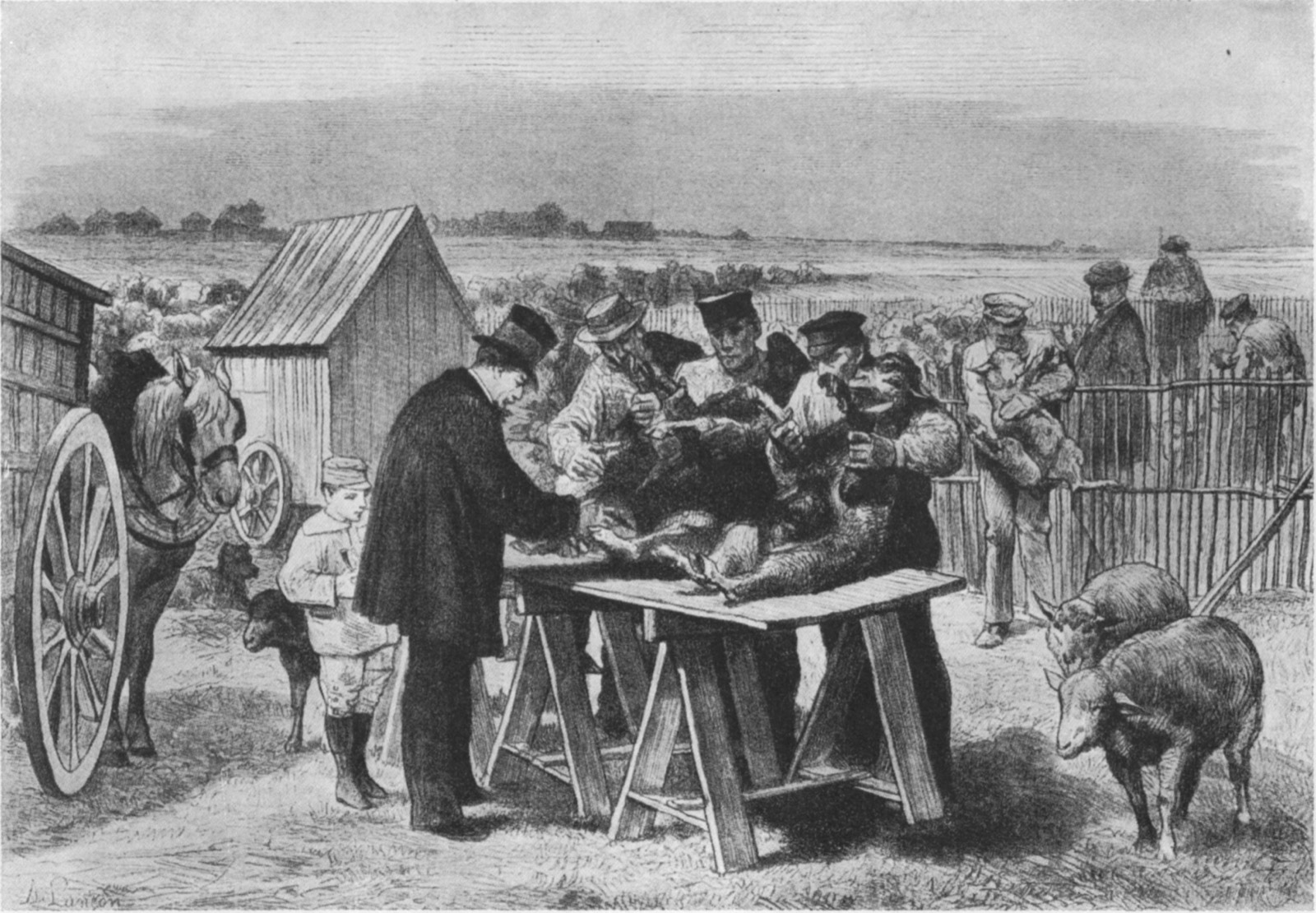
At two o’clock on the afternoon of Thursday 2 June 1881, Louis Pasteur walked into the yard of a farm at Pouilly-le-Fort, a village near Melun some forty kilometres south-east of Paris, and the people waiting there applauded. There were several hundred of them: the prefect of Seine-et-Marne, the director of agriculture from the ministry, a senator, the mayor of Melun, the president of the local agricultural society, cavalry officers from the garrison, veterinary surgeons from half the departments round Paris, farmers, and the Paris correspondent of The Times. In a shed stood two lots of sheep. The sheep of one lot had a hole punched in the ear. They were on their feet and eating. The sheep of the other lot, which had no hole, were dead or dying of anthrax, and the dead were being carried out one at a time to pits dug for them in advance, in a palisaded enclosure, according to a programme that had been printed and sent round the department five weeks before. The programme had said which sheep would die and on what day. This was the day.
Each sheep with a hole in its ear had been given, on 5 May, five drops of a liquid from a Pravaz syringe, under the skin of the inside of the right thigh: “cinq gouttes d’une culture d’un virus charbonneux atténué,” five drops of a culture of an attenuated anthrax virus, as Pasteur’s report to the Académie des sciences would put it eleven days later. On 17 May they had been given five drops of a second liquid, stronger than the first. On 31 May every sheep in both lots had been given a culture of anthrax so virulent that, Pasteur said, it killed a hundred sheep out of a hundred. Forty-eight hours later, here they were.
What was in the five drops was the one thing in the yard that nobody could see. Pasteur’s report said what day they had been given and in what dose, and said nothing about how the culture had been made except, in its last paragraph, that the method was one which might be generalised, “since once already it served to find the vaccine for chicken cholera.” Everyone who knew his work knew what that method was. He had described it to the Académie in October 1880 for chicken cholera and in February 1881 for anthrax: leave a culture of the microbe in contact with the air, and the oxygen of the air weakens it. That was the discovery the fifty sheep were understood to have proved. The notebook in which Pasteur wrote down, in his own hand, what the five drops actually were was kept by his family, on his instruction, closed to everyone, and was not read by a historian for more than ninety years. This entry is about a public experiment whose result was true, whose account of itself was not, and what the notebook was for. Three companion pieces take further what it can only touch: the race with the man in Toulouse whose method the five drops resembled; the ledger of the vaccinations that followed; and the notebook itself, and the quarrel over what it means.
Who ran it
Louis Pasteur was fifty-eight in the spring of 1881. He had been born at Dole, in the Jura, on 27 December 1822, the son of a tanner, and had made his name as a chemist: the asymmetry of crystals, then fermentation, then the diseases of silkworms, then beer. A stroke in October 1868 had paralysed his left side, and he walked with a stick. He was a member of the Académie des sciences since 1862 and of the Académie de médecine since 1873, and he ran a laboratory at the École normale supérieure in the rue d’Ulm. He had turned to anthrax, as he told the farmers of Melun the following winter, at the end of 1876, with Jules Joubert first, then Joubert and Charles Chamberland, then Chamberland and Émile Roux. “Nearly six years,” he said.
Chamberland was thirty, a graduate of the École normale from the Jura like Pasteur, and the laboratory’s engineer: the porcelain filter that bears his name came out of his hands. Roux was twenty-seven, a physician, who did the inoculating. A third assistant, Louis Thuillier, twenty-five, was at the farm on 5 May. Pasteur did not hold the syringe. He directed.
The disease was anthrax, charbon in French, the oldest and clearest of the diseases traced to a microbe. Casimir Davaine had seen the rod-shaped “bacteridia” in the blood of dying sheep in the 1860s; Robert Koch in 1876 had shown how the rods formed spores that lay in the ground and waited; Pasteur and Joubert in 1877 had grown the organism in pure culture and shown that it alone killed. In July 1880 Pasteur had told the Académie that the spores were brought up from the pits in which dead animals were buried by earthworms, and that was why some fields killed sheep year after year. France lost more than twenty million francs’ worth of animals a year to it, he said in London in August 1881, “but exact statistics are still lacking.”
The farm belonged to Hippolyte Rossignol, a veterinary surgeon of Melun. “I counted for some time among the unbelievers,” he wrote in his report to the Société d’agriculture de Melun afterwards; “I even warred a little with the pen against what I then called M. Pasteur’s utopias.” The society’s president was the baron de la Rochette, who carried the proposal to the rue d’Ulm. Behind them stood Henri Bouley, inspector-general of the veterinary schools and a member of both academies, Pasteur’s warmest ally among the veterinarians. In the crowd on 2 June was Henri de Blowitz, The Times’s correspondent in Paris.
And there was one man who was not at the farm. Jean-Joseph-Henri Toussaint, thirty-three, professor at the veterinary school of Toulouse, had announced an anthrax vaccine of his own in July 1880, seven months before Pasteur announced his. The method he used, and what Pasteur’s laboratory had learned from it, are the part of the story the yard could not see, and the first companion piece, The race, tells it.
What they were trying to find out
The programme printed in April made one prediction, but it rested on two claims, and it is worth separating them, because the fifty sheep could test only one.
The first claim was that an animal which had been given a weakened anthrax culture, and then a less weakened one, would afterwards survive a dose that killed an untreated animal. Pasteur had established the principle with chicken cholera the year before, and in a paper read to the Académie on 28 February 1881 he had extended it to anthrax: each of the weakened anthrax microbes, he wrote, “constitutes, for the microbe above it, a vaccine, that is to say a virus fit to give a milder disease.” He had performed the operation “with great success on sheep,” and would try it on a large scale when the flocks were folded in the Beauce. That claim could be tested by inoculating sheep and counting.
The second claim was about how the weakening was done, and it was the claim Pasteur cared about, because it was his. In October 1880, after nine months of silence that had cost him some ill will at the Académie de médecine, he had explained the chicken cholera vaccine: cultures of the microbe left to stand for months in contact with air lost their virulence by degrees, cultures sealed in closed tubes did not, and so “c’est l’oxygène de l’air qui affaiblit et éteint la virulence”: it is the oxygen of the air that weakens and extinguishes virulence. The anthrax microbe was harder, because it made spores, and spores did not weaken in air; he had a tube of spores formed on 21 March 1877 that germinated each year as virulent as ever. The answer of 28 February was to grow the bacillus at 42 to 43 degrees, a temperature at which it multiplied but made no spores, and leave it there in contact with pure air. After eight days its cultures no longer killed guinea pigs, rabbits or sheep, and in between it passed through every degree of weakness. On 21 March he called the method one “of a marvellous simplicity,” and reported that each weakened bacillus, allowed at last to make spores, made spores that reproduced its own weakness: “as many bacteridia of different virulences, so many germs, each ready to reproduce the virulence of the bacteridium it came from.” A vaccine could be cultivated at will, in any quantity, fixed at any strength. That was what made it a method and not a trick.
The same paper of 21 March was an attack on Toussaint, whose vaccine was anthrax blood heated at 55 degrees for ten minutes. Pasteur, with Roux and Chamberland working through their holidays in August 1880, had shown that the heat did not always kill; the bacillus was “only modified in its vitality,” attenuated, so that Toussaint’s vaccine was a living vaccine of the Pasteur kind, got by an uncertain means. Heated blood might be dead and protect nothing; it might be alive and kill; only sometimes was it weakened and protective, and even then its cultures went back to full virulence. In February he had promised to show “the uncertainty of the one, the sureness of the other.” The oxygen method was the sure one.
So the hypothesis the sheep were to test was the first claim: vaccination with weakened cultures protects. The hypothesis the yard would take them to have proved was the second: the weakening is done by air, by the method that found the chicken cholera vaccine, the sure method as against Toussaint’s uncertain one. Pasteur’s report made the link himself, in its last paragraph. Nothing in the programme required him to say how the vaccine was made, and nothing he published said.
What they built
The Société d’agriculture de Melun took up Rossignol’s proposal on 2 April 1881; on 8 April Rossignol sent a circular to the members and to the agricultural committees of Melun, Fontainebleau and Provins. Pasteur drew up the programme in the last days of April. On 28 April, as his report says, the following was agreed and affirmed:
The society would put sixty sheep at his disposal. Ten would receive no treatment. Twenty-five would receive two vaccinal inoculations, twelve or fifteen days apart, with two anthrax viruses unequally attenuated. These twenty-five would then be inoculated, at the same time as the twenty-five remaining, with very virulent anthrax, after a further interval of twelve or fifteen days. “The twenty-five unvaccinated sheep will all die; the twenty-five vaccinated will resist.” The fifty would then be kept together in one shed, the vaccinated distinguished by a hole punched in the ear. Every sheep that died of anthrax would be buried in its own pit, the pits side by side in a palisaded enclosure. In May 1882 twenty-five new sheep would be folded in the enclosure, to show that they caught anthrax from spores brought to the surface by earthworms, and twenty-five more folded a few metres off, where nothing had been buried, to show that none of them died: the etiology of the disease, set out for a trial a year ahead. When the baron de la Rochette asked for cattle too, Pasteur agreed to take ten cows, six to be vaccinated and four not, with the warning that the trials on cows were less far advanced; the six would not fall ill, he affirmed, and the four would die, in whole or in part, or at least all be very ill.
“This programme, I admit, had a boldness of prophecy,” he told the Académie on 13 June, “des hardiesses de prophétie qu’un éclatant succès pouvait seul faire excuser,” that only a striking success could excuse. Several people had said so to him, “not without mixing in some reproach of scientific imprudence.” He answered that the programme had not been drawn up without solid support in previous experiments, “though none of these had the scale of the one in preparation,” and then said the thing that has been quoted ever since: “Le hasard, d’ailleurs, favorise les esprits préparés.” Chance, besides, favours prepared minds. He closed with Virgil, audentes fortuna juvat. His son-in-law René Vallery-Radot, who wrote the family’s life of him in 1900, records the words he used to his assistants when they heard the programme read: “What has succeeded on fourteen sheep in the laboratory will succeed just as well on fifty at Melun.” Rossignol had the programme printed in quantity and sent it round the agricultural world.
The animals were not quite the programme’s. At the society’s wish two sheep were replaced by two goats, so there were fifty-eight sheep, of different ages, breeds and sexes, since Pasteur had set no condition of either; and the ten cattle were eight cows, an ox and a bull. On Thursday 5 May a crowd came out from the stations at Melun and Cesson: general councillors, farmers, doctors, pharmacists, and above all veterinary surgeons, most of them full of scepticism. Pasteur, with Chamberland, Roux and Thuillier, set the animals up under a large shed. Twenty-four sheep, one goat and six cattle, five cows and the ox, were each given five drops of the first vaccine: the sheep on the inner face of the thigh, the cattle behind the shoulder. Then Pasteur gave a lecture in the farm’s big room, nearly an hour on the disease, its contagion and the bacillus. For the next five days Rossignol and a military veterinary surgeon named Garrouste took the animals’ temperatures, and Chamberland and Roux came out from Paris to do the same. Nothing happened. “On the whole, excellent health,” Rossignol wrote of 6 May.
On Tuesday 17 May the same crowd watched the second inoculation. The liquid used that day, Rossignol wrote, was far from being as harmless as the first; “usually, when it is inoculated straight off into sheep, it brings about the death of those animals in the enormous proportion of fifty per cent.” Temperatures were taken for six days. A seven-month lamb went to 40 degrees the next day and was back at 39.2 the day after. Nobody ran a fever worth the name. At first sight, Rossignol noted, “vaccinated or not, the sheep differ in absolutely nothing.”
Pasteur wrote to his son-in-law before the last act. “By 5 June at the latest the final result will be known, that is to say twenty-five survivors among the twenty-five vaccinated and six cows. If the success is that clean, it will be one of the finest facts of science and of application of this century.”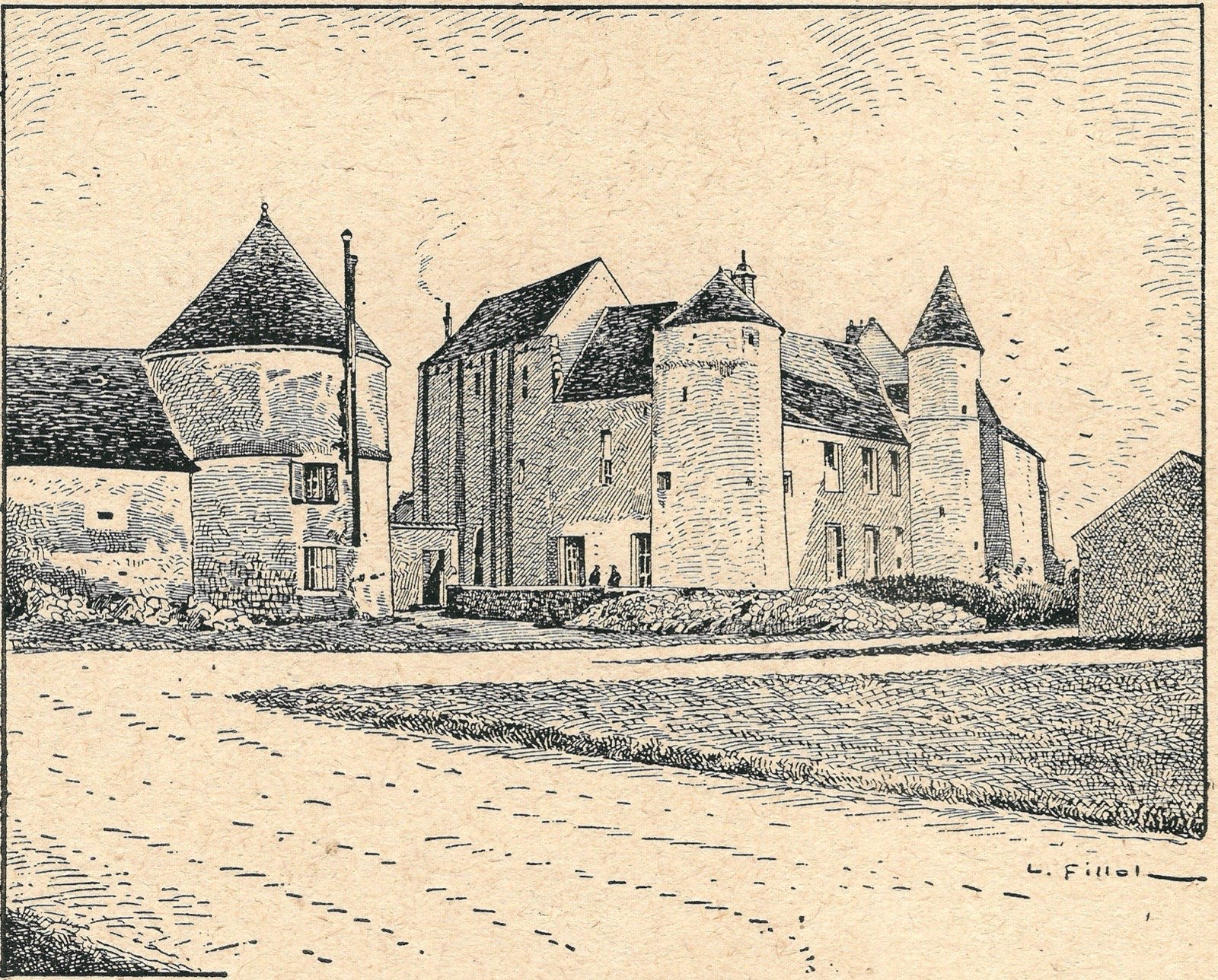
Forty-eight hours
The programme was not followed to the letter at the end, and the departure was Pasteur’s. Leaving the farm on 17 May he had fixed 31 May for the supreme test, but he had also decided that on 28 May one vaccinated and one unvaccinated sheep would be given the virulent culture, and on 29 May two more, so that when the crowd came on the 31st there would already be a dead sheep to open and show. On Saturday 28 May Chamberland, Roux, Garrouste and Rossignol picked two black two-year-olds, one vaccinated and one not, and injected each with a very virulent liquid from a culture whose line went back four years. By four the next morning the unvaccinated sheep was dead and still warm. On the Sunday they did it again with two eight-month lambs; the unvaccinated one went to 41 degrees by the next afternoon and Rossignol stayed to watch it die, which he described, minute by minute, in a passage he could not keep out of an official report. The vaccinated two ran a degree of fever and ate.
On Tuesday 31 May the yard was full again. Believers and unbelievers, Rossignol wrote, “but the latter are growing thinner on the ground,” and everyone could be heard saying: I wish I were two days older. “M. Pasteur, impassive, presides himself; one sees that he is sure of success.” Rossignol opened the lamb that had died the night before in front of the crowd: the spleen doubled and black, the blood dark and uncoagulated. Nobody wanted to look further.
Then the controls were given their dose, and here the veterinarians took a hand. Gabriel Colin of the Alfort school, the most persistent of Pasteur’s opponents, had warned the sceptical veterinarian Biot of Pont-sur-Yonne a day or two before that a culture flask had an inert upper layer and an active bottom in which the bacteridia settled, and that the vaccinated sheep would be given the top and the controls the bottom. Biot, who was there, shook the flask of virulent culture, Vallery-Radot says, “with a veterinarian’s energy,” and asked for a larger dose than the one proposed; a triple dose was given. Rossignol asked Pasteur to let the two lots be mixed before anyone was injected, and Pasteur agreed at once. Roux then inoculated forty-four sheep and two goats “in the order in which the animals were brought to him, without troubling to know whether they were vaccinated or not.” Pasteur’s own report puts it more formally: to make the experiments more comparative, a vaccinated and an unvaccinated animal were inoculated alternately. The culture, he said, had been regenerated from spores kept in his laboratory since 21 March 1877. The cattle followed: the five vaccinated cows and the ox, and four untouched animals, a Breton bull of two years, a Cotentin cow of five, a Breton cow of seven or eight and a Dutch heifer of eight months. Everything was finished at half past three. Pasteur gave everyone a rendezvous for the day after tomorrow.
Wednesday 1 June was Rossignol’s day, and the long paragraph he wrote about it is the only account of the experiment from inside the shed. He and the Paris men came at two. Among the vaccinated, four sheep were feverish, one was limping on an enormous swelling of the right thigh, and number 3, a ewe, was at 40.2 and off her food. All the rest were eating. Among the controls the sick “all keep apart and refuse all food,” every one of them with a hot, painful swelling in the right thigh and a temperature of 40. Rossignol decided to stay till dark. By five he counted a dozen controls refusing “the succulent lucerne” that was being put in front of them. At six the stockman pointed out a beast that looked very bad, and Rossignol found she was number 3, the vaccinated ewe. At 6.40 a black eighteen-month cross-bred merino among the controls “falls to the ground and dies at once”; ten minutes later a second; at seven a Southdown. Within a quarter of an hour the three carcasses stank. He left at eight. “Everything suggests that a great many sheep will die in the night.”
In Paris that evening Pasteur was not impassive. Chamberland and Roux came back with the temperatures of the vaccinated, and Rossignol’s telegram followed, saying he thought the ewe was lost. “For a few moments,” Roux wrote afterwards, “his faith wavered, as if the experimental method could betray him.” Nobody in the house slept. At eight the next morning, Madame Pasteur wrote to her daughter, “we were still very anxious, waiting for the telegram that might have announced some disaster.” At nine the laboratory was told, and five minutes later the telegram was in her hands. “I had a little moment of emotion that took me through all the colours of the rainbow.”
At four that morning the men watching the shed had found eleven unvaccinated sheep dead, and the goat. Pasteur sat down before leaving for the train and wrote to his absent children. “This morning eighteen were already dead and the others dying. As for the vaccinated, all are on their feet. The telegram ends with these words: Succès épatant,” stunning success. “It is from the veterinary surgeon, M. Rossignol.” Then: “It is still too early to judge in the last resort. The vaccinated might fall ill.”
What it looked like from inside
The yard at two o’clock has been described by three people who were in it, and they do not agree about the count. Rossignol: on the arrival of “the immortal author of the magnificent discovery of anthrax vaccination,” fourteen unvaccinated sheep and the goat had already died and the rest of the controls were at grips with death; by evening one was left, and it died in the night. Pasteur, to the Académie: twenty-one sheep and the goat already dead, two more “died before the spectators’ eyes,” and the last “went out at the end of the day.” De Blowitz, in the telegram he sent The Times that evening: “Things turned out as M. Pasteur had foretold. At two o’clock twenty-three of the sheep which had not been inoculated were dead. At three o’clock died the 24th, and the 25th an hour later. The twenty-five inoculated animals were sound, and frolicked and gave signs of perfect health.” Vallery-Radot, writing from the family’s papers twenty years on, has twenty-two corpses side by side, two sheep dying, and the last already panting. The counts differ by the hour at which each man counted and by what he counted as dead. Nobody disagrees about the sum.
De Blowitz, Rossignol wrote, “astonished, one might even say stupefied, by such a result,” hurried off a long telegram to his paper. The telegram got the theory wrong in nearly every particular: it had Pasteur collecting the earthworms, separating the virus they contained, and giving it a graduated virulence by subjecting it “to chemical action.” It ended: “the agricultural public now know that an infallible preventive exists against the disease in question. This preventive is neither costly nor difficult, for a single man can inoculate 1000 sheep in a day.” Rossignol made his own amends in the yard. “Pouilly a été mon chemin de Damas,” he wrote in his report, Pouilly was my road to Damascus; he had confessed his errors on 31 May “before the people, in the yard of this farm of Pouilly, which henceforth will be called the Clos Pasteur.” Biot and Rossignol each opened a dead sheep on the spot and everyone who wished looked through a microscope at the bacteridia in the blood. Biot said he would have himself vaccinated. Pasteur listened to all this, Vallery-Radot says, and was not satisfied. “We must wait until 5 June.”
The ewe, number 3, rallied on 2 June, ate a little, dropped to 38.6, went back above 40 the next day and died in the night of 3 to 4 June, by Rossignol’s account; Pasteur’s report says Friday 3 June, and Vallery-Radot says the 4th. Rossignol and Garrouste opened her the same day. She was pregnant and at term, and the lamb had been dead in the womb for twelve to fifteen days. The veterinarians who did the autopsy put the ewe’s death down to the lamb’s. The unvaccinated cattle grew swellings that Rossignol measured in centimetres and litres; none of them died, as Pasteur had allowed they might not. On 5 June he wrote to his daughter: “The success is well and truly won. The vaccinated animals are still admirably well. The test is complete.” Bouley, who had had to leave for Lyon, wrote back the same day that the world had found Pasteur “faithful in all your promises.”
That was the view from the yard. The view from the laboratory survives in a notebook that the Bibliothèque nationale catalogues as NAF 18016, “10e cahier,” the tenth notebook, 10 November 1880 to 10 April 1882, whose pages for April and May 1881 were read, independently, by the Italian historian Antonio Cadeddu in the 1980s and by Gerald Geison of Princeton, who published his reading in 1995. I could not reach the notebook: the library’s finding aid lists it, with Rossignol among the names on its pages, but shows no digital copy of it, and Gallica refused my reader. What follows is Geison’s account of what it says, and his translation.
On 13 April 1881, two weeks before the programme was signed, Pasteur recorded a small comparison. Two sheep had been vaccinated with one of his own oxygen-attenuated cultures and two with a culture that Chamberland had attenuated by growing the bacillus in broth containing potassium bichromate, an antiseptic salt; all four were then given virulent anthrax. One of the two sheep on Pasteur’s vaccine died. Both of Chamberland’s lived. Pasteur wrote that Chamberland’s vaccine was the surer, sûr, in the notebook’s word. On 26 April he headed a page “Charbon. Vaccination à Melun” and in a footnote at its bottom, after recording the agreement of 28 April, set out what he meant to do: the twenty-five sheep would be given on 5 May a culture so weakened by potassium bichromate that it no longer harmed mice, and then strengthened again by three passages through mice. On page 113 of the same notebook, by his own numbering, he recorded what was done. The culture used for the first vaccine on 5 May, in Geison’s rendering, “was an anthrax culture attenuated by Ch[amberland] with bichromate and which, no longer being lethal at all, had been reinforced by three successive passages in three mice.” The second culture, of 17 May, had also been attenuated with bichromate, for only a few days and without the mice; in the laboratory it had killed two of four unvaccinated sheep, which is Rossignol’s fifty per cent. Adrien Loir, Pasteur’s nephew and assistant, told the story in his reminiscences of 1937: when the assistants asked which vaccine he would use at Melun, Pasteur answered, “The potassium bichromate one.” Loir’s version, Geison writes, had been read by almost nobody, offered no document, and was contradicted by Roux himself, who in 1896 repeated in print that the Pouilly-le-Fort vaccine had been a spore-free culture weakened by air. The notebook settles it.
Bichromate was a rival’s kind of method. Toussaint, after his heated blood failed him, had moved in August 1880 to attenuating anthrax blood with carbolic acid, the antiseptic Lister used, and had vaccinated twenty sheep with it at Alfort on 8 August; four died, the rest proved immune. Roux heard of it from Bouley on 19 August and wrote to Pasteur the same day, and Chamberland and Roux then went looking for an antiseptic vaccine of their own, and by April had one. Pasteur’s paper of 21 March, which named Toussaint’s heat, said nothing about Toussaint’s carbolic acid, and nothing he published in 1881 said anything about Chamberland’s bichromate. The sheep in the yard had been protected by an antiseptic, “very similar in principle,” in Geison’s words, to the method of the man in Toulouse, and the crowd went home believing they had watched the oxygen of the air at work.
What happened
On Monday 13 June 1881 Pasteur read his summary report of the experiments at Pouilly-le-Fort to the Académie des sciences, and the next day to the Académie de médecine, which he had stopped attending after what he called the unscientific and constantly renewed attacks of two of its members. It is six pages long. It gives the programme, the dates, the five drops, the second virus “also attenuated, but more virulent than the preceding,” the spores of 21 March 1877, the alternate inoculation, the counts, the cattle’s swellings, the ewe and her lamb, and a page of the names of the veterinarians who had come, “whom the wish to know the truth called to Pouilly-le-Fort.” Most of them, he said, had received the programme with incredulity. “Today they are the most fervent apostles of the new doctrine.” Then a condition: “It is essential that the vaccinal cultures be, for a time at least, prepared and controlled in my laboratory.” A bad application of the method could compromise the future of a practice called to render great services to agriculture. Then the paragraph on the method that had found the chicken cholera vaccine, and the claim that the anthrax vaccines were “a sensible advance on the Jennerian vaccine,” since Jenner’s had never been obtained experimentally.
At the Académie de médecine the obstetrician Blot asked about the ewe: a fetus could not putrefy while the membranes were intact, he said, and nothing in the autopsy explained the mother’s death by the lamb’s. Several members called it an episode of no importance. Pasteur replied that had he been told there was a ewe at term in the flock he would have refused to experiment on her, as no vaccinator would vaccinate a woman on the eve of her confinement. He described the three cultures he had used: “a vaccine killing the guinea pig and not the sheep, then a virus killing fifty per cent of sheep, and finally the most virulent vaccine, the one that kills a hundred per cent.” As for the veterinarian who wished to be vaccinated, “I would vaccinate myself, if contradiction cared to push me to it.” Nature in London summarised the session on 23 June in a dozen lines: vaccine matter of charbon, “transportable anywhere without alteration, and prepared by a method which may probably be generalised.”
The practice outran the papers. The method, he told the International Medical Congress in London in August, “had scarcely become known before it passed into large-scale practice.” In fifteen days his laboratory had vaccinated nearly 20,000 sheep in the departments round Paris, and could no longer make vaccine fast enough. In London Pasteur gave the sheep of Pouilly-le-Fort a simpler shape than they had had: fifty sheep, twenty-five vaccinated, twenty-five not, and the twenty-five unvaccinated “died, all of anthrax, in fifty hours.” On 26 January 1882, in a courtyard of the town hall of Melun, survivors of Pouilly-le-Fort were challenged again beside new controls, and the controls died and the vaccinated of May were well: immunity lasted at least eight months, and it would be enough to vaccinate in April. The society gave him three medals, bronze, silver and gold, struck with his portrait and the date, and he gave them the figures of the summer: 32,550 sheep vaccinated between July and September 1881 beside 25,100 controls, and ten times as many controls dead since as vaccinated. By February 1882 he put the total at more than 90,000 animals. The figures, the failures that followed, and Robert Koch’s attack on them are in the second companion piece, The ledger.
The vaccine was made in a separate annexe in the rue Vauquelin, two streets from the laboratory, under Chamberland. On Christmas Day 1881, Geison found in the correspondence, Pasteur proposed to the government a state factory for anthrax vaccine with himself as director; the government declined, and the laboratory made and sold the vaccine itself. Which method the annexe used, the notebooks do not clearly say; Geison thought oxygen attenuation had become central to it. Toussaint published four papers in 1881, on tuberculosis, and then nothing. His health broke that year, his mind with it; he was put on leave from Toulouse in 1887 and died there on 3 August 1890, at forty-three.
After
Two years after the sheep, the antiseptic method came out, and it came out as somebody else’s. At the Académie’s session of 9 April 1883, the same session at which Pasteur read a note on a failed trial at Turin that began by recalling Pouilly-le-Fort, Chamberland and Roux presented a note on the attenuation of the anthrax bacillus “under the influence of antiseptic substances.” Carbolic acid in broth, at a dose that let the bacillus grow but not spore, weakened it by degrees, and the weakness bred true: “We thus have, by a new procedure, a series of vaccines among which one can choose for practice.” Then, in smaller type: “Carbolic acid is not the only antiseptic that gives such effects; with potassium bichromate one can obtain analogous ones.” A culture taken from the bichromate flask three days in “kills rabbits and guinea pigs, but kills only half the sheep it is given to”; after ten days it no longer kills sheep; after longer it is harmless even to guinea pigs. Those are the second and first vaccines of Pouilly-le-Fort, described as if for the first time. Neither this note nor its sequel of 14 May mentions Melun. Loir said in 1937 that Pasteur had told his two assistants that so long as he lived they would not publish the bichromate result before attenuation by oxygen had been found.
In 1878 Pasteur had told his family never to show his laboratory notebooks to anyone. They did not. In 1964 his grandson Louis Pasteur Vallery-Radot gave the papers to the Bibliothèque nationale, 152 notebooks among them by the library’s count, and access stayed restricted until his death in 1971. Cadeddu read the anthrax notebooks and published his analysis in 1987. Geison made the tenth notebook the centre of a chapter called “The Secret of Pouilly-le-Fort” in The Private Science of Louis Pasteur in 1995, reproduced the pages in facsimile, and concluded that Pasteur had “deliberately deceived the public” about the vaccine, not by silence only but by presenting the trial as a demonstration of oxygen. Max Perutz, who had won a Nobel prize for the structure of haemoglobin, reviewed the book in the New York Review of Books on 21 December 1995 under the title “The Pioneer Defended,” and wrote that Geison, “rather than Pasteur, seems to me guilty of unethical and unsavory conduct” in going through the notebooks for scraps of wrongdoing; on the vaccine, he argued that bichromate and air “both” have “an oxidizing effect,” so that a charge of misrepresentation failed. Geison replied in April 1996 that an antiseptic’s effect depends on its dose, and that the point was what the publications said: they “gave a misleading account” of the research. Perutz’s verdict on Pasteur stood: “courageous, compassionate, and honest.” The third companion piece, The tenth notebook, follows the book from the family’s cupboard to the quarrel. Both men were right about something. The vaccine worked; the oxygen vaccines came, and were the ones the annexe sold; bichromate is an oxidising agent; and for a hundred and fourteen years every account of the most famous experiment in the history of vaccination, including Roux’s, gave the wrong recipe for what was in the syringe.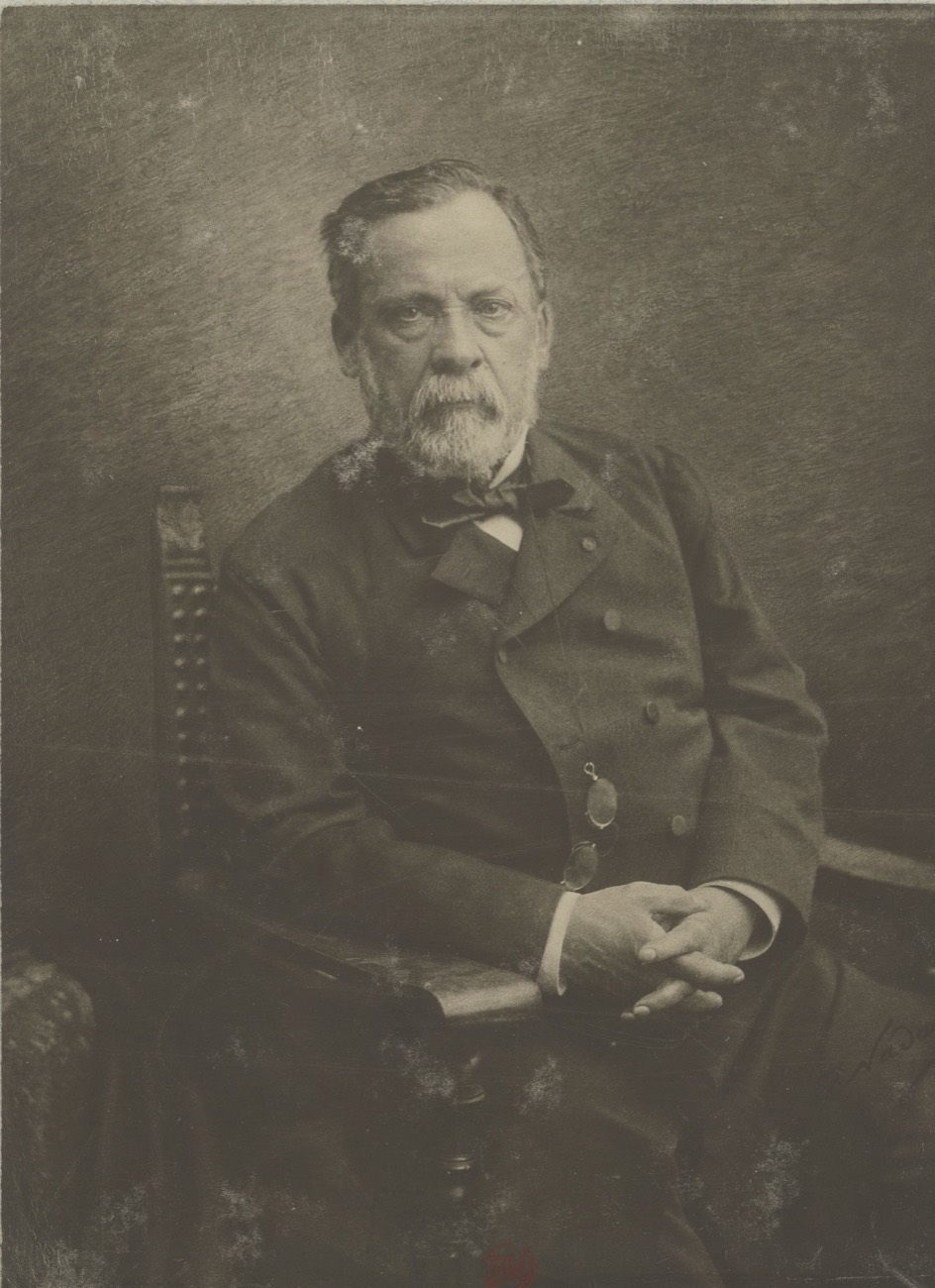
What it taught
Start with what the sheep did show. Twenty-four sheep and a goat given two doses of weakened anthrax culture, twelve days apart, lived through a dose of virulent anthrax that killed twenty-four sheep and a goat beside them in two days, in public, on the day named, with the lots mixed and the syringe passed alternately from one to the other at the request of the doubters. That is as clean a result as the nineteenth century produced, and it was true: the figures from the Beauce the next year were the same result at the scale of a department. What the sheep did not show was how the weakening had been done, and that was the thing the yard, the Académie and the textbooks took them to have shown.
A public experiment tests what the public can see, and no more. The crowd could see dead sheep and live sheep. It could not see the contents of the syringe, and the programme did not require them to be stated. The result therefore bore on the first claim, that attenuated cultures protect, and not at all on the second, that air attenuates; but the second was the claim Pasteur’s papers of February and March had staked, and his report tied the two together in its last paragraph. An audience will credit a demonstration with everything its author has recently asserted unless the author tells it otherwise. Before a demonstration, write down which claim the instrument can speak to, and say it aloud.
The account of an experiment is part of the experiment, and a true result with a misleading account corrupts the record more than a false one would. A false result is retested and dies. A true result is cited, and whatever is attached to it travels with it. The sheep of Pouilly-le-Fort carried the oxygen method into every account for a century, including Roux’s own in 1896, and carried Toussaint out of the story. When Chamberland and Roux published the antiseptic method in 1883 they wrote as if it were new, and it was received as a refinement. The strength of a public success is that nobody checks it; that is also its danger.
The notebook was the control that nobody could read, and it is the reason the truth survived. Pasteur recorded the comparison of 13 April, the plan of 26 April and the vaccine of 5 May in his own hand and kept the book. He told his family to show it to no one, and they obeyed him for ninety years; but he did not destroy it, and he did not write it false. A private record kept honestly is what makes a public account correctable, even by a stranger, even after everyone is dead. Keep the one that says what you did. The one that says what you wanted it to look like is the published paper, and it will be kept for you.
Competition is a reagent too. The vaccine in the syringe was a rival’s idea improved by the laboratory’s own skill: an antiseptic, as Toussaint had used, chosen by Chamberland, reinforced by passages through mice. The notebook shows Pasteur choosing it because it was the surer, which is the right reason, and the papers show him unable to say so, because saying so would have put Toussaint’s name beside his own. An experiment run in a race is read by its runner for what it does to the race. Someone who is not running should read it as well.
The complication is Perutz’s, and it is a fair one. Bichromate is an oxidant; a chemist of 1881 could have told himself, and perhaps Pasteur did, that it was air by other means. The oxygen vaccines were real and came within weeks, and they were the ones the farmers got. The protocol was kept; the sheep were not cheated; nobody died of the secret. What was lost was smaller and lasts longer: a method misdescribed for a century, a man in Toulouse who published his sealed note the week it was questioned and was written out of the result, and the habit, in every reader of the most-told story in the history of vaccines, of believing that a yard full of witnesses can see what is in five drops. They cannot. Only the notebook could, and it was shut.
Sources
All translations from the French are mine; the French of the principal passages is given at the foot of this list.
- Louis Pasteur, “De l’atténuation du virus du choléra des poules,” Comptes rendus de l’Académie des sciences 91 (26 October 1880), 673–680. The attenuation by air, the closed tubes, the oxygen sentence and “Le temps était un élément de ma recherche.” archive.org
- H. Toussaint, “De l’immunité pour le charbon, acquise à la suite d’inoculations préventives,” Comptes rendus 91 (12 July 1880), 135–137, and the sealed note of 12 July opened at the session of 2 August 1880, Comptes rendus 91, 303–304: the eight dogs and eleven sheep, the filtration, and the heating of defibrinated blood at 55 degrees for ten minutes. archive.org, archive.org
- Louis Pasteur, with Chamberland and Roux, “De l’atténuation des virus et de leur retour à la virulence,” Comptes rendus 92 (28 February 1881), 429–435; “De la possibilité de rendre les moutons réfractaires au charbon par la méthode des inoculations préventives” and “Le vaccin du charbon,” Comptes rendus 92 (21 March 1881), 662–668; and “Compte rendu sommaire des expériences faites à Pouilly-le-Fort, près Melun, sur la vaccination charbonneuse,” Comptes rendus 92 (13 June 1881), 1378–1383, with the discussion at the Académie de médecine of 14 June (Blot, Pasteur). Volume 92 is not on archive.org and Gallica refused an automated reader, so all four were read in the Masson edition of the Œuvres de Pasteur, volume VI, Maladies virulentes, virus-vaccins et prophylaxie de la rage (Paris, 1933), pages 332–355. archive.org
- H. Rossignol, De la possibilité de rendre les bestiaux réfractaires au charbon, par la méthode des inoculations préventives. Rapport (à la Société d’agriculture de Melun) sur les expériences de Pouilly-le-Fort (Melun: Drosne, 1881), reprinted in the Œuvres, volume VI, pages 700–720: the temperatures, the sessions of 5, 17, 28, 29 and 31 May, the mixing of the lots, 1 and 2 June hour by hour, de Blowitz’s telegram, “mon chemin de Damas,” the Clos Pasteur, and the ewe. The society’s own Bulletin for 1881 I could not find online. Same link.
- Louis Pasteur, the London address of August 1881 (the twenty million francs, the 20,000 sheep, Lambert near Chartres, “en cinquante heures”); the letter to the president of the Société d’agriculture de Melun of December 1881; the speech at Melun of 26 January 1882 with the figures for July to September and November to January; the note to the Société nationale d’agriculture of February 1882 on the duration of immunity; and “Sur la vaccination charbonneuse” on the Turin failure, 9 April 1883. All in the Œuvres, volume VI. Same link.
- Ch. Chamberland and E. Roux, “Sur l’atténuation de la virulence de la bactéridie charbonneuse, sous l’influence des substances antiseptiques,” Comptes rendus 96 (9 April 1883), 1088–1091, and “Sur l’atténuation de la bactéridie charbonneuse et de ses germes sous l’influence des substances antiseptiques,” presented by Pasteur, Comptes rendus 96 (14 May 1883), 1410–1412. The carbolic acid and bichromate vaccines, the culture that kills half the sheep, and the absence of any mention of Pouilly-le-Fort. archive.org, archive.org
- René Vallery-Radot, La vie de Pasteur (Paris: Hachette, 1900), pages 446–460: the society’s meeting of 2 April and Rossignol’s circular of 8 April, the fourteen sheep, the sceptics, Thuillier, the lecture, the letters of Pasteur and Madame Pasteur, Colin’s advice to Biot, the triple dose, the night of 1 June and Roux’s sentence, “Succès épatant,” and Bouley’s letter. archive.org
- “Extraordinary Results of Inoculation,” Bruce Herald (Otago), 18 November 1881, page 6, reprinting the report of The Times’s Paris correspondent dated Pouilly-le-Fort, 2 June 1881. The same text ran in the Southland Times of 4 November and the Tuapeka Times of 16 November; I could not read The Times itself. The quotations follow Papers Past’s text of the page. paperspast.natlib.govt.nz
- Nature 24 (23 June 1881), the report of the Académie’s session of 13 June. archive.org
- Gerald L. Geison, The Private Science of Louis Pasteur (Princeton University Press, 1995), chapter 1 on the notebooks and their restriction, chapter 6, “The Secret of Pouilly-le-Fort,” and appendixes A and B: the notebook pages of 13 and 26 April and page 113, the translation of the entry for 5 May, Loir’s reminiscence of 1937, Roux’s letters of August 1880, Toussaint’s trial at Alfort, the Christmas letter of 1881, and Toussaint’s end. In copyright; quoted in short phrases. Loir’s sentences are quoted at second hand from this book. press.princeton.edu
- Antonio Cadeddu, “Pasteur et la vaccination contre le charbon: une analyse historique et critique,” History and Philosophy of the Life Sciences 9 (1987), 255–276. In copyright; its abstract read. philarchive.org
- M. F. Perutz, “The Pioneer Defended,” New York Review of Books, 21 December 1995, and Gerald L. Geison and M. F. Perutz, “Pasteur and the Culture Wars: An Exchange,” New York Review of Books, 4 April 1996. In copyright; quoted in short phrases. nybooks.com, nybooks.com
- Bibliothèque nationale de France, Département des manuscrits, Papiers Pasteur, NAF 17923–18112, finding aid: NAF 18016, “XCIV, 10e cahier. Du 10 novembre 1880 au 10 avril 1882,” with Rossignol among the names indexed; no digital copy is shown. archivesetmanuscrits.bnf.fr
- Institut Pasteur, “Charles Chamberland, inventor of sterilization tools,” for his dates and his charge of the vaccine after 1881. pasteur.fr
- “Henry Toussaint,” French Wikipedia, used only for his dates (30 April 1847 to 3 August 1890), his posts and his illness, which it takes from Cornevin’s obituary of 1890 and Chauveau’s eulogy of 1900. fr.wikipedia.org
- The figures: Auguste Lançon’s engraving of the inoculation, scanned from the 1927 German edition of de Kruif’s Microbe Hunters; L. Fillol’s drawing of the farm from Fraitot’s Pasteur of 1905; and the Atelier Nadar print from the Bibliothèque nationale, all through Wikimedia Commons. commons.wikimedia.org, commons.wikimedia.org, commons.wikimedia.org
- The French of the principal translated passages. Pasteur, 28 February 1881: “chacun de nos microbes charbonneux atténué constitue pour le microbe supérieur un vaccin, c’est-à-dire un virus propre à donner une maladie plus bénigne”; “Nous avons pratiqué cette opération avec un grand succès sur les moutons. Dès qu’arrivera l’époque du parcage des troupeaux dans la Beauce, nous en tenterons l’application sur une grande échelle”; “l’incertitude de l’une, la sûreté de l’autre.” 21 March 1881: “d’une merveilleuse simplicité”; “Autant de bactéridies de virulences diverses, autant de germes dont chacun est prêt à reproduire la virulence de la bactéridie dont il émane”; “seulement modifié dans sa vitalité”; “la méthode de M. Toussaint est très incertaine.” 13 June 1881: “Les vingt-cinq moutons non vaccinés périront tous; les vingt-cinq vaccinés résisteront”; “non sans y mêler quelque reproche d’imprudence scientifique”; “bien qu’aucune de ces dernières n’eût l’ampleur de celle qui se préparait”; “également atténué, mais plus virulent que le précédent”; “moururent sous les yeux des spectateurs”; “le dernier de la série s’éteignit à la fin du jour”; “contenaient plusieurs litres de liquide”; “que le désir de connaître la vérité appela à Pouilly-le-Fort”; “Ce sont aujourd’hui les plus fervents apôtres de la nouvelle doctrine”; “Il importe essentiellement que les cultures vaccinales soient, pour un temps du moins, préparées et contrôlées dans mon laboratoire”; “préparés enfin par une méthode qu’on peut croire susceptible de généralisation, puisque, une première fois, elle a servi à trouver le vaccin du choléra des poules”; “un progrès sensible sur le vaccin jennérien.” 14 June 1881: “un vaccin tuant le cobaye et non le mouton, puis un virus tuant 50 pour 100 des moutons, et enfin le vaccin le plus virulent, celui qui en tue 100 pour 100”; “je me vaccinerais moi-même, pour peu que la contradiction voulût me pousser à bout.” London, August 1881: “La méthode que je viens de vous exposer pour obtenir des vaccins du charbon était à peine connue qu’elle passait dans la grande pratique”; “mais des statistiques exactes font encore défaut”; “Le résultat fut celui de Pouilly-le-Fort”; “les 25 non vaccinés moururent, tous charbonneux, en cinquante heures.” Melun, 26 January 1882: “soit par continuation de la mortalité qui existait dans les troupeaux avant la vaccination, soit par des circonstances qu’on peut attribuer à des accidents de vaccination.” Rossignol: “J’ai compté pendant quelque temps parmi les incrédules, j’ai même quelque peu guerroyé de la plume contre ce que j’appelais alors les utopies de M. Pasteur”; “En somme, état sanitaire excellent”; “d’habitude, lorsqu’on l’inocule d’emblée à des moutons, il amène la mort de ces animaux dans l’énorme proportion de 50 p. 100”; “moutons vaccinés ou non ne diffèrent absolument en rien”; “mais ces derniers deviennent de plus en plus clairsemés”; “Je voudrais être vieux de deux jours de plus”; “M. Pasteur, impassible, préside lui-même; on voit qu’il est sûr du succès”; “dans l’ordre où on lui présenta les animaux, sans se préoccuper de savoir s’ils étaient oui ou non vaccinés”; “se tiennent tous à l’écart et refusent toute nourriture”; “la succulente luzerne”; “tombe sur le sol et meurt aussitôt”; “Tout fait présager qu’un grand nombre de moutons succomberont dans la nuit”; “l’immortel auteur de la magnifique découverte de la vaccination charbonneuse”; “étonné, on pourrait même dire stupéfait, d’un tel résultat”; “coram populo, dans la cour de cette ferme de Pouilly, qui désormais s’appellera le Clos Pasteur”; “n’a rien perdu de son caractère belliqueux.” Vallery-Radot: “Le retentissement que ces expériences auront nécessairement frappera les esprits et finira par convaincre ceux qui éprouvent encore quelques doutes”; “Ce qui a réussi sur 14 moutons au laboratoire réussira aussi bien sur 50 à Melun”; “avec une énergie de vétérinaire”; “Pendant quelques instants sa foi chancela, comme si la méthode expérimentale pouvait le trahir”; “nous étions encore très préoccupés et dans l’attente de la dépêche qui aurait pu nous annoncer quelque désastre”; “J’ai eu un petit moment d’émotion qui m’a fait passer par toutes les couleurs de l’arc-en-ciel”; “Ce matin, 18 étaient déjà morts et les autres mourants. Quant aux vaccinés, tous sont debout. La dépêche se termine par ces mots: Succès épatant. Elle est du vétérinaire, M. Rossignol”; “C’est trop tôt encore pour juger en dernier ressort. Les vaccinés pourraient tomber malades”; “Il faut attendre jusqu’au 5 juin”; “Le succès est bien acquis. Les animaux vaccinés vont toujours admirablement bien. L’épreuve est complète”; “fidèle en toutes vos promesses”; and the letter before 31 May, “Mardi 31 mai aura lieu la troisième et dernière inoculation, cette fois avec 50 moutons et 10 vaches. J’ai grande confiance, puisque les deux premières, du 5 mai et du 17, se sont effectuées dans les meilleures conditions sans la moindre mortalité dans le lot des 25 vaccinés. Le 5 juin, au plus tard, le résultat définitif sera connu, c’est-à-dire 25 survivants chez les 25 vaccinés et 6 vaches. Si le succès a cette netteté, ce sera un des plus beaux faits de science et d’application de ce siècle.” Chamberland and Roux, 1883: “sous la direction de notre maître, M. Pasteur”; “de nouvelles conditions d’atténuation de la virulence”; “Nous avons ainsi, par un procédé nouveau, une série de vaccins parmi lesquels on peut choisir pour la pratique”; “L’acide phénique n’est pas le seul antiseptique qui donne de semblables effets; avec le bichromate de potasse on peut en obtenir d’analogues”; “tue les lapins et les cobayes, mais ne fait périr que la moitié des moutons auxquels on l’inocule”; “On voit par là combien il faut être prudent dans le choix des vaccins qui doivent être employés dans la pratique.”


