On 27 October 1950, on a conical hill of mine sludge sixty feet high outside Rutherglen, in north-eastern Victoria, a field officer of the Commonwealth Scientific and Industrial Research Organisation named Ken Myers injected sixty-six wild rabbits under the skin with a millilitre each of glycerinated liver and lung from a rabbit that had died of myxomatosis, and let them go. The hill was an old gold mine, fenced on thirteen acres, and it held about nine hundred rabbits. It was the seventh time that year that the Organisation’s new Wildlife Survey Section had put the virus into a wild population in the Murray valley. The six before it had come to nothing.
This time Myers counted every day. On the seventh day, when the inoculated rabbits showed the swollen eyes and ears of the disease, he began driving the whole population underground through the daylight hours, so that the sick would lie against the healthy in the burrows and give the infection every chance. Four natural generations of the disease followed, each smaller than the one before: about thirty-five rabbits in the first, then sixteen, twelve and eight. The ratio of each generation to its parent came out at 0.53, 0.46, 0.75 and 0.66, which is to say about 0.6, and a disease in which each sick animal infects six-tenths of another is a disease that is going out. On 15 December the counting stopped. The seven hundred rabbits of August had become a thousand. Myxomatosis had killed about seventy of them.
Four years later Myers wrote the sentence that is the whole of the first experiment in this entry: “As subsequent developments show, the one factor lacking was transmission by flying insects.”
The subsequent developments had begun before he stopped counting. In the first week of December, on a test site at Balldale, seven miles north of the Murray, where the disease had been given up for dead in November, rabbits began dying again. By 10 December word reached Canberra that they were dying by hundreds on the river flats at Corowa. By the middle of February 1951 the disease was in nearly every part of a river system a thousand miles from south to north, and in that same river system, in the same weeks, a disease of people began that had killed nineteen of forty-five by April, and the two were joined in the public mind before any laboratory could separate them. The second experiment of this entry was three men in Melbourne with a syringe, in March 1951, answering that.
Who ran it
The field experiment belonged to the Wildlife Survey Section of CSIRO, which was two years old. Its officer in charge was Francis Ratcliffe, born in Calcutta in 1904, trained in zoology at Oxford, and brought to Australia in 1929 as what the Council for Scientific and Industrial Research called its biological scout, to study flying foxes and the drifting sand of the inland. He had served in the war as an army entomologist, and in 1948 he was put in charge of the new Section, which was meant to study the native fauna. It was told instead to begin with the rabbit. The men who did the work on the ground were Myers, at the Section’s field station at Albury; Bernard Fennessy; John Calaby; Roman Mykytowycz, who caught the insects; and John Brereton, whose surveys mapped where the disease had got to.
The chairman of CSIRO, reconstituted under that name in 1949, was Ian Clunies Ross, a veterinary scientist who had joined the Council as a parasitologist in 1926. It was Clunies Ross who had chosen Ratcliffe, and Clunies Ross who, in Frank Fenner’s account, “insisted that he should first try out myxomatosis.” Behind both of them stood a paediatrician. Dame Jean Macnamara, a Melbourne physician whose life’s work was poliomyelitis, had visited Richard Shope’s laboratory at Princeton in 1933 and come home convinced that a virus which killed laboratory rabbits in South America could be made to kill the rabbits of Australia. For the better part of two decades she said so, in letters to high commissioners and in the rural press. Ratcliffe said, of himself, that she regarded him as “a boil on the bum of progress.”
The second experiment belonged to three men who were not, strictly, running the first. Macfarlane Burnet had directed the Walter and Eliza Hall Institute of Medical Research in Melbourne since 1944 and was, in the words the Minister would use to Parliament, “by general agreement among his colleagues, the greatest expert in Australia on virus diseases.” Frank Fenner, born at Ballarat in 1914, a wartime malariologist who had worked on mousepox under Burnet and spent two years at the Rockefeller Institute in New York, was appointed in 1949 professor of microbiology at the Australian National University in Canberra, a university which did not yet have a building to put him in. Through 1951 and 1952 he worked in two laboratories lent to him at Burnet’s institute. The date on which he decided to make myxomatosis his subject can be fixed to the day, because Burnet’s diary for 1 February 1951 records him asking. He went to Clunies Ross, “who was delighted to have a virologist working on this topic, for at the time there were no virologists in CSIRO.”
The third was Clunies Ross again, who was responsible for the virus and said so. And answering for all of them in the House of Representatives was Richard Casey, the Minister in charge of CSIRO, who had to stand up in March 1951 and say what the scientists had told him.
What they were trying to find out
The first experiment had been running, on and off, since 1933, and its hypothesis had two halves. The first half was that myxoma virus would kill Australian rabbits and nothing else. That was settled before the war. Sir Charles Martin tested the virus at Cambridge in 1933 and 1934 on Macnamara’s prompting; Lionel Bull, chief of the Council’s division of animal health, tested it at Werribee in 1937 on everything a farm or a bush could offer. Casey summarised the result for Parliament in 1951: “All domestic animals and a wide range of Australian wild animals and birds were tested but none showed any development of the symptoms of myxomatosis. Even hares were immune.”
The second half was the one that had never come out, which was that the disease would spread. Between 1937 and 1943 Bull and his colleague Bill Mules ran the virus through rabbits penned in ninety-acre enclosures and then through wild warrens in the semi-arid pastoral country of South Australia. It spread from warren to warren once, where the rabbits carried the stickfast flea; foxes, taking the slow sick rabbits first, could stop an outbreak before it started; in the open country there was no natural spread at all, and in 1943 the Council stopped the work. “At the time,” Ratcliffe wrote in 1952, “it was not known that myxomatosis was essentially an insect-borne disease.” That was not quite true, and the untruth is the hinge of the story. Bull and Mules had shown in the laboratory that four species of Australian mosquito could transmit the virus. In 1942 the Brazilian Henrique de Beaurepaire Aragão had shown that in its home the disease lived in a native rabbit of the genus Sylvilagus, ran a mild course there, and was carried by mosquitoes. Nobody in Australia read Aragão’s paper until 1951. “We had all missed Aragao’s paper,” Burnet told an American audience in 1952, “and the realization that in Australia effective spread needs mosquito carriage came as a surprise.”
What the new trials of 1950 were meant to find out, then, was whether the disease would gain momentum in a wild population if it were put into well-watered country where mosquitoes were likely, and what governed whether it did. Myers set out the four factors the Section proposed to measure: “rabbit density; predation, which might have a selective effect on diseased members of the population; the behaviour of sick rabbits, particularly their movements away from their warrens; and the presence of possible insect vectors.” The vectors were on the list. They were fourth on it, and the trials were timed for the Australian winter. “There was still a general feeling that infection would be mainly by contact,” Burnet said afterwards, “and the tests were made in autumn, winter and spring.”
The second experiment’s hypothesis was simpler, and it had been proved already. The virus does not infect people. The question in March 1951 was not whether that was true but how to make a public believe it in a valley where children were dying of encephalitis, and the answer the three men chose was to put the virus into their own arms, on the record, in a dose a hundred times larger than any mosquito could carry.
What they built
The rabbit the virus was meant for had arrived in Victoria in 1859 and by 1930 had colonised everything below the tropics that would hold it. Burnet, who did not like a number he could not defend, told the American Public Health Association that it was “impossible to give an estimate of the average number of rabbits in Australia beyond the guess that it lies between one and three billions,” and that by a conservative reckoning ten rabbits ate as much pasture as a sheep. By 1946, after a war that had taken away the men who trapped and poisoned them, the numbers were past anything in living memory. Casey would tell Parliament in 1952 that each rabbit cost the country five shillings a year, and then that his officers had corrected him to ten.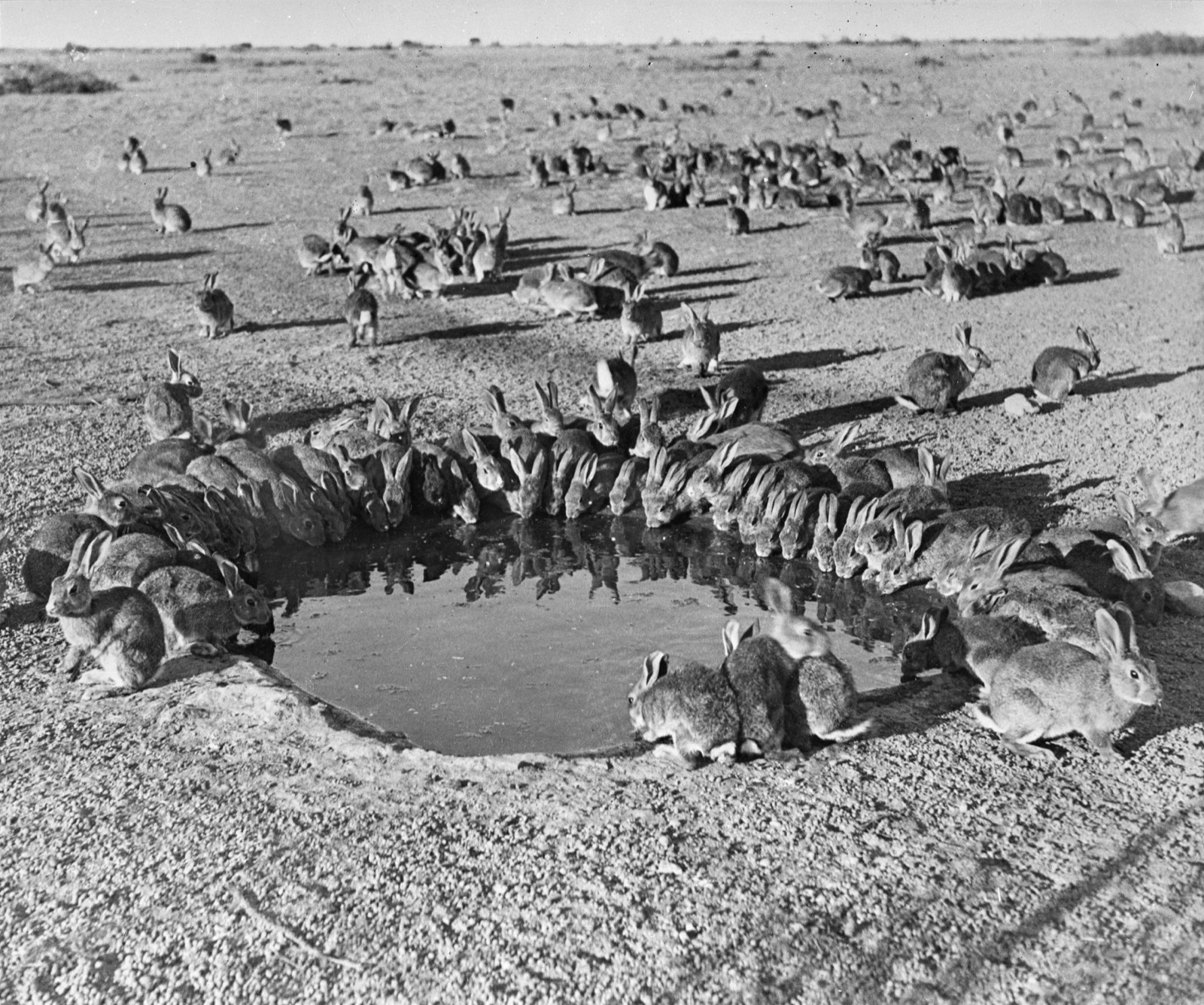
The virus came from a laboratory strain, Martin’s strain B, held since the 1930s, and the Section got its working stock from the New South Wales veterinary research station at Glenfield as a glycerinated extract of the liver and lungs of a rabbit that had died of it. The trial sites were chosen for water. Work began at Gunbower, on an irrigated dairy farm in Victoria about a hundred miles down the Murray from Albury, in January 1950, and the first liberation that Ratcliffe counted was made in May. A large trial followed at Wymah, in the foothills east of Albury. Then, in August 1950, Myers opened four sites in the Corowa district of the eastern Riverina, chosen to represent three of the four kinds of country the rabbit lived in there: two stands of native pine on sandy soil at Balldale, a granite hill at Coreen, and the mullock heaps of the old goldfield at Rutherglen. The fourth kind of country, the river flats of the Murray with their billabongs and swamps, was left out, because the annual flood was rising. The Murray reached the peak of that flood on 31 October 1950.
The method was counting. The Section’s officers caught rabbits by ferreting, or dug them out, inoculated each one under the skin, earmarked it, and put it back where it came from. The population was counted on warm sunny evenings, when the rabbits came up to the mouths of their burrows, by an observer who walked the same transect at the same slow pace every time; predators were read from what they left of the carcasses, and insects by the number that bit the observer’s bare arm in a minute. Myers was severe about why the counts had to be good. In this work, he wrote, “it is necessary to distinguish clearly between a 95 % and 99.5 % mortality in a rabbit population.” How the counting was done, site by site, is in The counting.
Seven liberations on five sites, as Ratcliffe reckoned it, or six sites in Myers’s count, which treats the two Balldale stands separately. Rutherglen first, twenty-seven rabbits on 7 September; Balldale B, thirty-three on 9 September; Coreen, forty-eight on 10 September; Balldale A, twenty-nine on 17 September; and the sixty-six at Rutherglen on 27 October. At every one of them the disease went into the inoculated rabbits, spread to a few of their neighbours, and then stopped. “All were disappointing,” Ratcliffe wrote, “in that, except in a portion of one of the experimental areas, the disease had no noticeable effect on the rabbit populations.” None of the factors on the list was the answer. Predation was light and fell almost wholly on the kittens; the sick rabbits did not wander, but sat in their own warrens until they died; and density was not the limit, since the final trial was run at 1.2 rabbits to every active burrow mouth, with the sick driven in among the well, and still the ratio came out at six-tenths.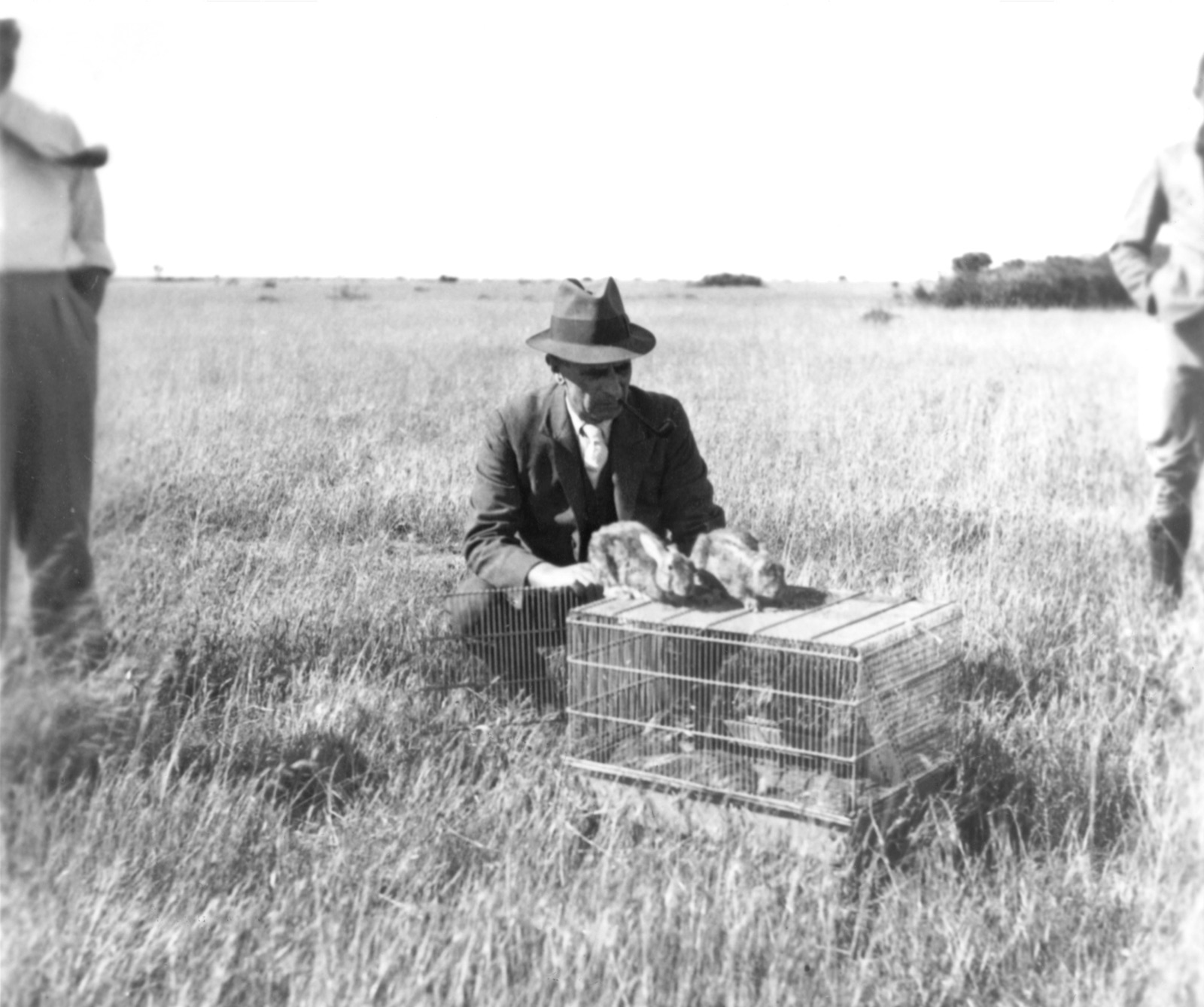
The insects had been measured too, and they are the one line in Myers’s tables that reads differently now from how it read in November 1950. At Rutherglen, through August, September and October, the only winged blood-feeder taken was the mosquito Aedes theobaldi, in very low numbers, biting by day; towards the end of November the first few Anopheles annulipes came biting in the evening. At Balldale the day-biting Aedes were dense, twenty to the arm in ten minutes, “but no epizootic developed during the period of their activity.” The mosquitoes that were there did not carry it, and the mosquitoes that would carry it were not there yet. On the river flats the lagoons were still running with the flood, and could not, Myers wrote, “have become suitable for mosquito breeding on a large scale until later in the month.”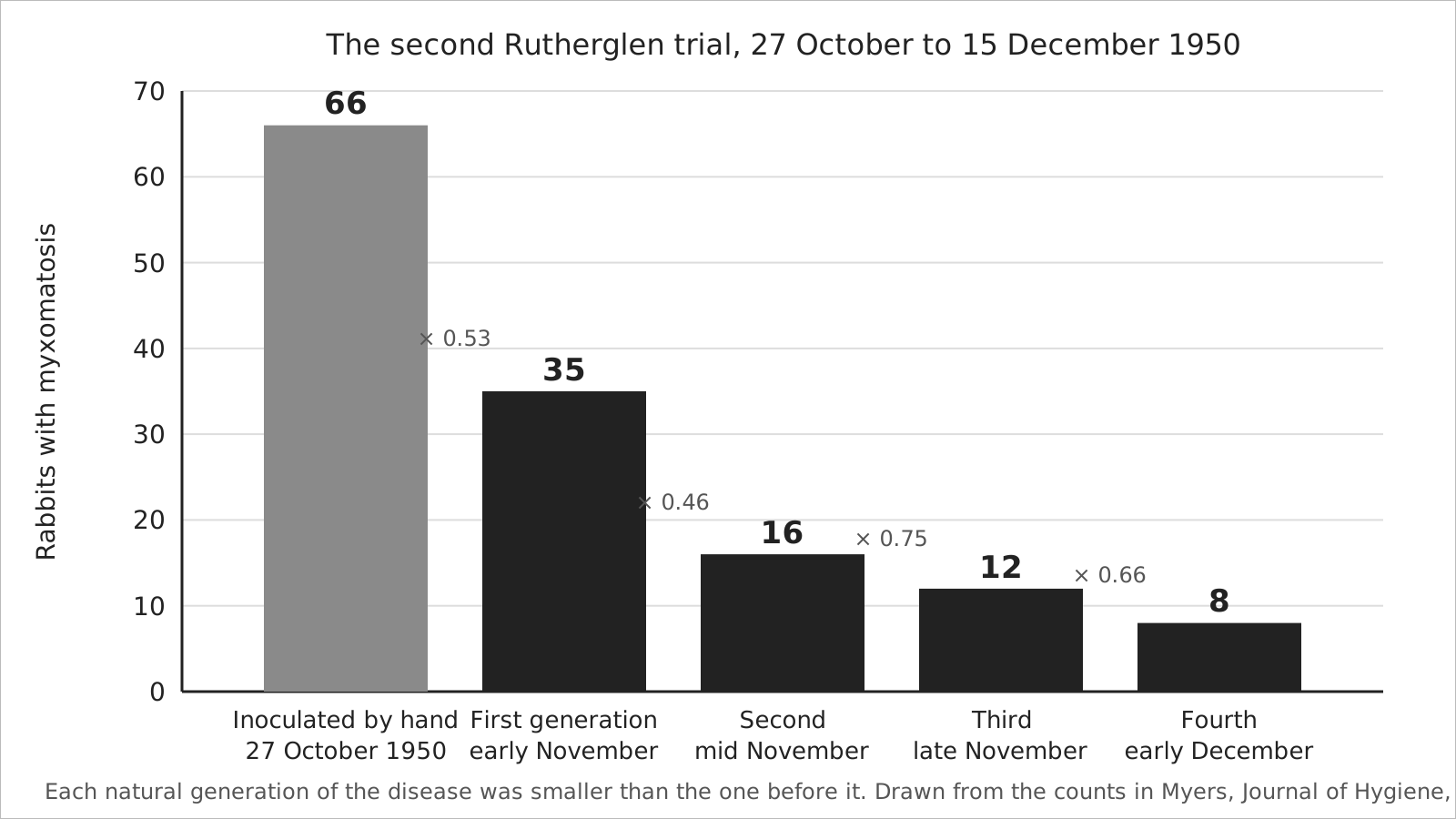
“At the end of November, 1950,” Burnet said, “the team went back to Canberra prepared to write up the account of a fruitless experiment.”
Eight miles south
What happened next is in three accounts by people who were there, and they do not quite agree on the distances. Myers: “In December 1950, however, an epizootic broke out at Balldale. Control measures by the landholder prevented a study of the disease on this site, but very soon diseased rabbits appeared on the low-lying flats of the Murray River, 8 miles to the south.” Ratcliffe: “During the first week in December, myxomatosis flared up on the Balldale test site near Corowa, situated about seven miles north of the river in New South Wales. Almost at once reports began to come in of the appearance of the disease in other places, some on the Murray main stream, some on the northern tributaries.” Burnet: “Then on December 10, 1950, word came to Canberra that rabbits were dying by hundreds along the Murray River flats at Corowa 20 miles from Balldale where the liberations had been made. This was front page news for Australia and everyone in the country was on the look-out for sick rabbits.”
The look-out found it everywhere. One of the December outbreaks, turned up in Brereton’s surveys afterwards, was on the Darling River nearly four hundred miles from Corowa. After the New Year, Ratcliffe wrote, “the epizootic gathered momentum rapidly. By mid-February 1951 myxomatosis had appeared in practically all parts of the huge area that was to be affected before the advent of winter, and the peak of the epizootic had passed in most districts.” Where it took hold it was quick: kills of ninety per cent or better “were as a rule achieved within 3-4 weeks of the date on which the infection was first noted in the population.” By the end of March the Section could map it, and the map was the river system: the Murray, the Murrumbidgee, the Lachlan and the Darling, into Queensland by the end of summer, with isolated outbreaks thrown out fifty miles apart along the dry margins in South Australia. From the mouth of the Murray to the Texas district on the Queensland border, the furthest point the first season reached, was 860 miles. Along the Murray itself the useful kills were confined to a strip a few hundred yards wide, matching the belt of river red gum; on the tributaries of the Darling east of Bourke, where a record wet spring had left water standing everywhere, “it was possible to drive for a day or more through country that had previously been swarming with rabbits and see only isolated survivors.”
Myers went back to the river to find out what had changed, and what had changed was the air. In January and February 1951 the mosquitoes of the Murray flats were two species, Culex annulirostris and Anopheles annulipes, both night-biters that come out at dusk; of 1,369 larvae dipped from the lagoons, 88.4 per cent were Culex annulirostris. The disease stopped where the mosquitoes stopped: away from the river, on the higher, drier ground, the count of mosquitoes at nine in the evening fell away, and so did the count of sick rabbits. About three times as many mosquitoes fed on a sick rabbit as on a healthy one, because the sick did not flick them off. During the decline of the outbreak Mykytowycz caught 168 female Culex annulirostris biting people on the river frontage, ground them in a mortar, and injected half a millilitre of the suspension into the flank of a laboratory rabbit; a lesion came up in three days and the rabbit had generalised myxomatosis a few days later. Three laboratory rabbits put out for three hours a night for fourteen nights were bitten freely, and two of them came down with the disease. By 15 March 1951 the evening temperature on the river frontage fell below seventy degrees Fahrenheit for the first time and the mosquitoes began to go quiet. “By April,” Myers wrote, “evening temperatures registered 50-60° F., adult mosquito activity ceased completely, and with it all evidence of the disease.”
Nobody could say how the virus had crossed four hundred miles of dry country in a month. Culex annulirostris rarely flies half a mile from where it breeds. Ratcliffe allowed for long flights, for carriage on high winds, and for the uncomfortable possibility that the December flare-up had not been the beginning: “we can only record the possibility that one or more of our earlier and apparently abortive virus liberations may have contributed in some way to what might be termed the embryonic stage of the epizootic.” What the Section would not allow was doubt about the carrier. “One thing we believe to be beyond question: the spread of the disease was a reflexion of the movement of infected insects, almost certainly mosquitoes.”
What it looked like from inside
In the same valley, in the same weeks, people were falling ill with a disease nobody under thirty-five had seen. The first case came on in December 1950 in south-western New South Wales; by April there were forty-five, most of them children, and nineteen had died. Burnet recognised it as the Australian X disease of 1917 and 1918, which had never been explained. He put two of his staff on it, Gray Anderson on the epidemiology and Eric French on the virus, and French isolated it from the brains of the dead: a mosquito-borne encephalitis of the Japanese B and St Louis group, which they named Murray Valley encephalitis. Its carrier, on all the evidence that came in that year and the next, was Culex annulirostris, “a river bottom mosquito,” Burnet said, “which feeds freely on water birds and rabbits.” The epidemic and its explanation are told in The other virus.
That was the mosquito that was killing the rabbits. It bred in the same lagoons, after the same flood. The connection the public made between the two outbreaks was wrong in its mechanism and right in nearly everything else, and that is the condition in which rumours are hardest to answer. The rabbits were dying along the rivers of something the government had put there; the children were dying along the same rivers of something nobody could name; the one had followed the other by a matter of weeks. Burnet’s institute had the two viruses side by side in Melbourne and could show that, as Casey put it to the House, “they are not even distantly related.” That was not the kind of evidence that reaches a hospital board.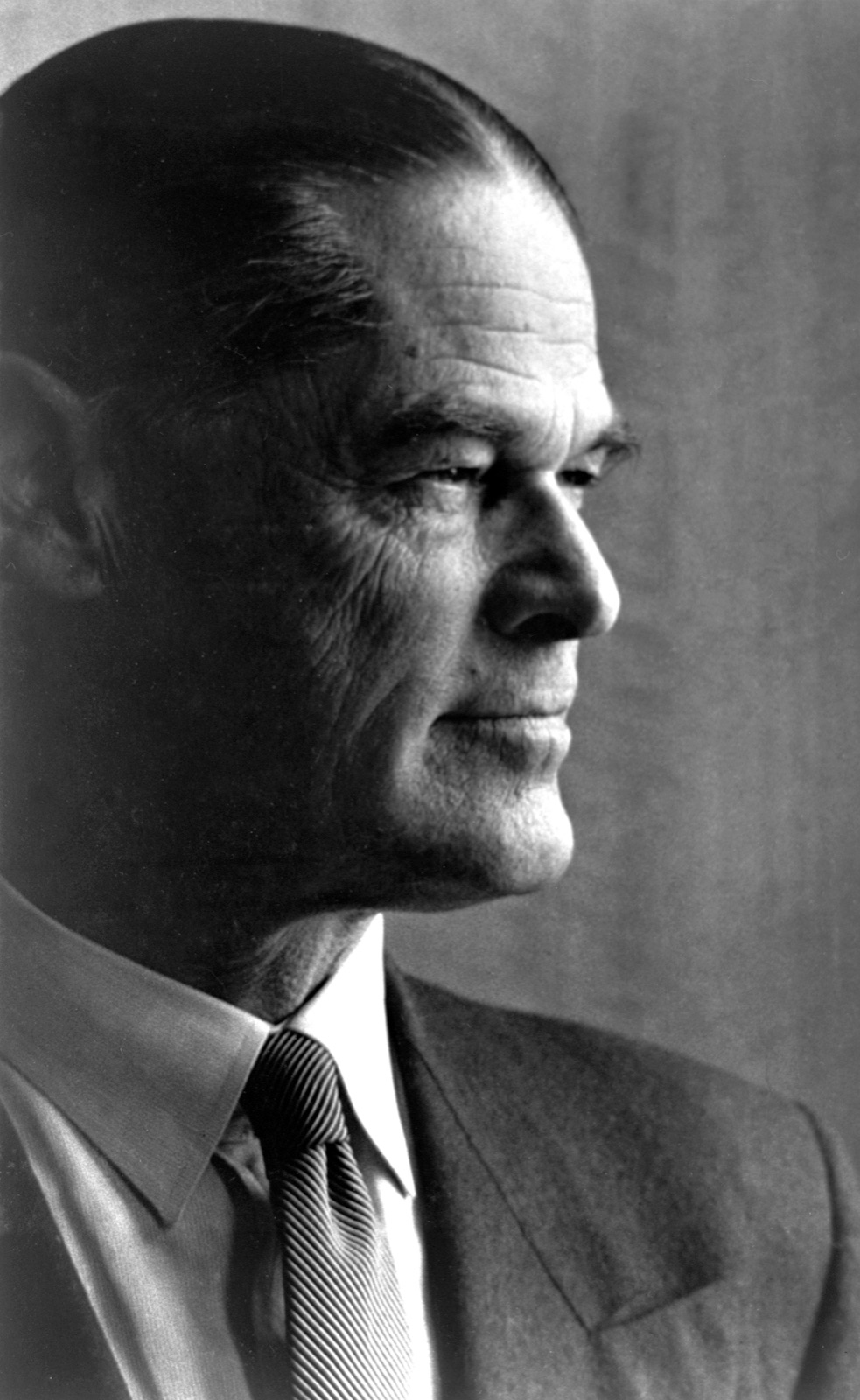
The challenge came from Mildura, the irrigation town where there were a dozen cases. The chairman of the Mildura hospital board, in Fenner’s account, “challenged Burnet and R. G. Casey (Minister in charge of CSIRO) to test the harmlessness of myxoma virus on themselves.” In the House on 8 March 1951 Charles Morgan, the member for Reid, asked Casey whether he was “prepared to accept the challenge of the citizens of Mildura to submit himself and other members of the Government to inoculation with the myxomatosis virus.” Casey’s answer is the first public trace of the second experiment. “Recently in Australia two research workers voluntarily inoculated themselves with the virus, and there was no reaction. I think that, in the circumstances, the extreme lengths to which the honorable gentleman suggests that I should go are probably unnecessary.”
Two research workers. Fenner’s account of what happened in the laboratory is the only one from inside, and he wrote it half a century later. “Burnet consulted me and we decided that it was absolutely safe. I prepared a suspension and injected Burnet subcutaneously with one, 10 and 100 rabbit-infectious doses; Burnet inoculated me. As soon as he heard of this, Clunies Ross said that, as Chairman of CSIRO, he was responsible for the use of the virus, and therefore he should be included in the tests, so I injected him. None of us showed lesions or an antibody response.” Clunies Ross, when the newspapers finally got to him in October, said the injections had been “in March.” Casey’s two on 8 March, then, were Burnet and Fenner, and the chairman came after, which is what the chairman’s own account implies.
They did not want it known. Later that day Casey read the House a statement on the whole affair, from Martin’s experiments to the Wardang Island trials that had failed “probably due to the absence of mosquitoes or other insect carriers,” and on the encephalitis he said that the authorities “agree that there is no connexion whatsoever between the virus causing myxomatosis and the virus causing encephalitis,” and that “the Commonwealth Scientific and Industrial Research Organization is not taking any further steps to spread myxomatosis.” He did not name the two. A week later he was asked about the stories of cattle, dogs, cats, foxes and eagles dying of the rabbit disease, and said that every one had been run down and “in no case has it been established that the death of an animal, domestic or wild, has been caused by that disease.”
The names came out seven months later, because Parliament wanted them. On 9 October 1951 Roger Dean, the member for Robertson, asked Casey who the “three senior officers” were who had inoculated themselves, and for the particulars of “their very gallant experiment.” Casey said he had not yet had their assent to be named. On 11 October he had it: “I have had some difficulty in persuading the three scientists to agree to the publication of their names, but they have now done so.” He named Burnet, Clunies Ross and Fenner, and went on: “The experiment proved, as they had expected, that the virus has no effect upon human beings. The dose with which they were inoculated has been described to me as being 100 times larger than that which a mosquito can inject into a human being after feeding upon a rabbit that is infected with myxomatosis.” Members stood and cheered.
The three were asked about it in Melbourne the same day, and what they said is the clearest statement in this journal of what a demonstration is for. Burnet, to the Daily Telegraph: “Do you think we would have done it if we had thought anything would happen? It wasn’t an experiment, because we all knew the answer in advance. Myxomatosis has been given to every conceivable animal and reptile in this country and has affected only one — the rabbit. Unfortunately, someone started a tale that Murray Valley encephalitis was being spread among human beings by myxomatosis, and that myxomatosis was lethal. We felt it was necessary to squash this fallacy. The best way was to have a really big injection ourselves. The only effect I noticed was a tiny pink mark where I had the injection.” Clunies Ross: “If we’d been wrong we’d have known all about it by now.” And to the Sun News-Pictorial: “It was a completely unexciting story. There was nothing but a small red spot at the point of inoculation.” Fenner: “It was nothing at all. We felt we had to do it for the sake of unbelievers.”
The Argus ran a leader the next morning under the heading “The Brighter Side.” The news, it said, “is the kind of thing that goes far to restore our faith in human-kind,” and it was “no mere coincidence that the three men who took this risk for the sake of others were scientists.” None of the papers asked what the risk had been, and the men had just said there was none.
What happened
The disease wintered. It died down in the cold months everywhere and went out nowhere, and in the spring of 1951 the States took it up as a weapon. CSIRO would not hand the virus to farmers, because, as Casey explained in July, spreading it “entails the inoculation of individual rabbits with a hypodermic syringe. That is a rather delicate operation to perform on rabbits.” Instead the departments sent officers out to the stockyards. Burnet spent a night that October in a country hotel in northern Victoria and copied the notice on the wall: “An officer of the Lands Department will attend at the stock-yards on Tuesday next to inoculate rabbits with myxomatosis. Landowners should bring 10-20 live rabbits.” On 3 October Casey told the House that “tens of thousands of doses are going out daily,” and that every mainland State was co-operating; Tasmania banned the virus instead, and Casey said the following May that he believed it was established there anyway.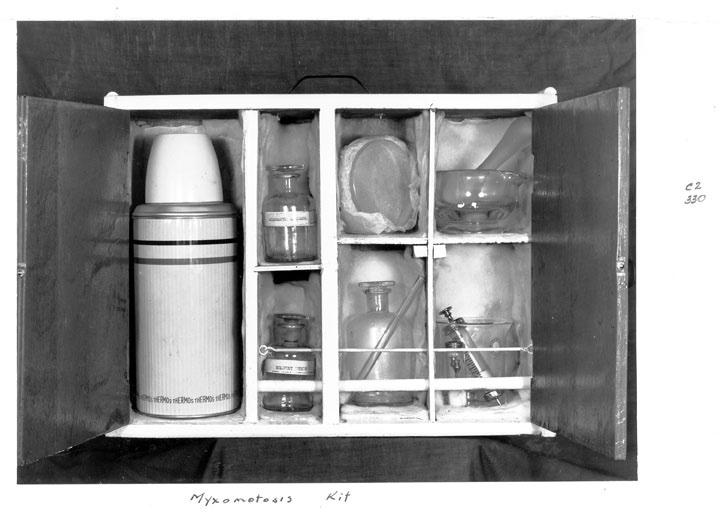
The summer of 1951 and 1952 was a normal one, not a wet one, and the disease went where the mosquito of a normal summer took it, which was Anopheles annulipes, a mosquito of the rolling farming country that rests in rabbit burrows, so that the second season killed away from the rivers where the first had not. Fenner’s laboratory, meanwhile, had built the instrument the first season had lacked: rabbits that lived through myxomatosis carried antibodies that could be found in their blood for more than eighteen months afterwards, so the survivors could be counted. Between 1951 and 1952 Fenner, Ian Marshall and Gwen Woodroofe bled 824 wild rabbits from seventeen localities, and in the places where the disease had struck hard, seventy to ninety per cent of the animals left alive two to five months later had had it and recovered. Where Myers had real counts before and after, the arithmetic could be closed. On a sample area at Lake Urana, in the Riverina, 5,000 rabbits became 50 in the outbreak of November and December 1951, about a quarter of the fifty were immune, and so of five thousand rabbits that met the virus, 99.8 per cent had died. A second area went from 500 to 12, for 99.4. Fenner found the figure hard to credit even in old age: “The case mortality rate, we later found, was over 99 per cent in the field – unbelievable.”
Burnet tried the sum for the continent in October 1952, with every warning a careful man can attach to a guess: from the counts, the immune rates, the skins and carcasses coming to market, “it is believed that between 25 and 50 per cent of the rabbit population may have been destroyed, perhaps three or four hundred million rabbits.”
After
The thing that made the field experiment work was understood in the laboratory within a year, and it is the title of this entry. Fenner and Max Day, an entomologist from CSIRO’s division of entomology, took the mosquito Aedes aegypti and let it feed on infected rabbits. A mosquito that fed on a rabbit in full viraemia, through clean skin, could not pass the disease on. A mosquito that probed through one of the skin lesions of the disease could. The virus did not multiply in the insect at all; it rode on the mouthparts, and the next rabbit was infected in its skin, not its blood. Fenner found he could reproduce every result with an entomological pin pushed through a lesion and then into a healthy animal. “The role of the mosquito,” Burnet said, “is merely that of a ‘flying pin’.” It followed that there was nothing special about the mosquito: any arthropod that bit through skin and fed on more than one rabbit would do, and in the field the Section found the disease carried by a black fly near Yarrawonga, by sandflies in Queensland and, in winter, by the rabbit louse. It followed too that the disease could only go where the biting insects were dense enough, and only in the season when they were. Myers’s rule, written in 1954, was that “wherever myxomatosis causes a significant mortality in a rabbit population, a blood-sucking vector is responsible for the spread of the infection.” The failures of Wardang Island and the dry north in the 1930s, and of the winter of 1950, were the same failure.
The flying pin also explained what happened next, which Burnet had predicted before it happened. “No biological association on a basis of 99.5 per cent lethality could ever be an enduring one,” he told the Americans in 1952; somehow a modus vivendi between virus and rabbit would develop. On the Lake Urana sample area, where the first outbreak had killed 99.8 per cent, the second, in November and December 1952, killed about ninety, and the strains taken from mosquitoes there and at Corowa that December were all attenuated. The reason was the pin. A rabbit infected with the original strain died in a few days with its skin full of virus; a rabbit infected with a slightly milder strain lived for weeks with lesions just as rich, and was bitten through them all that time. The mosquito did not care which rabbit it bit, but the virus that kept its host alive longest got carried furthest, and so the field selected against its own weapon. Fenner spent the next fifteen years measuring that, and the rabbits’ answering resistance, and he and Ratcliffe wrote it up in 1965 in the book they called Myxomatosis.
The encephalitis did what Burnet’s own analysis said it would. Anderson and Charles Miles went through the rainfall records and found that each of the four epidemic years, 1917, 1918, 1925 and 1951, had followed a November of flooding on the headwaters of the Darling. In the normal summer that followed, the institute’s sentinel fowls, bled volunteers and mosquito collections at Mildura found no virus at all. It had come into the valley on the flood with its mosquito and left with it, exactly as the rabbit disease had. On 22 November 1951 the Prime Minister, Robert Menzies, answered a member who had told the House that “the mosquitoes are spreading myxomatosis and encephalitis”: “There is no direct proof that the mosquito is responsible for the spread of encephalitis although the available evidence supports this theory.” The member had been right about the mosquito. He had been wrong only about which pin it was.
Australia had tried biological control once before in that generation, when the sugar industry shipped a hundred-odd toads from Hawaii to Queensland in 1935 against the cane beetle, bred them, and let them go before the trial was finished; that story is told in Twelve Beetles a Night. The two are usually set against each other, the warning and the vindication, and the contrast is real. The virus had been tested for fifteen years against every animal anyone could think of before a single wild rabbit was inoculated, and the species it killed was the species it was meant for. But the fifteen years had been spent on the wrong half of the hypothesis. What the virus would do inside a rabbit had been settled in 1937. What it would do between rabbits was settled by a flood.
What it taught
Begin with what the experiment of 1950 was. It was well designed for the four factors on its list: density, predation and the behaviour of the sick were each measured with a care that still reads well. The fourth factor was the one it could not control, because a vector is not a thing a field section can put on a site. It could only choose sites where the vector might come, and a season in which it did not.
The experiment answered a hypothesis its designers had not written down. Mosquitoes were on the list, fourth; the trials were run in winter, when the right ones were not flying, by people who still expected the disease to pass by contact. The disease behaved exactly as a contact-borne disease would, and went out, and when it came back it was not the design that had changed but the weather. Burnet named the two reasons it took fifteen years: an aversion by health authorities to field trials anywhere near people, “and the failure to grasp the importance of mosquito vectors for the spread of the disease.” The instrument was reading correctly all along. The number it was reading, 0.6, was the right answer to a question about contact.
Nature ran the trial the Section had not, and it did so after the observers went home. The team left for Canberra at the end of November to write up a failure; the result arrived on 10 December by telephone from a landholder. It is the shape of the winter nobody saw in Forty-Two: the decisive reading comes when the station is unmanned. Here the Section was lucky: the reading was loud enough to be heard four hundred miles away, and Myers could go back to the river in January and measure the thing that mattered. The lesson is not that nature is kinder than design. It is that a trial should be left running past the point where its designers have decided what it means.
A demonstration is not an experiment, and the men who gave it said so first. Burnet’s sentence on 11 October 1951 deserves its place beside Pettenkofer’s glass in One Cubic Centimetre, because it is the opposite gesture with the same syringe. “It wasn’t an experiment, because we all knew the answer in advance.” Pettenkofer drank his culture to find out, with a sample of one and both outcomes explained away beforehand. Burnet, Fenner and Clunies Ross injected theirs because the finding out had already been done, on every domestic animal, every marsupial anyone could catch and a hare, and on two viruses lying side by side in a Melbourne laboratory that were “not even distantly related.” The three bodies added no evidence. What they added was a form of evidence that a hospital board in Mildura could read, which is a newspaper photograph of a man who is not dead. That is why it worked, and why it would have been worthless if the laboratory had not come first. A body is an argument, not a measurement, and the men who used theirs that way were careful to say which.
The public was wrong about the mechanism and right about the connection. The rumour that the rabbit virus was killing children was false in every particular that a virologist could test and true in the one that an epidemiologist could: the two outbreaks had one cause. The same flood filled the same lagoons, bred the same mosquito, Culex annulirostris, and the same insect carried a virus from rabbit to rabbit on its mouthparts and a different virus from bird to child in its gut. Casey’s “no connexion whatsoever” of 8 March was right in the sense he meant it, and by November the Prime Minister was telling the House that the evidence supported the mosquito for the encephalitis too. A denial that is exact can still miss what people have noticed. When the public ties two events together, the answer is not only to prove that the tie is wrong but to find the true one, which in this case was a wet November on the headwaters of the Darling.
A ninety-nine per cent weapon cannot stay one, and the reason is the same as the reason it worked. The pin carried whatever was in the lesion it went through, and it went through the lesions that were there longest. A virus that killed in four days was carried less often than a virus that kept its host sick for three weeks, and so the field bred a milder virus, and the rabbits that survived the milder virus bred resistant rabbits, and the figure went from 99.8 per cent to ninety in two years and kept falling. Anyone who plans on an instrument that reads 99.8 should ask what the instrument is made of, and whether the thing it measures can change under it.
Check the story before you learn from it. The sites were five in Nature and six in the Journal of Hygiene, with seven liberations in both; the first work at Gunbower began in January 1950 and the first liberation that counted was in May; the Balldale site was seven miles from the river in Ratcliffe’s paper, eight in Myers’s, and twenty from Corowa in Burnet’s lecture. The injections were given in March 1951, by Clunies Ross’s account and the Academy of Science’s memoir of Fenner; Casey spoke of two research workers on 8 March and three senior officers in October. The dose was one, ten and a hundred rabbit-infectious doses in Fenner’s memoir, a hundred times a mosquito’s load in Casey’s statement, and enough to kill a thousand rabbits in the Daily Telegraph. The encephalitis killed nineteen of forty-five in Anderson’s paper and seventeen in the institute’s own history today; Burnet gave the cases as forty in round figures. The kill was 99.5 per cent in Burnet’s lecture, 99.8 and 99.4 at Lake Urana, and “over 99 per cent, unbelievable” in Fenner’s memory. The mosquito, the flood and the three red spots are not in doubt. Everything else moves a little, which is the ordinary condition of a true story and the reason this one is worth checking.
Sources
- K. Myers, “Studies in the epidemiology of infectious myxomatosis of rabbits. II. Field experiments, August–November 1950, and the first epizootic of myxomatosis in the Riverine Plain of south-eastern Australia,” Journal of Hygiene 52 (1), 47–59, March 1954. The six sites, the four factors, the counting methods, the Glenfield extract and the three caged rabbits, the dates and numbers inoculated, the second Rutherglen trial with its four generations and the ratio of 0.6, “the one factor lacking was transmission by flying insects,” the December outbreak eight miles from the river, the 1,369 larvae, the 168 ground mosquitoes, the three exposed rabbits, the flood of 31 October, the temperatures of 15 March and April 1951, and the rule about vectors. doi:10.1017/S0022172400027248
- F. N. Ratcliffe, K. Myers, B. V. Fennessy and J. H. Calaby, “Myxomatosis in Australia: a step towards the biological control of the rabbit,” Nature 170, 7–11, 5 July 1952. The pre-war work and its conclusions, “it was not known that myxomatosis was essentially an insect-borne disease,” the seven liberations on five sites, “all were disappointing,” the first week of December at Balldale, the Darling outbreak four hundred miles away, the possibility of an embryonic stage, “beyond question,” the spread to mid-February, the kills within three to four weeks, the map, the 860 miles, and the country east of Bourke. Read in the archive.org scan of the issue. archive.org, doi:10.1038/170007a0
- Sir Frank Macfarlane Burnet, “Murray Valley Encephalitis” and “Myxomatosis as a Method of Biological Control Against the Australian Rabbit,” two addresses to the American Public Health Association at Cleveland, 22 October 1952, American Journal of Public Health 42 (12), 1519–1521 and 1522–1526, December 1952. The X disease and the case numbers in round figures, Mildura’s dozen cases, the rainfall analysis and the five wet Novembers, the vanishing of the virus in 1952, Culex annulirostris as “a river bottom mosquito,” the one to three billion rabbits, the fifteen years and their two reasons, the tests “made in autumn, winter and spring,” the team going home to write up a fruitless experiment, 10 December 1950 and the front page, the hotel notice, the three or four hundred million, Aragão’s missed paper, the “flying pin,” and the prediction that 99.5 per cent could not last. archive.org
- S. G. Anderson, “Murray Valley encephalitis and Australian X disease,” Journal of Hygiene 52 (4), 447–468, December 1954. The forty-five cases of 1950 to 1951, their months, States and ages, and the nineteen deaths. doi:10.1017/S0022172400036925
- Frank Fenner, I. D. Marshall and G. M. Woodroofe, “Studies in the epidemiology of infectious myxomatosis of rabbits. I. Recovery of Australian wild rabbits (Oryctolagus cuniculus) from myxomatosis under field conditions,” Journal of Hygiene 51 (2), 225–244, June 1953. The grades of kill, the 824 sera from seventeen localities, the seventy to ninety per cent immune survivors, and the Lake Urana arithmetic of 99.8 and 99.4 per cent. doi:10.1017/S0022172400015655
- K. Myers, I. D. Marshall and Frank Fenner, “Studies in the epidemiology of infectious myxomatosis of rabbits. III. Observations on two succeeding epizootics in Australian wild rabbits on the Riverine Plain of south-eastern Australia, 1951–1953,” Journal of Hygiene 52 (3), 337–360, September 1954. The two Lake Urana epizootics, 99.8 per cent and then about ninety, and the attenuated strains from mosquitoes at Lake Urana and Corowa in December 1952. doi:10.1017/S0022172400027546
- Frank Fenner, M. F. Day and G. M. Woodroofe, “Epidemiological consequences of the mechanical transmission of myxomatosis by mosquitoes,” Journal of Hygiene 54 (2), 284–303, June 1956. The selection for slightly attenuated strains by the length of time a sick rabbit presents its lesions to mosquitoes; read for its summary, the mechanism itself being taken here from Burnet’s 1952 account of Fenner and Day’s experiments with Aedes aegypti. doi:10.1017/S0022172400044521
- Commonwealth of Australia, Parliamentary Debates, House of Representatives: 8 March 1951 (Duthie’s and Morgan’s questions, Casey’s “two research workers,” and his statement by leave), 15 March, 5 July, 3 October, 9 October (Dean’s question), 11 October 1951 (Clark’s interjection and Casey’s statement naming the three), 22 November 1951 (Menzies’s answer on the mosquito), and 27 May and 3 September 1952 (the cost of a rabbit, Tasmania, and no animal but the rabbit). Read at Historic Hansard. 8 March 1951, 9 October 1951, 11 October 1951, 22 November 1951, 27 May 1952
- “Myxomatosis test ‘nothing’,” Daily Telegraph (Sydney), 12 October 1951, page 9: Burnet’s “It wasn’t an experiment, because we all knew the answer in advance,” Clunies Ross’s “in March” and “If we’d been wrong,” and Fenner’s “for the sake of unbelievers.” Trove
- “The Brighter Side,” leader, The Argus (Melbourne), 12 October 1951, page 2; reprinted as “There is Goodness in Men,” Warwick Daily News, 20 October 1951. Trove, Trove
- “Myxo Guinea Pigs Say ‘No Risk’,” Sun News-Pictorial (Melbourne), 12 October 1951, page 3, and “Scientists take myxo.; ‘no danger’,” Weekly Times, 17 October 1951: “a completely unexciting story” and the small red spot. Trove, Trove
- “Trio Who Took Myxo Named,” The Herald (Melbourne), 11 October 1951, page 1; “Leading scientists virus guinea-pigs,” The Sun (Sydney), 11 October 1951, page 1; “Scientists Acted as Myxomatosis ‘Guinea Pigs’,” Daily Mirror (Sydney), 11 October 1951; “Myxomatosis Injections For Scientists,” Newcastle Sun, 11 October 1951; “Harmless to Humans,” Barrier Miner, 12 October 1951: the refusal to be named, the cheers, and the hundredfold dose. Herald, Sun, Daily Mirror, Newcastle Sun, Barrier Miner
- Frank Fenner, Nature, Nurture and Chance: The Lives of Frank and Charles Fenner, ANU E Press, Canberra, 2006, chapter 6. The history of the virus from Sanarelli and Aragão, Macnamara and Shope, Ratcliffe’s appointment, Clunies Ross’s insistence, the escape over Christmas and the New Year, the decision of 1 February 1951, the Mildura hospital board’s challenge, the doses of one, ten and a hundred, Burnet inoculating Fenner and Fenner inoculating Clunies Ross, and the absence of lesions or antibody. In copyright; quoted briefly. press.anu.edu.au
- Stephen Boyden, Robert Blanden and Cedric Mims, “Frank John Fenner 1914–2010,” Historical Records of Australian Science 24 (1), 2013, reprinted by the Australian Academy of Science: the injections “in March 1951” with a hundred rabbit-infectious doses, and the slight inflammation at the site. science.org.au
- Frank Fenner, interviewed by Max Blythe for the Australian Academy of Science, 1992 and 1993, “Myxomatosis: a second poxvirus.” The releases through the winter, the escape ten miles from the nearest site, “over 99 per cent in the field – unbelievable,” Burnet’s diary entries of 31 January and 1 February 1951, and Macnamara’s needling. science.org.au
- John Warhurst, “Ratcliffe, Francis Noble (1904–1970)”; C. B. Schedvin, “Clunies Ross, Sir William Ian (1899–1959)”; Ann G. Smith, “Macnamara, Dame Annie Jean (1899–1968)”; G. J. V. Nossal, “Burnet, Sir Frank Macfarlane (1899–1985)”; Australian Dictionary of Biography. Ratcliffe’s and Clunies Ross’s careers, “a boil on the bum of progress,” Macnamara at Princeton in 1933, Bull’s tests at Werribee in 1937 and the South Australian trials to 1944, and Clunies Ross’s injection. Ratcliffe, Clunies Ross, Macnamara, Burnet
- Walter and Eliza Hall Institute, “Myxomatosis experiment” and “Murray Valley encephalitis,” institute history pages, for the seventeen deaths in the institute’s own count. wehi.edu.au, wehi.edu.au
- Figures: National Archives of Australia, A1200, L44186, rabbits at a waterhole on Wardang Island, 1938, a Department of Information photograph, via Wikimedia Commons, copyright expired; CSIRO Archives, ScienceImage 2232, “Releasing the Myxoma Virus for Rabbits,” and ScienceImage 2008, Ian Clunies Ross, both CC BY 3.0, via Wikimedia Commons (the ScienceImage site itself is no longer online); Queensland State Archives, Digital Image ID 4509, myxomatosis kit, about 1951, copyright expired. Wardang, NAA record, ScienceImage 2232, ScienceImage 2008, QSA 4509


