On the morning of Friday 7 October 1892, two hours and a quarter after his breakfast, Max von Pettenkofer drank a glass of water in Munich in front of witnesses. Into the glass had been measured one cubic centimetre of a broth culture of the cholera bacillus, grown from material sent down from the epidemic in Hamburg, which had been killing people there since the middle of August. He had first neutralised the acid in his stomach, because Robert Koch had shown that gastric juice destroys the bacillus and he wanted the dose to arrive alive. It tasted, he wrote, “like very pure water.” His temperature was 36.7 degrees and his pulse 86.
He was seventy-three years old. When he described the experiment in public five weeks later he said he was seventy-four, and gave his qualifications for the work in the same breath: “I have had glycosuria for years, have not a single tooth in my head, and only use my artificial teeth when I have to make a speech.”
On the ninth the diarrhoea began, and it went on with colic for the better part of a week. He took no medicine, kept his appetite, did his work, and at the end of it announced that the question was settled. The comma bacillus, he said, does not cause cholera. “Possibly in Hamburg my experiment might have ended fatally,” he added, “because there, on Oct. 7th, in addition to the Asiatic x there was plenty of the Hamburg y present.”
That sentence is the whole of this entry. It was written by the man whose experiment it was, about the experiment he had just run, and it says that a bad outcome would have proved him right as surely as the good one had. Ten days after his own trial his colleague Rudolf Emmerich repeated it, was a great deal sicker, and that proved him right too.
Meanwhile, in the city the culture had come from, the same question was being asked by a different method, on a scale nobody had chosen and nobody could repeat. The answer was already in.
Who ran it
Max Joseph von Pettenkofer was born in 1818 at Lichtenheim, near Neuburg on the Danube. He was intended for pharmacy, found the position distasteful, and tried his fortune on the stage; after a few months of that, in the phrase of the obituary the British Medical Journal gave him, “he doffed the buskin and resumed the student’s gown.” He studied medicine at Munich, Giessen and Würzburg, took his doctorate at Munich in 1843, and was made extraordinary professor of pathological chemistry there in 1847 and ordinary professor in 1853. In the middle of the 1860s a chair of hygiene was created for him, the first of its kind, and he held it until he died. The Munich Hygienic Institute was built for him between 1872 and 1878. He was invited to Vienna in 1872 and asked in 1876 to be the first director of the imperial health office in Berlin, and he stayed in Munich.
He was, before he was anything else, a chemist. The method for measuring carbonic acid in air that bears his name was his, and so is the test for bile acids in urine that was taught to students for the next half century. With the physiologist Carl von Voit he built the respiration apparatus that produced the first reliable accounts of what a human body consumes and gives off at rest and at work. Voit was still his friend in 1892, and it was Voit’s figure for the quantity of gastric juice in an empty stomach that Pettenkofer used when he planned his dose.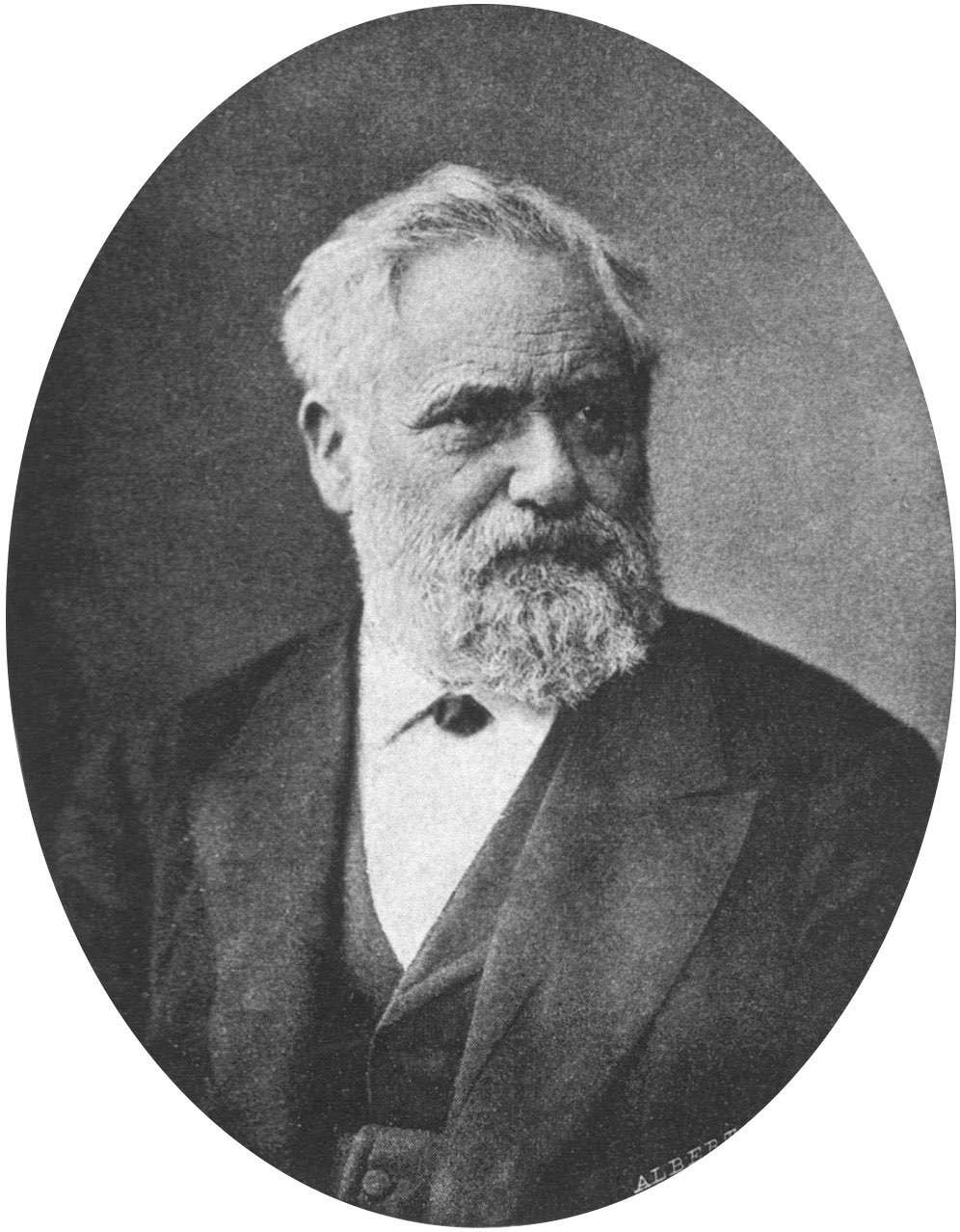
What he was famous for, though, was dirt. He had spent forty years telling German cities that their soil, their drains, their air and their water were making them ill, and German cities had listened. Sir John Simon, who had done the same work in England, wrote of him in 1901 that his teaching had taught Germany “to disinfect herself of odours which must have lasted from the days of Charles V.” The hygiene chairs in the German universities were his doing, and so were the men in them.
One of those men was Rudolf Emmerich, professor in the hygienic institute at Munich, who had worked with him for years and who followed him into the experiment ten days behind. Two others, named in every account of it, were the younger colleagues who prepared the culture and then examined what came out of him: Richard Pfeiffer and Carl Eisenlohr.
On the other side of the argument stood Robert Koch, twenty-five years younger, who in 1884 had come back from Egypt and India with a curved bacillus he had found in the intestines of cholera patients and nowhere else, and who by 1892 directed the Institute for Infectious Diseases in Berlin. When cholera broke out in Hamburg that August, Koch was sent there by direct order of the Emperor, with Dr Rahts of the imperial health office, to inspect the arrangements and advise. Between the two men stood Georg Gaffky, who had been Koch’s assistant, was by then professor at Giessen, and was preparing the imperial government’s official report on the Hamburg epidemic. It was Gaffky who sent Pettenkofer the culture.
What they were trying to find out
Pettenkofer’s position was not that Koch’s bacillus did not exist. He said so plainly in the paper he published about the experiment: the invariable presence of the comma bacillus in cholera stools “proves that the fungus has something to do with cholera, but it is still a question whether it alone causes the disease and solely generates the virus.”
He had named the two sides of the quarrel himself, in an article The Lancet printed in 1884, and in the same paragraph he said why the naming mattered. The people who held that cholera came out of the sick body “might be termed ‘contagionists’; the supporters of the second ‘localists.’ As is always the case in medicine, the conflict of views is important, inasmuch as the measures to be adopted in the healing and prevention of a disease depend on the theoretical conception of it.” Everything in this entry hangs on that sentence, which he wrote eight years before he drank the glass.
What he had instead of the bacillus was an equation. “Many years ago I said that the etiology of cholera appeared to me as an equation with three unknown quantities,” he wrote, “x, y, and z. Let x be a specific germ disseminated by human intercourse; y something which depends on place or time, the ‘local disposition’; and z the individual disposition.” The contagionists, he said, had simply struck out the y. They had Koch’s germ for the x and susceptibility for the z, and with those two they thought they had cholera. “The view is simple and easy, sufficient for him who only concerns himself with individual cases; but it does not satisfy the epidemiologist; for the latter knows that there are not only cholera-immune people, but also cholera-immune places.”
The y had a history, and the history is the part that is usually left out. In 1854, when cholera came to Munich, Pettenkofer set out to prove the drinking-water theory. He believed it. The city was supplied by a patchwork of different waters, which made it, he thought, an ideal place to demonstrate the thing, and he went at it house by house, establishing the supply of each single dwelling from the water rate books and by walking round and looking. It did not come out. The account comes from Dr C. Childs, whose history of typhoid fever in Munich The Lancet published in 1898 and which the British Medical Journal quoted at length when Pettenkofer died: “in all cases his expectations were disappointed, and he could find no connection, local or temporal, between the water distribution and the cholera outbreaks.” He repeated the exercise for typhoid fever, with the same result, and “could never trace any of the local outbreaks which frequently occurred to any of the many separate water supplies.” At the end of it he was convinced “that in Munich there was not the slightest connection between the drinking water and the typhoid fever.”
So he turned to the ground. From 1856 the level of the subsoil water under Munich was measured regularly, and when he set the curve of that level against the curve of deaths from typhoid fever, the two moved together: the fever rose as the water fell. That chart is the instrument of his whole career.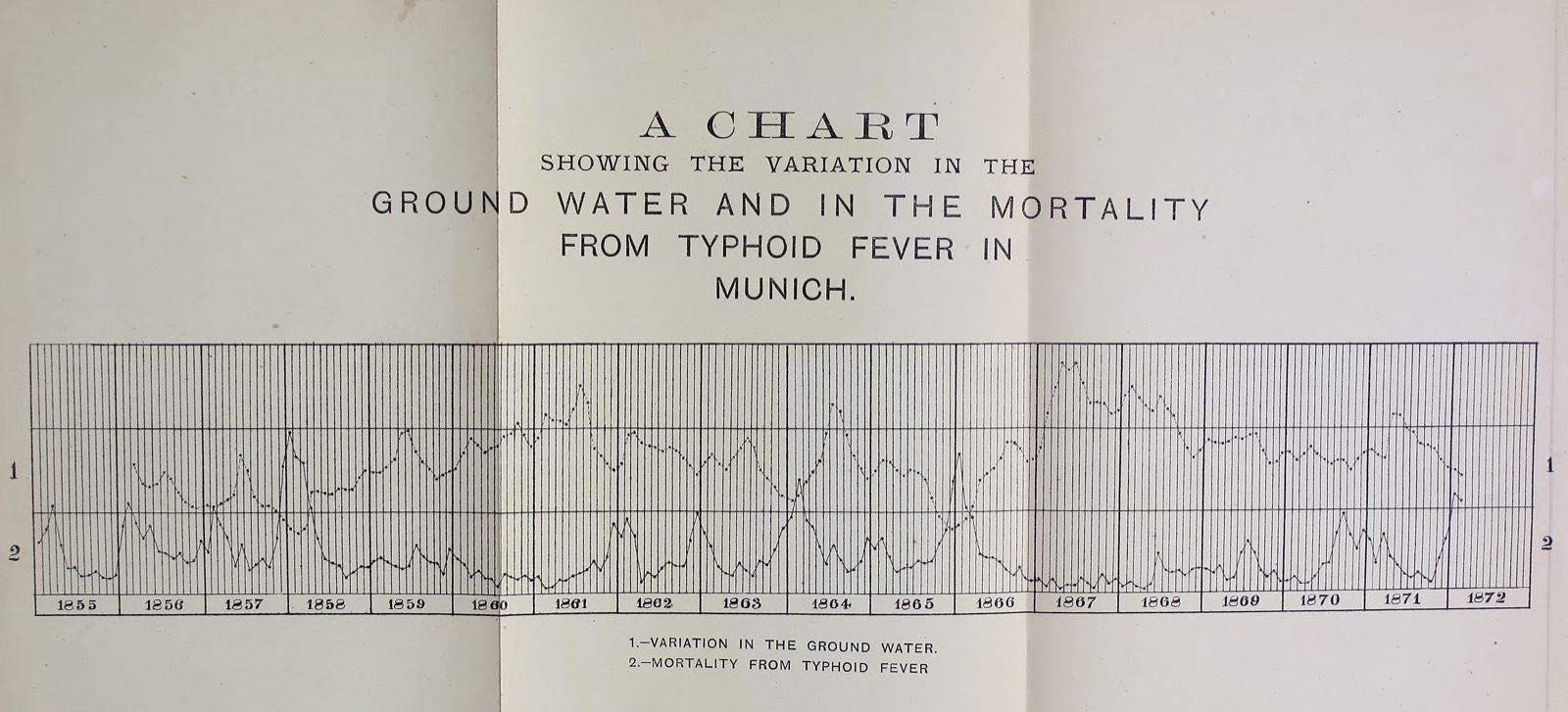
From the chart came the theory. The germ, in his account, was not infectious as it left the patient. It had to fall on ground of the right kind, porous and damp in the right degree, and ripen there into the thing that made epidemics. “The Ground-water is at present the most accurate measure we have for the variation in the moisture of the soil,” he wrote in the English edition of his cholera lectures, which he revised himself. The ground water was not the poison and was not to be drunk or avoided; it was the gauge.
That is why he was not a water man. The authorised English text of 1875 puts the consequence as flatly as it can be put: the germs “can be conveyed by dirty linen, and other objects, and also by drinking-water, but this is the only sense in which drinking-water can have any influence on the spread of the disease.” And: “It is quite superfluous to regard pure water as a panacea or specific remedy for Cholera and Typhoid Fever, and then to get perplexed whenever a town well provided with this requisite is nevertheless attacked by an epidemic.”
He wanted clean water all the same, for the ordinary reason that dirty water makes people ill all the time and not only in epidemics. “It should be a matter beyond the bounds of credibility,” he wrote, “that in the nineteenth century men must still be driven to be clean by terror of a specific disease.” But filtration as a defence against cholera, quarantine, cordons, the isolation of the sick: these followed from the contagionist account, and he thought them useless, expensive and cruel.
So the question in October 1892 was not whether the bacillus existed. It was whether the bacillus alone, swallowed by a man in a place with no local disposition, could produce Asiatic cholera. If it could not, the y survived, and everything that followed from the y survived with it.
Folded inside that is the question that decides the entry: what result would have made him abandon the y? He answered it himself, in print, before anyone could ask.
What they built
The instrument was his own body, and he argued for it on grounds that were correct. Cholera does not take hold in animals as it does in people. “Man alone of all living creatures is susceptible to the cholera virus, and therefore experiments on animals with comma bacilli can determine nothing,” he wrote; guinea pigs could be made ill by injection under the skin or into the belly, but “epidemics of cholera are never accompanied by epizootics,” and in Hamburg that summer the guinea pigs were fine. “So that the only indisputable experiments on infection with comma bacilli are those made on man.”
The material came from Hamburg, through Gaffky, as a pure culture on agar. Pfeiffer and Eisenlohr grew from it the broth he was to drink. Max Gruber, then in Vienna, had found that fresh cultures acted more powerfully on guinea pigs than cultures some days old, so Pettenkofer chose one that had been in the incubator barely twenty-four hours. Plated out, one cubic centimetre of that broth held countless bacilli even after being diluted a thousandfold, which was the point: he wanted a dose beyond anything a careless hand could carry to a mouth. “So that I could take at one dose milliards of bacilli,” he wrote, “very many more than one could possibly introduce by unwashed hands.”
Then the stomach. Koch had shown that the acid of the gastric juice kills the bacillus, which is why swallowing it does not reliably give anyone cholera. Pettenkofer removed that defence deliberately: he took the dose on a nearly empty stomach and neutralised what acid was there, so that the bacilli would reach the intestine in numbers. Several of his pupils asked to take it in his place. He refused them on an old principle, fiat experimentum in corpore vili, let the experiment be made on a worthless body, and said that at seventy-four, diabetic and toothless, he was the worthless body in the room.
Count what the design contains. One subject. No second subject given anything else. No comparison with a man who swallowed broth without bacilli, or the same dose with his stomach acid left alone, or the same culture after a week on the shelf. No measurement of the thing he claimed to be testing, since the Munich y was not measured in October 1892 and could not be. One observer, who was also the subject, who was also the author of the hypothesis, and who had told the world in advance what both possible outcomes would mean.
And the two things that were different about him were the two things most likely to decide the result. He was an old man with diabetes who had lived his whole life in a city where cholera was not then present, and he had been drinking Munich water for decades. Whether he was susceptible at all was the unknown z in his own equation, and his experiment had no way to see it.
While it was being prepared, six hundred kilometres to the north the other experiment was already running. Hamburg drew its water from the Elbe above the city at Rothenburgsort and let it into reservoirs at flood tide. The works were about forty years old. A correspondent told the British Medical Journal in September 1892 that the filters were “so imperfect that algae, shells, and even eels have been found in the pipes.” Altona, immediately to the west and continuous with it, took its water from the Elbe below both cities, where the river had already received the sewage of nearly 800,000 people, and put it through sand filters that were kept to the rules. Wandsbeck, to the east, took lake water and filtered that. The three towns sat on the same ground under the same sky, and in the middle of August the cholera arrived.
Eight days
He drank it on 7 October. On the ninth, severe colic and a moderate diarrhoea; on the tenth it increased; it ran on until the fourteenth, and by the British Medical Journal’s account of the same paper did not entirely cease until the fifteenth. The urine stayed normal in quantity and held no albumen. He refused medicine for it, on the ground that stopping the diarrhoea might make it chronic. He had no vomiting, no collapse, no fall of temperature, none of the things that empty a cholera ward.
Pfeiffer and Eisenlohr followed the bacillus through him. The first loose stool held a great quantity; the watery ones that followed were nearly pure cultures; by 14 October there were only scattered organisms, and by the sixteenth they were gone. Pettenkofer did the arithmetic that mattered to him and turned it into a rhetorical question. Virchow had pointed out twenty years earlier that cholera resembles acute arsenical poisoning. “How great must have been the amount of poison formed by the many milliards of comma bacilli during their eight days’ sojourn in my intestine,” he wrote. “But I did not suffer at all from poisoning, was quite well, retained my appetite, had no trace of nausea, no fall of temperature, no albumen in the urine &c., and went about my daily avocations, so that I could not but conclude that, although comma bacilli may cause diarrhoea, they cannot cause cholera, either European or Asiatic.”
On 17 October Emmerich took his dose, prepared the same way. The published account of his week is not the same account. Early the next morning he passed one fluid motion; during that day the diarrhoea set in; on the nineteenth and twentieth he had as many as fifteen to twenty colourless watery evacuations, the rice-water stools of the disease under discussion. He was given an enema of tincture of thebaica on the one day and one of tannic acid and opium on the next. His motions became natural in the course of the twenty-first, and the bacillus was found in them from the eighteenth to the twenty-eighth; the nineteenth was almost a pure culture. He had hoarseness and a dry pharynx and some weakness, and no pain. On the twenty-fourth he went back to his ordinary diet.
Two men, then, both of whom took the bacillus; one with a week of moderate diarrhoea, one with two days of something that a Hamburg doctor seeing it in August would have put in a barrack. Pettenkofer’s conclusion from the pair was that “these two experiments on man show that the comma bacillus does not generate the virus of Asiatic cholera.”
He had anticipated the obvious reply and he printed it himself. “Perhaps one should concede that Emmerich and I did have a mild attack of cholera, as Koch and his numerous supporters would say, but I cannot admit the correctness of their view of the sufficiency of x and z to cause an epidemic, to the exclusion of y.” Against the concession he called two witnesses, the Munich physicians Bauer and von Ziemssen, both of whom had seen a great deal of cholera and both of whom said that what the two professors had was not what they had seen in epidemics. That is the whole of the control: two experienced men, after the fact, looking at two cases and saying they did not look like the ones they remembered.
What it looked like from inside
On 12 November 1892 he read his account to the Munich Medical Society, which received it, the British Medical Journal reported, with great enthusiasm. It was printed in the Münchener medicinische Wochenschrift of 15 November. The Lancet ran a long abstract on 19 November, and the British Medical Journal, sent advance proofs by that journal’s editor, ran its own summary the same day.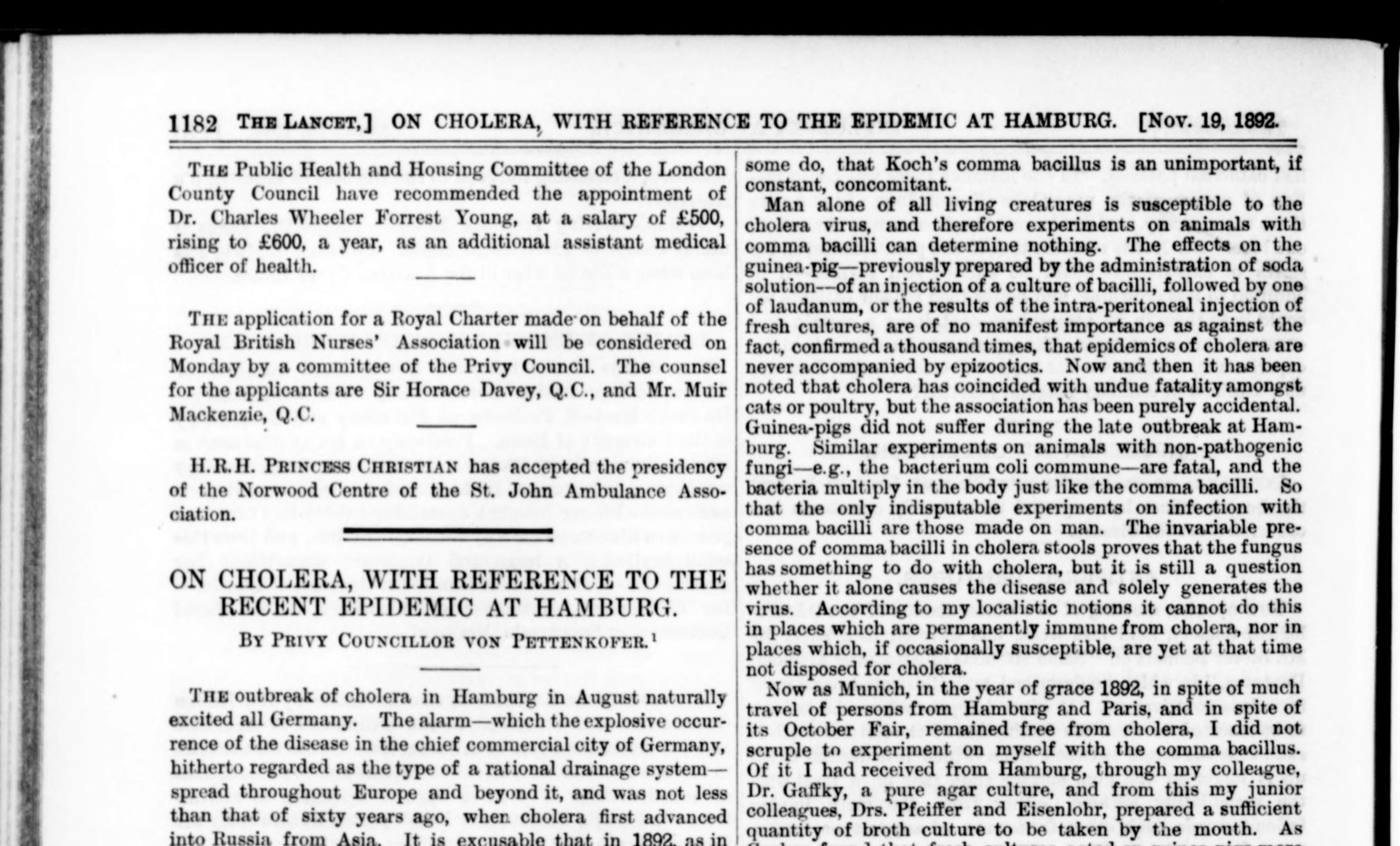
What the paper shows, read now, is a man entirely clear about what he was doing and entirely untroubled by the thing that was wrong with it. He opens the experiment with the one condition he thought mattered: “Now as Munich, in the year of grace 1892, in spite of much travel of persons from Hamburg and Paris, and in spite of its October Fair, remained free from cholera, I did not scruple to experiment on myself with the comma bacillus.” The absence of cholera in Munich is offered as the licence for the trial and, two paragraphs later, as the explanation of its result.
He is frank about the risk and not at all frightened by it. “Even if I had deceived myself and the experiment had endangered my life, I should face death calmly, for it would not be as a thoughtless or cowardly suicide. I should die in the cause of science, like a soldier on the field of honour. Health and life, as I have often said, are very great earthly gifts, but not the highest. He who wishes to rank higher than the brute must be ready to sacrifice even life and health for great ideals.” And then, immediately: “However, to me the matter did not seem quite so tragic, for I was firmly convinced my x could not kill without y.”
He is funny about his opponents, and the joke is the sharpest thing in the paper. By the rules then in force in Germany, he observes, the discovery of comma bacilli in his stools should have had him shut up in the isolation barracks of Munich and his house disinfected. “It seems a pity that this did not take place, for if it had, the contagionists would have been able to have loudly proclaimed that they had saved Munich from cholera, since Emmerich and I, by our stools, which were discharged without disinfection into the closets and drains, might otherwise have certainly infected the town.”
And then he states his real position, which is not a theory of soil but a complaint about an unanswered question. “Joking apart, I too would become a contagionist, so comforting and so sparing of all further trouble is the view, if it could only be explained to me why so many places into which cholera has repeatedly entered have never had an epidemic.” He names Lyons, on the road between Paris and Marseilles, infected again and again and never taking fire. He sets out tables of the cholera years in Hamburg and Berlin since 1831 and asks why the two cities, joined by constant traffic, do not match. These are real questions. Nobody in 1892 could answer them well.
He finishes in the register of a man who expects to be dead before the argument ends, and with an aside about the army estimates then before the Reichstag. “I live and die in the conviction that our army will subdue enemies who would invade us from the east or the west, but not that our capture of bacilli, our cholera barracks, isolations, disinfections, prohibitions of entry and transit, or our quarantines can prevent the invasion and the dissemination of cholera.”
What happened
The reception in London was admiration and refusal, in that order, in both journals, within the same fortnight.
The Lancet could not “withhold our admiration for the calm courage exhibited by Professor von Pettenkofer and Professor Emmerich in undertaking experiments of the nature described,” and then said what the experiments showed, which was less than he thought: the two men had swallowed large quantities of cholera bacilli “without any more serious consequences than diarrhoea, which might, of course, be induced by any septic agent. Bacteriological examination of the excreta proved, at any rate, that the experiment was thorough, so far as the individual experimenters were concerned.” And, in one short sentence that disposes of the novelty: “It has been done before and with similar negative results.”
The British Medical Journal admired the courage too, in an experiment “certainly not free from danger,” and then put the knife in the right place. “The experiment, however, cannot be accepted as conclusive, the more that in the case of Professor Emmerich, who also partook of cultivations of the cholera vibrio, the symptoms of intestinal disorder produced were of a still more severe character.” The second subject had been worse, which is the opposite of what a negative result looks like when you have two of them.
In Berlin, Rudolf Virchow dealt with it in a university lecture on 17 November by granting the premise and keeping the conclusion. Local circumstances mattered, he said, and had never been ignored; one may infer a special disposition of the ground from the fact that a pine forest grows on one part of it and a fir forest on another, “but these trees flourish in other places too; the main thing is that the bearers of life, germs, seeds and spores, get there. And so it is with cholera and cholera bacilli. These latter are the main thing.” An anonymous medical writer in the Vossische Zeitung made the point arithmetically, quoting Koch’s estimate that more than 60 per cent of mankind are naturally immune to cholera. If three people in five would have done what Pettenkofer did and felt nothing, then one man feeling almost nothing is not a measurement.
A few took it as decisive. Ernst von Leyden told the Society for Internal Medicine on 28 November that he attached great importance to it, that the bacteriologists had become too dogmatic, and that the measures taken against cholera had treated patients chiefly as carriers of contagion and interfered with their rights inhumanly. He was right about that, and it had nothing to do with whether the bacillus causes cholera.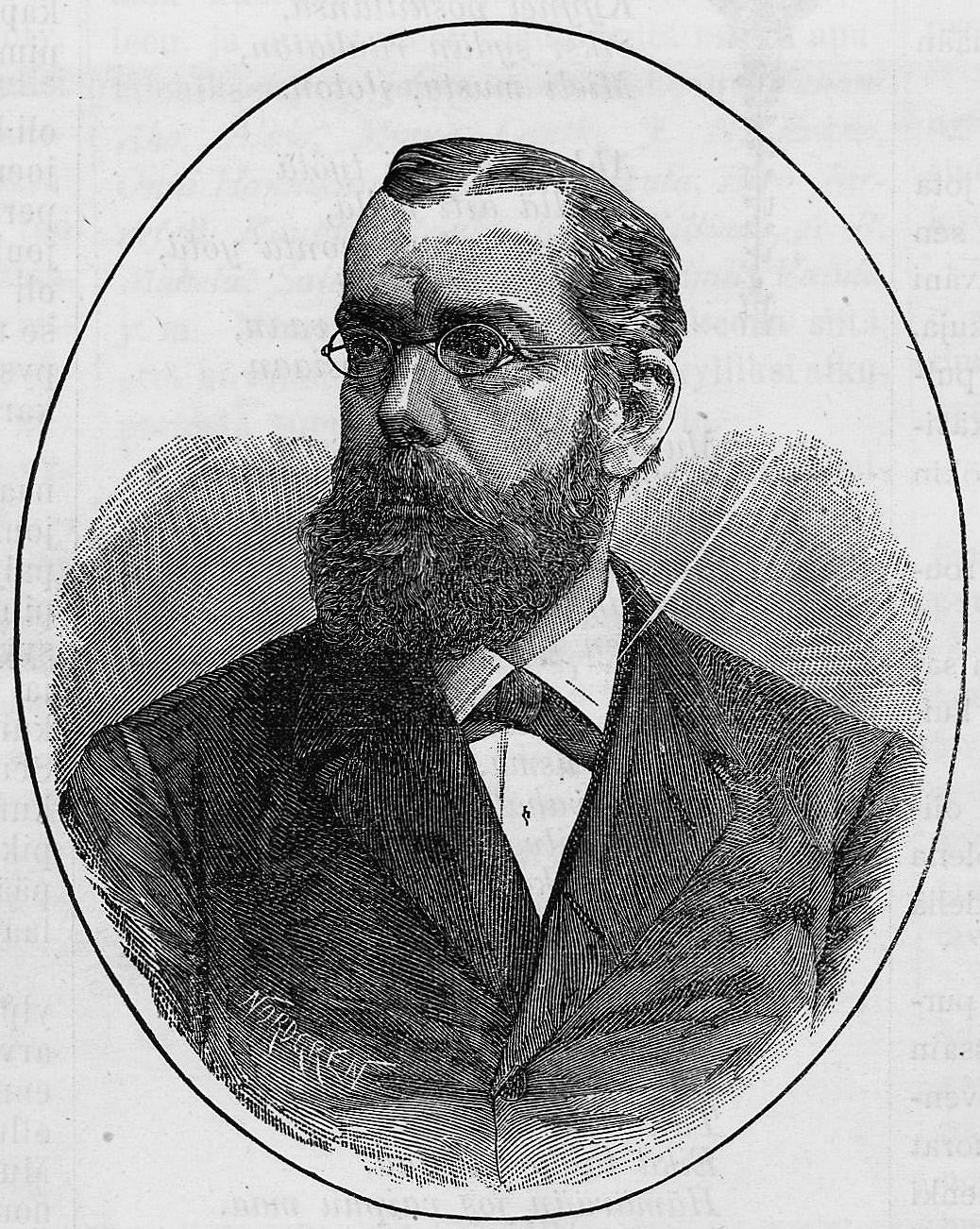
Then the figures came in from Hamburg, and they were of a different order.
Ferdinand Hueppe, a bacteriologist with localist sympathies of his own, set them out in 1893. The Hamburg state, with 622,530 inhabitants, had 17,974 cases and 7,611 deaths to 12 November: 28.8 cases and 12.2 deaths for every 1,000 people. Altona, with 143,249 inhabitants, had 572 cases and 328 deaths to 5 November, 2.3 deaths per 1,000, and most of its early cases were people who worked in Hamburg. Wandsbeck, with 20,571, had 64 cases and 43 deaths. Koch’s own report, written the following spring, rounded the Hamburg epidemic to 18,000 cases and 8,200 deaths between 16 August and 23 October.
The two towns were not merely similar. They were the same town with a line through it. Hueppe walked the line. On one street called Am Schulterblatt the row of houses taking Altona water was spared and the row taking Hamburg water was heavily attacked. “A street joining Hamburg and Altona runs straight, on the same ground,” he wrote; “the Hamburg part, Schmuckstrasse, had cholera patients in every house; the Altona part, Ferdinandstrasse, not one case.” His conclusion is one sentence in German, and it is the only sentence needed: Der einzige durchgreifende Unterschied liegt in der Wasserversorgung. The only thoroughgoing difference lies in the water supply. The translation is mine, as are the others from the German in this entry; the originals are in the Sources.
Koch’s own account of the boundary was published in the Zeitschrift für Hygiene und Infectionskrankheiten, which received it on 26 May 1893, and it is the single most pointed document in the quarrel, because he presents the epidemic not as an observation but as an experiment and dares the other side to read it.
“The most surprising phenomena of the epidemic came to light on the frontier of Hamburg and Altona,” he wrote. “On both sides of the frontier the state of the soil, the buildings, the sewerage, the population, in short all the conditions that are of importance in this connection, are perfectly similar, and yet the cholera in Hamburg spread only to the frontier of Altona, and stopped there.” One block of workers’ housing called the Hamburger Platz belonged to Hamburg but was supplied with Altona water, and it stayed clear while the Hamburg houses all round it did not. The cholera, he wrote, “found out with sharp precision not the political frontier but the frontier of the water-supplies of the two cities.”
Then the sentence that answers Pettenkofer’s method without naming it:
“Here then we have to do with a kind of experiment, which performed itself on more than a hundred thousand human beings, but which, despite its vast dimensions, fulfilled all the conditions one requires of an exact and absolutely conclusive laboratory-experiment. In two large groups of population all the factors are the same except one, namely, the water-supply. The group supplied with unfiltered Elbe water suffers severely from cholera, that supplied with filtered water very slightly.”
Hamburg, he adds, drew the cleaner water of the two and Altona the filthier. He disposes of the weather in a line: “sky, sun, wind, rain, etc., were distributed with absolute equality on both sides of the frontier.” And he states the obligation that an experiment of that quality lays on everyone in the argument. It is “an epidemiological fact of the first rank, which lies before us in perfect clearness and transparency,” and so “one has a right to demand that every investigator of cholera who claims consideration for his opinion shall tell us what he makes of it.”
Pettenkofer told him. The water, he said, had not infected anyone; it had been predisposing, bringing dirt into the dwellings and the streets and the soil and so preparing the ground for the germ. Koch, who quotes the answer in a footnote and calls its author “the revered Herr Localist,” replies that Hamburg was one of the best drained cities in the world, and asks what earthly use the sewerage is if it cannot carry away the little dirt that unfiltered water brings in.
The last blow of 1893 came from the man who had sent the culture. At the congress for internal medicine in April, Gaffky, speaking on the bacteriology of cholera, said two things about the Munich experiments in one breath: the case from which the bacilli had been taken was a mild one, and Emmerich “was so ill that he did not give free course to the consequences of his experiment, but took opium to lessen the diarrhoea.” A third party, Dr Hasterlik of Vienna, had swallowed cholera cultures himself and given them to others, and the second time he took them he felt nothing at all, from which Gaffky drew the obvious inference that the first dose may have immunised him. Every one of these is a variable that Pettenkofer’s design could not hold still and did not record.
After
He did not stop. In 1893 he published a long paper on the Hamburg epidemic and on protective measures, in which the self-experiment appears again, now doing a second job. His stools, he writes, containing myriads of bacilli, had gone into a fast-flowing city brook and thence into the Isar without a trace of disinfectant, and the bacilli from Hamburg that he and Emmerich had swallowed were fully virulent, as Gruber’s animal tests in Vienna had shown. “Nevertheless no cholera appeared in the places lying down the Isar, nor on the Danube into which the Isar flows, as far down as Budapest, where cholera did indeed break out epidemically in 1892, but fortunately for me earlier, before I committed my stools in Munich to the course of the Isar.”
It is the same experiment extended to a continent, with the same structure. Nobody downstream fell ill, therefore the water does not carry it, therefore the y. That there was no cholera in the Bavarian towns on the Isar that autumn was true; that one man’s stools in a mountain river are a test of a city’s water supply does not follow, and the clause about the dates protects the argument from the one place where the prediction failed.
In January 1893 an outbreak in the lunatic asylum at Nietleben near Halle gave him the kind of case he liked: months of diarrhoea in the institution beforehand, the Saale water boiled from October, and then a murderous epidemic in the middle of winter with no one able to say who had brought the bacillus in. Koch’s institute took Nietleben apart and traced it to the water. In the same winter the Altona filters, which had been the hero of the summer, worked badly in the frost, the bacterial counts in the filtered water climbed, and Altona had a winter epidemic of its own. Koch, who investigated it, concluded that filtration protects only when it is run as Altona had run it in August. The natural experiment, repeated by accident, answered in the same direction twice.
By the spring of 1893 the two camps were closer than either liked to say. A correspondent at the congress that heard Gaffky reported that the opposed currents “are now going to flow together,” that Pettenkofer “has now, it is publicly stated, at least partly admitted the specific character of the comma bacillus,” and that his opponents had been obliged to grant him his z, the individual disposition, which is where the argument has largely stayed.
Hamburg built filters. The imperial statistics for 1892 gave 8,510 cholera deaths in Germany, of which Hamburg had 7,611, or 122 for every 10,000 people; Altona, next door, had 328, which is 23.
Pettenkofer gave up his chair in 1894. His wife had died a few years earlier, and he left Munich for the country. Sir John Simon, who had letters from him as late as the autumn of 1900, wrote that a friend he sent to see him was astonished by the old man’s liveliness. On 10 February 1901, “overwhelmed by the infirmities of old age,” in the words of his obituary, “he is said to have shot himself in a fit of depression which darkened his reason.” The post-mortem found calcified cerebral arteries, arthritis in a knee that had hurt him for years, and gallstones; he had been diabetic for decades, and in his last weeks a septic condition of the mouth and throat had made him wretched. He was buried on 12 February, before “a vast concourse of all classes of the population of Munich.”
The Lancet’s obituary, printed six days after his death, is the earliest statement of the lesson of this entry, and it was written by someone who thought he was being kind:
“So strongly was he convinced of the truth of his views that he undertook to swallow a cholera broth to demonstrate the harmlessness of the cultivations. He did it and luckily for himself without ill effect, but he must have been too much a man of science to have attached any significance to his solitary experiment.”
He was not. He attached everything to it. The obituarist could not believe that a man of that standing would weigh one case against the mortality returns of a city, and in the same sentence got the facts of the case wrong, since the experiment was not without ill effect for either man who tried it.
What survived him is not the water theory but the shape of his question. The epidemiologist Alfredo Morabia, writing in 2007, put the reckoning in a sentence: “The disastrous consequences of the lack of water filtration during the massive outbreak of cholera in the German town of Hamburg in 1892 tarnished von Pettenkofer’s reputation and marked thereafter the course of his life.” But Morabia’s argument is that the thinking deserved better than the theory did, since “germ-environment interactions are more appropriate than is bacteriology alone for explaining the occurrence of cholera epidemics in populations.” Who falls ill when the bacillus arrives does depend on the host and on the place: on stomach acid, on nutrition, on crowding, on how the water reaches the house. Pettenkofer’s z is now ordinary epidemiology. His y turned out to be, in Hamburg, a pipe.
What it taught
The experiment of 7 October 1892 is famous as an act of courage, and it was one. It is more useful as a specimen, because every fault in it is visible from the outside and each of them is still being made.
An experiment with one exit is not a test. Before he drank, Pettenkofer had published the reading of both outcomes. If he stayed well, the bacillus did not cause cholera. If he had been killed, the Hamburg y would have done it, or the Munich y would have proved to be present after all. No result available to him in October 1892 could have cost him the y, because the y was unmeasured and was invoked afterwards to explain whatever happened. A hypothesis that explains the outcome in every direction is not being tested by the outcome.
A sample of one measures the subject, not the question. Koch’s own figure, thrown at Pettenkofer by an anonymous critic within a fortnight, was that more than three people in five are naturally immune. Add the things that came out later: the source case was a mild one, the culture was a single strain in broth with no company, Emmerich took opium, Hasterlik felt nothing the second time. Every one of these moves the result, and the design could not see any of them, because there was nothing to compare the subject with. Two men is not two trials. It is two anecdotes that disagree, and when they disagreed he took the milder one as the finding and explained the other away.
The comparison he wanted was already running, and he had helped to set it up. He had spent forty years asking why one place takes fire and the neighbouring place does not. In August 1892 the question was put with a rigour no committee could have designed: two populations on one piece of ground, under one sky, with one difference between them, and more than a hundred thousand people in the smaller arm. The man who had been asking the question for forty years was, at that moment, in Munich, running an experiment on himself with a sample of one and no control. The evidence that answers your question rarely arrives in the form you prepared for, and it is usually larger and uglier than the thing you built.
An instrument that only correlates cannot tell you what to do. The ground-water curve is a real finding. Typhoid in Munich did rise as the subsoil water fell, and nobody has ever shown the chart to be a fabrication. But a curve that moves with the seasons moves with everything else that does, and it cannot separate the moisture of the soil from the temperature, the food, the crowding, or the state of the wells in a dry summer. The Hamburg boundary could separate them, because it held everything else still. That is the whole difference between a correlation watched for seventeen years and a comparison that lasts ten weeks, and it is why the shorter one won.
The complication is that Pettenkofer was not wrong about everything, and the men who were right about the bacillus were not right about everything either. He was right that Koch’s followers were treating susceptibility as a detail, and susceptibility turned out to matter. He was right that quarantines and cordons did not stop cholera and did cause suffering, and Leyden was right to say so in public. He was right that clean water, clean air and drains are worth having for their own sake and not as a charm against one disease. He built the first institute of its kind, he trained the generation that took hygiene into German public life, and the city he could not cure of typhoid with a theory was cured of it by the works he had argued for.
And he was wrong in the one way that cost lives, which was to decide in advance what his evidence would be allowed to mean, and then to go looking for some. The Lancet obituarist could not believe a scientist would do it. He had done it in front of witnesses, written it down in a journal, and been applauded for it by a room full of doctors, and nine years later the sentence of his epitaph was that nobody serious could have meant it.
Sources
- Max von Pettenkofer, “On Cholera, with Reference to the Recent Epidemic at Hamburg,” The Lancet, 19 November 1892, pages 1182 to 1185, an abstract of his paper in the Münchener medicinische Wochenschrift of 15 November 1892. The x, y and z equation, the animal experiments, the preparation of the culture by Gaffky, Pfeiffer and Eisenlohr, Gruber on fresh cultures, the dose, the drinking of it on 7 October, corpus vile and the seventy-four years, the soldier on the field of honour, “my x could not kill without y,” the course of his illness and Emmerich’s, the isolation barracks, “Joking apart, I too would become a contagionist,” Lyons, the Hamburg and Berlin tables, and the closing passage on the army and the quarantines. archive.org
- “Professor von Pettenkofer on Cholera,” British Medical Journal, 19 November 1892, pages 1131 to 1132, from advance proofs supplied by the editor of the Münchener medicinische Wochenschrift. The address of 12 November to the Munich Medical Society, the same experiment with the diarrhoea ending on 15 October, Emmerich on 17 October, Bauer and von Ziemssen, and the leading note “Cholera and the Comma Vibrio” with its refusal to accept the experiment as conclusive. PubMed Central
- The Lancet, “Cholera: Current Notes, Comments and Criticism,” 19 November 1892, page 1185 (“It has been done before and with similar negative results”); “Professor Pettenkofer’s Experiment,” 26 November 1892 (Virchow’s lecture of 17 November and the Vossische Zeitung writer on Koch’s 60 per cent); and “Professor Leyden on Professor Pettenkofer’s Experiment,” 3 December 1892, with the note that Emmerich had added errors of diet. 26 November, 3 December
- Robert Koch, “Water-Filtration and Cholera” and “The Cholera in Germany during the Winter of 1892-93,” from the Zeitschrift für Hygiene und Infectionskrankheiten, volume 15 (1893), in the contemporary English translation by George Duncan, Professor Koch on the Bacteriological Diagnosis of Cholera, Water-Filtration and Cholera, and the Cholera in Germany during the Winter of 1892-93, Edinburgh, 1894. The Hamburg, Altona and Wandsbeck water supplies, the frontier and the Hamburger Platz, “a kind of experiment, which performed itself on more than a hundred thousand human beings,” the equality of sky and weather, the demand that every investigator say what he makes of it, the localist reply and Koch’s answer to it, the 18,000 cases and 8,200 deaths of the summer epidemic, and the Altona winter epidemic. archive.org
- Ferdinand and Else Hueppe, Die Cholera-Epidemie in Hamburg 1892, Berlin: August Hirschwald, 1893, pages 16 and 17. The case and death figures for Hamburg, Altona and Wandsbeck; Am Schulterblatt; “Eine Hamburg und Altona verbindende Strasse bildet einen geraden Zug auf gleichem Boden; der Hamburger Theil, Schmuckstrasse, hatte in jedem Hause Cholerakranke, der Altonaer Theil, Ferdinandstrasse, keinen Fall”; and “Der einzige durchgreifende Unterschied liegt in der Wasserversorgung.” Translated here by the author of this entry. archive.org
- Max von Pettenkofer, Ueber die Cholera von 1892 in Hamburg und über Schutzmassregeln, Munich and Leipzig: R. Oldenbourg, 1893, pages 25 and 26, reprinted from the Archiv für Hygiene. The passage on his stools and the Isar: “Als ich in München im vorigen Herbste an mir selbst das Choleraexperiment mit Einnahme von Kommabacillen machte … Die von mir und Emmerich eingenommenen, aus Hamburg stammenden Kommabacillen waren vollvirulent, wie Versuche an Thieren, welche Prof. Gruber in Wien angestellt hat, nachgewiesen haben … aber glücklicher Weise für mich schon früher, ehe ich in München meine Stühle dem Laufe der Isar übergab.” Also Nietleben in January 1893. Translated here by the author of this entry, and checked against the page images. archive.org
- Max von Pettenkofer, Cholera: How to Prevent and Resist It, translated by Thomas Whiteside Hime and revised by Pettenkofer, London: Baillière, Tindall and Cox, 1875. The ground-water chart for Munich, 1855 to 1872; “The Ground-water is at present the most accurate measure we have for the variation in the moisture of the soil”; Hime’s statement of the ripening of the germ in the soil and of the one sense in which drinking water can matter; “It is quite superfluous to regard pure water as a panacea”; and the remark about being driven to be clean by terror of a specific disease. archive.org
- British Medical Journal, 3 September 1892, page 566, from its Berlin correspondent and “an authority in Berlin of special competence”: Koch and Rahts sent to Hamburg by order of the Emperor, the Hamburg waterworks at Rothenburgsort, and the filters through which algae, shells and eels reached the pipes. archive.org
- British Medical Journal, 31 December 1892: the official German return for the 1892 epidemic, 8,510 deaths in the empire, 7,611 in the city and state of Hamburg at 122 per 10,000, and 328 in Altona at 23 per 10,000. Same volume as above.
- British Medical Journal, 1893, report of the congress for internal medicine: Gaffky on the mild source case and on Emmerich’s opium, Hasterlik of Vienna, Rumpf’s conclusions, and the statement that Pettenkofer had at least partly admitted the specific character of the comma bacillus; also Nencki on mixed cultures. archive.org
- “Max von Pettenkofer,” obituary, The Lancet, 16 February 1901, page 491. His training, the swallowing of the cholera broth, and “he must have been too much a man of science to have attached any significance to his solitary experiment”; also the pointer to his article in The Lancet of 1 November 1884. archive.org
- “Max Josef von Pettenkofer,” obituary, British Medical Journal, 23 February 1901, pages 489 to 490, with the note on the post-mortem and the funeral at page 497 of the same volume. Birth at Lichtenheim in 1818, pharmacy and the stage, the degrees and chairs, the Hygienic Institute, the Vienna and Berlin invitations, C. Childs’s account of the Munich investigation of 1854 and the turn to the subsoil water, the manner of his death on 10 February 1901, and Sir John Simon’s tribute from The Times of 18 February 1901, quoted here from this reprint rather than from The Times itself. archive.org
- Alfredo Morabia, “Epidemiologic interactions, complexity, and the lonesome death of Max von Pettenkofer,” American Journal of Epidemiology 166 (2007), pages 1233 to 1238. Quoted from the abstract: Hamburg and the tarnishing of his reputation, and germ-environment interactions as the better account. doi:10.1093/aje/kwm279
- Max von Pettenkofer, “Dr. Max von Pettenkofer on Cholera,” The Lancet, 1 November 1884, page 769, in the translation published at the time: contagionists and localists, and “the measures to be adopted in the healing and prevention of a disease depend on the theoretical conception of it.” Checked against the page image, since the scan’s text layer interleaves the two columns. archive.org