On the morning of 1 July 1935, at the Bureau of Sugar Experiment Stations’ laboratory at Meringa, outside Gordonvale in North Queensland, Reginald Mungomery went out to a concrete pond twelve feet across and found what he had crossed the Pacific for. Tangled in the water weed were “long strings of a gelatinous substance enclosing jet black eggs.” It had drizzled on the two days before, after a week of cold. The toads in the pond had been in Australia nine days. In the ninety years since the species had first been carried out of South America, nobody had induced it to lay in a cage. The eggs hatched on 4 July.
Five days earlier the Cairns Post had printed what the Bureau knew about the animal it had just imported. “It was definitely established at Porto Rico that an average of twelve cane-beetles were consumed by one toad per night. The resultant effect by millions of frogs may be imagined.” Two paragraphs on, the same correspondent wrote the sentence this entry is about. “Their habits will be closely studied here, as it has not yet been established when the beetle is captured.”
Twelve beetles a night was a measurement. It had been made in Puerto Rico in 1931, on a beetle that comes back to the ground every morning, by a woman who opened 301 toads to make it. The beetle in Queensland does not come back to the ground every morning. Whether the toad would ever meet it was the only question the experiment existed to answer, and the toads were in the pond, breeding, before anyone had designed the trial that would ask it. This entry is about a number that travelled halfway round the world without its conditions, the men who carried it, the one man who objected in print, and the year in which the trial was run at last, for a different purpose, after the toads were out.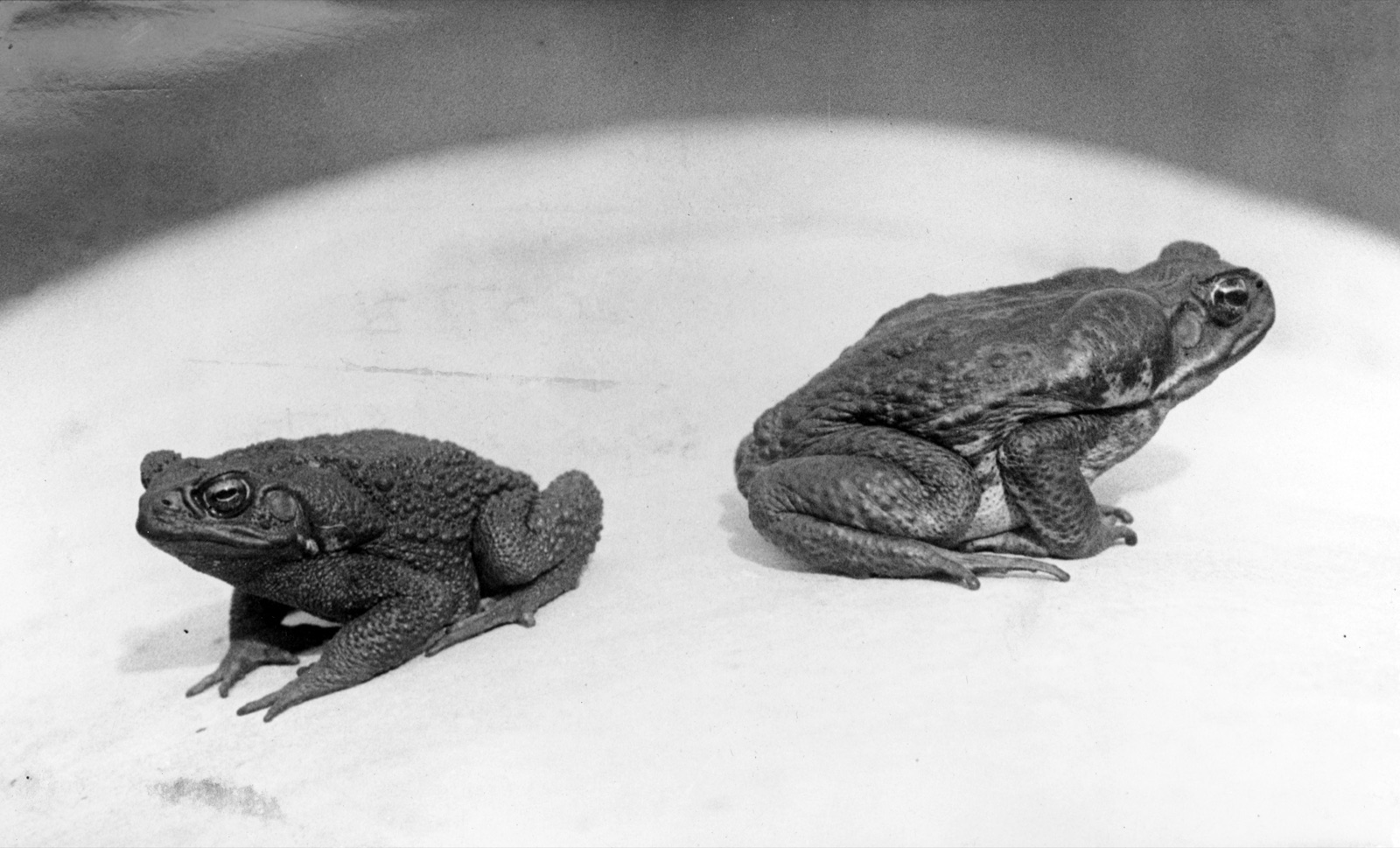
Who ran it
The Bureau of Sugar Experiment Stations was the scientific arm of the Queensland sugar industry, founded in 1900 under the Department of Agriculture and Stock. It bred the varieties, tested the soils, fought the diseases and, from a laboratory at Meringa on the Mulgrave River, studied the insects. The insect that mattered was the greyback cane beetle, Lepidoderma albohirtum as it was then named, a brown scarab a little over an inch long whose grub lives in the soil and eats the roots of the cane. A field with grubs in it falls over. For forty years the growers of the wet tropics between Mossman and Tully had fumigated their soil, paid for beetles by the measure, and lost crops anyway.
The beetle has a year to its life and spends most of it underground. The adults come out of the soil with the first storms of the wet season, in November or December, and fly to feeding trees, figs and the like, where they eat and mate. About a fortnight later the females go down into the cane fields to lay. The grubs feed on the roots through the autumn, pupate, and wait for the next storms. The window in which a beetle is on the ground and could be eaten by anything that does not climb is the few minutes of its emergence and the few minutes of its return, and the Bureau’s entomologists knew it.
Three men at the Bureau carried the toad to Queensland. Arthur Bell, born in South Brisbane in 1899, had joined the Department as a junior at sixteen, taken degrees in Brisbane and California, and come back in 1928 as the Bureau’s plant pathologist. He was the Queensland government’s representative at the fourth congress of the International Society of Sugar Cane Technologists, held in San Juan, Puerto Rico, from 1 to 16 March 1932, and from that year to 1935 he was the Society’s general secretary. He would be the Bureau’s director in 1945 and the Department’s under-secretary in 1947, and he died at his desk in 1958.
Reginald Mungomery, born at Childers in the Isis cane district in March 1901, had no university training. His first job in science, in 1923, was as a laboratory assistant at the Commonwealth Prickly Pear Laboratory in Brisbane, where the moth that would clear most of the sixty million acres of cactus in Queensland over the next ten years was being tested. In 1925 he joined the Bureau as an assistant entomologist, worked nine years at Bundaberg, and in 1933 with Bell proved that a leaf-hopper carried Fiji disease, the discovery that made both their names. In 1935 he was the Senior Assistant Entomologist at Meringa, thirty-four years old, and the man the Advisory Board chose to send to Hawaii. He would run Meringa from 1938 to 1945, lead the work on the soil insecticide that finally beat the greyback after the war, and retire in 1968.
James Buzacott, thirty-three, Brisbane-born, had been at the Bureau since 1926 and at Meringa was Mungomery’s colleague. He built the enclosure. He would end as the Bureau’s chief plant breeder and, in a short memoir fifty years later, its historian of the toad.
Behind them stood the experiment station of the Hawaiian Sugar Planters’ Association in Honolulu, whose executive entomologist, Cyril Pemberton, had been at San Juan too and had done something about what he saw there. And behind Pemberton stood Raquel Dexter of the biology department of the University of Porto Rico, who had done the measuring.
Against them stood one man. Walter Froggatt was born in Melbourne in June 1858, had been the New South Wales Government Entomologist from 1896, had written Australian Insects in 1907 and Forest Insects of Australia in 1923, had helped found the Naturalists’ Society of New South Wales, the Gould League and the Wildlife Preservation Society, and in 1935 was seventy-seven and retired. The office that could stop anything was in Canberra: the Commonwealth Director-General of Health, John Cumpston, who administered the quarantine law under which animals entered the country.
What they were trying to find out
The Bureau’s hypothesis was two claims, and it is worth separating them, because one was tested and the other was not.
The first was that the giant toad of tropical America, Bufo marinus, would live and breed in North Queensland. That could be tested in a pond, and was, inside nine days.
The second was that the toad would eat enough greyback beetles to reduce the damage done by their grubs. The Bureau’s own statement of this claim is in the Cane Growers’ Quarterly Bulletin for July 1935, reprinted in the Queensland Agricultural Journal on 1 August, under Mungomery’s name. He gave the evidence from Puerto Rico and Hawaii, and then he gave the condition. “The greyback cane beetles, against which this toad has been primarily introduced, fly to various feeding trees soon after their emergence from the soil, and a period of approximately 14 days elapses before their eggs are sufficiently developed to be deposited in the soil. During this 14-day period the beetles alternate between the feeding trees and resting trees, but the toads do not ascend trees, so that they are not likely to exact toll from them in these positions.” In Puerto Rico, he wrote, the beetle went up to feed at night and came back to the soil every morning, “and it is probable that the toads account for large numbers of beetles either when they are emerging from or returning to the soil.” Then: “With regard to the greyback beetle, the same clear cut daily return of the whole beetle population to the soil does not exist. Therefore, the degree of control which we can expect through the agency of these toads will centre largely around the length of time the beetles actually spend on or near the ground.”
That is the hypothesis stated with its weakness in it, by the man about to test it, before the test. He ended with the sentence a careful scientist writes when he knows he is guessing. “Whether our speculations are fully justified is one of the fascinating problems met with in economic entomology, and time alone will show whether our cherished hopes for the total elimination of grub damage in Queensland canefields will be realised.”
The number that had made the guess look like knowledge came from Dexter. Her paper to the San Juan congress, “The Food Habits of the Imported Toad Bufo marinus in the Sugar Cane Sections of Porto Rico,” is the only piece of measurement in the whole story, and it is a good one. The toad had been brought to Puerto Rico from Barbados in 1920. Starting in the autumn of 1930 Dexter collected toads across the island, early in the morning after their night’s feeding, and washed the contents of each stomach into a porcelain dish, on the rule that field observation is evidence but the stomach, as she put it, quoting an older authority, “constitutes the court of final appeal.” She opened 301 toads. By bulk, 51 percent of what they had eaten was insects injurious to agriculture, 42 percent neutral, 7 percent beneficial. And she found the condition that governed the number. Where the banks of a reservoir were planted with bananas, the foliage the adult May beetle Phyllophaga flies up to eat at night, eighteen toads had eaten 224 beetles in one night, “an average of 12.5 beetles per toad per night.” Where the banks were weeds, twenty toads had eaten eight. The beetles came down to the ground at dawn under the trees they fed in, and the toads were waiting underneath. Her method, her tables and what she recommended are in The court of final appeal.
Twelve and a half beetles a night, then, was a figure for a beetle that returns to the soil daily, measured under a tree it feeds in, on an island where the planters had already failed with everything else. It was carried to Brisbane without the tree, without the daily return, and without the half.
What they built
Pemberton built the first thing. He took a consignment of toads from Puerto Rico back to Honolulu in 1932 and let them go in two colonies of sixty or seventy animals, one in the mountain streams of the Manoa Valley above the city and one in a pond by a rice field at the Association’s Waipio sub-station. By the time Mungomery saw them three years later the sub-station was sending out young toads at the rate of one to three thousand a day, and egg strings of twelve thousand eggs were being collected from the taro fields and hatched in a pond built for the purpose. The Bureau watched. Its Advisory Board’s annual report, as the newspapers reported it in March 1935, said the Senior Assistant Entomologist “will study methods of borer and grub control in Hawaii, and will bring back giant toads of the same species,” that “an attempt will be made to breed the toads at Meringa experiment station, after which the first generation will be liberated in the surrounding grub-infested area.” A growers’ conference, reported in the Queenslander, was told the proposal was “worthy of serious consideration, particularly as there is no evidence to show that its presence here would prove harmful in any way.”
On the night of 1 June 1935, Mungomery, Pemberton and a third man named Denison went out with torches on the lawns of suburban Honolulu and at Waipio and picked up 102 toads, half of them male and half female, from half-grown to full size, so that they would come into breeding at different times and lay over several months. They were packed in moistened wood wool in two wooden cases about two and a half feet long and six inches deep, the method Pemberton had used from Puerto Rico, and damped with a little water from time to time on the voyage. They sailed on 3 June. On 20 June the case was opened in the Department of Agriculture in Brisbane in front of what the Courier-Mail called “more than one pair of interested eyes.” Its report next morning, under the headline “Toad Army Lands,” counted a hundred of them: “big, brownish fellows—the largest of them from 6in. to 8in. long—and they were as fresh as toads can be, although they had made the voyage packed together in a box with woodwool for padding. They did not require food on the way, and not one of them was lost in transhipment.” Mungomery left Brisbane with them that night. They reached Gordonvale on 22 June. One half-grown male had died on the way. “When opened up the toads were somewhat thin and dehydrated,” Mungomery wrote, “but when placed in water, they soon swelled out, and assumed a more normal appearance.”
The enclosure at Meringa was Buzacott’s. A concrete pond twelve feet across, “shaped somewhat like a plate,” deep in the middle and shallow at the rim, with a pipe standing in the centre and a revolving sprinkler on it to aerate the water, a gauze-covered overflow, water hyacinth and lilies in the water and ferns and taro planted among rocks at the edge, “the object being to simulate as nearly as possible natural conditions.” Around it an octagonal timber frame covered with chicken wire. The toads went in on 24 June and spent the first days cold and uninterested in food. They walked round the inside of the wire with their noses against it until their noses were skinned; smaller mesh did not help, and in the end ferns were planted thickly against the netting so that they could not see out. The weather turned warm on 28 June and wet on the 29th and 30th. On the morning of 1 July the eggs were in the weed.
Mungomery’s reasons for keeping the adults in the cage are on record and they are good ones. It was the dry season. “As the toads arrived during the period of the year which is probably the most unsuitable for them, i.e., during the cold and dry winter months, it was thought that if an early liberation of the colony were made they would probably scatter too widely before breeding commenced.” The waterholes would dry up as the winter went on, there would be no real rain before November, and “snakes and birds might seriously deplete their necessarily small numbers before reproduction could take place; accordingly, it was decided to hold them in captivity until the advent of the wet season rains in November or December.” The plan, in other words, was to hold a hundred toads in a cage for six months and let them go into the rain. The eggs made the plan unnecessary. “It will be obvious that if breeding can be carried out successfully under controlled conditions there will be considerable saving in time and labour in the collection of small toads for distribution to other centres,” he wrote, and the Bureau made the saving. The tadpoles were fed on cereal, as Pemberton fed his, and on the algae in the hyacinth. On 19 August 1935, by Buzacott’s later account, he and Mungomery released about 2,400 young toads at the Little Mulgrave River and other places around Gordonvale. They were six and a half weeks out of the egg, and it was the dry season.
Eight days later the fifth congress of the International Society of Sugar Cane Technologists opened in the Brisbane City Hall, the first international conference ever held in Queensland, the Governor believed, with delegates from twelve countries and Bell as general secretary. It ran from 27 August to 3 September. Mungomery’s “Short Note on the Breeding of Bufo marinus in Captivity” was read to it, three pages with two photographs of the cage, and the chairman of the session in which it was read was Pemberton, who then gave a paper of his own. The congress went north afterwards, and on 13 September Frank Bulcock, the Queensland Minister for Agriculture and Stock, formally opened the enlarged station at Meringa with sixty-two overseas delegates present. The toads were the thing to see.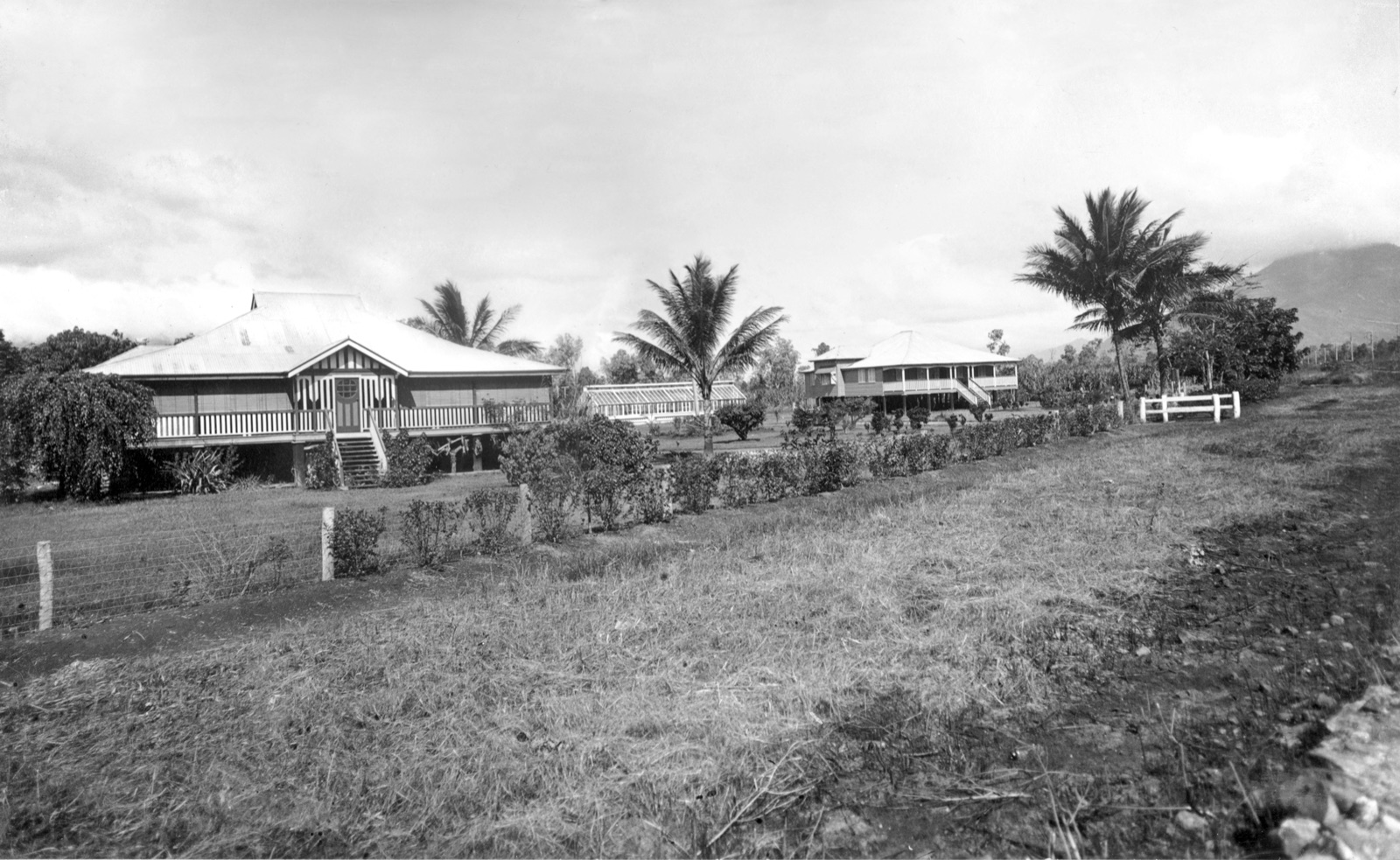
What was never built was the trial, and it would have been cheap: a few dozen toads caged over a fresh emergence when the beetles came up in November, or collected at dawn in a grub-infested field during the flight and opened as Dexter had opened hers, would have given a number for Queensland to set beside the number from Puerto Rico. The Cairns Post correspondent, writing on 26 June from what Mungomery had told him, had put the question exactly: when was the beetle captured, “either as they emerge from the ground, or as they drop back on the ground to ovideposit.” The Bureau’s statement for the public, reprinted that winter in the Rockhampton Morning Bulletin, said the same thing more carefully: the toad’s success against the greyback “appears likely to be controlled by the length of time during which the beetle is on the ground and accessible to the toad—a matter which can only be determined by further observation when the toad has established itself in numbers.” That is the sentence in which the experiment was turned round. The release was to come first, and the observation was to follow when there were enough toads to observe. On the other question, the statement was shorter. “The introduction of any new form of life naturally raises the question as to whether it is likely to become a pest. Careful consideration has been given to this aspect, and no reason can be found to assume that Bufo will be found in any way an undesirable immigrant. He at least comes with irreproachable credentials.”
Mungomery’s own answer to that question, in the July bulletin, rested on a precedent. To those who “suggest the possibility that the toad will, in turn, itself become a pest, we can point to the fact that nearly 100 years have elapsed since it was first introduced into Barbados, and there it has no black marks against its character. Experience with it in other West Indian islands, and in Hawaii, certainly points to the fact that no serious harm is likely to eventuate through its introduction into Queensland.” Barbados is 166 square miles. The islands of Hawaii are 6,400. Queensland is 668,000, and the toad was being released on the edge of a continent.
No more toads are to be liberated
By the end of November 1935 there were, in the words of a Brisbane report carried by the Sydney Morning Herald, “thousands of young toads” loose in the Gordonvale and Innisfail districts, and the Bureau had been distributing them for three months. Then the Commonwealth spoke. The Herald of 29 November, datelined Brisbane the day before, is the plainest account of what happened and of how it was received.
“Canegrowers’ organisations throughout Queensland protest against the declaration of the federal Director-General of Health (Dr. Cumpston) that no more giant toads are to be liberated on the northern canefields. The announcement surprised canegrowers, as much time and money have been spent in investigating the habits of the giant toads, which are considered likely to be effective in combating canefield pests. The Federal authorities made no objection to their introduction to Queensland from Hawaii. Already thousands of young toads have been liberated in the Gordonvale and Innisfail districts. The outcome of representations of the Minister for Agriculture to the Federal Government is being awaited with interest.”
The reasoning behind Cumpston’s instruction was given when it was lifted, in the Courier-Mail of 16 September 1936: “It was feared that they would eradicate insects of economic value, and those that were liberated had to be restricted to a certain area.” Mungomery described the area in 1937: “a ban, imposed by the Federal Government, which restricted the distribution of toads to the Cairns, Gordonvale, Innisfail, and Tully districts.” The toads already out stayed out. What stopped was the carriage of toadlets to the next district.
The man behind the instruction, by the accounts that have drawn on the Commonwealth’s files, was Froggatt, who had written to the Department of Health. His public case was two pages in the Australian Naturalist, the journal of the society he had founded, for 1936, under the title “The Introduction of the Great Mexican Toad Bufo marinus into Australia.” He had read Dexter, and said so. He had also talked to Pemberton, who passed through Sydney in 1935. “He said that, since the toads were introduced, they had distributed 600,000 of their progeny, and were sending 1,000 a day to the more distant sugar plantations.” Pemberton “estimated that there were some millions roaming over the Hawaiian Islands, and they were swarming at night over the gardens and streets of Honolulu,” where householders netted their lily ponds against them and “every morning the street cleaners have to collect the dead toads that have been run over by the motor cars during the previous night.”
Then Froggatt asked the question nobody at the Bureau had asked in print. “Up to the present these big omnivorous toads have been liberated only on island areas, but the possibilities of the spread of these creatures over an immense area like Australia with all kinds of climate is something very different. Granted that these toads will do all that is expected of them in exterminating the cane-root beetles in the Queensland sugar plantations, what will become of the increasing thousands which breed up in tropical Queensland?” His answer was a list. “They are insectivorous, but nothing comes amiss to them. All our small ground fauna will become their prey, and all our curious, mostly harmless, and often useful ground insects, in forest and field, will vanish. The eggs and nestlings of all our small ground-nesting birds will be snapped up by these night-hunting marauders. All our frogs and lizards, most valuable insectivorous creatures, will be in danger of their lives.” He saw the range. “There is no limit to their westward range, and, though originally natives of tropical regions, will probably adapt themselves to our mountain ranges, and even reach the river banks and swamp lands in the interior.” He saw the verandahs. And he ended with the sentence that has been quoted ever since, in which the two great Australian pests of his lifetime stand together: “This great toad, immune from enemies, omnivorous in its habits, and breeding all the year round, may become as great a pest as the rabbit or the cactus.”
Froggatt’s paper has mistakes in it: the San Juan congress is dated 1934 and the Hawaiian consignment is 142 toads. What it has that the Bureau’s papers do not is the other half of the hypothesis. The Bureau had asked what the toad would do to the beetle. Froggatt asked what it would do to everything else, and whether islands were evidence about a continent.
The Commonwealth’s objection, as reported, was narrower than Froggatt’s. It was about “insects of economic value,” which is to say that the Health Department wanted to know whether the toad ate bees and the insects that ate pests, and the Bureau could answer that with the instrument it had not used on the greyback. “Accordingly,” Mungomery told the growers in 1937, “we took this matter up further with the Federal Health Department who are responsible for the administration of the quarantine laws. After analysing the excreta of toads collected in this district under a variety of conditions, and dissecting a number of toads caught similarly, we presented to the Health Department the details of what they had eaten, with the result that the ban was finally lifted in September of last year.” That is the feeding trial. It was run in the first half of 1936, on toads already at large, to find out what they were eating, and it was run to lift a ban, not to test the hypothesis. Its results went to a Queensland sugar technologists’ conference that year as a survey of the toad’s feeding habits; the paper is not online, and what later work cites it for is the ants.
The lifting came from the top. Bulcock had taken the growers’ case to the Premier, William Forgan Smith; the Premier had written to the Prime Minister, Joseph Lyons; and the Prime Minister overruled his Health Department. On the evening of 15 September 1936 Bulcock announced that the instruction had been countermanded and that toads “might be released as desired by his department.” The Courier-Mail’s headline next morning was “The Giant Toad Can Roam Again.” The ban had held for nine and a half months, and in that time the toads inside the four districts had gone on breeding.
What it looked like from inside
Mungomery reported to the Pests Boards’ conference at Meringa on 13 May 1937, and the report, printed in the Cane Growers’ Quarterly Bulletin that July, is the view from inside at the moment the toad stopped being an experiment and became a programme.
“Since then toads have been liberated in the Mossman, Babinda, Ingham, Bambaroo, Giru, Ayr, Mackay, Bundaberg, and Isis districts.” That is the whole sugar coast of Queensland, seven hundred miles of it, from Mossman in the north to his own birthplace in the Isis. “It is pleasing to note that the first Australian-bred generation have commenced breeding, and toadlets are now plentiful in areas where the toads were originally liberated. Egg strings can occasionally be found in the pools along the Little Mulgrave, whilst the same pools harbour thousands of tadpoles. Breeding has been taking place there continuously since last December.” The Bureau had stopped releasing toads in the Mulgrave, Hambledon and Innisfail districts, “as any further liberations at this juncture would not add appreciably to the already existing populations there,” and planned “extensive liberations in the central and southern districts for some time, so that having once established big populations in those areas there should be no need to make further liberations there next year.”
And then the measurement that was still not there. “With regard to the usefulness of toads against the Greyback beetle pest, it is much too early to judge their efficacy yet. Certainly they could have had very little or no influence on the beetle pest last year because during the flighting period the number of mature toads at large which would be capable of eating a Greyback beetle would then be too small. However, it is possible that during the coming year, in localised areas, we may gain some idea of their possible effects. I refer particularly to the Little Mulgrave area where toad populations are now dense, and grubs are now commencing to reassert themselves, and where if no serious check occurs beetle emergence is likely to be intensified at the end of this present year.”
Two years after the first release, with toads from Mossman to the Isis and the first wild generation breeding continuously, the man who had brought them was saying that the test of whether they ate the beetle had not yet been possible, and that the first place it might be read was a valley where the grubs were coming back under a dense population of toads. The experiment he describes is the one that should have been run in a cage in the summer of 1935. By May 1937 it could only be run on the whole district.
Froggatt did not see it. He died at Croydon, in Sydney, on 18 March 1937, at seventy-eight, eight weeks before Mungomery’s report. The Minister answered him posthumously. In January 1938 Bulcock told the Queenslander, under the headline “Giant Toad Not a Menace,” that careful inquiries before the introduction had found nothing to suggest the toad would ever become one.
The Bureau did, in the end, open toads in a beetle district during the flight. A note in the Queensland Agricultural Journal for October 1941 records that “over a hundred of them were collected recently in the Hambledon canegrowing area and opened up for inspection. The examination of the stomach contents of the toads showed that, while a few greyback cane beetles had been swallowed, the number of Frenchi beetles counted encourages the belief that the toad is doing a useful job in controlling the beetle pest.” The Frenchi beetle is another of the cane scarabs. “A few greyback cane beetles” is the number the entry has been waiting for, six years late, reported in a column of rural topics beside a note on worming horses, as a reason for encouragement. The same note records the first consequence Froggatt had not predicted: “where the toad is numerous there has been a remarkable decrease in snakes and death adders, and this is believed to be because by swallowing a toad the reptiles commit suicide.”
What happened
The toads did what the pond had promised. They bred, in Mungomery’s phrase, “continuously,” and the Bureau carried them to every district that asked. What the beetle did is harder to say, because nobody counted, and it took until 2020 for anyone to look at the one series of numbers that existed. The Bureau’s own fiftieth-anniversary history of 1950 printed the yield of cane per acre in Queensland for every year from 1900. Richard Shine, Georgia Ward-Fear and Gregory Brown of Macquarie University ran an intervention analysis on it: fit the trend before 1935, and ask whether the line steps up or steepens afterwards. Yields rose across the half-century, slowly. They “did not step upward concurrent with the introduction of toads in 1935,” nor “increase annually over background levels subsequent to toad introduction.” The scientists’ own judgement, the authors noted, had been the same; what they added was that it could be shown. They also suggested why. The toad eats ants in enormous numbers, and ants eat beetle larvae. It poisons the goannas that eat it, and the big goannas of the north, when they were studied, were found to be eating cane beetles almost exclusively for the first two months of each season, thirteen beetle heads to a dropping. And it is itself food for the native rats, which lose nothing by eating it and which are the other great pest of cane. “In short, any direct benefit of toads on agricultural production (via consumption of insect pests) likely was outweighed by negative effects that were mediated via the toads’ impacts on other taxa.”
The greyback was beaten in the end, and it was beaten by Mungomery. From 1945 he led the Bureau’s work on benzene hexachloride in the soil, and by the time he retired in 1968 grub damage in Queensland cane was a matter for insecticide. The toad had nothing to do with it.
The toad’s own story ran on without the Bureau. It went south down the coast, west across the Gulf country and the Northern Territory, and over the Western Australian border in 2009, by then at an average of about fifty kilometres a year, faster than in its first decades, because the toads at the front had been bred by seventy years of front-running into longer-legged animals than the ones Mungomery picked off the lawns. Shine’s review of the ecological evidence in 2010 found what Froggatt had and had not foreseen. The main harm is a single mechanism: predators that eat frogs eat a toad and die of it. Goannas, some snakes, quolls and crocodiles have died in numbers on the invasion front; some populations have recovered within decades, by learning and by selection; prey species released from those predators have increased. “No native species have gone extinct as a result of toad invasion.” Froggatt’s ground insects and frogs and lizards were not eaten out; his verandahs and lawns and river banks were occupied exactly as he said; and the rabbit and the cactus, in the public mind, acquired a third.
After
The toad is the one biological-control release in Australia everyone has heard of, which has made it a byword, and a byword is a poor substitute for a lesson. Fifteen years after the toadlets went into the Little Mulgrave, another government laboratory in the same country released another organism against another pest, after years of trials that had mostly failed, and the organism did more in one summer than anyone had planned for. That is the virus the Commonwealth let loose on the rabbit in 1950, and its story is told in A Flying Pin. The two make a pair. In one the biology was tested for years and still surprised its authors; in the other it was not tested at all and surprised nobody who had read the papers. The difference the testing made was not in whether there were surprises. It was in whether anyone was in a position to read them.
The island in Forty-Two is the other comparison: a closed system of 128 square miles that gave its result in nineteen years to a biologist with a boat. Here the system was open from the first day and the result is still being read, by a different science, ninety years on.
Pemberton went back to Hawaii, and the toad went on to the Philippines, Fiji and New Guinea. Bell became the first scientist to run Queensland’s Department of Agriculture. Buzacott wrote his notes on the toad for the Mulgrave Shire Historical Society in 1984. The Bureau’s history of 1950 gave the toad a line; its history of 1975 gave it none. Meringa, with its buildings of the 1930s, was put on the Queensland Heritage Register in 2014, and the toads bred there to control the cane beetle are in the citation. Two of the first Queensland-born toads sit on an enamel plate in a photograph in the State Archives, and the caption does not say which beetle they were for.
What it taught
Start with what the experiment was, because the Bureau never quite said. It was a test of whether an animal that eats beetles on the ground would control a beetle that is hardly ever on the ground. Everyone involved knew the beetle’s habits; Mungomery wrote them down in the article announcing the import. The hypothesis was stated honestly, with its condition attached, and the condition was then left untested while the release went ahead, because the thing that could be tested in a cage, the breeding, had succeeded so quickly that it looked like the result.
A number carries its conditions only if someone carries them. Twelve and a half beetles a night was Dexter’s figure for toads under a banana tree where the May beetle came down at dawn. Beside it was eight beetles for twenty toads where it did not. Only the first number travelled. By Cairns it had lost its half, its tree, its daily return and its twenty-toad control, and it had gained the sentence “the resultant effect by millions of frogs may be imagined.” It was imagined. The measurement that would have replaced imagination was the one Dexter had shown how to do, on an animal the Bureau had by the thousand, in a season it knew the date of, and it was not done until a ban made the Bureau do it for another purpose.
The cheap trial first, not the easy one. Breeding toads in a pond was easy, and its success filled the place where a result should have been. Opening a hundred toads during the beetle flight would have cost a week. The order of operations in June 1935 was: import, breed, release, observe “when the toad has established itself in numbers.” Written out, the design puts the release before the observation that would justify it, and nobody wrote it out. When the feeding analysis was finally done in 1936 it answered the Commonwealth’s question, about beneficial insects, and not the Bureau’s, about the greyback; and the first count of greybacks in toad stomachs, in 1941, came back as “a few,” and was printed as encouragement.
The objector had the better hypothesis and no instrument. Froggatt asked the question the Bureau had not: not what the toad would do to the beetle, but what it would do to everything else, and whether islands were evidence about a continent. He was right about the range, right about the verandahs and wrong about the extinctions, and nothing he wrote could be tested in 1936 except by releasing the toad and waiting, which is the test that was run. A warning without a measurement attached to it loses to a programme with a pond. The lesson is not that he should have been believed. It is that his question should have been given an experiment, and the only people with the toads were the people with the hypothesis.
A ban is an instrument too, if it makes someone measure. The Commonwealth’s instruction of November 1935 produced the only feeding data of the first two years, because the Bureau had to show the Health Department what the toads were eating before the toads could travel. Then the data lifted the ban and the measuring stopped. The halt had worked as a halt should, by forcing a reading, and was treated as an obstacle removed rather than as the one moment at which the experiment had been designed.
When the trial comes after the release, the trial is the continent. By May 1937 Mungomery could only say that the first reading might come from a valley where the grubs were returning under a dense toad population, and that the valley would answer in its own time. It answered. The reading took until 2020 and came from fifty years of yield figures and the droppings of goannas, and it said that the toad had probably made the beetle problem slightly worse by eating the ants and poisoning the lizards that ate the beetle. That is the kind of result an open system gives: late, indirect, and about everything at once. The Bureau chose the continent without choosing it.
Check the story before you learn from it. Mungomery caught 102 toads and landed 101; the newspapers said a hundred. Pemberton’s founding stock in Hawaii was 142 by Froggatt, 154 by one library account, and two colonies of sixty or seventy by Mungomery. The first release was 2,400 toadlets on 19 August by Buzacott’s memory and “more than 3,000” in July by the archive’s caption; the first season’s total was “thousands” by November and hundreds of thousands within the year by the modern histories. The ban was declared in late November 1935 by the newspapers and in December by some later summaries, and lifted in September 1936 by Mungomery and the Courier-Mail and in October by others. The twelve and a half, the 301 stomachs, the fourteen days in the trees and the “few” greybacks of 1941 are the numbers that are not in doubt, and they are the whole story.
Sources
- Raquel R. Dexter, “The Food Habits of the Imported Toad Bufo marinus in the Sugar Cane Sections of Porto Rico,” Proceedings of the International Society of Sugar Cane Technologists, Fourth Congress, San Juan, 1–16 March 1932, Bulletin 74. The Barbados introduction of 1920, the 1,114 toads to Aguirre, the 301 stomachs, the 51, 42 and 7 percent, the 224 beetles for eighteen toads and eight for twenty, the 12.5, the “court of final appeal,” and the tribute of gratitude. dochub.sasri.org.za
- R. W. Mungomery, “Short Note on the Breeding of Bufo marinus in Captivity,” Proceedings of the International Society of Sugar Cane Technologists, Fifth Congress, Brisbane, 1935, 589–591. The capture of 102 toads on 1 June, the packing, the sailing of 3 June and arrival of 22 June, the one death, the pond and cage, the dates of 24 June, 1 July and 4 July, the reasons for holding the adults until the wet, and Pemberton in the chair. dochub.sasri.org.za
- R. W. Mungomery, “The Giant American Toad (Bufo marinus),” Cane Growers’ Quarterly Bulletin, July 1935, reprinted in the Queensland Agricultural Journal 44 (2), 242–248, 1 August 1935. Bell at San Juan, Dexter’s percentages, the toad’s history from Barbados to Hawaii, the Hawaiian colonies and the daily distribution, the greyback’s fortnight in the trees, “no black marks against its character,” Wolcott’s prediction and “time alone will show.” Queensland Crown copyright, expired. era.dpi.qld.gov.au
- R. W. Mungomery, “The Present Situation Regarding the Giant American Toad in Queensland,” presented to the Pests Boards’ Conference at Meringa, 13 May 1937, printed in the Cane Growers’ Quarterly Bulletin, July 1937, and reprinted in the Queensland Agricultural Journal 48 (2), 209–210, 1 August 1937. The ban’s four districts, the excreta analysis and dissections presented to the Health Department, the lifting in September 1936, the nine districts of 1936 and 1937, the breeding since December, and “much too early to judge.” era.dpi.qld.gov.au
- “What a Giant Toad will Swallow,” Rural Topics, Queensland Agricultural Journal 56 (4), 344, October 1941. The hundred toads from Hambledon, “a few greyback cane beetles,” the Frenchi beetles and the snakes. era.dpi.qld.gov.au
- “Sugar Scientists in Brisbane” and Sir Raphael Cilento’s address, Queensland Agricultural Journal 44 (4), October 1935. The congress of 27 August to 3 September, the twelve countries and the Governor’s opening in the City Hall. era.dpi.qld.gov.au
- Walter W. Froggatt, “The Introduction of the Great Mexican Toad Bufo marinus into Australia,” The Australian Naturalist 9, 163–164, 1936. Every quotation attributed to him, Pemberton’s 600,000 and the Honolulu street cleaners, the 142 and the 1934. Read in archive.org’s scan of volume 9. archive.org
- “Giant Toads. To Combat Sugarcane Pests,” The Australian Worker (Sydney), 27 March 1935, page 4, quoting the Bureau’s Advisory Board’s annual report on the plan to bring toads from Hawaii, breed them at Meringa and liberate the first generation. trove.nla.gov.au
- “Toad Army Lands. American Foes of Cane Beetles,” The Courier-Mail (Brisbane), 21 June 1935, page 16. The hundred toads opened in Brisbane, the wood wool, “not one of them was lost in transhipment,” Bell and Pemberton at Puerto Rico, and the plan to breed and distribute. trove.nla.gov.au
- “Cane-Beetle. Reported Remedy. Introduction of Toads,” Cairns Post, 26 June 1935, page 6. The Gordonvale correspondent’s visit to the pond, “twelve cane-beetles,” “it has not yet been established when the beetle is captured,” and “the experiment seems worth while.” trove.nla.gov.au
- “Giant Toads. Federal Ban Imposed. Canegrowers’ Protest,” The Sydney Morning Herald, 29 November 1935, page 11. Cumpston’s declaration, the growers’ protest, the thousands already liberated, and the Minister’s representations. trove.nla.gov.au
- “The Giant Toad Can Roam Again,” The Courier-Mail (Brisbane), 16 September 1936, page 23. The Health Department’s instruction, its reasoning about “insects of economic value,” the restriction to an area, and Bulcock’s announcement of 15 September. trove.nla.gov.au
- Simon Miller, “Toad Army Lands: the cane toad in the press,” John Oxley Library blog, State Library of Queensland, 7 December 2012. The source, at second hand, for the Bureau’s statement in the Rockhampton Morning Bulletin (“irreproachable credentials”), the growers’ conference report in the Queenslander (“no evidence to show that its presence here would prove harmful”), and Bulcock’s “Giant Toad Not a Menace” in the Queenslander of 26 January 1938. slq.qld.gov.au
- Luke Keogh, “Introducing the cane toad,” Queensland Historical Atlas, 2011. The 51 females and 51 males, the enclosure built under Buzacott’s direction, the release of 2,400 on 19 August 1935, the sixty-two delegates at the opening of Meringa on 13 September, Froggatt’s approach to the Department of Health, and the chain from Bulcock to Forgan Smith to Lyons; it draws on J. Buzacott, “Notes on the Giant Toad,” Mulgrave Shire Historical Society Bulletin 64, 1984, which was not read. qhatlas.com.au
- Peter L. Lloyd, “Bell, Arthur Frank (1899–1958),” Australian Dictionary of Biography, volume 13, 1993; K. C. Leverington, “Mungomery, Reginald William (Reg) (1901–1972),” volume 15, 2000; D. I. McDonald, “Froggatt, Walter Wilson (1858–1937),” volume 8, 1981. The three lives. Bell, Mungomery, Froggatt
- Richard Shine, Georgia Ward-Fear and Gregory P. Brown, “A famous failure: Why were cane toads an ineffective biocontrol in Australia?”, Conservation Science and Practice 2 (12), e296, 2020. The 101 toads, the hundreds of thousands released in the following year, the intervention analysis of the Bureau’s 1950 yield series, the ants, the goannas’ thirteen beetle heads, the rats, and the conclusion. doi:10.1111/csp2.296
- Richard Shine, “The ecological impact of invasive cane toads (Bufo marinus) in Australia,” Quarterly Review of Biology 85 (3), 253–291, 2010. Lethal toxic ingestion as the main mechanism, the recoveries, and “No native species have gone extinct”; read in its abstract. doi:10.1086/655116
- Department of Parks and Wildlife, Western Australia, Cane toad strategy for Western Australia 2014–2019, 2014. The crossing of the border in 2009 and the rate of advance. dbca.wa.gov.au
- Queensland State Archives, “Cane toads at the Meringa Sugar Experiment Station, North Queensland, c 1935,” Image ID 2981, and “Meringa Sugar Experiment Station, North Queensland, c 1935,” Item ID 1140021, both marked public domain on the Archives’ Flickr channel; the first carries the Archives’ transcription of the Cairns Post of 26 June 1935. Image 2981, Item 1140021
- Queensland Heritage Register, “Meringa Sugar Experiment Station,” entry 602835, 2014, read in the Wikipedia article that reproduces it under licence, for the station’s history, the opening of 13 September 1935 and the citation of the toads. en.wikipedia.org
- Nigel Turvey, Cane Toads: A Tale of Sugar, Politics and Flawed Science, Sydney University Press, 2013. The full history, on which Shine and Keogh draw; not read for this entry.
- R. W. Mungomery, “A survey of the feeding habits of the giant toad (Bufo marinus L.), and notes on its progress since its introduction into Queensland,” Proceedings of the Queensland Society of Sugar Cane Technologists 7, 1936, and C. E. Pemberton, “Local investigations on the introduced tropical American toad Bufo marinus,” Hawaiian Planters’ Record 38 (3), 1934. The 1936 feeding survey and the Hawaiian account; neither could be reached, and they are cited here from Shine’s and Mungomery’s references.