On May 18, 1964, a Navy P2V ice-reconnaissance aircraft flew the length of St. Matthew Island, in the middle of the Bering Sea, with a wildlife biologist aboard who had asked for the ride. The island was thirty-two miles long and under snow, with bare ground showing only on the wind-swept ridges and the slopes that faced south. David Klein wanted photographs. Ten months earlier he had counted six thousand reindeer here, and on snow, from the air, six thousand reindeer should have been easy to see.
He saw none. His explanation, written four years later in the plainest sentence of a plain paper, was that the aircraft was fast and the pilot would not go low over the mountains. “We were not aware, of course, that a die-off had already taken place.”
Nobody had been on the island since July. Nobody would land on it for another fifteen months. In between, in the one winter of the experiment when there was no one to watch, the instrument had read out its result, and the first person to fly over it afterwards looked straight at the answer and decided he had missed it. Forty-two is the number he found when he finally went ashore. This entry is about how twenty-nine became six thousand, how six thousand became forty-two, and why the measurement is still argued over sixty years later.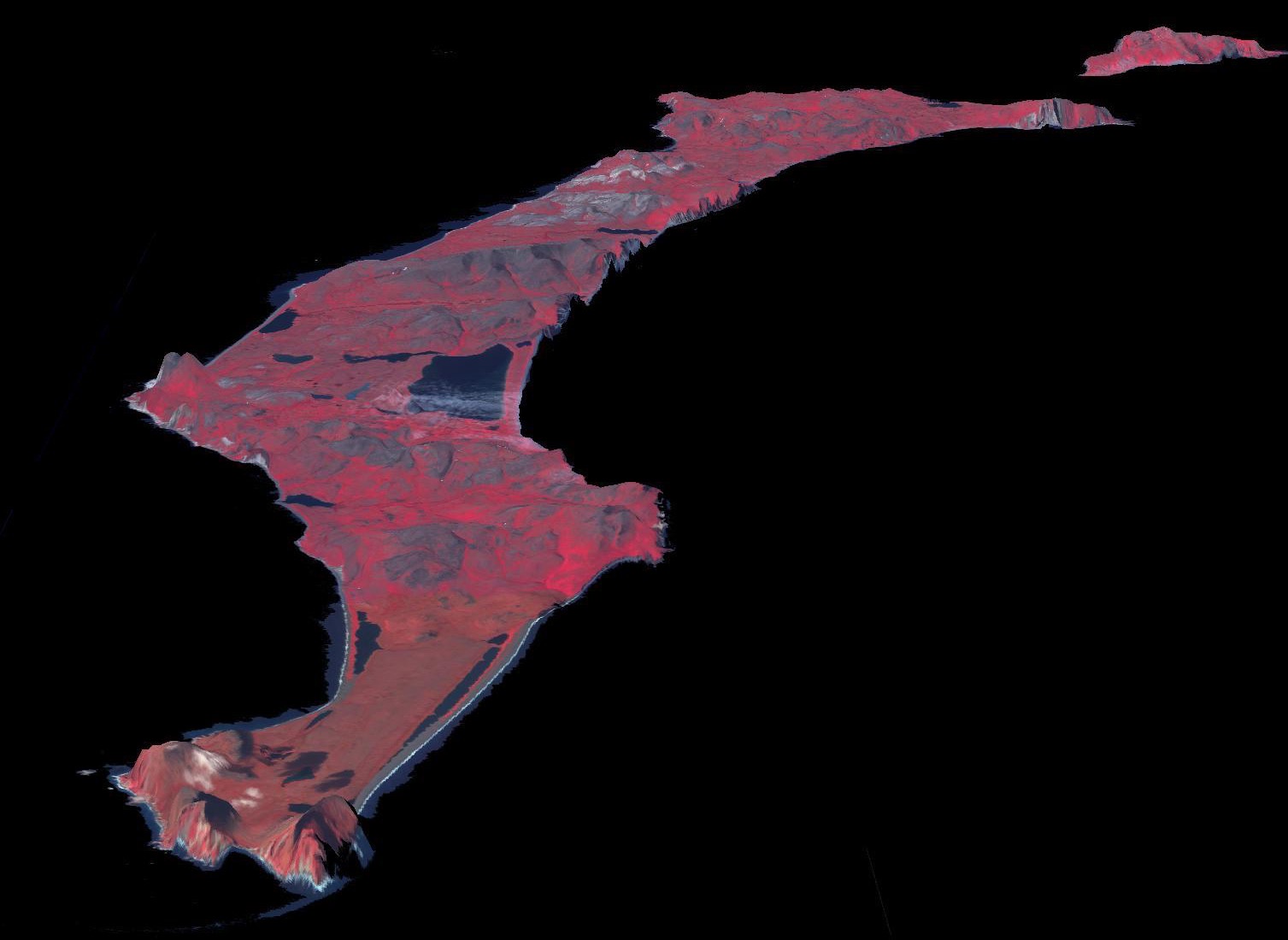
Who ran it
Nobody designed this experiment. Three organisations ran a piece of it each, and only the last of them knew it was an experiment at all.
The first was the United States Coast Guard. In January 1943, with the Japanese holding the western Aleutians, the Navy directed the Coast Guard to build a chain of loran radio-navigation stations across the Bering Sea, at Umnak, St. Paul and St. Matthew, so that ships and aircraft could fix their positions in fog. St. Matthew was the northern end of the chain, 200 miles north of St. Paul and more than 400 miles north of the base at Dutch Harbor, and the plan allowed it one officer and eighteen men. The station’s unit on the island would ask, in June 1944, for permission to buy thirty reindeer as emergency food. The reindeer were the Coast Guard’s idea and the Coast Guard’s responsibility, and the Coast Guard left.
The second was the Fish and Wildlife Service, which held the island but not the animals. St. Matthew had been a bird reservation since Theodore Roosevelt set it aside on February 27, 1909. Reindeer in Alaska belonged, under the Reindeer Act of 1937, to the Natives and the government and were the business of the Bureau of Indian Affairs, which could not manage a herd on an island without people. In 1957 the three bureaux agreed that herds “of obscure origin” which had “increased in a wild state” would be classified as big game and handed to the Bureau of Sport Fisheries and Wildlife. The Service’s regional director in Alaska, Clarence Rhode, flying his own aircraft over the island in good weather in 1955, had guessed at seven or eight hundred reindeer.
The third was Klein. He was born in Fitchburg, Massachusetts, in May 1927, left the Navy’s pilot programme when the war ended, and in 1947 drove a Model A Ford over the new Alaska Highway to Fairbanks with a friend. He took a master’s degree at the University of Alaska, was drafted for the Korean War and spent it in Alaska, and in 1954 joined the Fish and Wildlife Service as a biologist in Petersburg, in the south-east of the territory. In the summer of 1957 he was thirty, and his supervisor in Anchorage, Robert Scott, asked whether he would like to spend three weeks on an island nobody could get to. He went six times in the next fifty-five years. “I can talk forever on St. Matthew,” he told an interviewer in 2014, when he was eighty-six.
The reindeer themselves had a longer chain of custody than any of the people. They came from the Nunivak Island herd, which had been stocked in 1920 from the mission herd at Golovin, which the government had lent in 1895 out of the animals the revenue cutter Bear had carried across from Siberia. That history, and the forty-year experiment it belongs to, is told in Sixteen Reindeer. This entry is about what happened to twenty-nine of its descendants on an island with no herders.
What they were trying to find out
The Coast Guard’s hypothesis was the simplest in this journal: that reindeer put ashore in August would be alive and edible when a station crew needed them. The answer was yes.
The Fish and Wildlife Service’s hypothesis was written down before anyone had counted. On July 20, 1957, with Klein already on his way, the Department of the Interior issued a press release announcing the study. It said there were “about 800 reindeer on the island and that the food supply will not sustain that many animals for any length of time.” Then it said what would happen: “Because there are virtually no natives on the island to harvest the herd and because there are relatively few predators, the herd has increased rapidly until it has exceeded the sustained carrying capacity of the range and will eventually destroy the range and itself too.”
That is a prediction, made in public by the agency responsible, before the first measurement. Its only number was wrong, the herd being 1,350 and not yet past anything, but the shape of what followed was in the sentence.
Klein’s own statement of the hypothesis came in the report he wrote that winter, and it is the point at which a management problem became an experiment. He had been sent to count the herd and judge the range. He concluded that nothing could be done with the herd: harvesting it was “economically impractical” on an island two hundred miles from anyone, and removing it would mean chasing the last few animals through summer fog for years. So he recommended that the government do nothing, and watch. “It is recommended that the St. Matthew Island reindeer herd be used as an experiment in population dynamics and range ecology. Merely by following a laissez-faire policy with the herd, much valuable information of reindeer-range relationships will become available as the population builds to its peak and the expected crash decline follows.”
That sentence contains two claims. The first is that the herd would peak and crash. The second is that the crash would be worth watching, which depended on somebody being there when it happened. Klein saw the difficulty and named it. “It is desirable that annual, or at least periodic, counts of the population be made to enable plotting of the trend in growth and pinpointing the peak of the cycle. The population decline may be rapid after the peak is reached.” The reindeer on St. Paul Island, in the Pribilofs, had lost 37 percent in the year after their own peak. He suggested the Navy’s weather-reconnaissance flights might photograph the herd in winter. Nobody did, for six years.
What they built
The island is thirty-two miles long and about three and a half wide, 128 square miles of ridges and valleys with no trees, no harbour and no airstrip, 170 miles west of Nunivak, 200 miles south of St. Lawrence Island and 220 miles north of the Pribilofs. It has one native land mammal besides the arctic fox, a vole, and in the nineteenth century it had polar bears, which sealers and the crew of a revenue cutter are thought to have shot out in the 1890s. G. Dallas Hanna of the Biological Survey spent six days on it in July 1916 and wrote the sentence everyone quotes: “It is barren, treeless, uninhabited and surrounded by dangerous and poorly charted waters.” He also wrote the one that matters here. “Most of the valleys are covered with reindeer lichen and mosses.”
Lichen is the point of the island. On the dry flats at the southern end, in the fog of a Bering Sea summer and with nothing to eat it, the reindeer lichen had grown into a mat three to four inches deep, the top third alive and the rest dead material underneath. Lichen is what reindeer live on in winter, when the sedges are under snow. It grows a few millimetres a year. The mat was the accumulation of centuries, and it was the entire winter food supply of whatever was put ashore.
The Army came first, landing a weather detachment of nine or ten men on the south coast on September 15, 1942, with two Quonset huts, food for a year and a machine gun; they had no mail or supplies for eight months. The Coast Guard’s cutter Clover brought the loran station’s construction crew from Dutch Harbor in June 1943 and built six Quonset huts on a fifty-foot bluff on the south-west shore, on foundations that took six hundred sacks of cement because the tundra would hold nothing when it thawed. In September, while the station was testing, five of its men took a surfboat along the shore on a calm day and were never found. That winter the drifts reached twenty-five feet, the blizzards came at hurricane force and lasted ten days, and men lost their way between huts fifty feet apart until ropes and tunnels were put in. The Army’s weather log, kept for a year from September 1943, survives in Klein’s report: in January 1944 the wind averaged 26 miles an hour for the month, with gusts above eighty, and the island was in fog for 148 hours. In July it was in fog for 468. The station went to twenty-four-hour service on July 10, 1944. The building of it, the men it lost and what it left on the bluff are in The station.
Twelve days before that, on June 28, 1944, the Coast Guard unit on the island asked the government’s reindeer supervisor at Nome for permission to buy twenty-five female and five male reindeer from the Nunivak herd and move them to St. Matthew. Permission came on June 30, with a circular letter on how to load and unload reindeer. The Clover collected the animals at Nash Harbor on Nunivak and put them ashore on St. Matthew on August 20, 1944: twenty-four females and five males, by the count of Frank Beals, a Fish and Wildlife agent who was on the island that summer and whose diary is the source for the date. The Coast Guard’s own station record gives August 14. They were young animals: yearlings, just over a year old, in Klein’s published account, and two-year-olds in his first report. “The objective of the release was to establish a small herd as an emergency food supply during World War II,” Klein wrote. “Shooting of the newly established animals by the military personnel was not permitted.”
The station crew never did shoot one. The chain had been built for a war that moved west, and on September 13, 1946, the commanding officer and twenty enlisted men left aboard the cutter Unalga. Apart from a cutter’s work party that came for some of the equipment in 1949, the island was empty of people from that day until the summer of 1954, when a parasitologist, Robert Rausch, and his wife Virginia camped for six weeks by Big Lake to study the voles, in a driftwood hut the Coast Guard helped them build, and reported the reindeer in the hundreds and the lichen behind their camp already broken up.
What stood on the island when the reindeer were left to it was therefore a closed system of the kind this journal keeps returning to. No predator larger than a fox, no harvest, no herder to move the animals when they had eaten out a valley, and nowhere to move to: the strait to Hall Island, three miles north, runs with currents and moving ice, and no reindeer ever crossed it. No disease that mattered, since the animals had been moved in August, after the warble flies and nose bots of the mainland herds had left them, and neither parasite ever established. An unlimited summer range of sedge, a finite winter range of lichen, and twenty-nine animals.
Klein and his field assistant, an undergraduate named Jim Whisenhant, came ashore from the cutter Wachusett in the middle of July 1957, with a radio in a box the size of a small bookcase, a generator to run it, a two-man tent, a gill net, and rolls of five-foot cattle fencing with which they built three exclosures, pairs of one-metre plots fenced against the reindeer beside pairs left open, the only part of the experiment with a control built into it. They lived in the Rausches’ hut, ate char from Big Lake, hung their reindeer meat from the roof beam out of reach of the foxes, and walked the whole island, ridge to ridge, counting with binoculars and a spotting scope. The Coast Guard dropped Klein on Hall Island for a few hours on the way out, so that he could see what the lichen looked like where no reindeer had ever been.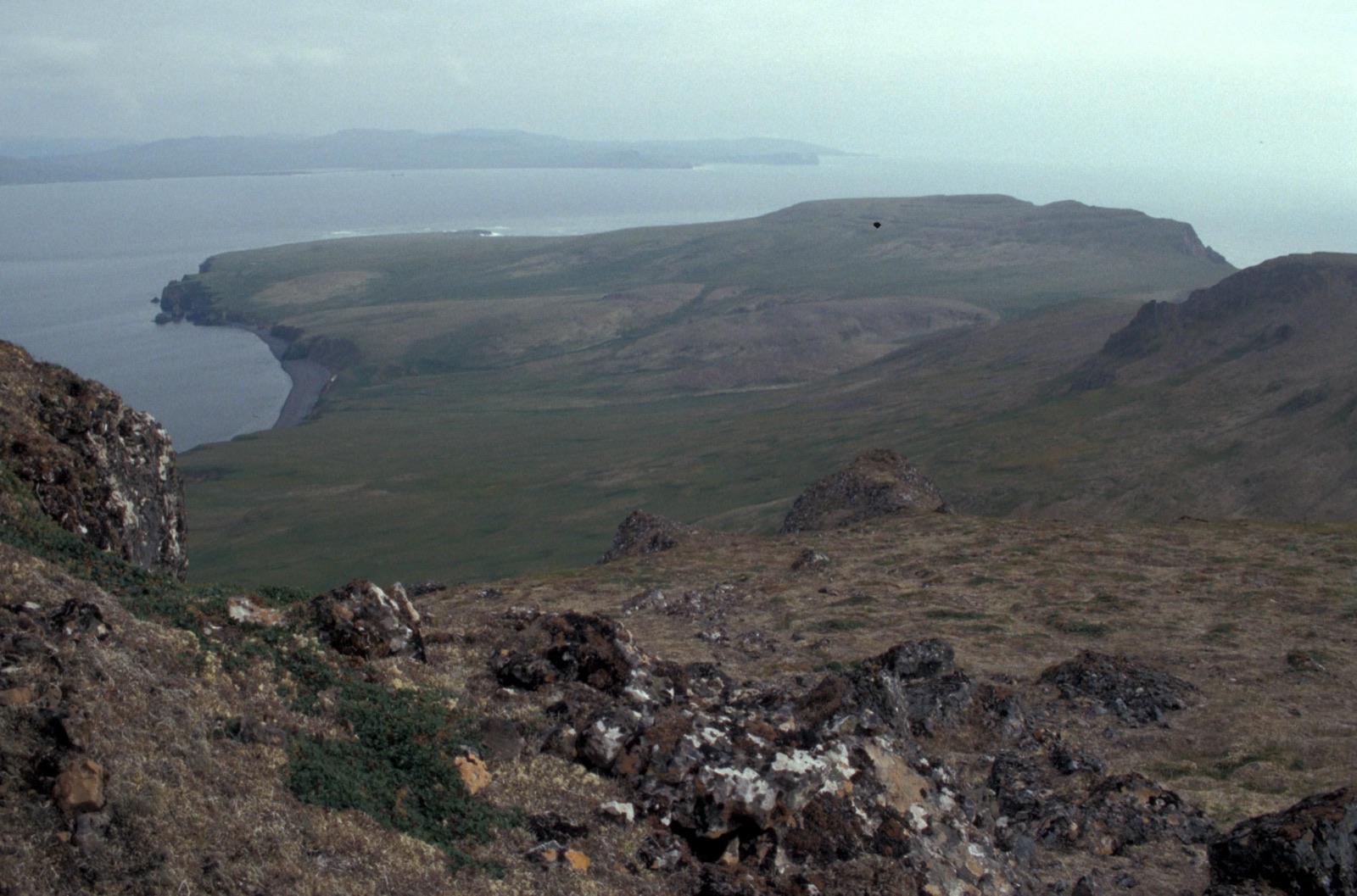
They counted 1,226 reindeer in four days, judged that fog at the north end had hidden about a tenth of them, and set the herd at 1,350. That was an average increase of 34 percent a year for thirteen years. The animals were enormous. The twelve they shot for examination were all in what the report called excellent condition, with fat three to four inches thick on the rumps of the big bulls, and one of those bulls weighed 404 pounds; the females were a quarter to a half heavier than reindeer in the domestic herds they had come from, the males half as heavy again or more. The report also recorded six reindeer dead with their antlers tangled in copper wire at the abandoned Coast Guard station, and a shed antler found four miles away with about ten pounds of wire on it.
The range was another matter. On the dry flats near Big Lake and Cape Upright, where the herd wintered, the lichen that had been three to four inches deep on Hall Island “seldom exceeds an inch in depth and is composed of badly shattered lichens unattached to the ground.” The animals did not simply eat it. They trampled it, broke the dry mat into fragments, and the wind, which averages more than twenty knots in winter, carried the fragments off the island. “Deterioration of the lichen range has been in progress for at least the past 3-4 years,” Klein wrote. The willows and sedges that the lichen had smothered were coming up in its place, and the reindeer were already turning to the willows. At 10.5 animals to the square mile the herd was still under the limit an earlier government biologist, Lawrence Palmer, had set for the safe use of a tundra range, but only if the whole island counted as range, and half of it was bare scree. On the part that was range, the density was already past Palmer’s figure. On St. Paul, Klein noted, the reindeer had reached forty-nine to the square mile just before their die-off.
Then nobody could get there. Klein went to British Columbia for a doctorate, came back to Juneau in 1961 and to Fairbanks in 1962 as leader of the federal Cooperative Wildlife Research Unit, and in July 1963 a Coast Guard icebreaker carrying two helicopters put him ashore again.
Forty-seven to the square mile
“We got there and there were lots of them,” Klein said half a century later. “I mean, there were reindeer all over the place. And it was so damn foggy we couldn’t make good counts.” On the shore there were tracks, droppings, and willows bent flat. Where the fog lifted they could take composition counts of whatever band stood in the clear, but from the ridge tops, where in 1957 the island had opened out below them, they could see nothing. The exclosures had rusted and a bull had torn one down with his antlers; inside the fences that held, the lichen had not come back, having been too far gone when they went up. Along the beach ridges, where the snow had not yet melted, they found windrows of lichen fragments mixed with the drift, blown off the range all winter and on their way to the sea.
The count was made on the day they were due to leave. The weather had lifted to a high overcast, and Klein got on the radio to the icebreaker and asked for the captain. “We’re really in a bad way. We’ve done these studies and there’s just lots and lots of reindeer here, but we haven’t been able to get a count. Is there any way we could get use of the helicopter to do a survey?” The answer came back in minutes: both of them. Francis Fay, a walrus biologist who had come to trap voles, took the southern half of the island in one helicopter and Klein the northern half in the other, counting the small bands and estimating the big ones, and that night on the ship they added it up. “We counted 6,000 of them,” Klein said in 2003. “They were really hammering the lichens.”
Six thousand reindeer on 128 square miles is 46.9 to the square mile, within a hair of the density at which the St. Paul herd had collapsed. Everything else had changed with the number. The animals were smaller: adult females averaged 38 percent lighter than in 1957, adult males 43 percent, down to the weights of ordinary domestic reindeer, in every age class. There were sixty fawns per hundred cows instead of seventy-five, and twenty-six yearlings per hundred instead of forty-five. Three of the fifteen animals shot carried lungworm; none had in 1957. The lichen mat on the old winter range was under a centimetre deep, where Hall Island’s was eight to twelve, and what remained was mostly the dead basal layer from which nothing regrows. Sedges and grasses had spread into the ground the lichen had covered, and the reindeer were eating them in winter now, and the willows. The herd had passed, in Klein’s judgement, “from moderate levels, with respect to the food supply, to excessive populations in only a few years,” and the winter that was coming would be fed on crowberry.
He did not know that last part. What he knew in July 1963 was the number, the weights, and the ratios, and what they meant was that the increase was slowing and the range was gone. The animals were, as he put it, “still reproductive and capable of expanding.” He left on the icebreaker and did not see the island again for three years.
What it looked like from inside
Nobody was inside. That is the experiment’s defining condition and its defect, and what follows is a reconstruction from the two nearest weather stations, from bones, and from what the Coast Guard saw a year and a half later.
The winter of 1963 to 1964, Klein wrote, “was one of the most severe on record from the standpoint of amount and duration of snow on the ground and extreme cold.” At Mekoryuk on Nunivak Island, the nearest weather station to the east, the snow on the ground reached 31 inches in January, 42 in February, 47 in March and 48 in April, each the deepest in twenty years of records, and February was the coldest February recorded. At St. Paul, the nearest to the south-east, the figures were 33, 32 and 27 inches for February, March and April, also records, with February 7.8 degrees below its mean. Forty-five years later, when Klein asked two climatologists to reconstruct the season from the St. Paul record and a global reanalysis, they found February and March 1964 to have been nearly continuous windstorms, one with the central pressure of a Category 3 hurricane; wind chills below minus forty for a week in early February; and on March 13, 1964, an air temperature of minus 34 Fahrenheit with a thirty-mile wind, which is a chill of minus seventy-one. St. Paul recorded 140 inches of snow that season.
On a range with no lichen left, snow of that depth and duration, crusted by wind, left nothing a reindeer could reach. The bones say the rest. When Klein walked the island in 1966 he sexed and aged 241 skeletons from the die-off and opened the marrow cavities of the long bones. “Without exception the cavities were hollow, indicating that no fat was present in the marrow at the time of death.” Fat in marrow survives five years or more in a dead animal, and its absence is the standard sign of starvation. The skeletons lay in groups. “Frequently 10 or more skeletons were found in such close proximity,” as if a band had lain down together in a storm and not got up. Among the remains of four females were the bones of unborn fawns, 380 to 480 millimetres long, which against the known growth of reindeer fetuses put the deaths of their mothers in late February and March. The rumen contents still lying among the skeletons were crowberry. Among the animals old enough to sex, 41 percent were male and 59 percent female, and the proportion of males fell with age: the breeding bulls, which go into winter having spent their fat on the rut, had died first and most completely.
The first people to see any of this were a Coast Guard cutter’s crew, who went ashore on August 14, 15 and 16, 1965, to hunt reindeer for sport, in three days of unusually fine weather, in several parties, over most of the island. They found one band of about forty animals near the south-eastern end and no others, and reported that the tundra was scattered with skeletons bleached white, with no hide or flesh on them. Klein, reading their report, noted that bones do not bleach like that in one summer. The die-off had happened the winter before last, in the months after he had counted six thousand and before the Navy aircraft had flown over and seen nothing.
He got there in late June 1966, with a botanist, Vernon Harms, and a German post-doctoral researcher, Detlef Eisfeld, landed by a Coast Guard buoy tender that was going on north to Point Lay. The Rausches’ hut had washed away. They camped in a wall tent by a lake with char in it, in the middle of the island, and walked. The bones were everywhere, and moss had begun to grow on those that touched wet ground; where a skeleton lay, the soil around it carried a rank growth of the grasses that elsewhere on the island grew only under the bird cliffs and beside fox dens, plants that need nitrogen and had found it. It took a long time to find a living reindeer. Klein and Eisfeld hiked seven miles south to Big Lake in fog and had three or four animals appear out of it below them; they shot three, two females and one with the antlers of a female and shrunken testes. Days later, on the far side of the same valley, at about four in the afternoon, they found the rest grazing in a sedge meadow: thirty-nine, which with the three already shot made forty-two. There were no fawns and no yearlings, and the youngest animal they shot was just over four years old, which meant that no fawn born since the winter of 1963 had lived, or none had been born. Every one they could examine was female. The animal with the small antlers was the only male on the island, and the ovaries of the females showed that they had gone on ovulating since the crash without conceiving. Klein crawled through the sedge to within range and shot seven more for his sample of ten; the two men weighed them in pieces on a spring scale, took the ovaries and the jaws, and walked home with the liver and heart. “We figured that we covered 22 miles that day.”
Then the buoy tender radioed that an Air Force aircraft had gone into the sea at Point Lay with everyone aboard, that the ship had been ordered to stay and drag for it, and that the pick-up would be as much as a month late. The island did what the island does with people. They were down to rice and oatmeal and the char they could net, and the Service would not risk its new aircraft on 250 miles of open water. What got them off, in the end, was a Super Cub on floats that came down through a hole in the clouds one still afternoon, flown by a young man from Bethel who had heard there were a lot of reindeer out here and had found the island by its mountain tops showing above the overcast; he took Harms, raised a charter company from the air, and the next afternoon a Grumman Goose landed on their lake. On the way out, in the best weather the island had shown him, Klein asked the pilot to fly down the valley by Big Lake, and there were the thirty-two that were left, where they had been. That week is told in full in The pick-up.
What happened
Klein published the whole of it in the Journal of Wildlife Management in April 1968, under the title “The Introduction, Increase, and Crash of Reindeer on St. Matthew Island,” with the growth curve as Figure 2. The curve has four points on it: 29 in 1944, 1,350 in 1957, 6,000 in 1963, 42 in 1966. His conclusion weighed four causes together, the overgrazed lichen, the number of animals competing for what was left, the condition they went into the winter in, and the snow, and gave the verdict in one sentence that has been quoted ever since. “Food supply then, through interaction with climatic factors, was the dominant population-regulating mechanism for reindeer on St. Matthew Island.” He noted what argued against weather alone: the reindeer on St. Paul had come through the same winter well, and Nunivak’s herd had lost animals but not crashed. And he explained the survivors: “because reproductively active males are more susceptible to winter mortality than females, none of them survived the extreme conditions that brought about the nearly complete annihilation of the herd,” so that the survivors, however well they ate afterwards, could not breed.
They did eat well. The females shot in 1966 weighed more than the adult females of 1963, and the protein in their rumens was higher and the fibre lower than in the samples from a managed herd near Nome: thirty-two animals on a range that had fed six thousand, with no fawns to feed. In February 1970 an oceanographic cruise aboard the icebreaker Northwind put a party ashore for two days in the sea ice and a forty-knot wind, and found the whole herd in one band at the south-eastern corner, still thirty-two. “The animals were large and appeared to be in good condition, with impressive antlers.” After that the visits were years apart and the counts were a handful, then fewer. The last, a lame female that a refuge biologist photographed, is believed to have died in 1982; other accounts put it a year earlier, or in the mid-1980s. She had lived at least twenty-one years, and never had a fawn.
After
The lichen is the other half of the result, and it took longer to read.
Klein went back in July 1985, carried out by the refuge on a chartered crab boat, and remeasured the plots he and Whisenhant had laid out twenty-eight years before. Mosses had spread over a third of the ground the lichen had been stripped from. The lichen that had come back was eighteen millimetres deep against seventy-five on Hall Island, and it was the wrong lichen: dark pioneer species that reindeer do not prefer, where the climax mats across the strait were still the pale Cladina the herd had eaten first. Dried and weighed, the lichen on St. Matthew’s old winter range came to 35 grammes a square metre. Hall Island’s came to 550, of which 431 was living. Twenty-two years after the crash, the island carried 6 percent of the lichen it had carried before the Clover came.
He went again in July 2005, when he was seventy-eight, for the forty-first summer since the die-off. The lichen had reached 12 percent of Hall Island’s. On the old beach ridge between Big Lake and the sea, where the Rausches had photographed a stand of lichen and crowberry in 1954 and Klein had found pure crowberry three years later, there was still no lichen at all, forty-eight years on. With a climatologist, Martha Shulski, he looked for the reason in the St. Paul weather record, the longest in the region, and found that the summers had warmed by almost two degrees Celsius since 1949, with a step in 1976; that they had dried; and that there was less low cloud and fog, which is the only moisture a lichen has. The largest lake on the island had dropped about two metres. Lichen does not grow when it is dry. The range the reindeer had stripped was not recovering on the schedule of the textbooks, thirty to fifty years, because the climate that had grown the mat in the first place no longer existed.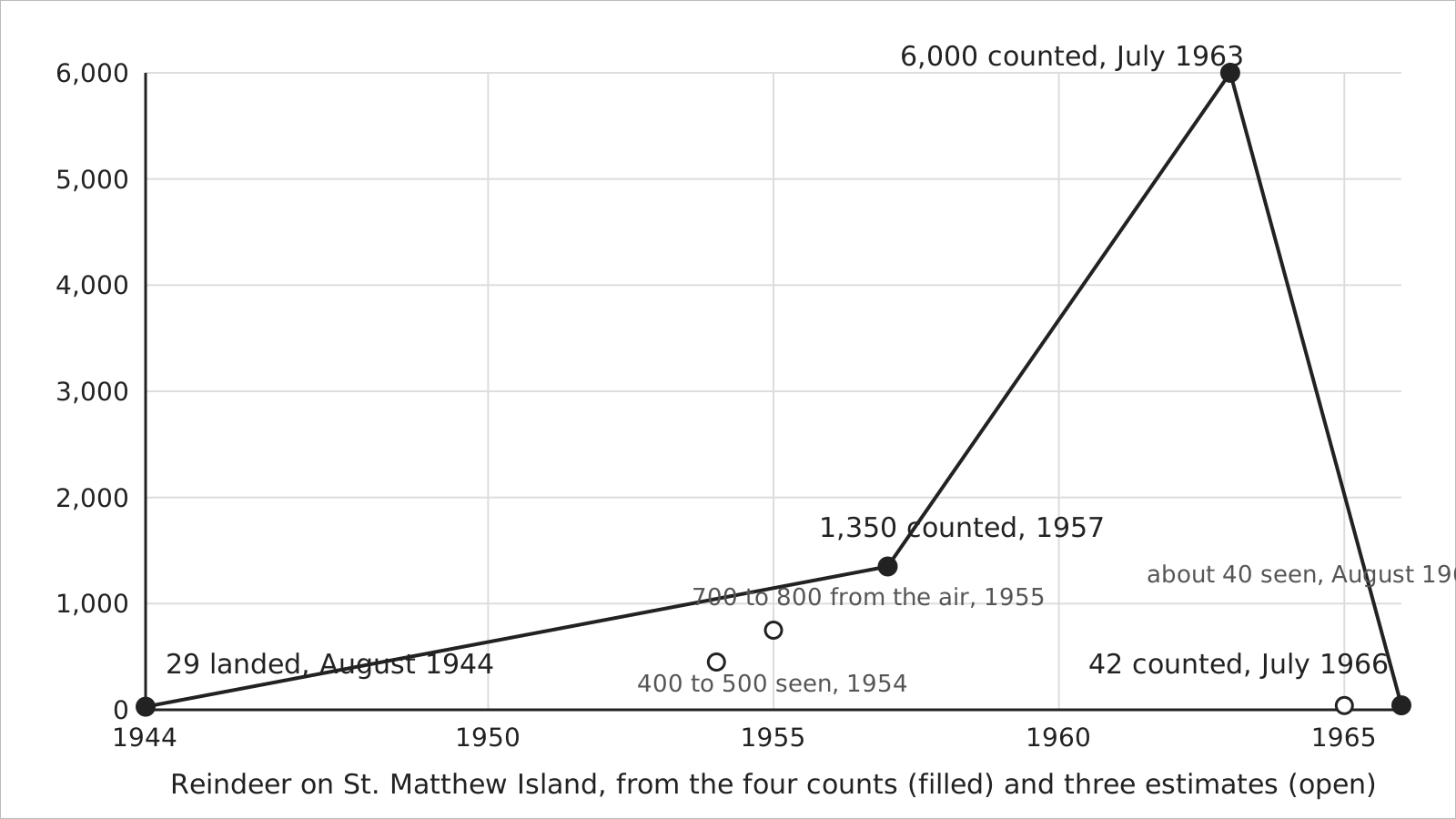
The four-point curve, meanwhile, had gone where good curves go. Within a few years of the paper it was in the textbooks as the picture of what a population does when nothing stops it, and it has stayed there. Garrett Hardin built a lecture on it in the 1980s, calling it “David Klein’s classic study” and drawing the moral that a population which overshoots its range does not fall back to the old carrying capacity but to a lower one: “Transgressing the carrying capacity of St. Matthew Island reduced its carrying capacity by at least 97.5 percent.” The curve became an argument about people.
The scientists argued about the winter. In 2004 three Canadian Wildlife Service biologists, Frank Miller, Samuel Barry and Wendy Calvert, took Klein’s two reports apart at a caribou workshop in Girdwood and published the result under the title “St. Matthew Island reindeer crash revisited: Their demise was not nigh—but then, why did they die?” Their case was that the 1957 fawn ratio Klein had compared against 1963 came from the wrong sample, that the ratios had not in fact fallen, that the herd was still growing at near its maximum rate when it died, and that a population limited by food declines over years, not in one winter. “We believe,” they wrote, “that the winter weather was the all-important factor that led to the premature, extreme, and exceptionally rapid, near total single-year loss of 99% of the reindeer on St. Matthew Island in winter 1963–64.” They did not dispute that the lichen was gone or that a reckoning was coming, only that it had arrived; on their reading the snow killed a herd that was still, by every measure in the data, healthy. “No one knows whether there was extensive icing compounding the severity of the snow pack on St. Matthew Island in winter 1963–64—and no one ever will.”
Klein’s answer came in 2009, in Weatherwise, with Shulski and the climatologist John Walsh, under the title “What Killed the Reindeer of Saint Matthew Island?” Walsh had reconstructed the storms of February and March 1964 from ships’ barometer readings and the reanalysis, and the answer the three of them gave was the same combination Klein had given in 1968, now with the weather quantified: a herd that had eaten its winter range, and then the worst winter in the record. “In isolated or fractured environments,” Walsh said when he presented it, “wildlife populations can be extinguished by severe weather events.” The fetal bones had always said when; the barometers now said what the weather had been that week. What they could not say, and what the four-point curve cannot say, is whether six hundred reindeer on an intact lichen mat would have lived through it.
Klein went to the island a sixth time in August 2012, at eighty-five, and with his son-in-law cut a core of marsh sediment nearly a metre and a half long from a fen, carried it home frozen and sent it to a geologist in Virginia. In 2020 the analysis of its isotopes showed that the Bering Sea had less winter ice than at any time in the 5,500 years the core recorded. He died on November 21, 2020, at ninety-three.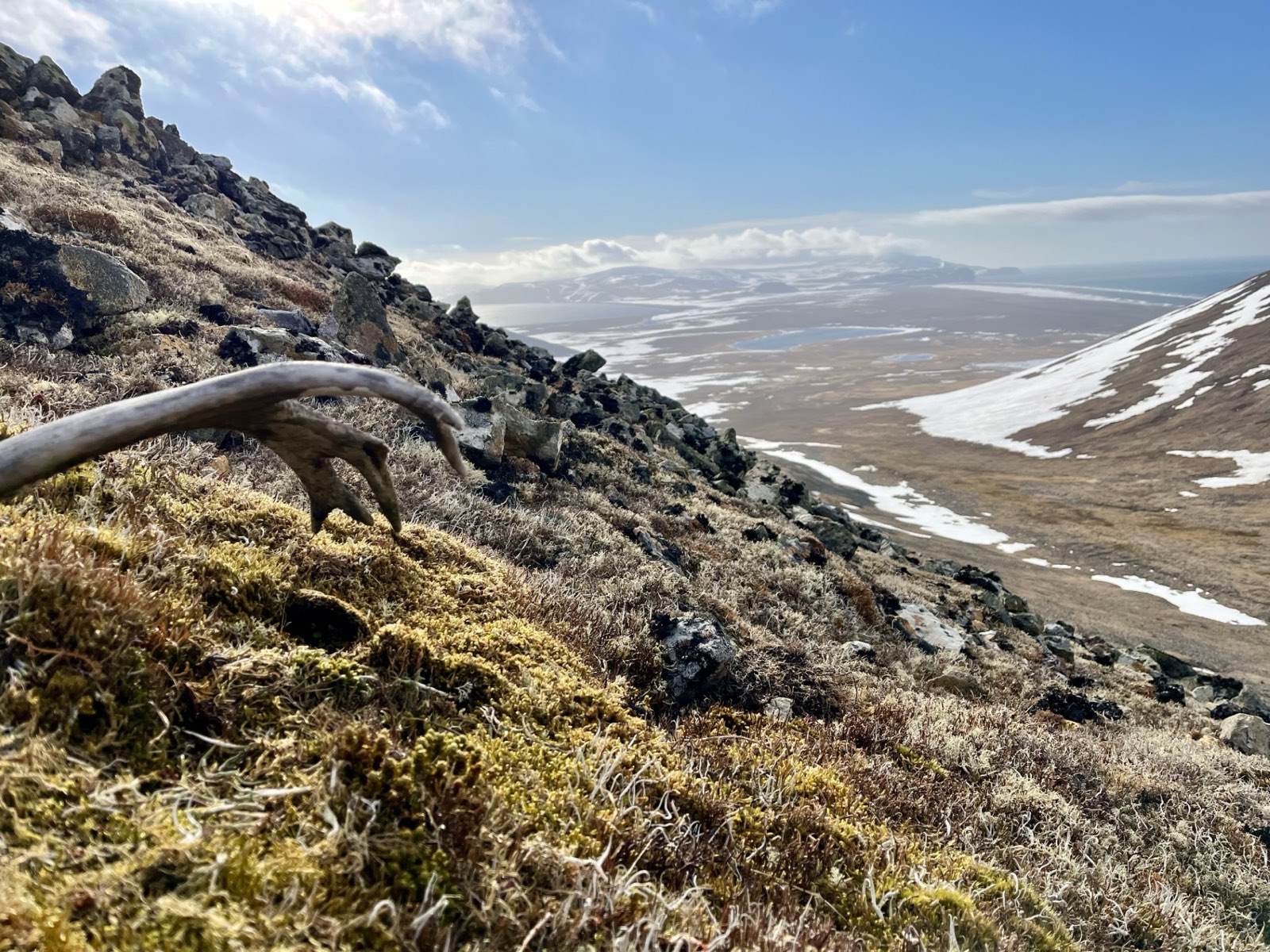
The station is still on its bluff: the foundations of the huts, the trench of the tunnel to the transmitter, two tractors stuck in the middle of the island, hundreds of oil drums rusted to fragments, and a toilet. The reindeer skulls that littered the tundra for decades have mostly gone under the moss; the few that show are buried to the antler tips. Polar bears can reach the island across the drift ice in the years when there is ice; in the winters of 2018 and 2019 there was none around it at all.
What it taught
Start with what the experiment was. Nobody built it, but it had everything a built one needs: a closed system, a known starting condition, a single variable left to run, and a control. The twenty-nine were counted ashore on a known day, the island let nothing in or out, no one harvested or herded, and three miles of water kept a second island in its original state for comparison. The result is the cleanest measurement of an unchecked population that ecology has, and it was produced by a commissary request and a biologist who could get a boat three times in nine years. The instruments that speak most clearly are often the ones nobody meant to build, and they speak whether or not anyone is listening.
The sampling interval was longer than the event. Klein wrote in 1958 that the decline after the peak might be rapid and that the herd should be counted every year. It was counted twice in the next nine. The peak was measured in July 1963 and the crash was over by April 1964, and nobody saw the one happen or the other. The May 1964 flight is the hinge of the story: the result was on the ground and the observer, who had every reason to expect six thousand animals, concluded his instrument had failed rather than that the world had changed. If a process can run its course between your readings, you will not see the process. You will see two points and draw a line, and the line will be in every textbook, and it will be right about the two points and silent about everything between them.
The control was the only thing that made the result mean anything. The counts say the herd rose and fell. They do not say why. The lichen measurements on Hall Island, a few hours ashore in 1957 and a week in 1985, are what turn a count into a finding: eight to twelve centimetres there and under one here, 550 grammes a square metre there and 35 here, twenty-two years on. Without the island the reindeer did not reach, the island they did reach would be a story. With it, it is a measurement, and the measurement is the part nobody has been able to argue with.
What is argued about is the mechanism, and the argument is the result. Klein said food through weather; Miller said weather; Hardin said overshoot; the textbooks mostly say nothing about the snow. All of them use the same four numbers. The lesson is not that one of them is right. It is that a curve with four points on it will carry any mechanism you bring to it, and that the mechanism is what people act on. The curve has been shown to generations of students as a picture of what happens to a population that outgrows its food. It is also a picture of what happens to a population that meets the worst winter in the record on an island it cannot leave. Both are true, in proportions that cannot now be recovered, because the one winter that would have settled it was the winter nobody was there.
Carrying capacity is not a line on the ground. The thing the reindeer ate was not an annual crop but a mat laid down over centuries, and when it was gone the island’s capacity did not return to what it had been; forty-one years later it was 12 percent of the control. Then the climate shifted under the experiment, and the lichen stopped growing for reasons that had nothing to do with reindeer. The number the textbooks print as a ceiling was a one-time balance, drawn down in nineteen years and not restored in sixty. Whoever plans a system on its measured capacity should ask whether the capacity is income or savings.
The prediction was made, and that is why there is a record. The Fish and Wildlife Service said in July 1957, in a press release, that the herd would “destroy the range and itself too.” It then did nothing, because nothing could be done, and Klein turned the nothing into a design: say what you expect, fence four plots, come back when you can. Almost every number in this entry exists because a man who could not manage a herd decided to write down what it would do instead. The experiment was a failure of management from the day the Unalga sailed. It became knowledge at the moment someone stopped pretending otherwise and started counting.
Check the story before you learn from it. The reindeer were landed on August 20 in Klein’s reports and August 14 in the Coast Guard’s station record; they were yearlings in his paper and two-year-olds in his first report; the station held nineteen men by the Coast Guard’s own allowance and twenty-one by the number who left on the Unalga; the station closed in 1945 in one history and on September 13, 1946, in another. The survivors were forty-two in 1966 and thirty-two after Klein’s sample, and the last of them died in 1981, 1982 or the mid-1980s depending on who is asked. Klein’s own memory, at eighty-six, had twenty-four reindeer landed and one drowned in the unloading. The six thousand and the forty-two are not in doubt, and neither is the lichen. Everything else wobbles a little, which is the normal condition of a true story and the reason this one is worth checking.
Sources
- David R. Klein, “The Introduction, Increase, and Crash of Reindeer on St. Matthew Island,” Journal of Wildlife Management 32 (2), 350–367, April 1968. The 1944 release, the 1957, 1963 and 1966 counts and densities, the weights and ratios, the lichen depths against Hall Island, the May 1964 flight, the Coast Guard’s August 1965 report, the bones, the weather records from Nunivak and St. Paul, and the conclusion. Read in the full-text transcription mirrored by over-reeen.nl; the original is on JSTOR. over-reeen.nl, doi:10.2307/3798981
- David R. Klein and James L. Whisenhant, Caribou Management Studies: Saint Matthew Island Reindeer-Range Studies, Federal Aid in Wildlife Restoration job completion report, Project W-3-R-12, Alaska Game Commission, April 30, 1958. The 1957 field work from the Wachusett, the count of 1,226 and the estimate of 1,350, the Clover and Beals’s diary as the source of the August 20, 1944 release, the “not permitted” shooting, the weights, the wire, the exclosures, the lichen on the dry flats and on Hall Island, the Army weather log of 1943 to 1944, the press release’s eight hundred, and the recommendation that the herd be treated as an experiment. adfg.alaska.gov
- US Fish and Wildlife Service, “FWS Begins Study of Reindeer on St. Matthew Island in Bering Sea,” press release, July 20, 1957. The 1957 agreement among the three bureaux, “about 800 reindeer,” and “will eventually destroy the range and itself too.” fws.gov
- David R. Klein, “Vegetation Recovery Patterns following Overgrazing by Reindeer on St. Matthew Island,” Journal of Range Management 40 (4), 336–338, July 1987. The 1985 visit, the plots, 35 grammes against 550, eighteen millimetres against seventy-five, the moss, the pioneer species, and the last survivor “believed to have died in 1982.” doi:10.2307/3898732
- David R. Klein and Martha Shulski, “Lichen Recovery Following Heavy Grazing by Reindeer Delayed by Climate Warming,” Ambio 38 (1), 11–16, 2009. The 2005 visit, 6 and 12 percent, the beach ridge with no lichen after forty-eight years, the St. Paul warming of almost two degrees and the 1976 step, the fog, the lake, and the Chukchi lineage of the Nunivak stock. digitalcommons.unl.edu
- David R. Klein, John E. Walsh and Martha Shulski, “What Killed the Reindeer of Saint Matthew Island?”, Weatherwise 62 (6), 2009. The reconstruction of February and March 1964. Not read directly; its figures are taken from Ned Rozell’s account of it below. doi:10.1080/00431670903337581
- Frank L. Miller, Samuel J. Barry and Wendy A. Calvert, “St. Matthew Island reindeer crash revisited: Their demise was not nigh—but then, why did they die?”, Rangifer Special Issue 16, 185–197, 2005. The reanalysis of the ratios and the case for weather alone. septentrio.uit.no
- David Klein, oral history interviews with Karen Brewster, April 3 and April 10, 2014, Project Jukebox, University of Alaska Fairbanks. The 1957 voyage and camp, the 1963 fog and the helicopters, the 1966 finding of the herd, the stranding, the Super Cub, the airdrop and the Goose, the last lame female, and “I can talk forever on St. Matthew.” April 3, April 10
- US Coast Guard, The Coast Guard at War, IV: Loran, Volume II, Historical Section, Public Information Division, August 1, 1946, transcribed by Bill Dietz. The Bering Sea chain, one officer and eighteen men, the Army detachment’s eight months without mail, the Clover’s sailing of June 17, 1943, the cement, the five men lost, the drifts, the guide ropes and tunnels, the twenty-four-hour service of July 10, 1944, the Christmas mail, and “There were also 29 reindeer.” media.defense.gov
- Loran Station St. Matthew Island, loran-history.info. The chronology compiled from Coast Guard records: the Army weather station of September 15, 1942, the men lost on September 20 and 21, 1943, the reindeer request of June 28, 1944 and its approval, the release of August 14, 1944, and the departure of the commanding officer and twenty men aboard the Unalga on September 13, 1946. loran-history.info
- Dennis Griffin, “A History of Human Land Use on St. Matthew Island, Alaska,” Alaska Journal of Anthropology 2 (1–2), 84–99, 2004. The Army and Coast Guard stations from the Coast Guard histories and Elaine Rhode’s 1987 account, the Rausches’ hut, the 2002 survey of the station’s remains, and Klein’s 1963 photograph of it. loran-history.info
- G. Dallas Hanna, “Mammals of the St. Matthew Islands, Bering Sea,” Journal of Mammalogy 1 (3), 118–122, 1920. The 1916 visit aboard the Unalga, “barren, treeless, uninhabited,” and the lichen in the valleys. archive.org
- C. Peter McRoy, Sam W. Stoker, George E. Hall and Edward Muktoyuk, “Winter Observations of Mammals and Birds, St. Matthew Island,” Arctic 24 (1), 63–65, 1971. The thirty-two reindeer in February 1970. journalhosting.ucalgary.ca
- Victor B. Scheffer, “The Rise and Fall of a Reindeer Herd,” Scientific Monthly 73 (6), 356–362, December 1951. The St. Paul precedent: forty reindeer in 1911, more than two thousand in 1938, eight in 1950. archive.org
- Ned Rozell, Alaska Science Forum, Geophysical Institute, University of Alaska Fairbanks: “When Reindeer Paradise Turned to Purgatory,” November 13, 2003, for “We counted 6,000 of them” and “hammering the lichens”; “Bitter weather may have wiped out reindeer,” January 7, 2010, for the Weatherwise figures and Walsh’s sentence; “A voyage to St. Matthew,” July 26, 2012; and “Message from a lonely Alaska island,” September 24, 2020, for the core and its result. 2003, 2010, 2012, 2020
- Garrett Hardin, “An Ecolate View of the Human Predicament,” the lecture behind Filters Against Folly, 1985. “David Klein’s classic study” and the 97.5 percent. garretthardinsociety.org
- Eigil Reimers, Olav Hjeljord, Bob White and Rolf Langvatn, “In Memoriam: David R. Klein (1927–2020),” Rangifer 40 (1), 2020, and the Anchorage Daily News obituary, for his life and the date of his death. septentrio.uit.no
- Marc Romano, David Klein and others, Report of 2012 Expedition to St. Matthew and Other Bering Sea Islands, US Fish and Wildlife Service, 2013, for the sediment core of August 2, 2012. absilcc.org, archived
- Sarah Gilman, “Inhospitable, remote and compelling: The island swallowed by nowhere,” Hakai Magazine and High Country News, October 14, 2020, for the skulls under the moss and the station today. hcn.org
- US Geological Survey, “The Rise and Fall of St. Matthew Reindeer” and “What remains of the St. Matthew Loran Station,” photographs by Laura McDuffie, 2024, public domain. usgs.gov, usgs.gov