At half past seven on the morning of Thursday 7 November 1940 Kenneth Arkin, a chainman on the survey crew of the Washington Toll Bridge Authority, drove out to the middle of the Tacoma Narrows Bridge and read the anemometer. It said 38 miles an hour, from the south. The deck was bouncing, “but of no great magnitude”. He had been out once already, at five, to look at the temporary guy cables on the side spans, which had thrashed all night. Arkin reported to the office, drove back, and at mid-span read the anemometer again: 42 miles an hour. He counted the bounce. Thirty-eight to the minute.
On the hill above the toll plaza stood a small observation house with a transit in it. From the transit a line of sight ran along the south side of the bridge to targets fixed to the lamp standards, nine of them, from the shore end of the side span to the middle of the main span 1,400 feet out. Readings had been taken from that transit since 1 August. Arkin climbed up, put his eye to it, and saw about three feet of movement at mid-span, the same movement the targets had been showing for three months. Then the mid-span targets went out of the field of view to the right.
He looked over the instrument. The middle of the bridge seemed to have blown north by about half the width of the roadway and to be coming back “in a spiral motion”. He shouted to the toll collector to stop the traffic and telephone the bridge engineer. The call to the radio patrol office was logged at 10:07. “This was approximately three minutes after the start of this peculiar motion.”
A few minutes after that, by the account of the professor standing on the deck with a cine camera, the frequency was fourteen to the minute, the two cables were moving in opposite directions, and the roadway was tilting forty-five degrees each way. An hour later most of the main span was at the bottom of Puget Sound. The bridge had been open for four months and six days. Nobody died but a dog.
Who ran it
The bridge belonged to the State of Washington. The legislature had created the Washington Toll Bridge Authority in 1937, with the Governor, Clarence D. Martin, as its chairman and the Director of Highways, Lacey V. Murrow, as its chief engineer. Murrow, elder brother of the broadcaster Edward R. Murrow, left for the Army Air Corps in September 1940 and James A. Davis acted in his place. In direct charge of design and construction was Clark H. Eldridge, the Authority’s bridge engineer, born in 1896, who had come to the state from the Seattle city bridge office in 1936. Above him stood Charles E. Andrew, principal consulting engineer, late of the San Francisco-Oakland Bay Bridge, and a board of three consultants.
The money was federal. The Public Works Administration under Harold Ickes made the grant, and from 1939 the PWA answered to John M. Carmody, Administrator of the Federal Works Agency; its project engineer at Seattle was L. R. Durkee and its chief resident inspector at the bridge David L. Glenn. The loan came from the Reconstruction Finance Corporation, which sent T. L. Condron, an advisory engineer, to review the plans.
The superstructure was the work of Leon S. Moisseiff of New York, with his associate Frederick Lienhard. Moisseiff was born in Riga in 1872, took his degree at Columbia in 1895, designed the Manhattan Bridge of 1909 for the New York Department of Bridges, the first American suspension bridge calculated by what engineers call the deflection theory, and by 1938 had been a consultant on the Golden Gate, the Bay Bridge and the Bronx-Whitestone. The piers were built to Eldridge’s own plan; the Pacific Bridge Company of San Francisco held the contract, and Bethlehem Steel erected the steel.
The measuring was done by the University of Washington. Frederick Burt Farquharson, an associate professor of civil engineering, was born in Boston in 1895, flew with the Royal Air Force and was a prisoner of war in Germany, graduated from the university in 1923, worked two years for Boeing and joined the faculty in 1925. He built the models, took the readings and filmed the end.
After the end came three more names. On 28 November 1940 Carmody appointed a board to find out what had happened: Othmar H. Ammann of New York, designer of the George Washington Bridge and the Bronx-Whitestone; Theodore von Kármán, director of the Guggenheim Aeronautical Laboratory at the California Institute of Technology; and Glenn B. Woodruff of San Francisco, of the Bay Bridge design. Their report, dated at Pasadena on 28 March 1941, is the document on which most of this entry stands.
What they were trying to find out
There were two experiments at the Narrows, and the second was built on top of the first.
The first was a hypothesis about design. For a century the thing that kept a suspension bridge from heaving in the wind had been a stiffening truss, a deep lattice of steel running the length of the deck. The deflection theory said that on a very long span this was largely wasted: the weight of the deck and cables, and the tension in the cables, did most of the stiffening, and the truss could be shallow. Moisseiff had come to believe that it could be a plain plate girder, cheaper to fabricate and “presented a simple and good appearance”. His Bronx-Whitestone Bridge of 1939 had girders eleven feet deep on a deck seventy-four feet wide. The Narrows would push the idea further than it had ever gone. The girders would be eight feet deep. The deck would be thirty-nine feet wide between the cables, for a main span of 2,800 feet: a ratio of width to span of one in seventy-two. The narrowest bridge ever built before was the Golden Gate, at one in forty-seven.
Farquharson set the question out in July 1940 in the plainest terms anyone used before the fall. “Prior to the building of the Golden Gate Bridge, a ratio of span to width of 40 was considered daring. In that structure it jumped to 48, and in the Tacoma Narrows Bridge it has reached 72. As might well be expected, such a drastic change has introduced complications that render prediction exceedingly precarious and necessitate greatly extended theoretical investigations.” Because of its proportions, “information on vibration or undulation under action of wind and traffic gathered from previous structures may be of little worth.”
The second experiment began when the deck was poured and started to move. From May 1940 the Authority and the university were trying to find out what made it undulate, by measuring the bridge and reproducing it on a model, and what would stop it. The hypothesis was that the motion was a vertical wave, that it could be read off the targets and the model, and that a cure could be found for it. For four months the instrument answered. What nobody wrote down was the question the instrument was not being asked.
What they built
The crossing had been talked about since the 1920s and refused money through the Depression. In June 1938, when the PWA at last offered a grant of $2,700,000 and the Reconstruction Finance Corporation a loan of $3,300,000, the Authority had a design in hand. It was Eldridge’s: a main span of 2,600 feet, side spans of 1,300, a twenty-six-foot roadway and stiffening trusses twenty-five feet deep, for about $11,000,000. The federal agencies would not fund it. The grant was conditional on outside consultants, and Moisseiff was engaged in July. “In no instance,” the acting Commissioner of Public Works, J. J. Madigan, told the Carmody board afterwards, “did this Administration nominate, or express any preference for any particular individual, group or firm.” Eldridge told it differently for the rest of his life.
Moisseiff’s report to Murrow that July says what he did and why. “It was found that the stiffening trusses as shown cannot effectively stiffen the bridge except at great cost. The side spans should be shortened and the versine of the main span should be reduced.” Rigidity could instead be had “by shortening the side spans and by a reduction of sag ratio. It is not only a better solution but also the cheapest.” So the main span grew to 2,800 feet, the side spans shrank to 1,100, the cables were pulled flatter to a sag of 232 feet, and the trusses became plate girders ninety-six inches deep with a half-inch web. Against Eldridge’s trusses this saved “5,000,000 lb. or about $350,000”, and “the plate girder design will command a price which will be about one cent per lb. less than for a truss.” The girders would be stiffened on the inside face only: “This will result in a neat and pleasing appearance.” In October 1938 the grant and loan were raised to $2,880,000 and $3,520,000, a total of $6,400,000, and the contract was let.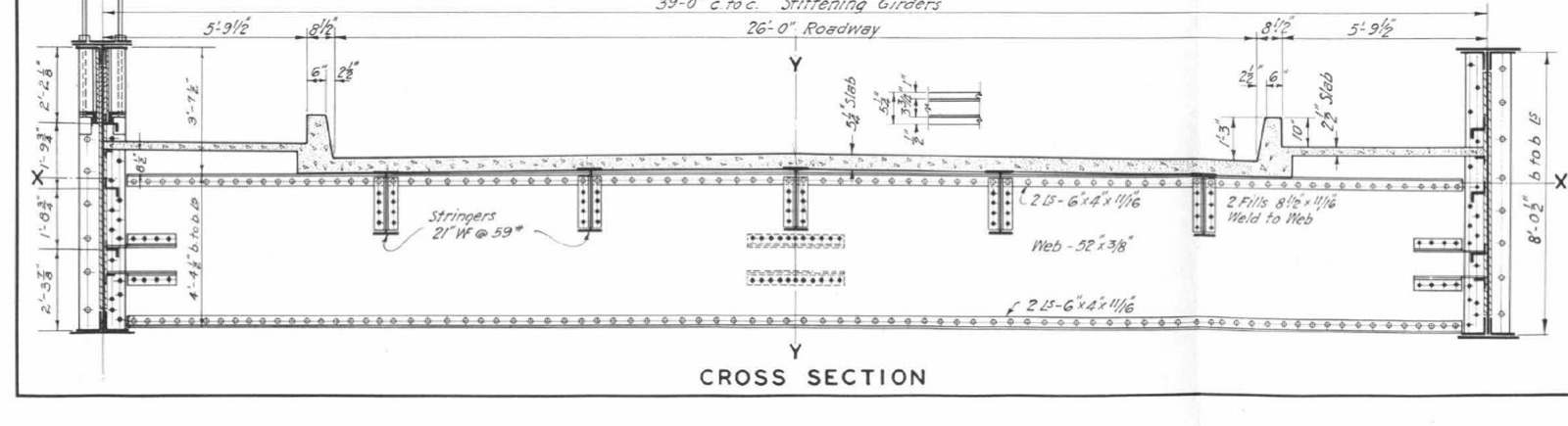
The design was reviewed three times in two months, and each review recorded the same doubt and set it aside. The Authority’s own consultants reported on 31 August 1938 that they had not had time to check the stresses: “In this regard we have full confidence in Mr. Moisseiff, and consider him to be among the highest authorities in suspension bridge design.” A width ratio of seventy-two, “being without precedent”, might seem excessive to the inexperienced; “In our opinion this feature of the design should give no concern.” Condron, for the lenders, went further than anyone. “In view of Mr. Moisseiff’s ability and reputation, I hesitate to make any criticism of the structural design, but from a practical standpoint, I would feel that the width of this Bridge relative to the length of spans was open to criticism, particularly, since it was without precedent.” Moisseiff had written to him on 14 September that “For a bridge of such horizontal slenderness the obtained stiffness is rather satisfactory.” Condron underlined the adverb: “There seems to be some question even in his mind as to whether the obtained stiffness is other than rather satisfactory.” He recommended widening the deck to fifty-two feet, and then deferred: “It is probably technically sound notwithstanding its narrowness.” The PWA, Madigan explained, “scrutinized and considered the personnel engaged by the applicant rather than the project itself.” The board that read all this in 1941 found nothing to blame: “It could not have been expected that any official of the Public Works Administration should have had any doubts as to a design recommended by such engineers.” The companion piece “The reviews” gives these papers at length.
The bridge was built in nineteen months, from 23 November 1938, and the building was a triumph. The piers went down through 120 and 140 feet of water, in tides of twelve and a half feet a second, to the deepest foundations ever sunk; the towers, 420 feet of riveted steel, were finished on 6 January 1940, the cables spun by 9 March, the suspended steel hung by 31 May and the roadway poured by 28 June. The suspended structure weighed 5,700 pounds a foot. On 1 July 1940 the bridge opened, the third longest suspension span in the world, and the traffic in the first two weeks was double what the engineers had predicted.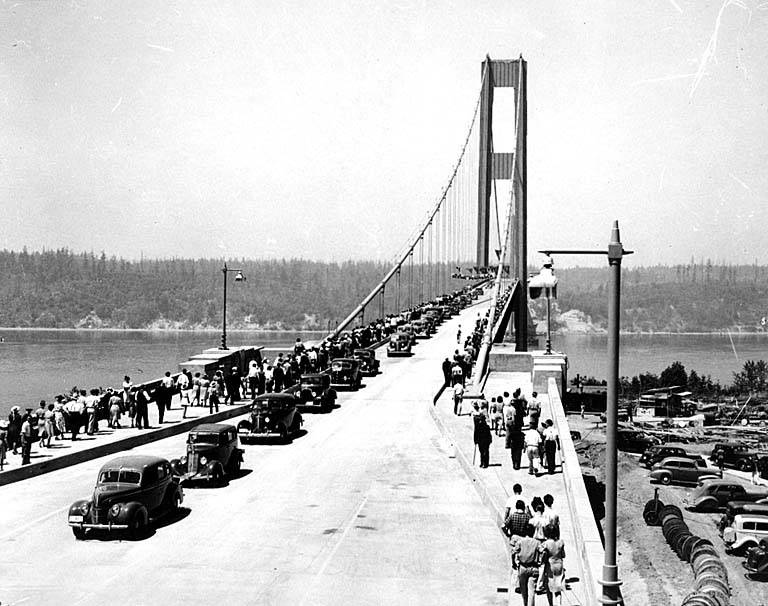
It had already begun to move. The deck rose and fell in waves while the floor steel was still being hung in May, and the men pouring the concrete felt sick on it. The Carmody board found that “the engineers of the Tacoma Narrows Bridge anticipated, before starting of erection of the suspended structure, the oscillations which later occurred.” Two remedies went in before the bridge opened: diagonal stays at mid-span, tying the cables to the girders so the deck could not slide beneath them, about 1 June; and hydraulic buffers at the towers, oil-filled cylinders against any lurch of the deck, about 28 June. Moisseiff’s Whitestone had been quieted by devices of this kind. The Narrows was not. “In the meantime,” the board wrote, “information concerning the oscillations of the other bridges was secured and it was decided to construct a more elaborate model.”
The model was Farquharson’s, and it was the pride of the university: “an elaborate 50-ft model—probably the first of its kind”, at a scale of one to a hundred, in which every part was made to the stiffness and the weight of the real one, down to music-wire cables threaded with lead to bring their weight to scale and towers sprung to the five-second period a seismograph had measured on the real one. Along its length were a hundred horizontal electromagnets, “for the purpose of simulating various forms and amounts of lateral wind force.” It was a wind that pushed and pulled in time, not a wind that blew. Eldridge wrote in May 1940 that the model studies were expected to be finished before the superstructure was, “and that advantage can therefore be taken of them in the final arrangement of the central span in the damping out of any set wave pattern.”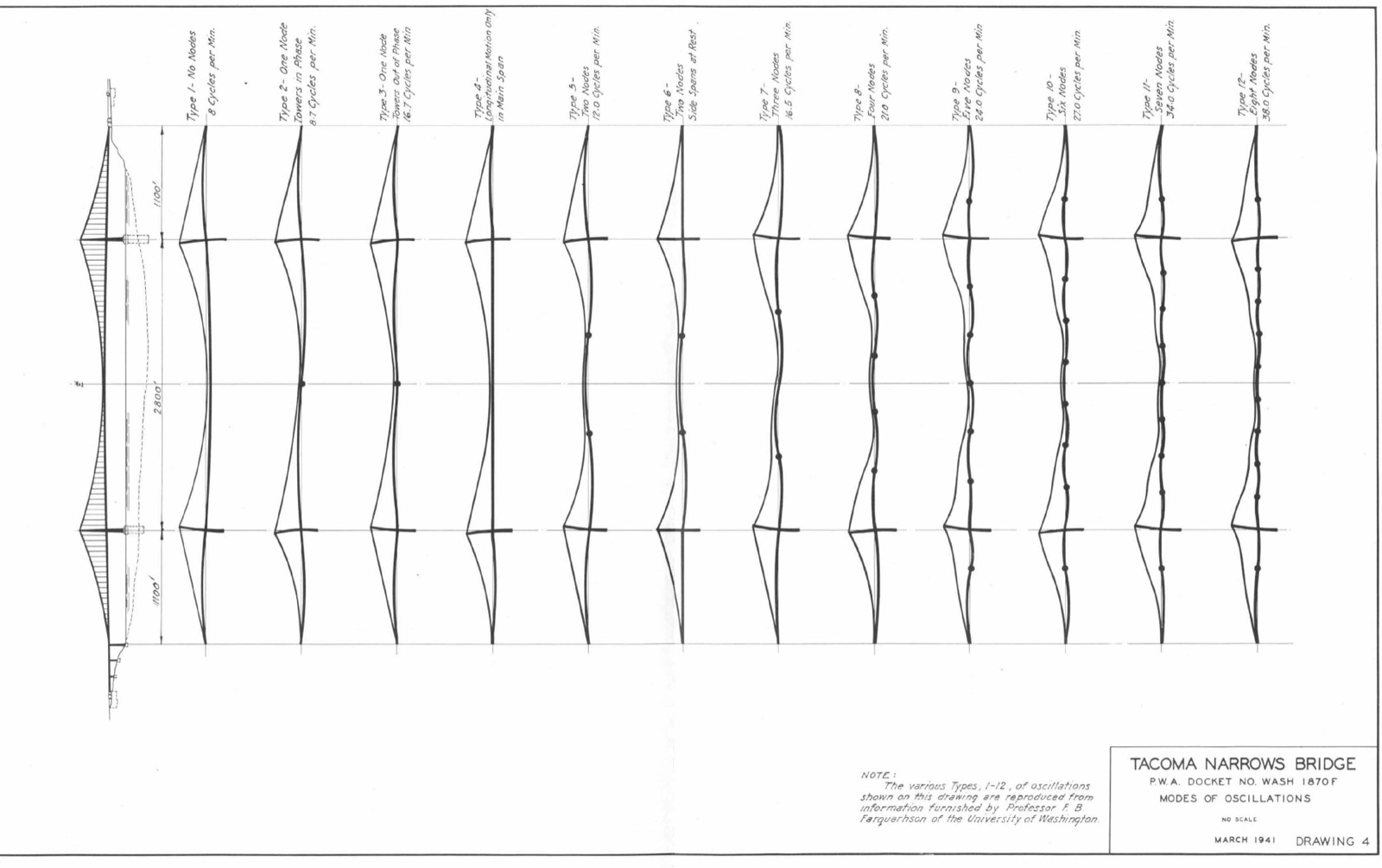
From 1 August the real bridge was read as well. Under Eldridge’s direction targets were mounted on the lamp standards and a transit set up on the canopy of the toll house, and the readings were tabulated by date and hour: wind speed and direction, frequency in cycles per minute, type of wave, and double amplitude in inches at each target. By 12 August the observers had reached number 190; from 14 August to 10 October they took fifty more, up to observation 249. They saw the deck move thirty-six inches in a wind of thirteen miles an hour and lie still in winds of twice that. By 4 November Durkee could tell Washington what four months had established. “Motions of considerable magnitude, having amplitudes as high as 48” with frequencies of 16 per minute, have been observed with wind velocities as low as three or four miles per hour.” “The violence of motion is not necessarily proportional to the velocity of wind.” “Altogether, seven different motions have been definitely identified on the main span of the bridge, and likewise duplicated on the model.” His report of 18 September had added the line that mattered to the Authority: “Close observations have been kept to observe any structural effect from these movements but none has been noted.”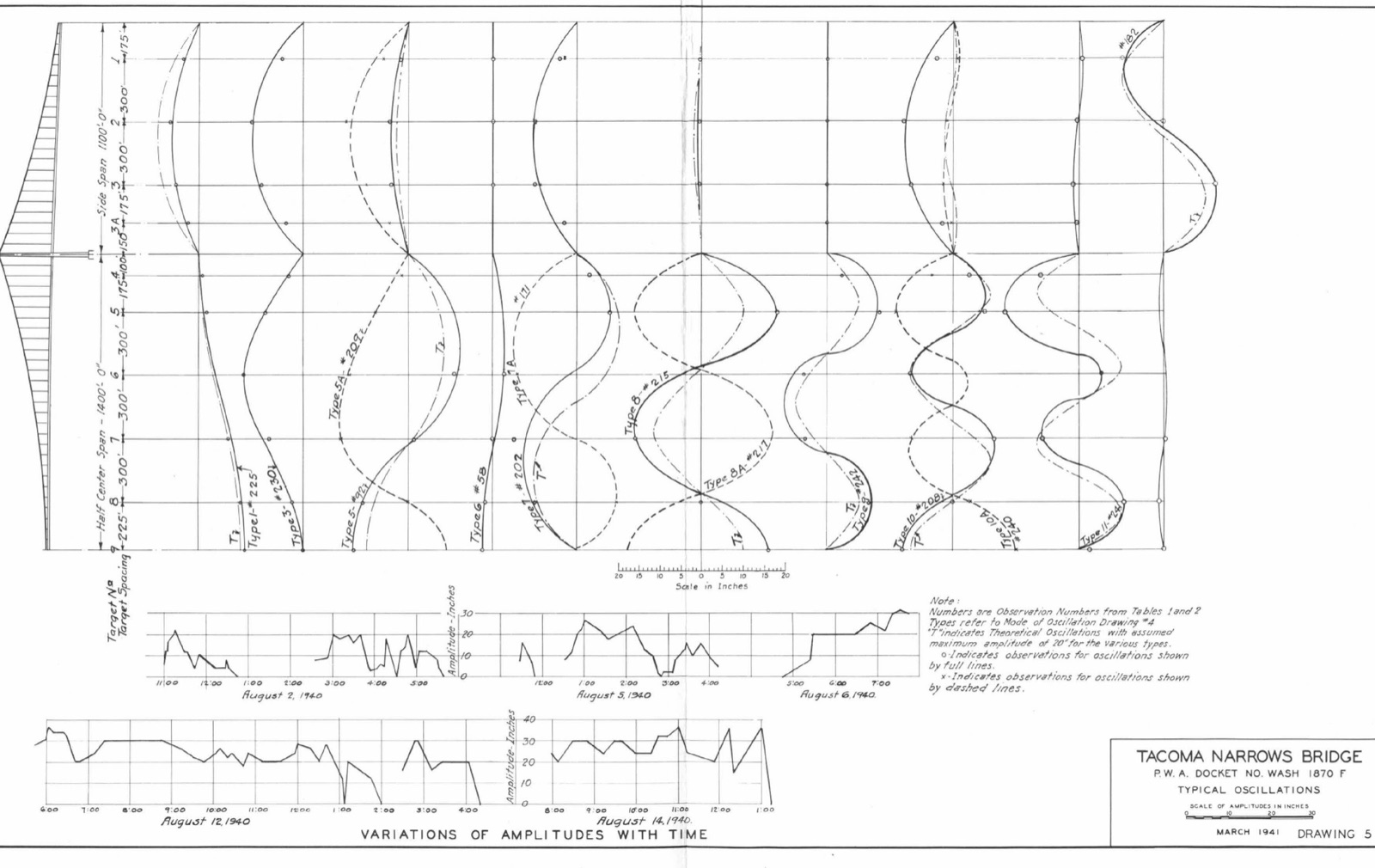
Every one of those readings was of a vertical wave. The board checked: “Prior to 10:00 A.M. on the day of failure, there were no recorded instances of the oscillations being otherwise than with the two cables in phase and with no torsional motions.” Both sides of the deck went up together and came down together, and so the deck was never twisted. A note in the tables says what the tables were: “The observations do not include the complete history, nor do they necessarily include the greatest amplitudes.”
The remedies followed the readings. The model showed that tying the side spans down would damp them, and on 4 and 7 October hold-down cables were fixed from the girders of each side span to concrete blocks on the east shore and timber piles on the west. They quieted the side spans and did nothing for the main span. Then, about five weeks before the end, the question changed. Farquharson built a section of the deck at one-twentieth scale, two feet by eight, and put it in a wind tunnel. The tunnel could only blow square to the deck, but it was enough. The curve of lift against the angle of the wind reversed its slope through a few degrees either side of horizontal; at those angles the deck would feed on the air and build its own wave. The section as built was, in the word of the hour, aerodynamically unstable. The cure was in the tunnel too: fairings, curved vanes set in front of the girders, or holes cut through their webs. A wooden vane nineteen inches across, set eighty inches out from the web, straightened the curve and would be invisible from the road.
Farquharson’s studies, delayed by defence work, were finished on 2 November. On Wednesday 6 November Andrew, Farquharson, Durkee and Eldridge met and decided “that we would proceed immediately to streamline the southerly side of the main span.” Eldridge was to make the sketches and get prices. He sat down to it at nine on Thursday morning.
Fourteen cycles
The wind had blown hard through the night. Eldridge drove across at half past eight, as he did every morning, and found the bridge “behaving in the customary manner”, the main span in a four-noded wave; “All of these motions, however, were considerably less than had occurred many times before so I came to the office at about nine o’clock.” Walter Miles, an engineer with the Pacific Bridge Company, filmed the diagonal stays at mid-span about half past nine, “alternately tightening and loosening causing considerable snapping at this point”. R. E. Stewart, the Authority’s instrumentman, parked in the middle of the span and counted thirty-five waves a minute. Farquharson arrived from Seattle at about a quarter to ten with two cameras and found the familiar ripple, thirty-six cycles a minute, eight nodes, the deck bowed a couple of feet to the north by a wind of 42 miles an hour. He asked Arkin for the wind speed and the count.
The Coast Guard cutter Atalanta came up the Narrows about then, and her commanding officer, Lieutenant W. C. Hogan, looked up as he passed beneath. “I particularly noted that the north cable was loose in its mooring, at the center of the bridge, and was sliding back and forth for a distance of about 1 to 2 yards.” The band at the middle of the north cable, to which the diagonal stays were bolted, had begun to slip along the wire.
A delivery van paid its dime and went west with Ruby Jacox and her business partner in the cab. Winfield Brown, twenty-five, a student at the College of Puget Sound, had decided “I’d like to walk across the Narrows bridge to get a little fun out of it”, paid a dime each way and was on his second crossing. Then Leonard Coatsworth, a news editor at the Tacoma News Tribune, drove on with his daughter’s cocker spaniel, Tubby, in the back seat.
Farquharson was checking the frequency from the roadway north of the toll plaza when it happened. “A violent change in motion was noted. This change appeared to take place without any intermediate stages and with such extreme violence that the span appeared to be about to roll completely over.” Looking along the bridge he could see the top of the roadway on the far half of the main span and, on the near half, “what appeared to be a nearly perpendicular view of the bottom of the roadway”. “The motion, which a moment before had involved a number of waves (nine or ten) had shifted almost instantly to two.” Carl West, the Authority’s bridge designer, saw it from the ferry dock a mile and a half away: “The deck at that time appeared to be tilting crazily about the longitudinal axis of the bridge and since no such motion had previously been observed I immediately called Mr. Eldridge”. Miles telephoned him too. Eldridge wrote that evening: “This was the first indication I had that anything of an unusual or serious nature was occurring.”
Farquharson got to a station just outside the east tower and filmed. “At the moment of first observing the main span from the vicinity of the towers the motion had a frequency of 14 cycles per minute and consisted of a differential action of the cables with the two waves in each cable. The node was at the center of the main span and the structure was subjected to a violent torsional action about this point.” One cable rose as the other fell; at the quarter points the roadway tilted to forty-five degrees one way and then the other, and the cable above it moved through twenty-eight feet. “It was quite impossible to operate a camera on the main span so violent was the motion.” Within ten minutes the sidewalks and kerbs were breaking up around the girder stiffeners and the first lamp post fell on the Gig Harbor side.
The one thing the four months of readings had never recorded was the thing the bridge was now doing.
What it looked like from inside
Coatsworth had just passed the east tower when the road tilted and threw his car against the kerb. He climbed out of a window onto his face, tried to go back for the dog, was thrown again, and began to crawl. Brown, caught near the centre, was “thrown completely over the railing” time after time; “During the worst parts the bridge turned up so far that I could see the coast guard boat in the water beneath.” Near the west tower the van tipped over seconds after Jacox and her partner had jumped from it, and two painters backed a truck out to fetch them. Brown reached the toll gate, remembered the dime for the return crossing and mentioned it to the collector. “He said, ‘Skip it’.” Coatsworth reached the plaza and telephoned his office, which sent a photographer; Barney Elliott and Harbine Monroe of The Camera Shop came with a cine camera and colour film, and made the pictures the world has seen since.
Eldridge arrived at about a quarter past ten and walked out to the quarter point. “The main span was rolling wildly. The deck, however, was tipping from the horizontal to an angle approaching forty-five degrees.” Beyond the centre the lamp posts tilted the other way: “The entire main span appeared to be twisting about a neutral point at the center of the span in somewhat the manner of a corkscrew.” He found Farquharson at the tower with his camera, and they went back to warn people off. The side spans were quiet, and the hold-downs were holding. “At this moment, I felt very happy that these temporary guys were in.” He telephoned Bethlehem Steel for a gang to rig cables from the piers to the deck the moment the wind dropped, and the Weather Bureau, which told him the barometer was rising.
Farquharson stayed on. During a lull he went out to the stalled car, meaning to drive it off; when he reached it the motion came back so hard “that the acceleration must have reached that of gravity since the car began to shift about in a most alarming manner.” “As far as the eye and ear could detect the double amplitude of approximately 28 ft. was causing no distress in the girder.” Sighting along the girders, “It was plain that at this stage the lower limit of the undulation was almost exactly flattening the girder to a straight line from tower to tower while the upper limit must have been something over 25 ft. above this level.” Of the dog he said nothing in his statement for the board. He told the Associated Press the next day: “Since I love dogs I staggered out to midspan again and opened the door and tried to coax him out. The animal, sick and terrified, bit me on a knuckle.”
At about half past ten a panel of the lateral bracing dropped out of the middle of the bridge and hung there, and a section of the roadway slab fell. West, on the bluff, saw the girders at mid-span “crimped in a horizontal direction”. Farquharson, sighting along the edge of the girder, saw “a distinct lateral failure” at about the quarter point on the Gig Harbor side. “From this point on failure occurred so rapidly that observation became difficult and impression and fact are somewhat mixed.” Suspenders “were seen to fly high in the air above the main cable”, and the failure ran towards the centre “until apparently a whole section fell out of the bridge near the quarter point.” It was about eleven o’clock. Six hundred feet of deck and girders turned over as it went and fell 190 feet into the Narrows.
“After this first section fell the whole bridge almost at once ceased its violent torsional motion and fell into a much easier vertical motion which was photographed from the tower.” It did not last. “Almost at once, however, the original motion resumed,” and now the side span under Farquharson’s feet took it up, because the hold-downs had gone slack as the lightened main span rose and the side spans sagged. Section after section fell out towards each tower, and each sent a shock through the side span; two of them threw him to the deck, and he broke a camera. “The portion where I was had dropped 30 feet when the tension was released.” He knelt on the roadway and finished the film. At 11:10 the last of the main span went, all but about 250 feet at each tower. Arkin heard “a deafening crash and looking up saw clouds of dust and a snarled mass of suspenders and deck whipping. The east approach dropped below my vision and then everything became quiet.” Farquharson walked off along the centre line of the sagging side span, the last man on the bridge. The seven accounts collected that month are given in full in the companion piece “The statements”.
What happened
The towers stood, bent twelve feet towards the shores by the pull of the side spans that still hung from them. The piers and anchorages were unharmed. At the middle of the north cable about five hundred wires had been cut through by the slipping band. By mid-afternoon the Governor was at the bridge, ferries were running again, and twenty-two insurance companies holding policies worth $5,200,000 were sending men west.
The explanations began the same evening and never agreed. Andrew told the Associated Press that the cause was the “substitution of plate girders 8 feet in depth for a truss design which had previously been planned”: “The solid metal expanses acted like a sail, catching the wind and swinging the bridge.” Farquharson told the same reporters about the twist on the model: “We watched it, and we said that if that sort of motion ever occurred on the real bridge it would be the end.” “We had hopes, and I am sure we could have found the remedy if we had only been given a little more time.” Moisseiff, in New York, was “completely at a loss to explain the collapse”. On Saturday 9 November the Tacoma Times put Eldridge on its front page under the headline “U. S. money-lenders blamed by engineers for span crash”. “We had a tried-and-true conventional design. We were told we couldn’t have the necessary money without using plans furnished by an eastern firm of engineers”. The state’s engineers had called the girders “sails”: “But, in order to obtain governmental money, we had to do as we were told.” On an inside page he said that on the Wednesday “we hit upon what we still believe would have solved the problem”, and “now it’s too late.” Lienhard, arriving that night, said of the charge that the lenders had insisted on eastern designs: “not true”. The paper’s editorial was headed “Bridge Price Too Low”. “Tacoma has lost its Narrows Bridge because the bridge was designed to fit a price—too low a price.” “It was an experiment in skimpiness.”
The Engineering News-Record said on 21 November what the profession was coming to think: “Incompetence or neglect cannot be blamed for the Tacoma Narrows collapse, greatest bridge failure in history,” and “a bridge amply strong to resist all probable static forces may be fatally weak under dynamic attack.” In the same issue von Kármán, not yet appointed to the board, derived in a page the wind speed at which a narrow deck would twist itself apart: “Hence there must exist a critical value of the wind velocity, for which the structure becomes unstable,” and that speed “is therefore especially low for narrow bridges.” In March 1941 J. K. Finch of Columbia filled four pages of the same journal with the suspension bridges that wind had wrecked between 1818 and 1889: “they were not new—they had simply been forgotten.”
Carmody’s board met in Washington on 28 November, spent 6 to 14 December at the wreck and in Farquharson’s laboratory, and had von Kármán’s wind tunnel at Pasadena test models of the deck as built, faired, and with trusses in place of girders. Its report of 28 March 1941 exonerated everyone. “The Tacoma Narrows Bridge was well designed and built to resist safely all static forces, including wind, usually considered in the design of similar structures. Its failure resulted from excessive oscillations caused by wind action.” “It was not realized that the aerodynamic forces which had proven disastrous in the past to much lighter and shorter flexible suspension bridges would affect a structure of such magnitude as the Tacoma Narrows Bridge, although its flexibility was greatly in excess of that of any other long span suspension bridge.” And in one sentence it struck out the standard the design had met: “The criteria usually considered for rigidity against static forces do not necessarily apply to dynamic forces.”
On the morning itself it settled on the band. “It appears reasonably certain that the first failure was the slipping of the cable band on the north side of the bridge to which the center ties were connected. This slipping probably initiated the torsional oscillations.” The ties put in to quiet the vertical waves had also been holding the two cables in step; whether the vertical motion wore the band loose or the wind reached the speed at which the deck wanted to twist, “the results in either case would be the same.” Then it closed the door on the thought that a stronger band would have saved the bridge. “Even assuming that the bridge, without the slipping of the cable band, had weathered this particular storm, it is now apparent that it would have failed under wind velocities far below that of 100 m.p.h. for which it was designed.” Pasadena’s section model, swinging in the tunnel on springs, had shown that for this deck the aerodynamic damping of a twist turned negative, the air feeding energy in instead of taking it out, “as soon as the speed exceeds 25 m.p.h.” Whether the bridge twisted at 25 or at 42 depended on how much damping the structure could muster, and it had almost none. At forty-five degrees of twist the wind was feeding the deck “a figure of the order of 5,000 horsepower.”
The report also explained why four months of readings had never seen it. The one-noded twist that killed the bridge “was probably prevented by the action of the center guys, short suspenders and other torsional resistance of the floor, which efficiently hindered the differential motion of the cables near the center of the main span.” The instrument had been silent on torsion because, until that morning, there had been none to read: “previously the development of torsional oscillations was suppressed, by the internal resistance of the structure.” And of the cure on Eldridge’s desk: “The evidence as to whether the vertical oscillations of the bridge would have been affected by fairing (streamlining) is inconclusive. There is certain evidence that fairing would have had an unfavorable influence on the torsional stability.” The girders, the board thought, “should have been many times” as stiff; but the lesson it chose to underline was Condron’s. “This experience reveals the danger of excessive narrowness.”
After
The PWA’s own inspector had been the one official who refused to sign. The state’s historians record that in July 1940 Glenn had submitted a report warning of faults in the design and declining to recommend that the finished bridge be accepted, that the PWA accepted it anyway, and that when the Tacoma Times printed the story on 11 January 1941 he was relieved of his post within a fortnight. The insurers settled in August 1941 for $4,000,000; Coatsworth was paid $450 for his car and $364.40 for its contents, the dog included. The towers and cables were cut up for scrap between 1941 and 1943, at a loss.
Eldridge resigned in April 1941 and went to Guam to build for the Navy; the Japanese took him in December and he spent the war in a prison camp, where an officer who had studied in America recognised him and said, “Tacoma Bridge!” He wrote in his memoirs half a century later: “I go over the Tacoma bridge frequently and always with an ache in my heart. It was my bridge.” Moisseiff died on 3 September 1943. Farquharson got his laboratory, built to house the models, and for a decade he tested the old bridge and the new one in the wind tunnel. The results came out as Bulletin 116 of the university’s Engineering Experiment Station, Aerodynamic Stability of Suspension Bridges with Special Reference to the Tacoma Narrows Bridge, in five parts between 1949 and 1954. He died in 1970.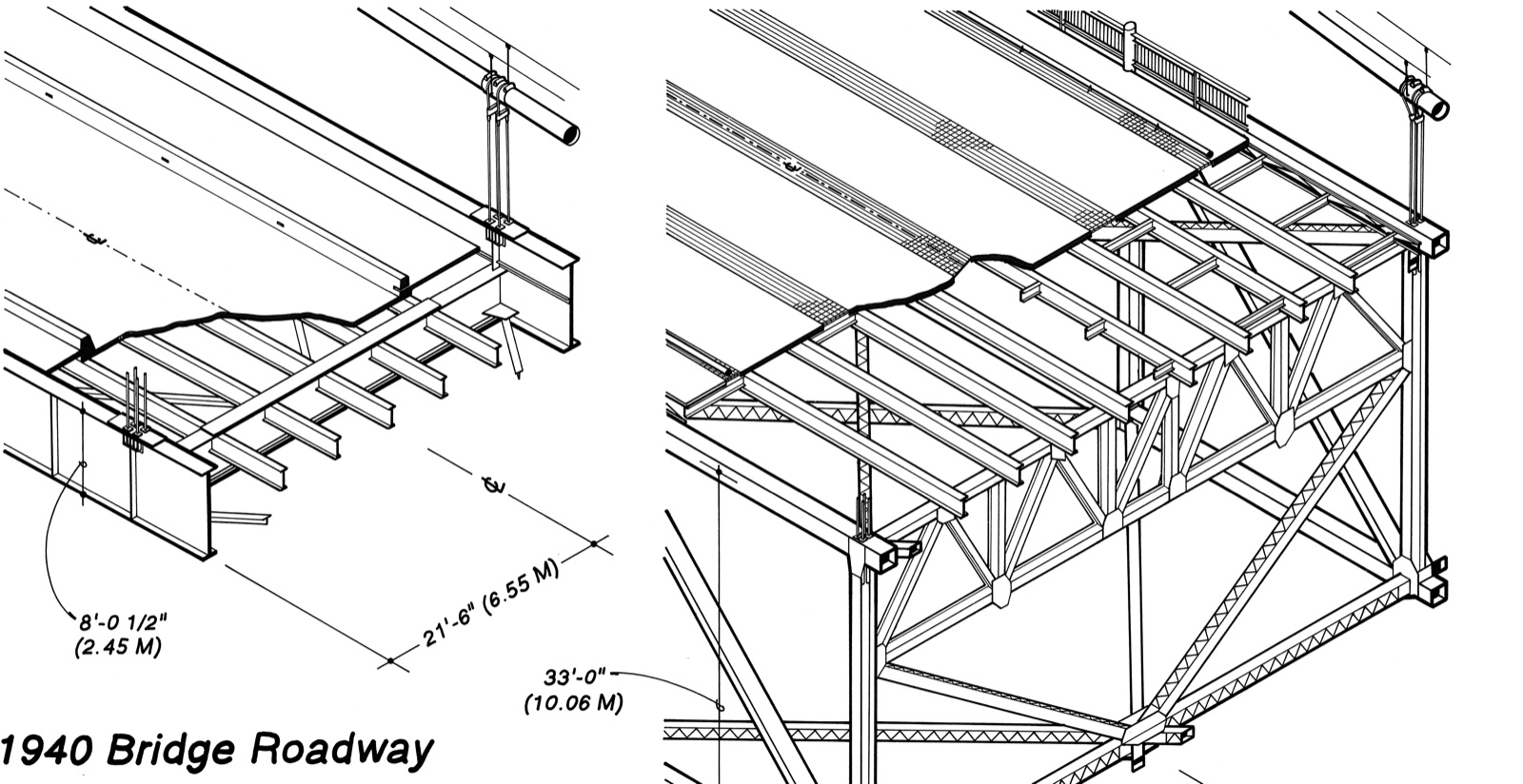
The second bridge was, in effect, Eldridge’s. Andrew appointed Dexter R. Smith of the Oregon highway department as its chief designer in July 1941, and the design Farquharson tested at one-fiftieth scale had open Warren trusses thirty-three feet deep, four lanes between cables sixty feet apart, and, at von Kármán’s urging, slots of steel grating down the roadway so that the wind could pass through. It was built on the old piers between 1948 and 1950, opened on 14 October 1950, and is still there, the westbound half of the crossing. The Historic American Engineering Record, surveying it in 1993, called it “the first suspension span constructed in the United States after its predecessor’s failure in 1940 from wind-induced torsional oscillations.” Every long suspension bridge built since has been tested in a wind tunnel first.
What it taught
The Tacoma Narrows was two experiments, and both were run with care. The first tested a design against the loads the profession had agreed to design for, and passed. The second measured a bridge that was misbehaving, for four months, with a transit, a model and a wind tunnel, and found a cure. The bridge fell during the second experiment, from a cause the first had not named and the second had not measured.
An instrument reports the question it was built to answer. Two hundred and forty-nine observations, every one a vertical wave with the cables in step, were a true record of the bridge. They were also the whole of what targets on one side of the deck could show: a twist would have been invisible to the transit until the targets left the field of view, which is exactly how the end was first seen. Nobody falsified anything. The readings were about the motion the bridge was making, and the motion that destroyed it had never once appeared, because the ties put in to cure the first motion were holding the second down. Four months without a sign of a thing is not evidence that the thing cannot happen. It is evidence of what the wind had done so far.
A model answers for the forces you put into it. The fifty-foot model with a hundred electromagnets reproduced seven of the real bridge’s motions. But its wind was a set of magnets pushing in time; it could show what the structure did when driven, not what the air did to the structure. The deck as an aerofoil came into the laboratory only in October, in a section model that could face the wind only square-on. Each model was honest about the thing it modelled.
The cure in hand was for the wrong motion. The wooden vane on Eldridge’s desk that morning would have straightened the lift curve for the vertical wave, the only motion anyone had seen. The board found that the same vane would have lowered the speed at which the deck began to twist. Had the storm held off for thirty days, the fairings would have gone on the south side first, and the next high wind would have tested a hypothesis nobody knew they were testing.
Reputation is not a review. The width of the bridge was questioned by the designer, by the lenders’ engineer and by the owner’s consultants, in writing, in the two months before the contract was let, and every one of them deferred to the standing of the man who had drawn it. Condron saw furthest, recommended widening the deck, and then wrote that the design was “probably technically sound notwithstanding its narrowness.” The PWA, by its own account, examined the engineers rather than the engineering. A procedure that passes a design because of who signed it can pass a design that nobody has checked, and the board that reviewed the wreck said in so many words that this was reasonable. It was. That is the problem.
The failure came out of the proportion, not the parts. The board found every piece of the bridge beyond criticism. What failed was a ratio, one in seventy-two, chosen so that two lanes of traffic would not have to pay for sixty feet of steel. The board’s last word on design was that width “is essential”, so that a twist cannot start within the highest wind the bridge will meet; the Tacoma Times’s was that the bridge had been built “to fit a price”. They were saying the same thing.
The complication is that the readings were not useless, and the people reading them were not fools. Durkee’s findings of 4 November are a model of an engineer saying exactly what he knows, and the four months of observation gave the Carmody board the only continuous record of a suspension bridge’s motion that then existed; Farquharson’s films and tables became the starting point of a science. And the board itself, with the best wind tunnel in America and four months to think, could not say whether the bridge twisted because the band slipped or the band slipped because the bridge was ready to twist; it could only say that the result was the same. What the record supports is narrower and more useful. A bridge that moved from the day it opened was measured for four months in one dimension, by people who knew the measurement was incomplete and said so, and was within a day of being fitted with a cure for that dimension when it failed in the other. Nobody was listening to the wrong thing. They were listening to the only thing their instrument could hear.
Sources
- Othmar H. Ammann, Theodore von Kármán and Glenn B. Woodruff, The Failure of the Tacoma Narrows Bridge: A Report to the Honorable John M. Carmody, Administrator, Federal Works Agency, Pasadena, 28 March 1941. The summary of conclusions; the history of the project, the five designs and the financing; the description of the bridge and the construction dates; the remedial devices; Tables 1 and 2 of the transit readings and Drawings 2, 4 and 5; Durkee’s letters of 18 September and 4 November 1940; the account of the failure; Chapter V’s findings on torsion, the critical velocity, damping, fairing and width; Appendix II (Moisseiff’s reports of July 1938); Appendix III (Madigan’s letter of 4 December 1940); Appendix IV (Condron’s report of 21 September 1938, Moisseiff’s letter of 14 September and the Board of Consulting Engineers’ report of 31 August 1938); Appendix V (Durkee’s report of 12 November 1940 and the statements of Eldridge, Stewart, West, Arkin, Farquharson, Miles and Hogan); Appendices VII and VIII (the Washington and Caltech tests). Scanned copy, 287 pages. authors.library.caltech.edu
- F. B. Farquharson, “A Dynamic Model of Tacoma Narrows Bridge,” Civil Engineering, July 1940, p. 445. The ratios 40, 48 and 72, the fifty-foot model, the electromagnets and the tower periods. archive.org
- Clark H. Eldridge, “The Tacoma Narrows Bridge,” Civil Engineering, May 1940, p. 299. The model studies expected before completion. archive.org
- N. A. Bowers, “Tacoma Narrows Bridge Wrecked by Wind,” Engineering News-Record, 14 November 1940, p. 647; “Model Tests Showed Aerodynamic Instability of Tacoma Narrows Bridge,” 21 November 1940, p. 674, with the editorial and Theodore von Kármán’s letter “Aerodynamic Stability of Suspension Bridges” in the same issue; “Board named to study Tacoma bridge collapse,” 28 November 1940; “Court orders complete payment to Tacoma Bridge contractors,” 17 April 1941. 14 Nov, 21 Nov, 28 Nov, 17 Apr 1941
- J. K. Finch, “Wind Failures of Suspension Bridges, or Evolution and Decay of the Stiffening Truss,” Engineering News-Record, 13 March 1941, p. 402. archive.org
- The Tacoma Times, 8 November 1940 (the collapse and the insurance); 9 November 1940 (Eldridge’s statement and his remedy, Moisseiff, the editorial “Bridge Price Too Low”, Winfield Brown’s account and Farquharson’s films). Chronicling America, Library of Congress. 8 Nov, 9 Nov
- Evening Star, Washington, 8 November 1940 (Farquharson’s account “Last Man on Bridge Describes Its Collapse”, and the Associated Press report with Andrew’s “sail” and Farquharson’s “it would be the end”); 9 November 1940 (Lienhard’s “not true”). Chronicling America, Library of Congress. 8 Nov, 9 Nov
- Washington State Department of Transportation, Tacoma Narrows Bridge history: “1940 Narrows Bridge – The Machine”, “Galloping Gertie collapses November 7, 1940”, “Eyewitness accounts”, “Lessons from failure”, “Aftermath”, “People of the 1940 Narrows Bridge”, “Bridge timeline” and “Weird facts”. The biographies; the course of the morning; the Jacox account; the Glenn affair; Eldridge’s memoir and his captivity; the insurance, the salvage and the second bridge. wsdot.wa.gov
- Robert W. Hadlow, Tacoma Narrows Bridge, Spanning Narrows at State Route 16, Tacoma, Pierce County, WA, Historic American Engineering Record WA-99, National Park Service, 1993, with drawing sheet 2 by Wolfgang G. Mayr. loc.gov
- University of Washington Libraries, Tacoma Narrows Bridge Failure (silent), the film shot by F. B. Farquharson, with its catalogue note on his engagement in May 1940. archive.org
- F. B. Farquharson and others, Aerodynamic Stability of Suspension Bridges with Special Reference to the Tacoma Narrows Bridge, University of Washington Engineering Experiment Station Bulletin 116, Parts I to V, 1949 to 1954. Not reachable online; cited for its existence and dates only.