One day in the summer of 1784, in the orchard of a garden at Passy, on the hill above the Seine west of Paris, a boy of about twelve was led out of the house with a bandage over his eyes. The bandage had been made for the purpose: two caps of elastic gum stuffed with eiderdown, sewn into two round pieces of cloth and tied at the back of the head, so that no light came through it or round it. The boy was walked to a tree and told to put his arms round it for two minutes. Then to a second tree, a third and a fourth. At the first he said he was sweating in large drops; he coughed, spat, and complained of a slight pain in the head. At the second he felt stupefied. At the third the stupefaction and the headache grew worse, and he said he believed he was getting near the tree. At the fourth he fainted, his limbs stiffened, and he was carried to a patch of grass, where the physician who had brought him ran to him and brought him round.
The physician was Charles d’Eslon, a doctor of the Paris Faculty of Medicine and the most prominent disciple of Franz Anton Mesmer. Earlier, alone, he had magnetised an apricot tree at the far end of the orchard, chosen because it stood well apart from the others. None of the four trees the boy embraced was that tree. The fourth, where he fell, was about twenty-four feet from it.
The house belonged to Benjamin Franklin, seventy-eight years old, minister of the United States to the court of France, who was too ill with the stone to travel into Paris, so the experiment had come to him. The commission he headed included Antoine Lavoisier, Jean-Sylvain Bailly and Joseph-Ignace Guillotin; the report they signed that August does not say which of them stood in the orchard, or on what day, and nothing else in the record supplies the date. What it records is the number, twenty-four feet, and the two minutes at each tree, and the sentence that follows the fall: “The result of this experiment is entirely contrary to the theory of the animal magnetism.”
The commissioners had been sent to find out whether a fluid existed. They had worked out, in writing and beforehand, that the way to find out was to separate the fluid from the belief in it, and that the instrument for doing so was a blindfold. The boy at the fourth tree is what the instrument read. This entry asks what was done with the reading, by the nine men who took it, by the physician who disputed it, and by the century that went on magnetising regardless.
Who ran it
Mesmer had arrived in Paris at the beginning of 1778, a physician trained at Vienna who had quarrelled with the physicians there and been refused by the Academy of Berlin. In 1779 he published a Mémoire sur la découverte du magnétisme animal with twenty-seven propositions, and by 1784 he was the sensation of the capital. The translator who put the commissioners’ report into English the next year wrote that the subject “seems to have divided the public speculations with the celebrated and incomparable discovery of the aerostatic globe.” Mesmer had a house full of patients and a course for which pupils paid to be taught the secret.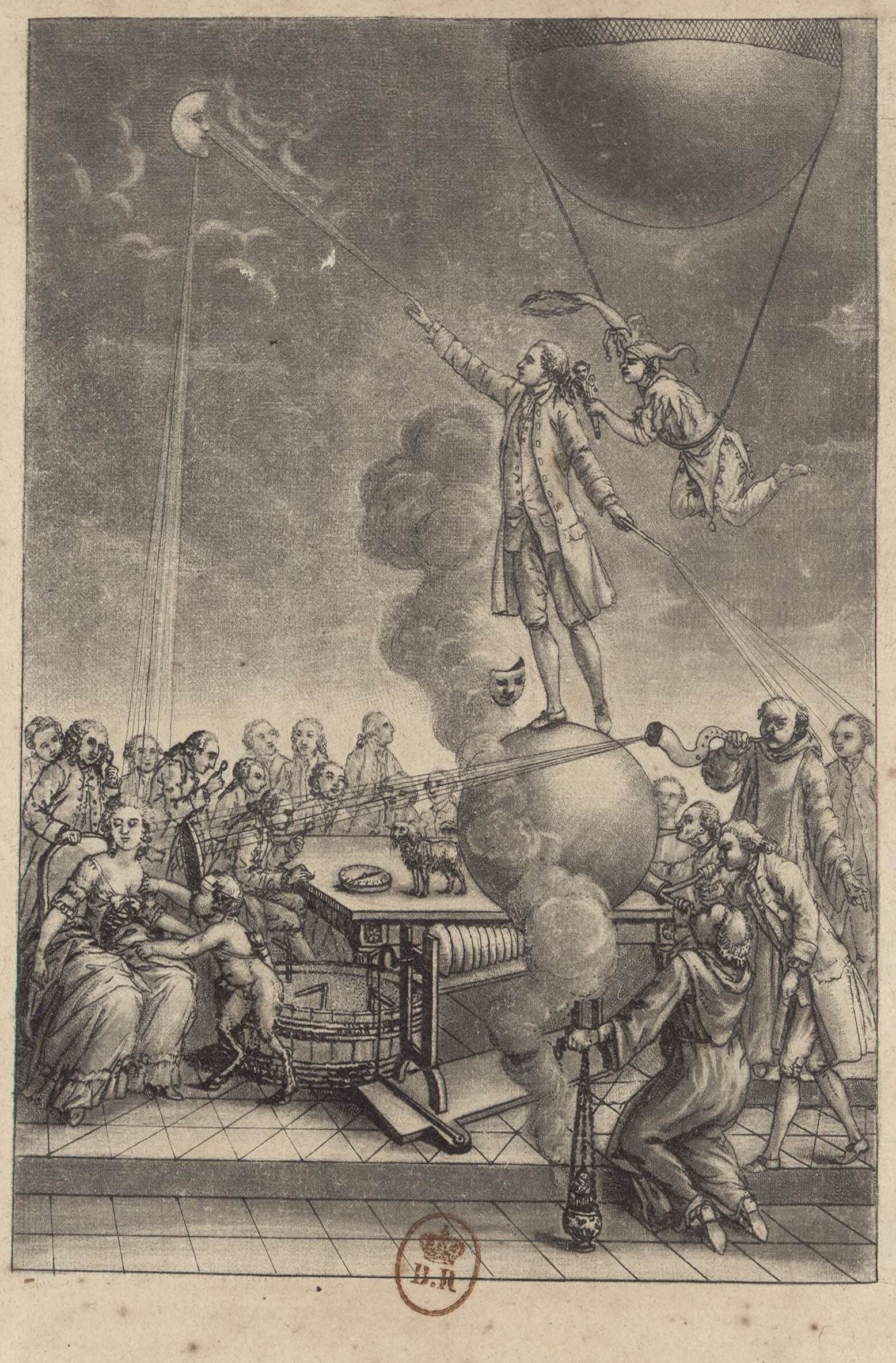
The most important of those pupils was Charles-Nicolas d’Eslon, born in 1750, a doctor-regent of the Faculty and physician to the comte d’Artois, the king’s brother. He had published his own Observations sur le magnétisme animal in 1780, and the Faculty had put him on trial for it. By 1784 he ran a treatment of his own and had taught the method to a great many physicians, and he was the one who asked the government for an examination. Mesmer would have nothing to do with it. In a letter to Franklin that he later had printed, Mesmer wrote that d’Eslon had “dared to ask the Government for Commissioners, to have certified at his house a discovery which is not his.” The translation is mine, as are the others from the French in this entry; the originals are in the Sources. To the Journal de Paris he declared that if the commissioners meant to judge his system at d’Eslon’s house, “I do not recognise them as my judges.”
So the thing examined was animal magnetism as d’Eslon practised it, and the Report says so in its first sentence. The king named, on 12 March 1784, four physicians of the Paris Faculty: Borie, Sallin, d’Arcet and Guillotin. At their own request he added five members of the Royal Academy of Sciences: Franklin, Le Roy, Bailly, de Bory and Lavoisier. Borie died as the work began and was replaced by Majault. The academicians took care about what the mixed company meant. In a note Lavoisier kept, they declared that their business was solely “to establish the existence of the agent designated by the name of animal magnetism”, and that the treatment of diseases “is entirely foreign to them and concerns only the physicians.”
Bailly, the astronomer, wrote the Report. Lavoisier, by the evidence of the drafts in his hand, designed the experiments. Franklin lent his house and his name, and both mattered. In March 1784, as the commission was being formed, he answered a provincial physician who asked what he thought of Mesmer’s cures. “As to the Animal Magnetism, so much talk’d of, I am totally unacquainted with it, and must doubt its Existence till I can see or feel some Effect of it,” he wrote. “None of the Cures said to be perform’d by it, have fallen under my Observation; and there being so many Disorders which cure themselves and such a Disposition in Mankind to deceive themselves and one another on these Occasions; and living long having given me frequent Opportunities of seeing certain Remedies cry’d up as curing everything, and yet soon after totally laid aside as useless, I cannot but fear that the Expectation of great Advantage from the new Method of treating Diseases, will prove a Delusion. That Delusion may however in some cases be of use while it lasts.”
A second commission, from the Royal Society of Medicine, worked alongside: Poissonnier, Caille, Mauduyt, Andry and, named on 5 April, the botanist Antoine-Laurent de Jussieu. He is the only one of the fourteen examiners who did not sign what his colleagues wrote, and his reasons are in a companion piece, “The one who did not sign”.
What they were trying to find out
The Report begins by quoting Mesmer’s own description of what he claimed to have found. In the English of 1785: “It is a fluid universally diffused; the vehicle of a mutual influence between the celestial bodies, the earth, and the bodies of animated beings; it is so continued as to admit of no vacuum; its subtlety does not admit of illustration; it is capable of receiving, propagating, and communicating all the impressions that are incident to motion; it is susceptible of flux and reflux.” The human body had poles like a magnet. And it cured. “In the influence of the magnetism, nature holds out to us a sovereign instrument for securing the health and lengthening the existence of mankind.”
D’Eslon admitted every one of those principles. On 9 May 1784, at his house, with the lieutenant-general of police in the room, he read the commissioners a memoir which asserted “that there is but one nature, one distemper, and one remedy; and this remedy is the animal magnetism.”
The commissioners saw at once that the claim was two claims, and they put them in order. “The question of its existence is first in order; that of its utility it were idle to examine, till the other shall have been fully resolved. The animal magnetism may indeed exist without being useful, but it cannot be useful if it do not exist.”
Then they did the thing that made the inquiry possible: they refused to count cures as evidence. D’Eslon wanted them to follow his patients and watch them get better; the Report says he “insisted that the former of these methods should be employed principally, and nearly exclusively”. The commissioners declined, because nature cures most of the sick without help, and they quoted Mesmer against himself: asked once to prove his agent by its cures, he had replied, “It is a mistake to imagine that this kind of proof is unanswerable; it cannot be demonstrated that either the physician or the medicine causes the recovery of the patient.” Lavoisier’s private note was blunter: to prove the magnetism by cures “would perhaps take the lives of several men.” So the question was narrowed to the one thing the fluid was supposed to do at once and visibly: produce effects in a body.
And here is the design, in Lavoisier’s hand, before the decisive experiments were made. “Good logic does not permit the admission of new principles to explain facts when they can be explained by other principles already known. We shall therefore admit animal magnetism only in so far as it presents effects which cannot be referred to any other cause. We shall examine whether the imagination alone, without magnetism, could not produce similar effects, and we shall accordingly apply ourselves to making a series of experiments on magnetism separated from imagination and on imagination separated from magnetism.” Further on he said how. “There is only one way to reach this end: it is to magnetise very sensitive persons without their knowledge, and to persuade them that they are being magnetised while they are not.” And then a rule of work: “Every experiment that departs from this plan will obscure the matter instead of clearing it; for in the sciences and in the arts, a single conclusive experiment is more precious than a great number of others which do not go directly to the end.”
Two arms, each with one thing removed, and the meaning of each outcome written down in advance. That is what made the orchard at Passy different from the hall of the baquet.
What they built
First they went to look. What they saw is the best-known paragraph of the Report, and it deserves to be read as the description of an apparatus. “They saw in the centre of a large apartment a circular box, made of oak, and about a foot or a foot and a half deep which is called the bucket; the lid of this box is pierced with a number of holes, in which are inserted branches of iron, elbowed and movable. The patients are arranged in ranks about this bucket, and each has his branch of iron, which by means of the elbow may be applied immediately to the part affected; a cord passed round their bodies connects them one with the other”. The patients also joined thumbs. “A piano forte is placed in one corner of the apartment, and different airs are played with various degrees of rapidity”. The operators each carried an iron rod ten to twelve inches long, which d’Eslon said concentrated the fluid at its point; the inside of the tub was “a grand reservoir” from which it flowed up the iron.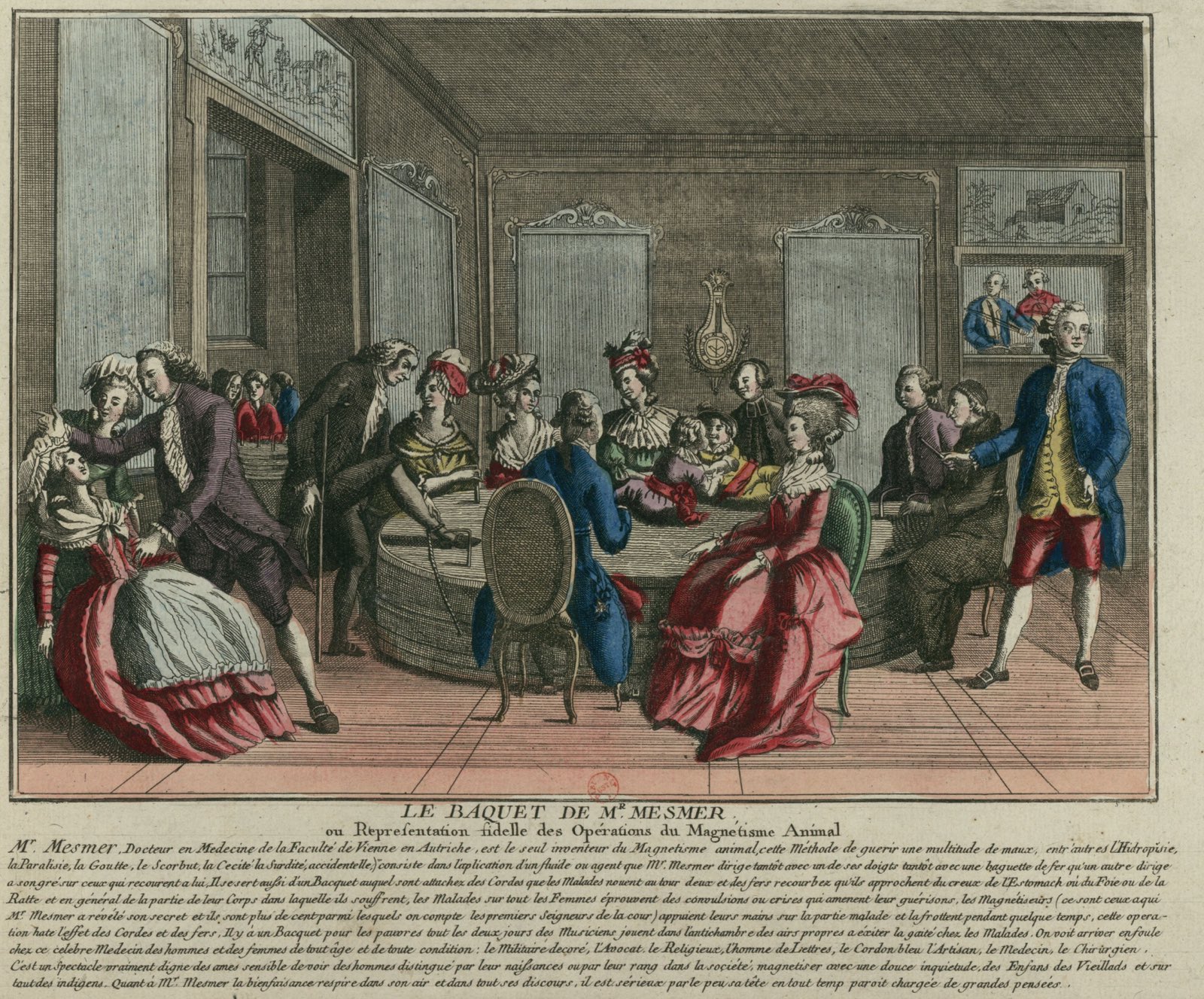
The commissioners tested the tub as an object. “By means of an electrometer and a needle of iron not touched with the loadstone”, they found “that the bucket contained no substance either electric or magnetical”. Then they described what it did to people, and did not understate it. Some patients were calm; some coughed, spat, sweated; others “are agitated and tormented with convulsions”, which could last three hours. “Nothing can be more astonishing than the sight of these convulsions; he that has not had it can have no idea of it”. “It is impossible not to recognise in these regular effects an extraordinary influence, acting upon the patients, making itself master of them, and of which he who superintends the process, appears to be the depository.” There were “always many women and few men” in crisis, and once one began the rest followed. The commissioners decided the hall was no place to experiment: “too many things are seen at once for any one of them to be seen well”. So they built, in stages, something simpler.
The first instrument was themselves. D’Eslon gave them a private room and a separate tub, and “the commissioners repaired thither once in the course of every week. The operation was continued in each experiment for two hours and a half”. They agreed not to watch themselves too closely, since “if the magnetism were a real and operative cause, there was no need that it should be made an object of thought”. After weekly sessions, and then three days running, “Not one of the commissioners felt any sensation, or at least none which ought to be ascribed to the action of the magnetism.”
The second instrument was the sick, “and we chose them out of the lower class.” Seven were brought to Passy and magnetised by d’Eslon before all the commissioners, among them a scrofulous child of six, a girl of nine with convulsions like St Vitus’s dance, and a woman who had been thrown against a log by a cow two years before. “Of these seven patients, four felt no sensation at all; three experienced some effects”. Then the household. “Dr. Franklin, though the weakness of his health hindered him from coming to Paris, and assisting at the experiments which were there made, was magnetised by M. Deslon at his own house at Passy. The assembly was numerous; every person who was present underwent the operation.” Some of d’Eslon’s own patients, who had come with him, went into crisis as they did in Paris. “Dr. Franklin, his two relations, his secretary, and an American officer, felt no sensation, though one of Dr. Franklin’s relations was convalescent, and the American officer had at that time a regular fever.”
The tally, with four patients from society added: “Of fourteen sick persons, five only appeared to feel any effect from the operation, nine felt no effect at all.” The five were the poor, the ones most likely to want to please a room full of physicians who were paying them; the child of six, “so irritable so susceptible”, had felt nothing. The commissioners’ suspicion had become a hypothesis: that the effects “were the fruits of anticipated persuasion, and might be operated by the mere force of imagination.” Everything after this was built to test it.
The third instrument was the blindfold, and the Report describes it like a piece of apparatus because that is what it was. “The bandage was made of two calottes of elastic gum, whose concavity was filled with edredon; the whole inclosed and sewn up in two pieces of stuff of a circular form. These pieces of stuff were then fastened to each other, and to two strings which were tied in a knot at the back part of the head. Placed over the eyes, they left in their interval room for the nose, and the entire liberty of respiration, without the person blindfolded being permitted to receive even the smallest particle of light, either through, or above, or below the bandage.”
The fourth was a script. Among Lavoisier’s papers is a “Plan d’expériences” for a day at Passy: “One will go to Passy, to M. Franklin’s, at noon precisely.” It silences d’Eslon and every commissioner but one, sends the patients on a pretext to separate rooms, and assigns three men to each: one to put questions “of a captious form”, one to write down “faithfully the questions, the answers and all the circumstances”, and one “to imitate M. Deslon magnetising, without affectation.” The plan is translated in full in a companion piece, “Lavoisier’s plan”. With the blindfold it is the whole of the method: one voice, one pen, a known deception, and a result written down whichever way it went.
The fourth tree
The first blindfold went on a woman who was not d’Eslon’s patient at all. A physician named Jumelin, who said he had worked the method out from conversation, was magnetising people at a colleague’s house, and of eleven he tried before the commissioners, one felt anything: a woman who felt heat wherever his hand went. Blindfolded, “the phenomena no longer answered to the places towards which the magnetism was directed.” Blindfolded and left alone, with Jumelin sent from the room, she “was induced to believe that the operation was performing. The effects were the same, though no operation, either near or distant, was performed”. The next day a man and a woman gave the same result, and the commissioners wrote the sentence on which the whole inquiry turns: “it was evident their answers were determined by the questions that were put to them, that is, the question pointed out where the sensation was expected to be”. Someone objected that Jumelin’s method was not the real one. The answer is a model of knowing what you are testing: “at the present moment it was not proposed to bring the magnetism, but the imagination to the proof.” None of these subjects had convulsed, and the question became whether imagination alone could produce a crisis. The whole run of these trials is in a companion piece, “The other blindfolds”.
That is why there was a tree. The doctrine held that a magnetised tree affected whoever stood under it. The commissioners put it to d’Eslon, who said the experiment “ought to succeed, provided the subject were extremely susceptible”, and agreed it should be done at Passy before Franklin. Because susceptibility was the condition, they let him choose the subject, and he brought the boy. They let him magnetise the apricot tree alone while the boy stayed indoors with a minder. They would have preferred him to leave, “but he declared that he could not answer for its success, if he did not direct his cane and his countenance towards the tree”. So he was placed as far off as possible, with commissioners standing between him and the boy “in order to ascertain the impracticability of any signals”.
Then the four trees, two minutes each, with d’Eslon pointing his cane at the right one from a distance. The distances in the Report are twenty-seven feet, thirty-six, thirty-eight and, at the fourth, about twenty-four. The boy fainted. D’Eslon explained afterwards that all trees were magnetised by nature and that his presence had reinforced them. The commissioners replied that in that case “a person sensible to the power of the magnetism, could not hazard a walk in a garden without the risk of convulsions”, and that d’Eslon’s presence had done nothing to the boy in the coach from Paris, where they had sat face to face. Then they drew the inference exactly. “If he had experienced no sensation even under the tree which was magnetised, it might have been said that at least upon that day he had not been sufficiently susceptible: but the boy fell into a crisis under a tree which was not magnetised; the crisis was therefore the effect of no physical or exterior cause, but is to be ascribed solely to the influence of imagination. The experiment is therefore entirely conclusive”.
They did it again with women, on a day when all the commissioners and d’Eslon were at Passy together and d’Eslon had been asked to bring his most susceptible poor patients. He brought two. While he was in another room magnetising Franklin and the company, the women were separated. One, “Dame P——”, had films over her eyes but could see a little, so the bandage was used; she was told d’Eslon had come in to treat her. Three commissioners sat with her, “one to interrogate, another to make minutes of the transaction, and the third to personate M. Deslon”, and spoke to the empty place as if to him. Nobody touched her. “At the end of three minutes the patient began to feel a nervous shuddering; she had then successively a pain in the back of her head, in her arms, a creeping in her hands, that was her expression, she grew stiff, struck her hands violently together, rose from her seat, stamped with her feet: the crisis had all the regular symptoms.” Two commissioners in the next room heard it through the door. They were sitting with “Mademoiselle B——”, a seamstress, not blindfolded but seated facing a shut door and told d’Eslon was magnetising her from the other side of it. In the first minute she shuddered; in the second her teeth chattered; “in the third minute she fell into a regular crisis”, and “bit her hand, and that with so much force, that the marks of the teeth remained perfectly visible.” The Report notes: “neither of these subjects were touched in any manner; their pulse was not even felt”.
The last experiment ran both arms on the same person in the same hour. Two rooms were joined by a doorway from which the door had been taken and a frame covered with a double thickness of paper put in its place. Mademoiselle B was sent for on the pretext that a lady from the country wanted linen made up, and the only chair she could take stood in the papered doorway. On the other side a commissioner who was a physician, and had produced crises before, magnetised her through the paper for half an hour, at a foot and a half, with the poles observed as d’Eslon taught; paper was no obstacle in the theory, and d’Eslon had said so. “During the operation she conversed with much gaiety, and, in answer to an inquiry concerning her health, she readily replied, that she was perfectly well”. Then the same man came round into her room, asked her consent, and magnetised her openly for twelve minutes, except that he now worked across the poles, the one way the theory said could not work. In three minutes she was gasping and hiccuping; by twelve “the convulsive crisis was complete and accompanied with all the regular symptoms.” He then told her it was time to stop and held up two crossed fingers, still across the poles, still, by the theory, doing nothing. The crisis went out of her in three minutes, “in obedience to the voice to which the imagination was subjected”. The Report’s verdict on the pair: “The inevitable conclusion is, that the imagination singly produces all the effects attributed to the magnetism, and that, where the imagination ceases to be called forth, it has no longer the smallest efficacy.”
What it looked like from inside
Franklin’s part was to be ill in the right house. The Report says twice that his health kept him from Paris, and it is the reason the orchard, the two rooms and the magnetising of a whole household with an American officer in a fever are at Passy. His name stands first among the signatures; the editors of his papers record that he signed there, before the others met in Paris on 11 August.
What he thought is in his letters. On 25 August 1784 he wrote to his grandson Temple, who had just left for London: “The Report is publish’d and makes a great deal of Talk. Everybody agrees that it is well written; but many wonder at the Force of Imagination describ’d in it, as occasioning Convulsions &c. and some fear that Consequences may be drawn from it by Infidels to weaken our Faith in some of the Miracles of the New Testament. Some think it will put an End to Mesmerism. But there is a wonderful deal of Credulity in the World, and Deceptions as absurd, have supported themselves for Ages.”
Inside the hall of the baquet, the man who saw most was Jussieu, because he went most often and worked the method with his own hands. “I frequented M. Deslon’s rooms; to avoid illusion, I wished to see a great deal, and to operate often myself”, he wrote. He sorted his facts into four classes, and the last was a small set he thought the imagination could not explain, among them a blind woman at the tub whom he had twice made uneasy, he said, by pointing a rod at her stomach from six feet while the room’s noise covered him. He concluded that something physical passed between bodies, probably animal heat, and that thirteen men had judged “on a few isolated facts”. He refused to sign. D’Eslon, in his reply, was glad to name him as the one commissioner who “alone thought it right to follow my treatments with constancy.”
And inside the commission there was a question nobody printed. On 9 May, at d’Eslon’s house, in front of the commissioners, the lieutenant-general of police put it to him: “I ask you, in my capacity as lieutenant-general of police, whether, when a woman is magnetised or in crisis, it would not be easy to abuse her?” D’Eslon answered yes. The exchange is not in the Report. It is in a second document, signed by the same nine men on the same day, which the minister had asked them to write for the king alone, and which stayed out of print, so far as I can find, for forty years. It concerned morals, and it is the subject of a companion piece, “The secret report”.
The most revealing thing said from inside was said by d’Eslon, and the commissioners printed it. “He declared in our session, held at the house of Dr. Franklin, the 19th of June, that he thought he might lay it down as a fact, that the imagination had the greatest share in the effects of the animal magnetism; he said that this new agent might be no other than the imagination itself, whose power is as extensive as it is little known”. In a footnote the Report quoted what he had printed in 1780: “if the physic of the imagination be more salutary than the other kinds of medicine, what good reason can be alleged, why the physic of the imagination should not be brought into general use?” Three months later d’Eslon complained in print that a hypothesis of his had been made into an assertion. But he had said it, at Passy, and they had written it down.
What happened
The Report was signed at Paris on 11 August 1784 and printed by the royal press. Its findings fill a paragraph. “Compression, imagination, imitation, are therefore the true causes of the effects attributed to this new agent, known by the appellation of animal magnetism, this fluid, which is said to circulate through the human body, and to be communicated from individual to individual. Such is the result of the experiments of the commissioners, and the observations they made upon the means employed and the effects produced. This agent, this fluid, has no existence.” “The magnetism then is no more than an old falsehood.” Of the three causes, imagination was “that active and terrible power”. The last paragraph before the signatures states the test and its result in a sentence any experimenter could still hang over a bench: the commissioners had “demonstrated by decisive experiments, that the imagination without the magnetism produces convulsions, and that the magnetism without the imagination produces nothing”.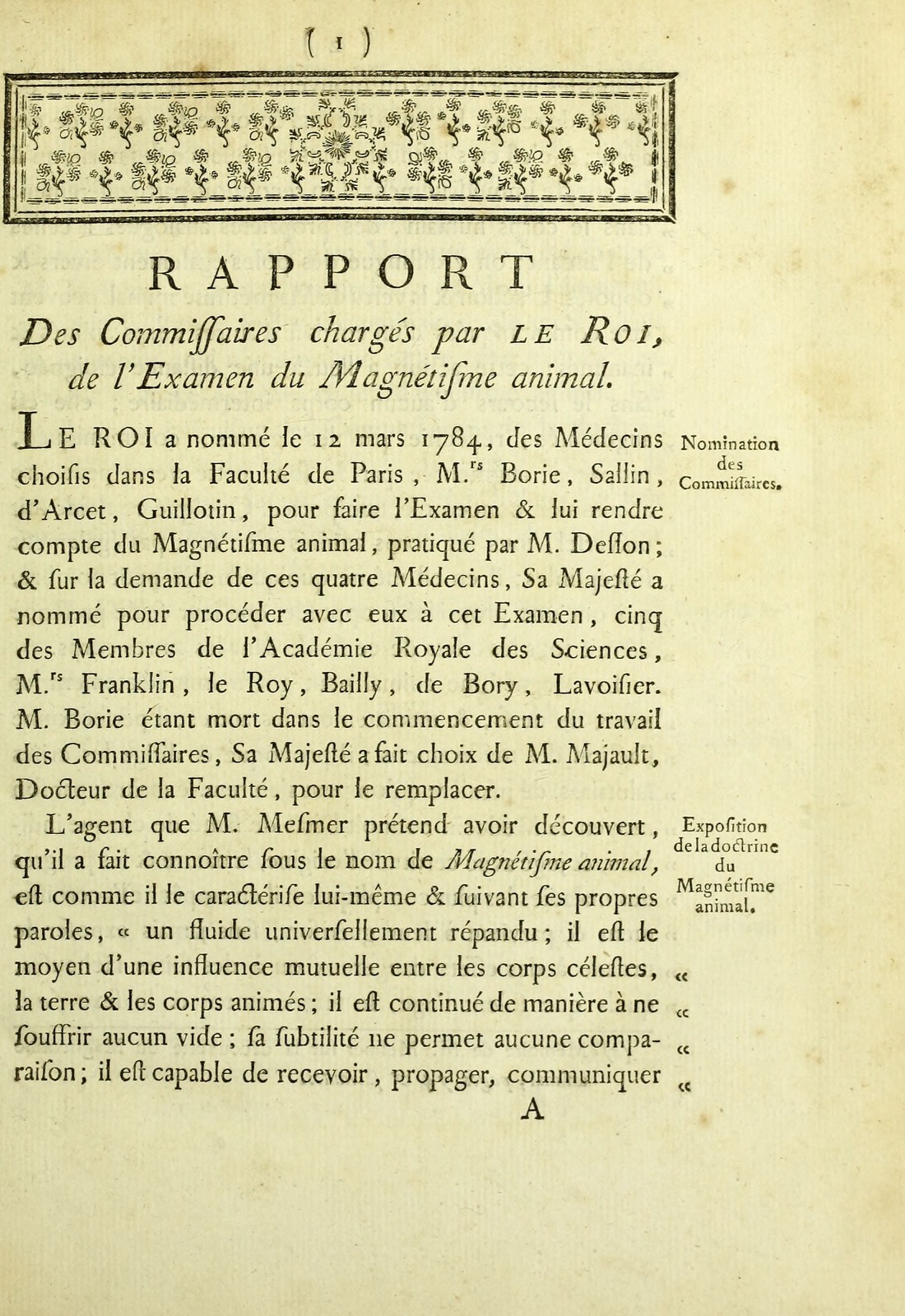
Then came the part that was not about the fluid. Having found a real cause, the commissioners pronounced on its use. Hope, they allowed, heals: “in physic as well as Religion, men are saved by faith; this faith is the produce of the imagination”. But crises were violence, to be used “in the medical art in the same manner as poisons”, once if ever, never daily. So they concluded “that the existence of the fluid is absolutely destitute of proof, that the fluid having no existence can consequently have no use”, and “that of consequence every public process, in which the means of the animal magnetism shall be employed, cannot fail in the end of producing the most pernicious effects.” Five days later the Royal Society of Medicine’s four signatories reached the same end: the theory “a system absolutely devoid of proof”, the practice useless where it caused no crisis and harmful where it did. Their report also conceded, in a paragraph that has had less attention, that several of d’Eslon’s milder patients “assured us that they found themselves better, that they had more appetite, that they digested better”, and put it down to “the hope they have conceived, the exercise to which they give themselves every day, the cessation of the remedies which they may have used before”.
On 4 September Bailly told the Academy of Sciences how the commission had worked, and said plainly what the blindfold had been for. “Forced to give up physical proofs, we were obliged to seek the causes of the real effects in moral circumstances.” “We said: the effects attributed to Magnetism and to a fluid which nothing manifests take place only when the imagination is forewarned and can be struck; the imagination therefore seems to be their principle: we must see whether these effects can be reproduced by the power of the imagination alone. We attempted it, and we fully succeeded.” The search for an agent that did not exist had “served to make known a real power of man”, and Bailly called the study of it “a science still new, that of the influence of the moral on the physical”.
Mesmer petitioned the Parlement of Paris, which, Franklin wrote on 8 September, “laid hold of it to clinch Mesmer, and oblige him to expose all directly”, and on 6 September ordered him to set out his doctrine before four doctors, two surgeons and two apothecaries. He never did. D’Eslon answered the two reports the same day in a pamphlet dated from Paris. He thought the conclusions “lacking in moderation”, and pointed out that a prohibition was now impossible, since “M. Mesmer has made 300 pupils, I have instructed 160 physicians”. On the tree he wrote: “I do not see what this fact proves against Magnetism and for the imagination.” The boy had fallen before reaching the right tree because the agent, once set to work in a body, finished when nature pleased, and the work might have begun “in the carriage in which he came with me, or perhaps in the treatment of the preceding days.” He added a reproach that was fair: “I dare to charge them with a little too much haste when I see them pass an absolute judgment on a single fact, which deserved at least to be repeated by them on the same subject, or on others”.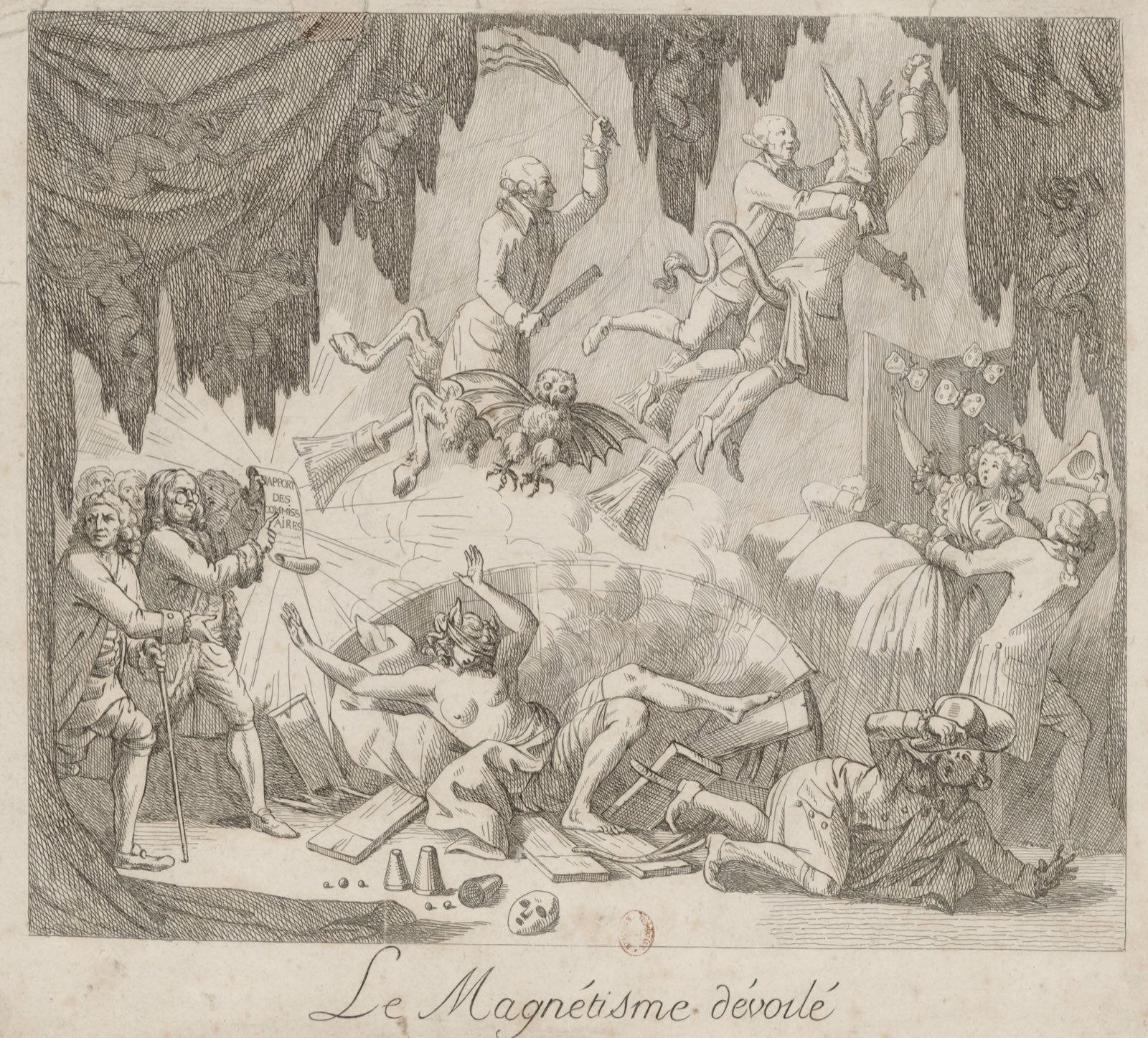
After
Within eight months the thing the commissioners had tested had changed shape. On 29 April 1785 Franklin wrote to Jan Ingenhousz in Vienna: “Mesmer continues here and has still some Adherents and some Practice. It is surprizing how much Credulity still subsists in the World. I suppose all the Physicians in France put together have not made so much Money during the Time he has been here, as he has done. And we have now a fresh Folly. A Magnetiser pretends that he can by establishing what is called a Rapport between any Person and a Somnambule, put it in the Power of that Person to direct the Actions of the Somnambule, by a simple strong Volition only, without Speaking or making any Signs; and many People daily flock to see this strange Operation!” The magnetiser was the marquis de Puységur, who had found that a patient could be put into a sleep in which he talked, obeyed and diagnosed. The tub and the convulsions, which the commissioners had tested, went out of fashion; the rapport and the sleep, which they had not, came in.
D’Eslon died in 1786. Mesmer left Paris, and died in obscurity in 1815. Franklin went home in 1785 and died in 1790. Bailly became the first mayor of Paris and was guillotined in November 1793; Lavoisier followed him in May 1794; the machine that killed them bore Guillotin’s name against his will. The secret report stayed in manuscript until Alexandre Bertrand printed it in 1826, in a history that treated the question as still open.
It was still open because the practice had never stopped. The Royal Academy of Medicine took the subject up again in the 1820s; a committee of eleven took five years and reported in June 1831 that magnetism had real effects and that somnambulists had read with their eyes closed. The American physician who reprinted the Franklin commission’s Report in 1837, with an abstract of the new one, put his finger on the difference in a sentence: “The examinations as to clairvoyance were not conducted with the same caution of covering the eyes, as was practised by the commissioners of the king”. In 1837 the physician Burdin deposited 3,000 francs with the Academy as a prize for anyone who could read “without the help of the eyes, of light and of touch”; nobody won it, and Burdin and Dubois published the whole academic history in 1841 with the secret report inside it and the remark that nothing had changed except that “instead of convulsions a pretended somnambulism is provoked.” The blindfold had to be invented again each time, and each time it gave the same reading.
What did not need reinventing was the finding the commissioners had set aside. They had shown that belief could produce convulsions and stop them in three minutes; d’Eslon had asked why the physic of the imagination should not be brought into general use. Nobody on either side of 1784 took that as the question to pursue. The commissioners filed it under danger, the magnetisers under fluid, and the practice went on for a century on the strength of effects the commissioners had proved were real and attributed to the wrong cause.
What it taught
The commission got the central thing right, and got it right by design: Lavoisier wrote down beforehand that the only way to settle the question was to separate the agent from the belief and test each alone, and the commissioners did exactly that, in both directions, on the same subjects, and wrote both results down. What followed from the reading is the lesson, and it is not simple.
Separate the thing from the belief in it, and test each with the other removed. The hall of the baquet had everything at once: the iron, the cord, the music, the hands, the crowd, the man with the rod, and the expectation. No reading taken there could be attributed to anything. The commissioners stripped the setting to one variable, then removed the variable and left the belief, then kept the variable and removed the belief. A seamstress magnetised unknowingly through paper for thirty minutes felt nothing; magnetised knowingly for twelve, against the rules of the art, she convulsed. That pair of readings is worth more than every crisis ever witnessed at the tub, and Lavoisier had said so in advance.
The blindfold was on the subject, and the questions were written to mislead. Know what your instrument cannot see. That was the right design for the question the commissioners had: does the fluid act when the belief is absent? It was no design at all for the question the patients had: does the treatment help? A deceived subject can tell you that a fluid is unnecessary. She cannot tell you whether the thing that made her convulse is worth having. The commissioners knew which question they were answering, and said so. Their successors a half-century later forgot the blindfold and reported that the sleepers could read.
A result called “entirely conclusive” should still be repeated, and d’Eslon was right to say so. One boy, one tree, one afternoon. The commissioners repeated the principle, with the two women, the cups and the paper partition, and the repetitions all pointed the same way. But the tree was never done again, and d’Eslon’s complaint about an absolute judgment “on a single fact” is the one objection in his pamphlet that a reader of the Report cannot dismiss. He also offered the standard escape of every theory under test, that the agent finished its work when nature pleased, and the commissioners had anticipated that: “If he had experienced no sensation even under the tree which was magnetised, it might have been said that at least upon that day he had not been sufficiently susceptible”. A test is only a test if its failure has been given a meaning in advance.
They proved a real effect and recorded it as an error. The Report’s own words are “that active and terrible power”. Bailly called it “a science still new”. Then the commissioners recommended that the practice which displayed it be stopped, because convulsions are poison. The reasoning was medical and arguable; the consequence was that the most interesting finding of the inquiry, that a sign from a trusted operator could start a crisis in three minutes and end it in three more, was left to the people who were wrong about its cause. They used it for another hundred years. The commission’s question was whether the fluid existed. The patients’ question was whether they felt better. Only the first was answered.
The report the king read and the report the public read drew different conclusions from the same afternoon. The public Report said the crises were imagination. The secret one said they were sometimes simulated to set the others off, that there were no real cures, that the practice was a danger to morals, and that d’Eslon, asked by the chief of police whether a woman in crisis could be abused, had said yes. The public was given the physics and denied the police report, and the physics alone did not persuade anyone who had felt the heat.
The complication is that the commissioners were right about the fluid, and being right did not help. There is no magnetic fluid; there was no electricity in the tub; the boy fell at the wrong tree. Jussieu, who refused to sign, was wrong about his animal heat but right that something passed between people in that hall which deserved more study than a sentence about poison. D’Eslon was wrong about the agent and right about the haste, and right too, in 1780, that a physic of the imagination might be worth having. What was built at Passy in 1784 was an instrument that could tell belief from matter, and it told them. What nobody built was anything to do with the answer. The practice survived its own test because the test, honestly run and honestly reported, had measured the one thing its practitioners did not depend on.
Sources
- Rapport des commissaires chargés par le Roi de l’examen du magnétisme animal, Paris: Imprimerie royale, 1784. The French original: the appointment of 12 March 1784, Mesmer’s propositions, the memoir of 9 May before the lieutenant-general of police, the baquet, the commissioners’ self-experiments, the seven poor patients and the household at Passy, Jumelin, the bandage of elastic gum and eiderdown, the apricot tree and the four distances, the two women, the paper partition, d’Eslon’s declaration of 19 June, and the conclusions and signatures. Wellcome Collection copy. archive.org
- Report of Dr. Benjamin Franklin, and Other Commissioners, Charged by the King of France, with the Examination of the Animal Magnetism, as Now Practised at Paris. Translated from the French. With an Historical Introduction, London: J. Johnson, 1785. The English quotations from the Report in this entry are from this translation, including “the imagination without the magnetism produces convulsions, and that the magnetism without the imagination produces nothing”; also the translator’s introduction (the aerostatic globe, the gardens of the prince de Soubise). archive.org
- Animal Magnetism: Report of Dr. Franklin and Other Commissioners, Philadelphia, 1837, a reprint of the 1785 translation with an anonymous “History and Progress of Animal Magnetism” and an abstract of the Royal Academy of Medicine’s report of 1831. Used for its cleaner text of the translation, checked against the 1785 printing, and for the sentence on the 1831 committee not covering the eyes “with the same caution”. National Library of Medicine copy. archive.org
- Rapport secret sur le magnétisme animal, rédigé par Bailly au nom de la même commission, Paris, 11 August 1784, as printed in Charles Burdin and Frédéric Dubois, Histoire académique du magnétisme animal, Paris: Baillière, 1841, pages 92 to 100, and earlier in Alexandre Bertrand, Du magnétisme animal en France, Paris: Baillière, 1826. Morals, Lenoir’s question of 9 May and d’Eslon’s answer, the simulated crisis, “Il n’y a point de guérisons réelles”, and the signatures. Burdin and Dubois also for the Faculty’s proceedings against d’Eslon in 1780, the prize of 3,000 francs of September 1837, and “au lieu de convulsions on provoque un prétendu somnambulisme”. Translated here by the author of this entry. archive.org (Burdin and Dubois), archive.org (Bertrand)
- Antoine-Laurent Lavoisier, papers on animal magnetism in Œuvres de Lavoisier, tome III, Paris: Imprimerie impériale, 1865, pages 499 to 527: Breteuil’s letter of April 1784, the academicians’ declaration on their functions, Lavoisier’s “Remarques” (“magnétisme séparé de l’imagination et imagination séparée du magnétisme”, “une seule expérience concluante”), and the “Plan d’expériences” for Passy. Translated here by the author of this entry. archive.org
- Jean-Sylvain Bailly, Exposé des expériences qui ont été faites pour l’examen du magnétisme animal, lu à l’Académie des Sciences … le 4 septembre 1784, Paris: Moutard, 1784. “Nous l’avons tenté, et nous avons pleinement réussi”, and “une science encore neuve”. Translated here by the author of this entry. archive.org
- Rapport des commissaires de la Société royale de médecine nommés par le Roi pour faire l’examen du magnétisme animal, Paris: Imprimerie royale, 1784, signed Poissonnier, Caille, Mauduyt and Andry on 16 August 1784. The conclusions, and the paragraph on the milder patients who felt better through hope, exercise and the stopping of their remedies. Translated here by the author of this entry. archive.org
- Antoine-Laurent de Jussieu, Rapport de l’un des commissaires chargés par le Roi de l’examen du magnétisme animal, Paris: Veuve Hérissant, 1784. His appointment on 5 April, his refusal to sign, his four classes of facts, the blind woman at six feet, and animal heat. Translated here by the author of this entry. archive.org
- Charles d’Eslon, Observations sur les deux rapports de MM. les commissaires nommés par Sa Majesté pour l’examen du magnétisme animal, “Philadelphie” and Paris: Clousier, 1784, dated 6 September 1784. Jussieu as the one who followed his treatments, “manquent de modération”, the 300 pupils and 160 physicians, and his answer on the tree. Translated here by the author of this entry. archive.org
- Franz Anton Mesmer, Lettres de M. Mesmer à Messieurs les auteurs du Journal de Paris, et à M. Franklin, Paris, 1784: the letter to the Journal de Paris of 20 August 1784 (“je ne les reconnois pas pour mes juges”) and the copy of his letter to Franklin. Translated here by the author of this entry. archive.org
- Benjamin Franklin, letters to La Sablière de la Condamine, 19 March 1784; to William Temple Franklin, 25 August and 8 September 1784; and to Jan Ingenhousz, 29 April 1785, in Albert Henry Smyth (ed.), The Writings of Benjamin Franklin, vol. 9, New York: Macmillan, 1906. The same letters are at Founders Online, whose editorial notes (not quoted here) record that Franklin signed the Report at Passy. archive.org
- Franz Anton Mesmer, Mémoire sur la découverte du magnétisme animal, Geneva and Paris: Didot, 1779. The twenty-seven propositions, as the Report quotes them. archive.org
- Michel-Augustin Thouret, Recherches et doutes sur le magnétisme animal, Paris: Prault, 1784. The seventeenth-century antecedents on which the Report’s “old falsehood” rests. archive.org
- Claude-Anne Lopez, “Franklin and Mesmer: an encounter,” Yale Journal of Biology and Medicine, vol. 66 (1993), pages 325 to 331. Read in abstract only, for Mesmer’s death in 1815. PubMed Central
- The prints: “Le Baquet de M.r Mesmer” (De Vinck 900), “Mesmer magnétisant une patiente” (Mondin 673, 1784) and “Le Magnétisme dévoilé” (Hennin 10026), Bibliothèque nationale de France, via Wikimedia Commons; and the first page of the 1784 Rapport from the Wellcome Collection’s copy. Commons: baquet, Commons: Mesmer, Commons: dévoilé, Wellcome Collection


