March 29, 1898, was a clear, sharp morning at Cape Smythe, nine miles down the coast from Point Barrow, the top of Alaska. The men who came out of the trading station to see who was coming up the beach did not at first believe it. Dog teams were coming up from the south. On the sleds were an officer of the United States Revenue Cutter Service and a ship’s surgeon, in deerskin, with Native drivers. “They were stunned,” Lieutenant David Jarvis wrote of the whaling officers who came out to greet him, “and it was some time before they could realize that we were flesh and blood. Some looked off to the south to see if there was not a ship in sight, and others wanted to know if we had come up in a balloon.”
There was no ship. The sea was ice to the horizon and would be until August. The thing Jarvis had come with was twenty miles behind him, walking.
It came up over the next days: a herd of reindeer, driven from Cape Prince of Wales on the Bering Strait, more than seven hundred miles in fifty-five days, by a mission schoolteacher named Tom Lopp and seven Iñupiaq herders. Jarvis counted. He had started with 448 animals and arrived with 382. The rest had been eaten by the drivers, run to death, taken by dogs and wolves, or lost in a blizzard on Kotzebue Sound. Nobody in the party had died. At Cape Smythe some 275 whalemen from eight ships frozen in along the coast had been living since September on flour, salt meat cached in 1889, and whatever caribou the Native hunters could bring in, and four of them had scurvy. Now there was meat on the hoof, and a surgeon.
Three hundred eighty-two was the number that proved the experiment. The experiment had another number, kept in a table in Washington and published every year. That one went up for thirty-four years, and everyone who had anything to do with reindeer read it, and it was the wrong number.
Who ran it
In the summer of 1881 the revenue cutter Thomas Corwin went north through the Bering Strait looking for the Jeannette, a Navy exploring ship that had gone into the ice two years before and not come out, and for two whalers that had vanished the same season. Her captain was Calvin Hooper. Her executive officer was Michael Healy, forty-one, born on a cotton plantation near Macon, Georgia, to an Irish planter and an enslaved woman, and therefore, under Georgia law, a slave. His father had sent the children north to school. Michael ran away from a French seminary at fifteen and shipped as a cabin boy on a clipper bound for Calcutta, and in 1865 he took a commission in the Revenue Marine on a paper Lincoln signed. Nobody in the service knew his mother’s history, and he did not tell them. The naturalist aboard the Corwin that summer was John Muir.
The Corwin called at St. Lawrence Island, where in the winter of 1878 and 1879 most of the people had starved; the crew walked through villages where the dead still lay in the houses. On the Siberian side, in August, a party from the ship went with two Chukchi guides to the head of Plover Bay to look at a herd of reindeer. The Chukchi had kept reindeer for centuries. Fifty miles of water away, the Iñupiat and Yupik of Alaska lived on walrus and whale and seal, and for thirty years the American whaling fleet had been taking the walrus by the tens of thousands for oil and ivory, and had thinned the bowhead to a fraction of what it had been. Healy would watch this from the bridge of a cutter for the next fifteen years.
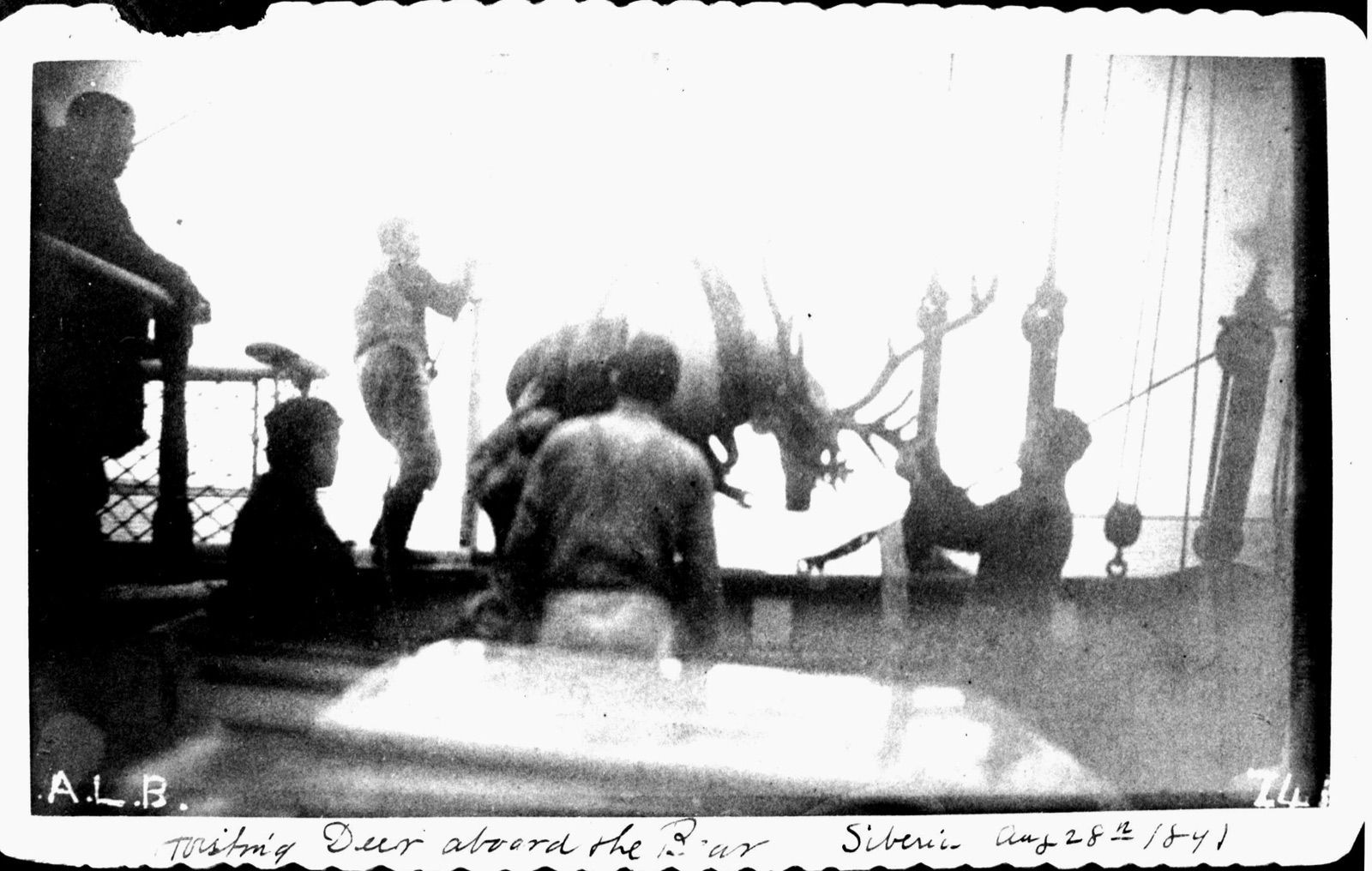
He got the Corwin in 1882 and the Bear in 1886, and for nine years he took her north from San Francisco each spring and brought her back each autumn, the only government on two thousand miles of coast. She carried the mail. She carried the teachers, the missionaries, the census takers and the federal prisoners. Her deck was a courtroom. Her surgeon treated whoever came alongside. She chased seal poachers off the Pribilofs and liquor traders out of the villages, and in 1888 she took 160 shipwrecked whalemen off the ice near Point Barrow. The Natives called her Healy’s fire canoe. The whalers called him Hell Roaring Mike, which he had earned in the saloons of San Francisco rather than at sea, and which he did not mind.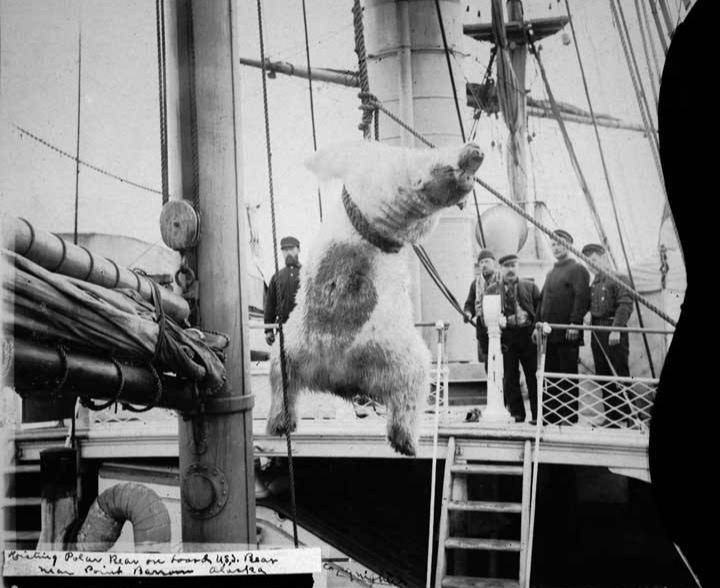
By 1890 he had an idea, and he put it in writing: the introduction of reindeer “seems to be the solution of three vital questions of existence in this country—food, clothing and transportation.” That summer he had a passenger who could do something with it. Sheldon Jackson was fifty-six, a Presbyterian missionary who had planted churches across the Rocky Mountain West and since 1885 had been the federal government’s General Agent of Education for Alaska, a post he had largely invented. He had worked in the southeast of the territory since 1877 and had never been to the Arctic. On July 3, 1890, the Bear put into Port Clarence, the harbour just south of the strait, and Jackson counted twenty-five whaling ships at anchor. He went back to Washington in September with Healy’s plan and his own conviction, and the Commissioner of Education endorsed it, and the Fifty-first Congress declined to pay for it.
So Jackson wrote to the newspapers. “I made an appeal in the Mail and Express, of New York City, the Boston Transcript, the Philadelphia Ledger, the Chicago Inter-Ocean, and Washington Star, as well as in a number of the leading religious newspapers of the country,” he reported later. “The response was prompt and generous; $2,156 were received.” The money was turned into trade goods and put aboard the Bear.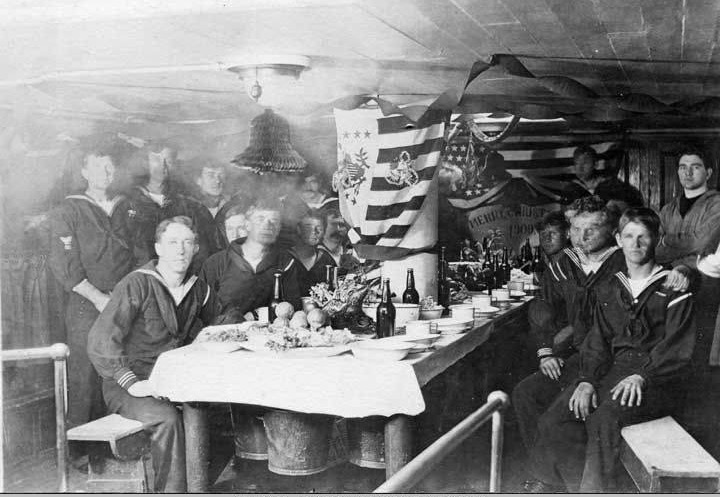
What they were trying to find out
Jackson wrote down the hypothesis in his report to the Senate in 1894, and it is worth reading slowly, because it is two claims wearing one coat. “To stock Alaska with reindeer, to reclaim and make valuable millions of acres of moss-covered tundra, to introduce a large, permanent, and wealth-producing industry where none previously existed, to take a barbarian people, on the verge of starvation, and lift them up to comfortable self-support and civilization, is certainly a work of national importance.”
The first claim is about animals: that reindeer from Siberia would live on Alaskan lichen, breed, and survive the handling of people who had never kept a domestic animal larger than a dog. That claim could be tested by counting.
The second is about people: that a hunting people would become a herding people, and that the herds would end up in their hands. That claim could only be tested by looking at who owned what, and Jackson knew it. In the same report he named the one way the experiment could fail. “If white men are allowed to establish herds,” he wrote, “they will not get into the hands of the natives, and the main object in the enterprise will be defeated.”
So the design was that the government would own the reindeer, lend them out, and take back the number lent while the borrower kept the increase. Native apprentices would learn the trade and earn deer by serving. The missions would hold herds in trust. Nobody else would own any. That was the safeguard, and it was written into the first report, by the man who ran the experiment, in the first year of its funding.
What they built
In the summer of 1891 the Bear bought twenty reindeer on the Siberian coast for $180.90 in trade goods and landed sixteen of them, with sacks of Siberian moss, on Amaknak Island in Unalaska harbour, in the Aleutians. The purpose was narrow: to find out whether a reindeer survived a sea passage in a cutter. They did. Jackson, who was not a man to leave a result unused, reported that it was “desirable that in the near future all the larger islands of the Aleutian group should be stocked with reindeer.”
In 1892 the ship made the crossing in earnest. On July 4, 1892, the first of 171 reindeer, bought for $623.30, came ashore at Port Clarence, and Jackson named the place the Teller Reindeer Station, for the Interior Secretary who had given Alaska its schools. Healy brought over four Chukchi herders to teach, and nine Iñupiaq apprentices were put under them. Two deer strayed. Twelve died of the voyage. Thirteen more died fighting, or slipping on the ice. Seventy-nine fawns were born in the spring, and 124 more animals were landed that summer, and in September 1893 the station counted 346. Congress, now that there was something to count, appropriated $6,000.
The Chukchi went home. Jackson said later that the degree of success with them was “so small” that in 1894 he sent a Norwegian-born Wisconsin man named William Kjellmann to Lapland to hire Sámi families instead; five came, with their dogs, on three-year contracts. Other accounts say the people of Wales had threatened to kill the Chukchi, or that the missionaries could not abide their methods of guiding deer. One fact survives from the trading itself: a trader had paid for reindeer with whisky, and the Siberians then refused to sell without it. “As Capt. Healy could not concede that to them,” Jackson wrote, “the Government lost the purchase of one hundred reindeer.”
The rules for the apprentices changed almost every year. In 1892 a Native herder was to serve two years and receive ten deer. In 1894 it was three years, with two deer the first year, five the second, ten the third. In 1896 it was five years, no deer during training, deer “might” be given at the end, and no herder could go home until his herd reached a hundred. The loans began on January 31, 1895, when a hundred deer were lent to an Iñupiaq herder named Charlie Antisarlook at Point Rodney, on the five-year terms Jackson had designed: the government to get back a hundred, Charlie to keep the increase. A hundred each went to the Congregational mission at Cape Prince of Wales, the Swedish mission at Golovin Bay, the Catholics on the Yukon and the Presbyterians on St. Lawrence Island.
The count at the end of 1897 was 1,466. Then the whalers got caught.
Three hundred eighty-two
In the first days of November 1897 the Chamber of Commerce of San Francisco told the President that eight ships of the whaling fleet had been closed in by ice near Point Barrow, that 265 men were aboard them, and that they could not possibly have provisions to last the winter. Two of the ships, the Orca and the Jesse H. Freeman, had been crushed on September 22 off the Sea Horse Islands and their crews walked to the shore station at Cape Smythe. The third mate of the Belvedere, George Tilton, had set out on foot on October 17 to carry the news south, and was walking still.
McKinley ordered a relief expedition. The Treasury’s instructions to the Bear are dated November 15. The ship had been home from a six-month Arctic cruise for three weeks. Her captain, Francis Tuttle, took only volunteers and sailed from Seattle on November 27, knowing he could not get within a thousand miles of Barrow before the ice. The plan, which was in the instructions, was to land a party as far north as the ship could reach and have it travel overland to the government’s reindeer. “The purpose is to collect from the herds at Rodney and Cape Prince of Wales the entire available herds of reindeer, all to be driven to Point Barrow.” Lopp, the Wales schoolteacher, was to take charge of the drive. “Impress upon Mr. Lopp and the natives employed,” the instructions said, “that they will be amply rewarded for their labor.”
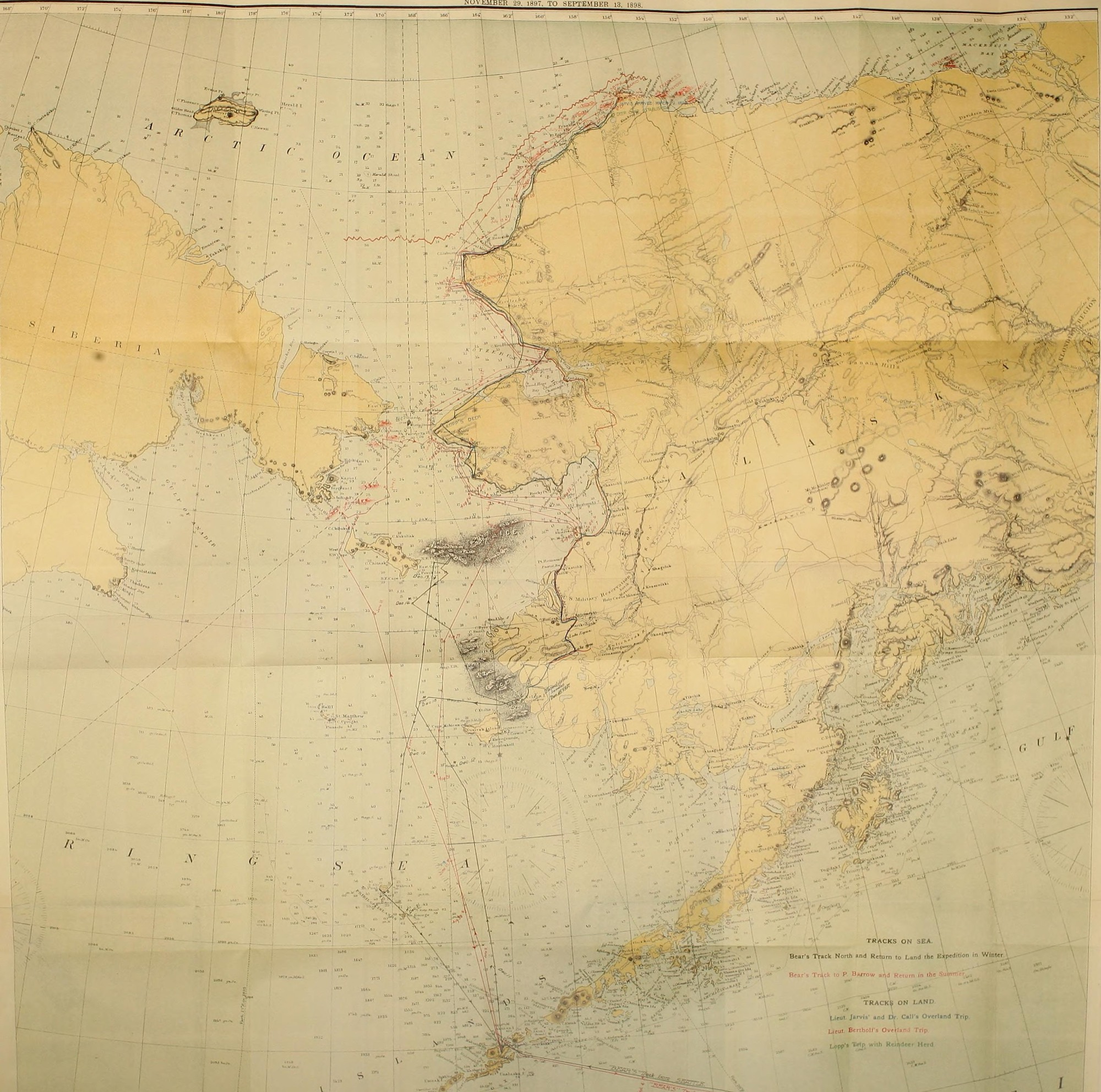
On December 16, 1897, the Bear put the party on the beach near Tununak, on Nelson Island, 1,500 miles from Barrow: Jarvis, thirty-five, who had served under Healy on the Bear and knew the coast; Second Lieutenant Ellsworth Bertholf; Surgeon Samuel Call, who had practised medicine in the Aleutians; and a reindeer-service employee named Koltchoff. Tuttle’s note on the choice of men reads: “the fewer white people in the party the better.” A trader named Alexis Kalenin lent them dogs, found them four Native drivers and went himself as guide across the Yukon delta. Before daylight on the eighteenth they left with four sleds and forty-one dogs. They were at St. Michael by New Year’s Eve, 375 miles on, the dogs finished.
On January 19, at Point Rodney, Jarvis came to Charlie Antisarlook’s herd and asked for it. His account is careful. “I explained to him carefully and particularly what the deer were wanted for; that I had not come with power or force to take his property from him, and that he must let me have them of his own free will and trust to the Government, which I represented, for an ample and suitable reward and return. He and his wife, Mary, held a long and solemn consultation, and finally explained their position. They were sorry for the white men at Point Barrow, and they were glad to be able to help them; they would let me have their deer, which represented their all, on my promise of return, if I would be directly responsible for them.” There were 138 reindeer in the herd. Charlie owned 133. The other five belonged to boys he employed, and Jarvis bought them at about fifteen dollars each. The receipt he wrote promised to replace the 133 that summer “together with the estimated increase in the herd for the coming spring, about 80 fawns, thus making 213 reindeer in all to be replaced.” Charlie came with the herd. Mary stayed. In June, when the Bear came north again, Tuttle found her and her child in a camp on Sledge Island, and she told him they had nearly starved since her husband left.
Jarvis went on to Cape Prince of Wales, fifty miles that he called “the most trying and fearful of all I experienced on the expedition,” and on January 25 Lopp gave up the mission’s 292 reindeer on the same promise. Nine more belonged to a man who would not lend them, and since a herd cannot be split on the trail, Jarvis bought those too. Lopp’s wife urged him to go. He hired six of his herders, Ootenna, Kivyearzruk, Sokweena, Keuk, Ituk and Tautuk, who came from Port Clarence with a small Lapp dog trained to circle the edge of a herd, and with Charlie that made seven. Bertholf’s account of it in Harper’s the next year begins with the thing the experts had said, that none but Laplanders or Siberians could drive deer, and the decision to ignore them: “the herd was to be driven by Alaska natives entirely.”
On February 3, 1898, 438 reindeer and eighteen sleds left the north shore of the Seward Peninsula. Jarvis and Call went ahead by dog team to prepare the coast. Lopp and the herders took the deer straight across the sea ice of Kotzebue Sound, from Cape Espenberg to Cape Krusenstern, a crossing Jarvis had left a letter advising against. Lopp’s letter, which caught up with Jarvis at Point Hope, says what it cost. They camped ten miles from land on the north side; in the night the deer wandered back down the trail for miles; the boys rounded them up and drove all day and all night until daybreak before they reached the land. “Deer and men were in the same condition, almost dead from hunger and fatigue. Six sled deer had become exhausted and were left on the ice.” It saved 150 miles and about two weeks. When Jarvis met Lopp on the Kivalina River on February 26, everyone in the party had frozen cheeks and noses.
From the Kivalina they went over the mountains to the Pitmegea and down to the Arctic coast. Lopp nailed a message between two boards at the river for Jarvis to find: “Letter between boards; arrived here March 7th; look out for the train.” The thermometer stood between fifteen and thirty below on the good days, and in the blizzard of March 15 and 16 Jarvis read forty-five below with the wind. On March 17 he caught up with the herd. On the twenty-sixth he reached the Belvedere, the first of the ships, frozen in behind Point Franklin, and on the twenty-ninth Cape Smythe, ninety-nine days after the landing. Lopp came in on the thirtieth. The deer had walked more than seven hundred miles in fifty-five days, and Charlie’s a hundred more than that, from Point Rodney.
Jarvis took command of the beach. He found seventy-eight men berthed three deep on the walls of an abandoned whaling-company house, and Call found four of them with scurvy and the rest “more or less affected.” “Their white, emaciated faces,” Call wrote, “looked like specters as they peered at us from their cold, dark, and frosty berths.” Jarvis moved them into three dry buildings that could be inspected, aired the bedding, threw out the clothing, and set the ration: two and a half pounds of fresh meat a week at first, four by the end of April, because the old salt meat would bring the scurvy back. A hundred and eighty of the reindeer were killed for food. In May the men shot 1,100 eider ducks in ten days. The only death after March 29 was a man of the Freeman, of heart disease, in June.
On July 28 the Bear worked through the ice to Point Barrow, the first ship of the season. She took 97 of the whalemen aboard, was frozen in for a fortnight, blasted her way out on August 16, and reached Seattle on September 13, 1898, after nine months and sixteen days. In January 1899 McKinley asked Congress for gold medals for Jarvis, Bertholf and Call, and for $2,500 to be divided among Lopp, Charlie Antisarlook and the herders. The money was voted; the medals took until 1902.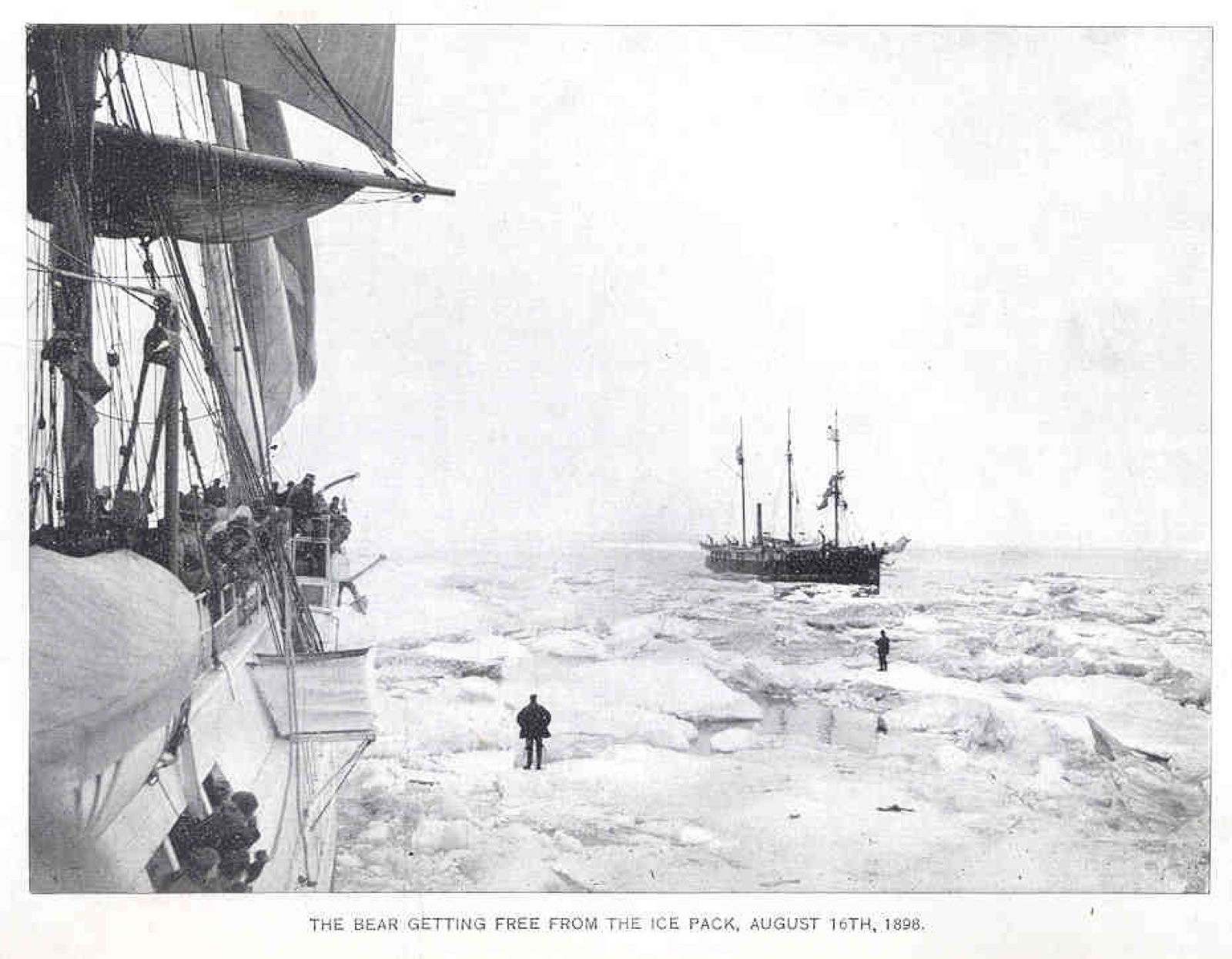
Then the government paid its debt. It took two fawning seasons to do it, which raised what was owed from 425 reindeer to 1,042, and Congress made a special appropriation of $20,000. Jarvis, who had the Bear now, bought 116 deer in Kamchatka in July 1899 to help cover it. On August 19, 1899, Lopp signed for 714 reindeer “being payment in full for the 292 reindeer borrowed by Lieut. D. H. Jarvis.” On December 2, 1899, at Point Rodney, Charlie Antisarlook signed for 328.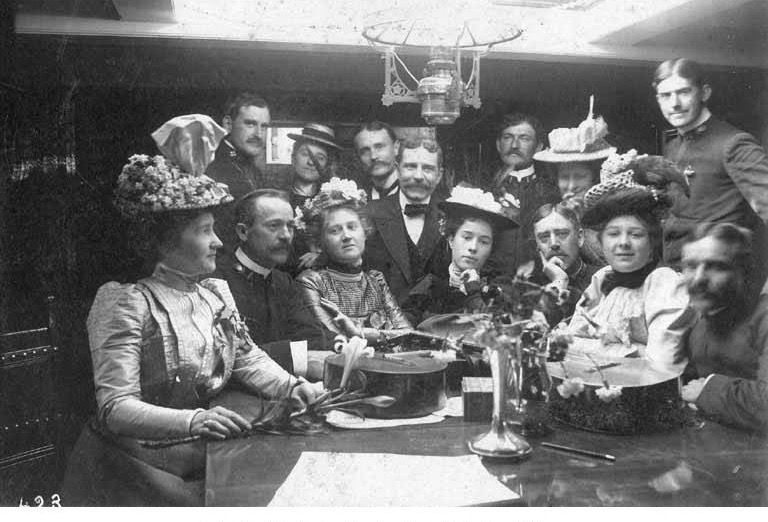
He died of measles the next summer. Mary kept the herd. There were about five hundred head in it, and she held them, against relatives and traders and officials who told her she could not, for the rest of her life.
The drive proved the first claim completely. Reindeer could live in Alaska, breed in Alaska, and be driven across Alaska in winter by Alaskans, and 382 of them could walk into a camp of starving men and end a famine. Bertholf put the sequel in one sentence: the Eskimos “were fully equal to the task.” It also proved a second thing that nobody wrote down as a result. The herds the government reached for in its emergency were not government herds. They belonged to a mission and to an Iñupiaq couple, lent on a promise, and the promise was kept, to the animal. It was the one transaction in the experiment’s history in which the government owed a Native owner, and paid him, with the increase, to the animal.
What it looked like from inside
Jackson’s annual report carried a table. “Increase from 1892 to 1899,” it was headed in the ninth report: 171, 346, 588, 891, 1,100, 1,466, 2,062, 2,837. He wrote the number into the text too, with the care of a man who knew it was the thing Congress read. “The total head surviving October 1, 1898, numbered 1,918. This number is swelled to 2,062 by the addition of 144 deer turned over from the War Department as the survivors of the herd purchased in Lapland.”
That last clause is its own experiment. In the winter of 1898 Congress gave $200,000 to relieve miners thought to be starving on the Yukon, and Jackson and Kjellmann sailed to Norway and bought 539 reindeer, 418 sleds, 511 sets of harness, and the services of 113 Sámi, Norwegians and Finns, and shipped the lot by liner to New York, by rail to Seattle, and by sailing bark to Haines, where there was no moss and the deer were fed alfalfa. They began to die on March 31. By the time 144 were handed over to the Interior Department, the Yukon miners had been found to be in no danger. Alaska could receive a reindeer from Siberia; it could not receive one from Norway by way of New Jersey. The programme could move animals across the world and lose them to the one thing it had not thought about, which was what they ate.
The count went on climbing. In 1900 it was 3,323; in 1905, 10,241; in 1908, Jackson’s last report, 19,322. He had been forced out of the education office by then, and he died in 1909. The Bureau of Education kept the table: 27,325 in 1910; 70,243 in 1915; 98,582 in 1917; 180,000 in 1920; 350,000 in 1925. Every year the number was larger than the year before, and every year the people reading it in Washington took it as the measure of the thing they had paid for.
The safeguard went first, and it went through a door Jackson had built himself. The Sámi had been hired as teachers, and their contracts gave them what the apprentices got: a loan of a hundred deer, the hundred to come back and the increase to stay. They were not Natives, so the rule that Native deer could not be sold to white men did not apply to theirs. By 1902, 68 Iñupiaq herders owned 2,841 reindeer between them, and five Sámi owned 1,150. By 1908, 171 Native owners averaged fifty-two head each and five Laplanders held 2,685. Jackson had seen it coming and made his peace with it in 1903: “it will become possible for white men to own large herds, but the men that will do the herding and teaming will always be the Eskimos and Laplanders.”
In 1914 Carl Lomen, the son of a Nome lawyer who had come north with the gold rush, bought the herd of the Sámi herder Alfred Nilima at Kotzebue Sound, 1,200 animals, with money from the man who had struck gold at Anvil Creek. The missions sold next, Golovin in 1916, then Teller. Between 1914 and 1929 the Lomens bought 14,083 reindeer for $236,156, which is about seventeen dollars a head, and they did not sell them one at a time to Natives. They built cold-storage plants at Egavik, Elephant Point, Golovin and Nome and shipped carcasses to Seattle: 624 in 1918, 9,000 in 1927, 14,500 in 1929. At Christmas 1926 they lent Macy’s a sleigh, and Santa Claus drove reindeer through Boston, San Francisco, Chicago and Seattle behind a Sámi herder named Mathis Nilluka in costume, with letters from children, which the company wrote, printed in the newspapers beforehand. Carl Lomen was called the Reindeer King. The cattlemen of the western states, who had noticed, got ordinances passed against the sale of reindeer meat.
Under the count, two things were happening that the count could not show. The first was the ground. Within two years of 1892 the lichen for three miles around Teller was gone; by 1920 the coastal strip ten miles deep was described as badly deteriorated. The lichens reindeer winter on grow about five millimetres a year and take twenty to forty years to come back after heavy grazing. The second was the bookkeeping. The herds had been organised as stock companies with shares, and the shares were credited each year with a fawn increase of fifty or sixty percent when the real increase was nearer twenty, so the number of reindeer that existed on paper pulled away from the number on the tundra, and no one had walked the ranges to find out by how much.
The Native owners knew. In 1928 four herders led by Chester Seveck formed an association to market their own meat against the Lomens, and failed. In 1929 the Secretary of the Interior appointed a committee, and in February 1931 it held hearings in Washington. No Native owner was present; they held their own meetings in Nome and sent telegrams. The Reindeer Service that was supposed to supervise all this consisted, that year, of eight civil servants, responsible for somewhere between 500,000 and 800,000 reindeer and seventy-eight Native associations with 5,878 members. Nobody could say which figure was right. In February 1932 a Philadelphia reform journal printed an article called “Eskimo Reindeer Seriously Threatened” and the Secretary received thousands of letters. By 1933 the Native owners owed the Lomen stores $45,000 in credit, and by 1935 a Lomen store would advance two dollars of goods against one deer. A herder at Wales wrote to Lopp, retired by then to Seattle: “As long as Lomen’s men are allowed to stay in the Reindeer Service the Natives will be forced to sell a deer for $2 in trade.”
The count peaked in 1932, at 641,000. A government auditor who went through the Lomen books in January 1935 reported that the family owned 250,000 reindeer “by computation.” That is the phrase. The largest herd in the experiment, in the year of its greatest success, was a number somebody had worked out.
What happened
The Bear was sold that same year, 1932, to Admiral Byrd, for $1,050, and went to the Antarctic. The experiment went to Congress.
The Reindeer Act was signed on September 1, 1937. Its first section says what the whole thing had been for: “to establish and maintain for the said natives of Alaska a self-sustaining economy by acquiring and organizing for and on behalf of said natives a reindeer industry or business … and by preserving the native character of the said industry.” The government would buy every reindeer a non-Native owned, by eminent domain if it came to that, and no Native or government deer could be sold alive to anyone but a Native again. Two million dollars was authorised. Section 11 defined “reindeer” to include any caribou that “have actually joined reindeer herds,” which was the law’s way of admitting what was by then eating the experiment from the inside.
The non-Native owners declared 500,615 reindeer. The appraisers sent out in the summer of 1938 could find about 180,000. Congress appropriated $720,000, at a ceiling of four dollars a head, and in the winter of 1939 and 1940 the roundups were held. The Lomens’ packing company, which had claimed 260,000 animals, delivered 25,000. In all, 84,001 reindeer were counted, paid for, and became Native property. For something under half a million dollars the Lomen name passed from the ranges, and the count, for the first time in forty-eight years, was a count.
It was 544,000 in 1937, on paper. It was 377,712 in 1939, 252,550 in 1940, 128,700 in 1943. In 1948 it was 32,623 and in 1950 it was 25,000. The herders’ explanations, taken down later, agree with the biologists’. The caribou came back. The Western Arctic herd, which had been nearly gone when the reindeer arrived, began to pass through the ranges in the 1930s, and the informants say the thousands of caribou “simply swallowed up the reindeer herds,” which followed them north and did not return. Wolves came with the caribou. The lichen was gone from the coast. The winter of 1938 and 1939 was severe. And there were fewer herders every year than the shares said, because herding a reindeer is a job, and the money in it had gone to Seattle.
The herd at Unalakleet had 20,000 head in the early 1940s and 700 by 1945. On the Seward Peninsula, where the first 171 had come ashore, there were 6,500 reindeer in 1951.
After
The prohibition on non-Native ownership stood for sixty years. In 1997 the Ninth Circuit, in a case brought by a man who wanted to import Canadian reindeer, read the Act as not reaching animals that had never been part of the Alaska herds, and that is where the law sits. On the Seward Peninsula there are about twenty herders and twenty thousand reindeer, in family herds of a few hundred to a few thousand, and since 1990 half of them have lost half their animals or more to the Western Arctic caribou, which number in the hundreds of thousands and still pass through.
In August 1944 the Coast Guard barged twenty-nine reindeer, twenty-four females and five males, from Nunivak Island to St. Matthew Island in the Bering Sea, as emergency food for the nineteen men of a loran station. The station closed soon after. A biologist counted 1,350 reindeer in 1957 and 6,000 in 1963; in the winter after that they starved; in 1966 there were forty-two, forty-one of them female. Every ecology textbook has the graph. The Nunivak herd had been stocked in 1920 from Golovin, and the Golovin herd was the Swedish mission’s, lent by the government in 1895 out of the deer the Bear brought from Siberia. The experiment’s one unambiguous result was produced by accident, on an island, after it was over.
Jarvis commanded the Bear himself, then left the service in 1905 to run the Guggenheims’ copper and railroad interests in Alaska, which made him a target for the territory’s politicians for years. On June 23, 1911, he shot himself at the Seattle Athletic Club. The note said, “Tired and worn out.” Call died in 1909. Bertholf ran the Revenue Cutter Service from 1911 and was its head when it became the Coast Guard in 1915. Lopp spent twenty years in the Bureau of Education in Alaska and died in Seattle in 1939, the year the Lomens were bought out. Mary Antisarlook, who was known the length of the coast as Sinrock Mary, lived until 1948.
Healy was court-martialled in 1896 on charges his own officers brought, found guilty of seven counts including “Drunkenness to the scandal of the Service,” and dropped to the bottom of the captains’ list for four years. In 1900, taking a cutter home from the Aleutians, he tried to cut his wrists. He was restored to his rank in 1902 and given a ship, retired in September 1903 at the mandatory age, and died in San Francisco the next August. “I do not steer by any man’s compass but my own,” he had told the court. Who his mother was became known in the 1970s and 1980s, long after anyone who had served with him was dead. The icebreaker it commissioned in 1999 is named for him.
The ship outlived all of them. After the Antarctic she was commissioned into the Navy again in 1939, and in October 1941, two months before Pearl Harbor, she towed into Boston a Norwegian sealer the Greenland Patrol had caught supplying a German weather station. She was decommissioned in May 1944, sold in 1948 to a Halifax owner for $5,199 who meant to send her sealing, as she had been built for in Dundee in 1874, and could not afford the refit. In 1962 a Philadelphia restaurateur bought her for a floating seafood restaurant, had a new bear carved for her bow at Mahone Bay, and on St. Patrick’s Day 1963 sent her south behind the tug Irving Birch. On the morning of March 19 the tow parted in a gale about a hundred miles south of Nova Scotia; the foremast came down and opened the hull; her two caretakers got into a rubber dinghy that a Coast Guard aircraft dropped to them and were picked up by the tug. She sank that night.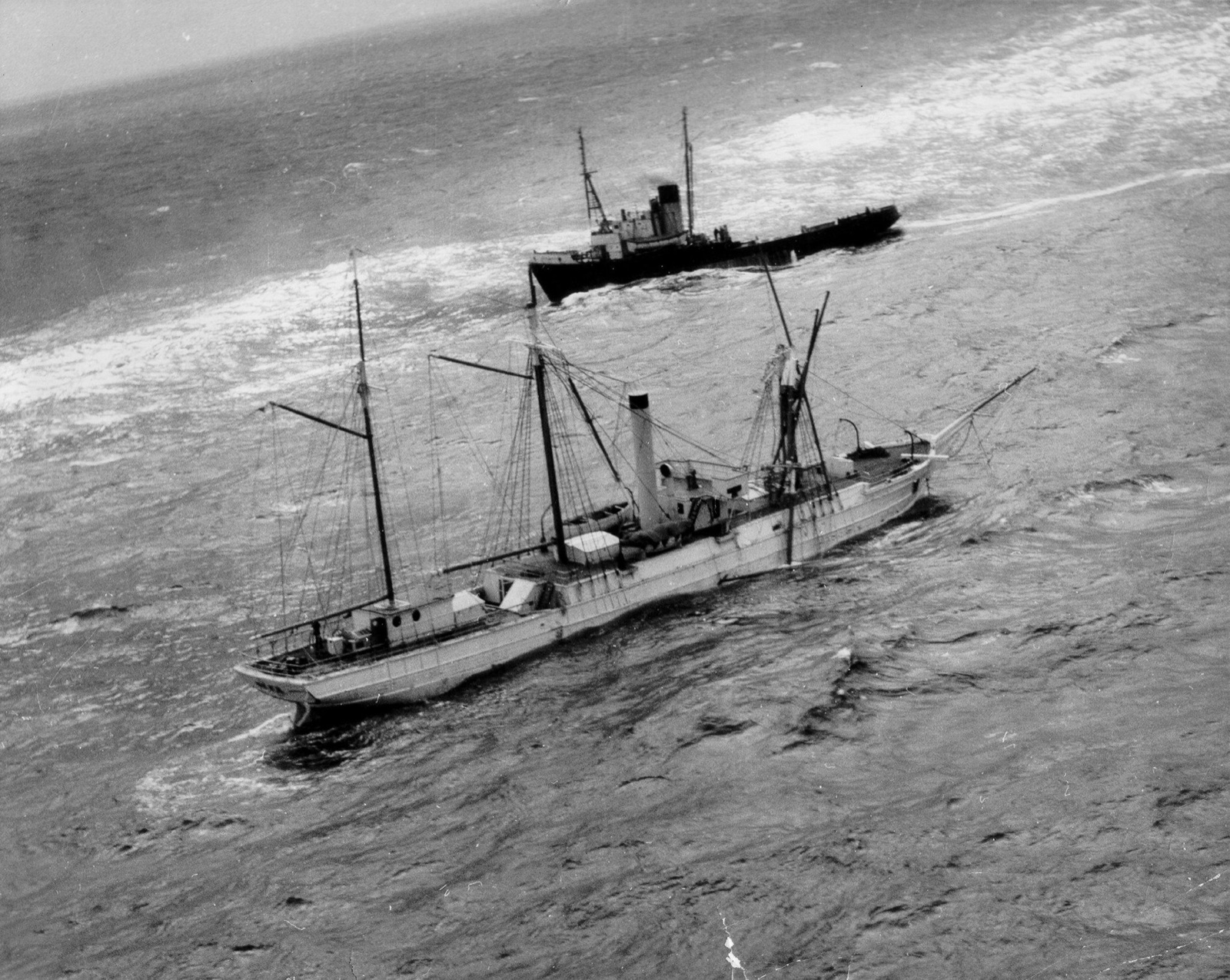
A search in 1979 with the inventor of side-scan sonar found nothing, possibly because the tug had misreported the position. In September 2019 a Coast Guard cutter named Bear mapped sixty-two square miles of seabed ninety miles south of Cape Sable and found a wooden wreck of the right length. In June 2021 a remotely operated vehicle spent thirty hours over it in two hundred feet of water. The bow was intact, with planking seven inches wide in several layers. There was no engine; the log said it had been lifted out in May 1944. There was no bell and no name. What settled it was the pattern of bolts around the stern tube, which matched a photograph taken in a drydock in 1933, when she was Byrd’s. On October 14, 2021, at a pier in Boston, with the icebreaker Healy alongside, an admiral announced that the Bear had been found.
What it taught
An experiment measures what its instrument can see. The instrument this one had was a herd count, and the herd count could answer the first question, whether reindeer would live in Alaska, so completely and so soon, with a column of numbers that never went down, that it was taken for an answer to the second question too. For forty years an experiment about whether a people would come to own a livelihood was reported as a number of animals, and because the number rose, the experiment was a success, and because the experiment was a success, nobody went to look at who owned the animals until a reform magazine and a few thousand letters made them. When they looked, the number itself turned out to be partly imaginary.
The people who ran it had named the failure. Jackson wrote in 1894 that if white men got herds the main object would be defeated, then hired the men through whom they got them. Jarvis proved in 1898 that Native herders could do anything the experts said they could not, and the lesson the Service drew was that reindeer could be driven. The proof was so good that it stopped the question.
What the drive also showed, in a receipt signed at Point Rodney, was what it looks like when someone measures the right thing: 133 reindeer borrowed, 328 returned. It happened once. The herd it made outlived its owner by half a century in the hands of his widow, which is to say that the hypothesis was true where anyone had bothered to test it. That is the part that outlives the experiment. The count is what everyone remembers.
Sources
- D. H. Jarvis, E. P. Bertholf, S. J. Call and F. Tuttle, Report of the Cruise of the U.S. Revenue Cutter Bear and the Overland Expedition for the Relief of the Whalers in the Arctic Ocean, from November 27, 1897, to September 13, 1898, Treasury Department Document 2101, 1899. The instructions, the landing, the receipts for Antisarlook’s and Lopp’s herds, the herders’ names, the accounting of 448 and 382, and every quotation from Jarvis, Call and Tuttle. archive.org
- Ellsworth P. Bertholf, “The Rescue of the Whalers: A Sled Journey of 1600 Miles in the Arctic Regions,” Harper’s New Monthly Magazine, June 1899. “Driven by Alaska natives entirely” and “fully equal to the task.” explorenorth.com
- Sheldon Jackson, Report on Introduction of Domesticated Reindeer into Alaska, Senate Ex. Doc. 70, 53rd Congress, 1894. The $2,156 appeal, the 1891 and 1892 purchases, the Teller station, the Siberian herders, the whisky, the statement of purpose, and the warning about white ownership. archive.org
- Sheldon Jackson, Eighth and Ninth Annual Reports on Introduction of Domestic Reindeer into Alaska, 1898 and 1899. The Lapland expedition, the repayment of Lopp and Antisarlook, and the table of increase from 1892 to 1899. 1898, 1899
- William McKinley, message to Congress, 17 January 1899, recommending the medals and the $2,500. presidency.ucsb.edu
- John Muir, The Cruise of the Corwin, 1917, for the 1881 voyage, St. Lawrence Island and the reindeer at Plover Bay. archive.org
- Dean F. Olson, Alaska Reindeer Herdsmen: A Study of Native Management in Transition, Institute of Social, Economic and Government Research, University of Alaska, 1969. The apprenticeship rules, the Antisarlook loan, the ownership figures, Jackson’s 1895 and 1903 remarks, the Lomen purchases, the share inflation, and the collapse. alaskool.org
- Richard O. Stern, Edward L. Arobio, Larry L. Naylor and Wayne C. Thomas, Eskimos, Reindeer, and Land, Agricultural Experiment Station Bulletin 59, University of Alaska, 1980. The annual estimates of reindeer numbers 1891 to 1977 (Table 15), the ownership shares, the Lomen company, the 1931 hearings, the 1935 audit, the Reindeer Act purchase, the range and the caribou. arlis.org
- The Reindeer Act, Public Law 75-413, 50 Stat. 900, 1 September 1937. govinfo.gov
- Williams v. Babbitt, 115 F.3d 657, Ninth Circuit, 1997. narf.org
- Jim Dau, “Managing reindeer and wildlife on Alaska’s Seward Peninsula,” Polar Research 19, 2000, for the caribou and the herds since 1990. polarresearch.net
- Ned Rozell, “When reindeer paradise turned purgatory,” Alaska Science Forum, 2003, and L. J. Palmer’s 1930 Biological Survey memorandum on Nunivak, for St. Matthew Island and where its reindeer came from. gi.alaska.edu, fws.gov
- William H. Thiesen, Coast Guard Atlantic Area Historian, background essays for the NOAA Bear expeditions, 2019 and 2021: Healy, the reindeer, Byrd, and the search. oceanexplorer.noaa.gov
- James M. O’Toole, “Racial Identity and the Case of Captain Michael Healy,” Prologue, National Archives, Fall 1997, and the Coast Guard’s Healy biography, for his birth, career, the 1896 court-martial, the 1900 breakdown, and the quotation to the court. archives.gov, history.uscg.mil
- Dictionary of American Naval Fighting Ships, “Bear,” and the Coast Guard’s “Bear, 1885,” for the ship’s purchase, the Greely rescue, the Navy years and the Buskø. history.navy.mil, history.uscg.mil
- “The Bear,” Shipbuilding and Shipping Record, June 1963, on the tow, the caretakers and the sinking. navalmarinearchive.com
- NOAA, “Wreck of famed Revenue Cutter Bear found,” 14 October 2021, and the NOAA Ocean Exploration summaries of the 2019 survey and the 2021 ROV dives, for the bolt patterns, the 1933 photograph and the announcement. noaa.gov, oceanexplorer.noaa.gov