At about five o’clock on the morning of Monday, 17 February 1969, a closed-circuit television screen in the control van on the deck of the USS Elk River, moored about 4,000 yards off the eastern shore of San Clemente Island, California, showed a man in a wetsuit 610 feet below the ship, beside a yellow cylinder the size of a railway tank car. He began to convulse. Captain George Bond, the Navy doctor who had spent twelve years arguing that men could live at that depth, was watching the screen. “I saw his body jackknifing, making a rapid motion,” he said that week. “Any time you see rapid motion in a diver, you know he’s in trouble.” The diver was Berry Cannon, a civilian electronics engineer from Panama City, Florida, aged 33. He had been in the water a few minutes. The capsule that carried him back up weighed 25,000 pounds and took more than half an hour to reach the surface, and he was dead before it got there.
Four breathing rigs had gone down in the capsule that morning. In the hurry to get Cannon up, three of them were left outside it, hanging on a line a hundred feet below as it rose. A week later the Navy announced that “one of the diving rigs in use by Sealab divers was equipped with an empty Bar-alyme canister,” and that “this could explain the tragic event.” Baralyme is the granular chemical that takes the carbon dioxide out of the gas a diver breathes out and back in. Nobody then or since has been able to say which of the four men had worn the rig that lacked it.
The cylinder he died beside was Sealab III, the third of the Navy’s experiments in living on the sea floor. The two before it had been at 193 and 205 feet. This one had been lowered to 610 in a single step, and it had leaked from the hour it arrived.
Who ran it
George Foote Bond was born on 14 November 1915 in Willoughby, Ohio, and was for years the country doctor in Bat Cave, a hamlet in the Blue Ridge Mountains of North Carolina, where he also preached. He entered the Navy in 1953, went into submarine medicine, and by 1957 was at the submarine base at New London, Connecticut, with an idea. A diver’s body takes up the gas he breathes under pressure, and the longer he stays down the longer he must take coming up, until the tissues can take up no more. After that, the decompression costs the same whether the dive lasts a day or a month, and men could live on the bottom for weeks and pay for it once.
He began testing it on the side with two men who would stay with him for twelve years. Walter Mazzone had made eight war patrols in submarines, qualified as a pharmacist after the war, and come back into the Navy’s Medical Service Corps. Robert Workman was the decompression physiologist at the Experimental Diving Unit in Washington. Under the name Genesis, in 1957 and 1958, they put guinea pigs, goats, dogs and snakes into a pressure chamber on mixtures of helium and oxygen, and paid for some of the animals and the food themselves. When the animal work was done Bond proposed extending it to men, to “offer the opportunity for development of ecological systems which would permit man, as a free agent, to live and perform useful work to depths at 600 feet, and for periods in excess of 30 days.” The proposal was rejected. What found the money in the end was the space programme, which wanted to know whether astronauts could live in helium and oxygen. In 1962 three men spent six days at surface pressure in helium and oxygen; in 1963 three men spent twelve days in a chamber at 200 feet and came up well. Mazzone’s summary of what they had been after is the plainest: “What we set out to really do was to increase bottom time without increasing the penalty of decompression.”
The sea trials followed. Sealab I, in July 1964, was a converted harbour-net float at 193 feet off Bermuda; its four men were brought up after eleven days when a storm came. Sealab II, in the late summer of 1965, was a purpose-built cylinder 57 feet long at 205 feet on the edge of the La Jolla canyon, off the Scripps Institution of Oceanography. Three teams of ten lived in it for fifteen days each, one man, the astronaut Scott Carpenter, for thirty. The men did salvage tasks, took measurements and came up. One man was treated for the bends. The report, published by the Office of Naval Research in 1967 with a foreword by the Secretary of the Navy, Paul Nitze, said that “SEALAB’s success puts us at the threshold of an expanding capability for military operations on the continental shelf where required.”
One of the twenty-eight was Berry Cannon. He had been raised in Williston, Florida, by his grandmother, served four years in the Navy as a mineman, taken a degree in electronic engineering at the University of Florida in 1962, and gone to the Navy Mine Defense Laboratory at Panama City. The Sealab II report gives him two lines: “Mr. Cannon, 30, is a Navy veteran. He is presently an Electronics Engineer at the U.S. Navy Mine Defense Laboratory, Panama City, Florida.” He wrote one chapter of the report, on a breathing system for divers, with three colleagues from the laboratory. One of the three was Paul A. Wells, a chief torpedoman who had been wounded as a Marine in the Second World War. Cannon’s own diving log for 1967 and 1968 survives, a notebook of cave dives at Wakulla Springs and test dives off Panama City, kept in capitals. Its first entry, for a dive to 200 feet on 8 July 1967, ends: “No top at all, got cold.”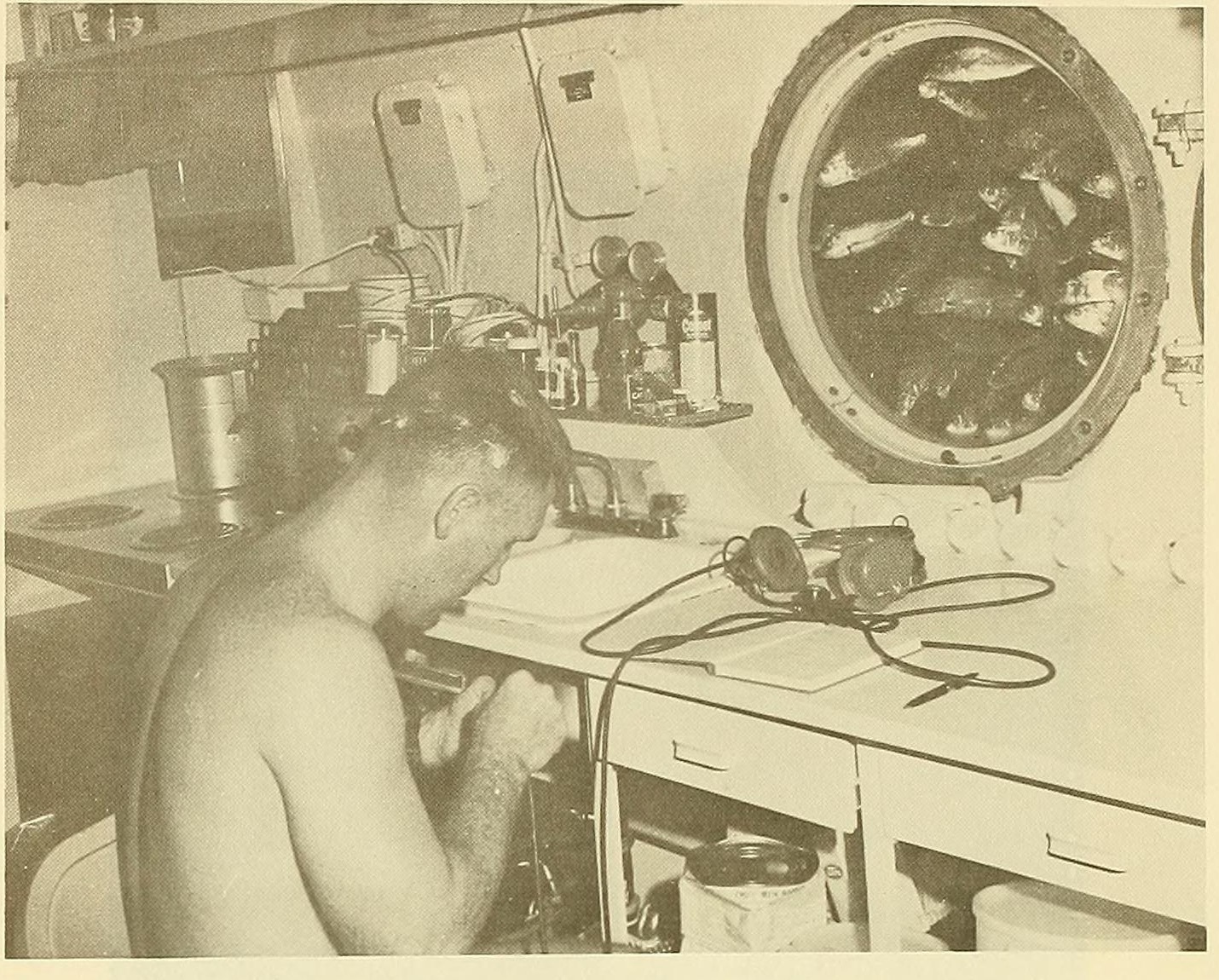
After Sealab II the programme changed hands. The submarine Thresher had been lost in 1963, and the Navy had set up a Deep Submergence Systems Project to build the means of reaching and rescuing a sunken submarine and of recovering things from the deep sea floor. Its chief scientist was John Piña Craven, who had been chief scientist of the Polaris missile programme. In September 1965 a telephone call from the Pentagon told Craven that the Man-in-the-Sea programme and its Sealabs were now his. On 9 February 1966 the project was made a separate command under the Chief of Naval Material and given the requirement to carry out a Sealab III. Craven wrote long afterwards that among the people involved in Sealab II he alone knew that Sealab III “was to be a cover for the top secret development of an operational saturation diving capability for intelligence purposes.”
The money was now of a different order. Mazzone remembered it: “there was more money then they knew what to do with. That was part of the problem.” Bond stayed as principal investigator and senior medical officer, but the project was managed from Washington by Captain William M. Nicholson, the project manager of the Deep Submergence Systems Project, and at sea by a master diver, Commander Jackson M. Tomsky, as on-scene commander, with Carpenter as his deputy. Bond, in the journal he kept through the project and later published, counted “the thousand-odd people involved with the new experiment,” and noted that only he and Mazzone among the naval officers had any experience of a habitat or of saturation diving. His own part he described as “an observer, chronicler, and occasional adviser to the project.” Mazzone put it more carefully: “the control shifted from the medical people that were doing it to the operational people because it was going operational.”
What they were trying to find out
The stated question was whether men could live on the continental shelf at 600 feet, go out to work in water at 47 degrees Fahrenheit, and come back, for two months at a stretch: five teams of nine, twelve days each. The work was to be real: the Supervisor of Salvage had a list of lifting pontoons, explosive studs and power tools to be tried from the habitat by Team 2, and the oceanographers had their own list. Sealab III had been announced in 1967 as a sixty-day project at 430 feet. As it slipped, the depth was raised, to 600 feet.
Behind the stated question were two claims, and they were not equally untested. The first was physiological: that a man saturated with helium at 600 feet could think, work and be brought up. That had been tried in chambers. Between 1966 and 1968 the Experimental Diving Unit ran twenty-three saturation dives from 200 to 850 feet, with seventy-one divers on ninety-seven man-dives and seventy-four excursions, one of them to 1,025 feet, then a record. The project’s doctors took “over 25,000 biomedical observations and measurements” on fourteen of those dives. There were eight cases of decompression sickness. A decompression schedule from 600 feet was “developed and found to be safe for use during SEALAB III.” At 1,000 feet the doctors saw a tremor in the diver that he did not notice himself; nobody yet had a name for it. But claim one was, by February 1969, mostly settled.
The second claim was that the apparatus could deliver men to that depth and keep them alive while they worked: the habitat, the ship over it, the capsule between them, the umbilicals, the rigs they would breathe from, the suits that would keep the cold out. This was the claim nobody had tested at 600 feet, because there was nowhere to test it but 600 feet. Bond had written in 1967 that “the lack of adequate breathing apparatus becomes more crucial as greater depths are reached,” and that at the depths now planned “it appears a closed system will be needed.” Mazzone was blunter afterwards: “We went to 600 feet. We were not being assured that the technology was there. We had no hot water suits that really worked. We had no way to keep the diver warm.”
Craven’s purpose was a third claim, and it was never written on the project. If the open experiment proved the method, the Navy would have a way to put divers on the sea floor from a submarine, for as long as it liked, where nobody could see them.
What they built
The habitat was Sealab II’s hull made over. Two rooms were welded beneath it, one a diving station and one for stores, so that it would float off the bottom on its own buoyancy, settle level, and then be held down by a frame with a third ballast tank in it. The main entrance was a hatch four feet square in the floor of the diving station, opening inward into a room whose air was kept a little above the pressure of the sea outside, so that the water stood at the bottom of a skirt beneath it. Inside were laboratory benches, a galley, berths and a bathroom. The atmosphere was to be about 95 percent helium, 3.5 percent nitrogen and 1.5 percent oxygen, which at nineteen and a half atmospheres gives a man a little more oxygen than air does at the surface. A main umbilical from the ship brought 440-volt power, compressed air, breathing gas, water and communications, and ran to a set of penetrators through the hull under a cover plate on one side.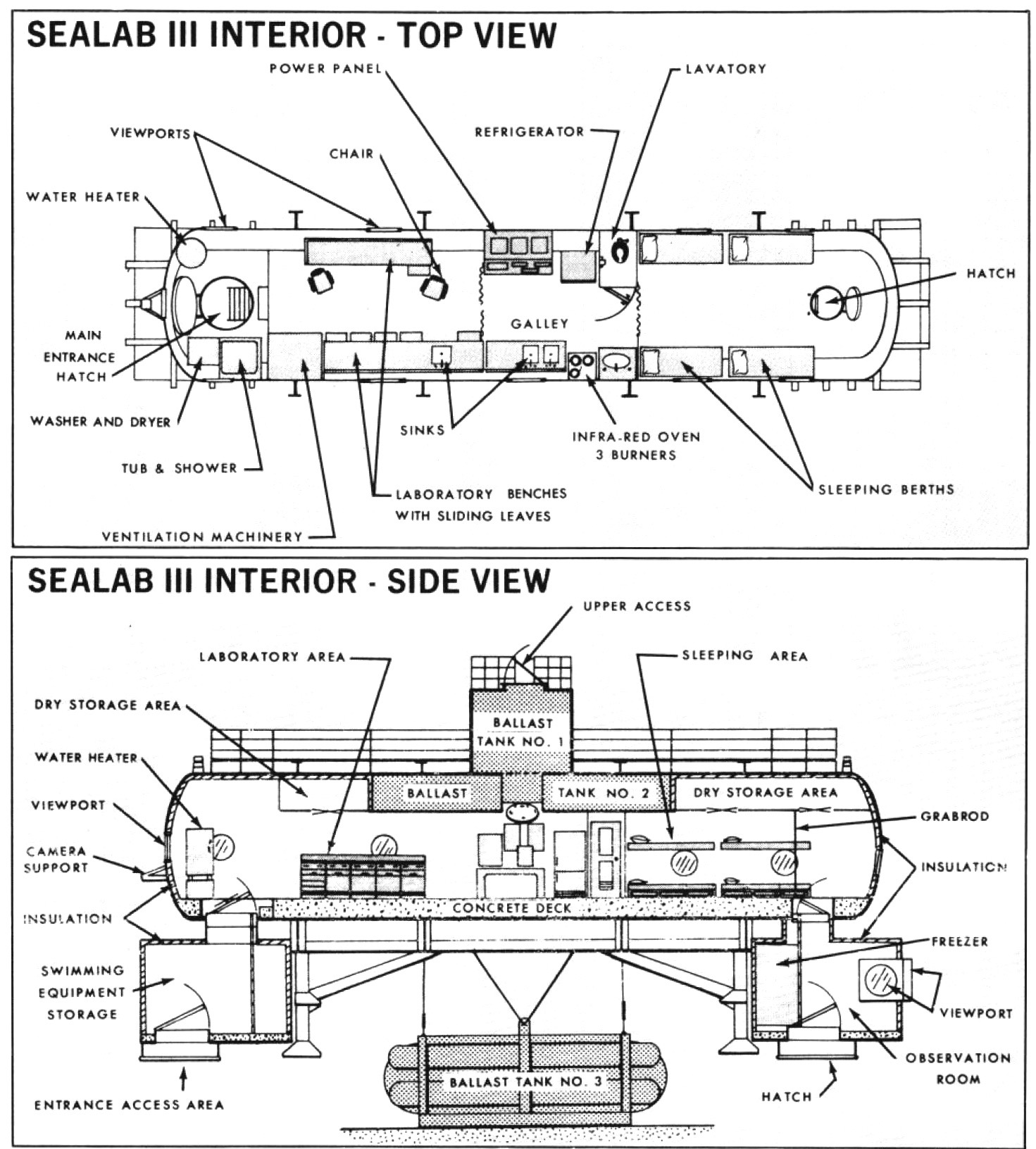
Over it, instead of Sealab II’s barges, was a ship. The Elk River was a landing ship of the Second World War cut open amidships to make a well, with a gantry over the well and, on deck, a pair of deck decompression chambers to which a pair of personnel transfer capsules could be mated. The capsule was a steel sphere with a hatch in the bottom, a scrubber, a heater, bottles of gas outside and a cage above for the gantry’s latching dogs. Men pressurised in a deck chamber to the pressure of the bottom would step into a capsule at that pressure, be lowered on a cable to within sixty feet of the habitat, swim across, and be brought up the same way weeks later to decompress on deck. This was the Mark II Deep Diving System, built by the project with the Navy’s Supervisor of Salvage.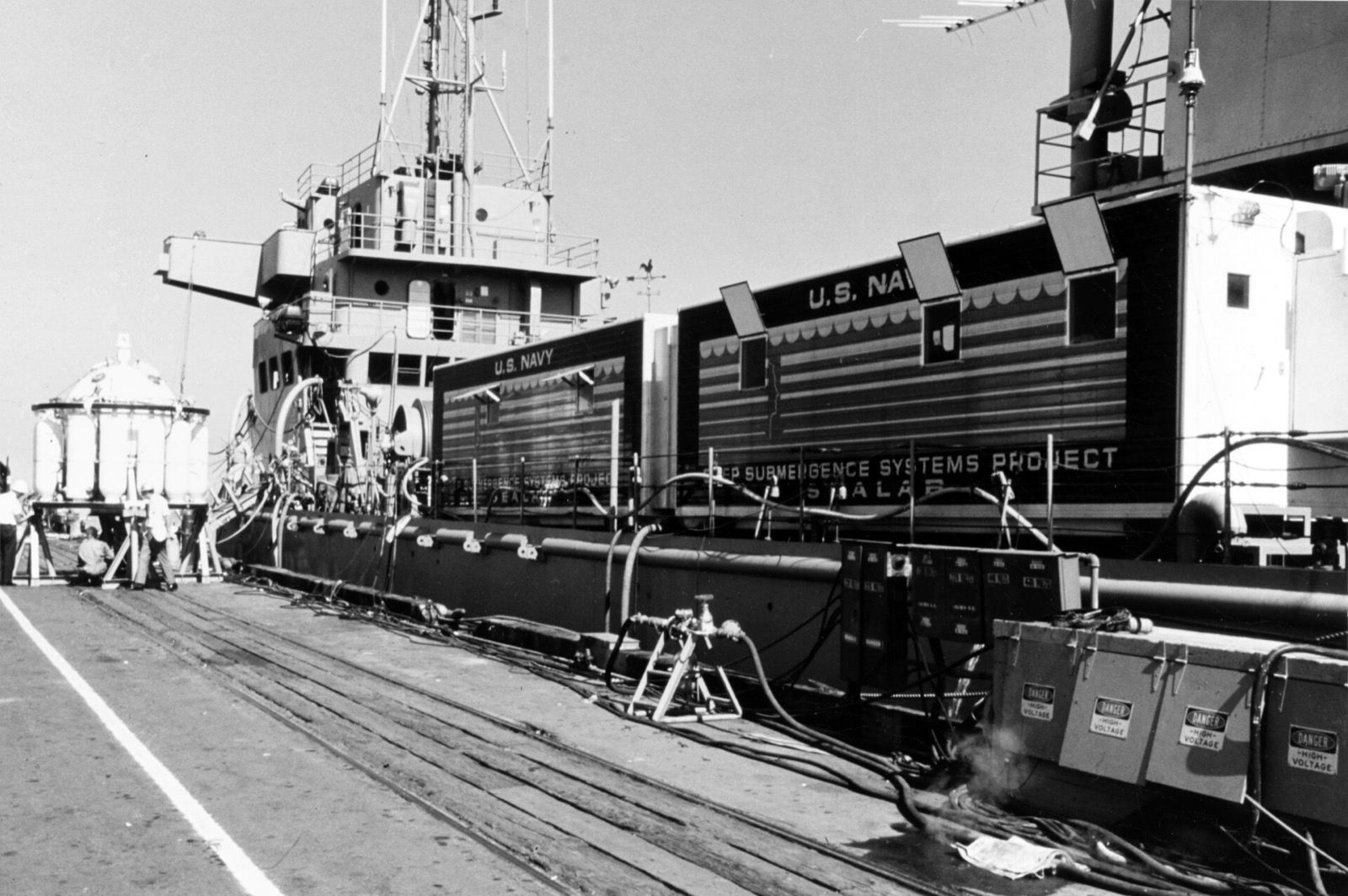
The divers would breathe from a rig called the Mark VIII, a semi-closed apparatus in which a trickle of fresh gas is metered into a bag, the diver breathes from the bag and back into it through a canister of Baralyme, and the surplus bubbles off. From the habitat the Mark VIII would be fed by an umbilical carrying gas, hot water and electricity, which the Navy’s own engineers reported in 1970 was still not reliable or durable enough. For use from the capsule the rig was modified into a self-contained version, the Mark IX, with its own gas and a by-pass the diver pressed when the bag ran short. There was no full-face mask that would seal against it, so the men would use an ordinary mask and a bite mouthpiece, and there would be no voice link between a diver in the water and anybody at all.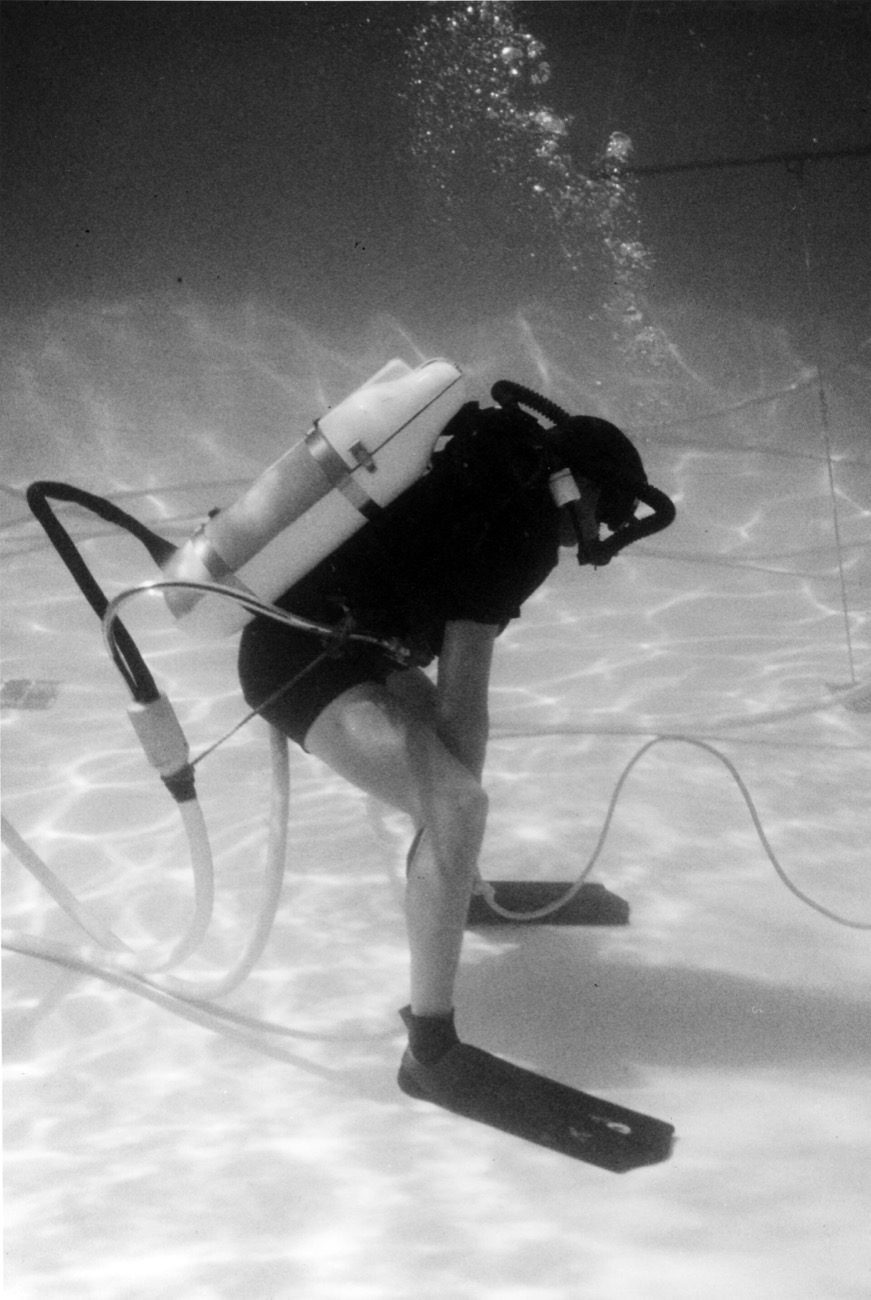
The cold was the other problem. Helium carries heat away from the body about six times as fast as air, and at 610 feet there is eighteen and a half times as much of it in every breath. The project had ordered electrically heated wetsuits and suits warmed by hot water pumped down from the surface, and Bond had written that both would be tried. In-water training with the rigs had gone no deeper than seventy feet. Sixty men trained; forty-five were assigned to five teams.
The habitat took two years longer than planned. There was a steel strike; then some of the steel delivered proved brittle in the cold; then, after the Apollo fire, the oxygen system was redesigned. In August 1968 the habitat was craned onto a lighter at the San Francisco Naval Shipyard, and in September it was tested submerged in a dry dock there. Mazzone, who knew where every valve was, remembered that test: “They made a dive with it in the dry dock and flooded the chamber because they forgot that behind the hatch was a valve that was left open. But nobody wants to say, ‘Well that valve was open. For some reason it leaked.’” Nicholson said thirty years later: “When we tested it, we tested it with air because we were running on a very tight budget.” By late October the habitat was floating off San Clemente Island, tied alongside the Elk River, and the schedule had gone through Thanksgiving, Christmas and New Year. On 1 December a representative of the project flew out from Washington to look at it.
The capsules were worse. In November one of them could not be certified because of electrical grounds and flooded batteries and cables. A few days later the other flooded on its only test dive to 590 feet, which ruined everything electrical inside it; an officer of the project concluded that a valve had been set wrong and that whoever had done it had kept quiet. There was no time to repair it before the deployment, and the project decided to go on with one capsule, patched: its scrubber now blew cold helium straight at the men inside, because the deflectors had not been put back, and its heater did not work. On 12 February, during a training dive with the second capsule, two of the three latching dogs failed to engage as the gantry took the load, the capsule dropped several feet, the 2,500-pound clump weight beneath it broke away and fell 610 feet to the bottom, and two men inside were thrown about and bruised. On 13 February the habitat’s umbilical had to be taken off its reel and laid out on a barge, because the reel had no slip rings and nobody had noticed until the Sunday before. The project office in Washington had already set the date. The habitat would go down on 15 February.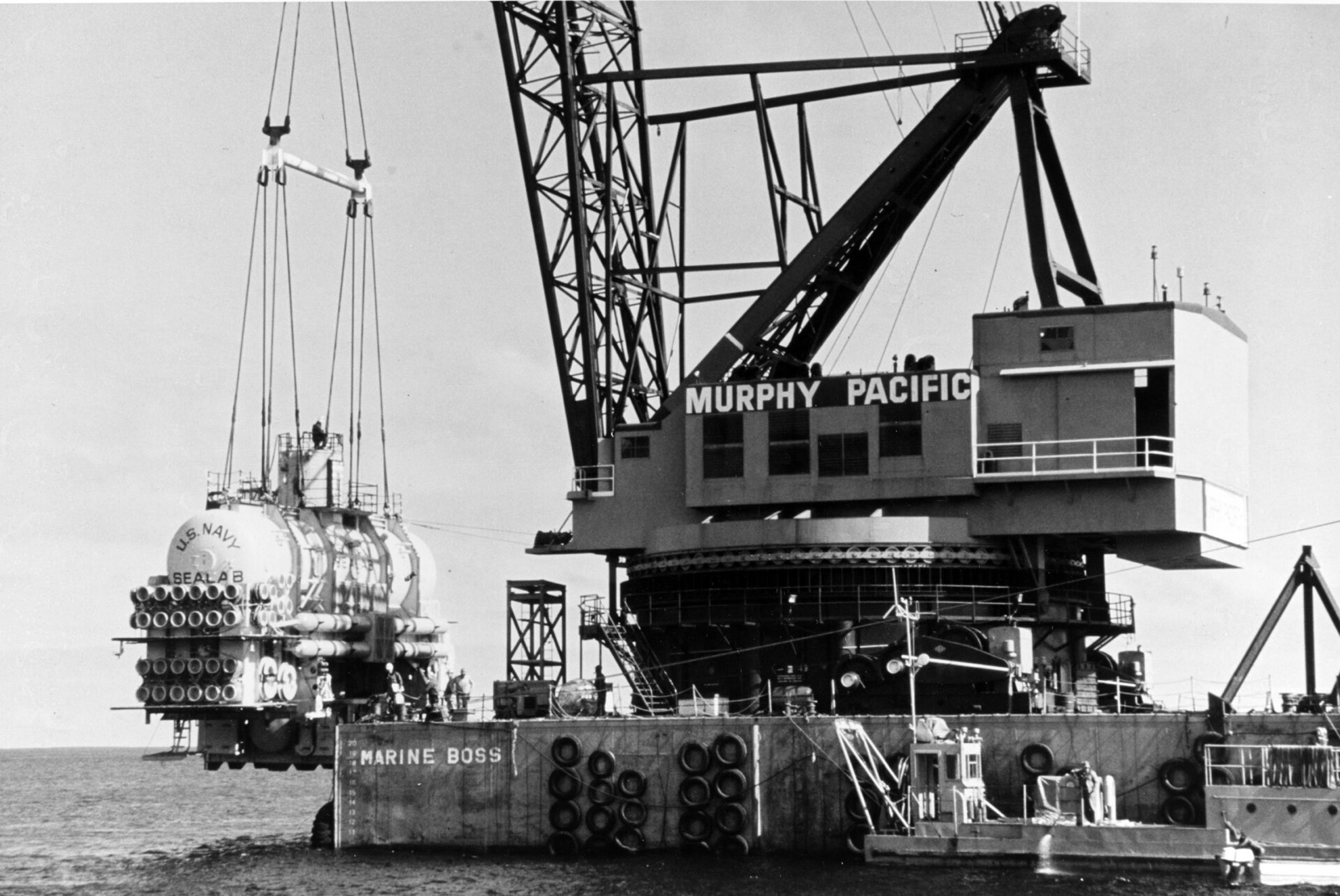
Six hundred and ten feet
Before the lowering the habitat was submerged with its interior pressurised to 12 pounds per square inch, and several gas leaks were seen. Tomsky judged them minor and not enough to stop. The habitat was ballasted down on Saturday 15 February to a bottom 610 feet below the ship, where the water was 47 degrees Fahrenheit. The two senior aquanauts of Team 1, Barth and Cannon, with two others, Richard Blackburn, an aviation ordnanceman, and John Reaves, a photographer’s mate, were put into one deck chamber and compressed to the pressure of the bottom in about four hours. The other five, who would follow once the habitat was open, were compressed in the second chamber over fifteen.
On the bottom the habitat began to lose helium faster than anyone had planned for. The loss rose to about 3,000 cubic feet an hour at the surface. A gas that leaks at a given rate at the bottom comes out eighteen and a half times larger at the top, and on the surface the jackets of the instrument cables split as helium that had got into them through the penetrators expanded. The Westinghouse submersible Deepstar 4000 was on site to look at the habitat, and Carpenter, riding in it as observer, reported seven streams of gas coming from the cable penetrators. To keep the sea out of the habitat its interior was raised to four, then six, pounds per square inch above the pressure outside. The ground-fault alarms on the 440-volt main cable began to sound; the engineers isolating circuits on the ship concluded that the fault was in the capsule or the habitat. There is a difference between an instrument that measures a thing and an instrument that only says a thing has happened. The leak rate was a measurement; the ground-fault alarm was only a bell, and there was no breaker behind it.
The habitat had gone down empty, so the first men in had to open the hatch from outside. The procedures described an equalising line from each lower room to its skirt, so that the pressure inside and out would be the same when a diver came to the hatch. In practice the gas being pumped in to replace the leaks was more than the line could pass.
On Sunday 16 February the four went down in the one working capsule. The descent took about two hours instead of the thirty minutes planned. The capsule’s fan blew cold helium on them all the way. Blackburn, remembering it fifty years later: “The bell had absolutely no heat in it whatsoever.” On the bottom Barth and Cannon opened the hatch in the floor, connected their umbilicals to the Mark IX rigs kept inside, and went out. Cannon flooded the last ballast tank and released the clamps on the levelling cables, so that the habitat was settled and fixed. He was out thirteen minutes. When he came back into the capsule his teeth were chattering and he was breathing very hard; what he said, by Blackburn’s account, was “Cold. Very Cold.” Barth swam into the skirt beneath the diving station and pulled at a hatch that weighed 150 pounds and was held shut by the pressure inside it, at four pounds per square inch over the whole of a four-foot square, with a force of about four and a half tons. On the ship a television camera was looking at the gauge that showed the difference. Keith Moore, a diver standing watch in the gas shack with his hand on the valve that fed air into the habitat, understood what was holding the hatch and asked Tomsky three times for leave to throttle the flow and let the leaks bleed the pressure down. He was told each time to hold pressure. Barth came back to the capsule, by his own account “dizzy, weak, about to pass out and in need of assistance,” after less than fifteen minutes. Nobody in the water could speak to the capsule, and nobody in the capsule could speak to the diver.
The capsule was hauled up and mated to the deck chamber, and the four went back inside to get warm. Blackburn wrote a note for Wells, who ran the diving locker, to go up with the rigs: the breathing resistance was bad, and the inlet hose had a stiffener in it. “That is a small hole to have to suck through at 600 feet.” Wells and Moore refilled and reloaded the four Mark IX rigs and Moore carried them back to the capsule. He is certain to this day that none of them was light.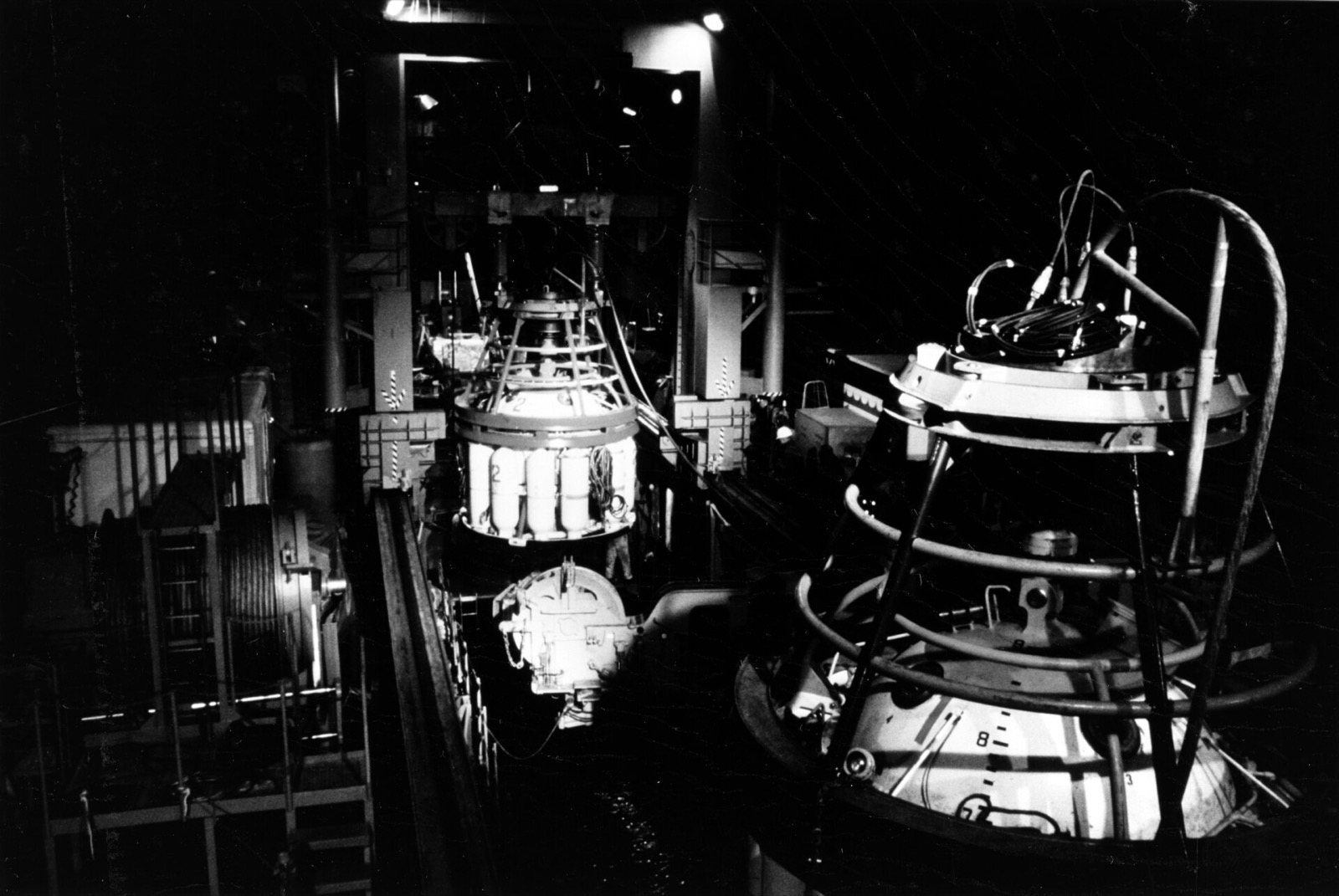
The second dive
They were asked to go again about four hours after they had come up, with an hour’s sleep. The habitat was losing gas at a rate that would soon be unsupportable and the sea was coming in; the flood alarm in the lower room had sounded at six inches of water when the interior pressure dipped, and the pressure had been put back up to six pounds, which made the hatch heavier still. Carpenter argued for more rest and was overruled. Mazzone wanted Barth and Cannon to go out again, as the two who had trained to open the habitat, and Barth, by Hellwarth’s account, told the commanders his men were in good shape. By the accounts the divers gave Kevin Hardy half a century later, they were given amphetamines to keep them awake. Barth put a jumper under his hot-water suit and a neoprene hood and gloves on; Cannon wore a hot-water suit with nothing under it and no gloves and no hood. A makeshift system had been rigged to pump hot water into the suits, and on the bottom it failed. The two decided to go anyway. “I made the choice,” Barth said, “to get back down and get done with what we were trying to or we would lose the habitat.”
The capsule reached the bottom at about four in the morning of 17 February. Barth went to the hatch and pulled against six and nine-tenths tons. Cannon’s job this time was to look at the leaking penetrators and the umbilical connections on the side of the habitat, in the dark, under the cover plate, in a curtain of bubbles. In the capsule Blackburn and Reaves heard what they describe as a scream through the water. On the screens in the van the men watching saw Cannon jackknife and his mouthpiece come out. He settled on the bottom a few feet from Barth, who got to him, tried to force the buddy-breathing mouthpiece between his teeth and could not, because his jaws were clenched, and started to tow him toward the capsule. Barth has said that if it had been twenty feet farther he would not have reached it. Blackburn came out, met them, found the teeth locked, and brought Cannon in. The dive had lasted, by Hardy’s reconstruction from the logs, about seven minutes. Three rigs were left outside. The capsule went up at once and took more than half an hour. The doctor for Team 1, Lieutenant Commander James Vorosmarti, was in the other deck chamber with the five, and could not be moved across to the three, because the second capsule was the one that did not work.
The habitat was on the bottom, losing gas, and eight men in two chambers on deck would need about a week to come up. Craven, who had arrived by seaplane that day, was the senior officer present. By his account the helium ran out within hours, a winch on the barge was rigged to the habitat’s own lifting cable, and late that night the Deepstar, watching from below, called “She’s broken free!” The habitat was lifted to a hundred feet, blown, and surfaced. That night, and the week of decompression that followed, in which a valve on the divers’ oxygen would not stay shut, are in The open valve. Nicholson had already given a press conference at noon on the island. “We could tell he was in trouble but we couldn’t tell what kind,” he said. The Navy’s doctors said they believed Cannon had died of cardiac arrest. All Sealab diving was suspended.
What it looked like from inside
What the divers remember is the cold and the breathing. Barth, on the helium: “Colder than hell. You’re breathing helium and your body is permeated with helium.” Blackburn, who wore a three-eighths-inch wetsuit he had ordered for himself, has said the four of them had never been so cold, and that in the capsule their faces were so cold they could hardly speak. On a rig like the Mark IX, he explained, the diver’s own lungs push the gas round the circuit and through the chemical, and the least resistance in a hose “will have a devastating effect on the diver.” After the first dive, in his words, Barth and Cannon “had such a hard time breathing and both had mental problems.”
What the control van saw was a pressure gauge and a man who could not open a door. Bond and Mazzone were trying to tell Tomsky what Moore had told him. None of them could speak to Barth.
What the aquanauts have said since, in the plainest terms, is that the normal rules of diving had been set aside for the schedule. Blackburn: “If we had adhered to normal, accepted and approved diving practices, the first dive probably would not have been made, let alone the second one.” At the hearing a month later he told the board that “we were all pushed to the point where mistakes were inevitable,” and that “it is a horrible thing for a man to have to die to slow this outfit down.” James Osborn, the engineer of Team 3, said many years later that if the habitat had been opened and the dives gone ahead, “there would have been deaths,” because the men had had almost no training in the habitat itself and no protection against the cold that would have worked.
Mazzone, asked in 2000 to tell what had happened, would not. “I can’t even talk about that part. I know what happened and I can’t tell it.” He said this much: “It resulted in a couple of us getting letters of reprimand. Mine was because I allowed the divers to go separately. Well I didn’t allow the divers to go separately. I gave them instructions before they left the deck decompression chamber to go down, but each did his own thing.” And this: “It was an accident that never should have happened. There were two people on the outside and one on the inside that didn’t check the canister. And I wasn’t even there. I was in bed.”
What happened
On 24 February the project’s officers reported that an empty chemical canister had been found aboard the Elk River, and the coroner said that the final autopsy showed Cannon had died of carbon dioxide poisoning; Time reported “a greatly excessive” amount of carbon dioxide in his blood. On 26 February, in San Diego, a board of investigation of three officers opened, headed by the commander of the Naval Weapons Laboratory; its members, by the divers’ account, were Captain John D. Chase, a medical officer, Captain Tor Richter, and Commander William R. Liebold. In the same weeks, also in San Diego, a court of inquiry was taking evidence on the surrender of the Pueblo to North Korea. The same day a Florida congressman, Robert Sikes, put the Panama City newspaper’s editorial into the Congressional Record. It said he had been buried “with the final salute at the brink of the grave,” that “he was doing his job. He was doing it well,” and that the experiment should go on “without undue delay.” The men who had been in the water with him were still in the chambers when he was buried.
The board sat for seventeen days by the newspaper’s count, fourteen by Hellwarth’s, partly in closed session. The parties named to it were Tomsky, as commander, and Wells, as the chief who had certified the rigs; Bond asked to be named too, and was. It heard that the empty rig also had a hole in its breathing hose, and from the project’s communications officer that the videotape of the dive could not show which of the four rigs Cannon had worn. Wells’s counsel argued that an alarm system which had sounded when Cannon was in trouble could have put a shock into the water. The San Diego press reported that Bond, giving evidence, was shaken several times. On Wednesday 12 March the board closed, in the words of the Long Beach paper, “without establishing whether he was the one who wore a defective breathing rig on the fatal dive,” and sent its findings to the Chief of Naval Material in Washington for release “in three weeks to a month.” What it heard about the rigs, and what has been argued since, is in Four rigs.
What came out of Washington was carbon dioxide poisoning as the official cause, and letters of reprimand. Craven’s account is that they went to Tomsky and to Wells, and that both men left the Navy; Mazzone received one as well. Craven and Tomsky had sat up on the night of the salvage and agreed “that there had to have been multiple acts of sabotage.” Craven took what he had to the Office of Naval Intelligence, which “reported that there was insufficient evidence for concluding that sabotage had played any role in the SeaLab disaster,” and he has written since that many in the Navy felt a finding of sabotage, in the month of the Pueblo inquiry, would have been one embarrassment too many. Wells, by every account the divers have given since, was the most meticulous man in the project. Bond wrote in his journal: “Not one of us believed that Paul Wells would ever load an empty canister into a Mk IX rig.” Barth: “We lost two good divers that day, Berry Cannon and Paul Wells.”
In an interview published on 17 March, Nicholson called the dive “a simple process” and the death “a perfect example of Murphy’s Law,” said that “the mishap could have happened at 60 feet as easily as 600 feet,” and compared the cold to gulping air on a ski slope. The Los Angeles Times ran a piece on 23 March headed “Sealab Tragedy: Despite Navy Inquiry, a Host of Questions.” In April the New York Times reported from the Virgin Islands, where four civilian aquanauts had just spent sixty days at 42 feet in a habitat called Tektite, that the Navy’s ten-million-dollar project “had been stalled by the mysterious death of an aquanaut two months ago,” and that the delay would be a year at least. That summer the Experimental Diving Unit and Duke University ran a fourteen-day chamber dive to 600 feet with five men in a refrigerated wet pot, to test how they stood the cold in Navy equipment and, as a North Carolina congressman told the House on 15 July, “to simulate the conditions existing at the time of the death of Aquanaut Berry Cannon.” “The exact cause of his death,” he said, “has never been determined.”
After
Sealab III was never put down again. The habitat was lifted onto a barge and taken ashore, and by the end of 1970 the Navy had closed the programme, and the aquanauts were sent to Panama City. In October 1971 the Deputy Chief of Naval Material signed the order for the habitat’s disposal: “Final disposal instructions shall prohibit its use as a pressure vessel or display.” It was stripped and cut up for scrap. One of its domed end bells turned up in a San Francisco scrapyard in 1991, where a Sealab II aquanaut, Bob Sheats, recognised it; it has been on display at the Naval Undersea Museum at Keyport, Washington, since 2001.
The method survived the experiment, as Craven had intended. The Elk River and its Mark II system were worked up and certified over the following years and became the Navy’s school for saturation divers. The capability went into the black: saturation divers working from the submarines Halibut and Seawolf tapped Soviet cables on the sea floor through the 1970s, and Tomsky, Craven says, was called back from retirement to help start it, one of five retired officers then on active duty and the only one with a letter of reprimand. The civilian science went to other habitats, beginning with Tektite.
Bond died in 1983. The Experimental Diving Unit had named its ocean simulation chamber for him in 1974. Mazzone left the Navy in 1970, worked another thirty years in ocean engineering, and died in 2014. Barth, who had been a subject in the Genesis chambers and an aquanaut in all three Sealabs, died on 26 March 2020. The Berry L. Cannon Memorial Aquarium was dedicated at Crystal River, Florida, in 1970 and became part of a school district’s marine science station.
In 2024 Kevin Hardy, an ocean engineer who had spent forty years at Scripps, published the aquanauts’ own account of the two dives in the Journal of Diving History, built on the logs of the project’s engineers, with a foreword signed by eleven surviving aquanauts asking for Wells’s exoneration. Hardy’s conclusion is that “there is greater evidence that Berry Cannon died from electrocution than CO2 poisoning.” In 2025 he asked the National Archives for the board’s report and the transcripts. The reply was that the Archives’ records of boards of inquiry end in 1953.
What it taught
Start with what it was not. It was not a failure of the physiology; the chamber dives had shown that men could be taken to 600 feet and back, and the Navy went on doing it. It was not the failure of one chief; three of the four rigs spent half an hour on a line outside the capsule, and nobody could say whose the empty one had been. And it was not a secret. The leaks were seen before the lowering, from the Deepstar after it, in the ground-fault alarms, and in the gauge on the television screen.
A leap is not a step. Every system in Sealab III had been proven at 205 feet or in a chamber, and almost none of it had been tried in the sea at 610. Helium that seeped through gaskets at seven atmospheres poured through penetrators at nineteen. A hatch that opened easily in a dry dock was held shut by four and a half tons once the leaks had to be fought with pressure. A rig never breathed below sixty feet was breathed at 610, through gas eighteen times as dense. Genesis had gone from one atmosphere to 100 feet to 200, and Sealab from 193 feet to 205; the project tripled the depth in one go because the money and the calendar said it could. Mazzone’s image for it was a man who starts to run before he has remembered to bring his legs: “When you were walking and then moving a little faster it was great. But when you started to run before you realized that you had to take your legs with you, there were problems.” The place an experiment goes wrong is the range it has not been tested in, and this one had moved its whole operation into that range at once.
A fix for one fault can lock the door on the next. Raising the pressure inside the habitat kept the sea out, which was right. It also made the only entrance impossible to open, which nobody had written down. The man with his hand on the valve understood it and asked three times; the man with the authority told him to hold pressure. When the instrument and the rule disagree, somebody has to be allowed to believe the instrument. Nobody on the Elk River that weekend had been given that permission.
The checklist covered the rig on the bench, not the rig in use. Wells’s canisters were filled and certified, and everyone who worked with him believed the certificate. What the checklist could not cover was a rig that had been modified late, tested at no depth, breathed through a stiffened hose by a man who had been awake for a day and was colder than he had ever been, and then left hanging in the sea for half an hour where its chemical could wash out. The board looked for the one line on the checklist that had been missed. It did not ask whether the checklist described the dive.
One man’s name is the cheapest finding. The programme ended with a reprimand to a chief, a reprimand to the commander who had told the man at the valve to hold pressure, and a reprimand to Mazzone, who had been in bed. The questions the aquanauts had, about the schedule, the cold, the untested rigs and the unbroken circuit, were not findings and did not have to be answered. Hardy’s remark is fair: it is absurd to suppose that one unfilled canister could have sunk the whole of the Navy’s Man-in-the-Sea programme. The canister did not end it. It was the explanation that let it end.
Check the story before you learn from it. The depth is 600 feet in Craven and the first wire reports, 610 in the Navy’s announcements and the coroner’s, and 620 in a Navy caption written before the lowering. Time put Cannon in the capsule with “two companions”; the Navy, the divers and the board had four men in it; Craven remembered two going out and four staying in. The second dive lasted seven minutes by the engineers’ log; the documentary has the capsule on the bottom at about four, and the wire report has Cannon stricken at five. The cost was ten million dollars in the New York Times and fifteen in the aquanauts’ account. The cause of death was a heart attack on the Monday, carbon dioxide a week later, and never determined by July. What the record supports without argument is that a habitat leaking helium was sent down on a date fixed in Washington, that four cold men were sent twice to open a hatch that the pressure held shut, that one of them died in sight of a television camera and out of reach of a voice, and that the one thing found afterward was the one thing that could be blamed on a single pair of hands.
Sources
- Sealab I Project Group (H. A. O’Neal, G. F. Bond, R. E. Lanphear and T. Odum), Project Sealab Summary Report: An Experimental Eleven-Day Undersea Saturation Dive at 193 Feet, Office of Naval Research report ACR-108, 14 June 1965. Sealab I’s depth, crew and duration. archive.org
- Sealab II Project Group, D. C. Pauli and G. P. Clapper, editors, Project Sealab Report: An Experimental 45-Day Undersea Saturation Dive at 205 Feet, Office of Naval Research report ACR-124, 1967. Nitze’s foreword, the Sealab II teams and dates, Cannon’s biography (chapter 24) and the Arawak chapter he wrote with Wells (chapter 14), and figure 8, used above. archive.org
- Mark E. Bradley, James Vorosmarti, Paul G. Linaweaver and Walter F. Mazzone, Results of Physiologic Studies Conducted During Chamber Saturation Dives from 200 Feet to 825 Feet: A Preliminary Report, Deep Submergence Systems Project Technical Office, Research Report 1-68, 1 May 1968. The fourteen chamber dives of February 1967 to May 1968 and the 25,000 observations. archive.org
- J. K. Summitt and J. W. Kulig, Saturation Dives, with Excursions, for the Development of a Decompression Schedule for Use During SEALAB III, Navy Experimental Diving Unit Research Report 9-70, 23 September 1970. The twenty-three dives, seventy-one divers, the 1,025-foot excursion, the eight cases of decompression illness, the 600-foot schedule, and the history of Genesis and the Deep Submergence Systems Project’s assignment of 9 February 1966. archive.org
- John J. Bayles, Salvage Work Projects, SEALAB III, Naval Civil Engineering Laboratory Technical Report R-684, June 1970, and John J. Bayles and Douglas Taylor, Aquanauts’ Composite Life Support Umbilicals, SEALAB III, Technical Report R-688, July 1970. The salvage tasks planned for Team 2 and the umbilical that could not be made reliable. archive.org, archive.org
- Berry Cannon, personal diving log, 8 July 1967 to 17 May 1968, scanned from the family’s papers. archive.org
- Interview with Captain Walter Mazzone, conducted by Jan Herman, historian of the Bureau of Medicine and Surgery, San Diego, 18 March 2000. Genesis, Sealabs I and II, the money, the dry-dock flooding, the shift of control, the letters of reprimand and the canister. archive.org
- “Oceanography: Death in the Depths,” Time, 28 February 1969. Bond’s words at the screen, the Navy’s statement on the canister, the autopsy and the two years of delays. content.time.com
- “Death Stalls Sealab,” Billings Gazette, 18 February 1969 (wire report); “Sealab death probe set,” Tampa Times, 25 February 1969; and “Sealab hearing ends; inconclusive,” Long Beach Independent, March 1969 (the transcription gives its date as 17 January 1969, which is a slip), all transcribed on Islapedia’s page on Cannon, which also cites Skin Diver, September 1967, for the sixty-day project at 430 feet. The five o’clock seizure, Nicholson’s press conference, the capsule’s weight, the coroner, the empty canister found on the ship, the board’s chairman and the testimony of Marsh and Goldberg. islapedia.com
- Congressional Record, 26 February 1969 (Extensions of Remarks, Representative Robert L. F. Sikes, reprinting the Panama City News-Herald editorial “Aquanaut Cannon a hero”); 20 May 1969 (Representative John B. Anderson, reprinting Richard D. Lyons, “Tektite Project Points the Way,” New York Times, 20 April 1969); and 15 July 1969 (Representative Nick Galifianakis on the Duke chamber dive). govinfo.gov, govinfo.gov, govinfo.gov
- “Five Divers Reach 600’ Below,” InterCom (Duke University Medical Center), 1 July 1969. The Duke dive’s plan. digitalnc.org
- Kevin Hardy, “SEALAB III (1969): The Divers’ Story,” Journal of Diving History 32 (119), second quarter 2024, with a foreword signed by eleven aquanauts. The minute-by-minute account of both dives from the logs of Larry Hallanger and Howard Talkington, the Mark IX, the pressures on the hatch, Moore’s three requests, the amphetamines, the rigs left outside the capsule, the board, Nicholson’s interview and the 1971 disposal order; and the quotations from Bond’s Papa Topside and Barth’s Sea Dwellers, which are at second hand here. uhms.org
- John Piña Craven, The Silent War: The Cold War Battle Beneath the Sea, Simon and Schuster, 2001, chapter 9. The transfer of the programme in 1965, its covert purpose, the flooded capsule, the salvage of the habitat, the oxygen valve, the sabotage theory, Naval Intelligence, the Pueblo and the reprimands. archive.org
- John Murray, “‘Papa Topside’, Captain George F. Bond, MC, USN,” Faceplate, February 2005. Bond’s entry into the Navy in 1953, the Genesis phases, his rejected proposal and the space programme’s money, and Sealab III’s planned atmosphere. web.archive.org
- Sealab, American Experience, PBS, 2019, written from Ben Hellwarth’s Sealab: America’s Forgotten Quest to Live and Work on the Ocean Floor (Simon and Schuster, 2012), with Barth and Blackburn interviewed. The cold, Carpenter’s objection, Barth’s decision, the time the capsule reached the bottom and Blackburn’s testimony. pbs.org
- Ben Hellwarth, Sealab, chapter 1 excerpt, for Bond’s early life; and Hellwarth’s letter to InDEPTH, 2 October 2024, on Hardy’s article, quoting his book (p. 179) on the choice of divers for the second dive and giving the date of Barth’s death. archive.org, indepthmag.com
- Kevin Hardy, “SEALAB III: Another Letter to the Editor,” InDEPTH, 6 November 2024, with replies from five aquanauts. Hardy’s correction on the choice of divers, and the passages from Nicholson’s oral history of 8 February 1999 on testing the habitat with air, which are at second hand here. indepthmag.com
- Kevin Hardy, request to the National Archives for the board of inquiry report, History Hub, May and June 2025. openhistoryhub.com
- Naval History and Heritage Command, photographs K-81513, K-81530, K-81534 and K-81565, December 1968; All Hands, October 1968, for the drawing. history.navy.mil
- Wikipedia, “Berry L. Cannon,” for his birth, schooling, family and memorial. en.wikipedia.org