The reindeer were a footnote to the station, and the station was a footnote to a war. This piece is about the footnote: what it took to put twenty men and six metal huts on an island in the Bering Sea in 1943, what the island did to them, and what they left behind when they went.
The Army, 1942
The Army came first. After the Japanese attacked Dutch Harbor and landed on Attu and Kiska in June 1942, Army intelligence wanted eyes on the Bering Sea, and the cheapest eyes were weather observers. On September 15, 1942, a detachment of nine men by the Coast Guard’s count, ten by a later civilian one, was landed under sealed orders on the south coast of St. Matthew, east of Sugarloaf Mountain, with two Quonset huts, radio transmitters, weather instruments, food for a year, forty tons of coal and one .30-calibre machine gun. The sea took most of the coal off the beach the first night. They carried what was left half a mile inland, had the camp up by October 4 and the transmitter on the air by October 7, and for the next year sent a reading every six hours to Anchorage: wet-bulb temperature, maximum and minimum, wind from a hand-held anemometer. They caught Dolly Varden in the stream and the lake, shot seals on the beach and eiders inland, and built machine-gun emplacements in the dunes against an enemy who never came.
Nobody came at all. In the spring of 1943 the Coast Guard’s flying boat, watching the ice around the island on its way to the loran sites, saw movement on the beach, risked a landing, and was met by a small boat with an Army sergeant in it. The detachment had been there eight months without mail or supplies. The Coast Guard’s own history notes the fact without comment. Replacements arrived in June 1943, and in the late autumn the Army gave up the camp and moved its men nine miles west into the new Coast Guard station. By 1957 one of the two huts had been burned by persons unknown; by 1982 the other had fallen down.
The chain
Loran, for long-range navigation, was a Coast Guard invention of 1942: pairs of transmitters, a master and a slave, hundreds of miles apart, whose synchronised pulses let a ship or aircraft with the right receiver and the right chart fix a line of position in any weather, by day to about 800 miles and by night to 1,400. The Bering Sea was the first chain the Coast Guard built and ran itself. A survey party in September 1942 chose Umnak, St. Paul and St. Matthew, with a monitor at Cape Sarichef on Unimak, and on January 28, 1943, the Navy directed the Coast Guard to build them. St. Paul was the double master. St. Matthew, the northern slave, was the far end of the line, 200 miles north of St. Paul and more than 400 miles from the base at Dutch Harbor. The allowance for each slave station was one officer and eighteen men, who would build it and then run it, a year at a time. Headquarters had already decided that loran stations were expendable.
The men and most of the material left Seattle on April 12, 1943, aboard the Henry Failing and reached Dutch Harbor on the twenty-fifth. The buoy tender Clover, 180 feet and 935 tons, built for servicing aids to navigation, was detailed to carry each station’s crew and cargo to its island. St. Matthew was still in the ice. The Clover sailed for it on June 17, 1943, with the landing barge aboard.
The building of it
The site was on a fifty-foot bluff on the south-west shore, a quarter of a mile from a sandy beach that changed its shape with every storm and was easiest to land on just after one. Snow still lay on it. The tundra was eighteen inches to eight feet thick and, thawed, would hold nothing, so the six Quonset huts and the generators went onto foundations that took over six hundred sacks of cement. From the beach to the site the trail ran through volcanic sand two and three feet deep, in which the one small tractor the siting report had specified bogged every few yards until a bigger one was shipped in. The technical gear arrived in the same state as everywhere else on the chain and needed several round trips of four hundred miles for spares. “When it rains in any quantity,” the history says, “the whole island was literally a sea of mud since the tundra was thin and the muskeg beneath, when wet, offered no support to man or machine.” It rained or drizzled on nearly every day of the summer.
The station began testing on September 11, 1943. Some days after that, five enlisted men took the station’s small surfboat along the shore towards the Army camp, nine miles east, to fetch a small petrol generator. The station’s record puts it on September 20 and 21. “The men, boat, and all equipment disappeared without a trace,” the Coast Guard’s history records, “despite the fact that the sea was calm and that they had orders to remain within 200 yards of the shore.” The searchers found a five-gallon oil can that had been in the boat and nothing else. The history’s own section on the station names three of them, Floyd Haglund, Elmer Breimo and Thomas MacLean; its memorial page at the front names all five, adding Kenneth Schmoll and Edward Hagen. They are a third of all the men the loran programme lost in the war.
The chain’s signals went out intermittently from late September, were accepted for ten hours a day from October 18, 1943, sixteen from November 10, twenty-two from New Year’s Day 1944, and around the clock from July 10, 1944. That first winter, the history says, the station “was covered with drifts ranging from 3 to 25 feet in depth during most of the winter,” under blizzards of hurricane force that lasted ten days each. “Several times during these blizzards men lost their bearings traveling between huts not more than 50 feet apart. Guide ropes and tunnels through the snow drifts had to be provided.” The water and sewer lines froze in the first weeks and stayed frozen; the men built outside heads and melted snow to drink.
The second winter
In the summer of 1944 the station was improved, the men who had done a year were relieved before the last supply run, and on June 28 the unit asked the reindeer supervisor at Nome for thirty reindeer from Nunivak as emergency food; they came ashore in August, and the Coast Guard’s history lists them with the foxes and the seabirds among the island’s wildlife. “There were also 29 reindeer which had been transported here from Nunivak Island.”
The winter of 1944 to 1945 is remembered in the history for the mail. The Christmas packages were dropped from an aircraft in December at the abandoned Army camp, several miles from the station, the same camp the five men had been making for when they were lost. One party went out in December in bad weather and came back with the official and first-class mail only. The commanding officer then forbade another attempt until the weather allowed it, on the ground that the station could not treat a serious injury or frostbite. The packages were a subject of constant discussion, “so close and yet so far away,” until about the first of April. In March a second drop went to the same place, and because it was known to contain Army codes, a party had to go. They waited two weeks for weather. Then three groups set out: five men hauling a toboggan of sleeping bags, guns and food seven miles to the first hill, where they turned back to stand their watches; twelve men who took it on to the camp, slept there and came back next morning with the load, now about five hundred pounds; and five more who met them three miles from the station. The plan to move the load a short distance a day and leave it had been dropped, because nothing could be left on the island unguarded: “the foxes chew to pieces sleeping bags, mail bags and mail if given an opportunity,” and had already eaten a number of the Christmas packages. The walkie-talkie’s batteries froze ten or fifteen minutes out. Everything was recovered except the magazines and a few parcels addressed to men no longer there.
The leaving
The war ended in August 1945. The chain had been built for a campaign that had moved three thousand miles west, and on September 13, 1946, the commanding officer and twenty enlisted men left St. Matthew aboard the cutter Unalga. The Navy asked in 1947 that the three station sites be kept, against a plan for permanent loran in the Aleutians, and the equipment was left where it stood. A working party from the icebreaker Northwind came ashore for three days in May 1949 and took away what it could carry in skiffs and a dory. Nobody else came for it.
When David Klein walked the island in 1957, six Quonset huts were still standing on the bluff and the antenna poles still stood; he suggested in his report that a future party could use the poles for its radio aerial. He also recorded six reindeer dead with their antlers wound in copper wire from the station, one animal lame with wire around its knee, and a shed antler four miles away carrying about ten pounds of it. His photograph of July 1963 shows the row of huts intact against the headland. Some were still up in 1977.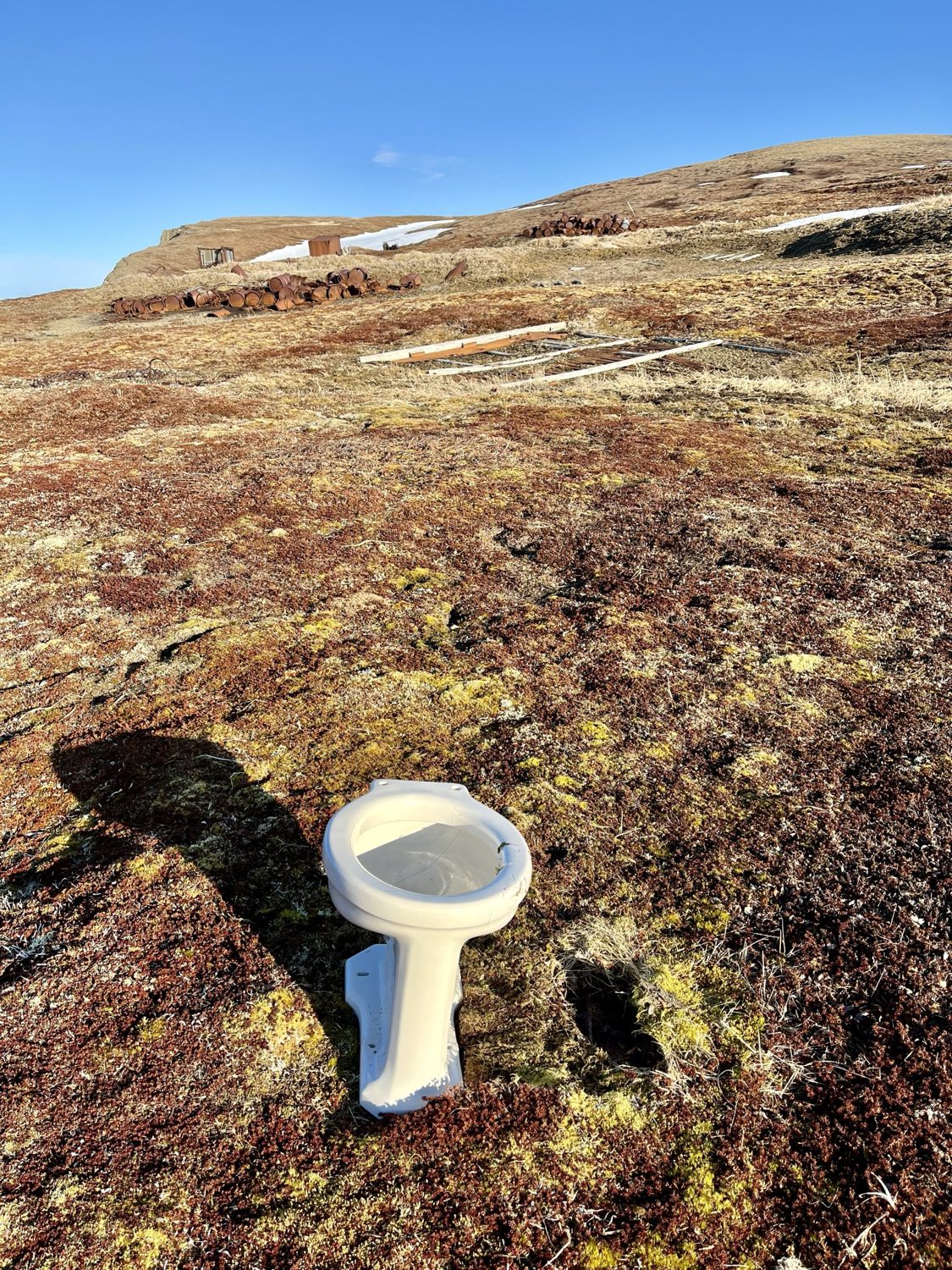
An archaeologist, Dennis Griffin, surveyed the site in July 2002 for the Fish and Wildlife Service and found its condition poor. Hundreds of fifty-five-gallon drums had rusted to fragments over oil spills that still stung the eyes of anyone walking through. The wooden sheds had blown down and their boards and metal were scattered across the tundra. Rusted engines sat where they had been left. The trench of the longest snow tunnel, about fifty metres, still ran from the middle of the camp to where the transmitter hut had stood. In the middle of the island, miles from anywhere, the two Caterpillar tractors that had built the station sat where they had bogged and been abandoned. Only the foxes visited.
A writer who went ashore with a seabird expedition in 2019 found the site much as Griffin had left it: a pole anchored by cables, concrete pillars, drums, debris, and a toilet standing by itself on the moss. A biometrician on the trip gave her the sentence for it: “We’re great at building wondrous things. We’re terrible at tearing them down and cleaning them up.” A Geological Survey biologist counting buntings there in the 2020s photographed the toilet and noted that it remained in nearly pristine condition. It is the most durable thing the Coast Guard left on St. Matthew Island, the reindeer included.
Sources
- US Coast Guard, The Coast Guard at War, IV: Loran, Volume II, Historical Section, Public Information Division, August 1, 1946, transcribed by Bill Dietz: the chain, the manning allowance, the Henry Failing and the Clover, the Army detachment’s eight months, the building of the station, the five men lost, the first and second winters, and the mail. media.defense.gov
- US Coast Guard, The Coast Guard at War, IV: Loran, Volume I, December 1944, transcribed by Erma Hill, for the memorial list naming all five men. loran-history.info
- Loran Station St. Matthew Island, loran-history.info, for the station’s chronology: September 15, 1942; September 20 and 21, 1943; June 28 and 30, 1944; September 13, 1946; and the Northwind party of May 1949. loran-history.info
- Dennis Griffin, “A History of Human Land Use on St. Matthew Island, Alaska,” Alaska Journal of Anthropology 2 (1–2), 2004, for the Army camp from Elaine Rhode’s 1987 account and Ben Schlegel’s recollection, the Navy’s 1947 request, Klein’s 1963 photograph, and the 2002 survey of the remains. loran-history.info
- David R. Klein and James L. Whisenhant, Saint Matthew Island Reindeer-Range Studies, job completion report, April 30, 1958, for the huts and poles standing in 1957 and the reindeer dead in the wire. adfg.alaska.gov
- Sarah Gilman, “Inhospitable, remote and compelling: The island swallowed by nowhere,” Hakai Magazine and High Country News, October 14, 2020, for the 2019 visit and the biometrician’s sentence. hcn.org
- US Geological Survey, “What remains of the St. Matthew Loran Station,” photograph by Laura McDuffie, 2024, public domain. usgs.gov