At nine seconds past eleven on the night of Sunday, 8 July 1962, Hawaiian time, the street lights on Ferdinand Street in the Manoa valley of Honolulu went out. So did the lights on Kawainui Street in Kailua, across the mountains on the windward side of Oahu. Several people telephoned the police to say so, and the Honolulu Advertiser printed their account the next morning: the lights had gone out “at the instant the bomb went off.”
The bomb was 1,445 kilometres away and 400 kilometres up. It was a 1.4-megaton thermonuclear warhead carried on a Thor missile from Johnston Island, in the middle of the Pacific, and it was the first successful shot of a series that had already failed twice. For two or three seconds the sky over Honolulu went white, as if the sun were rising at eleven at night. Then, as one observer put it to the Associated Press, “the sky reddened from its earlier hues of white and green to pink, rose and deep orange. Then just as suddenly, it was night again.” That took six minutes. Tourists and residents who had gone out to the beaches and hillsides every night that week for nothing “appeared pleased with the show.” Many stood open-mouthed. “You just can’t put anything like this into words after you’ve seen it,” one man said.
Twenty-five minutes after the flash, Joint Task Force 8 issued its announcement: “A nuclear device carried aloft on a Thor booster was detonated at an altitude of hundreds of kilometers over Johnston Island at 11 p.m., HST (5 a.m., EDT Monday). Detonation was in the megaton yield range.” Asked whether the shot was a success, a spokesman smiled and said, “Certainly!”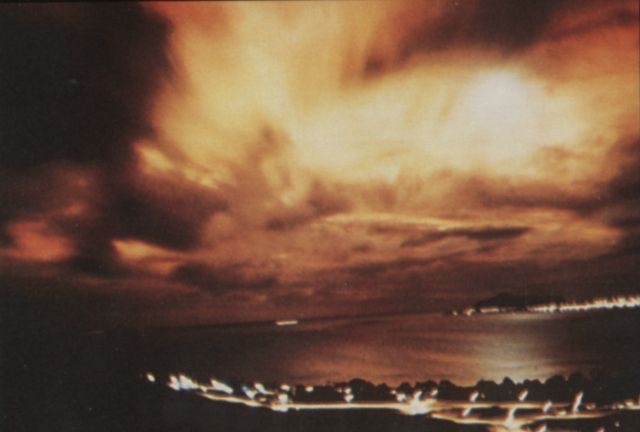
In the days that followed, a satellite 7,400 kilometres from the burst began to lose its power, then another, then a third. A fourth, launched from Florida a day later with better radiation instruments than anything then in orbit, spent the autumn measuring what had been done to the sky, and then died of it.
Ten months later, in May 1963, the Air Force and the Massachusetts Institute of Technology put a cloud of copper needles, 480 million of them by the plan, into orbit 3,600 kilometres up, to see whether a belt of them could carry military radio across the United States and then clean itself out of the sky. The needles were the second attempt too. Each experiment was designed on the assumption that its effect would stay where it was aimed, and each was answered by instruments that belonged to somebody else.
Who ran it
Starfish Prime was one shot of Operation Dominic, the last series of atmospheric nuclear tests the United States conducted. Its Pacific half was thirty-six detonations between April and November 1962, run by Joint Task Force 8 for the Atomic Energy Commission and the Department of Defense. Five of them were lofted by rockets from Johnston Island, 1,445 kilometres west-south-west of Honolulu, and were called Fishbowl; the island had been chosen over Bikini because of the eyeburn hazard of a megaton flash.
Project West Ford belonged to the Air Force and to MIT’s Lincoln Laboratory in Lexington, Massachusetts. The idea came in 1958 from Walter Morrow, a Lincoln engineer who later directed the laboratory, and Harold Meyer of the Ramo-Wooldridge Corporation, as an answer to a problem the laboratory’s history states plainly: that “if the ionosphere became unavailable to serve as a natural reflector because of thermonuclear detonations or such phenomena as solar storms, an orbiting artificial reflector could replace the ionosphere.” It began as Project Needles, and the history records why the name changed: it “attracted negative publicity.” Morrow and Donald MacLellan published the proposal in the Astronomical Journal in 1961, where astronomers could read it.
The two projects shared a man. Jerome Wiesner, President Kennedy’s science adviser, approved the first West Ford launch in October 1961 and, by the account of Herman Hoerlin of Los Alamos, was prevailed upon the following year to restrict nuclear tests in space after Starfish. The British radio astronomer Bernard Lovell, director of Jodrell Bank, opposed both, in public, in the same paragraph.
What they were trying to find out
Each experiment carried two claims, and in each case the second was the one that mattered.
The first claim of Starfish was military. In October 1957, before the natural radiation belts had even been discovered, Nicholas Christofilos had suggested that a nuclear explosion high above the atmosphere would produce “many observable geophysical effects,” among them a shell of electrons trapped in the Earth’s magnetic field. Three small shots over the South Atlantic in 1958, Operation Argus, had shown that it happened. A megaton shot at 400 kilometres would show how much, and what the shell did to radio, to radar and to anything flying through it. The Washington Evening Star’s editorial the next day listed the objectives as the public understood them: to measure the effects on communications, on radar, and on “the enormous danger of surprise attack by intercontinental ballistic missiles.”
The second claim was an assumption rather than a hypothesis, and it was made in advance: that the artificial belt would be small and would not last. Western scientists, the Associated Press reported on 10 July, “were divided whether the blast upset the delicate radiation balance in outer space,” and then gave the official position: “The AEC had said that if the explosion did affect the belt the effects were expected to be minor and temporary.”
The first claim of West Ford was that a thin ring of half-wave dipoles, each a resonant antenna at about 8,000 megacycles, could scatter enough of a 20- to 40-kilowatt signal from a 60-foot dish in California to a 60-foot dish in Massachusetts to carry voice and teletype, on a channel no enemy could cut or jam. The Lincoln Laboratory’s John Harrington put it plainly on launch day: “There are so many of the particles in the band that it would be almost impossible for an enemy to tune in on the one we were using.”
The second claim was the one the astronomers cared about: that the belt would remove itself. The laboratory’s history is candid that this was designed in from the start. “Recognizing that a proposal to place vast numbers of anything into orbit would be controversial, Lincoln Laboratory designed the proposed experiment, named Project West Ford, to ensure that the dipole scatterers were in a resonant orbit such that the pressure of incident solar radiation on the orbiting dipoles would cause their orbits to decay.” Sunlight would push the needles into ever more elliptical orbits until their low points dipped into the air and they burned. A few years, the laboratory said; not more than five.
In both cases, then, the experiment was built to answer the first question, and the second was answered by a calculation. What neither programme planned was the instrument that would check the calculation.
What they built
Johnston Island is a flat coral island. For Fishbowl it carried a Thor launch pad, a rocket range and radars; before each shot the people not needed on it, 599 of them for Starfish Prime, were taken off to the helicopter carrier Iwo Jima. The warhead rode in a re-entry vehicle on the Thor; three instrument pods were strapped to the missile to be thrown off near the burst and recovered from the sea.
The first attempt, Bluegill, went up shortly after midnight on 2 June 1962. The missile flew normally but the tracking system lost it, and with ships and aircraft below and no way to know where it was going, the task force commander ordered the warhead and missile destroyed. The second attempt, Starfish, went up just before midnight on 19 June. The Thor’s engine stopped after 59 seconds, and the range safety officer destroyed it at between 30,000 and 35,000 feet. Pieces fell back on Johnston Island and into the lagoon, where Navy divers spent two weeks recovering about 250 of them, some contaminated with plutonium. The third attempt was Starfish Prime, and this time it worked: the Thor launched near midnight, all systems functioned, and the 1.4-megaton device detonated at 400 kilometres. Twenty-seven small rockets went up from the island before and after to measure what happened. Two weeks after the success, on 25 July, the next Thor, Bluegill Prime, malfunctioned on the pad; the safety officer destroyed the warhead by radio, the missile blew up, and plutonium from the warhead contaminated the pad, carried by burning fuel down the cable trenches.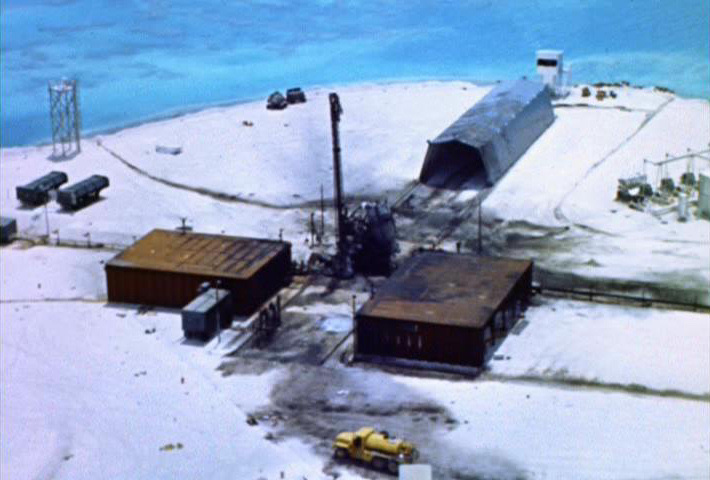
West Ford’s apparatus was smaller and stranger. Each dipole was a length of copper wire 1.78 centimetres long, half the wavelength of the radio signal, and 0.0007 of an inch thick, about a third of a human hair. One weighed 40 millionths of a gram. The 1961 payload, by the Associated Press’s count, was 350 million of them; the laboratory planned the experiment at 480 million, and the 1963 payload was announced as “some 400 million,” fifty pounds of wire. They were packed in a solid cylinder about six inches across and twenty long, embedded in a binding material that was to disintegrate in the vacuum of space, and mounted on a dispenser that was to spin up and fling them off, so that over weeks they would spread into a ring 40,000 miles round. If they spread as planned they would be about a quarter of a mile apart.
The ground stations were a 60-foot dish at Camp Parks, east of San Francisco, and another on Millstone Hill in Westford, Massachusetts. The needles went up as a passenger: a canister in the tail of Midas 4, an Air Force missile-warning satellite, on an Atlas-Agena from Point Arguello, California, at 9:53 on the morning of 21 October 1961, Eastern time. The second launch, on 9 May 1963 by the satellite catalogue and 8 May by the laboratory’s history, was the same arrangement with an improved dispenser.
The laboratory’s history puts the decision plainly: “While Project West Ford had initially been classified secret, the necessity for openness was clear to all involved. In 1960, Lincoln Laboratory unveiled West Ford in virtually complete detail.” Openness brought the astronomers. In August 1961 Wiesner set out the government’s policy in a letter to Lloyd Berkner of the National Academy of Sciences, and a panel of American scientists he convened reported that the needles would block about one part in a billion of the light from any star and one part in a million of its radio emission, and would stay up “a matter of a few years at most.” On 24 August 1961 the International Astronomical Union, meeting at Berkeley, adopted two resolutions.
The first was general and was accepted without discussion. It viewed “with great concern the grave danger that some future space projects might seriously interfere with astronomical observations,” maintained “that no group has the right to change the Earth’s environment in any significant way without full international study and agreement,” and appealed to all governments “to refrain from launching until it is established beyond doubt that no damage will be done to astronomical research.” The second named West Ford. The Union “views with the utmost concern the possibility that the band of dipoles proposed in Project West Ford might be long-lived, and it is completely opposed to the experiment until the question of permanence is clearly settled in published scientific papers with adequate time being allowed for their study.” It asked for a group of astronomers to be given “full privileges” to measure the belt alongside the West Ford authorities. Georges Lemaître asked why the second resolution was not, like the first, addressed to all governments; Pol Swings had the words “or not” added, so that the text warned of signals “which are barely, or not, detectable today.” The resolution passed with nobody voting against.
Hermann Bondi of London, one of those who had objected most, gave the terms of the bargain in a sentence: “If we could be reassured the band would not be permanent, it would be all right.”
Thirty strings
The flash reached Honolulu at the speed of light. The electromagnetic pulse reached it at the same moment, and this is where the street lights come in.
Oahu’s street lighting in 1962 belonged to the City and County of Honolulu, not to the power company, and much of it ran on an old design: long loops of wire carrying a constant current of 6.6 amperes, with the lamps in series, like Christmas lights. On side streets where the poles were too short for the high-voltage loops, a small isolation transformer fed a secondary loop of about twenty incandescent lamps at a few hundred volts. Across the secondary of each transformer sat a disk cutout, a fuse the size of a coin made of two lead disks separated by a thin plastic washer: if the loop broke, the voltage rose, an arc jumped the gap, and the lead melted into a short, so that the rest of the circuit stayed lit. The Ferdinand Street loop was one of these, 3,000 feet of wire.
When the pulse swept across Oahu it induced a voltage along those loops. On about thirty of them the voltage was enough to fire the disk cutout, and the twenty lamps on each went dark. No filament or lamp was damaged. The fuses had done exactly what they were designed to do, in response to a signal they had not been designed for, and the City’s crews filed the lead disks clean, put them back, adding a washer when one failed again, and relit the streets. A disk took about five minutes to repair. The Star-Bulletin on 28 July carried a review headed “What Happened on the Night of July 8?”, in which a street lighting official attributed blown fuses in nine areas to energy from the bomb. The AP’s version, in Washington on 10 July, was a single sentence at the end of a story about the next shots and the colours of the sky: “Honolulu city street lighting department officials said shock waves from the blast blew out fuses in several areas.”
That sentence was the whole of the civilian instrument’s report, and almost nobody read it as one. A microwave repeater station on Kauai, the island to the north-west, probably failed; so did the input stages of ionospheric sounders and rectifiers in some receivers. Later retellings add burglar alarms, a hundred of them in some versions; they do not appear in the wire reports of that week or the government reports read for this entry, and the Honolulu papers themselves are not online. The number that survived was thirty strings. It was carried into Glasstone and Dolan’s The Effects of Nuclear Weapons as “the simultaneous failure of 30 strings (series-connected loops) of street lights at various locations on the Hawaiian island of Oahu, at a distance of 800 miles from ground zero,” without a reference, and from there into every account of what a nuclear pulse does to a city. By a 1967 count it was about 300 lamps, about 1 per cent of the lights on the island. Official records were kept for ten years or less, and when Charles Vittitoe of Sandia reconstructed the incident in 1989 he had the circuit drawing of Ferdinand Street only because John Mattox of Stanford had found it in Honolulu in the mid-1980s. Vittitoe also spoke to the retired lineman foreman, Willy Souza, and wrote that the discussion “indicates that many more than the 23 listed strings were damaged. Workmen took short cuts on paperwork on July 9, 1962, because of the number of failures and the large area where failures occurred.”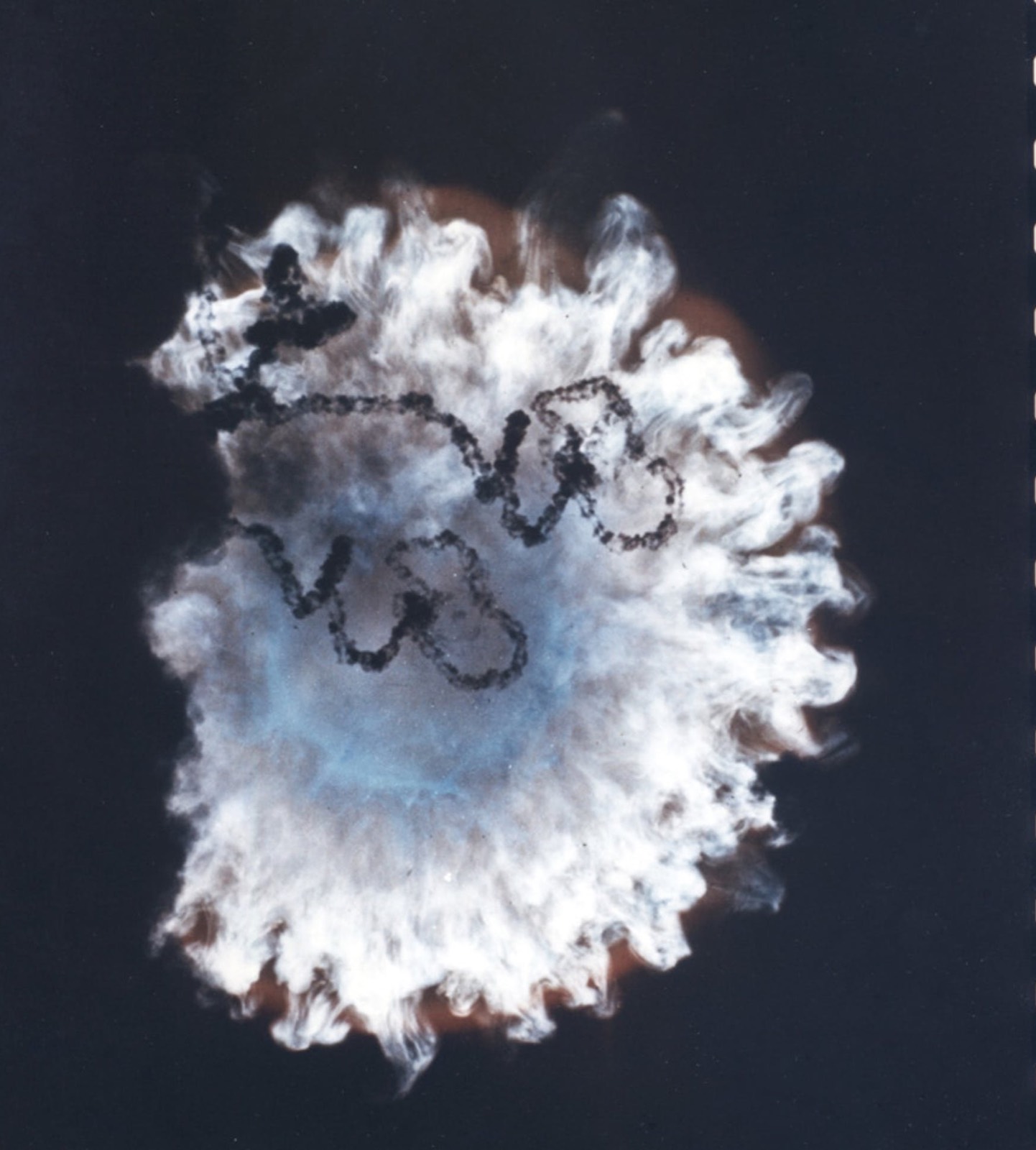
Meanwhile the main event was happening where nobody on the ground could see it. Jets of the bomb’s debris shot out across the Earth’s magnetic field lines; photographs from Christmas Island and from a high-flying aircraft caught debris up to 2,000 kilometres high between one and three minutes after the burst. The electrons from the decay of its fission products were trapped in the field. The natural inner Van Allen belt had been discovered only four years earlier, and nobody knew the electron population in it to better than a factor of three. Now a new belt sat on top of it, and the only way to know what it was doing was to ask the satellites already up there.
What it looked like from inside
There were a handful. Injun 1, a small University of Iowa satellite flown by James Van Allen’s group; Traac and Transit 4B, two Johns Hopkins Applied Physics Laboratory satellites in the same orbit, Traac 190 days into its life; Ariel 1, the first British satellite, launched from Cape Canaveral on 26 April 1962 and carrying an X-ray detector that had never been meant to count charged particles; Cosmos 5, which the Soviet Union had launched in May. None of them had been placed to measure a bomb.
Then came Telstar. The Bell System’s experimental communications satellite went up from Cape Canaveral on a Thor-Delta at 4:35 on the morning of 10 July 1962, Eastern time, almost a day after the detonation, into an elliptical orbit that climbed to 5,600 kilometres and crossed the new belt on every pass. It was a 34-inch sphere weighing 170 pounds, built by AT&T at its own cost of nearly 50 million dollars. On 11 July the first television pictures from England came across the Atlantic by way of it.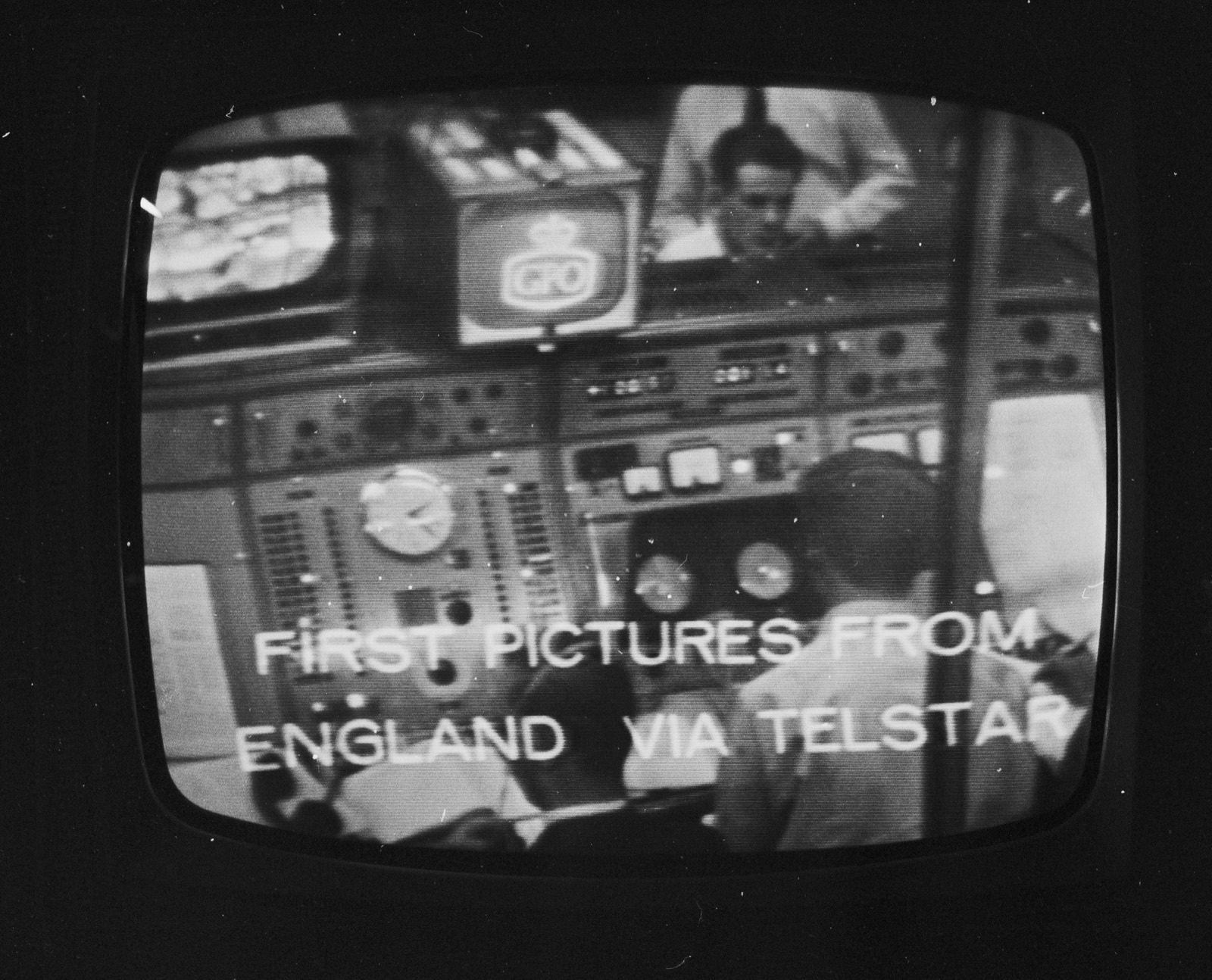
Bell’s engineers had listed six objectives for the experiment in order, and the first was “To look for the unexpected.” The fifth was to get “a better numerical knowledge of the character and intensity of radiation in the Van Allen belt,” because, as A. C. Dickieson of Bell Laboratories wrote, that knowledge “was not adequate as a basis for design of a long-lived satellite.” So Telstar carried four silicon particle detectors, and four solar cells and six special transistors whose job was to be damaged and report it. For most of the next four months, as Walter Brown and his colleagues at Bell wrote afterwards, “the Telstar satellite was the only intermediate-altitude radiation monitor in space.” By the end of October the ground stations had logged 770 hours of usable telemetry. The experiment to look for the unexpected had been launched into it.
What it found was not the belt the AEC had described. Wilmot Hess of NASA’s Goddard centre, writing NASA’s status report as of 12 September, began it this way: “This explosion produced, as was expected, an artificial radiation belt. However, the intensities in this radiation belt are considerably higher than were expected.” Then he listed the satellites that had stopped transmitting. It had taken, he said, “about a month to start getting some grasp of the characteristics of the new radiation belt,” and he had had to assemble the picture from instruments never calibrated for the job: Injun’s shielded Geiger counter, meant to measure background, “is now called on to provide quantitative information, and it has been calibrated after the fact”; Ariel’s X-ray detector, whose efficiency “is uncertain”; and the degradation of the satellites’ own solar cells, used as an integrating dosimeter. Hess expected the belt’s electrons to last several years.
A British radio astronomer had objected in advance. In May 1962, two months before the shot, Lovell had addressed the Institute of Strategic Studies in London. He said that his “belief in the inevitability of progress has been very considerably undermined during this past year by the realization that some of the American and probably some of the Russian space activities are not being guided by the purest of scientific motives. I refer of course to the military programme by the U.S. Air Force for the orbiting of ‘Project Needles (West Ford)’ around the Earth and more recently the proposed explosion of a megaton nuclear weapon in the region of the Van Allen belts.” He begged that such projects be carried out only “within the framework of the resolution of the International Astronomical Union which was phrased only a few months ago in California,” and ended: “If this is not done then the United States may bear the awful responsibility of having started a chain of events leading to the militarization of space and the destruction of astronomy on Earth.” When the address was printed he added a note: “The United States exploded the megaton bomb outside the atmosphere and have thereby enormously confused the study of the natural radiation belts by setting up a new long-duration zone of trapped particles.”
At the Kremlin, where a World Peace Congress happened to open on the morning of the test, the British crystallographer J. D. Bernal told reporters that such experts as Lovell had called it “wanton interference with the ionosphere.” The Soviet Union then fired three high-altitude shots of its own in October and November, the first two on 22 and 28 October, and added their electrons to the sky.
From inside West Ford the view was of a belt that would not form. The dispenser on Midas 4 had been designed to spin up and throw the needles off; MacLellan’s account is that “the dipole-dispenser ejection mechanism didn’t spin up, so no dipoles were released.” NASA’s orbital debris office gives a different mechanism, “design characteristics and unanticipated thermal effects,” by which “the dipoles did not dispense individually.” Either way, the surveillance network eventually catalogued seven lumps believed to come from it. The laboratory had planned to begin radio transmission within days. There was nothing to transmit through. The same day, Tass denounced the launch as “anti-scientific,” carried out “in spite of the fact that many scientists of the world protested against these American plans,” and Lovell called it “a stain on the hitherto untarnished United States program of space research.”
What happened
The satellites went one by one. Ariel 1, four days after the shot, could no longer make enough electricity to work properly; by Hess’s account it stopped transmitting, and by Hoerlin’s it operated only intermittently from 13 July. Transit 4B stopped on 2 August. Traac, which had been degrading slowly in the natural belt, degraded fast and fell silent after 14 August, 34 days after the explosion. Injun 1’s active life ended in December. Cosmos 5’s Soviet operators published four months of radiation data and only indirect word of the state of its power supply.
Telstar was the long case. Its solar power plant lost output steadily, half to protons that had always been there and half to the new electrons. On 7 August, one month after launch, one of its two command decoders began answering intermittently; by 21 August it had failed, and from then on the satellite was probably taking its orders through the other decoder alone. “Early in the week of November 18, 1962,” the Bell team wrote, “the command system became sluggish—the satellite responded only after a long string of continuous commands had been sent.” On 18 November it took eight minutes to answer. “On November 24, after five days of increasingly sluggish performance, the command system failed to respond.” The cause, when they had reproduced it on the ground with a cobalt-60 source, was “surface damage to certain transistors in the redundant command decoders by the enhanced radiation in the inner Van Allen belt”: ionisation building up on the surface of the silicon until the gates in the decoder’s logic would not switch.
They nursed it. Because the orbit’s high point, where the radiation was weakest, was then over the southern hemisphere and out of sight of Maine and Florida, they borrowed NASA’s station at Johannesburg to send commands from there. They designed command pulses to favour the damaged transistors. On 20 December some commands went through; on 3 January 1963 both decoders were answering and the communications equipment was switched on and worked. On 5 February the fault came back. On 21 February the satellite misread a modified command, opened the relay that connected its batteries to its solar cells, and did not respond again. The Bell paper gives the date as 21 February in its summary and 22 February in its introduction.
In Washington the belt had become a political object. James Webb, NASA’s administrator, went to Wiesner, and by one account to the President, to have future nuclear experiments in space restricted to lower altitudes. Urraca, a smaller shot planned for 1,300 kilometres, was cancelled. The Bell scientists, reporting in September that essentially all of the bomb’s fission electrons had gone into the belt, had overstated the injection by a factor of about ten, and Hess’s September lifetimes were too long by about a hundred. Van Allen, who had measured the belt with Injun 1 and then Injun 3, wrote a year later that the electrons’ mean lifetime in the belt’s most durable part was about sixteen months, “about two orders of magnitude less than the estimate of Hess et al. in September 1962,” and that about a tenth of what had been injected remained after a year. Then he urged “that an official government report be prepared, summarizing current evidence, in order to correct the excessively high estimates of the injection efficiency, physical extent, and lifetime predictions which were contained in early, widely distributed government documents in the fall of 1962 and to provide satellite engineers with realistic design specifications.” The belt had been small in advance, enormous in September, and large for years, and the satellite engineers had to design to whichever number was current.
On 5 August 1963 the United States, the Soviet Union and Britain signed the treaty banning nuclear tests in the atmosphere, under water and in outer space. Starfish Prime was the last American megaton shot above the atmosphere. The remaining Fishbowl shots that autumn were smaller, and the Soviet three were the last of their kind anywhere.
West Ford’s second attempt came three months before the treaty. The Lincoln Laboratory’s announcement, released on Sunday 12 May 1963, said that “the first conclusive radar contact with the cloud of fibers was made about 1 p.m. (EDT) yesterday by the Lincoln Laboratory field station in Westford, Mass.,” that the needles were “circling the earth every 166 minutes, in a near-polar orbit, some 2,000 miles high at an inclination of approximately 87 degrees,” and that “each of the dipole fibers is, in fact, a tiny passive communications satellite.” It also restated the promise: the fibres “will have a life of not more than five years. By that time, the solar radiation pressure will have forced all the dipole fibers down to lower altitudes where the atmospheric density is greater and they will disappear harmlessly.”
The belt formed and closed in about forty days. While it was still thick, before the needles had spread, the two stations passed voice, teletype and data at up to 20,000 bits a second, which the laboratory calls the first demonstration of reliable transcontinental military satellite communication. As the needles dispersed the link got worse, which was the point: “testimony,” the laboratory’s history says, “that it was indeed cleaning itself out of orbit.” “By late 1965,” MacLellan wrote, “the dipole belt had been swept from orbit, right on schedule”; the laboratory’s history says early 1966. Irwin Shapiro published “Last of the West Ford Dipoles” in Science in 1966. A paper by MacLellan, Morrow and Shapiro on the belt’s effect on astronomical observations appeared alongside the rest of the project’s results in a special issue of the Proceedings of the IEEE in May 1964, with a piece by John Findlay titled “West Ford and the Scientists.”
Lovell and Martin Ryle had set out the astronomers’ real objection in the Royal Astronomical Society’s quarterly in 1962, and it was mainly about the belts that would follow. For the density planned, and for small radio telescopes with existing receivers, they calculated that interference would be severe only when a telescope’s main beam and a transmitter’s beam crossed in the belt at the same point, which “is likely to be very low in circumstances likely to arise in the near future.” The danger was the next belt: “It is not known what dipole density would be employed if an operational communication system were introduced, nor what steps would be taken to replenish the belt when diffusion had made it useless as a communication system, but it seems that interference many times that discussed must inevitably occur.” There was no next belt. Active satellites, Telstar’s descendants, took the field, and West Ford, as the laboratory’s historians wrote, “had little impact in terms of operational employment.” The big antenna the laboratory built to go with them was named Haystack because, MacLellan wrote, “its main job was to look for needles in space.”
After
Not all the needles left. The dispenser had been designed to release them one by one; a post-mission investigation, NASA’s orbital debris office reported in 2013, “concluded that only 25-45% of the planned 480 million dipoles dispersed properly. The others were believed to have remained in clumps, which were later discovered by the SSN,” the Space Surveillance Network. The individual needles, with their high ratio of area to mass, went as promised. The clumps, being heavier for their size, did not. Since 1966 the network has catalogued 144 pieces from the 1963 launch; in 2013, 46 were still in orbit, and on the day this entry was written the public catalogue listed 147 pieces from that launch, 43 of them still up, with perigees from 476 to 3,636 kilometres. A few come down each decade; the most recent fell in 2024. The seven lumps from 1961 were all still in orbit in 2013. The belt that was designed to clean itself did, and the part that was not designed is still there, sixty-three years on.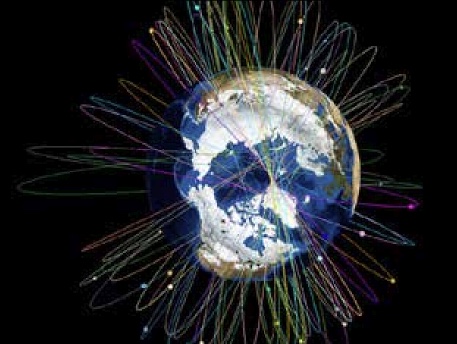
The street lights became the best-known fact about nuclear electromagnetic pulse, and in 1989 Sandia reopened the case to see whether the fact was true. Vittitoe’s conclusion was that it was: the voltage the pulse would have induced along a loop lying at that angle to Johnston Island was at the threshold of the disk cutouts, which is consistent with thirty strings failing and the rest not. In 1962 the lights were incandescent and the receivers were vacuum tubes; “with the increase of solid-state circuitry over the vacuum-tube technology of 1962,” Hoerlin had written in 1976, “the susceptibility of electronic equipment will be higher.” The thirty strings were a measurement of 1962’s equipment. Nobody has been allowed to take the measurement again.
The belt itself persisted for years in the records of every satellite that flew through it, and in the design margins of the satellites that followed, which had Telstar’s and Van Allen’s numbers to build to. Hoerlin’s retrospect for Los Alamos, fourteen years after the shot, concluded that the science gained “far outweighed the information which would have been gained otherwise,” while recording in the same pages that the belt’s size “was unexpected; so were the damages sustained by three satellites in orbit.”
And the astronomers got their clause. The IAU’s demand of 1961, that no group had the right to change the Earth’s environment without international study and agreement, went through the Soviet draft principles of 1962, which were aimed at West Ford and would have made any such experiment subject to prior agreement among the countries concerned, and through the United States’ objection that it would not submit its programmes to a veto, and surfaced in 1967 as Article IX of the Outer Space Treaty, which requires a state planning an activity that might cause “potentially harmful interference with activities of other States Parties in the peaceful exploration and use of outer space” to consult first. The Evening Star had asked for exactly that in May 1963, in an editorial headed “Project Needless?”, and in doing so had already tied the two experiments together: “one is reminded of the fact that the United States, in its last high altitude nuclear test, created a rather formidable radiation belt which had not been anticipated and which our experts, speaking in advance of the event, dismissed as a virtual impossibility.” It went on: “It is too bad in the circumstances that there is not some sort of international clearing house to pass upon dubious or debatable ventures of this kind.”
What it taught
Start with what each experiment got right. Starfish Prime was instrumented with twenty-seven rockets, ships, aircraft, a U-2 and stations across the Pacific, and it answered its first question completely. The belt, the blackout and the pulse were all measured, and a generation of physics came out of them. West Ford answered its first question too: the belt formed, the link worked, and the needles, the ones that spread, went away on the schedule the laboratory had published in advance. The orbital mechanics of the needles was the one prediction in this story that was checked by the people who made it, with their own radar, and held.
What neither programme did was treat the second question, where the effect would stop, as an experiment. It was treated as a calculation, which is to say as a settled thing, and the two calculations failed in the same direction: minor and temporary, a few years at most.
The instrument that answers is whatever is in the way. No instrument of Joint Task Force 8’s measured the effect of Starfish on a city or on the satellites, because no one had designed one; the measurements were made by the City and County of Honolulu’s fuses, by Telstar’s decoders, by Ariel’s solar cells and by an X-ray counter that was never meant to see electrons. When an experiment’s apparatus is the sky, every piece of equipment under it is a detector, and the reading comes back in the form that equipment allows: a dark street, a satellite that stops answering, a filed lead disk. That reading is poor, because nobody calibrated it, and it is thrown away, because nobody owned it; Vittitoe had to reconstruct the one circuit from a retired foreman’s memory.
An assurance is a prediction with no plan for being wrong. “Minor and temporary” was offered before the shot as a reason not to worry, and it carried no error bar, no threshold and no instrument assigned to test it. When it failed, the correction came from outside, in Hess’s “considerably higher than were expected,” and then overshot, so that the engineers of 1962 had estimates too high by a hundred to design to. Van Allen’s plea a year later for an official correction is the sound of an experiment discovering that it had never said what it expected precisely enough to be corrected in an orderly way. West Ford did better: “not more than five years” was a number, the laboratory tracked the belt, and the number held. It held for the part of the belt the design had considered.
The failure mode you did not design for is the one that stays. Lincoln Laboratory designed its needles to leave. It made them light for their area so that sunlight would push them down; that was the safety case, and it was sound. It did not design the clumps, which were a failure of the dispenser, and a clump is a different object with a different ratio of area to mass and a different orbit lifetime. Forty-three of them are still up. The 1961 lumps were the same failure in a worse form, seven objects that have outlasted everything else in this story. The laboratory’s promise was kept in exactly the terms in which it was made, and the thing it had not promised about is what remains in orbit.
“It would be all right” has to be checkable by the people who are worried. Bondi’s sentence was the whole negotiation: reassure us that it is not permanent and we will accept it. The IAU’s resolution asked for the two things that would make the reassurance real, published papers with time to study them and access for astronomers to the belt’s measurements, and the project’s results were published in full. That is why the West Ford story ends in a journal issue and a treaty article. Starfish offered no such terms. The AEC’s assurance was not a paper anyone could check, the belt’s measurement was a race between people with different instruments, and the first correction came from a British satellite failing. The difference between the two experiments is not that one went wrong and the other went right. It is that one wrote its second claim down in a form that could be tested, and invited the sceptics to test it.
Everyone’s sky, nobody’s consent. The deepest objection to both experiments was the IAU’s first resolution: that no group has the right to change the Earth’s environment without agreement. The Soviet Union made the same point at the United Nations in 1962, months before its own high-altitude shots, and the United States answered that it would not accept a veto. Both sides were using the sky above everyone as an apparatus, and the people whose equipment measured the result had not been asked. The clause that came out of it in 1967 requires consultation, not consent. But it exists because of thirty strings of street lights and half a billion needles, and because a newspaper editorial in 1963 noticed that the two were the same story.
Check the story before you learn from it. Thirty strings is Glasstone’s number and Vittitoe’s; “nine areas” and “several areas” are the 1962 newspapers’; about 300 lamps is a 1967 newspaper’s; 23 is what the crews wrote down. Three satellites were damaged in Hoerlin’s summary, “two or three” in his chapter on the reaction, six named in his detail; the retellings’ “a third of the satellites in low orbit” traces to no document read for this entry. The needles were 350 million in the 1961 press and 480 million in the laboratory’s plan; in 1963, “some 400 million” were announced and between 120 and 215 million dispersed. The second launch was on 9 May in the catalogue and 8 May in the laboratory’s history. Telstar died on 21 February or 22 February, in the same paper. Forty-six clumps remained in 2013 and 43 are in the catalogue today. The burglar alarms are in every account and in none of the week’s dispatches.
What the record supports without argument is the sequence: an assurance, a flash, a dark street, a satellite that stopped answering, a number corrected downward by a hundred, and a second experiment, ten months later, whose makers had written their promise down and let the people who doubted it watch. That is enough to learn from, and the part that mattered was known the night the lights went out.
Sources
- Defense Nuclear Agency, Operation Dominic I, 1962, DNA 6040F, United States Atmospheric Nuclear Weapons Tests, Nuclear Test Personnel Review, 1983. Chapter 7, the Fishbowl events: Bluegill, the Starfish abort of 19 June, Starfish Prime, the Honolulu and Kwajalein displays, Ariel’s failure, Bluegill Prime. archive.org
- Herman Hoerlin, United States High-Altitude Test Experiences: A Review Emphasizing the Impact on the Environment, Los Alamos Scientific Laboratory report LA-6405, October 1976. The belts, the satellite damage (Ariel, Traac, Transit 4B, Cosmos 5, Injun, Telstar), the Oahu street lights and the Kauai microwave link, Lovell’s May 1962 address, NASA’s reaction, Webb and Wiesner, the cancellation of Urraca. Wayback copy of the FAS scan
- Charles N. Vittitoe, Did High-Altitude EMP Cause the Hawaiian Streetlight Incident?, Sandia National Laboratories report SAND88-3341, April 1989. The series circuits, the disk cutouts, Ferdinand Street, the thirty strings and the 23 recorded repairs, the foreman’s recollection, and the quotations from the Honolulu Advertiser of 9 July 1962 and the Honolulu Star-Bulletin of 28 July 1962 and 8 April 1967, which are taken here at second hand from this report. osti.gov
- The Evening Star (Washington), 9 July 1962, page A-1, “H-Bomb 200 Miles in Sky Lights Pacific 6 Minutes” (Associated Press, Honolulu), with the Task Force 8 announcement and the eyewitness; page A-6, the Moscow reaction; 10 July 1962, page A-1 on the Telstar launch, page A-4 on Honolulu’s fuses and the AEC’s advance assurance, page A-8 editorial “Test in the Pacific”. Library of Congress, Chronicling America
- Wilmot N. Hess, The Artificial Radiation Belt Made on July 9, 1962, NASA Technical Note D-1687, April 1963 (the status report of 12 September 1962). The intensities “considerably higher than were expected,” the satellite failures, the improvised instruments. NASA Technical Reports Server
- J. A. Van Allen, Further Observations on the Starfish and Soviet Artificial Radiation Belts, State University of Iowa report SUI-63-37, 1963. The sixteen-month lifetime, the tenth remaining after a year, and the plea for an official correction. archive.org
- J. S. Mayo, H. Mann, F. J. Witt, D. S. Peck, H. K. Gummel and W. L. Brown, “The Command System Malfunction of the Telstar Satellite,” Bell System Technical Journal 42, no. 4, July 1963, pp. 1631–1657. The decoder failures of August and November 1962, the Johannesburg commands, the recovery of January 1963 and the end on 21 (or 22) February. archive.org
- W. L. Brown, J. D. Gabbe and W. Rosenzweig, “Results of the Telstar Radiation Experiments,” Bell System Technical Journal 42, no. 4, July 1963, pp. 1505–1559: the only monitor in space, the 770 hours and 180,000 points, the solar-plant damage, the Soviet tests of October. A. C. Dickieson, “The Telstar Experiment,” same issue, pp. 739–746: the six objectives. H. N. Upthegrove and others, “Launching of the Telstar Satellite,” same issue: the launch of 10 July 1962. archive.org, archive.org
- MIT Lincoln Laboratory, Technology in Support of National Security, Lexington, 2011, chapter 5, “Satellite Communications” (drawn from W. W. Ward and F. W. Floyd, “Thirty Years of Research and Development in Space Communications at Lincoln Laboratory,” Lincoln Laboratory Journal 2, no. 1, 1989). The dipoles’ dimensions and number, the 1960 unveiling, the launches, the forty days, five per cubic kilometre, 20,000 bits a second, early 1966. archive.org
- Donald MacLellan, “Space Needles,” Lincoln Laboratory “Looking Back” note. Morrow and Meyer, the dispenser that did not spin up, the belt swept from orbit by late 1965, Haystack. ll.mit.edu
- International Astronomical Union, Resolutions adopted at the XIth General Assembly, Berkeley, 1961, Resolutions 1 and 2, with the footnote to Wiesner’s letter of 11 August 1961 to Berkner; and Transactions of the IAU XI B, “Final Session,” 24 August 1961, for Lemaître, Swings and the vote. IAU resolutions, Cambridge Core
- A. C. B. Lovell and M. Ryle, “Interference to Radio Astronomy from Belts of Orbiting Dipoles (Needles),” Quarterly Journal of the Royal Astronomical Society 3, 1962, pp. 100–108. The test-belt parameters and the conclusions. NASA Astrophysics Data System
- The Evening Star, 21 October 1961, page A-1, “Anti-Missile Rocket Gets Dual Role” (Associated Press, Point Arguello), continued on page A-3, for the launch, the 350 million needles and John Harrington’s account; The Sunday Star, 22 October 1961, pages A-1 and A-6, for Wiesner’s panel, Bondi, Lovell’s “stain” and the Tass statement; 13 May 1963, page A-32, “Cloud of Tiny Needles Is Released in Space” (Associated Press, Lexington), for the Lincoln Laboratory announcement of 12 May; 14 May 1963, page A-10, editorial “Project Needless?”. Library of Congress, Chronicling America
- Proceedings of the IEEE 52, no. 5, May 1964, the West Ford issue: C. F. J. Overhage and W. H. Radford, “The Lincoln Laboratory West Ford Program—An Historical Perspective,” pp. 452–454; J. W. Findlay, “West Ford and the Scientists,” pp. 455–460; I. I. Shapiro, H. M. Jones and C. W. Perkins, “Orbital Properties of the West Ford Dipole Belt,” pp. 469–518; D. C. MacLellan, W. E. Morrow and I. I. Shapiro, “Effects of the West Ford Belt on Astronomical Observations,” pp. 564–570; P. Waldron, D. C. MacLellan and M. C. Crocker, “The West Ford Payload,” pp. 571–576. The papers are behind the publisher’s paywall; only the issue’s index was read for this entry. doi.org
- NASA Orbital Debris Program Office, “West Ford Needles: Where are They Now?”, Orbital Debris Quarterly News 17, no. 4, October 2013, pp. 3–4. The two launches, the 25 to 45 per cent that dispersed, the 144 catalogued pieces, the 46 clumps, the seven objects of 1961, and the treaty clause. orbitaldebris.jsc.nasa.gov
- CelesTrak satellite catalogue, objects named “WESTFORD NEEDLES,” international designator 1963-014, consulted 19 October 2026: 147 catalogued, 43 without a decay date. celestrak.org
- Andrew J. Butrica, ed., Beyond the Ionosphere: Fifty Years of Satellite Communication, NASA SP-4217, 1997, chapter 8 by William W. Ward and Franklin W. Floyd on West Ford, and the chapter on satellite communications policy for the Soviet draft principles of 1962 aimed at West Ford. history.nasa.gov
- Treaty Banning Nuclear Weapon Tests in the Atmosphere, in Outer Space and Under Water, signed at Moscow 5 August 1963; and the Treaty on Principles Governing the Activities of States in the Exploration and Use of Outer Space, 1967, Article IX. state.gov, unoosa.org
- Carey Sublette, “Operation Dominic,” Nuclear Weapon Archive, for the Honolulu photographs and for the burglar-alarm claim that this entry could not trace to a contemporary source. nuclearweaponarchive.org