On June 22, 1972, at the Royal Society of Medicine in London, a small man with a greying goatee stood up to give a paper at the Society’s annual symposium, which that year was called Man in His Place. The chairman of the morning was the anatomist J. Z. Young, who had opened the day by telling the room that “the opposite of control is death.” The speaker was an ecologist employed by the United States government, and his first sentence was this: “I shall largely speak of mice, but my thoughts are on man, on healing, on life and its evolution.”
On that same day, in the loft of a metal building on a farm in the Maryland countryside, the mice he was speaking of numbered 122: 22 males and 100 females. Four years earlier there had been eight. Two and a half years earlier there had been 2,200. The last mouse born there that had lived past weaning had been born on March 1, 1970, and the last conception of any kind had come about day 920 of the colony’s life, in the middle of January 1971. Nothing had been taken away except about 150 animals for other studies, and nothing had been let in. The population was dying with its food hoppers full.
When the speaker had finished, and had begun to say what the mice meant for Calcutta and for the year 1984, the chairman stopped him. The published record keeps the interruption: the chairman “said that he ought to be careful about this. He had been discussing mice.” The room objected. Londoners forty years before had lived as crowded as these animals and bred very well. Hong Kong was denser than east London, and its people, as far as one could see, were happy. The speaker’s answer was that density was not his point at all.
The speaker was John B. Calhoun, and the pen was Universe 25. In the fifty years since, its story has been told more often than almost any experiment of its decade, and nearly always as a parable: build a paradise for mice, fill it, and watch it rot, and then look at the city outside the window. This entry is about the other experiment, the one that was measured. Its instrument was a count, taken by hand, of colour-coded mice in 256 nest boxes, which by 1972 had produced what Calhoun called about a million observations. The question is what became of them.
Who ran it
Calhoun was born in Elkton, Tennessee, on May 11, 1917, the son of a school principal and an artist, and spent his boyhood collecting birds’ eggs and turtles. He took his degree at the University of Virginia in 1939 and a doctorate in zoology at Northwestern in 1943, and in 1946 joined the Rodent Ecology Project at the Johns Hopkins School of Hygiene and Public Health in Baltimore, whose purpose was to get rid of the city’s rats. He found that a Baltimore block held about 150 of them, that poison brought the number down, and that within a few years it came back to exactly where it had been. Something other than food was setting the number. In 1947 he built a quarter-acre pen in the woods behind his house at Towson to find out what, and watched five pairs of wild rats for twenty-seven months from a tower. The pen could have held 5,000 rats at laboratory densities. The population settled at 150 adults and never passed 200.
From 1954 he worked for the National Institute of Mental Health, which gave him a barn on a farm at Rockville, and there between 1958 and 1962 he ran the rat experiments that made his name, published in Scientific American in February 1962 under the title “Population Density and Social Pathology.” It was in that barn, in a room ten feet by fourteen divided into four pens, that he coined the phrase that would follow him: the behavioural sink. The rats of Towson and Rockville are a story of their own, told in Rat city. By the late 1960s he was chief of a unit of the Institute’s intramural programme, with a new laboratory on the farm the National Institutes of Health had bought near Poolesville, in upper Montgomery County, which the Institute called its Animal Center and the press called the mousery.
He did not run it alone, though the record mostly names him. His colleague Halsey Marsden ran the experiments that moved mice out of the crowded pens into empty ones. Julius Axelrod, who won the Nobel Prize in 1970, and Larry Ng measured the stress enzymes in the brains and adrenal glands of mice that Calhoun and Marsden picked out for them. The technicians who caught, identified and recorded every mouse at every survey are not named anywhere in the published record, and the surveys were the experiment. Two television crews from Time-Life came to film it, in April 1970 and in the autumn of 1972. A photographer named Yoichi Okamoto, who had been the White House photographer under President Johnson, took the one picture of the pen that everybody has seen. The science writer Maya Pines interviewed Calhoun three times in the autumn of 1970 for the Institute and wrote the account that the government printed. And the mice were Balb C albinos from the Institutes’ breeding colony, a strain chosen because it was inbred to the point where the animals were nearly identical, so that whatever they did to each other could not be blamed on heredity.
What they were trying to find out
The question had been the same since Baltimore: what sets the number of animals in a place when food does not? Calhoun’s way of asking it in 1968 was to take an ecologist’s list of what kills animals in the wild and remove every item from it. Writing the experiment up for London he put the list in the words of the Book of Revelation, sword, famine, pestilence and wild beasts, and translated them: emigration, resource shortage, bad weather, disease and predation. “I shall briefly treat each of these five mortality factors, and then discuss the steps taken to eliminate, or drastically reduce, the impact of each in a Utopian environment constructed for mice.” His own name for it, in the paper, was a mortality-inhibiting environment for mice. The television narrator called it mouse heaven.
The hypothesis had two parts, and he stated both on camera on April 1, 1970, when the colony was near its peak. The first was “that the larger the space the smaller the ultimate population density.” The second was “that the larger the space with reference to number of colonizers, the slower it would get started.” Both could be tested by counting, and the experiment was built to test them: not one universe but five, each colonised with four pairs of mice, of sixteen cells, eight, four, two and one, so that the same eight mice started with sixteen times more or less room. The first claim, he said on camera, “proved not to be true.” The second “has been true.” That is the whole of the ecological result, and it is almost never mentioned.
There was a third claim, which no count in the pen could test. “I shall largely speak of mice, but my thoughts are on man.” The Institute paid for the work as mental health research, and Calhoun’s reading of the four phases of a mouse population as four phases in the history of the human species was in the government’s own report of 1971, with a deadline attached: fifteen years, to 1984, in which mankind had to decide to stop growing. The mice could not confirm this and could not refute it. They could only be counted, and the counting is what follows.
What they built
The universe was a square of four galvanised metal walls, 101 inches on a side, 2.57 metres, and 54 inches high. The lower 37 inches of each wall were built for climbing. The upper 17 were bare metal, and no mouse ever got over them. Each wall was divided into four identical cells, sixteen in all, and against each cell four vertical tunnels of half-inch wire mesh, three inches across and thirty-four inches tall, were soldered to the metal. Every eight inches up each tunnel an opening led through the wall into a nest box eight inches by five by four, in which fifteen mice could rest in comfort. Four tunnels, four boxes each: “four four-unit walk-up one-room apartments in each cell,” Calhoun told London, which made 256 nest boxes and room, at fifteen to a box, for 3,840 mice. Halfway up each cell a wire-mesh food hopper, six inches by ten, let twenty-five mice eat at once, which would have fed 9,500. Above it, on a platform, four water bottles let eight drink, enough for 6,144. Strips of paper for nesting lay on the floor by the tunnels, which was covered with ground corn cob. The pen stood on the second floor of a prefabricated metal building, kept near 68 degrees Fahrenheit in winter and ventilated by fans in summer. Every four to eight weeks the corn cob and the droppings were cleared out. Nothing was ever sterilised, and nothing needed to be: bacterial cultures taken at the peak found no disease. There were no predators.
Into this, on July 9, 1968, after each had spent twenty-one days alone, went four pairs of 48-day-old mice. Four other pens of the same design but smaller, down to a single cell, got four pairs each on the same terms.
The instrument was the survey. Every mouse was marked with its own combination of dye colours, and every part of the pen had a code. At regular intervals the animals were caught, one by one, identified, and their condition and whereabouts written down; between surveys observers in the loft above recorded who did what, with whom, and where. By the autumn of 1970 the Institute’s writer put the total at “over half a million separate observations for which the animals had to be captured and identified at regular intervals.” By June 1972 Calhoun told London that “they had taken about a million observations on the set of populations, of which Universe 25 was the largest and had been followed for the longest period of time,” and that they were “in the process of structuring their data on magnetic tape for detailed analysis.” Nothing about the experiment was automatic. A mouse was a datum when a person held it in a gloved hand and read its colours.
Day 315
For 104 days nothing was born. Calhoun called this Phase A, and it was not quiet: eight mice in a pen built for thousands fought until they had settled who lived where. Then the litters came, and the population doubled every fifty-five days, from about 20 to 40, 80, 160, 320 and 620. This was Phase B, the exploitation of the resource, and it ended on day 315 after colonisation, at 620 weaned mice, when the doubling time abruptly lengthened from 55 days to about 145.
What had filled was not the pen. At 620 mice, four-fifths of the nest boxes were still empty and the hoppers could have fed fifteen times as many. What had filled, in Calhoun’s reading of his survey sheets, was the social space. He tabulated the place of birth of every mouse born between day 86 and day 338, nest box by nest box, and the pattern was fourteen groups, each with a territorial male, a set of females and their young, each holding a stretch of wall and a wedge of floor. The group in the south-west corner had produced 111 young in 252 days. The group opposite it, in the north-east, had produced 13. Between them the numbers fell away in both directions round the walls, and when he ranked the fourteen groups by their output the line was straight, with the same slope as the line he got when he ranked fourteen males by how active they were. The dominant male’s group bred most. The fourteen groups held about 150 adults, which he took to be the number of social places the pen had. Around them were 470 young mice that had been born into those groups, reared well, and were about to grow up into a system with no vacancy.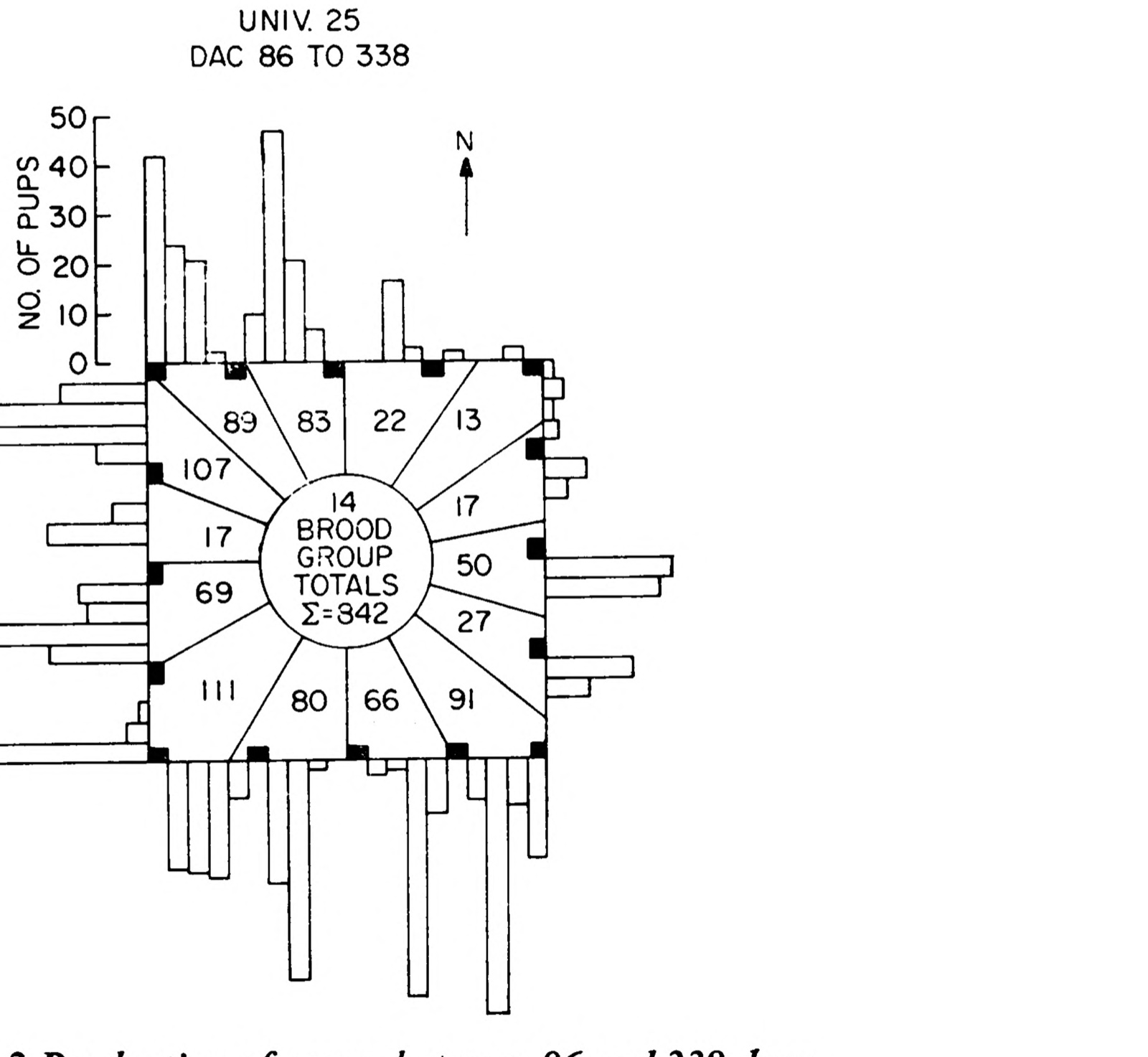
In the wild, the young that find no place emigrate, and emigration, Calhoun had written, is a form of death. In the pen there was nowhere to go. “As the unusually large number of young gained adulthood they had to remain, and they did contest for roles in the filled social system. Males who failed withdrew physically and psychologically; they became very inactive and aggregated in large pools near the centre of the floor of the universe.” The territorial males did not attack them; they attacked each other. When two or three returned from eating, the change in the air would set one of the resting males on the others, and the others, “having lost the capacity for fleeing, remained relatively immobile despite receiving vicious attacks. A mouse so attacked would at a later time become an attacker.” Their female counterparts withdrew upward instead, into the high boxes that mothers did not want.
That was Phase C, from day 315 to day 560, and it ran on the mothers. The territorial males, worn down by rejecting the maturing young, defended less and less, and the nursing females took over the defence of the nests and became aggressive, and “this aggression generalized to their own young who were attacked, wounded, and forced to leave home several days before normal weaning.” Conceptions fell, foetuses were resorbed, young were wounded in delivery, litters were carried from box to box and dropped on the way, and whole litters recorded alive at one survey were gone by the next. The population went on growing, slowly, because 1,600 more young were weaned in this phase. But “for all practical purposes there had been a death of societal organization by the end of Phase C.”
On day 560, January 20, 1970, the count was 2,200, and it never rose again. A few mice born up to day 600 lived past weaning; the last of them was born on March 1, 1970. After that there were pregnancies, fewer and fewer, and no survivors. The last conception was about day 920.
What it looked like from inside
Nobody lived inside, but people climbed in. The Time-Life correspondent Carl Coleman brought a camera crew to the loft on April 1, 1970, day 631, and asked how many mice were in the enclosure. “There’s something of the order, we don’t know exactly what it is now,” Calhoun said. “It’s between twenty-two hundred and twenty-five hundred mice, that is bodies, moving bodies. But there are really only uhh about a hundred and fifty mice in here. Real mice, that is mice who are in the social sphere. All the others have been rejected in one way or another.”
The rejected came in two kinds, and he showed the camera both. On the floor were the withdrawn males, “highly stressed animals but the stress comes from each other because of the peculiar violence that they exhibit,” pointing to one “with his tail all chewed up.” In the boxes, and rarely out of them, were the others, the last few hundred born, who had been kept as juveniles by the crowd and “although they are now adults uh they no longer engage in aggressive behavior or in reproductive behavior. And we call them the beautiful ones because they are so excellent physically, they are unstressed.” He saw one that had taken refuge in a can of nesting material, climbed over the wall, and lifted it out for the lens: “He’s colored very few, practically no wounds, he’s in excellent physical shape.” Coleman asked whether, as far as the mouse was concerned, he was a nothing. “He’s a total nothing.”
Yoichi Okamoto’s photograph, which the London paper printed as its first figure, was taken that winter. It looks down into the square from above: the tunnels and their rows of water bottles along every wall, the floor strewn with torn paper, Calhoun crouched near the middle with a mouse in his hand, and across the floor from him a dense pale mass that the caption calls “an exceptionally large aggregate of pooled withdrawn mice.” The caption also points out what the picture shows about the hoppers: mice heaped on some, none on others, “the ‘behavioural sink’ phenomenon in which the learned need for proximity to others as a secondary reinforcer at a resource site gains dominance over the primary need, in this case food.” The hoppers were identical. The mice ate where other mice were eating.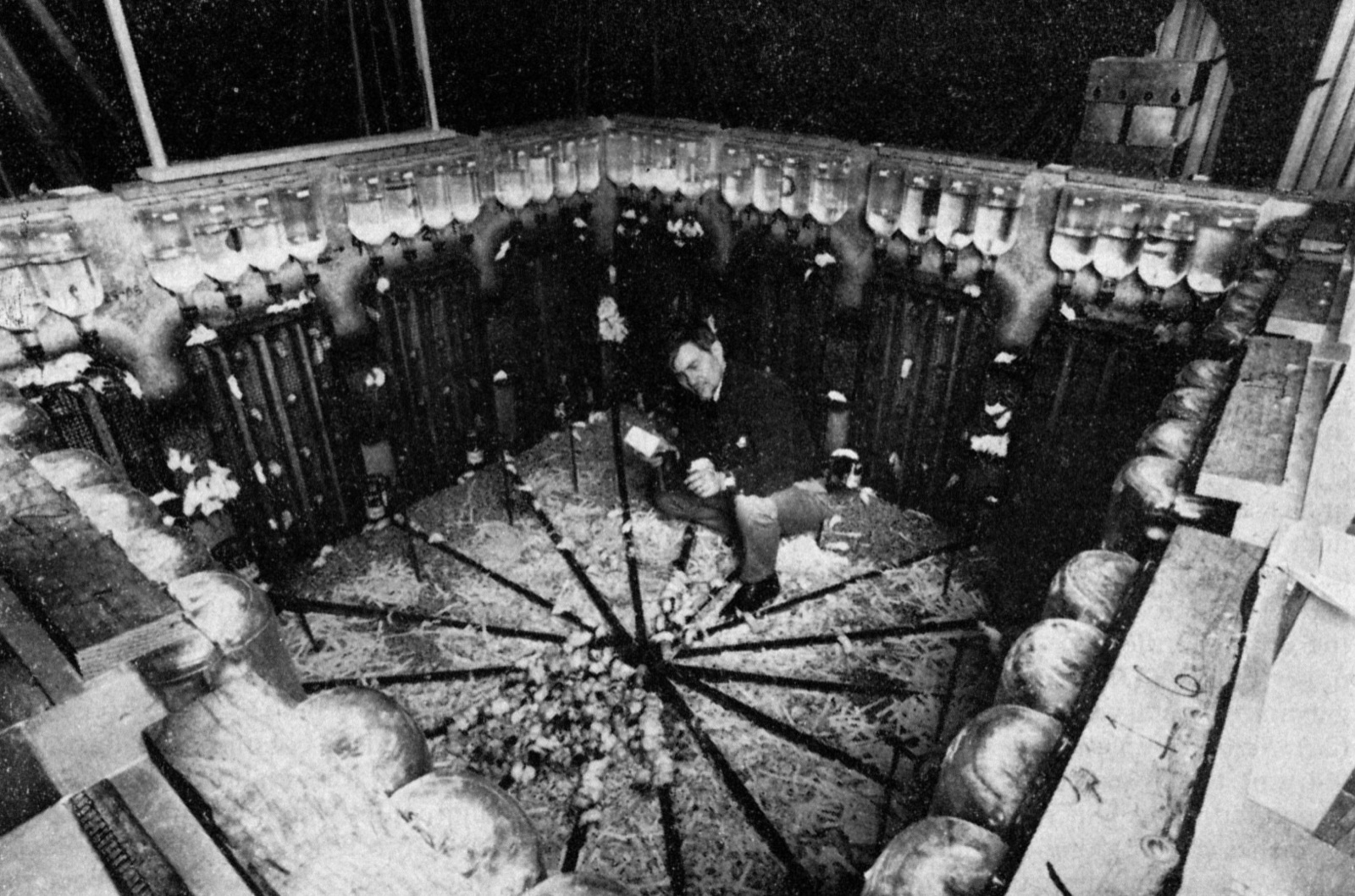
The columnist Stewart Alsop went out that summer for Newsweek. “It was a lovely day,” his column of August 17, 1970, began, “much too lovely to spend in an office. In fact, it seemed a perfect day to visit Dr. John Calhoun’s mousery.” He found the laboratory “out beyond the suburbs, in rolling Maryland farmland,” and Calhoun “a smallish, cheerful man with bright blue eyes, a goatee and mouse-colored hair that looks as though it had never been combed,” whose chief interest “is not in mice but in men.” Upstairs, “peering down from the sides of the box at the squirming, flowing mass of tiny bodies, smelling the rank mouse smell, which is at first overpowering, I had a strong impulse to get out again, into the sunlight.” Calhoun picked up two of the beautiful ones and two of the floor males and held all four in one hand; “the proles were scruffy and chewed up—one had lost half its tail—while the beautiful ones were sleek, unharmed and utterly passive.” He told Alsop: “We’ve had no live births for six months, and no conceptions for almost as long.” Calhoun’s daughter, asked decades later what she remembered of the place, remembered the smell.
Maya Pines came for the Institute in September, October and November. Her report describes the beautiful ones in Calhoun’s words: “All capacities for developing and maintaining social bonds are disappearing with the last group of animals born. These are mostly beautiful ones, unstressed by normal tendencies for sex and aggression, and they cannot learn. They’re all washed out.” The mice had stopped burying their dead, as they had once done. What mating remained had gone, in his phrase, down to the amphibian level. In the places where the withdrawn piled together, “some mice actually suffocated, while one fifth of the living units remained vacant and many more contained only one or two mice.” The twenty per cent of empty boxes is in the London paper too, offered as proof that any female who wanted a quiet place to rear a litter could have had one. Marsden, who worked in the pens, had a shorter description of what utopia had become, which he put in print in 1972. It was hell.
What happened
The curve bent down. On day 736 there were 2,056 mice, and from about day 700 Calhoun could draw the rest of it in advance from the death rate, as a dashed line, because nothing was being born to change it. By March 1, 1972, the average age of the survivors was 776 days, more than 200 days past the age, about 560 days, at which a female of this strain stops ovulating; large numbers of mice were living to 800 days, “which is equivalent to 80 years of age for a human.” On June 22, 1972, the day of the London paper, 122. On day 1,471, in July, 100. When he finished editing the paper on November 13, 1972, day 1,588, there were 27: 23 females and 4 males, the youngest of them more than 987 days old. From the rate of the previous months he projected the death of the last male to May 23, 1973, day 1,780. The counts after day 1,000 were a little below the dashed line, he noted, because about 150 mice had been removed along the way for other studies.
Those other studies are the part of the result that the parable leaves out, because they are the part that was designed. A two-cell universe had run beside the sixteen-cell one on the same terms; 300 days after its own growth stopped, Calhoun killed it and opened the 148 females that had been born in the last fifty days of its Phase C. At a median age of 334 days, when a normal female would have reared five litters, 82 per cent had never conceived, and the three that were pregnant carried one embryo each instead of five. Marsden took small groups of mice out of the crowded pens and put them into empty universes at very low density, and then put them with partners of the opposite sex that had grown up uncrowded. “All groups exhibited nearly total loss of capacity for developing a structured society or for engaging in the full repertoire of reproductive behaviours.” The one thing that had worked, Pines reported in 1970, was two months of solitary confinement, after which a handful of animals “seemed able to start life all over again, as if reborn.” Axelrod’s and Ng’s enzyme assays gave the beautiful ones a biochemical profile like that of the territorial males, not the withdrawn ones: physically healthy, and, Calhoun told London, “rather than socially withdrawing from the system, the implication was that they never attempted to enter it.”
The four smaller universes had done the same thing at different numbers. The one-cell pen had reached 185 mice per cell before it turned; the sixteen-cell pen had peaked at an average of 137 per cell, which is 2,200. Then every one of them had stopped breeding, and in every one the last half of the mice born had never learned to fight, court or nurse. That was the test of the two hypotheses, and it is the only replication the experiment ever had.
The paper came out in the Proceedings of the Royal Society of Medicine in January 1973 under the title “Death Squared: The Explosive Growth and Demise of a Mouse Population,” nine pages with four figures and a discussion. It ends with an equation. Mortality, the death of the body, is the second death of Revelation; its drastic reduction is the death of the second death, “death squared”; death squared “leads to dissolution of social organization,” and that “leads to spiritual death,” the first death, “loss of capacity to engage in behaviours essential to species survival.” “Therefore: (Death)² = the first death.” Then four lines of Proverbs, rearranged. Between the equation and the mice the paper had made the step that Young had tried to stop it making: “For an animal so complex as man, there is no logical reason why a comparable sequence of events should not also lead to species extinction. If opportunities for role fulfilment fall far short of the demand by those capable of filling roles, and having expectancies to do so, only violence and disruption of social organization can follow. Individuals born under these circumstances will be so out of touch with reality as to be incapable even of alienation.”
Asked in the discussion how the activity of a dominant male had been measured, he gave the fullest account of the instrument that exists in print, and then, asked about the physiology, said what the instrument could not do. A proper picture “had to be planned from the beginning. The real dilemma was the removal of sufficient numbers of animals with known histories at critical points in population growth,” which risked changing the history being studied. “The only effective approach would be to run a large number of populations and terminate them at critical periods. The labour problem was tremendous. This was not normal science, a balanced experiment. It was observation and reconstruction of a process; it was historical.”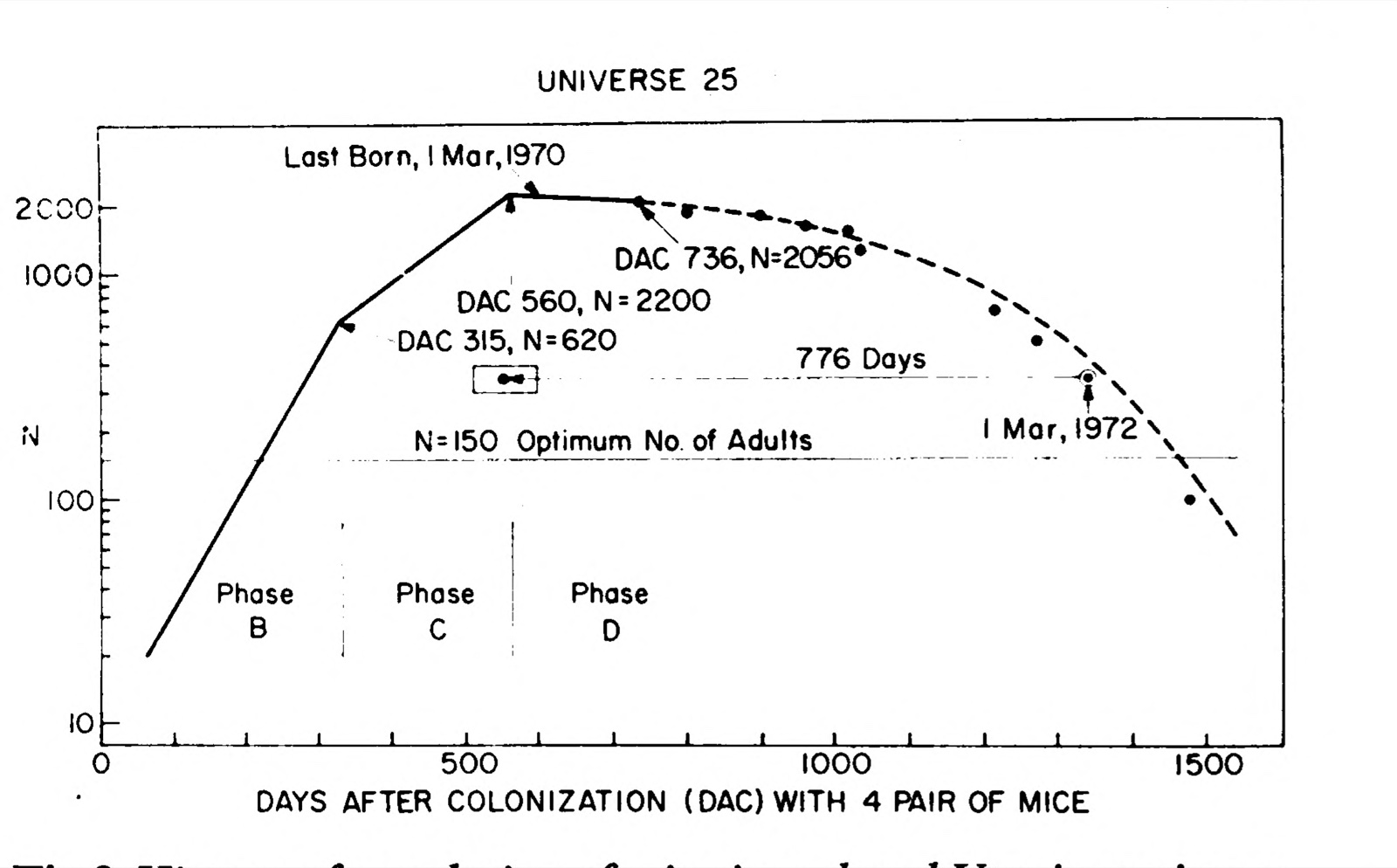
After
The parable had been written before the pen was built. Calhoun’s rats had been in Scientific American since 1962, and in 1968 Tom Wolfe had put the phrase from that article into the last chapter of The Pump House Gang, “O Rotten Gotham! Sliding Down into the Behavioral Sink,” which followed the anthropologist Edward Hall through the crowds of New York and reported that “it got to be easy to look at New Yorkers as animals.” Paul Ehrlich’s The Population Bomb had been published earlier in 1968, a few weeks before the four pairs went in. What the mice added was a photograph, a number, and a name. Alsop’s Newsweek column of August 1970 asked whether “the dropout, drug culture” of the young was “the phenomenon of the beautiful ones, already,” and whether the young had “some sort of subconscious prescience of what lies in store.” A 1971 article in Time, Population Explosion: Is Man Really Doomed?, warned that even a fed humanity “may still face a psychic fate similar to the one that befell Dr John Calhoun’s white mice.” On April 1, 1971, Senator Bob Packwood of Oregon read Calhoun’s work into the Congressional Record. The Institute’s own report of December 1971 told the country that the mice “have sunk to sexual deviation, cannibalism, pathological withdrawal, inability to rear young, and even inability to conceive,” and that “they are now so mentally ill that they seem unlikely ever to recover.” In the autumn of 1972 a second Time-Life crew filmed the last survivors for broadcast: “Dr. Calhoun wanted to find out what would happen to a mouse colony given everything mice need except living space. The result was chilling.” In March 1973 the Associated Press carried the paper to the small-town papers under the headline “Population spoils paradise for mice.” Robert O’Brien’s Mrs Frisby and the Rats of NIMH came out in 1971, and Calhoun was sure the author had visited his laboratory.
The scientists went the other way, and the London discussion was the pattern. Young and Kenneth Mellanby, who was to speak after lunch on checks and balances in animal populations, had objected on the day; the geographer Gunter Gad in 1973 praised animal researchers for not extrapolating and censured Calhoun for failing “to resist the temptation”; and by 1975 the urban sociologists Claude Fischer, Mark Baldassare and Richard Ofshe could write that the inconsistent results of a decade of human crowding studies were the natural product of “Calhoun’s rats… pulling a fast-moving bandwagon.” Jonathan Freedman, whose human experiments at Stanford had been inspired by Calhoun, concluded his 1975 book Crowding and Behavior with a chapter in praise of cities and the observation that “if the world cannot conveniently blame its problems on overcrowding, it will be forced to look elsewhere for the causes.” The two readings had split cleanly: the public took the mice as a prophecy about people, and the people who studied people took the prophecy as the reason to stop citing the mice.
Calhoun was reading a third experiment. He had never thought the pen showed that people were doomed. His rats at Towson, in the worst of their disorganisation, had invented a way of rolling dirt out of a burrow in a ball, which he compared to the discovery of the wheel; he thought creativity came from the periphery and from pressure, and that the human answer to crowding was not fewer contacts but a new kind of space, the conceptual space of ideas and networks, which he spent the rest of his career trying to design. “Human beings thus face a predicament,” he told Pines in 1970. “If we try to make everybody totally happy, we’ll destroy mankind.” Edmund Ramsden and Jon Adams, the historians who went through his papers, put it this way in 2009: “For Calhoun, contrary to many interpretations, population growth was not inherently bad and humanity was not destined to destroy itself.” Hardly anyone took the ameliorative half. The Institute’s interest moved to drugs; a senior administrator told an awards ceremony in July 1981 that “N.I.M.H. is drugs, period.” Calhoun’s programme was ended in 1983, a year short of the cycle he had planned to 1984, and he wrote his letter of resignation on July 30, 1986, annotating the parallels between his institute and Orwell’s. He died on September 7, 1995, of a heart attack and a stroke, on holiday, aged seventy-eight.
The million observations went where the tape went. Calhoun published little in the scientific journals after London, and the nine pages and four figures of the paper remain the fullest account of the counts in print; the later universes, 33 and 34, in which Calhoun tested whether cooperation slowed the explosion, were never published at all. His papers, 170 boxes and the oversize material, 196 linear feet, went to the National Library of Medicine, which lists among them the photographs of “Study 102, universe 25” for 1970 and 1971, a folder of “Mice color coded – universe 25,” and “Pictures of universe 25 structure and portions of structure removed, 1974.” The donor’s copyrights were given to the public domain. The collection is open to anyone who goes to Bethesda. In 2024 the biologist Lee Alan Dugatkin, who did, reported that no behavioural sink and no beautiful ones have ever been found in a wild population of any species, and that textbooks of animal behaviour no longer mention the work at all. In 2025 a researcher fitted the rise and fall of Universe 25 and the rise and fall of the reindeer of St. Matthew Island with the same maximum-entropy model; the reindeer are the subject of Forty-Two, and the two curves, drawn from a pen and an island, look alike.
What it taught
Start with what was measured, because it is better than its reputation. A closed population with no predators, no disease, no weather and no shortage was followed by hand for four and a half years, every animal identified at every survey, and it grew, stalled, and died out without ever filling a fifth of its shelter. Four smaller pens did the same. The last half of the mice born in each never learned the behaviour their species needs, and moving them out did not teach them. Those are findings. They are not findings about Calcutta.
The names were the instrument that travelled. Calhoun chose his words to carry: the behavioural sink, the beautiful ones, walk-up apartments, the establishment, death squared. They carried. The photograph and the phrase reached Newsweek, Time, the Senate and a children’s novel; the brood-group diagram and the rank-frequency line reached nine pages of a medical proceedings and a magnetic tape. An experiment has two outputs, its data and its description, and the one that is easier to repeat is the one that gets repeated. Whoever names a phenomenon for a lay audience should expect the name to become the result.
What it measured was the surplus. In the wild the mice that found no place would have left and died somewhere else, and nobody would have counted them. The pen made emigration impossible and so made the surplus visible, in pools on the floor and in the high boxes, and then showed what became of young reared by the surplus. That is the thing a closed system can show and an open one hides, and it is exactly what a city does not do: cities have doors. The room in London said so, in its own terms, on the day. The result is about what happens when a social animal cannot leave, and the parable dropped the condition and kept the ending.
A hypothesis that was tested got no attention; a claim that could not be tested got all of it. Larger space, lower final density: false. Larger space, slower start: true. Five pens, one design, replicated across sizes; the only part of the experiment with a control built in. Nobody quotes it. The claim about man had no control and no pen, and it is the one the experiment is remembered for, including by its author, who said in London that this “was not normal science, a balanced experiment.” He was describing the whole of his study, and he was right.
The reading matched the reader, not the data. The public read a prophecy. The scientists read an overreach and stopped reading. Calhoun read a prescription, and the only popular work that took up the hopeful half was a children’s novel about intelligent rats. The counts supported none of these in particular and all of them a little, which is what counts do when nobody publishes the analysis. The million observations were the only thing in the story that could have adjudicated, and they are in Bethesda, on tape.
Check the story before you learn from it. The pen was 101 inches square in the paper and nine feet square in Newsweek; the peak was 2,200 in the paper and “between twenty-two hundred and twenty-five hundred” on film. The colony started on July 9, 1968, in the paper and in June 1968 in the Institute’s report. Calhoun told Alsop in the summer of 1970 that there had been no conceptions for nearly six months, and told London that the last conception was about day 920, in January 1971. The photograph is dated February 10, 1970, and captioned day 681, which would be May. The last mouse died on May 23, 1973, in every popular account; in the paper that date is a projection, made in November 1972 from the death rate of 27 survivors, and no primary source records the day it came true. The address on the paper is Bethesda; the pen was at Poolesville. None of this touches the shape of the curve, and all of it is the normal condition of a true story.
Sources
- John B. Calhoun, “Death Squared: The Explosive Growth and Demise of a Mouse Population,” Proceedings of the Royal Society of Medicine 66 (1, part 2), 80–88, January 1973, with the discussion that followed the paper at the Society’s symposium Man in His Place on June 22, 1972. The dimensions and capacities of the pen, the four pairs of July 9, 1968, the phases and their days, the brood groups, 2,200 on day 560, the last surviving birth and the last conception, the counts of 1972, the projection to May 23, 1973, the two-cell universe, the beautiful ones, the equation, the Okamoto photograph and its caption, and the chairman’s interruption. Calhoun was a government employee, so the text and figures are public domain. pmc.ncbi.nlm.nih.gov, archive.org
- J. Z. Young, “Environment and behaviour,” the chairman’s introduction to the same symposium, Proceedings of the Royal Society of Medicine 66, 79–80, 1973, for “the opposite of control is death”; Kenneth Mellanby, “Checks and balances in animal populations,” 107–109. The symposium’s date is in the Bronowski papers at Jesus College, Cambridge. pmc.ncbi.nlm.nih.gov, collegecollections.jesus.cam.ac.uk
- Maya Pines, “How the Social Organization of Animal Communities Can Lead to a Population Crisis Which Destroys Them,” in Julius Segal, ed., Mental Health Program Reports 5, National Institute of Mental Health, December 1971, 157–173, from interviews with Calhoun in September, October and November 1970. The Animal Center near Poolesville, the loft, June 1968, “over half a million separate observations,” the four phases Strive, Exploit, Stagnate and Die, the 1,600 young weaned in Phase C, the suffocations and the empty boxes, “They’re all washed out,” the solitary confinement, the five universes of different sizes and their densities, “If we try to make everybody totally happy,” and the Towson and Rockville rats. A government publication. files.eric.ed.gov
- John B. Calhoun Film 7.1, National Institute of Mental Health and Time-Life Broadcasting, 1970 to 1972, 38 minutes, with the transcript published by the National Library of Medicine’s Medicine on Screen: the Carl Coleman interview of April 1, 1970 (“between twenty-two hundred and twenty-five hundred,” “He’s a total nothing,” the two hypotheses) and the Bill Roberts report of the autumn of 1972 (“The result was chilling,” “the National Institute of Mental Health’s Animal Center near Washington”). medicineonscreen.nlm.nih.gov, medicineonscreen.nlm.nih.gov
- Jon Adams and Edmund Ramsden, “The Falls of 1972: John B. Calhoun and Urban Pessimism,” Medicine on Screen, National Library of Medicine, December 2017. The two Time-Life interviews, the film’s slate, and Calhoun’s daughter’s memory of the smell. medicineonscreen.nlm.nih.gov
- Stewart Alsop, “Dr. Calhoun’s Horrible Mousery,” Newsweek, August 17, 1970, p. 96. “It was a lovely day,” the smell, the four mice in one hand, “no live births for six months,” and the questions about the young. In copyright; quoted briefly, from the copy on the Calhoun family’s site. johnbcalhoun.com
- John B. Calhoun, “Population Density and Social Pathology,” Scientific American 206 (2), 139–148, February 1962. The Rockville rats, the room of four pens, 48 and 80, the behavioural sink, the 96 per cent, and the somnambulists. In copyright; quoted briefly. gwern.net
- Edmund Ramsden and Jon Adams, “Escaping the Laboratory: The Rodent Experiments of John B. Calhoun and Their Cultural Influence,” Journal of Social History 42 (3), 761–792, 2009; read in the authors’ working-paper version, LSE Department of Economic History, January 2008. The Towson pen, the 1948 Time piece, Wolfe and Hall, Packwood, the Capital Times of 1970 and the Associated Press of March 14, 1973, Marsden’s “hell,” Gad, Fischer, Baldassare and Ofshe, Freedman, “N.I.M.H. is drugs, period,” the resignation letter of July 30, 1986, and the sentence on what Calhoun believed. Wolfe’s and Marsden’s words are quoted from this paper, at second hand. researchonline.lse.ac.uk
- John B. Calhoun Papers, 1909–1996, MS C 586, National Library of Medicine, finding aid: the biographical note, the extent of the collection, the rights statement, and the folders on Universe 25 in Series 7. findingaids.nlm.nih.gov
- Lee Alan Dugatkin, “The ‘mad egghead’ who built a mouse utopia,” The Guardian, November 21, 2024, adapted from Dr. Calhoun’s Mousery: The Strange Tale of a Celebrated Scientist, a Rodent Dystopia, and the Future of Humanity, University of Chicago Press, 2024. The London lecture, the colour coding and the loft, the Time cover story of 1971 and the Senate, Universes 33 and 34, the wild populations, and Calhoun’s death. theguardian.com
- Will Wiles, “The Behavioral Sink,” Cabinet 42, summer 2011; Sam Kean, “Mouse Heaven or Mouse Hell?”, Distillations, Science History Institute, May 17, 2022. Two accounts from the papers and the published record, for the Mortality-Inhibiting Environment, the 1972 design document, and the later readings. cabinetmagazine.org, sciencehistory.org
- Sabin Roman, “Maximum Entropy Models for Unimodal Time Series: Case Studies of Universe 25 and St. Matthew Island,” arXiv, August 2025. The two curves fitted with one model. arxiv.org
- Wikimedia Commons, File:CalhounJ.JPG, a copy of Okamoto’s photograph from the 1973 paper, reproduced above with the paper’s own credit. Commons lists it as public domain as a work of the White House photographer, though Okamoto had left the White House in 1969 and the paper dates the picture to 1970. commons.wikimedia.org
