On January 17, 1940, a reporter from the New York World-Telegram asked the Rockefeller Institute for Medical Research the question the paper had asked on that date for years: how was the chicken heart? The answer was that it was dead. Dr. Alexis Carrel had gone home to France the previous July, his laboratories on York Avenue had been shut, and the paper printed the news under the headline “That chicken heart of Dr. Carrel’s is dead at 28.” The next day it printed another: “Cancel that obituary on the chicken heart.” The cells were alive, the Institute said, in a private laboratory it would not name, in the keeping of a scientist it would not name either.
The scientist was Albert Ebeling, and the laboratory belonged to a drug company at Pearl River, New York, across the Hudson in Rockland County. The cells were not a heart, and had not been one since the spring of 1912. They were fibroblasts, the spindle-shaped cells of connective tissue, descended from a scrap of a chick embryo’s heart that had been set in a drop of chicken plasma at the Institute on January 17, 1912, and every forty-eight hours or so since then someone had lifted them off their glass, cut them in two, washed them, and set them in fresh medium. By the paper’s reckoning they were twenty-eight years old. They would be fed for six more years, until April 1946, two years after Carrel’s death, and then thrown away. For the whole of that time, and for fifteen years after it, they were the best-known proof in the world that cells taken out of a body need never grow old.
Nobody has been able to do it again. In 1961 two men in Philadelphia found that normal cells in glass divide about fifty times and stop, and that chick cells stop sooner. The likeliest account of the thirty-four years, set out in 1980 by a historian who went looking for the people who had done the feeding, is the feed. That is the spine of this entry: an experiment arranged so that it could not fail, and which therefore ran for a third of a century without teaching anyone what it was showing. Three shorter pieces at the foot of the page take further what the entry can only touch: what the embryo juice was and why it is suspected; what the newspapers were told each January; and the fifty doublings.
Who ran it
Alexis Carrel was born at Lyon on June 28, 1873, the son of a silk merchant who died when he was small. He took his medical degree at Lyon in 1900, and in 1902 published a way of sewing the cut ends of blood vessels together so that they did not clot, a technique he was said to have practised by tying knots inside a cardboard box with two fingers and by sewing five hundred stitches into a sheet of cigarette paper. He left France in 1904 for Montreal and then Chicago, where with Charles Guthrie he transplanted kidneys, thyroids and legs from one dog to another. In 1906 the new Rockefeller Institute for Medical Research in New York took him as an Associate Member. He became a full Member in 1912, and in October of that year the Nobel Prize in Physiology or Medicine went to him for the suture of vessels and the transplantation of organs, the first Nobel Prize awarded to a doctor working in the United States.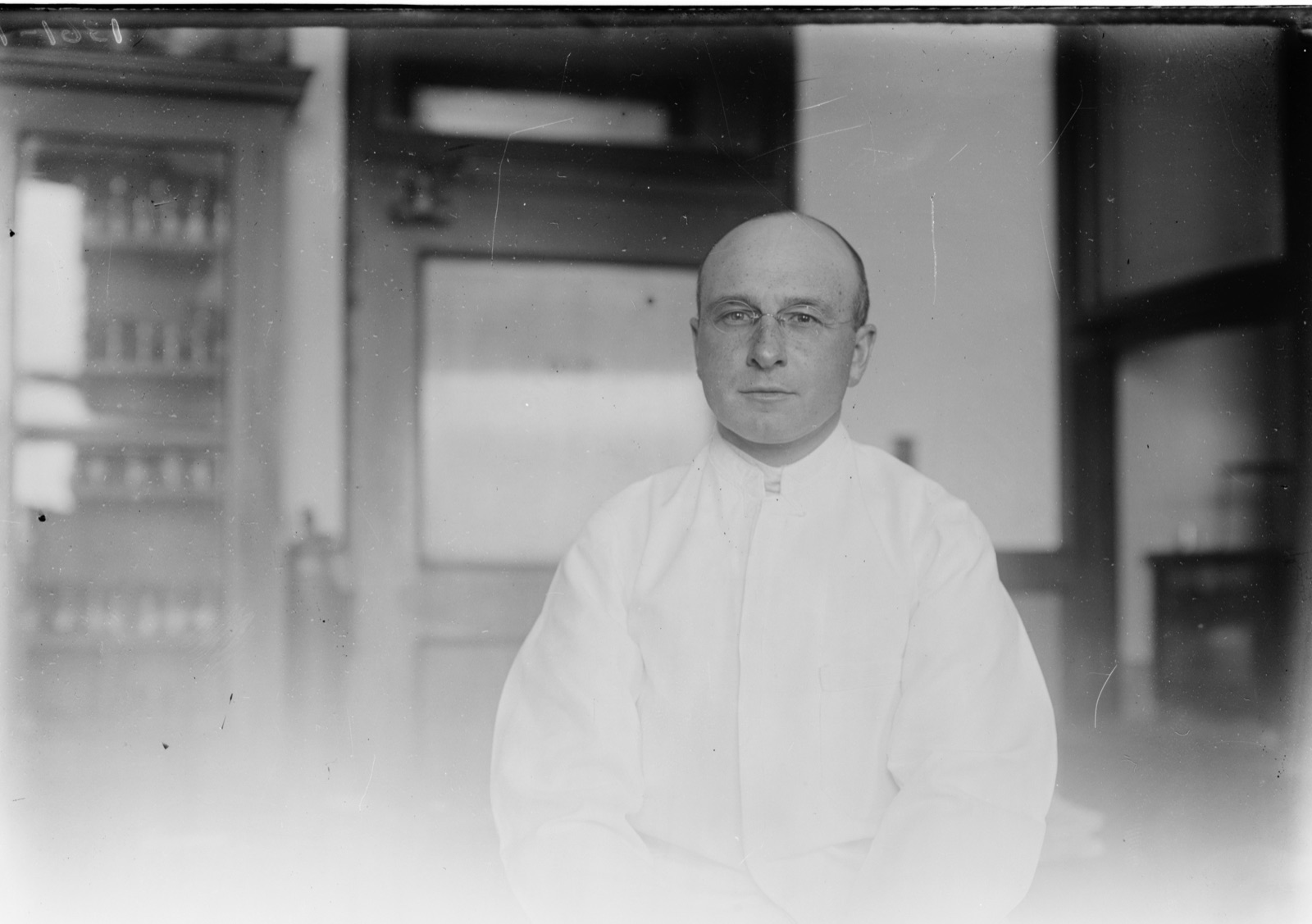
The culture of tissues was not his invention. In 1907 Ross Harrison at Yale had watched nerve fibres grow out of a scrap of frog embryo in a drop of clotted lymph on a coverslip, hung face down over a hollow slide. Montrose Burrows, a young doctor in Carrel’s laboratory, learned the method from Harrison and brought it back in 1910 with chicken plasma in place of lymph, and between October 22 and November 12 of that year Carrel and Burrows sent seven papers to the Société de Biologie in Paris announcing that kidney, bone marrow, spleen, thyroid and sarcoma from adult animals could be grown outside the body, in their words, “comme des microbes,” like microbes. A fortnight later the French histologist Justin Jolly answered that they had grown nothing: what they had seen, he wrote, were “phénomènes de mort,” the last movements of dying cells, not growth. The long cultures that followed were, in the first place, Carrel’s reply.
The man who kept them was Albert H. Ebeling, a physician on the Institute’s staff who took charge of the cultures on June 1, 1912, when they were five months old, and whose name is on the reports of their condition at one year, seven years, ten years and thirty years. Two technicians, Mrs E. Hull and Miss D. Olmstead, went with him and the cells when they left the Institute in 1939. Around them, over the years, worked Raymond Parker, who wrote the standard manual of tissue culture, Lillian Baker, who tried to find out what in the feed made the cells grow, and from 1930 Charles Lindbergh, who built Carrel a glass pump for keeping whole organs alive and who drew the newspapers back to the laboratory in the 1930s as nothing else could.
The laboratory had its own manners. Carrel’s technicians worked in full-length black gowns with hoods, and the historian George Corner, writing the Institute’s official history in 1964, said that Carrel “held himself aloof from the general life of the Institute. Working largely by himself he rarely consulted colleagues. . . . People from other laboratories, fearing to carry infectious germs into the laboratory, did not drop in for casual visits, and never learned about what was going on, except when specially invited.” That sentence will matter later.
What they were trying to find out
The paper that began it, “On the Permanent Life of Tissues outside of the Organism,” was received by the Journal of Experimental Medicine on March 15, 1912, and it states its question in its second paragraph. “The purpose of the experiments described in this article was to determine the conditions under which the active life of a tissue outside of the organism could be prolonged indefinitely. It might be supposed that senility and death of the cultures, instead of being necessary, resulted merely from preventable occurrences; such as accumulation of catabolic substances and exhaustion of the medium.”
That is two claims wearing one coat, and the second grew out of the first as the years went on. The first was technical. Cultures in 1911 died in a week or two, and Carrel supposed they died of their own waste and of a used-up medium, so that washing and fresh plasma would keep them going; if a culture lived for months it would also have answered Jolly, because cells that lived for months must be feeding and dividing. The second claim was about time itself. If the cells died only of their surroundings, then age was something done to cells by the body they lived in, not something in the cells. Carrel had said as much to the Société de Biologie in 1911, in a sentence the historian Jan Witkowski later dug out: “la sénescence et la mort sont un phénomène contingent et non nécessaire,” senescence and death are a contingent phenomenon and not a necessary one. By 1914 the strain was “no longer subject to the influence of time.” By 1922 Ebeling could write that “the cells are potentially immortal.” In the 1920s the two men turned the idea round and used the strain to measure the body’s share: the serum of old chickens slowed the cells, the serum of young ones did not, and they concluded that age acted not by taking an accelerating factor out of the serum but by putting an inhibiting one in. What aged, on this view, was the blood. The cells only obeyed it.
The claim had a test, and the test had been set by a critic. Harrison, who had started the whole method, said that calling cells immortal was unjustified until they had lived in glass longer than the animal they came from. The biologist Raymond Pearl put a chicken’s life at about ten years. That is why January 17, 1922, mattered so much to the laboratory, and why the newspapers were told about it: it was the day the strain was older than any hen.
What they built
The instrument was small enough to hold between finger and thumb. A square coverslip; on it a drop of chicken plasma diluted with distilled water, three parts to one or two; in the drop a fragment of tissue; the plasma allowed to clot; the coverslip turned over and sealed with paraffin onto a slide with a hollow ground in it, so that the fragment hung in its drop over a small sealed chamber; the slide put in an incubator at 38 or 39 degrees Celsius, the temperature of a hen. Within hours cells crept out of the fragment into the clot. Within days they had made a halo around it, and the halo was the culture.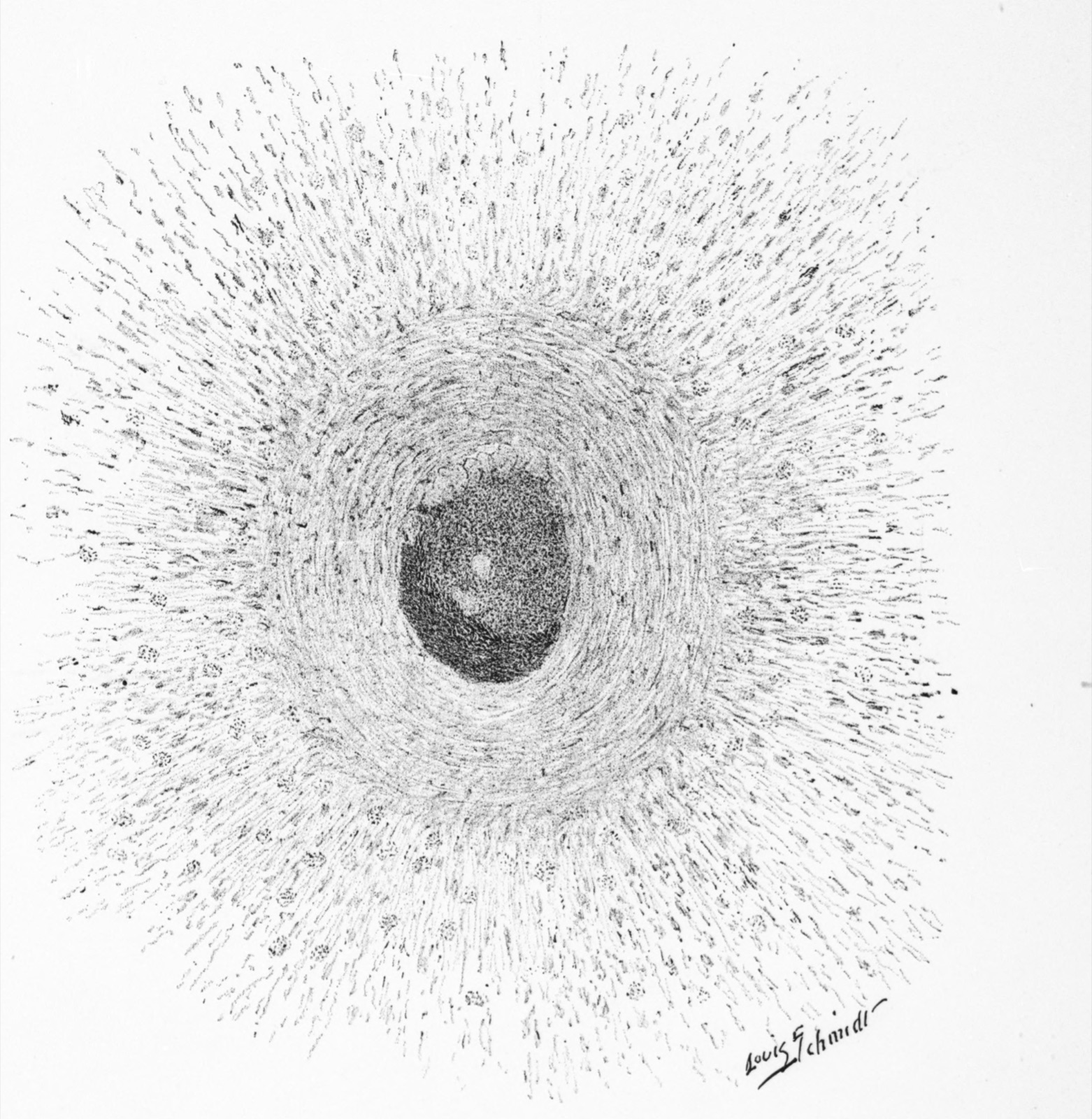
What Carrel added was the passage. Before the culture could die of itself, the coverslip was lifted with the heated point of a blunt cataract knife, laid on black glass, and the growing edge cut out with four strokes of a sharp one. The piece, or the two or three pieces it was divided into, went into a bath of Ringer’s salt solution, for several minutes in 1912 and for forty-five seconds by 1919, and then into a fresh drop on a fresh coverslip, and back into the incubator. A culture that had been through this was said to have undergone a passage, and the passages were counted. The strain had been passed 129 times in its first year, 358 times by May 1914, 1,390 times by July 1919 and 1,860 times by January 17, 1922, on which morning, Ebeling wrote, “our incubators contained about 60 cultures which represented the 1860th generation of the connective tissue cells.”
The medium changed in the first weeks, and the change is the hinge of the story. In its first days the strain was fed on plasma alone and grew slowly. From February 1912 a drop of extract of chick embryo went into the drop of plasma, and by 1919 the standard medium was equal volumes of chicken plasma and chick embryo extract. Ebeling described how the extract was made. The plasma came from young healthy hens not over two years old, starved for twenty-four hours so that their blood would not be turbid with fat, drawn from the carotid through an oiled glass cannula into chilled, paraffined tubes and spun down. The extract came from chick embryos seven to eight days old. “The embryos are first washed in Ringer’s solution to remove the amniotic fluid and traces of blood which adhere to them after removal from the shell. Then the solution is drawn off in order to obtain an undiluted tissue juice. The embryos are minced in a watch-glass with sharp, curved scissors. The pulp is centrifuged for 10 minutes and the supernatant fluid obtained is drawn off.” That fluid, the laboratory’s “embryonic juice,” was what the strain ate every other day for thirty-four years.
Growth was measured by projecting the culture onto paper and tracing round the fragment and its halo at intervals, as quickly as possible because the lamp heated the cells; a piece at its best could multiply its area forty times in forty-eight hours. Ebeling used the measurement to turn the strain into an instrument. Two halves of one fragment, he showed, grew at the same rate in the same medium, so a difference between them measured the medium. “The strain, then, could be used as a reagent for the detection of substances contained in the humors which have the power of activating or decreasing the rate of cell proliferation.” Serum from old and young animals, extracts of organs, heat, dilution, filters: all were tried on it. More than 30,000 cultures, he reckoned in 1922, had been derived “from a fragment of heart less than 1 c.mm. in size.” The strain was at once the department’s proof, its standard reagent, and its mascot.
One drop of extract
Sixteen fragments of heart and blood vessel were put into plasma on January 17, 1912, from chick embryos of seven to eighteen days. Carrel’s own paper describes one of them, Experiment 720-1, from an eighteen-day fetus: it “pulsated regularly for a few days and grew extensively,” stopped beating, was passed eleven times through February, stopped growing, was dissected down to a small central fragment, and on March 1 was beating again at sixty to eighty-four a minute. “It was thus demonstrated that a fragment of chicken heart could still pulsate rhythmically at the beginning of the third month of its life outside of the organism.” That was the chicken heart the newspapers heard about in October 1912, when the Nobel Prize made Carrel famous and the New York Times quoted the paper at length. Other papers understood that he had a chicken’s heart beating in a test tube, and the misunderstanding outlived everyone concerned.
The strain itself was not that fragment. Ebeling’s table, published in March 1913, lists it as Experiment 725, from the heart of a seven-day embryo. Its pulsations had gone by January 19; they came back at the end of February at eighty-eight a minute and flickered on and off through the spring until, by the laboratory’s later reckoning, the fragment had beaten for 104 days. For its first fortnight it grew slowly in plasma alone. Then, on February 1, 1912, passage four: “Washed in Ringer solution for 5 minutes and cultivated in hypotonic plasma, 2 drops, plus extract, 1 drop.” A footnote says what the extract was: “prepared from seven day old chick embryo plus 3 drops of Ringer solution.” The observation column for the next day reads “Feb. 2, active growth.” From the middle of March fresh embryonic extract went in at nearly every passage, and the column fills with “large growth” and “large increase in growth of cells.” Carrel had found the effect while studying how wounds heal, and in June 1912 he sent the journal a paper showing that juices of embryo, spleen and sarcoma made connective tissue grow in glass from three to forty times faster than plasma alone, that the effect was lost on heating to seventy degrees, and that it would not pass a porcelain filter. Embryo juice was the strongest, and it became the standard constituent of the medium. What it was, and why it is suspected, is the first of the pieces below, The juice.
In the same month of February 1912, in the same paper, Carrel did one more thing. To prove to Jolly that his cells divided rather than merely wandered out of the fragment, he minced a nine-day embryo, mixed it with an equal volume of Ringer’s solution, spun it for five minutes, and put a drop of the clear fluid from the top of the tube into a culture medium with no tissue in it at all. “On February 2 many isolated cells were seen in the peripheral part of the medium. On February 5 the number of these cells had increased very much.” After five passages “the cells had then increased so much in number that they formed a real tissue, and had the appearance of an ordinary culture.” He drew the conclusion he needed: “it is absolutely certain that the cells multiply.” He had also shown, and published, that the fluid drawn off a centrifuged embryo pulp could carry enough living cells to found a culture by themselves. Nobody, for fifty years, put the two pages together.
The rest of 1912 was a story of losses. Of the sixteen cultures, five were alive in March. Ebeling took over on June 1; on July 1 five survived; “technical accidents caused the loss of several cultures, and on September 25 only one culture survived. This culture arose from a fragment of connective tissue derived indirectly from the fragment of heart which still pulsated after 104 days of life in vitro. It was very small but grew actively.” On October 23 it was big enough to divide. By November 17 there were twelve cultures, by January 1913 thirty, and from that one small piece, as far as the record shows, every culture of the next thirty-three years descended. Ebeling’s conclusion in March 1913 was measured: connective tissue “can be kept in a condition of active growth outside of the organism for more than eleven months,” its mass increases, and its power of growth after so long “is more active than at the beginning of its life in vitro.” Carrel’s, six months later, was not. The strain, he wrote, was “in a condition of real life, since the cells of which they were composed, like microörganisms, multiplied indefinitely in the culture medium,” and “time has no effect on the tissues isolated from the organism.” In July 1914, at the twenty-eighth month, he put the rule in one sentence: “If we exclude accidents, connective tissue cells, like colonies of infusoria, may proliferate indefinitely.”
Every culture that had died in 1912 had died by that rule of an accident. The rule had no other category.
What it looked like from inside
For the people who kept it, the strain was a timetable. Every second day the coverslips came out of the incubator, were cut, washed, fed and sealed; every week fresh hens were bled and fresh eggs opened; every slowing of growth was looked into and put right. Ebeling wrote in 1919 that in seven years “it was always found that the decrease in the rate of growth was due to deficient medium, or extract, or to the presence of alkali at the surface of the slides.” A culture that slowed had been badly fed, and was fed better.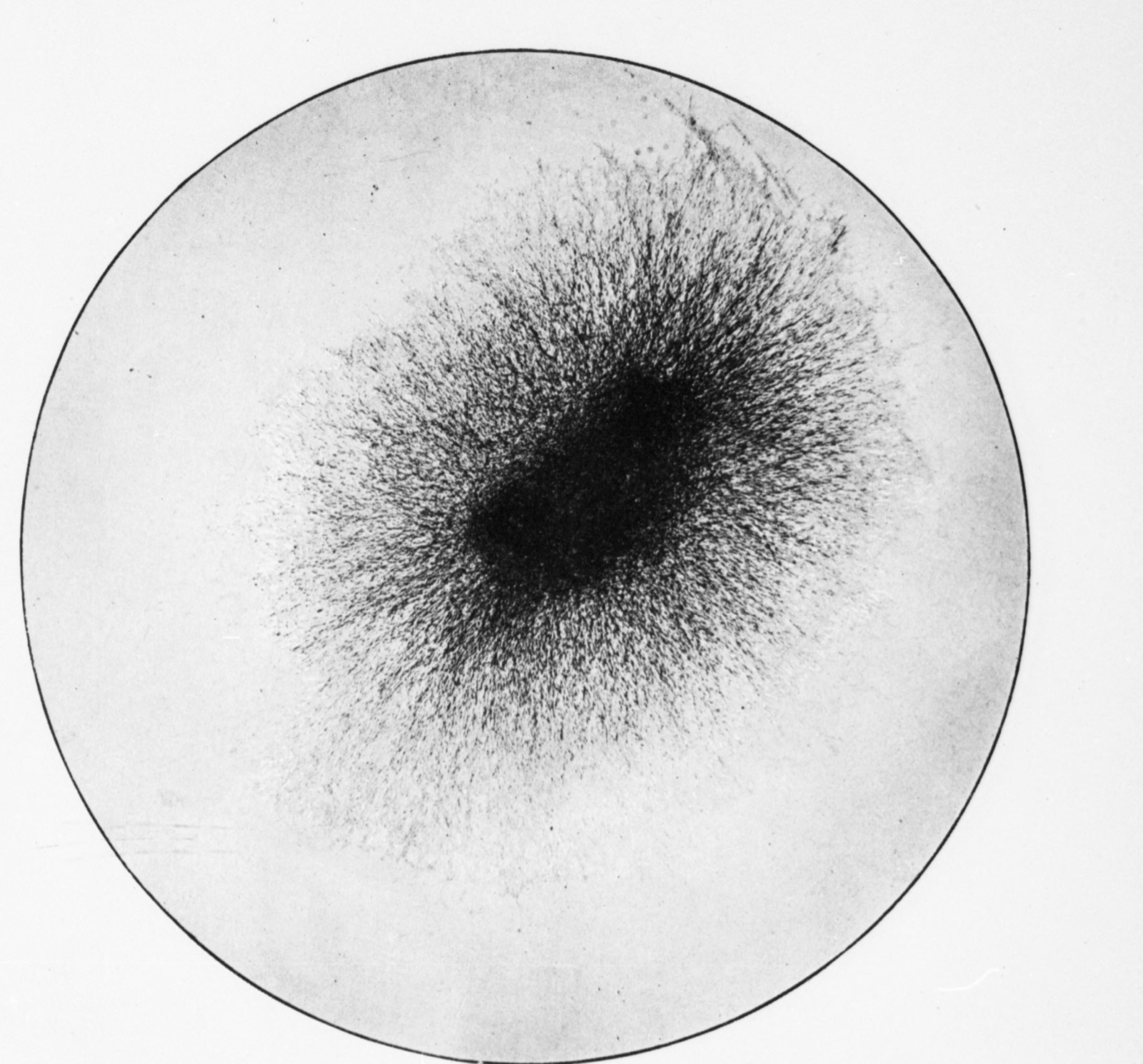
For the public the strain was a birthday. On April 23, 1921, Carrel, Ebeling and a wealthy amateur named Alessandro Fabbri showed the American Philosophical Society in Philadelphia the first time-lapse films of the cells, and the next morning the New-York Tribune ran the story under the headline “Two Nurses and Doctor Attend Carrel’s Living ‘Chicken Heart’,” with a second line that admitted the thing was not a heart at all. “Every forty-eight hours the cell mass must be removed from the growing medium in which it is kept and a surgical operation performed on it,” the paper said. “With the white-clad nurses in attendance, the surgeon with his rubber-gloved fingers and sterilized instruments cuts it in two, severing the new cell growth from the old.” Left to itself, Carrel was reported to have said, it “would have generated a sufficient number of cells to form a ball larger than the earth.” Seven weeks later the World worked out that the cells would by now have made a rooster “big enough today to cross the Atlantic in a stride.” Ebeling’s own figure, in his tenth-birthday paper, was that “today their mass would be very much larger than the sun.”
On January 17, 1922, the New York Herald gave the tenth birthday a column: “Bit of Heart Tissue Lives on Ten Years. Secret of ‘Old Age’ Causes Seen in Fragment of Embryonic Chicken.” “Ten years ago to-day Dr. Alexis Carrel of the Rockefeller Institute isolated a fragment of tissue from the heart of an embryonic chicken. The tissue kept on growing; it has kept on growing ever since.” It gave the recipe of the medium and the forty-five seconds in Ringer’s solution almost word for word from Ebeling’s paper of 1919, and it was careful about the men: “Neither Dr. Carrel nor Dr. Ebeling has ever been willing to speculate along this line. . . . They hesitate to say anything that might provoke unjustified assumptions regarding the continuity of human life.” Then it said what the laboratory had taught it to say. “It is, so far as those who are watching and nourishing it can see, immortal.”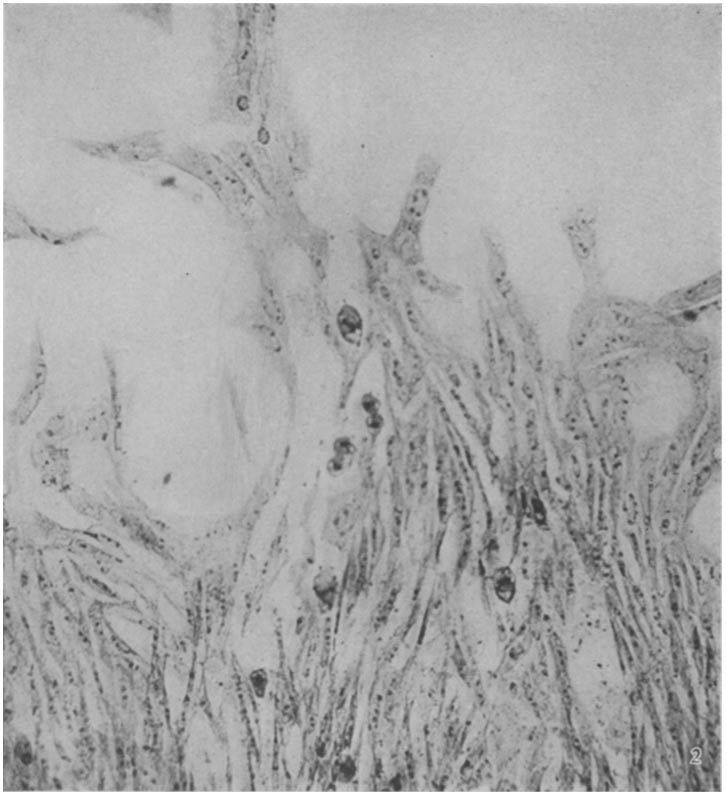
After that the story told itself, and the laboratory’s care about words did not travel. A syndicated photograph in May 1924 told readers in North Dakota that “a piece of chicken’s heart has been kept beating for twelve years” by Carrel, whom it placed at Johns Hopkins. In November 1925 Time quoted an English chemist, home from a visit to the laboratory, who said the tissue “doubles itself every twenty-four hours and if it had not been pared down each day since the experiment began it would now be a colossal monster overspreading all New York”; Time itself added, correctly, that “Dr. Carrel’s chickenheart-tissue is not a chicken.” In January 1932 Time described Carrel, “who has kept a piece of chicken heart growing for 19 years,” announcing that rejuvenation was impossible and that “the process of aging remains irreversible,” and explained the laboratory’s theory of age as the paper had understood it: “as soon as one begins to live, he begins to kill himself. All living cells give off waste products which, unless removed, clog continued growth.” In 1935, in Man, the Unknown, the book that made him a bestseller, whose lectures that winter drew crowds the police were called to control, Carrel dropped the word “potentially.” Cells kept in a constant medium, he wrote, “record time by quantitative, and not by qualitative, changes. If, by an appropriate technique, their volume is prevented from increasing, they never grow old. Colonies obtained from a heart fragment removed in January, 1912, from a chick embryo, are growing as actively to-day as twenty-three years ago. In fact, they are immortal.” Time’s profile of him that September put the arithmetic the other way up: if his assistants “had not periodically pared the embryonic tissue and destroyed the parings, the whole earth might now (theoretically) be covered with a film of soft flesh.” In March 1937 a Chicago radio writer named Arch Oboler, who had read about the laboratory, broadcast a seven-minute play called “Chicken Heart” in which a fragment kept alive in a laboratory breaks its glass, grows until it covers the earth, and swallows the last aeroplane with a wet sound; a generation of children remembered it with their lights off. In April 1939, reporting Carrel’s retirement, Time said: “For 27 years he has kept a scrap of chicken heart alive and growing. Every few days the heart has to be trimmed, for it spreads so rapidly that if left alone it would fill the laboratory in a year.” The whole run of them, from the Nobel Prize to the obituary, is in The birthdays.
Ebeling spent part of an article in 1942 denying all of it: that “Dr. Carrel’s original tiny fragment of chick embryo heart-tissue has grown into a large, pulsating chicken heart; or pieces have to be ‘snipped off’ from time to time to hold it in bounds; or it is being kept in a glass jar or on a white marble slab, with the added setting of a group of scientists crowded around intently watching and tending it constantly, day and night!” He called them “fantastic legends.” But the legends had got one thing right that the laboratory’s papers had not dwelt on. The cells were never allowed to grow. Every forty-eight hours, most of what had grown was thrown away and a small piece was kept and fed. Whether the piece that was fed on Tuesday was the piece that had been fed on Sunday was a matter of the knife, the Ringer’s bath, and the judgement of whoever held them.
One visitor saw the knife held. In the summer of 1930 a graduate student from Chicago, Ralph Buchsbaum, who had been trying for months to keep his own chick cultures alive, drove to New York to see the famous strain. Carrel was in France. Parker put him off until the next day because of a “big experiment,” which turned out to be golf. Ebeling showed him the laboratories but said the strain “was too delicate to risk being shown to visitors.” Buchsbaum went back to the floor where the cultures were kept and asked a young technician. Fifty years later he wrote down for Witkowski what happened next. He looked at the cultures and said they were full of fat globules and on their way out, “and she said slyly, ‘Well, Dr. Carrel would be so upset if we lost the strain, we just add a few embryo cells now and then . . . We make new strains for new experiments. Dr. Parker says he will retire the strain soon, it costs too much to keep it going.’” Buchsbaum told the story for years. His own professor, he said, refused to believe it; “others chuckled gleefully.” It is one person’s memory of one remark, made half a century before it was written down, by a technician whose motives cannot now be known. It is also the only account there is from inside the room.
What happened
The Institute retired its members at sixty-five, and Carrel reached that age in June 1938. In July 1939 he sailed for France, his laboratories were closed, and the cells went with Ebeling, Mrs Hull and Miss Olmstead to the Lederle Laboratories of the American Cyanamid Company at Pearl River, where Ebeling had set up a tissue culture department to test the toxicity of drugs and germicides on living cells. That was where they were on January 17, 1940, when the World-Telegram buried them and dug them up again; Newsweek reported that the paper had asked after them on that date every year since they were started. Ebeling’s article of January 1942, in Scientific American, carried the subtitle “Present Authentic Facts about This Oft-Falsified Scientific Celebrity.” A photograph showed the Rockefeller technique unchanged, and Ebeling wrote that in the drug work the strain “has already thus ‘earned its keep’ over and over again.”
Carrel’s last years were his own and not the strain’s. In 1941 the Vichy government made him regent of a Fondation française pour l’étude des problèmes humains, with several hundred staff, to study the French population and its improvement along the lines his book had drawn. After the liberation of Paris he was suspended from it and accused of collaboration. He died in Paris on November 5, 1944, aged seventy-one, before any charge was tried.
The cells outlived him by seventeen months. Corner’s history records that the strain was discarded on April 26, 1946, and that the Herald Tribune reported its end on October 2 of that year. Nobody published why. Witkowski, forty years on, could find no one who had worked with it in its last decade to ask. Parker’s manual, in its 1950 edition, still described it in the present tense of a standard: a strain that “was kept in a state of active multiplication for thirty-four years,” retaining “its original characteristics throughout the entire period of cultivation,” and it still carried a photograph of the cells at twenty-six years, supplied by Ebeling in 1938.
And nobody could repeat it, which had been true all along. Buchsbaum, meticulous with his cultures, had never kept a strain going “for more than perhaps a year, mostly less,” and had been blamed for it by a professor who said Carrel had shown the way. Across the field, failure to keep cells alive was put down to the failings of the culturist. Pearl, surveying the biology of death in 1921, had written that there was abundant evidence cells could live for ever except “for the purely accidental intervention of lethal circumstances.” As late as 1956 two workers who watched three strains of rabbit cells slow and die blamed their medium, and the editor of the Journal of Experimental Medicine could write in 1960 that “the largest fact to have come out from tissue culture in the last fifty years is that cells inherently capable of multiplying will do so indefinitely if supplied with the right milieu in vitro.” The editor was Peyton Rous, who had worked at the Institute alongside Carrel for thirty years. He was rejecting the paper that ended the fifty years.
After
Leonard Hayflick came to the question sideways. In 1958, at the Wistar Institute in Philadelphia, he set out to look for cancer viruses by growing normal human cells from fetal tissue alongside tumour cells, and noticed that his normal cultures, started at random times over months, all died in the same way: “Cultures only stopped dividing after about fifty population doublings regardless of when in time they were initiated.” The same technician, the same media, the same glassware, kept young cultures flourishing while old ones in the next rack stopped. With the cytogeneticist Paul Moorhead he showed the cells were chromosomally normal, and then ran the experiment that mattered. “We mixed the same number of male cells at the fortieth doubling with an equal number of female cells at the twentieth doubling. After twenty more doublings of the mixture we found that the only cells present were female.” No virus, toxin or deficiency of the dish could have killed the old male cells and spared the young female ones beside them. The limit was in the cells. The paper, after Rous had turned it down, appeared in Experimental Cell Research in December 1961; the fifty doublings are called the Hayflick limit, the strain he made the next year, WI-38, is the one in which many human virus vaccines have since been grown, and the mechanism he postulated as “an intracellular clock or event counter” turned out, thirty years later, to be the shortening of the telomeres at the ends of the chromosomes with each division. The experiment, and what it changed, is in Fifty doublings.
Hayflick then turned to Carrel. In 1965 he pointed out that the periods of good growth in Ebeling’s table of 1912 were the ones when embryo extract went into the medium, and suggested the obvious thing. His own words, in 1998: “I have suggested that, although probably unknown to them, Carrel and Ebeling made a serious technical error. The alleged immortal chick heart cell culture was fed in those years with an extract of chick embryo tissue prepared daily and extracted under conditions that permitted the addition of fresh living cells to the alleged immortal culture at each feeding.” Chick cells themselves were measured. In 1967 Hay and Strehler found that fibroblasts from the chick embryo manage about twenty-five doublings, sixty to eighty days, and die; in 1970 Pontén grew sixteen strains of them for twenty to twenty-seven doublings each, and none turned into the kind of abnormal line that grows for ever. “Despite many efforts,” Hayflick wrote, “no one has ever confirmed Carrel’s work even to the extent of keeping normal chick cells proliferating for as short period of time as two or three years. Since confirmation is lacking and the scientific method demands this, Carrel’s studies are invalid.”
Witkowski’s reassessment of 1980 weighed three explanations. That the cells had transformed spontaneously into an immortal line he thought unlikely: transformed cells change shape and pile up, the strain was described for thirty years as unchanged, and chick cells almost never transform. That the extract carried living cells by accident he thought possible but hard to sustain: Parker’s manual of 1938 warned of exactly that danger and recommended freezing and thawing the extract to kill cells in it, a London worker had advised the same in 1924, and Helen Morton, who learned Parker’s method from Parker, found living cells in two of five preparations when she tested it in the early 1950s; but every other laboratory made its extract the same way and none of them grew an immortal strain. The third explanation was Buchsbaum’s technician: that the cultures were restocked with fresh embryo cells when they flagged, by people who knew what the strain meant to the man who had founded it. Corner had called the strain “a consummate piece of scientific enterprise and showmanship,” and written that it gave Carrel “a vivid sense of closeness to Nature’s secrets” and won him “almost fanatical devotion from some of his immediate helpers.” Peter Medawar had already put the possibility in print: “an alternative and less creditable possibility [to accidental cell contamination] is that the cultures did die out, and were simply started anew from fresh tissues on the grounds that their death could only have been due to lack of attention, to the use of a toxic medium or to some other accident.” Witkowski could not settle it. “I have attempted to contact colleagues of Carrel who were working with the immortal strain of cells between 1930 and 1939,” he wrote, “unfortunately I have had no success.” His verdict on the whole was that “Carrel’s results were spurious and that they diverted attention away from an important phenomenon.” For fifty years, because cells were believed to be immortal, almost nobody looked for the causes of ageing inside them.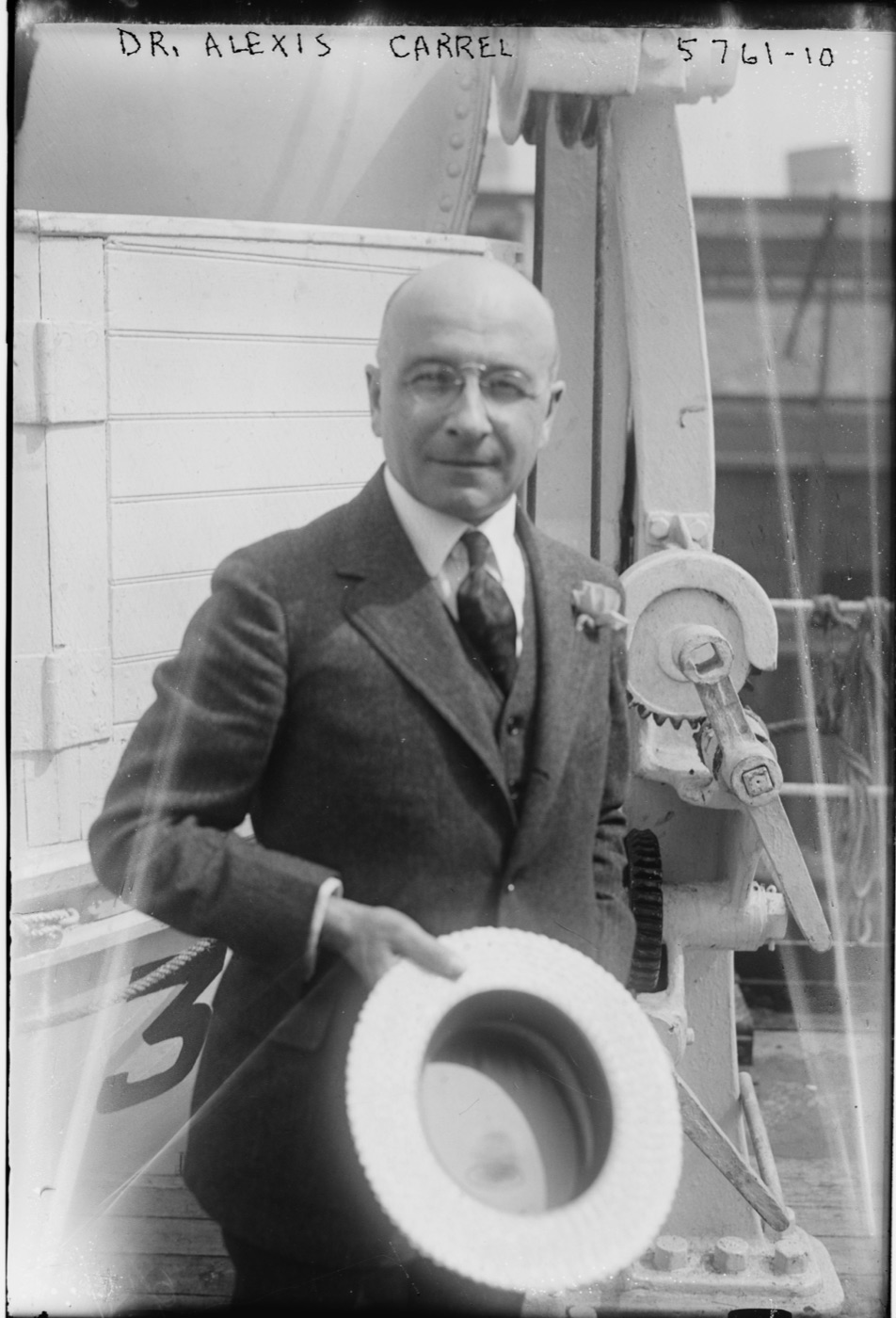
What it taught
Start with what the strain did show. For thirty-four years a laboratory kept a population of chick fibroblasts growing on coverslips, and in doing so made the culture of cells a routine: the passage, the washed fragment, the standardised medium, the measured rate of growth, the pure strain used as a reagent. Those were real, and the field used them. What the strain did not show was the thing it was famous for, and the reason is in its design.
An experiment that cannot fail cannot teach. Carrel wrote the rule in 1914: cells “may proliferate indefinitely” if we exclude accidents. Every culture that died, and almost all of them died, had therefore died of an accident, a bad batch of plasma, alkali on the glass, an infection, a technician’s slip, and was struck from the record while the survivor went on. Ebeling’s finding that every slowing in seven years “was due to deficient medium, or extract, or to the presence of alkali” is not a result; it is the rule applied. A system in which only one outcome can count as evidence will report that outcome for as long as it is kept running, and the thirty-fourth year of “still alive” carried no more information than the first. Before you start, decide what result would make you stop.
The feed was the experiment. The variable nobody controlled was the thing added at every passage. From February 1, 1912, a drop of juice from minced embryos went into the medium, and the growth that followed was read as nourishment, as Carrel’s own work on wounds had led him to expect. In the same month he grew a whole culture from the clear fluid off a spun embryo pulp, and published it as proof that cells divide. The two observations sat in one paper for half a century. A control was never kept, because a culture on plasma alone dwindled passage by passage, as Parker’s manual recorded, and its dwindling only confirmed that the juice was food. When the thing you add to make an experiment work is also the thing that could produce the result on its own, the first test is to leave it out, and to treat the failure that follows as information rather than as an accident.
A procedure that is never watched from outside becomes a ritual. Corner’s sentence about the laboratory, that colleagues “did not drop in for casual visits, and never learned about what was going on,” describes a place where the only people who knew how the strain was kept were the people whose standing depended on keeping it. Ebeling would not show the cultures to a visitor; a technician would. Whether she spoke the truth cannot now be known, and no villain is needed to see the design: a strain that was the department’s standard reagent, its founder’s proof, and the newspapers’ yearly story could not be allowed to die, and everyone who held the knife knew it. Any measurement that only its owners can see should be assumed, in time, to say what its owners need.
The field’s failure to repeat it was explained away by the theory it was failing to repeat. For fifty years every laboratory that watched its cultures slow and die blamed its own technique, because the dogma said cells were immortal and the dogma rested on one strain in one laboratory. Buchsbaum was told to do better; the rabbit cells of 1956 were blamed on their medium; Rous rejected the paper that was right because its result contradicted the fact he knew best. A single unrepeated success with a mechanism nobody could inspect should weigh less, not more, than many honest failures. It took an experiment built to fail, male cells of one age beside female cells of another, to make the failures count.
Check the story before you learn from it. The strain began on January 17, 1912, but Carrel’s famous heart was Experiment 720, from an eighteen-day fetus, and Ebeling’s strain was Experiment 725, from a seven-day embryo; sixteen fragments became five by March and one by September 25, 1912, so whatever lived for thirty-four years descended from a single small piece that was already a survivor of accidents. The passages were 1,860 by January 1922 in Ebeling’s paper and “nearly 2,000” in the Herald. The cells were fed every forty-eight hours in the laboratory, “each day” in Time of 1925 and “every few days” in Time of 1939; they were “trimmed” in every newspaper and in none of the papers. They were “potentially immortal” in the journal in 1922 and “immortal” in the book in 1935. They were discarded in 1946, on April 26 according to Corner, by Ebeling according to Hayflick, for reasons nobody wrote down. The limit for human cells is about fifty doublings and for chick cells about twenty-five to thirty, and the explanation of the thirty-four years is Hayflick’s accident or Witkowski’s restocking, between which, the people being dead, there is no longer a way to decide. What the record supports without argument is the recipe, the forty-eight hours, the one drop of extract on February 1, 1912, the single survivor of September 25, and the fact that no one, before or since, has kept normal chick cells alive for three years. That is enough to learn from.
Sources
- Alexis Carrel, “On the Permanent Life of Tissues outside of the Organism,” Journal of Experimental Medicine 15 (1912), 516–528, received March 15, 1912. The purpose of the experiments, the methods, Experiment 720-1 and its 104 days of pulsation, the culture grown from the centrifuged embryo suspension of February 1, the five survivors of March, and the summary. Public domain. pmc.ncbi.nlm.nih.gov, scan of the issue at archive.org
- Albert H. Ebeling, “The Permanent Life of Connective Tissue outside of the Organism,” Journal of Experimental Medicine 17 (1913), 273–285. The sixteen fragments, Ebeling taking charge on June 1, 1912, the single survivor of September 25, the thirty cultures of January 1913, and Table I with every passage of Experiment 725, including the first drop of extract on February 1, 1912. pmc.ncbi.nlm.nih.gov, scan at archive.org
- Alexis Carrel, “Artificial Activation of the Growth in Vitro of Connective Tissue,” Journal of Experimental Medicine 17 (1913), 14–19, received June 1912. Extracts of embryo, spleen and sarcoma raising growth three to forty times, the loss of the effect on heating and filtration. pmc.ncbi.nlm.nih.gov, scan at archive.org
- Alexis Carrel, “Contributions to the Study of the Mechanism of the Growth of Connective Tissue,” Journal of Experimental Medicine 18 (1913), 287–298. The sixteen-month strain “in a condition of real life,” and “time has no effect.” pmc.ncbi.nlm.nih.gov, scan at archive.org
- Alexis Carrel, “Present Condition of a Strain of Connective Tissue Twenty-Eight Months Old,” Journal of Experimental Medicine 20 (1914), 1–2. The 358 passages, the seven-day embryo, the doubling in forty-eight hours, and “if we exclude accidents.” pmc.ncbi.nlm.nih.gov, scan at archive.org
- Albert H. Ebeling, “A Strain of Connective Tissue Seven Years Old,” Journal of Experimental Medicine 30 (1919), 531–537. The 1,390 passages, the technique in detail, the plasma and the extract, the projection apparatus, and the finding that every decrease in growth was due to the medium. pmc.ncbi.nlm.nih.gov, scan at archive.org
- Alexis Carrel and Albert H. Ebeling, “Age and Multiplication of Fibroblasts,” Journal of Experimental Medicine 34 (1921), 599–623. The serum of old and young chickens and the inhibiting factor. pmc.ncbi.nlm.nih.gov, scan at archive.org
- Albert H. Ebeling, “A Ten Year Old Strain of Fibroblasts,” Journal of Experimental Medicine 35 (1922), 755–759. The sixty cultures of January 17, 1922, the 1,860th generation, the 30,000 cultures, the mass larger than the sun, “potentially immortal,” Harrison’s objection and Pearl’s answer, and the strain as a reagent. pmc.ncbi.nlm.nih.gov
- “Two Nurses and Doctor Attend Carrel’s Living ‘Chicken Heart,’” New-York Tribune, April 24, 1921, page 11; and “Bit of Heart Tissue Lives on Ten Years,” New York Herald, January 17, 1922, page 24. Public domain, read in the Library of Congress’s Chronicling America scans. loc.gov, loc.gov
- “Heart Tissue Is Still Alive after Twelve Years,” syndicated photograph and caption, Bismarck Tribune, May 21, 1924, page 2. loc.gov
- Time: “Science: Physical Immortality,” November 30, 1925; “Medicine: No Rejuvenation,” January 4, 1932; “Medicine: Carrel’s Man,” September 16, 1935; “Medicine: Rockefeller Retirements,” April 24, 1939. In copyright; quoted briefly. time.com, time.com, time.com, content.time.com
- Alexis Carrel, Man, the Unknown, Harper, New York, 1935, chapter V, page 173. In copyright; the sentences quoted were read in archive.org’s search-inside text of the first edition, not on the page itself. archive.org
- Albert H. Ebeling, “Dr. Carrel’s Immortal Chicken Heart: Present Authentic Facts about This Oft-Falsified Scientific Celebrity,” Scientific American 166 (January 1942), 22–24. In copyright and behind a paywall; the “fantastic legends” passage and “earned its keep” are quoted at second hand from Witkowski 1980. scientificamerican.com
- Raymond C. Parker, Methods of Tissue Culture, second edition, Hoeber, New York, 1950, pages 3–8 and 107. The thirty-four years, the photograph at twenty-six years, and the account of the extract’s discovery in 1912. The 1938 first edition’s warning about cells in the extract is cited from Witkowski. archive.org
- George W. Corner, A History of the Rockefeller Institute, 1901–1953, Rockefeller Institute Press, 1964, pages 127–128, 153 and 533. Carrel’s aloofness, the “showmanship,” and the discard on April 26, 1946, all quoted at second hand from Witkowski 1980; the book itself is lending-only online. archive.org
- Leonard Hayflick and Paul S. Moorhead, “The Serial Cultivation of Human Diploid Cell Strains,” Experimental Cell Research 25 (1961), 585–621; and Leonard Hayflick, “The Limited in Vitro Lifetime of Human Diploid Cell Strains,” Experimental Cell Research 37 (1965), 614–636. In copyright and paywalled; their findings and the suggestion about the extract are taken from Hayflick’s own account of 1998 and from Witkowski. doi:10.1016/0014-4827(61)90192-6, doi:10.1016/0014-4827(65)90211-9
- Leonard Hayflick, “A Brief History of the Mortality and Immortality of Cultured Cells,” Keio Journal of Medicine 47 (1998), 174–182. The fifty doublings, the male and female cells, Rous’s rejection and his sentence, the World-Telegram’s annual inquiry, the “serious technical error,” and “Carrel’s studies are invalid.” jstage.jst.go.jp
- Jan A. Witkowski, “Dr. Carrel’s Immortal Cells,” Medical History 24 (1980), 129–142. The history of the strain, the newspaper headlines of 1921, 1924, 1940 and 1946, Ebeling’s article of 1942, the three explanations, Parker’s warning, Morton’s test, Buchsbaum’s account in full, Medawar’s sentence, and the quotations from Corner. pmc.ncbi.nlm.nih.gov
- Jan A. Witkowski, “Alexis Carrel and the Mysticism of Tissue Culture,” Medical History 23 (1979), 279–296. Jolly’s objection of 1910, the black gowns, and the reputation of the method. pmc.ncbi.nlm.nih.gov
- “Alexis Carrel: Biographical,” Nobel Lectures, Physiology or Medicine 1901–1921, at nobelprize.org. Birth, degrees, Chicago, the Institute in 1906 and 1912, the mission of 1939, the Vichy foundation and the death in Paris. nobelprize.org
- Alexis Carrel Papers, Georgetown University Library, finding aid GTM-530913, for the Institute’s retirement age and the collaboration charge. findingaids.library.georgetown.edu
- Margaret A. Brucia, “Alessandro Fabbri, the Rockefeller Institute, and the Immortal Chicken Heart,” Gotham Center for New York City History, September 5, 2017, for the films of April 1921. gothamcenter.org
- Neely Tucker, “Halloween Heartthrob: The ‘Chicken Heart’ that Gobbled Up the Globe,” Library of Congress blog, October 22, 2024, for Oboler’s broadcast of March 10, 1937. blogs.loc.gov
- Lijing Jiang, “Alexis Carrel’s Immortal Chick Heart Tissue Cultures (1912–1946),” Embryo Project Encyclopedia, Arizona State University, 2010, a secondary survey used for orientation. embryo.asu.edu
- The portraits are George Grantham Bain Collection negatives at the Library of Congress, LC-DIG-ggbain-07318 and LC-DIG-ggbain-34418, through Wikimedia Commons. commons.wikimedia.org, commons.wikimedia.org

