On Saturday 18 November 1933, in Vienna, the Administrative Court of the Austrian republic sat to decide whether a market town in the Tyrol had been issuing money. Reporters had come from Holland, Switzerland, England and the United States, and for the first time in its history the court had had to restrict admission to the public gallery. The money in question was a set of printed certificates in three colours, for 1, 5 and 10 schillings, which had circulated in the town of Wörgl for thirteen and a half months and had been called in two months before, under threat of the police. On the face of each note was a grid of twelve small boxes, one for each month of the year, and a rule: at the start of every month the holder had to buy a stamp worth one per cent of the note and stick it in that month’s box, or the note was worth that much less.
The court found what the law required it to find. “In the territory of the commune of Wörgl,” it said, “the labour certificates were without doubt tokens of money and as such suited to replace banknotes,” and only the National Bank might issue those. But it opened its reasons with a sentence about what it was not deciding. Whether the certificates had done anything for the economy or for the town’s finances, it said, “must remain excluded.”
The number that mattered to the court was 122, the article of the bank’s statute. The number the town’s mayor had set out to test was a different one, and nobody in the room had measured it. Irving Fisher of Yale had printed the mayor’s guess at it that spring: the notes came back twenty times a month. An unfriendly official would soon put it at twice a week. Eighteen years later a friendly writer would multiply the official’s figure by a guess of his own and arrive at 416 times a year, and that is the number the world remembers.
Who ran it
Wörgl is a market town in the valley of the Inn, in the Tyrol, about fifty kilometres down the river from Innsbruck and twenty from the Bavarian border. It owed what it was to the railway junction, made when the line from Italy to Munich crossed the Innsbruck line there in 1875, which drew a cellulose works founded by French investors in the 1880s, a cement works, a brickworks, two sawmills and a locomotive depot. By 1910 the population was more than four thousand.
By 1932 most of the reasons for the town had stopped. The railway electrified the line and closed the depot; its staff at Wörgl went from 310 in 1930 to 190 in 1933. The cement works in the next village, Kirchbichl, closed in 1931 and never opened again. The cellulose works, which had employed between 360 and 410 and had once sent pulp to Paris for the newspapers, kept four men to watch the machines. By the spring of 1932 about 350 people in the town were out of work, and 1,500 in the surrounding district; about 200 of the town’s unemployed had exhausted their insurance and were on the parish poor relief. The town owed the Innsbruck savings bank 1,300,000 schillings, borrowed in the 1920s for a school and other works, and in July 1931 the bank had raised the interest from 7 to 10 per cent. The interest for 1931 had not been paid. Tax arrears stood at about 118,000 schillings. In the first half of 1932 the municipal taxes brought in 3,000.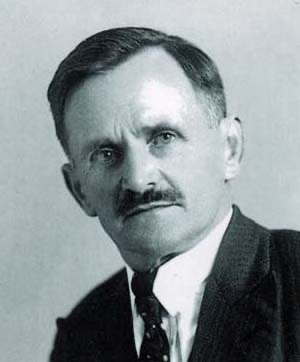
The mayor was Michael Unterguggenberger. He was born on 15 August 1884 at Hopfgarten in the Brixental, a few miles up the side valley, the son of a working family, and left school at twelve to work in the sawmill. He was apprenticed to a mechanic at Imst, walked as a journeyman through the monarchy and into Germany, joined a trade union at Liegnitz in Silesia, and in 1905, at twenty-one, came back to the Tyrol to drive locomotives for the state railway at Wörgl. He was a Social Democrat. He sat on the council from 1919 and was deputy mayor from the early 1920s. On 12 December 1931, with the council divided evenly between the two political camps, the choice of mayor was settled by lot, and it fell to him. He retired from the railway, with a weak heart and lungs, to take the job, which paid 1,800 schillings a year.
He had read Silvio Gesell. Gesell, born in 1862 in the Prussian Rhineland, had made money as a merchant in Buenos Aires in the 1880s and 1890s, watched the Argentine currency inflate and collapse, and in 1891 published the first of the pamphlets in which he argued that the trouble with money was that it kept. His book, Die natürliche Wirtschaftsordnung durch Freiland und Freigeld, the natural economic order through free land and free money, appeared in 1916; an English translation by Philip Pye was published in 1929. Gesell died in March 1930. His followers, the Freiwirtschaft, were a movement of their own, and in 1931 some of them had persuaded the owner of a closed coal mine at Schwanenkirchen in Bavaria to reopen it and pay his miners in a private stamp currency called Wära. At Whitsun 1931 Unterguggenberger went to see it. That autumn a Freiwirtschaft group formed in Wörgl around him and some of the town’s shopkeepers. In November 1931 the German government banned Wära by emergency decree.
The experiment was not his alone. The body that ran it was the town’s welfare committee, the Wohlfahrtsausschuss, two dozen people: the mayor, the two deputy mayors, Josef Gollner, a merchant, and Josef Ralser, a railway official; councillors who were farmers, railwaymen and tradesmen, a retired senior finance officer named Georg Stawa, and three women listed as the wives of railway officials. Two trustees held the money: the parish priest, Matthias Riedlsperger, and Dr Stawa. The editor of the local paper, Hans Burgstaller, wrote for it. The town’s savings bank, the Raiffeisenkasse, kept the account. Every vote the council took on the matter, in a country where everything was political, was unanimous.
And it had a reader before it had a result. Irving Fisher of Yale had been corresponding with Gesell’s followers through his assistant Hans Cohrssen, a German who had come to New Haven from the movement. Late in 1932 Fisher sent a man from the Geneva office of his index-number service, Hermann Scheibler, to Wörgl to question the mayor, the bank, the merchants and the workmen, and early in 1933 he published a small book called Stamp Scrip with a chapter on what Scheibler found.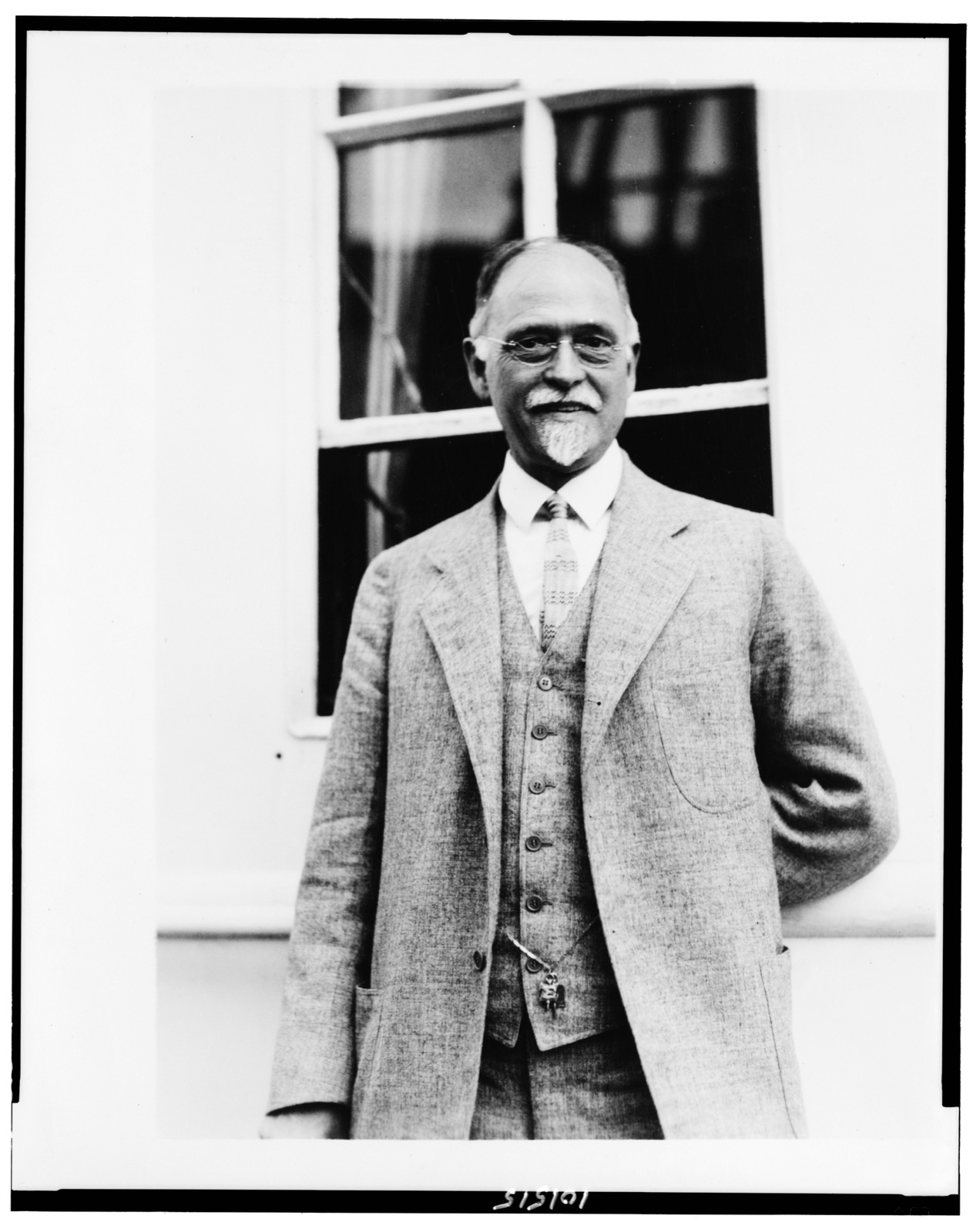
What they were trying to find out
Gesell’s hypothesis was about the difference between money and everything money buys. Goods decay and money does not, so whoever holds money can wait and whoever holds goods cannot, and when prices are falling the waiting is the slump. Gesell wrote it as a demand. In my translation from the fourth edition of 1920: “Money, if it is to have no privileges over goods, must rust like them, go mouldy, rot; it must be eaten away, fall ill, run off, and when it dies its owner must pay the knacker’s fee besides.” Then as a rule: “Only money that goes out of date like a newspaper, rots like potatoes, rusts like iron, evaporates like ether, can prove itself as a means of exchange for potatoes, newspapers, iron and ether. For such money is preferred to goods neither by the buyer nor by the seller. … We must therefore make money worse as a commodity if we want to make it better as a means of exchange.” His mechanism was a stamp. The notes would lose a thousandth of their face value every week, about 5 per cent a year, and the holder would keep them whole by sticking on stamps bought from the post office, so that “everyone always pays cash at once, settles his debt, and carries whatever surplus money then remains with the same haste to the savings bank.” Wörgl’s committee set its stamp at 1 per cent a month, 12 per cent a year, more than twice Gesell’s rate.
Unterguggenberger put it in his own words to the welfare committee on 5 July 1932, in a paper he called the emergency relief programme, the Nothilfe-Programm. Fritz Schwarz, a Swiss journalist of the Gesell movement who wrote the first book about the experiment, in 1951, printed the minutes. In my translation: “Slow circulation of money is the main cause of the present economic paralysis. Money as a medium of exchange is slipping more and more out of the hands of working people. It seeps away into the channels of interest and collects in the hands of a few, who no longer bring it to the market for goods but hold it back as a means of speculation. … Every damming-up of money causes a damming-up of goods and unemployment.” “Since the world cannot be freed from here, we want at least to give a sign.” The sign was that “the sluggish and slowly circulating money of the National Bank must be replaced, within the district of the municipality of Wörgl, by a medium of circulation which will fulfil its purpose as a means of exchange better than the usual money.” The town would issue “labour certificates” in three denominations, 1, 5 and 10 schillings; the townspeople would be persuaded to buy them at face value and make their payments in them; and public works would be paid for in them according to a plan still to be drawn up.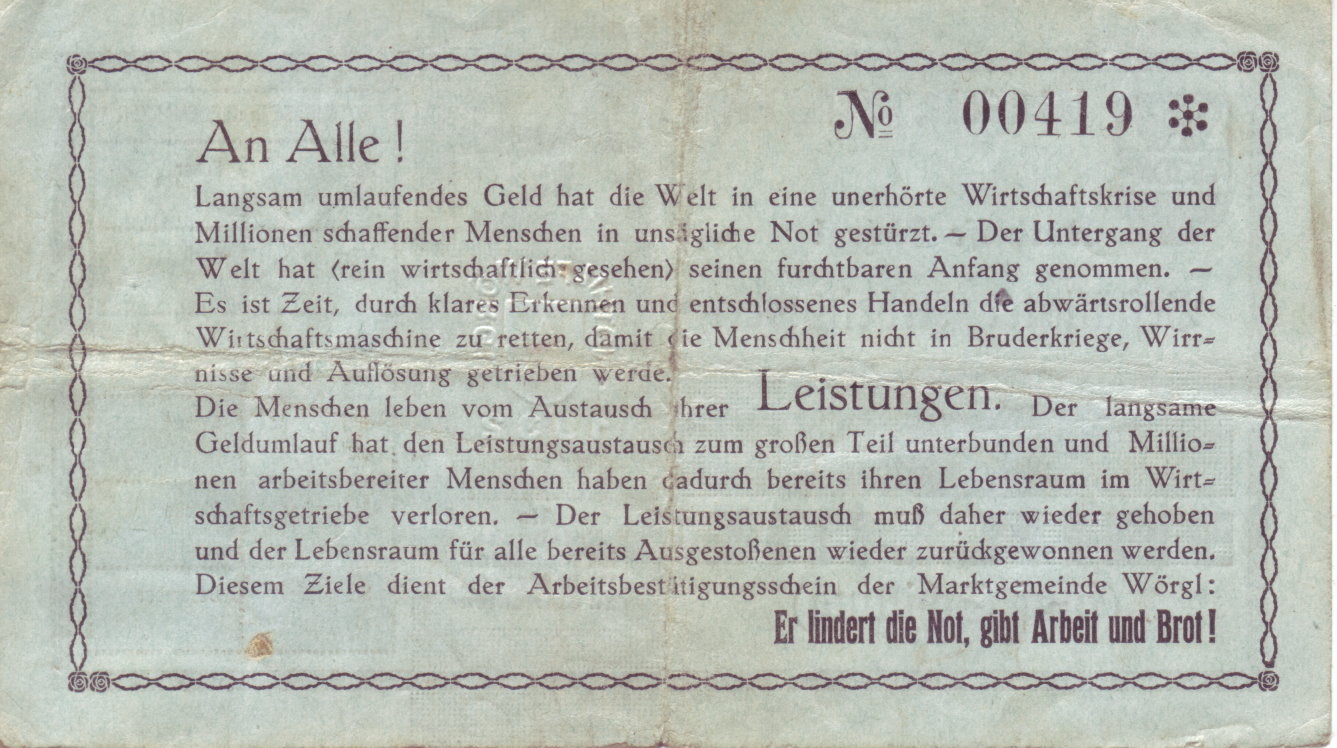
There are two claims in that, and they are tested differently. The first is that money which costs something to hold will move faster than money which does not. That could be measured, in a town of four thousand people, by counting: how often a note came back to the treasury, how often it changed hands between. The second is that money moving faster in one town would put the town’s unemployed to work, pay its arrears and lift its trade, in a country where the money was not moving at all. That could only be measured against what would have happened in Wörgl without the notes, and nobody could know that. Both claims were Gesell’s, and the committee adopted both in a single vote.
There was a third question, which the committee did not write down and which was decided before the first note was spent. The Austrian National Bank wrote to object before the notes were delivered from the printer, on the ground that what was being printed was money, and that Article 122 of its statute gave it alone the right to issue money in Austria. The mayor replied that it was not money; it was a labour certificate. Schwarz, who knew him, says he smiled when he said it: the theorists would never agree on what money was, and meanwhile the disputed money would circulate.
What they built
The rules were adopted by the welfare committee on 5 July 1932 and by the council on 8 July, unanimously, in nine points. In my translation of the ones that matter: the welfare committee would issue labour certificates, which the participants in the Nothilfe Wörgl, the Wörgl Emergency Relief, would give and take in place of payment. The certificates would be held at the municipal treasury, where they could be bought at full face value and sold back at any time “against a deduction of 2 per cent of the face value (the job-creation contribution)”. The first issue would consist of 2,000 notes each of 1, 5 and 10 schillings, “a total face value of 32,000 schillings”; the 1 schilling was yellow, the 5 blue, the 10 red, and each note was to be embossed with a control stamp from the mayor’s office, without which it was void. Point eight carried the experiment: the certificates “are charged with an emergency levy of 1 per cent of face value a month, which the holder at the time bears by sticking on the corresponding adhesive stamp at the start of the month. Notes which, when passed on, do not carry the full set of levy stamps are accepted only at the amount reduced by the missing stamps.” Point nine: “Participation in the Nothilfe Wörgl is voluntary.” The council’s consent, the Tiroler Anzeiger reported, came with a declaration from the deputy mayor, Josef Gollner, for the non-socialist bloc: “If the mayor is conscious that in this matter he is carrying out an action not contrary to the law, the motion will be agreed to,” on condition that the issue never exceed a fixed sum in Austrian schillings and that full cover in schillings be held at the trustees’ office for every note in circulation. The legal question was asked, and set aside, on the day the experiment was voted.
The face of each note said Nothilfe Wörgl, Bestätigter Arbeitswert, certified labour value, the denomination in large squared figures, and Marktgemeinde Wörgl, Armenpflege, the town’s poor relief, with the slogan across the top: Lindert die Not, gibt Arbeit und Brot, relieves want, gives work and bread. In the middle was the embossed control stamp and the words Ohne Prägestempel ungültig. On the right was a grid of twelve small fields, headed Notabgabe in Klebemarken, labelled in the Austrian way, Jänner, Feber, März, April, Mai, Juni, Juli, August, September, Oktober, November, Dezember. A 1 schilling note took a stamp of one groschen a month; a 10 schilling note, ten groschen; twelve stamps a year. On the back, under the serial number, was an address headed An Alle!, To Everyone, which ended, in my translation: “People live by the exchange of what they can do. Slow circulation of money has largely cut off that exchange, and millions of people willing to work have thereby already lost their place in the workings of the economy. … This is the purpose the labour certificate of the market town of Wörgl serves: it relieves want, gives work and bread!”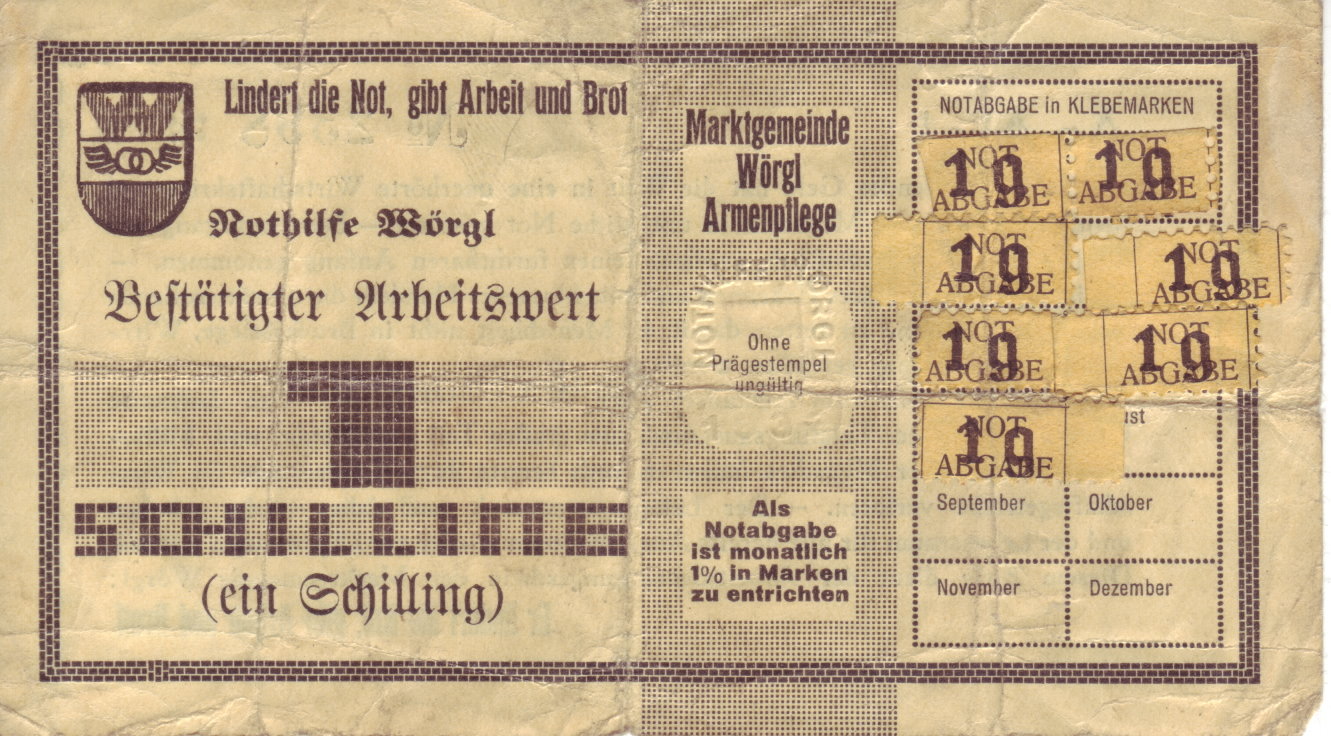
The committee did not give the notes away. The town bought them from the committee for ordinary schillings, and the committee’s trustees paid those schillings into a separate account at the Raiffeisenkasse, so that every note in circulation was matched by a schilling in the bank. The bank undertook to buy the notes back at any time, less the 2 per cent. The stamps were sold at the town hall, and their proceeds, with the 2 per cent and the interest on the deposit, went to the poor relief. The deposit did not sit in the vault; the bank lent it to wholesalers at 6 per cent, and the 6 per cent went to the town.
The town got the notes into circulation by paying its own people with them. The municipal staff, the mayor included, agreed to take half their salaries in certificates, and later three-quarters. The men on the emergency works were paid in them entirely. On 31 July 1932 the town bought the first 1,000 schillings of notes from the committee and paid them out in wages; The committee’s own account, which Schwarz printed, is shorter: 8,500 schillings in seven tranches between 31 July and 17 September, and then nothing more. The most that was ever out at one time was 7,443. Averaged over the thirteen and a half months the notes ran, the sum in circulation was about 5,490 schillings, about 1.3 schillings a head.
The works had already begun. Burgstaller’s account, which Schwarz reprinted, dates the first building programme from 11 July 1932, three weeks before the first note was paid out: sewers under the Jahnstraße and the Brixentaler Straße, four streets and the church square rebuilt and most of them asphalted. That programme finished on 29 October 1932 and cost 31,222 schillings. A second programme asphalted the two remaining streets, laid out the Premstraße and made pipes and kerbstones for stock, at 43,385. Smaller jobs followed: roads and tracks outside the town, a soup kitchen, a wash-house at the town mill, a ski jump that took five hundred man-shifts, and the widening and lighting of the road up from the station. He put the total at 102,197 schillings. Fisher’s chapter says 100,000. The mayor’s own figure, from the provincial works office which supervised the jobs, was 93,796 for 1932, not counting the town hall, the ski jump and a reservoir at the hamlet of Winkl. All the wages were paid in certificates. The materials were paid for, in part, from a provincial grant of 12,000 schillings, and the wages were subsidised by the federal fund for productive unemployment relief at 3.50 schillings per man per day. That is the part of the arithmetic that was easiest to leave out later.
Article 122
The National Bank had objected before the first note was spent, and it did not stop. Its case was short. The statute under which it had been reorganised in November 1922, while the League of Nations was rebuilding Austria’s finances after the inflation, gave it in Article 122 the sole right to issue notes in the republic, and the Wörgl certificates, whatever they were called, were pieces of paper made out to the bearer, in round sums, passing from hand to hand as payment. The town’s case was equally short: the certificates were not legal tender, nobody was obliged to accept them, and every one was covered by a schilling in the bank. Fisher’s chapter, written at the turn of the year, reported that “the attitude of the Austrian Government has not been hostile.”
The bank’s own file, which Gebhard Ottacher read in the archive of the Wörgl Heimatmuseum for a study published in 2007, shows how fast the objection had moved. On 21 July 1932 the bank’s branch at Innsbruck read in a local newspaper that the Wörgl council had resolved to issue free money. The next day the directorate in Vienna passed the matter to the finance ministry, which telegraphed the governor of Tyrol the same day, 22 July, to have the issue stopped “with all speed”. On 23 July the bank’s head office wrote to Innsbruck that steps had been taken through the government “to put a stop to this nuisance”, wegen Abstellung dieses Unfugs. The first note was not paid out for another eight days. On 22 September the Innsbrucker Nachrichten reported that the bank had applied to the federal government for a ban, and that letters were arriving in Wörgl from Germany, Switzerland, America, Japan, Palestine, England, Greece, British India and Romania. The orders fell to the district officer at Kufstein, whose job was to supervise the communes, and on 9 August he wrote to the provincial government that he could not see in the certificates an infringement of the bank’s privilege, “but rather the introduction of a kind of cashless payment”, and called the scheme an attempt that deserved recognition. On 5 January 1933, on instruction from the federal chancellery, the same district officer issued the prohibition he had argued against: by issuing certificates “made out to the bearer and used in commerce as tokens of money”, the commune of Wörgl had infringed Article 122 of the statute of the Austrian National Bank, and its resolution was set aside.
Article 122 is worth reading, because it is the instrument the authorities had. The first section of the law of 14 November 1922 to which the bank’s statute was annexed reads, in full: “Neither the federation nor the provinces nor the communes may issue paper money.” The article made it an offence for anyone to issue without authority “banknotes or other orders made out to the bearer, or non-interest-bearing debt instruments, which could be used in commerce as tokens of money”, on pain of a fine of ten times the value issued and at least 10,000 schillings. The word an official in the justice ministry underlined was könnten: could be. The question was not whether the certificates were money. It was whether they could be used as if they were.
The town appealed on 18 January 1933. There could be no question of a breach of the bank’s privilege, the council wrote, “since the labour certificates are restricted to the circle of persons taking part in the relief action, and lack all the marks of a token of money (cover values, general usability, compulsory acceptance and so on)”. On 22 February the governor’s office rejected the appeal; “this decision is final.” On 7 March the council heard that the prohibition was final and resolved unanimously, the Tiroler Anzeiger reported, to appeal to the Administrative Court in Vienna “and to leave these labour certificates in circulation until that decision”; it retained a Vienna lawyer, Hans Hollitscher, whose complaint went in at the end of April. The complaint had no suspensive effect; from May the district office ordered the town to stop paying out the notes, but those already out went on circulating.
Everything the town did to be noticed now counted against it. On 12 June the Innsbruck branch warned Vienna that the mayor’s propaganda could have unpleasant consequences, “since individual Raiffeisen banks are apparently beginning to flirt with the idea”; on 16 June the bank asked the finance ministry to have the notes called in at once, regardless of the case before the court. In the same week the mayor addressed about 170 mayors from across Austria in Vienna. Money, he told them, by a Vienna reporter’s account, was exactly like a state’s railway wagons: it had to keep moving without interruption, and every stoppage ought to be penalised. A number of them formed a committee to demand the right to issue shrinking money should the court decide against Wörgl. Parliament had been shut since March. On 5 July the chancellery instructed Tyrol to have the notes withdrawn at once. Its answer to the court, on 10 July, called the action “highly dangerous efforts of an inflationist nature” which, by “general application and imitation”, could produce “the most unwelcome phenomena”. On 27 July the district officer at Kufstein set a deadline of 10 August. On 6 August the mayor asked for the end of the month. The companion piece “The file” follows the letters in order.
What it looked like from inside
A Swiss visitor, Alex von Muralt, a journalist of the religious-socialist press in Bern who was then living in Vienna, came to Wörgl in April 1933 and wrote the first careful account by an outsider, published in the Annals of Collective Economy the next year. He went from shop to shop. Every business in the town took the notes at face value, he found, and the notes came back to the treasury as taxes and dues. The shopkeepers “are, of course, not enamoured at the idea of losing 1 per cent at the end of the month if they cannot pass on the relief money, or 2 per cent if they desire to convert it into banknotes. They prefer ordinary money.” Most backed it anyway, believing it had lifted their turnover a little or stopped the fall they had feared. A grocer complained that the wholesaler who supplied him would take only half of any bill in certificates; the wholesaler confirmed it, and supported the scheme all the same. Prices were the same as in Innsbruck and Kitzbühel; there had been no inflation. The treasury’s side Muralt could count: the stamps, the 2 per cent and the interest on the deposit together were worth the town something over 2,000 schillings a year, in a parish where the mayor’s salary was 1,800. The large claim, that 79,000 schillings of arrears had come in, he took to the provincial government in Innsbruck and could not get confirmed; an official there found the town’s own tax receipts up sharply from 1931 to 1932, “but they are not as substantial as those cited by the burgomaster,” and the town’s share of federal and provincial taxes down by more, because the rest of Austria was paying less.
Fritz Pfister, a former city councillor from Bern, walked the town with a schoolteacher the same year and put twelve questions to a dozen people whose trades he recorded but whose names he mostly did not, from the bank director and the priest to the tinsmith and the cinema owner. Asked how safe the money had seemed, the police inspector said he had been sceptical at first, and then told a story: at a burglary, the thief had taken only the Austrian money and thrown the Wörgl money away, “so it must have been a stranger; a local would have taken it.” Asked for complaints, ten of the twelve had none; the bank director, the chemist and the beer-depot keeper said the stamps ought to stick better. Asked about the prohibition the government was then pressing, the trade association’s president, Hans Hutterer, said: “Rather be locked up than stop the action.” The translations are mine; the companion piece “The twelve questions” gives all the answers.
The outside world came in through the post. Muralt found “a gigantic correspondence, inquiries from all over the globe” piled on the desk of a mayor who read neither French nor English and had had to set up a translation service. Fisher’s book, out that spring, made Wörgl the leading case in the world; on 17 February 1933 a broadcast from New York, by Fisher’s assistant Cohrssen in the Austrian papers’ account and by Fisher himself in Bourdet’s, called Wörgl the best example of the dated money that ought to be introduced everywhere, and that day a bill went into Congress for a billion dollars of federal stamped money. When Claude Bourdet, a young French engineer trained at Zurich, brought to the town hall in August 1933 a Vienna newspaper’s special edition urging the capital to follow “the example of Wörgl”, the mayor, half annoyed and half flattered, asked what all this gibberish was and said, “Ah, these journalists!”
Bourdet’s piece in L’Illustration on 9 September 1933 is the account that most of the world read. “I arrived at Wörgl in August 1933,” he wrote, a year to the month after the start. “One must admit, without bias, that the effect borders on the miraculous. The streets, so sadly famous, now look like motorways.” A new reinforced-concrete bridge bore the inscription “Built in 1933 with free money.” The workmen on the building sites were “all fanatical partisans of melting money”. The notes were taken everywhere at par; prices had never risen. He also noticed what nobody in Wörgl had reason to say aloud: that the praise in the Vienna press “only serves to alarm the National Bank further, anxious to safeguard its privilege of issue.” Kirchbichl had issued its own notes and took Wörgl’s, and communes in three other provinces were preparing to follow.
What nobody measured, in all this, was the one thing the hypothesis was about. Fisher asked the mayor how fast the notes moved and was told that the first wages paid had come back to the town twenty times a month. Alfred Hornung, an Innsbruck official who went through the books afterwards, found that the first 1,600 schillings “flowed through the municipal treasury about twice a week”. Both were counts of returns to the one place that kept books. Nobody counted the hands in between, and nobody, then or later, measured how fast an ordinary schilling moved in Wörgl in those months, which is the comparison the hypothesis required. Fisher said so himself, in the manual he wrote for American towns: “what had been the Woergl turnover for conventional money, I am not informed.”
What happened
The notes came in. Unterguggenberger’s own report says that the town hall withdrew them from circulation on 1 September 1933, “in consequence of the repeated orders of the supervisory authorities”, after twelve months of trial. Schwarz, Ottacher and the town’s own history give 15 September, and Ottacher adds that the authorities in Vienna and Innsbruck had threatened to send the police. The whole withdrawal, the mayor wrote, took eight days, and nobody who held a note lost by it, because every one was changed out of the deposit that had covered it. Kirchbichl’s notes had already gone, stopped by the district office on 20 April after four months. On 24 July the chancellery had issued a general decree, at the bank’s prompting, against the communes that were following Wörgl’s example with “shrinking money, emergency money and the like”, calling for energetic steps “against the further spread of this mischief”; the Social Democrats’ own newspaper in Tyrol approved it in September: if Wörgl were allowed, it said, the city of Vienna could issue shrinking money on the largest scale. On 7 October the Innsbrucker Nachrichten reported the town’s new financial plan, in force from 1 September, with 50,000 schillings a year set aside for the Innsbruck savings bank, and added the experiment’s closing account: “The labour certificates were withdrawn. As effective profit the commune can book 980 schillings; however, the overheads for materials and lawyer’s costs came to 950.”
The court sat on 18 November, under its president, Wenzel Kamitz. Hollitscher, closing for the town, called the action an epoch-making experiment, and the gallery applauded the mayor until the president called it to order. The judgment was short: the certificates had been tokens of money and suited to replace banknotes, and only the National Bank might issue those. The town’s case had rested on the claim that nobody was obliged to take the notes; the president’s answer, as the Tiroler Anzeiger reported it, was that compulsory acceptance “does not belong to the inner essence of a banknote”, and that the Wörgl money had been taken as money by a large part of the town and by people outside it. The Arbeiter-Zeitung, the paper of the mayor’s own party, gave the judgment six lines. The sentence at the head of the court’s reasons is the most exact statement anyone made of what had and had not been decided. The court “must confine itself solely to judging the question whether the prohibition of the issue of labour certificates is founded in law”, and “a discussion of the economic significance of the circulation of the said labour certificates, of their expediency or inexpediency from the standpoint of currency policy, of the revival of the economy and of the restoration of the commune’s finances, must remain excluded.”
Unterguggenberger wrote his own account of the end for the Annals of Collective Economy, in a piece the Geneva editors called “The End Results of the Wörgl Experiment” and printed after Muralt’s. “Here are the facts,” he began. Depreciating money had done everything money does and had done it faster; not one complaint had been lodged; the two currencies had lived side by side. He gave the town’s current revenue for 1931 and 1932, the canal dues trebled and the land and house taxes up by about a quarter; those were current receipts, he insisted, and the arrears were extra: of the 83,000 schillings owing at the end of 1931, 77,327 had been paid in 1932. He answered Ernst Bundsmann, the Innsbruck professor who had added up the town’s total income, found it 4,375 schillings lower in 1932 than in 1931, and concluded that “the Wörgl experiment is therefore all bluff”: the fall, the mayor said, was in the town’s share of federal and provincial taxes, down by nearly 29,000 schillings as the rest of Austria paid less. The winter programme, he wrote, was not assured, because without the notes the town’s revenue would fall, the wage money could not be found, and the town would no longer qualify for the federal subsidies that had matched it. “Hence, owing to a deficiency in mobile, liquid money, the workers will have their tools struck out of their hands.”
A friend, Hans Jüllig, wrote down what Unterguggenberger said afterwards: he had foreseen that the thing would be forbidden him; he had done it to give the world a sign that it was possible; the railway, too, they had wanted to forbid at first. In February 1934 the Austrian government crushed the Social Democrats in four days of fighting, in Wörgl among other places, and banned the party. On 19 February a government commissioner took over the town hall: Martin Pichler, a master tailor who had sat on the welfare committee in July 1932. He died at Wörgl on 19 December 1936, at fifty-two.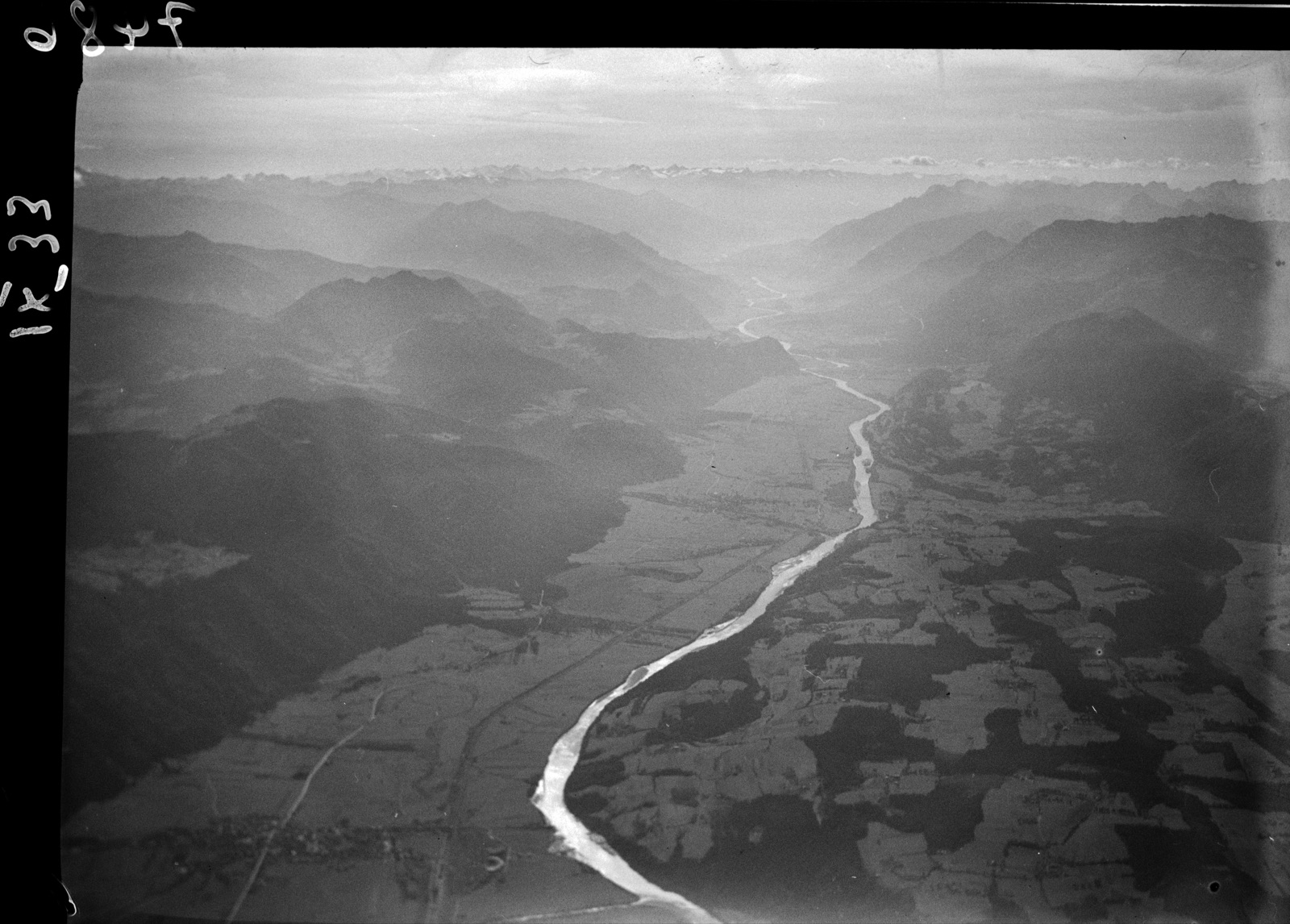
After
Wörgl went into the literature at once and has not come out of it. The Freiwirtschaft press carried it round the world as the miracle of Wörgl; the Innsbruck economists carried it as the bluff. In 2007 the town made Unterguggenberger an honorary citizen, and an institute in his name opened in the shop his widow had kept; in 2018 Austrian television made a film of him.
The number went on travelling after the experiment stopped, and it grew as it went. Fisher had printed the mayor’s “20 times a month” and his own caution that the schilling’s speed in Wörgl was unknown. Hornung in 1934 had the notes passing through the treasury twice a week. In 1951 Schwarz took Hornung’s two passes, assumed three more hand-to-hand payments between each, multiplied by fifty-two, and wrote “416 a year”, adding that this “can be right”; from it he worked out that 5,490 schillings of certificates had done 2,547,360 schillings’ worth of business. It has been repeated since as a measurement, and sometimes as Fisher’s; it is a count at one desk multiplied by an assumption. The companion piece “Four hundred and sixteen” follows it.
The sharpest reading came while the notes were still out. In May 1933 Der Österreichische Volkswirt, the economists’ weekly in Vienna, went through the town’s accounts and found that about half the money for the works had come from the federal unemployment fund and a provincial credit, that the mayor had dug up a forgotten claim of 70,000 schillings against nineteen neighbouring communes, and that the notes were not accepted outside Wörgl. The miracle, it wrote, was not supernatural: “the explanation is that the commune temporarily made itself the preferred creditor of its citizens,” because a shopkeeper could do nothing better with shrinking money that bought no stock from outside than pay his municipal taxes with it. It needed three things, unemployment, stagnant trade and tax arrears, and “one and the same commune cannot continue the experiment for as long as it likes or repeat it as often as it likes.” The ban, the paper thought, was urgent all the same, because the thing was inflation and other communes were copying it. Hornung’s study of 1934 said the same at length: the arrears “formed a very substantial, perhaps the only, support for the circulation of the shrinking money”; the relief works had employed fifty or sixty men directly and thirty or forty more indirectly, “a quite modest success against a total of about 400 unemployed in Wörgl”; and since the notes ran beside the schilling and were covered by it, they had not been Freigeld in Gesell’s sense at all.
What it taught
The experiment had an instrument. It was the speed of the notes, and the town’s own design made it readable: every return to the treasury could be logged, every stamp sold was a month of holding, every redemption at the bank was a note leaving the circuit. The treasury logged what came in. Nobody set out to count the rest, and nobody measured the schilling against which the notes were supposed to be fast. So the one claim that could have been tested in a town of four thousand people was left to be estimated, by the mayor to Fisher, by a hostile official from the arrivals at his desk, and by a sympathetic journalist eighteen years later from the official’s estimate and a multiplication. The figure the world remembers is the last of these.
The second claim could not have been tested in Wörgl at all, and everyone who argued over it was arguing about the same arithmetic. Unemployment in the town fell by a quarter, or by a sixth, or by between fifty and a hundred men, or, in the complaint the town’s lawyer filed with the court, to almost nobody, while Austria’s rose; the arrears came in; the streets were asphalted; the bridge carried its inscription. But the wages on those streets were subsidised by the federal relief fund at 3.50 schillings a day, the materials were bought with a provincial grant of 12,000 schillings, the first programme began three weeks before the first note was issued, and the town’s share of national taxes fell by 29,000 schillings in the same year for reasons that had nothing to do with Wörgl. The notes were one input among several into a small town in a bad year, and the experiment had no control. Bundsmann read the total and called it bluff; the mayor read the current revenue and called it proof; Hornung read the arrears and called it a tax trick; Muralt read the whole and said the question was open. None of them was wrong about the numbers.
The authorities read a third instrument, which gave a clear answer. Article 122 asked whether a town may issue notes, and the court said no, and the answer was final and correct and had nothing to do with whether the notes had worked. The experiment was stopped at thirteen and a half months, in the autumn of 1933, as the Austrian unemployment figures began their seasonal climb into winter, five months before the country’s civil war and four and a half years before the Anschluss, and nothing that happened in Wörgl afterwards can be separated from any of that. What was ended was not a result but the possibility of one.
What the record supports is narrower than the legend and more useful. A town that had lost its reasons found that money it had to spend quickly was money it spent, that the first use people found for it was to pay the town what they already owed, and that a treasury which gets its arrears back can pay men to lay asphalt. That much the treasury’s books show. Whether the speed of the money did anything that a grant of the same size would not have done, the books cannot show, because the comparison was never built. The lesson is not that the hypothesis was right, or wrong. It is that an experiment which ends before anyone has measured its instrument leaves two numbers behind, the one the law read and the one the believers made up, and that the second will outlive the first.
Sources
- Fritz Schwarz, Das Experiment von Wörgl, Bern: Verlags-Genossenschaft Freies Volk, 1951. The welfare committee’s sitting of 5 July 1932 and those present, the Nothilfe-Programm, the nine-point rules, the committee’s “note return”, the first wages and the arrears, Burgstaller’s account of the works, Hornung’s findings and the 416 arithmetic, Pfister’s twelve questions, and the dates of the ban and the judgment. Transcribed at userpage.fu-berlin.de
- Irving Fisher, assisted by Hans R. L. Cohrssen and Herbert W. Fisher, Stamp Scrip, New York: Adelphi, 1933, chapters III, IV and VI. Scheibler’s visit, the mayor’s report of 1 January 1933, the tax arrears, the 4,542 schillings, the works, “20 times a month”, “not been hostile” and “I am not informed”. Transcribed at userpage.fu-berlin.de; the scan at archive.org is lending-only.
- Alex von Muralt, “The Wörgl Experiment with Depreciating Money”, Annals of Collective Economy 10, no. 1, 1934, pp. 48 to 57; Claude Bourdet, “A French View of the Wörgl Experiment”, pp. 58 to 59; Michael Unterguggenberger, “The End Results of the Wörgl Experiment”, pp. 60 to 63; all translated by G. Spiller. The shops, the wholesaler, the prices, the treasury’s arithmetic, the Innsbruck official’s figures, the correspondence and the astrologers; the mayor’s revenue table, the 77,327 schillings, the works of 1933, Bundsmann’s “all bluff” and the “tools struck out of their hands”. reinventingmoney.com
- Alex von Muralt, “Der Wörgler Versuch mit Schwundgeld”, Ständisches Leben 6, 1933, the German original, with the text of the back of the notes and the note on the order of May 1933. tauschkreisrohrbach.files.wordpress.com
- Claude Bourdet, “Une nouvelle Mecque économique: Wörgl ou l’« argent fondant »”, L’Illustration, 9 September 1933, pp. 56 to 57, with its eight photographs. The visit of August 1933, the motorways, the bridge, “Ah! ces journalistes!”, the National Bank’s alarm, Kirchbichl and Westendorf, the twenty-two American towns and Fisher’s radio talk of 17 February 1933. My translations. fr.wikisource.org
- Gebhard Ottacher, Der Welt ein Zeichen geben: Das Freigeldexperiment von Wörgl 1932/33, Kiel: Gauke, 2007, from his Vienna thesis of 2001. The National Bank’s letters of July 1932 and June 1933, the district officer’s letter of 9 August 1932 and his order of 5 January 1933, the appeal, the governor’s decision, the court complaint, the chancellery’s answer, the deadlines, the police threat, the other communes, Hornung’s and Wendel’s figures, the mayor’s words to Jüllig, and the text of Article 122. My translations. silvio-gesell.de
- Verwaltungsgerichtshof, “Das Wörgler Schwundgeld”, in the court’s 150th-anniversary series, for the judgment of 18 November 1933, A 504/33, its president, and the two passages from the reasons, in my translation. vwgh.gv.at
- Bundesgesetz vom 14. November 1922, BGBl. 823/1922, with the statute of the Oesterreichische Nationalbank annexed, for the first section’s wording. alex.onb.ac.at
- Silvio Gesell, Die natürliche Wirtschaftsordnung durch Freiland und Freigeld, fourth edition, Rehbrücke bei Berlin, 1920, Introduction and Part IV, chapter 1, in my translation; the same passages in Philip Pye’s English translation, The Natural Economic Order, revised edition, London: Peter Owen, 1958, pp. 33, 269 and 273. silvio-gesell.de, userpage.fu-berlin.de, archive.org
- John Maynard Keynes, The General Theory of Employment, Interest and Money, 1936, chapter 23, section VI, on Gesell. marxists.org
- Veronika Spielbichler, “Freigeld Wörgl” and “Michael Unterguggenberger”, Heimat Wörgl, the town’s heritage site, for the mayor’s biography, the lot of December 1931, the visit to Schwanenkirchen, Rosa Unterguggenberger, the works of 1933 and the sixteen per cent. heimat.woergl.at, heimat.woergl.at
- Unterguggenberger Institut Wörgl, “Wörgler Freigeld historisch” and “Fakten zum Wörgler Freigeld”, for the Institut’s figures, the 8,500 schillings, the 200 communes and the institute in the widow’s shop. unterguggenberger.org, unterguggenberger.org
- The notes themselves: scans of the 1, 5 and 10 schilling certificates and of the text side, on Wikimedia Commons, from which the printed wording and the twelve fields are read. Freigeld1.jpg, Freigeld_5b.jpg, Freigeld_10.jpg
- The Austrian press of 1932 and 1933 on ANNO, the Austrian National Library’s newspaper portal, read from the page images and translated by me: Innsbrucker Nachrichten, 11 July 1932, p. 5, the council session of 8 July; Allgemeiner Tiroler Anzeiger, 12 July 1932, p. 6, the welfare committee’s plan and Gollner’s declaration; Reichspost, 22 and 24 July 1932, pp. 10 and 17, the first Vienna reports and the finance ministry’s steps; Innsbrucker Nachrichten, 22 September 1932, p. 3, the bank’s application for a ban and the letters from abroad; Allgemeiner Tiroler Anzeiger, 10 March 1933, p. 7, the council’s resolution to appeal and keep the notes out; Der Tag, 7 April 1933, p. 7, “Geschieht in Wörgl ein Wunder?”; Neues Wiener Tagblatt, 29 April 1933, p. 25, and Reichspost, 30 April 1933, p. 16, the lawyer’s account of the complaint, Cohrssen’s broadcast and “almost no unemployed”; Der Österreichische Volkswirt, 27 May 1933, pp. 10 to 13, the preferred-creditor analysis; Der Tag, 20 June 1933, p. 6, the mayors’ meeting and the railway wagons; Innsbrucker Nachrichten, 18 July 1933, p. 8, the communes that followed; Salzburger Volksblatt, 22 August 1933, p. 11, the chancellery’s decree; Innsbrucker Nachrichten, 7 October 1933, p. 8, the financial plan and the 980 schillings; Der Tag, 22 August 1933, p. 10, the decree of 24 July; Neues Wiener Tagblatt, 18 November 1933, p. 25, Salzburger Chronik, 20 November 1933, pp. 2 to 3, Allgemeiner Tiroler Anzeiger, 20 November 1933, p. 8, and Arbeiter-Zeitung, 19 November 1933, p. 6, the hearing and the judgment. Tiroler Anzeiger, 12 July 1932, Der Tag, 7 April 1933, Volkswirt, 27 May 1933, Der Tag, 20 June 1933


