On the morning of February 17, 1916, in the council chamber of the City of San Diego, a thin man in a pressed suit stood up in front of the mayor and said why he had come. “The essence of my contract was to fill Morena Reservoir,” Charles Hatfield said. “That has been done. I have fulfilled my contract and I desire that the city should fulfill its contract to pay me $10,000.”
Three weeks earlier the Lower Otay dam, sixteen miles south-east of the city, had gone out in a storm and emptied a lake into the valley below it. The coroner’s first count of the dead had been fifty. The railways were cut, nearly every bridge in the county was down, and the city had been reached for a month only by sea and by wireless. Morena, the mountain reservoir Hatfield had been engaged to fill, had filled, and something over three billion gallons had gone over its spillway. The man who answered him was not the mayor but the city attorney, Terence Cosgrove, who was thirty-four and made his name in water.
“How much,” Cosgrove asked, “do you claim to have put into Morena?”
“Four billion gallons, if not more.”
Nobody in the room had an instrument that could have said whether that number was right, or wrong, or what it would have meant either way. That was the experiment the city had bought, and that was the morning it was read.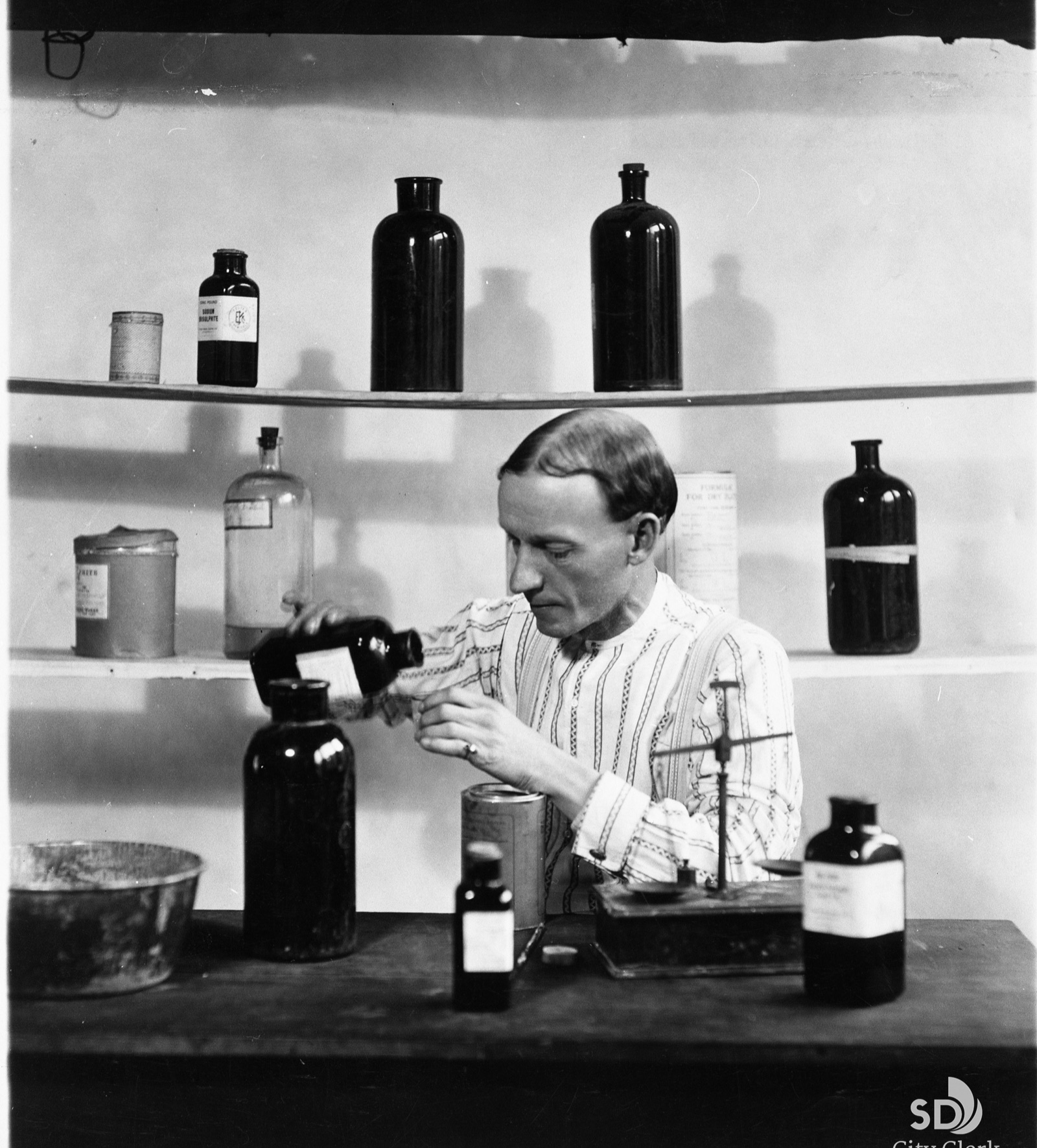
Who ran it
Charles Mallory Hatfield was born in Fort Scott, Kansas, in 1875, the year his father sold a sewing-machine agency there, and came to San Diego with the family late in 1886, in the boom that followed the railway. At eleven he was Newsboy No. 9 at Hanley’s stand at Fifth and F, selling the San Diego Union. The family moved on to Los Angeles in 1890, and Charley, as everyone called him, went into the trade his father knew: he sold New Home sewing machines from an agency on South Spring Street, and sold them well. He was a Quaker, neat, polite, and sure of himself. In the Pasadena and Los Angeles public libraries he read tables of rainfall and a Harvard professor’s Elementary Meteorology, and in 1902, from the top of a windmill on his parents’ ranch at Bonsall in northern San Diego County, he began evaporating a mixture of chemicals from shallow pans into the air, to see what would happen.
What he said happened was rain. In February 1904, in a drought that had the churches of Los Angeles calling a day of prayer, a group of Spring Street merchants paid him $50 to try it from a tower in the brush at La Crescenta, and it rained. “The people’s prayers for rain have been answered through my son,” his mother told the Los Angeles Times. “For five years he has studied alone against prejudices. His determination is simply marvelous. Some divine power must aid him.” Over the next eleven years he took contracts from ranchers in the San Joaquin Valley, from the Yukon, from Texas, and in 1912 from the dry farmers of Hemet, where the draft contract he wrote himself carried the heading that explains most of his career: “Four Inches of Rain for Four Thousand Dollars. No Rain, No Pay.” Asked by the Hemet reporter whether he would guarantee rain, he said, “I certainly will, or it won’t cost the people a cent.” His brother Paul kept the camp. Nobody, in Thomas Patterson’s phrase, ever got behind his mask, and it may never have been one.
His advocate in San Diego was Fred A. Binney, a tall, whiskered English real-estate broker with a belief in socialism, who had been writing to the council about Hatfield since 1912. Hatfield’s wife was a San Diego woman, the daughter of J. F. Rulon.
The city that hired him had a Common Council of five men, Schmidt, Fox, Benbough, Moore and Fay, with Mayor Edwin M. Capps, a civil engineer, in the chair. Its Manager of Operation was Fred Lockwood. Its city attorney was Cosgrove, a graduate of Notre Dame and Yale, who was spending much of that winter in Los Angeles fighting the city’s claim to the whole flow of the San Diego River; his assistant, Shelley Higgins, would spend years afterwards defending what the two of them did. Its water system was run by George Cromwell, the city engineer, and R. C. Wueste, superintendent of the impounding reservoirs; at Morena the dam keeper was Seth Swenson, who lived with his wife Maggie in a cottage by the dam and answered its telephone. The United States Weather Bureau’s office in San Diego was in the charge of E. Herbert Nimmo, with a young assistant named Dean Blake. Nimmo’s opinion of Hatfield was public before the winter began: he thought him a mountebank.
What they were trying to find out
There were two hypotheses on the table in December 1915, and they were not the same.
Hatfield’s was that a vapour released into the air from his pans would increase the rain that fell nearby. He was careful about the word. He did not make rain, he said; he released it, when conditions were favourable, and he could increase the amount. The claim had a shape that could, in principle, be tested: a gauge beside the tower, a long record of the place, and a comparison. At Hemet three gauges governed the pay.
The council’s question was different. The city had bought its mountain water from the Southern California Mountain Water Company: the Lower Otay reservoir, the conduits and the water rights for $2,500,000, and Morena, with a further bond issue of $1,500,000, the purchases completed in 1913. Morena had been built in 1897 to hold fifteen billion gallons, which is 46,000 acre-feet, and in eighteen years it had never been full. At the end of 1915 it held about five billion. The city was growing, it was in court over the river, and a reservoir two thirds empty was an argument. The question the council put to itself was not whether chemicals cause rain. It was whether Morena would fill.
Hatfield wrote the terms himself, without a lawyer, and offered alternatives. His first written proposal was that by June 1 he would “produce 40 inches of rain (at Morena Reservoir) free gratis, I to be compensated from the 40th to the 50th inch by $1,000 per inch.” On December 8 the council’s minutes record “a communication from Chas. M. Hatfield relative to installation of precipitation plant at Morena reservoir”, and Resolution 20782, which directed the Manager of Operation “to prepare and submit to this Council, at the earliest possible date, his recommendation in the matter of the City accepting the proposition of Chas. M. Hatfield to install a rain-making plant at Morena Reservoir”, and at the same time to advise the council “of the probable rainfall on the water shed of the Morena Reservoir during the coming season.” That was the right question, and it was asked once. If Lockwood answered it, the minutes do not record the answer, and nothing that followed made use of one. The clerk was authorised to telegraph Hatfield at 208 Royal Drive, Eagle Rock. The next day, at a conference, Hatfield put three propositions in writing: to fill Morena, however much rain that took, by December 20, 1916; or fifty inches of rain by June 1, 1916, paid at $500 an inch from the thirtieth inch to the fiftieth; or the same fifty inches paid at $1,000 an inch from the fortieth. Each came to $10,000 if completed.
Councilman Walter Moore explained the arithmetic on the 9th. “If he fills Morena, he will have put 10 billion gallons into it, which would cost the city one tenth of a cent per thousand gallons; if he fails to fulfill his contract, the city isn’t out anything. It’s heads the city wins, tails Hatfield loses.” That was Hatfield’s own reasoning, and it was the design of the test: no rain, no pay. Cosgrove was asked whether the contract would be legal, and grinned. “If Hatfield fills Morena, I guess there would be no doubt about the legality.”
On December 13, 1915, the minutes record that “a communication from C.M. Hatfield transmitting certain proposition to install a precipitation plant at Morena, is presented, read and on motion said proposition is accepted”, with Schmidt, Fox, Benbough and Moore voting aye and Fay no. Then: “Thereupon the papers are sent to the City Attorney for preparation of a contract.” The motion did not say which of the three propositions it accepted. Nobody noticed, and no contract was prepared.
So the test as bought had this form. A man would go to a lake in the mountains and do something there. If the lake filled, the city would pay him $10,000; if it did not, nothing. There was no second lake with no tower beside it. No figure for what the rain at Morena would have been without him was written into the terms, and the Weather Bureau, which had the record, was not asked, as far as the minutes show, and kept no gauge of its own at Morena. The only instrument that would be read was the one on the dam, the gauge that said how full the lake was, and that instrument could say nothing at all about why.
What they built
Hatfield did not wait for the contract. He was at work by January 1, 1916, with his youngest brother Joel, on a slope beside the road up to Morena dam, sixty miles east of the city and about three thousand feet up. The tower was on the pattern he had used since 1904: a timber frame some twenty feet high with a platform on top, a tent at its foot, and on the platform the shallow pans from which he evaporated a fluid whose contents he never told anyone. The Swensons were the only regular visitors. They watched the brothers clear the brush from the soft ground under the platform and rake it with a hand rake after each session, and when they walked over, Charley would come down the ladder and meet them twenty feet from the tower. Mrs Swenson supposed they were keeping her from identifying the chemical. She relayed telephone messages to him from the city, two miles away by road.
What the city had built was behind him, and it is the other half of the story.
Morena dam was a rock-fill 150 feet high with a concrete face on its upstream side, the work of an engineer of standing, with a spillway sixty feet wide closed by radial gates and guarded, for some reason nobody later could explain, by a rack of railway iron spaced a foot apart.
Lower Otay dam, sixteen miles south-east of the city, was something else. It had been completed in 1897 by the Southern California Mountain Water Company, and it was designed and built not by an engineer but by the company’s president, a promoter named E. S. Babcock. It was a pile of blasted rock, 130 feet high and 565 feet long, dumped from a cableway and left where it fell, at a slope as steep as it would stand, and held watertight by nothing but a riveted wall of steel plate, a quarter of an inch thick at the top, standing up through its middle in a thin casing of concrete. For its first two years the dam had no spillway at all; the one cut afterwards was thirty-eight feet wide. The reservoir behind it held thirteen billion gallons, about 40,000 acre-feet, and in nineteen years it had never been filled; the water had never come within fifteen feet of the spillway floor. In October 1915 the editor of Engineering News, Charles Whiting Baker, had walked over it with the hydraulic engineer Allen Hazen, and the San Diego engineers who showed them round “frankly expressed their disapproval of the structure”. Baker’s verdict, written after it was gone, was that one chief objection to the design was “the impossibility of determining with accuracy its margin of strength.”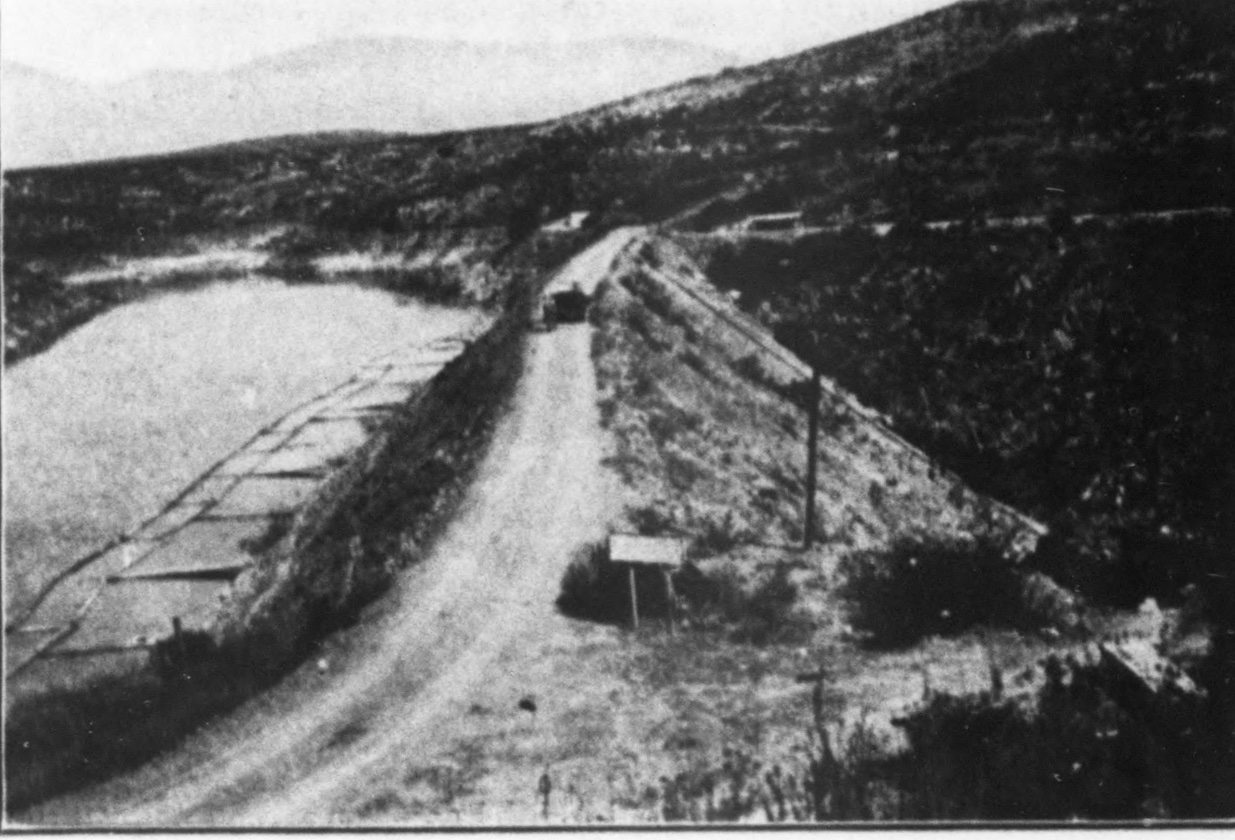
Nineteen years is a long time to own an instrument that has never given a reading. The Engineering News editorial of February 10 put the point plainly. “The company and its successors have always worried far more over lack of rainfall to fill the dam than over floods that might overtop it. Nor is this strange, when one reflects that never in the 19 years since the dam was built has the reservoir behind it been filled until the storms of last month came.”
The twenty-seventh
Rain fell at Morena on January 5, and the water department reported 48½ million gallons impounded since December 27. Rain of a different order began on January 10, and from the 14th it rained in torrents. On the 17th, in the early hours, the San Diego River went over its banks and spread a mile wide across Mission Valley; on the 18th the Tijuana River carried away a colony of forty families called the Little Landers, and two women drowned. The Union’s headline on the 17th was “Is Rainmaker at Work?” The roads to Morena were already impassable, so the paper telephoned the Swensons. “The mysterious Hatfield, rainmaker, was said to be particularly active in the vicinity of Morena Sunday,” it reported. “While engaged in his experiments, Hatfield is not altogether sociable, but persons watching his work from a distance said he seemed to be on the job at all hours of the day and considers the downpour due to his efforts. Incidentally, it was said that Hatfield himself is getting a good soaking.”
On the same Monday, January 17, the council met at ten in the morning with the valleys under water and passed two resolutions one after the other. One authorised the mayor “to supervise the work of assistance to persons and property endangered by flood waters”. The other, Resolution 20989, directed the city attorney to prepare a written opinion “as to the legal liability of the City of San Diego for the payment of public monies for any alleged or assumed work or works on the part of one C. M. Hatfield or his associates, prior to the entering into by the City of San Diego of any contract”, and as to its liability “because of a favorable majority vote of the Common Council of the City of San Diego upon the proposal or offer of the said Hatfield”. It passed four to nothing. The city had begun reading the instrument before the lake was full, and the first thing it read was the law.
The Weather Bureau’s own reading came later, in its Monthly Weather Review for January. A low, charted as No. X, “passed inland over the middle California coast on the 17th, crossed the south-central part of the State on the 18th, and then moved northeastward into Wyoming by the morning of the 19th. During its movement over the south-central portion of California the storm slackened its progressive movement somewhat, meanwhile giving very heavy rains over the counties of southern California.” The Bureau’s gauges in San Diego County read, for January 16 to 20, 7.72 inches at San Diego, 9.41 at Campo, 16.04 at Cuyamaca and 22.61 at Nellie on Palomar mountain. Lower Otay, which had never been within fifteen feet of its spillway, reached it on the 21st and began to run over. Hatfield telephoned the city between the storms. “I understand the newspapers are saying I didn’t make the rain. All I have to say is that Morena has had 17½ inches of rain in the last five days and that beats any similar record for the place that I have been able to find.”
The sun came out for a few days. On the evening of January 25 Nimmo forecast rain for the next day, and it came, a general storm out of the north-west, and over it, the Bureau later concluded, lay a rarer kind of storm from farther south in the Pacific. “It seems reasonable to suppose,” the Review wrote, “that the storm which swept over Hawaii on the 18th-19th passed inland over California on the 27th.” At San Diego the rain began at 7.18 in the evening of the 26th, with winds averaging thirty miles an hour and a gust of fifty-four from the south at 4.29 the next morning. “The reservoirs in the county whence the water supply of the city of San Diego is drawn were already nearly full as a result of the rains of the previous week,” the Bureau wrote, “and all of them evidently, were not in a condition to withstand the added strain put upon them by the rains of the 26th-27th.”
At Morena the telephone failed on the 26th, but not before Maggie Swenson had taken a message for her husband from Cromwell. The council, it said, was determined to impound all the water it could: keep the spillway gates closed until the level reaches the very top. The gates, closed, stood as high as the dam. Towards midnight the lake was rising two feet an hour. Swenson judged that the spillway, even wide open, would not pass what was coming in, and with the line dead he used his own judgement: he rowed out to the outlet tower, went down the slippery ladder inside it, and opened two valves far below the surface. The lake went on rising, and by dawn nearly five feet of water was going over the spillway. Then the flood brought a mass of drift against the iron racks and choked them, so that with the reservoir three feet above spillway level and every gate open the water actually crossing the spillway floor was three inches deep. By the city engineer’s account the water came within eighteen inches of the top of the parapet and waves threw debris over it; by Swenson’s, forty years on, it came within five inches of the coping. The rock fill settled two or three inches under the load. The dam held. In one day of that storm 15,000 acre-feet came into Morena.
At Lower Otay there were no gates to argue about. The lake had been at the spillway for six days, and the spillway, thirty-eight feet wide, was taking what it could. “The rain on Jan. 27 was extremely heavy,” wrote the engineer Roy Silent, who examined the site four days later, “and by noon the water had risen so high that Mr. Weuste, in charge at the dam, deemed it advisable to open the outlet gate. This failed to check the rise, and it was realized that the dam would probably be overtopped before evening.” Four men were sent down the valley to warn the several hundred people who lived in it, and the telephone exchange at National City rang round. Most of the valley moved. At 4.45 the water reached the top of the fill, two feet of earth and gravel laid over the rock, and seeped into the inspection boxes sunk in the crest. At about 4.50 it began to run down the downstream face on the east side. Wueste, walking the crest from north to south, had to jump a sizeable stream on his way back. “Several spouts or small streams of water appeared on the lower face of the dam,” Silent wrote, “in one instance loosening a large boulder which rolled down to the bottom. From this time on, the destruction was very rapid. The lower face of the fill quickly melted away, thus removing the support from the core wall. At 5:05 p.m. the tension was so great that the steel diaphragm tore from the top at the center, and the dam opened outward like a pair of gates.”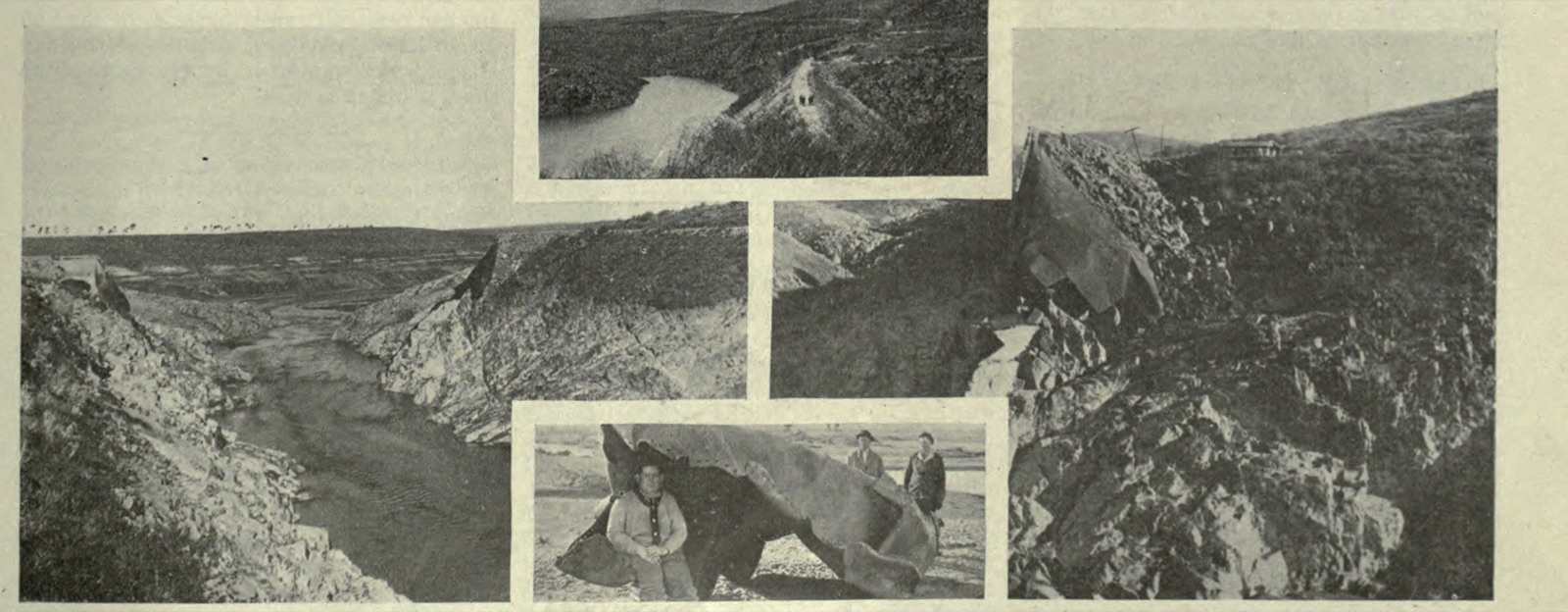
The Geological Survey’s figure for the inflow in the last forty minutes before the dam went is 32,700 cubic feet a second, from a drainage basin of ninety-nine square miles on which about nineteen inches of rain had fallen since the 14th. The reservoir held 15,030 million gallons at that moment, more than it had ever held. It emptied in two and a half hours. “A huge wall of water, variously described as from 6 to 20 ft. high, rushed down the valley,” Silent wrote, “covering the distance from the damsite to Palm City, about 10 mi., in 48 min., carrying all before it.” Wueste, who watched it go, described a torrent rather than a waterfall, and said the loudest noise was the torn remainder of the steel plate banging against the rocks. The next day the bulk of the steel core was found rolled up on a delta of debris at the mouth of the Otay River, twelve miles from the dam.
The same afternoon the Sweetwater dam, a masonry arch on the next stream north, was overtopped and ran three and a half feet deep over its parapet for about nine hours; the earth fill at its north end washed out and the flood cut a bypass seventy-five feet wide through the rock beside it, but the reservoir did not empty. The Upper Otay dam, a thin concrete arch above the one that failed, ran three feet deep over its crest and was unharmed. Both railways into San Diego were gone, and the new concrete highway bridge over the San Diego River had been lifted off its piers. The city was without its main water supply and its outside lines, and for the rest of the month was reached by steamer and by wireless.
What it looked like from inside
From Morena, nothing. The telephone was dead until the 30th. Charley and Joel Hatfield saw a lake fill and overflow, as promised, and a dam come within a few inches of going. Of their many conversations Maggie Swenson remembered one from the first storm most clearly. “It’s sure raining now!” she said, and Hatfield answered, “You haven’t seen anything yet. Wait two weeks and it will really rain.”
The Union had Hatfield’s mother-in-law, Mrs Rulon, who said what he had said himself many times, that her son-in-law did not make rain but released it when conditions were favourable, and added: “If Morena has overflowed we may expect him shortly. If it has not, he will remain until it does.” It had Binney, who wrote in to point out that Lake Cuyamaca, higher in the mountains, usually had thirty-six inches of rain in a year to Morena’s twenty-one and a half, and that up to the 27th Cuyamaca was still 4.79 inches short of its yearly average while Morena had already exceeded its own by 4.50. “Here we have scientific proof,” he explained. The paper headed his letter “What Hatfield Has Done, as F. A. Binney Sees It.” Nimmo’s office pointed out that the storm was general along the whole coast. Neither remark settled anything, and neither could have.
When the line came back on the 30th, the Swensons heard from the Dulzura headquarters below that Lower Otay was gone, that the damage in the back country was unbelievable, and that there was talk of a party coming up to lynch Hatfield. They passed it on. Hatfield, who had been in no hurry, reduced the tower to a neat pile of lumber, raked the ground where it had stood, and left on foot with Joel down the canyon trail. Swenson, watching them go, saw two men far below coming up the same trail. They were Wueste and Cromwell, and when they arrived Wueste asked for Hatfield; he had seen footprints going down and met nobody. The brothers had stepped off the trail to let the strangers pass. Cromwell found a new jam of drift blocking the spillway and the lake rising again, walked nine miles through mud to Campo for dynamite, and broke the jam with two sticks. The engineers agreed afterwards that Swenson’s valves, opened against his instructions, had saved the dam.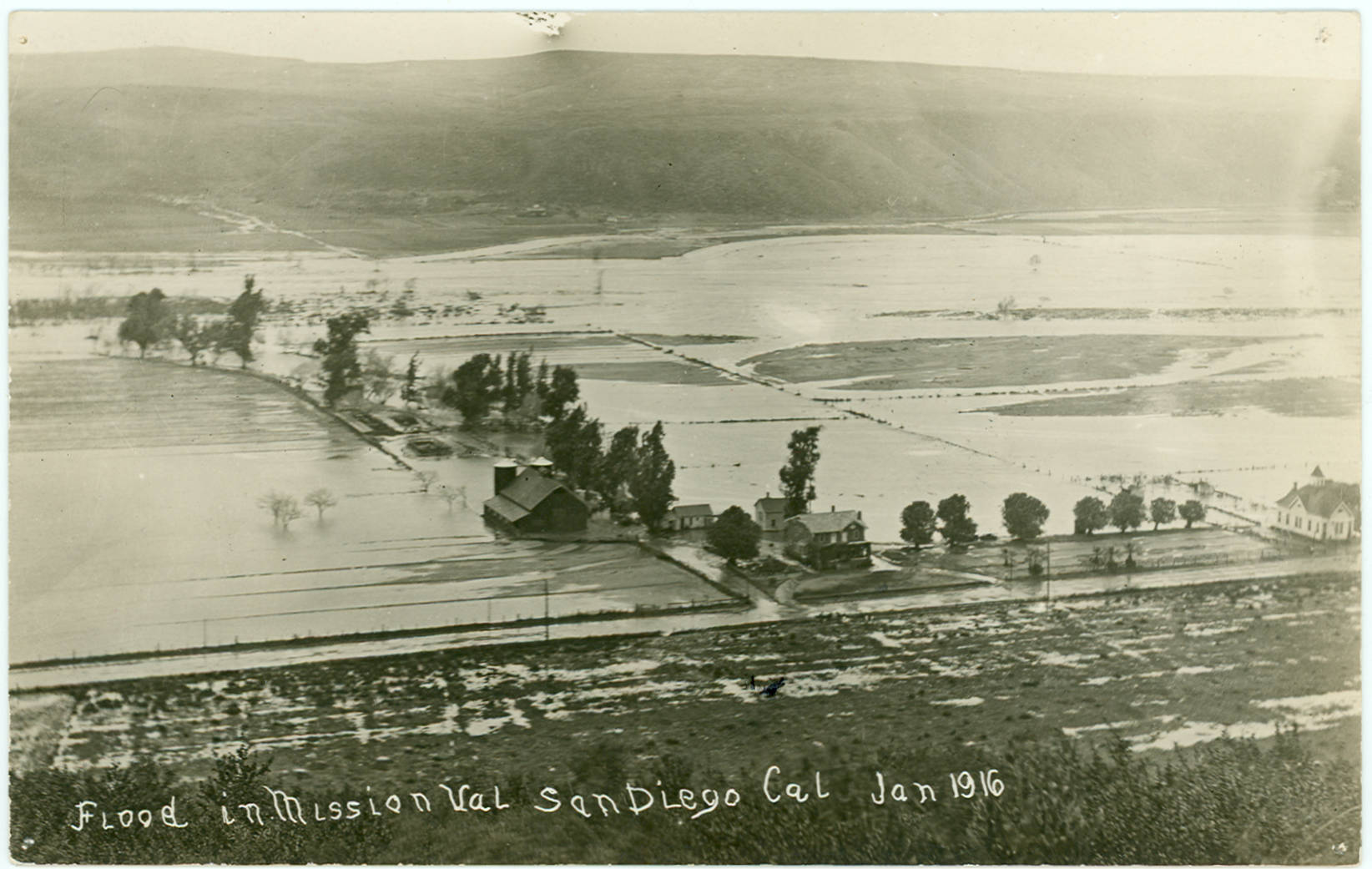
How many had died was fought over in the headlines. The coroner’s office estimated fifty on the 28th. The Scripps Sun and the United Press put out as many as sixty-five, and the Union, which wanted the country to go on coming to the Exposition in Balboa Park, accused them of frightening the East. On February 3 the coroner said the known dead numbered fourteen. Silent, writing on February 8, had fourteen “but there are still several persons missing”; the Weather Bureau’s official in charge put the Otay dead at eighteen; the Geological Survey, two years later, wrote that “twenty-two persons were drowned in San Diego County. Most of them were living in Otay Valley and were swept away by the flood wave which was released from Lower Otay reservoir when the dam failed.” Many of the Otay valley’s dead were Japanese farmers who lived apart; on the morning after, the city treasurer found their small boats spread across the mouth of the river, searching.
It took the brothers two days to walk the sixty miles to San Diego, with a night at Jamul. On the afternoon of February 4 Hatfield held a press conference in Binney’s office. By then he knew that the people he had to answer were not a lynching party but the men who meant not to pay him on the ground that he had had nothing to do with the rain. He had spent his own money, he said, and expected the city to pay as agreed. If he had caused the rain, why had it rained all along the coast? He did not claim to be a rainmaker, only that he could increase the amount. Then the question the reporters had been given: if he took credit for the rain, would he accept liability for the damage? The benefits would exceed the damage, he said. And the deaths? They were deplorable. He did not feel responsible.
From the press conference he went, as everyone told him he must, to see Cosgrove, who was cordial and businesslike, and who advised him to file a written statement setting out in detail what he claimed to have accomplished: what, exactly, did he expect to be paid for? Hatfield, who had spent twelve years allowing clients to assume he had caused whatever rain fell, and who had never before been asked to put a figure on his share of it, went away and wrote seven pages. He argued that while he was at work the city had had three days of sunshine and that since he stopped the sun had shone every day. And he put a number on it. He claimed to have been directly responsible for four billion gallons of what had run into Morena.
What happened
The claim was before the council on February 9: “Claim of Chas. M. Hatfield for $10,000. for the alleged filling of Morena Dam with water,” the minutes read, referred to the city attorney. On February 17 Hatfield came to the council conference to press it, and Cosgrove, who had the seven pages in front of him, asked how much he claimed to have put into Morena.
“Four billion gallons, if not more.”
“But you agreed to put in 10 billion gallons,” Cosgrove said.
“There were five billion gallons when I started work and it required 15 billions to fill the reservoir. I claim that through the instrumentality of my work four billion gallons were put into the reservoir and the other was the indirect result of my work.”
“You want the city to pay you only for what you yourself did? You do not want the city to pay you for what nature did, do you?”
“No.”
“Well, why do you ask the city to pay you for 10 billion gallons when you put in only four billion gallons?”
Cosgrove turned to the council. “According to his own statements, this man has admitted that he put only four billion gallons of water into the reservoir. He offered to deliver 10 billion gallons. Therefore he had not fulfilled his contract, and there is no liability on the part of the city. He should have waited until he fulfilled his contract.”
Moore, who had voted for the man, said what he thought. “If Morena overflowed, I think he should be paid his money.” Cosgrove fixed him with a look and went on. “If I give a ruling it will be based solely upon the facts as shown by the records, and not upon any understanding or upon anybody’s sympathy. The records all show that Hatfield made three propositions to the city. The first was to fill Morena for $10,000; the second was to produce 40 inches of rain gratis and to receive $1,000 an inch for every inch between 40 and 50 inches and the third was to produce 30 inches of rain gratis and to receive $500 an inch for every inch between 30 and 50 inches. The resolution which was passed by the council simply said that Hatfield’s offer was accepted, but it did not say which of the propositions was accepted. This gentleman, according to my opinion, cannot collect his money in the courts. Under the constitution and the statutes of the state and the charter of the city, a claim that is unenforceable is invalid.” Benbough, who had also voted for him, put it in the council’s own language: “Four councilmen voted to accept the man’s proposition and told him to go ahead. He ought to be paid.”
The vote went the attorney’s way, by steps. On February 21 a motion to deny the claim was on the floor when Benbough moved instead that the papers go back to the city attorney, which carried three to two, Fox and Fay against. On February 28 the minutes record that the claim “for the sum of $10,000.00, for the alleged filling of Morena Reservoir to overflow, be denied, also, that the offer of Chas. M. Hatfield to compromise such claim for the sum of $4000.00, as contained in Document No. 97353, be rejected”, and this time all five voted for it, Moore and Benbough included. Binney kept writing, on March 20 with a claim “for alleged placing of 9 inches rain in Morena Reservoir”, and his letters were “presented, read and ordered filed.”
Then the city made Hatfield an offer, which Higgins recorded years afterwards. He and Cosgrove would recommend that the council pay the whole $10,000 if Hatfield would sign a statement assuming responsibility for the flood and absolving the city. It was the one offer that read the instrument honestly: the city would pay for the rain on the single condition that the rain was his. Hatfield refused to sign. He got a lawyer and filed suit for the $10,000; he had already offered to take $4,000. The reason the city would not settle was the one every San Diegan understood then and understands now. If Hatfield had made the rain, the city had hired him to make it, and the people of the Otay valley and the owners of every bridge, orchard and railway in the county had somebody to sue.
They sued anyway. Two of the damage suits went to trial, moved out of the county, and the courts in Orange and San Bernardino counties found that the rain had been an act of God and not of Hatfield. The city settled with some claimants out of court for cash. The Geological Survey’s engineers, writing up the flood, noted under the Lower Otay record: “Data collected by the city of San Diego were withheld because of pending litigation.” Cromwell, answering his critics in a letter of March 23 that Engineering News printed in April, used the same words the courts would use, and meant them a little differently: “It seems too bad the Almighty does not see fit to inform us a few weeks ahead of time when He sends such a deluge as He visited upon this section on Jan. 27, 1916.” He hoped the engineer who had accused his department of mismanagement would “acknowledge that the failure of the Lower Otay dam was due to an act of God in sending a deluge that was beyond human possibility to anticipate or cope with.” In the same letter he called the dam “a hybrid type beyond question.” The companion piece, “The hybrid dam”, follows the engineers’ inquest.
After
The city rebuilt Lower Otay in concrete, as an arched gravity dam 149 feet high, and renamed it Savage Dam. The Southern California floods of January 1916 became Water-Supply Paper 426, a report of gauge readings in which the rainmaker does not appear, and in whose table of reservoirs Cottonwood Creek at Morena is entered as having delivered 41,200 acre-feet in the month, 6.43 inches of run-off from 120 square miles. It had begun the month with five billion gallons and ended it full.
Hatfield went back to rainmaking. In the spring of 1921 the Alberta town of Medicine Hat engaged him, and the Redcliff Review reprinted the news that “Rainmaker Hatfield” was coming on April 20. He worked in Honduras in 1929, he said he had made rain some five hundred times, and when the Depression took the contracts away he went back to selling sewing machines. In 1956 Hollywood made a film called The Rainmaker from a play his career had suggested, and invited him to the opening. He died on January 12, 1958, at eighty-two, at Pearblossom in the Mojave desert, where his brother Paul lived. His suit against the City of San Diego stayed on the court calendar for nearly twenty-two years, and in 1938 the court dismissed it for want of prosecution. Nobody had asked it to decide anything.
San Diego kept the story as a comedy, and the flood kept his name: it was Hatfield’s flood, and still is. He went on saying, to anyone who asked, that the city had never paid him. A reporter found him thirty years after the flood. “To this day,” he said, “I’ve never felt right about that San Diego city council.” For him it was strong language.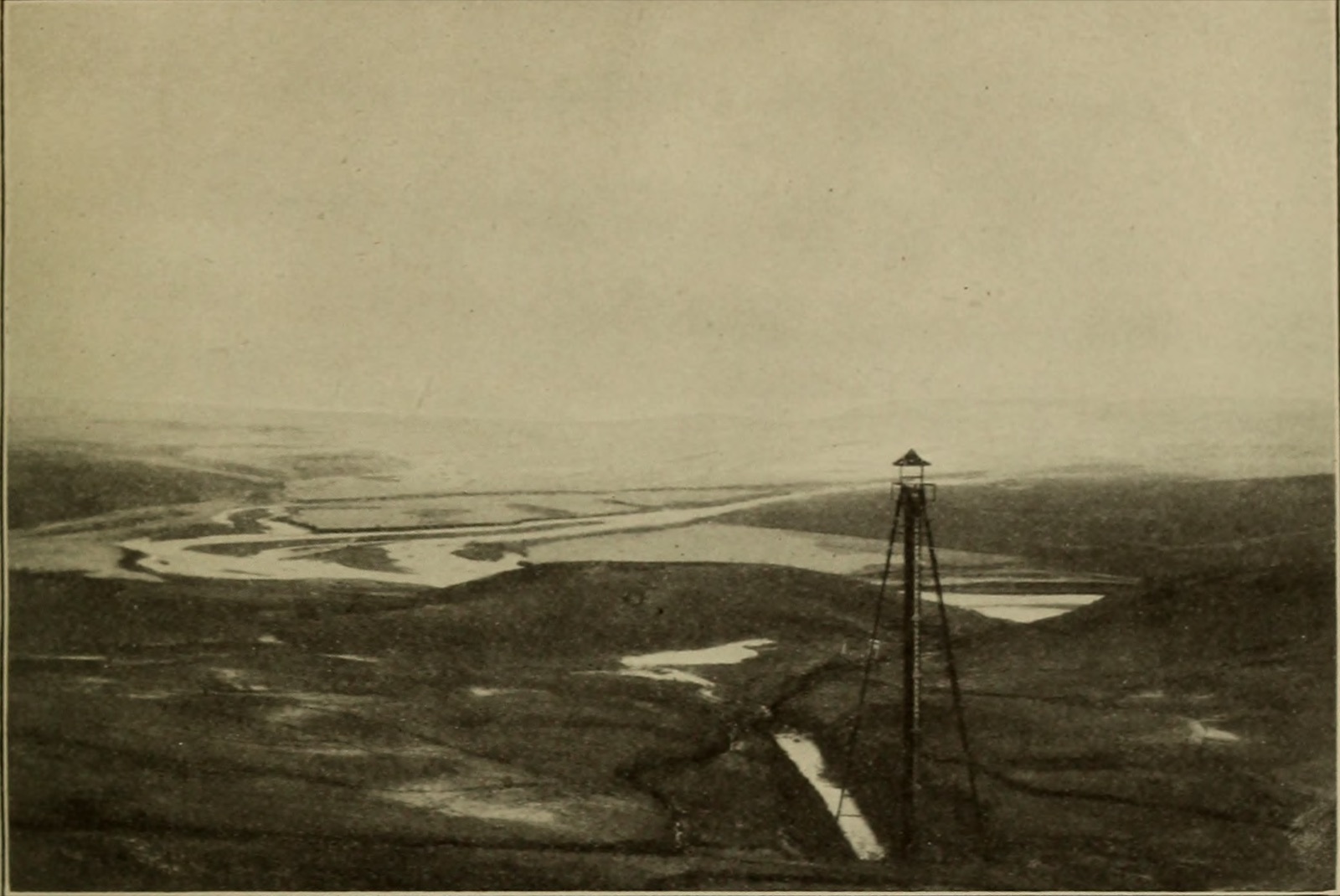
What it taught
An experiment is a question put to the world in a form that lets the world answer it. The council of San Diego put a question in December 1915 and got, in January, the most emphatic answer any instrument in the county had ever given: Morena full, Lower Otay gone, twenty-two dead, the heaviest rain on record from the coast to the mountains. And the answer told them nothing, because the question had been put in a form that no answer could satisfy. There was one lake and one tower. There was no second lake, no expectation of what the winter would bring without him written into the terms, no gauge anybody had thought to read before he arrived. The only comparison anyone made in the whole affair was Binney’s letter to the newspaper, two gauges and a rule of thumb, offered as proof by the man least able to be believed. Hatfield’s hypothesis was a claim about cause. The instrument the city read was a staff gauge, and a staff gauge reads depth. Depth is not cause.
“No rain, no pay” was the design, and it looked like a free bet, and it was the flaw. It let the council buy the test without ever deciding what the test was for, which is why the minutes record a vote to accept an offer and do not record which offer. Moore’s arithmetic was true: if the lake did not fill, the city lost nothing. What nobody worked out was the other branch. If the lake did fill, and the man was paid for filling it, the city had agreed in public that the rain was his, and the rain was now the costliest thing that had ever happened to the county. The test had a readout only in the direction nobody expected it to go. When it went that way, both parties needed the instrument to read something it could not read, and to read opposite things: Hatfield that the rain was his, the city that it was not. So the city asked the one man who could not know to put a number on it, and he gave one, four billion gallons, a figure with no gauge behind it, invented to the nearest billion in a lawyer’s office, and the city attorney used it to show that the thing being measured had not been delivered. That exchange is the whole reading of the experiment: a number nobody could have checked, used to settle a question nobody could have asked.
The courts, when they came to it, did not measure anything either. “Act of God” is not a finding about storm tracks; it is a legal category for a cause that nobody is liable for, and the city engineer reached for the same words to describe a flood his own spillway had been too small to pass. The Weather Bureau’s account, which traced the second storm from Hawaii and the first across the state into Wyoming, is the nearest thing in the record to a reading of Hatfield’s hypothesis, and it does not mention him. It had a control the city never thought of: the rest of southern California, where it rained just as hard with no tower in sight.
Which leaves the instrument that did speak, and was not read until it spoke. The city owned a dam that had never been full, built by a promoter to a design no engineer approved, with a spillway a quarter of the size that flood needed, and it had worried, as the dam’s builders had worried for nineteen years, about the lake being empty. Then it hired a man to fill lakes. The thing being tested in January 1916 was not whether chemicals cause rain. It was whether the Lower Otay dam could pass a flood, and the answer came in twenty minutes on the afternoon of the 27th, from the top down, like a pair of gates. One of the engineers who went over the wreck that spring put it for everybody: the dam’s twenty years of standing had “taught nothing”, because the margin by which it stood could never be known, and the only reading such a structure can give is the one it gives when it goes. The city of San Diego bought an experiment on the sky and ran one on its own water system, and it read the first because the bill came addressed to it, and the second because there was nothing left to read.
Sources
- City of San Diego, Office of the City Clerk, Record of the Common Council, Book 40, 11 October 1915 to 3 April 1916. The meetings of 8 and 13 December 1915 and 17 January, 9, 21 and 28 February and 20 and 27 March and 3 April 1916: Hatfield’s communications, the four-to-one vote, the resolution directing the city attorney, the claim, its denial and the rejected compromise, and Binney’s letters. sandiego.gov
- City of San Diego, Office of the City Clerk, Resolution Books 30 (28 June to 13 December 1915) and 31 (13 December 1915 to 7 August 1916). Resolutions 20782 and 20788 of 8 December 1915 and 20989 of 17 January 1916, quoted in the text. Book 30, Book 31
- United States Weather Bureau, Monthly Weather Review, vol. 44, no. 1, January 1916: “Floods” (California), the tracks of Lows X and XIV, the San Diego rainfall and wind of 26 and 27 January, the loss of life, and Table 16, the daily precipitation in San Diego County for 16 to 20 and 24 to 29 January. archive.org
- H. D. McGlashan and F. C. Ebert, Southern California Floods of January, 1916, US Geological Survey Water-Supply Paper 426, 1918. The reservoirs’ capacities, the Morena and Lower Otay storage records, the inflow at the moment of failure, the loss of life, the damage, the withheld city data, and Plate II. pubs.usgs.gov, archive.org
- Charles Whiting Baker, “Otay Rock-Fill Dam Failure,” Engineering News, 3 February 1916, with John L. Bacon’s wired account and Allen Hazen’s photographs of 27 October 1915. The dam’s design and construction, the spillway, the leakage, and the engineers’ disapproval. archive.org
- “Is the Rock-Fill Dam a Safe Type of Dam?”, editorial, Engineering News, 10 February 1916. “Never in the 19 years since the dam was built has the reservoir behind it been filled.” archive.org
- Roy A. Silent, “Failure of the Lower Otay Dam,” Engineering News, 17 February 1916. The reservoir levels, the rainfall at the dam, the warnings, the minutes of the failure and the wall of water. archive.org
- George Cromwell, “San Diego’s City Engineer on the Otay Dam Failure,” letter of 23 March 1916, Engineering News, 13 April 1916. The run-off figures, the mayor’s refusal to flashboard the spillway, “a hybrid type”, and “an act of God”. archive.org
- “California Floods Wreck Otay Rock-Fill Dam,” Engineering Record, 12 February 1916; “Safety in Dam Design,” 19 February 1916; George S. Binckley, “Are Rock-Fill Dams Safely Designed? What Failure of Lower Otay Dam Teaches,” 10 June 1916. Morena’s racks and the eighteen inches, the Sweetwater break, the city attorney’s conference and the warnings, the coroner’s fourteen, and the photographs. archive.org
- Thomas W. Patterson, “Hatfield the Rainmaker,” Journal of San Diego History 16, no. 1, Winter 1970. Hatfield’s life to 1915, the December propositions and conferences, the Swensons’ and Wueste’s recollections, the press conference and the exchange of 17 February, the offer to pay against a signed liability, the damage suits and the 1938 dismissal. The quotations from the San Diego Union and the Los Angeles Times in this entry are taken from Patterson’s article, which cites the papers. sandiegohistory.org
- Redcliff Review (Alberta), 7 April 1921, reprinting the Medicine Hat News: “Rainmaker Hatfield Coming April 20.” archive.org
- City of San Diego, Office of the City Clerk, Digital Archives: the photograph “Rainmaker Charles Hatfield”, 1916, and the note on the original Lower Otay dam and its replacement by Savage Dam. sandiego.gov, sandiego.gov
- San Diego Public Library, “Flood in Mission Valley San Diego, Cal Jan. 1916,” via Wikimedia Commons. commons.wikimedia.org
- Wikipedia, “Charles Hatfield,” for the later career, the 1931 divorce, the film and the death at Pearblossom in 1958. en.wikipedia.org
