At ten to three on the afternoon of Monday 1 March 1954, on Eniwetok Island in Rongerik Atoll, the pen of a recording gamma-ray monitor went off the top of its chart. The instrument belonged to the Atomic Energy Commission’s Health and Safety Laboratory in New York. It had been left on the island to record the small amounts of radioactivity expected to drift that way from the proving ground 135 nautical miles to the west, and its scale ran from one hundredth of a milliroentgen an hour to one hundred. The twenty-eight Americans who ran the weather station there had been told to send word to a Mr Breslin, the laboratory’s man on the task force command ship, if anything significant happened. At a quarter past three the station’s radio operator sent this: “Attention Mr. Breslin, Information Commander, Weather Reporting Element, Provisional. GR 12 MIKE over 100 CHARLIE — Over 100.”
The message reached the communications centre on Eniwetok Atoll, more than 300 miles to the west, at 3:43, and Breslin aboard the USS Estes at about four o’clock; because the group count, “GR 12”, had been typed into the address instead of the body, the copy for the Weather Reporting Element never arrived at all. What it meant was that the reading was higher than one hundred milliroentgens an hour, the most the instrument could say. Nobody on the ship could tell how much higher, and the first thought was that the tube had gone bad. The men on Rongerik, who had no training in radiation and called the device “one screwy recorder”, went back to work in a haze of fine grey dust that was settling on the tables in the mess hall. They changed into long sleeves. One of them looked at the dust under a microscope. Someone found that it made the screen of a cathode-ray tube glow.
Eight hours and some minutes earlier, 135 nautical miles to the west, the first American hydrogen bomb built on a solid fuel had been fired on a reef at Bikini. It had been expected to yield six million tons of TNT. It yielded fifteen. This entry is about the difference, and about what measured it.
Who ran it
Operation Castle belonged to Joint Task Force 7, a command of more than ten thousand soldiers, sailors, airmen and scientists under Major General Percy Clarkson of the Army, with Alvin Graves of the Los Alamos Scientific Laboratory as its scientific director and William Ogle, also of Los Alamos, commanding the scientific task group. The Army held the base at Enewetak, the Navy patrolled the sea and carried the people and the devices, and the Air Force flew the sampling, tracking and weather aircraft and ran a chain of weather stations on islands across the central Pacific. The bomb came from Los Alamos, where Norris Bradbury was director, and the decision to fire it rested with Clarkson on Graves’s advice. In Washington the Commission’s chairman was Lewis Strauss, who had served under Admiral Blandy at the first Bikini tests of 1946 and would fly out to see the second shot of the series.
Graves had been in the room at Los Alamos on 21 May 1946 when Louis Slotin’s screwdriver slipped and the plutonium core went critical; he was standing just behind Slotin and took about 360 rem, and that story is told in The Demon Core. He had run the scientific side of the Pacific tests since.
The Marshall Islands were, in 1954, part of the Trust Territory of the Pacific Islands, administered by the United States under the United Nations; its people were, in the phrase Graves would use that March, “wards of the Government”. The United States had moved the people of Bikini off their atoll in 1946 to make room for the tests, and the Pacific Proving Ground now covered Bikini and Enewetak, two hundred miles apart. East of Bikini lay the atolls that figure in this entry. Rongelap, about 105 nautical miles to the east, had eighty-two people at home that week: sixty-four on Rongelap Island and eighteen fishing at Ailinginae, the next atoll west; many others who normally lived there were away because of a drought. Rongerik, 135 nautical miles out, held no Marshallese but twenty-eight Americans, most of them of the Air Force’s 6th Weather Squadron. Utirik, some 300 miles out, had 154 people. Ailuk, south of Utirik, had about four hundred.
What they were trying to find out
Castle carried two hypotheses, and only the first was treated as one.
The first was about the bomb. The thermonuclear device fired at Enewetak in November 1952, Mike, had worked, but it had been a building, not a weapon: it burned liquid deuterium, kept near absolute zero by a refrigeration plant, and weighed tens of tons. In August 1953 the Soviet Union fired a device that drew part of its force from fusion and could be carried by an aircraft. The American answer was a “dry” bomb, fuelled by lithium deuteride, a solid, in which the tritium needed for fusion is made inside the bomb at the moment of firing, when neutrons strike the lighter isotope of lithium. That isotope, lithium-6, is about seven per cent of natural lithium, and the plant at Oak Ridge that separated it had only just come into production; the fuel for the first shot, which the laboratory called Shrimp, was enriched to between 37 and 40 per cent. The rest was lithium-7, which the designers treated as all but inert.
The official estimate of what Shrimp would do, sent to Graves and Ogle by radiotelegram on 18 February 1954, was six megatons, with a range of four to eight. The same message gave a maximum possible yield, “which is not expected but should be allowed for in safety considerations”, of fifteen. Ogle had asked for that number, and the task force’s rule was that the protection of people would be planned on the maximum and the protection of equipment on the most probable yield.
The second hypothesis was about where the bomb’s debris would go, and it was not called a hypothesis; it was called a safety plan. When Mike was fired in 1952, almost none of its radioactivity could be found afterwards. “Although conscientious efforts were made to document the fallout from MIKE,” Clarkson and Graves wrote later, “only about 5 percent of the total debris could ever be accounted for.” The cloud had punched into the stratosphere, and the tidy explanation was that the stratosphere had kept it. The task force did not believe this outright: “It was assumed,” its radiological safety report says, “that confidence could not reasonably be placed in significant trapping of debris by the tropopause unless definite proof of such a mechanism was available.” But the model it used to draw the fallout plot took the source of the fallout to be a cylinder fifteen miles across, standing over the shot point up to the base of the stratosphere. The head of the cloud, above that, was the part nobody could account for from Mike, and it was left out of the drawing.
Thomas Shipman, the Los Alamos health division leader, had written in 1953 what the plan could not promise: “Some material obviously is coming down somewhere, and there can never be any positive assurance that some of this will not land on inhabited islands or on ships of the Task Force.” Clarkson asked the Pacific command for ships to stand by to evacuate the populated atolls, and was refused; the task force would use its own destroyer escorts. It offered film badges for the people of the northern atolls, so that there would be a record of any dose, and the Pacific Fleet declined that too, as “impractical in view of the numerous populated atolls”.
What they built
The shot was to be the most heavily instrumented of the series, and that is why it was not fired from a barge in the lagoon. The device had to sit still on land, at the end of vacuum pipes that would carry its first light to recording stations, so the contractor dredged up coral and built a one-acre island on the reef about 3,000 feet off Namu, at the north-west corner of Bikini, joined to it by a causeway. Shrimp was assembled inside the cab there on 22 February. It weighed 23,500 pounds, was fifteen feet long and four and a half feet across, and it was not a weapon; “It was an experiment to gain the basic data needed to design practicable high-yield nuclear devices.”
The firing party, a small group from the weapon laboratories, would stay on the atoll in a concrete bunker on Enyu Island, about twenty miles across the lagoon to the south-east, and close the last link in the firing circuit after everybody else had left. Everybody else was about 1,400 workmen and technicians, taken off the islands in the last two days of February to the ships, which then steamed out to their stations about thirty miles south-east of the shot point: the command ship Estes, the escort carrier Bairoko with its helicopters, destroyers, tugs and landing craft.
Beyond the atoll the apparatus was thin. Navy Neptune patrol planes from Kwajalein searched the sea for ships before the shot, not in every direction but in the quadrant the forecast said mattered: a corridor on a bearing of 300 degrees two days before, 330 degrees the day before. The weather islands reported winds. The Health and Safety Laboratory had put its automatic gamma monitors on the islands, with a top reading of one hundred milliroentgens an hour because off-site fallout was expected to be small, and had left them with whoever was there; a lieutenant colonel had written after Mike that the equipment “was so simple to operate and maintain that an orangutan chained nearby could have handled [it]”. The first cloud-tracking aircraft, Wilson 2, would hold west of Bikini for two hours after the shot in case the cloud went that way, then turn east to find it. For an evacuation there were the destroyer escorts and four flying boats, with a Trust Territory official and an interpreter waiting at Kwajalein in case.
The Danger Area around the proving ground, published to the world’s mariners, was a rectangle about 335 miles east to west and 150 north to south, and its eastern edge was not where the fallout might reach. The first draft had put that edge sixty nautical miles east of Bikini, a line that would have cut Rongelap off from Ailinginae and might have meant moving its people; the Navy decided that the Rongelap people were no threat to security and the line was moved to leave them outside. The area’s purpose, the task force’s records say, was “to deny information to enemy nations as to the yields of the devices being tested”. Hewlett and Holl, the Commission’s historians, put it this way: “it was misleading to refer to the zone as a ‘danger area’.”
The weather briefings were held aboard the Estes at six on the evening of 28 February, at midnight, and at half past four in the morning. An advisory eighteen hours out had told the Pacific command to expect “no significant fallout . . . for the populated Marshalls”. At midnight the winds at 20,000 feet were heading for Rongelap, but slowly; the plot was drawn on “the most pessimistic situation that could occur”, and “it was considered that the distance to Rongelap and Rongerik compared to the resultant wind speeds were such that no fall-out should reach those atolls. From the forecast hodograph the time of travel to Rongelap would have been about 12 to 15 hours.” Bikini itself was expected to be contaminated, so the smaller and slower ships were moved out from thirty miles to fifty; the big ships stayed at thirty to keep the radio link with the bunker. Rongelap Island lay about forty miles outside the radiological exclusion plot. At half past four there were “no significant changes”, and the decision to fire was confirmed. The orders from Washington had said the first shot was not to be before 1 March; the weather on 27 and 28 February, the task force’s own charts later showed, had been better.
Over 100
At 6:45 the firing signal went out from Enyu and the reef off Namu became a fireball nearly three miles across. Within a minute it had risen to 45,000 feet, with a stem of pulverised coral four miles wide beneath it; after five minutes the cloud stopped rising at more than 115,000 feet, well into the stratosphere, and spread out against the top of the troposphere like an anvil. At ten minutes the head was seventy-five miles across, and at thirty the cloud-photography aircraft saw material falling out of its underside like rain. Where the island had been was a crater about a mile across and two hundred feet deep.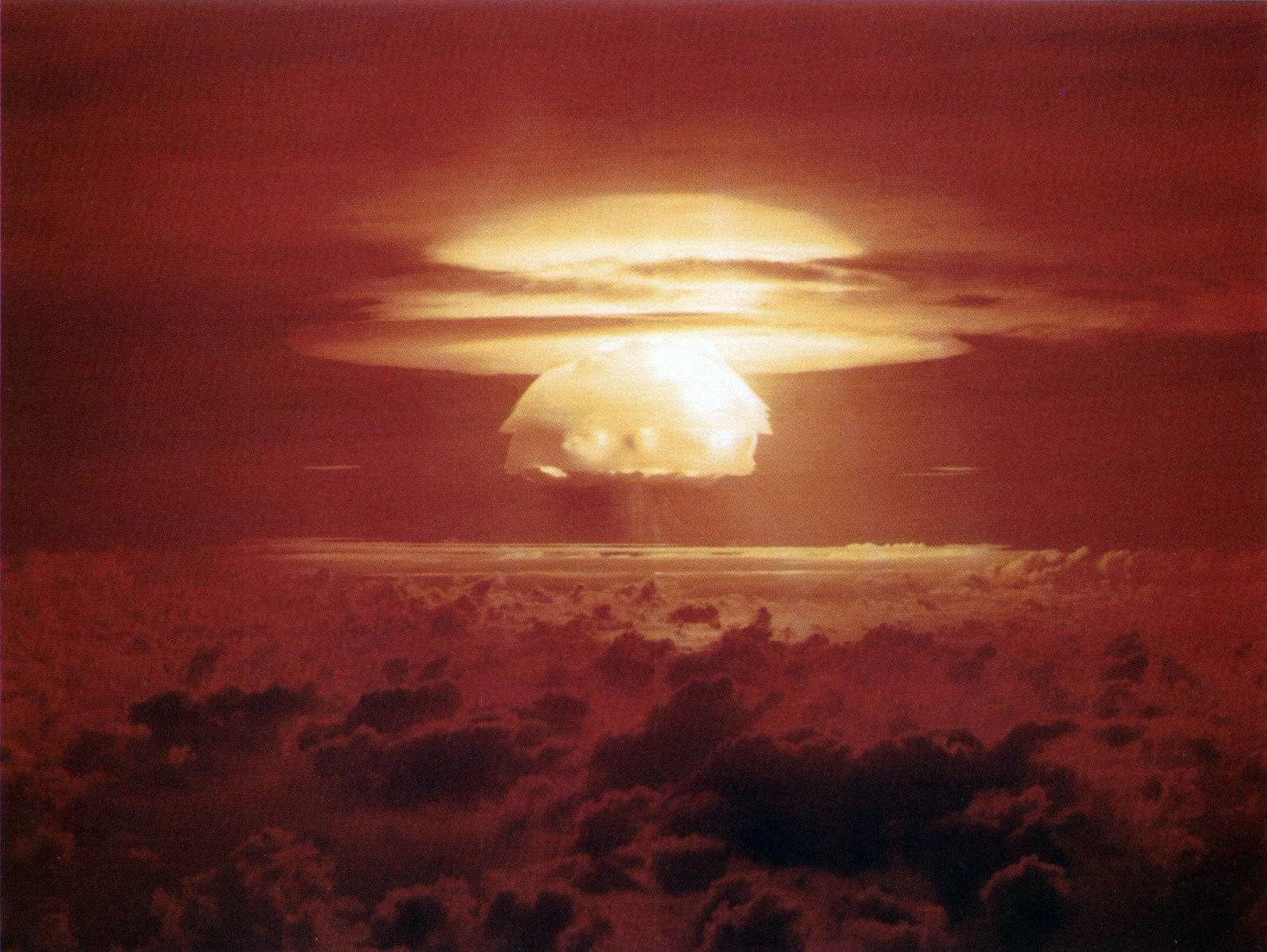
The first instrument to answer was the firing bunker. Within half an hour the readings outside Station 70 on Enyu were rising, and at one hour they reached 250 roentgens an hour. The men inside, behind concrete, read 0.035, and stayed there until the Bairoko’s helicopters took them off between 10:15 and 12:30. The second instrument was the fleet. At eight o’clock the ships thirty miles to the south-east began to receive what the sailors described as pinhead-sized white and gritty snow; on the Bairoko the reading went from 0.0002 roentgens an hour to one in five minutes. The ships were sent south at best speed to fifty miles with their washdown systems running; the Bairoko’s flight-deck gutters read five roentgens an hour and a deck drain twenty-five, and the crews were held below in the heat for more than four hours.
At 9:49 a Neptune from Kwajalein, searching for shipping on a bearing of 65 degrees, the direction the cloud was supposed to be going, became so contaminated that it turned for home, radioing that heavy contamination should be expected on a bearing of 86 degrees, 238 miles from Enewetak. The message reached the task force’s radiological safety centre five days later.
On Rongelap the people had seen the flash, felt the heat on their faces, and counted seven booms. At about ten in the morning the powder began. Billiet Edmond, the schoolteacher, wrote that “At 11:30 the classes were dismissed and the students and I went out and were greeted by the powder-like particle as it began to fall on the land”. The magistrate, John, told Clarkson a few days later that “The fall-out powder whitened the hair and adhered to [the] skin as a salt-like film.” The health practitioner, Jabwe, closed the wells and the cisterns and told the people not to drink, in a drought that had rationed them to a half-litre tin of water a day. Nobody had told the Marshallese what to do if powder fell from the sky.
At Rongerik the monitor began to climb at 13:18 and went off the scale at 14:50. The message went at 15:15. Aboard the Estes it arrived against a different piece of evidence: at about 15:50 the cloud-tracker Wilson 2, which by its flight plan should have been near Rongerik, reported no contamination there, and had earlier found the main cloud about 150 miles out on a bearing of 60 degrees, where the forecast had said it would be. The negative report and the forecast agreed, and the off-scale meter was discounted. What nobody on the ship knew until days later was that Wilson 2, through a misunderstanding at air operations control, had been held in its holding pattern for six hours instead of two and had never flown near Rongerik. Its position had been inferred from the clock. The Defense Nuclear Agency’s history is blunt: “It is clear that at this time Hq JTF 7 did not know where the cloud was, nor where it had been. There was apparently no great concern about this, however.”
During the commander’s briefing at eight that evening a second message from Rongerik arrived: the pen had been off the chart since 14:50, and would somebody please acknowledge. Wilson 3, flying east at last, reported airborne contamination north-north-east of Rongerik at 19:45. A reply was drafted at ten o’clock telling the weather station that its fallout should pose no significant hazard; it left the ship at five the next morning. A message ordering the twenty-eight men to stay inside the metal buildings was sent just after midnight. Requests for a night survey flight over the atolls went out at about eight, and through a procedural error did not clear the Estes’s radio room for about twelve hours.
The man who did the measuring was Captain Louis Chrestensen of the Air Force, a radiation monitor sent by night to Kwajalein to catch the morning supply run. He was over Rongerik at 9:45 on 2 March, measured what the history calls potentially dangerous levels, and at 11:30, on his own initiative, began taking the detachment off in the flying boat that had brought him, eight men in the first load and the other twenty by 16:45. His readings reached the task force at about one o’clock, “Task Force Command’s first knowledge of the true severity of the off-site fallout”. From Kwajalein he signalled: “Suggest immediate survey of inhabited islands of Rongelap. High possibility exists that immediate steps must be taken to evacuate natives.”
Clarkson and Graves convened a conference aboard the Estes at 13:30. At 13:40 the laboratory’s survey aircraft reported dangerous levels at Rongelap and Ailinginae, and Clarkson ordered the evacuation to begin. The destroyer escorts were hours away at their patrol stations and the Trust Territory had to be told, so the ships would go that night and the people would be taken off at dawn. Monitors flown to Rongelap that afternoon read an average of 1,400 milliroentgens an hour in the village. The USS Philip left Bikini at 21:45. The people in the heaviest fallout were taken out of it some fifty hours after it fell.
On the morning of 3 March a flying boat took fifteen of the sick, pregnant and old to Kwajalein, chosen by John the magistrate. The other forty-eight were aboard the Philip by 11:30 and showered on deck; the ship picked up the eighteen at Ailinginae by six in the evening. “All children were provided milk shortly after decontamination,” the captain wrote. “The meat course was the least popular. Hot soup was most in demand. Ice cream was the natural favorite of all the children.” Many were seasick, or sick. They landed at Kwajalein at 8:30 on 4 March. That morning the Renshaw lay off Utirik; the lagoon was too shallow for a destroyer and the surf was up, and 154 people were shuttled through it by raft to the whaleboats between 10:50 and 12:51. Ailuk, four hundred people in an estimated 13,000 milliroentgens, was not evacuated; two more destroyer escorts had been offered by the fleet that morning, and could have done it.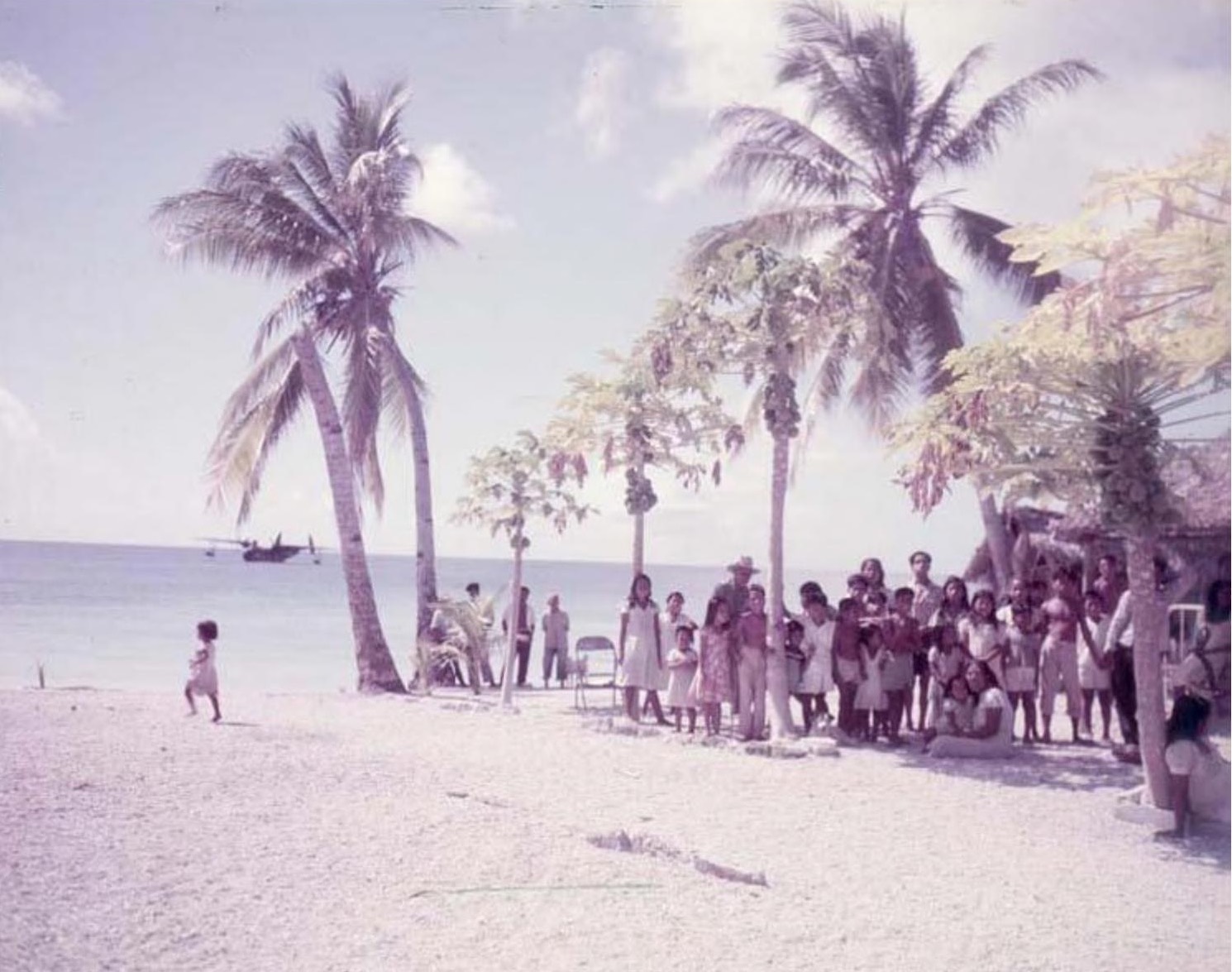
What it looked like from inside
There was one more instrument, and the task force did not know it existed. The Fukuryu Maru No. 5, the Fortunate Dragon, a wooden tuna boat of 99.9 tons from Yaizu in Shizuoka, with twenty-three men aboard, had left port on 22 January and come to the waters north of Rongelap, which were poor fishing, in the last days of February. By the Japanese government’s account of her voyage, handed to the American ambassador on 27 March, she had set her lines in the small hours of 1 March and was drifting with her engine stopped when “a reddish brilliant light” was seen to the west-south-west; “The color of this light gradually turned to white-yellow and again back to red and faded away.” Seven or eight minutes later came two blasts in succession, and a cloud “having the shape of a mushroom” that spread until it covered the sky. “Some of them realized that probably an atomic test, about which they remembered having read in the newspapers, might have occurred.” They began hauling in their lines by machine, “all hands with the exception of a few engineers on watch” on the upper deck. About three hours after the flash the ash began to fall and “the deck . . . was turned white”. They finished hauling at 10:30 by their clock and turned north to get out of it; the ash fell until about noon.
The Japanese government put the boat at the flash some nineteen miles outside the Danger Area and at the ash twenty-six; the task force history puts her 85 miles east-north-east of the burst, and the searches before the shot, flown to the north-west, had not looked there. After a week the crew began to burn where the ash had touched them: necks, faces, ears, and under the hachimaki, the cotton towels tied round their heads. “On the first night we were unable to eat our supper,” the radioman, Aikichi Kuboyama, told Life magazine at the end of March. “We tried drinking some sake (rice wine) to improve our appetites, but our appetites would not improve and the sake did not make us drunk. We were very depressed.” A deckhand, Tadashi Yamamoto: “If we realized how sick we were, I think we would have put in at Midway and asked the Americans there for help.” They did not; by the Commission’s account they feared being detained, or sunk, if the Americans found them near Bikini. The Fukuryu Maru came into Yaizu at six in the morning of 14 March. Her voyage and what followed in Japan are in The Fortunate Dragon.
At Kwajalein, meanwhile, the evacuees were showered again and counted. Of the sixty-four from Rongelap Island, eighteen complained of itching and burning of the skin and eyes, and of nausea. Blood counts fell over the next weeks. After two to four weeks the beta burns came out, on the parts of the body that clothing had not covered, worst on the tops of the feet; hair fell out. The twenty-eight Americans had the same in milder form. The dose the radiation safety staff computed was 175 rad of whole-body gamma radiation for the people on Rongelap Island, 69 for the fishing party at Ailinginae, 14 for Utirik, and 78 for the Americans on Rongerik; a Defense Nuclear Agency reconstruction in 1987 put the airmen’s film badges at about 40 rem.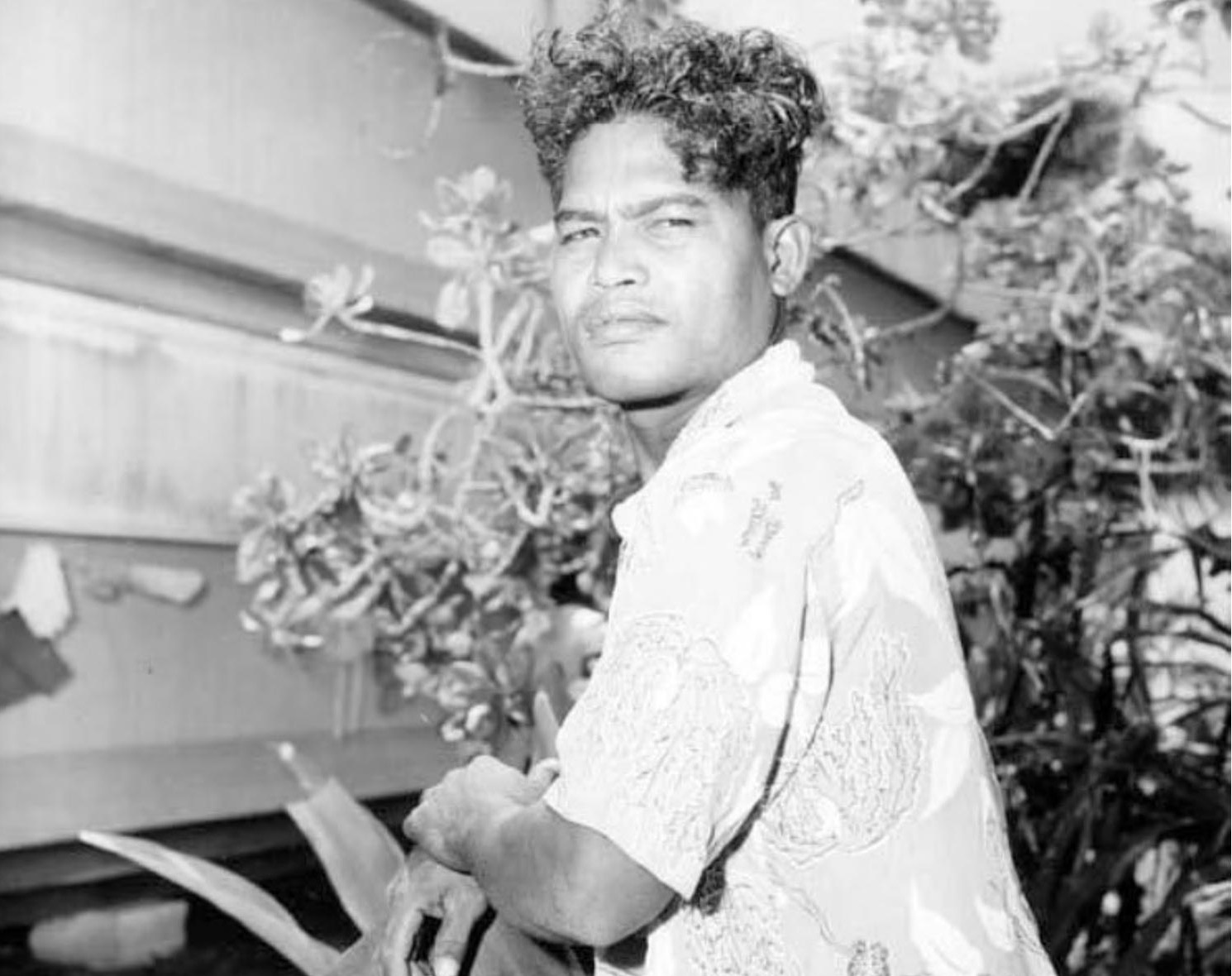
On 5 March, two days after the Rongelap evacuation, the Armed Forces Special Weapons Project asked permission to set up a study of “human beings exposed to significant gamma and beta radiation due to high yield weapons”, and three days later it existed as Project 4.1, with a Navy physician, Eugene Cronkite, flown out to lead it. There had been no biomedical project in Castle’s plans. Shipman put it in a sentence that has been quoted against the programme ever since: “Purely by luck, good or bad, we did manage to get some unusually good results on humans at Rongelap.”
The first thing the Commission said in public about any of this was a release on 11 March: “During the course of a routine atomic test in the Marshall Islands, 28 United States personnel and 236 residents were transported from neighboring atolls to Kwajalein Island according to plans as a precautionary measure. The individuals were unexpectedly exposed to some radiation. There were no burns. All are reported well. After completion of the atomic tests, they will be returned to their homes.” Graves had argued against the decision to say nothing unless forced: “I hope that the fact that these natives are not United States citizens but wards of the Government was given appropriate weight. I should regret very much the impression that we are being furtive in our actions with regard to these people.”
What happened
The burns were on the front pages of Tokyo within two days of the Fukuryu Maru’s return, and from 16 March the story ran on the Associated Press wires with the crew’s estimate of their distance, eighty miles, in every version. Tuna from the hold had been sold before anyone thought to test it, and the price of tuna in Tokyo fell by forty per cent. The chairman of the Joint Committee on Atomic Energy, Sterling Cole, said it was possible the fishermen had been spying. On 24 March the Navy disclosed that a tanker, the Patapsco, with ninety-two men aboard, had been dusted too, and the danger area was enlarged to a radius of 450 miles. Congressman Chet Holifield, who had flown over the crater, said the explosion “was so far beyond what was predicted that you might say it was out of control.”
Strauss answered on 31 March, at the President’s news conference, in a statement the newspapers printed in full. “It was a stupendous blast in the megaton range but at no time was the testing out of control.” The misapprehension had two causes. “First, that the yield was about double that of the calculated estimate—a margin of error not incompatible with a totally new weapon.” Second, the fallout: “The wind failed to follow the predictions but shifted south of that line and the little islands of Rongelap, Rongerik and Uterik were in the path of the fall-out.” The trawler “appears to have been missed by the search but, based on a statement attributed to her skipper, to the effect that he saw the flash of the explosion and heard the concussion six minutes later, it must have been well within the danger area.” The 236 Marshallese “appeared to me to be well and happy”. A suggestion that the fallout on inhabited islands “was actually a planned part of the operation” he called “utterly false, irresponsible and gravely unjust to the men engaged in this patriotic service.” Asked whether a hydrogen bomb could be made large enough to destroy New York, he said yes, large enough “to take out any city”, and that was the headline.
Two of the statement’s claims were corrected within weeks, in private. The Japanese embassy’s aide-memoire of 12 April put the interval between flash and sound at seven or eight minutes, not six, and the boat outside the zone. And on 9 April the task force signalled the Commission that there had been only small differences between the forecast winds and the real ones; the Clarkson–Graves memorandum of 12 April gave the finding: “Forecast for shot time winds at shot time was essentially correct. Variation from forecast trajectories was approximately 10 degrees in significant upper levels: unfortunately, the variation was in the wrong direction.” The conclusion the task force reached almost at once, and Washington did not say aloud, was that the fallout had come from the head of the cloud in the stratosphere, the part the plan had left out. “The theory that a significant fallout does not come from the stratosphere,” Graves wrote that March, “is not substantiated by the facts of BRAVO.” An analysis a week after the shot, drawing the fallout from a cloud seventy to a hundred miles wide, put the populated atolls inside it. The arguments over the winds, the models and the three reconstructions of the pattern are in The fallout plot.
The series went on. The second shot, Romeo, waited two weeks for weather and fired on 27 March from a barge moored in the Bravo crater; by the end the exclusion area had grown to about 570,000 square miles, twice Texas. Shrimp’s success made a planned Los Alamos device obsolete overnight, and it was never fired. The Rongelap people were moved in June to a village built for them at Majuro and told they would go home in about a year.
Aikichi Kuboyama died in a Tokyo hospital on 23 September 1954, of what the Japanese autopsy called radiation sickness through jaundice and the Commission’s director of biology and medicine called complications of septicaemia; by early September he had received no fewer than seventy-three transfusions of blood and plasma, and the American doctors who had been kept from the fishermen thought the treatment as likely a cause as the illness. Within the hour the ambassador, John Allison, expressed “extreme sorrow and regret at this most unhappy event”. On 4 January 1955 the United States offered and Japan accepted two million dollars “as payment in full for all damages” from the tests.
On 15 February 1955 the Commission published what it had learned, in figures for a bomb like Bravo fired on a city with everybody in the open for thirty-six hours: a cigar-shaped area 220 miles long and up to 40 wide; 2,300 roentgens measured in the north-west of Rongelap Atoll in the first thirty-six hours; “about 7,000 square miles of territory down-wind from the point of burst was so contaminated that survival might have depended upon prompt evacuation of the area or upon taking shelter”. The paragraph on the data repeats the sentence about the winds: “Due to an unexpected shift in the direction of the prevailing winds in the higher altitudes, the fall-out missed the observation rafts that had been placed farther north previous to the test firing.” The rafts had been where the model said the fallout would be.
After
The Rongelap people went home on 29 June 1957, after ten surveys of their atoll, to a rebuilt village where the gamma dose rate was about 500 milliroentgens a year, eight times the islands’ natural background, with the medical recommendation of no further exposure “for at least 12 years” still on file. The Brookhaven National Laboratory took over their care and examined them every year, and one of the programme’s reports said that “the habitation of these people on Rongelap Island affords the opportunity for a most valuable ecological radiation study on human beings”. Nine years after the fallout a girl of twelve was found with nodules on her thyroid; in time about a third of the exposed Rongelap people developed thyroid tumours, most benign, some not, with the heaviest incidence among those who had been under ten in 1954. Lekoj Anjain, who had been a year old that March, died of leukaemia in 1972, at nineteen. In 1966 Congress voted the exposed people an ex gratia payment of 950,000 dollars, about 11,000 each. In 1985 the people of Rongelap left their island again, by their own decision, and by a Los Alamos historian’s account in 2024 “have yet to return home”.
In 1994 the House Committee on Natural Resources held a hearing on Bravo, and in 2013 the Defense Threat Reduction Agency published a report by Thomas Kunkle of Los Alamos and Byron Ristvet titled Castle Bravo: Fifty Years of Legend and Lore, written to answer it. Its conclusions cut against the public story in both directions. On the winds: “It was never the position of the task force scientific staff that the fallout on the inhabited islands was caused by an unexpected shift of the winds.” On the yield: “The high yield of the BRAVO device was not in itself the cause of the fallout on the inhabited islands”, because a cloud from six megatons would have risen nearly as high and spread nearly as wide, and every Castle shot at Bikini, including the seven-megaton Union, contaminated Rongelap. On the plan: “The error in forecasting the BRAVO fallout was that the contribution from the stratosphere was not adequately considered.” On the hours after the shot it is harder on its own side than the public story ever was: the Neptune’s message lost for five days, the tracker that was never where it was believed to be, the survey requests that sat in the radio room for twelve hours, Ailuk, and the transcripts of the radiological safety office’s discussions, which the record-keeping plan had called for and which do not exist. Ogle wrote in his own recollections: “To call the result ‘Chaos’ is putting it mildly.”
Graves wrote to the Commission’s director of military application on 17 April 1954: “If I ever have anything to do with another operation, which is an unlikely circumstance if I ever heard one, I would propose to get shots ready as soon as possible and fire when the weather is suitable rather than schedule a shot for 1 March for instance.” He never ran another. The Japanese word for the fallout, shi no hai, the ashes of death, went round the world, and the argument that began that spring ended, for the atmosphere, in the test ban treaty of 1963; the last American megaton shot fired above the atmosphere before it is the subject of Thirty Strings. Gordon Dunning of the Commission wrote in 1968 that “until 1954 one school of thought held that high yield surface detonations would create intense fallout only in the immediate area of the shot, and that most of the activity would be carried into the stratosphere where it would be scattered widely around the world. March 1, 1954 saw the dismissal of that school — permanently.”
What it taught
Start with what the experiment got right, because it got its own question right. Shrimp was built to find out whether a dry thermonuclear bomb would work, and it did. Ogle had planned the people’s safety on a yield larger than fifteen megatons, and nobody on the task force died. The lithium-7, which the designers had written off, turned out to breed tritium under the fast neutrons of the fusion itself, and that discovery, worth two and a half times the expected yield, was the kind of result an experiment is run to get.
The second claim was not run as an experiment. Where the debris would go was answered by a drawing, and the drawing was made from the one previous shot of the kind, whose debris had not been found. The absence of Mike’s fallout was read as evidence that the stratosphere kept it, rather than as evidence that nobody had looked where it fell, and the head of the cloud, the part that could not be accounted for, was the part left out of the model. The task force did not believe the trapping theory, and said so; but it drew its plot as if it did. A calculation inherits the blind spot of the data it is scaled from.
The instrument that answers is whatever is in the way. Nothing of Joint Task Force 7’s was placed to measure fallout on the inhabited atolls, because the plan said there would be none worth measuring; the laboratory’s monitor on Rongerik had a ceiling of one hundred milliroentgens an hour for that reason. So the measurement was made by a weather station’s recorder pen, by a patrol plane’s crew, by a tanker’s deck, by the skin of sixty-four people on Rongelap and twenty-three on a boat nobody knew was there. Thirty Strings tells the same thing about a shot eight years later, when the measurement of a bomb fired in space was made by Honolulu’s street lights and other people’s satellites. In both cases the reading came back late and in the wrong form, and it was the only one there was.
When the needle goes past the end of the scale, doubt the scale before the needle. “Over 100” meant more than a hundred and could have meant a thousand. The task force reasoned on a hundred, computed a lifetime dose it could live with, and waited for an aircraft that was not where its flight plan said. The instrument had told the truth and had been built too small to tell all of it. A reading that saturates is not a number; it is a warning that the instrument is the wrong one.
A line drawn for one purpose will be read for another. The Danger Area was drawn to keep foreign ships from sampling the cloud, and its eastern edge was fixed to leave Rongelap outside so that its people need not be moved. Then it was published to the world as the limit of hazard, the trawler’s master kept outside it, and when the ash fell on him the chairman of the Commission concluded that he must have been inside. A boundary set for secrecy and convenience was taken, by a Yaizu fishing master and by Lewis Strauss alike, as a boundary of safety. It had never been one.
The number everyone read was not the one that mattered. Fifteen megatons explained the surprise, and “about double” was offered to the public as the whole of it: a big bomb, a wind that shifted, bad luck. The task force’s own finding in April was that the winds had been forecast about as well as winds can be, and the 2013 report’s finding is that six megatons would have done much the same. The lesson of the night was in the drawing, in the five-day message and the tracker that never got there, and that was never read aloud. Thirty-Six Seconds tells of a test whose official account blamed the operators while the reactor’s design sat in the record; here the official account blamed the wind and the yield while the plan sat in the record, and the plan was the thing to learn from.
Check the story before you learn from it. The boat was 71 miles from the burst in Life, 80 in the wire reports, 82 nautical miles in the Commission’s history, 85 in the Defense Nuclear Agency’s, and “well within the danger area” in Strauss’s statement; the sound came six minutes after the flash in his telling and seven or eight in the crew’s. The yield was “about double” the estimate for the press and two and a half times it in the laboratories. The bunker read 250 roentgens an hour at one hour in one government history and 40 in a careful private one. Kuboyama died of radiation sickness in the Japanese autopsy and of his treatment in the opinion of the American doctors who were not allowed to examine him. The winds shifted in the statement of 31 March and the report of February 1955, and did not in the task force’s memorandum between them.
What the record supports without argument is the sequence: a yield estimate with a ceiling that was respected for the ships and the aircraft; a fallout plot drawn without the top of the cloud; a shot fired on a forecast that was essentially right; a pen off the scale at ten to three; a people taken off their island fifty hours after the ash fell; and a boat nobody searched for, which carried the result to the only country that had seen one before. That is enough to learn from, and the part that mattered was in the drawing before the shot.
Sources
- Defense Nuclear Agency, Castle Series, 1954, DNA 6035F, United States Atmospheric Nuclear Weapons Tests, Nuclear Test Personnel Review, 1982. Chapter 4, the Bravo test: the searches, the three briefings, the firing party, the detonation and cloud, the fleet’s fallout, the Neptune’s message, Rongerik’s messages, the tracking flights, the evacuations; Appendix A, the Japanese government’s aide-memoire of 27 March 1954 on the Fukuryu Maru No. 5 and the embassy’s aide-memoire of 12 April. archive.org
- Thomas Kunkle and Byron Ristvet, Castle Bravo: Fifty Years of Legend and Lore. A Guide to Off-Site Radiation Exposures, Defense Threat Reduction Agency, DTRIAC SR-12-001, January 2013. The yield telegram of 18 February, the stratospheric trapping theory and Pate’s memorandum, the fallout plot, the midnight briefing memorandum, the Danger Area’s purpose and eastern boundary, the monitor on Rongerik and its message, Wilson 2’s position, Chrestensen, the evacuations hour by hour, Ailuk, Project 4.1, the Clarkson–Graves memorandum of 12 April, the weather officers’ complaint, Graves’s letters, Ogle’s “Chaos”, Shipman’s remark, the Rongelap return and the 1994 hearing; the quotations from Edmond, Jabwe, John, Pletsch, Barney, Shipman, Dunning, the captain of the Philip and the task force’s memoranda are taken at second hand from this report. The two photographs are its Figures 5-12 and 5-7. archive.org
- Richard G. Hewlett and Jack M. Holl, Atoms for Peace and War, 1953–1961: Eisenhower and the Atomic Energy Commission, University of California Press, 1989, the official history released by the Department of Energy. Chapter 7 on the build-up, the exclusion area, the briefings, the firing, the yield, the evacuations and doses, and the Lucky Dragon; chapter 10 on the fallout evaluation, Strauss’s news conference and Kuboyama. osti.gov
- Roger A. Meade, Operation Castle, Los Alamos National Laboratory, LA-UR-21-29474, 2021, for the Agnew–Bethe memorandum of August 1953, the cancelled shot and the table of Castle yields; and The Forgotten Marshallese of Wotho, Rongelap, and Utirik Atolls, LA-UR-24-25380, 2024, for the return of 1957 and the departure of 1985. osti.gov, osti.gov
- Carey Sublette, “Operation Castle,” Nuclear Weapon Archive, for the Shrimp device’s dimensions, weight and fuel enrichment, the 4 to 8 megaton range, the lithium-7 “tritium bonus”, the crater and the bunker reading of 40 roentgens an hour. nuclearweaponarchive.org
- United States Atomic Energy Commission, Eighteenth Semiannual Report of the Commission to the Congress, January–June 1955, Appendix 7, “A Report by the United States Atomic Energy Commission on Effects of High-Yield Nuclear Explosions” (the report of 15 February 1955): the cigar-shaped area, the 2,300 roentgens at Rongelap, the 7,000 square miles and “an unexpected shift in the direction of the prevailing winds”. osti.gov
- The Evening Star (Washington), 12 March 1954, page A-1, the Commission’s announcement of 11 March; 16 March, page A-6, “23 Fishermen Tell Of Burns From Ash Blown From Bikini”; 17 March, page A-1, the embassy’s offer, Cole’s remark and the tuna markets; 24 March, page A-1, the Patapsco, the new danger zone and Holifield; 25 March, page A-4, the President’s remarks of 24 March and the Life interview with Kuboyama and Yamamoto, whose words are therefore at second hand through the Associated Press’s report of the magazine; 31 March, pages A-1 and A-2, Strauss at the President’s news conference and the full text of his statement, with the “Alice” story; 23 September, page A-1, Kuboyama’s death and Allison’s statement; 24 September, page A-19, the million-yen cheque. Library of Congress, Chronicling America
- The Nome Nugget, 5 January 1955, page 5, “U.S. Pays Japan $2 Million For H-Bomb Damage” (Associated Press, Tokyo). Library of Congress, Chronicling America
- Operations Coordinating Board, “Attachment to Status Report”, 9 June 1954, on the condition of the fishermen, the Japanese claim of about seven million dollars and the 800,000 dollars of direct damage. CIA reading room, via archive.org
- J. Goetz and others, Analysis of Radiation Exposure — Service Personnel on Rongerik Atoll, Operation Castle, Shot Bravo, Defense Nuclear Agency, DNA-TR-86-120, 1987. The film-badge doses of about 40 rem. archive.org
- Robert A. Conard, Fallout: The Experiences of a Medical Team in the Care of a Marshallese Population Accidentally Exposed to Fallout Radiation, Brookhaven National Laboratory, BNL 46444, 1992. The thyroid tumours, Lekoj Anjain, the payment of 1966 and the departure of 1985. osti.gov
- Wikimedia Commons, “Castle Bravo Blast.jpg”, a United States Department of Energy photograph of the Bravo cloud, in the public domain as a work of the United States government. commons.wikimedia.org
