At 11:45 on the morning of Wednesday, November 15, 1978, forty-five minutes late, Senator Daniel Patrick Moynihan of New York took the chair in room 2228 of the Dirksen Senate Office Building in Washington and apologised to the witnesses. “The computer which manages the Eastern Airlines flights went down and we stayed on the ground,” he said, “and we could not help that.” He was the only senator in the room. He had a statement about the three days of hearings he was opening, and rather than read it he put it into the record.
The statement said what the hearings were for. Over ten years the United States government had spent about $112 million paying a guaranteed income to several thousand poor families in New Jersey, Iowa, North Carolina, Indiana, Washington and Colorado, to find out what they would do with it. “In the history of social policy there has never been such an extraordinary use of the experimental mode.” The results were in. “Ten years ago, we expected quite different outcomes from these tests. We must now be prepared to entertain the possibility that we were wrong.”
The number he had in mind was sixty. Among the families in Seattle and Denver who had been offered a guaranteed income, the researchers reported, marriages had broken up at a rate as much as sixty percent higher than among families who had not. Moynihan had spent a decade arguing that a guaranteed income would hold poor families together. “I am sort of sorry about these hearings,” he told the man who ran the experiment that afternoon. “I am certainly sorry about your findings.”
Twelve years later two economists in Wisconsin went back to the same data and could not find the sixty percent. By then no one in Washington was asking.
Fifteen hundred miles to the north-west, in the week of those hearings, the only other guaranteed-income experiment on the continent was winding down in a town of ten thousand people on the Manitoba prairie. Its researchers had been told two years before to stop analysing and start filing. The files, when they were finally counted, came to eighteen hundred boxes. Nobody opened them for thirty years, and when someone did, she could not read them either.
Who ran it
The American experiments came out of the Office of Economic Opportunity, the agency of President Johnson’s war on poverty, which from 1965 had put a negative income tax into every anti-poverty plan it sent to the White House and had every one of them turned down. Unable to get the law, the agency decided to get the evidence. The first experiment began in New Jersey in late 1968. The idea behind all of them was the one Milton Friedman had set out in 1962 and Lady Rhys Williams in Britain before him: the government would guarantee every family a minimum, and reduce the payment by some fraction of every dollar the family earned, so that working always left you better off than not working, and no one fell below the floor.
The largest of the experiments was the one that mattered in the end. The Seattle and Denver Income Maintenance Experiments, written as SIME/DIME and said as a single word, enrolled families in Seattle from 1970 and in Denver from 1972. The Department of Health, Education, and Welfare paid for it; the states of Washington and Colorado were the prime contractors; they subcontracted the design, the operation and the analysis to the Stanford Research Institute in Menlo Park, California, which became SRI International in 1977, and SRI subcontracted the payments and the interviewing to Mathematica Policy Research. The director was an economist named Robert Spiegelman. The marriage findings were the work of two Stanford sociologists, Michael Hannan and Nancy Brandon Tuma, with Lyle Groeneveld of SRI.
The man who read them was Moynihan. As an assistant secretary of labor in 1965 he had written the report on the Negro family that made his name and his enemies. As President Nixon’s adviser on urban affairs in 1969 he had talked Nixon into proposing the Family Assistance Plan, a guaranteed income for every family with children, and had watched the Senate Finance Committee kill it in 1970 and again in 1972. He wrote a book about it in 1973. In January 1977 he came to the Senate himself, took a seat on the Finance Committee, and was given the chair of its Subcommittee on Public Assistance, which is to say the chair of welfare reform. That August, President Carter proposed a guaranteed income of his own, the Program for Better Jobs and Income, and Moynihan’s subcommittee was where it would have to pass.
The Canadian experiment came out of a different politics and the same decade. A Senate committee under David Croll had recommended a guaranteed annual income for Canada in 1971; a federal review of social security began in 1973; and the New Democratic government of Manitoba under Edward Schreyer offered to be the place where the idea was tested. In March 1973 Manitoba sent Ottawa a proposal for a full experiment, with a budget of $17 million, more than a thousand families, and the federal Department of National Health and Welfare paying three-quarters. The two governments announced their approval on February 22, 1974, and signed the agreement on June 4. The experiment was called Mincome, from Manitoba, minimum and income. Ron Hikel, a political scientist in the Manitoba civil service, negotiated it and ran it as executive director. Its first research director was Michael Laub; its second was Derek Hum, an economist at the University of Manitoba. A payments agency, Mincome Manitoba, was set up in Winnipeg. Mordecai Kurz of Stanford was brought in to evaluate the sample design, so that the two experiments shared, among other things, a university.
What they were trying to find out
The experiments were built to answer one question and were judged on another.
The question they were built for was about work. If you guaranteed a poor family an income and taxed away half of every dollar it earned, how much less would its members work? Economists could predict the direction of the answer, because the guarantee made leisure affordable and the tax made work pay less, but not the size, and the size was the cost of the policy. Every plan tested had two numbers, a guarantee level and a tax rate, and the experiments varied both so that the response could be measured along each.
The question they were judged on was about families. The welfare programme the United States had, Aid to Families with Dependent Children, paid mothers with children and, in most states, paid nothing to a family while the father was in the house. Everyone who proposed a guaranteed income, from the Office of Economic Opportunity to Nixon to Carter, said that this split families and that a payment made regardless of who was in the house would hold them together. It was the moral centre of the case. It was also, as Moynihan knew better than anyone, unproven. In 1967 he had written that “there are not 5 cents worth of research findings” to show that welfare broke up marriages, and in 1978 he read that sentence back into the record himself. The Seattle and Denver experiment was not designed to test the family claim. It collected the data that could, because the interviewers asked every family every few months who was living there.
Mincome asked the work question too, and Hum and his colleagues designed its Winnipeg sample on the American pattern to answer it. But it added a question the American experiments had not asked. In a dispersed sample, each family is alone with its payment; nobody else on the street has one. Hikel’s team wanted to know how a guaranteed income behaved when a whole community had it: how it would be administered, what it would do to the town, and whether people who would never go on welfare would take it. For that they chose a saturation site, one place where every family was eligible, and the place was Dauphin.
What they built
Seattle and Denver enrolled 4,800 families between them, 2,042 in Seattle and 2,758 in Denver, drawn from low-income census tracts, with heads aged eighteen to fifty-eight and incomes under $9,000 for one earner or $11,000 for two. The families were Black, white and, in Denver, Chicano. Eleven negative-income-tax plans were tested: three guarantee levels, $3,800, $4,800 and $5,600 a year for a family of four in 1971 dollars, which Spiegelman described as 90 to 140 percent of the poverty line, crossed with four tax schedules, 50 percent, 70 percent, and two that started at 70 and 80 percent and declined as income rose. Some families were enrolled for three years and some for five. A separate set of treatments offered counselling and subsidised training, alone or with the payments. About a thousand families were controls, which meant they had whatever Washington State or Colorado offered them, which was welfare if the father left. Every family on a plan filed a monthly income report form, and every family, control or not, was interviewed at intervals for the duration. Midway through, about 150 Denver families were told their payments would continue for twenty years.
Mincome’s Winnipeg sample was the American design in Canadian dollars. Interviewers screened 21,700 households in late 1973, took baseline interviews from 3,800 families in late 1974, and randomly assigned 1,255 of them, 1,074 in Winnipeg and 181 in small rural communities, to one of seven plans or to a control group. The plans crossed three guarantees, $3,800, $4,800 and $5,800 for a family of four in 1975 dollars, with tax rates of 35, 50 and 75 percent, less the two combinations that were too generous or too mean to be worth testing. The guarantees were indexed to inflation. Nine rounds of interviews followed between 1974 and 1977, and Mincome Manitoba paid monthly cheques against monthly income reports, filed the participants’ tax returns and reconciled the over- and underpayments.
Dauphin was chosen because it was the right size and the right distance. The researchers needed a town of about ten thousand, small enough to afford and big enough to count, within a day’s drive of Winnipeg. It is 300 kilometres to the north-west, a farming town with a large Ukrainian population, a railway station, a new hospital and a factory making running shoes. Every family in the town and the rural municipality around it was eligible, the elderly and the disabled included, and there was no control group, because there could not be one. Everyone was offered the same plan: a guarantee of $3,800 for a family of four, about 60 percent of the Statistics Canada low-income cut-off, indexed, with fifty cents taken from the payment for every dollar earned. A Dauphin family that earned $2,000 kept $2,800 of its payment and had $4,800. A family on provincial welfare would have seen little difference. A working family that had never qualified for anything saw a cheque. By the count in the payments file, 586 Dauphin families enrolled; by Forget’s reckoning about a third of the town’s families qualified at any one time in the years the cheques went out.
It cost $17 million on paper, $12.8 million of it federal and $4.2 million Manitoba’s, and the paper was wrong from the first year. The payments were indexed to a cost of living that rose by double digits through the middle of the decade; the budget was not. Unemployment ran higher than planned, so more families qualified for more. Forget, who interviewed the people who ran it, wrote later that “the original budget of $17 million was never more than a wild guess and, in the event, proved far inadequate.” Cheques to families were a statutory obligation. Interviews were a contract. Analysis, she wrote, “was the last claim on the budget, and it was funded from an ever diminishing residual.”
Sixty percent
The marriage finding was first written up by SRI in December 1976, on eighteen months of data, and published by Hannan, Tuma and Groeneveld in the American Journal of Sociology in May 1977. On the first two years of the experiment, the dissolution rate among white and Black couples on the payments was close to double the rate among the controls. It was, the researchers said, the opposite of what everyone had expected, themselves included, and they were careful about it. They tested it against attrition, against the possibility of fraud, against a second statistical method. Nothing made it go away.
They also had an explanation. A payment to a couple has two effects, they argued. It makes the couple better off, which steadies the marriage; they called that the income effect. And it is also available to the wife alone if she leaves, which makes leaving affordable; they called that the independence effect. Welfare was available to her too, but welfare was stigmatised, uncertain and hard to get, so a dollar of welfare counted for less in her calculation than a dollar of the experiment’s money; they called that the welfare discount. The pattern in the data fitted the model. The lowest guarantee, which paid a separated mother no more than welfare would have, had the largest effect on break-ups, because it carried the independence effect without much income effect. The most generous plan had the smallest.
The finding reached Carter’s cabinet before it reached the public. On Tuesday, February 7, 1978, Joseph Califano, the Secretary of Health, Education, and Welfare, came before Moynihan’s subcommittee to argue for the President’s plan, and Moynihan asked him for his evidence that paying intact families would keep them intact. Califano offered the Seattle and Denver experiment, which “indicated several things, none of which, I must say in all candor, was indicated that clearly,” and conceded: “I cannot say that we have, out of that experiment, any clear evidence one way or the other.” Moynihan was not satisfied. “The Seattle-Denver experiment, as you know, casts for the first time some real doubt on the proposition that the program you are proposing will have the effects you say.” Califano’s department had convened a panel of statisticians and demographers that same month to look for the flaw. The panel offered alternative explanations and agreed, in general, that the effect was real.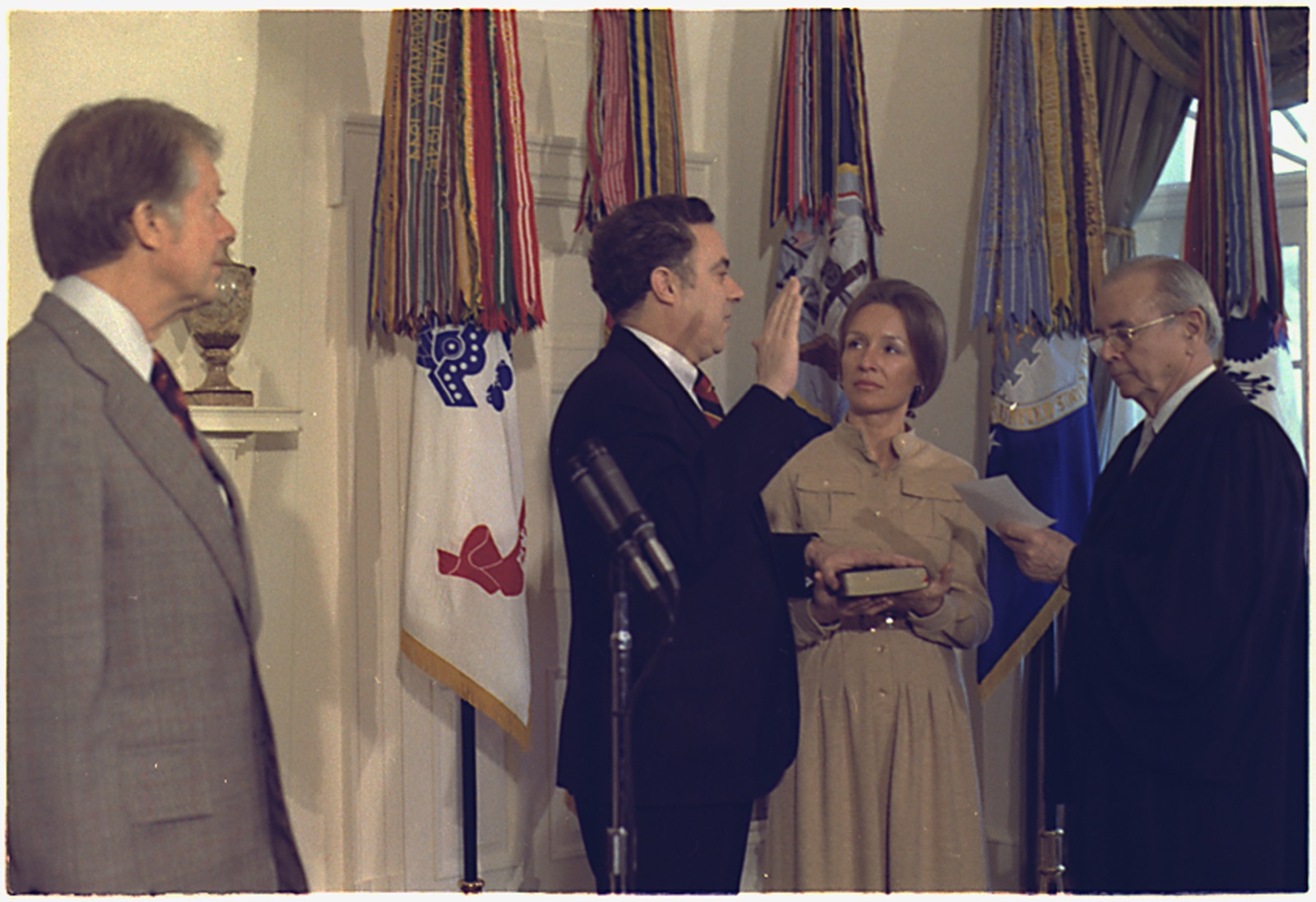
On May 1, 1978, Spiegelman testified in person, with Groeneveld and Philip Robins beside him, to a session chaired by Senator Danforth of Missouri. “Contrary to our prior expectations, we found that black and white families on the negative income tax have significantly higher rates of marital dissolution than do control families,” he said. “The dissolution rate for white families on the experiment exceeded that for control families by 61 percent; for black families, the difference was 58 percent; for Chicanos, essentially 0.” The table he filed with the committee showed the low-guarantee plan alone at 96 percent for whites, 67 percent for Blacks and 60 percent for Chicanos over two years.
The President’s plan was never voted on that year. In November Moynihan convened the hearings on the research itself. On the first morning Jodie Allen, the Labor Department’s welfare reform adviser, gave the work numbers: on the three-year plans, husbands had cut their hours by about 7.6 percent, wives by 16.7 percent and single mothers by 13 percent, and on the five-year plans by 11.4, 25.3 and 15. She asked the senator to keep the marriage numbers in proportion: “I think it is important to remember that what was observed are marginal influences.” Moynihan: “A 60-percent increase over the control group where there is a lot to begin with—is that marginal, ma’am? That is not what I call marginal.”
Irwin Garfinkel, who directed the Institute for Research on Poverty at Wisconsin and was the most sceptical witness of the three days, told him the programmes “seem to increase marital splits. I say ‘seem’ only because I remain skeptical of, and puzzled by, these findings. I have not found any fatal flaw in them, although I must admit that I have tried a bit.”
Spiegelman came in the afternoon. The new estimate, over three years rather than two, was smaller: 63, 43 and 37 percent at the lowest guarantee, and the written statement said in summary that “we know of no evidence to cause us to doubt that the rate of marital dissolution in SIME/DIME was substantially higher among the experimental couples who were eligible for the NIT payments than it was among couples in the control group.” He also said something that the hearing did not take up. “Our assignment problems, our whole selection of families, our whole selection process, was aimed at the labor supply results.” If marriage was going to decide the policy, he said, the experiment could have been designed better to measure it.
Moynihan’s reply was long, and it is as close as the record comes to the moment the policy died. “I have to say I think there has been an avoidance of this information,” he said; the results had been in hand when the Carter administration took office and “we did not hear a word about it, not a word.” Then he turned to what the experiment had done. “What are the limits of experiments with communities? You write it all up and say, ‘Gee, it was very interesting. Everything went to hell.’ What about those people you leave behind?” A cut in hours worked was “only money.” “But when a child loses a father, that is a large event in that child’s life.” Spiegelman answered that to say the experiment had induced divorce was perhaps to overstate it: “We provided an alternative to the marriage that was a totally free choice on the part of the mother.” Moynihan said he was not enjoying the hearing one damn bit, and that if the country made a commitment to the experimental mode and then rejected the results it did not like, “then what are we?”
What it looked like from inside
In Dauphin the experiment looked like a cheque. Eric Richardson was ten when it began, the youngest of six children in a family that always had food and never had extras. His mother Amy told the Winnipeg Free Press in 2009 that the payments brought “your income up to where it should be,” which was “enough to add some cream to the coffee.” The family bought a table and chairs, and Eric went to a dentist for the first time. “I remember it very well because I had 10 cavities and our dentist would drill your teeth without freezing.” Betty Wallace and her husband raised sheep and trained saddle horses, did not think of themselves as poor, and bought a used one-ton GMC truck with the money; she still owned it at eighty-seven. Doreen Henderson stayed home with two children while her husband worked as a janitor. “People work hard and it’s still not enough,” she said. Joy Taylor was eighteen and newly married; her husband was able to get a bank loan to open a record shop, because the bank could see the floor under the family’s income.
The researchers asked people why they had applied. In the community survey Mincome took in Dauphin in 1976, the answers that David Calnitsky found in the boxes thirty-eight years later were plain: “I wanted to spend a year at home with my children.” “From this stage on I believe I can’t work much longer if any.” “[John] had broken his leg and we needed help.” The town’s employers saw it from the other side. One told the survey that the programme was “just spoiling people rotten and upsetting the workforce something unreal,” and that applicants were unacceptable because they were “not willing to train at reduced salary.”
Inside the research office in Winnipeg the experiment looked like a budget that would not close. The original plan had four programmes of research: economic, sociological, administrative and statistical. The sociologists, who wanted to interview people at length and sit in on the town, went first; the press called their methods an intrusion, and the economists who ran the project were not sorry to see them go. The farm labour study went next. Then, with the federal review of social security collapsing and no more money coming, the project was told what Forget calls an archive strategy: “researchers would collect and archive data, but not engage in analysis.” They declared the research a success, stopped the labour-market work, and spent the rest of the project on the administrative questions, which were cheap, and on paying the families, which was the law. “And as far as I can tell,” Forget said in 2016, “that meant empty the filing cabinets into cardboard boxes and lock the door on the way out.”
In Seattle and Denver the experiment looked like an interview that never ended. Families were asked the same questions every few months for three or five years, and Spiegelman told the committee that the dissolution effect shrank in the third year partly because of what he called panel fatigue: “They are getting tired.” Allen admitted that the five-year sample was a quarter the size of the three-year one, “which I, in retrospect—and I am responsible for that decision—I think was a mistake,” so that the results everyone quoted were weighted toward the families who had always known the money would stop soon. The 150 Denver families who had been promised twenty years had their payments stopped in 1980, nine years in.
What happened
Carter’s plan did not come back in its original form. A smaller bill, mostly a reform of welfare rather than a replacement for it, passed the House on November 7, 1979, by 222 votes to 184. In February 1980 Moynihan’s subcommittee held two days of hearings on “how to think about welfare reform for the 1980’s,” and Moynihan said in his opening statement that the committee would consider the bill itself another day. The day did not come. The bill died with the Congress at the end of 1980, Ronald Reagan was elected that November, and the negative income tax left American politics. Gilbert Steiner of the Brookings Institution wrote in 1981 that “the Seattle-Denver evidence has persuaded key politicians that a guaranteed-income plan at levels the leaders of the country think it can afford is incompatible with maximizing family stability in the affected population.”
The number did not stand still as it travelled. Martin Anderson of the Hoover Institution, who became Reagan’s domestic policy adviser, wrote that among white families on the lowest guarantee marriage break-up had “increased 430 percent during the first six months of the experiment.” George Gilder told a congressional hearing in 1980 that the plans “showed some sixty percent increases in family breakdowns.” Moynihan himself, in a letter the economist Karl Widerquist later quoted, wrote: “But were we wrong about a guaranteed income! Seemingly it is calamitous. It increases family dissolution by some 70 percent, decreases work, etc. Such is now the state of the science.” Charles Murray’s Losing Ground in 1984 told its readers the effect was large and that every alternative explanation had been checked and had failed. The final report of the experiment, two volumes from SRI published by the Government Printing Office in 1983, said that the plans “dramatically increased the rate at which marriages dissolved among white and black couples,” by 40 to 60 percent.
Then two economists read the data again. Glen Cain of the Institute for Research on Poverty at Wisconsin and Douglas Wissoker, first in a conference paper in 1986 and then in two discussion papers in 1988, took the experiment apart along a seam that the original analysis had sewn shut. Two-thirds of the families on payments had also been offered the training programme, and the training programme, by raising the earning power of wives, had its own effect on marriages. Cain and Wissoker separated the families on a pure negative income tax from those on payments and training, used all the years of the experiment rather than the first two or three, and let the break-up rate vary with time rather than assuming it constant. On the pure payments, with the whole sample and the full duration, they found 13 percent more break-ups than among the controls, not statistically significant; adjusted for attrition, 4 percent; and in a model that allowed the rate to fall over time, nothing. “We find no effect of practical significance of the negative income tax on the rate of marital breakups when comparing treatment and control families in the experiment.” The surprising result that remained in the data, they noted, ran the other way: couples were less likely to split the larger the payment the wife would have received by splitting.
Their reanalysis was published in the American Journal of Sociology in March 1990, with a reply from Hannan and Tuma, who did not concede, and a response to the reply. Cain and Wissoker wrote: “We have no hesitation in rejecting the strongly worded conclusion of Groeneveld, Hannan, and Tuma.” They also wrote, with care, that the original researchers had been thorough and diligent, that the difference between the two results was testimony to how hard it was to draw long-run conclusions from a short experiment, and that “the negative income tax program, however, has receded from legislative consideration.” It was twelve years after the hearings. The welfare debate of 1990 was about work requirements, and nobody in it was waiting for the answer.
Mincome ended more quietly. The Progressive Conservatives took Manitoba from Schreyer in 1977 and Ottawa from Trudeau in May 1979, and neither new government wanted to pay to analyse the other’s experiment. “The project itself died a quiet death in 1979,” Hum and Simpson wrote. The paper files went to a warehouse in Winnipeg under the Department of National Health and Welfare. In 1981 Ottawa gave the University of Manitoba a grant to found an Institute for Social and Economic Research and salvage what could be salvaged, and by 1983 the Winnipeg labour-market files had been read off the old tapes into a database. Hum and Wayne Simpson, another Manitoba economist, published the work results in a monograph for the Economic Council of Canada in 1991 and in the Journal of Labor Economics in 1993: hours fell by about one percent for men, three percent for wives and five percent for unmarried women, smaller than any of the American estimates. Those were the only official findings Mincome ever produced, more than a decade after it closed. “The Dauphin data,” Forget wrote, “collected at great expense and some controversy from participants in the first social experiment ever conducted in Canada, were never examined.” Hikel, who had given four years to it, said in 2010: “I was disappointed that the data were warehoused.”
Asked in 2001 why there had never been a final report, Hum and Simpson wrote that in Canada’s small community of experts “much myth surrounds these questions. In fact, the explanations are not mysterious and have mainly to do with mundane factors such as money, timing, changing policy preferences, and new governments.”
After
Evelyn Forget was a psychology student at York University in Toronto in 1974, in an economics class she had not wanted to take, when the professor came in talking about an experiment in Manitoba that was going to change how Canada delivered its social programmes. She changed fields on the strength of it and became a health economist at the University of Manitoba. In 2008 she went looking for what had become of it.
What had become of it was a room in the Winnipeg regional office of Library and Archives Canada. “When we decided to investigate the Dauphin site,” she wrote, “we were confronted with 1800 dusty boxes at the National Archives and traces of a few obsolete data tapes based on the labour market results of the Winnipeg sample. The Dauphin results had never been entered into a database.” Questionnaires, income report forms, interview schedules, all on paper. A Toronto Star columnist who interviewed her in January 2011 put the count at 2,000 and wrote that if the files stayed on paper Forget feared she would die of old age finishing the job.
So she went around the boxes. Manitoba had brought in universal health insurance in 1970, four years before Mincome, and every hospital stay and every doctor’s visit in the province since then was in a database at the Manitoba Centre for Health Policy. Forget could not identify who in Dauphin had received a cheque; the ethics rules forbade it, and the names were in the boxes anyway. But she could identify everyone who had lived in Dauphin and its rural municipality continuously from January 1974 to December 1978, match each of them to three Manitobans of the same age, sex, family size and family type living in similar small towns, and compare the two groups’ hospital records before, during and after the experiment. “We took advantage of an historical accident,” she wrote.
Her paper, “The Town with No Poverty,” circulated in 2008 and 2010 and was published in Canadian Public Policy in September 2011. Before Mincome, Dauphin residents had gone to hospital more often than their matches; during it the gap closed, and by 1978 they were going less; the difference was an 8.5 percent fall in hospitalisation relative to the comparison group, concentrated in accidents and injuries and in mental-health admissions. Doctors’ visits for mental-health diagnoses fell too. A higher share of Dauphin’s grade-eleven students went on to grade twelve during the experiment than before or after. There was no rise in births. And there was no rise in family break-up: “We found no evidence of increased family dissolution rates among the Dauphin subjects.” She had looked for the Seattle result in a Canadian town and it was not there either.
The paper was read as the American one had been, immediately and far beyond the people who could check it, and in the same spirit of wanting it to be true. By 2021 it had been cited more than three hundred times, and a town in Manitoba had become the standing evidence that a basic income makes people healthier. That year David Green, an economist at the University of British Columbia, reanalysed Forget’s own published figures and argued that Dauphin’s hospital use had been falling relative to the comparison towns before the cheques began and went on falling after they stopped; take out that trend, he wrote, and “the data point to an increase in hospital use during MINCOME.” Forget had corresponded with him at length; he thanked her for it. The two of them had the same numbers and read them differently, and the only data that could settle it were thirty years old and in boxes.
The boxes have since been opened, a little. Calnitsky, a sociologist, went into them for the 1976 community survey and found that Dauphin’s recipients did not feel the shame that welfare carried; his 2016 paper is called “More Normal than Welfare.” With Jonathan Latner in 2017 he used the payments files to estimate what Hum and Simpson had never been able to: labour-force participation in Dauphin fell by 11.3 percentage points during the experiment, nearly a third of it attributable to the fact that the whole town was in it. That is a larger work effect than the one percent in Winnipeg. In 2021 he and Pilar Gonalons-Pons reported violent crime in Dauphin down by 44 percent in the Mincome years. In 2020 and 2025 Chris and Craig Riddell went through the Winnipeg files and the American ones together and reported larger work responses than the consensus held, higher reported happiness and marital satisfaction in Manitoba, and one finding about Seattle and Denver: the rise in separations, such as it was, came from Seattle alone. In Denver, and in Winnipeg, it is not there. Most of the eighteen hundred boxes are still paper.
What it taught
Two experiments, built to the same design by people who read each other’s papers, were read in opposite ways, and both readings were failures of the same kind.
A result is read when someone owns the question. The Seattle marriage finding was read within a season because it landed in a hearing room in front of a man who had spent ten years asking exactly that question and had written down that there was no evidence either way. Dauphin’s hospital records sat in a provincial database from 1970 on, and nobody asked it about Mincome for thirty-four years, because the question had no owner; the people who had asked it had been told to stop. The instrument spoke in both cases. What differed was whether anyone was obliged to listen. Nobody was obliged in Washington either; Moynihan listened because he wanted to.
The number travels faster than the table. Over two years at the lowest guarantee the increase was 96 percent; over three years, 63; averaged over plans, 58 or 61; in the final report, 40 to 60; in Moynihan’s letter, 70; in Anderson’s account, 430. Each figure was in a table somewhere, and each person read the row that served the sentence they were writing. By the time the reanalysis arrived there was no single number left to refute. The row Spiegelman himself put before the committee, that the experiment “was aimed at the labor supply results” and not at marriage, was in the record from the first afternoon and is in nobody’s summary.
Analysis is the last line in the budget and the first cut. Both experiments paid their families by law and their interviewers by contract and left reading the results to whatever was over. Mincome indexed its cheques and not its budget, and the thing that went when the money ran short was the thing the money was for. Allen’s five-year sample was a quarter the size of the three-year one, by her own account a mistake, and so the result that mattered most, what people do when the income is permanent, was the result the experiment could least afford to know. An experiment that cannot pay for its own analysis has bought data, not knowledge.
An instrument built for one question answers the others badly. The marriage result came from a design that assigned families to plans to measure hours of work, with the training treatment stirred through the sample; the design hid the seam that Cain and Wissoker later had to find. Forget’s result came from a health database built to pay doctors, read backwards into an experiment it was never meant to measure, and it has the pre-trend problem Green found because nobody in 1974 was keeping Dauphin’s hospital statistics against a control. Neither finding is a lie. Both are what you get when you ask a well-made instrument a question it was not made for and then read the answer as if it had been.
Check the story before you learn from it. The Mincome agreement was signed on June 4, 1974 by the research director’s account and in 1973 by the historian’s. The boxes are eighteen hundred in Forget’s paper and two thousand in the newspapers. Dauphin’s guarantee was $3,800 in the design papers and $4,800 in a museum’s telling. The hospital effect is a fall of 8.5 percent or a rise of 5, from the same figures. The American work response is 5, 7.6, 9 or 11.4 percent for husbands depending on which year, which sample and which witness. The divorce effect is 96 percent, 60 percent, or nothing.
What the record supports without argument is the shape. An experiment in two cities produced a number that one man was waiting for, and the number ended a policy before anyone had finished checking it. An experiment in one town produced no number at all, because checking was the first thing cut, and thirty years later the people who finally went looking had to read a different instrument and now disagree about what it says. Moynihan asked the researchers in 1978 what happened to the people you leave behind when an experiment is over. Joy Taylor’s husband closed the record shop, and in 1980 they left Dauphin for Ontario, “because there was nothing to stay for anymore.” Her answer is in no box, and nobody asked for it until 2020.
Sources
- Welfare Research and Experimentation, hearings before the Subcommittee on Public Assistance of the Senate Committee on Finance, 95th Congress, 15, 16 and 17 November 1978 (Senate hearing 95-91). Moynihan’s opening statement, the Eastern Airlines remark, the exchanges with Jodie Allen, Irwin Garfinkel and Robert Spiegelman, and the SRI prepared statement with its Table 6. finance.senate.gov
- Welfare Reform Proposals, hearings before the same subcommittee, February to May 1978, Part 1 (7 and 9 February: Secretary Califano’s testimony and Moynihan’s “casts for the first time some real doubt”) and Part 4 (1 May 1978: Spiegelman’s first oral testimony, with Groeneveld and Robins). Part 1, Part 4
- Committee on Finance staff, Materials Related to Welfare Research and Experimentation, committee print, November 1978, Part IV: the SRI paper on work effort and marital dissolution with Table 8 (the two-year estimates of 96, 67 and 60 percent). finance.senate.gov
- How to Think About Welfare Reform for the 1980’s, hearings before the Subcommittee on Public Assistance, 6 and 7 February 1980, for Moynihan’s opening statement on H.R. 4904. finance.senate.gov
- Office of Income Security Policy, Department of Health and Human Services, Overview of the Final Report of the Seattle-Denver Income Maintenance Experiment, 30 April 1983. The design, the sample, the eleven plans, the labour-supply and marital findings of the final report. aspe.hhs.gov
- Michael T. Hannan, Nancy Brandon Tuma and Lyle P. Groeneveld, “Income and Marital Events: Evidence from an Income-Maintenance Experiment,” American Journal of Sociology 82, May 1977, pp. 1186 to 1211, and “Income and Independence Effects on Marital Dissolution,” American Journal of Sociology 84, 1978, pp. 611 to 633; as described in the sources above and below.
- Glen G. Cain and Douglas A. Wissoker, A Reanalysis of Marital Stability in the Seattle-Denver Income Maintenance Experiment, IRP Discussion Paper 857-88, January 1988, and Marital Breakups in the Seattle-Denver Income Maintenance Experiment: A Different Conclusion, Discussion Paper 870-88, November 1988; published as “A Reanalysis of Marital Stability in the Seattle-Denver Income-Maintenance Experiment,” American Journal of Sociology 95, March 1990, pp. 1235 to 1269, with Hannan and Tuma’s “A Reassessment” and Cain and Wissoker’s response in the same issue. DP 857-88, DP 870-88, Hannan and Tuma 1990
- Glen G. Cain and Douglas A. Wissoker, “A Reanalysis of Marital Stability in the Seattle-Denver Income-Maintenance Experiment,” Focus 10, no. 4, Institute for Research on Poverty, 1988. The Califano and Moynihan quotations, Steiner’s 1981 verdict, the Anderson, Gilder and Murray passages, and the final report’s “dramatically increased.” irp.wisc.edu
- Glen G. Cain, “The Income Maintenance Experiments and the Issues of Marital Stability and Family Composition,” in Alicia H. Munnell, ed., Lessons from the Income Maintenance Experiments, Federal Reserve Bank of Boston, 1986. bostonfed.org
- Karl Widerquist, “The Negative Income Tax Experiments of the 1970s,” in The Palgrave International Handbook of Basic Income, 2019. The twenty-year Denver families and their cancellation in 1980, Moynihan’s “Seemingly it is calamitous,” and the eighteen hundred boxes. widerquist.com
- Voteview, House roll call on H.R. 4904, the Social Welfare Reform Amendments of 1979, 7 November 1979. voteview.com
- Evelyn L. Forget, The Town with No Poverty: Using Health Administration Data to Revisit Outcomes of a Canadian Guaranteed Annual Income Field Experiment, University of Manitoba, February 2011; published in Canadian Public Policy 37, no. 3, September 2011, pp. 283 to 305. The history of Mincome, the budget, the archive strategy, the 1,800 boxes, and the health and schooling results. Working paper, archived, journal
- Evelyn L. Forget, “The Town with No Poverty: A History of the North American Guaranteed Annual Income Social Experiments,” draft of 12 May 2008, for the earlier form of the history. livableincome.org
- David A. Green, “A Reanalysis of ‘The Town with No Poverty’,” Vancouver School of Economics, 5 March 2021, for the pre-trend argument and the 8.5 percent figure as published. economics.ubc.ca
- Derek Hum and Wayne Simpson, “A Guaranteed Annual Income? From Mincome to the Millennium,” Policy Options, January 2001. The agreement of 4 June 1974, the February 1974 announcement, the guarantee levels and tax rates, the one, three and five percent, “died a quiet death” and “mundane factors.” Their fuller studies are Income Maintenance, Work Effort, and the Canadian Mincome Experiment, Economic Council of Canada, 1991, and “Economic Response to a Guaranteed Annual Income: Experience from Canada and the United States,” Journal of Labor Economics 11, 1993. policyoptions.irpp.org
- Chris Riddell and W. Craig Riddell, Does a Universal Basic Income Reduce Labour Supply for All Groups? Evidence from Canada’s Negative Income Tax Experiment, December 2020, for the screening, baseline and assignment counts, the 586 Dauphin families, the single Dauphin plan, and the state of the files at Library and Archives Canada; and What Did We Learn from the North American Income Maintenance Experiments?, IZA Discussion Paper 18174, October 2025, for the Seattle-only finding. 2020, 2025
- David Calnitsky, “‘More Normal than Welfare’: The Mincome Experiment, Stigma, and Community Experience,” Canadian Review of Sociology 53, no. 1, 2016, pp. 26 to 71; David Calnitsky and Jonathan Latner, “Basic Income in a Small Town: Understanding the Elusive Effects on Work,” Social Problems 64, no. 3, 2017, pp. 373 to 397; David Calnitsky and Pilar Gonalons-Pons, “The Impact of an Experimental Guaranteed Income on Crime and Violence,” Social Problems 68, no. 3, 2021. The survey answers and the employer’s comment are as reproduced in Calnitsky’s slides for the Institute for Research on Poverty, December 2024. irp.wisc.edu
- Wayne Simpson, Greg Mason and Ryan Godwin, “The Manitoba Basic Annual Income Experiment: Lessons Learned 40 Years Later,” Canadian Public Policy 43, no. 1, 2017, and Gregory Mason’s list of the ten Mincome technical reports of 1979. utppublishing.com, gregorymason.ca
- Ronald S. Hikel, Mincome Briefing and Basic Income Design Options, for the Maine Legislature, 22 November 2019. legislature.maine.gov
- “1970s Manitoba poverty experiment called a success,” CBC News, 25 March 2010: Forget’s early results, the 2,000 boxes not yet opened, and Hikel’s “disappointed that the data were warehoused.” cbc.ca
- Carol Goar, “Anti-poverty success airbrushed out,” Toronto Star, 11 January 2011. The $12.8 million and $4.2 million, and the boxes still on paper. thestar.com
- Sarah Gardner, “On the Canadian prairie, a basic income experiment,” Marketplace, 20 December 2016. Eric Richardson, Betty Wallace, and Forget’s “empty the filing cabinets.” marketplace.org
- David Cox, “Canada’s forgotten universal basic income experiment,” BBC Worklife, 25 June 2020. Forget’s 1974 economics class, 2008, the Library and Archives Canada office, Joy Taylor and Eric Richardson. bbc.com
- Travis Tomchuk, “Manitoba’s Mincome experiment,” Canadian Museum for Human Rights, 10 August 2022, for Amy Richardson and Doreen Henderson, and Alexandra Shimo, “The Dauphin Experiment,” Broadview, March 2024, for Hikel’s “we never got to analyze it.” humanrights.ca, broadview.org