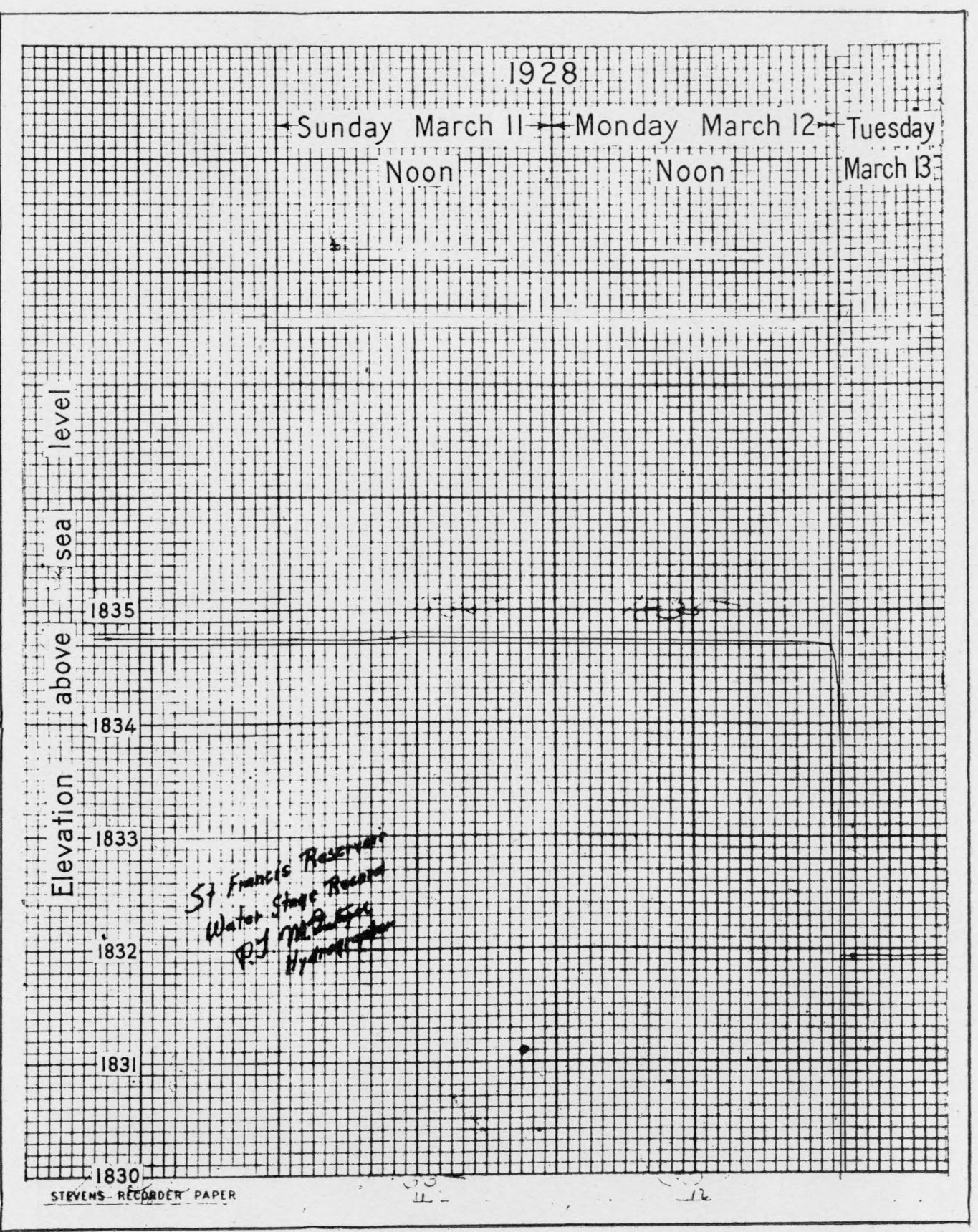
On the crest of the St Francis Dam, forty-five miles north of Los Angeles, a clockwork drum turned slowly under a pen. The pen was moved by a float in a twelve-inch pipe fixed to the upstream face, and it drew the height of the water on a sheet of squared paper that was changed once a week. From Monday 5 March 1928 the line it drew was straight. The reservoir stood at 1,834.75 feet above the sea, a quarter of a foot below the lip of the spillway, three inches from full, and it stayed there, through the wind of the weekend that threw water over the lip, through Monday morning when the chief engineer came to look at a leak, through Monday evening when the last cars going home to the power house up the canyon came up the road past the east end and saw nothing wrong. At about half past eleven on the night of Monday 12 March, by the clock on the drum, the line began to fall. It fell slowly at first, then faster, and when it had fallen about three-tenths of a foot the pen went down the paper almost vertically and did not come back.
The chart was found afterwards, because the piece of the dam it stood on was the one piece left standing. The commission that read it put the first fall at “about 11.30 p.m. (corrected time)” and the end at midnight, and warned that the clock could not be trusted to the minute. What the clock meant was argued over for a year, and is still: some read the fall as water leaving the reservoir, and some, later, as the dam itself lifting under the float. Either way the pen had been writing for five days, and what it wrote was that the St Francis reservoir, for the first time since it was built, was full.
Who ran it
William Mulholland was seventy-two in March 1928 and had been in charge of the water of Los Angeles for forty-two years. He was born in Belfast in 1855, went to sea at fifteen, came to Los Angeles in 1878, and was hired as a zanjero, a ditch tender, by the private Los Angeles City Water Company. In 1886 he was its superintendent, and when the city bought the company in 1902 he came with it as chief engineer of what became the Bureau of Water Works and Supply. In 1904 he began the surveys for the aqueduct from the Owens River, 233 miles away across the desert, and in 1913 he opened it. He had built, he told the coroner’s jury, nineteen dams. All but two were of earth or rock fill. The two of concrete were the dam at Weid Canyon above Hollywood, renamed Mulholland Dam at its dedication in March 1925, and the one in San Francisquito Canyon.
Above him sat the Board of Water and Power Commissioners of the city, businessmen and lawyers. Its president, Reginaldo F. del Valle, an attorney, had sat on it for twenty years. Asked at the inquest what the board had done about the St Francis site and plans, he said that after the permit from the government “this matter has been left entirely in the hands of Mr. Mulholland”, and that no member of the board, since the project began, had been an engineer: “None at all.” Below Mulholland were the men of the bureau: his assistant Harvey Van Norman; the office engineers W. W. Hurlbut and Edgar Bayley, who had the drawings and the computations; Stanley Dunham, the superintendent who built it; William Lindsey, the general foreman who dug the trenches; and Tony Harnischfeger, the keeper, who lived in a cottage a quarter of a mile below the dam with his six-year-old son and a woman named Leona Johnson.
The state had nothing to do with it. California’s law of 1917 required the plans of dams to be approved by the state engineer, and exempted municipal corporations with an engineering department (“Four Billion Gallons” tells the story of the dam that brought the law). Mulholland asked the state engineer, Wilbur McClure, to look at the site anyway. “Didn’t spend but a half day,” he said, “and he saw all there was to see in a half day, because there wasn’t much to see.”
Below the dam, San Francisquito Creek ran nine miles south to the Santa Clara River, and the river ran forty-three and a half miles west past Castaic, Piru, Fillmore, Santa Paula and Saticoy to the sea. A mile and a half below the dam was Power House No. 2 of the city’s Bureau of Power and Light, with the families of its operators in cottages beside it. Farther down were ranches, among them Chester Smith’s; a construction camp of the Southern California Edison Company at Kemp, with about a hundred and forty men in tents; the orchards of the valley; and the towns.
What they were trying to find out
The St Francis Dam was built to hold water, not to test anything. But a dam is a hypothesis about rock, and this one had been written down in an unusual way, so that it is possible to say exactly what was assumed and what was not.
The first assumption was that a section of concrete that had been calculated for one canyon would serve in another. The coroner put it to Mulholland in his second appearance before the jury: the jury had learned that morning from Bayley and Hurlbut that the design “was an adaptation of the dam originally designed for Hollywood, and, with some changes, the general scheme was applied for the St. Francis Dam”. “Yes sir,” Mulholland said, “very little difference.” Hurlbut, the office engineer, said that “there were no changes in the design to fit the different conditions”. The rock at Hollywood was sandstone. The rock in San Francisquito Canyon was a mica schist on the east side and the stream bed, and a red conglomerate on the west, meeting along an old fault that ran up the canyon under the dam.
The second assumption was about that rock. The schist, Mulholland told the jury, was “a hard igneous mica schist”; the word, he said, “is the German for solid”. The conglomerate on the west he had tested himself. “I ordered the holes in, was very much interested in their behavior, put a big hole at the top, filled it full of water, and it was there about two weeks, and the conglomerate was no softer than it was afterwards, had to bail the hole out, the conglomerate was very tight.” He had tunnelled into the ridge west of the dam, and concluded that “if I could make a dam as good as that, I would be through making a dam, that is permanent”. Dunham, asked what tests were made of the foundation before the dam was begun, answered: “None made at all.” Ten holes were drilled in the stream bed, but they were for drainage, not exploration, and no log of them could be found.
The third assumption was added while the dam was going up. The design of July 1923 was for a dam 175 feet above the creek, holding 30,000 acre-feet. In July 1924 ten feet were added to the height, for 32,000 acre-feet, and a dike was run westward along the ridge to hold the extra water. In July 1925, after eleven months of pouring, another ten feet were added, for 38,168 acre-feet. The base was not widened. A gravity dam is held in place by its own weight, and twenty feet of water on a base designed for a lower dam is a question put to the base; the engineer J. David Rogers, who went back to the bureau’s drawings sixty years later, found no record that the question was ever worked. Mulholland’s own answer, when the jury asked what pressure the dam had been built to withstand, was “Not in units, but it was about three times the resultant” of the water behind it.
Underneath all three assumptions was a rule for reading leaks, and Mulholland stated it on the first day of the inquest. Muddy water from under a dam “is taken as a very bad characteristic of a leak through the earth anywhere. It means the earth is cutting.” Clear water meant the earth was not cutting. Every dam leaks, he said; the bureau measured the leakage of this one daily over a V-notch weir, and “of all the dams I have built and of all the dams I have ever seen, it was the driest dam of its size I ever saw in my life.”
So the experiment, as it stood on 5 March 1928, was this. A section proved on sandstone had been set on schist and conglomerate across a fault, raised twenty feet, and filled by degrees: a third full in 1926; to within three feet of the lip in May 1927, and down again; and now to within three inches, and held. The instruments were the weir, the register and the keeper’s eye. The reading that would mean danger was mud.
What they built
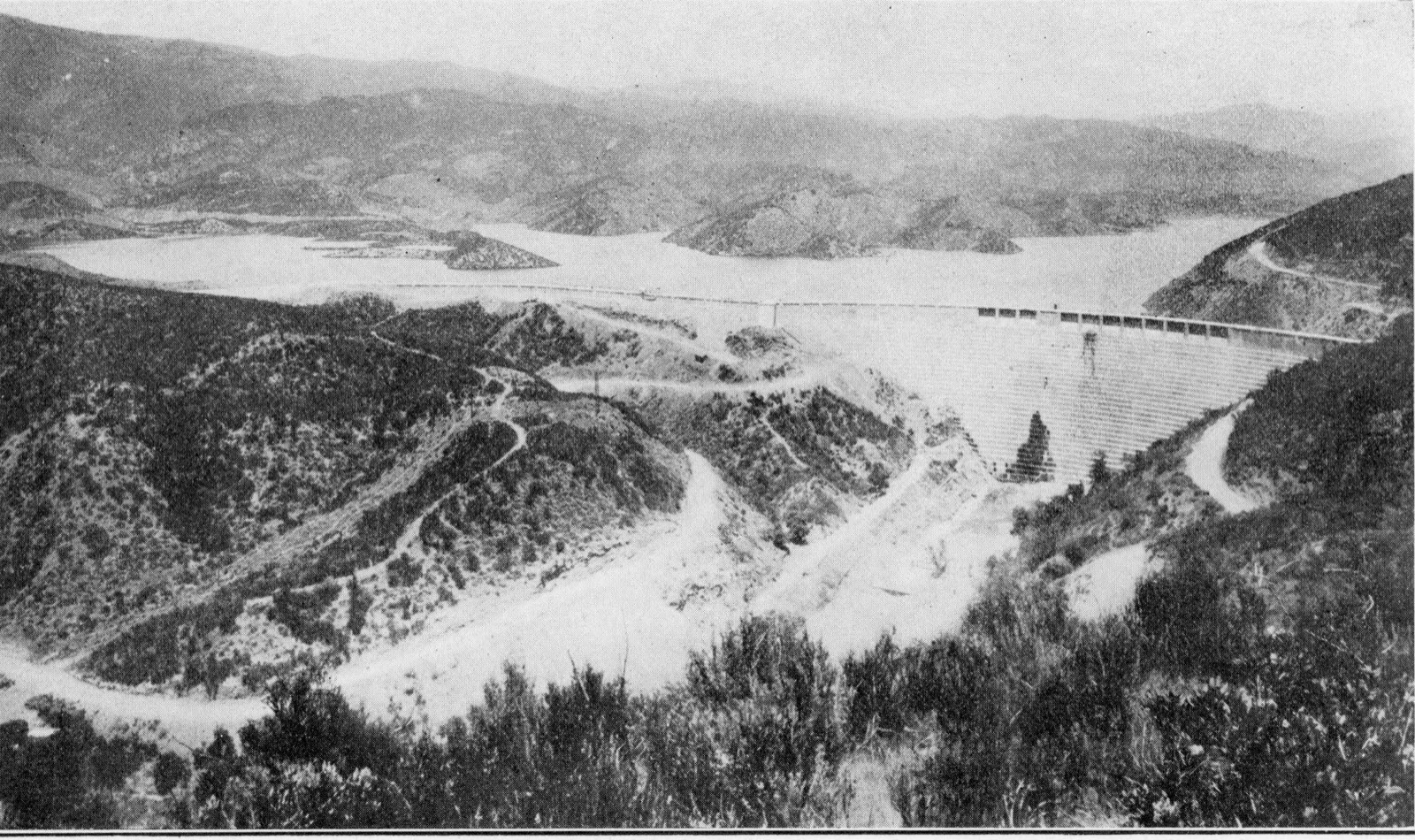
The Governor’s commission described it from the bureau’s own drawings. It was “of the solid gravity type, curved on a radius of 500 feet to the upstream face at the crest”: a curved wall of concrete whose stability was reckoned from its weight alone. The crest was 16 feet thick; the greatest section was 205 feet high and 175 feet thick at the base, by the drawing the bureau supplied; the main dam was 700 feet long along the curve, and from its west end a wing wall ran a further 500 feet along the ridge. The downstream face rose in steps five feet high. The spillway was eleven openings in the parapet, each twenty feet wide and a foot and a half high, with the lip at 1,835 feet; five outlet pipes of thirty inches ran through the base. The reservoir held 38,000 acre-feet, about twelve billion gallons.
Construction began in April 1924 and the dam was finished on 4 May 1926; the concrete was poured by the bureau’s own men, since, as Mulholland said, “we don’t let contracts”. The aggregate was the gravel of the creek bed below, “neither washed nor graded”. In the stream bed a trench was taken to about thirty feet below the gravel and a concrete wall built across it as a cofferdam, later swallowed into the heel of the dam. On the east the concrete was notched into the schist and carried up the slope of the canyon wall “without steps, and with no cut-off wall”. On the west a trench about three feet wide and three feet deep was cut along part of the abutment with picks and gads. Lindsey, who dug it, said the men went in four feet where the rock was hard, because to go deeper they would have had to blast, and “Didn’t want to shoot it, shake up the rocks.” Ten holes bored in the stream bed under the middle of the dam were piped to a common outlet, to let out water that might press upward under the concrete; the water that came from them was piped down to the keeper’s cottage, “because it was sweet and clear”. There was no drainage under the two sloping abutments, no cut-off wall, no inspection gallery, no grouting of the rock, and no contraction joints, because the bureau’s practice was to let the concrete crack where it would and caulk the cracks afterwards.
It cracked. Four cracks ran through the body of the dam from the crest, two of them, about fifty-eight feet east and west of the outlet gates, marking out what would become the standing section. Mulholland and Van Norman judged them the ordinary shrinkage of a mass of concrete, and in the winter of 1927 to 1928 the bureau’s men stuffed them with oakum and hemp rope on the downstream face and pumped cement grout in behind.
Storage began on 1 March 1926, two months before the dam was finished. The water reached 1,779 feet, 13,200 acre-feet, in June 1926, and was lowered in the autumn. From January 1927 it was raised to 1,832 feet by 10 May, three feet below the lip, held for seventeen days, and let down to 1,813 by November. From 1 January 1928 it rose steadily. By 5 March it stood at 1,834.75 feet, three inches below the lip, and no more aqueduct water was turned in. As it rose, the leaks grew. Seepage had appeared on both sides of the main dam and along the slope below the long dike as soon as storage began; the dike’s leak became so troublesome that a line of drain tile was buried along its downstream face. In the first week of March a new leak came out at the foot of the dike, and an eight-inch concrete pipe was laid to carry it along the base of the dike and let it out beside the west abutment.
The rock itself had been described by the people who read rock. The commission’s two geologists found “a fairly uniform mica schist” under the stream bed and the east slope, “strongly sheared” along planes that lay nearly parallel with the slope, so that “under such stresses the schist would slip like a pack of cards thrown upon a table”. On the west, above the fault, was the conglomerate: small pebbles in a matrix of sandy, flaky detritus, cut by seams of clay and veins of gypsum, “so minutely crushed as to have lost most of the strength to be expected in a rock possessing its general appearance”. It was hard when dry. “When, however, a piece of the rock is placed in water, a startling change takes place”: air bubbles came off, flakes fell from the sides, the water turned turbid, and “usually in from fifteen minutes to an hour, a piece the size of an orange has disintegrated into a deposit of loose sand and small fragments, covered by muddy water”. The commissioners found this out in March 1928, after the dam was gone, with a glass of water.
Clear as glass
On Monday 12 March 1928 the reservoir had stood three inches below the lip for a week. The weekend’s north wind had thrown water over the spillway and down the stepped face, so that men looking at the dam from below saw water running where it had not run before.
That morning Harnischfeger telephoned the bureau. There was a new leak, on the west side, and the water was muddy. Van Norman was in the room next to Mulholland’s and heard him say he was going out to San Francisquito: “It is full, and the wind has been blowing some, water coming over the spillway. I am going to look at it.” Van Norman said, “I will go along with you.” They drove up in the bureau’s car and were at the dam by half past ten. Harnischfeger walked round with them.
“The keeper telephoned us that the water was dirty,” Mulholland told the coroner nine days later, “and we went up there and the water was not dirty and had not been dirty, but it was cutting.” The new leak came out of the west abutment, above the contact between the conglomerate and the schist, and ran down the hillside across the cut of an old construction road that the bureau was replacing, and it was the loose dirt of the road that it picked up. Van Norman climbed to within ten feet of the place where it came out; Mulholland, who said he “was disinclined” to climb in where Van Norman was, stayed below. “The water came out of the leak and it was as clear as glass.” He put its flow at about a second-foot, a cubic foot a second, which was more than all the seepage of the dam together had been a fortnight before, when the weir had measured a sixth of that; the whole was now near two second-feet, “or twice the total observed at any previous time”, as Engineering News-Record reckoned it. It was not increasing while they watched it. It was clear. “No, sir,” Mulholland said, “it never occurred to me that it was in danger. I just wanted to see the new leak, naturally.”
Van Norman’s account of the same two hours is almost the same. “Everything was, as far as I could see, as secure as it ever had been. There was some seepage coming from both ends of the dam, some coming from under the very base of the dam. The water in every case was crystal clear, no indication of any erosion, and there was nothing that would alarm, or, at least, did not alarm me to any extent at all. I left there with perfect confidence that the dam was perfectly all right.” They drove back to the city and had lunch.
Could anything have been done? The five outlet pipes, all opened, Mulholland said, “could not have lowered that water more than an inch or two a day in the reservoir”. If he had thought the dam was going, “I would have sent a Paul Revere alarm up and down the Valley.” But he had not thought so, and neither had Van Norman, who said he would have slept in the canyon that night without “the remotest idea” of danger. The reading was clear water, and clear water was the dam being a dam.
Chester Smith, who was not an engineer, read it differently. He drove cattle up past the dam that Monday and back in the afternoon, and still saw “a big leak on the west side”. “I was a little suspicious, to tell you the truth,” he said, “and left my door open.” He slept in the barn that night, three or four miles below the dam.
What it looked like from inside
Nobody who saw the dam go lived. “It is reported that one of the caretakers was seen on top of the dam at 11 p.m.,” the commission wrote, “only an hour before the failure, and apparently up to this time there had been no alarming developments. The caretakers were lost in the flood, and so far as is known there is no living witness of the dam’s collapse.” The last people who passed it were employees of Power House No. 1 driving home along the road that skirted the east end of the dam about ten feet above its crest. Katherine Spann, a nurse at the camp there, and Elmer Steen passed at about twenty-five past eleven by the watch Steen had looked at, and told the jury they had seen nothing unusual, only the dam blacked out, as it always was. Ace Hopewell, a carpenter, came up on a motorcycle at about ten minutes to twelve. About a mile and a half beyond the dam he stopped, because he heard a rumbling behind him; he got off, smoked a cigarette and listened, and then went on to Power House No. 1, where he found out what it had been.
At Power House No. 1 the operator, Henry Silvey, had spoken on the telephone with the operator at Power House No. 2 at 11.47 pm, and everything there was normal. At 11.57 and a half, by the records of the Southern California Edison Company, the Borel transmission line, which ran down the canyon on poles about ninety feet above the east end of the dam, went dead; the commission rounded it to 11.58, and took it as the moment of failure. At 12.03 am the power from Power House No. 2, a mile and a half below the dam, went off. In the five minutes between, the water had come down the canyon at eighteen miles an hour, more than a hundred feet deep.
At Power House No. 2 the operators’ families were asleep in their cottages. Ray Rising woke to a roar and a wet mist in the air and got out; his wife Julia, who was twenty-nine, and their children did not. Lillian Curtis’s husband woke to the same mist and put her and their three-year-old son up the slope behind the house before the water took him and the other two children. Of the 123 people living at the power house, by Rogers’s count, those three were the only ones to live. Harnischfeger, his son and Leona Johnson were among the first dead; her body was found between two blocks of the dam, dressed, as if she had been up and out of the house when it came.
Three or four miles down, Chester Smith’s dog barked. “I ran when I heard that noise, and the dog awakened me; I could hear it coming, hear the trees breaking, and could hear a big pole snapping, could hear the wires on the electric poles going. I knew what was coming, because I had been in a flood once before.” He ran a hundred and fifty feet to the house where Hugh Nichols and his wife were sleeping and shouted “The dam is broke”, and the three of them ran a hundred and fifty feet to the hill, “and as we ran up the hill, the water was right behind us”.
The flood came out of the canyon into the Santa Clara valley at about twelve miles an hour. At 12.38 am it took out the Edison substation near Saugus, and at 1.20 am it reached the Edison construction camp at Kemp, sixteen and a half miles below the dam, where “more than 80 out of about 140 perished”. It reached Fillmore at 2.25, Santa Paula at 3.10, Saticoy at 4.15 and the Montalvo bridge, four miles from the sea, at five, two miles wide and moving at about five miles an hour. The commission reckoned the peak below the dam at more than half a million cubic feet a second. It had occurred in darkness, and “very few of the persons in the constricted valley below the dam escaped with their lives, though they were immediately adjacent to the safety of the steep slopes of the bordering hills”.
Mulholland and Van Norman were woken and driven up to the canyon in the night. “The first time was in the dead of night,” Mulholland said later of his two visits to the wreck; they “had no chance to observe the details”.
What happened
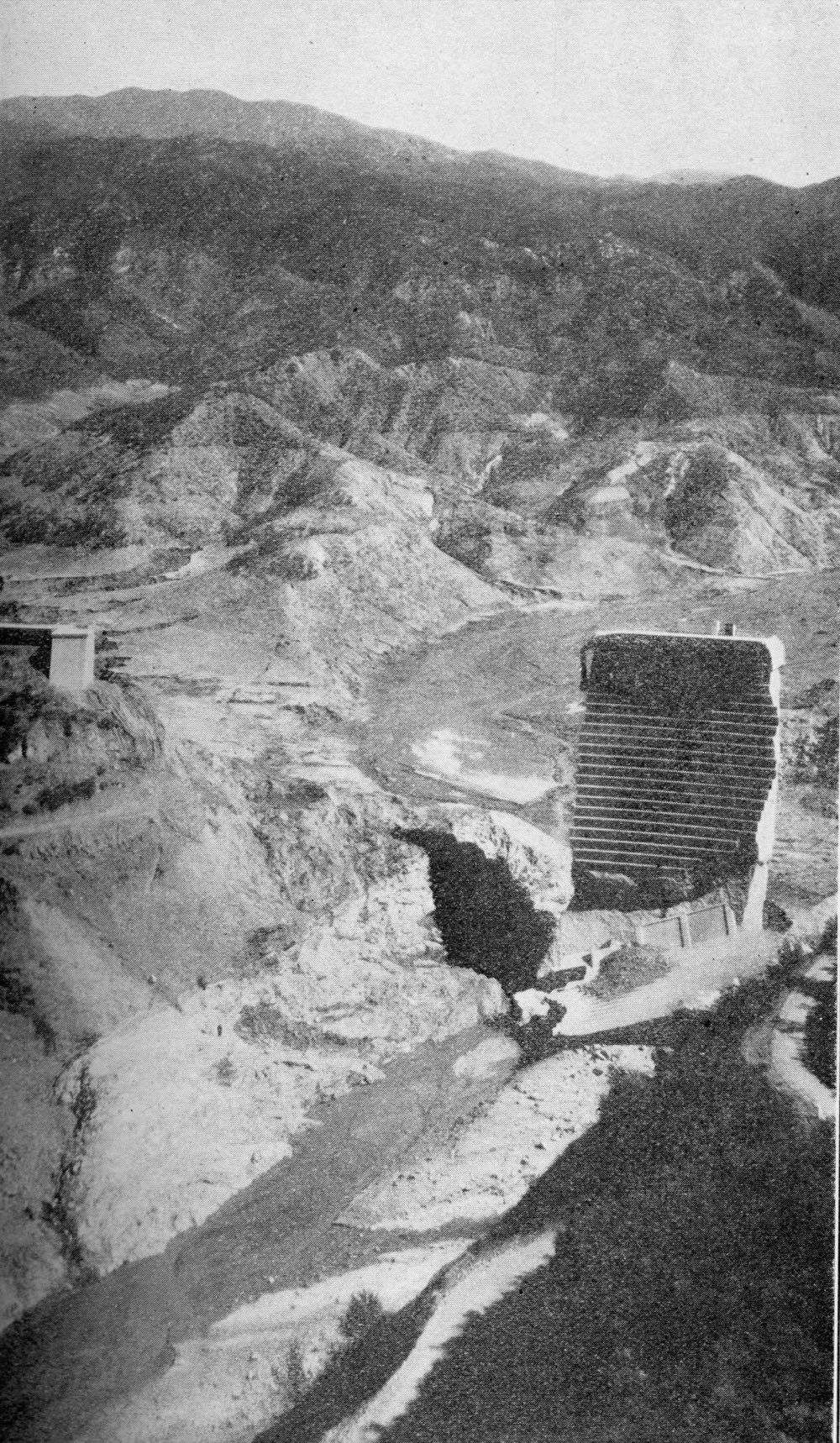
Daylight showed what was left. Of the 700 feet of the main dam, one piece about ninety feet wide stood in its place in the middle of the canyon, with its two ends sheared off. On each side of it was a gap about 300 feet wide. The gap on the west, where the conglomerate had been, held no concrete at all; the blocks from that side, some of them weighing ten thousand tons, lay half a mile and more down the canyon. The gap on the east was choked with blocks that had fallen almost where they stood, and the schist wall above it was still sliding when the commission visited ten days later. A triangulation from the old survey stations found that the standing section had moved seven-tenths of a foot, some five and a half inches downstream and six inches towards the east.
The dead were counted for weeks. The Associated Press had 243 bodies recovered on the morning of 14 March, with “from 300 to 600” unaccounted for. The commission, writing on 24 March, had “known dead at this time is 236 and 200 are still missing”. Engineering News-Record put the dead and missing at 450 on 25 March and at 426 in May. The county’s official figure, in August, was 385. Later counts put it at 431 or more, and the state’s marker at the site says over 450. Nobody knows. The city’s engineers put the damage at ten million dollars.
Mulholland said on 13 March that seepage had caused part of the hill on the west side to crumble, and that there had been no earthquake; the seismographs agreed. Half a dozen inquiries were sitting within the week: Governor C. C. Young’s commission, four engineers and two geologists under A. J. Wiley of Boise, which signed its report on 24 March; the city council’s board under Elwood Mead, the federal Commissioner of Reclamation, which reported on 31 March; the district attorney’s board under Edward Mayberry, on 4 April; the water board’s three geologists; the coroner’s jury, nine men of whom six were engineers or contractors, which sat from 21 March to 10 April and gave its verdict on 12 April; and in June a report for the valley’s water district by the Grunskys and the Stanford geologist Bailey Willis, which said something the others had not. The companion piece, “Six reports”, goes through them.
They agreed on the rock. “The failure of St. Francis Dam was due to defective foundations,” the Governor’s commission concluded, in its first sentence; the conglomerate, “when wet became so soft that most of it lost almost all rock characteristics”, and “with such a formation, the ultimate failure of this dam was inevitable, unless water could have been kept from reaching the foundation”. The commission thought the west end had gone first, at or near the fault, and that the rush of water had then cut away the schist under the east end. The district attorney’s board said that “it was not economically feasible to build a safe dam at the site chosen”. The coroner’s jury listed ten defects in the dam and found that the leakage “was remarkably small, considering the critical condition existing under the dam, and less than is commonly present in dams that are considered safe and have stood for years”. “The only reasonable explanation,” it wrote, “is that those in charge were completely deceived as to the true conditions and acted through ignorance and not from intent to omit any precaution from any motive.”
Then it said where the fault lay. “The responsibility for the error in engineering judgment rests upon the Bureau of Water Works and Supply and the Chief Engineer thereof.” The deeper error, it went on, was one of public policy, and belonged to the commissioners, the legislatures of city and state and the public, who had let “excessive responsibility to be delegated to or assumed by any one individual”. “A sound policy of public safety and business and engineering judgment demands that the construction and operation of a great dam should never be left to the sole judgment of one man, no matter how eminent, without check by independent expert authority, for no one is free from error, and checking by independent experts will eliminate the effect of human error and insure safety.” It found no criminal act or intent, and recommended no prosecution.
Mulholland had said much the same on the stand, where he had wept. “I have a deep appreciation of the job before you, gentlemen. Don’t imagine for a minute that I would throw you off the scent. I am willing to take my medicine like a man.” On his second day he closed with the sentence that has been quoted ever since. “Whether it is good or bad, don’t blame anybody else, you just fasten it on me. If there is an error of human judgment, I was the human. I won’t try to fasten it on anybody else.” The companion pieces “On the stand” and “The other witnesses” follow the inquest.
One finding went further than the rock, and it concerned the clear water. On 10 May Engineering News-Record printed an analysis that S. B. Morris of the Pasadena water department had made of the seepage coming out of the west bank just after the break, beside one of the aqueduct water. The seepage carried ten times the chlorides and five times the dissolved solids of the water that had gone into the reservoir, and was “heavily charged with calcium and magnesium sulphates”: it had been dissolving gypsum out of the veins in the conglomerate. At two miner’s inches, the journal’s figure for the seepage through the conglomerate since storage began, water that looked clean could have carried away 97 tons, or 1,343 cubic feet, of the rock in the fifteen months the reservoir had been in service. “This experience is a warning that clear seepage is not necessarily harmless; many minerals are soluble, and only a chemical test will show what clear water really contains.” The test that would have shown danger was not the one the engineers had used.
Willis, in June, moved the question from the west side to the east. The east abutment, he wrote, “was located on a landslide. It was an old slide which had become inactive and was modified by erosion and vegetation, but it is recognizable in the topographic forms of the hillside. When it had become soaked by the water in the reservoir standing against its lower portion, it became active and moved.” The slide, he and the Grunskys argued, had lifted the east wing, tilted the whole dam, and let the water under the west; the proof was a ladder from the upstream face found crushed in a crack at the base of the standing section. The Governor’s commission had concluded that every slide on that bank “took place after and as a result of the failure of the dam”. The two readings have never been reconciled by anyone who was there.
After
The city did not argue. Van Norman, speaking for it to the relief committees, said: “The city built this dam to provide storage which it was obliged to have. No question of the legal status of claims should ever be raised; the moral obligation to repay damage in the valley is sufficient.” The council voted a million dollars on 20 March, and within forty-eight hours of an agreement with the contractors’ association 1,300 men and a million and a half dollars’ worth of machinery were in the valley clearing silt off the orchards.
On 14 November 1928 Mulholland handed the commissioners his resignation, to take effect on 1 December. He was seventy-three, and, as the journal reported it, “he desires to rest and to leave duties of his position to younger men of the organization”. Van Norman succeeded him. He died at home on 22 July 1935, after a stroke, at seventy-nine. Van Norman told the papers: “Bill Mulholland was rough. He was tough. But we loved him.”
The state did what the jury and the commission had asked. The legislature of 1929 passed Chapter 766 of its statutes, which took effect on 14 August 1929 and put every dam in California that was not federal under the state engineer: existing dams to be examined and approved or repaired, new dams to have their plans approved and their construction supervised, all dams to have their maintenance watched. The exemption for cities was gone. Before the act, the state’s own account says, its supervision “was limited in scope and extended to less than half of the dams in the state”. The same session set up a board to license civil engineers, and in October 1929 the new law stopped its first dam, the county’s San Gabriel dam at the Forks, whose west abutment a state board found to be an old landslide.
Hollywood came next. A resident sued in 1928 to have the reservoir behind Mulholland Dam drained, because it, “like the St. Francis dam, has been built without a cutoff wall at the heel, without inspection galleries, contraction joints or sufficient drainage pipes”. Mulholland had already had it lowered. Boards that examined the dam in 1930 and 1931 found its line of thrust outside the middle third of its base, and from 1932 the city spent two years burying its downstream face under more than 300,000 cubic yards of earth.
The standing section stood for a year, visited by engineers and then by the curious, and in May 1929 the city bored two tunnels fifty feet below its base, put in five tons of high explosive, and toppled its 45,000 tons of concrete into a pit dug in the stream bed. “The structure itself is now gone,” Engineering News-Record wrote under the heading “Requiescat”. “The lessons to be learned from it will stand forever.”
The reading of the wreck went on without the wreck. From 1992 Rogers, a geological engineer, went back to the inquest transcript, the bureau’s archive and the geology. He found that the east abutment had been built against an ancient landslide in the schist, as Willis had said; that the blocks found farthest downstream had come from the east side, not the west; that the dam’s real base width was about 148 feet, not 175; and that “no site-specific rational design methodology was actually performed”, only the transfer of the Hollywood section. His account of the last night is that the east abutment began to slide and the dam, losing its support on that side, lifted at its heel and tilted downstream, so that the 3.6 inches the register recorded in its last forty minutes was not water leaving the lake but the float’s pipe going down with the dam: “the dam was LIFTING as opposed to the reservoir dropping just prior to the failure.” The historians Norris Hundley and Donald Jackson accepted much of the geology and argued that the dam had fallen short of the practice of its own day. The argument is open. What is not in dispute is the sentence Rogers put at the head of it: “The dam collapsed 10 days after the reservoir’s initial filling, to within three inches of the spillway sill.”
In 2019 Congress made the site a national monument. The reservoir is a canyon again, with a stream in it.
What it taught
The St Francis Dam was not run as an experiment, and that is the first thing it teaches, because it was one. A hypothesis about rock had been written in concrete, raised twice without being re-examined, and filled by stages over two years while its instruments reported; and the men who read them had decided, before the test began, what a bad result would look like.
An instrument answers the question it was built to answer. The register on the crest measured the height of a float in a pipe, and the commission read its last half-hour as water leaving the reservoir, as it was built to be read. Sixty years later the same trace was read as the dam lifting under the float. The V-weir measured the volume of the seepage, and the volume was small; the keeper’s eye measured its colour, and the colour was clear. None of the three measured what was being carried out in solution, which was the quantity that mattered, and the one instrument that could have, a chemist’s flask, was never put to the water until the dam was gone. The engineers at Vajont, thirty-five years later, had a model that answered the question of the wave and could not answer the question of the slide (“Seven Hundred Metres”); the engineers at San Francisquito had a weir that answered the question of volume and could not answer the question of what the volume was dissolving.
A result carried from one trial to another is not a result. The section had been computed for sandstone at Hollywood, with a coefficient of friction taken from a book, and it was set on schist and conglomerate “with minor modifications, by the Chief Engineer”, and nobody recomputed it when the dam was raised ten feet, or when it was raised ten more. The jury’s finding that the chief engineer and his assistants “had had limited experience in the building of large masonry or concrete dams” is exact: seventeen of his nineteen dams were earth, which sits on yielding ground, and a gravity dam cannot. What had been proved at Hollywood, if anything had, was proved for Hollywood.
The dangerous reading is the one that agrees with you. Mulholland’s rule, that mud means cutting and clear water does not, was true as far as it went, and it was the only rule he took to the dam on 12 March. Clear water confirmed the dam; a leak that doubled the seepage in a fortnight, that came out above the fault, and that the keeper had thought muddy enough to telephone about, was explained by the road cut and the wind. Chester Smith, who had no rule, left his door open. The difference between them was not knowledge. It was that one of them had a hypothesis to protect.
One judgement is one judgement. The jury’s sentence about “the sole judgment of one man, no matter how eminent” has been quoted in the writing on dam safety ever since, and it is right, but it should be read with the other half of its finding, that the fault was “a logical result of a set of conditions that the citizenship has allowed to develop and continue”. Del Valle’s board had no engineer on it and did not think it needed one; the state’s law exempted the city; the state engineer gave the site half a day, at Mulholland’s own request, because “there ought to be state inspection of such things, whether it is a municipality or not”. He was not checked because everyone, including the law, had decided he did not need to be.
Check the story before you learn from it. The height of the dam is 185 feet in the newspapers, 195 by the drawings, 205 and 208 to the bottom of the trench; the base is 175 feet to the commission and 148 to Rogers; the dead are 385, 426, 431 or 450; the west end went first to five boards in 1928 and the east end first to Willis and to the geologists since. What survives every version is the shape: a design borrowed, a base not widened, a rock that turned to mud in a glass of water, a reservoir held three inches from full for the first time, a leak read as clear, and a line on a chart that ran level for five days and then went down. The lesson is not that Mulholland was careless; he went to the dam himself the morning it was reported, and took the blame alone. It is that a man who has built nineteen dams and is told the water is clear will believe the water, and that an experiment must be designed so that someone else is reading the instrument.
Sources
- Report of the Commission Appointed by Governor C. C. Young to Investigate the Causes Leading to the Failure of the St. Francis Dam near Saugus, California, California State Printing Office, Sacramento, 1928 (signed 24 March 1928). The dam’s dimensions and construction, the filling record, the register’s trace and the discharge table, the times of failure, the velocity table, the geology of the schist, the conglomerate and the fault, the landslides, the conditions after the failure and the conclusions; the Governor’s foreword and instructions; Plates 10, 11 and 22. Read in the scan posted by the Association of State Dam Safety Officials’ damfailures.org and in Caltech’s copy. damfailures.org, authors.library.caltech.edu
- Transcript of Testimony and Verdict of the Coroner’s Jury in the Inquest over Victims of the St. Francis Dam Disaster, Los Angeles County, March to April 1928, two volumes, 825 pages in the scan. Mulholland’s two appearances, Van Norman, Dunham, Lindsey, Chester Smith, Hugh Nichols, David Matthews, Ray Rising, del Valle, and the death list. Read in the scan posted by SCVHistory.com from Ann Stansell’s copy; the OCR of the typescript is rough and every quotation was checked against the page. scvhistory.com, transcript, the verdict
- Nathan A. Bowers, “St. Francis Dam Catastrophe—A Great Foundation Failure,” Engineering News-Record, vol. 100, no. 12, 22 March 1928, pp. 466–472, with the editorial “The St. Francis Dam Disaster,” p. 465. The first engineer’s description of the wreck, Van Norman’s statement that the seepage was “clear as usual”, the 1917 law and the investigations begun. archive.org
- Engineering News-Record, 29 March 1928, pp. 517–519 and 527–528: Bennett’s study of the site; the Governor’s commission’s findings; the inquest’s first days, with Mulholland’s words to the Evening Express. archive.org
- Engineering News-Record, 5 April 1928, pp. 553–555 and 561: the abstract of the Governor’s commission’s report; the personnel of the boards and of the coroner’s jury. archive.org
- Engineering News-Record, 19 April 1928, pp. 638–639 and 642: the coroner’s jury’s findings; the letters. archive.org
- Nathan A. Bowers, “St. Francis Dam Catastrophe—A Review Six Weeks After,” and “Reports of Four Boards of Engineers and Geologists,” Engineering News-Record, vol. 100, no. 19, 10 May 1928, pp. 727–736, with the editorials “Muddy Seepage” and “The Human Factor.” The adaptation of the Mulholland Dam design, the test pits, the seepage figures, Morris’s analysis, the gypsum arithmetic, the gauge record, the rehabilitation, the Mulholland Dam, and the four reports including the full text of the jury’s findings. archive.org
- “Sixth Report on St. Francis Dam Offers New Theories,” Engineering News-Record, 7 June 1928, pp. 895–896: the Grunskys and Bailey Willis for the Santa Clara Water Conservancy District, the landslide and the ladder. archive.org
- “Suit Asks Abandonment of Mulholland Dam,” Engineering News-Record, 16 August 1928; “Mulholland Retires After 50-Year Service at Los Angeles,” 22 November 1928, p. 785; “H. A. Van Norman… Water Department Head,” 6 December 1928. August, November, December
- “Destroy Standing Section of St. Francis Dam,” and the editorial “Requiescat,” Engineering News-Record, 23 May 1929. archive.org
- Evening Star (Washington), 13 March 1928, pp. 1–2, and 14 March 1928, p. 1 (Associated Press): the first reports, Mulholland’s opinion of the seepage, the count of 243, the seismograph at Georgetown. Read through the Library of Congress’s full-text service. 13 March, 14 March
- The New York Times, 14 and 15 March 1928: the Saugus postmistress on ten days of talk about leaks; the count of 296; Van Norman’s refusal to say whether the dam would be rebuilt. 14 March, 15 March
- Imperial Valley Press, 22 July 1935, p. 1 (United Press): Mulholland’s death, with Van Norman’s words. loc.gov
- California Department of Water Resources, Dams Within Jurisdiction of the State of California, Bulletin 17-68, 1968, foreword: the law of 14 August 1929, Chapter 766 of the Statutes of 1929, and the state’s supervision before it. archive.org
- J. David Rogers, “A Man, A Dam and A Disaster: Mulholland and the St. Francis Dam,” Ventura County Historical Society Quarterly, vol. 40, nos. 3–4, 1995, and Southern California Quarterly, vol. 77, nos. 1–2. The two raises, the base width, the cracks and their caulking, the last week, the witnesses on the road, the register, the east abutment slide, the dynamiting and the Mulholland Dam retrofit. Copyrighted; quoted briefly. Read in the Museum of Ventura County’s scan on archive.org. archive.org
- J. David Rogers, “Who Designed the Ill-Fated St. Francis Dam?” World Environmental and Water Resources Congress 2017, American Society of Civil Engineers, pp. 379–393. Hurlbut’s and Bayley’s testimony on the design, the coefficient of friction, the exploration, the drains and the cracks. Copyrighted; quoted briefly. Read in the copy posted by SCVHistory.com. scvhistory.com
- Wikipedia, “St. Francis Dam,” for the later counts of the dead, the 1929 engineers’ licensing act, the Mulholland Dam retrofit, the Hundley and Jackson critique and the 2019 memorial, checked where possible against the sources above. en.wikipedia.org
How this entry came about
Written in the overnight run of 21 October 2026, by the standing rules in _ideas/OVERNIGHT.md, with nobody to ask, and in two sittings. A first writer drafted the entry between 09:10 and about 09:30 UTC and was stopped by a usage limit with the draft unchecked and the younger version and the companions unwritten. A second writer took it up at 19:14 UTC, read the sources again and checked every quotation and figure in the draft against them as if they were its own, corrected what is listed below, cut the draft from 8,100 words to the house length, and wrote the younger version and the three companions. The backlog line named the coroner's inquest transcript and the Governor's commission report. The commission's report was read in full in the damfailures.org scan; the inquest in the OCR of the 825-page scan on SCVHistory.com; the contemporary engineering record in Engineering News-Record from 22 March 1928 to 23 May 1929 on archive.org; the newspapers through the Library of Congress's full-text service and archive.org; and the modern rereading in Rogers's 1995 and 2017 papers.
Title. "Three Inches" is the quarter of a foot between the water and the spillway lip from 5 to 12 March 1928, in the commission's words "1834.75 or 0.25 foot below the spillway crest". The nickname "the Tombstone" for the standing section, which the entry had first been going to use, was not found in any source of 1928 or 1929 read here (the engineers call it the standing section or the monolith), so it was not used (rule 5).
Figures. Three, all plates from the commission's report, a California state publication of 1928 and so before 1930 (rule 1): Plate 10, the register's chart; Plate 11, the completed dam; Plate 22, the site from downstream. The second writer rendered pages 42, 44 and 64 of the PDF and confirmed that the three files are those plates. Cropped from the 300-dpi rendering of the scan, the page margins and plate numbers cut off, Plate 11 turned upright; the Plate 22 file reduced to 1,000 pixels wide to bring it under the checker's size limit; nothing upscaled. The bureau's photograph of Mulholland, Van Norman and Harnischfeger on the crest at noon on 12 March, and the construction views in Rogers's papers credited to the Department of Water and Power, the University of California Water Resources Center Archives and the Museum of Ventura County, were left out because their release could not be checked on the holders' own pages.
Length. The first draft ran to 8,100 words before Sources by the checker's count, not the 6,400 its colophon claimed. The entry now stands at 6,471 words; the inquest and the six reports went into three companions, "On the stand", "The other witnesses" and "Six reports", the first two split from one piece to keep each near the checker's 3,000 (rule 2). The younger version is 2,738 words.
Sources not reached, and quotations at second hand. The inquest transcript's OCR is poor. Dean Keagy's page (p. 424) is illegible in it, and his testimony is given as Rogers (1995) summarises it from Outland; Bayley's pages (pp. 339 to 350) are largely illegible, so his and Hurlbut's words on the design are quoted as Rogers (2017) transcribed them from the Huntington Library's copy, except Hurlbut's answer on the coefficient of friction (p. 483), which the OCR carries; Silvey's call to Power House No. 2 at 11.47 is given as Rogers reads his testimony; the only session dates legible in the OCR are 21 March, 4 April and 10 April, so Mulholland's later appearances are dated only to the week. Mulholland's remark that he "only envied those who were killed" is given by Rogers; it was not found in the OCR and is not used. The Los Angeles Times and Evening Express of March 1928 were not available; the Express interview is quoted as Engineering News-Record reprinted it. The Mayberry (district attorney's) and Mead (city council's) reports, the water board geologists' report, and the Grunsky–Willis report for the water district were read as Engineering News-Record abstracted them, not in the original. Outland's Man-Made Disaster (1963, 1977) and Hundley and Jackson's work (2004, 2015) are lending copies only and were not read; Outland's finding about the lowest steps is given as Rogers reports it, and Hundley and Jackson's argument as Wikipedia summarises it. The Library of Congress's page viewer answers 403 to scripts; the newspaper pages were read through its full-text service. The DSOD history page at water.ca.gov blocked the connection, so the 1929 act is cited from the department's 1968 bulletin. Rogers's 1995 text gives Mulholland's resignation as November 1929 and his death as 22 July 1930; Engineering News-Record and the Imperial Valley Press give 14 November 1928 and 22 July 1935, and the entry follows them.
Corrections made on the second pass. The Engineering News-Record editorial of 10 May is headed "Muddy Seepage", not "Clear Seepage", and its page numbers were dropped. The Imperial Valley Press report of Mulholland's death is of 22 July 1935, not 1928. Mead's board reported on 31 March, before Mayberry's on 4 April, not after it. The witness is Elmer E. Steen in the transcript's index and testimony (Rogers has "Helmer"); Spann put the passing of the dam at "about twenty minutes after eleven", not more than five minutes after Steen's watch showed 11.19 (Rogers has 11.35 to 11.40); Hopewell put himself "about a mile and a half" beyond the dam when he stopped (Rogers has a mile); the operator is Henry Silvey in the index (Rogers has "Henry (Ray)"). The factor-of-safety answer "About three or four" was not found in the transcript and was replaced by his answer of 21 March, "about three times the resultant". The standing section's width is ninety feet, as the journal gave it in May 1929 (Mulholland said seventy-five and Van Norman eighty). Ray Rising's children are given without a number, none being found in the sources read. The relief figures of 1,300 men and a million and a half dollars' worth of machinery are the journal's of 10 May; its 29 March issue said a thousand men.
Where sources disagree. The time of failure is 11.58 pm on 12 March in the commission's report and 11:57:30 in Rogers, from the Edison records; the entry gives both. The height is 185 feet above the stream bed in the press, 195 by Rogers's reading of the raised drawings, 205 to the bottom of the maximum section in the commission's report and 208 in the questions put to Van Norman; the base is 175 feet in the commission's report, 176 in Bowers, 169 in the questions to Van Norman and about 148 in Rogers. The main dam's length is 700 feet along the crest in the commission's report, 650 and 668 in other accounts. The dead: 236 known and 200 missing (the commission, 24 March), 243 recovered (AP, 14 March), 296 (NYT, 15 March), 450 dead and missing (ENR, 25 March), 426 (ENR, May), 385 (the official count of August 1928, per Wikipedia), "at least 431" (Wikipedia), "at least 432" (Rogers 2017), "at least 450" (Rogers 1995), "over 450" (the state marker); the entry says more than four hundred and gives the range. The seepage on 12 March is "about a second foot" from the new leak in Mulholland's first testimony and "two or three miner's inches" in his second, 1 second-foot (50 miner's inches) in Mead's board's abstract, 2 second-feet in total in Bowers, "between one and two second-feet" in the commission; the Edison camp's dead are "more than 80 out of about 140" in the commission and 84 of 150 in later accounts. The people at Power House No. 2 are 123 in Rogers and 67 in Wikipedia. The commission says the west end went first; Willis, the Grunskys and Rogers say the east; the entry gives both. The register's fall is "about three-tenths of a foot" in the commission and 3.6 inches in Rogers.
Decisions under the rules. The date was set as 20:00 on 21 October at the push, the current UTC hour rounded down, no entry on main carrying that hour (rule 4); the three companions carry the same date. The title "Three Inches" is not used in _posts (rule 5). No pull request; the entry landed by direct push after the checker passed (rule 6). The three companions are the only overflow (rule 2). The WARN lines left before narration were the audio lines; source links that answer 403 to the checker (the three Library of Congress pages) open in a browser. The five files were narrated with render-many.sh, two at a time, with the load gate's ceiling raised from 30 to 60 because the load average from other accounts' processes stood at 20 to 30 with nothing rendering, following the night's earlier writers (rule 10); the first launch was stopped after a minute to add a respelling for "Del Valle" at the start of a sentence, which the lower-case rule had missed, and the entry and the younger version were started again; nine respellings in all went into say-as/three-inches.txt (Harnischfeger, del Valle, Reginaldo, Piru, Weid, Silvey, Keagy, Vajont, Caltech).