On Tuesday 5 November 1929 the Deutsche Reichs-Zeitung, a daily printed in Bonn, gave the top of its thirteenth page to a report headed “Mit der Sonde im Herzen”, with the probe in the heart, and under it: “Sensational experiment of a doctor on himself.” The writer began by apologising. What followed, he said, was “a scientifically serious and practically important, unintentionally sensational communication from the medical side,” to be found in the newest number of the Klinische Wochenschrift. A doctor, Dr Forssmann, assistant in the second surgical department of the Auguste-Viktoria-Heim at Eberswalde, had hit on “the peculiar and amply bold idea” of pushing a soft, long rubber tube, a catheter, from a vein at his own elbow until it came to rest in the right side of his heart. The tube was 65 centimetres long. It had gone in under local anaesthetic through a slit in the vein at the left elbow, up under the collarbone and down the great vein into the heart, and the only things its owner had felt were a lively warmth near the collarbone and a wish to cough. He had checked its shadow on the fluoroscope screen himself. Then he had walked from the operating theatre to the X-ray station with the probe in his heart, climbing stairs on the way.
The medical journal that carried the three pages was dated the same Tuesday. Two provincial papers had printed the story the day before. Within a fortnight it was in Munich, Mannheim, Stuttgart and Hamburg, and on 18 November a Berlin cable appeared on page three of the Milwaukee Leader under the headline “Doctor Puts Tube In Own Heart to Test Treatment,” calling him Hermann and the tube “several feet in length.”
The number in the Bonn report is the whole of the experiment. Sixty-five centimetres was the length of the catheter; it was also the distance that Forssmann, a surgical assistant who had passed his state examination that year and turned twenty-five that August, had estimated from the crook of his left arm to his heart; and the catheter went in, as his paper put it, “for its whole length.” Nothing was measured through it. No pressure was recorded and no blood was drawn. What the experiment produced was a photograph of where the tip had stopped, and a living man beside it to show that making the photograph had not killed him.
Doctors, it turned out, were less interested than newspapers. The man who ran the surgical clinic of the Charité dismissed him within weeks; a Berlin professor wrote to the journal to say it had been done in 1912; and the physiologists who might have used the tube had no instruments to put on the end of it. Eleven years later two men at Bellevue Hospital in New York, who had spent a decade failing to get a sample of the blood entering the right heart by any other means, threaded a catheter into a patient’s right atrium to get one. Twenty-seven years later the three of them stood together in Stockholm. This entry is about the gap between the photograph and the question.
Who ran it
Werner Theodor Otto Forssmann was born in Berlin on 29 August 1904, the only child of Julius Forssmann, a lawyer, and Emmy Hindenberg. In August 1914 his father was called up; he was killed on the Eastern Front in 1916, and the boy was brought up by his mother and grandmother, with an uncle who practised medicine in a small town nearby for the nearest thing to a father. He went, as his father had wished, to the Askanisches Gymnasium, one of the classical schools of Berlin, left it in 1922 and entered the medical faculty of the Friedrich-Wilhelms-Universität the same year. His doctoral work, under the internist Georg Klemperer, was on what happens to healthy people who are overfed with liver extract; he took the degree in February 1929 and passed his state examination the same year. Klemperer had promised him a paid post in medicine and did not keep the promise. Salaried residencies were scarce. In the spring of 1929 he took what he could get, which was a surgical assistantship at the Auguste-Viktoria-Heim at Eberswalde, a Red Cross hospital in a small town forty-five kilometres north-east of Berlin, meaning to move back into internal medicine when something opened.
The surgeon who ran the second surgical department there was Richard Schneider, born in 1869, a friend of the Forssmann family. Everything that happened in the summer of 1929 happened under his roof and against his orders, and he is the one senior man in the story who comes out of it well. The other names belong to the people in the building: Peter Romeis, a colleague on the staff; Gerda Ditzen, the theatre sister who kept the key to the cupboard of sterile instruments; and a nurse in the X-ray department in the basement who held a mirror.
Three Berlin professors stand on the other side. Ferdinand Sauerbruch, director of the surgical clinic of the Charité, was the most famous surgeon in Germany. Ernst Unger was chief of surgery at the Rudolf-Virchow-Krankenhaus, and in 1912, with Fritz Bleichröder and Walter Loeb, had published on pushing medicines into arteries through catheters. Wilhelm His, the internist who had described the bundle of conducting tissue in the heart that bears his name, was consulted and said no. And far away were the two men whose names would be joined to Forssmann’s: André Cournand, born in Paris in 1895, who came to the Columbia University service at Bellevue Hospital in New York in 1930, and Dickinson Richards, born in New Jersey the same year, under whom Cournand worked there from 1931 on the physiology of breathing.
What he was trying to find out
The idea came from a picture. As a first-year student Forssmann had seen, in Claude Bernard’s Leçons de physiologie opératoire and in his textbook of physiology, the experiment that Auguste Chauveau and Étienne-Jules Marey had made in 1861: a long tube passed down the jugular vein of a standing horse into the right side of its heart, and another down the carotid artery into the left, with small balloons at the tips that moved a lever and wrote the pressure inside the beating heart on a smoked drum. Bernard’s book had a woodcut of a dog on its back with the thorax opened to show the routes a sound could take. The horses walked away afterwards. Forssmann’s hypothesis, which he never put in these words, was that a man was a large animal, and that what the veins of a horse would carry to the heart without harm the veins of a man would carry too.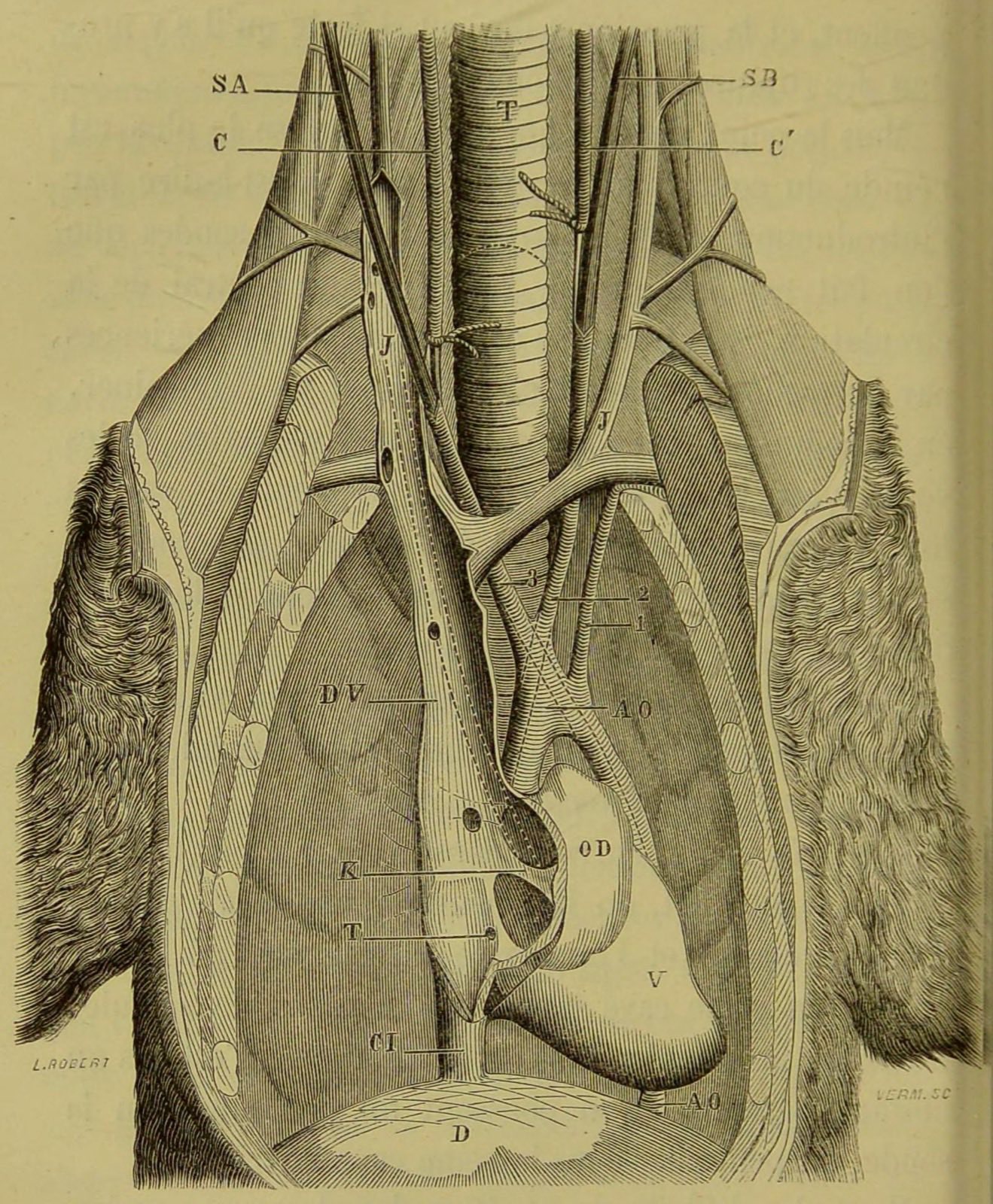
In his Nobel lecture of 1956 he said so plainly: his first attempts at probing the right heart, “undertaken in 1929,” were “based on the work of Chauveau and Marey.” What he wanted the tube for is less clear, and the paper he wrote and the memoir he published forty-three years later do not say the same thing. The paper, finished on 13 September 1929, argues for a treatment. When a heart stops under anaesthesia or in collapse, the fastest way to give it a stimulant was then to push a needle through the chest wall into the ventricle, which could tear a coronary vessel or the heart itself and fill the pericardium with blood; the papers he cites are about exactly that. A catheter lying in the right atrium would be a “natural way to the heart” along which adrenaline or strophanthin could be run in seconds, with the ten or fifteen minutes that resuscitation allows still unspent. His daughter, who read the memoir and knew him, wrote in 1997 that he had in fact wanted the tube for diagnosis, having decided as a student that percussion, auscultation, the X-ray and the electrocardiogram were “inherently inaccurate and subjective,” and that Schneider advised him to write the paper as a therapeutic proposal in the hope of blunting the uproar.
So there were two claims folded together, and only one of them could be tested at Eberswalde. The first was that a catheter could be passed from an arm vein into the living human right heart without harm. That could be tested on one man, with one plate, and the man was available. The second was that something useful would follow: a drug given, a pressure measured, a sample of blood taken, a picture made. That needed a patient with a failing heart, or a manometer that could be attached to a 65-centimetre rubber tube, or an apparatus to analyse blood, or a contrast medium that the circulation would tolerate, and in the summer of 1929 the hospital at Eberswalde had none of these, nor did Forssmann know how to use them. The physiologists, who did, were not interested. The historian Ralf Bröer, who went through the evidence in 2004, put the point without kindness. Forssmann in 1929, he wrote, “possessed no experience whatever of animal experiment and was not familiar with the working methods of a cardiopulmonary laboratory either. A research programme did not exist even in outline.” His one concrete aim was “to prove the harmlessness of heart catheterisation in man by a spectacular experiment, and so to bring himself into the conversation for an academic career.”
That is harsher than the record, and it is also true. The experiment was designed to answer a yes-or-no question about safety, and it answered it.
What he built
The instrument list is short. A ureteral catheter, the thin rubber tube that urologists pass up the ureter towards the kidney: four Charrière, which is a third of a millimetre over a millimetre across, and 65 centimetres long, well oiled with sterile olive oil. A scalpel, a local anaesthetic, and a slit in the vein at the left elbow, because he judged that pushing a thick needle into his own vein would be too hard to manage one-handed. A fluoroscope in the X-ray department, a floor below the operating theatre, and a mirror, so that a man lying under the screen could see the shadow of a tube inside his own chest. A plate.
He asked Schneider for patients and was refused. He offered to do it on himself first and was forbidden that too. Schneider, who understood what the idea might be worth and what the Berlin faculties would make of an assistant of twenty-five breaking into the heart, told him to do the animal work first. Forssmann did not do the animal work. By his daughter’s account he “quite ingeniously deceived the scrub nurse, Gerda Ditzen,” sharing the plan with her over several weeks until she volunteered to be the subject, which got the instruments out of the cupboard. What happened next has two versions, and the entry will come to them.
The paper describes two attempts. In the first, a colleague, named in the memoir as Peter Romeis, opened the vein in Forssmann’s left elbow and pushed the oiled catheter in about 35 centimetres, easily, and then stopped, because he thought it too dangerous to go on and would not take the responsibility. About a week later Forssmann did it alone. The Hanover paper that paraphrased the article at the end of November put the sequence exactly: “Since he found no willing helper, he undertook the whole experiment on himself alone. Under local anaesthesia he made himself an incision in the left elbow that exposed the vein, cut into it and introduced the probe along its whole length, 65 centimetres.”
Count what the design contains, as this journal counted the design of Max von Pettenkofer’s glass of cholera broth in One Cubic Centimetre. One subject, who was the experimenter and the author of the hypothesis, young, healthy, with no heart disease and no reason to be harmed by a tube in the atrium of a heart that was doing nothing wrong. One outcome, read off a photograph: where is the tip? No measurement through the tube. No control, because the question did not need one; the comparison was with the fear. And one further thing that the Munich self-experiment did not have and that made all the difference: the result did not depend on the subject’s report of how he felt. It depended on a plate that anyone could hold up to the light, and he knew it, which is why he walked downstairs.
Sixty-five centimetres
The paper, as the surgeons Morris and Schirmer translated it in 1990, gives the second attempt in Forssmann’s own words. “Because venipuncture with a thick needle in oneself appeared technically too tricky, I made a venesection after local anesthesia in my left elbow and introduced the catheter without resistance for its whole length, 65 cm. This distance appeared to correspond to the path from the left elbow as far as the heart.” He felt “a gentle warmth only during the sliding along the wall of the vein, similar to the feeling during intravenous injection of calcium chloride.” When the tube, moved in and out, beat against the upper and rear wall of the vein under the collarbone, he “noticed an especially intense heat beat behind the collarbone,” and, “probably through irritation of vagal branches, there was a gentle cough.”
Then the walk. “The trip from the operating room to the X-ray department is an unusually long distance in our establishment and during which I had to ascend stairs, covering the distance on foot with the probe lying in the heart, was not associated with unpleasantness.” The translators’ “ascend” is the German Treppen steigen, which says only that there were stairs; the X-ray room was in the basement. There the position of the catheter “was proven by X-ray, and indeed I observed the tip of the catheter itself in a mirror held in front of the illuminated screen by a nurse.” Under the screen he pushed it the rest of the way. The tip lay in the right atrium, the upper chamber that receives the blood from the veins; he could not get it into the ventricle below, because the catheter was not long enough. He had two X-ray pictures to print with the paper, and they are the only evidence of the experiment that is not his own word.
The memoir of 1972 tells the same lunch hour differently, and the difference is the part everyone remembers. In that version there is no colleague at the start. There is Sister Ditzen, who had agreed to help on condition that she, not he, would be the first subject, and who lay down on the table in the small operating theatre while the rest of the staff slept. “She gave way,” Forssmann wrote, “and in a flash I had fastened her legs with the big strap so that she could not reach the buckle, and put the hand restraints on her too.” While she lay strapped down and could not see, he anaesthetised his own elbow, opened his own vein, and pushed the catheter in. Then he released her, said that it was done, and they went down to the basement together. Romeis, in this version, burst in with his hair on end, “half asleep,” shouting “You idiot, what the hell are you doing?”, and tried to pull the tube out of his arm; Forssmann kicked him in the shins until he stopped. “News spreads like wildfire in a hospital,” the memoir says. Within an hour Schneider knew.
The two accounts cannot both be the whole truth, and the author of both was the same man. In 1929, with the plates in hand and a reputation to make, he wrote that he had done it alone. In 1972, a Nobel laureate in retirement, he wrote that he had tied a nurse to a table. Bröer, who set the versions side by side, read the second as a confession rather than a boast: the man who in 1929 claimed to have made experiments on corpses and animals in preparation had, on his own later showing, done neither to any purpose, and the preparation he did make was a deception. The newspapers of November 1929 repeat the corpse from the paper. “First Dr Forssmann tried the thing on a corpse and checked the position of the rubber tube on the X-ray picture,” the Bonn report says, “and then he used himself as the guinea pig.” Whether that test was ever made is not known.
What is known is the reaction of the chief. Schneider “reprimanded Forssmann severely for his disobedience,” his daughter wrote; “yet, he understood the far-reaching consequences of the experiment and decided to help.” He allowed one more use of the tube before the paper went in, and it is in the paper. A woman was dying on the wards of sepsis after childbirth, with, the newspapers said, the severest peritonitis, and everything else had been tried. A catheter was passed into her heart by the same route, and through it went a glucose solution with suprarenin, which is adrenaline, and a digitalis preparation. There was a response; it did not hold; the dose was repeated; she died six hours later. At the post-mortem there were no clots in the vein or the heart, which was the thing the critics would have predicted. The newspapers read this as a success: “in a case of the severest peritonitis, near death,” the Bonn report said, “this kind of direct injection into the heart achieved at least a passing result.” The paper’s own claim was smaller: that the way was open, that it took three or four seconds to pass the tube, and that the natural road to the heart was “far preferable” to the dangerous one through the chest wall and the heart muscle.
The paper was finished on 13 September 1929. Schneider, meanwhile, had been making calls. He went first to Wilhelm His, who met the young man, heard the idea and allowed that it might be of some use to surgeons. He went to August Bier, who was nearing retirement and recommended the young man to Sauerbruch. In October 1929 Forssmann took an unpaid post in Sauerbruch’s clinic in Berlin, hoping to qualify there as a university lecturer on the strength of what was about to appear. On 5 November it appeared.
What it looked like from inside
Three kinds of people read it, and they read three different papers.
The newspapers read a stunt and loved it. The report in the Bonn paper ran in a dozen towns within a week; the version that appeared in Westphalia on 7 November named him in full as “Dr Werner Forssmann of the second surgical department of the Auguste-Viktoria-Heim” and explained the route of the tube vein by vein. The Hannoverscher Kurier of 29 November gave it a column and a half under the heading “A foolhardy experiment,” and its medical writer confessed that he had read the account “only with horror, with highly unpleasant sensations in my own body, and have looked at the X-ray pictures.” He admired it anyway, and reached for the obvious comparison: “From the same wood were carved Pettenkofer, Schleich and other researchers who without hesitation put their lives at stake to translate an idea into reality.” Then, in the same breath, he predicted the next decade. This subjective admiration would survive, he wrote, “even if, objectively, one expects from the further development of the method perhaps less benefit to medicine than the hopeful experimenter has in view.” In Paris Le Matin reported that a German doctor had “just perfected a new way of administering stimulants to the heart,” and the Washington Evening Star picked that up the following July. Forssmann wrote later that a Berlin tabloid had made him out to be a medical daredevil, and the Berlin papers of that week are the one thing in this entry that could not be read.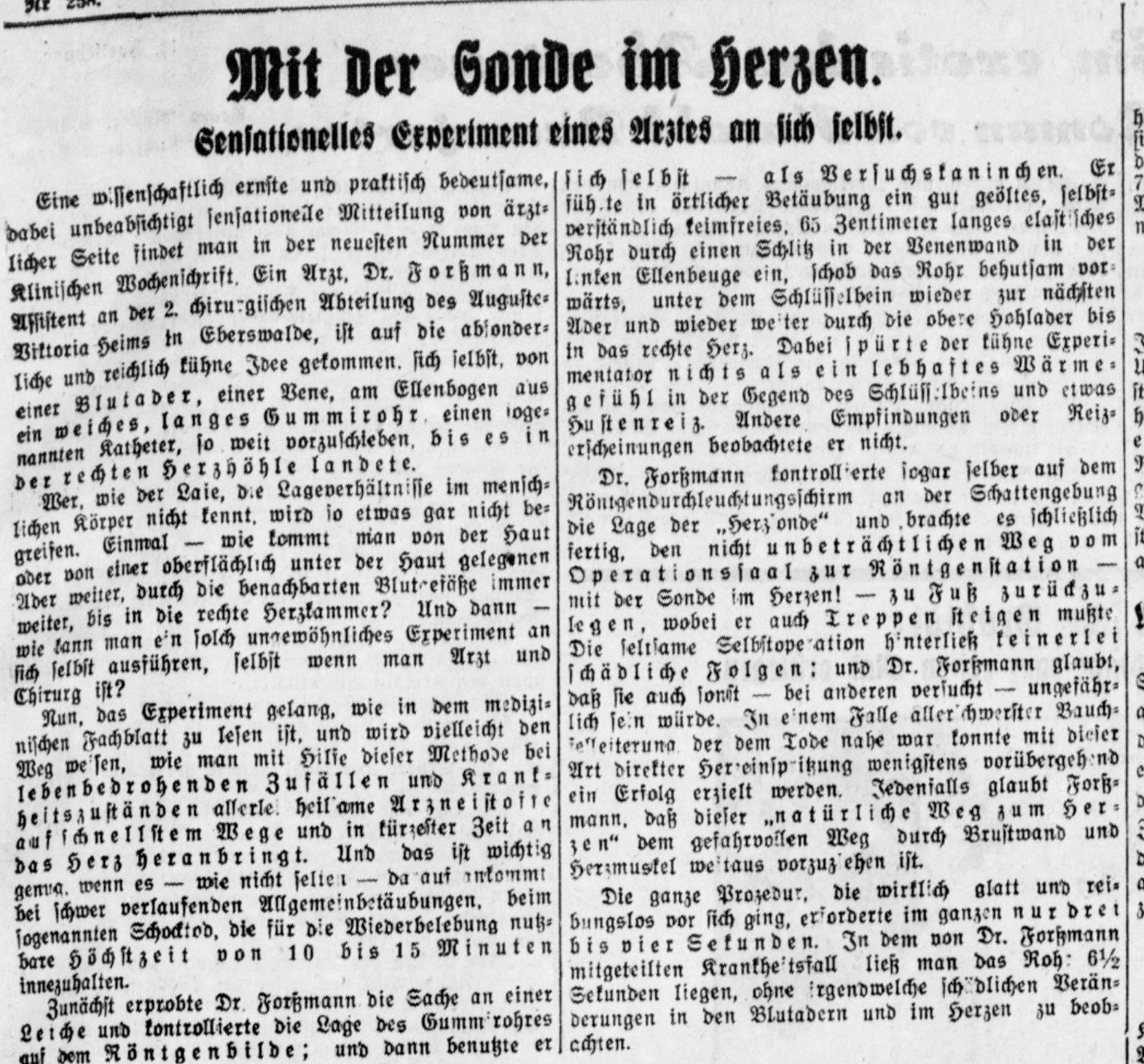
The surgeons read an insult. By his own account, given in the memoir and repeated in every telling since, Sauerbruch summoned him and dismissed him on the spot, with a sentence that has become the most quoted line in the story: “Mit solchen Kunststückchen habilitiert man sich in einem Zirkus und nicht an einer anständigen deutschen Klinik.” With tricks like that you qualify yourself for a circus, not for a decent German clinic. The formal ground was that he had gone ahead without permission; the letter from Unger, by the memoir’s account, had reached Sauerbruch before the paper did. In January 1930 Forssmann was back at Eberswalde with Schneider, three months after he had left it.
The priority men read a theft. Ernst Unger wrote to the Klinische Wochenschrift to say that he, Bleichröder and Loeb had done the same thing seventeen years earlier. What they had done is in the Berliner klinische Wochenschrift for 1912, in Bleichröder’s lecture to the Hufeland Society of 9 May that year on “intra-arterial therapy,” and it is worth setting against the claim. Bleichröder had passed oiled ureteral catheters up the femoral vein of dogs “well over a hundred times,” he said, to take blood from the vena cava below the liver, and had then thought of using arteries to carry a drug in high concentration to a diseased organ. Before trying that on patients he tried the veins on himself: “Colleague Unger pushed a catheter through a slit in a vein of the forearm up inside the arm as far as the armpit. Later the attempt was repeated at the thigh and a catheter pushed up in the vena cava.” The same was done on a colleague whose name the scan gives as Nathanblut, a laboratory servant and “another gentleman who had offered,” all “entirely without reaction.” Then four women with puerperal sepsis had collargol, a silver preparation, run into the femoral artery towards the uterus; three died within three weeks. Nothing in the paper mentions the heart, no X-ray was taken, and the aim was the womb. The Westphalian papers that reported the dispute on 10 December put it fairly: in the 1912 experiment “the probe did enter the heart, which however the researchers did not mention in their publication,” and “priority, in any case, does not count for much in medical experiments of this kind.” Forssmann, having been assured by the journal’s editor that the literature had been searched before his paper went to press, printed a short addendum on page 2287 acknowledging the earlier work. In Stockholm in 1956 he gave Unger, Bleichröder and Loeb a paragraph of their own: they had wanted to carry a drug to puerperal sepsis, had probed veins in four people “as a preliminary trial,” and “no X-ray checks were used, nor were the cardiological aspects taken into consideration.” The claims of 1831, 1912 and 1930, and what became of them, are in the companion piece The letter from Unger.
Which is the whole of the difference. A catheter had been in a living man’s vena cava in 1912, and no one had looked to see where it was.
What happened
What the paper started, it started elsewhere. In Prague, at the German medical clinic of the university, a Privatdozent named Otto Klein read it, saw at once the use that Forssmann had not written down, and did the thing that physiologists had been wanting to do for forty years. Adolf Fick had shown in 1870 that if you know how much oxygen the lungs take up in a minute and the difference in oxygen between the blood going into the lungs and the blood coming out, you can divide one by the other and get the volume the heart pumps. The arterial blood could be had from any artery. The blood going into the lungs, the mixed venous blood of the right heart, could not be had at all without a tube in the right atrium. Klein passed ureteral catheters by Forssmann’s route in eighteen patients, reached the heart in eleven, drew the blood, measured the oxygen and reported the first cardiac outputs ever measured directly in living people: in three with sound hearts, between 4.5 and 6.7 litres a minute. He lectured on it in Prague in November 1929, took it to the congress of internal medicine at Wiesbaden in April 1930 and published it in the Münchener medizinische Wochenschrift on 1 August 1930, citing Forssmann as the pioneer. Then his chief, Wilhelm Nonnenbruch, forbade him to do any more. Forssmann said in Stockholm that Klein’s procedure “has its place even today in the standard practice of heart and lung clinics.” Klein, who was Jewish, left Prague for Buenos Aires in March 1939 and died there in 1968, and the Nobel committee never considered him.
Forssmann himself went the other way, towards pictures. At the Charité he had met Willi Felix, who became chief surgeon at the Neukölln hospital in Berlin and gave him the run of its X-ray plant. He kept dogs at his mother’s flat, sedated them, carried them to the hospital in a sack on his motorcycle, passed catheters down their jugular veins into their hearts and injected contrast medium, trying to catch the dye passing through the chambers on plates exposed as fast as a hand could change them. Rabbits came first and nearly ended the project: when the tip of the catheter touched the inner wall of a rabbit’s heart the electrocardiogram showed the heart stop, and he said in 1951 that had he begun with rabbits he would never have experimented on himself. The dogs tolerated the dye. He tested it on his own mouth, pressing the iodine solution against the lining of his cheek for hours, then catheterised himself again, nine times in all by his daughter’s count, and injected the contrast into his own right atrium: a mild irritation of the nose, an unpleasant taste, a passing dizziness, and no usable picture, because the plates could not be changed fast enough. He showed the dog pictures to the Eberswalde medical society in November 1930, published them in the Münchener medizinische Wochenschrift in 1931, and read a paper at the fifty-fifth congress of the German Society of Surgery in Berlin in April 1931, where, by the only account there is, which is his, there was no applause and no discussion. Four months later Egas Moniz in Lisbon published better pictures with a stronger solution, and angiocardiography went forward without him.
The congress did him one service: Sauerbruch, who had heard the paper, offered him his post back, and from 1931 he was at the Charité a second time, as a junior on the wards with no time for research. In the summer of 1932 he was dismissed again, this time, the clinic said, for want of scientific initiative. On 31 July 1932 he started at the municipal hospital in Mainz. On 1 August 1932 he joined the National Socialist German Workers’ Party, six months before it came to power; he later joined the stormtroopers and the Nazi doctors’ league as well, and left all three out of his memoir. In December 1933 he married Elsbet Engel, a doctor at the Mainz hospital; since a husband and wife could not work in the same house, he went back to Berlin, where Karl Heusch had opened the city’s first specialist urological department at the Rudolf-Virchow-Krankenhaus, and became a urologist, which is the one trade in medicine whose everyday instrument was the tube he had used. He was senior physician at Dresden-Friedrichstadt from 1936 and from 1937 deputy chief of surgery at the Moabit hospital in Berlin under Kurt Strauss, an SS officer. By his own account he treated the Jews who came to him after the pogrom of November 1938, against orders, and when Strauss introduced him to Heinrich Himmler’s physician Karl Gebhardt, who offered to supply human subjects for his research, he refused: “To use defenseless patients as guinea pigs was a price I would never be prepared to pay for the realization of my dreams.” He enlisted in 1939, served as a surgeon in Poland, Norway and Russia, ended the war running a hospital for the badly wounded at Neuruppin, and was a prisoner of the Americans until October 1945. The French occupation authorities barred him from practice for three years and classified him in 1948 as a follower. His wife was the general practitioner of a village in the Black Forest; he cut timber, and worked in her practice, and in 1950 took the urological department of a church hospital at Bad Kreuznach on the Nahe.
That is where the question caught up with the photograph. At Bellevue, Richards and Cournand had been trying since 1931 to do what Klein had done, by the opposite method. They wanted the oxygen of the mixed venous blood for the Fick equation, and tried for three years to get at it indirectly, by having patients rebreathe gas until the lungs and the blood came into equilibrium. In patients with diseased lungs it did not work, “and after three years it became apparent that we had failed completely in these attempts,” Richards said in Stockholm. They were, he said, “aware of the earlier experiment of Forssmann and had followed closely its isolated uses in Germany, Portugal, South America, and France.” Late in 1940 Cournand and Hilmert Ranges passed a catheter into the right atrium of a patient and found that consistent blood-gas values could be had from it, that cardiac output by the Fick principle followed, and that “the catheter could be left in place for considerable periods without harm.” Their report appeared in 1941. The war did the rest. With the United States fighting, the physiology of shock in wounded men was needed at once, and the catheter was the way to measure it: with a deficit of forty to fifty per cent in blood volume, they showed, the output of the heart and the return of blood to it fell critically, and whole blood did more good than plasma. By 1945 the thing that Forssmann had done once, to see if it could be done, was a laboratory procedure with a decade of results behind it, and other laboratories were taking it up to find the holes in children’s hearts before the surgeons opened them. “For us in 1943,” Cournand said in Stockholm, “the cardiac catheter was only the key in the lock.” The ten years before that sentence and the fifteen after it are in the companion piece The key in the lock.
After
Forssmann’s name travelled with the method. Cournand’s first paper, by the account of those who have read it, credited him in its opening sentence. In 1952 a retired professor of surgery at Jena, Nicolai Guleke, nominated “Dr Werner Forssmann, urology, Bad Kreuznach” for the Nobel Prize; in 1953 William P. Murphy of Boston, himself a laureate, nominated him jointly with Cournand, and Ludwig Heilmeyer of Freiburg nominated him alone. In 1954 the Academy of Sciences in East Berlin gave him its Leibniz Medal, and the German surgical congress, which had sat silent in 1931, honoured him.
The announcement came from Stockholm on Thursday 18 October 1956: the prize in physiology or medicine, 38,633 dollars to be divided among three, “for their discoveries concerning heart catheterization and pathological changes in the circulatory system.” The United Press cable that the Evening Star printed on its front page that afternoon got him wrong in the way the story had always been got wrong: “a Berlin urologist curious about the functions of the heart,” who “sat down one night behind an X-ray screen.” Its Sunday editorial, “Heart Pioneers,” had him pushing the tube into “a vein in his right arm” and said that his friends had “finally persuaded him to abandon the whole project,” which was not how he told it. “I feel like a village parson who just learned that he had been made bishop,” he told a reporter. He took all six children to Stockholm. On 10 December the King gave him the medal; the banquet was cut to a modest dinner because of Hungary. In the presentation speech Göran Liljestrand of the Karolinska Institute said what the committee thought had happened. Forssmann had shown, “by making, with the intrepidity of youth, by no means harmless experiments on himself,” that a catheter could be advanced from a cubital vein “into the right atrium itself, a distance of almost two-thirds of a metre.” The method had been taken up “in a few places,” Prague and Lisbon, but on the whole he “was not given the necessary support; he was, on the contrary, subjected to criticism of such exaggerated severity that it robbed him of any inclination to continue. This criticism was based on an unsubstantiated belief in the danger of the intervention.” What mattered in New York, he went on, was “that a well-known research group at a distinguished clinic had set their seal of approval on the method.”
Forssmann’s own lecture the next day was a history of catheters from Stephen Hales’s gun barrel in the heart of a dying sheep in 1710 to the isotopes he expected to replace contrast media. He gave Unger his paragraph and Klein his sentence. Of his own work he said only that its requirements “were lacking and had first to be laboriously created,” and that its opponents had “not hesitate[d] to obstruct practical research work with threadbare ethical and moral objections, such as are still occasionally raised today.” The work of Cournand and Richards, he said, “had fanned a small flame into a blazing fire which began to rage all over the world,” and there was now “an army of diligent men and women at work.”
He never went back to the heart. Mainz made him an honorary professor; Cologne offered a chair and he declined it, saying he could not keep six children on a professor’s salary. From 1958 to 1969 he was chief of surgery at the Evangelisches Krankenhaus in Düsseldorf. In his last fifteen years he wrote and spoke against the death penalty, against euthanasia and, after Christiaan Barnard’s operation in December 1967, against heart transplantation, which he called a loss of moral substance; his daughter, a psychiatrist, thought the man who had once broken every rule to open a door had ended by trying to close one. He died of a heart attack at Schopfheim in the Black Forest on 1 June 1979 and is buried with his wife at Wies. The hospital at Eberswalde now carries his name. The operating theatre where he opened his vein and the X-ray room in the basement were still in use when his daughter visited in the 1990s, and she walked from one to the other: “it was a long walk from the ground floor to the basement.”
What it taught
Beside Pettenkofer’s glass, Forssmann’s tube is the other kind of self-experiment, and the pair define the kind.
A self-experiment can settle one question, and only the one that a single healthy body can answer. Can a catheter lie in the right atrium of a living man without killing him? Yes. The photograph proved it, and nothing that happened in the next twenty-seven years added to the proof or took away from it. Whether the tube was useful was a different question, and no number of catheters in his own arm could have answered it, because usefulness is measured in patients, with instruments, against a problem. Pettenkofer’s mistake had been to ask a question of his own body that his body could not answer. Forssmann asked the one it could.
The proof was the plate, not the man. The whole weight of the experiment rested on his decision to walk downstairs with the tube in his heart rather than take it out and describe where it had been. He understood, at twenty-five, that the word of an unknown assistant in a provincial hospital was worth nothing and a photograph was worth everything, and that is the difference between what he did and what Unger and Bleichröder had done in 1912, when a catheter went into a man’s vena cava and perhaps his heart and no one looked. A result that is not recorded by an instrument indifferent to the hopes of the experimenter is a story.
A method waits for the question it answers. For eleven years the tube lay in the literature with no use attached to it that anyone would fund. Klein attached one at once, in Prague, and was stopped by his chief; Forssmann attached the wrong one, pictures, for which the plates were too slow. What Cournand and Richards brought in 1940 was not courage or a better catheter but a decade of failure: they knew exactly which number they could not get, and the catheter was the only way to get it. “The key in the lock,” Cournand called it, and a key is nothing without a door. The instrument Forssmann made was finished in 1929. The experiment it belonged to had not been designed.
The record and the legend diverge, and the record is the one with the date on it. The paper of 1929 says a colleague helped and then he did it alone. The memoir of 1972 says he strapped a nurse to a table. The newspapers of 1929 say he practised on a corpse; the historian says he did not. The rule for reading such things is the one this journal uses everywhere: what the experimenter wrote within weeks, with the plates in front of him, outranks what he remembered with an audience.
The complication is that the men who called it a circus trick were not simply wrong. It was a trick, in the sense that it had no programme behind it and its author had none to offer; Sauerbruch’s clinic was not refusing a research plan, because there was none. The deception of the nurse, which Forssmann told against himself as a good story, was a deception. The corpse he claimed is unconfirmed. And the courage that the newspapers praised, and that the Nobel committee praised, was courage spent on the one risk the design had already minimised: a tube in a sound heart. The next step, into the hearts of the sick, was the step that needed what he did not have, which was a question, instruments, and a clinic prepared to let him ask it, and it was taken by other people. The lesson is not that the hierarchy was foolish, though it was unkind. It is that an instrument demonstrated is not an experiment performed, and that the distance between them can be eleven years and an ocean.
Sources
- Werner Forssmann, “Die Sondierung des rechten Herzens,” Klinische Wochenschrift, volume 8, number 45, 5 November 1929, pages 2085 to 2087, with the addendum at page 2287. The author’s affiliation, the date “Abgeschlossen am 13. September 1929” and the reference list (Henschen 1920 on resuscitation by intracardiac injection, Landois-Rosemann’s physiology textbook of 1923, Aschoff, Esch, Vogt and Volkmann) are from the publisher’s record; the passage on the second attempt, the warmth, the cough, the mirror and the stairs is quoted in the translation by J. B. Morris and W. J. Schirmer (British Journal of Surgery, 1990) as reproduced by Schott and Khan (below); the first attempt of 35 centimetres, the week’s interval, the corpse, the dying patient, the six hours, the three or four seconds and the olive oil are as the German press of November 1929 paraphrased the paper. The volume itself (HathiTrust, full view) could not be reached from this machine. Springer
- “Mit der Sonde im Herzen. Sensationelles Experiment eines Arztes an sich selbst,” Deutsche Reichs-Zeitung, Bonn, 5 November 1929, page 13. The same-day report: the “unintentionally sensational communication,” the “peculiar and amply bold idea,” the corpse, the 65 centimetres, the warmth and cough, the stairs, the case of “severest peritonitis” and the “natural way to the heart.” Translated here by the author of this entry. Deutsches Zeitungsportal
- “Ein tollkühnes Experiment,” Hannoverscher Kurier, 29 November 1929, page 9. The medical writer’s horror and admiration, the colleague who stopped, “the whole experiment on himself alone,” the 65 centimetres, the X-ray, the dying patient given glucose with suprarenin and a heart drug and dead after six hours, the absence of clots, the olive oil, the comparison with Pettenkofer and Schleich, and the forecast of “perhaps less benefit to medicine than the hopeful experimenter has in view.” Translated here by the author of this entry. Deutsches Zeitungsportal
- Wiedenbrücker Zeitung, 10 December 1929, page 9. The first attempt of 35 centimetres, the repeat a week later under the mirror, and the claim of “the professors Unger, Bleichröder and Loeb” to have made “the same experiment” in 1912: “the probe did enter the heart, which however the researchers did not mention in their publication.” Translated here by the author of this entry. The portal’s search lists twenty-nine German papers carrying the story between 4 November 1929 and the end of January 1930. Deutsches Zeitungsportal
- “Doctor Puts Tube In Own Heart to Test Treatment,” The Milwaukee Leader, 18 November 1929, page 3, a Berlin cable: “Dr. Hermann Forssmann,” the tube “several feet in length,” the “incision in the vein of his own left shoulder.” The same text ran in the Watauga Democrat of Boone, North Carolina, on 21 November. Library of Congress
- “German Physician Perfects Heart Stimulant,” from Le Matin, Paris, in the Evening Star, Washington, 3 July 1930, page 8. Library of Congress
- F. Bleichröder, “Intraarterielle Therapie,” with E. Unger, “Bemerkungen zur intraarteriellen Therapie,” and W. Loeb, Berliner klinische Wochenschrift, volume 49, 1912, pages 1503 to 1505. The lecture to the Hufeland Society of 9 May 1912: the hundred catheterisations of dogs’ veins, the self-experiments (“Kollege Unger schob durch einen Venenschlitz am Unterarm einen Katheter innerhalb des Armes bis zur Achselhöhle hinauf. Später wurde der Versuch am Oberschenkel wiederholt und ein Katheter in der Vena cava hinaufgeschoben”), Dr Nathanblut and the laboratory servant, and the four cases of puerperal sepsis treated with collargol. Translated here by the author of this entry. archive.org
- Werner Forssmann, “The Role of Heart Catheterization and Angiocardiography in the Development of Modern Medicine,” Nobel Lecture, 11 December 1956. Hales, Chauveau and Marey, the paragraph on Unger, Bleichröder and Loeb, Montanari, Klein “about six months after my first publication,” the requirements that “had first to be laboriously created,” the “threadbare ethical and moral objections,” the small flame and the army. Nobel Prize
- Göran Liljestrand, presentation speech for the Nobel Prize in Physiology or Medicine, 10 December 1956. “With the intrepidity of youth,” “almost two-thirds of a metre,” Prague and Lisbon, “criticism of such exaggerated severity,” and the “seal of approval” of a distinguished clinic. Nobel Prize
- Dickinson W. Richards, “The Contributions of Right Heart Catheterization to Physiology and Medicine,” Nobel Lecture, 11 December 1956. The work at Bellevue from 1931, the three years of failed rebreathing, “we still could not measure blood flow through the lungs,” the isolated uses in Germany, Portugal, South America and France, Cournand and Ranges “late in 1940,” the catheter left in place, and the wartime studies of shock. Nobel Prize
- André F. Cournand, “Control of the Pulmonary Circulation in Man with Some Remarks on Methodology,” Nobel Lecture, 11 December 1956: “For us in 1943, the cardiac catheter was only the key in the lock.” Nobel Prize
- “Werner Forssmann, Biographical,” from Nobel Lectures, Physiology or Medicine 1942-1962, Elsevier, 1964: the parents, the school, the state examination in 1929, Klemperer and Fick, Eberswalde, “a catheter for 65 cm,” the Charité, Mainz, Heusch, Dresden, the Robert Koch Hospital, the war, Bad Kreuznach, Düsseldorf, the Leibniz Medal, the marriage and the six children; and the Nobel nomination archive, which records the nominations of 1952 (Guleke) and 1953 (Murphy, with Cournand; and Heilmeyer). Biographical, Nominations
- “Two Americans and German Share $38,633 Nobel Prize in Medicine,” Evening Star, Washington, 18 October 1956, pages A-1 and A-6 (United Press): the citation, the sum, “a Berlin urologist curious about the functions of the heart,” and the Columbia team’s work at Bellevue; and “Heart Pioneers,” the editorial of 21 October 1956, page A-24. 18 October, 21 October
- Walter Theimer, “Ein Schlauch ins Herz: Nobelpreisträger Dr. Forssmanns kühne Tat,” Washington Journal, 9 November 1956, page 5: the 1951 lecture “Einundzwanzig Jahre Herzkatheterung, Rückblick und Ausschau” and the method as practised in 1956. Library of Congress
- Renate Forssmann-Falck, “Werner Forssmann: A Pioneer of Cardiology,” American Journal of Cardiology, volume 79, 1 March 1997, pages 651 to 660. His daughter’s account: the family and the school, Klemperer’s broken promise, Schneider, the paper’s summary (Romeis, 35 centimetres, a week later, 65 centimetres, the mirror, the catheter too short for the ventricle), the deception of Gerda Ditzen, the puerperal sepsis case, Unger’s charge and the editor’s search, His, Bier and Sauerbruch, the unpaid post of October 1929 and the dismissal, the Neukölln dogs and rabbits, the nine further catheterisations, the second Charité period and the dismissal of 1932, Gebhardt, the war and captivity, the three-year ban, Bad Kreuznach, the Nobel journey, Cologne, Düsseldorf, the writings on euthanasia and transplantation, the death on 2 June 1979 and the long walk at Eberswalde. Elsevier
- Ralf Bröer, “Werner Forßmann und der Herzkatheter-Selbstversuch: Dichtung und Wahrheit,” Ärzte Zeitung, 27 August 2004, as reprinted by the historical archive of the Deutsche Gesellschaft für Kardiologie. The legend and its correction: no animal experience and no research programme, the “spectacular experiment” as a bid for a career, the two versions of the day, the memoir’s sentence on the straps (“Sie gab nach, und blitzschnell hatte ich ihre Beine mit dem großen Riemen so festgemacht, daß sie nicht an die Schnalle heran konnte und ihr auch die Handfesseln angelegt”), the claim of corpse and animal work, Sauerbruch’s sentence, the party membership of 1932, the honour of 1954. Translated here by the author of this entry. DGK
- Historisches Archiv der Deutschen Gesellschaft für Kardiologie, “Werner Theodor Otto Forßmann (29. 08. 1904 - 1. 06. 1979)” and “Prof. Dr. med. Otto Klein”: the Bernard woodcut and the horse, Schneider’s refusal, the 60-centimetre version, the 5 November publication, Sauerbruch’s words, Willi Felix and Neukölln, the congress of April 1931 in Berlin, Dieffenbach in 1831, the Unger dispute, Mainz, the party, Dresden and Moabit, the war, the ban and the Mitläufer verdict, the Leibniz Medal, Düsseldorf, the apple orchard, the death at Schopfheim; and Klein’s eighteen attempts, eleven catheterisations, the outputs of 4.5 to 6.7 litres, the Prague lectures of November 1929, Wiesbaden, the publication of 1 August 1930, Nonnenbruch’s ban and the emigration of 1939. Forßmann, Klein
- Morton A. Meyers, “The Key in the Lock: Cardiac catheterization,” The Pharos, Summer 2016, pages 22 to 25. The memoir quoted: Romeis (“You idiot, what the hell are you doing?”), the motorcycle and the potato sack, the contrast on the lining of the mouth, the nasal irritation and dizziness, the congress of April 1931 without applause or discussion, Gebhardt (“To use defenseless patients as guinea pigs…”), the village parson and the bishop, and Cournand’s preface to the memoir. Alpha Omega Alpha
- Martin Schott and Zahid Hussain Khan, “Werner Forssmann, the Man Behind the Self-experiment, and the Nobel Laureate: A Historical Note,” Archives of Neuroscience, volume 8, number 3, 2021. The Morris and Schirmer translation of the paper’s central passage, the Eberswalde society of November 1930, the nine catheterisations, Cournand’s opening acknowledgement, and Sauerbruch’s sentence in English. Brieflands
- Werner E. Gerabek, “Forßmann, Werner,” NDB-online, Deutsche Biographie: the doctorate of February 1929, the 65 centimetres to the right atrium, the dismissal of 1932, the party, the Mitläufer classification, Wies, Bad Kreuznach, Düsseldorf and the death at Schopfheim on 1 June 1979; and the German Wikipedia article “Werner Forßmann,” which gives from the Bundesarchiv’s card the party entry of 1 August 1932, the Mainz appointment of 31 July 1932 and the marriage of 7 December 1933. Deutsche Biographie, Wikipedia
- Claude Bernard, Leçons de physiologie opératoire, Paris: Baillière, 1879, page 278, figure 90, “Ensemble des voies par lesquelles on peut pratiquer le cathétérisme du cœur et des gros vaisseaux.” The figure in this entry. archive.org