At noon Greenwich time on Monday, 18 August 1969, eight in the morning in Puerto Rico, a Navy A-6 Intruder came at Hurricane Debbie from the south-south-west at 33,000 feet, crossed the eye, and flew into the wall of cloud on the far side. The storm was about 650 nautical miles east-north-east of the Naval Station at Roosevelt Roads, farther than anyone had meant to work. Its strongest winds, measured by a Weather Bureau DC-6 at 12,000 feet, were 98 knots. A short way into the wall cloud, at the place where fourteen years of flying into hurricanes said the strongest winds should be, the crew began dropping canisters. There were 208 of them, each holding 190 grammes of silver iodide, and they went out along a line leading straight away from the centre of the storm, over two or three minutes and fourteen to twenty miles. Then the aircraft turned for home. Two hours later another Intruder did the same thing, and two hours after that a third, and a fourth, and a fifth.
Five hours after the fifth run, the DC-6 crossing the storm at 12,000 feet measured the strongest wind at 68 knots. The project’s annual report for the year did the subtraction on its second page. “On 18 August, the maximum wind velocity decreased 31%, and on the 20th it decreased 15%.”
Thirty-one per cent was the number Project Stormfury lived on for the next fourteen years. It was the strongest reading any experiment on a hurricane had ever produced, and it was read, by people who had every reason to be careful and said so in the same paragraph, as the effect of silver iodide on a storm. What it could not say, because nothing in the experiment had been built to say it, was what Debbie would have done that day with no aircraft in the sky.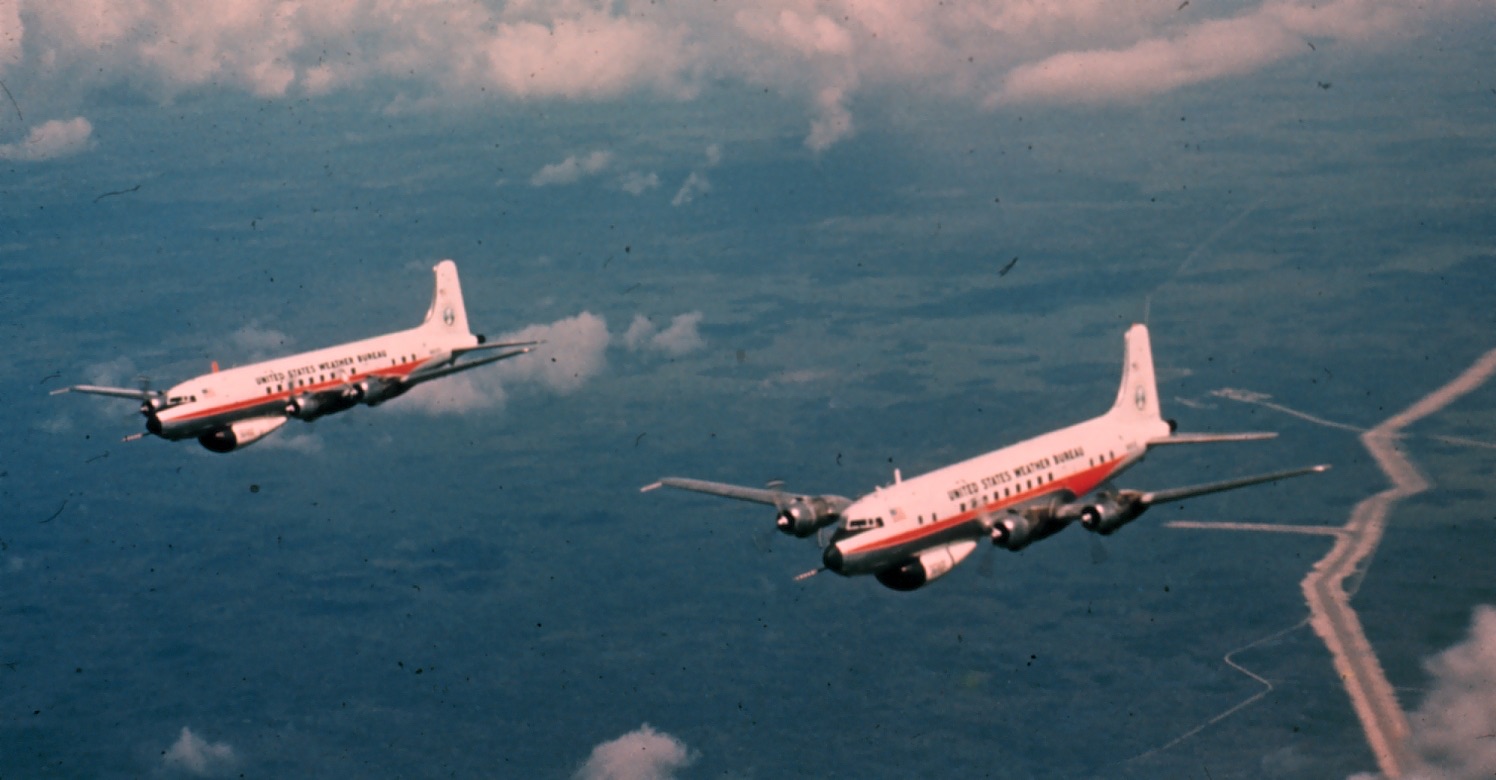
Who ran it
The idea was older than the project. On 13 October 1947, General Electric scientists working for the government under Project Cirrus dropped dry ice into a hurricane off Georgia and north Florida. The storm, which had been heading out to sea, turned west and came ashore in Georgia and South Carolina. The turn had nothing to do with the seeding, but Irving Langmuir claimed that it had, and the project’s own historians called the claim “an embarrassment at the time” that “left a legacy that had an adverse effect upon political and legal arrangements for later hurricane modification efforts.”
The project’s parent was born of a bad two years. In 1954 and 1955 six major hurricanes came ashore on the east coast of the United States, killed nearly 400 people and did more than six billion dollars of damage in the money of 1983, and after the second season Congress directed the Weather Bureau to set up the National Hurricane Research Project. Its mission had four parts: to study how hurricanes form, to study their structure and dynamics, to seek means of improving forecasts, and to seek means of modifying them. Its first director was Robert H. Simpson, who by 1961 was the Weather Bureau’s deputy director of research for violent storms. His collaborator on the clouds was Joanne Malkus, who had flown through tropical cumulus clouds with instruments since the early 1950s and built early numerical models of a single convective tower; she was at the University of California at Los Angeles when the project began, and became Joanne Simpson when the two married in 1965.
The silver iodide came from the Navy. In 1957 three chemists at the Naval Ordnance Test Station at China Lake, in the California desert, were trying to make a coloured smoke that would show at high altitude, and noticed that a pyrotechnic mixture containing silver iodate burned to give off finely divided silver iodide, the best freezing nucleus known. They patented it and found no use for it. In May 1961 they showed it to Pierre Saint-Amand, the head of their earth sciences division; Louis Battan of the University of Arizona suggested hurricanes, and sent him to Simpson. Saint-Amand went to Washington and, the station’s report records, “burned a small quantity of the compound in Mr. Simpson’s office.” Simpson wanted it in a hurricane that season.
Project Stormfury was formally established in 1962 as a joint programme of the Department of Commerce, through the Weather Bureau and its successors, ESSA and from 1970 NOAA, and the Department of the Navy, with the Air Force flying alongside. Simpson directed it until 1965, and his wife for the two years after him. The science sat with the National Hurricane Research Laboratory in Miami, whose director, R. Cecil Gentry, was project director in the Debbie years, with Harry Hawkins as his alternate; Robert Sheets, Stanley Rosenthal, who built the numerical hurricane models, and Peter Black, who read the radar, were among its scientists. The Navy provided the seeding aircraft, the Super Constellations of its Hurricane Hunter squadron VW-4, and the pyrotechnics, developed under Saint-Amand at China Lake. An Advisory Panel of five outside scientists, Noel LaSeur of Florida State in the chair, with Jerome Spar, Charles Hosler, James McDonald and, until October 1970, Edward Lorenz of MIT, reviewed the project each year.
The people who ended it were the laboratory’s own. Hugh Willoughby, David Jorgensen, Robert Black and Rosenthal, by then of the Hurricane Research Division, wrote the chronicle that closed the project in the Bulletin of the American Meteorological Society in May 1985.
What they were trying to find out
The hypothesis of 1961 had two parts, and both of them were about things nobody had measured.
The first was physical. The clouds of the eyewall, Simpson proposed, held a great deal of water still liquid at temperatures well below freezing, particularly in the tallest towers. Silver iodide dropped into that water would freeze it, and freezing releases heat. If the heat could be confined to a chosen part of the storm, he calculated, it would warm the cloud by one or two degrees, reduce the strongest pressure gradient by 10 to 15 per cent, and the strongest winds by about the same. The reasoning that joined the warming to the wind went through the eye, which was assumed to be unstable or nearly so. In the chroniclers’ words: “Seeding near the eye was intended to perturb the surface pressure through additional latent heat release. The perturbation would then trigger the inertial instability and cause outward migration of the eye wall, leading to reduction of the maximum wind through conservation of angular momentum.” A hurricane’s strongest winds ring the eye, and the tighter the ring the stronger they are. Widen the ring, and the same air, spinning at a larger radius, spins slower.
By the end of the decade the hypothesis had been rebuilt around Rosenthal’s numerical model, and the new version did not need the vortex to be unstable at all. The clouds just outside the eyewall would be seeded, repeatedly and heavily, so that they grew taller, drew in the inflowing air before it reached the old eyewall, and became a new eyewall at a larger radius, which would starve the old one of heat and moisture and replace it. The annual report for 1970 stated the new purpose in one sentence: “Thus, one purpose of seeding the clouds outside the old eyewall is to develop a ‘new eyewall’ at a greater radius.” A new eyewall farther out; a wider eye; weaker winds. The ideal subject, in either version, was an intense storm with a small, well-formed eye.
The second part of the hypothesis was never written down as one, and that is the point of this entry. It was that a change seen in a hurricane after seeding could be read as the effect of the seeding. The project knew the difficulty from the start and said so every year. The 1969 plan put it plainly: “Because the magnitude of natural variations in hurricanes is sometimes as large as the hypothesized artificially induced changes, it is difficult to distinguish between the two.” The way the project proposed to tell them apart was by timing and by size: if the winds fell at the hour the model said they should, and by more than hurricanes usually managed on their own, the seeding had done it. What the project did not have was a record of what unseeded hurricanes did hour by hour on days nobody was experimenting on them. The only aircraft that could collect such a record were the ones it used for the experiments, and they were waiting for a storm to seed.
So there were two claims. One was about ice and heat and the mechanics of a vortex, and could be tested by flying through the clouds with the right instruments. The other was about what a hurricane does on an ordinary day, and could only be tested by watching hurricanes on ordinary days. The project tested the first with a seeding and read the second off the same flights.
What they built
The seeding device came first, in eight weeks of the summer of 1961. China Lake turned the compound into a weapon-shaped flare called Cyclops, with the fins of an aircraft rocket, a parachute, and a telemetry transmitter adapted from a radiosonde so that the crew would know whether the unit had lit inside a cloud nobody could see into. The station needed about 500 pounds of silver iodate; a commercial house held about 500 grammes, and the chemists grew the crystals themselves in wooden boxes lined with polythene. The drop aircraft was a Douglas A3D Skywarrior, a carrier jet bomber, which, the station’s report noted afterwards, “was never designed to open its bomb-bay doors in a hurricane.” The companion piece, “Cyclops”, tells the story of the build and the first drop.
The targets were chosen by a rule. In the early years the project was confined to a band of the Atlantic between Bermuda and Puerto Rico. From 1967 a storm was eligible so long as there was only a small probability, 10 per cent or less, of its centre coming within 50 miles of a populated land area within 24 hours after seeding; in 1970 the 24 hours became 18. The report gave two reasons, and they are the project’s design in two sentences. “First, a storm seeded further at sea will have reverted to ‘nature’s own’ before affecting a land mass. Second, marked changes in the structure of a hurricane occur when it passes over land. These land-induced modifications would obscure the short-range effects produced by the seeding experiments and greatly complicate the scientific evaluation of the results.” A storm also had to be within reach of the aircraft and to have winds of at least 65 knots. By William Mallinger’s count, the Atlantic, the Caribbean and the Gulf of Mexico between them offered an average of about 2.35 eligible hurricanes a year under the relaxed rule, and the project never caught more than one.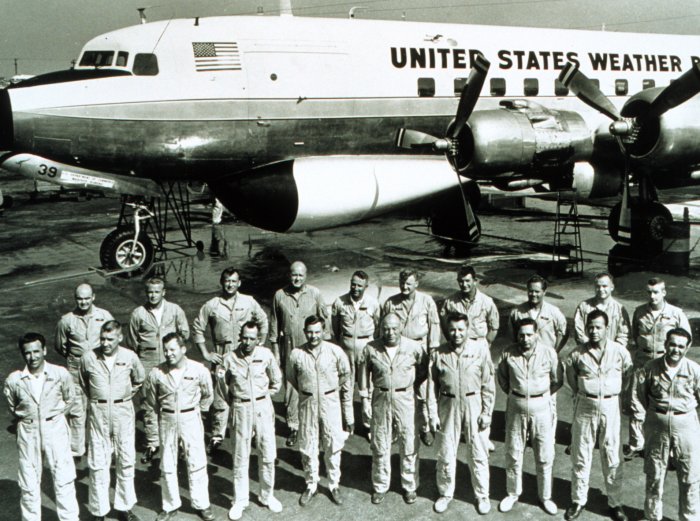
The fleet grew with each season. For Debbie in 1969 it was thirteen aircraft: four Navy WC-121N Super Constellations of VW-4, the radar and command ships, at 10,000 and 6,000 feet; five Navy A-6A Intruders of Attack Squadron 176, the seeders, at 33,000; two DC-6s of ESSA’s Research Flight Facility, the cloud physics and variability monitors, at 12,000; a B-57 and a C-54; and an Air Force WC-130 and WB-47. The pyrotechnic by then was the Stormfury I unit, each carrying 190 grammes of silver iodide, each gramme producing, the laboratory believed, more than a million million freezing nuclei.
The experiment itself, as designed for 1969, was the multiple eyewall seeding. It “calls for five seedings of the clouds around the eye at 2-hour intervals. Each seeding consists of dropping 208 pyrotechnic units along an outward radial flight path, starting just outside the region of maximum winds.” The seeder would begin dropping about three miles outside the inner edge of the eyewall as the radar showed it, because Sheets’s study of fourteen years of flight data put the strongest winds of a mature hurricane two or three miles outside that edge. The two DC-6s would relieve each other in passes across the storm from three hours before the first seeding until five or six hours after the last, so that one of them was always measuring the wind at 12,000 feet, where it ran at about 95 per cent of the wind near the surface.
What the project built, in other words, was an instrument for measuring a hurricane before and after it was seeded, with great care and at great expense. It built nothing for measuring a hurricane that was not.
Esther, Beulah, and the years between
The first drop was on 16 September 1961, and nothing went to plan. The Skywarrior’s engines would not start until the crew chief stopped a leak with his bare hand; the eye was too small to orbit in; the wall cloud rose far above the jet’s ceiling, so the pilot dumped 6,000 pounds of fuel to gain height, and the bombardier let go all eight Cyclops units on one pass. The radarscope film, developed at Roosevelt Roads that evening, was looked at by everyone. “It was the unanimous opinion that a drastic change in the formation of the eye of the hurricane had taken place after the drop.” Half the wall cloud, as seen by the 10-centimetre radar, which sees water and not ice, vanished from the screen; the eye went from a cylinder to a cup, held that shape for an hour and a half, and closed up again. The storm had been deepening about a millibar an hour before the drop. It stopped. The next day the eight units were dropped on a line tangent to the wall cloud, the jet lost contact with the control ship, and observers thought the canisters fell mostly into the eye. “No dramatic effects were noted. This experiment should properly be classed as a null.”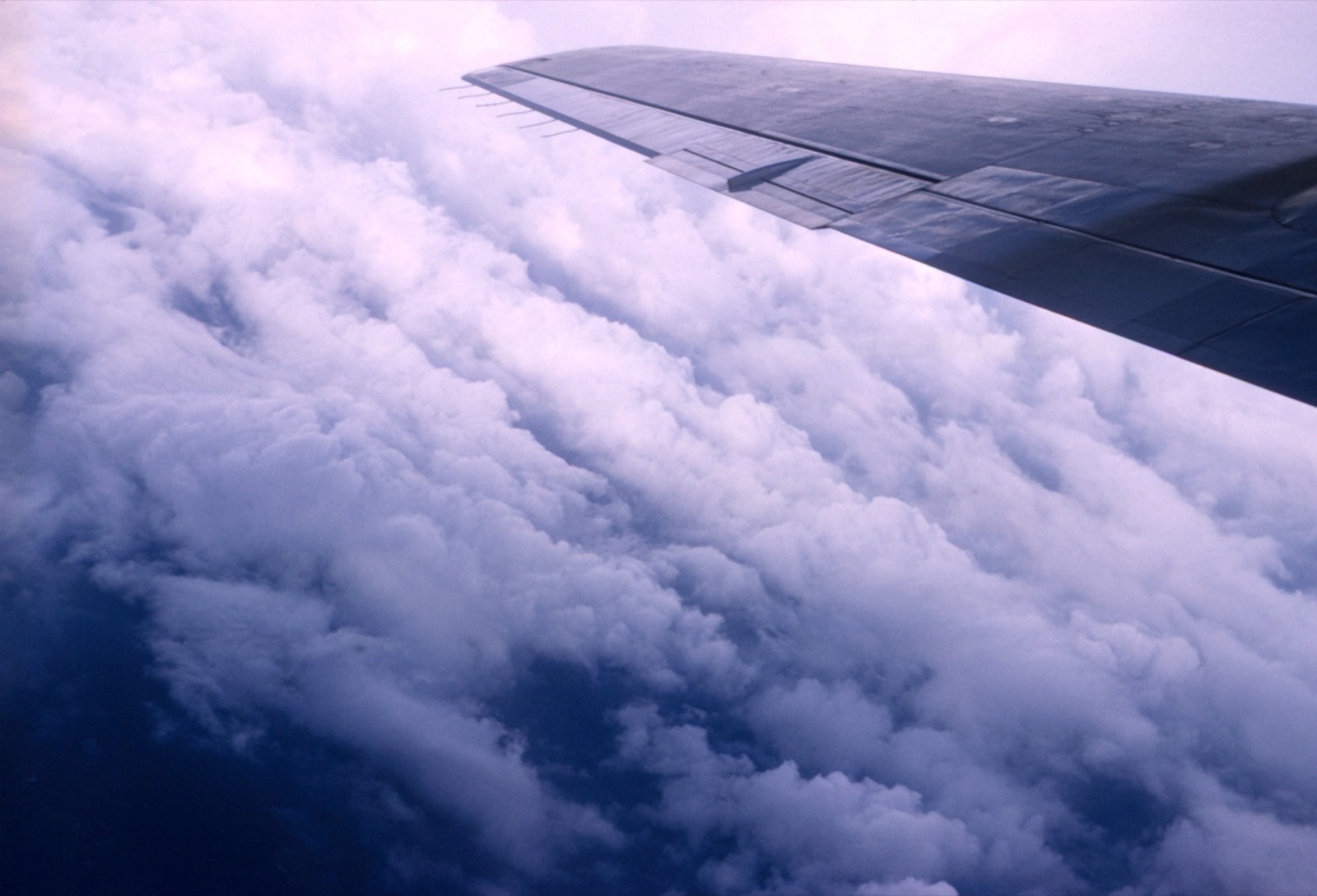
China Lake’s report was exultant and exact in the same breath. The seeding, it concluded, had turned “about 400 cubic miles of supercooled water clouds” into ice, “releasing the energy equivalent to several atom bombs.” Two paragraphs earlier it had recorded that “nor were other parts of the hurricane explored during the time of the seeding and the period immediately following, so that comparison with the undisturbed portions is not possible.” Esther was the pilot. On the strength of it, in 1962, Stormfury was established.
The 1962 season offered nothing suitable. In August 1963 the project ran a randomised experiment on eleven ordinary cumulus clouds, seeding six and leaving five: five of the six grew as the cloud model said they should, and none of the controls did. It was the one properly controlled experiment Stormfury ever ran, and it was on clouds that were not in a hurricane. Three days later it went for Beulah. On Friday 23 August, at 1311 Eastern time, and on Saturday at 1211, eleven Navy and Weather Bureau aircraft seeded her. The fact statement the project director authorised for the press on 26 August was careful: “No spectacular results were apparent during the 2–3 hours after seeding in which aircraft were monitoring changes in the storm structure. Some variations were observed in the cloud wall and in the wind field, but the degree to which these were related to the seeding will not be known until the data have been analyzed.” The Washington Sunday Star, two weeks later, had the task force’s eleven “instrument-packed planes poised to fly into the center of the next hurricane,” to “bombard the heart of the storm with 1,500 pounds of silver iodide.”
The analysis, when it came, read Beulah the way Esther had been read. On the Friday the storm had a poorly formed eye and winds of 40 metres a second, and the silver iodide “again missed the tall clouds around the eye”; no change. On the Saturday the eye was distinct and the winds over 50 metres a second, the seeding was on target, and the crews “reported disintegration of the eye wall, followed by formation of a new eye wall at larger radius.” The strongest winds fell and moved outward. In the chronicle’s figure they fell by 20 per cent; in Sheets’s table of 1977 by 14. One day a miss and no effect, one day a hit and an effect: it looked like a dose and a response, and the project “seemed to have had an auspicious beginning.”
Then nothing, for six seasons. In 1964 the instruments were not ready. In 1965 Betsy was too close to land and Elena out of range. In 1966 Faith turned away before it entered the area. In 1967, the Navy’s summary recorded, “for the first time in 14 years, or ever since official United States Weather Bureau forecasts were recorded by latitude and longitude for the areas and times concerned, no eligible hurricane appeared.” In 1968, none again. The project kept its aircraft ready each August, held dry runs, seeded cumulus clouds, built better pyrotechnics, and, in Rosenthal’s hurricane model, found the new hypothesis. The model, asked where heat should be added to weaken the winds, answered: outside the ring of strongest winds, never inside it. Asked how much the winds would fall, it said about 15 per cent.
Debbie
The alert came at ten on the morning of Saturday, 16 August 1969. Debbie was then far east of the Lesser Antilles, a storm off Africa that had become a tropical storm on the 15th, and the forecast took her into the eligible area east of the Bahamas. On Sunday the fleet moved to Puerto Rico. At the briefing at half past four that afternoon the storm was forecast to be 650 to 700 miles from the base at the time of the first seeding. “This was an extreme range for the operation,” the report says, “but working on Monday, the 18th, insured at least one experiment even if Debbie took an unexpected (but not impossible) turn to the north and moved out of range.” Permission to seed was asked of Robert M. White, the head of ESSA, and Captain E. T. Harding of the Navy, and granted.
The flights began leaving at 0500 Greenwich time on Monday. Thirteen aircraft made fourteen flights “and completed all missions close to scheduled time and without major incident.” The five Intruders arrived at about two-hour intervals “and released their loads of silver iodide pyrotechnics in the proper regions of the eyewall clouds.” Of the 1,040 canisters they dropped, about 6 per cent failed to fire. One DC-6 flew two eleven-hour sorties that day and landed at seven on Tuesday morning, which ended the experiment. There were two seats on the project’s aircraft for the press, one for a reporter and one for a television cameraman.
The first profile across the storm that morning showed the strongest wind at 98 knots, a short way north-north-east of the centre. Between passes “the winds sometimes increased and sometimes decreased. In the mean, however, the wind speeds decreased from shortly after the second seeding until at least 5 or 6 hours after the fifth seeding.” Five hours after the fifth seeding the maximum was 68 knots; since the force of the wind goes as its square, the belt of strongest winds had lost 52 per cent of its kinetic energy. On Tuesday the storm rebuilt itself, beginning about eight hours after the last canister had gone in. On Wednesday morning the maximum was back to 99 knots. The first Intruder, running in at 30,000 feet, hit downdrafts in the eyewall so strong that it was forced down to 27,000, and released its load on the way down, “close to the proper location.” Within six hours of the fifth seeding the maximum was 84 knots: a decrease of 15 per cent, and of 28 per cent in energy.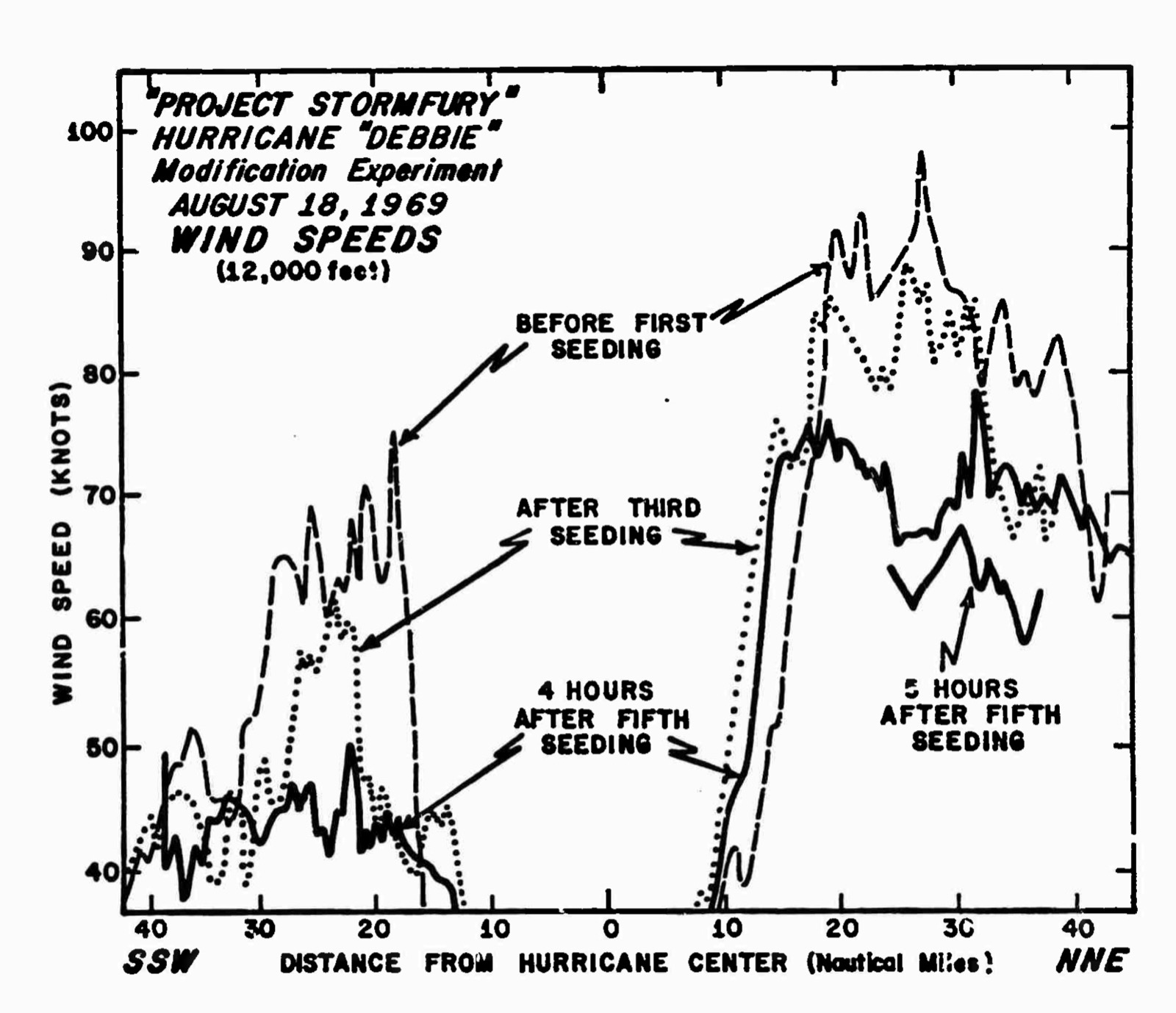
There was one more thing in the Wednesday data, and the report thought it made the response more impressive, not less. “Debbie had a double wall cloud structure on this day. That is, there were two concentric walls with radii of approximately 10 and 20 n mi, respectively. Each was associated with a maximum of wind speed at corresponding radii.” The seedings had all been placed outside the inner maximum, but only the fifth outside the outer one; the inner winds began to fall after the second seeding, the outer “did not show a net decline until after the last seeding.” The Navy’s radar at 1519 Greenwich time that day shows the two rings plainly, a bright inner wall around the eye and a second, broken wall around it. In 1969 that picture was evidence that the seeding was working on the inner wall first. Sixteen years later it would be evidence of something else.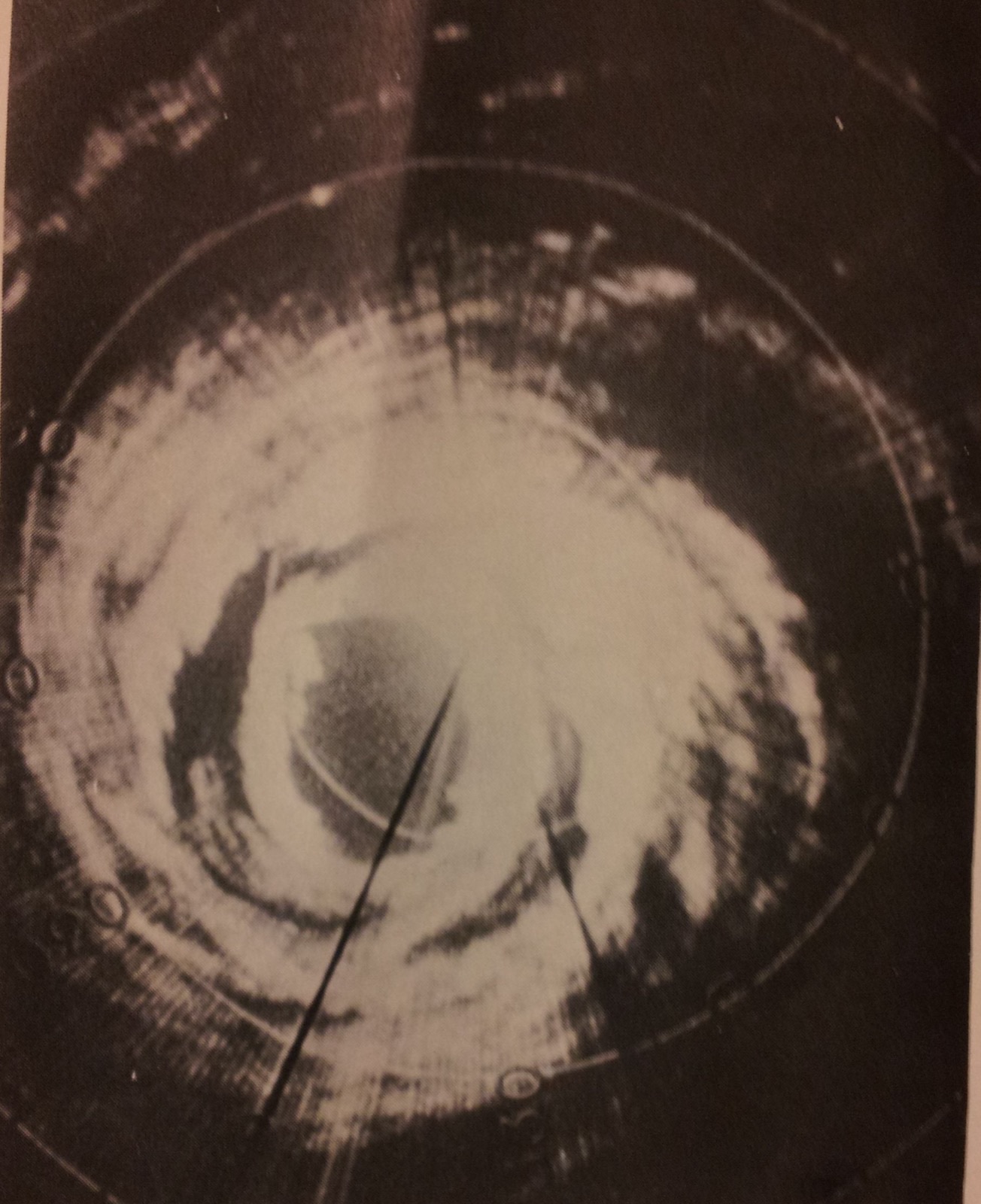
What it looked like from inside
The report’s appendix on Debbie, written by Gentry and published in Science the next spring, is a careful document, and its care is the best evidence of how the project saw itself. “That Hurricane Debbie decreased in intensity following multiple seedings on 18 and 20 August is well established,” it says. “What we do not know is whether the decrease was caused by the seeding, or whether it represents only natural changes in the hurricane.” Then it set out why the laboratory believed the first. The rate at which the central pressure rose on the 18th “has occurred in only 9 percent of 502 periods of similar length we have studied in other tropical cyclones”; the smaller fall on the 20th “occurs in considerably less than one-half of the hurricane days”; and on both days the fall came “at a time when it could reasonably have been caused by the seeding experiment,” which is to say at about the hour Rosenthal’s model said it should. The model had predicted about 15 per cent at sea level. “Considering the many unknowns in both the model and the field experiments, this agreement should certainly be considered satisfactory if not remarkable.” The introduction to the same report said the whole thing in four sentences: the experiments “were very impressive”; the winds fell 31 and 15 per cent; “Whether this can be attributed to the seeding remains unproven because natural variations of this magnitude do occur in hurricanes”; and “Data collected, however, strongly suggest that the experiments were successful.”
The same appendix carried the arithmetic that justified the project. Camille, which had come ashore in Mississippi the night before the first Debbie seeding, had done more than 1.4 billion dollars of damage. “If the United States continues supporting hurricane modification research at the present rate for the next 10 years and if by that time we modify just one severe hurricane, such as Betsy or Camille, sufficiently to reduce its damage by only 10 percent, the nation will have a 1000 percent return on its investment.” The report noted that “much favorable publicity resulted from these experiments,” and in 1970 Stormfury was designated a National Pilot Project and found more money.
Inside the laboratory the Debbie result changed the hypothesis as much as it confirmed it. Sheets’s few measurements of liquid and frozen water in hurricane clouds suggested there might be enough supercooled water in the eyewall to warm it a degree or two if all of it froze at once, but nothing like enough for five seedings in a day. The 1970 report said why in a sentence that should have been read more widely than it was: “Once the liquid in the clouds has been frozen, one cannot keep refreezing it to get more heat.” The heat of fusion, Gentry and Hawkins calculated, fell short of what Rosenthal’s model needed by one or two orders of magnitude. So the hypothesis moved: the seeding worked, they now argued, by making the clouds outside the eyewall grow, so that condensation released many times the heat that freezing could, and a new eyewall formed at the larger radius. The 1970 report announced “a new and better explanation for the apparent success of the 1969 ‘Debbie’ experiments than was possible with the pre-existing hypothesis.” The result stood; the reason for it had been replaced.
The Advisory Panel, reviewing the simulated seedings in November 1970, added two warnings. The model’s weaker maximum wind came with about 20 per cent more kinetic energy in the storm as a whole, which “could result in a significant increase in the storm surge,” so “we caution against conclusions that seeding does not make the storm ‘worse.’” And it asked for better radar and cloud physics instruments on the aircraft, because “Unless more and better data can be acquired on these questions, residual doubt will always remain in the interpretation of experimental results.” Every year from 1962 to 1972, the chroniclers would note, the panel recommended studies of microphysical and statistical feasibility alongside the seedings.
Then the storms stopped coming. “The 1970 hurricane season,” the report for that year begins, “produced no tropical cyclones which were eligible for seeding experiments. In spite of this, or perhaps because of it, the 1970 season was undoubtedly the most productive research period for Project STORMFURY to date.” In 1971 the only storm in the area was Ginger, a diffuse late-season hurricane without the small well-defined eye the design required; it was seeded anyway on 26 and 28 September, in clouds well away from the centre, and nothing happened. Ginger was the last hurricane Stormfury ever seeded. In 1972 every storm was too weak, too close to land or out of range. The Navy ended its sponsorship in 1973, and the Weather Bureau’s DC-6s and B-57, after more than a decade of hard use, were retired in the same fiscal year.
The project’s answer was to go where the storms were. Mallinger’s tables had counted 5.3 typhoons a season within reach of Guam or Okinawa, two or three times the Atlantic’s offering, and in January 1971 the Advisory Panel urged the government to solve “the financial, logistic, diplomatic, and other problems” of working there. The plan that emerged was for five aircraft, two new Lockheed WP-3D Orions built for NOAA among them, to work from Guam from 1976. The diplomatic problems were not solved. Japan and China objected; the eastern Pacific and Australia were tried and met resistance; and in 1974, when Hurricane Fifi devastated Honduras, the government found itself denying that it had seeded a storm it had never touched. The companion piece, “The years without a storm”, follows the rules, the counts and the diplomacy.
What happened
The aircraft came even though the storms did not. The first WP-3D was delivered in the autumn of 1976 and the second the following summer: “superb observing platforms,” the chronicle says, with three digital radars that gave horizontal and vertical pictures of the rain, inertial navigation that fixed the wind, and Knollenberg imaging probes that photographed every particle that passed through them and could tell a drop of water from a crystal of ice. “Thus,” the chroniclers wrote, “as the political fortunes of Project STORMFURY declined, the ability to observe and analyze the energetic core of mature hurricanes increased.”
For the first time, the project flew through hurricanes it had no intention of seeding, with instruments built to measure what the hypothesis assumed. It flew Anita in 1977, David and Frederic in 1979, Allen in 1980, Ella in 1978 and Irene in 1981. Two findings came out of those flights, and together they ended the project.
The first was about the clouds. Jorgensen, Edward Zipser and Margaret LeMone made a census of 3,000 updrafts and 2,000 downdrafts measured on eleven sorties in Anita, David, Frederic and Allen, intense storms that, “except for geographical location, fit the criteria for modification under the STORMFURY Hypothesis.” The strongest tenth of the updraft cores rose at three to five metres a second; in the continental thunderstorms of the Thunderstorm Project they had risen more than three times as fast. Both cloud water and radar reflectivity fell off sharply above five kilometres, where the air passes freezing: the rain had either fallen out of the slow updrafts before it got there or frozen as soon as it did. For dynamic seeding to work a cloud had to hold more than a gramme of liquid water per cubic metre at minus ten degrees with fewer than one natural ice particle per litre; the seeding was designed to add about ten. Black and John Hallett analysed seventeen hours of flight below freezing in Allen, Ella and Irene. In the principal rainband of Allen on 5 August 1980 the liquid water stayed below half a gramme per cubic metre while the ice ran at 40 to 50 particles per litre, “several times that expected to result from seeding at a temperature 5° colder”; in Irene’s rainband there was “abundant frozen precipitation and virtually no liquid water.” Only in a few strong updrafts in the eyewall itself was there liquid water in quantity, and those drew in air full of natural ice as they rose. “Thus, the predominance of natural ice over liquid water dictates that cloud seeding in the outer rainbands—such as required by the STORMFURY Hypothesis—would be ineffective.” The clouds the project had been seeding for twenty years were already frozen.
The second finding was about the storms, and it reached back to Debbie. On 30 August 1979 the aircraft in Hurricane David found an outer ring of convective cloud around the eyewall, with its own wind maximum, and over the following hours the outer ring intensified and contracted while the inner eyewall weakened and died, and the central pressure rose sharply. Allen did the same thing more than once in August 1980, its eye widening as the pressure rose and the winds fell. Willoughby, J. A. Clos and M. G. Shoreibah published the analysis in 1982. Nobody had seeded David or Allen. Concentric eyewalls, the outer one replacing the inner and the strongest winds moving outward and weakening as it did, were what intense hurricanes did on their own. It was the response the hypothesis had been written to produce.
Then they looked again at the four days on which seeding had seemed to work. “Reference to Fig. 1 shows that outer wind maxima were present before seeding began in Esther on 16 September 1961, in Beulah on 24 August 1963, and in Debbie on 20 August 1969,” the chronicle says. “Moreover, these hurricanes’ evolutions and appearances on radar closely resembled those of David and Allen. It is, however, more difficult to relate the events in Debbie on 18 August 1969 to the convective-ring scenario. Thus, in retrospect, it seems probable that outer eye walls formed by chance in three of the four ‘successful’ experiments and that the changes in the hurricane’s intensity were the result of natural evolution rather than a consequence of seeding.” The double wall on Debbie’s radar on 20 August, which the 1969 report had offered as a sign that the seeding was taking hold, was the storm already doing what the seeding was for. The one day it could not account for was the 18th, the day of the 31 per cent.
The chroniclers also said what the project could have done. The studies of unmodified hurricanes before 1977 had assumed a steady storm and “did not address the question of temporal changes”; Stormfury had judged its seedings by profiles before and after, and by the model’s timing. “Had Project STORMFURY devoted more attention to temporal changes in unseeded storms,” they wrote, “the difficulty that the concentric eye phenomenon poses for statistical control of hurricane modification experiments might have been appreciated much sooner.”
The chronicle set out five things a hurricane modification programme had to be: politically acceptable, operationally possible, microphysically sound, dynamically sound, and statistically testable. “By mid-1983, none (or perhaps only one: dynamic feasibility) of the five conditions for development of an operational hurricane amelioration strategy could be met, and Project STORMFURY ended.” The paper’s last page gave the verdict in the authors’ own words. “STORMFURY itself, however, had two fatal flaws: it was neither microphysically nor statistically feasible. Observational evidence indicates that seeding in hurricanes would be ineffective because they contain too little supercooled water and too much natural ice. Moreover, the expected results of seeding are often indistinguishable from naturally occurring intensity changes.”
After
“The goal of human control of hurricanes was captivating and seemed to be physically attainable in the beginning,” the chronicle’s conclusions begin, and it is worth noticing who wrote that. Willoughby, Jorgensen, Black and Rosenthal were employees of the division the project had become, and Rosenthal had built the model whose 15 per cent had matched Debbie’s. They began the study, they said, as a report to the World Meteorological Organization on the state of hurricane modification; the Christian Science Monitor summarised it that November under the headline “The rise and fall of Project Stormfury.” The laboratory had become the Hurricane Research Division of NOAA’s Atlantic Oceanographic and Meteorological Laboratory in 1983, the year the project ended, and of the four objectives written into its charter in 1955, three remain: formation, structure, and forecasts. The fourth is not pursued. The division’s public answer to the question whether anyone has tried to weaken a hurricane, written by Chris Landsea, says: “Thus nature accomplishes what NOAA had hoped to do artificially. No wonder that the first few experiments were thought to be successes.”
The aircraft stayed. The two WP-3Ds bought to seed typhoons from Guam became the instruments with which hurricanes have been measured ever since, and the chronicle called them, with two decades of research, the project’s lasting legacy. The cycle they found in David and Allen is now called the eyewall replacement cycle, and forecasters watch for it, because a storm that is doing on its own what Stormfury hoped to make it do will weaken for a day and then, as Debbie did on 19 August 1969, come back.
What it taught
The lesson is not that the hypothesis was wrong, though it was. Hypotheses are allowed to be wrong; that is what experiments are for. The lesson is in how long a wrong hypothesis was held up by a right-looking number, and in what it took to put the number down.
A result without a control is a description, not an effect. Debbie’s winds fell by 31 per cent on a day she was seeded. That sentence was true in 1969 and is true now. What the project read into it, that the seeding had made the winds fall, needed a second sentence about what Debbie would have done unseeded, and the only versions of that sentence available in 1969 were a frequency table of pressure changes in other storms and a numerical model whose heating rates, the project’s own scientists calculated within a year, nature could not supply. The control that would have settled it was a record of intense hurricanes on days nobody touched them, taken with instruments that could see their inner structure change hour by hour. That record did not exist, because the aircraft that could make it were kept for the experiment.
The absence of a control is not neutral; it reads in favour of the hypothesis. Esther weakened on the day the canisters hit the wall cloud and not on the day they missed. Beulah did the same. Debbie weakened twice. Every seeded storm that did something was read as a response, and every one that did nothing as a miss. One miss, one hit, one effect: it has the shape of a dose and a response, and the shape is what persuaded people, including the careful people who wrote “remains unproven” and “strongly suggest” in the same paragraph. A sequence of seeded storms can never show you the base rate, and without the base rate the hits are only the days the storm happened to do what it was going to do anyway.
Write down both halves of the hypothesis. The physical half, that supercooled water frozen by silver iodide would release enough heat to move the eyewall, was stated, modelled, argued about and eventually measured, and when the measurements came the project’s own scientists gave it up in print. The statistical half, that a change after seeding was an effect of seeding, was never stated as a claim that could fail. It was a difficulty, acknowledged every year and set aside, and a difficulty acknowledged every year is not a hypothesis under test. The chroniclers’ “more attention to temporal changes in unseeded storms” is the second half written down at last, fourteen years late.
A hypothesis that survives the loss of its mechanism should be looked at hard. By 1970 the laboratory knew there was not enough supercooled water for freezing to do the work. The project did not stop; it replaced the mechanism with cloud growth and kept the result, because the result was the thing it had. That is the moment the number took over from the physics. The National Pilot Project, the two new aircraft and the plan to work from Guam were built on Debbie’s 31 per cent while the reason it should have happened was being rewritten underneath.
The instrument that speaks may be the one you bought for something else. The WP-3Ds were procured to seed typhoons and never seeded anything. Flying through Anita and David and Frederic and Allen with probes that could tell water from ice and radars that could see the two rings, they made the measurement the Advisory Panel had asked for every year since 1962, and it answered both halves of the hypothesis at once: the clouds were already frozen, and the storms already did it themselves.
And the complication, which is the best part. The people who found this out were the project’s own, and they wrote it up under their own names in the society’s journal, with the project’s name in the title and its figures, the 31 per cent among them, reprinted on the second page. They said in the first line of their conclusions that the goal had been captivating and had seemed attainable, which is to say that they did not pretend to have known better. The project ran for twenty-one years on a number that was true and meant nothing, and it was closed by the one experiment it had never been designed to run, the measurement of a storm left alone, carried out by the people with most to lose by the answer. The storms had been doing it the whole time. Nobody with the right instrument had been there to watch.
Sources
- H. E. Willoughby, D. P. Jorgensen, R. A. Black and S. L. Rosenthal, “Project STORMFURY: A Scientific Chronicle 1962–1983,” Bulletin of the American Meteorological Society 66, no. 5, May 1985, pp. 505–514. The 1947 Cirrus seeding, the 1954–55 seasons and NHRP, the 1961 hypothesis, Esther, the 1963 cumulus experiment and Beulah, the years 1964–68, Debbie’s 31 and 15 per cent, Ginger, the Navy’s withdrawal, the Pacific plan and the five conditions, the WP-3Ds, Jorgensen’s census, Black and Hallett’s ice, David and Allen, the “three of the four” retrospect, and the conclusions. Read in the Wayback Machine’s copy of the publisher’s PDF. web.archive.org, journals.ametsoc.org
- US Naval Weather Service Command and ESSA National Hurricane Research Laboratory, Project Stormfury Annual Report 1969, Miami, May 1970. The introduction’s four sentences, the history, the eligibility rule and its two reasons, the aircraft, the multiple seeding design, the Debbie operations, the media seats, Appendix B by R. Cecil Gentry (the seeder’s track, 208 units of 190 grammes, 98 to 68 and 99 to 84 knots, the 9 per cent of 502 periods, the double wall cloud, the cost-benefit arithmetic) and Figure B-4, and Appendix G on eligibility. archive.org, apps.dtic.mil
- US Naval Weather Service Command and NOAA National Hurricane Research Laboratory, Project STORMFURY Annual Report 1970, Miami, May 1971. The season without a storm, the National Pilot Project, the Advisory Panel and its recommendations of November 1970 and February 1971 (the storm surge caution, the Pacific, the seeder aircraft), Appendix B by Gentry and Hawkins (the 1961 hypothesis, Rosenthal’s model, the supercooled water measurements, “one cannot keep refreezing it,” the new eyewall), and Appendix L by W. D. Mallinger on eligibility in the Pacific. archive.org, apps.dtic.mil
- Pierre Saint-Amand and Graeme W. Henderson, Project Cyclops: An Experiment in Hurricane Modification, NOTS TP 2751, US Naval Ordnance Test Station, China Lake, May 1962. The 1957 invention, Saint-Amand’s visit to Simpson, the eight weeks, the crystals in boxes, the test drops, the Skywarrior, the operations of 16 and 17 September 1961, the radar film, “classed as a null,” the twenty million tons of ice, and the missing comparison. archive.org
- Max W. Edelstein, “Project STORMFURY Operations–1967,” in A Summary of the U.S. Navy Program and FY 1967 Progress in Weather Modification and Control, Ninth Interagency Conference on Weather Modification, 26 October 1967. The band between Bermuda and Puerto Rico, the 1967 rule, and the first season in fourteen years with no eligible hurricane. archive.org
- National Hurricane Center, Hurricane Wallet Digital Archives, Hurricane Beulah 1963, “exper” folder: G. E. Dunn’s memorandum for the record of 22 August 1963 and the fact statement of 26 August 1963 authorised by the project director. nhc.noaa.gov
- “Hurricane Team Waits Chance to Seed Storm,” The Sunday Star (Washington), 8 September 1963, page A-36. Eleven planes and 1,500 pounds of silver iodide. Library of Congress, Chronicling America
- US Senate, Committee on Commerce, Science, and Transportation, Weather Modification: Programs, Problems, Policy, and Potential, Congressional Research Service, 1978, chapters 2 and 5 and the appendix on international aspects. The 1947 attempt, Esther’s and Beulah’s dates and amounts, Sheets’s table of seedings, the 700-mile and 65-knot rules, Ginger, the Navy’s decision of 1973, the Japanese and Chinese protests, the eastern Pacific and Mexico, the 1977 plan, the Fifi charge. archive.org
- NOAA, Environmental Impact Statement for the Hurricane Amelioration Research Project, February 1978, prepared by SRI International. The eastern Pacific plan from La Paz, Mazatlán and Acapulco. archive.org
- R. C. Gentry, “Hurricane Debbie Modification Experiments, August 1969,” Science 168 (1970), pp. 473–475. The published form of Appendix B of the 1969 report; behind the publisher’s paywall and not read for this entry. doi.org
- H. E. Willoughby, J. A. Clos and M. G. Shoreibah, “Concentric Eye Walls, Secondary Wind Maxima, and the Evolution of the Hurricane Vortex,” Journal of the Atmospheric Sciences 39 (1982), pp. 395–411. David and Allen; cited here as summarised in the 1985 chronicle, the publisher’s site having refused this entry’s reader. doi.org
- Robert C. Cowen, “The rise and fall of Project Stormfury,” Christian Science Monitor, 1 November 1985. csmonitor.com
- NOAA Atlantic Oceanographic and Meteorological Laboratory, Hurricane Research Division, “Project STORMFURY” and “30th Anniversary of Project STORMFURY evaluation article” (4 May 2015); “50th Anniversary of Hurricane Debbie seeding” (22 August 2019); and Chris Landsea, “Has there ever been an attempt or experiment to reduce the strength of a hurricane?”, Tropical Cyclone FAQ C4. aoml.noaa.gov, aoml.noaa.gov, aoml.noaa.gov
- Wikipedia, “Robert Simpson (meteorologist)” and “Joanne Simpson,” for Simpson’s directorship of NHRP from 1955 to 1959 and of Stormfury from 1962 to 1965, the marriage of January 1965, and Joanne Simpson’s two years as the project’s director. en.wikipedia.org, en.wikipedia.org
- Wikimedia Commons, for the NOAA Photo Library photographs of the Weather Bureau DC-6s, the Stormfury personnel of 1966 and the eye of Esther, and the Navy radar picture of Debbie. commons.wikimedia.org, commons.wikimedia.org
