At two in the afternoon on 4 November 2011, Moscow time, in a building at 76A Khoroshevskoye Shosse that belonged to the Institute of Biomedical Problems, a hatch that had been shut for 520 days was opened from outside. Six men in blue overalls came through it into television lights and the applause of the people who had been watching them. Diego Urbina, who was twenty-eight and had gone in at twenty-seven, said: “On the Mars500 mission we have accomplished on Earth the longest space voyage ever, so that humankind can one day greet a new dawn on a distant but reachable planet.” Romain Charles, who was thirty-one going in, said: “after a motionless trip of 520 days, I’m proud to prove, with my international crewmates, that a human journey to the Red Planet is feasible.” Then the six were taken to the doctors and their families, and the press was told to come back on 8 November.
Four hours later, at a little after six in the evening, each of the six took off the plastic watch he had worn on his non-dominant wrist since the first afternoon. The watches were not watches. They were accelerometers with a light meter, made by Philips, and they had counted the movement of each wrist once a minute for a year and five months. Between them they held 4,396,333 minutes of record, 98 percent of the time the men had been inside. While the crew were in the box, the data had gone out through the rubbish hatch once a week on memory cards, had been checked in Philadelphia for completeness and integrity, and had been filed; the institute’s bulletins, which said week after week that there were “no alterations of health state”, were built from other things. When the full analysis was published, fourteen months later, it described a mission that nobody on either side of the hatch had described: a crew that moved less and less and slept more and more as the months went by, one man whose day had quietly stretched to twenty-five hours so that he was out of step with the others for nearly a sixth of the flight, and another who had barely slept properly at all.
The mission was a success. The record says what it says. This entry is about how both can be true.
Who ran it
The Institute of Biomedical Problems, the IBMP, is the Russian space programme’s medical arm, and it had been sealing people into chambers since the 1960s; the European Space Agency, which became its partner, notes that the institute “had already organised a one year isolation study in 1967/68.” In the 1990s the two had worked together on a 135-day run and on SFINCSS-99, in which three crews lived for 240 and 110 days in connected chambers and one member of one crew left early after a New Year’s quarrel. In 2004, by ESA’s account, the institute “started considering using its facilities for a simulation of a full martian mission profile” and invited the Europeans in.
It was run in three stages: a fourteen-day trial in November 2007 that tested the modules; a 105-day run from 31 March to 14 July 2009, “the dry-run 105-day experiment,” with four Russians and two Europeans, the Air France captain Cyrille Fournier and the German army engineer Oliver Knickel; and the 520 days. The institute ran the main event “under the aegis of Roscosmos and Russian Academy of Sciences,” with ESA as “the prime partner” and China’s astronaut centre as the third. Its project director was Boris Morukov, a physician who had trained as a cosmonaut at the institute and flown once, on the shuttle Atlantis in September 2000; the Americans who later analysed the wrist data thanked four others of the institute “for creating the simulation”: Anatoly Grigoriev, Igor Ushakov, Evgeny Demin and Mark Belakovskiy. On the European side the study manager was Jennifer Ngo-Anh, the specialist who spoke to the press was Patrik Sundblad, and the ESA representative in Moscow, who became the crew’s psychological support, was Elena Feichtinger. In January 2008 the institute’s Viktor Baranov put the cost at more than fifteen million dollars, a figure reported by the magazine Novosti Kosmonavtiki and still being quoted when the hatch opened, and each volunteer was to be paid 50,000 euros. No final accounting has been published.
ESA took about 300 applications, examined ten candidates in Cologne in January 2010 and sent four to Moscow for training; the institute named the crew on 18 May 2010, sixteen days before the door closed. They were:
- Alexey Sitev, thirty-eight, the commander: a naval engineer who had trained more than 250 deep-sea divers for the Black Sea Fleet and, since 2004, trained cosmonauts for spacewalks in the water tank at Star City.
- Sukhrob Kamolov, thirty-seven, the crew’s physician: a surgeon trained at the Kirov Military Medical Academy, who had treated bullet and knife wounds on the Tajik border with Afghanistan and assisted at heart operations at the Bakulev centre in Moscow.
- Alexandr Smoleevskiy, thirty-two, researcher: a military physician and physiologist who, since 2009, had headed a laboratory of psycho-physiological research at a military centre for aviation and space medicine, and who would command the landing party.
- Romain Charles, thirty-one, flight engineer: a quality manager from Saint-Malo at a company that made composite panels for McLaren, Aston Martin and Tesla.
- Diego Urbina, twenty-seven, researcher: an Italian-Colombian electronics engineer from Turin with a master’s from the International Space University, who had been a crew member at the Mars Desert Research Station in Utah that January.
- Wang Yue, twenty-seven, researcher: a physician by training from the Astronaut Centre of China, where he helped select and train astronauts for the Shenzhou-7 mission.
Three Russians, a Frenchman, an Italian-Colombian and a Chinese; average age thirty-two; all men. They were the subjects of 95 experiments by the institute’s programme of February 2010, 105 by its press kit of February 2011, “more than 100” by its own summary at the half-way point, 91 by the Americans’ count and 106 by the symposium that reviewed the results. They were also, for 520 days, the people who ran those experiments on themselves, because nobody else could get in.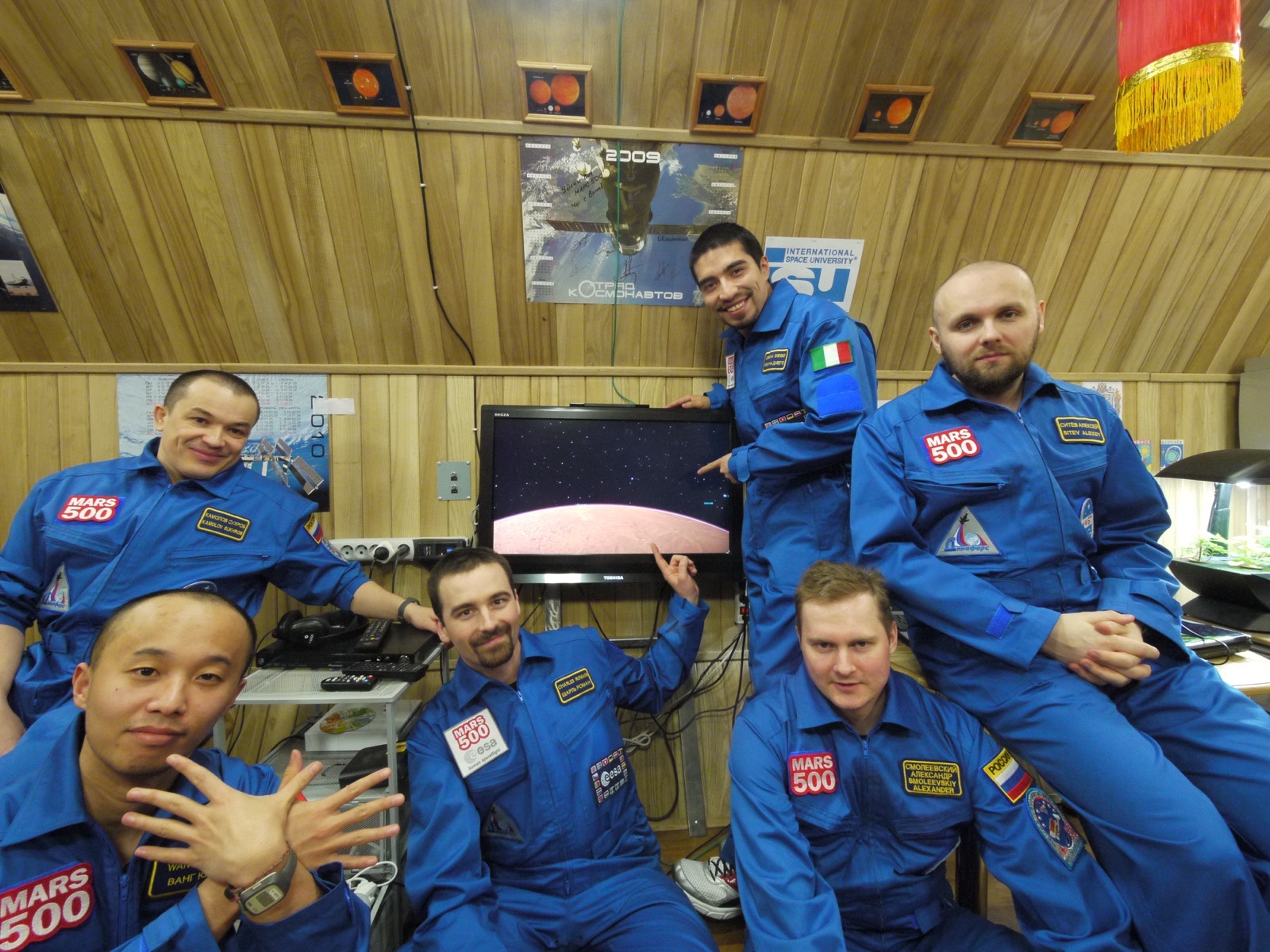
Outside the hatch were the teams who read the instruments, and most were Russian; the institute’s psychologists, Vadim Gushin, Dmitry Shved and Alla Vinokhodova among them, analysed the words of the crew’s messages to the ground. A group under David Dinges and Mathias Basner at the University of Pennsylvania, funded by NASA, supplied the wrist counters and the weekly vigilance tests; German, Italian, French, Norwegian, Czech and Chinese teams supplied the rest. Each team had its own protocol and its own data, and, as the Penn group later noted, “Agreements between the Russian IBMP (who developed and managed the 520-day simulation) and the other international partners supporting science in the simulated mission (e.g., ESA) precluded investigators from complete knowledge about each other’s experiments.” That sentence matters to what follows.
What they were trying to find out
The institute stated its purpose in its own English. “The aim of the project is investigation of the system ‘man – environment’ and obtaining of experimental data about the state of health and working capacity of the crew staying for a long time in conditions of isolation in hermetically confined environment of limited space during simulation of the main peculiarities of the Martian flight (over-duration, autonomy, changed conditions of communication with Earth – communication delay, limited consumable resources).” And then: “Among the tasks of the project is the task to determine whether such a flight is possible from the point of view of psychology and physiology (at the admissible level of simulation).”
There are two claims folded into that, and they should be separated. The first is that six people can be kept healthy, sane and working for 520 days in 550 cubic metres with no fresh air, no daylight, no resupply, and a conversation with Earth that takes up to half an hour to go round. That is a claim about the crew, and it can be tested by watching them. The second claim is quieter and was never written down as a hypothesis, but the whole design depended on it: that the people outside, with their cameras, their daily reports, their monthly medical checks and their questionnaires, could tell how the people inside were doing. That is a claim about the instruments, and it can only be tested by comparing what the watchers saw with what the instruments recorded afterwards.
The Americans put their own version in the plain language of a null hypothesis. They expected “behavioral and psychosocial responses to the prolonged period of confinement, isolation, and space operational requirements, would change systematically with time in mission,” but “due to the uniqueness and unprecedented duration of this simulation, we made no specific hypotheses related to the direction and duration of any systematic trend.” Nobody had done this before. Four people had spent more than a year in space, the record being Valery Polyakov’s 437 days aboard Mir; the longest ground simulation had been SFINCSS-99’s 240 days. On 14 August 2011 the crew would pass Polyakov’s mark, and the institute’s news page would record it to the minute: 437 days, 17 hours, 59 minutes.
Three things were decided in advance not to be simulated, and said so: weightlessness, radiation and danger. The modules sat on a floor in Moscow, and if anyone fell ill he could be out in minutes. ESA put the consequence honestly in the last week: “Real Mars-bound astronauts will be faced with additional psychological challenges. They will be in constant danger because they can’t just step from their spacecraft in an emergency.”
What they built
The facility was four sealed steel cylinders in a building on the institute’s site, joined by short tunnels, with a fifth, unsealed chamber above them. The habitable module was 3.6 metres across and 20 long, with six cabins of 2.8 to 3.2 square metres each, holding a bed, a desk, a chair and shelves; a kitchen, a living room with a large television, the main control console and a lavatory. The medical module had two berths and the equipment for the examinations. The storage module, 24 metres long, held the freezers, a dry store, an experimental greenhouse, the gym, a sauna and the bathroom. The lander, fifty cubic metres, had three bunks and was sealed off for the first eight months with its cargo inside. Together these made 550 cubic metres, the figure ESA and the institute both used. A spacecraft would not have had the panelling: the storage module was metal inside, Urbina noted, “as opposed to the rest of the ship that has a wooden interior.” Above the lander was the Martian surface: 1,200 cubic metres of chamber with a terrain of sand and rock, and an airlock holding the spacesuits.
The air was kept at a slight overpressure so that nothing could leak in. Everything the six would eat for 520 days was inside before the door closed, down to whatever could be found with a two-year shelf life for the way home, and was drawn from the store with a barcode reader and logged. Nothing came in. What went out went through the rubbish hatch: the waste, and once a week, the memory cards.
Communication was the cleverest part. For fifty-three days the crew could talk to the control room by voice. On 25 July 2010 the institute announced that “voice communication sessions will be completely ceased since the 26th of July,” and from day 54 a delay was put on every message, growing with the pretended distance: from eight seconds, to 736 seconds each way, twelve minutes and sixteen seconds, on day 351, 19 May 2011, and back down until on day 470, 15 September 2011, the crew were close enough to Earth to speak again. ESA’s public material rounded the figure to “up to 20 minutes each way.” The crew sent video messages and written “radiograms” and waited, and Charles wrote that “the video messages take so much time to come and go that the waiting is really frustrating.”
The watching went the other way too. Cameras covered the common rooms around the clock, and the crew knew it; Urbina wrote on Halloween of costumes that “must have been quite strange to the fellows that monitor us through the omnipresent video cameras 24/7.” Every morning and evening each man measured his blood pressure, pulse, temperature and weight and filled in a questionnaire about how he felt; once a month there was a full examination, and every six months a medical board sat on his fitness to continue. The institute’s news page carried a bulletin most weeks, and they read like this one, from day 485: “Scientific equipment is in operable condition. Clarification for implementation of special experiments is carried out. There are no alterations of health state which can interfere with participating in the experiment and realizing of scientific program.”
The day was the space station’s, kept to Moscow clock time: sleep from 23:30 to 08:00, work until lunch at 13:30, experiments and an hour’s physical training until supper at 19:30, then personal time; five days on and two off, with one man always on duty at the console. The experiments came in boxes, and the crew ran them on each other: ultrasound, EEGs, urine collections, wall swabs, blood draws, jump tests, docking simulations, and weekly questionnaires about mood, depression, conflict, loneliness and values. Sitev, asked at the one-year mark which experiments he did not like, said “I do not like sleep investigations. And there are a lot of repeated, similar questions in psychological tests.” Kamolov said: “nobody liked psychological tests, I think.”
The one instrument that asked nothing of them was the wristwatch. The Actiwatch Spectrum shows the time and contains a piezo-electric sensor that registers each change in the wrist’s acceleration thirty-two times a second and adds up the peaks into one number a minute, together with the light falling on it. A programme sorts each minute into active wakefulness, waking rest or sleep. The Penn group validated the algorithm on twenty-two people living in a sealed laboratory for fifteen days each, against polysomnography: it was right 96.4 percent of the time, and it overestimated sleep by about twenty-six minutes a night, which they allowed for. The watches went on at about a quarter to two on 3 June 2010. Once a week, after the evening vigilance test, each man copied his week’s data to a memory card and the card went out with the rubbish. The vigilance test, the PVT-B, was three minutes long, once a week in the morning and in the evening: watch a red box on a laptop, press the bar when a yellow counter appears, 888 times in all, with the laptop’s camera filming the face for drooping eyelids. The record was complete: 100 percent of the tests, 98.02 percent of the minutes. The instrument, and everything it recorded for each of the six, is set out in The wrist counters.
Twenty-five hours
The counters began to say something within the first month, though no one was reading them for it. The institute’s bulletin on 14 July 2010 said: “Main result of this month is the formation of joint team functioning in harmonious regime,” and that “the state of all crew members remains at control levels.” The watches say that in the first forty days the crew slept less than 6.78 hours a night on average, less than in any later period of the flight, under a workload they rated the highest of the mission; and that one man, whom the Penn group would call crewmember b, had begun to drift.
On two nights a fortnight before the hatch closed, b had fallen asleep at 00:51 and then 02:01, and had napped both days. In the first week inside, his sleep began at half past two in the morning on average, the latest of the six. In the second week it was 02:59, in the third 04:23, and in the fourth 05:12. “Nocturnal sleep onset for b drifted later than 04:00 after 16 days in mission,” the authors wrote. He was awake, in the lit kitchen and living room, at the hours of the night when light pushes the body’s clock later, and the clock duly went later. By the second quarter of the mission his sleep and waking had settled into a cycle with a period not of twenty-four hours but of 24.72, and it kept lengthening: 25.06 hours in the last quarter, 24.98 on average across the mission. The human clock, left alone, runs at about 24.18 hours; what the watches recorded was longer than that, something like the periods seen in people wintering in Antarctica, where room light at the wrong hour has the same effect. He still came to breakfast between eight and ten each morning; and every day his sleep came an hour later than the day before, round the clock and round again, so that in one month he was asleep in the afternoon and in the next awake all night.
The consequence was arithmetical. For 1,959 hours of the mission, 15.7 percent of it, b was asleep while every other man was awake, or awake while every other man was asleep. He was not the only one. Crewmember a, who slept the most of the six, had split his sleep into a night-time anchor and a daytime nap, and the nap grew. Between them, a and b were out of step with the rest of the crew for 2,498 hours, a fifth of the mission. “Such unplanned temporal desynchrony among crewmembers has the potential to pose a challenge for effective crew coordination during long-duration spaceflight,” the paper said. Nobody had diagnosed anything of the kind before the mission. “Although mission managers confirmed that the crew was selected based on extensive medical and psychological screenings to ensure he had no sleep disorders, in post-mission interviews, crewmember b indicated that he was ‘occasionally’ prone to delayed sleep onset times,” and “often ‘goes to bed very late’, especially on holidays.” He did not think it unusual. Nobody had asked him before.
Crewmember f went the other way. He slept the least of the six throughout, 6.54 hours a day on average, and unlike the others his sleep fell as the mission went on, from 6.80 hours in the first quarter to 6.33 in the third, “due to a worsening sleep onset insomnia.” His weekly ratings of his own sleep, stress and tiredness were the worst in the crew. And he made the errors. The PVT-B has no learning curve and is sensitive to sleep loss; across the mission he accounted for 64 percent of the crew’s lapses and 48 percent of their false starts, 828 errors in all against 54 for the best of the others. Of the fifty-one test videos in which the raters saw the slow eyelid closures of a sleepy man, thirty-nine were his. “The performance of crewmember f was consistent with his experiencing chronic partial sleep deprivation throughout the mission.”
Then there was the crew as a whole, which is where the title of the Penn paper comes from: “protracted crew hypokinesis.” Hypokinesis is the physician’s word for moving too little. In the first three months the time the six spent in active wakefulness fell sharply, and then it fell slowly for a year. By the last quarter of the mission each man was actively awake for 1.12 hours a day less than in the first, a drop of 7 percent; he slept 0.59 hours a day more, 8.4 percent; and he spent 0.54 hours a day more in waking rest, an increase of 50.4 percent. In the second half of the mission the six slept 673 hours more, between them, than in the first. On work days and rest days, by night and by day, the trend was the same, and their vigilance scores, far from falling, improved: with more sleep they got faster and lapsed less. The authors reached for a word from animal biology and wrote that the pattern “is suggestive of behavioral aspects of torpor, which historically refers to lethargy,” and is “consistent with the increases in sleep reported in some migratory birds and other animals living in confinement or during winter photoperiods.” Six healthy men in their thirties, on a five-day week with an hour of exercise a day, had gone into something like a slow hibernation, and had felt fine.
The watches also measured the light, and here the design had made its own weather. The lamps in the modules were fluorescent, and their spectrum was weak in the band between 446 and 477 nanometres, the blue that the circadian system listens to most. For 90 percent of their waking time the men were under less than 177 lux at the wrist, a dim office, and the average fell from 104.8 lux in the first quarter to 78.0 in the last; daylight runs to tens of thousands. There was no sun to set and none to rise. Urbina put it in a sentence after the mission: “Although there was an issue with sleeping patterns getting out of phase, it is amazing that the human body can adapt to a total lack of Sun.” The watches recorded the first half of that sentence more precisely than he knew.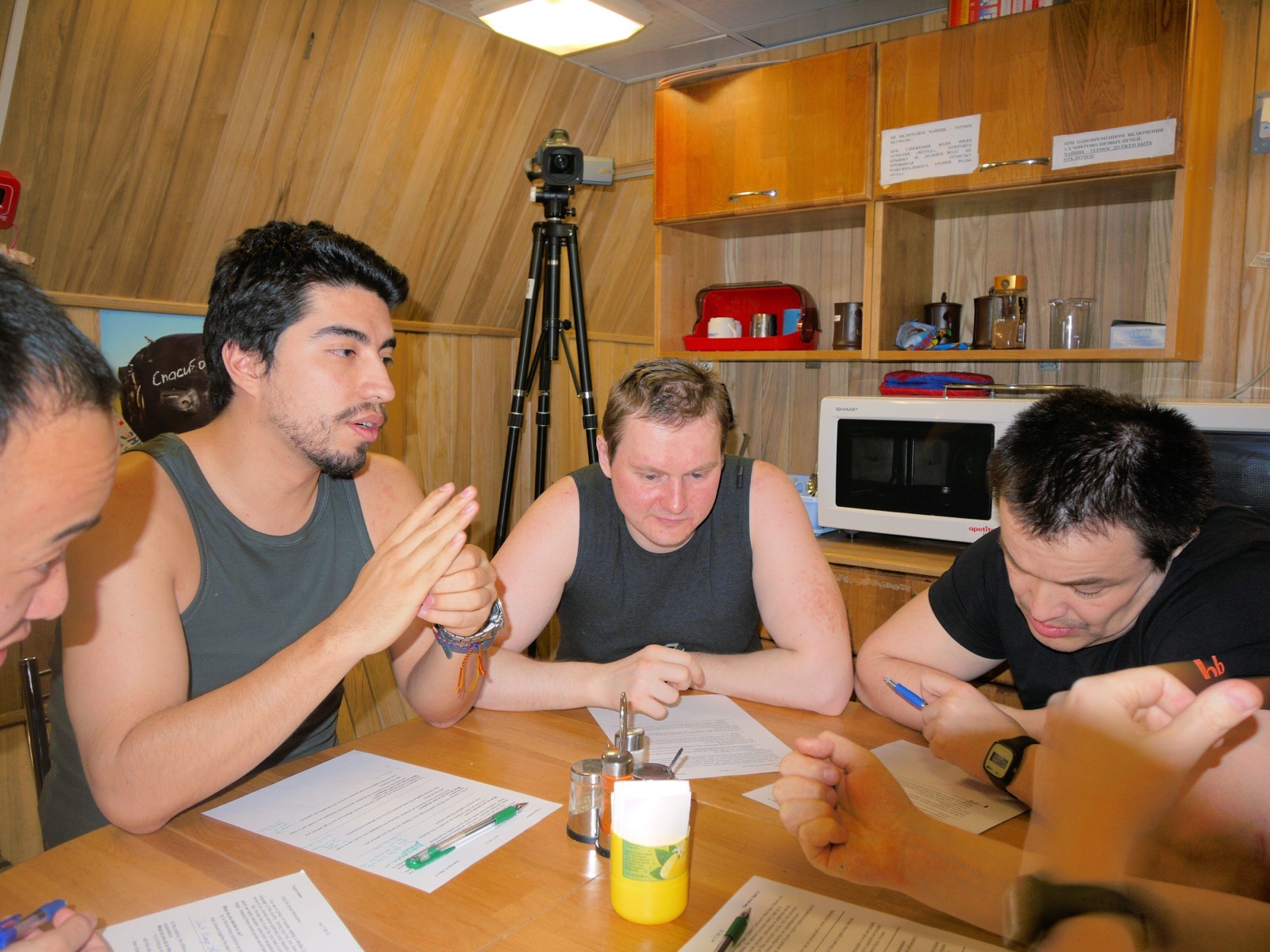
What it looked like from inside
From inside it looked like a routine, and the routine is what the crew wrote about. Charles, three weeks in, described the morning: six men emerging from “our small cocoons” into one corridor, Sitev and Kamolov always first, urine samples and the medical check to be done, “a rush hour in our narrow corridor,” and thirty minutes after waking all six at the kitchen table, “a ‘smooth routine’.” Urbina described the duty man going to the store at night with the barcode reader to “hunt” the next day’s rations, and menus that could not be changed because “scientists study the reaction of our bodies to a specific diet.” They played Portal, a game in which, Charles noted, “you take on the role of a test subject who tries to escape a scientific facility controlled by a crazy computer.”
The days were broken by what the crew made and by what the controllers did to them. On 1 December 2010, at one in the afternoon, the power went off; a message from the ground said the building’s transformer was on fire; the ventilation stopped, the water pressure fell, and the six sat in the kitchen under one light, saved the frozen food, and slept in silent rooms. The next afternoon a video message told them that “the event lasting 27 hours was a drill!” The institute’s own account times it at 22 hours 48 minutes. Urbina listed the blackout among the best things that happened: “it caught us by surprise, and in spite of the ‘risks’ it brought us together and was something very different.” Christmas was made with a cardboard tree and a poster of a fireplace; the Russian New Year was learned by the others; Wang Yue, who practised calligraphy, made six posters with six wishes for the Chinese New Year. The whole calendar, in the crew’s words, is in The crew’s calendar.
Then came Mars. On 1 February 2011, day 244, Sitev opened the two hatches into the lander, sealed since June, and the crew found it “filled with boxes from the floor to the ceiling”: food, and presents left by their families eight months before. On 8 February the landing party, Smoleevskiy in command, Urbina and Wang, moved into the lander, and on 12 February the hatch between them and the ship was closed. On 14 February Smoleevskiy and Urbina went out onto the sand in Orlan suits lightened from a hundred kilograms to thirty-five, for an hour and twelve minutes, the walk being broadcast to the real mission control centre in Korolyov so that nobody would be near the thin-walled chamber; Smoleevskiy and Wang walked on 18 February, and Smoleevskiy and Urbina again on 22 February, placing sensors and driving a rover called Gulliver. “The spacesuits were fantastic,” Urbina wrote; “after 8 months of not having used them, we could still remember how to work with them. Like riding a bike!” On 27 February, after a launch, a docking and three days of quarantine, the hatch opened and the six were together again. The watches recorded the month too: the only interruption in the crew’s lengthening sleep in the whole mission was the eighty days before and including the landing, when mean sleep dropped from 7.33 to 7.13 hours.
At the one-year mark, 3 June 2011, the institute put eighteen questions to the crew and published the answers. Charles: “For the last 12 months we didn’t have any conflict together. Our crew is as cohesive as when we entered the modules.” Urbina: “I think we have always been one cohesive group, no senseless divisions or anything.” Sitev, asked what he missed, answered “Fried meat.” Kamolov, asked whether the six had become friends: “we have become just a team.” Charles wrote the same day that “every day for the past year we woke up at the same time to do the same medical controls with the same devices: no week-end or holiday breaks for a year!”
Between 18 and 25 April 2011 the controllers had switched everything off. The crew were told there was a communications failure; no messages, no letters, no news, no telemedicine came for a week, and they ran the ship on their own timeline, “without difficulties,” the institute reported. The institute’s psychologists read the radiograms, 340 of them, 36,659 words, and found a crew that asked for less and less, “drastic reduction of the number of crew questions and requests,” and that after the week of silence sent out very little at all. They called it, after the psychologists Kanas and Manzey, “detachment”: the crew learning to solve problems without the ground, and the ground, as a later paper put it, finding that this “prevented the MCC from making effective decisions based on a clearer understanding of the situation on board.” In the crew’s accounts the week does not appear at all.
August was the worst month, and everybody said so afterwards. Sundblad, at ESA: “August was the mental low point: it was the most monotonous phase of the mission, their friends and families were on vacation and didn’t send so many messages, and there was also little variation in food.” Charles, ten days before the end: “except for a few colourful days, our months of August and September were dull.” The menu ran on a week’s cycle, and “after only one month the delicious tuna in oil vanished and, after four months, our good favourite chocolate bars followed the same fate.” Then on 15 September the delay ended and the crew could talk, and in October “each day we took one step forward and our mood rose accordingly.” “Yes, we’re ready to go!” Charles wrote on 25 October. In the last twenty days of the mission the watches recorded the six moving more, sleeping less and resting less than at any time in the previous four months; the controllers said there was no extra work, and the crew’s workload ratings agreed. They were simply, at last, awake.
What happened
The six came out on time, in good health, and said they were. The institute’s summary at the one-year point had already given the verdict it would keep: “The crew of 520-day isolation went through this stage as the single unity. There were not any conflict situations, moreover no situations requiring interference of the ground-based services.” Sundblad, a week before the end: “Yes, the crew can survive the inevitable isolation that is for a mission to Mars and back. Psychologically, we can do it.” And: “In fact, we anticipated many more problems, but the crew has been doing surprisingly well.” On 8 November they met the press; a month of tests in Moscow followed, then more in Germany. In April 2012 the institute gathered 127 oral and 46 poster papers at a symposium in the Academy of Sciences, and the results began to come out.
Measured as a demonstration, it had worked. Measured by the instruments, it had worked in a more complicated way.
The wrist counters said what the section above says, and said it in the Proceedings of the National Academy of Sciences on 7 January 2013. Four of the six, the authors summarised, “experienced one or more of the following problems: disrupted sleep–wake periodicity (n = 1), increased displacement of sleep into the diurnal period (n = 2), performance deficits associated with chronic partial sleep deprivation (n = 1), and frequent reductions in perceived sleep quality (n = 2),” and “these problems occurred early in the mission and persisted unabated.”
The questionnaires, reported by the same group in PLOS ONE in March 2014, were the crew’s own account of themselves, taken weekly, and they told a story between the two others. On average the crew was fine: a depression score of 2.2 out of 100 across the mission, “no consistent signs of elevation in total mood disturbance,” low stress, sleep rated good. But the average was six men. One, crewmember e, reported symptoms of depression in 93 percent of the mission’s weeks, mild in seven of the seventy-four and moderate in one, and scored highest on every scale of distress. He had also, before the mission, scored lowest of the six on a test of social desirability, the tendency to present oneself well, while two others had scored 81 out of 100. “Although crewmember e was the only subject to report these symptoms, it is unclear whether he was the only subject that experienced them.” Conflicts were reported forty-one times with mission control and eight times among the crew, and two men, e and f, reported 85 percent of them. In the debriefs, asked which two crewmates they had talked to most, the six pointed to c and d; a was named by no one, f by one. Only c and d, in the whole record, “showed neither behavioral disturbances nor reports of psychological distress.”
The other instruments each added a finding, and they are set out in The other instruments. The radio badges logged the crew spending less and less of their free time together, with the deepest low on day 470, the day the voice link came back. The belt accelerometers, an entirely separate dataset, agreed with the wrists: “Physical activity … decreased progressively over the course of isolation,” and jump power fell with it. The salt study found sodium leaving the body on a weekly rhythm “independent of salt intake.” The immune study found “elevated cortisol levels.” Gro Sandal’s group in Bergen found that “crew members were highly reluctant to express negative feelings towards each other, which increased towards the end of the mission.”
Put the pile together and it is not a contradiction, but it is not one story either. The cameras and the bulletins saw a unit. The crew, asked, said unit. The questionnaires said unit on average and said, underneath, one man in some distress and two who carried most of the friction. The badges said the unit spent less and less time together. The wrists said the unit was slowing down, sleeping longer, one man drifting round the clock and one man short of sleep and making errors. None of these instruments was wrong. They were measuring different things, and only one of them had been running every minute.
After
The data from the watches were deposited, the paper says, as an Excel file on a University of Pennsylvania server. The crew’s names are not in it: the Penn group randomised the six to the letters a to f and reported nothing about nationality, age, profession or role, and this entry says “one man” and leaves it there.
Boris Morukov died in Moscow on 1 January 2015, at sixty-four, as the institute’s deputy director. The chambers did not stay empty. From 2017 the institute ran a new series in the same modules, SIRIUS, with mixed crews, a five-minute delay and a landing half-way: seventeen days in 2017, 120 in 2019, eight months in 2021 to 2022. The institute’s psychologists found the detachment again: as in Mars-500, they wrote in 2021, the crew “did not demonstrate benevolence in contact with the MCC, less sharing with earth their problems, and needs in the second part of the mission.” The analysis is still coming out; the gut flora of the six were reanalysed in 2021.
In April 2012 ESA wrote that Charles and Urbina were “looking forward to using their hard-won expertise on new projects in Europe’s space industry.” All six, the Penn group noted, had been “free to discontinue the study at any time,” and none did; and the one thing every account agrees on, from the institute’s bulletins to the watches’ last twenty days, is that on 4 November 2011 they walked out on time.
What it taught
Start with what it was not. It was not a failure, by any measure its designers set: six men lived 520 days in 550 cubic metres, ran a hundred experiments on themselves, landed on a pretend planet and came home, with no conflict that needed the ground and no illness that needed the door. It was not a flight; the designers said so. And it was not a deception: everyone outside reported what they saw, and what they saw was true. What the wrist counters added was a second description of the same 520 days, taken by an instrument that did not ask the crew how they were.
A system can work and its record can still read otherwise. The bulletins said “no alterations of health state”; the medical boards passed everyone; the crew said no conflicts; and the crew were right about the thing they were asked about. The watches recorded a crew that was 7 percent less active, slept 8 percent more and rested 50 percent more by the end than at the start, one man on a twenty-five-hour day and one man chronically short of sleep, from the first weeks to the last. The lesson is not that the watchers were careless. It is that “the crew is fine” and “the crew is changing” are different questions, and only one of them was being asked every day.
Self-report is an instrument with a bias, and the bias was measured. The Penn group tested the crew’s social desirability before the door closed, and the one man who later reported depression in nine weeks out of ten was the one least inclined to present himself well, while two who reported none scored 81 out of 100. Sandal’s group found the men “highly reluctant to express negative feelings towards each other,” more so as the end approached. A man who is asked how he slept answers as the kind of man he is; a counter on his wrist answers only for the wrist. If a system’s health is to be judged by what the people in it say, measure first how they say things.
The instrument nobody reads while it runs is the one that will tell you most, afterwards. The watches’ cards went out with the rubbish once a week, were checked for completeness, and were read in full after the mission by a team whose agreement with the institute kept it from knowing what the other teams were seeing. Nothing in the design made the continuous record part of the running of the mission, and so the one drift the paper itself says light can address, a man’s sleep sliding an hour later every night under dim fluorescent lamps, ran uncorrected for seventeen months. The paper’s own prescription is engineering: habitats “that instantiate aspects of Earth’s geophysical signals (appropriately timed light exposure, food intake, exercise).” That is an answer to the drift. The prior question, who reads the wristwatches while the ship is still flying, is a question about the control room, not the lamps.
Six people are six experiments. Two of the six, c and d, showed nothing: no change in sleep, timing or quality, no distress on any scale, and they were the two the others talked to most. Four showed something, each a different thing, each present early and persisting. The paper’s conclusion is that the traits are “phenotypic,” visible in weeks rather than years, and that selection and countermeasures should be individual. The complication is that the man with the twenty-five-hour day passed “extensive medical and psychological screenings” and did not consider his sleep unusual, because at home, with the sun, it was not. The environment selected for the trait; the screening had not been done in the environment.
The detachment runs both ways. The crew asked the ground for less and less, until a week of silence was “without difficulties.” The ground, by its own psychologists’ account, found it harder and harder to know “the situation on board.” That is adaptation, and it is also the loss of the one instrument the mission was built around, the conversation between a crew and the people watching it. The autonomy arrived before anyone had decided what the ground was still for.
Check the story before you learn from it. The experiment is 520 days from 3 June 2010 to 4 November 2011 in every official account, which by subtraction is 519 and by counting both days 520; the institute’s February 2011 press kit gives the finish as 5 November, and so did Charles in June. The delay reached 736 seconds each way by the timeline and “up to 20 minutes” in the press material. The experiments number 95, 105, “more than 100”, 91 and 106 in five documents from the same project. The power cut lasted 22 hours 48 minutes by the institute’s clock, twenty hours by the crew’s count of darkness and twenty-seven by Charles’s reckoning. The week of simulated silence ran from 18 to 25 April 2011 in the institute’s summary and began on 25 April in ESA’s timeline; the lander’s hatch closed on 8 February in that timeline and on 12 February in the institute’s news. Kamolov was thirty-two on the institute’s candidate list of February 2010 and thirty-seven in every later account. Tafforin’s paper starts the mission on 5 June 2010, two days late. The hatch opened at 14:00 Moscow time, which the institute’s front page calls 14:00 GMT and ESA, correctly, 10:00 GMT. What the record supports without argument is the dates, the six names, the 4,396,333 minutes, the figures in the Penn tables, and six men who walked out on time. That is enough to learn from.
Sources
- Mathias Basner, David F. Dinges, Daniel Mollicone, Adrian Ecker, Christopher W. Jones, Eric C. Hyder, Adrian Di Antonio, Igor Savelev, Kevin Kan, Namni Goel, Boris V. Morukov and Jeffrey P. Sutton, “Mars 520-d mission simulation reveals protracted crew hypokinesis and alterations of sleep duration and timing”, Proceedings of the National Academy of Sciences 110 (7), 2635–2640, published online 7 January 2013, with the Supporting Information Appendix (Tables S1 to S7, Figs. S1 to S7) and the correction of 25 January 2013. Every figure for the wrist counters, the vigilance tests, the light, crewmembers a, b and f, Tables S2 and S3, the timeline, the validation study and the de-identification. Free to read on the PNAS site; not under a Creative Commons licence, which is why no figure from it appears here. The PDF with the appendix is on the authors’ site. doi:10.1073/pnas.1212646110, med.upenn.edu (PDF with appendix), correction
- Mathias Basner, David F. Dinges, Daniel J. Mollicone, Igor Savelev, Adrian J. Ecker, Adrian Di Antonio, Christopher W. Jones, Eric C. Hyder, Kevin Kan, Boris V. Morukov and Jeffrey P. Sutton, “Psychological and behavioral changes during confinement in a 520-day simulated interplanetary mission to Mars”, PLOS ONE 9 (3), e93298, 27 March 2014, CC BY. The crew’s ages, the 91 experiments, the social-desirability scores, the depression and mood tables, the conflicts, the debrief sociogram, crewmembers c, d and e, the null hypothesis, the limitations and the SFINCSS-99 comparison. doi:10.1371/journal.pone.0093298
- European Space Agency, Mars500 pages: “Mars500 quick facts” (the timeline and the 8-to-736-second delay), “Mars500: study overview”, “The isolation facility” (the modules and their dimensions), “Mars500 crew”, “ESA and isolation studies” (the 1967/68 study, HUBES, SFINCSS and the 2004 invitation), “Mars500 crew prepare to open the hatch” (28 October 2011, Sundblad’s words), “Welcome back and thank you, Mars500” (4 November 2011, the hatch time and the crew’s words), “Life after Mars” (18 April 2012), “Choosing the right people to go to Mars” (16 January 2013, Urbina on the Sun and Ngo-Anh), and the Mars500 Information Kit of February 2011 (the selection numbers, the crew biographies, the protocols). ESA copyright; quoted briefly with attribution. esa.int/Mars500, quick facts, the isolation facility, prepare to open the hatch, welcome back, choosing the right people, information kit (PDF)
- The Mars500 mission diaries of Diego Urbina and Romain Charles, published by ESA, 2010 to 2011: “This is our home, our workplace and our life” (7 July 2010), “‘Smooth routine’ and interplanetary birthday party” (22 July 2010), “Waste not – want not” (18 August 2010), “Science and thoughts of Chilean miners” (10 September 2010), “‘Are we alone?’” (10 November 2010), “Of emergencies and Christmas trees” (12 January 2011), “Approaching the Red Planet” (26 January 2011), “Celebrating Chinese New Year” (2 February 2011), “Unpacking the Lander” (9 February 2011), “Greetings from Mars!” (1 March 2011), “Long trip without moving anywhere” and “Thank you folks on twitter!” (3 June 2011), “The best moments of our trip” (17 August 2011), “Earth approaching!” (24 October 2011) and “Countdown is on!” (26 October 2011). The crew’s own words throughout; ESA copyright, quoted briefly with attribution. Mars500 diary index, Countdown is on, Of emergencies and Christmas trees, Greetings from Mars
- Institute of Biomedical Problems, “Mars-500” project site (English): the front page (the end “at 14:00 (GMT)”), “About the project” (the aim and the “April 2010 – October 2011” dates), “The main purpose of 520-day isolation”, the news page 2010 to 2011 (the candidate list of 26 February 2010 with ages and the programme of 95 experiments, the first-month bulletin of 14 July 2010, the end of voice communication on 25 July 2010, the power cut of 1 to 2 December 2010, the landing dates of 18 January 2011, the Polyakov record of 12 August 2011, the weekly bulletins), the one-year summary “Intermediate results” of 3 June 2011 (the work and rest regime, the medical boards, “the single unity”, the two off-nominal situations), the crew interview of 3 June 2011, and the press kit 520-day isolation: Landing of the surface of Mars of February 2011 (the 105 experiments and the “November 5” finish). The institute’s English, quoted as printed. mars500.imbp.ru, one-year results, crew interview, news, landing press kit (PDF)
- Institute of Biomedical Problems, International Symposium on the Results of the Experiments Simulating Manned Mission to Mars (Mars-500), April 23–25, 2012: Abstracts Book, Moscow 2012, edited by I. B. Ushakov. The 106 investigations and 127 oral papers; the abstracts of Basner and of Dinges (the “circa 25h” period), Ehmann, Balazs, Shved and Gushin (the 340 radiograms), Gunga (core temperature), Lv and colleagues (the Chinese EEG), Sandal, Bye and van de Vijver (values and reluctance), Poláčková Šolcová, Šolcová and Vinokhodova (the flight-story interviews). PDF
- Bernd Johannes, Alexej S. Sitev, Alla G. Vinokhodova, Vyacheslav P. Salnitski, Eduard G. Savchenko, Anna E. Artyukhova, Yuri A. Bubeev, Boris V. Morukov, Carole Tafforin, Mathias Basner, David F. Dinges and Jörn Rittweger, “Wireless monitoring of changes in crew relations during long-duration mission simulation”, PLOS ONE 10 (8), e0134814, 2015, CC BY. The badges, the 95.7 percent agreement with the video of day 475, the falling index and its minimum on day 470. doi:10.1371/journal.pone.0134814
- Daniel L. Belavý, Ulf Gast, Martin Daumer, Elena Fomina, Rainer Rawer, Hans Schießl, Stefan Schneider, Harald Schubert, Cristina Soaz and Dieter Felsenberg, “Progressive adaptation in physical activity and neuromuscular performance during 520d confinement”, PLOS ONE 8 (3), e60090, 2013, CC BY. The belt accelerometers, the jump and hop tests, the data leaving “via the rubbish disposal unit”, and the burst of walking after Mars. doi:10.1371/journal.pone.0060090
- Christopher J. Gaffney, Elena Fomina, Dennis Babich, Vladimir Kitov, Konstantin Uskov and David A. Green, “The effect of long-term confinement and the efficacy of exercise countermeasures on muscle strength during a simulated mission to Mars: data from the Mars500 study”, Sports Medicine – Open 3, 40, 2017, CC BY. doi:10.1186/s40798-017-0107-y
- Natalia Rakova and colleagues, “Long-term space flight simulation reveals infradian rhythmicity in human Na+ balance”, Cell Metabolism 17, 125–131, 2013, and Kathrin Lerchl, Natalia Rakova, Anke Dahlmann, Manfred Rauh, Ulrike Goller, Mathias Basner, David F. Dinges and colleagues, “Agreement between 24-hour salt ingestion and sodium excretion in a controlled environment”, Hypertension 66, 850–857, 2015. The salt rhythms; read as abstracts, the papers being paywalled. pubmed 23312287, pubmed 26259596
- Bing Yi, Marina Rykova, Matthias Feuerecker and colleagues, “520-d isolation and confinement simulating a flight to Mars reveals heightened immune responses and alterations of leukocyte phenotype”, Brain, Behavior, and Immunity 40, 203–210, 2014; abstract. pubmed 24704568
- Petra Schwendner, Alexander Mahnert, Kaisa Koskinen, Christine Moissl-Eichinger, Simon Barczyk, Reinhard Wirth, Gabriele Berg and Petra Rettberg, “Preparing for the crewed Mars journey: microbiota dynamics in the confined Mars500 habitat during simulated Mars flight and landing”, Microbiome 5, 129, 2017, CC BY; Silvia Turroni and colleagues, “Temporal dynamics of the gut microbiota in people sharing a confined environment, a 520-day ground-based space simulation, MARS500”, Microbiome 5, 39, 2017, CC BY; A. V. Mardanov and colleagues, “Metagenomic analysis of the dynamic changes in the gut microbiome of the participants of the MARS-500 experiment”, Acta Naturae 5 (3), 116–125, 2013, CC BY. doi:10.1186/s40168-017-0345-8, doi:10.1186/s40168-017-0256-8, PMC3848073
- Philippe Arbeille, Romain Provost, Nicole Vincent and Andre Aubert, “Adaptation of the main peripheral artery and vein to long term confinement (MARS 500)”, PLOS ONE 9 (1), e83063, 2014, CC BY; Jamaji C. Nwanaji-Enwerem and colleagues, “A longitudinal epigenetic aging and leukocyte analysis of simulated space travel: the Mars-500 mission”, Cell Reports 33, 108406, 2020. doi:10.1371/journal.pone.0083063, doi:10.1016/j.celrep.2020.108406
- Yue Wang, Xiaolu Jing, Ke Lv, Bin Wu, Yanqiang Bai, Yuejia Luo, Shanguang Chen and Yinghui Li, “During the long way to Mars: effects of 520 days of confinement (Mars500) on the assessment of affective stimuli and stage alteration in mood and plasma hormone levels”, PLOS ONE 9 (4), e87087, 2014, CC BY. The third-quarter pattern. doi:10.1371/journal.pone.0087087
- Carole Tafforin, “Time effects, cultural influences, and individual differences in crew behavior during the Mars-500 experiment”, Aviation, Space, and Environmental Medicine 84 (10), 1082–1086, 2013 (which gives the start as 5 June 2010), and “Confinement vs. isolation as analogue environments for Mars missions from a human ethology viewpoint”, Aerospace Medicine and Human Performance 86 (2), 131–135, 2015; abstracts. Iva Šolcová, Vadim Gushin, Alla Vinokhodova and Jiří Lukavský, “Emotional energy, work self-efficacy, and perceived similarity during the Mars 520 study”, Aviation, Space, and Environmental Medicine 84 (11), 1186–1190, 2013; abstract. pubmed 24261062, pubmed 25946738, pubmed 24279233
- D. M. Shved, V. I. Gushchin, B. Ehmann and L. Balazs, “Characteristics of the signal lag effect on crew–control center communications in the 520-day simulation experiment”, Aviakosmicheskaia i Ekologicheskaia Meditsina 47 (4), 19–23, 2013, abstract in English; and Natalia Supolkina, Anna Yusupova, Dmitry Shved, Vadim Gushin and colleagues, “External communication of autonomous crews under simulation of interplanetary missions”, Frontiers in Physiology 12, 751170, 2021, CC BY, which describes the Mars-500 “detachment” and the SIRIUS runs of 2017 and 2019. The eight-month SIRIUS-21 run is described in Ivan Rozanov and colleagues, “Retinal vascular changes and arterial stiffness during 8-month isolation and confinement: the SIRIUS-21 space analog mission”, Frontiers in Physiology 15, 2024. pubmed 24032160, doi:10.3389/fphys.2021.751170, PMC11163205
- Mathias Basner and colleagues, “Proximity measurements for objective assessments of crew cohesion in an Antarctic space analog environment”, Frontiers in Psychology, 2026; and Nicholas J. B. Brereton, Frederic E. Pitre and Emmanuel Gonzalez, “Reanalysis of the Mars500 experiment reveals common gut microbiome alterations in astronauts induced by long-duration confinement”, Computational and Structural Biotechnology Journal 19, 2223–2235, 2021, CC BY. PMC13283885, PMC8099722
- Boris Morukov’s dates and career from the cosmonaut biography at spacefacts.de and the reports of his death on 1 January 2015 (Space.com, AFP). spacefacts.de, space.com
- The cost: Viktor Baranov’s figure of more than fifteen million dollars and the 50,000-euro payment, from Novosti Kosmonavtiki news of 10 January 2008 as quoted by the RuSpace blog, which is where I read it, at second hand; the same fifteen million was given by NPR on 3 November 2011. suzymchale.com (RuSpace, 2008), npr.org
- The two photographs are ESA’s, published on esa.int under the ESA Standard Licence, whose terms permit images to be “used, reproduced, broadcasted and publicly performed for educational, editorial or informational purposes” free of charge with credit; both are credited to ESA alone. Crew in May, Mars500 crew with questionnaires, ESA image terms
- This entry sits beside Two Years Under Glass and Ninety-One Percent, the two sealed systems on this site that recycled their air; Mars-500 recycled nothing and measured its people instead.