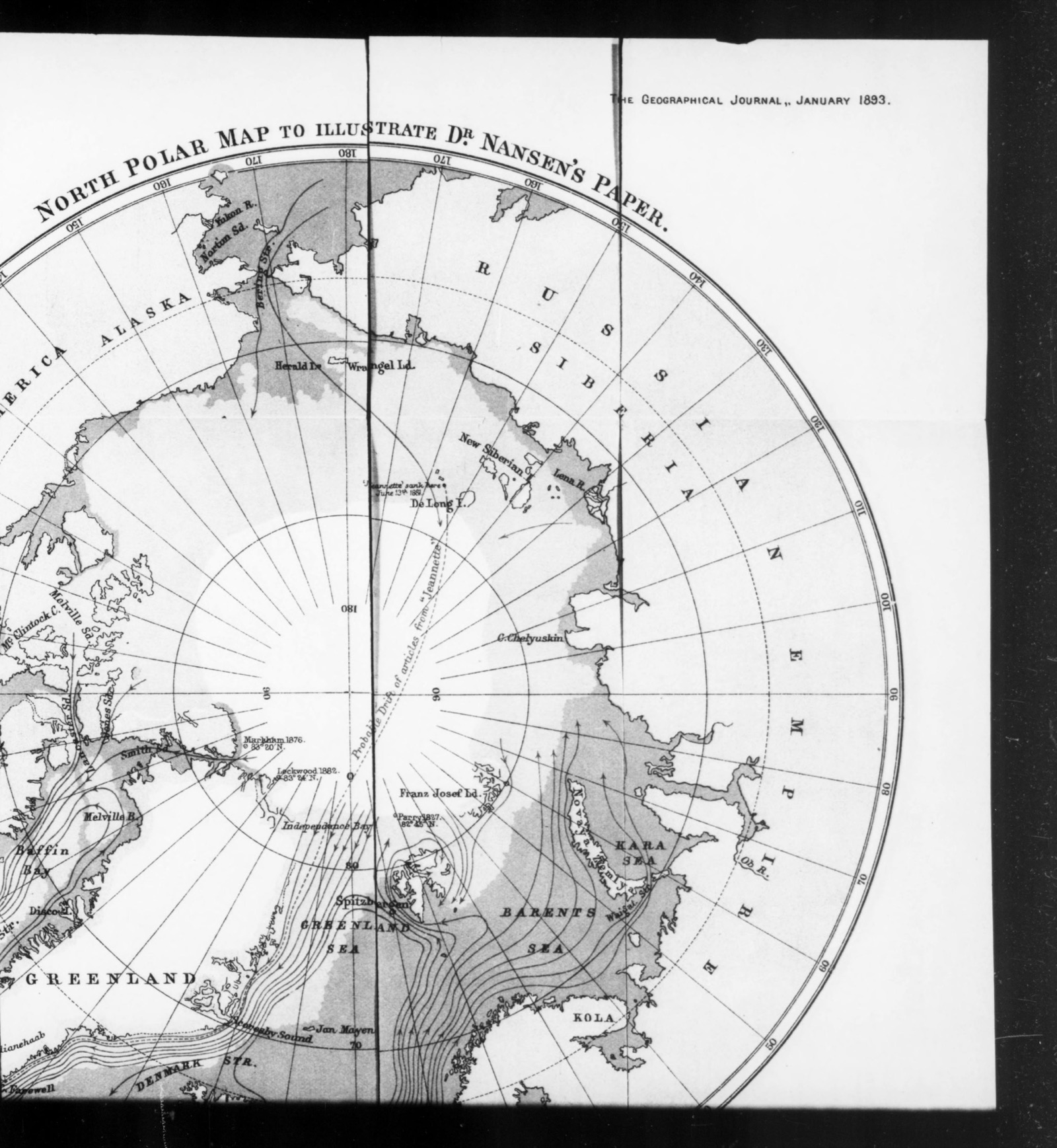
Late in the afternoon of 18 June 1884, three Greenlanders hunting seals in kayaks in the fjord off Julianehaab, on the south-west coast of Greenland, noticed a raven that would not leave a piece of floating ice. They worked their way over to it. A cotton sock was sticking out of the ice. Round it, frozen in, were other things: the lower half of a tent, a bearskin, a boot of sealskin, scraps of paper, buttons and clothes, among them a pair of oilskin trousers with a name written inside them. The men had no tools for the work. They freed what they could, saw that the floe was breaking in two, and left the rest.
The ice in the fjord was bad for two days, and it was 20 June before one of the three reached Julianehaab and told the colonial manager, Carl Lytzen. Lytzen went out at once with the man and four other kayakers and could not find the floe, and a reward brought nothing. But in the days that followed a second find was reported from Qassimiut, a small trading post sixty-odd kilometres to the north-west: fifty-eight pieces of clothing, some of them already being worn by the people who had found them. Lytzen bought what he could. On 23 June he wrote to the Danish consulate in New York, and gave his letter to the captain of an American cryolite barque that was loading at Ivigtut.
The name inside the oilskin trousers was Louis Noros. He was a seaman of the United States Navy, and three years earlier, to the day, he had walked off a floe on the far side of the Pole, north of the New Siberian Islands, with thirty-two other men, dragging boats towards Siberia. The place where their ship had gone down was about 2,500 nautical miles from Julianehaab in a straight line, and the straight line passed within a few degrees of the North Pole.
That autumn a 23-year-old curator of the Bergen museum, who had never been north of the Arctic Circle, read about the find in a newspaper in Christiania. He wrote later that his plan was laid at that moment.
Who ran it
James Gordon Bennett junior owned the New York Herald and spent its money on news that did not yet exist. In 1869 he had sent Henry Morton Stanley to find Livingstone. In March 1877 he went to Gotha, in Thuringia, to see August Petermann, the cartographer whose journal set the agenda of European exploration and who had started the two German polar expeditions. Bennett wrote to a young naval officer in New York what Petermann had told him. “He told me he had been studying the North Pole problem for the last thirty years, and that he feels certain it can be reached, but never, he said, by Smith’s Sound or Baffin’s Bay.” The English held to that route, both men agreed, “simply from pride”. Petermann’s view was that the Pole could only be reached “by a dash”, “in one summer”, by a suitable ship through Bering Strait, “and that with a suitable vessel and commander experienced in ice navigation, he would himself try the experiment for a three months’ cruise.” He thought wintering a mistake, and added an observation Bennett passed on: “it is the second winter, and not the first, men most suffer in the Arctic regions.” Petermann did not live to see the experiment. He killed himself at Gotha on 25 September 1878.
The officer was George Washington De Long, born in New York on 22 August 1844, a graduate of the Naval Academy of 1865, who in the summer of 1873 had taken a steam launch, the Little Juniata, up the Greenland coast through the ice to look for the survivors of the Polaris. On the first day of November that year, at dinner with Henry Grinnell, who had paid for two of the searches for Franklin, De Long asked why Grinnell did not fit out an expedition to the Pole. “I am too old a man,” Grinnell said. “There is Mr. James Gordon Bennett. He is the man to undertake such an expedition. You should apply to him.” De Long wrote to Bennett that week.
What they wanted was a ship, and in 1877 the only one for sale in Britain that would do was the Pandora, a former Royal Navy gunboat that Sir Allen Young had bought from the Admiralty in 1875 and taken twice to the Arctic as a yacht. She was refitted at Deptford in the spring of 1878, renamed Jeannette after Bennett’s sister, christened at Le Havre on 4 July 1878, and sent round Cape Horn to San Francisco. Congress accepted her into the Navy by an Act of 27 February 1879, on Bennett’s terms: he paid, the Navy supplied the officers and men and the discipline, and the ship flew the pennant of a national vessel.
Her thirty-three were a naval crew with civilians attached. Lieutenant Charles Chipp, who had been with De Long in the Little Juniata, was executive officer; Master John Danenhower was navigator; George Melville was chief engineer; James Ambler was surgeon. Jerome Collins, the Herald’s meteorologist, came as scientist and correspondent; Raymond Newcomb as naturalist and William Dunbar, a whaling captain, as ice pilot. Among the seamen were William Nindemann, who had drifted six months on an ice floe with the Polaris party in 1872 and 1873, and Louis Noros. Two Alaskan hunters, Alexey and Aneguin, were shipped at St Michael with the dogs.
What they were trying to find out
De Long had set out the choice to Bennett on 25 January 1878. “There are three ways for us to send the expedition, Smith’s Sound, Behring Strait and east coast of Greenland. Of the three I am in favor of Behring Strait.” The editors of his journal, writing in 1883 with his papers in front of them, put the reasons in a paragraph that is the hypothesis of the experiment.
“The reasons which determined the course of the exploration, besides the failures from other points, were, in brief, the existence of the Japan current, flowing through Behring Strait to the north, and the supposed extent of Wrangel Land. It was hoped that the warm waters of the current would open a way, possibly to the Pole. The experience of whalers was that whenever they had been obliged to abandon their vessels in those regions, the vessels had been drifted northward, and the inference was that the currents generally flowed in that direction. This would help explorers to make a high latitude, though it would, for the same reason, increase the difficulties of return. On the supposition that Wrangel Land, now known to be a small island, was a vast continental tract, it was expected that the Jeannette, in accordance with settled principles of Polar exploration, would follow its coast line to the north. When the vessel could work no further, sledge expeditions were to start out along the ice-foot to make a still higher latitude. Dr. Petermann, indeed, supposed Wrangel Land to stretch across the Pole and to reappear as Greenland of the Western continent.”
So there were two claims. The first was about water: that the Kuro Siwo, the warm current of the Japanese coast, went on through Bering Strait and kept a channel open far to the north, a “thermometric gateway”, in the phrase of the time. The second was about land: that the coast which the whaler Thomas Long had seen from a distance in 1867, and called Wrangel Land, was the edge of a continent, with an ice-foot a sledge party could follow. Under both lay a third, which nobody wrote down as a claim, because it looked like a fact: that a ship beset off that coast would drift north.
The instrument for testing all three was the ship. She would steam as far as the warm water took her; she would winter against the land; and if the ice caught her, the drift would carry her towards the Pole. That was the design. What it did not contain was a way for the ship to report. There were no carrier pigeons, no cairns planned, no relief ship ordered. The only channel from the experiment to the people who had framed it was the ship herself, coming back.
The Navy’s orders, dated 18 June 1879, were almost blank. “On reaching Behring Strait, you will make diligent inquiry at such points where you deem it likely that information can be obtained concerning the fate of Professor Nordenskjöld,” whose Vega had wintered on the Siberian coast and not been heard of since. “If you have good and sufficient reasons for believing that he is safe, you will proceed on your voyage toward the North Pole.” Bennett’s last word came by cable from Europe. “Say, also, he may push forward to north next spring with perfect confidence, for if ice-bound, I shall spare neither money nor influence to follow him up and send assistance next year, so neither he nor his men will be in danger. I wish this to be an American success.”
What they built
The Jeannette was a wooden steamer with three masts, a single screw and a yacht’s lines. The Navy’s survey board at Mare Island reported that her frames were single and “very light, probably 6 by 8 inches in dimensions, and spaces between frames about 2 feet”; “in fact she was a lightly built vessel.” The yard did what it could in the spring of 1879. De Long described the result to Bennett: “The bow had been filled in solid for a distance of ten feet from the stem, and for forty feet in length, and eight feet in depth amidships; the inside had been ceiled with oak planks six inches thick. Exactly amidships a very heavy system of kneed braces had been placed.” “The thickness of the vessel amidships is nineteen and a half inches,” he wrote. The board had asked for four six-inch watertight bulkheads; athwartship trusses were put in instead, and the stanchions under the beams were left out “because they were not authorized by the Bureau.”
She sailed from San Francisco on 8 July 1879, deep in the water with coal and three years’ provisions, and the season was already late. She called at Unalaska and St Michael, crossed to the Siberian side to ask after Nordenskiöld, satisfied herself at St Lawrence Bay that the Vega had got through, and at the end of August turned north with nearly 160 tons of coal. On the evening of 4 September Herald Island was sighted, and beyond it, through mirage, mountains that could only be Wrangel Land. On 5 September she entered the pack, grinding through young ice until “we came to pack ice from ten to fifteen feet in thickness, which of course brought us up.”
“This is a glorious country to learn patience in,” De Long wrote on 6 September. “As far as the eye can range is ice, and not only does it look as if it had never broken up and become water, but it also looks as if it never would.” On the seventh the ice took her on the starboard beam and listed her five degrees. On 9 September, by observation, she was in 71° 35’ north, 175° 6’ west, and at sunset the land showed clearly to the south-west. “And this is the land which, two months ago yesterday, we sailed for from San Francisco, hoping to explore this winter. Man proposes but God disposes. Here we are not even able to get to Herald Island.” On 11 September the lead, left on the bottom, showed the ship being carried away from it towards the north-west.
She had been at sea fifty-nine days, and the ice did not let go of her again.
Twenty-one months
The first winter was spent going round in circles within sight of the land she had come to explore, north-west on south-east winds and back again on north-west ones. By the end of the winter the men in the crow’s nest had seen the north side of Wrangel Land, and that settled the second claim. “Up to this time,” Danenhower wrote, “we had only demonstrated to our satisfaction that Dr. Petermann’s theory in regard to Wrangell Land being a portion of Greenland was no longer tenable, for its insularity was evident, as subsequently proved.” The continent that was to have led them to the Pole was an island about eighty miles long, and the Jeannette was drifting past the top of it.
On the night of 19 January 1880, in a temperature of 44 degrees below zero, the ice came in on the bow and the ship began to leak. The forefoot had been broken or twisted and the garboard planks started; water rose in the fore peak faster than the hand pumps could take it. Sledges packed with forty days’ provisions stood ready on the poop that night, and the records and papers were “in condition to seal up in a box”. Melville moved a steam pump forward; Nindemann and Sweetman stood in turns in the water of the fore peak building a bulkhead across it. For the rest of the ship’s life the pumps ran, by steam while the coal lasted, then by a windmill Melville built on deck, then by hand. “Men cannot stand pumping from now till spring,” De Long had written on the first night, and they pumped for seventeen months.
By June 1880 De Long had read the result of the first claim as clearly as Danenhower had read the second, and on 3 June he wrote it into the journal while working out where the ice went: not south, or Bering Strait would long since have been choked; not north, where it probably never broke up. “To go west is contrary to hypotheses based on the rotation of the earth and the supposed direction of equatorial currents; but we have gone N. W. by the prolonged action and force of S. E. winds. Therefore the wind may overpower the attraction of rotation, and set the ice in this ocean so far to the westward as to bring it within the influence of the Polar current about Spitzbergen, and discharge it thus into the Atlantic.” Then the verdict. “As to there being any warm current reaching to a high latitude, I very much doubt. We have found none; and I am inclined to agree with Lieutenant Weyprecht when he says, ‘The Gulf Stream does not regulate the limits of the ice, but the ice, set in motion by winds, regulates the limits of the warmer Gulf Stream water’; and I pronounce a thermometric gate-way to the Pole a delusion and a snare. Of course if any warm current came through Behring Strait it would be the Kuro Siwo, and our sea temperatures indicated no such fact.”
In that paragraph the experiment had answered both questions it had been sent to ask, and had named, in passing, the thing it would be remembered for. Nobody could read it. The ship did not get free that summer. “One year in the ice!” De Long wrote on 5 September 1880, “and we are only one hundred and fifty miles to the northward and westward of where we entered it.” The next day: “I suppose we may now say good-by to the Pole or the Northwest Passage. With us it is now another winter in the pack or a failure. If we get the ship in open water again, it is a question of our ability to keep her afloat.”
The second winter was quieter and worse. The ship drifted now steadily to the north-west and the sun went. The company wore as the ship did: lead poisoning from the tinned food, a coal-heaver who believed a mutiny was being got up around him, a navigator half blind and kept in the dark, the Herald’s correspondent under suspension after a quarrel with his commander. In May 1881 the soundings deepened as the ship went north, and on 16 May land was sighted to the south-west, the first in fifteen months: an island, then a second, which De Long named Jeannette Island and Henrietta Island. On 24 May he reckoned the drift since the 20th at thirty-two and a half miles. “This is progress indeed, — eight miles a day.” Since the new year the ship had made 310 miles to the north-west.
Shortly after midnight on 11 June 1881 the ice opened alongside and the ship righted to an even keel for the first time in months. On the afternoon of the twelfth it came in again on the port side, “in great force”, and jammed her against the ice on the starboard side, heeling her sixteen degrees. Melville, in the engine room, “saw a break across the ship in the wake of the boilers and engines”; she was breaking in two. The boats went on to the ice, then the pemmican, the bread, the sleds and the dogs; at five the pressure came again, the spar deck buckled, and at six she began to fill. “At eight p.m. everybody was ordered to leave the ship.” At four in the morning of 13 June, “the Jeannette went down. First righting to an even keel, she slowly sunk.” The position was 77° 14’ 57” north, 154° 58’ 45” east. She had been in the ice 646 days and had been carried about 580 nautical miles in a straight line, and many times that along the track.
“Everybody seems bright and cheerful,” De Long wrote that night, “with plenty to eat and plenty of clothes. Even music is not forgotten. Lauterbach serenaded us to-night with a mouth harmonica.”
What it looked like from inside
They left the floe on 18 June 1881 for the New Siberian Islands, pulling three boats and five sledges over ice that moved under them. After a week De Long’s observations told him what the floe had told the ship: the current was carrying the party north-west faster than they walked south. The court of inquiry put it afterwards: “He wisely refrained from discouraging the party by announcing this fact, and changed his course so as to cross this current at right angles.” On 29 July they landed on a new island, named it for Bennett, and rested eight days. They reached the New Siberian Islands in September, found open water, and on 12 September put into the boats for the Lena delta, ninety miles off.
The entry for that day is a log. “At nine p.m. lost sight of whaleboat ahead; at ten p.m. lost sight of second cutter astern; wind freshening to a gale. Step of mast carried away; lowered sail and rode to sea anchor; very heavy sea and hard squalls. Barometer falling rapidly.” Chipp’s second cutter, with eight men, was never seen again. Melville’s whaleboat, with eleven, found a mouth of the Lena on 16 September and natives three days later. De Long’s first cutter, with fourteen, grounded a mile and a half from a shore of mud on 17 September and the men waded in with what they could carry. They had landed on an uninhabited mouth of the delta with no map worth the name. On 19 September: “This exhausts our canned meats, and now we have about three and a half days’ rations, pemmican and plenty of tea.”
Of the walk south through October only the journal remains, and from the time the food ran out it is a line or two a day. Erichsen’s frozen feet; a reindeer shot; the surgeon’s amputation; Erichsen’s death on 6 October; the last dog eaten. On 9 October De Long sent Nindemann and Noros ahead to find help, with orders to keep the west bank of the river. “October 17th, Monday. — One hundred and twenty-seventh day. Alexey dying. Doctor baptized him. Read prayers for sick. Mr. Collins’ birthday — forty years old. About sunset Alexey died. Exhaustion from starvation. Covered him with ensign and laid him in the crib.” The days were numbered from the sinking of the ship. “October 21st, Friday. — One hundred and thirty-first day. Kaack was found dead about midnight between the doctor and myself. Lee died about noon.” “October 22d, Saturday. — One hundred and thirty-second day. Too weak to carry the bodies of Lee and Kaack out on the ice. The doctor, Collins, and I carried them around the corner out of sight. Then my eye closed up.”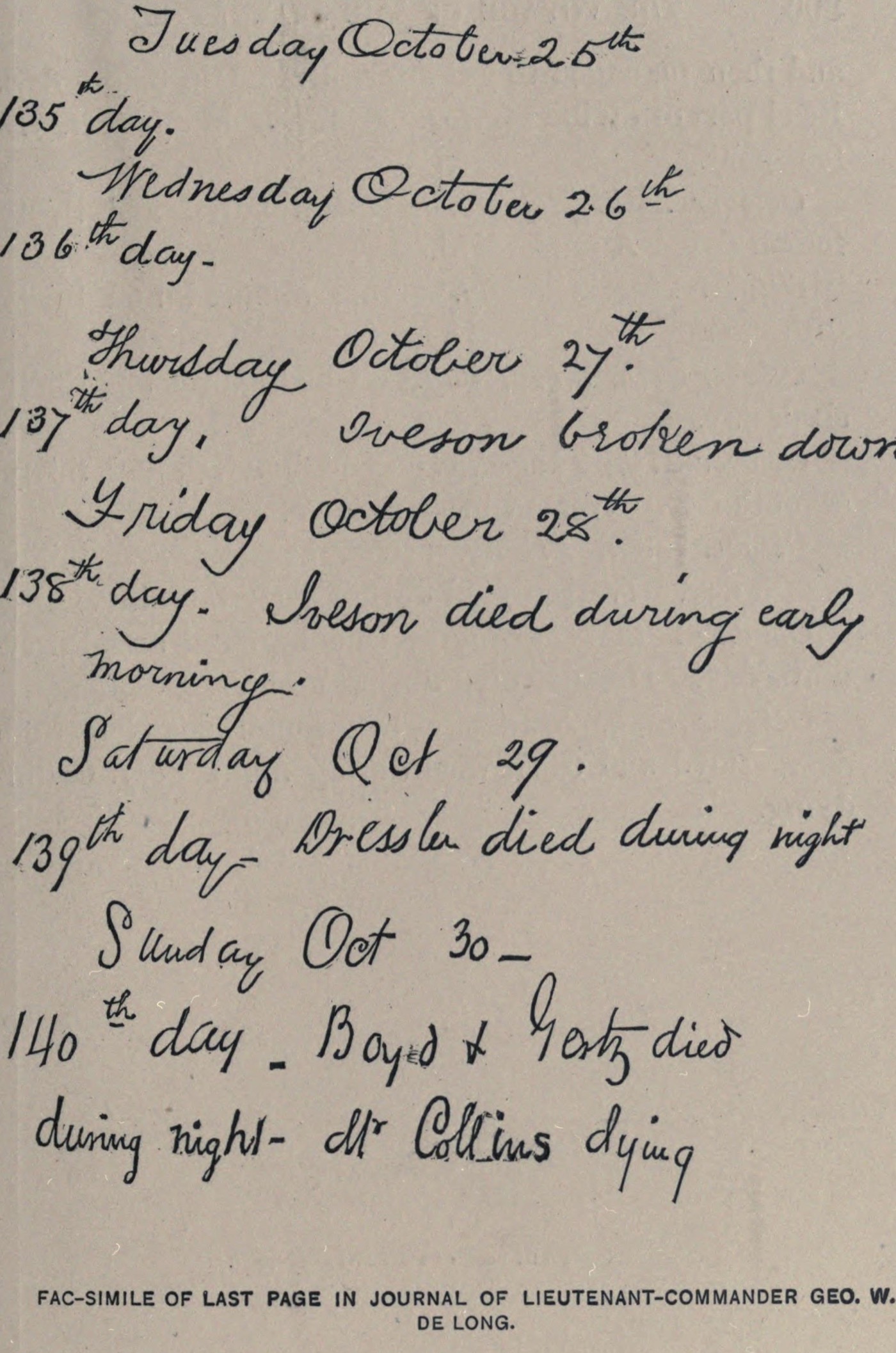
“October 28th, Friday. — One hundred and thirty-eighth day. Iversen died during early morning. October 29th, Saturday. — One hundred and thirty-ninth day. Dressler died during night. October 30th, Sunday. — One hundred and fortieth day. Boyd and Görtz died during night. Mr. Collins dying.”
Nindemann and Noros had reached a Yakut hut, and natives, and were taken south; nobody could understand what they were saying. Melville heard of them on 29 October and set out at once, found two of De Long’s record boxes in November, and could do no more that season. On 23 March 1882, with Nindemann to guide him, he found the camp on the high bank of a river. “I identified De Long at a glance by his coat. He lay on his right side, with his right hand under his cheek, his head pointing north, and his face turned to the west.” “About four feet back of him, or toward the east, I found his small note-book or ice-journal, where he had tossed it with his left hand, which looked as though it had never recovered from the act, but had frozen as I found it, upraised.” Melville turned to the last entry and read it, then read the book backwards. Of the thirty-three, twenty were dead: twelve of De Long’s fourteen, and all of Chipp’s eight.
What happened
The journals came home before the bodies. Emma De Long edited them and published them in two volumes in 1883, with the last page in facsimile. A court of inquiry convened at the Navy Department on 5 October 1882 under a joint resolution of Congress and reported in February 1883. On the ship it found her “not especially adapted in strength or model for that kind of navigation”, and on the loss it found this: “Any vessel in like position, no matter what her model might have been, or however strongly constructed, and subjected to the same pressures as those incurred by the Jeannette, would have been annihilated.” It attached no blame to anyone. It noted, in its account of the twenty-one months, “the disappointment consequent upon a want of important results”. The bodies were brought across Siberia and Europe and buried in New York in the last week of February 1884.
That was the whole of the experiment’s report as far as anyone in Washington knew: a hypothesis destroyed, a ship lost, twenty dead, and the islands. Four months later the floe came ashore in Greenland.
The barque Fluorine reached Philadelphia on 15 August 1884 with Lytzen’s letter, and the Danish consul sent it to the Herald. “On the 18th inst.,” it read, “three Greenlanders picked up on an ice-floe some effects, and some partly torn papers belonging to the American Arctic Jeannette expedition.” The list that followed was mundane: the end pieces of a wooden box, lettered in pencil “GENERAL ORDERS. TELEGRAMS. SAILING ORDERS. DISCIPLINE. SHIP’S PAPERS.”; a torn cheque book on the Bank of California; “A pair of oilskin trousers, marked: Louis Noros.” The fuller list Lytzen printed in Copenhagen the next year added a list of provisions signed by De Long, a manuscript list of the Jeannette’s boats, a cap peak marked F. C. Lindemann, which was Nindemann’s name as a Greenlander might have read it, buttons, and the lines of a tent. The floe had been found, by the captain’s reckoning, in 60° 36’ north, 46° 7’ west. The whole list, and the argument over it, are in the companion piece.
The first American reaction was disbelief, and then a story: that under the bearskin on the floe had lain the shape of a human body. Lytzen found two of the three kayakers before he left Greenland and had them deny it; the story, he wrote, “must therefore have been invented in America to make the find more piquant.” Noros, writing from Newburyport on 20 August, thought his trousers had more likely been left in the cache on the Siberian coast, and could not see how anything laid on Arctic ice could have stayed on the surface for three years. Charles Wolcott Brooks, reading a paper to the California Academy of Sciences on 1 September, found the answer in the cache De Long had left on the floe, and drew a conclusion the Navy had not. “It appears quite certain that had the Jeannette proved strong enough to hold together, she would have sailed safely into New York early in the Spring of 1884, if not before.”
The doubts lasted longer than the story. Adolphus Greely, who had come home in 1884 as one of six survivors of the twenty-five men at Lady Franklin Bay, wrote seven years later that “probably some drift articles were found, and it would seem more reasonable to trace them to the Proteus, which was wrecked in Smith Sound about 1,000 miles north of Julianehaab.” Admiral Sir George Richards, a former Hydrographer of the Navy, attached “no real importance” to them, and thought they had come down from Smith Sound. Against the ship’s own log, which gave her a westward drift of two years, these were opinions, and the only way to test them was to put another instrument on the same floe.
After
The curator in Bergen was Fridtjof Nansen. In the autumn of 1884 he read an article by Henrik Mohn, the professor of meteorology at Christiania, arguing in the Morgenblad that the Julianehaab find could have reached the west coast of Greenland only by the current that flows down Greenland’s east coast and round Cape Farewell, and could have reached that current only by crossing the polar basin. “It immediately occurred to me that here lay the route ready to hand,” Nansen wrote. “If a floe could drift right across the unknown region, that drift might also be enlisted in the service of exploration — and my plan was laid.” In 1888 he crossed the Greenland ice cap on skis, east to west, leaving himself no retreat. In February 1890 he read his plan to the Christiania Geographical Society.
Every route to the Pole had been stopped by ice, he said, because every expedition had worked against the drift. “It is useless, as previous expeditions have done, to work against the current; we should see if there is not a current we can work with. The Jeannette Expedition is the only one, in my opinion, that started on the right track, though it may have been unwittingly and unwillingly.” Then the arithmetic. From the New Siberian Islands to the 80th parallel on the east coast of Greenland was 1,360 miles, and from there to Julianehaab 1,540: 2,900 miles in 1,100 days, 2.6 miles a day. Allow 400 days for the known current down the Greenland coast and there remained 700 days for the unknown part, about two miles a day. “Two miles in the 24 hours, however, coincides most remarkably with the rate at which the Jeannette drifted during the last months of her voyage, from January 1st to June 12th, 1881.” Lytzen, in Copenhagen, had reached the same place by a shorter road. “It will therefore be seen,” he had written in 1885, “that Polar explorers who seek to advance towards the Pole from the Siberian Sea will probably at one place or another be hemmed in by the ice, but these masses of ice will be carried by the current along the Greenland coast.” A ship that could survive the pressure for long enough, he went on, might arrive safely in South Greenland, “but in that case it must be prepared to spend several years on the way.”
So the plan was the Jeannette’s voyage done on purpose, with the one failure designed out. “I propose to have a ship built, as small and as strong as possible; just big enough to contain supplies of coals and provisions for twelve men for five years.” Her sides must slope so that the ice could get no grip on her. “Instead of nipping the ship, the ice must raise it up out of the water. No very new departure in construction is likely to be needed, for the Jeannette, notwithstanding her preposterous build, was able to hold out against the ice pressure for about two years.” The ship would be driven into the pack north of the New Siberian Islands, moored between two floes, and left to be frozen in. “Henceforth the current will be our motive power, while our ship, no longer a means of transport, will become a barrack, and we shall have ample time for scientific observations.” “If the Jeannette Expedition had had sufficient provisions, and had remained on the ice-floe on which the relics were ultimately found, the result would doubtless have been very different from what it was.”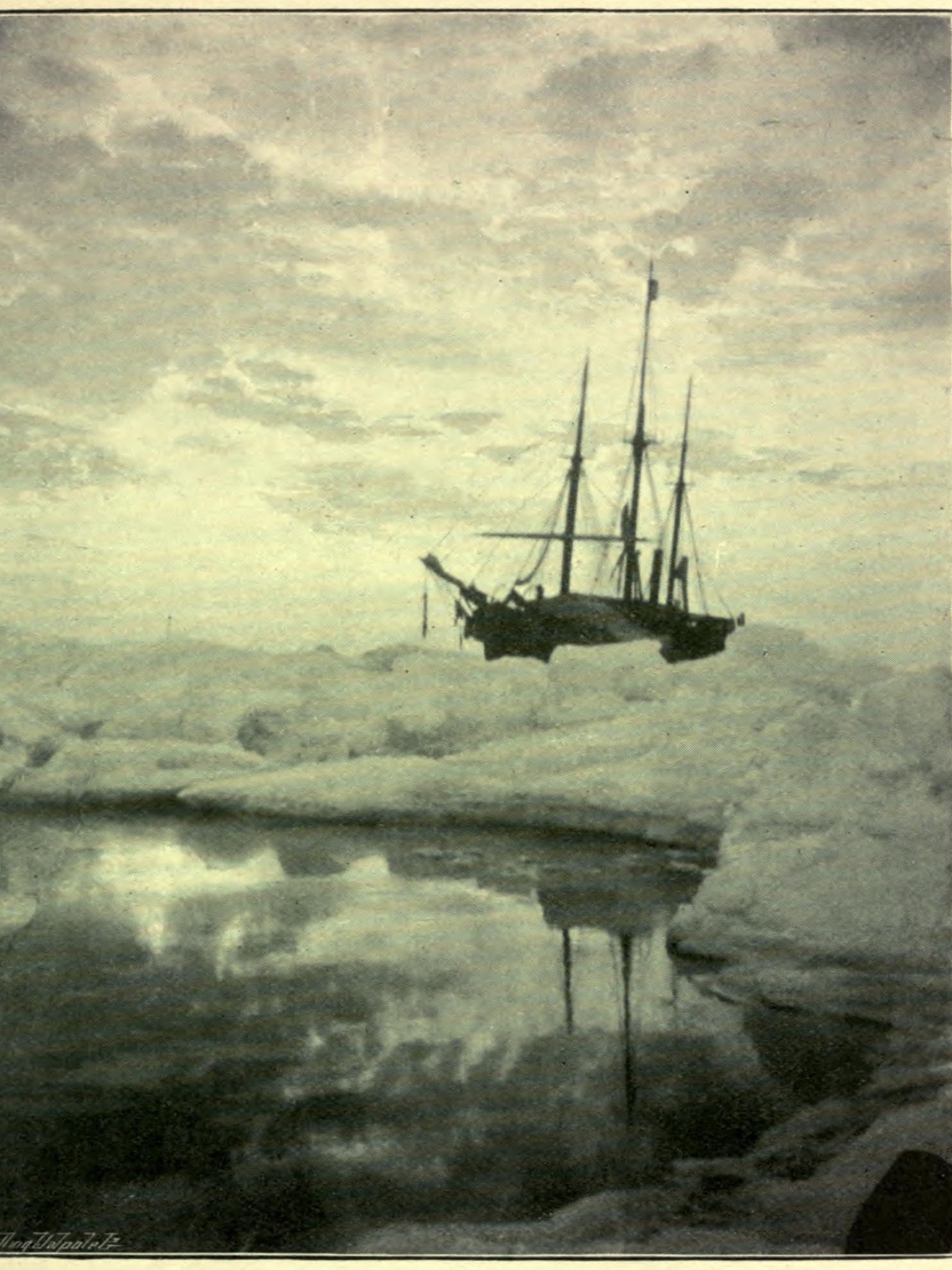
The Storthing voted two-thirds of the cost on 30 June 1890. Colin Archer, the Larvik shipbuilder, made plan after plan. The ship he launched on 26 October 1892 was 128 feet overall and 36 feet in the beam, a third as broad as she was long, with sides of oak, pitch pine and greenheart 28 to 32 inches thick and no sharp edge anywhere below the waterline. “Round and slippery like an eel,” Nansen told the Royal Geographical Society in London on 14 November 1892, “she will escape its cold and strong grasp.” She was named Fram, “forward”. “The only new feature in my plan will be,” he said, “that I wish to be drifted, while these previous expeditions drifted against their will.”
The men who knew the Arctic best told him what they thought. Admiral Sir Leopold McClintock, who had found the Franklin records, opened the discussion: “I think I may say this is the most adventurous programme ever brought under the notice of the Royal Geographical Society.” Admiral Sir George Nares, who had taken the Alert up Smith Sound in 1875, said the plan disregarded both axioms of ice navigation, a coast to keep near and a line of retreat, and as for the hull: “when once frozen into the polar pack the form of the vessel goes for nothing. She is hermetically sealed to and forms a part of the ice block surrounding her.” Sir Allen Young, who had owned the Jeannette, thought the danger was land; Sir Joseph Hooker thought the lives not worth the result. The discussion is in the companion piece. Greely had already written in The Forum: “It strikes me as almost incredible that the plan here advanced by Dr. Nansen should receive encouragement or support.” He ended by calling it “Dr. Nansen’s illogical scheme of self-destruction.”
The Fram left Christiania on 24 June 1893 with thirteen men, went east through the Kara Sea and round Cape Chelyuskin, and on 22 September 1893, north-west of the New Siberian Islands and a little short of 79° north, lay still in new ice. “Frozen in faster and faster!” Nansen wrote on the 25th. “Winter is coming now.” On the afternoon of 9 October came the first test. “All at once in the afternoon, as we were sitting idly chatting, a deafening noise began, and the whole ship shook. This was the first ice-pressure. Every one rushed on deck to look. The Fram behaved beautifully, as I had expected she would. On pushed the ice with steady pressure, but down under us it had to go, and we were slowly lifted up.” On the thirteenth the ice piled walls to the height of the rigging. “Now we are in the very midst of what the prophets would have had us dread so much.” The men stopped going up to look.
The drift went as the floe had gone. In September 1894, at the end of the first year, Nansen worked out its direction, north 36° west, and set it against the Jeannette’s. “Ours cuts hers at an angle of 59°,” he wrote; “the direction of our drift is exactly parallel with the course which I conjectured to have been taken by the floe with the Jeannette relics, and which I pricked out on the chart prepared for my London Address.” The floor of the sea did not go as expected at all. In the lecture of 1890 he had called the polar basin “remarkably shallow everywhere”, its greatest known depth “from 60 to 80 fathoms”, and had reasoned from the shallowness. In the summer of 1894, with every line on board spliced together, the lead went down to 2,058 fathoms. In July 1895, from the ship, Sverdrup found bottom at 3,800 metres.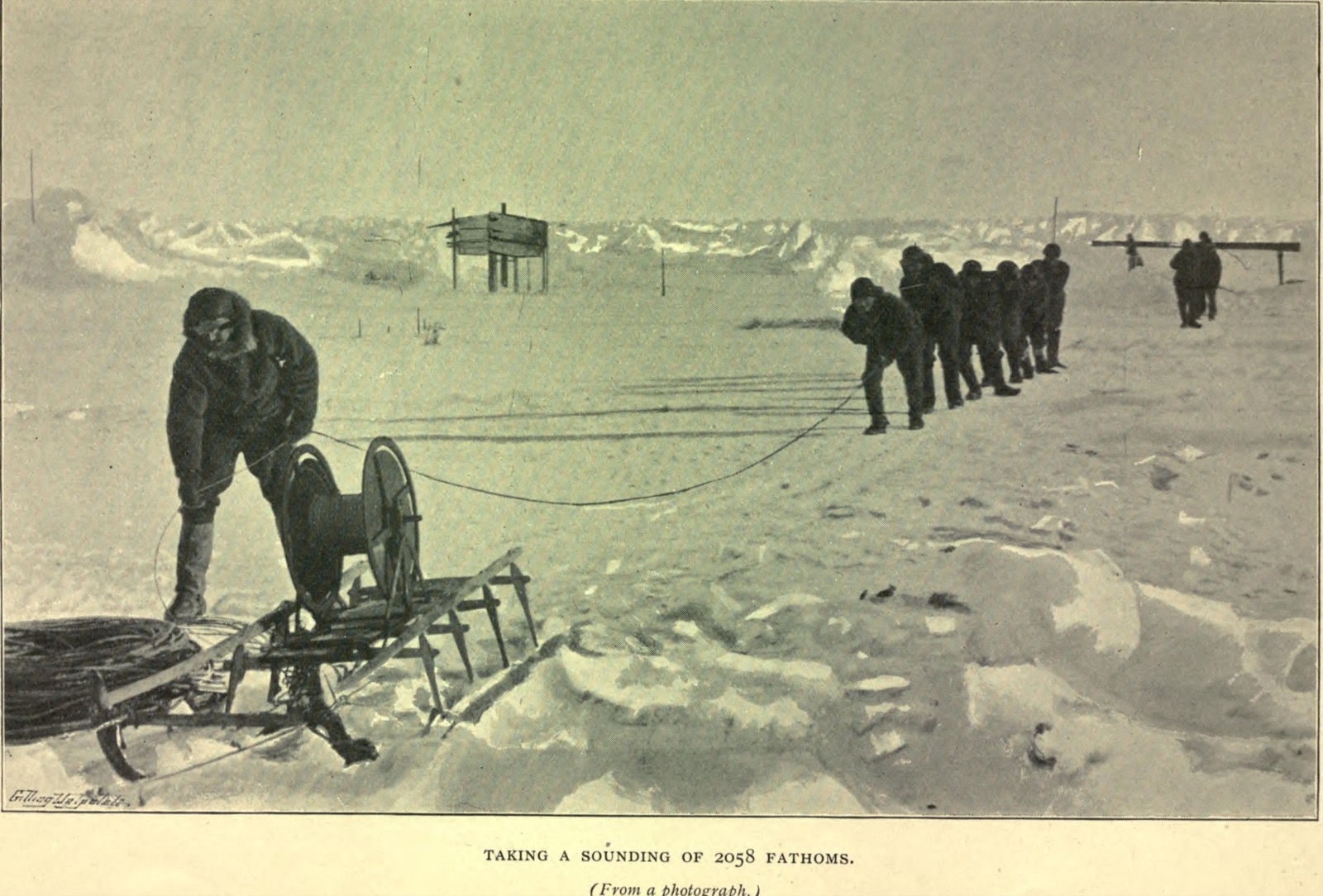
On 14 March 1895, in 84° 4’ north, Nansen and Hjalmar Johansen left the ship with dogs, sledges and two kayaks to go north on foot while the Fram drifted on under Otto Sverdrup. They turned back on 8 April at a latitude Nansen later computed as 86° 13.6’ north, nearly three degrees beyond Lockwood’s record of 1882, with impassable ice ahead and no land in sight. They wintered in a stone hut on Franz Josef Land, and on 17 June 1896 walked into the camp of Frederick Jackson’s English expedition at Cape Flora. The Fram broke out of the ice north of Spitsbergen on 13 August 1896, nearly three years after she had been frozen in, in open water of the Greenland Sea. “WE WERE FREE!” Sverdrup wrote. “Behind us lay three years of work and hardships.” Nansen’s telegram from Vardø that week put the result in four lines: “the Expedition has carried out its plan, has traversed the unknown Polar Sea from north of the New Siberian Islands, and has explored the region north of Franz Josef Land as far as 86° 14’ N. lat. No land was seen north of 82°.”
In the conclusion to Farthest North he wrote down what the drift had found. “In the first place, we have demonstrated that the sea in the immediate neighbourhood of the Pole, and in which, in my opinion, the Pole itself in all probability lies, is a deep basin, not a shallow one containing many expanses of land and islands, as people were formerly inclined to assume.” He had the Jeannette to thank for part of that too: “the more the Jeannette Expedition drifted north, the greater depth of sea did they find.” Nares wrote him a letter, Nansen recorded, “in which he said that the Fram’s remarkable voyage over the Polar Sea proved that my theory was correct, and his scepticism unfounded.” Greely, in Harper’s Weekly that September, allowed that the relics had been genuine after all, and found a different fault: “the single blemish that mars the otherwise magnificent career of Nansen, who deliberately quitted his comrades on the ice-beset ship hundreds of miles from any known land.”
The drift has a name now, the Transpolar Drift, and ships are still put into it on purpose. In October 2019 the German research icebreaker Polarstern was frozen into a floe in the Laptev Sea, north of where the Fram had been, and carried for a year, 1,700 kilometres past the Pole to Fram Strait, by an international expedition that called itself the successor of Nansen’s.
What it taught
The Jeannette was built, bought and sent as an instrument for one reading: how far north a ship could get along a warm current and a continental coast. There was no warm current; the sea temperatures said so. There was no continent; the crow’s nest said so. By the first June, De Long had written the answer to both questions in a notebook and gone further, reasoning from the direction the wind pushed the ice that it must end in the polar current off Spitsbergen and be “discharged thus into the Atlantic”. That is the Transpolar Drift, in a sentence, in 1880. The experiment had also been designed with no way of reporting except the ship’s return, and the ship could not return, because the same drift that was the finding was the trap. So the finding sat in the journal, and the journal went south in a tin box, and the men who carried it starved.
The second instrument was built out of the first one’s failure, piece by piece. Nansen read the Jeannette’s record not as a tragedy but as data: a drift of two years, west-north-west, at a known rate; a floe that completed the journey the ship had started; a hull that had “held out” for twenty-one months despite “her preposterous build”. From those he took the direction, the speed and the one design change that mattered, a hull the ice could not hold, and made the Jeannette’s accident his method. McClintock, Nares, Hooker and Greely were not wrong about the Arctic; they were wrong about what the Jeannette had shown, because they had read her loss as a warning and not as a measurement. The relics at Julianehaab were the first experiment’s result arriving by itself, three years late, and most of the people qualified to judge it took them for a hoax.
The complication is that Nansen’s reasoning was right about the current and wrong about nearly everything underneath it. He argued from a shallow polar basin and found one 3,800 metres deep. He expected an eastward current along the Siberian coast and found none. He hoped the drift would pass near the Pole and it passed well short, so that the last part of the plan, like Andrée’s a year later in Sixty-Five Hours, was done on foot and nearly killed him. The Fram proved the one thing she had been built to prove, that a ship could be frozen in and lifted and carried across the top of the world and come out the other side, and that was enough to make everything she measured on the way count. An experiment that reports is worth a dozen that are only right. The Jeannette was right in June 1880, and the news reached Christiania on a pair of oilskin breeches four years later.
Sources
- The Voyage of the Jeannette: The Ship and Ice Journals of George W. De Long, edited by his wife, Emma De Long, two volumes (Houghton, Mifflin, Boston, 1883). The letters to and from Bennett, the Petermann interview, the Navy’s orders and Bennett’s cable, the strengthening at Mare Island, and every entry of the journal quoted, including the besetment of September 1879, the leak of January 1880, the verdict of 3 June 1880, the anniversary entries, the sinking, the retreat and the last page, which is reproduced in facsimile in volume 2. vol. 1, vol. 2
- Proceedings of a Court of Inquiry convened at the Navy Department, Washington, D.C., October 5, 1882, in pursuance of a joint resolution of Congress approved August 8, 1882, to investigate the circumstances of the loss in the Arctic seas of the exploring steamer “Jeannette”, House Ex. Doc. 108, 47th Congress, 2nd session (1883). The survey testimony on the ship’s build, and the finding of the court, with its list of the thirty-three and their fates. archive.org
- Jeannette Inquiry: Before the Committee on Naval Affairs of the United States House of Representatives, Forty-eighth Congress, House Mis. Doc. 66 (1884). The Collins family’s petition and the second hearing. archive.org
- John W. Danenhower, Lieutenant Danenhower’s Narrative of the “Jeannette” (James R. Osgood, Boston, 1882). Wrangel Land shown to be an island, and the ship’s view of the drift. archive.org
- George W. Melville, In the Lena Delta (Houghton, Mifflin, Boston, 1884). The finding of De Long and the journal on 23 March 1882. archive.org
- Carl Lytzen, “Levninger fra Jeannette-Expeditionen paa Grønlands Vestkyst,” Geografisk Tidsskrift 8 (1885–86), pp. 49–51. The kayakers, the raven, the two finds, the full list of objects, the body story denied, and the sentence about a ship that could survive the pressure; the translations above are mine, except the last sentence, which is Nansen’s. tidsskrift.dk
- Charles Wolcott Brooks, Early Migrations: Arctic Drift and Ocean Currents, Illustrated by the Discovery on an Ice-Floe off the Coast of Greenland of Relics from the American Arctic Steamer “Jeannette”, read before the California Academy of Sciences, 1 September 1884 (San Francisco, 1884). Lytzen’s letter of 23 June 1884 in the consulate’s translation, Captain Wilson’s statement with the floe’s position, Noros’s letter of 20 August 1884, and Brooks’s own conclusion. archive.org
- Fridtjof Nansen, “How can the North Polar Region be Crossed?” and the discussion following it, The Geographical Journal 1 (January 1893), pp. 1–32, with the North Polar Map at the end of the number. The Fram’s design and dimensions, “round and slippery like an eel”, “I wish to be drifted”, and the remarks of McClintock, Nares and Young. archive.org
- Fridtjof Nansen, Farthest North, two volumes (Archibald Constable, London, 1897). Volume 1: the Mohn article and the plan’s origin, the lecture of February 1890 as printed in Naturen 1891, the objections of Richards, Hooker and Greely in The Forum of August 1891, Colin Archer, the departure, the besetment, the first pressure of 9 October 1893, the drift compared with the Jeannette’s in September 1894, and the plates reproduced here. Volume 2: the deep soundings of July 1895, the start on 14 March 1895, the farthest north, the telegram from Vardø, Sverdrup’s account of the release on 13 August 1896, Nares’s letter, Greely’s article in Harper’s Weekly of 19 September 1896, and the conclusion. vol. 1, vol. 2
- Ernst Behm, “August Petermann,” Petermanns Geographische Mittheilungen 24 (1878), for the date of Petermann’s death. polarhistorie.no
- Alfred Wegener Institute, “MOSAiC Expedition,” and High North News, “International MOSAiC Arctic Expedition Reaches North Pole,” 20 August 2020, for the Polarstern’s drift of 2019 to 2020. mosaic-expedition.org, highnorthnews.com
How this entry came about
Written in the overnight run of 21 October 2026, by the standing rules in _ideas/OVERNIGHT.md, with nobody to ask. The backlog line named the court of inquiry, De Long's journals and Farthest North, and all three were read in full on archive.org; the drift was then followed back to its source in Lytzen's article in Geografisk Tidsskrift, read by OCR of tidsskrift.dk's scan and translated by me, and forward to the Royal Geographical Society's discussion of November 1892 in The Geographical Journal.
Figures. Four, all from publications before 1930 scanned on archive.org (rule 1): the map from The Geographical Journal of January 1893, whose fold-out the scan cuts in half, so only the eastern half with the Jeannette's drift is shown; the facsimile of the journal's last page from the 1883 edition, at 1,400 pixels because the page is narrow; and two photographs printed in Farthest North in 1897. Nothing upscaled; the black scan edges cropped off.
Length. The first draft ran to 7,300 words and was cut to 6,498; the full list of the relics and the argument over it, and the whole of the London discussion, went into two companions, each kept under the checker's 3,000 (rule 2).
Sources not reached, and quotations at second hand. Lytzen's letter of 23 June 1884, Captain Wilson's statement and Noros's letter of 20 August 1884 are quoted as Brooks printed them in September 1884. Professor Mohn's article in the Morgenblad of autumn 1884 was not found and is given through Nansen, whose English edition dates Mohn's lecture "November, 1894", a misprint for 1884. Greely's article in The Forum of August 1891 and his piece in Harper's Weekly of 19 September 1896, the letters of Admiral Richards and Sir Joseph Hooker, and Nares's letter of congratulation are all quoted as Nansen prints or reports them in Farthest North; the spoken remarks of McClintock, Nares and Young are from the Geographical Journal. Petermann's obituary in his own journal was read by OCR for the date of his death only. The House committee's volume of 1884 was read only for the Collins family's petition. The Navy's ship history of the Jeannette (history.navy.mil) refused the connection with a certificate error, so her tonnage and length are left out. The burial of De Long and his companions in New York rests on the Library of Congress's index of newspapers of 23 to 25 February 1884 (the New-York Tribune of 24 February, page 12, among them), whose text was behind a challenge page; the entry therefore says "the last week of February 1884" and quotes nothing. The Danish is my translation except for the one sentence of Lytzen's that Nansen translated, which is given in his words.
Where sources disagree. The besetment position is 71° 35' N, 175° 6' W in De Long's journal; Nansen prints the longitude as east. The sinking position is 77° 14' 57" N, 154° 58' 45" E in the journal, 155° 50' E in the court's finding, and 77° 16' N, 150° 59' E in Lytzen; the journal is used. The ship sank at four in the morning of 13 June 1881 by the corrected date, which the journal gives as "June 12th, Sunday (or Monday, June 13th)"; Nansen's map says 12 June, and the entry says 13 June. Lytzen reckons the floe's journey as "17 degrees of latitude and 199 degrees of longitude" and 1,650 Danish miles in a straight line, which does not match any route; Nansen's 2,900 nautical miles is used, and the straight-line figures in the entry (about 2,500 nautical miles from the sinking to Julianehaab, about 580 from besetment to sinking) are my own great-circle sums. Nansen's farthest north is 86° 13.6' by his own later calculation, rounded to 86° 14' in his telegram; his letter of May 1896 says he turned back on 6 April and the narrative on 8 April, and the entry follows the narrative. The Fram's besetment latitude is garbled in the OCR of Nansen's summary ("7?° 43'") and is given as "a little short of 79°". Greely's party is given as twenty-five men with six survivors, Greely among them.
Decisions under the rules. The date is set as 08:15 on 21 October with minutes, at 08:20 UTC, because the current hour, 08:00, and every other whole hour of the day up to 10:00 already carried an entry on main, and the night's earlier entries had taken the free quarter-hours the same way (rules 4 and 10). The title "A Pair of Oilskin Breeches" is not used in _posts (rule 5). No pull request; the entry landed by direct push after the checker passed (rule 6). The two companions are the only overflow; a third, on the hundred and forty days of the retreat day by day, was considered and not written, the journal's last pages being short enough to stand in the entry. The WARN lines left before narration were the four audio lines; every source link answered the checker.