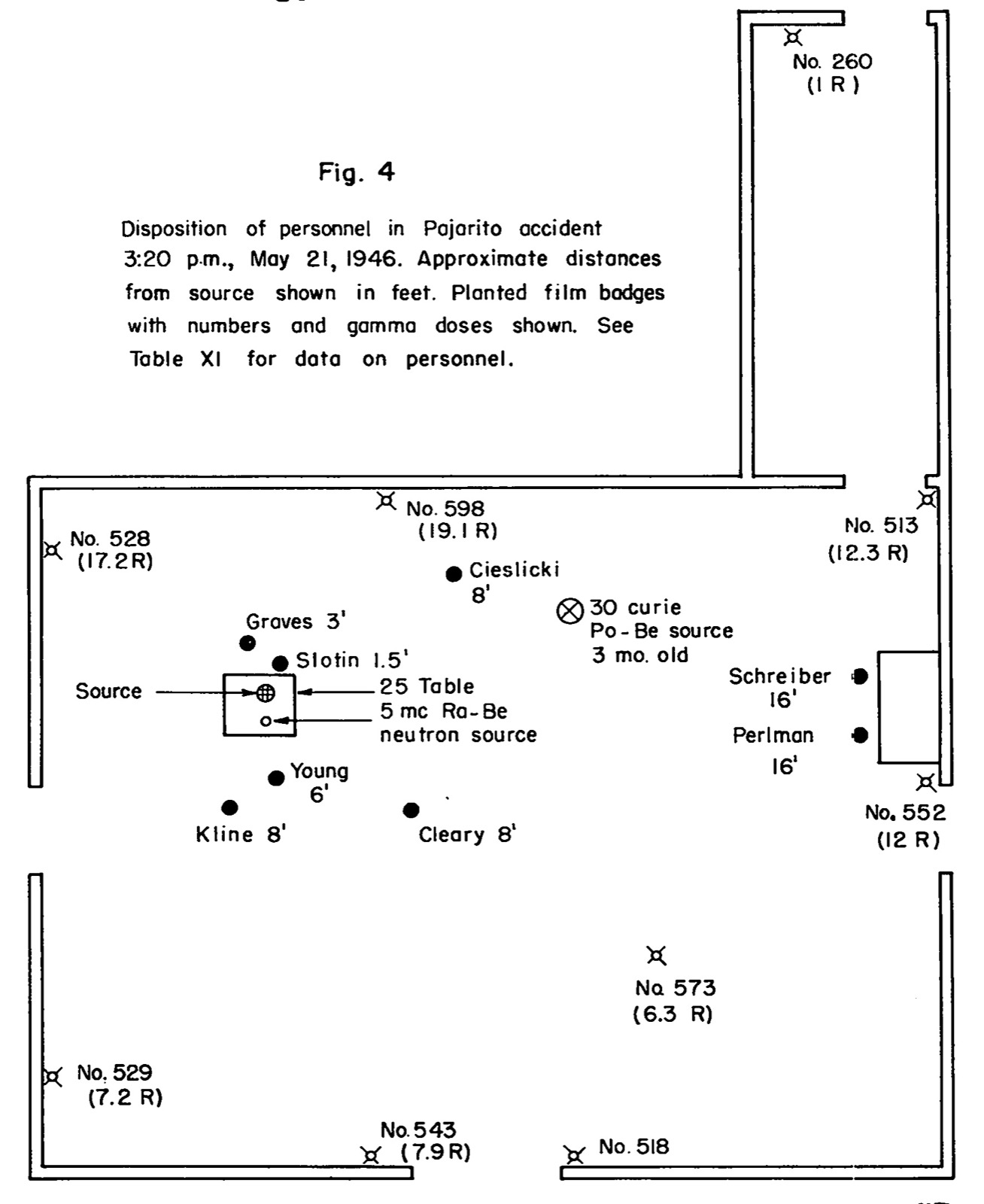
At twenty past three on the afternoon of Tuesday, 21 May 1946, in a one-room laboratory in Pajarito Canyon below Los Alamos, a security guard named Patrick Cleary saw a blue light, felt a wave of heat, and ran. “After the accident I ran out the East door and down the ramp,” he wrote in his statement eight days later. “Probably took me about five seconds or so. When I got to the gate, it was still locked and Mr. Kline, Cieslicki and myself were the only ones there. Mr. Kline told the M.P. to open the gate. He had some trouble getting his whistle out of his pocket, but, when he did, he opened the gates and then blew the whistle. I ran up the hill approximately 1,000 feet with the others.”
Then Slotin and Young came out of the building, and Young called everyone back. “As soon as we got there we drew a diagram to figure out approximately where everyone was when it happened. The only other conversation was that everyone was wondering who had gotten most of the radiation.”
The diagram survives, redrawn two years later in the laboratory’s report on the doses. It shows a table, a source at the centre of it, and eight dots with names and distances in feet: Slotin, a foot and a half; Graves, three; Young, six; Kline, Cieslicki and Cleary, eight; Schreiber and Perlman, sixteen. The film badges that should have recorded what each man received were in a lead box in another room, about a hundred feet away. The drawing was the instrument. From it, and from the sodium in the men’s blood, the laboratory calculated in 1948 that the man at a foot and a half had taken 386 units of neutron radiation. In 1978 it put the figure at 1,000. In 2000 it published 2,100. He was dead nine days after the drawing was made, which every reading agrees on. And he was the man who had investigated the last time the same sphere of metal had done this, nine months before, on a Tuesday the twenty-first.
Who ran it
Louis Slotin was born in Winnipeg on 1 December 1910, the eldest of three children of parents who had left the pogroms of Russia for the North End of the city. He entered the University of Manitoba at sixteen, took its gold medal in chemistry and physics, and finished a master’s degree in 1933. A travelling fellowship took him to King’s College London, which gave him a doctorate in 1936. He boxed there at bantamweight. He also let his friends believe things about him that were not so: that he had fought with the Loyalists in Spain, that he had flown with the Royal Air Force. His brother Sam said later that Louis had gone on a walking tour in Spain and had not taken part in the war. A Canadian journalist who looked into it in 1961 wrote that he “regularly amused himself with the gullible by planting false clues to an imaginary and stylish past.”
In 1937 the National Research Council of Canada turned him down, and he went to Chicago to help build the first cyclotron in the Midwest, for two years without pay and with cheques from his father, who ran a livestock agency. He made radiocarbon on the machine and fed it to pigeons for the biochemists. When the Metallurgical Laboratory of the Manhattan Project was gathered in Chicago in 1942 he was there, and in 1943 he worked at Oak Ridge. The health physicist Karl Morgan remembered one Friday afternoon there, fifty years afterwards. Slotin wanted the reactor shut down to adjust an experiment at the bottom of the water tank that shielded it; he was told to wait for the weekend. “When we came back on Monday morning, I found that Louis had stripped down to his shorts, dived into the tank and made the adjustments under water. I was appalled that anyone would take such risks. It shows what kind of person he was. He was like a cowboy — but a good experimental scientist.”
He came to Los Alamos in December 1944, into Robert Bacher’s weapon physics division, and found the place “a disorganized mess.” His work was criticality: finding, by experiment, how much fissile metal in what arrangement would sustain a chain reaction. In July 1945 it was Slotin who put together the plutonium core of the first atomic bomb, at a ranch house near the Trinity tower, and kept the scribbled receipt he was given when he handed it over to the Army. The National Park Service, which now looks after the building he died in, says the job earned him the nickname “Chief Armorer of the United States.” He was not allowed to go to Tinian with the bombs for Japan, because he was still a Canadian. By February 1946 he had his American papers and a permit for the next tests, at Bikini. He did not want to go. “I have become involved in the Navy tests, much to my disgust,” he wrote to a Chicago colleague in March. “The reason for this is that I am one of the few people left here who are experienced bomb putter-togetherers.” He meant to go back to Chicago after Bikini and work on radiobiology.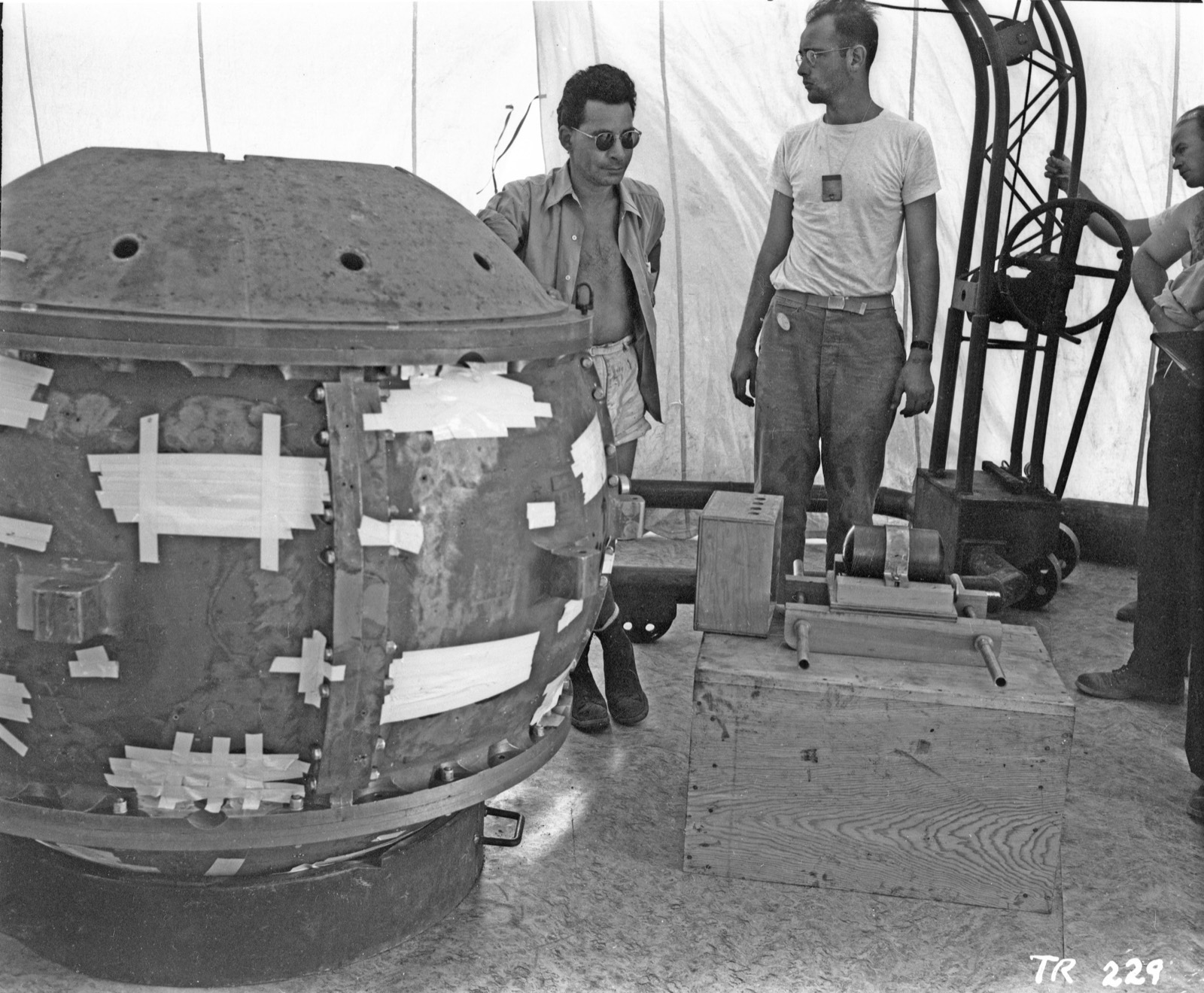
Harry Daghlian was born in Waterbury, Connecticut, on 4 May 1921, went to the Massachusetts Institute of Technology at seventeen and moved to Purdue to study particle physics. He came to Los Alamos in 1944 and was put in Otto Frisch’s criticality group at Omega Site, a laboratory set apart in Los Alamos Canyon so that its radiation would not spoil other people’s counters. In January 1945 the group ran the experiment that gave all of this work its name: a slug of uranium hydride dropped through a near-critical assembly of the same material, so that for a fraction of a second as it fell the whole thing was supercritical. The laboratory’s own history of such accidents records that Richard Feynman “pointed out the similarity of the procedures used in these experiments to tickling the tail of a dragon, thus it has been called the ‘Dragon Experiment.’” Slotin and Daghlian both worked on it. On 13 July 1945 Daghlian was photographed with Herbert Lehr lifting the plutonium for Trinity, in its tamper plug, into the back seat of an Army sedan.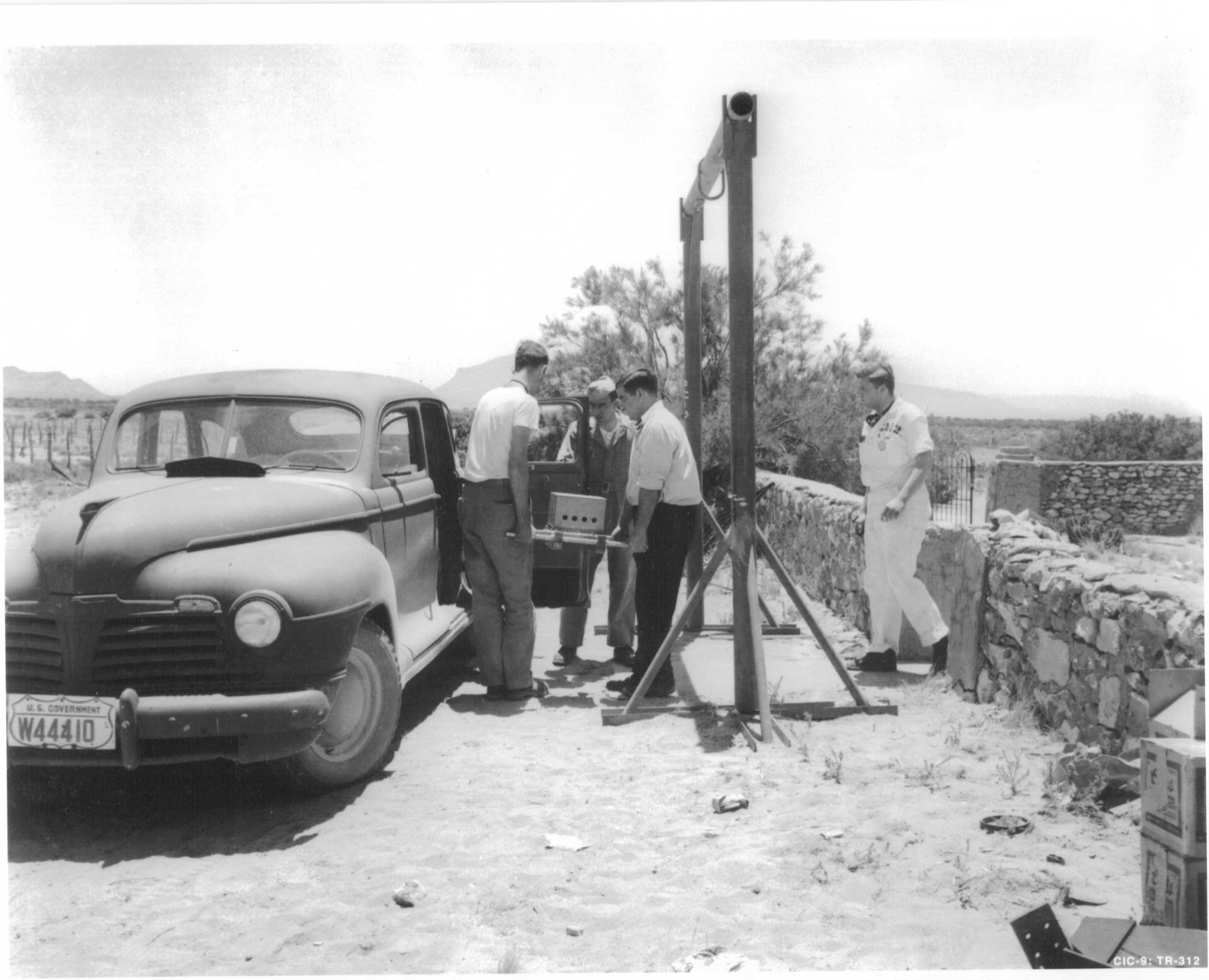
After the war Slotin was the leader of the critical assemblies group, which the laboratory called M-2. The men in the room with him on 21 May 1946 were, in the order of their distance from the sphere, Alvin Graves, Dwight Young, S. Allan Kline, Marion Cieslicki, Private Patrick Cleary, Raemer Schreiber and Theodore Perlman. Graves, thirty-six, had a Chicago doctorate and had been at Los Alamos since 1943; he was to take over the group when Slotin left for Bikini. Schreiber had carried the two plutonium hemispheres of the Nagasaki bomb to Tinian the previous August and helped assemble it. Kline, twenty-six, was a Chicago graduate who had been called over to watch. Young was a technician of fifty-four, Cieslicki and Perlman were twenty-three, and Cleary, twenty-one, was the guard, because a laboratory holding a significant part of the nation’s fissile material did not go unguarded.
What they were trying to find out
A sphere of plutonium of the size that went into a bomb was not, by itself, a bomb or a reactor. Too many of the neutrons from its fissions leaked out of the surface before they could find another nucleus. Put something around it that bounced neutrons back, a tamper, and the leak was closed a little; put enough around it and the chain reaction sustained itself. Schreiber said in 1993 that the core Slotin was using was “95% critical” on its own. The question for the critical assemblies group was always a version of the same one: with this core and this tamper, where exactly is the edge?
They had two reasons to ask. The first was design: how much metal a bomb needed, in which tamper, and how a gap between core and tamper changed things. The laboratory’s history for 1946 records that a small gap “reduced the observed multiplication by quite a large factor.” The second was safety. Every core that went into a bomb had to be certified first. “Louis Slotin was in charge of the critical assemblage,” Schreiber said, “and had to verify that these cores were safe to be put into a high explosive assembly.”
The way to find the edge was to approach it. A small neutron source sat near the sphere; counters nearby clicked at a rate that rose as tamper was added and the multiplication climbed. The experimenter added a little, read the counters, added a little more. “You get fooled by the fact that they lay critical; everything’s kind of interesting,” Schreiber said. “The counters go up; you move something off and the counters goes down. It’s a tantalizing sort of business. But if you go past critical – I don’t know what the multiplication rate is, but it’s far faster than human reactions.”
Behind the physics there was a second hypothesis, about procedure, and it was the one being tested. The experiments could have been done by machine, with the people a safe distance away. The laboratory chose hands. The medical follow-up of 1979, written by the doctor who had treated both men, put the reasoning plainly: “the physicists elected to carry out the procedure manually rather than remotely since a reliable remote control mechanism was not available at the time. The scientists in charge feared that failure of such a mechanism could lead to a minor but still serious nuclear explosion while manual operators, by meticulous attention to detail, could carry out the experiments with very little radiation exposure even while standing next to the critical assembly. Hundreds of such experiments were carried out properly with negligible exposures of the operators.”
The claim, then, was that a trained hand was a safer control than a machine. The Army’s own history of the laboratory, written in 1946 and 1947 and secret for decades, recorded what the Health Group thought of that. The critical assembly experiments were “especially dangerous because there is no absolute way of anticipating the dangers of any particular experiment, and because the experiments seem so safe when properly carried out that they lead to a feeling of overconfidence on the part of the experimenter.” The Health Group had no authority over them “except that of being sure that the men were aware of the dangers involved.”
What they built
The sphere was the third plutonium core in the world. The first had been fired at Trinity on 16 July 1945 and the second over Nagasaki on 9 August. On 10 August General Groves told General Marshall that the next bomb had been meant for “the first good weather after 24 August 1945. We have gained 4 days in manufacture and expect to ship from New Mexico on 12 or 13 August the final components.” A metallurgist named Lawrence Litz remembered casting its two hemispheres through one night in two adjoining laboratories, “because we weren’t sure that the Japanese would surrender even after the second bomb was dropped.” Japan surrendered on 15 August. The core stayed at Los Alamos.
It weighed 6.2 kilograms, in two hemispheres of plutonium in its delta phase, plated with five thousandths of an inch of nickel, with a density of 15.7 grams to the cubic centimetre, which makes a ball about nine centimetres across. One of the historians of the bombs was later told that the men who handled it called it Rufus. The name it has now was given to it afterwards.
Daghlian’s tamper was tungsten carbide: bricks of 4.4 kilograms each, stacked in layers around the sphere on a bench at Omega Site. The last brick of the fifth layer would have brought the reflector to 236 kilograms.
Slotin’s tamper was beryllium, which reflects neutrons better, so that less of it was needed and the whole thing fitted on a table. The lower piece was a hemispherical shell thirteen inches across the outside, with a hollow to take the core. The upper piece was a shell nine inches across, with a hole at its pole. The procedure the laboratory later described was to set the upper shell on one-inch aluminium shims above the lower one, with a small neutron source alongside, and then to lower it by stages, reading the counters as the gap closed. When the shims were out, the upper shell was to rest on its rim at one point and be held open at the opposite point by something the experimenter could withdraw by degrees.
In the spring of 1946 the work moved out of Omega Site to a new laboratory in Pajarito Canyon, operating by April. Richard Malenfant, who ran critical experiments there for decades afterwards, described the building: “it was literally just a box, a room,” with a table in it, pallets of material about the floor and a crane outside the door. The site had film badges for the staff, and “disaster badges” planted at points around the room to record a large dose; the laboratory’s report notes that one had been planted under the table the assembly stood on, “but at the time of the accident it was not there.”
The critical piece of equipment was the one that was not on any list. Slotin held the gap open with the blade of a flat screwdriver.
Schreiber, who was in the room, wrote to a biographer in 1993 about what that meant. “I’m quite sure that several of us knew that he was using the Pu hemispheres for demonstrations of simple critical assemblies, but were not aware of his unsafe method until it was too late. After all, he was the expert in this work. But he should have never made the assembly by lowering the upper section down onto the lower one so a slip would close the gap and make the system supercritical. He should have fixed the upper assembly in position and raised the lower section gradually to increase the reactivity. Then if anything slipped, the assembly would open harmlessly. Louis knew this, of course, but apparently thought he could get by with the simpler assembly.”
Tuesday the twenty-first
On 21 August 1945, six days after the surrender, Daghlian spent the day at Omega Site stacking tungsten carbide around the sphere. Two experiments were done. The next, with five bricks on each side, was scheduled for the following morning. He went to dinner, and then he went back, alone, which the rules did not allow. The only other person in the building was the guard, a private of twenty-nine named Robert Hemmerly, who sat at a desk ten or twelve feet away with his back to the bench, reading a newspaper. At 9:55 that night Daghlian had four layers in place and was carrying the final brick for the fifth over the top of the stack when the counters told him it would make the assembly supercritical. He drew his hand back. The brick slipped and fell onto the centre of the assembly.
The laboratory’s report, written in the days after, says that “he instinctively and immediately pushed this brick off the assembly with his right hand. While doing this, he stated that he felt a tingling sensation in his right hand and at the same time noticed a blue glow surrounding the assembly, the depth of the blue glow being estimated to be about two inches.” The flash lit up the guard’s newspaper. Daghlian then took the stack apart, by hand, and by his own estimate stayed near it for at least ten minutes. At the hospital half an hour later his hands were swollen and numb.
The burst was about ten million billion fissions. The laboratory’s reviewers in 2000 put his dose at 510 rem and the guard’s at about 50. He died on 15 September 1945. The dosimetry report of 1948 concluded that “there is a possibility that he might have survived if he had not insisted on remaining so close to the active materials.”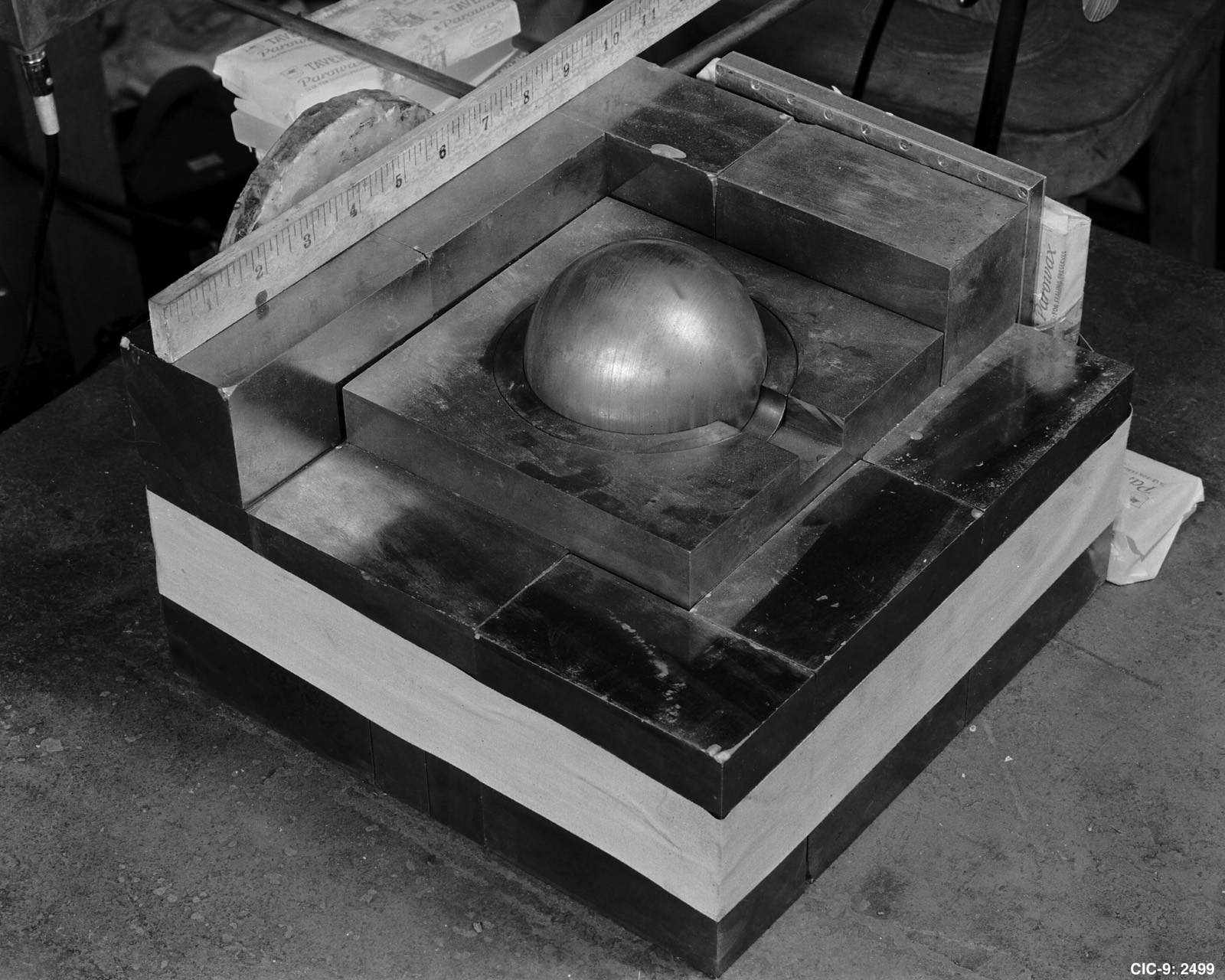
The man who investigated was Slotin. He interviewed Daghlian the next day. He signed the request for photographs of a reconstruction of the stack. The report on the accident carries three names, Paul Aebersold’s, Louis Hempelmann’s and his. On 2 October the laboratory re-ran the assembly with the same core to measure the radiation, stopping short of prompt criticality. Daghlian’s mother came out from Connecticut and stayed with the Schreibers, whose children were small. She left the day after he died, with a cheque for $10,000 from the Project’s welfare fund; the state’s compensation law paid nothing, because he had left no dependants. The Health Group, which had asked to be told what the critical assembly people were doing, now got something. Slotin, “after conference, agreed to assign one man from his group to report to J. G. Hoffman on monitoring activities.” Enrico Fermi, the story goes, told Slotin after Daghlian’s death that he would not last a year if he kept doing that experiment. The story is in every account and in no document that anyone has produced.
Nine months later Slotin was packing for Bikini, where he would assemble the cores for the tests, and Graves was to take over the group. No experiment was scheduled for the afternoon of 21 May 1946. Three things were going on in the box of a room: Schreiber was at a bench with his back to the table, checking initiators; a guard was on duty; and Graves had asked Slotin to show him the criticality measurement he would soon be responsible for. The doctor’s account calls it an impromptu test, done as indoctrination “even though six other people were in the laboratory.” Malenfant calls it “a pickup experiment without a great deal of consideration.”
Slotin put the lower beryllium shell on the table, the core in it, the upper shell on its shims, and the source alongside. He put his left thumb in the hole at the pole of the upper shell to lift it, took the shims out, and let the shell down until one edge rested on the lower one. Under the opposite edge was the screwdriver. He was working it out from under the shell, letting the gap close, at about twenty past three. The official accounts say the screwdriver slipped. Malenfant, who spent years with the documents and with Schreiber, never found a paper that said so, and thinks the last wedge came out and the shell simply came down flat, with Slotin’s thumb still in the hole and his hand and body over the assembly. Either way the gap closed, and the counters stopped mattering.
The excursion was about three million billion fissions, with the reactivity perhaps ten cents above prompt critical, and it lasted less than half a second, because Slotin flipped the upper shell off with the hand that was in it. “Went clattering on the floor,” Schreiber said. “Everything went off scale, there was a blue flash, etc. He knew he had had it at that time. He kept his head. We all dashed out of the room and I went back around the corner with a meter and that went off scale, so I decided I better not go back in.” Five of the seven men facing the table saw the glow. Cleary, who had not known what the sphere was, later told the investigators: “I knew something was wrong, but didn’t know exactly what it was, when I saw the blue glow and somebody yelled.”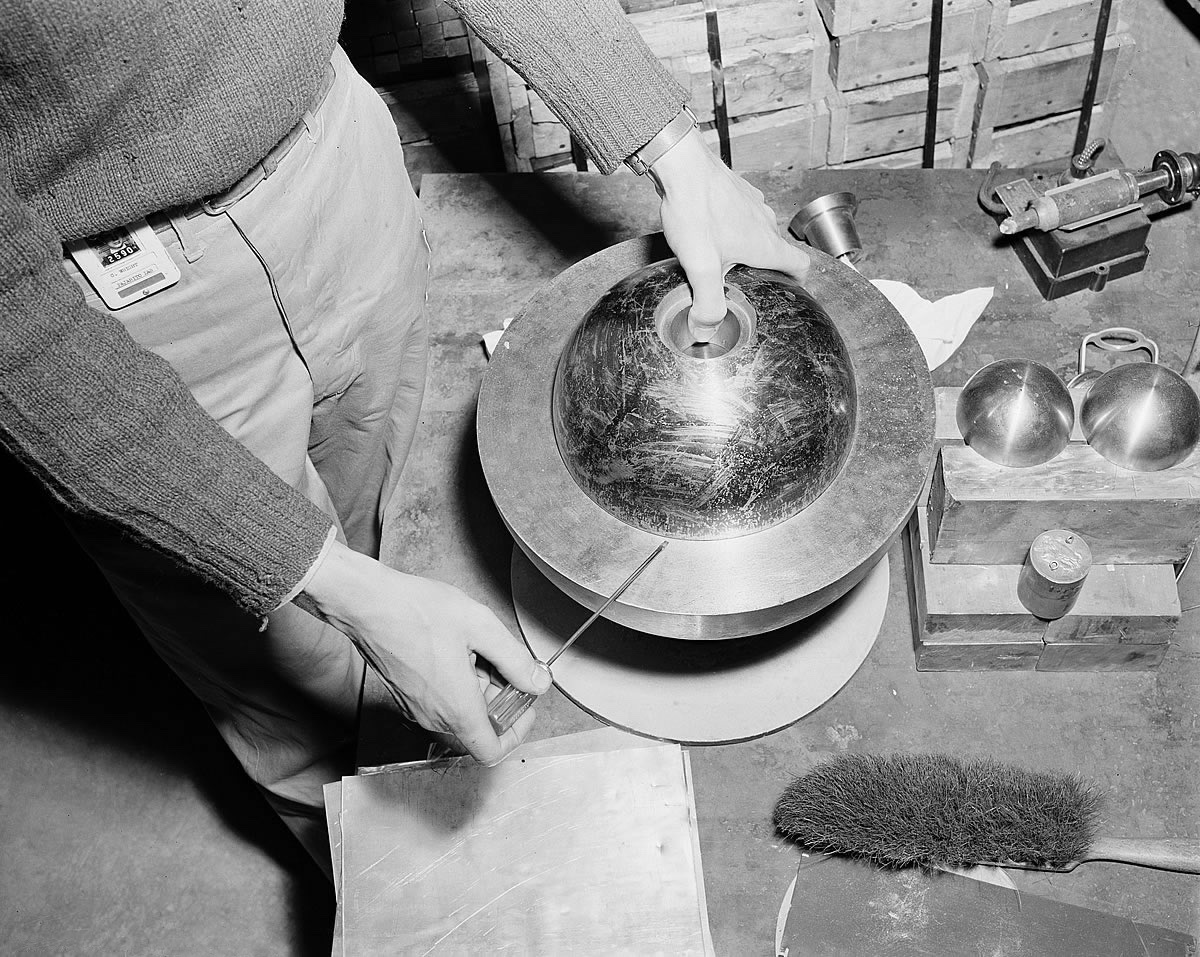
Outside, Slotin ran his own investigation on the spot, and it was the one piece of instrumentation that worked. The men drew the diagram. He had them turn out the coins in their pockets, whose silver had been made radioactive in proportion to the neutrons that had passed through it, and held a counter to the fillings in their teeth and to their armpits, where the blood runs close to the skin, to rank them. He asked for the film badges to be brought from the lead box and laid on the assembly. Schreiber did it, and went back a second time for the men’s coats. The 1948 report says the badges were placed “at what is now recognized to have been, a great personal risk,” that they told the physicists almost nothing because the neutrons had gone in the first flash, and that the episode “is presented here to remind scientific personnel that after an accident the safest mode of conduct is to get as far as possible away from the source of radiation.” Then they drove to the hospital, all but Schreiber, who went home first to tell his wife where he was going.
What it looked like from inside
Slotin’s own first estimate, made in the hospital, is recorded in the fullest account of his life, written for a Canadian magazine in 1995. He said to Graves: “I’m sorry I got you into this. I’m afraid I have less than a 50 per cent chance of living. I hope you have better than that.”
The treating physician was Paul Hageman. Louis Hempelmann, who had run the laboratory’s Health Group through the war and had been lent to the Bikini operation from his post at Washington University in St. Louis, was called back as consultant. A nurse, Annamae Dickey, came every day to take blood. The fullest account of the nine days is a letter that Philip Morrison, Slotin’s friend and one of the physicists who calculated the doses, wrote on 3 June 1946 to Bernard Feld at MIT, with copies to six of Slotin’s friends at other laboratories.
“For the first few days his hands bothered him, and he experienced one or two attacks of nausea. We were all, however, as cheerful as we could be, and I think that only the striking parallel between his condition and Daglian’s was a cause of great worry to him.” On about the fourth day his stomach and intestines stopped working. From the fifth day his fever stayed above 103. The white cell count had soared in the first days and then, between the fourth and fifth, collapsed; by the sixth day it was two or three hundred cells in a cubic millimetre, which, Morrison wrote, “all the experts assumed” to be hopeless, though the clinicians went on with penicillin and sterile precautions. On the seventh day the platelets fell, “a sure sign of the hemorrhagic phase, of which we saw a good deal in Japan. Both Louis and I knew enough about this to be unhappy about its coming.” At noon on the eighth day the delirium began.
His parents had been flown from Winnipeg on an Army aircraft and were there from the third day. He had telephoned them himself, with a nurse holding the receiver, to say he had been in an accident and would be in hospital for a time, and since he could not visit them, perhaps they would come to him. While he could still hear it, a citation from the laboratory was read to him: “Dr. Slotin’s quick reaction at the immediate risk of his own life prevented a more serious development of the experiment which would certainly have resulted in the death of the seven men working with him, as well as serious injury to others in the general vicinity.”
“Louis died quietly, 11 a.m. the 30th of May, in the hospital here,” Morrison wrote. A pathologist from Chicago did the autopsy that day. “The organs of the abdomen were terribly swollen and otherwise heavily damaged by radiation. It is no wonder their functions had stopped. There was no sign of infection of other complications. It was a pure and simple case of death from radiation.” Slotin’s father had agreed to the autopsy against the tradition of his family. He told Morrison and Hageman “that Louis had been a scientist all his life, and that when it could do him no harm, it would be wrong to prevent him from adding to knowledge.”
The physicists had meanwhile been measuring. The badges had failed, so the dose had to be reconstructed from the men themselves. Neutrons passing through the body are slowed by its water and captured by its sodium, which becomes radioactive sodium-24 and can be counted in a sample of blood serum or urine. “Most satisfactory is the absolute count on sodium activation in the blood plasma,” Morrison wrote. Combined with the gamma rays measured from the sphere afterwards, and multiplied by a factor of five for the greater damage done by fast neutrons, “we get an average dose of 800 ± 200 equivalent biological Roentgen. There is a great deal of chance for error in these measurements because we do not know the incident spectrum of neutrons very well.” Graves, at three feet, was “around 200”; his white count had dropped to about 3,000 and he had run a fever. None of the others had symptoms, and none had taken more than about 100. One sentence of the letter is about the physics rather than the patient: “It is possible to say only that we are not quite sure what stopped the reaction.”
Morrison’s covering note of the next day is shorter. “The usual hasty and not-much planned experiment was complete by the usual slip of the hands, the blue glow was seen ––– Louis was immersed in it ––– and you can read what happened. There were a few pieces of incredible irony: the accident was on Tuesday, the 21st of May, while Harry’s was on the previous Tuesday the 21st, in August. By an error Louis was put in Harry’s room in the hospital; they died in the same bed.”
What happened
The laboratory did not keep the accident quiet. A press release went out within days, and by 25 May the story was in the national papers. On 31 May the Associated Press reported from Los Alamos that the Army had announced his death from “exposure to radiation of atomic energy,” and that he “and seven other physicists and technicians” had been injured on the twenty-first; “The others are recovering.”
He was flown home to Winnipeg in time for the Sabbath. On Sunday 2 June about 3,000 people gathered in the street outside his parents’ house for the funeral, and the rabbi read from a letter General Groves had written before the death, thanking Slotin for his “bravery and quick action which saved the lives of seven co-workers.” On 14 June the Los Alamos Times printed a tribute in verse. In September a Berkeley physicist, Robert Brode, sent a small cheque to the memorial fund with a letter that said what some of his colleagues were saying privately: “I gathered, however, from the comments [of others] who have been through here that the whole affair was a scandal. I gather from the comments I have heard regarding the Slotin affair that he himself was guilty of negligence and that the absence of automatic safeguards was in large measure due to Slotin’s insistence that they were not necessary.” He suggested the money would do more good as an annual prize for safety.
The core had a schedule to keep. Norris Bradbury, the director, wrote to two colleagues while Slotin was still alive that the sphere had been getting “its final check” when the accident happened. “Obviously Slotin will not come to Bikini. Schreiber will come although the date of special shipment was postponed one week to allow us to pull ourselves together. Only two shipments will be made at this time as I see no courier for the third. The sphere in question is OK although still a little hot but not too hot to handle. We will save it for the last in any event if it is needed at all.” Schreiber, cleared by the doctors after a day of observation, went to Bikini and ran the team that put the cores into the bombs. The Able shot was fired on 1 July 1946 and the underwater Baker shot on 25 July. The third shot was cancelled. For seventy years the story was told that the demon core had gone into one of the Bikini bombs. It had not. In the summer of 1946 it was melted down and its plutonium cast into another core. The retired Los Alamos scientist who traced the first eight cores for the historian Alex Wellerstein said there was no particular reason; it was old, as cores went.
The men in the room were followed for the rest of their lives, and the follow-up was published, anonymised, in 1979, by Hempelmann and two colleagues. One of the eight, Kline by the later accounts that name him, refused to take part. Graves was weak for six months, lost hair, and was left sterile; nine years later he had a heart attack, and his doctors found his thyroid had failed, which they thought the radiation had done. He went on to run the laboratory’s test division and to direct the Nevada tests of the early 1950s, and died of a second heart attack on holiday in Colorado on 29 July 1965, at fifty-five. Cieslicki, who had taken a small dose at eight feet, died of leukaemia in 1965 at forty-two. Young, the technician of fifty-four, who had taken twenty-mile hikes within a fortnight of the accident, died in 1975 at eighty-three of an anaemia nobody could name. Cleary was killed in the Korean War. Hemmerly, Daghlian’s guard, died of leukaemia in 1978 at sixty-two. Schreiber and Perlman were in excellent health in 1978. The authors said what their statistician friends told them: the numbers were too small to prove anything, a brother of the guard had also died of leukaemia, Graves’s father had also had a heart attack in his forties. They thought the two leukaemias were probably the radiation’s work.
After
“This second accident outlawed hand operation,” wrote Hugh Paxton, who led the critical assemblies group for more than a quarter of a century afterwards. The Army’s history is more exact about the reasoning. “While it was clear that no machine could think as well as a trained man, it was also clear that a machine could only do what it was prescribed to do and could be provided with a variety of automatic controls and safeguards.” Since the work would otherwise stop, the laboratory “decided: to forbid (they had been stopped anyway) all manual critical assemblies; to provide a critical assembly laboratory operated by remote control and provided with every practical safety device that could be devised; and to locate such a laboratory at a distance from the control room and separated from it by earth embankments. Then should an accident occur, there would be the protection of both inverse square law and absorption.”
Schreiber came back from Bikini, took over the group in September 1946, and wrote the Pajarito Safety Manual, dated 3 December 1946. He had already written a memorandum of observations and recommendations to Darol Froman, the deputy director. Malenfant, who collected and published them, singles out two. The first observation was that Slotin “was by no means careless.” One of the recommendations was that “when a person becomes sufficiently familiar with the activities in which he was engaged to lose respect, his job should be changed.”
The new laboratory was a concrete building a quarter of a mile up the canyon from the control room, which the group called the Kiva, after the ceremonial chambers of the Pueblo people whose ruins were in the canyon walls. Cables ran up to it in troughs; the operators watched through early television sets, “big clumsy things, but they were quite reliable.” A machine named Topsy stacked uranium cubes by remote control. The design rule was the one Schreiber had put in his letter: the moving half of any assembly came up from below, so that “gravity provided the most reliable ‘fail-safe’ mechanism,” and a failure of anything opened the gap instead of closing it. Kiva operations began in April 1947. On 12 April 1947 one of the first things the group did was to repeat Slotin’s assembly, by remote control. It did not go critical.
There were no more deaths of this kind at Los Alamos. The laboratory’s next criticality death, in December 1958, was in a chemical plant, in a tank of plutonium solution, with nobody’s hands on an assembly. From 1953 the Pajarito site ran an assembly called Lady Godiva past prompt critical on purpose, about a thousand times in all, with everyone a quarter of a mile away, and Paxton could write that “remote control has served its purpose in six instances where prompt criticality was attained unintentionally.” Malenfant’s list of the site’s injuries in fifty years runs to a fractured wrist on the volleyball court and a hip broken on the ice.
The number went on moving. Hoffman’s report of 1948, with Morrison and Hempelmann among its authors, gave Slotin 386 units of neutron dose and 114 of gamma. The 1952 medical paper used the same figures. In 1957 they became 407 and 156. In 1967, when the spectrum of neutrons leaking from such an assembly had at last been measured and the assumption Oppenheimer had given the doctors in 1946, half a million electron volts, could be replaced, Slotin’s neutron dose became 1,000, and the 1978 handbook kept it there. The review of criticality accidents published in 2000 gives the eight men 2,100, 360, 250, 160, 110, 65, 47 and 37 rem, in the order of the diagram. Daghlian’s dose went from 96 units of neutrons in 1948 to 200 in 1978, and to 510 rem in the review. The estimate changed by a factor of five over thirty years. The order never changed.
What it taught
The experiment was not the sphere. The sphere behaved exactly as the physics said it would, both times, and in the second case for less than half a second. The experiment was the claim that a trained hand, “by meticulous attention to detail,” was a more reliable control than a machine, and hundreds of trials had confirmed it. The trouble with a procedure that rests on one steady hand is that it has only one way to fail, and when it fails it fails in the direction the hand was moving. Daghlian’s brick fell down onto the stack. Slotin’s shell came down onto the core. Schreiber saw it in a sentence: fix the top, raise the bottom, and a slip opens the gap. The laboratory wrote the same thing into concrete in 1947, as gravity. Nothing in the physics had changed between the two accidents and the fix. What changed was who was allowed to decide the direction of the slip.
The warning was heard, written down and filed, and then kept in the same drawer as the sphere. After August 1945 the laboratory had a report with Slotin’s name on it, a reconstruction photographed at his request, a re-run of the assembly to measure the dose, a man from his group assigned to report to the health physicists, and, if the story is true, a word from Fermi. None of it was wrong. None of it changed the procedure, because the procedure was Slotin’s and the report was Slotin’s, and the lesson he took from Daghlian’s death was that the hand must be more careful. The Army’s historian had the mechanism right while it was still happening: experiments that “seem so safe when properly carried out that they lead to a feeling of overconfidence on the part of the experimenter.” Schreiber’s recommendation is the one that addresses the person rather than the apparatus. Familiarity enough to lose respect is a reason to change the job, not a qualification for it.
The fix was not unknown; it was deemed unreliable, and the thing deemed unreliable was a machine. The people who ran these experiments were afraid that a remote mechanism might fail and cause “a minor but still serious nuclear explosion,” so they trusted a thumb in a hole and a screwdriver instead. When the machine was finally built it took a year and it was no more exotic than a lift that moved upward. The expensive part of the fix had never been the engineering. It was the admission that the hand was the weakest component in the room, and the experiment had been designed so that this could only be shown once per hand.
An instrument that gives the right order at once is worth more than one that gives the right number in thirty years. The badges, the proper instrument, were in a lead box a hundred feet away, and when they were laid on the assembly afterwards they recorded nothing useful. The diagram on the floor, the coins, the fillings and the counter in the armpit told the laboratory within the hour who had taken the most, and that ranking was what the doctors needed and what the sodium in the blood confirmed. The precise dose then took three decades to settle and moved by a factor of five, and nothing that mattered depended on it: the man at a foot and a half died, the man at three feet was ill for six months, the men at sixteen feet were well in 1978. The question an instrument has to answer in the first hour is seldom the question it will be refined to answer later, and it is worth knowing which one you are building for.
Check the story before you learn from it. The screwdriver slipped in every telling and in no document Malenfant could find; he thinks the last wedge came out and the shell came down. The accident was at Pajarito Site, not Omega Site, where Daghlian’s was, though the magazine that told Slotin’s life best puts both in one place. Daghlian died 24 days after his accident in the medical follow-up and 28 in the criticality review, and on 15 September by the calendar. Graves died in 1965 by his obituary and in 1966 by the doctors who followed him; Cleary was killed in Korea in 1950 by the later accounts and in 1952 by the same doctors. The core went to Bikini in sixty years of books and was melted down at Los Alamos in the documents. Fermi’s warning is in every account and in no document anyone has produced. What the record supports without argument is the drawing: eight dots, eight distances, and a lead box a hundred feet away.
Sources
- Thomas P. McLaughlin, Shean P. Monahan, Norman L. Pruvost, Vladimir V. Frolov, Boris G. Ryazanov and Victor I. Sviridov, A Review of Criticality Accidents, 2000 Revision, Los Alamos National Laboratory report LA-13638, May 2000, pages 74 to 76. The core’s mass, phase, plating and density; the bricks and the 236-kilogram reflector; the yields of both excursions; the doses of 510 rem and about 50 rem, and of 2,100 to 37 rem; the re-run of 2 October 1945; the half second; the Feynman footnote on the Dragon; the 1958 accident. osti.gov
- Louis H. Hempelmann, Clarence C. Lushbaugh and George L. Voelz, What Has Happened to the Survivors of the Early Los Alamos Nuclear Accidents?, Los Alamos report LA-UR-79-2802, 2 October 1979. The description of both accidents, the decision to work by hand, the shims and the thirteen-inch and nine-inch shells, the evolution of the dose estimates from 1948 to 1978, the medical histories of the survivors, and the references to the 1945 and 1946 accident reports. orau.org
- Joseph G. Hoffman and others, Radiation Doses in the Pajarito Accident of May 21, 1946, Los Alamos Scientific Laboratory report LA-687, 26 May 1948. The diagram of the room with the distances, the time of 3:20 p.m., the badges in the lead box, Schreiber’s return to the assembly, the planted badge that was not there, the sodium-24 method, and the verdict on Daghlian’s staying close. sgp.fas.org
- Manhattan District History, Book VIII, Los Alamos Project (Y), Volume 2, Technical, and its Supplement for August 1945 to December 1946, written 1946 to 1947 and declassified in 2014. The Health Group’s sentence on overconfidence; the names of the eight men in order of distance; “failure to obey the established regulations”; the deaths on 15 September 1945 and 30 May 1946; the $10,000 payments; the move to Pajarito Site; paragraphs 5.20 and 5.21 on the decision to forbid manual assembly; Schreiber’s safety manual. archive.org
- Hugh C. Paxton, Thirty-five Years at Pajarito Canyon Site, Los Alamos report LA-7121-H, revised May 1981. The move in April 1946, “outlawed hand operation,” the Kiva a quarter of a mile from the control room, Kiva operations from April 1947, the group leaders, and Appendix C on gravity as the fail-safe. sgp.fas.org
- Philip Morrison, letters to Bernard T. Feld of 3 and 4 June 1946, Los Alamos Historical Society archives, transcribed in “The Slotin Accident: Inside the Archives,” with Patrick Cleary’s account as quoted by Burt Sauer. Every quotation from Morrison. losalamoshistory.org
- Raemer Schreiber, interview with Richard Rhodes, Los Alamos, 8 June 1993, Voices of the Manhattan Project. The spare core, the screwdriver and the wedge, the blue flash, the counters, Mrs Daghlian, and the Kiva’s television sets. ahf.nuclearmuseum.org
- Richard Malenfant, interview with Cynthia Kelly, Voices of the Manhattan Project. Schreiber’s memorandum to Froman and its recommendations, the Dragon of January 1945, Slotin’s interview of Daghlian and the photograph request, the “pickup experiment,” the three activities in the room, the doubt about the screwdriver, the coins and fillings, and the remote repetition of 12 April 1947. ahf.nuclearmuseum.org
- Martin Zeilig, “Dr. Louis Slotin and ‘The Invisible Killer,’” The Beaver, August/September 1995. Slotin’s life, the Morgan and Newson recollections, the Zirkle letter, Cleary’s statement, “I’m sorry I got you into this,” the parents, the citation, the funeral, the Groves letter, the Brode letter, Schreiber’s 1993 letter to the author, and Fermi’s warning. canadashistory.ca
- Alex Wellerstein, “The blue flash,” Restricted Data, 23 May 2016, for the press release, Cleary’s words to the investigators, Bradbury’s letter, the name Rufus and the fate of the core; “The Third Core’s Revenge,” 16 August 2013, for the Groves memorandum of 10 August 1945, Litz’s casting and the quotation from the report of the Daghlian accident; and “Here be dragons,” 20 November 2015. blue flash, third core, dragons
- Associated Press, “Atom Scientist Died,” as printed in The Nome Nugget, 31 May 1946, page 8, Chronicling America, Library of Congress. loc.gov
- “Alvin C. Graves,” obituary, Physics Today, September 1965, page 113. His career and his death on 29 July 1965. aip.org
- National Park Service, “Slotin Building,” Manhattan Project National Historical Park, and the Atomic Heritage Foundation’s profile of Harry Daghlian. Slotin’s doctorate and the “Chief Armorer” nickname; Daghlian’s birth, education and death. nps.gov, ahf.nuclearmuseum.org
- The photographs are Los Alamos National Laboratory and Manhattan Project images, United States government works, via Wikimedia Commons: TR-229, the tamper plug, the Daghlian re-creation, the Slotin re-creation and the LA-687 diagram.


