On Monday, February 28, 1927, in an enclosure of partitions, painted paper and burlap built inside the coil winding department of the Hawthorne Works at Cicero, Illinois, sixteen women wound induction coils for telephones under lamps of twenty-five watts. The light at their benches measured 1.4 foot-candles. In September it had been 11, and it had come down by steps through the autumn and the winter: 9, 7, 6, 5, 4, and then 2.7 for six weeks. In an identical enclosure at the other end of the same room, sixteen other women wound the same coils under 11 foot-candles, as they had done since September. The twenty-five-watt lamps stayed in for one day. By the end of it the women under them had wound 13.4 coils an hour each. The women under the full light had wound 12.3.
On the Tuesday the electricians put the hundred-watt lamps back, and the two groups changed enclosures. Two months later the test ended. The engineer who had run it left the plant, and the report he had drafted was never finished. In December 1928 the superintendent who had sponsored the work at the plant ordered its data destroyed. What survived of them, in carbon copies and on microfilm, nobody analysed until 2009.
In the meantime the story of what had happened under those lamps went into every textbook of social science in the English-speaking world. It said that output had risen whatever was done to the lighting, up or down, because the women knew they were being watched, and it gave the thing a name, the Hawthorne effect, which is now applied to clinical trials, classrooms and the washing of hands. The sheet that recorded 13.4 against 12.3 was an instrument. This entry is about who read it, and when.
Who ran it
The Hawthorne Works was the factory of the Western Electric Company, which made the telephones, switchboards, cable and relays of the Bell System. It stood on the western edge of Chicago, in the town of Cicero, and the company’s own magazine told its employees in April 1926 that the Works “were begun in 1903 and now comprise more than 100 buildings, containing over 3,500,000 square feet of floor space, all built in accordance with a comprehensive plan.” Harvard’s Baker Library, which holds the company’s records of the experiments, says construction began in 1905 and that by 1929 more than 40,000 people worked there. Other accounts give 29,000, 31,000 or 35,000 for the 1920s. The plant had its own hospital, fire brigade, power station, athletics grounds and a monthly magazine, Western Electric News, which in 1923 sent the photographer Lewis Hine through the shops for two weeks and printed his portraits of the people who worked there. Many of them were immigrants or the children of immigrants, and the women who assembled relays and wound coils were in their teens and early twenties.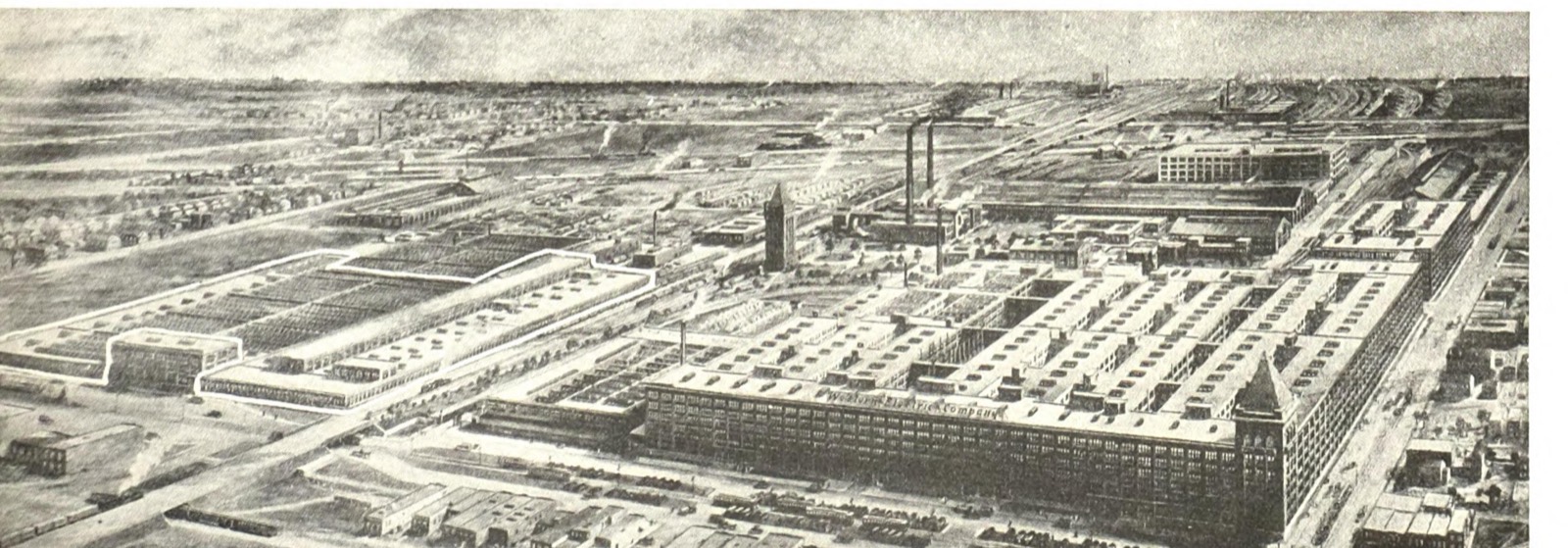
The lighting tests came from outside the plant. In 1923, according to the historian Charles Wrege, the General Electric Company gave $50,000 to the National Research Council, the working arm of the National Academy of Sciences, for a Committee on Industrial Lighting whose purpose was to show sceptical factory managers that more light meant more work. Thomas Edison was its honorary chairman; the fiftieth anniversary of his lamp was coming in 1929. Its working chairman was Dugald C. Jackson, head of electrical engineering at the Massachusetts Institute of Technology since 1907, and the man Jackson sent to Hawthorne to run the tests and write the reports was an MIT researcher named Charles E. Snow. The lamps and fittings to be tested were General Electric’s: Type C bulbs of 100, 200 and 300 watts in a “glassteel diffuser” patented by Ward Harrison of the company’s National Lamp Works, which the company hoped would become the standard factory fitting of the world.
At the plant the work was sponsored by Clarence G. Stoll, the general superintendent, and run by George A. Pennock, the superintendent of inspection, with a young man from the piece rates department, Homer Hibarger, as Snow’s assistant. Hibarger would go on to run the relay assembly test room that followed, and to be the “test room observer” of the 1939 book, which never names him. The foreman who chose the women for the first test was Frank Platenka, who, Wrege was told, preferred Polish women because he could talk to them in their own language.
The people who are remembered came later. Elton Mayo, an Australian who had come to the Harvard Business School in 1926 to head its department of industrial research, was first brought to Hawthorne by Pennock in 1928. Fritz Roethlisberger, his assistant, and William Dickson, the chief of employee relations research at the plant, wrote the six-hundred-page account of the whole programme, Management and the Worker, published in 1939; T. North Whitehead, also of Harvard, wrote two volumes of statistics on the test room in 1938. None of them had been at Hawthorne for the lighting tests. And the people who finally read the data came later still: Wrege, who tracked Snow down in 1957; the psychologist H. M. Parsons in 1974; Richard Franke and James Kaul in 1978; the historian Richard Gillespie in 1991; the economist Stephen Jones in 1992; the economists Steven Levitt and John List in 2009; and Masumi Izawa, Michael French and Alan Hedge at Cornell in 2011.
What they were trying to find out
There were two experiments at Hawthorne, and they asked two questions. A third question, the one the story is remembered for, was never asked by anyone there.
The first question was the lighting industry’s. Roethlisberger and Dickson state it in the words of the plan: the “relation of quality and quantity of illumination to efficiency in industry.” Put plainly, if a factory installed brighter lamps, how much more would its workers produce, and would the gain pay for the current? The industry had an answer it wanted. Gillespie, who read the committee’s papers, concluded that a final report would have recommended a basic level of 7 to 10 foot-candles, which “clearly failed to satisfy the electrical industry’s expectations that the research would provide the scientific justification” for higher levels. By the third winter Snow had narrowed the question to a search, in his own words, “to discover the critical point in the illumination intensity”: the level below which output fell.
The second question was the company’s. When Hibarger moved five relay assemblers into a test room in the spring of 1927, the object, in Pennock’s words as Mayo quoted them, was “to determine the effect of certain changes in working conditions, such as rest periods, mid-morning lunches, and shorter working hours.” The women were “expressly cautioned to work at a comfortable pace, and under no circumstances to try to make a race out of the test.”
The third question, whether people work harder because they are being studied, was not a hypothesis of either experiment. It was an observation, and the man who first wrote it down was Snow, in his report on the first winter, in 1925: “Another reason for a production increase during the test was the increased supervision incidental to the test. The operatives were very conscious of the fact that they were taking part in a test because the whole matter had been explained to them in a personal talk with the foremen.” And: “The mere taking of the records more frequently than usual was in itself effectively increased supervision.” That sentence sat in an unpublished manuscript for eighty-six years. What was published in its place was a legend, and a legend cannot be tested.
What they built
The first test ran from the end of November 1924 to April 11, 1925, in three departments chosen because their work was typical, repetitive, supposed to need the eyes, easy to count, and paid in three different ways: relay assembly, on a gang piece rate; coil winding, on straight piecework; and the inspection of jack shells and springs, on a day rate. Sixty-four women took part, in seven groups, with an average age of 19.8 years. Snow put his groups deep in the rooms, away from the windows. The existing fittings, Holophane reflectors with 50-watt frosted lamps in the relay room and 150-watt lamps in the other two, were the baseline; the glassteel diffusers with 100-, 200- and 300-watt lamps were the treatments. There were eight periods, and the four conditions were run through twice in different orders. One group of ten coil winders was left under the old lamps throughout as a control; the other departments had none. Light was measured with a Macbeth illuminometer every hour at six points in each room, at night for the artificial light alone and by day for daylight and lamps together. Output was recorded five times a day, at 8:30, 9:30, 2:00, 3:00 and at the close, and in inspection every hour. Attendance, temperature, humidity, ventilation and the line voltage were written down as well. The lamps were changed on Sundays, the one day the plant was shut, so every new condition began on a Monday.
The diffusers glared. In the first week of February 1925 Snow’s log records “a metal band which fastened some white cardboard to the edge of the reflector” and “black boxes” built as hoppers, fitted in all three departments in the middle of the test. Supervision went up at the same time, from one instructor for every ten or twelve women to one for every eight. Snow went round the departments and “fixed the shades to prevent abnormal readings.” The plant made its own electricity, and when the load was heavy the voltage sagged and the lamps dimmed, so that on some days the meter read less light with the lamps on than the sun gave through the windows.
The second test, from February 15 to April 24, 1926, kept to one department. Thirty-two induction coil winders were divided into two groups of sixteen with about the same output, and the groups were put in different buildings “in order to reduce the influence of any spirit of competition.” The control group kept its 150-watt lamps; the test group went to 200 and then 300 watts.
The third test was the one with the enclosures. Because daylight had swamped the lamps in the first two winters, two identical rooms were built inside the coil winding department, one at the east end and one at the west, each with its sawtooth glass roof covered pane by pane with paper painted green or white, walled off with partitions and the gaps above and below stopped with burlap. Thirty-two induction coil winders, matched for output, worked in them for five days to get used to the place, and then from September 13, 1926, through eleven periods, the control group had 11 foot-candles and the test group had less: 9, 7, 6, 5, 4, 2.7, and on February 28, 1927, under 25-watt lamps, 1.4. The company would not allow that level for more than a day. On March 1 the groups swapped enclosures, both at 11 foot-candles, and the supervision was raised. In the last period, from April 11 to April 30, the test group went back down to 4.
The relay assembly test room, which Hibarger opened while the third lighting test was still running, was a different kind of machine. It was a corner of a regular shop on the fifth floor, 562 square feet, walled off by a board partition that stopped short of the ceiling. It was, Roethlisberger and Dickson say, the same room that had been used for the lighting tests, and kept the lighting fittings and the electric fans. A relay was a switch for a telephone exchange, “approximately 35 small parts” put together in a fixture and fastened with four screws, about a minute’s work; an assembler made about five hundred a day. Two experienced assemblers who were friends were invited to join and asked to choose four more. Five of the six assembled; the sixth laid out the parts. At each assembler’s right hand was a hole in the bench, and each finished relay dropped through it down a chute to a counting mechanism. An old printing telegraph punched a hole in a moving paper tape for every relay, five rows for five women, so that, as Mayo told the American Economic Association in December 1929, the company had “a complete output record for each girl for every minute of every day.” Their temperature and humidity were logged. A company doctor examined them at intervals. Hibarger sat at a desk in the room and wrote down what they said. The periods are set out in The test room.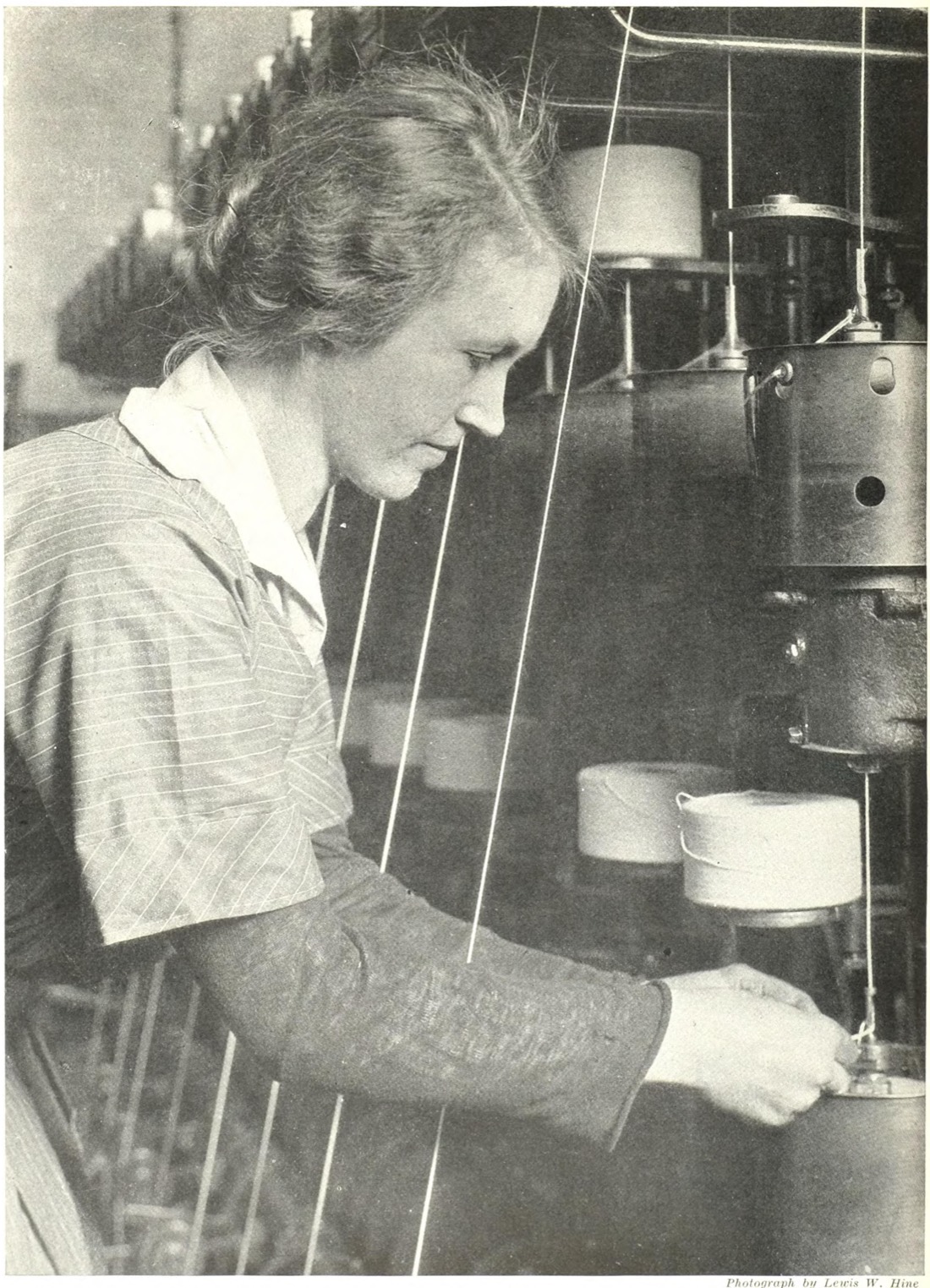
Twenty-five watts
The first winter did not give the industry its number. Roethlisberger and Dickson, who had no report to work from, quote the summary Snow published in MIT’s student magazine, The Tech Engineering News, in November 1927. In the inspection department the light went from 3 to 6 to 14 to 23 foot-candles and “the output bobbed up and down without direct relation to the amount of illumination.” In relay assembly it went from 5 to 44 and output “increased more or less continuously during the test, but not as a sole function of illumination.” In coil winding, from 10 to 46, output was always above the starting level “and did not always fall off with a decrease in illumination.” Snow’s conclusion was about method: the winter “brought out very forcibly the necessity of controlling or eliminating the various additional factors which affected production output in either the same or opposing directions to that which we can ascribe to illumination.”
In the second winter, with a control group, both groups improved by nearly the same amount, 12.1 coils an hour to 14.0 for the control and 12.1 to 14.3 for the test, and “the difference in efficiency of the two groups was so small as to be less than the probable error of the values.” In his unpublished report Snow went further than the magazine did. The gain, he wrote, was supervision: “the effect of increased supervision and the psychological factors incident to test conditions are of such magnitude as to completely mask any effect of illumination on production.”
The third winter is the one in the textbooks, and it is the one the twenty-five-watt lamps belong to. Period by period, as the test group’s light came down, its output went up: 13.2 coils an hour at 11 foot-candles in September, 13.4 at 9, 13.3 at 7, 13.6 at 6 and at 5, 13.7 at 4, 14.0 and then 13.8 at 2.7, and 13.4 on the one day at 1.4. The control group, under 11 foot-candles the whole time, went from 12.6 to 13.2 and then 12.3. When both groups were given 11 foot-candles in March and the supervisor’s attention, both rose again, to 14.1 and 13.6. Snow’s draft said what he thought it meant. The test “has demonstrated that the operatives will maintain their productive output at that level or in the neighborhood of that level which is customary, even in the face of insufficient illumination and the attending discomfort.” The period-by-period figures are in Three winters. The published summary, as Roethlisberger and Dickson quote it, put the protest at 3 foot-candles: “the operatives protested, saying that they were hardly able to see what they were doing, and the production rate decreased.”
Then came the tests that never reached print. Hibarger, with the company’s permission, took two “capable and willing” assemblers into a locker room that could be made dark and brought the light at the bench down over a fortnight in February 1927 to 0.06 of a foot-candle, “an amount of light approximately equal to that on an ordinary moonlight night.” Roethlisberger and Dickson say the two women “maintained their efficiency” and reported less eyestrain than under bright lamps. Hibarger’s own report, which Izawa and her colleagues found at Cornell, says “the test was successful, demonstrating as it did the possibility of maintaining a uniform output under greatly reduced illumination intensities.” Wrege’s reconstruction of the same test, which the economist François Geoffroy reprints, records a sharp drop in output at 0.06 and the women objecting. Hibarger also asked them whether they could assemble blindfold. Yes, one said, but “you do need to see a little, you can work faster.” And in the coil winding enclosure he had the electrician come in, in full view of the women, and change the bulbs for bulbs of the same wattage, day after day, telling them the light was going up and then that it was going down. They said they liked the brighter light and disliked the dimmer. “Their production did not materially change at any stage of the experiment.”
Snow left Hawthorne after April 11, 1927. His final report to the committee was four-fifths written and was never finished; Izawa and her colleagues, who read the draft, say it was abandoned “because of the disappointing findings,” and that the outline he left recommended methods of payment, supervision, glare, control groups and identical conditions as the things any future test would have to control. He resigned from MIT in 1928 and went to work for Western Electric. Roethlisberger and Dickson, writing twelve years later, could only say that “in the absence of any final formal report of this work it is impossible to give a complete, detailed statement.” On December 19, 1928, Pennock ordered the data of the lighting tests destroyed, and the copies that had gone to MIT were destroyed too. Snow had kept carbon copies of his three reports, with their appendices of tables and graphs, his log, and his photographs, and he kept them for thirty years.
What it looked like from inside
Inside the test room the experiment looked like a conversation that the people running it kept trying to stop. The five assemblers were moved in on the afternoon of May 10, 1927, after two weeks in which their output had been recorded in the regular department without their knowledge. They worked a forty-eight-hour week, 7:30 to 5:00 with three-quarters of an hour for lunch and Saturday mornings. On June 13 they were put on a group piece rate of five instead of a hundred, so that each woman’s effort showed in her own pay. In August came the first rest pauses, two of five minutes; then two of ten; then six of five; then, from November 7, a fifteen-minute break in the morning with a lunch the company provided and ten minutes in the afternoon. In the early periods, before each change, they were called to the superintendent’s office and asked what they thought. Theresa Layman Zajac, one of the operators, said in 1976: “I had no idea there would be so much happening and so many people watching us.”
They talked. On Tuesday, August 2, 1927, the log records that four of them “laughed and talked about 75 per cent of the day, more than ever before,” and the foreman called them into the office. The next day Hibarger asked whether they had to think about the work. Operator 1A: “Oh, I can think about other things, but it’s better when you can talk.” She “seemed to resent the reprimand more than any of the other girls.” When they were told off they answered, “We thought you wanted us to work as we feel.” In November the investigators tried making the women call out every defective part as they met it, to fix their attention, and the log began to read: “Operators 1A and 2A were so busy talking between 7:30 and 8:15 that they forgot to call out their defects.” Operators 3 and 4 stopped speaking to the two. The layout operator and Operator 4 asked that either they or the talkers be moved. Operator 2A was called to a conference, apologised, went back and was the same; the superintendent interviewed her himself; her output fell and “her attitude became more hostile than ever.” On January 25, 1928, 1A and 2A were sent back to the department and two experienced assemblers, matched to their rates and output, were put in their places as Operators 1 and 2. Roethlisberger and Dickson say the women “were told that they had been inattentive and had failed to co-operate. No serious attempt was made to understand the reasons for their attitude.” They add that the investigators wanted the women’s attitude to the test to be a constant, so that they “were to be ‘pure laboratory specimens,’” and that “here the experimenters took the easiest road.”
The one thing the women could not be told was the thing the room was for. In September 1928 the rests, the lunch and the short day were all taken away for twelve weeks, Period 12, “the return to original conditions,” and they were told it was just another feature of the test. They did not believe it. On September 24 Hibarger found that they were holding their output down to make sure the rests came back. He promised them, whatever happened to output, that the rests would be in the next period, a promise that Roethlisberger and Dickson admit was “not strictly in conformance with the logic of the original experiment.” Operator 3, whose hourly rate was falling, said: “Give me back the rests and see how my output goes up.” Her brother had told her mother she was not bringing home all her money, and her mother had borrowed thirty-five dollars from her savings.
Mayo arrived in the spring of 1928 with the apparatus of the Harvard Fatigue Laboratory. On April 26, 1928, blood pressures and pulse rates were taken through the working day from the five operators and from three coil winders in the department outside, and the test room’s “pulse product” was lower and steadier. The organic measurements, Mayo said, “served to assure the experimenting group that they were not ‘speeding up’ the workers.” What he found inside the room was the observer. Hibarger had noticed that one woman’s output fell for two weeks of “domestic crisis in her private affairs” and rose when it passed, and that it had helped her to talk to him. “The girls soon came to feel that the observer was there as a sympathetic listener and not as a gang-boss with fixed ideas about production.” Their absences were a fraction of the department’s. “So the provision of an impartial person to observe change became itself the greatest change.”
What happened
The experiment that Mayo described to the economists in December 1929 was the test room, and the illumination tests were its preface. The lighting test, he said, had been “carefully arranged and carefully controlled,” and its implication “had to be repudiated not because it was repugnant to common sense but rather because the carefully established control had obviously failed to take account of the factors that were actually significant in determining the result.” His moral was general: “Where human beings are concerned one cannot change one condition without changing others—so much the illumination experiment had shown.” Of the test room he reported a gradual rise in output, “as high as 85 per cent and 50 per cent” for some operators, “surprisingly steady” and “in a sense, independent of the conditions imposed,” and that when the women were put back on forty-eight hours without rests “the production curve during weeks ignores the change and rises steadily as before.” The improvement was, “in the language of the officials chiefly concerned, ‘startling’; it was also a little puzzling.”
The company drew its own conclusion before the academics drew theirs: rest pauses went into the whole relay assembly department in February 1928. Between 1928 and 1930 Mayo and Roethlisberger oversaw more than 21,000 interviews across the plant, and from November 1931 to May 1932 fourteen men wiring switching equipment were watched in another room, where output did not rise at all. The test room ran on through the Depression. Franke and Kaul, from the company’s records, count twenty-four periods to February 1933, the last beginning on March 1, 1932, when all five women were laid off and replaced by more senior workers who had never assembled a relay; Jones counts 270 weeks to June 1932. The best of the five, Jennie Sirchio, was kept on in an office for a few months and then let go.
Mayo’s The Human Problems of an Industrial Civilization came out in 1933 and carried the test room to a public far beyond the plant. Whitehead’s The Industrial Worker followed in 1938 with the graphs, and found that, except in Period 12, “changes in output rate do not correspond in time with changes in experimental periods for the most part.” Roethlisberger and Dickson’s Management and the Worker came in 1939, with four of its 615 pages on the lighting tests and the honest sentence about the rest: “the experiment which actually was being performed was quite different from the one originally intended.” They set out the five hypotheses the investigators had weighed in 1929 for the rise in output: better light and equipment; relief from fatigue; relief from monotony; the small-group wage; and the change in supervision. They preferred the fifth, and said so for five hundred pages. The lighting tests, they wrote, “failed to answer the specific question of the relation between illumination and efficiency,” but “provided a great stimulus for more research in the field of human relations.”
The name came from a social psychologist. John R. P. French, writing on field experiments in 1950 and again in 1953, said the Hawthorne studies had shown the importance of social factors in group productivity, and that “from a methodological point of view, the most interesting finding was what we might call the ‘Hawthorne effect.’” Henry Landsberger’s Hawthorne Revisited in 1958 made the studies a classic and their critics a literature. After that the lighting tests belonged to the textbooks, and the textbooks improved them. A research methods text of 1982 told students that “each time a change was made, worker productivity increased… As a final check, the experimenters returned to the original unfavorable conditions of poor lighting… Seemingly perversely, productivity continued to rise.” A social psychology text of 1981 said that “regardless of the conditions, whether there were more or fewer rest periods, longer or shorter workdays… the women worked harder and more efficiently.” Tom Peters and Robert Waterman told the managers of 1982 that the best companies created “an endless stream of Hawthorne effects.” In 2004 Ryan Olson and three colleagues read the twenty-one best-selling textbooks of organisational psychology and found that every one of them told the lighting story.
After
The first person to doubt the story in public with numbers was Alex Carey, in 1967, who asked how “conclusions so little supported by evidence” had held so respected a place for so long. The first to go back to the evidence was Parsons, an industrial psychologist. His answer, in Science in March 1974, was that the women had known their output every day from the counters and the clicking tape and had been paid on it: “a combination of information feedback and financial reward.” He redefined the effect as “the confounding that occurs if experimenters fail to realize how the consequences of subjects’ performance affect what subjects do.”
Franke and Kaul found the records. Between November 1976 and May 1977 they borrowed the test room’s files from the plant, and copies went on microfilm to the libraries of the University of Wisconsin at Milwaukee and Worcester Polytechnic Institute. Their regression over twenty-three periods, published in the American Sociological Review in October 1978, explained more than ninety per cent of the variance in output with three things: the replacement of the two operators in January 1928, which they called managerial discipline and which alone accounted for 56 per cent of the weekly figure; the Depression from October 1929, which raised output; and rest time. “Most of the difference in quantitative production of the group is explained by the replacement of two mediocre workers by others who from the outset demonstrated better performance.” Their last sentence was that “humanitarian procedures must provide their own justification.” Milton Bloombaum disputed the method in 1983. Jones, with the same data and the individual output of each of the eight women over 270 weeks, published his own test in the American Journal of Sociology in November 1992, and concluded “that there is slender or no evidence of a Hawthorne effect in the Hawthorne Relay Assembly Test Room,” and “that the Hawthorne effect is largely a construction of subsequent interpreters of the Hawthorne experiments.” Gillespie, who had worked through the archives for Manufacturing Knowledge in 1991, found that the standard account tended to “exaggerate the initial ignorance of the experimenters and misrepresent the process of discovery.” Every one of these was about the relay room. Nobody had the lighting data, which everyone agreed were gone. Berkeley Rice wrote in 1982 that “the original research data somehow disappeared.” Edwin Gale wrote in 2004 that “these particular experiments were never written up, the original study reports were lost, and the only contemporary account of them derives from a few paragraphs in a trade journal.”
Levitt and List went looking because of a sentence in Franke and Kaul’s appendix. “We were able to trace the data to a microfiche room in a small library in Milwaukee,” they wrote in May 2009. The index the Milwaukee librarians had made in 1977 led them to one room’s lighting data; “further inquiry lead us to a second forgotten archive maintained in Boston,” the Baker Library at Harvard, which held the other two. The data were graphs, the company’s own plots of daily output and of natural and artificial light, and the two economists read the points off the curves into a spreadsheet. The first thing they found was the calendar. Every lighting change had been made on a Sunday and had begun on a Monday, and output was higher on Mondays than on the Fridays and the Saturday half-days before them, whether or not the lamps had been changed. Plotted on the five days before and after a change, output “rises sharply on Mondays regardless of whether artificial light is altered.” The researchers of the legend, they wrote, had “seemingly misinterpreted the day of week effect with the Hawthorne effect.” The second thing was the seasons: output in all three rooms fell each summer, when the testing stopped and the daylight came, and rose again in the autumn, and the fall had been read as the effect of the experiment ending. With the weather, the day, the month, the holidays and the defective parts allowed for, the day of a lighting change had no significant effect on output, and the one coefficient that reached significance was a fall on days when the light was turned up. Output during the months of experimentation was three or four per cent above the months before, until room, month and year were put in the equation, when that went too. A one-standard-deviation change in the artificial light moved output by less than one per cent, and the natural light moved it less, which was the weak evidence they offered, in the paper’s own word, “circumstantial,” for an effect of being experimented upon. The working paper’s abstract said that “existing descriptions of supposedly remarkable data patterns prove to be entirely fictional.” The published version, in the American Economic Journal in January 2011, ended with a different sentence: “Perhaps the most important lesson to be learned from the original Hawthorne experiments is the power of a good story.”
The same year the Cornell group published what Snow had kept. His carbons had gone to Wrege in 1961 and from Wrege to Cornell’s Kheel Center in 1980, as Collection 5167, where they had sat, as the Cornell authors put it, generally unknown to the people who wrote about Hawthorne. The draft reports held the tables of this entry, the periods and their dates, the lamps, the foot-candles and the daily averages of each group, and the vector graphs on which Snow had plotted percentage changes in output against light and drawn his conclusions by eye. Run through a statistical package, they did not say what Snow had said or what Levitt and List had said. In the first winter, in the first run through the four conditions, output rose significantly with the light, by 0.039 of a standard deviation per foot-candle; in the second run, through the lengthening days of February to April, it did not. In the second winter there was no difference between the groups. In the third there was an effect, and it was the wrong way round: the test group’s lead over the control group grew as its light was reduced. “Strangely, there seems to have been some effect of lighting. This effect is the reverse of that expected.” Izawa and her colleagues also listed what Levitt and List’s microfilm had not told them: that the third room was the inspection department, which the economists never name, that Saturdays were four-hour days, that one of the coil groups had been a control from the start, and that the baffles and the extra instructors had gone in halfway through the first winter. Their acknowledgements end with Snow, “who disobeyed orders and preserved the history of the illumination experiments that otherwise might have been lost forever.”
What it taught
Start with what the data sheet says, because it is less than the legend and more than nothing. In three winters of changing the lamps over women who wound coils and assembled relays, the light moved output a little in one run of one test, not at all in the next, and the wrong way in the last; the one day at 1.4 foot-candles produced 13.4 coils an hour against a control group’s 12.3; and both groups, over any run of months, drifted upward, and fell in the summer. That is a finding. It is a finding about Hawthorne, in 1925, 1926 and 1927, under those lamps, and nothing else.
The result that was never written up was written up by someone else. Snow’s draft stopped at four-fifths because the committee did not want the number it gave. The industry got its campaign anyway, and the vacuum got Mayo. Roethlisberger and Dickson, who, as Gillespie puts it, “did not have access to any of the participants in the lighting tests or to the reports,” filled four pages from a student magazine, and those four pages were the whole published record for seventy years. An experiment whose sponsor dislikes the answer does not stay unpublished. It gets published by whoever finds it useful, in the form that is useful to them.
The instrument measured the calendar. The lamps were changed on Sundays because Sunday was the day the plant was shut, and so every treatment began on a Monday, and Mondays were good days, and the summers were bad ones. For eighty years the jump that followed each change was read as the workers answering the experimenters, when it was the workers answering the week. Nobody who told the story had looked at a Monday with no change in it. The control a story needs most is the one that is boring to keep.
The effect was on the sheet before it had a name, as an error term. Snow wrote in 1925 that “the mere taking of the records more frequently than usual was in itself effectively increased supervision,” and in 1926 that supervision and “the psychological factors incident to test conditions” were large enough “to completely mask any effect of illumination.” He was treating the thing as noise to be controlled; it took French in 1950 to call it a finding. Both were right. The lesson of 1925 was that you cannot vary one condition in a factory without varying the attention paid to the people in it. The lesson of the textbooks was that attention is everything. The second does not follow from the first, and the sheet supports only the first.
The test room was told what it was for, and worked to it. The women were told the test was about rest pauses, and when the rest pauses were taken away they held their output down to get them back, and were promised them whatever happened. Two of them were removed for talking, and the replacement explains more of the output than any rest pause. The observer became a confidant and the confidences became the result. All of this is in the 1939 book, in plain sight, with the sentence that the experiment actually performed was not the one intended. The legend kept the rising line and dropped the sentence.
A story that fits every outcome is not a result. Output up with more light, up with less light, up with rests, up without them: a hypothesis that this confirms is a hypothesis nothing could refute, and it was taught as a caution to experimenters for sixty years before anyone checked whether the data showed it. Jones found “slender or no evidence” in the relay room; Levitt and List found the Mondays in the lighting rooms; Izawa, French and Hedge found an effect the wrong way. Three sets of readers, two sets of data, no textbook pattern. The number in the title of this entry is on a sheet in Ithaca, and it took eighty-four years for anyone to divide it by anything.
Check the story before you learn from it. The Works were begun in 1903 in the company’s magazine and in 1905 in Harvard’s exhibit; they employed 29,000, 31,000, 35,000 or more than 40,000. The first test began on November 24 or November 26, 1924; the third ended on April 11 or April 30, 1927. The lowest light in the enclosures was 3 foot-candles in the published summary, 2.7 and then 1.4 in the recovered table, and 0.06 in the locker room, where the two women either maintained their efficiency or dropped sharply, depending on which report of the same fortnight you read. There were three rooms to Levitt and List and seven groups to Izawa. In the 2009 working paper “Monday output is less than other weekdays”; in the 2011 article “productivity is higher on Mondays than on Fridays and Saturdays,” and both are true of the same graph. The test room ran to June 1932 in one count and to February 1933 in another. The term was coined in 1950, or 1953, or 1958. None of this touches the shape of the finding, and all of it is the normal condition of a true story.
Sources
- F. J. Roethlisberger and William J. Dickson, with Harold A. Wright, Management and the Worker: An Account of a Research Program Conducted by the Western Electric Company, Hawthorne Works, Chicago, Harvard University Press, 1939. Chapter I (pp. 14–18) for the three illumination experiments and the quotations from Snow’s 1927 article, the moonlight test and the bulb-changing test; Chapters II–IV for the test room, its equipment, the periods and their dates, the operators’ words, the reprimands, the replacement of Operators 1A and 2A on January 25, 1928, Period 12, the sentence on the experiment actually performed, and the five hypotheses; Part V for the judgement on the replacement. The copyright was renewed on October 11, 1966 (R394960), so it is quoted briefly. Read in the scan on archive.org. archive.org, github.com/NYPL/cce-renewals
- Elton Mayo, “The Human Effect of Mechanization,” American Economic Review 20 (1), Supplement, Papers and Proceedings of the Forty-second Annual Meeting of the American Economic Association, March 1930, pp. 156–176. The earliest published account of the test room by a Harvard author: the repudiation of the illumination result, Pennock’s instructions to the operators (quoted at second hand from “a paper by G. A. Pennock”), the output record “for every minute of every day,” the “startling” improvement, the pulse measurements of April 26, 1928, and the observer as “sympathetic listener.” Read in a scanned copy. uv.es, jstor.org
- C. E. Snow, “Research on Industrial Illumination: A Discussion of the Relation of Illumination Intensity to Productive Efficiency,” The Tech Engineering News (MIT), November 1927, pp. 257–282 intermittently. The only contemporary published account. No copy could be reached; its words are quoted here as Roethlisberger and Dickson quote them, at second hand. MIT’s archive holds the run. archivesspace.mit.edu
- Masumi R. Izawa, Michael D. French and Alan Hedge, “Shining New Light on the Hawthorne Illumination Experiments,” Human Factors 53 (5), October 2011, pp. 528–547. The history of the Committee on Industrial Lighting, General Electric’s $50,000, Edison, Jackson, Snow, Stoll, Pennock, Hibarger and Platenka; the design, dates, groups, lamps, light levels and output of all three experiments (Tables 2–4); the glare baffles and supervision; Snow’s log, his 1925 sentence on supervision and his 1926 sentence on masking; Hibarger’s special test and interview; the unfinished final report; the destruction order of December 19, 1928; Snow’s carbons, Wrege and Collection 5167; French’s coinage; and the authors’ own analysis. Snow’s and Hibarger’s unpublished words are quoted from this article, at second hand. In copyright; quoted briefly. doi.org, gwern.net
- Steven D. Levitt and John A. List, “Was There Really a Hawthorne Effect at the Hawthorne Plant? An Analysis of the Original Illumination Experiments,” NBER Working Paper 15016, May 2009; and American Economic Journal: Applied Economics 3 (1), January 2011, pp. 224–238. The Milwaukee microfiche room and the Baker Library, the graphs, the Sunday changes and the Monday pattern, the seasonal declines, the regressions, the 1.4 per cent a year for the plant, the “entirely fictional” sentence of 2009 and “the power of a good story” of 2011; also the quotations from Blalock, Freedman, Peters and Waterman, Rice, Gale and Gillespie, which are taken from these papers at second hand. nber.org, aeaweb.org, gwern.net
- Richard Herbert Franke and James D. Kaul, “The Hawthorne Experiments: First Statistical Interpretation,” American Sociological Review 43 (5), October 1978, pp. 623–643. The borrowing of the records in 1976–77 and the microfilms at Milwaukee and Worcester, the twenty-three periods, the 24th period to February 8, 1933, managerial discipline, the Depression and the conclusions. In copyright; quoted briefly. jstor.org, gwern.net
- Stephen R. G. Jones, “Was There a Hawthorne Effect?”, American Journal of Sociology 98 (3), November 1992, pp. 451–468. The 270 weeks and 24 periods, the eight women, French’s 1953 sentence (quoted at second hand), Whitehead’s finding on Period 12, Gillespie’s sentence on the standard account, Hibarger’s log of January 25, 1928, and the conclusions. In copyright; quoted briefly. doi.org, gwern.net
- H. McIlvaine Parsons, “What Happened at Hawthorne?”, Science 183 (4128), March 8, 1974, pp. 922–932. The abstract, for feedback and reward and the redefinition of the effect; the body was not reached. doi.org, pubmed.ncbi.nlm.nih.gov
- François Geoffroy, “Is There a Hawthorne Effect?”, Gérer & Comprendre, English language online selection 2019, translated from the French of March 2019. For Olson, Verley, Santos and Salas’s 2004 survey of twenty-one textbooks, Wrege’s 1976 table of Hibarger’s moonlight test, the extension of rest pauses to the department in February 1928, and the 29,000 employees. annales.org
- Baker Library, Harvard Business School, The Human Relations Movement: Harvard Business School and the Hawthorne Experiments, 1924–1933, online exhibit. The plant’s construction from 1905 and its 40,000 workers by 1929, Mayo’s appointment and Pennock’s invitation in 1928, Hibarger and Chipman as observers, the operators’ families, Theresa Layman Zajac’s words of 1976, the 21,000 interviews, and the bank wiring room. library.hbs.edu, library.hbs.edu, library.hbs.edu
- Western Electric News, volume 15, April 1926 to March 1927. The company’s description of the Works in its annual statement (April 1926, p. 5), Lewis Hine’s photograph of Rose Vohn (April 1926, p. 2) and the aerial view with the remodelling article (December 1926, p. 29), from which the two figures are taken. Published in the United States before 1930, so public domain. archive.org
- Elton Mayo, The Human Problems of an Industrial Civilization, Macmillan, 1933 (renewed August 4, 1961, R280079); T. North Whitehead, The Industrial Worker, two volumes, Harvard University Press, 1938 (renewed April 26, 1965, R360176). Named, not quoted; the renewal records are in the New York Public Library’s transcription of the Catalog of Copyright Entries. github.com/NYPL/cce-renewals
- Charles D. Wrege, “Solving Mayo’s Mystery: The First Complete Account of the Origin of the Hawthorne Studies. The Forgotten Contributions of C. E. Snow and H. Hibarger,” Academy of Management Proceedings, 1976; and Facts and Fallacies of Hawthorne, Garland, 1986; Richard Gillespie, Manufacturing Knowledge: A History of the Hawthorne Experiments, Cambridge University Press, 1991. Not reached; cited through Izawa, Levitt and List, Jones and Geoffroy. The Snow papers are Collection 5167 at the Kheel Center for Labor-Management Documentation and Archives, Cornell University. archives.library.cornell.edu