At 11:38 in the morning, Eastern time, on Monday 13 October 1947, a B-17 numbered 5560 was flying at 19,200 feet over the Atlantic at 29.8 degrees north, 74.9 degrees west, about 350 miles east-north-east of Jacksonville, Florida. The air outside was five degrees below freezing. The aeroplane was at the level of the tops of a thin shelf of cloud, and thirty to fifty miles away, below and around it, was the wall of a hurricane. A second B-17 followed half a mile behind and 3,000 feet higher with cameras. A B-29 trailed fifteen to twenty miles behind, 5,000 feet above the lead ship, with a man from the General Electric Research Laboratory in it. On the word from the lead ship, a dispenser in the B-17 began to pour crushed dry ice out into the cloud.
It did so for thirty minutes, along a straight track 110 miles long. Eighty pounds went out of the dispenser, and two mass drops of fifty pounds each went into one big cumulus top on the way. Then the three aircraft turned round and flew back along the line, looking. The shelf of cloud they had seeded had come apart into scattered snow clouds over perhaps 300 square miles. They did not go into the eye. They flew home to Tampa and landed at four in the afternoon, and nobody went back to look again.
The storm was heading out to sea. Forty-two hours later it came ashore fifteen miles south of Savannah, Georgia, with gusts of ninety-five miles an hour. The man who had calculated the whole affair from his office in Schenectady, who was not on any of the planes, would spend the rest of his life saying what the odds were that a hurricane would do that on its own in the six hours after it was seeded. The number he arrived at was one in a hundred and ten.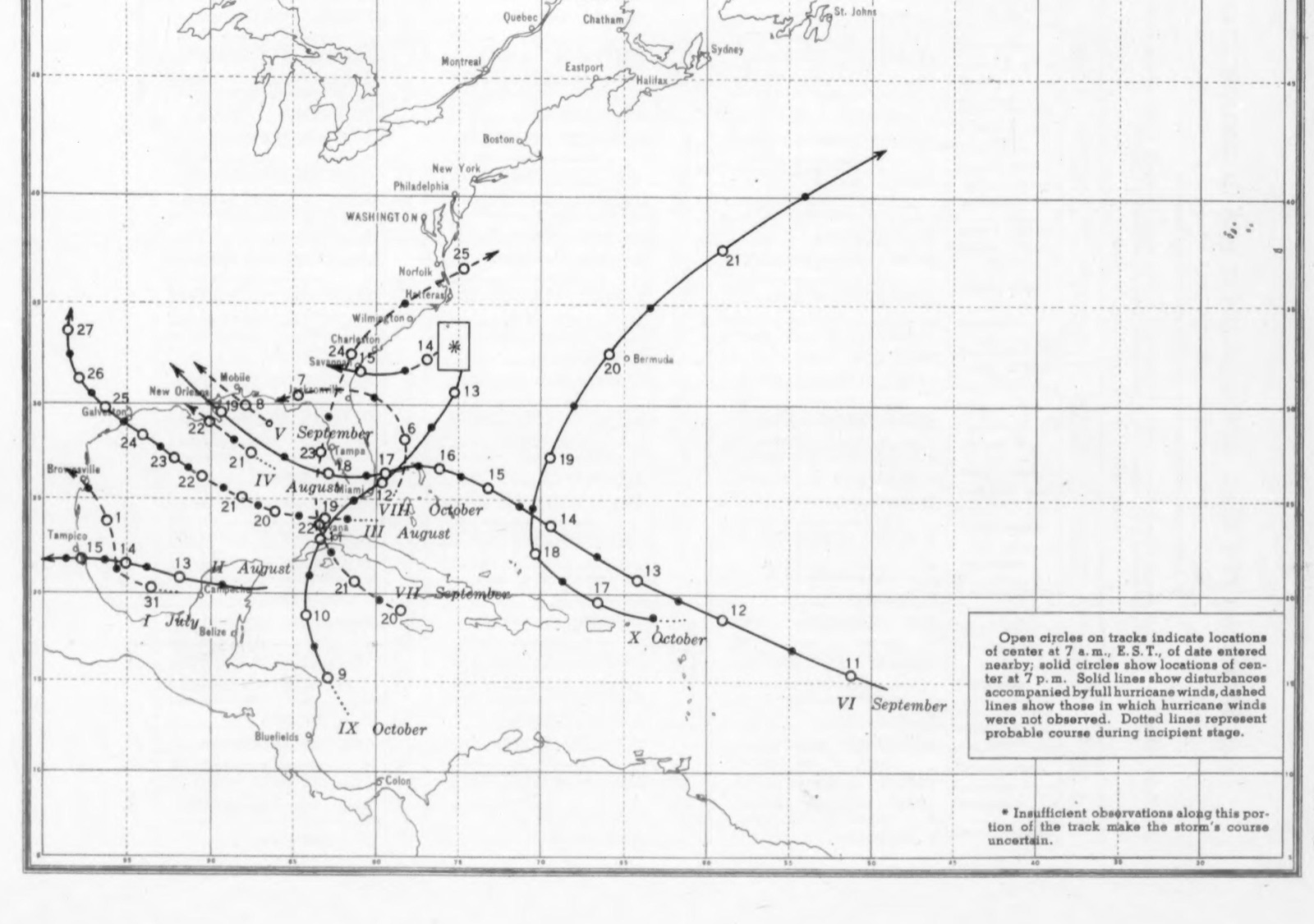
Who ran it
The laboratory was the General Electric Research Laboratory at Schenectady, New York, whose director was C. G. Suits and whose associate director was Irving Langmuir, who had won the Nobel Prize for chemistry in 1932. Langmuir’s collaborator since 1940 was Vincent Schaefer, with whom he had made smoke filters for gas masks and then the screening smokes the Army used in the war; in 1943 Schaefer had gone up Mount Washington in New Hampshire to study why aircraft radios failed in snowstorms, and found that everything he put outside turned to ice. Bernard Vonnegut had joined the laboratory from the Massachusetts Institute of Technology in the autumn of 1945 and worked on supercooling. The company’s general counsel was Vice President R. E. Luebbe, who enters the story at the one point where he matters.
The government side had three services and a committee. The contract was the Army Signal Corps’, beginning on 28 February 1947, with the Office of Naval Research as joint sponsor and the Air Force supplying the aircraft and the crews. A Steering Committee of the three services set the policy, with Langmuir and Schaefer as consultants. An Operations Group, which flew the aeroplanes and kept the weather station, was under an Operations Committee chaired by Lieutenant Commander Daniel F. Rex of the Navy. For the hurricane the project joined the 53rd Weather Reconnaissance group of the Air Force at MacDill Field, Tampa. The project got its name, Project Cirrus, on 25 August 1947.
The other party was the United States Weather Bureau, whose chief was Francis W. Reichelderfer. The Bureau was not part of the project. In the General Electric history of Project Cirrus, written in 1952 by the laboratory’s own public relations man, Barrington Havens, the Bureau is “the spearhead of the opposition, so to speak.” Ten years after the flight, three of the Bureau’s forecasters, Conrad Mook, Eugene Hoover and Robert Hoover, would go through the ships’ logs and find out where the hurricane had actually been.
What they were trying to find out
There were two claims, and only the first was ever stated in a form that could be tested.
The first was Schaefer’s, and it was already proved. A cloud below freezing is very often made not of ice but of water droplets that have not frozen, because there is nothing in them to freeze on. Drop something through it colder than about forty degrees below zero and the air behind it fills with ice crystals, which grow at the expense of the droplets and fall. In August 1946 Langmuir calculated what would happen in a real cloud: the pellets’ rate of fall, the number of crystals, the snow that would result, and one more thing. Freezing releases heat. Seeding a supercooled cloud would warm it, the warmed air would rise, and the rising would spread the crystals and make more cloud. That was the lever. A few pounds of dry ice, by this reasoning, were not the energy of the result but the trigger of it.
The second claim was the one the hurricane flight was made for, and nobody wrote it down as a prediction. The General Electric history says that the hurricane study “was planned by the various participating government agencies for the purpose of determining whether seeding operations could be carried out in such storms. These agencies hoped that the experience thus gained would permit the planning of further operations in the future, with the hope of possibly steering or in other ways modifying tropical hurricanes.” Schaefer, asked in the Senate in 1951 what the flight was for, said that “the main reason we made the flight was to see what a hurricane was made up of on top. With their supercooled clouds, how many supercooled clouds were there; could those clouds be changed? We did not try to break up the hurricane.”
So the hypothesis under test, as far as one was stated, was that a hurricane’s clouds could be seeded at all. Behind it stood the hope of steering. And behind that stood a problem that no amount of planning could have removed. An experiment on a cloud over Schenectady can be repeated the next day on the next cloud and set against the unseeded cloud beside it. A hurricane is one thing, in one place, once. There was no second hurricane to leave alone. Whatever the storm did after it was seeded, there would be exactly one reading, and it would be whatever the storm did.
What they built
The apparatus was a freezer, an aeroplane and a contract. The companion piece “The cold box” tells the first two in full.
The freezer was a home food-storage unit, lined with black velvet so that a beam of light showed what was in the air inside it. Schaefer breathed into it and got a cloud at about minus twenty-three degrees, and no ice, until one July day in 1946 when the box was not cold enough and he put a piece of dry ice in to cool it, and the air filled with crystals. A grain did it; a sewing needle dipped in liquid air did it; the cold was what mattered. The aeroplane was a rented Fairchild, which on 13 November 1946 took Schaefer up to a cloud over Pittsfield, Massachusetts, where he dropped about three pounds of dry ice and “was thrilled to see long streamers of snow falling from the base of the cloud through which we had just passed.” On 20 December, with the Albany Weather Bureau already forecasting snow for the evening, he seeded the base of the overcast at noon, and at 2:15 it began to snow in Schenectady and for a hundred miles around, the heaviest fall of the winter. The laboratory’s press release did not claim the snowstorm. The newspapers speculated anyway.
The contract was the result. Suits took the question to Luebbe, the general counsel, and the history records the conclusion in the company’s own voice: “It was recognized that the possibility of liability for damage from cloud-seeding experiments was a very worrisome hazard in this new form of cloud experimentation. Since such a threat to the share owners’ money would not be balanced by any known gain to the Company’s products or business, there was great reluctance to incur risks of uncertain but potentially great magnitude.” The remedy was to have the government do the flying. “No further seeding flights were made until such sponsorship was provided.” The Signal Corps contract carried the clause that mattered: “the entire flight program shall be conducted by the government, using exclusively government personnel and equipment, and shall be under the exclusive direction and control of such government personnel.”
That is how a hurricane came to be seeded by a Navy officer’s operations group in Air Force aeroplanes, with a General Electric chemist aboard as an observer, under the direction of a laboratory that was forbidden to direct anything. By the summer of 1947 the Operations Group had moved into the General Electric hangar at the Schenectady County Airport. Schaefer, Raymond Falconer and a colleague had built an automatic dispenser to meter dry-ice pellets out of an aircraft, and a crusher to reduce the blocks to pellets. Through the summer the project seeded stratus and cumulus around Schenectady and over the Adirondacks, with dry ice and with silver iodide, and photographed the holes it made.
The hurricane plan was laid in September. The agencies wanted “a ‘young’ storm as soon as possible after it had assumed the form of a hurricane,” and there was a dry run from Schenectady on 19 September. In the middle of the month a major hurricane crossed southern Florida and went on to Louisiana, and the newspapers found out what was being planned. “The newspapers were full of accounts that certain individuals were planning to seed it,” Langmuir said in November. “They called it ‘hurricane busting.’ I do not know where that phrase came from, because nobody intended to bust the hurricane, as far as I know. A flight was planned to get information. However, we were not ready for that.” Then the season went quiet.
Eleven thirty-eight
On 10 October 1947 word came from Miami of a storm forming below Swan Island in the western Caribbean. It crossed Cuba west of Havana on the night of the 10th as a moderate storm, and in the Gulf of Mexico, in three or four hours, became a hurricane. On the night of the 11th it crossed the southern tip of Florida from the west coast north of Cape Sable to the east coast between Miami and Palm Beach, and at the Hillsboro lighthouse near Pompano the calm centre passed between 3:30 and 4:30 in the morning of the 12th. The great hurricane of September had already broken that coast, the Weather Bureau’s H. C. Sumner wrote afterwards; what the October storm brought was rain, five to thirteen inches across the south of the state, on ground already under water; by the end of the month “most of south Florida resembled a great lake.” The flood damage was put at $20,000,000, the wind damage at about $75,000.
The project’s two B-17s had left Schenectady on the 10th and were at Mobile, Alabama, on the evening of the 11th, by which time the storm was crossing Florida. They flew on to MacDill the next day and joined the 53rd Weather Reconnaissance group. By then the hurricane was out in the Atlantic off Miami, moving north-east, and the forecasters expected it to go on that way. The plan was for early on Monday, when the storm would be 300 to 400 miles east of Florida.
The account of the flight is Rex’s, written for the project’s quarterly report to the Signal Corps and read in full by Langmuir to the National Academy of Sciences five weeks later. The three aircraft took off from MacDill at 8:20 in the morning and reached the outer wall of the eye at 10:45. “The storm consisted of an eye approximately 30 miles in diameter, surrounded by a thick wall of clouds extending from about 800 feet up into the cirrus overcast at 20,000 feet and being some 30-50 miles thick radially.” Shelves of thin cloud spread out from the wall, the uppermost with tops at 19,000 feet, with the sea visible through the breaks. Off to the east and south, spiralling out from the centre, was “an exceedingly active squall line, appearing as an almost continuous line of cumulonimbus with cirrus tops to an estimated 60,000 feet.”
They came in from the south-west into the storm’s right rear quadrant, flew once round the outer wall, and chose to seed the uppermost shelf. “Seeding commenced at 29.8 degrees North, 74.9 degrees West at 11:38 EST at an altitude of 19,200 feet, the outside air temperature being approximately -5°C. Continuous seeding was effected along a straight course to 30.2 degrees N, 73.9 degrees W, thence to 30.8 degrees N, 73.1 degrees W, at which point (12:08 EST) seeding was stopped. During this 30-minute period 80 pounds of solid carbon dioxide was dispensed along the 110-mile track. In addition, two mass drops of 50 pounds each were made into a large cumulus top at 30.7 degrees N, 73.4 degrees W.”
Then they flew the track in reverse, taking photographs. They had meant to go into the eye and to seed the squall line, and did not, because the group’s homing aids, radio, compass and visual flares, had failed, and the aircraft might have lost one another. What they saw was what the cold box would have predicted. “Visual observation of the seeded area showed a pronounced modification of the cloud deck seeded. No organized trough was observed; rather, the overcast previously observed appeared as an area of widely scattered snow clouds. The disturbed area covered perhaps 300 square miles. No convective activity was seen to follow the seeding process at any time during the mission.” The group landed at MacDill at four. Rex’s last sentence: “No post test observation flights were made.”
Schaefer, who had watched from the B-29, wrote six conclusions. The seeding had produced “an area showing snow showers and stable snow clouds with light rain in the above-freezing region.” “The region where profound effects might have been produced was in the extremely active squall line mentioned by Commander Rex. This was not attempted for the reasons indicated.” And: “Owing to the complex structure of this ‘old’ storm, it is believed that a ‘young’ hurricane would provide much more satisfactory data for estimating the effect of seeding operations.” Langmuir added one observation from those who had been aboard: “the extreme mildness of it. It was no storm at all in much of the area but seemed more like relatively fair weather.”
Those were the readings from the apparatus. The reading from the storm came in over the next two days. On Tuesday the 14th the Associated Press reported from Hatteras that the hurricane “remained nearly stationary” to the south-east of the cape, that the Bureau had put up storm warnings from the Delaware Breakwater to Wilmington and from Charleston to Wilmington, and that “a plane had located a secondary storm center 180 miles southwest of the original center moving northward about 10 miles an hour. It said winds near the two centers were estimated at 80 miles an hour.” Sumner’s account for the Bureau is more careful: “insufficient observations during the night of October 13-14 made its movement uncertain during that time.” A reconnaissance plane found winds of fifty to fifty-five knots early on the 14th, and another found eighty knots at sunset. “Moving on a westward course, the center moved over Georgia at about 7 a. m. of the 15th, a short distance south of Savannah.”
The lowest pressure at Savannah was 973.9 millibars at seven in the morning; the strongest wind was estimated at eighty-five miles an hour at 6:59, with gusts to ninety-five, and Hunter Field reported ninety-five-mile gusts “when recording instruments blew away.” The band of hurricane winds was about forty miles wide. The tide ran twelve feet above mean low water at Savannah Beach and at Parris Island, South Carolina, and nine feet at Charleston, where the water came over the Battery. The Red Cross’s first survey counted 1,500 homes and a hundred business buildings damaged in Savannah; the Bureau put the Savannah area at about $2,000,000, and Georgia and the Carolinas together at about $3,000,000. Two National Guard C-47s were destroyed in their hangars at Chatham airport. One man died: the Evening Star’s dispatch of the 16th named Neill McCord, a lumberjack of Thomaston, Georgia, thirty-five, killed when a tree fell on his cabin. “After passing over Southern Florida Sunday,” the Associated Press wrote from Savannah, “the hurricane was believed headed for the North Atlantic, but curved back and headed directly for Tybee Island, just off Savannah. Fire sirens and men with flashlights gave the alarm.”
What it looked like from inside
From inside the project the problem was first of all a security problem. The flight had been planned as a military operation and was not announced, and the newspapers had been told about hurricane busting in September. A weekly paper in Nahunta, Georgia, the Brantley Enterprise, laid the matter out on 23 October as everybody in the state understood it, under the heading “Did ‘Dry Ice’ Experiment Start Hurricane?” It gave the story in chapters: a hurricane going north up the Atlantic; government planes dropping dry ice into it “to see just what might happen if several tons of frozen air were suddenly loosed in the midst of such storm”; a “new freak hurricane” splitting off and veering west; the freak ripping through south Georgia. Chapter five was the official response. “News reports state that ‘A tight security lid has been clamped on all aspects of last week’s “hurricane steering” flight over the Atlantic hurricane.’ A scientist connected with the hurricane busting test is quoted as saying that he ‘discounted reports that the tests might have turned the storm suddenly toward the Georgia coast.’” The editor’s problem was stated in one line: “Did hurricane busting test cause freak hurricane?” And his request: “Is there a hurricane detective in the house?”
Langmuir’s answer came on 17 November 1947, in an address to the National Academy of Sciences in Washington that was printed the following July in the Proceedings of the American Philosophical Society. He read Rex’s report whole and showed a map, his figure 14, with the storm’s path from an island west of Jamaica across Florida and out to sea, a circle for the clouds of the hurricane at the time of seeding with the little straight line of the seeding run under it, and the big arrow of the squall line. “The path of the hurricane from that point on was uncertain for about a day or so,” he said. “The weather forecasters thought it had, at first, two centers, but later on decided it did not have two centers. The storm recurved and went west.” Of the squall line, which was on the photographs and in no meteorological record: “When it started, when it ended, what happened to it, nobody knows. The Weather Bureau has no record whatever.” And of the question the editor in Nahunta had asked: “What did happen, nobody knows.”
Then he drew the comparison himself. On the same map, as a dotted line, he put the hurricane of 13 to 23 October 1906. “In 1906 between October 13 and October 23 there was a hurricane which followed a path, shown as a dotted line in figure 14, very much like that of the hurricane of October 1947. It too turned almost back on its track and moved back to the coast. Perhaps it also had a squall line and this contributed to its erratic behavior.” It was Langmuir himself who produced the nearest thing to a control the experiment would ever have. “The main thing that we learn from this flight,” he said, “is that we need to know enormously more than we do at present about hurricanes.” Next year’s programme should be to study hurricanes away from land, out beyond Bermuda, “and see if we cannot, by seeding them, in some way modify them or shift their positions. I think the chances are excellent that, with increased knowledge, something can be done. The stakes are large and, with increased knowledge, I think we should be able to abolish the evil effects of these hurricanes.”
That last sentence was the one the Weather Bureau held against him. At a meeting at Oslo in August 1948 Reichelderfer told the world’s meteorologists that in all the American experiments “there was no recorded case in which seeding a cloud with dry ice had produced rain when rain from natural causes had not fallen within 30 miles.” Asked by Langmuir in January 1949 why he had said it, he answered that the statement “was needed to counteract the greatly exaggerated statements that I had made about the possibilities of weather modification,” and named the sentence about abolishing hurricanes as the worst of them. Langmuir’s reply was the whole of his position in a figure of speech. “To assume that a hurricane could not be successfully modified by even a single pellet of dry ice is like assuming that a very large forest could not be set on fire by such a small thing as a single match.”
The match makes the smallness of the dose an argument for the size of the effect, and it has the property that no reading from the storm can contradict it: any result at all, including no result, is consistent with a match that did or did not catch.
By 1953, in the second part of the project’s final report to the Signal Corps, Langmuir had turned the 1906 track from a doubt into a statistic. “This behavior, however, was almost exactly like that of a hurricane that followed about the same course between 13 October to 23 October 1906, which at about the same place turned back on its path and went back into the Gulf of Mexico. It cannot, therefore, be concluded that the change of direction of the 1947 hurricane did not occur of its own accord.” Then: “However, an examination of 304 hurricanes that have been recorded during the 44 years from 1900 to 1944 and are described in Tannehill’s book on hurricanes have shown that only 42, or about 14 per cent, showed any sudden changes in direction such as loops or abrupt turns of 60 degrees or more. The chance that a given hurricane between latitudes of 20° and 40°N will change its direction in any given six-hour period is only about one in 110. Therefore, the fact that the 1947 hurricane did change its direction within six hours after seeding has a significance factor of the order of 100, so that there is considerable evidence that seeding hurricanes does tend to change their behavior.” In a later paper he put it more shortly: “There are good reasons, discussed in the 1953 Report, for believing that this change in direction and in character was produced by the dry ice seeding.”
That is the number in the title, and it is the reading Langmuir took from an experiment that had no control. It was taken from a book of past tracks, after the event, for a six-hour window chosen because the storm turned within it, and it measured how often hurricanes turn, not whether this one turned because of eighty pounds of dry ice. A control would have been a second hurricane, in the same week, in the same place, left alone. There was one. It had come ashore near Brunswick, Georgia, on the night of 6 October, and nobody had thought of it yet.
What happened
Nobody sued. What happened instead was that the lawyers’ instrument, the one built into the contract in February 1947, was read at last, and it read what Luebbe had expected it to read.
The record of the reading is the joint hearings of three Senate committees in March 1951 on the weather-control bills, where Suits, Schaefer and Vonnegut appeared together for General Electric on the first day. Senator George Smathers of Florida asked whether experiments had not been made “attempting to dissipate hurricanes,” and recalled one “down off Puerto Rico, about a year or so ago,” when the Air Force “attempted to break up a hurricane heading toward Florida, and, I might add, without success.” Schaefer corrected him: he had been on the flight; its purpose was to see what a hurricane was made of on top; “We did not try to break up the hurricane.” He explained the forty-eight hours, the storm already over Miami when they arrived, the decision to wait until it was three or four hundred miles at sea, the localised seeding. “That is about all that happened.”
Smathers: “You say you carried out some localized seedings on that hurricane after it passed over Miami. What were the results?”
Schaefer: “We do not know.”
Smathers: “You do not know what the results were. I hope you will try it again.”
Schaefer: “I hope so, Senator.”
Suits then said what the company had come to say. Studies of hurricanes ought to be part of future research; hurricanes “may be susceptible to control.” But “public liability now stands in the way of such work. I think this question points particularly to the wisdom of the liability provisions of S. 222. Here is a case where there is the potential possibility of incurring tremendous liability. No one is willing to do that under present laws.” Schaefer added, for the record, “It so happens that we did not conduct the experiments.”
The Assistant Secretary of the Interior, William Warne, said two days later that Schaefer could have followed the storm with more flights, “but he had to recognize the possibility that General Electric would face several hundred million dollars’ worth of suits if he happened to turn the hurricane in the wrong direction.” And Senator Clinton Anderson of New Mexico, in the chair, questioning a Justice Department lawyer on the fourth day about who could be sued, gave the plainest summary of the experiment anyone ever made: “Now, that hurricane had left the Florida coast and started out to sea in the direction of Bermuda. It was seeded when it was out at sea. Because of some circumstance which no one understands, it immediately bent back and started up against the Georgia coast. If that had wiped out great sections of the Georgia coast, do you think people would have had quite a bit of legal activity against the party that did the seeding?” The lawyer, Carl Eardley, thought it might very well be. “We have no way of knowing whether that seeding bent it back, or whether the hurricane just turned and came back.” “That is the problem.”
The experiment’s own paperwork is thinner. The project’s final report on the 1947 contract, dated 31 December 1948, does not describe the hurricane flight at all; Rex’s account went into a quarterly progress report, and from there into Langmuir’s address. Schaefer’s own conclusion after the flight was that the time it took to plan “raises the question of whether the results justify further activities of this kind by this particular group until the urgent and much simpler operations are completed at Schenectady.” The last of the three Signal Corps contracts ran out at the end of September 1952, and Project Cirrus ended with it. The next seeding of a hurricane meant to change it was fourteen years away. Langmuir went on recommending it. “There are obvious reasons for not experimenting with hurricanes near the coast of North America,” he wrote in a later paper, “but it would seem very important to learn how such storms can be controlled. This would require experimentation with typhoons far from any inhabited lands.”
The Weather Bureau’s reading came in July 1957, in its own journal, from Mook and the two Hoovers at the forecast centre at Washington National Airport; the companion piece “The log of the Lisieux” follows it step by step. Their question was the one the state of Georgia had asked: where was the hurricane, and when did it turn? Langmuir’s figure 14 put the storm at the time of seeding at exactly the position shown on the Northern Hemisphere sea-level chart for 12:30 Greenwich time that morning, five hours earlier, “the implication, which one could draw from this,” being “that at the time of seeding the storm had stopped moving, which might be interpreted further as an indication that the storm was about to make a change in its course.” But the chart’s position “hinges almost entirely on a report received by radio from a vessel SS Lisieux,” and no other report from the ship was on file. So they went to find it. The French Line, which had owned the ship, tracked the log down through its present owners and sent it from Paris. It showed that at 12:30 Greenwich time on 13 October the Lisieux had had the wind from the east, not the west, and the position on the chart was wrong.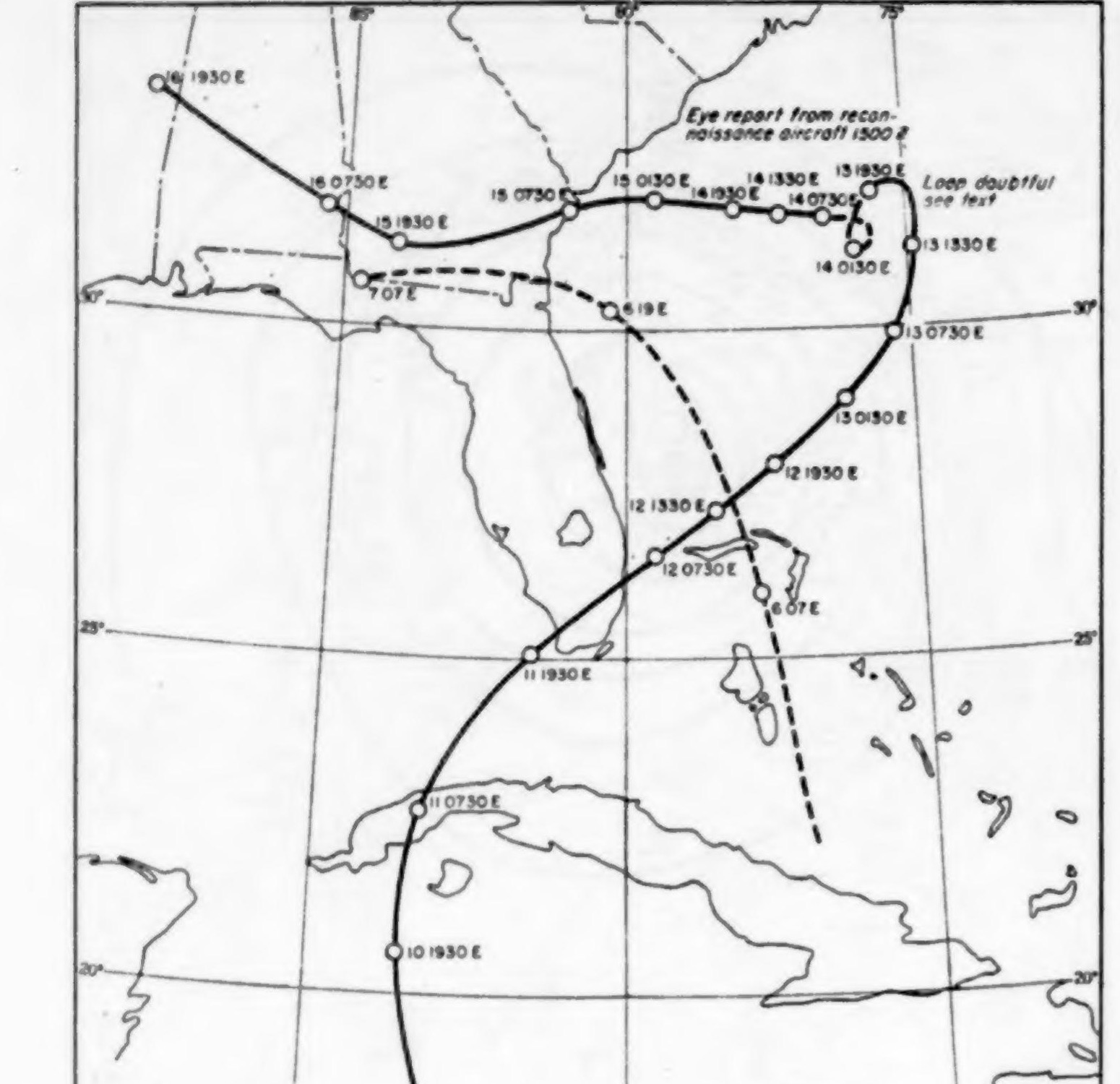
Then they did what nobody had done in 1947. The Bureau’s New York office went round the shipping lines in the harbour for the logs of every vessel that had been near the storm, and from the four-hourly entries the three forecasters drew charts for every four hours of the 13th and 14th, corrected each ship’s barometer by trial and error until the storm came out “consistent and symmetrical,” and plotted the result. “As a result of the corrections, the hurricane position was found to be somewhat to the west of the position where it was originally believed to have been located (fig. 1), which means that some change in course of the storm was then in progress.” The storm was turning before the dry ice fell. And they noticed the control. “Another tropical storm (fig. 4), though not of full hurricane intensity, made a similar turn on a track shown as having occurred on October 6, 1947. This storm moved northward over the Bahama Islands, then curved westward and moved inland in the vicinity of Jacksonville, Fla.” The 500-millibar charts gave the mechanism: a high building to the north-east, in the path the storm would have taken, which blocked it; on 6 October a similar but weaker high had done the same to the earlier storm. “It is reasonable to suppose, therefore, that the final tracks of both storms were the normal outcome of accompanying anomalies in the general circulation and their reflection in the circulation patterns making up the environmental steering pattern over eastern North America and the adjacent portion of the North Atlantic Ocean.”
The paper does not mention Langmuir’s one in a hundred and ten. It did not need to.
After
The next hurricane to be seeded was Esther, on 16 and 17 September 1961, and the people who did it were careful about where. The Navy and the Weather Bureau flew from Puerto Rico to a storm far out in the Atlantic, at about 23 degrees north, 60 degrees west, with a new pyrotechnic that burned silver iodide into smoke. A Navy A3D dropped eight units into the north-east quadrant of the wall cloud; on radar the eye changed from a cylinder to a cup for about an hour and a half, and “it was the unanimous opinion that a drastic change in the formation of the eye of the hurricane had taken place after the drop.” The report’s authors wrote the sentence Langmuir had never written: “Whether these were caused by the seeding or not is of course open to question, but the authors and the observers concurred in the opinion that the seeding produced the changes.” On the second day the units fell into the eye. “No dramatic effects were noted. This experiment should properly be classed as a null.” Out of Esther came Project Stormfury, which from 1962 to 1983 seeded four hurricanes on eight days and was given up when it became clear, from flights into storms that had not been seeded, that most hurricanes do not hold enough supercooled water for seeding to work on, and that they form new outer eyewalls and weaken by themselves, so that, as the Hurricane Research Division’s Chris Landsea puts it, “this phenomenon makes it almost impossible to separate the effect (if any) of seeding from natural changes.”
The 1947 storm itself was re-examined in 2013 and 2014, when the Hurricane Research Division went back through every season of the 1940s. The re-analysis gives the landfall at 11:00 Greenwich time on 15 October, near Ossabaw Island, with winds of ninety knots and a central pressure of about 965 millibars; it finds that the storm was a hurricane again by noon on the 13th, at about the time of the seeding; and it records that the conclusion in the Bureau’s Florida climatological report of the time, that the original centre had dissipated and a new one formed, “is not supported by the available observations.” The two centres of the advisory of 14 October, and the Brantley Enterprise’s freak hurricane splitting off from the main one, were an artefact of too few ships.
Langmuir had retired from the laboratory by 1952 and died in 1957, the year the Weather Bureau’s paper appeared. The amount of dry ice dropped into the hurricane is given as eighty pounds in Langmuir’s later summaries, which count only the seeding run, and as 180 pounds, or about eighty kilograms, in most accounts since, which add the two mass drops; the distance offshore is Rex’s 350 miles east-north-east of Jacksonville in the report and 415 miles in the Hurricane Research Division’s own anniversary account.
What it taught
Everything about the hurricane flight was done well except the one thing that could not be done at all. The formation flew. The dispenser metered its eighty pounds along a straight line between fixed coordinates at a known height and temperature. The cameras recorded the cloud before and after, and the cloud did what Schaefer’s freezer said it would, over 300 square miles. As an experiment on the first claim, that a hurricane’s clouds can be seeded, it was a success and nobody has ever disputed it. The trouble was the second claim, which had no form, and the reading, which had no comparison.
An experiment with one subject has no control, and a control cannot be improvised afterwards. There was one hurricane. Whatever it did next, there was no other hurricane in the same week, left alone, to show what the first would have done. Every party to the affair reached for a substitute. The Brantley Enterprise reached for the sequence of events. Langmuir reached for 304 hurricanes in Tannehill’s book and a six-hour window chosen after the storm had turned inside it, and got one in a hundred and ten, which is the rate at which hurricanes turn and says nothing about why this one did. The Weather Bureau reached, ten years later, for the storm of 6 October, and for the 500-millibar chart, which is the nearest the atmosphere offers to a reason. None of these is a control. The last is the best of them because it is a mechanism, and because it accounted for a turn by a storm nobody had touched.
A hypothesis that any outcome confirms has no reading. The match and the forest is a beautiful image and an unfalsifiable one. If the storm turned, the match had caught; if it had not turned, the forest was wet that day; if seeding a hurricane ever produced nothing, the storm had been seeded at the wrong stage. The one honest reading of the experiment was Schaefer’s, on the day in his conclusions and in the Senate four years later: “We do not know.”
When the apparatus is the sky, the readout is whatever is under it. The instrument that reported the result of the seeding was the city of Savannah: 1,500 houses, two aeroplanes in a hangar, a lumberjack’s cabin in Thomaston. That instrument could say how hard the storm hit and could not say why it came. It is the same instrument that read Hatfield’s experiment at Morena in 1916, the one the site tells in “Four Billion Gallons”: a reservoir that filled and a dam that failed, and a city asked to pay for the rain. In both cases the thing measured was the damage, the thing claimed was the cause, and no gauge in the county connected them.
The lawyers read the instrument the scientists did not build. The one prediction in this story that was written down in advance and came true was Luebbe’s, in December 1946: that an experiment on weather carried “risks of uncertain but potentially great magnitude,” and that the government should fly the aeroplanes. The contract clause was a control of a kind, a control on who could be sued, and it worked. Liability turned out to be the only quantity in the experiment anybody could measure, which is why the hearings are about it and the final report is not about the hurricane.
The data that settles it is usually in a log somebody did not read. The whole of the Weather Bureau’s 1957 answer rests on a cargo ship’s barometer and wind, reported by radio on the morning of the 13th, entered on the chart wrong, and corrected from the written log a decade later with the help of the French Line. The storm’s position at the time of seeding, the single fact on which Langmuir’s six-hour window depended, was wrong on the day, and the instrument that could have shown it was at sea on its way to Le Havre. The project had three aeroplanes, cameras and a weather station; the thing it needed was a ship’s log and the patience to go and get it.
What the record supports is this. A supercooled cloud deck over the Atlantic was turned to snow on the morning of 13 October 1947, exactly as its designers expected. The hurricane under it had already begun to turn. It went to Savannah, as a weaker storm had gone to Brunswick a week before, under the same kind of high. The one man who was sure it had been steered reached his certainty from a table of past storms and a window of six hours. The men who had flown it said they did not know. Between those two readings there was no instrument, and there never could have been, because the experiment that could tell them apart would have needed a second hurricane, and the sea only ever sends one at a time.
Sources
- Barrington S. Havens, History of Project Cirrus, General Electric Research Laboratory Report RL-756, Schenectady, July 1952. The early history (gas masks, Mount Washington, the cold box, Vonnegut’s silver iodide, Langmuir’s August 1946 calculations, the flights of November and December 1946), the liability worry and the contract clause of February 1947, the organisation, the dispenser and crusher, the hurricane chapter with Rex’s report and Schaefer’s conclusions, the flight list, and the “spearhead of the opposition”. archive.org, DTIC AD0006880
- Irving Langmuir, “The Growth of Particles in Smokes and Clouds and the Production of Snow from Supercooled Clouds,” address to the National Academy of Sciences, 17 November 1947, Proceedings of the American Philosophical Society 92, no. 3, July 1948, pp. 167–185. Rex’s report, “hurricane busting”, the mildness of the storm, “What did happen, nobody knows,” figure 14 with the 1906 track, and “abolish the evil effects of these hurricanes.” archive.org
- Irving Langmuir, Final Report, Project Cirrus, Part II: Analysis of the Effects of Periodic Seeding of the Atmosphere with Silver Iodide, General Electric Research Laboratory Report RL-785, 1953, and “Widespread Control of Weather by Silver Iodide Seeding,” both reprinted in The Collected Works of Irving Langmuir, vol. 11, Cloud Nucleation, Pergamon, 1962. The 304 hurricanes and one in 110, “It cannot, therefore, be concluded,” Reichelderfer at Oslo and the conversation of 25 January 1949, the match and the forest, and the recommendation to seed typhoons far from land. Quoted briefly; the volume is in copyright. archive.org
- General Electric Research Laboratory, Final Report, Project Cirrus, Contract W-36-039-SC-32427, Report RL-140, 31 December 1948, which does not describe the hurricane flight. archive.org
- H. C. Sumner, “North Atlantic Hurricanes and Tropical Disturbances of 1947,” Monthly Weather Review 75, no. 12, December 1947, pp. 251–255, with Table 2 and the chart of tracks. Storm IX from Nicaragua to Georgia, the Florida rains and floods, the uncertain night of 13–14 October, the Savannah landfall, pressures, winds, tides and damage; storm VIII of 6–7 October. archive.org
- United States Weather Bureau, “Severe Local Storms for October 1947” and “Rivers and Floods,” Monthly Weather Review 75, no. 10, October 1947. Savannah’s 1,500 buildings, Lake Okeechobee’s record stage, “most of south Florida resembled a great lake.” archive.org
- Conrad P. Mook, Eugene W. Hoover and Robert A. Hoover, “An Analysis of the Movement of a Hurricane off the East Coast of the United States, October 12–14, 1947,” Monthly Weather Review 85, no. 7, July 1957, pp. 243–250. The Lisieux, the ships’ logs, the re-drawn track and its loop, the storm of 6 October, the 500-millibar blocking high, and “the normal outcome of accompanying anomalies in the general circulation.” archive.org
- United States Senate, Weather Control and Augmented Potable Water Supply, joint hearings before subcommittees of the Committees on Interior and Insular Affairs, Interstate and Foreign Commerce, and Agriculture and Forestry on S. 5, S. 222 and S. 798, 14, 15, 16 and 19 March and 5 April 1951. McDonald’s statement for the Weather Bureau; Suits, Schaefer and Vonnegut on 14 March, with the exchange on the hurricane and “We do not know”; Warne’s “several hundred million dollars’ worth of suits” on 16 March; Anderson and Eardley on liability on 19 March. archive.org
- The Evening Star (Washington), 14 October 1947, page A-2, “Carolina Banks Cut Off as Storm Passes Hatteras” (Associated Press), for the two centres; 15 October 1947, page A-2, “Hurricane Sweeping Across Georgia After Lashing Savannah”; 16 October 1947, page A-3, “1,500 Savannah Homes Damaged, Hurricane Subsides in Georgia.” Library of Congress, Chronicling America
- The Brantley Enterprise (Nahunta, Georgia), 23 October 1947, page 1, “Did ‘Dry Ice’ Experiment Start Hurricane?” The security lid, the scientist who discounted the reports, and the hurricane detective. Obvious scanning errors in the library’s text have been corrected. Georgia Historic Newspapers
- Pierre Saint-Amand and Graeme W. Henderson, Project Cyclops: An Experiment in Hurricane Modification, United States Naval Ordnance Test Station, China Lake, NOTS TP 2751, May 1962. The seeding of Hurricane Esther on 16 and 17 September 1961, “a drastic change in the formation of the eye,” “open to question,” and “a null.” DTIC AD0275992
- Christopher W. Landsea, “Why don’t we try to destroy tropical cyclones by seeding them with silver iodide?”, Hurricane Research Division, Frequently Asked Questions, subject C4, for Stormfury’s four hurricanes and eight days, the shortage of supercooled water, and concentric eyewalls. aoml.noaa.gov
- Andrew Hagen and Christopher Landsea, replies to the Best Track Change Committee on the 1947 season, Atlantic Hurricane Database Re-analysis Project, October 2013, storm 9: the Georgia landfall at 11:00 Greenwich time, 90 knots and 965 millibars, and the finding that a new centre “is not supported by the available observations.” aoml.noaa.gov
- National Hurricane Center best track for the 1947 storm, as tabulated by the North Carolina State Climate Office: positions, winds and pressures every six hours from 8 to 16 October, with the landfall entry at 11:00 on the 15th. products.climate.ncsu.edu
- NOAA Atlantic Oceanographic and Meteorological Laboratory, “70th Anniversary of the first hurricane seeding experiment,” Hurricane Research Division blog, 12 October 2017, for the 415-mile figure. Its photograph of the crew before a B-17, credited only in passing to the Navy and 461 pixels wide, is not used. aoml.noaa.gov
- Wikipedia, “1947 Florida–Georgia hurricane,” for the re-analysis’s Ossabaw Island landfall and the storm’s later course across Georgia and Alabama. en.wikipedia.org