On the morning of 16 August 1960, passing 43,000 feet over the Tularosa Basin of New Mexico in an open gondola about the size of a large barrel, Captain Joseph W. Kittinger of the United States Air Force noticed that his right hand did not feel right. He was wearing a partial-pressure suit, and at that height the suit was doing what it was built to do: tubes along his limbs and bladders over his body had inflated to squeeze him against the thinness of the air. The glove on his right hand had a bladder of its own, and it had not inflated. He wrote afterwards that he looked at it, worked out what it meant, and made a decision.
Below him, at Holloman Air Force Base, a flight surgeon and a team of engineers were listening to everything he said and watching everything the radar could see. There was a fourteen-channel recorder strapped to his back, writing down what his body and his equipment were doing. There were electrodes on his chest. There was a radio, and there was a long antenna hanging from the gondola so that the radio would carry. The glove was not on any channel. The only instrument that could report it was the man, and the man had decided to keep the reading to himself until the test was over.
An hour later, when the pressure of the air around him was 0.142 pounds per square inch, less than a hundredth of what it is at the sea, he stood up, said a prayer, and stepped out.
Who ran it
John Paul Stapp was a physician who had spent the 1950s using his own body to find the limits of what a pilot could survive. He was born in Bahia, Brazil, in 1910, took a doctorate in biophysics at Texas and a medical degree at Minnesota, and entered the Army Air Corps in October 1944. By December 1954, at Holloman Air Force Base in New Mexico, he had ridden a rocket sled to more than 600 miles an hour and stopped in little more than a second, taking more deceleration than anyone had been thought able to live through. That story is told in Eighteen G. What matters here is what he did next. In 1958 he was a colonel commanding the Aero Medical Laboratory at Wright-Patterson Air Force Base in Ohio, the Air Force’s centre for the study of how to keep a flyer alive, and the laboratory had a problem that the sled could not answer. Aircraft were now flying above 60,000 feet, and the rocket plane then being built, the X-15, would go far higher. Nobody knew whether a pilot who left an aircraft at such a height could reach the ground alive.
Joseph William Kittinger junior was born in Tampa, Florida, on 27 July 1928, and grew up in Orlando. He entered the Air Force as an aviation cadet in March 1949, won his wings in March 1950, flew jet fighters in Germany for three years, and in July 1953 was posted to the Fighter Test Section at Holloman, where he met Stapp. He flew the Air Force’s first zero-gravity experiments. On 2 June 1957 he piloted the Air Force’s first manned flight to the edge of space, Manhigh I, sealed in an aluminium capsule under a plastic balloon, and reached about 96,000 feet above Minnesota. His radio failed twenty minutes after launch and he spent the flight tapping Morse. When the oxygen ran low because two lines in the cabin regulator had been crossed during installation, and the ground ordered him down, he tapped back a phrase that became his own: “Come up and get me.” He came down anyway, into a creek, and was given the Distinguished Flying Cross. He was thirty-one in the autumn of 1959, red-haired, 150 pounds, with a wife, Pauline, whom he had met in Munich in 1950, and two small sons. In a sworn statement nearly forty years later he put the next step in one sentence: “In 1958 I was made the Project Officer of Excelsior by Col John Paul Stapp, the Aero Medical Laboratory Commander.”
The third man was a civilian. Francis Beaupre was a technician in the laboratory at Wright Field, and the parachute that the project existed to test carried his name. Beside the three stood two organisations: the Balloon Branch at Holloman, which launched, tracked and recovered every balloon in the programme, and Winzen Research of Minneapolis, which had built the Manhigh capsule and now supplied the gondola. The name of the project was Stapp’s choice. Excelsior means “ever upward”.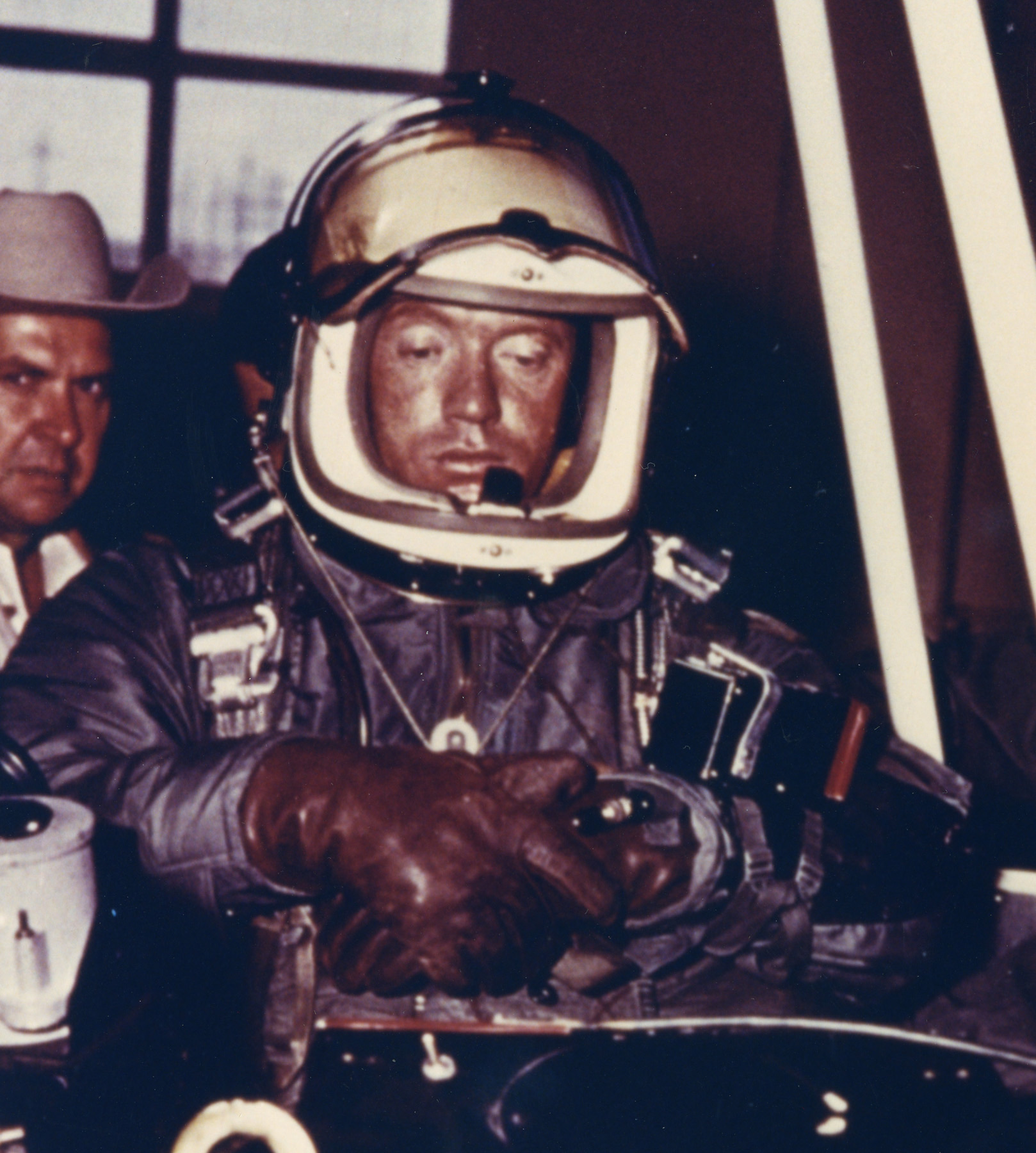
What they were trying to find out
The question was old. In June 1943 an Army flight surgeon, Colonel W. Randolph Lovelace, had jumped from a B-17 at 40,200 feet over Washington State and opened his parachute at once; the shock of the opening knocked him out and tore the gloves from his hands, and only a bottle of oxygen kept him alive on the way down. The lesson was that a man leaving an aircraft in the stratosphere must not open his parachute there. He must fall first, to a height where the air is thick enough to breathe and warm enough to bear, and open it low. But a falling body without a parachute does not fall straight. It tumbles, and it spins, and above 40,000 feet the air is so thin that nothing a man does with his arms and legs will stop it. Another flight surgeon, Colonel Mel Boynton, had tried the long free fall from 41,000 feet and hit the ground, it was thought, still looking at his stopwatch, his parachute unopened.
So the Air Force had spent the years from 1953 dropping dummies. Under a task called High Dive, then under Excelsior, the Aero Medical Laboratory sent anthropomorphic dummies, dressed in flying clothing and fitted with instruments, up under balloons from Holloman and let them go. By the Air Force’s own count there were forty-three balloon flights carrying sixty-seven dummies between June 1954 and February 1959, as well as thirty dropped from aircraft over White Sands in 1953 and 150 over Wright-Patterson in 1959. The dummies did what Boynton had done. In the laboratory’s first report on them, in 1957, a lieutenant named Raymond Madson recorded one dummy with a peak rotation of about 200 revolutions a minute; a study by Otto Walchner the next year showed that a man falling prone from 83,000 feet could in theory reach 465. A man spinning at such rates has the blood driven out of his head and into his hands and feet, and is unconscious within seconds. A pilot who ejected at 100,000 feet would be dead before he reached the air he could breathe.
Kittinger stated the hypothesis himself, in a paper he read to a conference on the peaceful uses of space at Seattle in May 1962: “There were two basic objectives of Project Excelsior… The first concerned the psychophysiological aspects of escape from high altitude and the second concerned the protection of a man in a space environment.” It is worth keeping the two apart, because the experiment answered them differently.
The first was about a parachute. Beaupre’s claim was that a very small canopy, opened at the right moment after the jump and before the spin could begin, would hold a falling man feet-down and face-forward all the way from the top of the atmosphere to the height at which an ordinary parachute could be opened, and that the whole sequence could be made to work without any action by the man, because a pilot thrown from a crippled aircraft could not be relied on to pull anything.
The second was about the man. A pilot in the stratosphere, in the Air Force’s standard partial-pressure suit and helmet, in air at a hundred degrees below zero, would have to survive the ascent, make the jump, stay conscious through the fall and do useful work on the way. The dummies could not answer that. As the Air Force’s own history put it, the free-fall tests “could not be accomplished by a human until a rigorous testing program using anthropomorphic dummies was completed”, and when it was completed the only instrument left to use was a human. Kittinger said so himself, in a sworn statement in the 1990s: the dummy data was the basis of the parachute, “and I later used this parachute on my three high altitude jumps.”
What they built
The parachute was a sequence. Beaupre’s system was packed on the jumper’s back in the ordinary way, but it opened in stages, and every stage was fired by a clock or a barometer rather than a hand. On leaving the gondola the man fell free for sixteen seconds, long enough to build up the speed that a canopy needs if it is to fill rather than flap. Then a spring threw out a pilot chute eighteen inches across. The pilot chute pulled out a stabilising canopy six feet across, and with it three-quarters of the main canopy, a 28-foot round parachute whose folds, still held closed, served as the small canopy’s lines. The small canopy did not slow the fall by much; Kittinger put the speed under it at three-quarters of terminal velocity. Its job was to act as a tail. A man hanging under it fell feet first, with no tendency to turn. At a set height, where the air was thick, a second release let the rest of the main canopy out. Behind all this, on the chest, was a reserve parachute with its own barometric release, modified by Beaupre so that if it opened into a spinning body the small pilot chute that pulled it could break away and let the canopy clear itself. The National Museum of the Air Force describes the sequence as “small, medium, then large parachutes deploying as the pilot fell”.
The gondola was Winzen’s Sky-Car, a cylindrical frame of steel tubing about four and a half feet across with sides about four feet high, built for low-altitude training and modified for the stratosphere. It was open. There was a sun shade around most of it, a seat, an instrument panel, a tank of oxygen, and a gap in one side. A camera was fixed to the frame to film the gap. The balloon above it, from General Mills, was polyethylene a fraction of a millimetre thick, with a volume of two million cubic feet for the first two flights and near three million for the third; on the ground it was a tall thin tube, and at the top of its climb it would be a sphere some 170 feet across. The gondola had a parachute of its own and could be cut away from the balloon when the man had left it.
The man was dressed in an MC-3 partial-pressure suit made by the David Clark Company, a laced garment with inflatable tubes along the limbs and bladders over the body, and a sealed helmet. At height the tubes and bladders were pumped up and squeezed the flyer, while the helmet fed oxygen under pressure to the lungs. If the suit or the helmet failed above about 60,000 feet, consciousness would last ten or twelve seconds and life a few minutes. Over the suit went insulated winter flying clothing, and under it layers of underwear and electrically heated gloves and boots. Strapped to the man were oxygen bottles, the fourteen-channel recorder, a seat kit with instruments and cameras, electrodes for his heart and breathing, the two parachutes, and the radio. Kittinger weighed about 150 pounds. With the equipment he weighed over 300.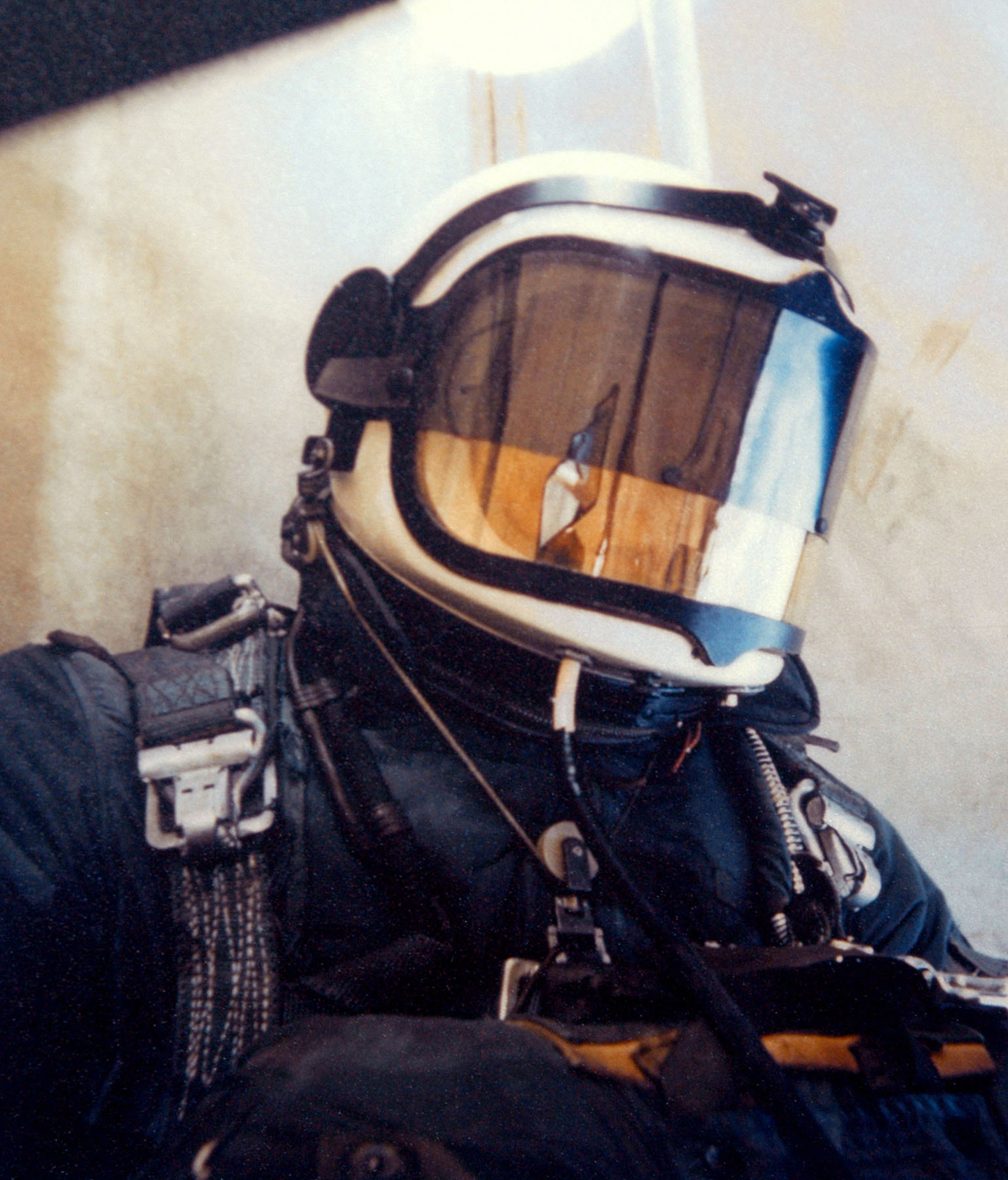
Before a man went, the system was dropped again. The stabilised dummy drops had been going since the end of 1955, with the early chutes fouling in their own risers, and the final design was proved in eighteen drops over the Holloman range in January and February 1959. In those eighteen, Madson reported, “The stabilization chute deployed cleanly and effectively on every test”, the opening shock never exceeded 3 g, and the greatest rotation recorded was 30 revolutions a minute; the release that separated the first stage failed twice. His conclusion was that “live jumps could be made safely from high altitude with the parachute developed during this program.” The companion piece The dummies has the whole record. Three live jumps were also made with the system from a C-130 at 28,000 feet. In May 1959 Stapp, worried that an injury to his one experienced balloon pilot would end the project, sent two more officers to Holloman to be trained, and on the second night flight the gondola overturned on landing near Roswell and put one of them in hospital with a head injury. Kittinger, bleeding from the face, telephoned Stapp from the hospital and the two agreed to get the crew out and away as quickly as possible, before an accident investigation could start. He said much later why: “We didn’t want publicity… about anything we were doing.” Some senior research officials, the Air Force’s historians wrote, “were reluctant to support a project that required a human subject to parachute from a balloon gondola at over 100,000 feet”, and a formal inquiry that summer might have ended it. The first manned flight was set for the autumn.
Two and a half seconds
Excelsior I was launched on 16 November 1959 from a site near Truth or Consequences, on the western side of the range, so that the wind would carry it over White Sands. The plan was to jump at about 60,000 feet. The plan did not survive the ascent.
The balloon turned slowly as it rose, as balloons do, and when the gap in the gondola’s sun shade faced the sun the light came in and glared off the instrument panel so that Kittinger could not read it. The inside of his visor began to fog. Then the suit pressurised, and the helmet, which the bladders push upward, began to rise off his shoulders; a sergeant named Frank Hale had tied lengths of parachute cord between the helmet clamps and the harness before launch, and the cord held it. Through a clear patch on the visor Kittinger saw that he was past 65,000 feet and opened the valve at the top of the balloon to stop the climb. At five minutes before the jump the visor cleared. Seventy seconds before it he dropped the antenna, and then unplugged one by one the hoses and cables that joined him to the gondola. Then he tried to stand up and could not: the instrument pack on his seat was stuck. He had carried bottles of water under it for warmth, and at a hundred below they had frozen and swelled. It took about eleven seconds and a last lunge to break free.
Standing in the gap, at a height that was now 76,400 feet, he pulled the lanyard that armed the barometric release on the main canopy and set the sixteen-second timer for the pilot chute. The lanyard needed three pulls to come clear. The first pull had started the clock.
The pilot chute left his pack two and a half seconds after he did. There was no airspeed yet to fill it, and in air with a hundredth of the sea’s density it did not fly; it fell with him, flapped, and wrapped itself round his neck. Without it the stabilising canopy stayed in the pack, and without that the main canopy would never be pulled. He began to turn. In the thin air high up he could counter it, he wrote in 1962, “by using sky diving techniques”. Lower down he could not. “At about 30,000 feet a violent spin was encountered that rendered the subject unconscious.” The instruments he carried recorded the spin’s peak at 87 revolutions a minute, at about that height; later tellings have made it 80 and 120. He lost consciousness with the pilot chute round his neck and did not know what happened next.
What saved him was the part of the design built for the case where the design failed. At 10,000 feet the barometric release on the reserve fired. The reserve, opening into a spinning body, tangled too. Then the break-away pilot chute that Beaupre had fitted parted, the canopy cleared itself, and at about 6,000 feet it filled. Kittinger came round under it, a few thousand feet above the desert, with no memory of the fall. “Recovery of the subject was effected by the automatic reserve parachute, opening at 10,000 feet, while the subject was unconscious,” he wrote in the 1962 paper, in which he is “the subject” throughout; and then he turned the failure into a reading. The spin had been “considerably lower than the expected spin rate that would cause unconsciousness”, and “on this first test, even though it was not planned, we obtained a control”: an unstabilised fall from 76,000 feet to set the stabilised ones against. The Air Force’s history, written in 1997, keeps a photograph of him taken minutes after he landed, and calls him in the caption “semi-conscious”.
Four days later the Air Force announced the jump. The Associated Press carried it on 20 November: “The Air Force today claimed that the longest parachute jump in history was made this week from an open balloon gondola 76,400 feet over New Mexico.” The story gave the temperature, 104 degrees below zero, the balloon, the ninety minutes to altitude, and this: “Capt. Kittinger plunged about 66,000 feet in a free drop before his parachute opened automatically at 10,000 feet above the earth’s surface.” Which was true. The parachute that opened automatically at 10,000 feet was the reserve. The next day’s story from Alamogordo began, “Red-haired Joe Kittinger says his 15-mile parachute jump didn’t scare him—he was too busy to worry.” He told the reporters that he had kept track of the time and the altitude “and physiological reactions”, on which he did not elaborate, and that “I had so many things to do. This was a research job. I wasn’t just sitting there thinking about the jump. I was trying to get data we didn’t have already.” Nothing in either story says that he had been unconscious, or that the parachute being tested had not worked. The jump was his forty-first, the Air Force said, and the gondola, with a parachute of its own, had followed him down.
Inside the laboratory the failure was read exactly. The timer knob and the aneroid knob were redesigned so that the lanyard could not start one before the other. Hale sewed the helmet webbing fast once it had been pulled taut. The visor heater was reset in a chamber at Holloman cold enough to reach the real temperature. A cardboard shade went round the instrument panel. The seat was changed so that nothing could freeze a man into it. Kittinger feared the senior officers would now stop the project; Stapp told him the second flight was approved. All of it took less than a month.
Excelsior II went up from Holloman at 6.30 in the morning of 11 December 1959 and was at 74,700 feet within the hour. This time the sequence ran as drawn. He stepped off, began a slow turn, dropped one foot and lowered an arm, and the turn stopped. Fourteen seconds out, the pilot chute fired; the stabilising canopy followed it and held him; at 18,000 feet the main opened. He was on the ground twelve minutes and thirty-two seconds after leaving the gondola. The parachute, he wrote, “provided perfect stability during the free-fall phase”; a slight turn could be stopped “by merely extending an arm and leg in the direction of the turn”; and, “I would have never made the Excelsior II tests if I had any doubts about the capability of the parachute, as I felt that one test like Excelsior I was sufficient for me.”
The first part of the hypothesis now had one clean reading in its favour, taken from fourteen miles up. The second part had been tested to fourteen miles. The design height was 100,000 feet, nineteen miles, and the difference, he explained in 1962, was not one of degree. At 75,000 feet the pressure outside the suit was about 25 millimetres of mercury. “I had thought during these tests that if I experienced any failure of the pressure suit, the helmet, the oxygen regulator, and so forth, I could make a rapid exit from the gondola and probably survive. Psychologically this was a very comforting thought. However, as we prepared for the Excelsior III tests, at 103,000 feet or a pressure of about 7 millimeters of mercury, I realized that if the protective equipment malfunctioned, there would be no escape from the consequences.”
Forty-three thousand feet
Excelsior III was launched at 5.29 in the morning of 16 August 1960, Mountain Standard Time, from an abandoned dirt airstrip a few miles north of the village of Tularosa, east of the range. The balloon was the big one, near three million cubic feet. The gondola carried two placards. One said, “This is the highest step in the world.” The other was a licence plate cut from a cereal box by his four-year-old son, Mark, who had thought the gondola ought to have one.
The ascent took an hour and thirty-one minutes. At 43,000 feet, in the first forty minutes, came the reading that this entry is named for. In the account he wrote for National Geographic four months later, Kittinger set it down as a line from his log: “My right hand does not feel normal.” The air bladder in the right glove had not inflated, and above that height, without the pressure, the hand would swell as its blood and tissue expanded into the thin air, and would go on swelling. He knew what would happen if he said so. The flight surgeon at the radio, Captain Marvin Feldstein, and the men behind him had the authority to end the flight, and he believed they would use it. He wrote that he reasoned it through: the hand was not needed to fly the balloon, because “I can still operate the gondola, since all the controls can be manipulated”, and he decided to “continue the ascent, without notifying ground control of my difficulty.”
So the gondola went on up, and the recorder on his back went on writing its fourteen channels, and the ground went on reading them, and none of the fourteen was the glove. At 50,000 feet he crossed the tropopause, where the temperature outside was 94 degrees below zero Fahrenheit, the coldest point of the flight. At float, 102,800 feet by the radar on the ground and 103,300 by the instruments in the gondola, the air outside was 36 below, warmer, because above the tropopause the air warms with height, and the sky was dark. He was not yet over the landing zone, and he drifted for eleven minutes on a wind from the east while he worked through a checklist of forty-six items. By then the hand had swelled to about twice its size and was in severe pain; he said afterwards that it had “doubled in size”. Whether he said anything about the hand in those last minutes is told two ways: the historian Gregory Kennedy writes that he reported it once he was at altitude and too high to be called down; his own account says that he did not. He told the ground what he could see. The senior curator of the National Air and Space Museum, Tom Crouch, gives the words that came down the radio: “There is a hostile sky above me.” In the magazine he wrote it differently, as “The sky above is void and very black and very hostile.” Feldstein’s voice told him, “Three minutes till jump, Joe.”
Then he dropped the antenna, as he had on the two flights before, and the radio went quiet, and from that moment the ground knew nothing about him that the tracking radar and the chase aircraft could not see. He unplugged the hoses and cables. He stood up in the gap. He said, as he remembered it fifty years later, “Lord, take care of me now.” The camera on the frame took its picture.
What it looked like from inside
He went out on his right side, and then over on to his back. The thing he told the reporters in Los Angeles the next day, and told again for the rest of his life, was that the balloon went up. “That was the most beautiful sight—to see that brilliant balloon against the black sky. It seemed I was lying still, while the balloon raced away from me.” There was nothing to fall past. He wrote in the magazine that he had “absolutely no sensation of the increasing speed”, and he told it later this way: “The altimeter on my wrist was unwinding very rapidly, but there was no sense of speed. We determine speed visually when we see something go flashing by—but nothing flashes by at 20 miles up in the air; there are no signposts when you’re way above the clouds.”
The timer ran. The Air Force’s first statement said the stabilising canopy opened thirteen seconds after bailout; the design said sixteen; Kittinger’s own account puts it at about 96,000 feet. It took hold, and he was “perfectly anchored against the dreaded flat spin”. Somewhere near 90,000 feet he reached his greatest speed, and here the air began to do its work, so that from then on he slowed. Under the small canopy he experimented. “I found I could initiate a body turn, or stop such rotation by sticking out my left or my right foot a little way. At one time I was facing toward El Paso, Tex., and then decided to have a look at New Mexico. All I had to do was point my left foot slightly outward to initiate a right turn through 180 degrees.”
At 21,000 feet there was a solid layer of cloud. He had never fallen through cloud, and as he went in he drew up his feet, as a man does who expects to hit something. A few thousand feet below the cloud, four minutes and thirty-eight seconds after he had left the gondola by the Air Force’s first count and his own, the barometric release let the main canopy go, and it opened. When it did, the Associated Press reported, he looked up, “perhaps a bit beyond the chute”, and said, “Thank you, Lord.” He came out of the cloud at 15,000 feet with two helicopters circling him.
The landing was hard. The seat kit under him should have been released to hang on a line before he touched; only one side let go, and he landed with its weight, and it bruised his leg. He was down thirteen minutes and forty-five seconds after the step, in sand, salt grass and sage, twenty-five miles or so north-west of Holloman. The helicopters were on the ground almost as he was. The first thing he said to the recovery crew, by the account of the historian Gregory Kennedy, was “I’m very glad to be back with you all.” Then the crew took the helmet off and began on the suit, and saw the hand.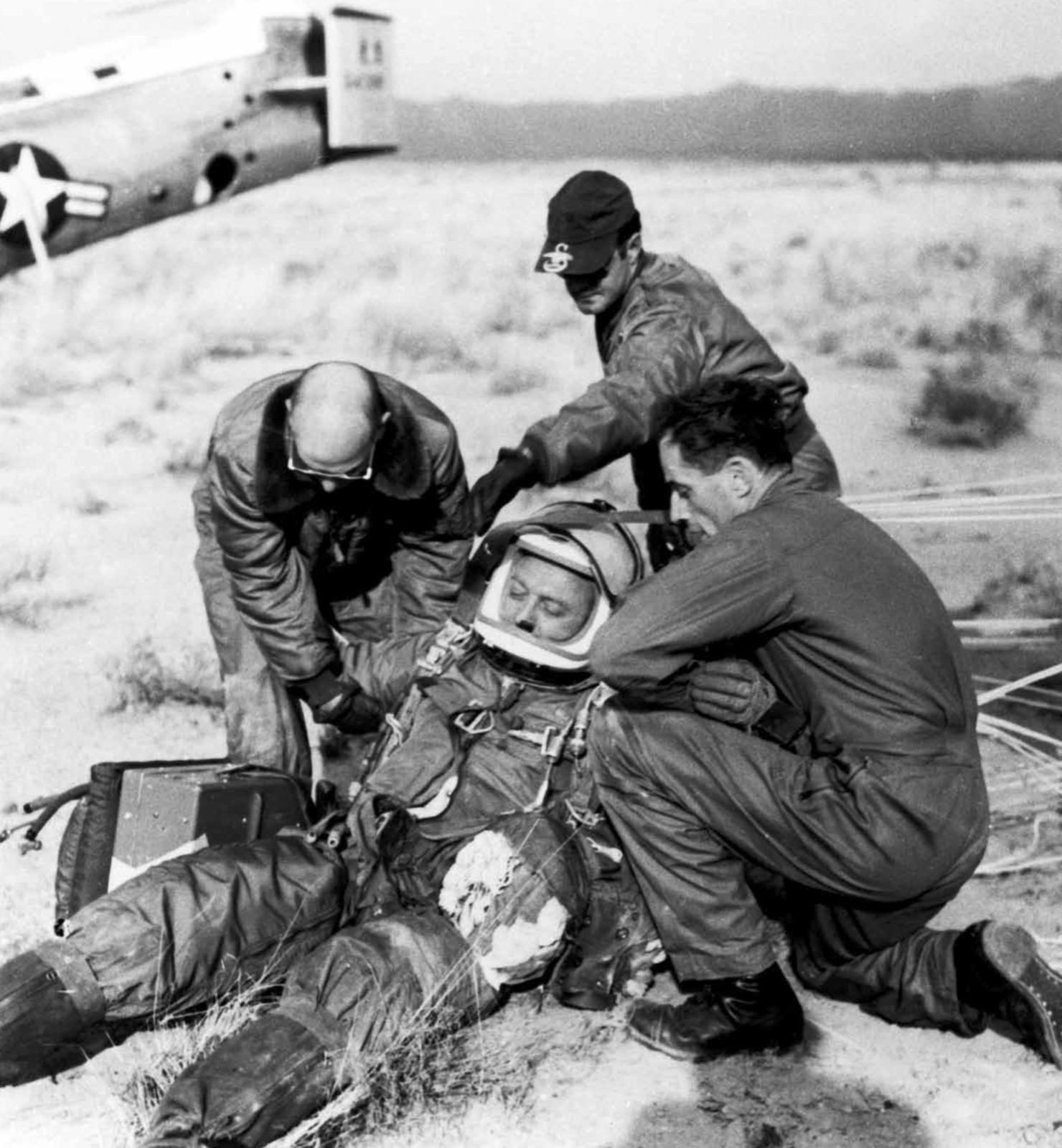
What happened
The Air Force’s numbers came out over three days, and they changed as they were read.
On the first day, from Tularosa, the Associated Press reported that the altitude “was not immediately determined, but it was a minimum of 102,800 feet and a maximum of 103,300. Radar observations, which were hampered by a high overcast, measured the lower altitude, and instruments carried in Capt. Kittinger’s open gondola measured the higher altitude.” The lower number was the one that stood. The same story said the stabilising chute had opened thirteen seconds after bailout and “checked Capt. Kittinger’s velocity only minutely”, that “the Air Force estimated he fell at a top speed of about 450 miles an hour”, and that the whole descent had taken thirteen minutes and eight seconds. It listed four records: the highest manned balloon flight, past the 102,500 feet the Air Force credited to Simons in a sealed capsule in 1957; the highest in an open gondola; the longest free fall; and the longest parachute jump, the last three all taken from Kittinger’s own jump of the previous November. It noted that he had “left the gondola with 155 pounds of clothing and equipment”, including “a 14-channel recorder strapped to his back, which measured certain data during both the ascent and descent”, and that the balloon, cut free, “continued upward, where it will be torn to bits by high altitude winds”. It said that a sergeant from the laboratory would make another bailout on 23 August. He did not; the third flight was the last.
On the third day, from Holloman, it was something else: “The Air Force says Capt. Joe Kittinger attained a maximum speed of 614 miles an hour during the free-fall phase of his record-breaking 102,800-foot parachute jump Tuesday.” The statement gave the pressure at the top, 0.142 pounds per square inch, and then a sentence that is the honest shape of the data: “The scientists said they were not able to determine for how long Capt. Kittinger fell at the 614-mile-an-hour speed—equal to .93 mach, nearly the speed of sound—or at what point in his descent he reached top velocity.” The thirteen minutes and eight seconds became thirteen minutes and forty-five. The citation for the Oak Leaf Cluster to his Distinguished Flying Cross settled on “free-falling for four minutes and thirty-eight seconds to an altitude of 17,500 feet”, the first day’s figures and his own; the museum that keeps the gondola gives four minutes and thirty-seven, and NASA’s historian thirty-six. The speed has been written since as 614, as 625.2, and as 714 miles an hour, the last of them past the speed of sound. When NASA’s historian of pressure suits went through it in 2011 he recorded that, “contrary to many published reports, Kittinger indicates he did not break the speed of sound.” The records were never submitted to the international federation that certifies such things, and stand as the Air Force’s own.
The hand was examined on the desert by a doctor named Chubb. Kittinger wrote that it had no strength. The editors of the magazine added a note that the swelling went down in about three hours, “with no ill effect”. The suit, the NASA history says, “performed as expected except for a failed glove.”
On 17 August, in Dayton, a reporter from the Journal-Herald went to see Pauline Kittinger. She said she did nothing special to keep her mind off the jumps “except to raise the children”, and “I always wish it would be all over with before he makes a jump.” Joseph, who was seven, said, “I want to go higher than he did.” On 3 October 1960, between 10.53 and 10.59 in the morning by the appointment book, President Eisenhower presented the Harmon International Trophies in the Cabinet Room of the White House: the Aviator Trophy to Captain Joe B. Jordan and the Aeronaut Trophy to Captain Joseph W. Kittinger junior. Among the guests listed are “Mrs. Joseph W. Kittinger, Jr. and two small children”, and General Curtis LeMay. In January 1961 The Airman, the Air Force’s magazine, reported the Oak Leaf Cluster to his Distinguished Flying Cross, “in recognition of his 102,800-foot parachute jump last August”.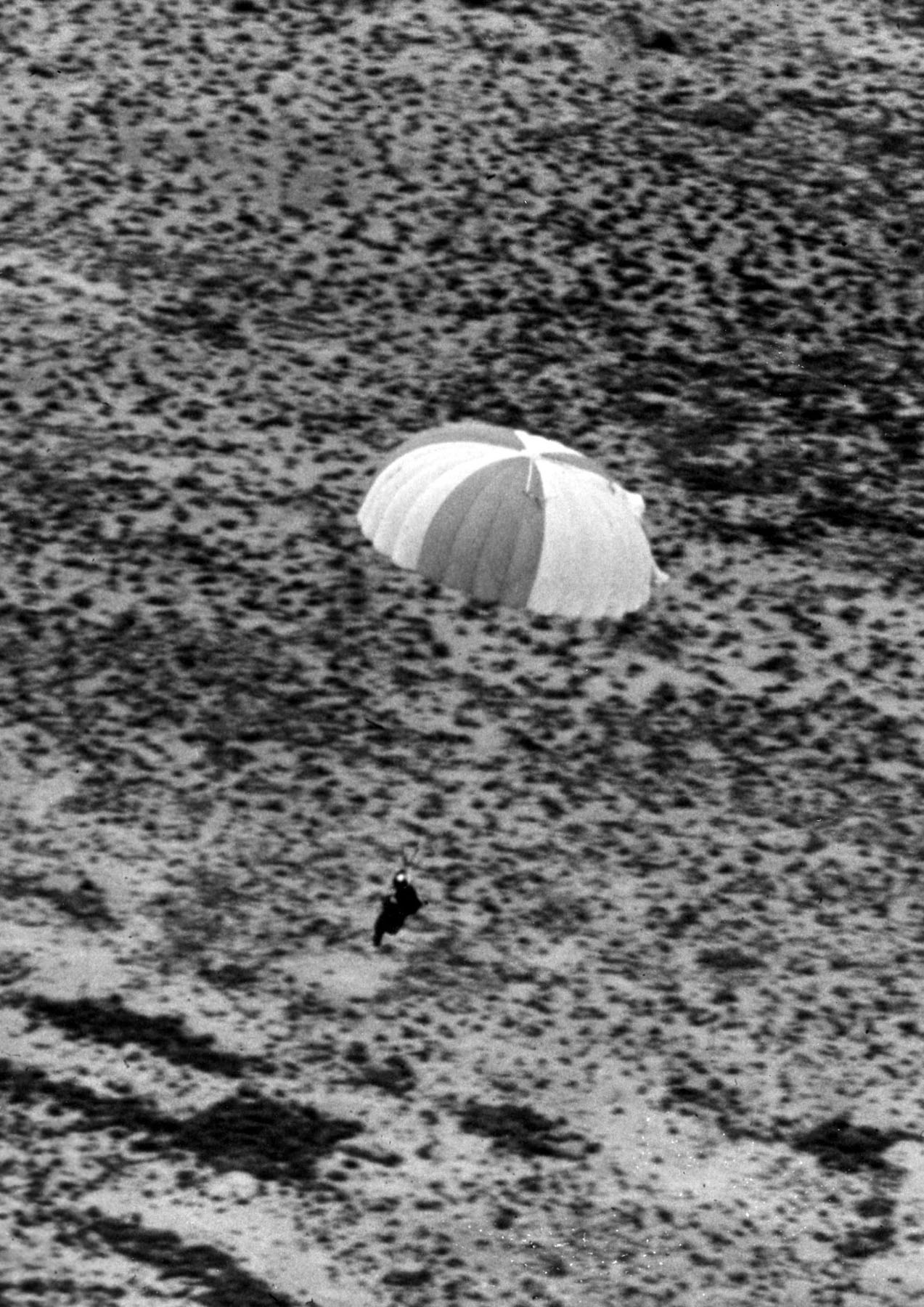
After
Kittinger gave the laboratory’s verdict himself, at Seattle in May 1962: “the primary objective of Project Excelsior was realized in that we were able to demonstrate that a man given the proper stabilization could be afforded an escape means from altitudes in excess of 100,000 feet.” The second objective, “that of the protection of a man in a space environment, will probably have more far-reaching consequences than that of escape from high altitudes.” The flights, he said, had been “the first ‘real time’ testing of a pressure suit”, though in them “the subjects were rather passive, and no useful work was accomplished other than making observations, manipulating switches, and so forth.” For a precedent he reached back to Glaisher and Coxwell in 1862, who “were very fortunate to return safely to Earth”; that ascent is the subject of Seven Miles. The paper runs to seven pages and does not mention the glove.
Beaupre’s parachute went into service. Kittinger said in 2014 that the drogue from Excelsior “is still in use today; every ejection seat has it”, and the small stabilising canopy that holds a seat and its man steady through the first seconds after ejection is the direct descendant of the six-foot chute of 1959. The flight also changed a helmet. The engineers who went through the Excelsior data on the X-15 programme concluded that a pilot ejecting from that aircraft would need to see on the way down, as Kittinger had needed to on the first flight and nearly could not, and a battery was added to the X-15 seat to keep the visor heated after it left the aircraft.
Kittinger flew once more under a balloon for the laboratory. On 13 December 1962, in Project Stargazer, he and a Navy astronomer, William C. White, spent more than eighteen hours above 80,000 feet in a gondola with a telescope, the last of the Air Force’s seven manned flights to the edge of space. Then he went back to fighters. He flew 483 combat missions in Vietnam in three tours, shot down a MiG-21 on 1 March 1972, was shot down himself over Hanoi on 11 May that year, and spent eleven months as a prisoner. He retired as a colonel in 1978, and in September 1984, at fifty-six, made the first solo balloon crossing of the Atlantic, from Maine to a wood in northern Italy, where he broke a foot. In 2012 he sat at the radio in Roswell as the voice in the ear of Felix Baumgartner, who stepped from a capsule at about 128,000 feet and broke the altitude and the speed, going past the speed of sound, but not the four and a half minutes. Kittinger died in Orlando on 9 December 2022, aged ninety-four.
Stapp died in 1999. The dummies had a stranger afterlife: in 1997 the Air Force concluded that the “alien bodies” remembered near Roswell were most probably the dummies of High Dive and Excelsior, being picked up by crews in trucks, and that the red-haired captain remembered at the base hospital was most probably Kittinger after the training crash of May 1959. That story is told in The dummies.
What it taught
The experiment had two claims in it, and the first was answered as well as any experiment of its kind has been. A spring, a clock, an eighteen-inch canopy and a six-foot one held a man steady from 102,800 feet to the cloud at 21,000, three times from three heights, with the failure on the first flight coming from the arming lanyard and not the parachute, and the correction made within a month. The gondola camera and the recorder on the man’s back reported it. That reading went into every ejection seat built since.
The second claim was about the man, and the man was the only instrument that could take the reading. There was nothing wrong with that; it was the reason he was there. What the design did not provide for was the case in which the instrument decided what to send. On the way up on 16 August 1960 the suit failed in one place, and the one channel that carried the failure was a radio, worked by a man who knew what the ground would do with the information and chose not to give it. The ground read fourteen channels and a voice, and all of them said that the system was working. By the time the reading reached anyone else, the hand had been swollen to twice its size for more than an hour, and the test was over.
He was right, by the numbers. The hand recovered in three hours. The jump was clean. The glove was a glove, and not the helmet, and he had worked out that it would not stop him flying the balloon. If he had reported it the flight would very likely have been ended at 43,000 feet, the balloon and the morning spent, and the second claim left where Excelsior II had left it, fourteen miles short of the design. Everyone who has told the story since has told it as courage, and it was.
The complication is what it did to the experiment. An experiment on whether a man can survive a thing, in which the man decides which of his failures to report, is not measuring what it says it measures; it is measuring the man’s judgement of what the ground can bear to hear. The laboratory knew this. It had known since November, when the public account of Excelsior I said that the parachute had opened automatically at 10,000 feet and did not say which parachute. The project kept its own counsel about its failures because, as Kittinger wrote in 1961, “the secrecy imposed upon Excelsior was of our own choosing”, and the men who ran it believed, probably correctly, that a frank account would have got it stopped. The man in the gondola did on his own body what the project did in its press releases. Both of them reasoned that the only way to finish the test was to filter the telemetry, and both finished the test. When Kittinger wrote the project up for a scientific audience in 1962, the spin of Excelsior I became a control, which it was, and Excelsior III became the first real-time test of a pressure suit, which it was. The glove is not in the paper.
The lesson is not that he should have called it in. It is that a design which puts a living instrument at the top of the atmosphere, and gives the ground the power to end the test on anything the instrument reports, has built itself a reason for the instrument to go quiet. The glove failed. So did the channel. The Air Force spent three days finding out how fast he had fallen, and never put a number on the thing that mattered most about the flight, which was how long a man will keep a reading to himself when the people reading him can stop the experiment. On 16 August 1960 the answer was about an hour, a minute at a time, past the coldest point in the sky.
Sources
- Associated Press, “Air Force Captain Sets 19-Mile Bailout Record” and “Bailout”, Washington Evening Star, 16 August 1960, pp. A-1 and A-6: the first-day figures (102,800 to 103,300 feet, radar against gondola instruments; thirteen seconds; 450 miles an hour; 13 minutes 8 seconds; the four records; the 155 pounds and the fourteen-channel recorder; the balloon torn to bits; Sergeant Post’s planned jump). Chronicling America, Library of Congress. page A-1, page A-6
- Associated Press, “Parachutist Prayed in Plunge”, Los Angeles, 17 August 1960, Evening Star, p. A-2; and the photograph “Capt. Joseph Kittinger takes a happy breather” on the same page: his words to the reporters on the balloon racing away, the body turns toward El Paso, and “Thank you, Lord”. page A-2
- Patricia Miller, “Capt. Kittinger’s Son Makes Gift”, Dayton Journal-Herald by Associated Press, Evening Star, 17 August 1960, p. B-10: Pauline Kittinger, the cereal-box licence plate, the papers for the Smithsonian, and the sons. page
- Associated Press, “Kittinger Reached 614 M.P.H. in Fall”, Holloman Air Force Base, 18 August 1960, Evening Star, p. B-5: the revised speed, the pressure of 0.142 pounds per square inch, and the sentence on what the scientists could not determine. page
- Peninsula Enterprise (Accomac, Virginia), “Here and There”, 18 August 1960, p. 4, for his words about the prayer before the jump and after the opening. page
- Associated Press, “76,400-Foot Jump Called New Record”, Evening Star, 20 November 1959, p. A-1; “Jump Kept Flyer Too Busy to Be Scared”, Alamogordo, 21 November 1959, p. A-2, with the gondola-camera photograph “History’s Highest Jumper En Route” on p. A-1; and United Press International, “Air Force Captain Bails Out of Balloon in Greatest Free Fall Parachute Jump”, Nome Nugget, 20 November 1959, p. 1: the Air Force’s public account of Excelsior I, the gondola’s dimensions, the forty-first jump, and what was not said. 20 November, 21 November, p. A-1, 21 November, p. A-2, Nome Nugget
- Joseph W. Kittinger, Jr., “Discussion of Project Excelsior”, in Proceedings of the Second National Conference on the Peaceful Uses of Space, Seattle, Washington, May 8–10, 1962 (NASA, 1962), pp. 249–255. The two objectives; Excelsior I (“a procedural problem”, the control of turning by sky-diving technique, the violent spin at about 30,000 feet, the peak of 87 revolutions a minute, the reserve at 10,000 feet, “we obtained a control”); Excelsior II (“perfect stability”, the arm and leg, three-quarters of terminal velocity, “one test like Excelsior I was sufficient for me”); the 25 and 7 millimetres of mercury and “no escape from the consequences”; the summation of the two objectives; the first “real time” test of a pressure suit and the passive subjects; and Glaisher and Coxwell. The paper does not mention the glove. From the copy in the Defense Technical Information Center (ADA307134), mirrored on archive.org. archive.org
- Raymond A. Madson, High Altitude Balloon Dummy Drops, Part I: The Unstabilized Dummy Drops, WADC Technical Report 57-477 (Wright Air Development Center, 1957), for the dummy that reached a peak of about 200 revolutions a minute; and High Altitude Balloon Dummy Drops, II: The Stabilized Dummy Drops, WADC Technical Report 57-477 (II) (Aerospace Medical Laboratory, Aeronautical Systems Division, August 1961), Project 7222, Task 71748: Walchner’s 465 revolutions a minute, the fouling in the early series, the final parachute with its two timers and three-quarters of the main canopy, the eighteen drops of January and February 1959 and their results, and the conclusion that live jumps could be made safely. The foreword names “Mr. Francis J. Beaupre” (the museum gives his middle initial as F.) and Kittinger among those who supported the work. DTIC ADA323780 and AD0270880, mirrored on archive.org. Part I, Part II
- James McAndrew, The Roswell Report: Case Closed (Headquarters United States Air Force, 1997). The dummy drops of High Dive and Excelsior (forty-three flights, sixty-seven dummies, June 1954 to February 1959; thirty over White Sands in 1953; 150 over Wright-Patterson in 1959), the project and task numbers, Stapp’s appointment of Kittinger in April 1958, the backup pilots and the crash of 21 May 1959, the hospital at Walker Air Force Base and the telephone call to Stapp, the reluctance of senior officers, the table of manned flights with the three Excelsior altitudes, the photographs of Kittinger after Excelsior I and at the step with the words “Lord, take care of me now”, Kittinger’s biography, and in Appendix B his signed statement and Raymond Madson’s; the quotation from The Long, Lonely Leap on secrecy is taken from this report. Kittinger’s statement, made at Altamonte Springs, Florida, on 24 June 1995, is also held by the National Archives among the report’s source files (Record Group 341, catalog 40989237). archive.org, National Archives
- Dennis R. Jenkins, Dressing for Altitude: U.S. Aviation Pressure Suits, Wiley Post to Space Shuttle (NASA SP-2011-595, 2012), pp. 161 to 165 and 269: Stapp’s biography; the establishment of Excelsior in 1958 with Kittinger as test director and the name; Beaupre as “a technician at Wright Field”; the open gondola and the 173-foot balloon; the spin of 120 revolutions a minute and the 22 g; the failed right glove; thirteen seconds, four minutes thirty-six seconds, 94 below and 614 miles an hour, with the note that Kittinger says he did not break the speed of sound; 17,500 feet and 13 minutes 45 seconds; the records never submitted to the FAI; Kittinger’s recollection for Red Bull Stratos (“Lord, take care of me now”, “there are no signposts”); the photograph of the recovery crew and its caption; and the X-15 visor battery. NASA
- National Museum of the United States Air Force, “Excelsior Gondola”, fact sheet: the purpose of the project, the X-15, the three-stage sequence (18-inch pilot chute at sixteen seconds, 6-foot stabilising chute at 96,000 feet, 28-foot main at 14,000 feet), the MC-3 suit with its heated garments and sensors, and the museum’s figures of four minutes thirty-seven seconds and 614 miles an hour. nationalmuseum.af.mil
- Joseph W. Kittinger, Jr., “The Long, Lonely Leap”, National Geographic 118, no. 6 (December 1960), pp. 854–873, republished by the magazine in October 2012: the launch at 5.29, the glove at 43,000 feet (“My right hand does not feel normal”), the decision to continue “without notifying ground control of my difficulty”, the tropopause at 94 below, 36 below at float, Feldstein’s “Three minutes till jump, Joe”, the stabilising chute at 96,000 feet, four minutes thirty-eight seconds, 13 minutes 45 seconds, Dr Chubb and the hand, and the editors’ note on the swelling. In copyright; quoted briefly. nationalgeographic.com
- Tom D. Crouch, “The Long, Lonely Leap”, National Air and Space Museum, 16 August 2010: the words radioed from float altitude, “There is a hostile sky above me”, and the swollen hand. airandspace.si.edu
- Gregory P. Kennedy, “Joseph W. Kittinger and the Highest Step in the World”, StratoCat, 2010: Lovelace and Boynton; High Dive from 1953 and the dummy at 200 revolutions a minute on 8 February 1956; the Winzen Sky-Car; Beaupre’s sequence as designed; the 140 dummy tests and the C-130 jumps; the narrative of all three flights, with the glare, the visor, Sergeant Hale’s cord, the stuck seat, the three pulls of the lanyard, the 2.5 seconds, the reserve at 10,000 and 6,000 feet, the fixes, Stapp’s approval of the second flight, fourteen seconds and 18,000 feet on Excelsior II, the placards, the choking, the cloud, the seat kit and the words to the recovery crew. Kennedy’s figures of 80 revolutions a minute for the spin and 625.2 miles an hour for the top speed differ from the Air Force’s. stratocat.com.ar
- StratoCat, flight records for Excelsior I (16 November 1959), Excelsior II (11 December 1959), Excelsior III (16 August 1960) and Manhigh I (2 June 1957), compiled from the Holloman Balloon Branch records in the National Archives and the Winzen flight report: the balloons’ makers, volumes and film thickness, the launch sites and times, the twelve minutes thirty-two seconds of Excelsior II, and the Manhigh I radio failure, the crossed regulator lines and “Come up and get me”. Excelsior I, Excelsior II, Excelsior III, Manhigh I
- The Airman, the Air Force’s magazine, vol. 5, no. 1 (January 1961): the year’s review, with the August jump and the photograph of the recovery crew, and the note that Kittinger “has been awarded an Oak Leaf Cluster for his Distinguished Flying Cross in recognition of his 102,800-foot parachute jump last August.” archive.org
- Dwight D. Eisenhower Presidential Library, The President’s Appointments, Monday 3 October 1960: the Harmon Trophies presented in the Cabinet Room from 10.53 to 10.59 in the morning, the two recipients, and the guests. eisenhowerlibrary.gov
- Nicholas Slayton, “When the Air Force had a guy jump from the edge of space”, Task & Purpose, 20 January 2026, quoting the citation to the Oak Leaf Cluster to the Distinguished Flying Cross (“free-falling for four minutes and thirty-eight seconds to an altitude of 17,500 feet”); the citation is quoted at second hand from this article. taskandpurpose.com
- Peter Grier, “Kittinger”, Air & Space Forces Magazine, 1 August 2014, for his words on the drogue in every ejection seat and on the hand that “doubled in size”; John A. Tirpak, “Col. Joe Kittinger—Fighter Pilot, POW, Longtime Freefall Record Holder—Dies at 94”, Air & Space Forces Magazine, 12 December 2022; and StratoCat’s biographical entry: birth, wings, Germany, Holloman, Stargazer, Vietnam, the Atlantic crossing, Red Bull Stratos and death. Grier, Tirpak, StratoCat
- Figures: all United States Air Force photographs, public domain as works of the federal government: Kittinger before a flight (Air Force release 120118-F-DW547-001), in the Excelsior III gondola (050419-F-1234P-037), the recovery crew after Excelsior III (from NASA SP-2011-595, p. 164), and the landing (130514-F-DW547-002). before a flight, in the gondola, recovery crew, landing The well-known photograph of the step itself is not shown: the camera on the gondola that took it was rigged by Volkmar Wentzel of National Geographic, whose magazine printed it in December 1960, so it is the magazine’s picture rather than an Air Force work, whatever the museum’s release says.


