At 1.51 in the afternoon of 5 September 1862, by a watch set to Greenwich time, James Glaisher read the mercury in a siphon barometer at 11.05 inches, subtracted the quarter of an inch by which he knew the instrument to be in error, and entered a height of 26,350 feet in his notebook. Beside it he wrote the temperature of the air, five degrees below zero on Fahrenheit’s scale, and a remark. “Lost myself; could not see to read the instruments.”
He read it anyway. Some minutes later, with the valve-line twisted above him and his companion gone up out of the car into the rigging to free it, he looked at the barometer again and saw the column standing at ten inches. The true reading was nine and three-quarters, which meant 29,000 feet. That number, written at 1.54, was the last thing he wrote in the air for thirteen minutes.
Nine years later the path of the balloon was lithographed in a book, a line rising from the word Wolverhampton through the readings of a thermometer. At 29,000 feet the line breaks into dots. The dots climb past six miles and over seven, turn, and come down to join the solid line again at 25,000 feet. Everything inside the dots was estimated afterwards. The estimate was seven miles, and seven miles went into the newspapers, into the encyclopaedias and into the record books for a generation, and the dotted line went with it, and nobody looked at the dots.
Who ran it
James Glaisher was born in Rotherhithe on 7 April 1809. At twenty he was sent to Ireland as an assistant on the Ordnance Survey’s principal triangulation. He spent the two years 1829 and 1830 on the summits of Bencorr in Galway and the Keeper Mountain near Limerick, often inside cloud for a week at a time, and he said afterwards that the clouds were where his meteorology began. In 1833 George Airy took him on as assistant at the Cambridge Observatory; when Airy became Astronomer Royal he followed him to Greenwich; and in 1840 Airy put him in charge of the Observatory’s new Magnetical and Meteorological Department. He was elected to the Royal Society in 1849. In 1850 he was one of the founders of the British Meteorological Society and became its first secretary. He published the tables by which a pair of thermometers gives the dew-point, and ran a network of volunteer observers across the country. By 1862 he was fifty-three, and the most experienced reader of thermometers in Britain. He had never been in a balloon.
Henry Tracey Coxwell was born on 2 March 1819 at the parsonage of Wouldham on the Medway, the youngest son of a naval commander, and was apprenticed to a surgeon-dentist in 1836. He made his first ascent at Pentonville on 19 August 1844 and had been a professional aeronaut since 1848, making his living from exhibition flights in England and on the Continent. By 1861 he had made more than four hundred ascents. He was forty-three.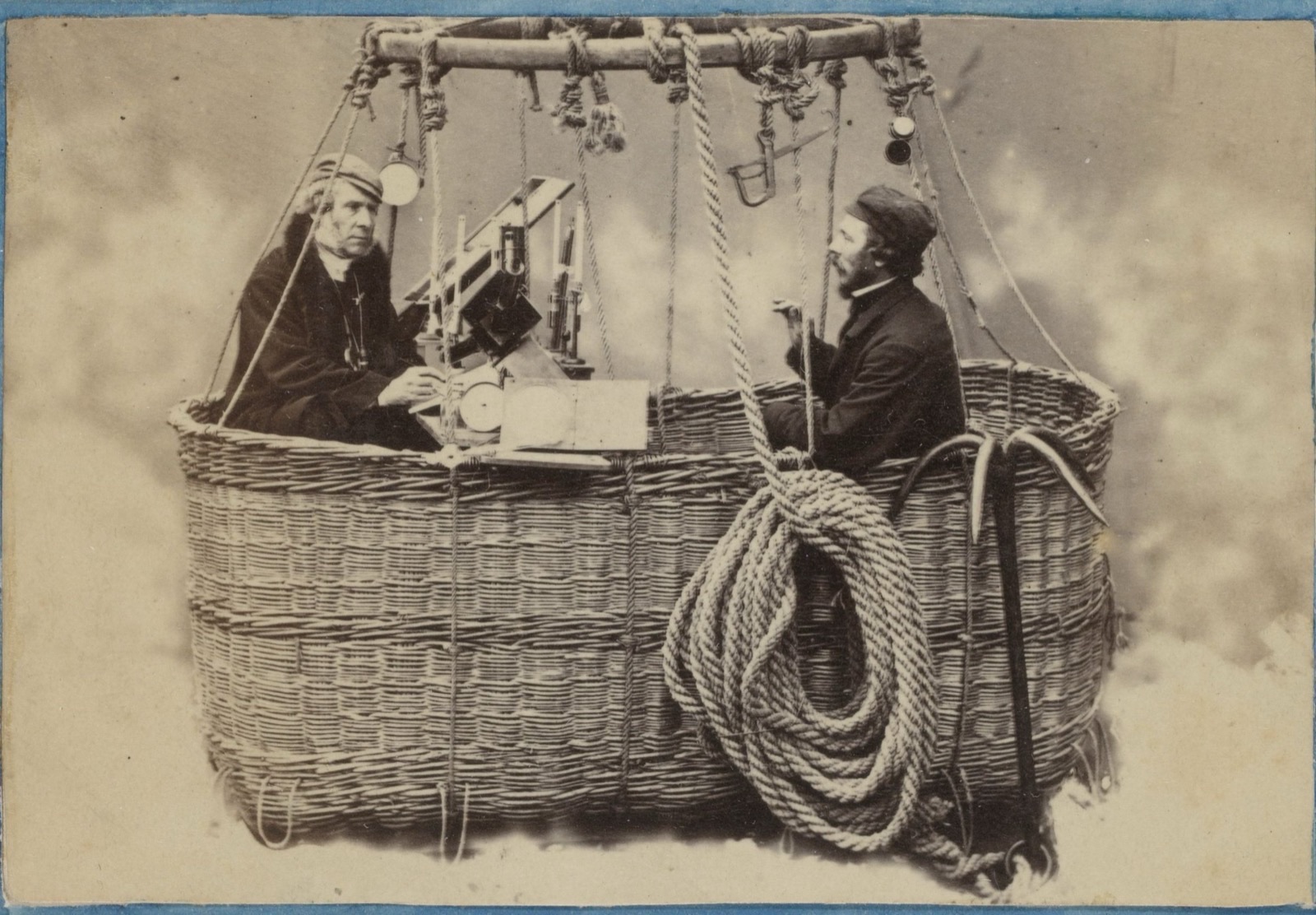
Behind them stood a committee. The British Association for the Advancement of Science had voted money for balloon experiments as early as 1843, and in 1852 had sent John Welsh of the Kew Observatory up four times in Charles Green’s great Nassau balloon, to 22,930 feet on the last ascent. Glaisher had watched the last of them through a telescope from the roof of the Royal Observatory, and it was that afternoon, he wrote, “which notably influenced me in my desire for balloon observations”. Welsh died, and the ascents stopped. In 1858 Colonel William Sykes, the Member for Aberdeen, revived the subject at the Association’s meeting at Leeds and got a committee appointed, with Airy, Lord Wrottesley, Herschel, FitzRoy and Tyndall on it, and Glaisher among them. In August 1859 the committee met at Wolverhampton, chosen for being as far from the sea as England allows, to watch the Nassau balloon filled. The wind tore it open on the second day. In 1862 they tried again with a balloon hired from Cremorne Gardens, which rose a little over a mile with Mr Criswick of Greenwich as observer and came down, as the newspapers put it, from sheer inanition. The committee had £200 from the Association’s Manchester meeting, and they had used it.
What they were trying to find out
The committee wrote down its objects in order. “The primary objects were— The determination of the temperature of the air, and its hygrometrical states, at different elevations, as high as possible.” Then came a list of secondary ones, from the dew-point at the heights “where troops may be located, as in the high lands and plains in India” to the ozone, the vibration of a magnet and the carrying of sound, and “To collect air at different elevations.”
Under the first object lay a law. Since the eighteenth century, from observations on mountainsides, the temperature of the air was held to fall one degree Fahrenheit for every 300 feet of height. Gay-Lussac’s ascent to 23,000 feet over Paris in 1804 had almost confirmed it; Welsh’s four ascents had confirmed it “with some modifications”. But a mountain is not the free air. Glaisher put the matter plainly in his report: however many mountain temperatures were collected, “much uncertainty would always prevail”, and “the only means of determining this important element is by balloon ascents.”
There was a second claim inside the first, and an American annual that summarised the paper Glaisher read to the Association at Cambridge that October set it out as a string of questions. “Is it then possible to make delicate and accurate observations in a balloon at great height? Can the observer there be at his ease so as to observe as well as on the earth? Can he make the observations with tolerable safety to himself?” The committee was testing a law of the atmosphere, and also whether a man at a table of instruments could be taken up six miles and still be one.
Glaisher had not meant to be that man. “Notwithstanding the desire which I had always felt for observations at high altitudes,” he wrote, “I had decided not to take the observations myself, but only to give all necessary instructions in the use of instruments and precautions necessary to be taken.” After the Cremorne failure he changed his mind. Coxwell, who had been sent for, remembered hearing of it with some surprise: Glaisher “had never yet ascended”, but “he wrote to me stating that he intended to take the observations himself.”
What they built
Coxwell’s first contribution was a sum. He showed the committee that no balloon in England would carry a man and his instruments five miles high; his own largest, the Mars, would not reach three. “Build a brand new balloon,” he told them, “fitted by internal capacity and general construction for the requirements of the British Association.” The answer was that there were no funds for that, “the grant for trial ascents is all that we can touch.” Coxwell then said: “I will undertake, at my own cost, to construct the required balloon, and will be ready by Midsummer Day to make such an ascent that will bring no discredit upon any one connected with the affair.”
He hired a schoolroom for pattern-cutting and took on every seamstress in his neighbourhood. There was no time for silk; the fabric was a kind of American cloth, made to order and oiled. The result stood eighty feet high when inflated and held, by Coxwell’s figure, more than 93,000 cubic feet of gas. Newspapers called it the Mammoth; nothing so large had been built in England.
The gas was the other half of the design. Ordinary coal gas was too heavy for the heights the committee wanted. Thomas Proud, the engineer of the Stafford Road gasworks at Wolverhampton, agreed to make a special gas: the product of the end of each distillation, poor in light but light in weight, and to store it in a gasometer the company set aside for the purpose for weeks at a time. “It is due to this circumstance,” Glaisher wrote, “that I was enabled to make the extreme high ascents, which would have been quite impossible if the Company had not placed a gasometer at our disposal.” Lord Wrottesley, whose private observatory stood 531 feet above the sea a few miles from the town, arranged for readings to be taken there at short intervals while the balloon was up, and lent his standard barometer for comparison before each start.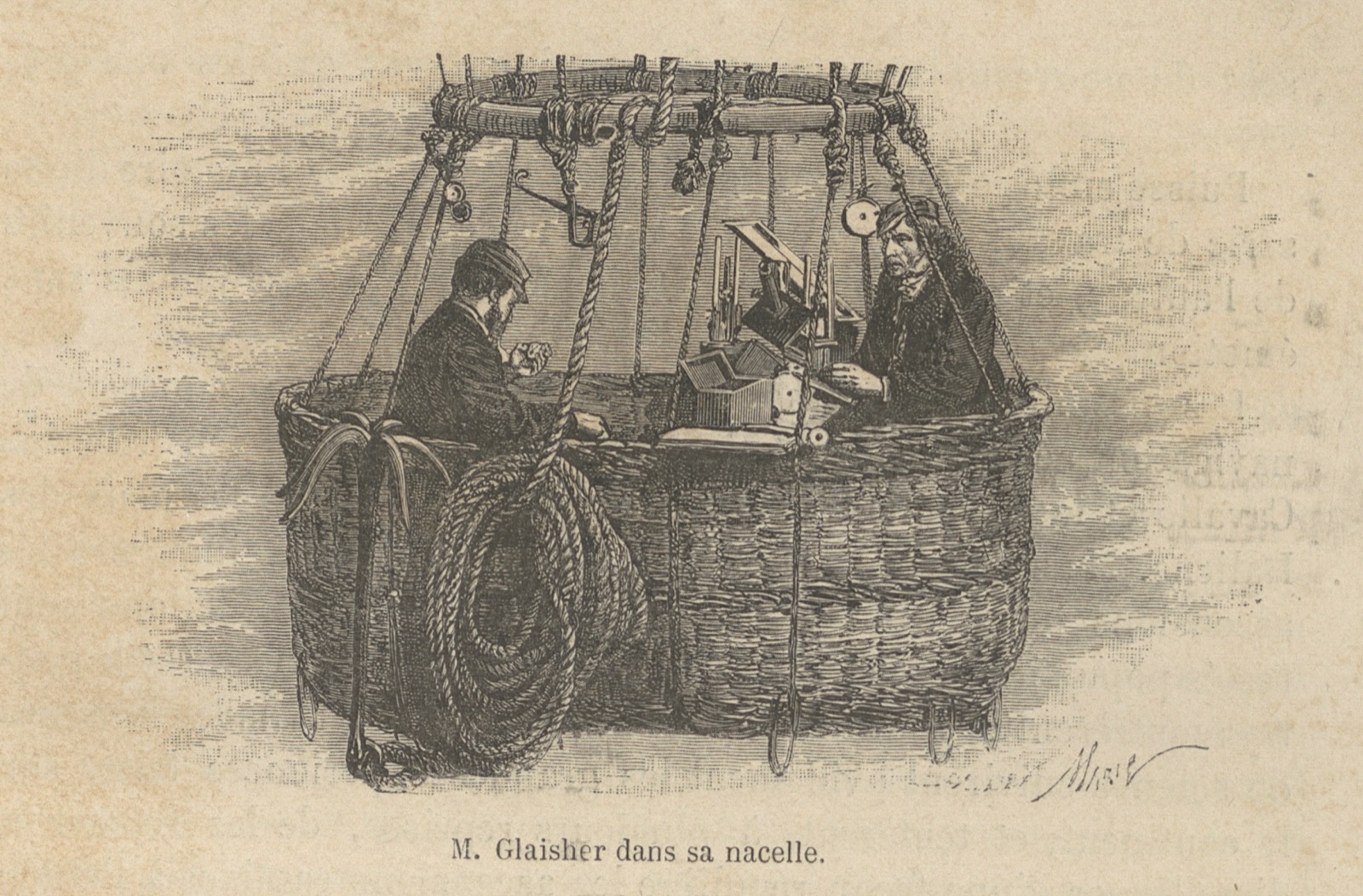
The instruments were Glaisher’s. The mercurial barometer was the siphon barometer Welsh had carried in 1852, returned by Kew and verified before it left. Two aneroids came from Negretti and Zambra, one graduated down to 5 inches, a pressure found beyond 40,000 feet; after the first ascent a second mercurial barometer was made with its scale corrected inch by inch against a boiled six-foot tube, “therefore probably as accurate at low readings as at high”. The thermometers had long, narrow bulbs, were graduated to forty below zero on ivory scales, and settled within half a degree in ten or twelve seconds. There were two pairs of dry and wet bulbs, one of them fed by an aspirator; Daniell’s and Regnault’s hygrometers for the dew-point directly; a minimum thermometer; a magnet; exhausted glass tubes to be opened at height and sealed again; ozone papers; and an electrometer lent by William Thomson of Glasgow.
The arrangement of the car is worth describing exactly, because it is the design that failed. “One end of the car was occupied by Mr. Coxwell; near the other, in front of myself, was placed a board or table, the extremities of which rested on the sides of the car.” “A watch was set to Greenwich time, and placed directly opposite to myself. The central space of the table was occupied by my note-book. The aspirator was fixed underneath the centre of the board, so as to be conveniently workable by either my feet or hands.” Glaisher’s seat faced the instruments; the instruments faced him. The ropes from the car to the hoop had been made longer than usual, and the valve-line was coiled into a pocket on the hoop, so that the big valve at the crown need not be touched except to come down.
The first ascent, on 17 July 1862, was Glaisher’s first time off the ground. The wind had blown from the west for a week, and “no instrument was placed in its position before starting”. Coxwell let go at 9.43, the balloon slid along the ground on its side before it rose, and Glaisher was still screwing thermometers into their frames at 10,000 feet, “a novice who had never before put his foot in the car of a balloon.” Then the observer took over: the clouds falling below, the temperature rising from 31 degrees at 15,500 feet to 42 at 19,500 so that both men threw off the clothing they had just put on, his own pulse at a hundred. At 21,792 feet he “experienced a feeling analogous to sea-sickness, though there was neither pitching nor rolling in the balloon.” They reached five miles at about eleven. Coxwell judged they were too near the Wash and brought the balloon down through a cloud 8,000 feet thick, so wet that the water condensing on the balloon outweighed the sand he threw out, and “we came to the earth with a very considerable shock, which broke nearly all the instruments.” The ascent of 18 August, in a light north-easterly, went to 24,000 feet and came down at Solihull. Between the two there were evening flights from the Crystal Palace for the lower air.
Thirteen minutes
The seventh ascent had waited for days on the weather. On 5 September Proud’s gas was the best they had yet had; Coxwell could tell from the tug of the net on the sandbags. The lesson of July was that the work had to be done fast, because England gives a balloon an hour or two before the sea. Coxwell decided, since “no symptoms of fainting had been felt previously”, that “we might risk a more spirited rise”.
The balloon left the gasworks at 1.03, in air at 59 degrees. At 5,000 feet it was 41. At 1.13 they entered a cloud about 1,100 feet thick in which the air was saturated and the temperature fell to 36 and a half, and heard a gun. At 1.17 they came out of the top of it into “a flood of strong sunlight, with a beautiful blue sky, without a cloud above us, and a magnificent sea of cloud below, its surface being varied with endless hills, hillocks, mountain chains, and many snow-white masses rising from it.” Glaisher tried to photograph it and could not, because the balloon was rising too fast and had been turning on its axis since it left the ground. The turning never stopped.
Two miles at 1.21, with the air at freezing. Three miles at 1.28, at 18 degrees; the ice on the wet bulb was not forming properly and its readings for eight minutes had to be thrown out. At 1.34 the notebook records “Mr. Coxwell pants for breath.” At 1.38 the mercury of Daniell’s hygrometer could no longer be seen. Four miles at 1.39, at 8 degrees, with a dew-point of 15 below zero. Sand went out. In ten minutes more they had passed five miles and the thermometer read two below zero, and Regnault’s hygrometer, cooled to thirty below, showed no dew at all; the dry and wet bulbs gave a dew-point of 36 below. Six pigeons had come up in a basket. One, thrown out at three miles, “extended its wings and dropped as a piece of paper”; a second, at four, “flew vigorously round and round, apparently taking a dip each time”; a third, between four and five, “fell downwards as a stone”.
“Up to this time I had taken observations with comfort,” Glaisher wrote. “I had experienced no difficulty in breathing, whilst Mr. Coxwell, in consequence of the necessary exertions he had to make, had breathed with difficulty for some time.” At 1.41 the notebook says “See with difficulty.” At 1.44, at 22,380 feet, “Experienced a difficulty in reading the instruments.” The aspirator, worked by his feet, “became troublesome”. At 1.51 came the reading of 11.05 inches and the correction and the height of 26,350 feet, and the words “Lost myself”. He read the dry thermometer once more, at five below, “this must have been about 1h 52m or later; I could not see the column of mercury in the wet-bulb thermometer; nor afterwards the hands of the watch, nor the fine divisions on any instrument.”
“I asked Mr. Coxwell to help me to read the instruments, as I experienced a difficulty in seeing. In consequence, however, of the rotatory motion of the balloon, which had continued without ceasing since the earth had been left, the valve-line had become twisted, and he had to leave the car and mount into the ring above to adjust it. At this time I looked at the barometer, and found it to be 10 inches, still decreasing fast; its true reading therefore was 9¾ inches, implying a height of 29,000 feet.”
What follows is the passage for which the ascent is remembered, and it should be read as what it is: an observer’s record of the observer.
“Shortly afterwards I laid my arm upon the table, possessed of its full vigour, and on being desirous of using it, I found it powerless—it must have lost its power momentarily. I tried to move the other arm, and found it powerless also. I then tried to shake myself, and succeeded in shaking my body. I seemed to have no limbs. I then looked at the barometer, and whilst doing so my head fell on my left shoulder. I struggled and shook my body again, but could not move my arms. I got my head upright, but for an instant only, when it fell on my right shoulder, and then I fell backwards, my back resting against the side of the car, and my head on its edge; in this position my eyes were directed towards Mr. Coxwell in the ring.”
“I dimly saw Mr. Coxwell in the ring, and endeavoured to speak, but could not; when in an instant intense black darkness came, the optic nerve finally lost power suddenly. I was still conscious, with as active a brain as at the present moment whilst writing this. I thought I had been seized with asphyxia, and that I should experience no more, as death would come, unless we speedily descended: other thoughts were actively entering my mind, when I suddenly became unconscious as on going to sleep.”
Of the one sense left to him he could say nothing, because there was nothing to hear: “the perfect stillness and silence of the regions 6 miles from the earth (and at this time we were between 6 and 7 miles high) is such that no sound reaches the ear.” The times he reconstructed afterwards. “My last observation was made at 1h 54m at 29,000 feet. I suppose two or three minutes fully were occupied between my eyes becoming insensible to seeing fine divisions and 1h 54m, and then that two or three minutes more passed till I was insensible, therefore I think this took place at about 1h 56m or 1h 57m.”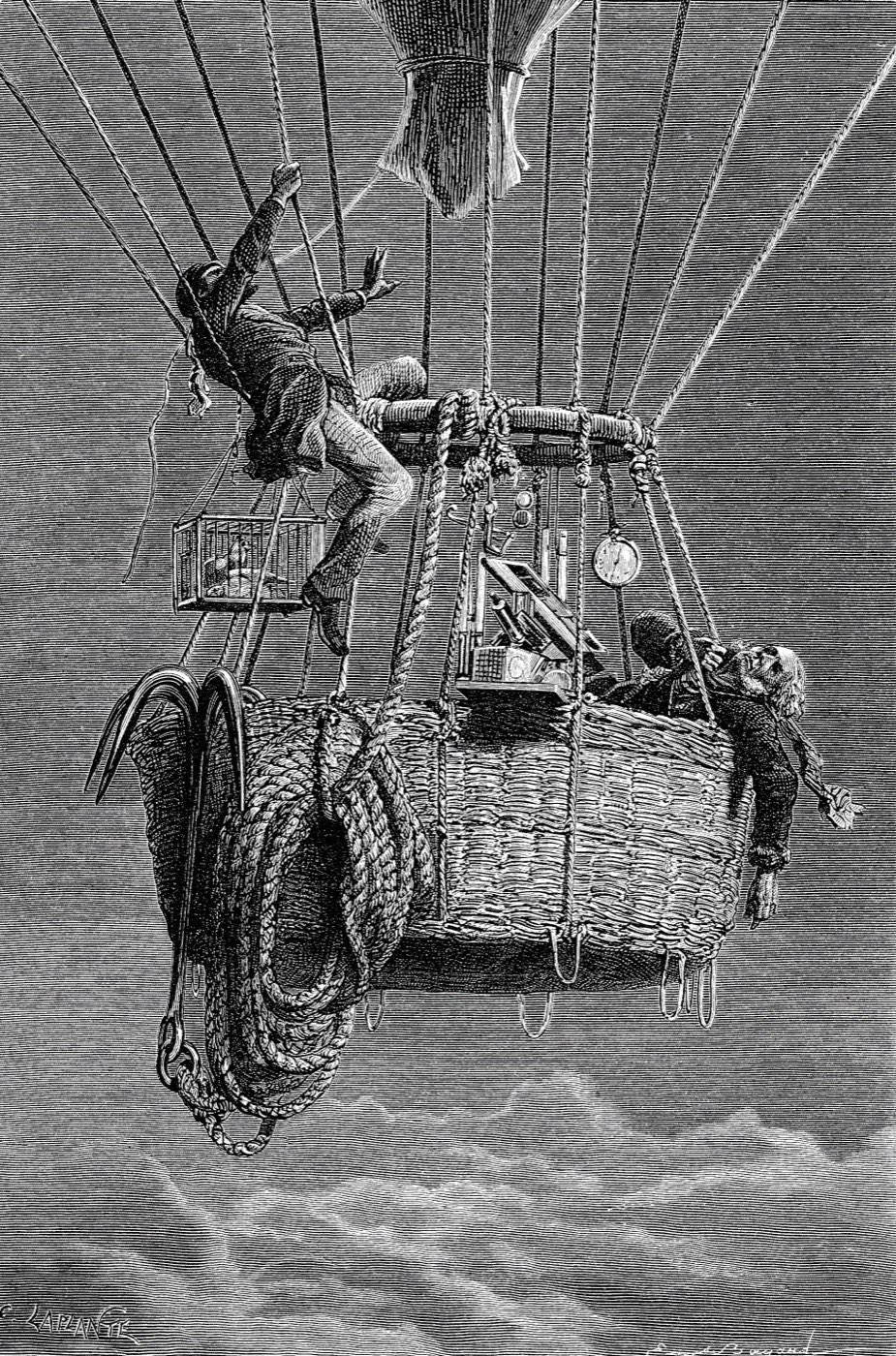
Coxwell’s part he knew only from Coxwell, and he set it down in reported speech, as evidence: “that whilst in the ring he felt it piercingly cold; that hoar-frost was all round the neck of the balloon; on attempting to leave the ring, he found his hands frozen, and he had to place his arms on the ring and drop down; that he thought for a moment I had laid back to rest myself; that he spoke to me without eliciting a reply; that he then noticed my legs projected and my arms hung down by my side; that my countenance was serene and placid, without the earnestness and anxiety he had noticed before going into the ring, and then it struck him I was insensible. He wished to approach me, but could not, and he felt insensibility coming over himself; that he became anxious to open the valve, but in consequence of having lost the use of his hands he could not, and ultimately did so by seizing the cord with his teeth and dipping his head two or three times until the balloon took a decided turn downwards. This act is quite characteristic of Mr. Coxwell.”
The first thing Glaisher knew was words. “Whilst powerless I heard the words ‘Temperature’ and ‘Observation,’ and I knew Mr. Coxwell was in the car speaking to me, and endeavouring to arouse me, therefore consciousness and hearing had returned. I then heard him speak more emphatically, but I could not see, speak, or move. I heard him again say, ‘Do try—now do.’ Then I saw the instruments dimly, then Mr. Coxwell, and very shortly saw clearly. I rose in my seat and looked round, as though waking from sleep, though not refreshed by sleep, and said to Mr. Coxwell, ‘I have been insensible;’ he said, ‘You have; and I, too, very nearly.’ I then drew up my legs, which had been extended before me, and took a pencil in my hand to begin observations. Mr. Coxwell told me that he had lost the use of his hands, which were black, and I poured brandy over them.”
“I resumed my observations at 2h 7m, recording the barometer reading at 11·53 inches and temperature −2°.” That is 25,318 feet. By his estimate consciousness had come back at about 2.04, “and this gives seven minutes for total insensibility.” The water that fed the wet bulb “was one solid mass of ice”.
The descent was “at first very rapid; we passed downwards three miles in nine minutes.” A fourth pigeon, thrown out at four miles on the way down, “flew in a circle, and shortly alighted on the top of the balloon.” By three o’clock they were in the middle of a large grass field at Cold Weston, seven and a half miles from Ludlow, with two pigeons still in the basket, one of them dead. “No inconvenience followed this insensibility, and when we dropped it was in a country where no conveyance of any kind could be obtained, so that I had to walk between seven and eight miles.”
What it looked like from inside
Coxwell told his side twenty-seven years later, in the second volume of his memoirs, and explained that he was “anxious to tell my own story, and describe my feelings during these awful thirteen minutes”. His account is the aeronaut’s, and it is about hands.
He had taken off a thick pair of gloves “so as to be the better able to manipulate the sand bags”. He was busy with the sand and the neck valve, and “when Mr. Glaisher’s troubles commenced, I was absorbed in my own duties which prevented me from noticing my colleague’s uneasiness. I thought that his eyes were dazed by the constant use of a lens and did not perceive that insensibility was approaching.” “I looked up far above the balloon for Supreme help, and then found myself springing aloft to do what at this critical juncture seemed necessary.” Then: “the moment my unprotected hands rested on the ring, which retained the temperature of the air, I found that they were frost-bitten, but I did manage to bring down with me the valve line, after noticing the hand of the aneroid barometer”.
He pulled, and asked his companion to take an observation, “but all was silent, so that in this position I felt an amount of anguish which can be better imagined than described.” He looked for a way to reach Glaisher, “but the table of instruments blocked the way, and I could not with disabled hands pass beneath, my last hope then was in seeking the restorative effects of a warmer stratum of atmosphere.” The table across the car, built so that the observer need not move, now kept the aeronaut from him.
“Never shall I forget those painful moments of doubt and suspense as to Mr. Glaisher’s state when no response came to my questions; I began to fear that he would never take any more readings.” Then “Mr. Glaisher gasped with a sigh, and the next moment he drew himself up and looked at me rather in confusion, and said he had been insensible, but did not seem to have any clear idea for how long, until he caught up his pencil and noted the time and the reading of the instruments.” Coxwell put him to work on the sand, “for we had dipped 19,000 feet in a quarter-of-an-hour”. Then “there was a mutual explanation, but Mr. Glaisher kept on dotting down his observations, and we did not discuss the dangers we had surmounted.”
At the nearest railway station there was no train for hours and nothing to eat but chops. Glaisher went out to telegraph. “Early next morning Mr. Glaisher’s report was written before and during breakfast, and duly appeared in the newspapers.” So the ascent reached the public in Glaisher’s own words, with the estimate of the summit already made.
What happened
The estimate was made three ways, and Glaisher set them out at the end of his report so that the reader could see them agree.
“I have already said that my last observation was made at a height of 29,000 feet; at this time (1h 54m) we were ascending at the rate of 1000 feet per minute, and when I resumed observations we were descending at the rate of 2000 feet per minute; these two positions must be connected, taking into account the interval of time between, viz. 13 minutes, and on these considerations the balloon must have attained the altitude of 36,000 or 37,000 feet. Again, a very delicate minimum thermometer read −12°, and this would give a height of 37,000 feet; Mr. Coxwell on coming from the ring noticed that the centre of the aneroid barometer, its blue hand, and a rope attached to the car, were all in the same straight line, and this gave a reading of 7 inches, and leads to the same result. Therefore these independent means all lead to about the same elevation, viz. fully 7 miles.”
The first assumes that a balloon climbing at a thousand feet a minute when its observer went blind kept climbing at that rate until the valve was opened, and then fell at two thousand feet a minute from the moment it turned. The second converts the lowest temperature reached into a height by the very law of decrease that the ascent was meant to test. The third is the memory of a man with frozen hands, of the line a needle made against a rope as he dropped out of the ring. None of the three is a reading. The American annual that summarised the paper said so in one sentence: “Since the instruments were placed facing Mr. Glaisher, the exact height reached in this ascent was not ascertained.”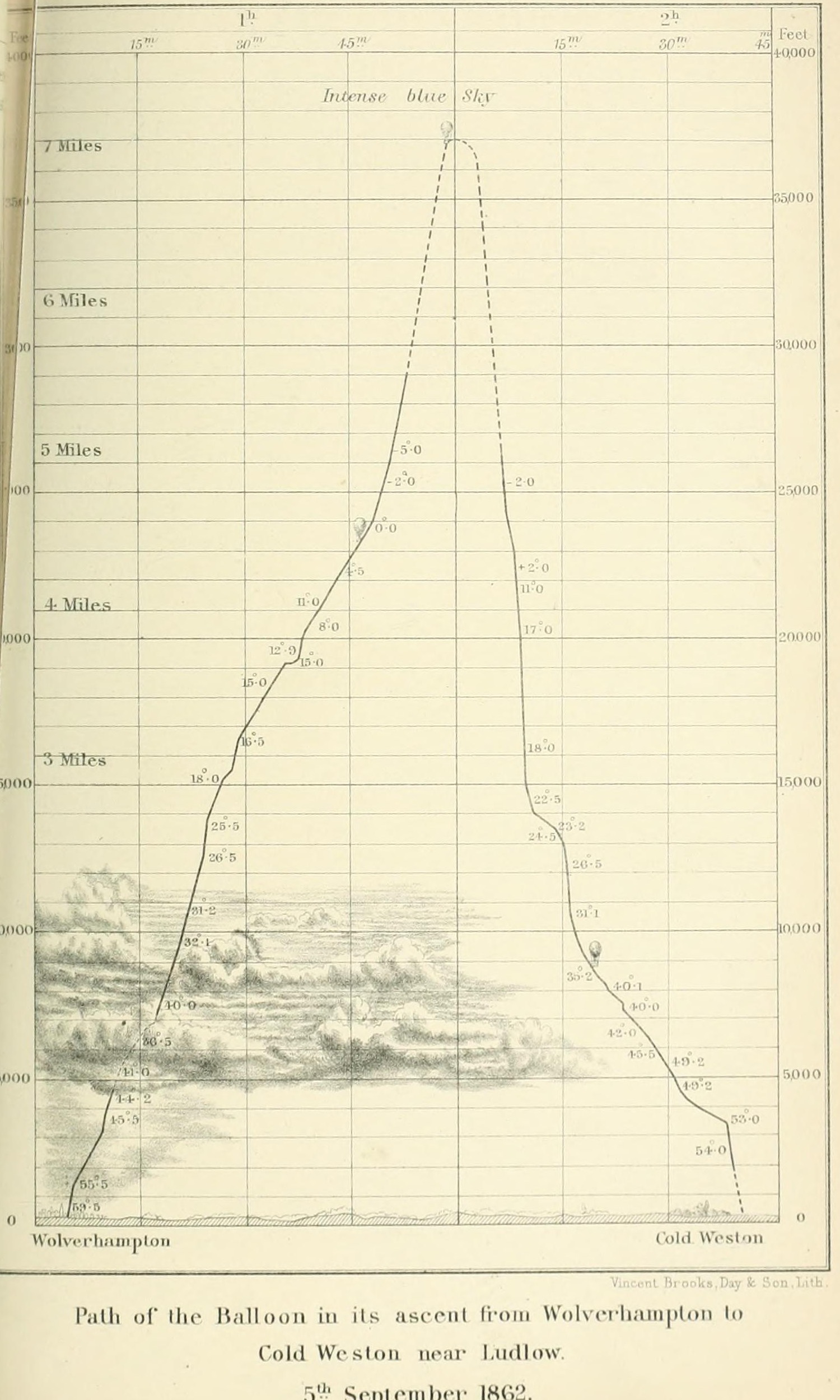
The newspapers did not look. The Illustrated London News of 13 September reported that “An altitude of six miles was attained, but at great peril”. The Times gave the ascent a leading article on 11 September, which Coxwell reprinted in full. “Two men have been nearer by some miles to the moon and stars than all the race of men before them.” And: “For ten whole minutes, Mr. Coxwell ascended alone, or rather worse than alone, with his companion insensible before his eyes, in a region seven miles distant from the earth.” Punch printed a schoolboy’s song about the two of them and Icarus:
Now what a lie is that account! About the hour of noon Glaisher and Coxwell both did mount Six miles in a balloon.
Six miles in the picture papers, seven in The Times, and in the Association’s own volume for the year, fully seven. At the Cambridge meeting in October a Dr Isaac Ashe read a paper proposing a valve that would open itself: a weight on the cord, held off only by the aeronaut’s continued grip, “so that in the event of insensibility supervening at great altitudes, the valve should open spontaneously”, thus “obviating the danger to life incurred by Messrs. Glaisher and Coxwell”. A dead man’s handle for a balloon. There is no record that anyone built one.
The pigeons had their own ending. The carrier that came down alive in the basket “would not leave the hand when I attempted to throw it off, till after a quarter of an hour it began to peck a piece of ribbon which encircled its neck, and was then jerked off the finger, and flew with some vigour towards Wolverhampton. One of the pigeons returned to Wolverhampton on Sunday the 7th, and is the only one that has been heard of.” Thirty-five years later, on 14 July 1897, with his own balloon bumping across the Arctic pack ice, Salomon Andrée saw one of the pigeons he had released earlier come back and fly round the car, and wrote in his diary: “Perhaps it has done the same as Glaisher’s pigeon?” He meant the fourth pigeon, the one that flew in a circle and settled on top of the balloon.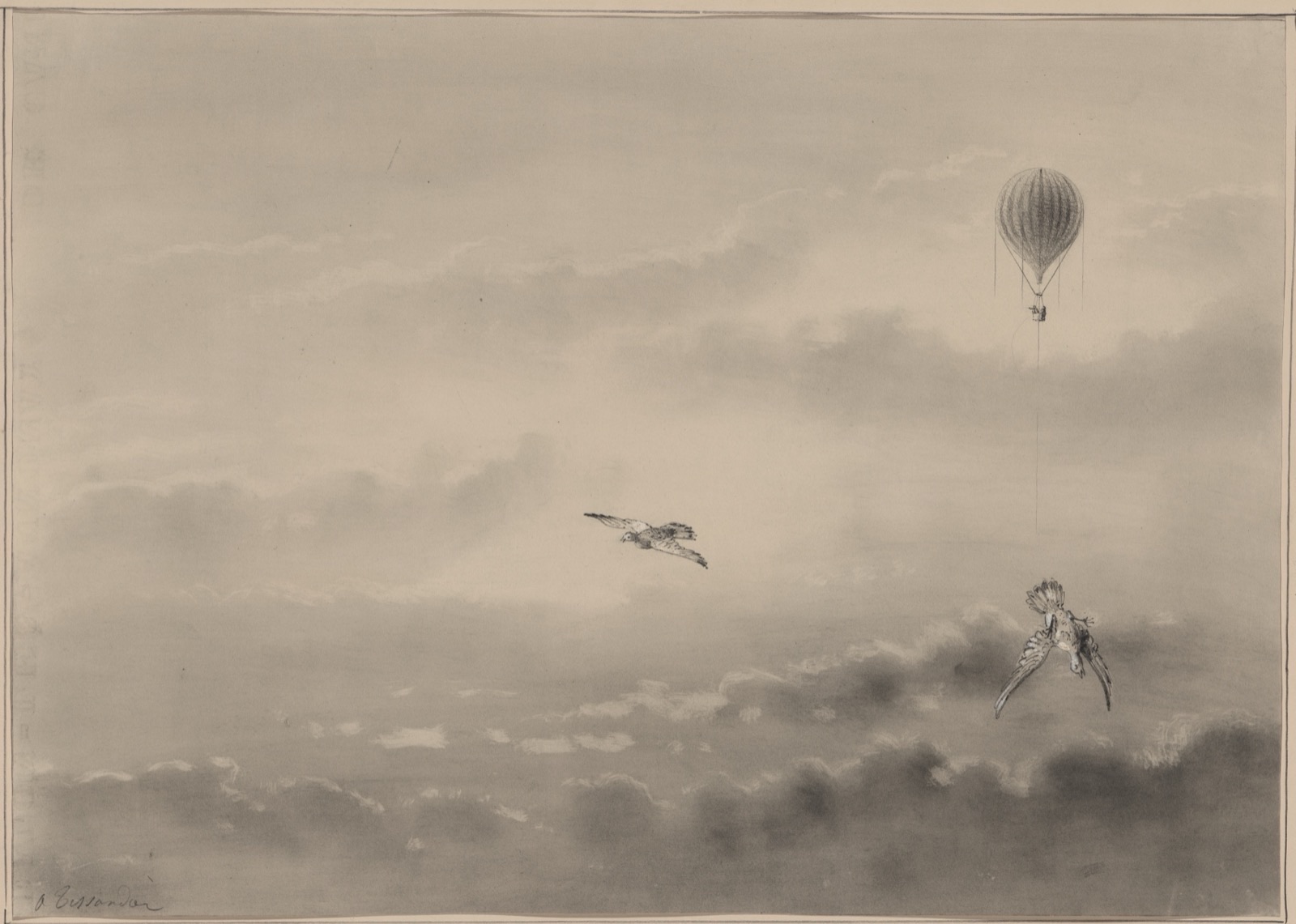
After
The committee was reappointed, with another £200 and £70 to cover the overspend, and £25 to Glaisher for his expenses. There were five more ascents in 1863 and nine in 1863 and 1864 together, and at the Newcastle meeting of 1863 the Association’s council asked for something. “At Newcastle a very general wish was expressed by the Members of the Council that I should not ascend to heights exceeding 4 or 5 miles. To this I readily consented, because for the most part, from the preceding experiments, all the observations above 5 miles could have been inferred from those made below 5 miles; and there was another reason, that the balloon, after the many rough descents, had become, in Mr. Coxwell’s opinion, too unsafe for extreme high ascents.”
So the experiment was changed to fit the instrument. In May 1864 Airy wrote to his superintendent: “If you shall have any more balloon ascents I much wish that you would give all your energies to magnetic determination.” That summer a crowd at Leicester tore one of Coxwell’s balloons to pieces at a public exhibition, and the later flights were made with other aeronauts and other balloons. In October 1865 came the first of the night ascents, from Woolwich, and with it the series’ last surprise: the temperature rose with height instead of falling, “and on every occasion the highest temperature was met with at the highest point. This result was remarkable indeed.” The twenty-eighth and last ascent was from Windsor on 29 May 1866.
What the series found about the air is in the tables of the Association’s reports, and it is not what the law said. In the first 1,000 feet above the ground on a clear afternoon the temperature fell a degree for every 139 feet, more than twice the mountain rate; higher up the fall slackened, to a degree in 300 feet near 14,000 and a degree in 1,000 feet near 30,000, so that the whole fall to 30,000 feet was 70 degrees where the law predicted 100. “The theory of a decline of temperature of 1° for every 300 feet of ascent must be abandoned.” Cloud changed everything: under an overcast the fall was nearly uniform up to the cloud, while under a clear sky the steepest change was in the first hundred feet. The humidity obeyed no law at all; there were strata of moist air with dry air between, and above 20,000 feet the air “was dry, being almost free from vapour”. On 5 September the dew-point above 30,000 feet “must have been as low as minus 50° below the zero of Fahrenheit’s scale, or 82° below the freezing-point of water”. The decrease of temperature with height turned out to have a daily cycle, greatest at midday and vanishing near sunset, with a likely reversal at night. The aneroid graduated to five inches read the same as the mercury all the way, and “These experiments prove that an aneroid can be made to read correctly at low pressures.” Nearly every secondary object failed on the high ascents for the reason the photograph failed: the balloon would not stop turning.
The observer reported on himself with the same care. “The number of my pulsations was generally 76 per minute before starting, about 90 at 10,000 feet, 100 at 20,000 feet, and 110 at higher elevations”. “At 17,000 feet my lips were blue; at 19,000 feet both my hands and lips were dark blue; at four miles high the pulsations of my heart were audible, and my breathing was very much affected; at 29,000 feet I became insensible.”
Coxwell built other balloons, formed balloon companies for the Prussian army at Cologne in 1870, made his last large ascent in 1885 and died at Seaford on 5 January 1900. Glaisher resigned from Greenwich in 1874 after a note from Airy about his hours, edited Travels in the Air in 1871 with the engraving of himself insensible as its best-known plate, and died at Croydon on 7 February 1903, two months short of ninety-four.
The number outlived them both, and it was challenged in their lifetime. In September 1898 the aeronaut Stanley Spencer, back from an ascent with oxygen, told an interviewer: “Glaisher and Coxwell had no oxygen, and I really can’t see how they could either of them have been conscious at 29,000 ft. I think that some error must have been made.” Coxwell, at seventy-nine, answered in the Daily News that the seven miles “has been accepted and recorded for the past generation by the most distinguished Fellows of the Royal Society, and by the Committee of the British Association, none of whom ever disputed the recorded observations”. The Aeronautical Journal, reprinting the exchange, added a table in which a German authority had sorted the great ascents into those “measured with certainty” and those with “only a reasonable estimate”. Glaisher’s of 5 September 1862 was in both: at 28,723 feet in the first, at 35,800 in the second.
Then an American meteorologist, H. A. Hazen, wrote to the journal on 9 December 1898 and went through the report figure by figure. “Mr. Glaisher’s own estimate was 37,000 feet, but as he was unconscious the last 11,000 feet, this estimate must be taken with caution.” A balloon, he pointed out, does not shoot up to a point and fall; it runs level near the top, so the thirteen minutes were spent “going on a level instead of rising and falling”. The gas and the size of the balloon “could not have carried the balloon over 30,000 feet”. A man pulling a cord with his teeth could not have let out enough gas to change the buoyancy much. And the minimum thermometer, applied at the rate of fall actually observed between the last two good readings, gave a rise of 2,900 feet above the last fixed height, not 8,000. “The exact height reached can never be known, but it could not have been over 29,500 ft. This was a most extraordinary feat, and there is no desire to in any way belittle Mr. Glaisher’s work.”
Hazen’s figure is where most later reckonings have settled. The physiology agrees with him. The tables that pilots are now trained on give, for a man without oxygen, a useful consciousness of one to two minutes at 30,000 feet, half a minute to a minute at 35,000, and fifteen to twenty seconds at 40,000; they are averages, but Glaisher read instruments for some minutes above 26,000 feet, was out for seven, and lived, while Coxwell climbed into the rigging, worked a line with his teeth and never lost consciousness at all. Those are the symptoms of a balloon that stopped somewhere near 30,000 feet, not of one that went on to 37,000. A neurologist who went through the account in 2003 as a case history took the height as 29,000 feet, and found the order of the symptoms unusual enough for plain lack of oxygen to raise the question of injury from the fall in pressure as well.
What it taught
The committee calibrated everything it could. The barometer had been to Kew, the thermometers timed in a warm room and a cold one, the aneroid tried under an air-pump. The observer had been tried to 26,000 feet, once, in July, and had felt sick. Nobody had asked what the observer’s own scale went down to, and the answer, found on 5 September between 1.44 and 1.57 in the afternoon, was that it went down to about 29,000 feet and then read nothing. “As high as possible” had been taken to be a property of the balloon and the gas. It was a property of the man.
The failure came out of the design in three pieces, each sensible on its own. The instruments faced the observer, so that he need never move to read them, which meant that when he could not read them nobody could, and that the aeronaut could not get past the table to him. The valve-line was stowed on the hoop at the end of lengthened ropes, so that the great valve could not be opened by accident, which meant that the one action that could end the ascent required a climb into the cold with bare hands. And the balloon turned all the way up, so that the line twisted, which is the ordinary behaviour of a balloon. Everything that went wrong was the ordinary behaviour of the apparatus. The only unusual element was that one of the instruments was alive.
What that instrument did while it was failing is the reason the ascent is still read. Glaisher had spent thirty years teaching other people to observe, and when his arms went he observed that; when his eyes went he observed that; and when he came back he picked up the pencil before he picked up the conversation. The passage about laying his arm on the table “possessed of its full vigour” is among the earliest descriptions of hypoxia written by its subject, and it is better than the instruments because it records what no self-registering instrument of 1862 could, the moment at which the reading stopped being taken. Coxwell’s fear, by his own account, was that his companion “would never take any more readings”. The aeronaut understood that the readings were the experiment.
The complication is that the experiment reported. The ascent produced a temperature and a dew-point for every thousand feet to 29,000, and with the rest of the series it took away a law that had stood since the eighteenth century and put in its place a curve that bent with height, with cloud and with the hour of the day. The committee read its instrument’s own report, that it had no scale above five miles, and did the right thing with it: not a self-opening valve, not oxygen, but a decision at Newcastle to stop at five miles because “all the observations above 5 miles could have been inferred from those made below 5 miles.” That is what a good experiment does when it finds the limit of its instrument. It stops using the instrument beyond the limit.
What it did not do was give up the number. Seven miles was arrived at by three methods, which is a good way to arrive at a number, and all three were estimates leaning on the same thirteen minutes, which is a bad one. Glaisher knew it; he printed the dotted line. Hazen read the report and the dotted line and got within a few hundred feet of what everyone now accepts. The lesson is the one the chart draws for anybody who looks at it. The solid line is what was read. The dots are what was wanted. Everything the public remembered was in the dots.
Sources
- James Glaisher, “An Account of Meteorological and Physical Observations in Eight Balloon Ascents, made, under the Auspices of the Committee of the British Association for the Advancement of Science at Manchester”, in Report of the Thirty-second Meeting of the British Association for the Advancement of Science; held at Cambridge in October 1862 (John Murray, 1863), pp. 376–503. The committee’s objects, the instruments and their testing, the arrangement of the car, the accounts of all eight ascents including the whole of the 5 September narrative quoted here, the table of observations with its marginal notes (“Lost myself”), the three estimates of the greatest height, the pigeons, and the conclusions on the decrease of temperature and the humidity of the air. The same volume carries the Association’s grants and recommendations (p. xl) and Isaac Ashe’s “Suggestions on Balloon Navigation” (Transactions of the Sections, p. 27). archive.org
- James Glaisher, the continuing reports: “Five Balloon Ascents in 1863”, in the Report of the Newcastle meeting, 1863 (1864); “Nine Balloon Ascents in 1863 and 1864”, in the Report of the Bath meeting, 1864 (1865), pp. 193 ff., for the council’s request at Newcastle not to exceed four or five miles and Coxwell’s opinion of the balloon; “Three Balloon Ascents in 1864 and 1865”, in the Report of the Birmingham meeting, 1865 (1866); and “Three Balloon Ascents in 1865 and 1866”, in the Report of the Nottingham meeting, 1866 (1867), pp. 367 ff., for the night ascent of 2 October 1865 and the count of twenty-eight. 1863, 1864, 1865, 1866
- James Glaisher, Camille Flammarion, Wilfrid de Fonvielle and Gaston Tissandier, Travels in the Air, edited by James Glaisher (Richard Bentley, 1871). Glaisher’s introduction and chapters: the history of Gay-Lussac, Barral and Bixio and Welsh, the committee of 1858, the Wolverhampton failures of 1859 and 1862, his own decision to observe, the first ascent of 17 July, the 1871 retelling of 5 September (with its small differences from the 1862 report), the chapter on the decrease of temperature with elevation, the aneroid, the physiological observations, and the plates: the path of the balloon and “Mr. Glaisher insensible at the height of seven miles”. archive.org
- Henry Coxwell, My Life and Balloon Experiences, with a Supplementary Chapter on Military Ballooning (W. H. Allen, 1887), for his birth and apprenticeship; and Second Series (W. H. Allen, 1889), chapters IV to VII, for the summons to Wolverhampton, the sum that showed no English balloon would do, his offer to build one at his own cost, the Mammoth’s construction and dimensions, Proud’s gas, his own recollections of 5 September (“Never shall I forget those painful moments”), the walk, the chops and the angler, and his reprints of the Times leading article of 11 September 1862 and the Punch song. 1887, 1889
- The Illustrated London News, 23 August 1862, p. 194, on the five-mile ascent, and 13 September 1862, p. 282, the paragraph reporting six miles and the teeth. 23 August, 13 September
- “Ballooning”, in Appletons’ Annual Cyclopaedia and Register of Important Events of the Year 1862 (D. Appleton, 1863), pp. 185–186. The summary of Glaisher’s paper at Cambridge and its three questions, the balloon’s dimensions as reported, and the sentence on the instruments facing Mr Glaisher. archive.org
- The Aeronautical Journal, vol. 2, no. 8 (October 1898), pp. 84–87, for Stanley Spencer’s interview, Coxwell’s letter to the Daily News of 27 September 1898, and the table of ascents of the first and second class; and vol. 3, no. 9 (January 1899), p. 13, for H. A. Hazen, “Glaisher’s Highest Balloon Ascension”, dated 9 December 1898. October 1898, January 1899
- Swedish Society for Anthropology and Geography, Andrée’s Story: The Complete Record of His Polar Flight, 1897, translated by Edward Adams-Ray (Viking Press, 1930), p. 80 and, in the transcript of Andrée’s first diary, p. 311, for the pigeon of 14 July 1897. archive.org
- H. P. Hollis, “Glaisher, James (1809–1903)”, Dictionary of National Biography, 1912 supplement; and Thomas Seccombe, “Coxwell, Henry Tracey (1819–1900)”, Dictionary of National Biography, 1901 supplement. Births, careers, societies and deaths. Glaisher, Coxwell
- J. L. Hunt, “James Glaisher FRS (1809–1903), Astronomer, Meteorologist and Pioneer of Weather Forecasting: ‘A Venturesome Victorian’”, Quarterly Journal of the Royal Astronomical Society 37 (1996), pp. 315–347. Glaisher’s early life and Greenwich career from the Observatory archives, Airy’s letter of 18 May 1864, the Times leading article and the Punch poem, the Leicester riot and the cooling with Coxwell, the twenty-eight ascents, and his death at Croydon. ADS
- M. J. Doherty, “James Glaisher’s 1862 account of balloon sickness: altitude, decompression injury, and hypoxemia”, Neurology 60 (2003), pp. 1016–1018. The clinical reading of the account. Europe PMC
- Federal Aviation Administration, Advisory Circular 61-107B, Aircraft Operations at Altitudes Above 25,000 Feet Mean Sea Level or Mach Numbers Greater Than .75 (29 March 2013), Figure 2-3, “Times of Useful Consciousness versus Altitude”, with its warning that the figures are averages and do not mark the onset of unconsciousness. faa.gov
- Figures: the studio photograph of Glaisher and Coxwell, about 1864, Rijksmuseum, Amsterdam, RP-F-2015-56-9, released under CC0; “M. Glaisher dans sa nacelle” from Voyages aériens (Hachette, 1870), Polona Digital Library; the Bayard and Laplante engraving, from the plate in Voyages aériens and Travels in the Air, via Wikimedia Commons; the path of the balloon, from the University of British Columbia’s copy of Travels in the Air on archive.org; and Albert Tissandier’s drawing “Pigeons lancés hors la nacelle”, Library of Congress Prints and Photographs Division, item 2002735688. Rijksmuseum, Polona, engraving, Library of Congress

