On 10 December 1954, on a railway track laid across the floor of the Tularosa Basin in New Mexico, a steel sled with nine rockets behind it and a man strapped to a seat on top of it reached 937 feet per second and ran into a trough of water. The water stopped it in 1.4 seconds. An accelerometer bolted to the man’s chest wrote the stop onto a trace: a rise at six hundred g a second, a shelf at twenty-five g that lasted more than a second, and two spikes on top of the shelf, at thirty-five and at forty.
The man’s own reading was shorter. The Associated Press reached him by telephone a fortnight later, when the Air Force released the news, and he said: “My eyeballs became uncaged, but there was no impairment of thinking.” Then he gave the reporter the part of the trace that no accelerometer had recorded. “I saw bright yellow and then vivid red. The pain was intense. So intense that I recall very little of the G pressure in stopping.”
Exactly seven years earlier, on 10 December 1947, the same man had made his first ride, on a different sled in a different desert, with one rocket, to ninety miles an hour. In between he had ridden twenty-seven times, and the number he had been sent to test had been eighteen.
Who ran it
John Paul Stapp was born on 11 July 1910 in Bahia, in the north of Brazil, where his father, a Baptist missionary, was president of the American Baptist College. At thirteen he was sent to the San Marcos Baptist Academy in Texas, a small, nearsighted boy with a bassoon. He took a degree in English at Baylor in 1931 and a master’s in zoology in 1932; he taught for two years at a Baptist college in Decatur, Texas, took a doctorate in biophysics at the University of Texas, and only then, at twenty-nine, went to medical school at Minnesota, where he qualified in 1944. He had decided to be a doctor over a Christmas vacation at Baylor, after his two-year-old cousin’s clothes caught fire at an open hearth and he had nursed the child for sixty-two hours until it died. He went on active duty as a first lieutenant in the Medical Corps on 5 October 1944 and became a flight surgeon.
On 10 August 1946 he was posted to the Aero Medical Laboratory at Wright Field in Dayton, Ohio, the Army Air Forces’ laboratory for everything that happened to a flier’s body. His first project was to test a liquid-oxygen breathing system in unpressurised aircraft; he logged sixty-four and a half hours at altitudes up to 45,000 feet, mostly as his own subject. In March 1947 he was assigned to a project called MX-981, on deceleration.
The people who built the apparatus were not Air Force. Northrop Aircraft of Hawthorne, California, held the contract; its project engineer was George Nichols, its chief mechanic Jake Superata, whom Stapp later told Time deserved much of the credit for the rocket work, and its crew of seven included a young engineer, David Hill, who joined in 1947 and was still describing the track half a century later: “It was a track, just standard railroad rail set in concrete, about a half-mile long.” An Air Force captain named Edward Murphy came out from Wright Field with some strain gauges and stayed two days. Later, at Holloman Air Force Base in New Mexico, the laboratory Stapp commanded held a biophysicist, Major David Simons, who would go up in a balloon for him; a helmet designer, Charles Lombard; a task scientist for automobile crashes, Lieutenant Sidney Lewis; and a test pilot, Captain Joseph Kittinger, who flew the chase plane on the last ride and later jumped from the edge of space for him.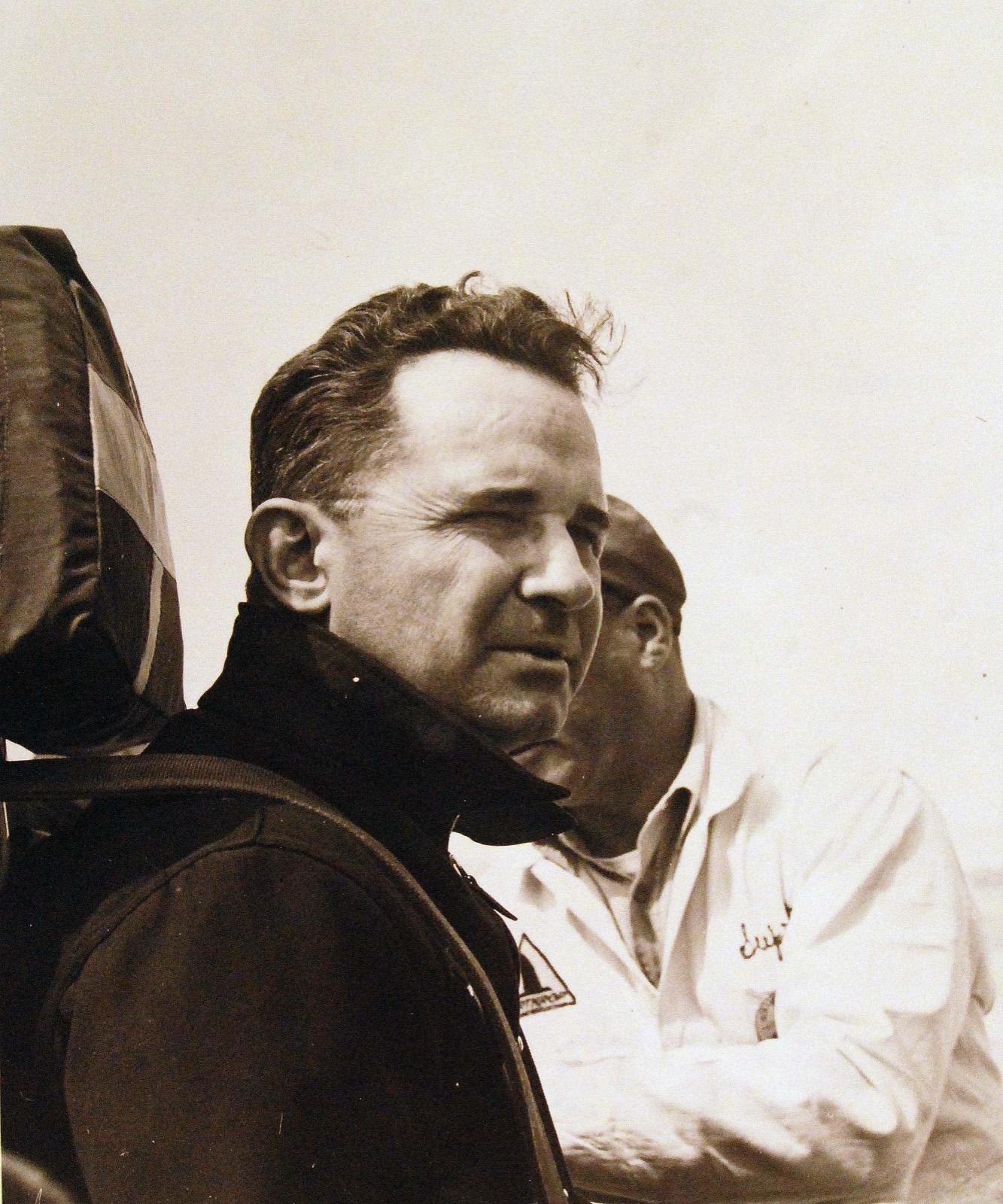
What they were trying to find out
The question the project was given was how much deceleration a human body could survive in an aircraft crash, so that seats and harnesses could be built to that figure instead of to a guess. There was a figure already, and it was the guess. For years the services had accepted that a man could stand about eighteen times the force of gravity and no more, and the strength of fighter cockpits, seats and belts had been designed to it; Hill, who came to the project in 1947, remembered that military aircraft designs were based on that number. Time, in 1955, put the figure at the other end of the chain: fighters had been built to an expected stress of nine g, because engineers and most doctors believed the body could take no more, and there was no point building a seat stronger than the man in it. Nobody could say where eighteen had come from. The Second World War had produced crashes in which men walked away from forces that should have killed them, and crashes in which seats or harnesses failed at forces that should not have, and the two kinds of evidence did not fit one number.
So there were two claims to test, and they were not the same size. The first was that the body could take more than eighteen g, and how much more. The second was that if the number was higher, a man properly held in a seat could survive any crash the aircraft around him survived, and that the thing to build to was the limit of the airframe, not the limit of the man. The project’s own words for its method, as Stapp gave them to a House committee in 1966, were to reproduce “the conditions of an aircraft crash as realistically as possible under controlled and measured conditions, and then to expose the human body to progressive increments of crash.”
In 1953, when the work moved to New Mexico, a third claim was added, because the aircraft had changed. Yeager had flown faster than sound in October 1947, and the fighters that followed him raised a question the crash work could not answer: whether a pilot who ejected at the speed of sound could live through the wind that hit him and the deceleration that followed, or whether every supersonic aircraft would have to carry a sealed capsule to throw him out in. The Air Research and Development Command’s test directive of 15 April 1953 set out “A program of experiments with the High Performance Linear Decelerator to study tolerance and survival limits for (1) Linear Deceleration, (2) Windblast in a Linear Deceleration Field, (3) Tumbling in a Linear Deceleration Field, and (4) Linear Deceleration with Tumbling and Windblast, as factors of the problem of escape from high speed, high altitude aircraft.” The “current military need”, it said, was tolerance up to fifty-five g. The directive then stated what the numbers were for: “Recommended limiting values established by these experiments will determine the design of escape devices and the choice of ejection seats or of ejection capsules for a particular aircraft.”
Stapp put the whole programme in one sentence to a safety meeting in the autumn of 1955. “There are only two models of the human body currently available, with no immediate prospects of a new design; any findings in this research should provide permanent standards.”
What they built
The track at Muroc, in the Mojave Desert of California, had been laid in the war to launch American copies of the German V-1, and ran 2,000 feet across the dry lake bed. Northrop built the sled. It weighed about 1,500 pounds and was made, in Stapp’s words, “of strength sufficient to withstand 200 times gravity loads of impact”; it was pushed by solid-fuel rockets of the kind used to help heavy aircraft take off, up to four at a time; and it was stopped by forty-five pairs of hydraulic clasp brakes mounted along forty-seven feet of track, which closed on two keels under the sled like vices, and which together could deliver, Stapp said, “as much as 1,800,000 pounds of braking force.” A run went like this: five seconds of rocket, about 180 miles an hour at burnout after some 700 feet, half a second of coasting, and a stop that could be preset by choosing how many brake pairs would bite. The crew called the sled the Gee Whiz.
The first passenger was a 185-pound dummy, which the crew called Oscar Eightball. Its early runs found what the apparatus could do wrong. On 30 April 1947 the brakes and the emergency arresting gear both failed and the sled went off the end into the desert. On another run the harness let go. “The dummy went through inch thick tongue-and-groove pine plank and sailed through the air 110 feet before landing between the rails,” Stapp told Congress, with the film running. “The accelerometers before the cables broke were recording 32 times gravity, or 6,800 pounds load on the dummy.” There were more than thirty of these dummy runs in 1947, and the question of who would ride next had been settled on Stapp’s first day at the track, when he told Nichols the dummy would not be needed. He had been sent to collect a human tolerance; he would be the human.
He rode first on 10 December 1947, facing backwards, with one rocket, to about ninety miles an hour; the next day he fired three. By May 1948 he had made sixteen runs and been stopped at thirty-five g, nearly double the number the project had been given. The runs produced data and they produced injuries, and the injuries were the data. Facing backwards above eighteen g he lost his sight to a white-out, as the blood left the front of his head. In 1949 the sled was turned round, a heavier harness was made for it, and the forward-facing runs began, in which the blood went the other way. A volunteer stopped at thirty-five g came out in shock; Stapp repeated the run himself, saw his vision close to what he reported as a “smoky green fog”, and broke his right wrist when his hand slipped off the armrest. Late in 1950, on what he described as a relatively mild twenty-g stop to test a harness, the taped wrist went again, and he wrote in his report that he had reduced the fracture himself on the walk back to the laboratory. He cracked ribs and lost fillings. Northrop’s Nichols remembered the blood blisters raised by grains of sand.
One instrument on the sled read nothing at all. Murphy’s strain gauges, brought from Wright Field to measure the load on the harness, were wired on by a technician so that two of them cancelled, and a run went down the track and recorded zero. Hill remembered Murphy’s remark about his assistant: “If there’s any way they can do it wrong, they will.” Stapp repeated it to reporters a few weeks later as Murphy’s law, and said the team worked with it in mind.
The run that mattered came in June 1951, and it is the one whose number has travelled furthest. Stapp sat facing forward, held by shoulder straps, a lap belt and inverted-V straps over his legs, his head bare and bowed as far forward as he could get it behind a windshield. The sled came into the brakes at 154.8 miles an hour and came out of them at 34.4, in 31.2 feet. “The head swung through an arc of 55 degrees during deceleration.” The accelerometer on his chest read 46.2 g; the one on the sled frame read 45.4; the load on his harness was about 8,000 pounds. There was no blackout at the end of the run. Within four hours his vision had fogged in both eyes; the next day the right eye was dim, with blind spots in the centre and at the edge, and he had, by his own later account, “severe frontal headache for thirty-six hours.” The retinas had bled. A month later the haemorrhages were still there and his corrected vision was back to twenty-twenty, with the blind spots persisting “with slight annoyance to vision in the right eye.”
The Edwards series ended that month. There had been seventy-three human runs, nineteen of them facing backwards; a colleague had taken thirty-eight g at a rate of onset of 1,370 g a second; chimpanzees, anaesthetised, had taken plateaus of sixty-five g and peaks near a hundred and fifty without reaching the point of irreversible injury. The project’s bibliography records two technical reports, numbered 5915, one for the backward-facing position in 1949 and one for the forward-facing position and the harness in 1951, and a paper in the Journal of Aviation Medicine summarising 166 runs. The Air Force’s own history of the work, written at Holloman in 1958, drew the conclusion in a sentence: the Edwards tests “clearly suggested that the human body, if properly positioned and secured, could endure any aircraft crash forces in which the aircraft itself survived.” The Air Force’s new transports were given seats that faced the tail.
What the Edwards tests had not done was the ejection problem. The brakes were mechanical, the top speed of a human run had been 226 feet per second, and the longest stop had lasted less than half a second. Pilots leaving a jet would be hit by wind at hundreds of pounds to the square foot and slowed over seconds, not tenths. Holloman had a track for that: 3,550 feet, built in 1949 to launch the Snark missile, with a water brake at the end, a trough between the rails into which scoops under the sled dipped, so that the force and the duration of a stop could be set by how much water was dammed up and where. Stapp arrived to command the base’s Aeromedical Field Laboratory in April 1953, bringing the project with him. Northrop built him a new sled, Sonic Wind No. 1, 2,000 pounds of steel, with a rack for nine rockets giving 40,000 pounds of thrust for five seconds.
The sled ran empty from 23 November 1953, and with a chimpanzee on 28 January 1954. On 17 March headquarters authorised human runs, and on 19 March Stapp made the first, with six rockets. The object, in his words, was to “evaluate human reaction to exposure to about 15 g of linear deceleration for about 0.6 seconds duration, approximately double the duration possible for the same magnitude of force on the crash decelerator previously used at Edwards”. The sled reached 615 feet per second, 421 miles an hour, and the stop peaked at twenty-two g. He came out of it with what the laboratory’s history calls momentary ill effects, and a new land speed record he had not been after.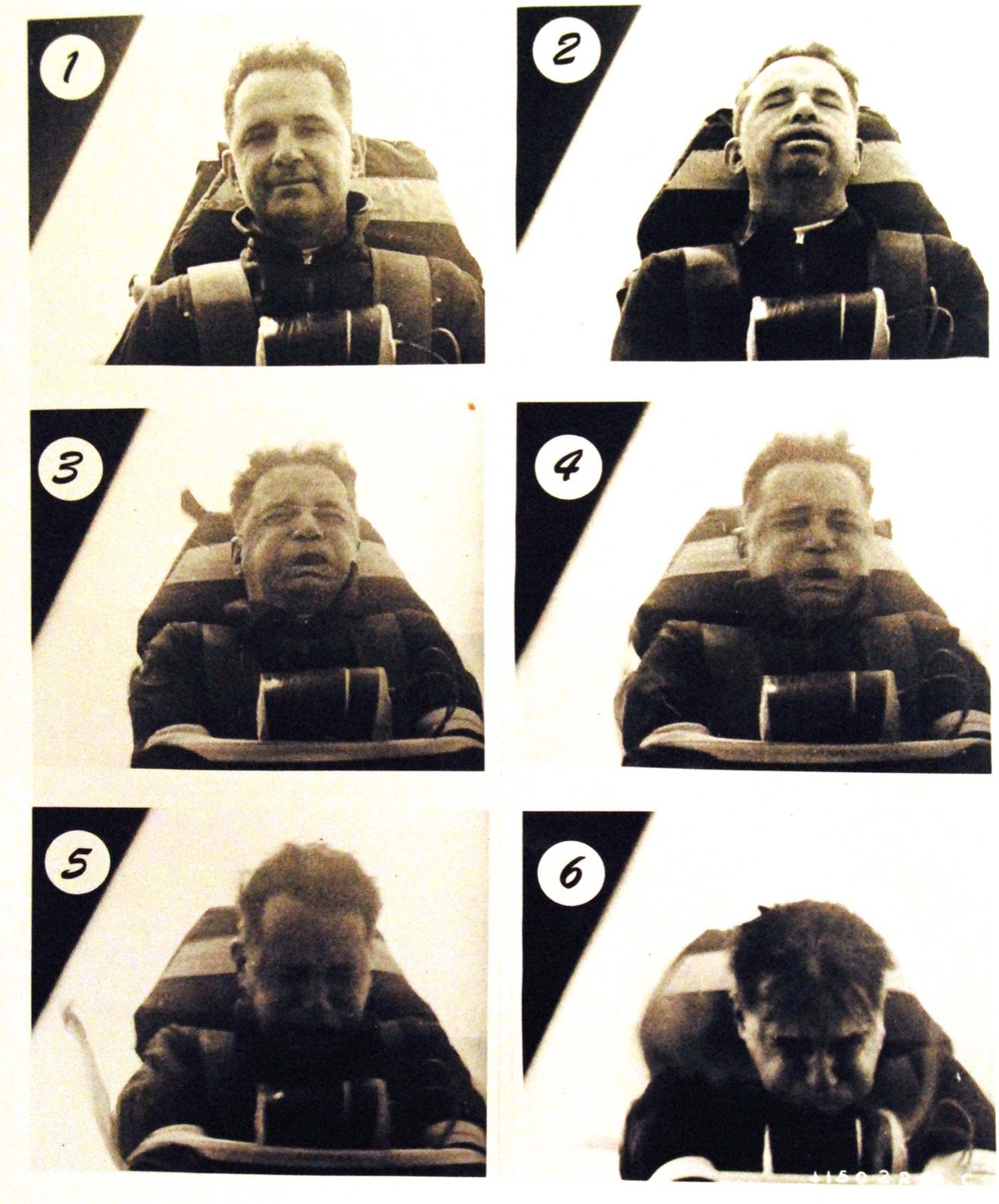
The second human run, on 20 August, was about wind. A windshield had covered him in March; now the sled carried, in the laboratory’s description, “a rectangular frame holding two doors hinged to the sides which opened inward by outside wind pressure when a cam mounted at the selected point on the track tripped a mechanism releasing the catches”, so that at speed the air would hit him all at once, as it hits a pilot whose canopy has gone. Lombard made him a helmet that enclosed the whole head. The doors opened at 736 feet per second, the pressure on him reached 5.4 pounds per square inch, and the stop was only twelve g. He called it the easiest run he had made. His clothes flapped him raw and the sand raised blisters, and that was all.
September went to a chimpanzee on a spinning seat, 105 revolutions a minute into a forty-five-g stop, which it survived, and to an explosive windshield meant to be blown off at speed, which killed more than one chimpanzee before it worked. In October Stapp went to California to perform the autopsy on a Northrop test pilot believed to be the first man to eject from an aircraft at supersonic speed, looking for what the wind and the deceleration had done to him. He found nothing from either; the pilot had been killed by the tail of his own aircraft. Through the autumn the laboratory ran chimpanzees down the track at 600 miles an hour and more as controls. The doors were too heavy for the speed Stapp wanted and the explosive windshield could not be trusted, so for the run of 10 December there would be no windshield at all: the helmet, the straps, and the air.
Eight and a half minutes
Time’s reporter, who came to Holloman the following summer, set down the routine of a ride. Up at half past four; coffee and an orange; a physical examination with an electrocardiogram and X-rays; the helmet, with a cloth neck zipped shut, over a blue wool flight suit; thin leather gloves. Then the straps, and they are worth listing, because they were the design under test. A broad belt across the lap. Shoulder straps to the belt and the seat. A strap across the back that pulled the elbows to the sides, because above 400 miles an hour the wind will flail a loose arm with, in the magazine’s words, “bone-snapping force.” Straps above and below the knees, with the wrists lashed to the upper one. A chest strap drawn so tight, the ophthalmological paper would record, “to completely stop rib movements in respiration”, so that he could breathe only with his diaphragm. A rubber block between his teeth carrying an accelerometer. The helmet lashed to the headrest, so that the wind could not twist his neck. A cord in one hand to start the camera that faced him. Then everyone went to the blockhouse, and a siren gave a minute’s warning, and he had to pull the cord when the count reached five.
Nine rockets fired. The sled covered 2,800 feet in five seconds and reached, by the figure the Air Force released, 632 miles an hour, nine-tenths of the speed of sound in the air at Holloman that day; the laboratory’s own history records 937 feet per second, which is a little more. Overhead a T-33 jet trainer was flying down the track, with Captain Kittinger at the controls. The sled passed it. The acceleration alone, about nine g by the AP’s account and more than six g for more than three seconds by the laboratory’s, took away Stapp’s sight for two seconds, which was itself a finding: a pilot on a catapult would see nothing for a moment and be able to fly within seconds of leaving the deck. The wind on his body was 7.7 pounds per square inch, better than 1,100 pounds to the square foot, about two tons on the man. Then half a second of coasting, and the water.
Stapp’s account to Aviation Week in January is the only description of the inside of that 1.4 seconds by the one person who was there. “It went from black to yellow, I saw the water splash when I hit the brake, and then came the redout. After that I didn’t see a cockeyed thing.” The trace on his chest, as the paper on his eyes set it out in 1956: “Exposure to an initial force of 35G applied at a 600G per second rate of onset was followed by a plateau of 25 to 27G lasting for .4 of a second and a second peak of 40G of less than .1 second duration followed by a plateau of approximately 5G for the remainder of a total duration of 1.1 seconds.” The sled stopped thirty-two feet from the end of the rails.
His own words for his eyes, as the Air Force history quotes them from his paper, were a “shimmering salmon” field and then “a sensation in the eyes . . . somewhat like the extraction of a molar without an anesthetic.” To Time he said it felt as if the eyes were being pulled out of his head. When the sled had stopped the salmon colour stayed. He lifted an eyelid with his fingers and saw nothing, like looking at the sun through closed lids. The crew ran to him. Nichols of Northrop told the story to the writer Nick Spark forty years on: “His eyes had hemorrhaged and were completely filled with blood. It was horrible. Absolutely horrible.” Stapp, on the stretcher, by Nichols’s account, said that this time he got the white cane and the seeing-eye dog. A minute or two later he saw blue specks. At about eight minutes the specks ran together into sky and cloud. A surgeon held up fingers and he counted them, which told him his retinas were attached and that he was not blind, and the time he gave the press for his blindness was eight and a half minutes. He had, he said, “two of the most beautiful shiners any man ever had.”
In the base hospital, by the laboratory’s weekly status report, he “ate heartily and spent two hours accommodating demands of motion picture photographers making documentary coverage of the run.”
What it looked like from inside
Stapp was asked afterwards what he thought about in the seat while the count ran, and told a friend that first he looked at the mountains and the bright sky and thought of nothing, and then he said to himself: “Paul, it’s been a good life.”
The paper in which he reported the run, in August 1955, is written by the subject about the subject, and the Air Force history quotes the passage that tells what the instrument felt after it had stopped reading. “There was no fuzziness of vision or sensations of retinal spasms as had been experienced in 1951 following a run in which a retinal hemorrhage occurred. Aside from congestion of the nasal passages and blocking of paranasal sinuses, hoarseness and occasional coughing from congestion of the larynx, and the usual burning sensation from strap abrasions, there was only a feeling of relief and elation in completing the run and in knowing that vision was unimpaired.”
The eyes were examined and written up by Donald Lyle, an ophthalmologist who had first looked into them when Stapp was at Wright Field, and who put the December run beside the June 1951 run and three accidental cases as one syndrome: blood driven forward into the head by the deceleration while the chest belt and the slumped viscera raised the pressure in the vessels. The sequence on 10 December, in the paper’s words, was “initial inability to see, then foggy light perception, with rapid clearing and ability to count fingers.” The whites of his eyes filled with blood until the haemorrhages ran together into blisters; the lids swelled and bruised; the sinuses were blocked. The cerebral signs “were not severe.” The paper also set down what the whole series had been measuring. “Criteria for tolerance are incipient reversible injuries, as well as the subjective evaluation.” The limit of a human experiment, that is, was the first injury that would heal; and whether it would heal was known only afterwards.
Lyle, discussing the paper, allowed himself one joke and one observation. When he had last examined Stapp, about a year after the run, the blind spots left by the 1951 bleed were still there but clearing, “with rapid improvement, following the last experiment, when he was projected 632 m.p.h., stopping in 1.4 seconds. However, Col. Stapp confided in me that he could not conscientiously recommend this procedure as routine treatment for retinal hemorrhage or residual scotomata.” And: “One might possibly expect, after 29 experiments, brain damage such as is found in a ‘punch drunk’ pugilist. The contrary is the case, as any one can testify after a few minutes’ conversation with Col. Stapp.”
What the crew saw was a man they could not look at. What the public saw, when the wire story ran on 28 December, was what the Associated Press made of the telephone call in one version of its dispatch: a doctor who “braked to a full stop in 1.4 seconds with a jerk that snapped his eyeballs from their sockets.” The Nome Nugget ran it under “Air Force Medico Rides Rocket Sled 632 mph And Stops In 1.4 Seconds In Simulation of High-speed Bail-out.” Stapp had meant to give a press conference in Los Angeles on the 27th and missed it. He had had car trouble twenty miles out.
What happened
The Air Force held the news for seventeen days and then gave it out as a speed record, which Stapp told the AP was “only a secondary part of the test.” The result that mattered to the laboratory was written into its progress report and into his paper: windblast on a properly secured and protected body at over 600 miles an hour at Holloman’s altitude, equivalent to Mach 1.6 at 40,000 feet, was “negligible and unnoticeable in comparison with deceleration effects of g-plateaus of more than 25 g’s for 1.1 seconds.” And the plateau itself, the longest anyone had held at such a force, “exceeded any predicted g time pattern for high speed aircraft ejection.” A man in an open seat could survive leaving a supersonic aircraft, if the seat held his head and his limbs. That was Stapp’s reading of it, and the capsule’s proponents did not all accept it. “We rest the case of deceleration,” Stapp told the AP, and said he wanted one more run, with the wind doors, before he would say the same of windblast.
He never made it. He told Aviation Week the Holloman track was too short: “We could make it faster with a longer track,” and he had in mind a thousand miles an hour on the Navy’s four-mile track at China Lake. A lighter sled, Sonic Wind No. 2, was built for the windblast work and in 1955 and 1956 ran chimpanzees past the speed of sound; it was the one Time’s reporter watched clock 995 miles an hour in the summer of 1955, with nobody aboard. In August of that year General Nathan Twining, the Chief of Staff, gave Stapp the Air Force’s Cheney Award, which the service’s dictionary defines as for “an act of valor, extreme fortitude, or self-sacrifice in an humanitarian interest performed in the preceding year”. On 12 September 1955 his portrait was on the cover of Time as the fastest man on earth. In March 1956 the Alamogordo police stopped him doing forty in a twenty-five zone, and the justice of the peace, with the whole country reading, dismissed the charge, wrote a new citation against a fictitious Captain Ray Darr, and paid the fine himself.
The fame cost him the track. In the first eight months of 1956 a general at the Air Research and Development Command counted sixty-two “known” public appearances and objected in writing to the “dissipation of his time into non-research and development efforts”; by Stapp’s own reckoning he was away from the laboratory more than he was in it. In June 1956 he read in the newspapers that he had been grounded from further rides as too valuable to risk. No order ever reached him, the laboratory’s history says, but none was needed. That month Sonic Wind No. 1 left the rails in an unmanned run at eighty g and was rebuilt, the track was lengthened to 5,000 feet, and the deceleration work went on with chimpanzees, up to 247 g for a millisecond on 2 February 1957. The windblast work moved to China Lake, where in 1957 and 1958 three chimpanzees in succession died, of a broken neck, of burns over forty per cent of the body, and of a harness failure, before the suit and the helmet were right. Stapp left Holloman in April 1958 to run the Aero Medical Laboratory at Wright Field, and early in 1959 headquarters vetoed the human windblast ride, at nearly twice Stapp’s speed, that Captain John Mosely, who had taken over the windblast work, was to make. Headquarters suggested that the work be reoriented to capsules.
Stapp’s own number went on being revised. The Daisy, a 120-foot track driven by compressed air that he had asked for in May 1953, kept measuring after the rocket sled stopped, and on 16 May 1958 Captain Eli Beeding took eighty-three g on his chest for a tenth of a second, seated upright and facing backwards. He went into shock afterwards and recovered in ten minutes, and said he thought that was about the limit.
After
The thing that went into every car was already in hand before the December run. In the latter half of 1953 Stapp had been corresponding with the School of Aviation Medicine at Randolph Field about automobile crashes, which were killing Air Force men at about the rate aircraft were: in 1954, by the figures he gave Time, some 700 airmen died in aircraft and 628 on the roads. An aeromedical laboratory doing car research raised eyebrows, the laboratory’s history admits, and the task was never well funded; its objective, as written, was “To measure the actual forces incurred in automotive crashes. To establish criteria for modifications and specifications for vehicles, personnel restraints and regulations for automotive safety.” On 10 March 1955 two dummies in lap belts were crashed in a 1945 Dodge weapons carrier as a trial, and on 17 May 1955 the laboratory staged what it billed as the first full-scale automobile crash test, before a meeting of industry, government and university people who had come at the request of Don Blanchard of the Society of Automotive Engineers, for its new Committee on Motor Vehicle Seat Belts. That meeting was counted afterwards as the first of the conferences that still carry Stapp’s name.
The Holloman salvage yard supplied the cars. They were driven into walls and into one another, rolled onto beds of worn-out tyres so that they could be rolled again, and stopped short by a cable through a snubber that General Motors sold the laboratory for a token sum. Anaesthetised hogs were put on a swing seat and thrown at a conventional steering wheel and at Ford’s new energy-absorbing one, which Ford’s own lawyers would not let Ford do. Human volunteers rode the swing in lap belts only to twenty-three g, where some of them reached a plain limit of pain; hogs showed “definite injuries to lungs, heart, abdominal organs” at about forty g and death at “something in the order of 50 G’s.” Lieutenant Lewis rode a portable catapult they called the Bopper, a seat on twenty-five feet of rail shot forward by rubber bands and stopped in two feet of spring-loaded friction brakes, to twenty-seven g in a lap belt. On the same device four men in turn were stopped from eighteen miles an hour in six inches, taking 4,800 pounds on a lap belt, to answer people who doubted that a belt need be built to 4,000. “We used four different subjects,” Stapp told Congress, “because none of them wanted to volunteer for it a second time.”
He said in public, whenever he could, that to drive without a belt was “negligent suicide”, strapped one into his own 1953 Cadillac, and went to Detroit in September 1955 to congratulate the manufacturers’ association for taking up some of his suggestions in the 1956 models. The laboratory’s history records that the Edwards data were turned over to the car makers from 1955 on; Stapp’s phrase in 1966 was “freely turned over to the automotive industry as early as 1955.” Meetings were held at Holloman again in October 1956 and November 1957, the last of them three days long, with a hundred visitors, demonstrations on the Bopper and the Daisy, and a bear, newly arrived, stopped at twenty g; a mistaken press report had promised a pig, and the laboratory’s correction went out under a headline of Stapp’s own, “Pig Tale Disproved by ‘Bear’ Facts.” In the summer of 1957 pictures of late-model sedans being wrecked under a Holloman contract at UCLA brought what he called a “ridiculous series of publicity blunders and Congressional trumpeting resulting therefrom”, and on 5 August 1957 he appeared before Kenneth Roberts’s House subcommittee on traffic safety and convinced it. The Air Force closed the programme anyway, in October 1958. The conferences did not close. By 1981 there had been twenty-four of them in twenty-six years, and the proceedings, from the fifth in 1961, were numbered.
In the spring of 1966, when the House Committee on Interstate and Foreign Commerce took evidence on the bills that became the National Traffic and Motor Vehicle Safety Act, Stapp was a colonel at the Armed Forces Institute of Pathology, building a registry of accident autopsies. He came late on an April afternoon, with four members left, and a congressman from Georgia, James Mackay, introduced him: “In my opinion Colonel Stapp is a national hero.” He showed the Gee Whiz film and the figures from the services’ own records: between 1945 and 1964 accidents had taken 97,117 lives in the armed forces “while all other causes took 27,592”. Mackay had from him the statistic that forty-two per cent of the previous year’s road deaths “occurred under survivable conditions”, meaning the forces had not been enough to kill. Stapp put the sled numbers into a car. A four-ton load that had stopped him from 154 miles an hour in thirty-one feet would stop a man from sixty in three, “in the usual distance that the front of the car will telescope against a stone wall and not necessarily be injured if nothing has collapsed on him, if his restraints hold, and if he is securely restrained.” On industry’s argument that it could regulate itself, he offered a surgeon’s simile: “It would seem that self-regulation of safety by industry becomes like self-surgery. No matter how well meant, both the objectivity and the sponge count can become difficult.” He was in the room on 9 September 1966 when President Johnson signed the Act, and from the 1968 models every new car sold in the United States had to carry belts. In 1967 the Air Force lent him to the new highway safety agency. He retired in 1970.
The Air Force had other uses for a man who would test a limit on himself, and he knew how to find them. For the first manned flight of his laboratory’s balloon programme, Manhigh, in June 1957, Stapp chose Kittinger, the test pilot who had flown chase over Sonic Wind, and sent him to 96,000 feet; and from Wright Field, in 1959 and 1960, Stapp’s Aero Medical Laboratory ran Project Excelsior, in which Kittinger jumped from balloons at the edge of space to prove a parachute that would not let a man spin. That story is told in The Right Glove.
Stapp chaired his car-crash conference for the rest of his life. He was given the National Medal of Technology in 1991, cited for research on the effects of mechanical force on living tissue, and died at home in Alamogordo on 13 November 1999, at eighty-nine; he is buried at Fort Bliss. Sonic Wind No. 1 went to the Smithsonian in 1966, stood for forty years outside the space museum in Alamogordo, and is now in the National Air and Space Museum in Washington. The Gee Whiz is in the Air Force’s museum at Dayton, with a label that says it stopped its riders at forces “as high as 46 Gs”.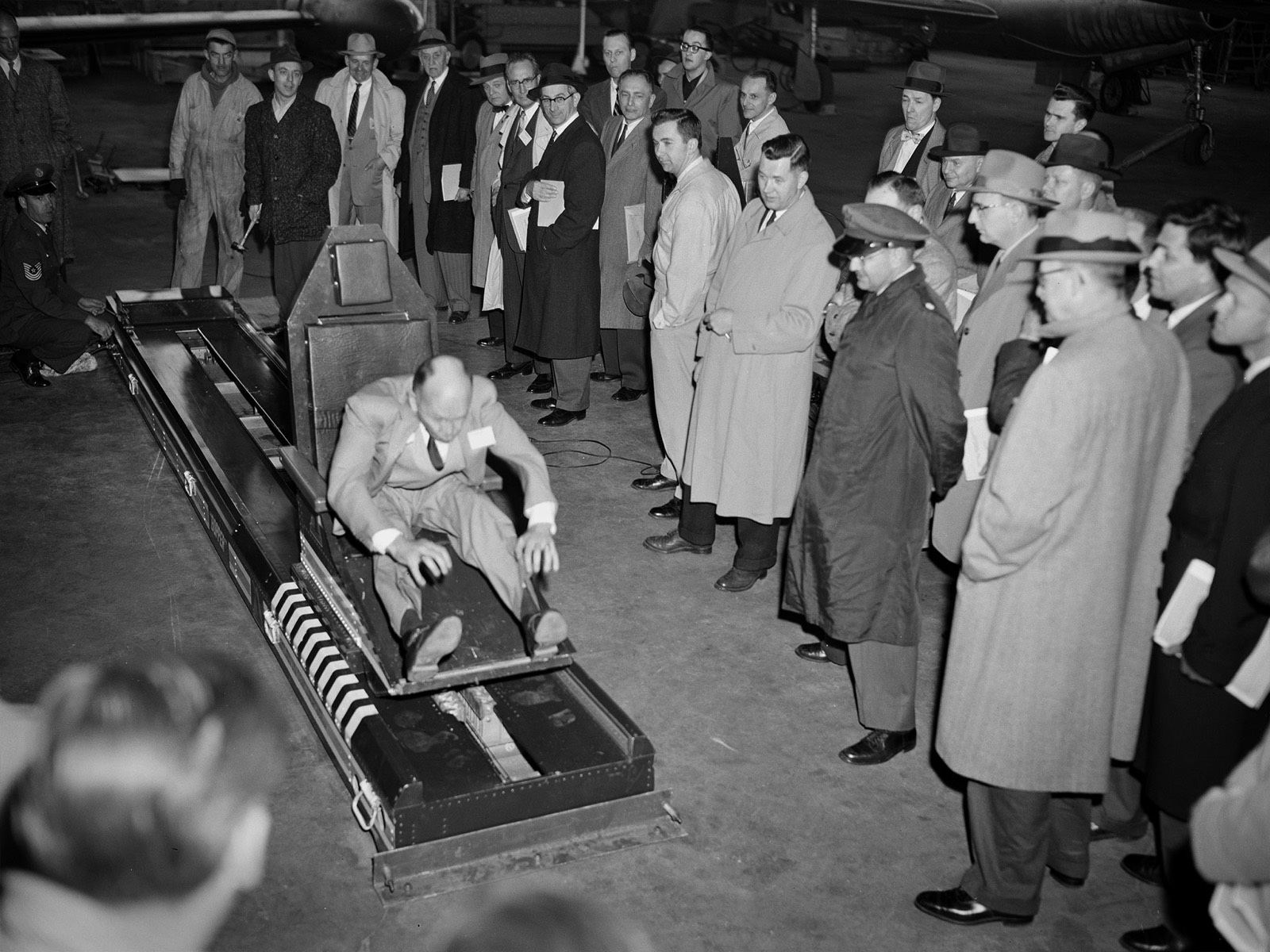
What it taught
The limit was the instrument nobody had read. Eighteen g had been the human tolerance for long enough that nobody at the drawing boards remembered it being measured, because it had not been; it was a figure that had come to be true by being built to. A seat designed to it would fail at it, and a man in that seat would die of the seat at a force his body could have taken twice over. The Gee Whiz was built to put a reading where the assumption had been, and the reading, within six months of the first ride, was thirty-five, and within four years forty-six, and the body had still not reached the point at which it would not heal. Everything that followed, the rear-facing transport seats, the harness, the lap belt at 4,000 pounds and the car that could be stopped against a wall from sixty, was a consequence of replacing one number that had never been read with numbers that had.
The complication is in what the instrument was. A chimpanzee can be taken to the point of injury and beyond, and was; a volunteer stops at the first injury that will heal, and nobody knows whether it will heal until later. That is what “voluntary tolerance” meant in these reports: the subject’s own reading of his own pain, with the clinical signs afterwards, and the limit was set each time by the man who had just been through it saying whether he would go again. Stapp’s rule of thumb to Congress was that the voluntary limit lay “between a fourth and a third of the limit for death or serious and permanent injury.” The body as an instrument has that property. It gives its best reading in the range where it is being damaged, and the only way to find out whether the reading cost something is to wait.
The last thing the story teaches is about what happens to a reading once it has been taken. The 46.2 g that Stapp measured on his chest at Edwards in June 1951, in a stop from 154 miles an hour, is now attached in almost every account to the run of 10 December 1954, including the Smithsonian’s and the museum’s in Alamogordo, where the laboratory’s own history, Stapp’s own paper and the trace recorded a shelf at twenty-five g with peaks at thirty-five and forty; the Air Force’s history from 1995 says forty-three; Aviation Week said thirty-five; the AP said an average of twenty-seven. The speed is 632 miles an hour in the release and 937 feet per second in the history, and those are not the same number. The run count is twenty-nine in Time and in Lyle, twenty-eight by August 1954 in the Holloman history, twenty-one in the caption the Air Force released in June 1954, and twenty-six on the Gee Whiz alone by its museum’s count. Even the chest reading and the sled reading on the same run differed by nearly one g, because an accelerometer measures where it is bolted. None of this changes what the body did. All of it shows how an instrument’s reading, as soon as it leaves the laboratory, begins to turn back into the kind of number that eighteen had been: a figure everyone knows and nobody has read.
Sources
- John P. Stapp, statement and further statement before the House Committee on Interstate and Foreign Commerce, Traffic Safety: Hearings on H.R. 13228 and Other Bills Relating to Traffic Safety, 89th Congress, second session, March to May 1966, parts 1 and 2, pp. 779–784 and 1149–1155. The Edwards track, the sled’s weight and strength, the brakes and their force, the run profile, the dummy through the pine plank, the maximum run from 154 to 34 miles an hour at 45.2 and 46.2 g, the seventy-three human runs, the catapult and its four subjects, the 97,117 deaths, the sixty-mile-an-hour car, the fourth-to-a-third rule, the data turned over in 1955, and the self-surgery simile; and Representative Mackay’s introduction and his forty-two per cent. archive.org, part 1, part 2 (full text)
- David Bushnell, History of Research in Space Biology and Biodynamics at the Air Force Missile Development Center, Holloman Air Force Base, New Mexico, 1946–1958 (Historical Branch, AFMDC, 1958), the monograph “Major Achievements in Biodynamics: Escape Physiology”, pp. 45–60 and notes. The test directive of 15 April 1953 and its fifty-five g, the Edwards figures (46 g at 500 g a second, the colleague’s 38 g, the chimpanzees, 226 feet per second), the Snark track and water brake, the sled’s practice runs, the chimpanzee of 28 January 1954, the authorisation of 17 March, the runs of 19 March, 20 August and 10 December with their speeds, pressures and traces, the tumbling seat, the autopsy, the sled passing the T-33, Stapp’s words on his eyes and his recovery as quoted from his 1955 paper and the weekly status report of 14 December 1954, the conclusions on windblast and the plateau, the Cheney Award, Time, This Is Your Life, the speeding charge, Threshold of Space, General Demler’s objection and the sixty-two appearances, the “grounding” of June 1956, the China Lake deaths, Mosely, and Captain Beeding’s 83 g on the Daisy track (pp. 75–77). DTIC ADA323170. archive.org
- David Bushnell, Research Accomplishments in Biodynamics: Deceleration and Impact at the Air Force Missile Development Center, Holloman Air Force Base, New Mexico, 1955–1958 (AFMDC, 1958), pp. 10–11 and 35–45. The plateau of twenty-five g and peak of forty on 10 December 1954, the 247 g chimpanzee run of 2 February 1957, and the whole of the automobile crash programme: its objective, the letter to Hugh De Haven of 7 December 1953, the crashes of 10 March and 17 May 1955, the hogs and the steering wheels, the swing seat, the Bopper, the snubber from General Motors, the meetings of 1955, 1956 and 1957, “negligent suicide”, the summer of 1957, the testimony of 5 August 1957, the cancellation, the bear and the “Pig Tale” headline. DTIC ADA323097. archive.org
- The Aeromedical Field Laboratory: Mission, Organization, and Track-Test Programs, 1958–1960 (AFMDC historical monograph, 1960), pp. 24–31, for the end of the windblast programme and the veto of Mosely’s ride early in 1959. DTIC ADA323166. archive.org
- Wayne O. Mattson and Martyn D. Tagg, We Develop Missiles, Not Air! The Legacy of Early Missile, Rocket, Instrumentation, and Aeromedical Research Development at Holloman Air Force Base (Holloman AFB, 1995), pp. 104–106. The second run dated 22 August, twenty-eight rides by then, 937 feet per second as 638.86 miles an hour, Kittinger named as the T-33’s pilot, 43 g, and the “hogs and chimpanzees” remark to a congressional subcommittee. Its photograph of the 10 December run is credited to Northrop and is not used here. DTIC ADA309953. archive.org
- Bibliography of Research Reports and Publications: Impact, Vibration, Windblast and Escape, 1942–1976 (Aerospace Medical Research Laboratory, 1977), for the titles, numbers and dates of Stapp’s reports: AF Technical Report 5915, Part I (June 1949) and Part II (December 1951), the summary of 166 runs (1951), the papers of 1955 to 1958, and his 1957 testimony on seat belts. The reports themselves could not be reached; their findings are taken here at second hand from the Holloman histories. DTIC ADA042201. archive.org
- Donald J. Lyle, John P. Stapp and Richard Button, “Ophthalmological Hydrostatic Pressure Syndrome”, Transactions of the American Ophthalmological Society 54 (1956), pp. 121–128, with Lyle’s discussion. The criteria of tolerance, the June 1951 run (154.8 to 34.4 miles an hour in 31.2 feet, 46 g, the 55-degree arc, the headache, the bleeding and the blind spots), the December 1954 restraint and force profile, the sequence of the eyes, the twenty-nine experiments and the punch-drunk pugilist. PMC
- “‘Fastest Man on Earth’ Hits 632 M.P.H. in AF Tests”, Associated Press, Evening Star (Washington), 28 December 1954, p. A-3, with the wirephoto; the same dispatch under Ralph Hovis’s byline in the Key West Citizen, 28 December 1954, p. 9, and with the rewritten lede in the Nome Nugget, 29 December 1954, p. 5. The telephone interview, the uncaged eyeballs, yellow and red, “We rest the case of deceleration”, 1,000 miles an hour at 35,000 feet, nine g in acceleration, twenty-seven g average, the thirty-two feet, Lovers Lane and the car trouble. Chronicling America, Library of Congress. Evening Star, Key West Citizen, Nome Nugget
- “Stapp Plans Supersonic Sled Test”, Aviation Week, 3 January 1955, pp. 14–15. The 2,000-pound sled, the nine rockets and 40,000 pounds, 2,800 feet in five seconds, the half-second coast, “minus 35 Gs”, 7.7 pounds per square inch, the helmet locked to the headrest, the eight-and-a-half-minute pain as Stapp gave it, and the quotations on the redout and the longer track. archive.org
- “Medicine: The Fastest Man on Earth”, Time, 12 September 1955 (cover story). Sonic Wind No. 2’s 995 miles an hour, the 168½ pounds and 6,740, the nine-g fighters and the mahogany desks, the routine of a run and the straps, the freight train, the salmon-coloured field, the blue specks and the surgeon’s fingers, the shiners, “Paul, it’s been a good life”, the biography, Oscar Eight-Ball, the first ride of 10 December 1947, sixteen rides by May 1948, the smoky green fog and the wrists, the 700 and 628, the Detroit visit and Godiva. Quoted briefly; in copyright. content.time.com
- Nick T. Spark, “The Fastest Man on Earth”, Annals of Improbable Research 9, no. 5 (2003), in four parts, from interviews with David Hill (July 2002) and George Nichols; and Spark, “The Story of John Paul Stapp”, Wings/Airpower, reprinted at The Ejection Site, for Nichols’s recollection of the blood-filled eyes and the white cane, the Gee Whiz’s early failures, Oscar Eightball, and the Murphy episode. At second hand. Part 1, Part 2, Ejection Site
- National Museum of the United States Air Force, “Northrop ‘Gee-Whizz’ Decelerator Sled”, fact sheet. April 1947 to June 1951, more than 250 tests, the forty-five brake pairs over forty-seven feet, the fifty-g design limit, twenty-six runs by Stapp, and the label’s “46 Gs”. nationalmuseum.af.mil
- Smithsonian National Air and Space Museum, “Rocket Sled, Sonic Wind I”, object record A19680015000 (nine rockets, 40,000 pounds for five seconds, 613 feet per second on 19 March 1954, 40 g on 10 December, transferred 1966), and “The Man Behind High-Speed Safety Standards”, 22 August 2018 (46.2 g). object, article
- New Mexico Museum of Space History, International Space Hall of Fame, “John P. Stapp” (inducted 1979) and “Joseph W. Kittinger Jr.” Birth, schooling, service dates, the March 1947 assignment, Manhigh, the signing of 9 September 1966, the loan to the highway agency in 1967, retirement in 1970, the National Medal of Technology, and death on 13 November 1999; Kittinger as pilot of the T-33 in December 1954. Stapp, Kittinger
- J. P. Stapp, “Twenty-Five Years of Stapp Car Crash Conferences”, SAE paper 811011 (1981), abstract: the first meeting at Holloman on 17 May 1955 at the request of Don Blanchard of the SAE for its Committee on Motor Vehicle Seat Belts, twenty-four meetings in twenty-six years, and the numbered proceedings from the fifth. TRID
- John L. Frisbee, “Valor: The Track to Survival”, Air Force Magazine, May 1983, for the Cheney Award and the eighteen-g belief as the Air Force’s own magazine put it. airandspaceforces.com
- Figures: Department of Defense photographs 330-PS-6748 (111-SC-1500220 and 111-SC-1500221), released June 1954, National Archives Record Group 330-PS, as posted by the National Museum of the United States Navy; and NASA Glenn Research Center photograph GRC-1956-C-41773, 21 April 1956. 1500220, 1500221, NASA