In the last week of January 1951, on the plateau at Kongwa in the Central Province of Tanganyika, three employees of the Overseas Food Corporation were trying to make it rain. Their names were Robbie Robson, Paddy Kenny and Robert Stewart. They had built a hydrogen generator out of the back of a lorry and some old vacuum brake cylinders, and a charcoal burner that looked, the Daily Express correspondent wrote, like a drainpipe with an aircraft rudder attached. The general manager of the whole scheme, George Raby, who had been an Army expert on projectiles, had helped with that one, and it was called “Raby’s Special.” The method was to burn about £5 worth of silver iodide in a battery of these burners and let the plateau’s rising air carry the smoke up into the clouds that sailed over from the east every afternoon and dropped their rain on the Mgomba Range, fifty miles away. They had made more than thirty experiments, and they said that it had rained every time.
Three weeks earlier, on January 9, 1951, the Government in London had published a white paper called The Future of the Overseas Food Corporation. It said that the Corporation could not pay interest on, or repay, the money advanced to it for the groundnut scheme, which by the end of the financial year would be about £36 million, and that the whole of it would be written off. The scheme that was to have cleared 3,210,000 acres of East Africa and grown 600,000 tons of groundnuts a year would be cut to a few tens of thousands of acres and renamed an experiment. At Kongwa, where 1,400 Europeans had worked at the peak, thirteen were to be left. The rain that the three men were trying to manufacture with £5 of chemicals was the thing the plan had assumed, in 1946, without anyone going to look at the record.
This entry is about that plan: who wrote it in nine weeks, what it took for granted, what the land said back, and why the only number anyone in London read, for four years, was the number of acres.
Who ran it
The idea came from a margarine company. In the early months of 1946 Frank Samuel, managing director of the United Africa Company, the African trading arm of Unilever, flew across Tanganyika on a tour of the continent looking for new sources of edible oil. Unilever made three-quarters of western Europe’s margarine. Britain imported nine-tenths of its oils and fats, and the fat ration that year was seven ounces a week. Alan Wood, who later became the scheme’s information officer and then its first historian, wrote that Samuel looked down at the bush and wondered “whether this waste land could not grow oil crops, to the benefit of the margarine ration of the British housewife and the legitimate profits of the United Africa Company.” Tanganyika’s Director of Agriculture told him the territory could spare about 100,000 acres and had no money. Samuel went to London with 2,500,000 acres in mind and put the proposal to the Minister of Food.
The Minister of Food was John Strachey, forty-four, a former follower of Oswald Mosley and then of the Communist Party, an RAF squadron leader in the war, elected for Dundee in 1945 and appointed to the Ministry in May 1946. The Secretary of State for the Colonies appointed a mission of three men to go and look: A. J. Wakefield, who had spent fifteen years in the agriculture of Tanganyika, latterly as its Director of Agriculture, and had since been Inspector-General of Agriculture in the West Indies; D. L. Martin, head of the plantations department of the United Africa Company; and John Rosa of the Colonial Office. They arrived in East Africa in June 1946. They were there nine weeks, six of them, by Matteo Rizzo’s account, spent surveying land from an aeroplane, and their report was in Strachey’s hands on September 20, 1946.
What followed was fast. The United Africa Company was appointed managing agent on November 6, 1946, to run the scheme until a public corporation could be set up to take it over. The Cabinet approved the plan in the winter. The report was published as a white paper, Command Paper 7030, A Plan for the Mechanized Production of Groundnuts in East and Central Africa, in February 1947, and the advance party, Strachey told the Commons, “pitched their tents in Tanganyika Territory on 20th January, 1947, just four months after we received the report.” The Overseas Food Corporation was created by the Overseas Resources Development Act, took over the scheme on March 1, 1948, and was given power to borrow up to £55 million. Its chairman was Leslie Plummer, a manager from Lord Beaverbrook’s Express newspapers and an old friend of Strachey’s. Its general manager in Africa was Major-General Desmond Harrison, who had been Mountbatten’s chief engineer in Burma. Wakefield and Rosa sat on the board. The scheme answered to the Ministry of Food, not the Colonial Office, and the Government of Tanganyika, which had to live with it, was consulted rather than put in charge.
The people whose land it was appear in the plan as a labour supply. The sites chosen were, by the plan’s own description, “uninhabited, tsetse-infected and waterless areas,” chosen partly so that no native rights would be disturbed, and the workers were to come from the villages round about and from as far as Mozambique. What the scheme looked like to them, and what it did to the Southern Province while it lasted, is told in Days of great prosperity.
What they were trying to find out
The hypothesis is in the title of the white paper. It was that groundnuts could be produced by machine, on bush that had never been farmed, at a scale that had never been tried, and that the produce would pay for the machinery. Strachey put the reasoning to the Commons on November 6, 1947, in the speech that gave the scheme its nickname. “What I would venture to call ‘Operation Groundnuts,’” he said, was to be a peacetime version of the landings he had seen in North Africa in 1942. He read the House his own diary of that voyage: “What could not be done if an expedition of this scope could be fitted out, not in order, as this one is, to decide who should have the right to develop Africa, but in order actually to develop Africa?” The enemy this time, he said, was “the tsetse fly, the climate, the stubborn African bush, the ignorance of the cultivator, and the lack of communications.” He believed in it “with my whole heart.”
The plan was a set of numbers, and they are worth setting down, because they were the instrument by which everything that followed was measured. There were to be 107 farming units of 30,000 acres each, 3,210,000 acres in all, of which about three-quarters lay in Tanganyika, in three blocks: at Kongwa in the Central Province, on the railway from Dar es Salaam; at Urambo in the Western Province, further along the same line; and in the Southern Province around Nachingwea, where there was no railway and no port and both would have to be built. The remaining units were pencilled into Kenya and Northern Rhodesia and never begun. Clearing was to start at once, with 150,000 acres under crop for the 1948 harvest and 600,000 for the harvest of 1949. By the fifth year the scheme would be producing 600,000 tons of groundnuts a year, and in the end 800,000. The whole thing was to cost £24 million and save the country £10 million a year in imports. Clearing was costed at three pounds, seventeen shillings and fourpence an acre. The mission had assumed a yield of 850 pounds of shelled nuts to the acre; the Ministry’s own experts wrote that down to 750 and called it conservative. The agricultural machinery was given a working life of five years. The first year’s staff was to be 160 Europeans and 7,500 Africans.
There were two claims inside the one hypothesis, and they could be tested separately. The first was mechanical: that bush could be flattened, rooted and ploughed by tractors at something like the plan’s price and speed. The second was agricultural: that the land chosen would grow groundnuts at 750 pounds to the acre, year after year, with the rain that fell on it. The plan knew which of the two it was unsure about. “Serious difficulties and delays, many of them unforseeable, may arise in the course of the undertaking,” it said, in a sentence Strachey liked to quote, and it admitted, in Webb’s later quotation of it, that the plan involved “considerable risks.” But the risks it had in mind were the machines and the ports. The land it took as read. “Nothing but the most highly mechanised methods, on a vast scale never previously envisaged,” it said, “will result in any appreciable amelioration of the presently disastrous food situation.”
The question of a pilot scheme was raised and decided against, deliberately. The world was short of fat now; a trial of a few thousand acres would take years to say anything, and in any case, as a Labour member put it in 1950 with the scheme already failing, “one can learn nothing very valuable about farming 100,000 acres from digging up a single cabbage patch.” So the experiment and the production run were the same thing, from the first day.
Two instruments existed that could have been read before the tents went up. One was the rain gauge. The plan said, on its nineteenth page, in a sentence a peer later called “a perfect platitude to anyone who has been to that part of Africa,” that “Agriculture in East Africa is largely dependent upon an erratic rainfall.” For Kongwa it had figures. Strachey gave them to the Commons in July 1949: “the best figures available were in the Kongwa area, which over the last ten years showed an average rainfall of 25 inches.” He did not say where the gauge had stood. Rizzo, from the archives, says the record was seven years long and came from Mpwapwa, a station nearby that gets more rain than the Kongwa site; and the Gogo people who lived there called the place, in John Iliffe’s words, “the country of perpetual drought.” The plan noted, Strachey said later, that Kongwa faced the risk of periodic droughts, and it hedged the risk by spreading the units across three territories, on the reasoning that a drought could not strike them all at once.
The other instrument was a spade. Lord Caldecote told the House of Lords in December 1949 that the mission “spent perhaps three to four weeks in the Kongwa area, where the bush is so impenetrable that no samples of soil could be taken in the area under consideration.” Wakefield’s own note on the agricultural soundness of the scheme, quoted in the official history, rested the case for Kongwa on the yield from “one fortieth of an acre taken within a field of native-grown groundnuts.” Paragraph 65 of the plan said that “Any suggestion of exploiting the inherent fertility of the land is unthinkable,” and paragraph 71 that “Soil conservation is undoubtedly the overriding factor.” It did not say what the soil was made of, because nobody had dug it up.
When the Bill setting up the Corporation came to the Commons in November 1947, the Opposition welcomed it. Oliver Stanley, who had been Colonial Secretary in the war, said: “Here undoubtedly is a Measure on which it is possible for all sections of the House to unite.” Alan Lennox-Boyd, winding up for the Conservatives, called the debate “an almost unanimous vote of confidence in these proposals and of high hopes that our confidence will be fulfilled.” Nobody, Webb said afterwards, had suggested that the scheme was unworkable.
What they built
They built it at Kongwa first because Kongwa was on the railway. The Southern Province, which the plan intended as the main area, could not be touched until a port and ninety miles of line had been made, so the advance party went to the one place a train could reach, which was also the driest of the three. Clearing began “on a very small scale on 1st May and seriously on 1st July” 1947, Strachey said, and by November they had “flattened 15,000 acres of African bush.”
The bush was acacia thorn “about 15 feet high,” of a density that “must be seen to be believed,” Harrison wrote in The Engineer the next summer, over “a solid mass of interlaced rubbery roots.” No new heavy tractors could be had anywhere in the world in 1947, so the managing agency bought what there was: war-worn machines, Strachey said, “picked up largely on the Pacific beaches of the Philippines, Hawaii and Honolulu,” shipped to Dar es Salaam and up the line to be reconditioned in the bush. A Labour member who visited in the first months counted 303 bulldozers, of which 291 were in the repair yards. When the Corporation took over at the end of March 1948 it had 289 tractors and 91 of them worked. The agency had bought surplus war stores by the ton, Strachey told the House, “hand tools, tents, kitchen utensils, and other kinds of stores, all mixed up together,” and they arrived in the holds of ships in “the most extraordinary mixture,” at a port that could not handle them. The Corporation’s first report said the handling of stores at Dar es Salaam “became a nightmare.”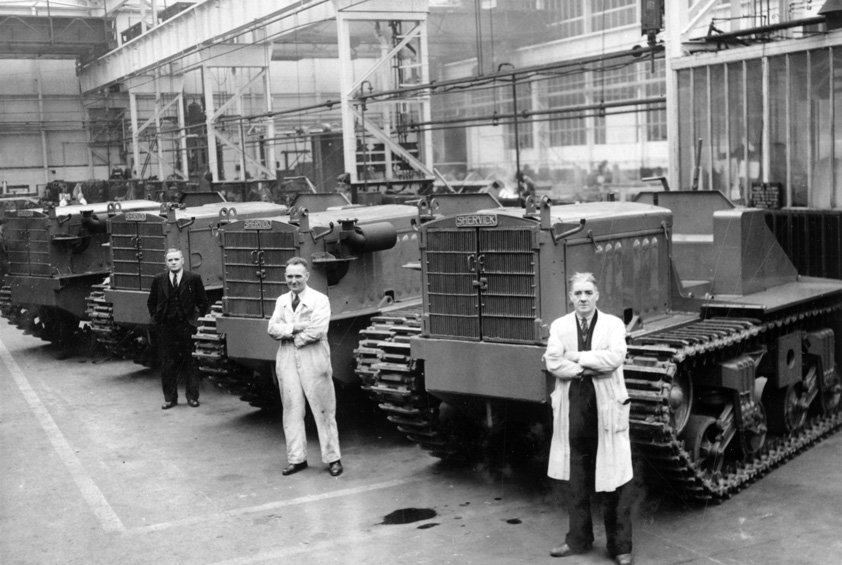
For the south, where the port was being built, Vickers took Sherman tanks apart at Elswick on the Tyne, took off the armour and the guns, and rebuilt the hulls as tractors. They were called Shervicks. Strachey saw a photograph of a landing craft “chugging up Lindi Creek full of these Shervic tractors which had once been Sherman tanks,” and said it was “a very fine symbol of the way in which we are today adapting our war effort, physically in this case, to the constructive purposes of peace.” The engineers found a better method on their own: two tractors chained together, dragging the chain through the thorn, which brought the cost of flattening an acre down, by the Corporation’s figures, from £30 to about £14. The plan had said three pounds, seventeen shillings and fourpence.
Then the roots had to come out, and the ploughs had to go in, and that was where the soil spoke. “Another point which was not foreseen,” Strachey said in March 1949, “was that the acacia thorn in Kongwa was not easier, but more difficult, to clear than the forest trees in the other areas. It is more difficult essentially because it leaves its root in the soil.” And: “it has been found that the soil there is of a particularly abrasive character.” The rooting tools wore out “in a remarkably short space of time” unless made of the hardest steel. Sir John Barlow, who farmed, gave the House the measurement: “A large disc measures 32 inches in diameter, and in bad parts the soil will wear four inches off that disc when it used to plough 200 acres.” Robert Hudson, who had been Minister of Agriculture, added the other half. “All the estimates were based on the belief that implements could work during the 12 months of the year. Brief experience on the spot proved that that type of soil sets like cement in the summer, when implements cannot be used at all.” A scheme designed to escape the African farmer’s dependence on the rains found that it could only plough when they came.
Around the clearing a town grew. At Kongwa the Corporation built 486 houses for Europeans and 1,488 for Africans, a 400-bed hospital, schools, workshops, and a police force of its own under ordinance from the Tanganyika Government. Half the boreholes found nothing, and some of the water the others found was, Hudson said, “grossly contaminated with Epsom salts,” so drinking water was carted twelve to fourteen miles in ex-RAF bowsers. The Corporation received more than 100,000 applications from Britain for about 1,000 posts. By January 1949 there were 870 Europeans on its staff and another 1,015 working for its contractors; the plan had allowed for 160. African labour, which the plan had feared would be the hardest thing to find, came readily: 5,000 men by the end of 1947, and in the Southern Province the number of people in paid work at least doubled in five years. The Africans working the scheme, Strachey said after his first visit, “all put on weight when they join.”
In the south the Corporation laid 120 miles of oil pipeline, built a temporary port in Lindi Creek, started a deep-water harbour at Mikindani, later Mtwara, and built ninety miles of railway up the Lukuledi valley to the edge of the groundnut land. By then the money advanced to the Corporation had reached £29 million, and the rate of spending, Barlow told the House, was £1 million a month.
Twelve inches
The plan’s first harvest, in the spring of 1948, was to have come from 150,000 acres and weighed 56,000 tons. It came from about 7,500 acres at Kongwa, nearly all that the agency had managed to clear, and the average yield was 500 pounds to the acre by Strachey’s reckoning and 540 by the Corporation’s, against the 750 the plan was built on. Strachey explained that “every kind of experiment was made in the first year,” varieties and densities and methods, so that the average told one nothing. Barlow’s description was that the crop was “probably just enough to supply the seed for the following year.” The Conservative front bench said the figure “knocks the bottom out of all the forecasts.”
What everyone counted instead was acres. The Corporation inherited a programme to clear 82,000 acres for the 1949 planting, judged it too ambitious, and “wrote it down to 50,000 acres,” Strachey told the House in November 1949, adding, as a point in its favour, that “they were able to clear and plant almost exactly that figure—the figure is some 49,000 acres.” The plan had called for 600,000 acres that year. A target had been set at 82,000, lowered to 50,000, and then hit, and the hit was reported as progress. A farmer who visited Kongwa that winter for a farming paper, Clyde Higgs, found the men in the bush receiving cables from London that said “Send urgentest latest acreage cleared,” and was told that if speeches could clear thorn the roots would be out in a night. “You cannot beat Africa with arithmetic,” he wrote.
The second harvest was the test of the land, and the rain gauge was read for the first time by a Minister at the despatch box. On March 14, 1949, Strachey gave the Commons the figures for the rainy season to the end of February: “At Kongwa the rainfall has been 12.53 inches; at Urambo 15.7 inches, and in the Southern Province 17.44 inches.” He added, of Kongwa’s rainfall being the least of the three, “this, of course, was known.” Fifty thousand acres had been planted, 25,000 of groundnuts and 20,000 of sunflowers at Kongwa and 3,200 acres at Urambo, and he said that “given normal conditions” they would give “quite a number of thousands of tons of oil seeds this year.” He said the target tonnage could be had from 2,000,000 acres instead of 3,250,000, by putting sunflowers into the rotation. He said that “Rome was not built in a day,” and that in a very few years the scheme would be “one of the acknowledged glories of the British Commonwealth.”
“I wonder if the House realises,” he said, “that the task set the three men was to select 3,000,000 acres from the whole area of East Africa in nine weeks.” He went on: “It turns out from information which we are given that there were no reliable records of rainfall for Kongwa at all, and it looks now as though the rainfall is most inadequate in quantity and erratic in incidence.” Strachey, winding up, said that no time limit had been set on the mission, and that the records existed and were published in the report.
The rain stopped in the third week of March. “Since the third week in March, when the crop prospects were good,” Strachey told the House on May 9, “most, but not all, of Tanganyika has suffered a widespread and severe drought, which has seriously affected both the groundnut and sunflower crops in the Central and Western Province, causing premature ripening.” Harvesting began in the second week of April, a month early. In July, with half the groundnuts in, the yields were 245 pounds an acre of nuts and 99 of sunflower. Barlow set the harvest against the plan: it “should have amounted, according to the original estimate, to about a quarter of a million tons, whereas in fact it would amount to rather over 2,000 tons.” Strachey gave the season’s rainfall at Kongwa as “under 12 inches,” against the ten-year average of 25 that the mission had used, and the record of the years since: 22 inches in 1946, 50 in 1947, 17 in 1948. It was doubtful, he said, “whether in the period for which there are records it has ever been as low as 12 inches.”
Anthony Hurd, a farming member who had been to Kongwa, said what the record was worth. “It is true that some very sketchy rainfall figures were obtained, particularly for the Kongwa area, but I hope the right hon. Gentleman will inquire of those who kept these records, because I think he will find that the job was not taken very seriously, and that sometimes the record was taken on Christmas Day and that had to suffice for a long period.” The plan had hedged the risk of drought by spreading the scheme across three territories. By 1949 the Kenya and Rhodesian units had been dropped, and every acre that had been cleared lay in the one province of Tanganyika that got the least rain.
The targets came down again that autumn. On November 21, 1949, with the Corporation’s first annual report before the House and an auditors’ note in it saying that “proper records of the expenditure relating to both Fixed and Current Assets were not maintained,” Strachey announced the new programme. Kongwa would be held at the 100,000 acres already flattened, of which 82,000 would be cropped; “last year’s drought at Kongwa should be a warning to us,” he said, but it would be “a most hasty decision to write off the Kongwa experiment on the experience of one year’s drought.” Clearing would move to Urambo and the south. By the harvest of 1954 there would be 600,000 acres, at a capital cost of £45 million to £50 million, and on that acreage, he said, “it is impossible to get a commercially attractive return.” Lennox-Boyd summed the arithmetic for the Opposition: “instead of 3 million acres at £25 million which was first suggested we hoped to have by the cropping season of 1954, 600,000 acres at £50 million. The production which was this year to have been 56,000 tons of shelled nuts, is actually nothing whatever for export.” A Nigerian proverb, he said, covered it: “Hurry is not strength.” The House rejected an inquiry by 315 votes to 161.
The same month Strachey wrote to Rosa, the finance member, and to Wakefield, “the chief author of the Wakefield-Martin-Rosa Report,” declaring their seats on the board vacant. Wakefield had been saying in public that the Corporation was going too fast and disregarding cost. Strachey’s reply was that “the Wakefield Report contained estimates of cost and proposals for speed of clearance far more unrealistic than any which the Corporation has ever considered,” which was true, and which meant that two of the three men who had written the target left the board in the month it was cut to a fifth.
What it looked like from inside
James Cameron of the Daily Express flew to Kongwa in December 1949, three days after the annual report came out, and found that his copy was the first anyone there had seen. He had been there nineteen months before. He found “huts where there used to be tents, a railroad, family parties of children bouncing around in Landrovers,” and the same red dust, and “few of the same people, and none of the same brave wild talk.” The earth, he wrote, was “hard as concrete, abrasive as emery”; it “tears the heart out of men and machinery.” He found that the scheme had become a joke all over East Africa, that the latest one was about the man who spread thirty tons of fertiliser before he found it was cement, and that in the bars of Dar es Salaam the Swahili dictionary was being consulted: kongwa meant rich fodder, and it also meant a slave’s yoke. “The only thing that can make this enterprise work,” he wrote, “is Yield Per Acre.”
Alan Wood, who had resigned as the scheme’s information officer, finished The Groundnut Affair that winter. Strachey wrote from Dundee during the general election of February 1950 to its publisher, Victor Gollancz, and Gollancz gave the book up; it came out later that year from another publisher, and the Opposition read from it in the House. Wood imagined his former colleagues “sitting by their firesides in a reminiscent mood,” wondering “if it really happened, or whether they merely dreamt in some idle moment, that a timber mill was sited before anyone had really counted the trees for the wood; that a pipeline costing £500,000 or more was built to take fuel, at a huge expense, to tanks set miles from anywhere in the African bush; that a railway was begun without anyone knowing exactly where it was going to in the end and that inspiring everything was a faith that you could grow groundnuts when you had not even bothered to inspect the ground.”
Inside the Corporation the instruments were being repaired. The accounts had been kept centrally in Dar es Salaam by a staff “inadequate in numbers and quality,” the new Minister of Food said later, and the arrears of store accounting were so heavy that the second year’s audit certificate was still expected to be qualified. The number of accountants on the job went from eighteen to fifty-six. The rain gauges at Kongwa, a Labour member who had been there told the Commons, lost their rings so regularly that nobody could be sure what had fallen in a given year. After the drought came the flood: at the turn of 1950 the rains washed out part of the Kongwa branch line, and Dodoma, where two weeks before there had not been water enough to fill the locomotives, was under water.
The election of February 1950 returned Labour with a majority of five, and Strachey went to the War Office. The new Minister of Food, Maurice Webb, told the House in July that “many of the errors of judgment and policy which afflicted the early phases of this scheme, were due to proceeding for probably quite laudable motives at a breakneck speed,” and gave the figures of the third harvest. At Kongwa, 3,100 of the 9,500 acres of groundnuts had been lifted and were yielding 214 pounds of shelled nuts to the acre; 32,000 of 56,000 acres of sunflower were yielding 90 pounds. At Urambo the groundnuts gave 540 pounds and in the south 530. Another 1,250 acres at Kongwa, the Corporation announced, had been “written off as not worth harvesting.” The whole scheme’s harvest that year was about 1,500 tons of nuts in the shell, 1,800 of sunflower seed, 850 of maize and 180 of sorghum. Plummer had resigned the chair in May; Sir Eric Coates, who had reorganised the accounts, replaced him. A working party under Sir Charles Lockhart, with the economist Herbert Frankel and the Colonial Office’s agricultural adviser on it, went out to Kongwa in July to decide what, if anything, the place could grow. “I recognise quite frankly,” Webb said, “that the original hopes which we had have not been realised.”
The working party reported on September 28, 1950. Its recommendation, in Frankel’s later summary, was “that the project for the large-scale mechanized production of groundnuts should be abandoned.” At Kongwa it proposed that for three years only 24,000 acres be farmed, about 12,000 under crop in any year, until there was evidence that crops could be grown there at all. The Corporation sent the Minister its revised plan in November. It said that “the original aims of the scheme have proved incapable of fulfilment,” and, of the thing it had actually learned to do, that “mechanical clearing can be done, but it cannot be done at an economic cost.” The Daily Mail’s correspondent cabled from Dar es Salaam that “The great £36,000,000 groundnut bubble has burst.” Six hundred tractors, bulldozers and harvesters were already on the seas for home. The shipping companies had 700 groundnut workers on their books waiting for passages. At Kongwa, “when final cuts are made 13 Europeans will be left out of 1,400 on the job previously,” and the thirteen were known in the bars as the bailiffs.
What happened
The white paper came out on January 9, 1951, with the Corporation’s plan as an appendix, and Webb moved the Bill that gave effect to it on February 20. “Why is this Bill necessary?” he asked. “It is, quite frankly, because the original plans for producing large quantities of oils and fats in Africa have proved to be beyond attainment.” He gave the figures. “So far £35,653,000 has been advanced to the Corporation for the Groundnut Scheme,” apart from £2,738,000 lent on to the railways and £1,500,000 for a sorghum scheme in Queensland, and “by the end of the current financial year about £36 million will have been advanced.” The Corporation had reported that it could neither pay interest on that nor repay it. “The Government, therefore, having received this intimation, have decided to adopt the course of financial prudence and to write off the whole of this investment.” It was, he said, “prudent, honest and right now to write off our losses.”
What was left was the pilot scheme that had not been run. Kongwa would farm 24,000 acres, Urambo 60,000, and the Southern Province would be allowed to reach 60,000 cleared acres by 1954 and no more, with the clearing done “by slower and cheaper methods” that put men with hand tools back into work the machines had been bought to do. The Corporation would have about 64,000 acres under crop in 1951, 74,000 in 1952 and 81,000 in 1953, “not going to make a direct contribution of any great significance to the world supplies of food,” Webb said, “but they are large enough to enable new techniques and the economics of large-scale farming to be really tested.” The scheme “must be regarded now as a scheme of large-scale experimental development to establish the economics of clearing, and mechanised agriculture, under tropical conditions.” It would cost about £6 million more over seven years, voted annually. Abandoning it outright would have cost £4,500,000 in broken contracts. Responsibility passed to the Colonial Office, and the board was moved to Africa. James Griffiths, the Colonial Secretary, closing the debate, began with four words: “The Groundnut Scheme has failed.” The Government carried the second reading by 302 votes to 295.
An Adelaide newspaper, reporting the Bill, set the whole harvest beside the whole plan. The project, it said, had “yielded so far only 2,368 tons of nuts, compared with an estimate of 227,676 tons.” Rizzo’s summary from the archives is shorter: it was “a scheme that imported more groundnuts as seed than it actually harvested.” By the end of 1950, the American consulate in Dar es Salaam reported, about 175,000 acres had been cleared in the three areas, 90,000 at Kongwa, 65,000 at Urambo and 20,000 in the south, and of those “less than 40 percent was believed suitable for agricultural crops.” Against 3,210,000, that is a little over five percent cleared and about two percent fit to farm. The Corporation had received 514 tons of groundnut oil from East Africa by October 1950.
After
The experiment that replaced the scheme ran for four years and then changed hands. At Urambo, where the first 120 acres of flue-cured tobacco were planted as a trial in 1951, tobacco became the crop, and the Corporation settled European and African tenants on the cleared land. In the Southern Province the mechanised units were broken up into tenant farms. At Nachingwea the groundnuts, on fourteen small state farms, eventually gave 1,000 pounds of shelled nuts to the acre, a third more than the plan had assumed, on a fraction of a percent of the plan’s land. At Kongwa, the Government told the House of Lords in November 1954, “the very uncertain rainfall has destroyed any hopes that we originally had about the possibility of developing arable agriculture on a large scale in this particular area,” and the cleared acres went to cattle: a ranching project, the improvement of local Zebu stock and research into pasture.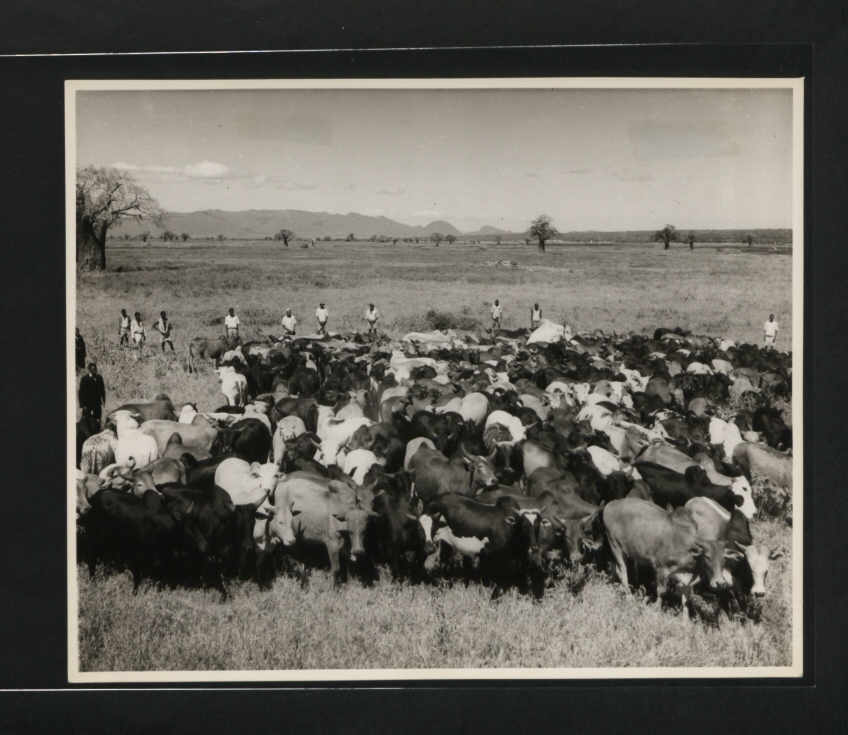
On April 1, 1955, the Overseas Food Corporation handed everything to a new Tanganyika Agricultural Corporation and was wound up. The port and railway in the south had cost about £6 million, some £1,500,000 more than estimated; the railway was never finished, carried little of the crop it was built for, and closed in February 1963, after independence, and the rails were lifted. A survey by the University of Dar es Salaam in 1992 found the Nachingwea arable scheme “completely abandoned,” most of Kongwa “still a cattle ranch managed by the National Ranching Company” with a pasture research station in one corner, and the land at Urambo taken by villagers for subsistence farming.
The rain-making went on after the rainmakers. From January to April 1952 the East African Meteorological Department ran 114 days of controlled trials at Kongwa for the Corporation, on a three-day cycle: silver iodide carried up by balloon to 14,000 feet and released by a time-fused charge on the first day, sea salt at 5,000 feet on the second, nothing on the third, with the rain measured by a network of gauges across the farm area, twenty-two miles by seven. The result, Nature reported in May 1953, was that the rainfall in the central area over which the particles were released “was reduced from a total of 9 in. on days of no seeding to one of 3–4 in. for the days of each type of seeding; seeding thus appears to have produced a great decrease of rainfall over the central area.” The one instrument the scheme finally read with care, a grid of rain gauges, answered no.
Strachey died in 1963, a few months after Plummer, who had become Member of Parliament for Deptford. Webb died in 1956. The word “groundnuts” outlived all of them as a thing shouted at Labour candidates, and then as a name for any expensive public failure; two economists who went over it for the United Nations in 1981 concluded that no new economic principle had come out of the failure, “and that is the saddest admission of all.” In Tanganyika the durable legacy was the tenant scheme, which the independent government took up in 1964 and enlarged into the villagisation of the 1970s; that story, too, is in the companion piece.
What it taught
An experiment with a target is in danger of measuring the target. This one was announced as a tonnage, costed as an acreage, and reported, every year, as acres cleared. The plan’s own instruments were the rain gauge and the soil, and both could have been read in 1946 for the price of a few months’ delay: the gauge said that the best record at Kongwa was seven years long, taken somewhere wetter, and that the place had a name that meant drought; the soil, when a spade finally went into it, wore the edge off a 32-inch disc in two hundred acres and set like cement when the rain stopped. Instead the mission flew over the land for six of its nine weeks, and the scheme’s progress was thereafter cabled home as a number of acres, a number that could be made to look like success at every revision, because each new target was set a little below what had already been done. Fifty thousand acres asked for and 49,000 delivered was reported to the House as the Corporation clearing “almost exactly that figure.” It was also a third of what the plan had set for its first year, planted in its second.
The complication is that the hypothesis had two halves and one of them was true. The scheme did learn to clear tropical bush by machine, by a method nobody had planned, and its agronomists published the method; the first half of the claim was proved at a cost that made it useless. The second half, about the land, was false at Kongwa, uncertain at Urambo and true in the south, where it rained in the drought year and where the groundnuts, grown on small farms a decade later, beat the plan’s own yield. The pilot that was refused in 1946 because the world could not wait was run anyway, from 1951 to 1955, on the same ground, under the same Corporation, with the word “experimental” put into its Act. It gave the answer in four years, which is about what a pilot would have taken, and it cost the £36 million that had been spent finding out that the question needed asking.
The lesson is not that the men were fools. Wakefield had spent fifteen years in Tanganyika’s agriculture and Martin ran plantations for a living, and Wakefield and Rosa were put off the board in 1949 after saying that the thing was going too fast. It is that a plan written in nine weeks against a famine had to assume the answers to the two questions it could not wait to ask, and that once the assumptions had been printed in a white paper and voted through both Houses without a division, the only instrument left to read was the plan itself. For four years the number of acres went up, and nobody was listening to the rain. In January 1951, on the week the account was closed, three men at Kongwa were trying to make it.
Sources
- John Strachey, Minister of Food, moving the second reading of the Overseas Resources Development Bill, House of Commons, 6 November 1947: the timetable of the mission and the managing agency, “Operation Groundnuts,” the diary of the North African convoy, the Pacific-beach tractors, the 15,000 acres, and the sentence from the white paper on difficulties and delays; Oliver Stanley’s and Alan Lennox-Boyd’s welcomes. api.parliament.uk
- Strachey’s statement on the appointment of the public corporation’s board, 16 May 1947, for Plummer, McFadyen and Harrison. api.parliament.uk
- Supplementary Estimate debate on the African Groundnuts Scheme, House of Commons, 11 March 1948: the 303 bulldozers and 291 in the repair yards (Aidan Crawley), Strachey on Martin and Samuel, and paragraphs 65, 71 and 76 of Cmd. 7030 as read into the record by Colin Thornton-Kemsley. api.parliament.uk
- Vote on Account debate on the East African Groundnut Scheme, House of Commons, 14 March 1949: Crookshank’s figures from the Blue Book (150,000 acres, 160 Europeans, £3 17s. 4d., 540 lb.), Strachey’s full review (the 7,000 acres at 500 lb., 50,000 acres planted, 12.53 inches, the abrasive soil and the acacia roots, 2,000,000 acres for 600,000 tons, twice the cost and twice the revenue, Shervicks, “acknowledged glories”), Robert Hudson on the nine weeks, the rainfall records and the Epsom salts, and Strachey’s reply on the time limit. api.parliament.uk
- Strachey’s answers on the drought, 9 May 1949, and on the harvest and the acreage, 11 July 1949. 9 May, 11 July
- Supply debate on the East African Groundnuts Scheme, House of Commons, 27 July 1949: Sir John Barlow on the disc and on the harvests against the plan, Anthony Hurd on the Christmas Day record, and Strachey on the ten-year average of 25 inches, the rainfall of 1946 to 1949, the 106,000 acres flattened at Kongwa and the £1 million a month. api.parliament.uk
- Debate on the Overseas Food Corporation’s first annual report and accounts, House of Commons, 21 November 1949: the auditors’ note, the 7,500 acres inherited, 82,000 written down to 50,000 and 49,000 cleared, the tractors, £30 to £14 an acre, the limit of 100,000 acres at Kongwa, 600,000 acres by 1954 at £45 million to £50 million, the dismissal of Rosa and Wakefield, Lennox-Boyd’s summary and proverb, Hynd on the nine weeks’ tour, and the division of 315 to 161. api.parliament.uk
- Debate on the Ground-Nuts and Oil Seeds Scheme, House of Lords, 14 December 1949: Lord Caldecote on the three to four weeks at Kongwa and the soil samples, the quotation of “Agriculture in East Africa is largely dependent upon an erratic rainfall” from page 19 of Cmd. 7030, and the Corporation’s report on the stores “nightmare” and the port conference. api.parliament.uk
- Exchanges on Alan Wood’s book, House of Commons, 20 and 27 March 1950, for Strachey’s letter to Gollancz from Dundee. 20 March, 27 March
- Supply debate on the Overseas Food Corporation, House of Commons, 18 July 1950: Maurice Webb’s interim report, “breakneck speed,” the 1950 yields, the Lockhart working party, the accounts; Ian Mikardo’s cabbage patch; Francis Bowles on the boreholes and Joseph Mallalieu on the rain gauges. api.parliament.uk
- Webb’s written answer on oil received, 23 October 1950 (514 tons), and his answers of 15 November 1950 and 29 January 1951 on the white paper. 23 October, 15 November, 29 January
- Second reading of the Overseas Resources Development Bill, House of Commons, 20 February 1951: Webb on Cmd. 8125 of 9 January, the £35,653,000 and £36 million written off, the 7 oz. ration, the new acreages, “large-scale experimental development,” the £6 million and the £4,500,000; John Hynd’s forty-year average of 33 inches; Lennox-Boyd’s “Hurry is not speed”; James Griffiths’s “The Groundnut Scheme has failed”; the division of 302 to 295. api.parliament.uk
- Second reading of the Overseas Resources Development Bill, House of Lords, 16 November 1954: the transfer to the Tanganyika Agricultural Corporation on 1 April 1955, the £7 million of surplus assets and £2 million realised, the cost of the port and railway, and the plans for Kongwa, Urambo and Nachingwea. api.parliament.uk
- “A Plan for the Mechanized Production of Groundnuts in East and Central Africa,” Cmd. 7030, February 1947, and “The Future of the Overseas Food Corporation,” Cmd. 8125, January 1951. Neither could be read in full for this entry: HathiTrust’s copies block automated readers and archive.org has neither. Their sentences are quoted here as read into Hansard, as above, or at second hand from Esselborn, below, who gives the page numbers (pp. 4, 18, 19, 20 and 44 of Cmd. 7030; p. 10 of Cmd. 8125).
- Matteo Rizzo, “What Was Left of the Groundnut Scheme? Development Disaster and Labour Market in Southern Tanganyika 1946–1952,” Journal of Agrarian Change 6 (2), 2006, pp. 205–238. The mission’s nine weeks and six in the air, the members, the 3,210,000 acres, the seven-year rainfall record from Mpwapwa, “the country of perpetual drought,” the seed imported against the harvest, Makwinja’s account, the labour tables for the Southern Province, and the district officers’ reports. Read in the author’s deposited copy at SOAS Research Online, by way of the Internet Archive; the journal’s copy is paywalled. doi:10.1111/j.1471-0366.2006.00120.x, web.archive.org
- Stefan Esselborn, “Environment, Memory, and the Groundnut Scheme: Britain’s Largest Colonial Agricultural Development Project and Its Global Legacy,” Global Environment 11, 2013, pp. 58–93. Samuel’s flight and Alan Wood’s account of it, the 107 units, the £24 million and £10 million, the waiving of a pilot, the Harrison passages from The Engineer of 30 July 1948, Wakefield’s fortieth of an acre, the Clay mission, the Lockhart working party’s recommendation as given by Frankel, the Corporation’s words in Cmd. 8125, Hogendorn and Scott’s “saddest admission,” the 1992 survey, and the tenant schemes and villagisation. environmentandsociety.org
- Alan Wood, The Groundnut Affair, The Bodley Head, 1950. The book is in copyright (Wood died in 1957) and is quoted here only briefly and at second hand, from the passages Esselborn reproduces (pp. 27, 151 and 182).
- Clyde Higgs, “A Farmer Reports on the East African Groundnuts Scheme,” from the Farmer and Stockbreeder, as printed in the Chronicle, Adelaide, 20 January 1949: the cables from London, the rainfall data, the thorn roots and the abrasive soil. trove.nla.gov.au
- James Cameron, “James Cameron flies out to Kongwa with the Report on Groundnuts,” from the Daily Express, as printed in the Sunraysia Daily, Mildura, 15 December 1949. In copyright; quoted briefly. trove.nla.gov.au
- “First a Drought, Now Floods,” The Age, Melbourne, 4 January 1950, and “Further Failure in Groundnuts Plan,” Daily Mirror, Sydney, 1 August 1950, with the Corporation’s harvest figures and the 1,250 acres written off. The Age, Daily Mirror
- Noel Monks’s Daily Mail despatch from Dar es Salaam, as cabled to the Courier-Mail, Brisbane, 28 November 1950, and reprinted at length in the Farmers’ Weekly, Perth, 18 January 1951, with the Corporation’s “incapable of fulfilment.” Courier-Mail, Farmers’ Weekly
- “Rainmaking in Tanganyika,” from the Daily Express, as printed in the Daily Mercury, Mackay, 5 February 1951, and as “Rain for the White Witch-Doctors” in The Sun, Sydney, 28 January 1951: the three men, Raby’s Special, the £5 of silver iodide and the thirty experiments. Daily Mercury, The Sun
- “A Costly Lesson,” editorial, The Advertiser, Adelaide, 22 February 1951, for the 2,368 tons against 227,676. trove.nla.gov.au
- United States Department of Agriculture, Foreign Crops and Markets: “Outlook for African Groundnut Scheme Crops Disappointing,” 10 April 1950; the note of 22 May 1950 on the 1949 crop; “Tanganyika,” 19 February 1951, with the 175,000 acres cleared and the share fit for crops; and “Tanganyika Final Groundnut Scheme Report Indicates Progress,” 4 June 1956, for the yields at Nachingwea and the Corporation’s dissolution. 1950, May 1950, 1951, 1956
- “Artificial Stimulation of Rain at Kongwa,” Nature 171, p. 829, 9 May 1953, summarising D. A. Davies, D. Hepburn and H. Sansom, Reports on Experiments at Kongwa on Artificial Control of Rainfall, January–April 1952, East African Meteorological Department. doi:10.1038/171829a0
- Tyne & Wear Archives & Museums, “Shervick Tractors at the Elswick Works,” 1 April 1948, ref. 1027/269, on Flickr Commons with no known copyright restrictions; and The National Archives UK, Colonial Office photographic collection, CO 1069/157, “Kongwa Ranching Project,” on Flickr Commons with no known copyright restrictions. TWAM, TNA
- Nicholas Westcott, Imperialism and Development: The East African Groundnut Scheme and its Legacy, James Currey, 2020, is the full modern history and was not available to this entry; it names the Director of Agriculture who advised Samuel as Ralph Miller. The Wikipedia article on the Southern Province Railway, citing David Burton’s The Groundnut Line (2014), gives the line’s closure in February 1963. cambridge.org, wikipedia.org