On 22 May 1969 a ski-equipped aircraft put a small party from the US Army’s Cold Regions Research and Engineering Laboratory down on the Greenland ice sheet, about 140 miles east of Thule Air Base, at a place where nothing showed above the snow but a meteorological tower and the roof of a building that had been put up on piles in 1964, twelve feet above the surface at the time. Everything else was underneath. The party, led by an engineer named Austin Kovacs, went down through an escape hatch into the camp that the Army had cut into the snow ten years before, and spent eleven days photographing what they found. The passage to the second water well, where a man had once walked upright, was now a crawl space. The corrugated steel escape tower at the end of Trench 19 had been crushed into a crumpled cylinder with the snow bulging in around it. In Trench 3 the arch over a building that had housed a nuclear reactor had been pushed down through its roof. Kovacs’s report has ninety-six photographs and almost no text. Its one sentence of judgement is this: “The effects of trench closure are dramatically shown.”
The camp had been built to find out whether a permanent installation could be kept under the snow, and the answer had been in the Army’s own measurements from the first winter, published four years before the photographs were taken. But the measurement that mattered most in the long run was not the one anyone had come to Camp Century to make. In July 1966, in Trench 12, a drill had gone through 1,387 metres of ice to the rock beneath and brought up three and a half metres of frozen mud. The mud went into glass jars, the jars went into a freezer, and nobody looked at them for fifty-one years.
Who ran it
The camp came out of the Corps of Engineers’ Greenland research programme, and the programme came out of the bomber. Elmer F. Clark, the retired lieutenant colonel who wrote its history for the Army in 1965, put the premise in one sentence: with the atomic bomb, the long-range bomber and the intercontinental missile, “it was inevitable that military attention should be drawn to the remote arctic regions which lie athwart the shortest air routes between the major land masses of the Northern Hemisphere.” Thule Air Base in north-west Greenland opened in 1951 under a defence agreement with Denmark. In the summer of 1953 four men went up to look at the ice behind it: Robert Philippe of the Office of the Chief of Engineers, Paul Siple of the Department of the Army, Roger Pryor of the Department of Defense and James Gillis of the Army’s Snow, Ice and Permafrost Research Establishment, known as SIPRE. They came back with seven problems to solve: snow as a building material, foundations, housing, drifting snow, power, water and waste.
The work was given to SIPRE, which became the Cold Regions Research and Engineering Laboratory, CRREL, in 1961, and to the Army’s engineering laboratories at Fort Belvoir in Virginia. Its chief scientist was Henri Bader, a Swiss glaciologist, and it was Bader who in 1955 brought over a Swiss machine for clearing avalanche snow from Alpine roads, the Peter snow miller, and had it tried on the ice cap at a radar station called Site II, 220 miles east of Thule. The snow it threw out, ground up and recompacted, hardened over days into a material of real strength, which the engineers called Peter snow. From 1956 a SIPRE engineer, Robert Waterhouse, studied what could be built with it.
In 1957 the first camp deliberately designed to be under the snow, Camp Fistclench, was built at Site II under Clark himself, who then commanded the Army’s research in Greenland. Its trenches were cut by the miller and roofed with timber and metal, and the engineers began measuring how fast the snow moved in on them. In 1958 Bader suggested cutting the trench narrow at the top and wide at the floor, eight feet and eighteen, so that an arch of Peter snow cast over a metal form could carry the roof by itself. Clark wrote that twenty feet of depth “provided sufficient overhead clearance to assure at least a 5-year life before settlement of the roof would begin to crush the enclosed framed structures.” That was the engineering idea Camp Century was built to prove at scale: cut-and-cover trenches in snow, roofed with snow, with the buildings inside standing clear of the walls so the snow could move.
The power idea came from elsewhere. In the summer of 1955 two men from the Army Nuclear Power Program visited Greenland and concluded that the engineering problems of a reactor on the ice cap, “although difficult, were not insurmountable”, and that the saving in fuel hauled across the ice would be enormous. The site they wanted was the hardest one, deliberately. Clark gives the reasoning: “if a plant could be installed and operated successfully there, where engineering problems would be complicated by excessive deformation of the snow trenches housing it, installation and operation of such a plant in other less severe environments would be easy by comparison.” By early 1958 the plant was approved, in September 1958 a project was opened to build a camp to put it in, and in early 1959 ALCO Products of Schenectady, New York, was given eighteen months to design, build, test and deliver it: the PM-2A.
The site was chosen on 17 May 1959 with Bader’s advice: a point 138 miles east of the Army’s base camp at the ice edge, Camp Tuto, on the existing trail to Site II, at about 1,900 metres, where the snow never melted. Clark called it “a calculated risk”, chosen with no weather records older than 1952 and the knowledge that the air might on rare occasions rise above freezing. The name was Philippe’s. The camp had first been meant to sit a hundred miles in from the ice edge, and it was not named after anyone because “Danish representatives at Thule Air Base had expressed a distinct aversion to maps which read like an obituary column.”
The camp was built by the US Army Polar Research and Development Center under Colonel John H. Kerkering, with Major Thomas C. Evans as project officer for everything that was not nuclear and Major James W. Barnett for everything that was. Its cost was estimated at $7,920,000, of which the reactor was $5,700,000, and Clark notes that the total “was held to this figure”. The research was the Corps of Engineers’. The money and the purpose were the Army’s, and the Army had a purpose it did not write into Clark’s report.
What they were trying to find out
The Chief of Engineers’ design criteria, as Clark lists them, were the stated hypothesis. The facility “was to be a subsurface camp (constructed by use of the cut-and-cover trenching technique), with a capacity to house 100 personnel on a year-round basis.” A nuclear plant was to provide its electricity and the steam for its water well. Snow was to be used as a building material wherever possible. And “the camp was to have a design life of 10 years (with appropriate maintenance).” Everything else in the criteria, from the chapel to the ten-bed infirmary, follows from those three: could a hundred men live for ten years inside the ice, on a reactor, in rooms made of snow?
There was a third question, and the clue to it is in the report’s section on roads. A subsurface camp needed year-round access, and in winter neither aircraft nor surface trains could be relied on, so the Corps considered tunnels: “Such roadways would be independent of weather, would eliminate navigation problems, and would provide reliable year-round access to camps located anywhere on the ice cap. However, it was realized that a system of subsurface roadways would be economically feasible only if major installations were envisioned.” Among the advantages Clark lists for building under the snow rather than on it are these two: “Is easier to camouflage” and “Is less vulnerable to enemy attack.”
The major installation was a missile field. Around 1960 the Army produced a study, later known by its code name Project Iceworm, for basing medium-range ballistic missiles under the ice, where they could be moved between launch points through tunnels so that no enemy could know where they were. The Danish historian Nikolaj Petersen, who was on the team that found the papers, described it in 2008 as “the mobile deployment of up to 600 MRBMs under the Greenland Icecap. It was designed around 1960 by the US Army as its bid for a share in the US strategic deterrent, and later presented as a candidate for a NATO nuclear force.” It was put to the Joint Chiefs of Staff in 1962, after a short experimental railway had been laid in a trench at Camp Century, and rejected in 1963; it “was never broached to the Danes”, and Denmark learned of it in 1996, when the papers were declassified. The plan, the papers and what Denmark made of them are in Iceworm.
So the hypothesis under the hypothesis was this: that trenches cut in snow would stay open long enough, and cheaply enough, for a railway hundreds of miles long to run through them for years, carrying things that weighed what a missile weighs. Camp Century was 1,100 metres by 500. Nobody at the camp was told what it was a model of, and the measurement that would decide the question was the one the engineers were already making for their own reasons: how fast the trenches closed.
What they built
Construction began in June 1959 and ended in October 1960, in two summers. In 1959 the engineers cut five trenches and put up five buildings, a tenth of the camp, and shut it on 1 September for the winter. In 1960, from 12 May, they built the rest. Everything came over the ice from Camp Tuto on tractor-drawn sled trains, 138 miles each way: about 1,000 short tons in 1959 and 4,600 in 1960.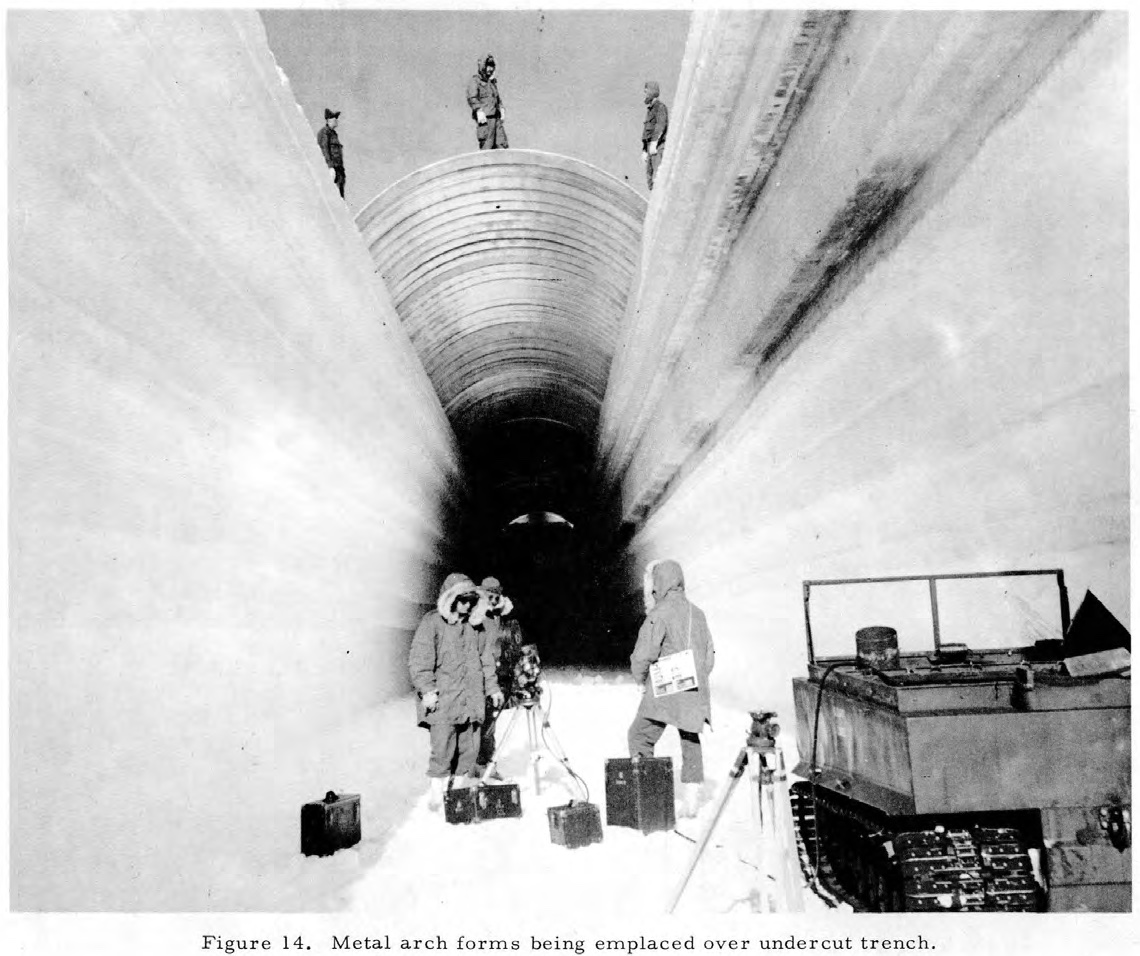
The plan was a long main trench for vehicles, with the side trenches running off it at right angles, each about twenty-four feet wide at the floor and roofed with an arch of Peter snow. Inside the trenches stood prefabricated buildings on timber cribs, with about two feet of clear space under the floors and a gap at the sides, so that the snow could creep without crushing them. The buildings were the Army’s standard T-5 arctic hut, cut from twenty feet wide to sixteen to fit the trench. There had been no time to design anything lighter for a place with no wind and no snow load: the T-5 “was grossly over-designed for use in Camp Century. However, there appeared to be no alternative to its use.” Many of them were the twelve-foot-wall version rather than the eight, which took four feet off the clearance under the arch. The consequence, Clark wrote, “was that trimming of the snow arches above the 12-foot wall buildings had to be commenced even before the rest of the camp had been completed.”
The reactor would not fit a twenty-four-foot trench. ALCO asked for relief from the width, and Waterhouse proposed straight-walled trenches up to forty feet wide, roofed with corrugated steel “Wonder Arches” and covered with Peter snow. “It was realized at the time that this type of construction (i.e., wide, straight-wall trench, covered with metal arches) had not been tested and might not prove to be a satisfactory structure. However, at the time there appeared to be no alternative to this solution.” Trenches 3, 4 and 5 were built that way for the PM-2A.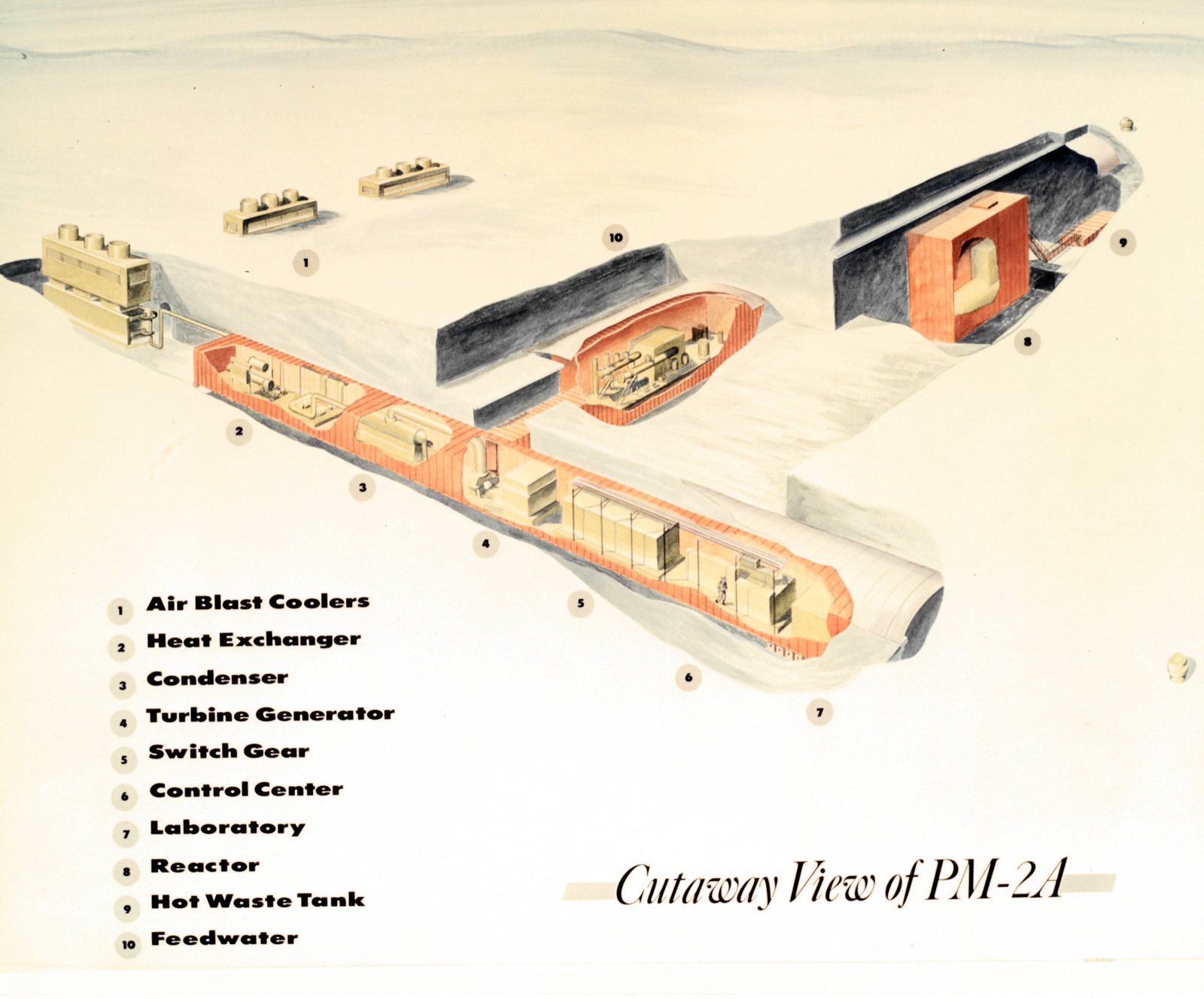
The PM-2A was a pressurised-water reactor of 10,000 kilowatts thermal and 2,000 electrical, of which the camp could draw 1,560, with steam to spare for the water well. It weighed 310 short tons and came in twenty-seven packages small enough to be flown. It went by ship from Buffalo, reached Thule on 10 July 1960, and went up the trail. A crew of eighteen soldiers had trained on it at ALCO’s plant. It went critical on 2 October 1960. The reactor needed more shielding than its design had allowed for, which was finished on 6 February 1961, and the Army accepted the plant on 8 March 1961. Its waste heat went down a pipe of glycol into the ice, where it melted a cavity that in two years held some twenty million gallons of water. Three 300-kilowatt diesel generators stood by.
Water came from a well invented for the purpose by Raul Rodriguez of the Fort Belvoir laboratories: steam melted a shaft a hundred feet or more into the ice, then a pool at the bottom, and a deep-well pump brought the melt up. Sewage went the other way, into a pit in the snow where it melted its own shaft downward. Camp Century was to hold a hundred men in winter and more in summer, with a mess hall, a theatre and chapel, a library, a dispensary with an operating room, a post exchange and a gymnasium in Trench 20 beside the headquarters.
Clark’s report is honest about what was dropped in the haste of two short seasons. The metal arch forms, which were meant to come out once the snow had hardened, were left in place in many trenches, including the main one, after some arches had been stripped too early and had deformed. The design had put the sewage sump at least a thousand feet from the water well and five hundred from the nearest building; as built, it was 150 feet from the nearest barrack, and it was not vented. The ventilation system that was to expel heat from the trenches was not installed, and nor were the fire walls. The convection barriers that the laboratories had specified between the heated buildings and the snow arches were dropped from the final plans by the Chief of Engineers. The camp, Clark wrote, “was a composite of tried and proven methods and techniques, which had resulted from 4 years of previous R&D efforts, along with untested and unproven techniques.”
Thirty inches
Snow is not a solid. Clark calls it “a visco-elastic material which deforms in a relatively slow although somewhat predictable manner as functions of density, temperature, and time under stress”, and the whole design of the camp rested on the word predictable. A trench cut in it starts closing the day it is cut. The walls bow in and the roof comes down and the floor, oddly, rises, because the weight of the roof is carried on the snow under the walls and the middle of the floor is squeezed up between them. The engineers knew this. They had measured it at Fistclench, they knew the closure was slowest between about sixty and 120 feet down, and they fitted the trenches with instruments to watch it happen.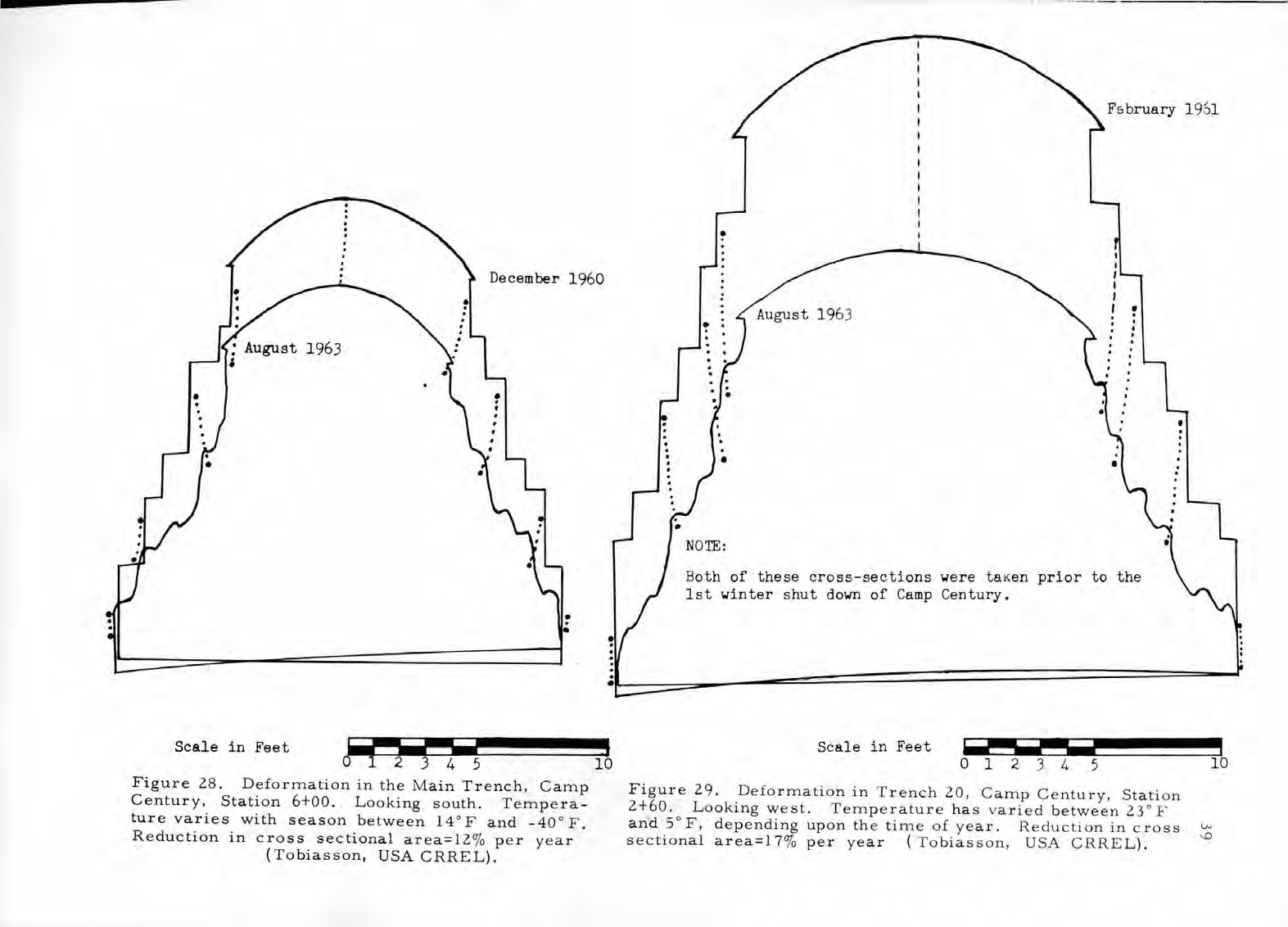
The first cross-sections were measured in August 1959, before the first winter, and the CRREL report of the survey, by Waterhouse, Wayne Tobiasson and Barrat Scott in 1963, holds the full record. Clark gives the result in a sentence. “In most cases the rates of deformation have approximated closely those which had been predicted. However, flow rates are highly temperature dependent, and where concentrations of heat have persisted in the camp, the temperature of the adjacent snow mass has risen several degrees. As a result, the snow has deformed more rapidly than predicted by several fold. Although there is considerable variation, the average approximates 30 inches of gross vertical closure a year.”
His table of Tobiasson’s figures for 1962 to 1963 shows what that meant trench by trench. The main trench, which had no heated buildings in it and kept its metal arches, lost about sixteen inches of height a year. The side trenches, away from their ends, lost thirty-four. The headquarters trench lost four feet in places. Over the whole camp the average was 29.66 inches a year. In a trench twenty-four feet high that is a tenth of the headroom a year, and the rate rose as four feet of new snow a year added to the load. The footnote carries the physics: “It has been observed that the creep rate is twice as fast at 14°F as at 2°F and one hundred times as fast at 28°F as at -40°F.”
Heat was the enemy, the camp was made of heat, and the barriers that were to have kept its warmth off the snow had been left out. Willi Dansgaard, the Danish geophysicist who visited in 1964, reckoned the camp had raised its own mean temperature “by a couple of degrees above the normal -24 °C”. The sewage sump was the worst case. In the first two years about 3,260,000 gallons of waste went into it, at 60 to 88 degrees Fahrenheit, 4,650 gallons a day. All of that heat went into the snow around it. “As a result, the snow floor in the end of Trench 19 settled about four feet, necessitating removal of the two T-5 buildings nearest the sump.” Cores drilled around the pit in 1962 found the liquid had spread about 170 feet sideways in under two years, and the report adds, “How far such contamination will ultimately spread with time is a matter of conjecture.”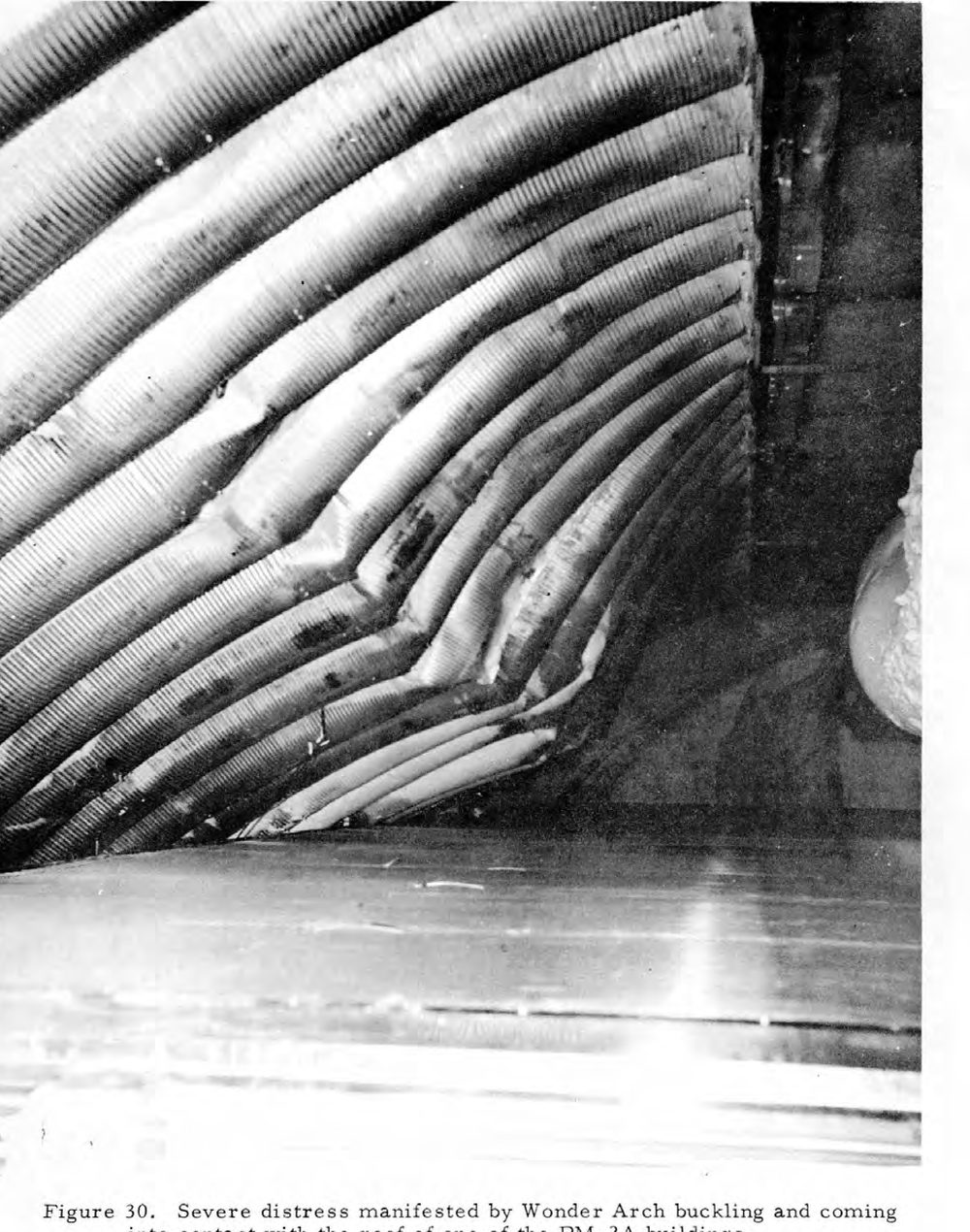
The reactor trenches went fastest of all. The Wonder Arches over Trenches 3, 4 and 5 had been covered unevenly with Peter snow in the rush to finish before the dark, and in places left bare, so that they took the load on one side. “As a result, the Wonder Arches acquired non-symmetrical loads and by the end of the first year of occupancy showed severe distress in a number of places.” Twice in the reactor’s three years at the camp the Army jacked sections of the arches up about six feet to keep them off the plant. In 1962 the reactor was off line for several weeks while crews rebuilt the arches over it, which is the main reason it ran only 74 per cent of that year.
What kept the camp open was men with saws. Clark estimates that to hold the trenches at their original section, about 20,000 cubic yards of snow had to be trimmed from the walls and roofs and carried out every year, “approximately 0.173 cu yd/min”, and his report’s photograph of the work is a soldier on the roof of a hut with an electric chain saw, cutting the snow back from the eave. Dansgaard, a year later, wrote that the buildings and galleries “frequently had to be cut free by power chain saws”; the hanging walls of ice were known as “brain crushers”. Machines to do the trimming could have been developed, Clark wrote, for about $400,000, but “this expensive development effort would not be justified unless a number of subsurface installations such as Century were planned.”
The number was known by 1963. It was published, in a report anyone in the Army could read, in 1965. It said that a trench in the Greenland snow, with a heated building in it, closed at thirty inches a year and faster every year, and that a camp a kilometre long needed 20,000 cubic yards of chain-saw work a year to stay open. Whether anyone set the number beside 4,000 kilometres of railway tunnel, the record from the American side does not say. Dansgaard, who did not know about Iceworm in 1964 and read about it in 1997, had his own view: “our experience of the railway in Camp Century clearly shows why Iceworm had to be abandoned.”
What it looked like from inside
The Army showed the camp to the world before it was finished. Walter Cronkite went up for CBS in 1961, and the first release of the Army’s own television series The Big Picture for 1961 to 1962 was a half-hour film, “City Under the Ice”. The National Archives’ catalogue summary of it reads as the Army meant the camp to be read: “This city under the ice cap referred to as Camp Century, is a new concept of polar construction. It is today’s Modern Army in action on a new frontier of solid ice and snow. During this 30-minute presentation, you will see how snowy wastelands are developed into a completely built city equipped with every convenience from a nuclear power plant to a shower.” Its last line is that the film “is an outstanding example of man’s never ceasing quest for knowledge.” The narrator is the camp’s own builder. “Now to the voice of Captain Tom Evans, the young officer who was in charge of the construction of the camp,” the film says, and Evans tells it in the first person: in May 1959 “we needed a flat surface, a level with less than one degree of slope”, and the site chosen “was the closest location to Thule, our supply base, which would not be affected by the summer thaw”; “in the months it took to build Camp Century, more than 6,000 tons of supplies were used”, hauled by the “heavy swings, crawling up the ice cap at approximately two miles an hour”; and a three-month-old sled dog “went along as camp mascot, strictly against regulations.” Clark’s own list of the disadvantages of living under the snow includes one that no film mentioned: “Is psychologically undesirable.”
Dansgaard arrived in July 1964 to collect old snow for a dating method he was testing, and kept a diary. The camp he describes was “a strictly isolated male society set up when the cold war was coldest”, 32 buildings dug into the firn, with “power stations, workshops, offices, radio station, garages, dump building, shops, hospital, living quarters, fitness centre, baths, shops, canteens, storerooms, bars, cinema, church, and library.” Any drink in the bar cost 25 cents. On the wall of the mess room was a poster of what to do on warning of an atom-bomb attack, which ended, after opening the windows and loosening one’s tie, “kiss your ass goodbye.” Henrik Clausen, his chemist, summed the place up in a sentence Dansgaard thought hit the nail on the head: “Here are all facilities, but for women.” On the plan of the camp he noted that “the distance from the nuclear reactor to the living quarters was only a good hundred metres.”
The smell was the sump. By the summer of 1961, Clark records, “the odor of sewage became almost unbearable in the nearest quarters by the following summer and traces of sewage odor were detectable throughout Trenches 18, 19, and 20.” Venting the pit helped and did not cure it. The reactor crew’s exposure was logged at about fifty millirem a month of gamma and forty of neutrons, with no overexposures, and once a fortnight or so through 1962 between 1,600 and 3,500 gallons of low-level radioactive water from the plant were run off into the ice, 47,078 gallons in the year carrying 11.3 millicuries. The footnote to that table says where the limit came from: “Danish American agreement permits up to 50 millicuries per year of radioactive liquid waste disposal in the ice cap. In accordance with this agreement all solid waste must be removed from Greenland.”
What happened
The reactor ran, with its turbine troubles, for thirty-three months. “The plant achieved initial criticality and became operational on 2 October 1960, and, except for down-time to accomplish routine maintenance or repairs, it operated continuously until 9 July 1963 at which time it was closed down pending a decision to relocate it.” On 2 August 1963 the Army approved a plan to take it out. Clark gives the reason plainly: “This decision stemmed primarily from plans to discontinue year-round operations at Camp Century in order to reduce Greenland R&D support costs.” The research objective, he added, had been met: the plant “had demonstrated conclusively that nuclear power is feasible at remote military installations and that these plants can be operated efficiently with military personnel”. In the summer of 1964 it was taken apart and shipped home, with one surprise: “residual radiation levels around the primary unit (i.e., reactor and hot waste tank) were considerably higher than had been anticipated”, so more men were needed to take it apart in time for the ship. The reactor vessel went to the Atomic Energy Commission for destructive testing. The diesels took over.
Year-round occupation ended in 1964, the year Iceworm was already dead; Colgan and his colleagues date its rejection to 1963. In 1965 the Army pulled the buildings out of Trenches 18 and 19, the ones nearest the sump. In the summer of 1966 the camp’s last working party lived on the surface, in three trains of wanigans and one T-5 hut, while the drilling in Trench 12 was finished. That was the last season. Kovacs’s report says the camp was “constructed in 1959 and abandoned in 1966”; the Danish and American scientists who inventoried the site fifty years later say seasonal operations continued until 1967, “when the base was abandoned with minimal decommissioning”. The buildings, the railway, the fuel tanks, the diesels, the sump and everything in the trenches stayed where they were, under the snow that was falling on them at four feet a year.
Clark’s report was dated October 1965, between those two summers, and it is a report of a success. “The main objectives of the Camp Century project were achieved.” Subsurface camps on ice caps “are feasible and practicable, but only in environments as cold or colder than Century.” The well, the sewage system, the foundations and the reactor were all pronounced sound. Then the seventh conclusion: “Roughly 10 years is the maximum feasible design life for an undersnow camp in environments similar to Century. This presupposes an adequate maintenance program.” The camp had been designed for ten years and had been given up in seven. Nothing in the conclusions says why, because nothing had failed. The trenches had closed at the rate the snow closes trenches, the Army had measured it, and the Army had drawn the conclusion that followed, which was that the thing worked and could not be kept.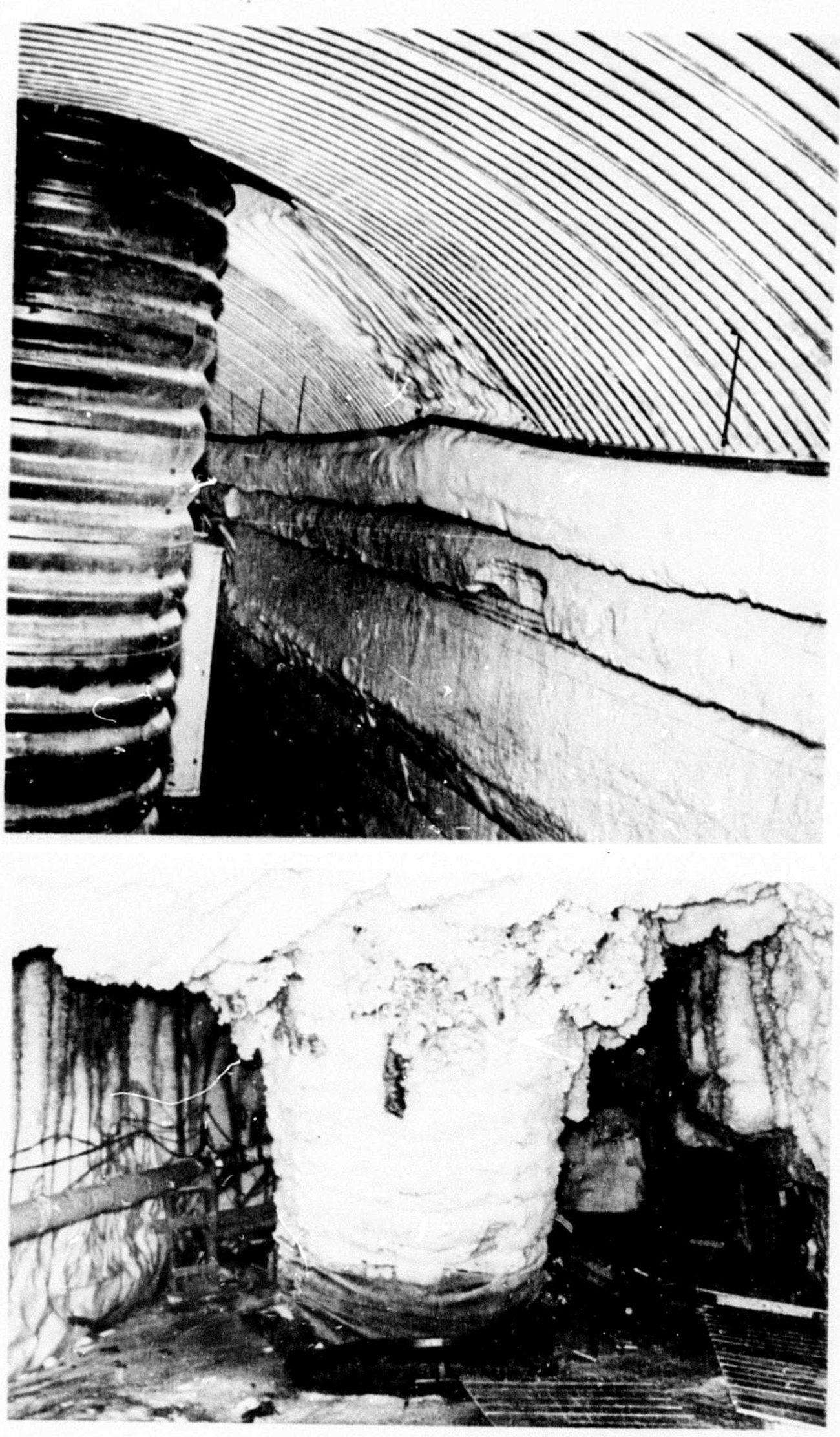
When Kovacs’s party went down in 1969 the trenches had been closing unattended for three years. Dansgaard’s group, who visited the same summer, found “much of it was still in unchanged condition – furniture, equipment, and various supplies, i.a. tons of deep-frozen beef and thousands of prepacked rations”. The glycol trench, “once 9 ft wide”, had gone in on itself around the warm pipe, and the derrick over the glycol well was crushed. The passage to the second water well was a crawl. The party also found the drill tower and extended its casing ten feet above the new surface; in 1977 the next party could not find it, and by 1986 it was reckoned to be seven or eight metres under. Nobody went back into the trenches after 1969, and within a decade there were no trenches to go back into.
The jars
The other experiment at Camp Century belonged to Bader too. From 1960 a CRREL team under Lyle Hansen, with Herbert Ueda and Donald Garfield as its engineers and Chester Langway in charge of the core, drilled in Trench 12 for a continuous core from the surface to the bed, the first anywhere. It took six seasons, two kinds of drill and a hole full of diesel oil to keep it from closing. Hansen and Langway reported the end that autumn: “On July 2, at a depth of 1,370.5 meters, ice containing silt bands and small pebbles was encountered. On July 4, after drilling through 16.9 meters of this material, the interface at the bottom of the ice cap was reached at a depth of 1,387.4 meters. The bottom material is frozen till; 3.55 meters of this material was recovered.”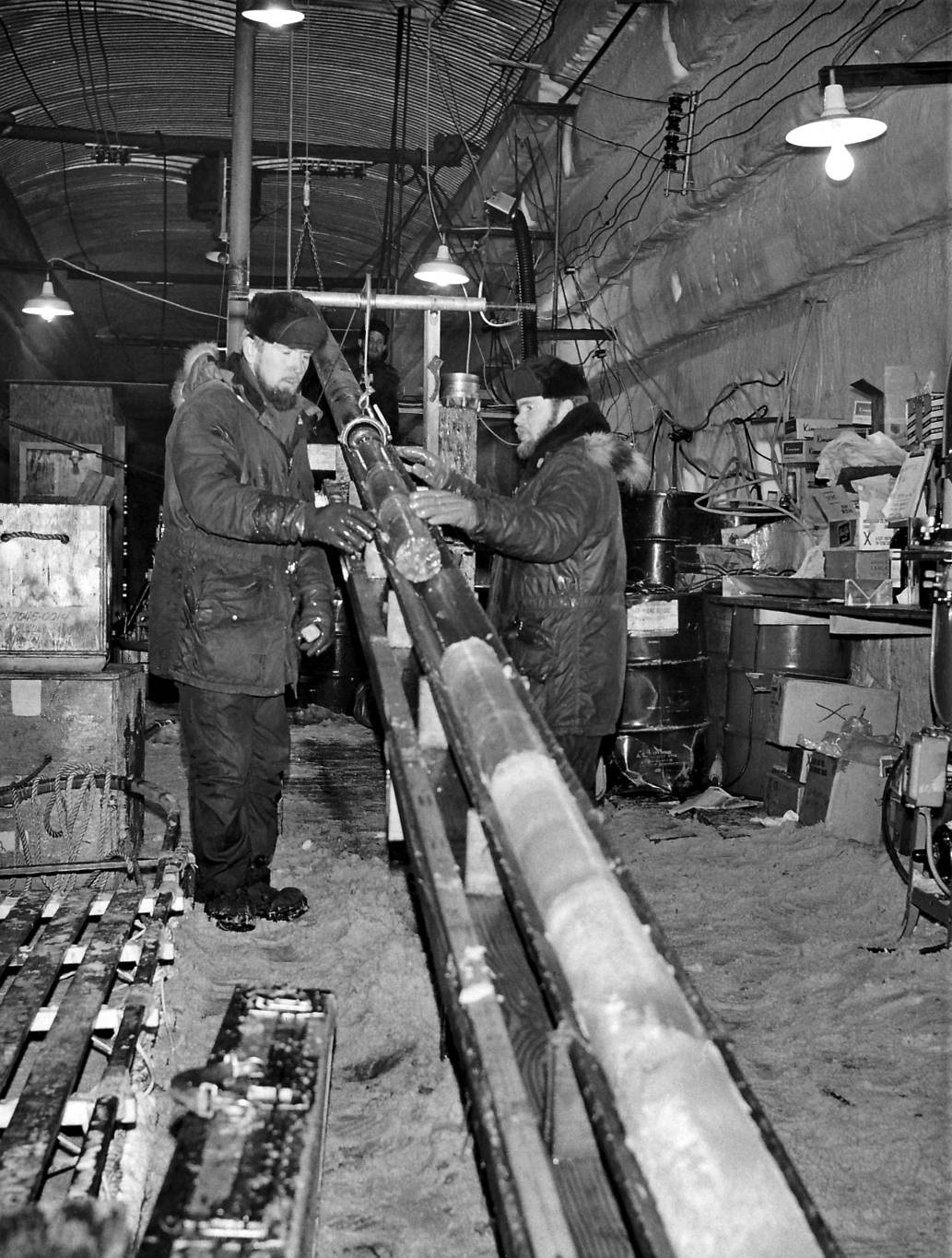
The ice got the attention. Dansgaard’s group in Copenhagen read the temperature of the past from its oxygen isotopes, and the paper they published with Langway in Science in October 1969, “One thousand centuries of climatic record from Camp Century on the Greenland ice sheet”, was the beginning of ice-core science. The mud got none. It went into glass jars; the jars went with Langway to a freezer at Buffalo, and in the 1990s, when he had nowhere left to keep them, to Copenhagen, where they sat unopened until 2017, when the collection was being moved to a new freezer and Jørgen Peder Steffensen came on boxes marked “Camp Century sub-ice”. Two jars were opened in 2019. In 2021 eighteen scientists reported in the Proceedings of the National Academy of Sciences that the upper jar held twigs and moss leaves, the plants of a tundra, in soil that had last seen the sun “within the last 1.0 ± 0.1 My”, and that the sediment “documents at least two episodes of ice-free, vegetated conditions, each followed by glaciation.” Within the last million years, under a climate not much warmer than today’s, north-west Greenland had been bare ground, and the sea had been higher by the water now in the ice. The whole story of the core, from the first thermal drill to the cookie jars, is in The jars.
After
In 2016 William Colgan and five colleagues published a short paper in Geophysical Research Letters called “The abandoned ice sheet base at Camp Century, Greenland, in a warming climate”. Its abstract begins with the camp’s purpose, “There they studied the feasibility of deploying ballistic missiles within the ice sheet”, and its argument is in one sentence: “The base and its wastes were abandoned with minimal decommissioning in 1967, under the assumption they would be preserved for eternity by perpetually accumulating snowfall.” The phrase “preserved for eternity” they take from an Army document of 1962.
They went to the Army’s own reports and made an inventory. “Physical waste, such as buildings and railway, is approximately 9.2 · 10³ t. Chemical waste is an estimated 2.0 · 10⁵ L of diesel fuel and a nontrivial quantity of polychlorinated biphenyls (PCBs). Biological waste consists of at least 2.4 · 10⁷ L of grey water, including sewage, disposed in unlined sumps. Previously acknowledged radiological waste (coolant for the portable nuclear generator) had a bulk radioactivity of 1.2 · 10⁹ Bq at the time of its disposal (1960–1963) in an unlined sump.” Nine thousand tonnes of buildings and rails; 200,000 litres of diesel in tanks that had probably ruptured; twenty-four million litres of sewage and waste water; the reactor’s run-off; and PCBs, in the paints and fluids of the period, which they thought “the most consequential waste at Camp Century”. The tunnels covered fifty-five hectares. By 2015 the solid waste was about thirty-six metres down, the frozen sumps at least sixty-five, and NASA’s airborne radar had seen “strong, anomalous reflections” where the tunnels should be.
Then they ran the climate forward. Of their two simulations under the high-emissions pathway, one kept the site in net accumulation to 2100 and one did not: snowfall would rise but melt would rise faster, “resulting in a transition to negative SMB (net ablation) around 2090.” “A transition to net ablation at Camp Century would make the eventual coastward remobilization of abandoned wastes inevitable”, by melting down through sixty-seven metres of firn over the better part of a century, or sooner by water percolating through it. The political point of the paper was that nobody had decided whose problem that was. Article XI of the 1951 agreement left American property in Greenland American, to be “disposed of in Greenland by the Government of the United States of America after consultation with the Danish authorities”, and whether the consultation had happened for Camp Century’s decommissioning was, they wrote, unclear.
The Government of Greenland, which had not existed in 1959, raised its concern with Denmark, and Denmark’s answer, in 2017, was to measure. The Geological Survey of Denmark and Greenland set up the Camp Century Climate Monitoring Programme, and in July and August 2017 a six-person team spent two weeks on the ice at the site, put in weather stations, drilled two firn cores inside and outside the camp, and skied a radar grid across it. The radar found the debris field “c. 2 km in diameter, with debris ranging between c. 20 and 100 m depth.” The core inside the camp showed a dense, discoloured layer between 32 and 35 metres, the camp’s working floor, and when the drill went through it “pressurised hydrocarbon vapours vented from the borehole until it was backfilled.” The fourth of the programme’s stated goals was “to publicly report all findings from the Camp Century Climate Monitoring Programme in a timely manner.”
The findings since have been quieter than the paper of 2016. In 2021 Baptiste Vandecrux and his colleagues at the survey modelled the firn at the site from 1966 to 2100 under three emissions pathways. The top of the debris field, at thirty-two metres in 2017, would be between fifty-eight and sixty-four metres down in 2100, because the snow keeps coming; meltwater at the surface would reach at most 1.1 metres into it in the warmest case; and “it is therefore extremely unlikely that meltwater interacts with military waste within this century.” The century after that is another question, and the stations are still transmitting. In April 2024 a NASA aircraft testing a radar meant for mapping the bed of the ice sheet flew over the site, and the trenches appeared in its image as a row of parallel lines. “We were looking for the bed of the ice and out pops Camp Century,” Alex Gardner of the Jet Propulsion Laboratory said when the picture was published that November; the Danish team had mapped the same trenches seven years before. The waste is where the Army left it, sinking at about half a metre a year relative to the surface, as the trenches did.
What it taught
Start with what it was not. It was not a secret base that failed because of its secret; the trenches closed on the chapel and the mess hall at the same rate as on the railway. It was not a reactor accident; the PM-2A ran for thirty-three months, logged its doses and its discharges, and was taken out intact. And it was not a failure by the Army’s lights. Clark’s conclusions are a list of things proved, and most have stood. What Camp Century could not do was last, and the Army knew the number for that from the first winter.
Measure the thing you cannot change, and believe it. The engineers staked the trenches before the first winter shutdown, read them for four years, and reported thirty inches a year, several times the rate predicted where heat had been allowed to collect, and rising with depth. The measurement was honest and the response to it was honest too: a ten-year design life, a maintenance programme of 20,000 cubic yards of snow a year, and a camp given up after seven. The instrument spoke early and was listened to. That is the uncommon thing about this story, and it is why the camp killed nobody.
The unstated hypothesis is tested by the same instrument as the stated one. The Army asked whether a hundred men could live under the snow on a reactor, and the question it did not write down was whether 4,000 kilometres of tunnel could carry missiles for a decade. The closure survey answered both; thirty inches a year in a trench with a warm building in it is the end of a railway as surely as of a barracks. A pilot that is secretly a pilot of something larger should be read as such by someone, because the data will not know the difference.
Heat is a structural load. Every design document said so, and the convection barriers, the ventilation to expel heat, the sump five hundred feet from the nearest building and the vented pit were all in the plans. Each was dropped for time or money in two short summers. The sump then warmed the snow until a floor sank four feet and two buildings had to go. The failure was not of the snow. It was of the margin that had been designed and then not built.
“Feasible” has a date on it. Clark’s second conclusion is that undersnow camps are “feasible and practicable”, and his seventh is that ten years is the most such a camp can last. Both are true, and the second empties the first of most of its use. When an experiment reports success, ask for how long, and at what rate of chain-saw work.
Abandonment is a design decision, and it was made by default. The camp was left “under the assumption they would be preserved for eternity by perpetually accumulating snowfall”, and nobody had measured that. The one thing in the whole project that was never instrumented was the ice sheet’s own future. Whatever you leave behind, write down what you are assuming about the place you are leaving it.
Keep the sample you cannot yet read. The three and a half metres of frozen till came up because the drillers were told to go to the bottom and not stop at the ice. It was packed in jars, labelled, kept frozen, moved three times across an ocean by people who had no use for it, and found by accident during a freezer move. It then answered a question nobody could have asked in 1966 with any hope of an answer: whether Greenland had been ice-free in the last million years. The lesson is not luck. It is that Langway labelled the jars and refused to let them go into the lake.
Check the story before you learn from it. The camp was abandoned in 1966 by the CRREL report of 1970 and in 1967 by the Danish and American papers of 2016 and 2018. It held a hundred men by design, up to 200 by the Danish survey, 85 to 200 by Colgan, and up to 250 in summer by Dansgaard, who was there. The reactor went critical on 2 October 1960 and was shut down on 9 July 1963 by the Army’s record, and later accounts round that to two years or more than three. Colgan’s twenty-four million litres of waste water became 240,000 in the press release that announced it; Clark’s 3,260,000 gallons for the first two years alone say the paper is right. What the record supports without argument is the closure rate, the sump, the reactor’s dates, the depth of the hole, the jars and the inventory of what is under the snow. That is enough to learn from.
Sources
- Elmer F. Clark, Camp Century: Evolution of Concept and History of Design, Construction and Performance, US Army Cold Regions Research and Engineering Laboratory, Technical Report 174, October 1965. The programme’s history from 1953, the design criteria, the compromises, the cost, Table II of closure rates and the “30 inches” sentence, the sewage study, the PM-2A’s dates, output and waste discharges, the removal, the conclusions and the chronology in Appendix A. Read in the Internet Archive’s copy of the Defense Technical Information Center scan, AD0477706. archive.org, apps.dtic.mil
- Austin Kovacs, Camp Century Revisited: A Pictorial View, June 1969, CRREL Special Report 150, July 1970. The visit of 22 May to 2 June 1969, the ninety-six photographs and their captions, the 1964 surface building and the 1966 surface camp, and the dates “constructed in 1959 and abandoned in 1966”. The 1960 photographs it reprints are from Robert D. Leighty, Pictorial Performance Study of Camp Century, 1960–1962, CRREL Special Report 56, 1963. archive.org
- Robert W. Waterhouse, Wayne N. Tobiasson and Barrat G. Scott, Camp Century Movement Record, CRREL Technical Report 121, May 1963. The closure survey from the first cross-section in August 1959 to May 1962. Cited by Clark as the full record; the ERDC library’s catalogue, which blocks automated readers, gives its abstract. erdc-library.erdc.dren.mil
- B. Lyle Hansen and Chester C. Langway Jr., “Deep core drilling in ice and core analysis at Camp Century, Greenland, 1961–1966”, Antarctic Journal of the United States 1 (5), 207–208, September–October 1966. The six seasons of drilling, 2 and 4 July 1966, the depths and the 3.55 metres of till. icedrill.org
- Herbert T. Ueda and Donald E. Garfield, Drilling Through the Greenland Ice Sheet, CRREL Special Report 126, November 1968. The thermal drill, the Electrodrill, the hole fluid and “nearly a mile of ice”. icedrill.org
- W. Dansgaard, S. J. Johnsen, J. Møller and C. C. Langway Jr., “One thousand centuries of climatic record from Camp Century on the Greenland ice sheet”, Science 166 (3903), 377–380, 17 October 1969. Paywalled; the abstract is quoted from the PubMed record. pubmed.ncbi.nlm.nih.gov
- Willi Dansgaard, Frozen Annals: Greenland Ice Cap Research, Niels Bohr Institute, Copenhagen, 2005. Chapter 5, his diary of July and August 1964 at the camp and his account of Iceworm from the Danish report; chapter 6, the cutting of the core at Hanover in 1967, the 1969 paper, and the visits of 1969, 1977 and 1986. nbi.ku.dk
- Andrew J. Christ, Paul R. Bierman, Joerg M. Schaefer, Dorthe Dahl-Jensen, Jørgen P. Steffensen and others, “A multimillion-year-old record of Greenland vegetation and glacial history preserved in sediment beneath 1.4 km of ice at Camp Century”, Proceedings of the National Academy of Sciences 118 (13), e2021442118, March 2021. The storage history of the sediment, its rediscovery in 2017, the plant fossils, the dating and the conclusions. pmc.ncbi.nlm.nih.gov
- Joshua E. Brown, “Secrets Under the Ice”, University of Vermont, 2019. Steffensen on Langway’s telephone call and the cookie jars, and Bierman’s “big-time bad news”, from the preliminary results of 2019. uvm.edu
- William Colgan, Horst Machguth, Mike MacFerrin, Jeff D. Colgan, Dirk van As and Joseph A. MacGregor, “The abandoned ice sheet base at Camp Century, Greenland, in a warming climate”, Geophysical Research Letters 43 (15), 8091–8096, August 2016, open access. The inventory of wastes, the depths, the radar, the projection to 2090, Article XI, and the dates 1964, 1967 and 1969. agupubs.onlinelibrary.wiley.com
- William Colgan, Allan Pedersen, Daniel Binder, Horst Machguth, Jakob Abermann and Mike Jayred, “Initial field activities of the Camp Century Climate Monitoring Programme in Greenland”, Geological Survey of Denmark and Greenland Bulletin 41, 75–78, 2018, open access. The 2017 field season, the programme’s four goals, the radar, the dense layer at 32 to 35 metres and the vented vapours. geusbulletin.org
- Baptiste Vandecrux, William Colgan, Anne M. Solgaard, Jørgen P. Steffensen and Nanna B. Karlsson, “Firn evolution at Camp Century, Greenland: 1966–2100”, Frontiers in Earth Science 9, 2021, open access. The debris depth of 32 metres in 2017, 58 to 64 metres in 2100, percolation of 1.1 metres, and the conclusion. frontiersin.org
- Nikolaj Petersen, “The Iceman That Never Came: ‘Project Iceworm’, the search for a NATO deterrent, and Denmark, 1960–1962”, Scandinavian Journal of History 33 (1), 75–98, 2008. Paywalled; the abstract and the notes, which identify the Army’s paper of 1 February 1962, its declassification on 26 September 1996 and its printing in Grønland under den kolde krig (Danish Institute of International Affairs, 1997, vol. 2), are open. tandfonline.com
- US Army, The Big Picture: City Under the Ice, 1961, National Archives identifier 2569752, local identifier 111-TV-514. The Army’s own framing of the camp. The catalogue description is quoted from the Internet Archive’s copy; the narration, by Captain Thomas Evans, is quoted from the film’s first five minutes, transcribed from the same copy. archive.org
- Kathryn Hansen, “New View of the ‘City Under the Ice’”, NASA Earth Observatory, 25 November 2024. The UAVSAR flight of April 2024 and Gardner’s remark. science.nasa.gov
- Figures: Clark 1965, figures 14, 28, 29 and 30, and Kovacs 1970, figures 78 and 78a, are US Army works in the public domain; the Clark figures were taken from the copies on Wikimedia Commons, which carry the report’s page numbers. “Cutaway View of PM-2A” and the ice-core photograph are from the US Army Corps of Engineers Office of History digital collection, items 4153 and 654, public domain. commons.wikimedia.org, usace.contentdm.oclc.org, usace.contentdm.oclc.org
