At half past five on the evening of Wednesday 10 April 1901, in a hospital for consumptives whose name he never printed, a man dying of tuberculosis was lifted onto a cot bed. The bed stood on a light wooden frame, and the frame stood on the platform of a Fairbanks standard scale, the kind sold to warehouses and silk merchants, with a beam at the top and a sliding weight along it. Two physicians watched the beam. One of them, Duncan MacDougall of Haverhill, Massachusetts, had been waiting four years for this patient. For three hours and forty minutes the man lost weight at the rate of an ounce an hour, as he found the dying do, and every ten or fifteen minutes MacDougall moved the sliding weight back along the beam to keep the beam’s end pressed up against its upper stop. At eight minutes past nine he moved it for the last time.
“Suddenly at 9:10 P. M. the patient expired,” he wrote seven months later, “and exactly simultaneously with the last movement of the respiratory muscles and coincident with the last movement of the facial muscles the beam end dropped to the lower limiting bar and remained there without rebound as though a weight had been lifted off the bed. Later it took the combined weight of two silver dollars to lift the beam back to actual balance. On weighing these they were found together to weigh three-fourths of an ounce.”
Three-fourths of an ounce is 21.3 grams. That number has had a longer life than anything else in this story. It has been the title of a film and a fact that most people have heard somewhere without knowing where. The two silver dollars have had no life at all. Under the Act of 1878 that put the silver dollar back into circulation, each one weighed 412 and a half grains of standard silver, so two of them weighed 825 grains. Three-fourths of an ounce is 328 grains. MacDougall had put a known weight on the one reading he would stake his name on, and the known weight was two and a half times the reading. In the paper he printed six years later the coins are gone, and the loss “was ascertained to be three-fourths of an ounce.” Nobody seems to have remarked on the coins in the century since. The gap between what the scale said and what was read off it is the subject of this entry.
Who ran it
Duncan MacDougall was born in 1866. Later accounts make him a Glaswegian who came to Massachusetts at about twenty; his own papers say nothing of where he came from. He took his medical degree at the Boston University School of Medicine, in 1893 by the American Medical Directory and in 1898 by the notice of his death, and the school was then the homoeopathic one of the city. He practised in Haverhill, a shoe-making town on the Merrimack thirty-odd miles north of Boston. The directory of 1914 has him at 131 Main Street, seeing patients from eight to nine in the morning, from two to half past three, and from seven to half past eight at night, which is the day of a general practitioner. He was a Fellow of the Massachusetts Medical Society. The New York Times, when he died, called him a contributor of poetry to magazines. Nothing else about him is on the record except the experiment, and most of that he put on the record himself.
His colleague in the first two cases was a Dr. Sproull, who has no first name in any of the papers and never wrote a word about them. The newspapers of 1907 gave MacDougall “four other physicians” and a “Research Society”. The letters and the paper give him Sproull.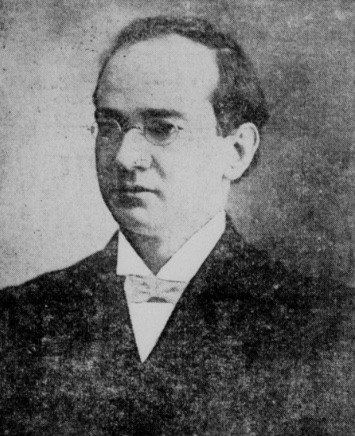
The reader he chose was Richard Hodgson, who ran the American branch of the Society for Psychical Research from Boston. MacDougall wrote to him in November 1901 on the advice of a Boston surgeon, Herbert L. Burrell, who had heard the story on the deck of the Leyland liner Cestrian that summer, when “a discussion arose one evening among a group of passengers concerning the question of immortality, materialism or spiritualism.” Hodgson read the letters, replied to them, kept them private as he was asked, and died in December 1905 without seeing a third case. The letters came out in 1907 only because the newspapers had got there first.
The instrument was a Fairbanks scale. The platform scale, a weighing machine with a low platform and a system of levers under it, had been the invention of Thaddeus Fairbanks of St. Johnsbury, Vermont, in 1830, and by 1867 the firm’s catalogue ran from a scale for grocers to one for railway wagons. MacDougall described his in December 1907, when a critic finally asked: “The balance used was the Fairbank’s standard scale of the kind used for weighing silk, with a maximum capacity of 300 pounds and showing a variation of a quarter of an ounce. The particular scale used was sensitive to one-fifth of an ounce with about 200 pounds as the combined weight of frame, bed, patient, and clothing. The combined weight never exceeded 206 pounds, so I was well within the limits of my scale.” The hospital is the one thing nobody named. Later writers place the bed at the Cullis Consumptives’ Home at Grove Hall in Dorchester, a charity hospital for the dying whose consulting physician was a professor at the same homoeopathic school MacDougall had come from. MacDougall himself wrote only of “the institution” and of “friction on the part of officials”.
What they were trying to find out
MacDougall stated the hypothesis before he described a single case, and it is two claims.
The first is that whatever survives death must take up room. “If personal continuity after the event of bodily death is a fact,” the paper of 1907 begins, “if the psychic functions continue to exist as a separate individuality or personality after the death of brain and body, then such personality can only exist as a space-occupying body.” To Hodgson in 1901 he had put it more plainly: “If we continue to exist then as Tom, and Dick and Harry, having personal identity intact, with the separateness of personality, it can only be as space-occupying bodies.”
The second claim is that what takes up room can be weighed. Science, he wrote, divided substance into “that which is gravitative, solids, liquids, gases, all having weight, and the ether which is nongravitative.” The ether was supposed to be continuous, a single whole that could not exist in separate pieces, “whereas the one prime requisite for a continuing personality or individuality is the quality of separateness, the ego as separate and distinct from all things else, the nonego.” So the soul could not be ether. It had to be “some form of gravitative matter, and therefore capable of being detected at death by weighing a human being in the act of death.”
He also wrote down, at the start and again at the end, what a failure would mean, and this is the part of the design that matters most. “The absence of a weighable mass leaving the body at death would of course be no argument against continuing personality, for a space-occupying body or substance might exist not capable of being weighed, such as the ether.” To Hodgson: “If on the other hand I am proven to be in error in my experiments, the question remains as it was before—the absence of weight loss is no proof against human immortality.” The scale could confirm the hypothesis. By his own statement it could not refute it. He regarded that as fairness, and it is the reason the experiment could only ever come out one way.
The idea had come to him, he told Hodgson, “sometime in the winter of ‘96-97.” He had not read the Atlantic Monthly for June 1887, in which Josiah Phillips Quincy’s story “A Crucial Experiment” has a Professor Hargrave tell a clergyman and a doctor what he means to do at a deathbed: “I hope to be able to show that, approximating the time when the soul leaves the body, there is an alteration in its weight which is capable of registration. I have caused the bed to be supported upon an exquisitely poised balance which will show any remission of the downward pressure. I can scarcely doubt my success here.” In the story the patient does not die and the experiment is off. Hodgson sent MacDougall the reference, and MacDougall wrote back: “It is very singular that I should have carried out even to the point of completion, the experiment of J. P. ——’s fictitious professor. I am rather glad to find that I have not been alone.”
What they built
The apparatus was the scale, a wooden framework “very light” built on its platform, and on the framework a cot bed with its bedclothes, “in such a manner that the beam was not interfered with in any way.” The beam ran between two stops, an upper and a lower limiting bar. The method was to keep the beam’s end up against the upper bar, so that any sudden loss from the bed would show as the beam falling to the lower one, and to keep it there by moving the sliding weight back as the patient slowly lost weight.
He tested the scale’s sensitivity and wrote the test down. “If placed at balance one-tenth of an ounce would lift the beam up close to the upper limiting bar, another one-tenth ounce would bring it up and keep it in direct contact, then if the two-tenths were removed the beam would drop to the lower bar and then slowly oscillate till balance was reached again.” Two-tenths of an ounce is 5.7 grams, on a load of about 200 pounds.
The patients were chosen for the scale’s sake. “Consumptive cases were selected because they fulfilled the conditions requisite for a delicate test to a nicety, i. e.—a consumptive dying after a long illness wasting his energies, dies with scarcely a movement to disturb the beam, their bodies are also very light, and we can be forewarned for hours that a consumptive is dying.” They weighed, he said in December 1907, “70 or 80 or 90 or 100 pounds (and these were about the average weights).” The one patient who was not a consumptive was a woman dying in diabetic coma, and hers is the case he threw out.
Then he listed what he called the channels of loss, and closed them one by one. The bowels did not move in the first case, and the bladder’s “one or two drams of urine” stayed in the bedding. The skin and the breath were the slow loss he had already measured, an ounce an hour in the first man and three-quarters of an ounce an hour in the second, and the patients “were well blanketed”. That left the lungs. “Getting upon the bed myself, my colleague put the beam at actual balance. Inspiration and expiration of air as forcibly as possible by me had no effect upon the beam. My colleague got upon the bed and I placed the beam at balance. Forcible inspiration and expiration of air on his part had no effect.”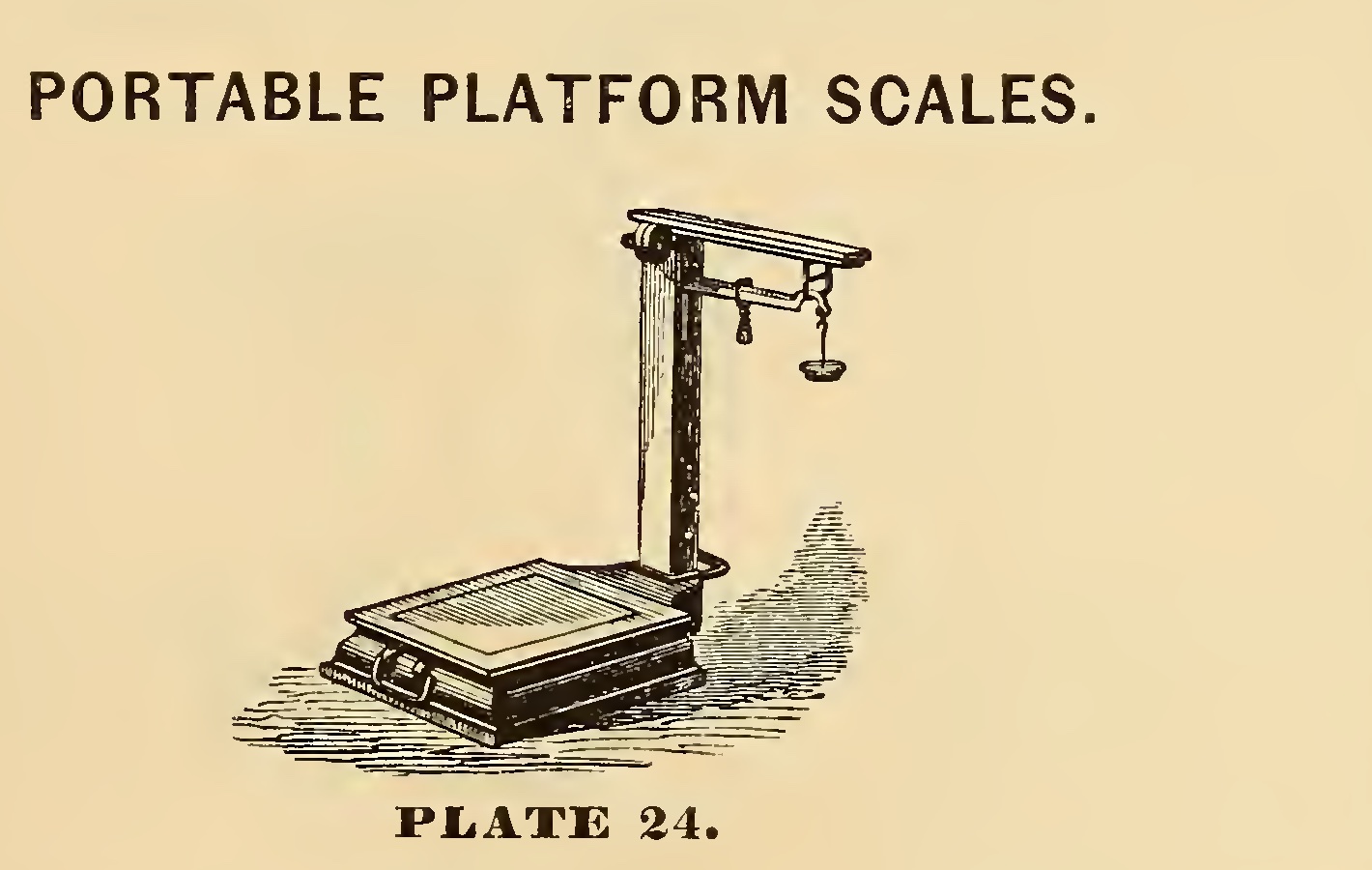
The dogs were the control. Between 1901 and 1907 he put fifteen of them, weighing from fifteen to seventy pounds, through “the same experiments”, on a scale which with the dog upon it was “sensitive to one-sixteenth of an ounce”, and he found “no loss of weight at death.” There was a loss twenty or thirty minutes later, “due to the evaporation of the urine normally passed”, and he checked that by evaporating the same amount of water on the empty scale. He also wrote down what was wrong with the dog tests. “The tests on dogs were vitiated by the use of two drugs administered to secure the necessary quiet and freedom from struggle so necessary to keep the beam at balance.” They were, he told Hyslop, “all healthy dogs”. He had wanted dogs dying of a wasting disease, like the consumptives, and “It was not my fortune to get dogs dying from such sickness.”
What the design did not have is as clear in his papers as what it did. There is no column of temperatures, no weight for any patient, no note of the month, the room or the weather, and no second observer’s record. When Augustus Clarke asked for these in 1907, MacDougall answered that the question was the rate of loss, not the weight, and that the rate was what he had recorded. That is a fair description of the design. It is also a description of a record from which nothing but his own reading of the beam can ever be recovered.
Two silver dollars
The first case is the one in the cold open, and it is the whole legend. “Here then is a loss of weight—three-fourths of an ounce occuring simultaneously with death not accounted for by known channels of loss,” he wrote to Hodgson on 10 November 1901. “What is the meaning of it? Have I really weighed the soul substance?—the thing that carries with it in its flight, personality, individuality, consciousness.” He had looked the subject up in an encyclopaedia that night and found that Rudolph Wagner had proposed a “soul substance” to a congress of physiologists in 1854 and that “not one of the five hundred voices present was raised in defence of a spiritual philosophy.” “Have I discovered Wagner’s ‘soul substance’ with my weighing machine? I think so, and I mean to verify and re-verify and re-re-verify, if I live long enough.”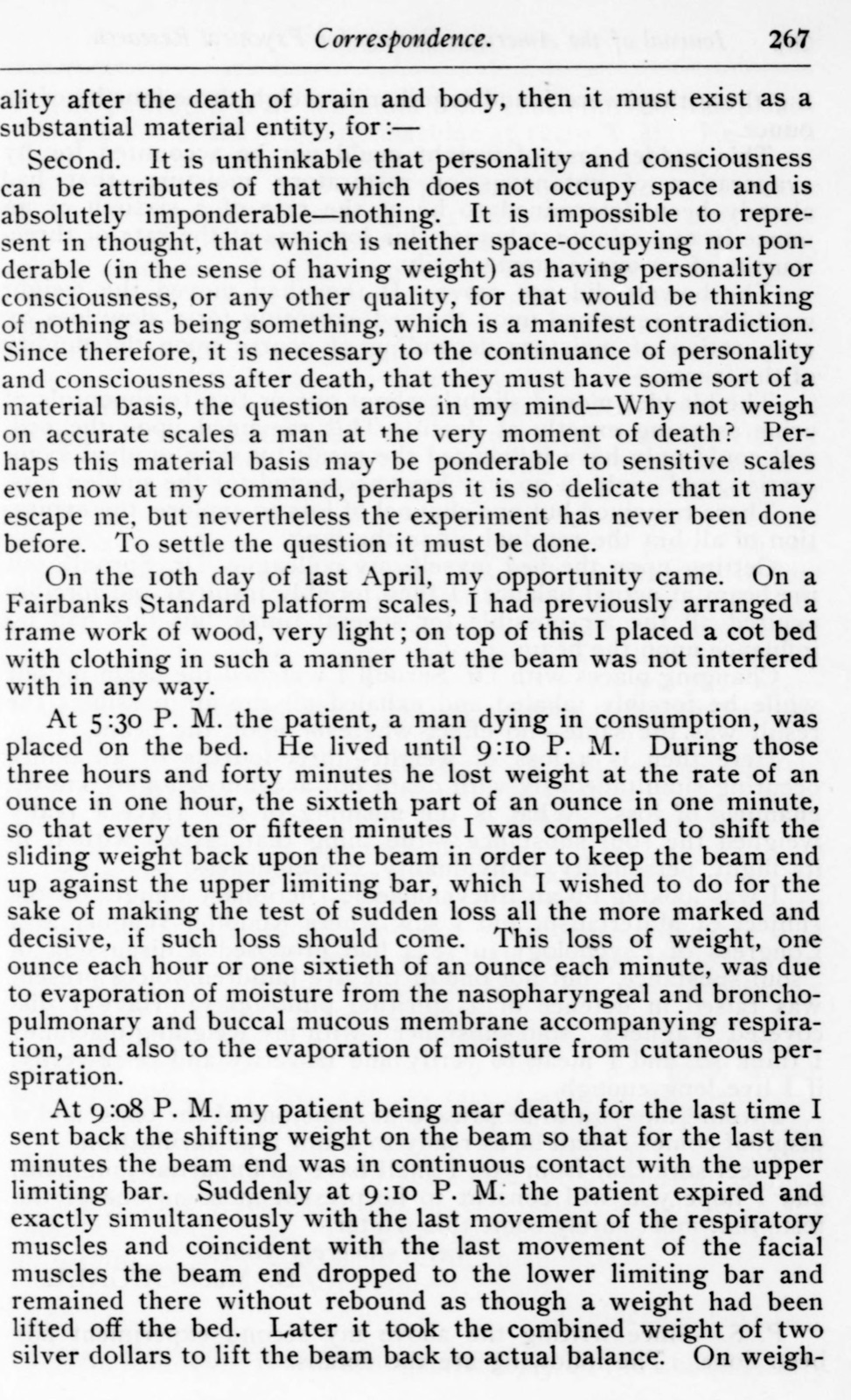
The second case came before the letter was posted, and it was nothing like the first. The man was “moribund from consumption”, larger than the first, and went onto the bed at ten past midnight. He lost three-quarters of an ounce an hour until ten past four, “when he apparently ceased breathing. For fifteen minutes after there was twitching of the eyelids and twitching of the lips only, during which time there was no loss of weight, the beam remaining constantly against the upper bar, then in a few moments after the last twitching the beam began to sink slowly until in fifteen minutes more it had touched and remained at the lower bar.” Half an ounce brought it back. Sproull listened to the heart and found it stopped. MacDougall tried again, “when it took one ounce and a half and fifty grains to lift it back to the upper bar.” That is 706 grains, or 45.8 grams, in the eighteen minutes “between the time he ceased breathing until we were certain of death”, against three ounces in the four hours before. “This patient was of a totally different temperament from the first, his death was very gradual so that we had great doubt, from the ordinary evidence to say just at what minute he died.” And then the sentence that moves the goalposts: “It is not however pure coincidence of loss that I am after; it is to determine if a loss of weight takes place at or near death which cannot be explained or accounted for by known channels of loss. This second test was as conclusive in support of my thesis as was the first.”
By 22 May 1902 there had been four more. In the first of them, a man dying of tuberculosis, “there was a loss of half an ounce coincident with death, and an additional loss of an extra ounce a few minutes later, but in the interval there was a jarring of the scales and a movement of the beam that might have caused the sliding weight to shift accidentally on the beam. This jarring was caused in examining the heart with a stethoscope.” In the second, the woman in diabetic coma, “unfortunately our scales were not finely balanced, and although there is a descent of the beam requiring about three-eighths to half an ounce to bring it to the point preceding death, yet I consider this test negative.” In 1907 he added that “there was a good deal of interference by people opposed to our work”, and told Hyslop that “In the case of the woman this friction and annoyance were so great, that I threw that test out.” The third “shows a distinct drop in the beam registering about three-eighths of an ounce, which could not be accounted for; this occurred exactly simultaneously with death, but peculiarly, on bringing the beam up again with weights and removing them again, the beam did not sink back to stay back for quite a period—about ten or fifteen minutes.” The fourth “was negative. Unfortunately owing to complications which we could not prevent the patient was but a few minutes on the bed before he died, and whether I had the beam accurately balanced before death or not I cannot be sure of. I am inclined to believe that he passed away while I was adjusting the beam. At any rate there was no loss of weight.”
That is the sixth and last patient, and his record changed twice. In March 1907 MacDougall told Hyslop that “while in the communication which I made to Dr. Hodgson I have written there was no loss of weight in that case, I should have written that there was more than two ounces in fact, but the whole thing was done so hurriedly in this case, that I was dissatisfied, though the weight might have slipped, or the beam, and so I threw out the experiment.” In the paper a month later it was “a loss of one and one-half ounces”, which “might have been due to accidental shifting of the sliding weight on the beam. This could not have been true of the other tests; no one of them was done hurriedly.”
So the ledger, in his own hand, is this. Six patients. One sudden, clean drop of three-quarters of an ounce, with two silver dollars put on the bed afterwards that should have weighed 825 grains and were recorded as 328. One slow sink of half an ounce some minutes after the breathing stopped, and a further ounce and fifty grains in a period when the observers “had great doubt” whether the man was alive. One half-ounce at death and an ounce a few minutes later, with the scale jarred by a stethoscope in between. One woman thrown out. One three-eighths of an ounce that took a quarter of an hour to settle. One man who died while the beam was being set, and whose loss was first nothing, then more than two ounces, then an ounce and a half. The sudden losses, where there was one, ran from three-eighths of an ounce to three-quarters. In the fifteen dogs there was nothing at all, on a scale three times as fine.
MacDougall’s own count, in the paper, kept four and discarded two. Austin O’Malley, a Philadelphia physician who went through the paper in November 1907, counted again: “drawn from four experiments, three of which are decidedly doubtful.” The second case “proves nothing finally” by MacDougall’s own admission about the moment of death. Of the third: “Does this inexplicable second loss suppose the man had two souls? It certainly makes the case useless in the argument.” Of the fifth: “Did the ponderable soul go back for fifteen minutes? Whether it did or not, this case too is not ad rem.” “So far,” O’Malley wrote, “there is only one case really worth consideration.” That was the first, and it is the one everyone has read ever since.
What it looked like from inside
The letters to Hodgson are the inside of the experiment, and they are the letters of a careful man who knew what he was risking. “I beg of you to keep this private in the meantime,” he wrote in November 1901. “I am arranging to begin on animals.” He wanted a witness: “I would like you to be present at some one of the tests, and if disproof comes I shall be as ready to admit it as verification.” Hodgson’s reply of 29 November was warm and a little wry. “I congratulate you heartily on the experiments which you are making. I suppose it might be a little queer if I were to say that I hoped you would have enormous opportunities for your special experiment with the patients that come under your charge.” He did not accept the reasoning, and said so, adding that “Any theory, however, is independent of your valuable experiments.” He asked whether MacDougall had “thought of obtaining help from other doctors or hospitals”, and whether he might consult a friend at the Harvard Medical School.
MacDougall’s answer of 5 December has the sentence that gives the whole enterprise away, and he wrote it as a joke. “My soul substance, which eludes me the moment I demonstrate it, is of course of such weight that it is totally different from the ether. Perhaps some genius will apply a spectroscope to it some day and demonstrate its composition.” On 6 January 1902 he asked Hodgson to hold off the Harvard man: “I wish a third test before broaching the matter to positioned and entrenched scientific authority. I have had two rebuffs already from such a quarter.” And: “a foolish misunderstanding barred me from what would have been an excellent test case. The misunderstanding has been cleared away and I am now free to go on with my observations whenever the opportunity presents.”
By May he had the four further cases and twelve dogs, and a different tone. “My chief reason for holding back on this before was the fear that after all I had discovered a mare’s nest, and that I might put others to trouble for nothing. It may be now that other experimenters will discover it to be a mare’s nest; but at any rate we have sufficient grounds to warrant putting others to the trouble of proving the matter.” He offered the apparatus: “An apparatus of mine is now in Boston, and I am willing to place it at the disposal of any one who has the opportunity and the desire to make the tests.” And he said how he meant to publish. “I want to first publish the discovery as a fact in the physiology of death, stripped, as a good friend of mine has said, of its ‘psychical significance,’ because to insist upon the latter might raise prejudice in the minds of many of our present day scientific men, and prevent repetition of the experiment by others. After the fact has been acknowledged and proven, it will be time enough to insist upon its meaning.”
That is the last letter. Nobody took the apparatus. No third test was ever reported. Hodgson died. For five years MacDougall practised in Haverhill and said nothing in print, and in the spring of 1907 he had, he said, “lately become connected with a hospital and was thereby winning the confidence of those in charge, and hoped that within this year I might be able to resume my experiments.”
What happened
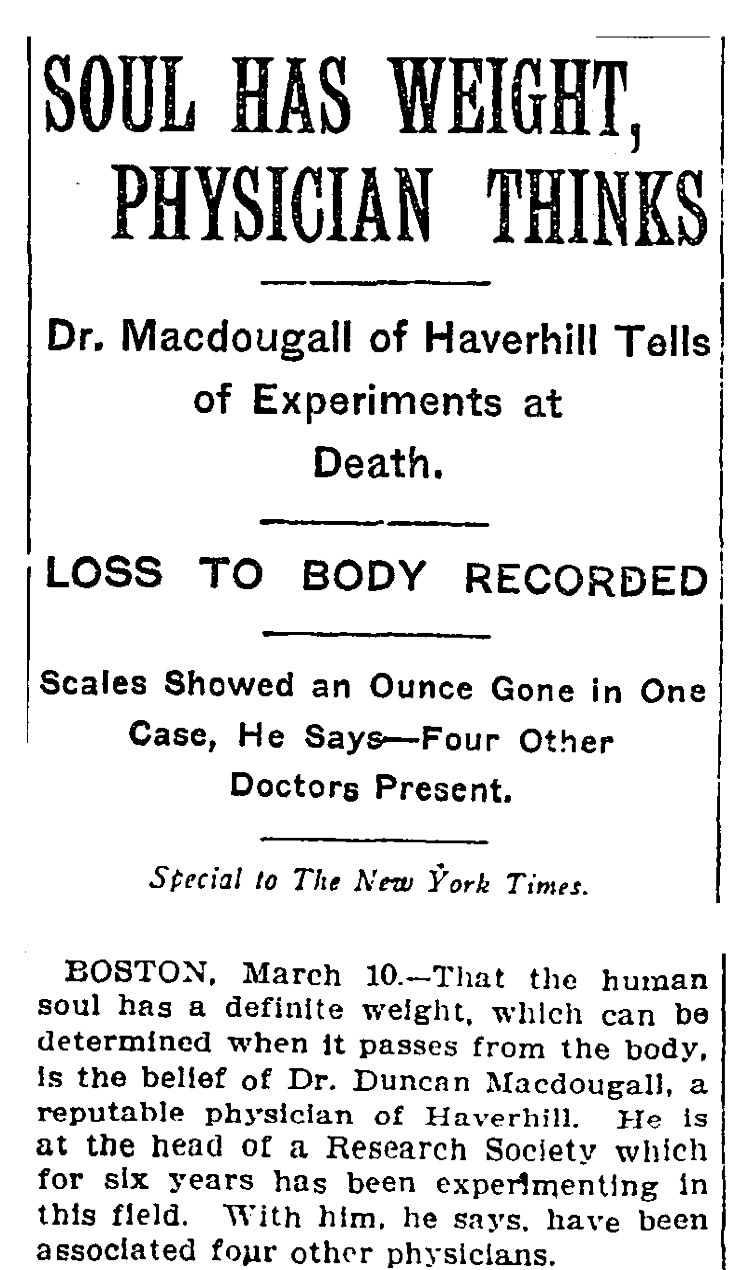
On Sunday 10 March 1907 the Boston Post ran a story headed “Existence of ‘soul’ tested by doctors”. On the Monday the New York Times carried its own, “Special to The New York Times”, datelined Boston the day before, under the headline “SOUL HAS WEIGHT, PHYSICIAN THINKS”, and the Haverhill Evening Gazette ran “Weight of a soul”. The Times began: “That the human soul has a definite weight, which can be determined when it passes from the body, is the belief of Dr. Duncan Macdougall, a reputable physician of Haverhill. He is at the head of a Research Society which for six years has been experimenting in this field. With him, he says, have been associated four other physicians.”
The story went out on the wires and was in the weekly papers of South Carolina within ten days, under “CAN THIS BE SO? Is It Possible to Accurately Weigh the Soul of Man?”; its full text is in the companion piece, “The wire story”. It had a research society and four physicians where the letters have Sproull. It had “a pair of scales made expressly for the experiments”, sensitive to “less than one tenth of an ounce”, where there was one Fairbanks scale sensitive to two-tenths. It had “a full ounce of weight unaccounted for” where there had been three-quarters. It had a third patient, “a phlegmatic man slow of thought and action”, in whom “the soul remained suspended in the body after death, during the minute that elapsed before it came to the consciousness of its freedom.” And it had “three other cases … including that of a woman”, in each of which a loss “was established”, where the woman had been thrown out. Nothing in it is quite false and nothing in it is the experiment. The soul that pauses in a sluggish man is in no letter and no paper MacDougall ever wrote, and it is the line most of the papers quoted.
He wrote to James Hyslop, the editor of the Society’s Journal, on 13 March. “It is unfortunate that they have received publicity first through the newspapers, as it was my intention to collect the data and complete my argument in a paper to be made public before some scientific body. That I judge, is out of the question now.” The hospital connection “ends that hope.” “Now that the cat is out of the bag, by the least desirable method—newspaper publication—after being securely kept in for five or six years, if you care to publish this letter, I have no objection to your doing so.” And, with the letters to Hodgson, a verdict on himself: “I am well aware that these few experiments do not prove the matter any more than a few swallows make a summer, but yet the results should at least provoke further experiments.” Hyslop printed everything in the May number with an editorial note that “an unauthenticated publication of his attempts, with the usual distortion that everything gets in the papers, has resulted in this prompt effort to correct the misrepresentation.” Hereward Carrington, in the same number, reported that a reporter had asked him “what I thought of the idea of placing a criminal who had been sentenced to death on the scales—death chair and all”, and that he had suggested a glass hood over the condemned man’s head to catch the air from his lungs. He also did the arithmetic MacDougall had not. A cubic foot of air weighed “about 1¼ ounces”; the lungs held at most 300 cubic inches, “as nearly as possible one-sixth oz.”, and a dying consumptive’s “would not contain within their lungs anything like 100 cubic inches—the eighteenth of an oz.” Breath could not be the answer.
The paper itself appeared in April in American Medicine, and in the Society’s Journal for May, “published synchronously”, as a footnote said, “by courtesy of the Editor”. It ended with a sentence that is the nearest MacDougall came to a creed. “One ounce of fact more or less will have more weight in demonstrating the truth of the reality of continued existence with the necessary basis of substance to rest upon, than all the hair-splitting theories of theologians and metaphysicians combined.” And with the admission: “I am aware that a large number of experiments would require to be made before the matter can be proved beyond any possibility of error”.
The reply came in May from Augustus P. Clarke of Cambridge, Massachusetts, and it was about heat. Clarke regretted that the paper gave no temperatures. He had watched the dying run hot as they stopped breathing, from 108 to 110 degrees in one young man, because the blood was no longer cooled in the lungs, and argued that such a rise “would have been deemed quite sufficient to account for the rapid loss of three-fourths of an ounce in weight in an inappreciable lapse of time by insensible transudation of fluid”, without “supposing that a distinct entity of a ponderable soul substance had escaped to regions of unknown space.” MacDougall answered in July that his patients had died with “the cold clammy skin, and the cold feeble stream of respiratory air, so common in those dying of long protracted chronic tuberculosis”, that a body whose skin had emptied of blood radiated less and so evaporated less, and that “High temperature alone does not account for the loss of weight. A loss of weight implies a loss of substance.” Austin O’Malley of Philadelphia, in November, denied that the patients were dead when the beam dropped, counted the cases and found one worth considering, and asked of the third whether a loss in two instalments meant “the man had two souls”. His figure for the whole paper was a jilted lover: “If a maiden abandons her lover, and he therefore rapidly loses bodily weight, does the loss of weight in his body represent the girl’s ‘avoirdupois,’ or prove that she is a space-occupying body?”
Clarke came back in December with a list of what the paper did not contain: the patients’ weights, the temperature of the room, the humidity, the barometer, the month. MacDougall’s last word, in the same number, gave the make and capacity of the scale for the first time, and the reason the rest was missing: “the question to be determined by the experiment was not the weights of the subjects, but the rate of loss of weight while dying”. He had the weights “in my possession”. He had not thought them worth the space. “I had not intended to enter into any further discussion of the subject,” he wrote, “for the reason that such discussion is fruitless and barren, a mere championing of opinions, when it were far better to appeal to nature herself and get facts for arguments.” Anyone who thought temperature mattered could repeat the experiment with a thermometer. Nobody did. The exchange is given in full in the companion piece, “The argument about heat”.
After
He did not weigh anyone again. In July 1911 the Boston Sunday Post had him under “Pictures of Soul Sought by Doctors”, and the New York Times under “As to picturing the soul”; by the accounts of those stories he doubted that X-rays would do it, but thought the soul substance might give off a light of its own. In May 1914 the Post ran a page on the “Astounding Theory of Haverhill Scientist Who Declared He Weighed Soul”, with his photograph. He died at his home in Haverhill on 15 October 1920, aged fifty-four. The Boston Medical and Surgical Journal gave him five lines. The Times headed its notice “He Weighed Human Soul”, which is what he had become.
The experiment had its imitators and its number had its career. In 1915 H. LaVerne Twining, in California, killed mice on a balance, some of them sealed in glass tubes so that nothing could evaporate away, and the writers who took the sealed mice as the answer took them as MacDougall’s refutation. In 2001 Lewis Hollander weighed sheep and a goat as they died and reported, in the Journal of Scientific Exploration, that seven of the adult sheep had briefly gained between 18 and 780 grams. In 2003 the film 21 Grams gave the number a title, and in 2004 Len Fisher’s Weighing the Soul and in 2005 Mary Roach’s Spook gave it a chapter each, Fisher proposing that the drop was a convection current from a cooling body. In 2010 a Japanese researcher, Masayoshi Ishida, who had already gone through Hollander’s sheep, published a thirty-five-page rebuttal of the critics in the same journal, with a simulation of the bed on a modern four-cell weighing platform, and dedicated it to MacDougall. Sweat “has practically no effect” on the finding, he concluded; “the speculated effect of convection air currents on MacDougall’s balance scales does not exist”; and Clarke’s physiology was wrong, since a body whose circulation stops does not get hotter. “Therefore,” he wrote, “all the cases of his experiment do remain as pioneering cases published in a scientific journal.” He also wrote that “Four cases are certainly small as an experimental sample size.” The unaccounted losses in his table run from 10.6 grams to 45.8.
What survived all of this was none of the table. It was the first number, rounded, in metric: twenty-one grams.
What it taught
MacDougall did a great deal right. He stated his hypothesis before he began. He chose his subjects so that the instrument could speak. He measured the rate of loss before death so that a loss at death would stand out from it. He tested the sensitivity of the scale and the weight of a breath, and wrote both down. He discarded two of his six cases himself and said why. He asked for a witness, offered his apparatus to anyone who would use it, said “a few swallows” do not make a summer, and said twice that he might have found a mare’s nest. None of that saved the result, and the reasons it did not are the lesson.
The one reading that is read is the clean one, and the clean one is not the data. Six patients gave six different records, and the record that could be told in a sentence was the first: a beam that fell “with an audible stroke” at the moment of death, three-quarters of an ounce. The second patient’s loss was twice as large and arrived over half an hour in a man nobody could say was dead; the third’s came in two instalments with a stethoscope between them; the fifth’s took a quarter of an hour to make up its mind. MacDougall himself wrote that “It is not however pure coincidence of loss that I am after”, which was a way of keeping the cases that did not match the first. The newspapers kept the first and gave it a soul that paused to collect itself. The film kept the first in grams. The one case with a story became the finding, and the five without one became the sample size.
A control that gives the hypothesis what it wants is not a control, and the experimenter said so. The fifteen dogs lost nothing, and the paper read that as “a physiological difference between the human and the canine at least and probably between the human and all other forms of animal life.” The same paper says the dog tests “were vitiated” by the drugs that kept the dogs still, and the letter to Hyslop says they were “all healthy dogs”, not the wasted, motionless subjects the human test had been designed around. A negative result from a compromised control was reported as a positive discovery about dogs. Clarke’s answer, that a dog that stops panting stops losing water, is the one point MacDougall conceded in full, and it took the dogs out of the argument without anyone noticing that it took the human cases’ only comparison with them.
The instrument was fit for the purpose. The record was not. Ishida has shown that a 300-pound Fairbanks sensitive to a fifth of an ounce can see twenty grams, and that sweat, draughts and heartbeats cannot hide it. What the scale could not supply was the rest of the row: the patient’s weight, the temperature, the room, the month, a second pair of eyes on the beam, and a check on its own calibration against a known mass. MacDougall had the weights “in my possession” and left them out because the question was the rate; he had no temperatures because he had no theory that needed them. The one time he put a known mass on the bed, the two silver dollars, the known mass disagreed with his reading by a factor of two and a half, and the disagreement went into a private letter and out of the printed paper, where nobody has gone looking for it. An experiment that records only the quantity its hypothesis predicts has no way of finding out that its hypothesis is wrong.
An experiment that cannot fail does not succeed either. MacDougall wrote down in advance that no loss of weight would be “no argument against continuing personality”. That is an honest sentence, and it is fatal. If the scale dropped, the soul had weight; if it did not, the soul was ether. Hyslop saw the other half at once: if the scale dropped, the loss might be “some form of energy unaccounted for by known agencies, and not necessarily that this residuum was the subject of consciousness.” O’Malley put it as the lover and the maiden. Between a hypothesis that nothing could refute and a result that nothing could tie to it, the beam was free to mean whatever its reader needed, and for more than a century it has.
The first account to reach the public is the one the public keeps. The experiment went out through a reporter, in a form MacDougall never wrote, five weeks before the paper and six years after the first case; the correction appeared in a psychical research journal and a medical monthly that the readers of the wire story never saw. Worse, the publicity ended the work. “This premature newspaper publication ends that hope,” he wrote of the hospital that had just begun to trust him, and he was right. The experiment that needed a hundred cases stopped at six because its result had been announced.
The complication is that none of the people who read it wrong were careless, and MacDougall was the least careless of them. Clarke’s physiology was mistaken, but he asked for exactly the data a reader needs. O’Malley’s metaphysics is not everyone’s, but his count of the cases is the correct one. Hyslop printed every letter. Ishida, who believes the loss was real, is the only writer since 1907 to have put numbers on the objections, and his numbers show that a scale from a silk warehouse was good enough. The thing that was never good enough was the question. Whether the soul has weight could not be settled by a beam, because MacDougall had arranged, honestly and in writing, that no movement of the beam could ever count against the soul. What the beam could have settled, with a column of weights and a thermometer and a hundred patients, was whether a dying body loses twenty grams it cannot account for, and that is a question in the physiology of death that nobody has answered, because the only person who ever asked it published his answer first.
Sources
- Duncan MacDougall, “Hypothesis Concerning Soul Substance Together with Experimental Evidence of the Existence of Such Substance,” American Medicine, new series vol. 2 no. 4 (April 1907), pages 240 to 243. The hypothesis, the six cases as published, the sensitivity test, the breathing test, the fifteen dogs, “One ounce of fact”, and Wagner. archive.org
- Duncan MacDougall, the same paper in the Journal of the American Society for Psychical Research, vol. 1 no. 5 (May 1907), pages 237 to 244, followed by the editorial “Weighing the Soul” (pages 259 to 260) and the correspondence (pages 263 to 275): MacDougall’s letter to Hyslop of 13 March 1907, his letters to Richard Hodgson of 10 November 1901, 5 December 1901, 6 January 1902 and 22 May 1902, and Hodgson’s replies of 29 November and 9 December 1901. The first and second cases in detail, the two silver dollars, the Cestrian, Quincy’s professor, “re-verify and re-re-verify”, the rebuffs, “a mare’s nest”, the apparatus in Boston, the twelve dogs, and “the cat is out of the bag”. archive.org
- Hereward Carrington, “On Dr. MacDougall’s Experiments,” Journal of the American Society for Psychical Research, vol. 1 no. 5 (May 1907), pages 276 to 283. The reporter and the electric chair, the glass hood, and the weight of the air in the lungs. Same volume.
- Augustus P. Clarke, “Hypothesis Concerning Soul Substance,” American Medicine, new series vol. 2 (May 1907), pages 275 to 276, and (December 1907), pages 675 to 676. The temperature cases, “insensible transudation of fluid”, the missing weights, room, month and barometer, the dogs’ tongues, and the four hundred autopsies. archive.org
- Duncan MacDougall, “Hypothesis Concerning Soul Substance,” American Medicine, new series vol. 2 (July 1907), pages 395 to 397, and (December 1907), pages 677 to 678. The reply to Clarke: the cold clammy skin, “the milk in the cocoanut”, the blankets, the weights “in my possession”, the patients of 70 to 100 pounds, the Fairbanks silk scale of 300 pounds, and “appeal to nature herself”. Same volume.
- Austin O’Malley, “Is the Vital Principle Ponderable?”, American Medicine, new series vol. 2 (November 1907), pages 653 to 658. The count of the cases, the resuscitated boy, “two souls”, the fifteen minutes, and the lover’s avoirdupois. Same volume.
- “Soul Has Weight, Physician Thinks,” New York Times, 11 March 1907, page 5. The headline, the subheadings and the opening paragraph, from the clipping on Wikimedia Commons; the Times’s own archive page carries the same opening. commons.wikimedia.org, nytimes.com
- “Can This Be So? Is It Possible to Accurately Weigh the Soul of Man?”, The Abbeville Press and Banner, Abbeville, South Carolina, 20 March 1907, part second, page 11, and the same wire story in The Horry Herald, Conway, South Carolina, 21 March 1907, page 3. The syndicated text of the March 1907 story: the research society, the pair of scales, “a full ounce”, the phlegmatic man and “the consciousness of its freedom”, and the woman. historicnewspapers.sc.edu, historicnewspapers.sc.edu
- Josiah Phillips Quincy, “A Crucial Experiment,” The Atlantic Monthly, vol. 59 no. 356 (June 1887), pages 721 and following. Professor Hargrave’s “exquisitely poised balance”. archive.org
- Fairbanks’ Standard Scales, E. and T. Fairbanks and Company, 1867. The 1830 patent, the portable platform scales (plate 24) and their capacities. archive.org
- American Medical Directory, fourth edition, Chicago: American Medical Association, 1914, Haverhill entries. MacDougall’s year of birth, school and year, address and hours. archive.org
- The Boston Medical and Surgical Journal, vol. 183 no. 18 (28 October 1920), deaths. “Duncan MacDougall, M.D., a Fellow of the Massachusetts Medical Society, died at his home in Haverhill, October 15, 1920, aged 54 years. He was a graduate of the Boston University School of Medicine in 1898.” archive.org
- Thirty-Sixth and Thirty-Seventh Annual Reports of the Cullis Consumptives’ Home, Boston, 1901. The Home’s address at Grove Hall, New Dorchester, and its medical board, with Herbert C. Clapp of the Boston University School of Medicine as consulting physician. archive.org
- An Act to authorize the coinage of the standard silver dollar, and to restore its legal-tender character, 28 February 1878 (the Bland–Allison Act), 20 Statutes at Large 25: “of the weight of four hundred and twelve and a half grains Troy of standard silver”. govinfo.gov
- Boston Sunday Post, 23 July 1911, “Pictures of Soul Sought by Doctors,” and 31 May 1914, “Astounding Theory of Haverhill Scientist Who Declared He Weighed Soul”: the headlines and the photographs, as reproduced on Wikimedia Commons. commons.wikimedia.org, commons.wikimedia.org
- Masayoshi Ishida, “Rebuttal to Claimed Refutations of Duncan MacDougall’s Experiment on Human Weight Change at the Moment of Death,” Journal of Scientific Exploration, vol. 24 no. 1 (2010), pages 5 to 39. The table of the six cases in grams, the simulation, the answers to Blackmore, Fisher and Clarke, Twining’s mice, and “pioneering cases”. journalofscientificexploration.org
- Lewis E. Hollander, “Unexplained Weight Gain Transients at the Moment of Death,” Journal of Scientific Exploration, vol. 15 no. 4 (2001), pages 495 to 500, and Masayoshi Ishida, “A New Experimental Approach to Weight Change Experiments at the Moment of Death with a Review of Lewis E. Hollander’s Experiments on Sheep,” Journal of Scientific Exploration, vol. 23 no. 1 (2009), pages 5 to 28. The sheep. web.archive.org
- Psi Encyclopedia, Society for Psychical Research, “Soul Weighing Experiments”. The Boston and Haverhill headlines of 10 and 11 March 1907, and the later literature. psi-encyclopedia.spr.ac.uk
- Len Fisher, Weighing the Soul: The Evolution of Scientific Beliefs, London: Weidenfeld and Nicolson, 2004, and Mary Roach, Spook: Science Tackles the Afterlife, New York: Norton, 2005. The experiment’s later reputation; both in copyright and quoted here only at second hand through Ishida.
- John Beatty, “Dr. Duncan MacDougall and the Weight of the Soul,” Scotia, Brooklyn College. The only account of MacDougall’s early life, Glasgow and the Cullis Home; it cites no sources and is used here for those two points only, with that caveat. brooklyn.cuny.edu


