On Sunday 5 October 1930 Leonard Bairstow, professor of aerodynamics at Imperial College and chairman of the Air Ministry’s panel on the airworthiness of airships, was drafting a report. Its subject was whether His Majesty’s Airship R101, cut in two that summer and lengthened by forty-five feet, was fit to fly. He and his colleague Professor Sutton Pippard had already sent the Air Ministry a letter, dated 1 October, saying that she complied with the panel’s requirements. It added that the differences between the ship as designed and the ship as she now was “surprised us by their magnitude”, that “a good deal of general thinking and comparison on limited information has been required in reaching our conclusion”, and that they had not had time to write a considered report.
The Air Ministry had not waited. On Thursday 2 October it had typed out Certificate of Airworthiness No. L/A. 6, in the name of the Air Council, for the rigid airship G-FAAW, type R.101, built at Cardington in 1929, category Special, subdivision Research or experimental. The form said that the Secretary of State for Air, “having regard to the Reports furnished to him”, issued the certificate. It was handed to the ship at the Cardington mooring tower on the evening of Saturday 4 October, a few minutes before she left for India.
Bairstow was still at his draft when the news came. The report it was meant to be had never been received, and the ship it certified had been lying on a hillside south of Beauvais, in northern France, since eight minutes past two that morning. Of the fifty-four people in her, forty-six were already dead.
Who ran it
Christopher Birdwood Thomson was born on 13 April 1875, went from Woolwich into the Royal Engineers in 1894, served in South Africa and the Balkans and spent most of the war as military attaché in Romania. Afterwards he left the army, joined the Labour Party, and in January 1924, when Ramsay MacDonald formed the first Labour government, became its Secretary of State for Air and a peer. He took his title from the village where the Royal Airship Works stood: Baron Thomson of Cardington. In June 1929, when Labour came back, he came back with it. Between his two terms Sir Samuel Hoare held the Air Ministry for the Conservatives and kept the programme going. Under both ministers the officer who answered for it was the Air Member for Supply and Research: Air Marshal Sir John Higgins until September 1930, then Air Vice-Marshal Hugh Dowding, who had been in the post a month when the ship sailed. Neither had any airship experience. That mattered, and the inquiry said so.
The ship belonged to Cardington. Wing Commander Reginald Colmore, a naval officer, became Director of Airship Development in January 1930. Major George Herbert Scott had commanded R34 across the Atlantic and back in 1919, invented the mooring tower, and was Assistant Director in charge of flying. Lieutenant-Colonel Vincent Richmond, born in 1893, was the designer of R101; the inquiry said his powers “were almost autocratic”. Squadron Leader Michael Rope was his assistant and the inventor of her gasbag wiring. Flight Lieutenant Herbert Carmichael Irwin, who had captained R33 on her experimental flights, was her captain; Squadron Leader Ernest Johnston her navigator; Lieutenant-Commander Noel Atherstone her first officer; Maurice Giblett, who had founded the Meteorological Office’s airship division, her weather man. All of them went to India.
The competition was more than a hundred miles north, at Howden in Yorkshire. There the Airship Guarantee Company, a subsidiary of Vickers set up for the purpose by Commander Dennistoun Burney, built R100 under a fixed-price contract of £350,000, with Barnes Wallis as chief designer and a young calculator named Nevil Shute Norway, who later wrote novels as Nevil Shute. The Howden ship was flown by Cardington’s crews and judged by Cardington’s officers, who were, Norway wrote in 1933, “both the judges and the competitors of the constructing company”.
Between the two stood the inspectors: the Aeronautical Inspection Directorate, with its Director, Lieutenant-Colonel H. W. S. Outram, in London and its Inspector in Charge at Cardington, Frederick McWade, who had twenty-seven years of airships behind him and who handed the ship each Permit to Fly she flew under. And there was Bairstow, with his panel and his professor.
What they were trying to find out
The last large British airship before these two, R38, had broken in two over the Humber on a trial flight on 24 August 1921. The sub-committee that investigated found that her designers had calculated only the strains of a ship hanging still in the air and had paid no regard to the forces of motion. After that the Airship Branch of the Royal Air Force was closed for economy.
What revived it was an argument about money and empire. Burney proposed a commercial scheme; a Cabinet committee of MacDonald’s 1924 government decided instead that the state should do the research the R38 inquiry had called for. The programme was to run three years and cost £1,350,000; MacDonald told the Commons in 1931 that the whole had come to £2,350,000. Design was to proceed from first principles, with model tests in the wind tunnels of the National Physical Laboratory and a full-scale section of the ship built and strained before the ship was. Two airships were to be built to the same requirements, one by the Air Ministry at Cardington and one by private enterprise, and both were then to fly to an overseas terminal and back “to test whether the airships were suitable for the work for which they were designed.” Two ships, Hoare told the Imperial Conference of 1926, “ensured competition in design and provided that a purely accidental failure of one ship should not terminate the whole programme.”
The requirements were six. Each ship was to be of five million cubic feet, giving about 150 tons of gross lift with hydrogen, nearly twice that of any British airship before; was to meet the factors of safety the Aeronautical Research Committee had laid down in 1924; was to do seventy miles an hour and cruise at sixty-three; was to carry a hundred passengers; was to weigh, engines included, no more than ninety tons, leaving sixty tons of useful lift; and was to burn a fuel “which could safely be carried and used in sub-tropical or tropical climates”, which meant heavy oil.
So the hypothesis had two parts. The first was about engineering: that a rigid airship of this size, designed by calculation and tested piece by piece, would carry its load the length of the Empire. The second was about method. Norway put it as a joke that was not one. The gods, he wrote, had said: “we will try this ancient question once again. The Air Ministry at Cardington shall build an airship of a certain size and of a certain speed, and Vickers, Ltd., shall build another to the same contract specification. By this ingenious device we really shall find out which is the better principle, capitalism or State enterprise.” The gods “then turned to other matters for the next six years while the experiment germinated.”
The second question could be answered only if both ships were put through the same trials and the results set side by side. Nobody designed that part.
What they built
Cardington’s ship took four years. About a hundred of her girders were tested to destruction, and a whole bay was set up with a gasbag in it and its strains measured. “It is probably no exaggeration to say,” the inquiry wrote, “that never before in the history of structural engineering has so much care been taken to explore the strength of a structure before it was used.”
Almost everything in her was new. The frame was stainless steel tube. Richmond and Rope had patented a wiring system that held each gasbag like a drum in a net; one advantage claimed in the patent was that it kept the bags “from touching the longitudinal girders.” The gas valves were a new pattern, halfway up the side of each bag, with no spring, and so sensitive that they began to open when the ship rolled through five degrees. The outer cover was doped before it was put on, to save weight, which no one had tried. And the five engines were Beardmore Tornadoes, eight-cylinder diesels of a kind that had never flown.
The engines were the first instrument to speak. They were meant to give 700 horsepower each; they gave 585. “As installed,” the inquiry found, “the total weight of the power installation of R.101 (including auxiliaries) amounted to 17 tons, in comparison with under 9 tons for R.100 and 7 tons for the Graf Zeppelin.” Norway recorded that a few months before her first flight Richmond “urged his superiors to fit petrol engines in the ship”; “this petition was refused.”
The second instrument was the scale. When the gasbags were filled in September 1929 the ship’s fixed weights came to 113.6 tons against a gross lift of 148.6. The specification had asked for ninety and sixty. R101 had thirty-five tons of useful lift, and the engines were not the chief reason; the structure was. A ship with thirty-five tons to spare could not carry twenty-five tons of fuel to Egypt with anything over. Every alteration that followed came from this one number.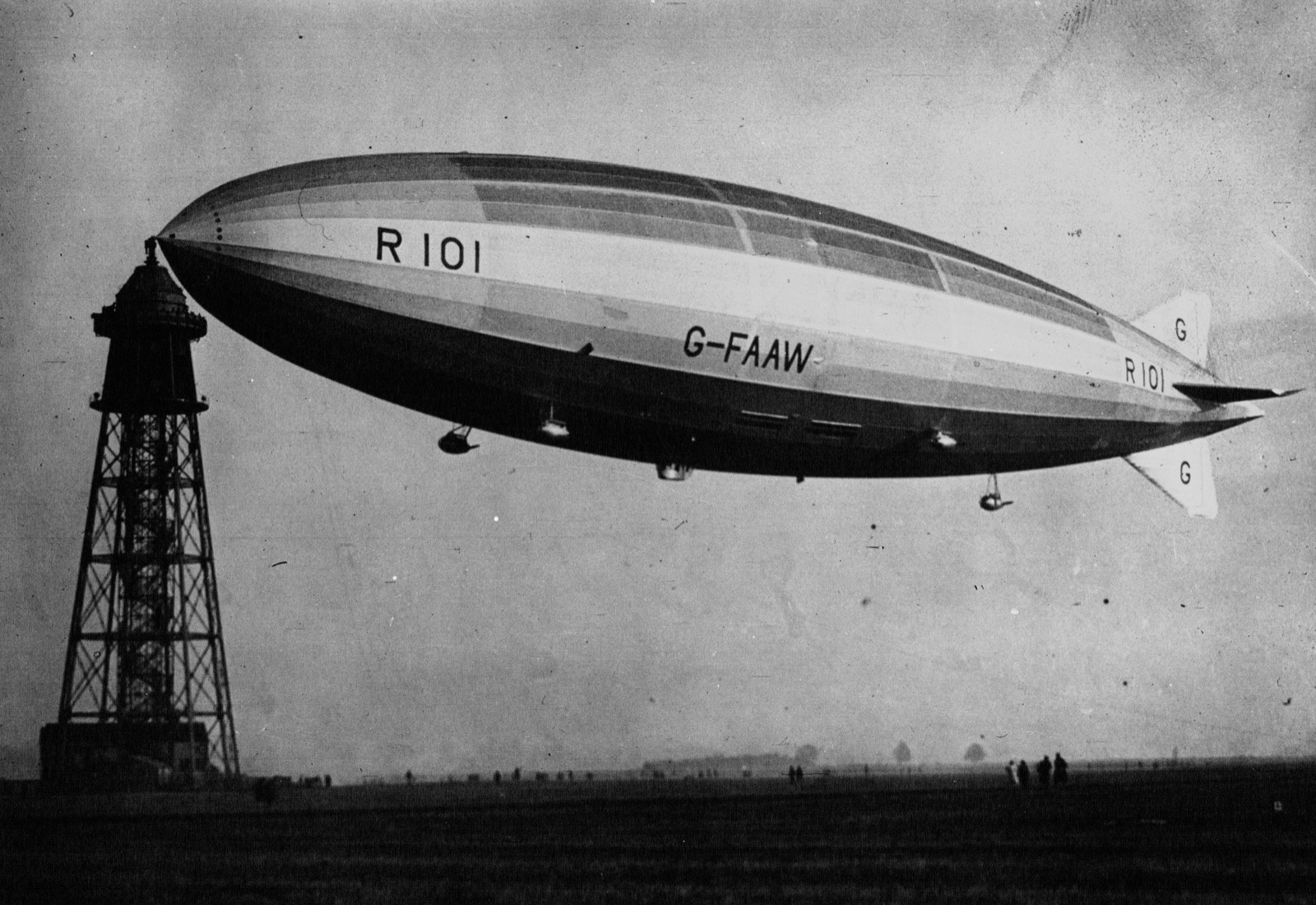
She flew for the first time on 14 October 1929, round London. Thomson was aboard the second flight, on 18 October, and told the press that he hoped to go to India in her at Christmas, and that his policy was “safety first”: no pressure would be brought on the technical staff to fly until they were satisfied.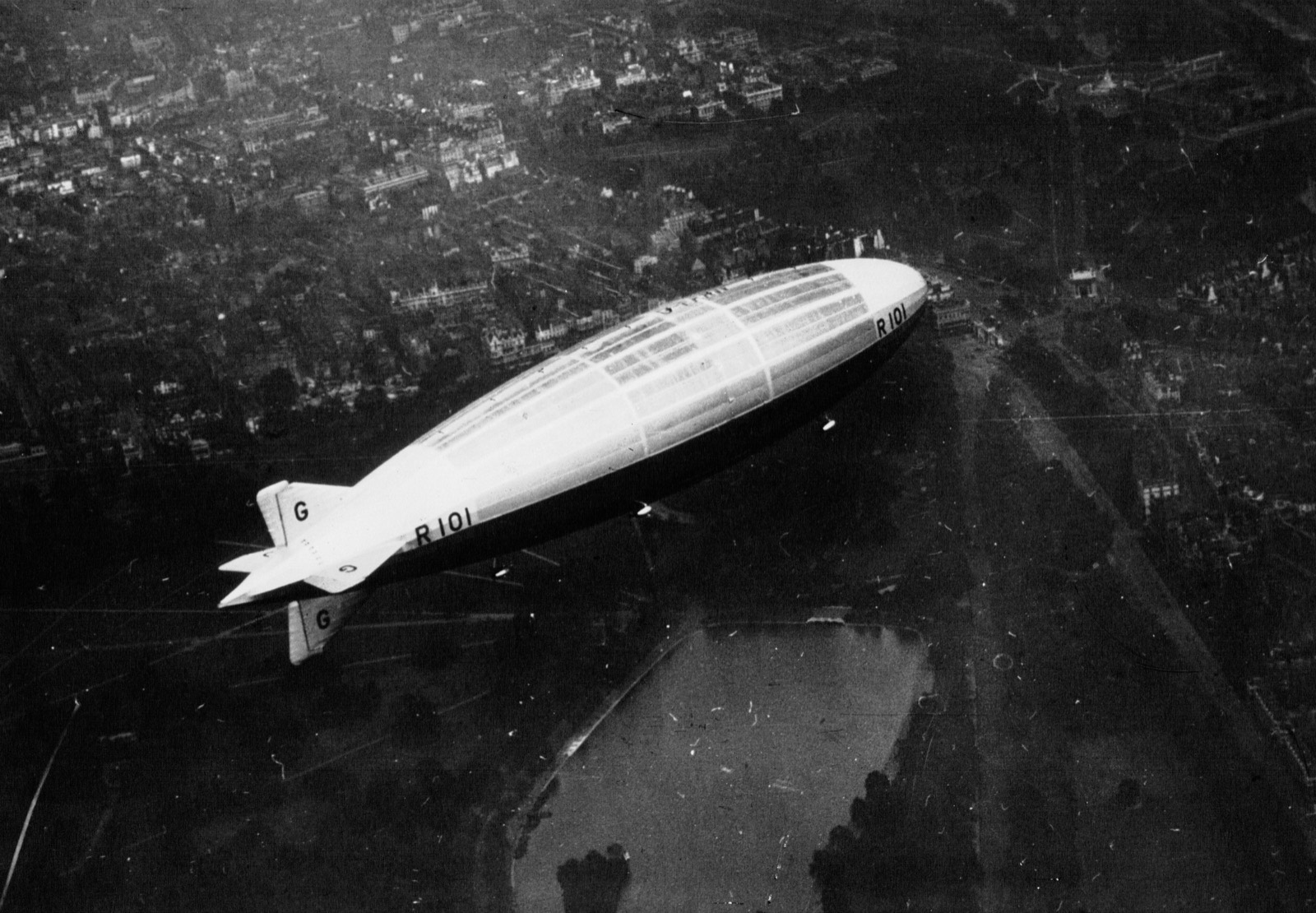
Then came the trials, five more flights in November, the longest thirty hours and forty-one minutes over Scotland, Ireland and England; an attempt at a speed trial failed when an engine gave out. On 11 November she rode out a gale at the tower, with gusts of eighty-three miles an hour, and the inquiry thought this more impressive than any of the calm-weather flights. But the chief coxswain, George Hunt, reported what he saw inside her that day: bags 3 to 14 moving three or four inches from side to side and surging fore and aft “considerably more”, plates on the struts that “rubbed and chafed the bags”, and at the fore end of No. 8 a plate that “tore the bag 9 inches in a jagged tear.” No. 8 deflated to sixty per cent, and “on every roll the valves opened”.
She had flown seventy hours in seven weeks, all in good weather, with no long trial at full speed. On 30 November she went into the shed and stayed there until June.
That winter the Air Ministry weighed its two courses: strip the ship of servo gear, heavy windows, a dozen cabins and some tanks, and let out the gasbag wiring so the bags filled more of the hull, for about six tons; or cut her in two and put in a new bay with an eighteenth gasbag, for about nine tons more and a year’s delay. Thomson’s reply to Higgins on 28 November 1929 is one of the documents by which he should be judged. “I am of opinion that no good, and quite possibly some harm, might be done by a flight to India in the early months of 1930”: do the alterations, insert the bay, and “make every effort for a flight with 55 tons disposable load to India and back at the end of Sept., 1930.” Everyone understood that a rebuilt ship would be tried again. In a minute of 6 December Higgins set the standard in a sentence: “Before she gets a full Certificate of Airworthiness, R.101 has yet to do a 48 hours’ endurance flight. There has hitherto been no suitable opportunity for this, as we cannot run the risk of an endurance flight finishing in a gale.”
When the gasbags came out of her that December every one but one was holed. No. 11 had 103 holes; No. 5 had 57. The holes were mended, the projections that had made them were wrapped, and before she came out again in June, with her bags let out to touch the girders, four thousand pads had been made.
The private ship, meanwhile, flew. R100 came out of Howden on 16 December 1929. In January she flew for fifty-three hours, which her contract required, and was worked up to eighty-one miles an hour. By July she had made seven flights and, by Norway’s reckoning, flown “over a hundred and fifty hours”, “repeatedly been flown at full speed, and had flown for long periods in very bad weather.” Her gasbags leaked worse than Cardington’s and her cover tore on her fins. She was the rougher piece of work; Norway’s own staff, seeing R101 in the shed, found her finish “far superior to that of our own ship” and her design “almost unbelievably complicated.”
Thousands
R101 came out of her shed at dawn on 23 June 1930, lightened and enlarged, to fly at the Royal Air Force Display at Hendon on the 28th. Almost at once her pre-doped cover split along the starboard side for about 140 feet; they mended it on the tower, condemned the cover, and flew.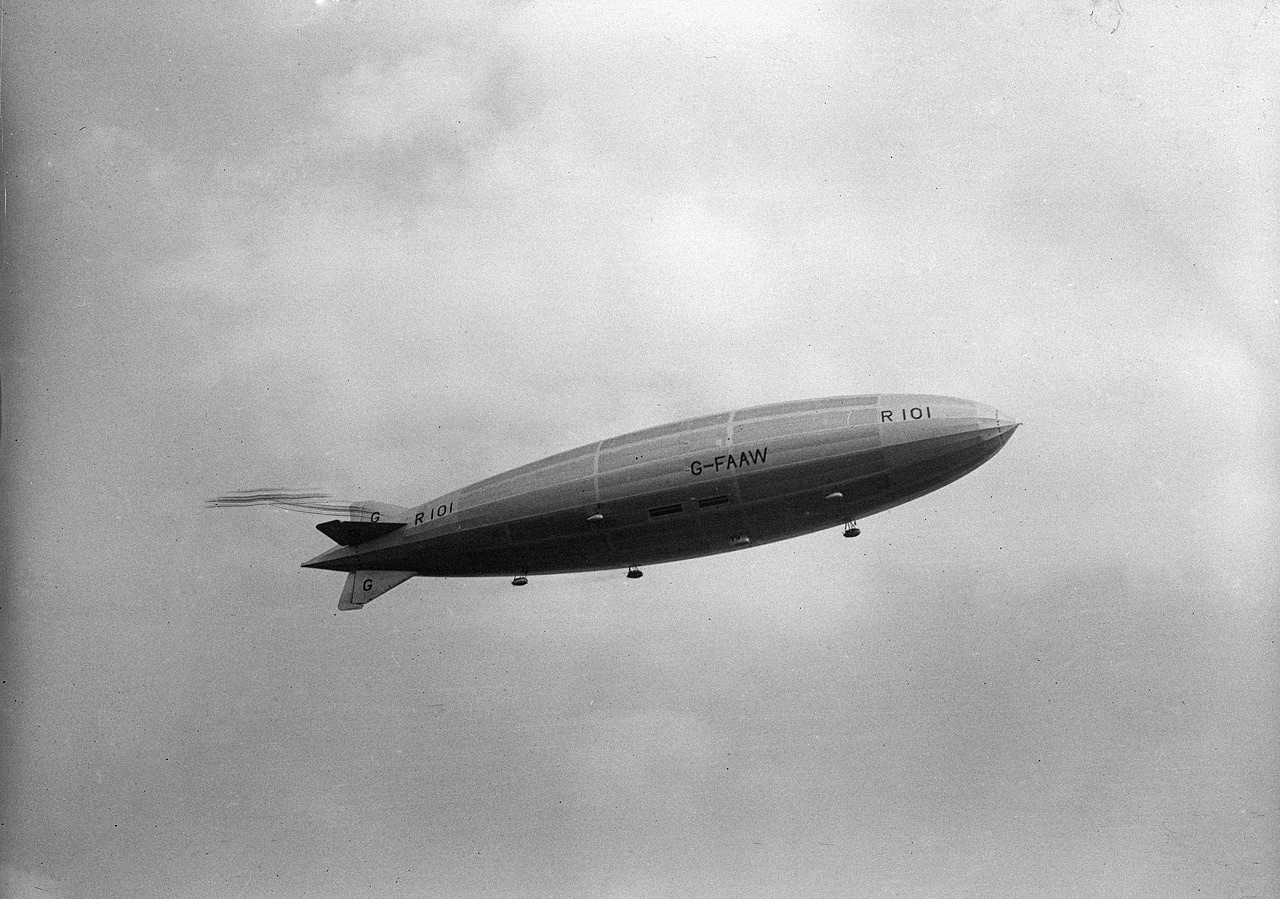
She flew on three successive days, about thirty hours in all, and what the officers who flew in her noticed was that she was heavy. Squadron Leader Ralph Booth, captain of R100, told the inquiry that on 27 June “she was getting heavier than seemed to be consistent with the temperature and the height at which we were flying”, and that nine tons of ballast had gone over the side in a day.
On 29 June she went into the shed for the last time, to be cut in two. Irwin’s report on the June flights said that “the non-padding of girders before inflation and flying has resulted in an abundance of holes in gasbags.” Richmond’s minute the next day worked out that “the rate of loss of lift is about 1 ton per square inch of opening in 12 hours”, a result he called “somewhat startling”.
Then on 3 July the inspector wrote to London. McWade did not minute his immediate superior; he wrote to the Secretary of the Air Ministry, for the attention of the Director of Aeronautical Inspection, because it would fall to him to hand the ship her next Permit to Fly. The gasbags, he wrote, “are now hard up against the main longitudinals and rubbing very hard on the nuts of the bolts”; the matter “has become very serious, as the points of fouling occur throughout the ship and amount to thousands.” Padding on this scale was “very unsatisfactory, because the bags move when the ‘ship is in flight and the padding becomes loose and the projection complained of is again exposed.” He ended: “Until this matter is seriously taken in hand and remedied I cannot recommend to you the extension of the present ‘Permit to Fly’ or the issue of any further permit or certificate.”
Outram received it on 4 July and did the correct thing: he told Colmore that he would have to put the letter before Higgins, and asked for Colmore’s comments first. Colmore replied on 8 July that “we cannot accept, as a matter of principle, that the gasbags in an airship should be clear of all girders”, and that “we have little doubt that padding will be a permanent remedy.” Outram was satisfied, and decided it was not necessary to send McWade’s report to the Air Member after all; his closing minute told McWade that “the only expedient at the moment is to pad”. The companion piece “The papers” gives these documents in full.
“The result, therefore,” the inquiry found, “was that neither the Secretary of State nor any member of the Air Council learned anything about it.” It explained why without blaming anyone. The men who knew airships were all at Cardington; the men above them in London had grown up with aeroplanes; and so the Air Ministry “inevitably looked to Cardington, to a very large extent, to solve its own problems.”
The same month the calendar closed in. Thomson had minuted on 2 July: “I should like to be able to count definitely on starting for India during the week-end September 26-28th. I ought to be back by October 16th.” Colmore’s progress report of 11 July said the ship might be complete by 22 September, “but we have no allowance in our programme to cover unforeseen delays.” When Higgins proposed holding the cutting-open for a week, in case R100 failed her last trial and R101 was needed for Canada, Thomson answered the same day, 14 July:
“So long as R.101 is ready to go to India by the last week in September this further delay in getting her altered may pass.
“I must insist on the programme for the Indian flight being adhered to, as I have made my plans accordingly.”
Higgins minuted that the date “does not leave any margin for unforeseen circumstances” and “assumes that the trial flight will be completely successful.” Thomson wrote back: “I am sure everything possible will be done and am not unduly pessimistic.” The ship was cut in two before the end of July.
While she lay in halves, R100 went to Canada. She left Cardington on 29 July, mended a torn fin in the air, was thrown up from 1,500 to 4,000 feet by a thunderstorm over the St Lawrence, and moored at Montreal after seventy-nine hours. She came home in fifty-seven, on 16 August, with Scott, Colmore, Johnston and Giblett aboard, and Thomson met her at the tower and told Colmore he might “look forward with quiet confidence to the successful completion of the great experiment with which you have been charged by His Majesty’s Government.”
On 26 August Thomson’s private secretary set down the five things on which the date now depended, the last of them “the carrying out of a satisfactory trial flight of not less than 24 hours between being taken out of the shed and starting on the flight to India.” There would be six days for the trial and the start: “no margin, but may just be possible.” When Colmore then said he could not have the ship out by 22 September, Thomson replied that he could probably arrange for the Imperial Conference, the meeting of Dominion leaders then gathering in London, to take its air business about 20 October. Colmore was to start on 4 October if he could and be back about the 18th or 19th.
The ship was complete on 25 September. On the 26th Bairstow’s sanction for a Permit to Fly “was obtained by telephone”; his report was to follow in time for the certificate. On 1 October he wrote the letter with which this entry began. The draft he never finished said: “It is our opinion that the newness of the venture would have justified complete recalculation of the stresses in R.101 when the magnitude of the changes in fixed weights had been realised. Such recalculation was at one time proposed.”
On the evening of 30 September, the day before she came out, Colmore asked the Air Ministry whether the trial could be shorter than twenty-four hours “if the ship behaved well, and if Major Scott was satisfied.” Dowding asked him why. Colmore said: “So that we may have a chance, if all goes well, of starting on Friday evening. We shall thus have all Thursday to work on the ship, as well as Friday.” Dowding agreed, and went along.
R101 was walked out at half past six on the morning of Wednesday 1 October and slipped the tower soon after four. She flew over London and down the Thames, spent the night off the east coast, and came back to Cardington on Thursday morning: sixteen hours and fifty-one minutes. An oil cooler burst early in the starboard forward engine, so there was no full-speed test. Richmond’s diary has it in three lines: “Impossible to carry out full speed test owing to the early failure of the oil cooler in the forward starboard engine. Flying conditions were very perfect, and under these conditions, all other items in the ship behaved admirably.” No written report on the flight was ever found. It had taken four years to reach this trial, and the trial lasted a night.
On Thursday evening Colmore went up to London to settle the start with Thomson, Dowding beside him, and Saturday evening was agreed. Dowding told the inquiry that the Secretary of State said something to this effect: “You must not allow my natural impatience or anxiety to start to influence you in any way. You must use your considered judgment.” The private secretary’s note of the meeting is shorter. “Colmore: ‘Leave Saturday 5 or 6 o’clock.’ Thomson: ‘No rush on my account.’” Dowding pointed out that the ship had never done a full-power trial; the note records that she “ought to do full-power test near home”, and the flight instructions issued the next day said nothing of it. As the meeting ended Thomson said: “Well that is all settled; I can make certain of being back on the 20th.”
That is the trial the certificate of 2 October stood on. The ship’s own captain had drawn up, much earlier, the trials he thought she needed: flights in good weather, then twenty-four hours in reasonably adverse weather, then “a flight of 48 hours’ duration under adverse weather conditions to windward of base. Ship to be flown for at least 6 hours continuous full-speed through bumpy conditions and the rest of the flight at cruising speed. Ship to be berthed in shed as soon after landing to mast as possible, and a complete bow to stern inspection carried out.” Booth testified that Irwin had told him, before the ship left the shed, “that he hoped they would fly 36 or 48 hours at a reasonable cruising speed in bad weather in order to thoroughly test out the ship”, and that he had no reason to think Irwin had changed his mind. McWade, asked at the inquiry whether he thought padding a satisfactory cure, said he did not, and that had it been left to him the airship would not have received a certificate of airworthiness.
What it looked like from inside
Atherstone’s diary for Friday 3 October, after a day of last checks: “Everybody is rather keyed up now, as we all feel that the future of airships very largely depends on what sort of a show we put up. There are very many unknown factors, and I feel that that thing called ‘Luck’ will figure rather conspicuously in our flight. Let’s hope for good luck and do our best.” The same day Thomson wrote his will.
The forecasts handed to Irwin on Saturday gave winds of twenty to thirty miles an hour at 2,000 feet over France that night. The barometer was falling, and Scott wanted everyone aboard early. She slipped at 6.36 in the evening by Greenwich time, with fifty-four aboard and twenty-five tons of fuel, dropped four tons of water to get clear of the tower, and circled Bedford as the drizzle began. An hour and a half later Cardington wirelessed her a new forecast: forty to fifty miles an hour at 2,000 feet over the Channel and northern France, “a velocity”, Colonel Moore-Brabazon wrote for the inquiry, “which no British airship had met with over land before.” She crossed the French coast at 11.36. At eighteen minutes past midnight Cardington received her position fifteen miles south-west of Abbeville, making thirty-three knots against a wind of thirty-five miles an hour at 1,500 feet, and then:
“After an excellent supper our distinguished passengers smoked a final cigar and having sighted the French coast have now gone to bed to rest after the excitement of their leave-taking. All essential services are functioning satisfactorily. The crew have settled down to watch-keeping routine.”
At 1.52 she acknowledged a position from Le Bourget. It was the last thing she sent. At two the watch changed in the ordinary way, which the inquiry took to mean that the captain then knew of nothing wrong. Joe Binks walked aft along the keel to relieve Arthur Bell in the after engine car and climbed down at three minutes past two, by his watch; Bell stayed to tell him he was late, which is why Bell lived. Then the ship put her nose down. The dive lasted, both men agreed, not much more than thirty seconds. In the smoking room it threw a siphon and glasses off the table and slid Harry Leech, the foreman engineer, along the settee into the bulkhead. Then she came level, for ten seconds by Binks’s reckoning and five by Bell’s. Leech put the siphon and the glasses back. In those seconds the chief coxswain, Hunt, came aft from the control car past the bunk of Arthur Disley, the electrician, and said, “We’re down, lads.” The engine telegraphs rang “slow”. A rigger, Samuel Church, “received an order to release an emergency forward water ballast (½ ton) but before I could get to it the crash came.” She went into her second dive, and a few seconds later the nose touched. “There was no very violent jar; the striking was more of a ‘crunch.’” The lights went out, and within a second there was flame. The companion piece “The last watch” gives the whole of the last flight as the survivors and the wireless log recorded it.
She had struck with the underside of her bow, at between fifteen and twenty-five degrees, and stopped with her bow in a wood of small trees and her stern in a meadow. Her elevators were hard up; the turns of wire on the drum in the control car proved it. Six men got out alive: Leech, who went back into the wreck for Disley, Binks, Bell, Alf Cook and Victor Savory from the engine cars, and Disley himself, who walked to a telephone and told the Air Ministry at four in the morning. Church and a rigger named Radcliffe got out burnt and died in the hospital at Beauvais. Forty-six died where she lay.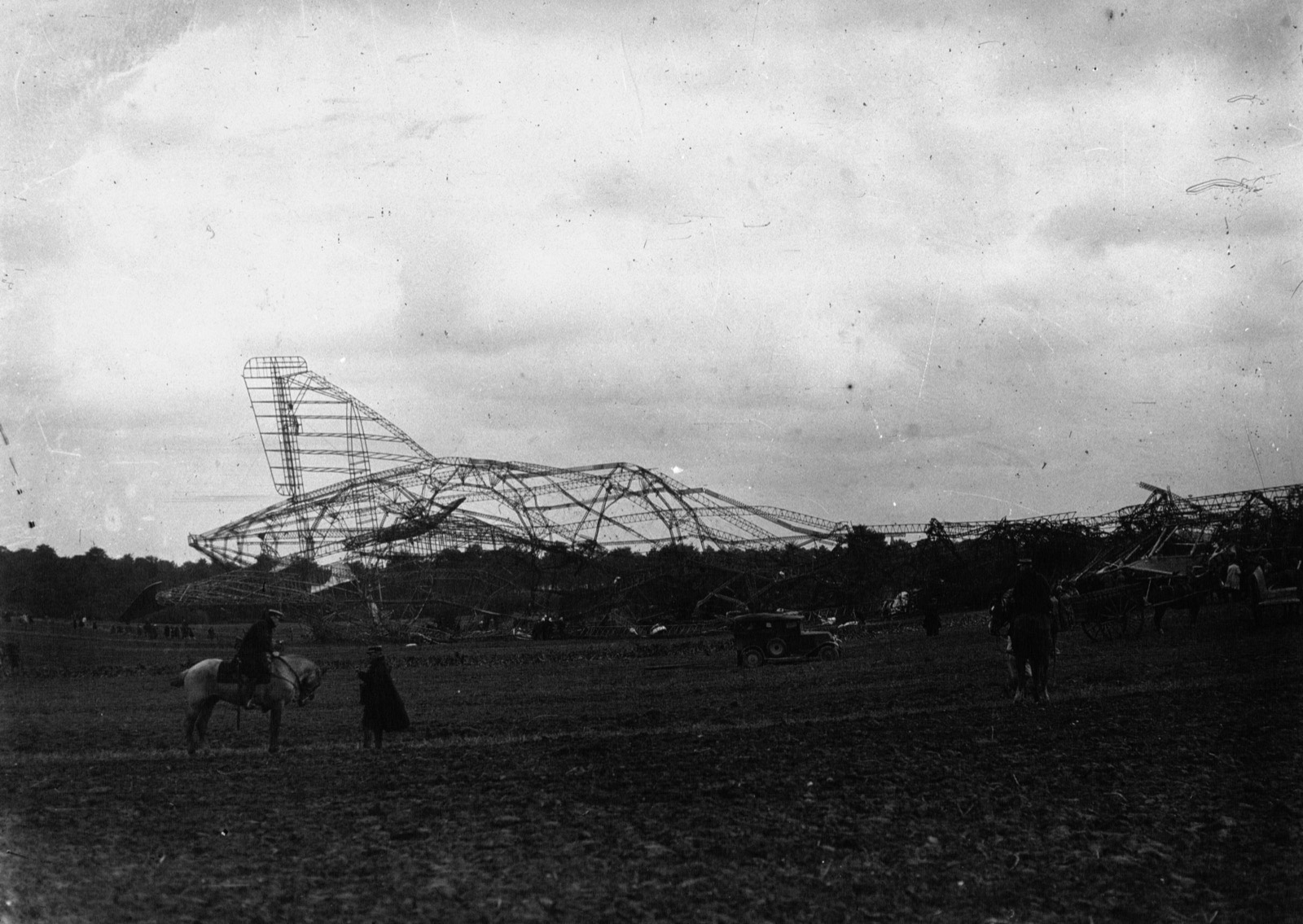
What happened
On the Sunday the Chief of the Air Staff flew to Beauvais with the Inspector of Accidents, Bairstow, Booth, McWade and the technical men from Cardington to go over the wreck with the French. No part of the structure had broken in the air; she had hit nose down with the elevators full up and the rudder straight; the fire had come at or just after the impact. On Friday 10 October the forty-eight coffins lay in state in Westminster Hall, with a queue half a mile long, and on the Saturday they were buried in one grave at Cardington, by the airship station, with the spare watch of R101 and the crew of R100 marching behind them.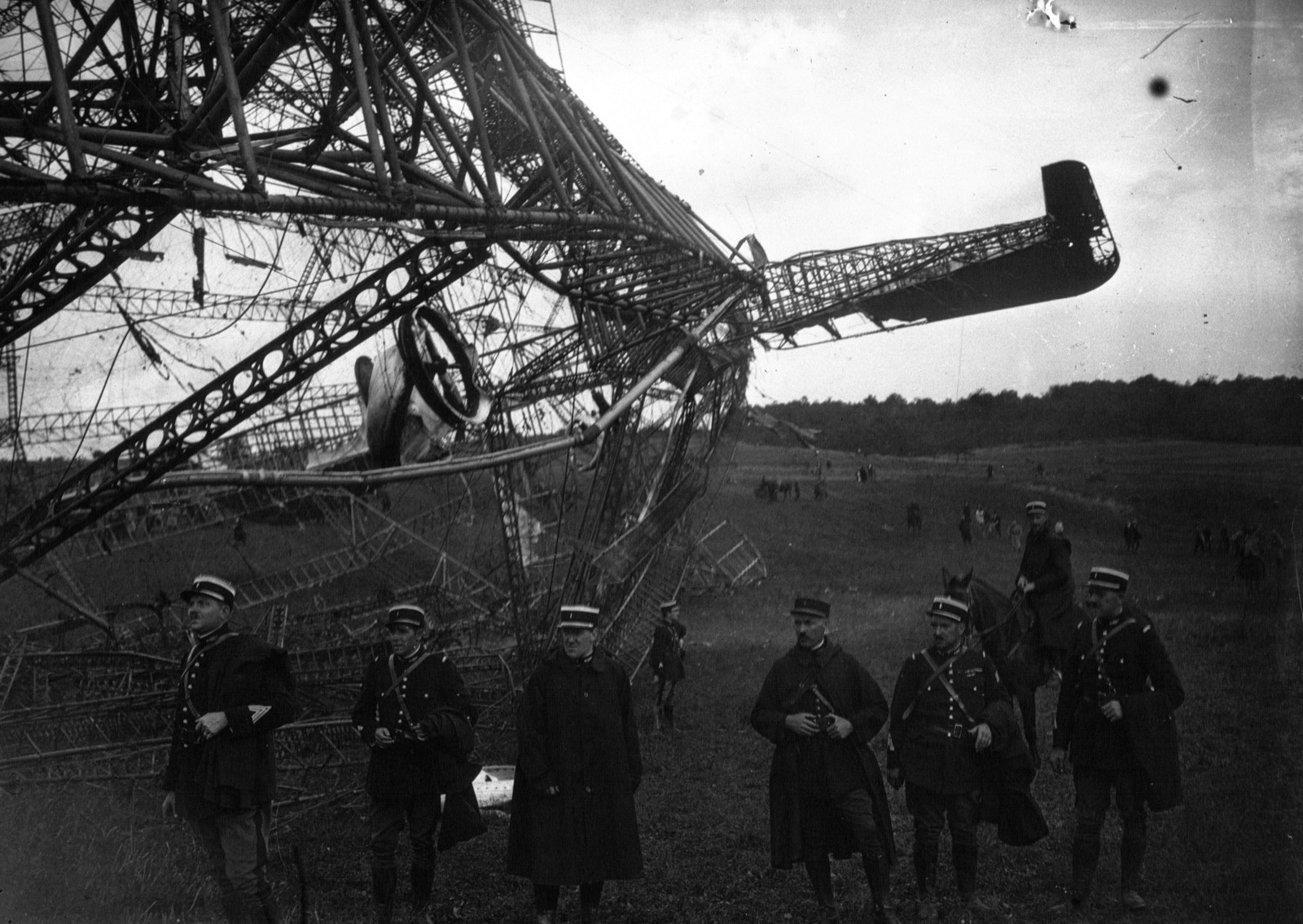
On 22 October the new Secretary of State, Lord Amulree, ordered a public inquiry under Sir John Simon, with Lieutenant-Colonel Moore-Brabazon and Professor Charles Inglis as assessors. It opened at the Institution of Civil Engineers on 28 October, sat thirteen days in all, and heard forty-two witnesses, among them the six survivors, Higgins, Dowding, Outram, McWade, Booth and Eckener. On 7 November Simon announced that two documents had just come into his possession which had not been produced before: Richmond’s minute on the ton per square inch, and McWade’s letter. The Solicitor-General said the file had been put aside for copying and overlooked. The same week 139 men and 94 women of the 750 at the Royal Airship Works were given notice.
The report was signed on 27 March 1931 and published on 1 April, the two assessors agreeing “in every word.” Its cause was gas. It took as established that at the change of watch there was no known cause for alarm; that the wind at her height was forty or fifty miles an hour in fierce gusts; that “the ship in her trials had lost gas at an abnormal rate … certainly by the wearing of holes in the gasbags, and perhaps through her valves when she rolled”; and that five minutes after two her nose went down. It rejected structural failure, failure of the controls, error by officers or crew, and weather alone. A ship in a normal condition would have climbed again after the first dive. That she did not “proves almost conclusively that it was not want of manoeuvring space, but a serious loss of buoyancy”, in the fore part of the ship. “How the vessel began to lose gas can never be definitely ascertained. The weather was exceptionally bad; the gasbags were hard up against padded projections, some of which may have begun to wear the fabric”; earlier flights had shown leakage through chafing and through valves opening as she rolled; and the sudden loss at the end was most probably a rip in the fore part of the cover. “But whatever the precise circumstances may have been, the explanation that the disaster was caused by a substantial loss of gas in very bumpy weather holds the field. This is the unanimous view of all the three members of the Court of Inquiry.”
On the decision to go the Court wrote the paragraphs for which it is remembered. “She had never gone through trials which proved by their length and conditions that she was well able to cope with a continuance of unfavourable circumstances. The programme of trials drawn up by her Captain had never been carried through, and the intended length of her last trial was avowedly cut down in order to provide a little more time for preparation before the date which was contemplated for her to start for India. No adequate speed trials had ever been carried through, and indeed this fact was so clearly realised that an official of the Air Ministry urged that she should conduct such speed trials on her voyage to India.
“It is impossible to avoid the conclusion that the R.101 would not have started for India on the evening of October 4th if it had not been that reasons of public policy were considered as making it highly desirable for her to do so if she could.”
It then said what it did not mean. Thomson “expressly stated that he relied on his experts, and it must never be forgotten that he was entitled to do so”; Colmore and Scott would never have accepted “without the strongest protest” a course they judged to risk the enterprise and the men. The atmosphere of the decision was “made up of several elements”: years of waiting; “the stimulus arising from the fact that the R.100 … had made its journey to Canada and back without serious mishap”; and “the personality of the Secretary of State”, whose resolve to travel in the ship himself “gave the cachet of Government support in the most striking way”. Its last paragraph began: “Airship travel is still in its experimental stage. It is for others to determine whether the experiment should be further pursued.”
After
The others were the Commons, on 14 May 1931. MacDonald put two courses before the House: scrap R100 and stop, or keep a nucleus of research at Cardington and recondition her; the government recommended the second. Simon, speaking as a member, said that “much too sanguine and confident a tone was adopted about airships” and asked whether the Air Council should not contain “a man whose principal qualification is very high scientific attainment.” Sir Philip Sassoon said that “the thing which surprises one is the very scanty nature of the trials undertaken with the R 101”. Then the financial crisis of that summer overtook the question. In 1933 Sassoon told the House that the year before it had been decided “to break up the R.100 and curtail airship work to a minimum.” Norway reckoned she had cost about £450,000 and fetched about £500 as scrap. “There was nothing whatever the matter with the ship.” Britain built no more rigid airships.
The argument did not stop. Norway’s account of 1933 in Blackwood’s, and his autobiography Slide Rule in 1954, fixed in print the view from Howden: that both long flights “were dictated by political motives alone”, and that “considered purely from the technical aspect, it was not prudent for either airship to attempt a long flight at that stage of development. We did it, and got away with it.” Sir Peter Masefield’s To Ride the Storm in 1982, written from Cardington’s surviving papers, argued that the ship was better than her legend and that the weight-cutting, the padding and the bay had all been forced on her designers by the one shortfall of lift. The Airship Heritage Trust’s study of 2015 calls the cause still inconclusive. On one thing the inquiry, the critics and the defenders agree, and it is the subject of this entry.
What it taught
The Imperial Airship Scheme was designed as an experiment, and a well-designed one. It had a written hypothesis, six requirements, a control in the form of a second ship built to the same specification by different people, and a test: a flight to a far terminal and back. What it never had was a rule for reading the result.
The instrument was the trials programme, and it was read backwards. Every measurement the ship made of herself was recorded, from seventeen tons of engines to 103 holes in one bag, and each was answered not by a longer trial but by a shorter one. The standard for the certificate was set in December 1929 at forty-eight hours of endurance; in August 1930 it was “not less than 24 hours”; on 30 September it became less than that “if the ship behaved well”; on 2 October it was sixteen hours and fifty-one minutes in weather Richmond called perfect, with one engine out and no speed test. Irwin’s list, forty-eight hours to windward in bad weather with six at full speed, was the only version of the instrument that measured what the ship had to do. Nobody cancelled it. The ship simply left before reaching it.
A warning stops where the people who must fix it are also the people who judge it. McWade’s letter was the one reading that went past Cardington, addressed to the head of his own directorate precisely so that it would not be judged by the men it was about. Outram did the proper thing and asked them anyway. Colmore’s answer was reasonable, and he believed it, and it was the end of the matter. A ministry that cannot judge an answer can only ask whether the people who gave it are confident. They were.
A certificate certifies the reports furnished. When the report has not been written, it certifies the calendar. The form of 2 October was true in every line: 777 feet long, five Tornadoes of 585 horsepower, smoking in the smoking room only. The one thing it attested, airworthiness “having regard to the Reports furnished”, was the thing that did not exist; the Air Council had said in June that it would be guided by the consultants’ report in deciding whether to grant it, and Bairstow was still writing it on the Sunday. A document that attests a judgment is only as good as the moment at which it is signed, and this one was signed at the moment the timetable required.
Pressure that disclaims itself is still pressure. Thomson was, by every record, honest. He chose delay in November 1929; he told the press his policy was safety first; he told Colmore on 2 October to use his considered judgment. He also minuted “I must insist on the programme for the Indian flight being adhered to”, arranged the Imperial Conference around his return, and said “I can make certain of being back on the 20th.” Both sets of words were sincere, and the men at Cardington could hear only one of them, because only one had a date in it. Booth said it without heat: their judgment “was biased by the fact of the Imperial Conference coming off, and the psychological moment in airships when they could carry the Secretary of State to India, and bring him back to time.” Had there been no conference, “I feel confident that they would have insisted upon more trials, as was done in the case of R.100 before she left for Canada.” The experiment’s sponsor was its passenger, and his seat was its deadline.
The comparison was the experiment, and nobody compared. Two ships were built so that the better method would show. The private ship was rougher, leaked more, tore her fins, and flew: seven flights, 150 hours, fifty-three of them in one stretch, repeatedly at full speed, before she was sent across the ocean. The state ship was finer, costlier and heavier, and flew 127 hours in all, never at full speed, and sixteen of them after being rebuilt. That result was available to the Air Ministry in August 1930, when one ship had just come back from Canada having done the trials the other was about to skip. The ministry treated R100’s success as “stimulus”, as evidence that airships worked, rather than as the control it was. The gods’ question was answered, and never read, because the two halves of the experiment were not set side by side until a court did it.
The complication is that the trials might not have saved her. The cause the inquiry settled on was gas lost in bumpy air, through chafing at padded points and valves that opened when she rolled, and perhaps a rip in the cover. Flight’s editor, reading the report, thought it “not unreasonable to conclude that the greater test included the lesser”, since a ship that had stood an eighty-mile gust at the tower might be expected to stand fifty in free air. A forty-eight-hour flight in calm weather would have shown nothing. Only the flight Irwin wrote, to windward in bad weather, would have put her gasbags against their pads in the conditions that mattered, and that is the flight that was never made, so the claim that she would have come home from it cannot be tested. What can be tested is the other way round. Her captain had written down how to find out whether she was fit to go, and she went without finding out. Everything the ship had said about herself in a year of trials pointed one way, and the programme that would have listened was shortened until there was nothing left to hear.
Sources
- Sir John Simon, with Lt-Col. J. T. C. Moore-Brabazon and Professor C. E. Inglis, Report of the R.101 Inquiry, presented to Parliament March 1931, Cmd. 3825 (HMSO, 1931). The 1924 programme and its requirements; the design, engines, gasbags, wiring and valves; the lift figures; every trial flight; Hunt’s report on the gale; the winter minutes of Thomson, Higgins and the Air Council; the holes found in December 1929 and the four thousand pads; the June flights and Booth’s evidence; Irwin’s report, Richmond’s minute, McWade’s letter, Colmore’s reply and Outram’s minutes; Thomson’s minutes of July; the memorandum of 26 August; Bairstow’s letter of 1 October and his draft; the curtailed trial and the conference of 2 October; the certificate; Irwin’s trial programme; Atherstone’s diary; the last flight, the wireless messages, the survivors’ evidence and the cause; and the appendices listing those on board, the flights and the weather. Scanned copy, Airship Heritage Trust. airshipsonline.com; catalogue record, Cranfield University
- Air Ministry, Certificate of Airworthiness No. L/A. 6 (Airships), G-FAAW, R.101, dated 2 October 1930. The form, its particulars and its wording. airshipsonline.com
- Royal Airship Works, Flight Instruction Serial No. 32, Captain R.101, 3 October 1930, with addenda. The object of the flight and the dinner party at Ismailia. airshipsonline.com
- Flight, 3 October 1930 (“R101 Out Again”); 10 October 1930 (“The Loss of H.M. Airship R101”, the eyewitness account of the departure, the messages, the list of dead and survivors, the obituaries); 17 October 1930 (the lying in state and the funeral); 31 October and 7 November 1930 (the inquiry’s opening, the Cardington dismissals); 14 November 1930 (McWade’s and Booth’s evidence, Thomson’s will); 5 and 12 December 1930 (Eckener’s evidence, the close); 3 April 1931 (the report and the editorial on it). 3 Oct, 10 Oct, 17 Oct, 31 Oct, 7 Nov, 14 Nov, 5 Dec, 12 Dec, 3 Apr 1931
- Flight, 4 July 1930 (R101 at the Hendon Display), 8 August 1930 (“R100 Flies to Montreal”) and 22 August 1930 (the return, Thomson’s welcome and Colmore’s broadcast). 4 Jul, 8 Aug, 22 Aug
- Nevil Shute, “The Airship Venture,” Blackwood’s Magazine, May 1933. The view from Howden: the gods’ question, the engines, R100’s trials, the first sight of R101 in the shed, the political motive of both long flights, the cost and the scrap price. archive.org
- Hansard. Commons, 28 October 1930, Debate on the Address, MacDonald’s tribute; 29 January 1930, “Airships (Cost)”, the estimates for R101 and the contract price of R100; 14 May 1931, “Airship Policy”, MacDonald’s two courses and the cost of the programme, Simon, Sassoon, Hoare and Montague; 14 March 1933, Supply, Sassoon on the breaking up of R100. Lords, 25 November 1930, the Air Ministry’s papers for the inquiry. 28 Oct 1930, 29 Jan 1930, 14 May 1931, 14 Mar 1933, Lords, 25 Nov 1930
- Airship Heritage Trust, “The R101 Story: a review based on primary source material” (Journal of Aeronautical History paper 2015/02), with its quotations from Atherstone’s and Richmond’s unpublished diaries, the Air Ministry files and the Masefield archive; and the Trust’s R.101 pages, including the flight log and the passenger and crew list. review, R.101
- Bedfordshire Archives, “Causes of the R101 Disaster”, for the inquiry’s dates and the transcript held at Bedford. bedsarchives.bedford.gov.uk
- Photographs: R101 at the Cardington tower and over London, Agence de presse Meurisse, October 1929, and the wreck at Allonne, Agence Meurisse, October 1930, Bibliothèque nationale de France, via Wikimedia Commons; R101 over Hendon, 28 June 1930, gelatine dry plate, Henley Collection, National Maritime Museum, Greenwich, no known copyright restrictions. Cardington, London, Hendon, wreck, gendarmes


