On the afternoon of 26 November 1918, in a ward of the United States Naval Hospital at Chelsea, Massachusetts, where thirty men lay ill with influenza, ten sailors were brought in one at a time and introduced to the patients.
Each sailor sat down beside a bed, shook the patient’s hand, and talked with him for a few minutes. Then he put his face about two inches from the patient’s face. The patient breathed out as hard as he could, five times, directly into it, and the sailor breathed in as the patient breathed out. Then the patient coughed into his face, five times. Then the sailor got up, went to the next bed and did it again, until he had done it with ten different men in ten different beds. The whole circuit took each sailor between thirty and fifty minutes.
“Muzzle to muzzle,” the officer who designed it told a medical meeting the following summer, “in accordance with his instructions, about 2 inches between the two.”
The ten sailors had been sprayed in the nose and throat five days earlier with the pooled secretions of four other influenza patients. They were watched for a week afterwards. Nothing happened to any of them, and nothing had happened to any of the fifty-two others either.
Three days before the ward, nineteen of those others had taken the raw nasal secretions of ten men transferred on swabs, nose to nose, within thirty seconds of collection. Every one of those ten donors had come off a single small gunboat lying in Boston harbour, the USS Yacona, where 80 men out of 95 had gone down with influenza inside a fortnight: an attack rate of 84.2 per cent, which is about as communicable as a disease gets. The experiment took what the ship had, moved it half a mile, and could not make it work.
Who ran it
The man at the head of it was Milton Joseph Rosenau, born in Philadelphia on 1 January 1869, who in the autumn of 1918 was forty-nine years old, the first professor of preventive medicine at Harvard, the author of the standard American textbook on the subject, and a lieutenant commander in the United States Naval Reserve Force. The uniform is the part his biographers leave out. The reference works record the professorship, the textbook, the school of public health he helped build at Harvard, and the one he went south to build at Chapel Hill in his late sixties. None of them mentions that he spent the worst months of the pandemic as a naval officer on an island in Boston harbour trying to give influenza to sailors. The only documents that record it are the documents of the experiment.
Before Harvard he had run the Hygienic Laboratory of the United States Public Health Service, from 1 May 1899 to 30 September 1909: the small federal laboratory that would grow into the National Institutes of Health. The man who held that post in 1918, George W. McCoy, ran the other half of the same experiment, three thousand miles away, at the quarantine station on Angel Island in San Francisco Bay, told in the companion piece The San Francisco series. The laboratory’s past director and its present one were working the two ends of one question in the same weeks, and neither of them could answer it.
With Rosenau at Boston were Lieutenant W. J. Keegan of the Navy, from the naval hospital at Chelsea, who had written one of the first clinical descriptions of the epidemic for the Journal of the American Medical Association in September; Passed Assistant Surgeon G. C. Lake of the Public Health Service; and Surgeon Joseph Goldberger, also of the Public Health Service, who three years earlier had produced pellagra in eleven convicts at a Mississippi prison farm by feeding them, and had then tried and failed to pass it from the sick to the well. Goldberger is the one man on the island who had already run a human experiment that produced a disease on purpose, and another that failed to pass one on, and had defended both in public. His pellagra work is told in Eleven Convicts.
The Navy’s Bureau of Medicine and Surgery, under Surgeon General W. C. Braisted, authorised the work and provided the hospital, the volunteers and most of the officers; the Public Health Service, under Surgeon General Rupert Blue, provided the island, the laboratory and Goldberger. The Navy’s own account of the arrangement is plain about the timing: “Just after the crests of the earlier epidemics were reached two series of experiments were authorized by the Navy Department … for the purpose of determining, if possible, the mode of transmission of influenza as well as the causative agent.”
Just after the crest. That is the first fact about the experiment, and it never stopped mattering. In the month the work was authorised, the thing being studied had already passed through the men who were going to be studied.
The officer commanding the quarantine station where it was done was Surgeon Donald Herbert Currie of the Public Health Service, port physician of Boston, forty-two years old, who had spent eight years in the Hawaiian Islands in charge of the leper settlement on Molokai and was regarded as the foremost American authority on leprosy. He gave the experimenters the run of his island. The report thanks him “for many courtesies and facilities,” and then, in the same sentence, records what happened to him: “Toward the close of the study, Dr. Currie contracted influenza, complicated with pneumonia, and died.”
What they were trying to find out
The hypothesis was two claims wearing one coat, and the report states them in its title: the cause of influenza, and the mode of its spread.
The first claim was about an organism. Since 1892 the accepted cause of influenza had been a small gram-negative rod isolated by Richard Pfeiffer in Berlin and named Bacillus influenzae. In the autumn of 1918 it was being recovered from the throats and lungs of the dying in enormous numbers, which looked like confirmation and was a different thing: most of those who died died of bacterial pneumonia on top of whatever had knocked them down, and Pfeiffer’s bacillus was one of the organisms that did the killing. The Service had already spent the autumn making vaccines against it.
The second claim was about a route, and the Navy stated the premise without embarrassment: “While it is presumed now, just as it was before the pandemic, that the causative agent of influenza is transmitted from person to person, either directly or indirectly, by moist secretions or fresh discharges from the mouth and nose no proof of this has been forthcoming.” Placards were going up in every American city about coughing and spitting, and nobody had ever demonstrated the thing the placards assumed.
There was a third thing in the design, and it is the reason the experiment took the shape it did. On 1 September 1918, in Tunis, Charles Nicolle and Charles Lebailly had reported giving influenza to two healthy volunteers with filtered sputum from a patient on the third day of his illness, and had concluded that the agent passed a filter: that it was not a bacterium at all. Bulletin 123 cites them twice, in the headnotes to Experiments 5 and 6, both times with the phrase “following Nicolle and Lebailly.” The Americans were not groping in the dark. They were repeating, with more men and better controls, an experiment that had just been reported to work.
And there was a fourth thing, which nobody could state as a hypothesis because it was not yet a question anyone knew how to ask. There was no test for influenza: no culture, no stain, no serology, nothing. A diagnosis in 1918 was a doctor looking at a man and deciding, from fever, headache, backache, flushing and a cough, whether this was the disease or something else. Every arm of the experiment, at both ends, rested on that judgement, and the whole programme would founder on it.
What they built
Gallops Island is a small island in Boston harbour, about sixteen acres, six miles down the bay from the city, a quarter of a mile from the nearest land. It was the quarantine station for the port of Boston: about thirty buildings, with hospital beds for a hundred and detention space for 1,300. It was chosen because it could hold healthy men completely apart from everyone else, so that if the experiment worked the disease would go no further than the men who had agreed to take it. The first plan, Bumkin Island, was dropped because a thousand sailors were training there. Rosenau called it “peculiarly well fitted for operations of this kind.”
The volunteers came from the United States Naval Detention Training Camp on Deer Island, four miles up the harbour: the camp the Navy had made in January 1918 out of the women’s prison at the Boston House of Correction, where sailors who had broken ship or overstayed leave were sent for training and discipline. A German-language paper in Washington called it the navy prison and the men guinea pigs; the experimenters called them volunteers, and so did everyone else, and what the word is worth in a detention camp is a question the record raises and does not settle.
The roll was printed. The report lists every man who came forward by name — Dewey Lavern Abney, Robert Andrew Allan, Arthur Raymond Anderson, Joseph Real Bolduc, and sixty-four more — under the sentence “Following is the list of names of those who volunteered to take influenza for the purposes of these experiments.” Sixty-eight names. Of those, 62 were put through the experiments, and it is the 62 that the report counts and analyses. The earliest official summary said 68, and the Navy and the medical press copied it; Rosenau, from a podium the following June, said a hundred all told, which is near enough the two Boston series added together. The numbers reconcile if 68 offered themselves and 62 were used.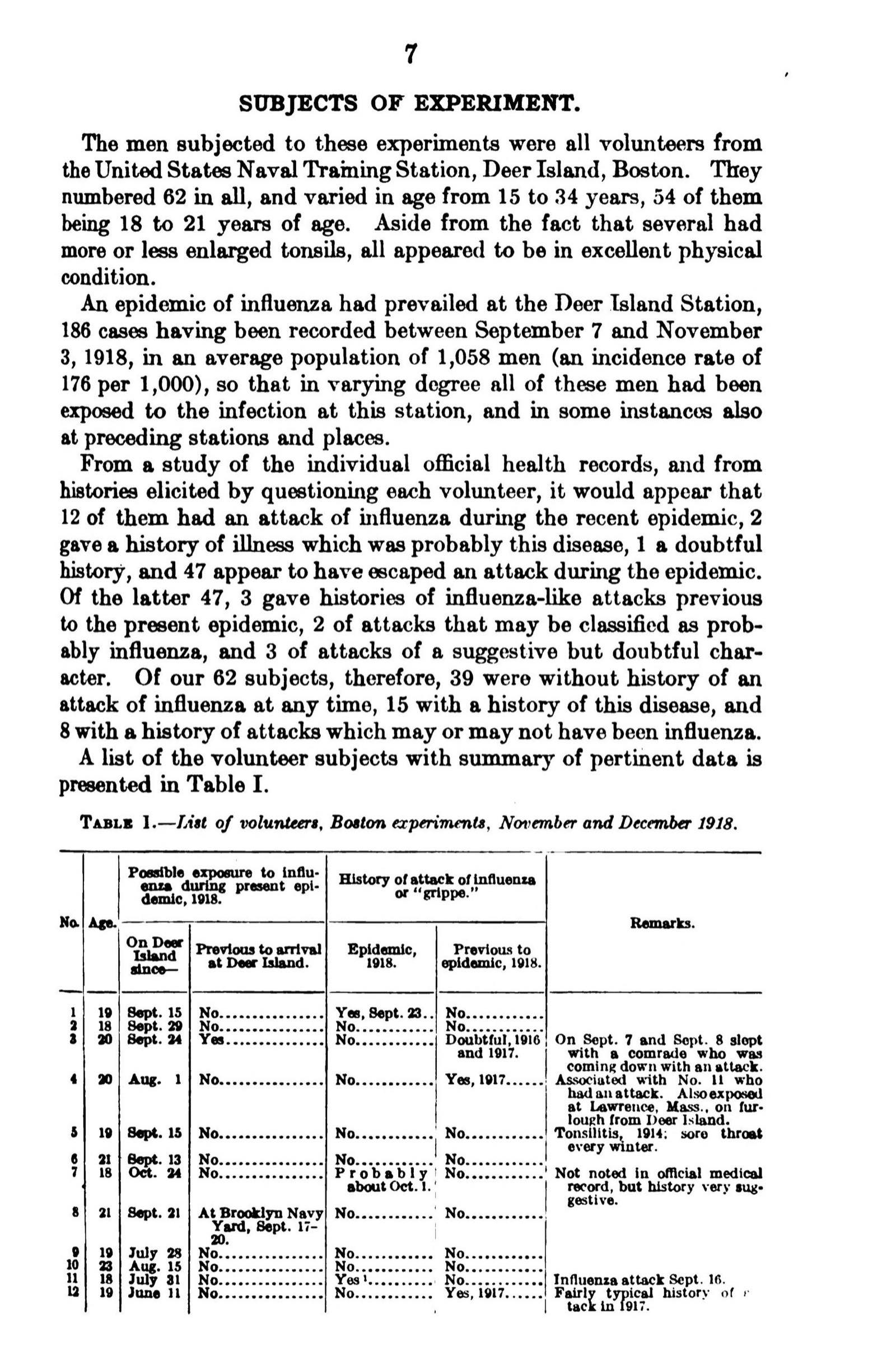
They were young: fifty-four of the 62 were between eighteen and twenty-one, the youngest fifteen and the oldest thirty-four. And they had all been living in the middle of the epidemic. The report says so in a sentence that is the hinge of everything that followed: 186 cases of influenza had been recorded at the Deer Island station between 7 September and 3 November 1918, in an average population of 1,058 men, “so that in varying degree all of these men had been exposed to the infection at this station, and in some instances also at preceding stations and places.”
The experimenters then did the thing that makes the report honest. They took each man’s official health record, questioned him, and wrote down what he said: twelve had had an attack during the epidemic just past, and 47 appeared to have escaped. So of the 62, by the report’s summary on page 7, 39 had never had influenza at any time, fifteen had, and eight were doubtful. Thirteen pages later the same report divides the same men 39, fourteen and nine. Both add to 62 and they do not agree with each other, which tells you how soft the underlying judgement was.
What none of them could know, and what makes the arithmetic beside the point, is that a man who lives through an influenza epidemic in a barracks of 1,058 men may be immune without ever having been ill. The table of volunteers carries, against number 3, aged twenty, the remark: “On Sept. 7 and Sept. 8 slept with a comrade who was coming down with an attack.” He is listed as having no history of the disease. He is in the column of the susceptible.
The donors came from the naval hospital at Chelsea, from the Peter Bent Brigham Hospital, and above all from the Yacona, a small gunboat back from Bermuda that had taken influenza aboard at New London and put into Boston on 22 November to land her sick. Over four days she transferred 72 men and six officers to the hospital. Counting two put ashore earlier, 80 of the 95 men in that isolated ship’s company had the disease, 84.2 per cent. One, a man named McCormack, died after seventy hours, and from him was cultured the strain the report calls culture No. 1, which would shortly be sprayed into nineteen men’s noses. Her medical officer’s account of it is printed as an appendix to the report.
The equipment was ordinary and the technique was careful: sterile saline for washings, glass beads to shake the material into suspension, Mandler filters with their pressure values noted, atomisers and droppers, West tubes and diphtheria swabs for direct transfer, syringes and sodium citrate for the blood. Material was carried down the harbour in a bottle in a man’s pocket to keep it from chilling. Every culture was identified before and after, and transplants were made from each tube to prove the organisms had been alive when they went in.
Muzzle to muzzle
The experiments ran from 6 November to 23 December 1918, and there were eight of them.
The first, on 13 November, was the bacillus by itself. Six men lay on their backs and had a cubic centimetre of a saline suspension of Pfeiffer’s bacillus dropped into the nose, half into each nostril. Three of the six had never had influenza; three had, and were there as controls. “No appreciable effects were observed.”
The second, on 16 November, was secretions. Mouth, nose and throat washings, bronchial sputum and swabs were collected at noon from three influenza patients in their third and fourth days, pooled, shaken with beads, and divided: half left raw, half passed through Mandler filters. Ten men were sprayed in the nose and throat with five to six cubic centimetres of the raw material; ten more got the filtrate, with a drop or two in each eye for five of them. Most of them, the report says drily, probably swallowed some. One man, number 29, ran a temperature for a week afterwards with a sore throat and swollen tonsils, and two consultants decided on 20 November that it was probably the inflamed throat, though influenza “could not positively be excluded.” That is as close as the first series ever came.
The third, on 21 November, was raw secretions again, from four fresh cases at Chelsea, carried down the harbour in a pocket, into the noses and eyes of ten more men within an hour and forty minutes of collection. Nothing.
The fourth, on 23 November, was the experimenters taking their own design apart: “It occurred to us that our failure to reproduce the disease thus far might be due to several factors, two of which we decided to eliminate. These two factors were (1) the time which elapsed between collecting the material from the donors and introducing it into the volunteer recipients, and (2) the salt solution.” So they abolished both. Swabs took the secretion from a sick man’s nose straight into a well man’s nose, and West tubes took it from throat to throat, with less than thirty seconds between the two. Ten donors, all from the Yacona, each serving a pair of recipients. Nineteen men. Nothing.
The fifth and sixth, both on 25 November, were Nicolle and Lebailly’s experiment done over. Ten men had filtered secretions injected under the skin, some of that material taken seven and eight hours after a patient’s first symptoms. Ten more had blood: twenty cubic centimetres drawn from the arm vein of each of five influenza patients, pooled with citrate, and ten cubic centimetres of the pool injected under each volunteer’s skin within three quarters of an hour of leaving the donors. Some soreness at the site. Nothing else.
The seventh, on 26 November, was the ward: the handshake, the conversation, the two inches, the five breaths and the five coughs, ten times over. This was the arm the report describes as the test of transmission “by what is assumed to be the natural means, viz, by the expired breath and cough.” None of the ten developed any indication of illness.
The eighth, on 2 December, was the bacillus again, in force. Thirteen strains, all from cases in the epidemic then ending, two of them grown on artificial media for less than forty-eight hours, were pooled into a suspension counted at about two billion organisms per cubic centimetre and sprayed into the noses and throats of nineteen volunteers, each of whom took a deep breath as his throat was sprayed, so that each man received about a billion bacilli. One vomited six hours later, having felt unwell beforehand; another had a headache and a temperature of 38 degrees for a day. “Aside from the foregoing developments all of the volunteers remained in good health; none showed any evidence of influenza.”
Eight experiments, 62 men, every route anyone could think of, and no influenza. The Navy’s verdict on the attempt is worth having, because it was written by people with no stake in excusing a failure: the design “would appear to leave little to be desired in respect to the completeness with which this research work was performed.”
What it looked like from inside
The men were housed apart in groups and had their temperatures taken twice a day. They did light chores and played outdoor games. They were weighed on arrival and on discharge, and their white cell counts were taken an hour before meals so the figures would be comparable. After each inoculation a man was watched for a week, and the groups were kept separate so that one man falling ill could not be the cause of the next.
They had been told what the experiment was, and the two official accounts of that do not read like boilerplate. “A word of appreciation is due to the men who subjected themselves to experimentation,” the bulletin says; “they were warned of the danger and believed, as did those who conducted the study, that they were risking their lives. The fact that none was harmed does not detract from the fine spirit, splendid courage, and readiness to serve humanity displayed by all of them.” The Navy’s annual report put the same emphasis on what everyone had expected: the men “were warned specifically and they had every reason to believe, as did those who conducted the research work, that they were risking their lives.”
Everyone involved, in other words, believed they were watching men take a disease that had killed hundreds of thousands of Americans in three months, and the thing they were all braced for did not arrive.
What did arrive, while they waited, was the disease itself, by its ordinary route, in the person of the officer who had lent them the island. Donald Currie fell ill, developed pneumonia, and died at Brookline on 23 December 1918. He was forty-two and left a widow and two children. The newspapers that carried his death notice did not mention the experiments. The Public Health Service’s annual report mentions him in the dry register of a station’s changes of officer: “Passed Asst. Surg. William M. Bryan assumed charge of this station on January 10, 1919, succeeding Surg. Donald H. Currie, who died of influenza on December 23, 1918.”
That is the same day the report gives for the end of the work: “The experiments were started November 6, and unavoidably discontinued December 23, 1918.” The island stopped trying to give sixty-two healthy men influenza on the day influenza finished with the man who commanded the island. The report sets the two facts a few pages apart and draws no line between them, and neither will this entry. They are simply both true, and together they say what that autumn was like: the disease was everywhere, it was killing the people in the room, and it could not be made to do on purpose what it was doing by itself on every side.
What happened
The first public account appeared on 10 January 1919, in Public Health Reports, three weeks after the work stopped: “Some Interesting Though Unsuccessful Attempts to Transmit Influenza Experimentally.” It summarised both series, Boston and San Francisco, in four pages, and ended with an editorial note that is the most sensible thing anyone said about the result for a century:
The foregoing experiments, though extremely interesting, do not, of course, warrant final conclusions. … For the present the sanitarian will do well to continue to apply the general principles of control that are based on the justifiable assumption that the disease is a droplet infection, giving, however, increased attention to a point that is suggested by these experiments—namely, an infective period at the very earliest stages of the attack.
It would seem to be wise to give renewed emphasis to the importance of going to bed at the slightest indications of illness.
Carry on as you were; and if the experiment hints at anything, it is that people are infectious earlier than you think, so go to bed at the first sign. A negative result, read by the people who produced it, changed almost nothing and sharpened one thing. The public read it differently, and faster. On 13 December 1918, ten days before the work ended, the Associated Press put out a short dispatch from Boston, and it ran across the country for a month under headlines that tell you exactly how a negative result travels. “Can’t Get Flu When They Try.” “Men Grow Fat on Flu Microbes.” “When Appetite Fails Try Some Flu Germs.” The copy underneath was accurate enough — a hundred volunteers, germs in the nose and throat and in the food, “no cases of the disease have developed thus far” — and then came the sentence that got it into the papers: “Increased appetite and more vigorous health have been the only noticeable results of the experiment according to the physicians.”
In January a syndicated Washington feature by Frederic J. Haskin ran it again as a story of heroism, and reached for the obvious comparison: the volunteers’ courage, it said, “is fully equal to that displayed some years ago by the men of the army medical corps who exposed themselves in Cuba to the bites of mosquitoes in order to determine finally whether yellow fever was transmitted by that insect. The only difference in the two experiments was in the result.” It is the right comparison, and that last sentence is the whole problem of this entry in nineteen words. In Cuba men had been bitten and had fallen ill, and the Board had then slept seven more men in the soiled bedding of the dead to show that the bedding did nothing; the pairing of the two results is what made the finding stick. That experiment is told in Building Number One. Gallops Island had the negative half and no positive half at all.
The same feature carried a statement from Surgeon General Blue, which shows where a negative result actually goes when a public health service has to act on it. Blue did not abandon droplets. He added a route: “I believe, however, that we have not paid sufficient attention to other paths of infection, especially to the lips, mouth and hands.”
Then they went back and did it again. On 5 February 1919, fifty more volunteers from Deer Island, chosen from several hundred who offered, crossed to Gallops Island for a second series that ran to 10 March. The press called them a death squad. This time the design went at the explanation the first series had left standing, that the material was too old: in one experiment secretions went into a volunteer’s nose within fifteen minutes of leaving a patient ill for eight hours, and in another the material had been taken within four hours of a man’s first symptom. And they added passage experiments, which is how you prove you are moving a living thing rather than a rumour. The second series is told in full in the companion piece The second winter.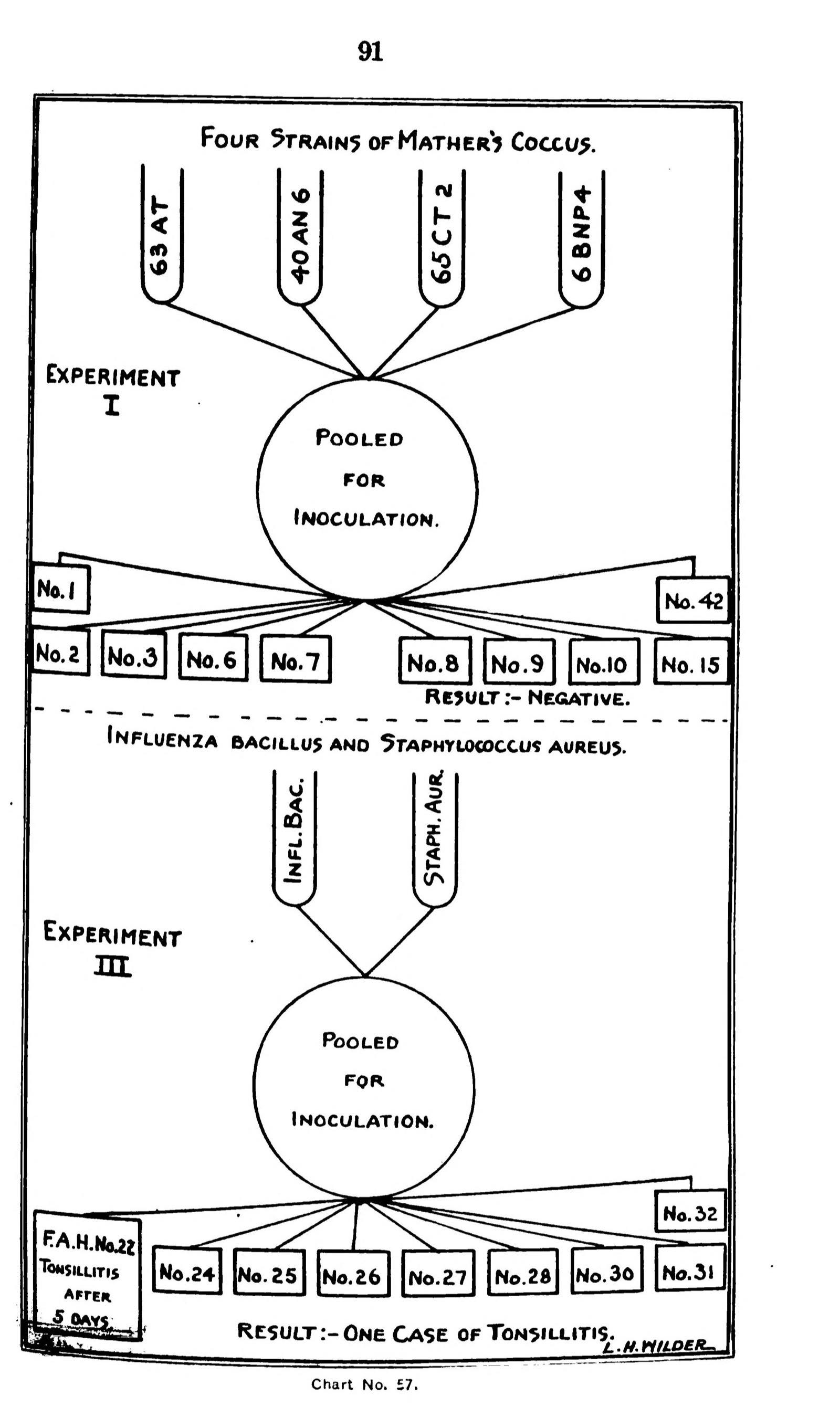
Forty-nine men came over; six were not used; 43 took 82 inoculations between them. And this time something happened, though not much and not cleanly. One man, number 5, aged twenty-three, developed five days after his inoculation a headache, backache, chills, weakness and a worsened cough, with a temperature that reached 39.2 degrees, and the report calls it “Influenza (?)” with the question mark printed. Another, number 42, aged twenty-one, fell ill between sixty-six and a hundred and twenty hours after his inoculation with a splitting headache, backache, photophobia, an evening temperature of 39.9 degrees and a cough that stayed with him; a consulting officer examined him and said, in the sentence the whole programme comes down to, that “in an epidemic the case would surely be called influenza.”
In an epidemic. He said it in March 1919, when the epidemic had gone.
What the second series transmitted beautifully was something else entirely. Volunteer after volunteer came down with acute streptococcal tonsillitis after being sprayed with other men’s secretions. The conclusions say it plainly, and it is the most useful finding in the whole bulletin:
In contrast to the difficulty in transmitting influenza by means of secretions, acute streptococcic tonsillitis may readily be transmitted in this way, and with a high percentage of success, even when the donor is apparently merely a carrier of the streptococcus.
The method worked. It could pick an organism out of one man’s throat and establish it in another’s, reliably, in a day or two, and demonstrate it by culture. It simply could not be shown to do it with the disease they were studying — and the only disease it could be proved to move was one nobody was looking for, and which then clouded every diagnosis they tried to make.
Their formal conclusions were correspondingly careful: that the results “indicate presumptively that influenza may be transmitted by means of the secretions of the upper respiratory passages from patients in the early stages of this disease, probably within less than 12 hours from onset”; that nothing definite could be concluded, because of “the uncertainty of our diagnosis in recipients and donors on account of the lack of decisive criteria as to what is influenza,” and because of “the clouding of our results by the transmission of streptococcic tonsillitis to many of our volunteers.”
In June 1919, at the annual session of the American Medical Association in Atlantic City, Rosenau stood up and told the profession what he had and had not found. He gave the formal conclusion first: “I think we must be very careful not to draw any positive conclusions from negative results of this kind. Many factors must be considered. Our volunteers may not have been susceptible. They may have been immune. They had been exposed as all the rest of the people had been exposed to the disease, although they gave no clinical history of an attack.”
And then he finished with the sentences that have outlived everything else in the programme:
As a matter of fact, we entered the outbreak with a notion that we knew the cause of the disease, and were quite sure we knew how it was transmitted from person to person. Perhaps, if we have learned anything, it is that we are not quite sure what we know about the disease.
After
While the Americans were failing, other people were succeeding, and the comparison is the thing that turns this story from a mystery into a lesson.
In Japan, between 1 December 1918 and the end of March 1919 — overlapping the second Boston series almost exactly — Professor T. Yamanouchi and two colleagues ran the same experiment on fifty-two friends, doctors and nurses who offered themselves. Twelve had an emulsion of the sputum of 43 influenza patients put into the nose and throat, and twelve more a Berkefeld filtrate of it. Among the twenty-four were six who had already had influenza. All six stayed well. “But all of the other 18 subjects,” they reported in the Lancet of 7 June 1919, “both those who had received the emulsion and those who had received only the filtrate, were attacked by the disease, after an incubation of two or three days.” Pure cultures of Pfeiffer’s bacillus, sprayed into fourteen people who had never had influenza, did nothing at all. Their five numbered conclusions reached in 1919 what took the rest of the world until the 1930s: that the agent passes a filter, that it is in the sputum and the blood, that “the known bacilli, such as Pfeiffer’s bacillus, pneumococci, and some diplococci are not the cause of influenza,” and that people who have had influenza are immune to it.
The Japanese paper has exactly the same weakness as the American one — no test for influenza existed there either, and their eighteen cases rest on the same clinical judgement — and that is the point. Two careful groups, with the same tools, in the same four months, got opposite results, and the difference was not technique. It was the arrangement of men. The Americans had sailors from a barracks that had just had an epidemic, and used the previously infected as controls to show the dose did nothing in the immune. Yamanouchi had volunteers who had not had it, and his previously infected stood apart and stayed well, which turned the same fact into a finding instead of a confounder. The other transmission experiments of those months are set out in The experiments that worked.
Pfeiffer’s bacillus did not fall at once. Confidence drained out of it over a decade, and what drained it was work on animals rather than argument about men. In 1931 Richard Shope, at Princeton, worked out swine influenza and found that pure cultures of the hog’s own influenza bacillus, put up its nose, did essentially nothing, while a filtrate gave a mild illness and the two together gave the full disease. In 1933, at Mill Hill in London, Wilson Smith, Christopher Andrewes and Patrick Laidlaw gave influenza to ferrets with filtered material from human patients and passed it from ferret to ferret, and the agent had a host at last. Much later, with the 1918 virus reconstructed from the tissue of the dead, the thing Gallops Island could not do was done in a cage: the reconstructed virus transmitted through the air to every ferret exposed to it.
So the virus was transmissible, and the men were there, and the method moved streptococci reliably, and still nothing happened on that island. The honest modern answers are three, and they stack rather than compete. The volunteers were probably immune: modelling of the English epidemics of 1918 and 1919 puts prior immunity in adult populations between 38 and 66 per cent, and a barracks that recorded 186 cases in 1,058 men had far more infections than that, most of them never counted and invisible to a questionnaire. The route was probably wrong: influenza given as a fine aerosol, reaching the lower airway, infects at a far smaller dose than the same virus put into the nose, and everything the design did was aimed at the nose and throat, because that was where the bacillus lived. And the donors were probably past it: shedding begins twelve to twenty-four hours before symptoms, so the ideal donor is a man who does not yet know he is ill, and no logistics will find him in time. The evidence for each is weighed in Why it did not work.
There is a last modern footnote, and it should make anybody careful about judging 1918. In 2013 a consortium of British and American investigators ran the experiment again with everything the twentieth century could supply: a known virus, a quarantine unit, PCR, serology, ventilation and humidity held at indoor winter values. They inoculated 52 donors, and 42 were infected, which is the easy half. Then they housed 75 screened, seronegative recipients with those donors for four days. They expected a secondary attack rate around 16 per cent. They got one confirmed transmission: 1.3 per cent. With every instrument the first experimenters lacked, the modern repeat failed in the same direction and for reasons its authors could not fully name.
The experiments themselves have never been properly re-examined. The modern medical literature on Gallops Island amounts to one historian, John Eyler, who observes that “it seemed that what was acknowledged to be one of the most contagious of communicable diseases could not be transferred under experimental conditions,” and offers no mechanism. The most quoted negative result in the history of influenza has no modern paper to its name. It has, instead, a second life. Within four months a chiropractic advertisement in a Wyoming paper was quoting the Journal of the American Medical Association’s summary of the experiments under the heading “HAS IT BEEN PROVEN THAT INFLUENZA IS TRANSMITTED FROM PERSON TO PERSON, THROUGH COUGHS, SNEEZES, ETC?” By December 1919 a syndicated health column was running the whole Associated Press dispatch under the advice: “Do not let anyone frighten you with tales about germs. They have nothing to do with the case.” The same paragraphs are still in circulation as proof that influenza is not contagious. Rosenau’s “we are not quite sure what we know about the disease” is quoted most often by people who are quite sure.
What it taught
A negative result is worth only what its positive arm is worth. Camp Lazear had two huts. In one, men slept twenty nights in the bedding of the yellow fever dead and stayed well; in the other, men were bitten and fell ill; and afterwards the Board bit two more to prove the mosquitoes were still infective. The negative half had meaning because the positive half stood next to it, run at the same time, with the same judge. Gallops Island had no positive half. It had controls — the previously infected men in Experiments 1 and 8 — but they pointed the wrong way: they were there to show that an inoculation did nothing in the immune, which is a conclusion you can only draw once you have shown it does something in somebody. Across 62 men, eight experiments and six weeks, the programme never once produced the disease it was studying, so it never established that any of its materials contained anything at all. Everything after that is interpretation of a blank.
An experiment cannot be better than its endpoint. There was no test for influenza in 1918, so both ends of every arm — is this donor’s illness influenza, is this recipient’s illness influenza — rested on a clinician’s judgement in a season when half the population had a cough. The clearest case in the whole programme, volunteer number 42 in March 1919, was settled by an officer saying that “in an epidemic the case would surely be called influenza,” which is an honest statement of the problem rather than a diagnosis. And the arm that worked perfectly — the streptococcal tonsillitis, transmitted readily, confirmed by culture, in man after man — worked because it had a laboratory test behind it. The experimenters could prove they had moved an organism whenever the organism was one they could see.
The comparison was running alongside, and nobody could use it. The Yacona lay in Boston harbour with 80 of her 95 men down, 84.2 per cent, and supplied the donors for the experiment that failed to infect anybody. The same ratio was turning up in barracks and ships and schools across the world. Max von Pettenkofer drank a cubic centimetre of cholera culture in Munich in 1892 while the decisive comparison between Hamburg and Altona was running a few hundred miles north, and the story of that is in One Cubic Centimetre. This is the same shape, with one difference that matters: Pettenkofer ignored his comparison, and Rosenau printed his, as an appendix, with the attack rate calculated to one decimal place. He could see that his experiment and the world disagreed. What he could not do was get the world’s arrangement — a ship’s company, three weeks, shared air — into a design that an ethics committee or a quarantine station could hold.
Who reads a result decides what it means. Rosenau’s reading was “be very careful not to draw any positive conclusions from negative results of this kind.” The Public Health Service’s was: keep assuming droplets, and go to bed earlier. The Navy’s was that the work “serves well to check the generally entertained belief that the transmission of an acute communicable disease of the respiratory type is a very simple matter.” The Surgeon General’s was to look harder at hands and eating utensils. The Associated Press’s was that germs make you hungry. And a chiropractor’s, within four months, was that influenza does not pass from person to person at all. Every one of those came out of the same six pages. A finding that says we failed to show X is an empty vessel, and it is filled by whoever picks it up; the people who ran the experiment get no more say than anybody else, and rather less, because their caution is the first thing cut.
The complication is that the experiment may have been right about something nobody could name. It was not a scandal of method: the Navy was correct that it left little to be desired, and the proof is that the same design, run in 2013 with modern instruments, produced one transmission in seventy-five people. Giving one person influenza on purpose is easy and has been for a century; making that person give it to the next one, under observation, is still close to impossible to demonstrate. What Rosenau’s sixty-two volunteers found, and could not interpret, may have been the real shape of the thing: that transmission is rarer and more conditional than the placards about coughing and spitting ever allowed. He said as much in his own report, in a sentence that is still a fair statement of where the science stands:
Despite our negative results, it is nevertheless probable that the disease is transmitted by the discharges from the mouth and nose. Our failure, however, to reproduce the disease with these discharges suggests that there may be unknown factors involved, either in the discharge of the virus from the body, or its entrance into the victim, or both.
Sixty-eight men put their names down to be given influenza in the worst winter of the pandemic, and sixty-two of them were sprayed, swabbed, injected and coughed on to find out what those unknown factors were. The factors are still unknown. The names are still printed, in a government bulletin, on page six.
Sources
- M. J. Rosenau, W. J. Keegan, Joseph Goldberger and G. C. Lake, “Experiments upon Volunteers to Determine the Cause and Mode of Spread of Influenza, Boston, November and December, 1918”; G. W. McCoy and De Wayne Richey, the same, “San Francisco, November and December, 1918”; and M. J. Rosenau, W. J. Keegan, De Wayne Richey, G. W. McCoy, Joseph Goldberger, J. P. Leake and G. C. Lake, the same, “Boston, February and March, 1919”: Hygienic Laboratory Bulletin No. 123, Treasury Department, United States Public Health Service, February 1921. The fullest primary source and the origin of every detail of the experiments, the roll of volunteers, the 62 subjects, the Deer Island epidemic figures, the eight experiments and their dates, the quotations from the acknowledgments, the discussion, the summary and the conclusions, the Yacona appendix, and the February 1919 cases. The report spells the island “Gallups.” archive.org
- Milton J. Rosenau, “Experiments to Determine Mode of Spread of Influenza,” Journal of the American Medical Association 73, no. 5, 2 August 1919, pp. 311–313; read before the joint meeting of three sections at the Seventieth Annual Session of the American Medical Association, Atlantic City, June 1919. “Muzzle to muzzle,” the description of the island, the praise of the volunteers, the hundred all told, the conclusion on susceptibility and immunity, and the closing sentences. archive.org
- “Some Interesting Though Unsuccessful Attempts to Transmit Influenza Experimentally,” Public Health Reports 34, no. 2, 10 January 1919, pp. 33–39. The earliest published account, the figure of 68 volunteers, and the editorial note quoted in full. archive.org
- Annual Report of the Secretary of the Navy, 1919 — Miscellaneous Reports, Government Printing Office, 1919: the report of the Surgeon General of the Navy, pp. 2414–2506, with the influenza experiments at pp. 2475–2483. The authorisation “just after the crests,” the premise about moist secretions, the 68 volunteers, the printed roll, the praise of the men, the judgement that the work left little to be desired, and the conclusion about the transmission of respiratory disease. Quoted from HyperWar’s transcription, which gives the original page numbers; no scan of the volume is online, and the wording is corroborated sentence by sentence by the Public Health Reports summary above. ibiblio.org
- Annual Report of the Surgeon General of the Public Health Service of the United States for the Fiscal Year 1919, Government Printing Office, 1919, p. 116 (Boston quarantine) and pp. 116–117 (the station, the 118 volunteers cared for, the 263 naval influenza patients, the shipping figures, and Currie’s death and succession). archive.org
- T. Yamanouchi, K. Sakakami and S. Iwashima, “The Infecting Agent in Influenza: An Experimental Research,” The Lancet, 7 June 1919, p. 971. The fifty-two volunteers, the twenty-four given sputum emulsion and filtrate, the six who had had influenza and stayed well, the eighteen who fell ill, the blood filtrate, the negative result with Pfeiffer’s bacillus, and the five summary conclusions. archive.org
- C. Nicolle and C. Lebailly, “Quelques notions expérimentales sur le virus de la grippe,” Comptes rendus de l’Académie des Sciences 167, 1918, p. 607. The experiment the American design was following; cited here at second hand, from the footnotes to Experiments 5 and 6 of Bulletin 123, which name it as the model.
- “Unsuccessful Attempts to Transmit Influenza Experimentally,” Current Comment, Journal of the American Medical Association 72, no. 4, 25 January 1919, pp. 280–281, for how the profession was told, and the sixty-eight. archive.org
- “Influenza in Boston and Vicinity,” Boston Medical and Surgical Journal 179, no. 23, 5 December 1918, p. 712: the earliest notice, written while the first series was running, with the choice of Gallops over Bumkin Island and Captain Edgar’s command. archive.org
- The Associated Press dispatch of 13 December 1918, as carried in the Pine Bluff Daily Graphic, 14 December 1918, p. 8, and in a dozen other papers over the following fortnight under headlines including “Men Grow Fat on Flu Microbes” and “Can’t Get Flu When They Try.” loc.gov
- Frederic J. Haskin, “The Influenza Mystery: A Story of American Heroism,” syndicated from Washington, 17 January 1919, as printed in the Topeka State Journal, 20 January 1919, p. 4: the comparison with the yellow fever volunteers in Cuba, the account of the ward experiment, and Surgeon General Blue’s statement on hands, lips and eating utensils. loc.gov
- “Tests for Influenza on Fifty Young Men,” Associated Press, Boston, 5 February 1919, in the Evening Star, Washington, 5 February 1919, p. 18; and the “death squad” version in the Washington Times the same day, p. 2, and the Washington Herald, 7 February 1919, p. 2, for the second series and the men chosen from several hundred who offered. loc.gov
- “Woman’s Prison Taken Over by U. S.,” Evening Star, Washington, 2 January 1918, p. 5, for the founding of the naval detention training camp at Deer Island; and Washington Journal, 25 April 1919, p. 3, for the German-language description of it as the navy prison and the volunteers as guinea pigs. loc.gov
- Deaths, Journal of the American Medical Association 72, no. 2, 11 January 1919, p. 134, and “Recent Deaths,” Boston Medical and Surgical Journal 180, no. 2, 9 January 1919, and the Associated Press obituary of 23 December 1918 as carried in the Daily Kennebec Journal, 24 December 1918, p. 5: Donald Herbert Currie, aged 42, Molokai, Bergen, and his death of pneumonia following influenza. archive.org
- A chiropractic advertisement, Casper Daily Tribune, 23 April 1919, p. 6, quoting the Journal of the American Medical Association on the experiments; and “Home Health Club,” Bridgeport Times and Evening Farmer, 12 December 1919, p. 8, reprinting the Associated Press dispatch under the advice not to be frightened with tales about germs. The earliest uses of the result as an argument against contagion. loc.gov
- John M. Eyler, “The State of Science, Microbiology, and Vaccines circa 1918,” Public Health Reports 125, supplement 3, 2010, pp. 27–36. The only modern scholarly account of the experiments; the quotations on the most interesting epidemiological studies and on what could not be transferred, and Warren Vaughan’s finding that 55 per cent of those who shared a bed with an influenza patient escaped the disease. pubmed
- J. S. Nguyen-Van-Tam, B. Killingley, J. Enstone and others for the EMIT Consortium, “Minimal transmission in an influenza A (H3N2) human challenge-transmission model within a controlled exposure environment,” PLoS Pathogens 16, no. 7, 13 July 2020, e1008704. The 52 donors, 42 infections, 75 recipients, four days of exposure, one confirmed transmission, the secondary attack rate of 1.3 per cent against 16 per cent expected, and the authors’ conclusions on contagiousness and on large droplets. journals.plos.org
- J. D. Mathews, E. S. McBryde, J. McVernon, P. K. Pallaghy and J. M. McCaw, “Prior immunity helps to explain wave-like behaviour of pandemic influenza in 1918-9,” BMC Infectious Diseases 10, 2010, p. 128: prior immunity of 38 to 66 per cent in adult populations, and the finding that only a quarter to two thirds of exposed susceptible people reported symptoms. pubmed
- V. Le Sage and others, “Pre-existing heterosubtypic immunity provides a barrier to airborne transmission of influenza viruses,” PLoS Pathogens 17, no. 2, 2021, e1009273, for immunity that abolishes airborne transmission without detectable neutralising antibody. pubmed
- M. J. Memoli and others, “Validation of the wild-type influenza A human challenge model H1N1pdMIST,” Clinical Infectious Diseases 60, no. 5, 2015, pp. 693–702, for the modern challenge dose, the 69 per cent who fall ill, and shedding that begins twelve to twenty-four hours before symptoms; and J. Yan and others for the EMIT Consortium, “Infectious virus in exhaled breath of symptomatic seasonal influenza cases from a college community,” PNAS 115, no. 5, 2018, pp. 1081–1086, for infectious virus in fine aerosols without coughing or sneezing. pubmed, pubmed
- R. E. Shope, “Swine Influenza. I, II and III,” Journal of Experimental Medicine 54, no. 3, 31 July 1931, pp. 349–385 (paper II with P. A. Lewis), for the eleven of thirteen negative attempts with pure cultures of the hog’s influenza bacillus and the filtrate experiments; and Wilson Smith, C. H. Andrewes and P. P. Laidlaw, “A virus obtained from influenza patients,” The Lancet 222, 8 July 1933, pp. 66–68, for the ferrets. The Shope papers were read in abstract and the 1933 paper at second hand, through Taubenberger and Morens below. pubmed
- J. K. Taubenberger, J. V. Hultin and D. M. Morens, “Discovery and characterization of the 1918 pandemic influenza virus in historical context,” Antiviral Therapy 12, no. 4 part B, 2007, pp. 581–591, for the Nicolle and Yamanouchi experiments in their contemporary setting, the bacteriology of the 1918 deaths, and the Mill Hill ferrets; and T. M. Tumpey and others, “A two-amino acid change in the hemagglutinin of the 1918 influenza virus abolishes transmission,” Science 315, 2 February 2007, pp. 655–659, for respiratory droplet transmission of the reconstructed 1918 virus between ferrets (read in abstract; the transmission counts are from the source data of M. G. Buhnerkempe and others, eLife 4, 2015, e07969). pmc, pubmed
- NIH, chronology of directors of the Hygienic Laboratory, for Rosenau’s directorship from 1 May 1899 to 30 September 1909 and McCoy’s from 1915; and the finding aid to the M. J. Rosenau Papers, Southern Historical Collection, University of North Carolina, for his dates, his textbook and his later career. unt web archive, finding-aids.lib.unc.edu
How this entry came about
Written overnight on 22 October 2026 by an unattended writing session, under the standing rules in the house's overnight file, which replace the owner's decisions and require every judgement to be recorded here rather than referred to anybody.
The number in the title. Four primary figures are in print for the first Boston series: 62, 68, 63 and "a hundred all told." The report of the experimenters themselves says "They numbered 62 in all," analyses 62 men throughout, and prints a roll of names that contains 68. The earliest official summary (Public Health Reports, 10 January 1919), the Navy's annual report and the Journal of the American Medical Association's Current Comment all say 68; a Maine paper said 63; Rosenau said a hundred from a podium in June 1919, which is near the two Boston series combined; and the quarantine station's annual report says it cared for 118 volunteers that year, which is 68 and 50. The reading taken here — that 68 offered themselves and were named, and 62 were used — is this entry's reconciliation, not a statement from any source, and is flagged as such in the text. Both counts are given.
Other disagreements left standing. The start date of the first series is 6 November in Bulletin 123 and 13 November in the Navy's report and the January summary; the bulletin's figure is used. The bulletin divides the 62 men's influenza histories as 39, 15 and 8 on page 7 and as 39, 14 and 9 on page 20; both are quoted. Keegan's initials are W. J. in every document of the experiment and J. J. on his own clinical paper of September 1918; W. J. is used. Rosenau called the San Francisco site Goat Island in his spoken paper; the station was on Angel Island and the volunteers came from the Yerba Buena (Goat Island) training station, and Angel Island is used. The island is "Gallups" in the bulletin and most of the 1918 press and "Gallops" in the Public Health Service's own annual report and in modern use; the modern spelling is used outside quotations.
Second hand. The Navy's Surgeon General's report for 1919 exists in no scan that could be reached; it is quoted from HyperWar's transcription, which prints the original page numbers, and its wording is corroborated sentence by sentence against the Public Health Reports scan. Nicolle and Lebailly (1918) are cited from the footnotes of Bulletin 123 and not read. Smith, Andrewes and Laidlaw (1933) are relayed through Taubenberger and Morens (2007). Tumpey (2007) and Carrat (2008) were read in abstract only, Science and Oxford University Press having refused the full texts. The two Rosenau obituaries of 1946 and 1947 were located but could not be opened, so his biography rests on the NIH chronology and the UNC finding aid, which disagree with NCpedia on whether he moved south in 1935 or 1936 — a detail the entry does not use.
Not reached. The Boston dailies of 1918 and 1919 are not in any open newspaper archive, so the local coverage here is wire copy carried by out-of-town papers. Bureau of Medicine and Surgery Bulletin No. 57, cited in 1919 as a separate Navy printing of both series, could not be found. No contemporary source links Currie's death to the experiments, and this entry does not either; the two dates are simply both 23 December 1918.
Figures. Two, both pages of Hygienic Laboratory Bulletin No. 123 (1921), a United States government work published before 1930, from the scan on archive.org; each was cropped to remove the scanning service's footer and reduced to 1,600 pixels wide. No photograph of the island, the station or the volunteers could be found with a rights statement good enough for the house rule, so there is none.
Decisions under the overnight rules. The overflow went to four companion pieces rather than being cut, to keep the entry inside the house length: the San Francisco series, the second Boston winter, the contemporary experiments that did transmit influenza, and the modern explanations of the failure. The narration was rendered with the load gate raised (MAX_LOAD=60), because this machine's load average runs far above the gate's ceiling from other accounts' work.