At seventeen minutes past nine on the morning of Wednesday, 10 April 1963, in the pilot house of the submarine rescue ship Skylark, about 220 miles east of Cape Cod, a loudspeaker the size of a shoebox carried a voice up from the sea. The voice gave the two ships’ call signs clearly. Then it broke into crackle. The navigator, Lieutenant James Watson, and the captain, Lieutenant Commander Stanley Hecker, both made out the last two words, “test depth”, and both thought the word before them had been “exceeding”. The radioman keeping the log, six feet from the speaker and holding on to the bulkhead in a roll, wrote down what he thought he had heard: “nine hundred North”. Under the keel there were 8,400 feet of water. The nuclear submarine Thresher, first of her class, was somewhere below with 129 men in her, and nobody on Skylark yet believed that anything was wrong.
A minute or more later Watson, who had served in submarines through the Second World War and had heard torpedoed ships break up, heard what he described to a court of inquiry three days afterwards as “a rather muted, dull thud”. The Navy’s listening arrays recorded the same sound at eighteen minutes and six seconds past nine. By a later analysis the pressure hull collapsed at about 2,400 feet in about a tenth of a second.
Four months earlier, in a shipyard on the Piscataqua River, a team of inspectors with a new ultrasonic instrument had examined 145 of the brazed pipe joints in Thresher’s sea-water systems and had found that twenty of them did not meet the Navy’s standard. There were more than 3,000 such joints in the ship. On 4 December 1962 the yard decided not to test the rest. The ship sailed on 9 April 1963, and the report of the 145 reached the Bureau of Ships in Washington after she was lost.
Who ran it
The Portsmouth Naval Shipyard stands on an island in the Piscataqua at Kittery, Maine, and had built submarines for the Navy since 1917. In October 1957 it was given the working plans for a new attack submarine designed by the Bureau of Ships, and in May 1958 it laid her keel. She was launched bow-first on 9 July 1960 and commissioned on 3 August 1961 as Thresher, SSN-593, under Commander Dean Axene. Her reactor was the same S5W plant that drove the Skipjack class before her, and it was the responsibility of Vice Admiral Hyman Rickover’s Naval Reactors branch, which wrote its own specifications and kept its own inspectors in every yard. Everything else about the ship, the hull, the piping, the air system, the sea valves, belonged to the Bureau of Ships and to Portsmouth.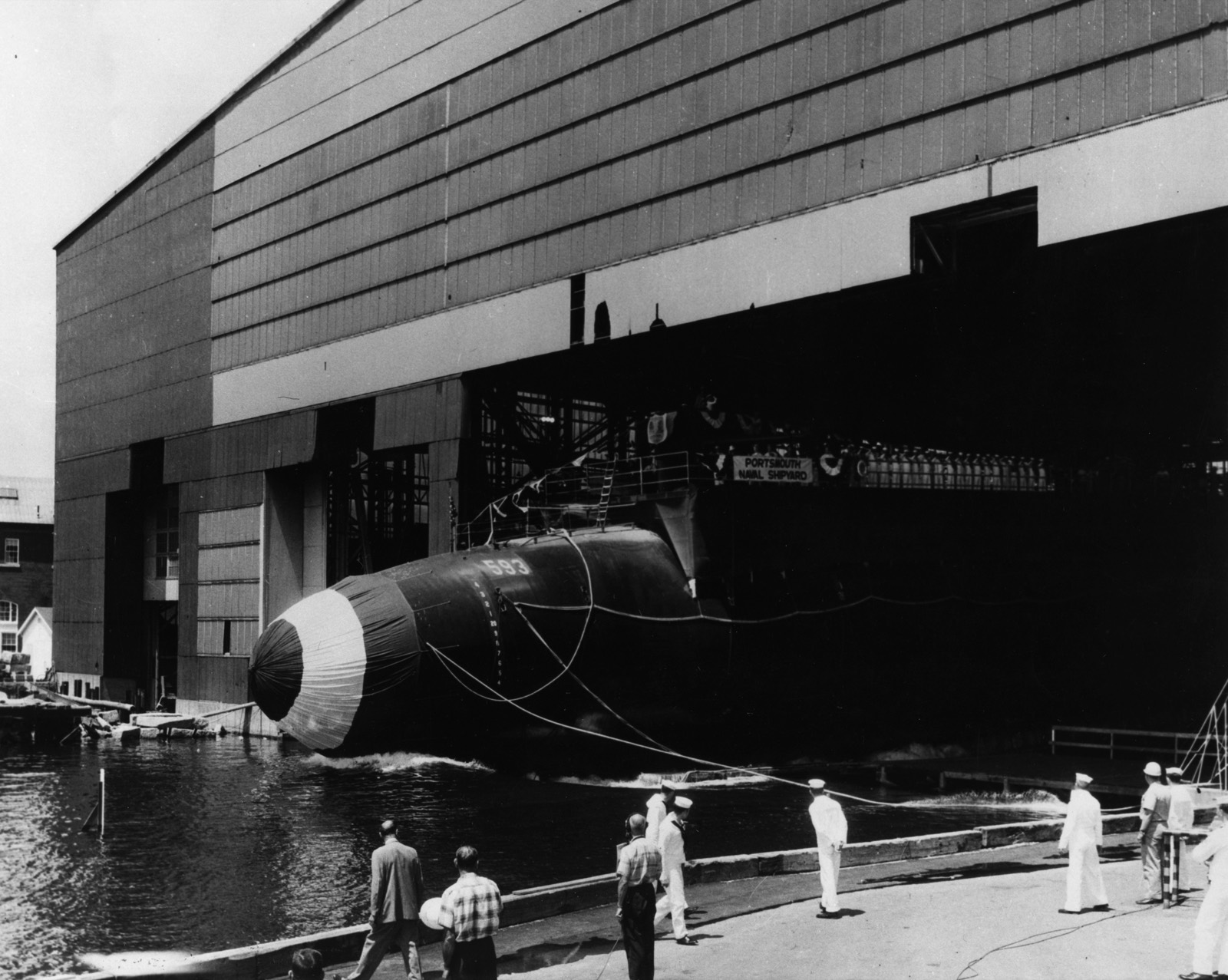
What made her new was not the reactor. Her hull was of HY-80 steel, her machinery was mounted on rubber to make her quiet, she carried the largest sonar yet put in a submarine, and she was designed to go nearly twice as deep as Skipjack. The court of inquiry’s findings give Skipjack’s test depth as 700 feet and blank out Thresher’s; the Navy would say in 1963 only that she dived “below 400 feet”; the figure that has been published since, by Norman Friedman and others, is 1,300 feet. In the court’s words she was “the first of a new class of nuclear powered attack submarines, capable of diving to a depth” that the censor removed, “with significant advances in sonar equipment, ability to resist shock, and to operate with reduced noise radiation.”
Axene commanded her for her first eighteen months of trials, in the Atlantic and the Caribbean, and about forty dives to test depth. He left in January 1963 to take a new Polaris submarine, and in the same month his executive officer, who was needed on a staff, left too. The new captain was Lieutenant Commander John Wesley Harvey, aged 35, born in the Bronx, a Naval Academy graduate of 1950 who had served three years in Nautilus, including her passage under the Pole in 1958, and had been executive officer of Seadragon when she met Skate at the Pole in 1962. Neither he nor his new executive officer, by the record the court took, had served in a deep-diving submarine before.
The yard was commanded by Rear Admiral Charles Palmer. In the same ninety days in which the ship changed her two senior officers, the yard changed the two officers who ran her overhaul, the ship superintendent in December 1962 and his assistant in November.
What they were trying to find out
A new submarine that has been nine months in a shipyard goes to sea to prove two things. The first is that her hull and every pipe that opens to the sea will hold at the greatest depth she is built for. The second is that if something does not hold, she can get back up. The two were tested together on 10 April 1963, on a dive that was scheduled to take two hours.
The first claim was being made for a ship that had been taken apart and put together again. Thresher had come into Portsmouth on 11 July 1962 for what the Navy calls a post-shakedown availability, after shock tests off Key West in which charges had been fired against her hull. The yard estimated 35,000 man-days and six months. The work grew; the completion date was moved from 18 January 1963 to 15 February, to 28 February, to 30 March, to 2 April and finally to 11 April, and the man-days spent came to more than 100,000. Shock damage went on being found until the end: loose condenser foundation bolts in January 1963, a misaligned torpedo ejection pump in March.
The second claim was the one that had never been examined at the depth that mattered. The court set out the arithmetic in a table. At 400 feet, a hole two inches across lets in six tons of water a minute; at 700 feet, nearly eight. The drain pump at those depths moves about one ton a minute. The only other way to get rid of weight is to blow compressed air into the ballast tanks, and the deeper the ship, the less water each cubic foot of air can push out. “The increasing operating depths of submarines has compressed the time available in which to take effective damage control action with respect to flooding,” the court wrote. “The shortness of time available to control flooding is not well recognized.”
The man who had commanded her knew it. In his report on the first year of operations, dated 16 November 1962, Axene called Thresher “the best ASW submarine afloat today”, listed her faults, which were that she was overly complex in many areas, difficult to handle near the surface, and that her auxiliary sea-water system was vulnerable, and wrote: “In my opinion the most dangerous condition that exists in THRESHER is the danger of salt water flooding while at or near test depth.”
Rickover knew it too, and had said so at her first trials in April 1961. He testified that two weeks before those trials he had found “little thought had been given to the details of how this dive was to be conducted,” and had had the yard write out, overnight, a plan for “a slow, deliberate descent at given stages; at each stage there was to be a cycling of all sea valves,” with a man at every valve station, “because of my concern at the lack of blowing margin.” He had told the Bureau, the yard and the submarine force that the ship’s blow capacity was small. The blow system she took to sea in 1963 was the one she had been built with.
What they built
The sea is kept out of a submarine not only by the hull but by every pipe that brings sea water in: to cool the condensers and the machinery, to flush, to trim. Thresher’s auxiliary sea-water system ran at full sea pressure through two six-inch supply headers and two four-inch discharge headers, arranged as a loop and, under the ship’s plans, normally cross-connected, so that to stop a leak in one engineering space a man might have to shut valves in two. The sea valves were operated by hand or by hydraulics at the valve; there was no requirement that they could be shut from a second station, and none that the electrical switchboards near them be sealed against spray from below.
The pipes were joined, as submarine pipes had been for decades, by silver brazing. A fitting slips over the pipe, silver alloy is melted into the gap, and if the metal flows round the whole circumference the joint is as strong as the pipe. If it does not, the joint will still hold a pressure test. “A hydrostatic test unfortunately shows you just one thing,” Rear Admiral William Brockett, the chief of the Bureau of Ships, told Congress in June 1963, “that at that particular instant of time, that that system would take 150-percent pressure.” The bond, he said, “can be almost chewing gum in a sense and still hold its pressure. But the submarine works; it rotates and it compresses, and this applies forces to the piping system throughout the hull.” The court counted more than 3,000 brazed joints of two inches and above in the ship’s hazardous systems.
The record of such joints was already bad. On 30 November 1960 a five-inch brazed joint in the submarine Barbel had parted at about 650 feet and flooded her engine room; the investigation found that the wrong material had been used and that Portsmouth’s quality assurance in brazing before 1961 had been inadequate. Skate had lost a joint under the ice; Ethan Allen had sprayed her switchboards and scrammed her reactor when a plug blew out of a strainer; Thresher herself had lost a vent-line joint on her first builder’s trials and a trim-line joint on her second. In September 1961 the deputy commander of the Atlantic submarine force sent the Bureau a message, copied to the Chief of Naval Operations, which said that “recent instances of flooding in submarines because of defective sea water piping or flexible hoses are cause for grave concern,” that such incidents “continue to occur with alarming regularity,” that “continued dependence upon such tenuous and fortunate circumstances” was “obviously unacceptable,” and asked the Bureau to “expedite development of reliable nondestructive test method for silver-braze fittings. This is urgently needed to enable operating forces to locate and repair defects.”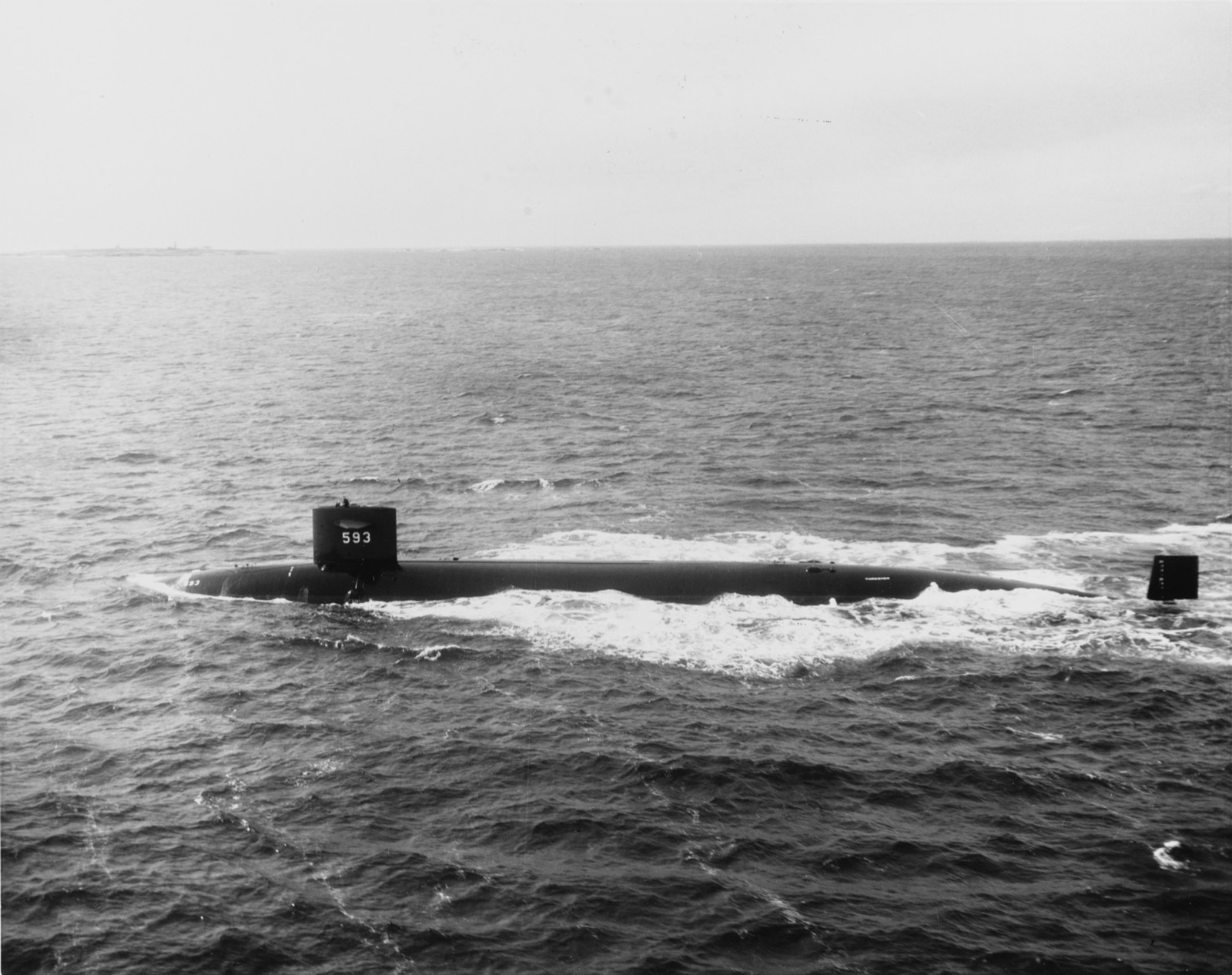
Rickover had drawn his own conclusion in May 1961, after the trim-line failure. “I decided I could no longer depend on silver brazing for high-pressure systems,” he told the court. In the systems he controlled, every sea-water pipe would be welded regardless of size, and so would the sea-water pipes that merely passed through the reactor compartment, “even though this piping was not under my cognizance.” That work was done during the overhaul. The same pipe, he explained later, “could continue elsewhere and be silver brazed.”
The air system was older in its ideas than the piping. The Bureau’s criterion for a submarine’s compressed air, unchanged since the war, was that she should be able to blow all her main ballast tanks twice at periscope depth, fire her torpedoes, and have a reserve. There was no modification of the criterion for the depth at which the blow might have to be made, no requirement to test a full blow-down of the air banks, and no provision to dry the air. Thresher stored her air at 4,500 pounds per square inch and let it into the tanks through reducing valves, and the reducers were fitted with conical wire-mesh strainers to keep dirt off the valve seats. The reducers had leaked and plugged throughout the ship’s life, which the yard traced to “minute particles in the system” and reported as corrected before the trials. And the system was arranged so that if electrical power to the ballast control panel failed, three of the four air banks shut themselves off and the fourth opened slowly, which left the ship, for between ten and fifty seconds, with no air to blow at all.
Into this ship the Bureau now sent the instrument the submarine force had asked for. By the spring of 1962 the Electric Boat yard had an ultrasonic test that could see how much of a brazed joint was actually bonded. It had been tried on 115 joints in Thresher’s hydraulic system before her shock tests, and eight had failed the standard. On 28 August 1962 the deputy chief of the Bureau, Rear Admiral Robert Moore, wrote to the commander of the Portsmouth yard. “The significance of gross failures of silver-brazed joints in vital submarine systems is such that the Bureau considers it a matter of urgency that an inspection program be developed for these systems that will ultimately permit the certification of all piping joints in submarines,” the letter said. It directed the yard to “employ a minimum of at least one ultrasonic test team throughout the entire assigned PSA to examine, insofar as possible, the maximum number of silver-braze joints,” beginning with the sea-water systems between the hull and the back-up valves. Any joint showing less than an average of 40 per cent bond, with a minimum of 25 per cent on either land, “shall be considered defective” and “repaired or replaced on a ‘not-to-delay’ ship basis.” The inspection, the Bureau said, “shall serve as a pilot test,” and the yard was asked to send back its comments and recommendations.
Twenty joints
The yard put one team on the job and told it to test the joints that were not lagged first, and to strip the lagging from the others “if time permitted thereafter.” The job orders called for periodic reports to the Planning and Estimating and Design Divisions. The court found that the periodic reports “were not forwarded as requested”; condition sheets for individual defects were.
By 29 November 1962 the team had tested 145 of the old joints and rejected 13.8 per cent of them. Twenty joints, out of the 145 it had been able to reach, in a ship with more than 3,000. The court’s Opinion 19 is a single sentence: “That the rejection rate of 13.8% on original sil-braze joints in THRESHER was a clear indicator that additional action was required.”
On that day the yard’s Quality Assurance Division reported the result to Planning and Estimating and asked for a decision: should the lagged joints be unlagged and tested? The decision was made on 4 December 1962. It was not to unlag. “This decision was known to the management personnel of the Shipyard, including the Production Officer and the Commander, who were apprised of the results of the survey,” the court found. A copy went to the commanding officer of Thresher, who was then still Axene. No further ultrasonic tests of old joints were made. And neither the result nor the decision “was made known to the Bureau of Ships or to anyone in the operational command line higher than the Commanding Officer of THRESHER.”
It was not the first such number to stop at the yard gate. Portsmouth had tested 322 joints in Skipjack in August 1962 and rejected 22.5 per cent, and had not reported that either; Mare Island had found 22 per cent in Sculpin. The yard’s confidence was its own. “Portsmouth Naval Shipyard management and workers exhibited a high degree of confidence in sil-braze joints in THRESHER’s piping systems,” the court wrote, and in another finding, that the yard “has authority to deviate from building specifications in certain areas, and is using the specifications as goals rather than requirements in certain cases.”
Asked by Congress in June 1963 why the other 2,855 joints were never tested, Vice Admiral Bernard Austin, the president of the court, said that the yard commander, questioned in retrospect, “admitted that he thought he should have looked into this more thoroughly, but at the time he did not consider it a dangerous situation. They were trying to meet a deadline date for the completion of the ship’s availability, and to have gone further with the testing would have required unlagging of piping and delaying the ship and running up the cost of the overhaul.” The court’s verdict on the decision was that the yard “did not exercise good judgment.” Brockett, who in November 1962 had been one step below the chief’s chair in the Bureau, said of the yard: “They were trying to get the ship finished and at that time I am sure that the philosophy was, ‘this is as good as any other ship.’”
The Bureau’s letter had asked for a report. The yard’s report was written in response to a reminder from the Bureau, and the reminder went out on 12 April 1963, two days after the ship was lost. “I remember the letter coming in because it was after the Thresher,” Brockett said. “Of course, it had a big red flag on it.”
Rickover had a different arithmetic. “If the quality of the joints so inspected was representative of all the Thresher’s silver-brazed joints,” he told the court in April and Congress in July, “this means that the ship had several hundred substandard joints when she last went to sea.”
The last weeks were the ordinary last weeks of an overdue overhaul. On 8 March 1963 a test of the after auxiliary sea-water system over-pressurised a reserve feed tank and lifted its top by one to two inches, with the drain lines mounted on it; the tank was repaired and the lines were not retested. The first “fast cruise”, the drill in which the crew runs the ship tied to the pier as if at sea, began on 23 March and was stopped “because of the large number of material deficiencies noted.” The second ran from 31 March to 1 April. In one of its drills, a simulated flooding in the after auxiliary sea-water system, it took the watch twenty minutes to isolate the leak; the system had been changed during the overhaul. Her trial agenda for 10 April did not provide for cycling the sea valves at intermediate depths on the way down; that was planned for the second, slower, deep dive. On 9 April Harvey wrote to his superior that she was ready for sea. Captain Clarence Zurcher of the submarine force staff, who had spoken to Harvey at length a week before, told the court: “There was no work left uncompleted that had anything to do with the safety of the ship.”
What it looked like from inside
Nobody inside Thresher survived to say what it looked like, and she carried no recorder. What survives is the view from the pilot house of Skylark, fifteen feet by ten, with a chart desk, a clock on the bulkhead and the underwater telephone, which the Navy called Gertrude. Skylark was a wartime ship built for the diesel boats; her rescue chamber could reach 850 feet, her sonar had no contact with Thresher that day, and she had no recorder for the telephone. Hecker had asked Harvey before the dive for a telephone check every fifteen minutes.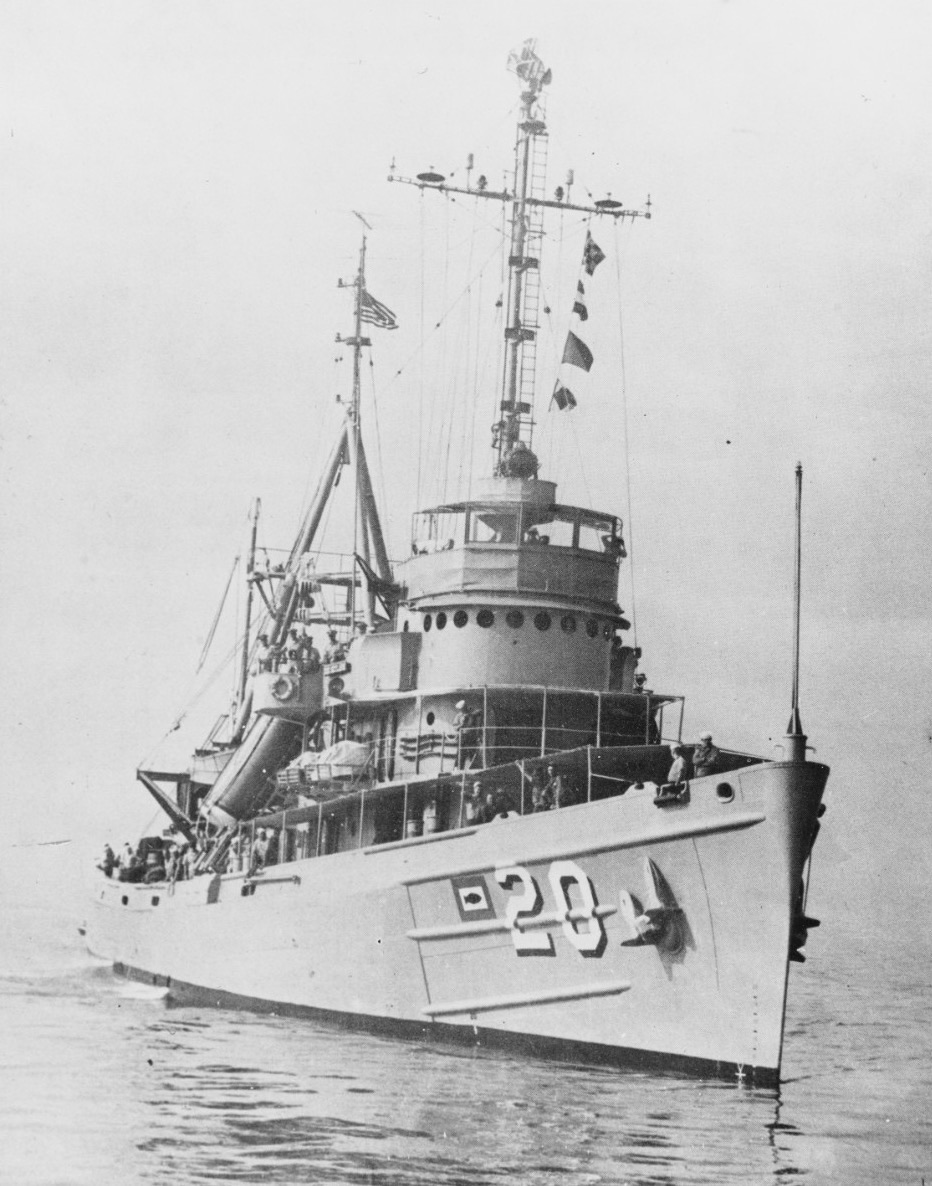
At 7:47 Thresher reported that she was starting her deep dive. At 7:52 she was at 400 feet checking for leaks. At 8:35 she reported “Proceeding to test depth minus three hundred feet,” and at 8:53 “Proceeding to test depth.” Hecker noticed that the descent had taken forty-eight minutes to that point, which “appeared rather rapid, and indicated to me that things must have been progressing very well.” The court established that she was at test depth by 9:09, and at about 9:10 she announced a course change from north to east “and gave no indication of any difficulty.”
At 9:11, by the Navy’s listening arrays, her main coolant pumps, which had been running in fast speed throughout the dive, stopped or dropped to slow. If they stopped, the reactor shut itself down. Under the procedures then in force the watch would then have shut the steam off from the turbines, and the ship would have had no propulsion but a battery-driven motor good for about five knots. At 9:12, by the log, Thresher asked for a telephone check and acknowledged it about ten seconds later.
Then, in the court’s finding, “about 0913R”, came the message that every account of the loss repeats: “Experiencing minor difficulties. Have positive up angle. Am attempting to blow. Will keep you informed.” The radioman logged a shorter version at 9:12; the man at the telephone, Boatswain’s Mate Roy Mowen, gave the court the whole of it; Hecker, seven feet away, heard “minor problem” and three fragments with pauses between them. “The voice was very relaxed and to me appeared not overly concerned, as if it were a normal experience,” he said. Behind the voice they heard air: four or five seconds of it to Mowen, three or four to Watson, “twenty to thirty seconds” to Hecker. The arrays recorded two disturbances that could have been ballast being blown, one from 9:09 and a half to 9:11 and twenty seconds, the other from 9:13 and a half to 9:14. The four versions of those minutes are set out in The telephone log.
At 9:14 Skylark told Thresher there were no contacts in the area, so that she could surface. Hecker thought the submarine had got slightly heavy near her test depth; his concern, he told the court, was “that he would come up underneath me.” At 9:15 he took the microphone himself, gave his course and asked for a range and bearing. No answer. He asked “Are you in control?” and repeated it at least four times.
The court’s findings place a garbled transmission believed to contain the words “test depth” at about 9:16, and a second at about 9:17 “reported as containing the words ‘… nine hundred North’.” The men in the pilot house told it in a different order: a transmission at about 9:16 that nobody could make out, and then, at 9:17, the one in which the call signs were clear, two or three words were lost, and “test depth” came through, with “exceeding” before it, Watson and Hecker both felt, “although we can’t be sure.” One reading of the radioman’s entry, since the record was opened, is that she was nine hundred feet below her test depth, which, if the test depth was 1,300 feet, is deeper than the depth at which her hull was calculated to collapse.
Then the thud. Mowen, who had stepped back to light a cigarette, heard nothing he could call an explosion. Watson and Hecker discussed it that afternoon and agreed, Watson said, “that it sounded similar to a breaking up noise.”
Hecker assumed a flooded transducer or a layer in the water, and began an expanding search at 9:21. At 9:40 his operations officer asked whether a message should go out; the reply, the court found, “was to the effect that, ‘It is too early.’” At 10:40 Skylark began dropping hand grenades, the signal to a submarine to surface, and at 10:45 Hecker ordered a message written. The radio would not reach New London; the message was receipted at 12:45. It read: “UNABLE TO COMMUNICATE WITH THRESHER SINCE 0917R. HAVE BEEN CALLING BY UQC VOICE AND CW QHB CW EVERY MINUTE EXPLOSIVE SIGNALS EVERY 10 MINS WITH NO SUCCESS. LAST TRANSMISSION RECD WAS GARBLED. INDICATED THRESHER WAS APPROACHING TEST DEPTH,” and gave a position. It did not mention the minor difficulties, the up angle, or the blow, although the operations officer had suggested including them. “I guess I had no realization of how fast time was passing,” Hecker told the court. Asked what Skylark could have done for a submarine out of control in 8,400 feet of water, he said: “None, sir. Admiral, I could not even plant a buoy.”
At about 5:30 that afternoon the salvage ship Recovery found an oil slick about seven miles to the south-east, with bits of cork, yellow plastic, two right-hand rubber gloves and a tube of something like cake icing floating in it. At eight o’clock that evening the Chief of Naval Operations, Admiral George Anderson, announced that the next of kin were being told that the submarine was “overdue and presumed missing,” and at half past ten the next morning that he had “reluctantly” concluded she was lost. The last words from Thresher did not reach anyone above Skylark until 12 April, when Watson was sent across to the destroyer Blandy with the telephone log and Rear Admiral Lawson Ramage, the deputy commander of the submarine force, read it.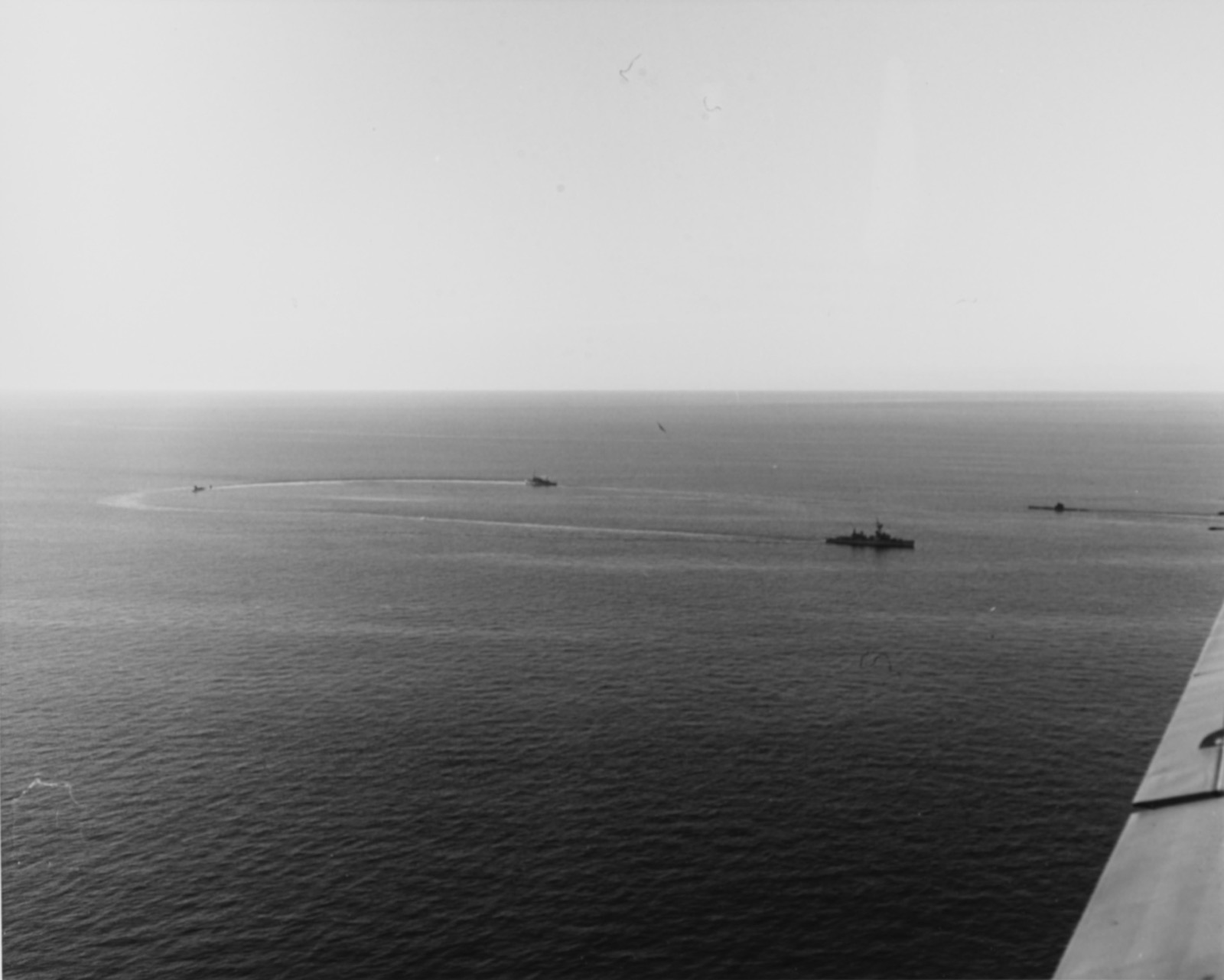
What happened
The court of inquiry met at the submarine base at New London at 8:25 on the evening of 11 April, under Austin, with four submarine officers as members. It moved to Portsmouth two days later and sat until 5 June, through 179 appearances by 120 witnesses, 1,718 pages of testimony and 255 exhibits. It named Hecker a party to the inquiry for failing to report what he knew, and later withdrew the designation; Palmer asked to be made a party and was. In Dry Dock No. 2 the court had a jet of water released at the pressure of Thresher’s test depth against a piece of electronic equipment; “the stream produced tremendous force, spray, fog and noise.” And it ordered a test that nobody had thought to make while the ship was alive. In Thresher’s sister Tinosa, still building at the yard, the court had the air banks blown down through the ballast system at the pier. The strainers in the reducing valves “were blocked and ruptured by the formation of ice in about thirty seconds.”
Its first opinion was that the loss “was in all probability due to” four things: “an initial flooding casualty from an orifice between 2” and 5” in size in the engine room, which continued, compounded by” the loss of reactor power “due to an electrically-induced automatic shutdown,” by operating procedures that were inadequate for either, and by “a deficient air system, susceptible to freeze-up, with low capacity and low blow rate.” Of the possible sources of the flooding it listed first “a faulty sil-braze joint.” Its computer runs fitted best a flood at about 9:09, a full-speed climb to about 750 feet by the time of the 9:13 message, and a hole “a little more than 4””, with “Am attempting to blow” being “not inconsistent with a 90 second blow which had been interrupted by a frozen reducer at 0911.3R or an electrical failure.” The court warned itself in its second opinion that “in melding together fact and conjecture, conjecture may be stretched too far and become accepted as fact.” Its fifty-fifth was that the shortcomings it had found “can be blamed on no individual or individuals, and many would not have come to notice had THRESHER not been lost.”
Most of the record was classified secret, and on 20 June 1963 the Secretary of the Navy, Fred Korth, released a summary: “a flooding casualty in the engineroom is believed to be the ‘most probable’ cause”; “Thresher slowed and began to sink. Within moments she had exceeded her collapse depth and totally flooded.” The same release carried the court’s finding against Hecker.
Congress’s Joint Committee on Atomic Energy, whose staff had sat through the closed sessions, took the Navy’s officers in executive session on 26 and 27 June and 23 July 1963. Representative Chet Holifield asked why, “when almost any one of those joints in the salt water system under great pressure could provide the reason for a catastrophe like this,” the rest had not been tested. Senator Henry Jackson asked whether the Navy had thought through what going deep did to a design built for shallower depths, and Brockett answered that “we have really extrapolated the World War II fleet boats into the present ones, and I might also add that it is not nuclear power which is significant, it is the depth.” Asked whether the ballast tanks of any nuclear submarine had ever been blown completely at depth, Rear Admiral John Maurer, the head of the submarine warfare division, said: “The fact that we did not blow those tanks in the first ship that came out and make a definitive test at test depth was an error. We should have done it; yes, sir.” Senator Bourke Hickenlooper noticed that the only man named in the Navy’s press release was the captain of Skylark, whose omission had, by the court’s own finding, nothing to do with the loss. “Is he being made a patsy?” Korth: “Certainly not.” And then: “It was irritating to me to learn that this fellow had the information and I didn’t know about it.”
Rickover’s testimony on 23 July was the longest. The silver brazing, he said, was a symptom, and “the worst thing that could happen would be for this committee to get off on a sidetrack and think the real issue in the Thresher was this silver brazing versus welding.” The issue was that the ship had been built to two standards, his and the Bureau’s, and that outside his compartment the specifications were treated as goals. “We are sitting on a quality control precipice where slight deviations can result in unsatisfactory or unsafe products.” In the five or six years of her design and building, he counted, Portsmouth had had three shipyard commanders, five planning officers and three design superintendents, and the Bureau two chiefs. “The inadequate ballast tank blowing system is a case in point: Who is responsible? With the present Navy system, this is an almost impossible question to answer.” He read the committee what he had told it two years before about the SL-1 reactor accident: “Responsibility is a unique concept: it can only reside and inhere in a single individual. You may share it with others, but your portion is not diminished.”
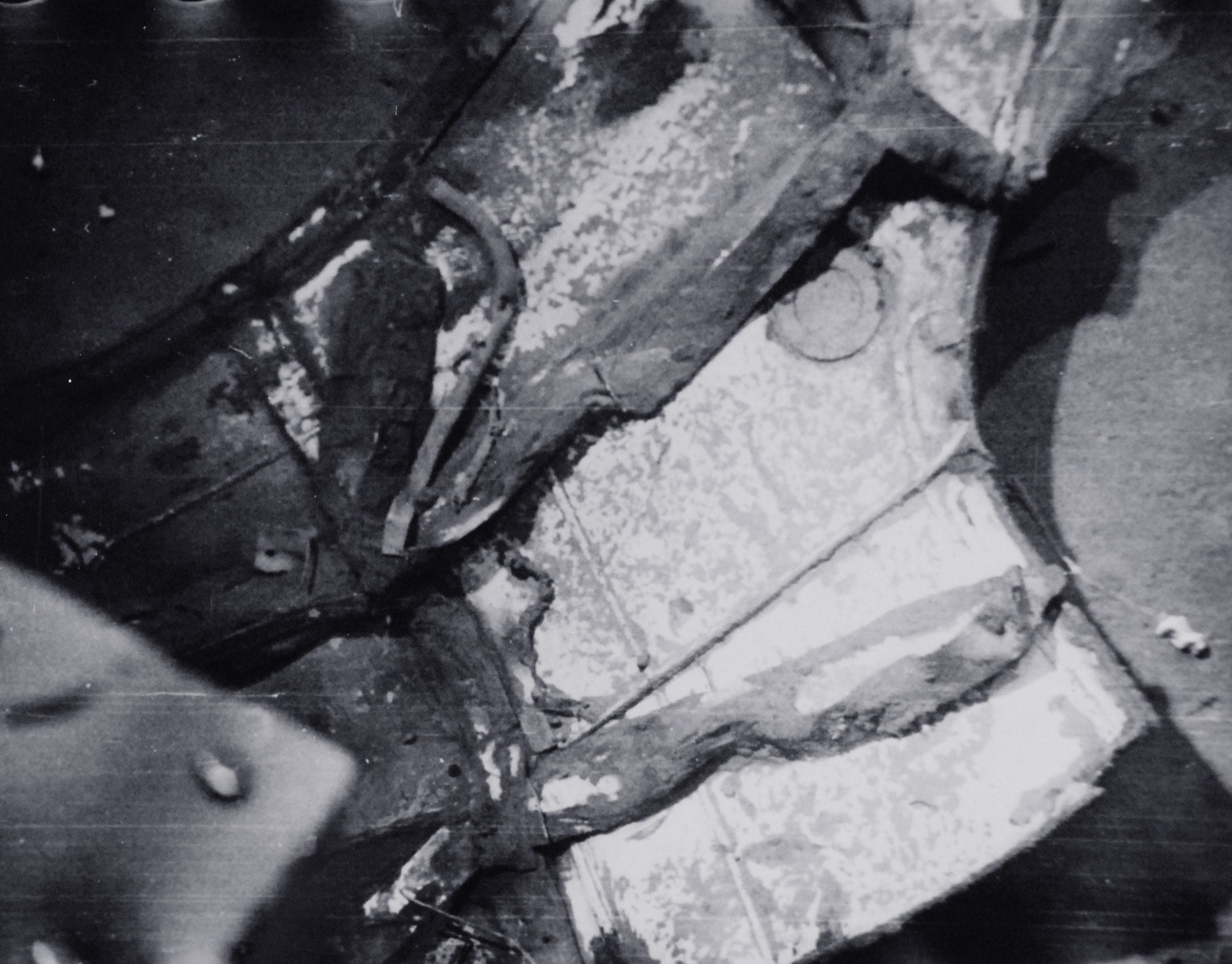
In the third week of May a camera towed from the research ship Atlantis II photographed scattered debris on the bottom. The bathyscaph Trieste, brought from San Diego, made two series of dives, the first from 24 to 30 June and the second in late August, and on 24 August photographed a section of sonar dome and the draft marks 4, 3 and 0 on a piece of hull; the Navy released the pictures in the first week of September. The following summer the research ship Mizar found the wreck in five main pieces spread over about a mile. All submarines had meanwhile been restricted to 500 feet.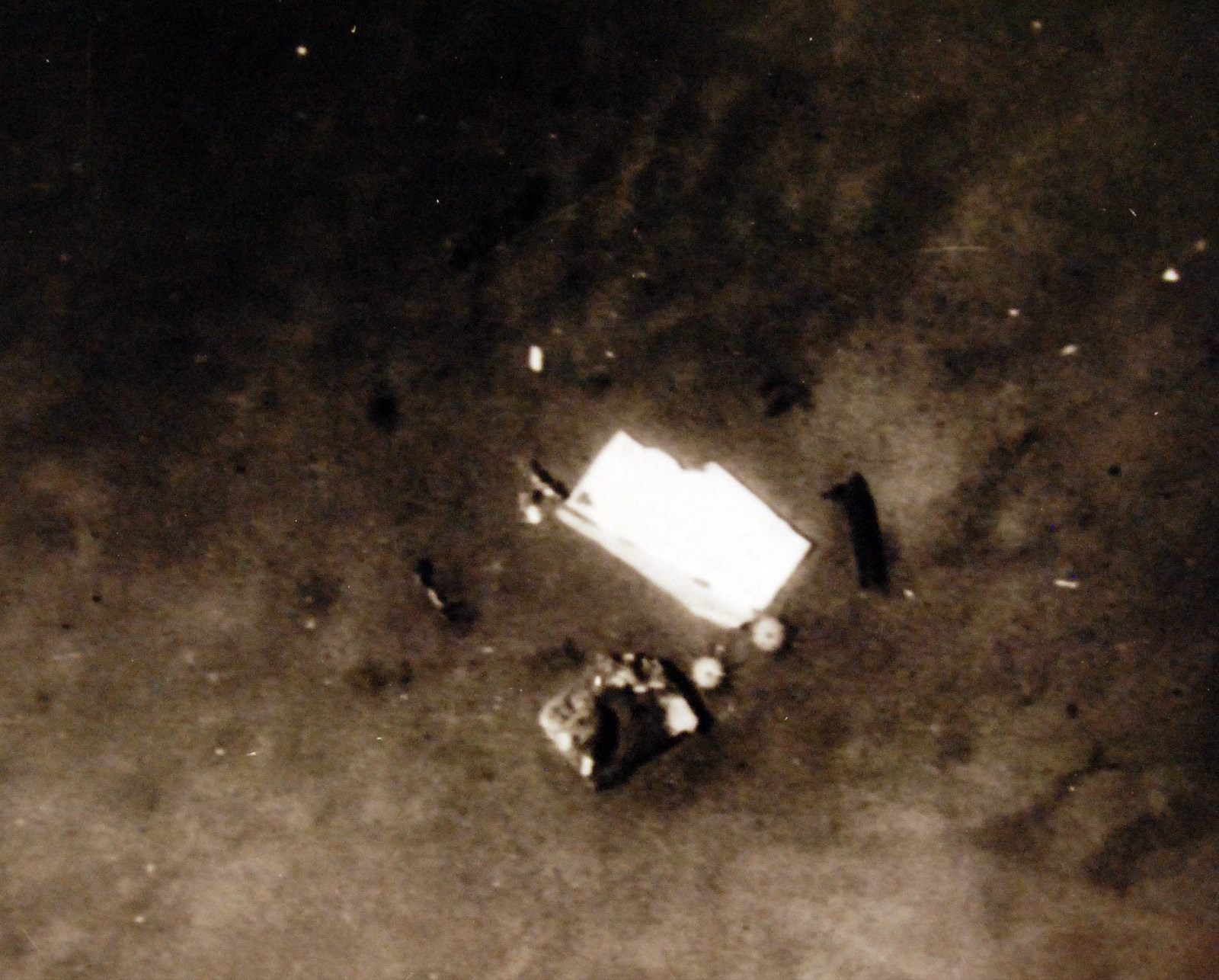
After
On 3 June 1963, two days before the court closed, the Bureau of Ships set up a submarine safety programme, with sixteen tasks covering the sea-water systems, the piping, the ballast blow, the switchboards and the quality assurance of every yard. Its founding document, the Submarine Safety Certification Criterion of 20 December 1963, is the origin of what the Navy has called SUBSAFE ever since. No submarine would be released from the depth restriction until the Bureau had certified her hull boundary and critical piping, with every brazed joint in the sea-water systems between hull and back-up valve either ultrasonically proven or welded and radiographed, and until she carried an emergency blow system that short-circuited the air from the banks to the tanks through the fewest possible fittings. The conical strainers came out. The acceptance standard for a brazed joint went from 40 per cent bond to 60. Every rescue ship got a recorder for the telephone. What the programme required, what it cost, and what it found when it audited itself twenty years later are in Maximum reasonable assurance.
Nobody was punished. Hecker was given command of a submarine, “an advancement in his career,” Ramage told the committee. Palmer retired. The court had found that the deaths were not “caused by the intent, fault, negligence, or inefficiency of any person or persons in the naval service.”
In 2003, after the loss of the shuttle Columbia, the Navy’s Rear Admiral Paul Sullivan explained the programme to the House Committee on Science. Between 1915 and 1963 the Navy had lost sixteen submarines to causes other than war, one every three years; since 1963 it had lost one, Scorpion in 1968, which had not been certified. “We have never lost a SUBSAFE certified submarine.”
The court’s record stayed closed for fifty-seven years. In 2019 a retired submarine captain, James Bryant, who had commanded a Thresher-class boat, sued under the Freedom of Information Act, and from September 2020 the Navy released the twelve volumes in monthly instalments, with the test depth and a few other figures still blacked out. Bryant’s conclusion, after reading them, was that there was “no coverup. No smoking gun”: the ship’s capabilities had outrun the Navy’s practices. His team’s reading of the acoustic evidence, with the Navy analyst Bruce Rule, is that the sounds of heavy flooding are absent from the record, that the ship may have been simply too heavy, leaking and uncompensated, when her pumps stopped, and that the chart Rule briefed to the court in 1963 is missing from what was released.
What it taught
Start with what it was not. It was not an accident without warning: Barbel in 1960, the submarine force’s message of 1961, Axene’s letter of November 1962 and the Bureau’s letter of August 1962 all said the same thing in writing. It was not a failure of the instrument: the ultrasonic test did exactly what the Bureau had bought it to do, on every joint it was pointed at. And it was not, by any finding then or since, the fault of one man, which is the part that is hardest to learn from.
A failed sample is a finding about the whole, not about the sample. Twenty joints in 145 is not twenty bad joints; it is a rate, and the rate applied to 3,000 joints is several hundred. The yard repaired the twenty and lagged the rest, and Rickover’s description of the habit is the whole story in two sentences: they would test a sample, find a percentage wrong, and “then they would only repair those they found wrong in that sample.” The Navy’s own later account extrapolates the figure to “possibly more than 400 joints.” The question to ask of any sample that fails is not “which ones?” but “how many more?”
The record went down when it should have gone up. The Bureau asked for the yard’s results and recommendations. The job orders routed the reports to the yard’s own planning division, and the court found they were not sent even there. The decision of 4 December was made with the knowledge of the yard commander and copied to the ship, and no one above either was told, just as no one had been told of the 22.5 per cent in Skipjack. The report reached Washington with a red flag on it after the loss. An inspection whose findings have no path to the people who set the standard is not an inspection; it is a local opinion with a certificate attached.
Test the escape before you test the limit. The ballast blow was the one system that had to work when everything else had failed, and it had never been run to the end at any depth, in any ship, because the criterion was written for 400-foot boats and nobody had rewritten it. It took the court thirty seconds at a pier to make it freeze. A deep dive is an experiment on a hull. Its control is the means of getting back, and the control has to be proved first, at the pressure where it will be needed, not assumed from a specification that predates the depth.
A specification used as a goal is not a specification. The court found the yard “using the specifications as goals rather than requirements in certain cases.” Brockett’s answer to Congress was that it would be “made perfectly clear that specifications are minimum requirements and not goals,” and that a yard which cannot meet one must have it rewritten, not waive it. The lesson did not stay learned: the Navy’s own review of the safety programme in 1985 found standards “beginning to be seen as goals vice hard requirements.” Rickover’s phrase for the asymmetry was “a quality control precipice”, a place where small deviations have large consequences, and the only known way to live on one is to treat the written number as a wall.
The blame went where the paperwork was. The one officer the court named was the man who left three sentences out of a radio message that could not have saved anyone. The men who left 2,855 joints untested, and the designers who had never tested a full blow, were a “collectivity”, as Rickover put it, and a collectivity cannot be named. A lapse that is documented and personal is easier to find than a practice that is diffuse and institutional. The remedy the Navy adopted, a programme with a boundary, written requirements, audits and a named technical authority, was a way of making the collectivity answerable.
Check the story before you learn from it. The last clear message is logged at 9:12, timed by the court at about 9:13, and remembered by the logger as half a minute after that. The words were “minor difficulties” to Mowen, “minor problem” to Hecker, and “attempting to blow up” in the log. The blow lasted four or five seconds to the man at the speaker, three or four to the navigator, twenty to thirty to the captain. “Test depth” came at 9:16 in the findings and 9:17 in the pilot house, and “nine hundred North” is in the findings and in nobody’s testimony that has been read here. The joints tested were 145 and the rejection rate 13.8 per cent in the court’s findings, 14 per cent in Congress, 10 per cent in Rickover’s first information; the joints in the ship number over 3,000 in the findings and 3,326 in a later count. The hull collapsed below her collapse depth by the Navy’s account and at about 2,400 feet by the acoustic analysis of 2013, which also finds no sound of flooding.
What the record supports without argument is the sequence: a yard told in August 1962 to test the maximum number of joints; 145 tested by the end of November, twenty failed; a decision on 4 December to stop, known to the yard commander, copied to the ship, reported to no one else; a blow system never tried to its end; a ship that reached test depth at 9:09 and was gone at 9:18. That is enough to learn from, and all of it was written down before she sailed.
Sources
- Record of Proceedings of a Court of Inquiry convened at the US Naval Submarine Base, New London, and the Portsmouth Naval Shipyard, to inquire into the loss of USS Thresher (SS(N)593), ordered 10 April 1963; Volume 1 of 12, released by the Department of the Navy under the Freedom of Information Act on 23 September 2020, with the index, the findings of fact (1 to 166), the opinions (1 to 55) and the recommendations (1 to 20), and the testimony of Captain Clarence Zurcher, Lieutenant (junior grade) James Watson, Boatswain’s Mate Roy Mowen, the radioman who kept the underwater telephone log, Lieutenant Commander Stanley Hecker, Lieutenant Raymond McCoole and Joseph Shafer. The times and words of the last messages, the 145 joints and the 13.8 per cent, the decision of 4 December 1962, the air system, the Tinosa test, the drydock demonstration and the court’s reconstruction. The Navy’s reading room at secnav.navy.mil holds the twelve volumes; a searchable copy of the first 300 pages is on DocumentCloud. documentcloud.org
- Secretary of the Navy, FOIA reading room, “THRESHER RELEASE,” interim releases 1 to 23, September 2020 onward, and the Navy’s press release of 23 September 2020 announcing the first release. secnav.navy.mil
- Joint Committee on Atomic Energy, Loss of the U.S.S. “Thresher”: Hearings before the Joint Committee on Atomic Energy, Congress of the United States, Eighty-eighth Congress, June 26, 27, July 23, 1963, and July 1, 1964, US Government Printing Office, 1965. The testimony of Korth, Austin, Brockett, Maurer, Rickover, Ramage and Curtze; Senator Pastore’s foreword; Appendix 1 (the submarine force’s message of September 1961), Appendix 2 (the Bureau of Ships letter of 28 August 1962), Appendix 6 (the Navy’s press release of 20 June 1963 and the unclassified summary of the court’s findings), and Appendix 17 (the ship’s chronology). Public domain; digitised by Stanford University Libraries. purl.stanford.edu
- Joseph W. Stierman, Jr., Public Relations Aspects of a Major Disaster: A Case Study of the Loss of USS Thresher, thesis, Boston University School of Public Communication for the Naval Postgraduate School, May 1964. The Navy’s fact sheet of 10 April 1963 (“below 400 feet”), Admiral Anderson’s announcements of 10 and 11 April, and the hours inside the Pentagon. archive.org
- Bruce Rule, “Misinformation About the Loss of THRESHER and the SOSUS Detection Thereof,” IUSS/CAESAR Alumni Association, 1 July 2013. The acoustic record: the collapse at 09:18:24 at about 2,400 feet in about a tenth of a second, the absence of propulsion noise, and the lack of recorders in the rescue ships in 1963. iusscaa.org
- Captain Jim Bryant, US Navy (retired), “What Did the Thresher Disaster Court of Inquiry Find?”, Proceedings, US Naval Institute, August 2021; and Bryant, Captain Frederick Best, Commander Ron Ricci, Steve Walsh and Nick Wulfekuhle, “Was the Thresher Ready for Sea?”, Proceedings, April 2023. The 1,300-foot test depth as published by Friedman and Polmar, the 3,326 joints, the missing acoustic chart, and the research team’s reading of the record. usni.org, usni.org
- David Sharp, “Skipper: Docs show no coverup in submarine sinking,” Associated Press, 2 August 2021, for Bryant’s “no coverup” remark, Norman Friedman on the test depth, the reading of “900 north”, and the Navy’s statement on Scorpion. militarytimes.com
- Gina Harkins, “Navy Declassifies 300 Pages of Probe into 1963 USS Thresher Disaster,” Military.com, 23 September 2020. The lawsuit, the court order of February 2020 and the first release. military.com
- Rear Admiral Paul E. Sullivan, statement on the Submarine Safety (SUBSAFE) Program, in NASA’s Organizational and Management Challenges in the Wake of the Columbia Disaster, hearing before the House Committee on Science, 29 October 2003, Serial No. 108-30. The programme’s purpose, its founding documents of June and 20 December 1963, the extrapolation to more than 400 joints, the record since 1963 and the review of 1985. govinfo.gov
- Naval History and Heritage Command, photographs NH 97549, NH 97552, NH 97555 and NH 97310, and USN 1048964 (National Archives); National Museum of the US Navy, press photographs 330-PSA-110-63 (USN 711302) and 330-PSA-191-65 (USN 711345), with their 1963 captions. history.navy.mil, history.navy.mil
- USS Thresher memorial roster, “John Wesley Harvey,” for his birth, his service in Nautilus and Seadragon, his months at Naval Reactors and the date he took command. ussthresher.com
- Wikipedia, “USS Thresher (SSN-593),” for the dates of the Trieste dive series in 1963 and the Mizar survey of 1964. en.wikipedia.org