On 5 September 1628, in the castle Tre Kronor in Stockholm, a court of seventeen men heard the master of the warship Vasa, the petty officer who had stowed her ballast, describe a test. Jöran Matsson said that while the ship lay at the crane below this same castle, with her ballast in and her guns not yet aboard, and in the presence of Admiral Fleming, thirty men had been made to run from one side of her deck to the other. The clerk wrote down what he said next. “The first time she gave a plank over, the second time two planks and the third time three planks; then Fleming bade them stop. Had they run more times, she would have gone over.”
A plank is the width of one deck board. Three planks was the measurement. The ship had sunk four weeks earlier, on 10 August, in the harbour of Stockholm, about a kilometre from the quay she sailed from, on her first voyage, in a wind the clerk of the Council of the Realm called “calm still weather, though somewhat gusty.” Nobody at the inquest disputed Matsson’s account of the test. Nobody asked the admiral about it either. He was not called.
Who ran it
Gustav II Adolf had been king of Sweden since 1611 and at war for most of it. In 1628 the war was with Poland, whose king, his cousin Sigismund, had once been king of Sweden too and still claimed the crown. The fighting was in Prussia, around Danzig, and the Swedish army got there by sea. The navy carried it, blockaded the Polish ports and kept the Baltic open. The king, who was a keen artillerist, wanted ships that carried more guns than anyone else’s.
Those ships were built at Skeppsgården, the navy yard in Stockholm, one of the largest workplaces in the country, with three or four hundred people in the warm months. In the 1620s the Crown let the work to contractors. In the autumn of 1624 the admiral of the realm, Carl Carlsson Gyllenhielm, who was the king’s older half-brother, and the vice admiral, Klas Fleming, sat down with the yard’s leading shipwright, a Dutchman named Henrik Hybertsson, to plan the navy’s building programme. On 10 January 1625 the king fixed the plan by contract. Henrik Hybertsson and his brother, the merchant Arent Hybertsson de Groote, undertook to maintain the fleet and to build four new ships over four years: a large one in 1626, a smaller in 1627, a large one in 1628 and a smaller in 1629. The first large ship was launched in the late autumn of 1626 and became the Tre Kronor. The second large ship was the Vasa.
Master Henrik had built warships for the Swedish Crown since the reign of the king’s father, and was a carver as well as a builder. He was also unwell. In January 1626 Fleming wrote to the king that Master Henrik had timber for a large ship cut and ready, and had promised that “His Majesty’s bestick”, the king’s own list of dimensions, “shall as far as possible be observed and followed.” A month later Fleming reported that the master had been badly ill, had kept his bed for eight weeks, and was beginning to come to himself again. By the summer of 1626 he had handed the daily running of the work to his assistant, Hein Jacobsson, another Dutchman. He died in the spring of 1627, about the time the ship was launched. His widow inherited the contract.
So the ship had, by the time she sailed, no designer alive. She had a builder who had followed another man’s specification, a merchant who had signed the contract, an admiral who had been at sea for most of the spring, and a captain appointed late. Söfring Hansson, called Jute because he was born in Denmark, had been in Swedish service since about 1600; the Crown had made him responsible for finishing the ship, and in 1628 he was given command of her.
What they were trying to find out
Nobody in 1628 would have called the Vasa an experiment. She was a warship, and the question asked of her was the question asked of any warship: would she carry her guns to sea. But under that question were two claims that had not been tested, and the story is what happened when the ship answered one of them and the people around her heard only the other.
The first claim was about the ship. The Vasa carried two full decks of heavy guns, forty-eight bronze 24-pounders, which the Vasa Museum says gave her a broadside about four times that of an ordinary Swedish warship of the 1620s and twice that of the largest ships in other northern navies. That weight had to go high in the hull, on two gundecks, with the upper works above them. The hypothesis was that a shipwright who had built good ships of the old size could build this one by the same method: by experience, proportion and the king’s list of dimensions. There was no other method. The museum puts it plainly: the mathematics for predicting a ship’s stability “were more than a century in the future”, so a builder designed from what had worked before. A new ship was often tender, or “crank”, when first put in the water, and there were known cures: take out guns, add planking at the waterline, or remove a deck. The claim was that this ship, bigger and heavier above the water than any the yard had built, would come out of the method the way the others had.
The second claim was about time. The king was in Prussia and needed the ship there. The hypothesis was that she was ready: that a ship with her ballast in, her guns aboard and her rigging up was a ship fit to sail, and that fitness was something the men on the spot could certify by looking at her.
Between the two claims stood one instrument, and it is the reason this entry exists. A seventeenth-century yard could not calculate stability, but it could measure it, crudely, by making a ship roll and watching how far she went. Thirty men running across a deck, back and forth, in step, will set a ship rolling. A stiff ship checks them; a tender one goes further with each run. It is the principle of the inclining test a modern yard performs with known weights before it certifies a hull. The instrument the Vasa’s people had was men, and the reading they got was in planks.
What they built
The ship that came off the Stockholm slip in 1627 was about forty-seven metres long in the hull and eleven and a half across, with her main mast rising more than fifty metres above the keel. The museum, which has weighed her as well as anyone can weigh a ship, puts her hull at about six hundred tonnes and her displacement on the day she sailed at between 1,200 and 1,250 tonnes. Hundreds of carved and painted figures, lions, warriors, emperors and mermaids, hung on her beakhead and her stern, and the inside of every gunport lid carried a carved lion’s mask, so that when the ports were opened the lions grinned at the enemy.
The guns came last, because the royal foundry could not cast them as fast as the yard could build. In August 1627 a contract was made to polish sixty 24-pounders “cast and intended for the new ship Wasan”, so the armament was settled a year before she sailed. When she took it in at the crane below the castle in July 1628, the arsenal accounts listed forty-six new 24-pounders and two old ones, eight 3-pounders, two 1-pounder falconets and six short pieces called stormstycken, sixty-four guns in all, weighing by the arsenal’s reckoning a little over 71 tonnes and by the museum’s a little over sixty. Either way they were about five per cent of what the ship displaced, and that is not what sank her. In the margin of the account book someone later wrote: “Sank by Danviken 10 August 1628.”
Below the guns went the ballast, about 120 tonnes of stone in the bottom of the hold. It was the ballast, and the room there was for it, that the inquest would spend most of its day on.
The officers’ evidence describes the ship as she floated. She drew fourteen feet forward and sixteen aft. Her lower gunports stood, by one account, four or four and a half feet above the water, and by another, no more than three and a half. The scuppers, the drains at the edge of the deck, were by the captain’s own estimate a span above the waterline, perhaps fifteen centimetres. She was already as deep in the water as her ports allowed.
Later accounts said that the king had changed his mind during the building and ordered a second gundeck added to a ship designed with one. The museum’s laser survey of the hull, eighty thousand measured points assembled by 2012 into a frame-by-frame model, found, in the words of one of the archaeologists on the project, “virtually no evidence of change during construction.” The Vasa was built as a two-decker from the keel up. What the survey did find was that she was not symmetrical, and among the tools recovered from the wreck were carpenters’ rulers in both Swedish feet and Amsterdam feet, which are not the same length. Fred Hocker, who has led the museum’s study of the ship since 2003, said in 2012 that “it may be that one side of the ship is much heavier than the other side.” That is a detail. The design itself, the museum says, is the cause: “the upperworks of the hull are too tall and heavily built for the relatively small amount of hull below the waterline.”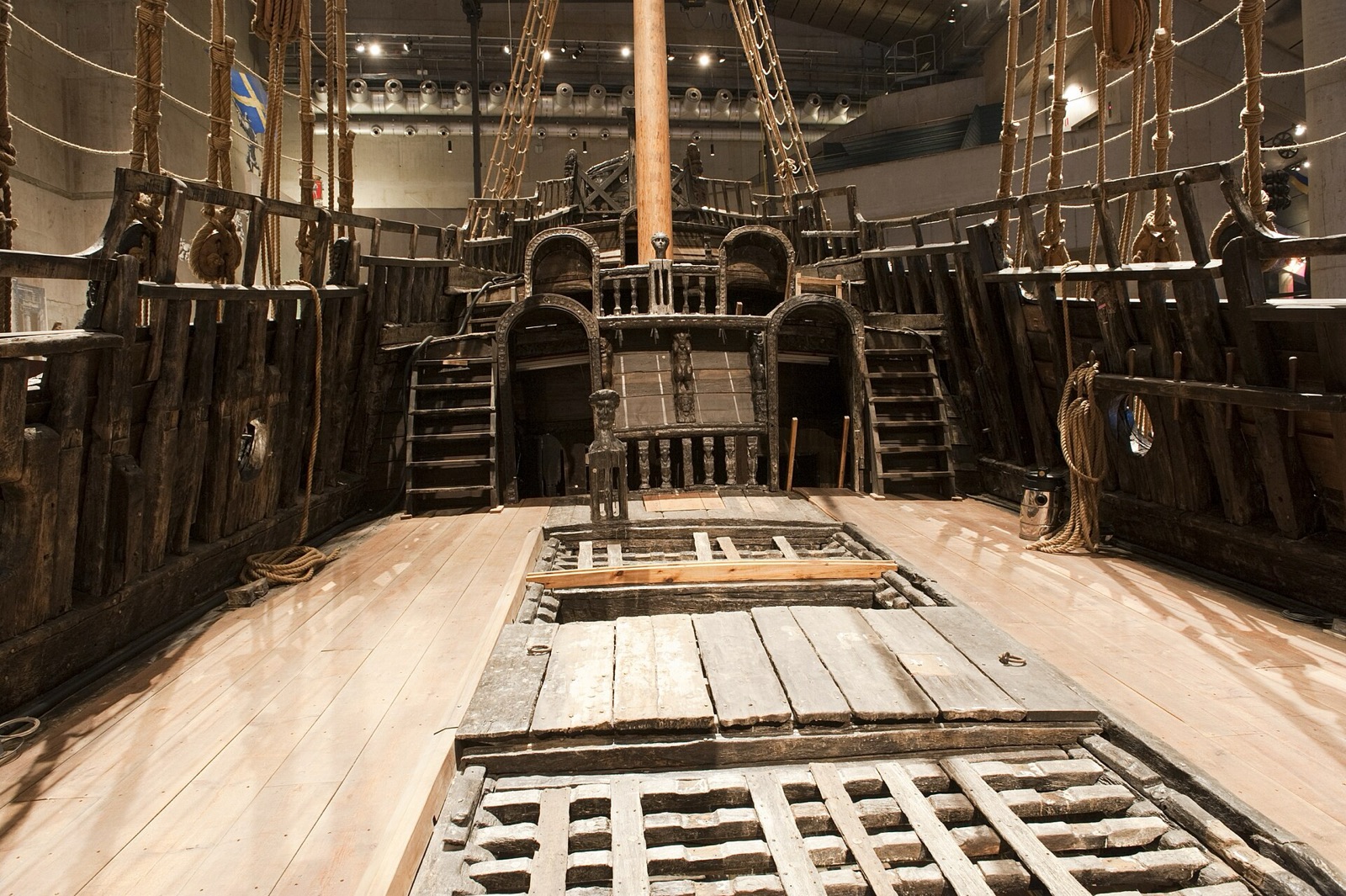
Three planks
The king left Stockholm for Prussia in the spring of 1628. His instruction to the Council of the Realm, dated 28 April, set aside five of the largest ships, the Vasa among them, as a reserve squadron in the Stockholm archipelago, ready to be sent “to the fleet”. By May the reserve was down to three ships, and one of them was not finished.
Both admirals were at sea with the main fleet that spring, and Hafström found, in the yard’s papers, that Fleming’s absence in particular was felt. On 20 May the Council called in Arent de Groote and Söfring Hansson and told them that “the ship which is to be completed” must be made ready. They answered that it would take more than two months. In the second half of May the king wrote to remind the Council that the ships at home were to be kept “so ready and in good readiness, that at whatever time and hour it pleases Us to call for them, they may be able to go to sail.” Around midsummer, judging that his orders were being followed too slowly, he sent Erik Jönsson, the army’s master of ordnance, from Prussia to Stockholm with instructions to demand that the ships be made ready “without neglect and delay”, and added that the Kronan and the Vasa must in any case be entirely ready “by next Jacobi”, the feast of St James, 25 July, or the Council would face His Majesty’s displeasure. Erik Jönsson was then to take command of them and sail to Älvsnabben, the fleet’s base in the archipelago, and wait.
Gyllenhielm came home in early July and was given the oversight of the squadron’s fitting out. Through July the guns went aboard at the crane. The loading of guns and ammunition was finished on 31 July, six days after the king’s date.
Somewhere in those months, with the ballast in and the guns not yet aboard, the test was made. The protocol does not date it. Hafström placed it in the spring, when the ship lay at the crane taking in ballast; the museum puts it about a month before she sailed, in early July. What matters is who saw it and what they said, and for that the only witness is Matsson, whose evidence opens this entry.
He said more than that. He said the captain, Söfring, had told Admiral Fleming that the ship was crank. He said that when he was bringing the ballast aboard he had told the admiral the fault himself, that the ship “is narrow in the bottom, nor has any belly”, and that Fleming had answered: “you carry too much ballast, so that the gunports come too near the water.” Matsson had replied, “God grant she will yet stand right on her keel.” The admiral had told him that the master builder had built ships before, and that he should not trouble himself about it. Asked whether the ship was fully ballasted when she sailed, Matsson said that all but one boatload was in. And he said that if, God willing, they got her up again and loaded her down to the gunports, she would still go over.
Then there is the sentence the museum has put at the centre of its account. When the thirty men stopped, Matsson said, Fleming said “that His Majesty were yet at home.” The museum renders it “If only His Majesty were at home!” and reads it as the admiral wishing for someone else to take the decision. The king was in Prussia demanding the ship by 25 July. Fleming did not write to him about the test. His only act, the museum says, was to confirm Söfring Hansson as her captain.
Here is the reading the instrument gave. One plank, two planks, three planks: the roll grew with every run, which is what a tender ship does, and the man in charge stopped the test because he could see where the fourth run would end. The admiral’s own remark about the gunports shows that he also understood the constraint: she could not be given more ballast without putting her ports in the water, and she could not be given less without rolling. That is not a loading problem. It is a design problem, and in 1628 it had three known cures, all of them slow. The admiral chose none of them, and the ship was certified ready by the fact of her sailing.
What it looked like from inside
Sunday 10 August 1628 began with church. Many of the crew took communion in the morning; the high boatswain, Per Bertilsson, would say so at the inquest when the prosecutor suggested he had been drunk. The ship lay below the castle with her guns aboard, and the museum’s account says the crew had been allowed to bring their families for the first short passage. The plan was to carry the guests out to the fortress at Vaxholm, put them ashore, and go on to Älvsnabben, where two companies of soldiers, three hundred men, would come aboard and the ship would wait for the king’s orders. The quay was crowded and the water was full of boats.
The Council’s letter to the king two days later gives the time. “Straight after evensong, between three and four o’clock,” the ship cast off from the crane, “with her proper ballast, the guns well secured, the wind at south-south-west, calm still weather, though somewhat gusty.” The wind was from the wrong direction to sail straight out, so she was warped along the waterfront, hauled on ropes run out to anchors and to the shore, around the end of the city island to where the current runs out of Lake Mälaren, by the oil sheds called the Tranbodarna below the southern cliffs. There, by the lieutenant’s later account, before any sail was set, “some persons went together to one side or the other, and the ship heeled after them.” Erik Jönsson, who was aboard as the squadron’s commander, ran below to see whether a gun had shifted. None had. The ship came upright again.
Then the sails went up: the two topsails, the foresail and the mizzen, four of her ten. The Council’s letter says that when the foresail fell they fired the salute, the double Swedish lösen that told the city the ship was leaving. Both gundecks’ ports were open, the lids raised and the lions showing, and the guns run out. In his own interrogation the day after, Söfring said that at first she “would not go by, or obey the helm”, that then she went a little, and that “when a little gust came, she threw herself a few times over and up again.” The lieutenant, Petter Gierdsson, said the wind was so light that when the order came to let fly the sheets, it “was not so strong that it could draw the sheets out, although they were well greased”, and the men had to push the sails out by hand; one man alone held a sheet. “He had never believed,” the clerk wrote, “that any ship would have gone over with so little wind.”
She drifted along under the cliffs of Södermalm with the wind blanketed, and came out past the gap at Tegelviken, where the wind could reach her. The Council’s letter: “when, in the bay by Tegelviken, somewhat more wind came into the sails, she began at once to heel much to leeward, but once or twice righted herself a little again, until she came against Beckholmen, where she fell wholly on her side, and the water in through the gunports, until she so slowly went to the bottom with standing sails, flags and all.”
Inside her it was faster than that. Matsson said that when she began to heel by Tegelviken men were told off to haul the guns in, “but before they had got one gun well in, the ship went over.” Erik Jönsson had run below again to see whether the guns had broken loose; they had not, “all were fast tackled.” As the water came in through the ports he shouted up for the sheets to be let fly and was told they already had been. By the time he tried to climb out the water was so high that the ladder came loose, and he said he barely got up, meaning to save himself on the rail. He was struck by a hatch cover on the way, pulled out of the water half-drowned, and the Council told the king two days later that he lay “at death’s door”. The captain stayed late and was dragged under by the ship before he reached the surface in his heavy clothes. The old captain Hans Jonsson, who had been named to command the Vasa before Söfring and was aboard as a second experienced master, as was the custom on a new ship’s first passage, did not come up.
The Council wrote that “many boats came out at once, but there was nothing to be done.” The masts stood above the water, and people clung to them. Some swam the 120 metres to the shore of Beckholmen. It was over before five o’clock. A councillor wrote in his diary that nothing showed above the water but the top of the main mast.
How many died is not known. The Council told the king it could not say until the muster was held, and the muster roll has not survived. Gabriel Gustafsson Oxenstierna, a councillor, wrote to his brother the chancellor on 23 August that “about 30 persons, with boatswains, wives and children who wanted to go along to Vaxholm,” had perished. The Danish agent Erik Krabbe reported home on 17 August that it was “said to be over half a hundred persons, among them some women and children.” The museum uses the lower figure, about thirty of perhaps a hundred and fifty aboard, and notes that most of the dead were trapped inside the ship. The skeletons of at least fifteen people were found in and around the wreck in the 1960s.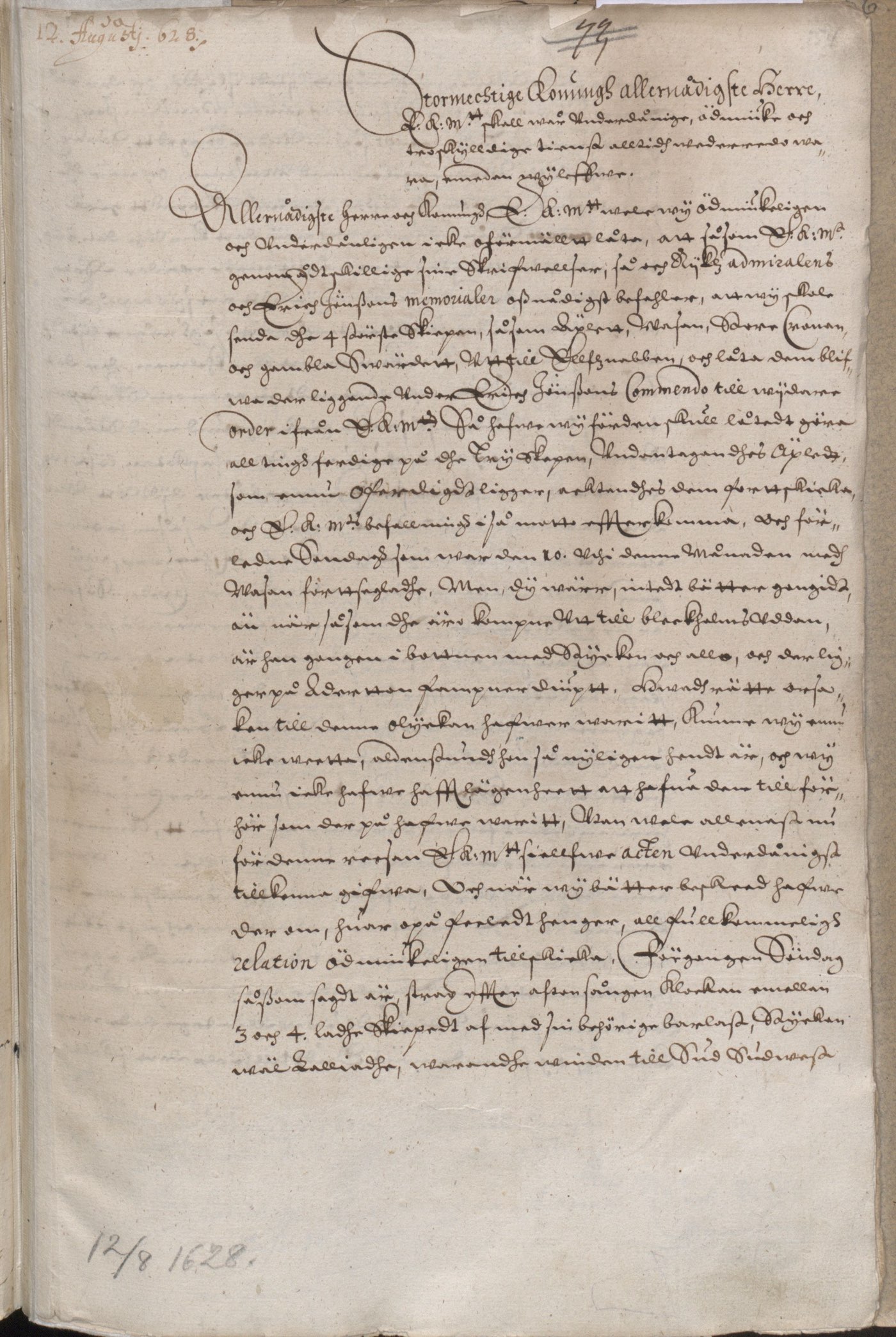
What happened
The Council had the captain in the castle the same evening and questioned him on 11 August. The clerk’s notes are short and broken. Söfring swore that all the people were sober. “All guns were fast, and if any gun was not fast, they may hew him into a thousand pieces.” The ballast was in “as much as had room”, and, he said, a hundred lasts more than Admiral Fleming had wanted. The fault was “nothing other than crankness”, and the ship had been so crank that she could not carry her masts. Asked the right cause of her great crankness, he gave the only answer he had: she was narrow in the bottom.
On 12 August the Council wrote to the king. The letter reports the orders the king had given, the ship’s departure, the wind, the sails, the salute, the heel at Tegelviken, the sinking by Beckholmen “with guns and all” in eighteen fathoms of water, and the Council’s ignorance of the cause: “what the right cause of this misfortune has been, we cannot yet know, since it happened so lately and we have not yet had opportunity to examine those who were aboard.” Then it turns to the practical question. An Englishman named Bulmer had offered to raise her. The next day he was given a commission, and by 21 August the Council could tell the king that he had got the Vasa to stand “right on her keel on the bottom.” She stands so still.
The king received the letter in his camp in Prussia on 27 August and answered on 1 September. The paragraph on the Vasa is a dozen lines in the register of outgoing letters. The misfortune had happened, he wrote, “doubtless through the imprudence and carelessness of those who should have governed her.” The Kronan and the Gamla Svärdet were to stay at home, every effort was to be made to raise the Vasa, and he wanted Captain Söfring to lead the work, “since We do not doubt that he, as well as any other, if it be at all possible, shall be able to bring her up.” The man whose ship had sunk under him was, in the same breath, the man the king trusted to lift her. The museum reads the letter as fury and a demand that the guilty be punished. It is at least a verdict given before the evidence: the cause was the people aboard, and the ship was to be got back.
The Council had already set up its court. It had seventeen members, six of them councillors of the realm, and it sat on 5 September 1628 in the castle under Gyllenhielm, with a prosecutor, the fiscal, putting the questions. Among the assessors were navy captains, the Crown’s treasurer, the burgomaster of Stockholm and the ironmaster Willem de Besche of Finspång, who had been called to the city to advise on the salvage. The protocol survives only in a copy, and the copy is missing its beginning. What remains starts in the middle of Erik Jönsson’s evidence and runs through the builders to a list of the experts’ opinions. The companion piece “The protocol” gives the whole of it in English; what follows is the part that decided the case.
The pattern of the questions was the same for every officer. Did you know the ship was crank? Did you look to the ballast? Was it your fault? Erik Jönsson said he was a master of ordnance, not a seaman, and that even had she not been under sail she would still have gone over, “for the heaviness of the upperworks, since she was heavier above than below.” Told that the builder would have had her laden a foot deeper if anyone had warned him, he asked how she could be ballasted more when the gunports lay no more than three and a half feet from the water. Gierdsson, the lieutenant, had rigged the ship and did not know what ballast was in her. Matsson, the master, gave the evidence about the test. Bertilsson, the boatswain, had been to communion and was not drunk. Then the court turned to the builders.
Hein Jacobsson was asked why he had built the ship “so narrow and ill that she had no belly to lie on, and therefore went over.” He answered that he had built her after the certer, the specification, “given him by Master Henrik, and on His Royal Majesty’s command.” He added that he had even built her a foot and five inches broader than he had been given, about forty centimetres, and that “all people say she was well built.” Arent de Groote, asked why the ship was so ill provided in her building, said he had built her after the specification he had contracted for with His Majesty, and after the manner of a French ship he had seen building in Holland for the Duke of Guise, which he had shown the king. He thought there was no fault in the building; as the builder thought, the fault must be in the ballast.
The builder said that with more ballast the ship would have been in no danger. Söfring answered that with more ballast the scuppers would have been under water and the ports too, “which could not be, if one should otherwise be able to use the guns.” Then the captain said the thing that should have ended the inquiry and did not. It was to be feared, he said, “that it will go the same way with the ship he now builds, since that too is built in the same manner.” The ship Jacobsson was then building was the Äpplet, the Vasa’s sister, due to be launched the next year. The builder’s reply was that he had to build after the specification he had been given.
De Groote said that if they would have all the master builders look at her, they would say that she was built “blameless”. The fiscal asked the obvious question: if she was blamelessly built, what then was the cause that she went over? The clerk recorded the answer of both men: “they did not know it; God may know it.” Then de Groote said the sentence that decided the inquest. He had told His Majesty how long and how broad she was, “and His Majesty was pleased with it, and would have it so.” The fiscal’s answer is written in the protocol and then corrected in another hand in the margin, as if someone had thought about how it would read: though His Majesty had wanted it so, those who understood the matter better should have told His Majesty what she could carry. The builder was asked whether he had a good conscience about building such a ship. “She is as well built as any ship can be,” he said. The fiscal gave the court’s finding in a sentence: “the ship is indeed well built, but not rightly proportioned as she ought to be.”
One more builder was called, Johan Isbrandsson, the Crown’s own master at the yard. He could see no fault; she was as broad as the Kronan, and by his art seemed stiffer, and he thought it impossible that such a ship should go over. The court asked him how far the Kronan’s gunports stood from the water. About four feet, he said. Captain Frans was sent to the Kronan to find out. It is the only measurement the inquest took.
After the witnesses the protocol lists, in eight numbered paragraphs, the “discourse and censure” of the experts who had been called to sit in. They disagreed about the rig and agreed about the hull: the hold was too small and should have been two feet deeper, so that the ballast lay too high and too little of it could be stowed; she was “built too sharp below, so that she could not carry the upperworks”; and “therefore the fault was in the building.” De Besche, who appears in the protocol as Master Wellam, said that “a master builder ought to make his reckoning, and know how high she ought to stand above the water,” and gave the court an illustration. Put a pound of lead in one pan of a balance and a pound of feathers in the other, pull the lead pan down and let it go, and the feathers will weigh it back up again. “So it is here: the load in the bottom was too light.”
That was the inquest. The protocol was read to the Council on 11 September. No verdict is recorded, nobody was charged, and nobody was punished. Master Henrik, who had drawn the specification and was dead, took the blame by default, and the king, who had approved it, took none. Hafström, who published the protocol in 1958, noted that the court had the king’s dimensions and the king’s admiral in front of it and could not easily find against either. The museum calls the proceedings “to a certain degree” a piece of political theatre, a demonstration of what would now be called due diligence, and points out that everyone involved had had a month to get their stories straight.
Everyone questioned did well afterwards. Hein Jacobsson built ships for the navy until 1638, among them the Äpplet, which Söfring had feared and which served for nearly thirty years. Jöran Matsson became a captain. Söfring Hansson, released on bail after a few days, led the first attempts to raise the ship and later ran the yard. Klas Fleming, whom the museum identifies as the Admiral Fleming of the protocol, was with the fleet off Danzig when the court sat, was never examined, and died in action against the Danes in 1644.
After
Bulmer righted the ship and could not lift her. Others tried in 1628 and 1629 with cables, capstans and divers and gave up. In the 1660s two men with a diving bell, Albrecht von Treileben and Andreas Peckell, worked on the wreck in thirty metres of water in near darkness and brought up more than fifty of the bronze guns, tearing up most of the upper deck to get at them. Then the ship was forgotten for nearly three hundred years. The companion piece “Three hundred and thirty-three years” tells how she was lost and found.
In 1955 Anders Franzén, an engineer in the navy’s fuel department who had spent his spare time in the archives and dragging the harbour bottom, found the Council’s letter of 12 August 1628 and the other papers that put the wreck off Beckholmen. On 25 August 1956 his coring device came up with a plug of old black oak, and in early September a navy diver, Per Edvin Fälting, felt his way in the dark along a wooden wall with a row of square openings and another row above it. Only one two-decked warship had been lost near Beckholmen. On the morning of 24 April 1961, at three minutes past nine, after eighteen months of tunnelling under the hull and eighteen lifts in 1959, the timbers of the Vasa came up through the surface. Eleven skeletons were found on her decks and four more in the wreckage of her stern. The archaeologists took 120 tonnes of stone out of her hold and more than thirty thousand objects, among them the carpenters’ rulers.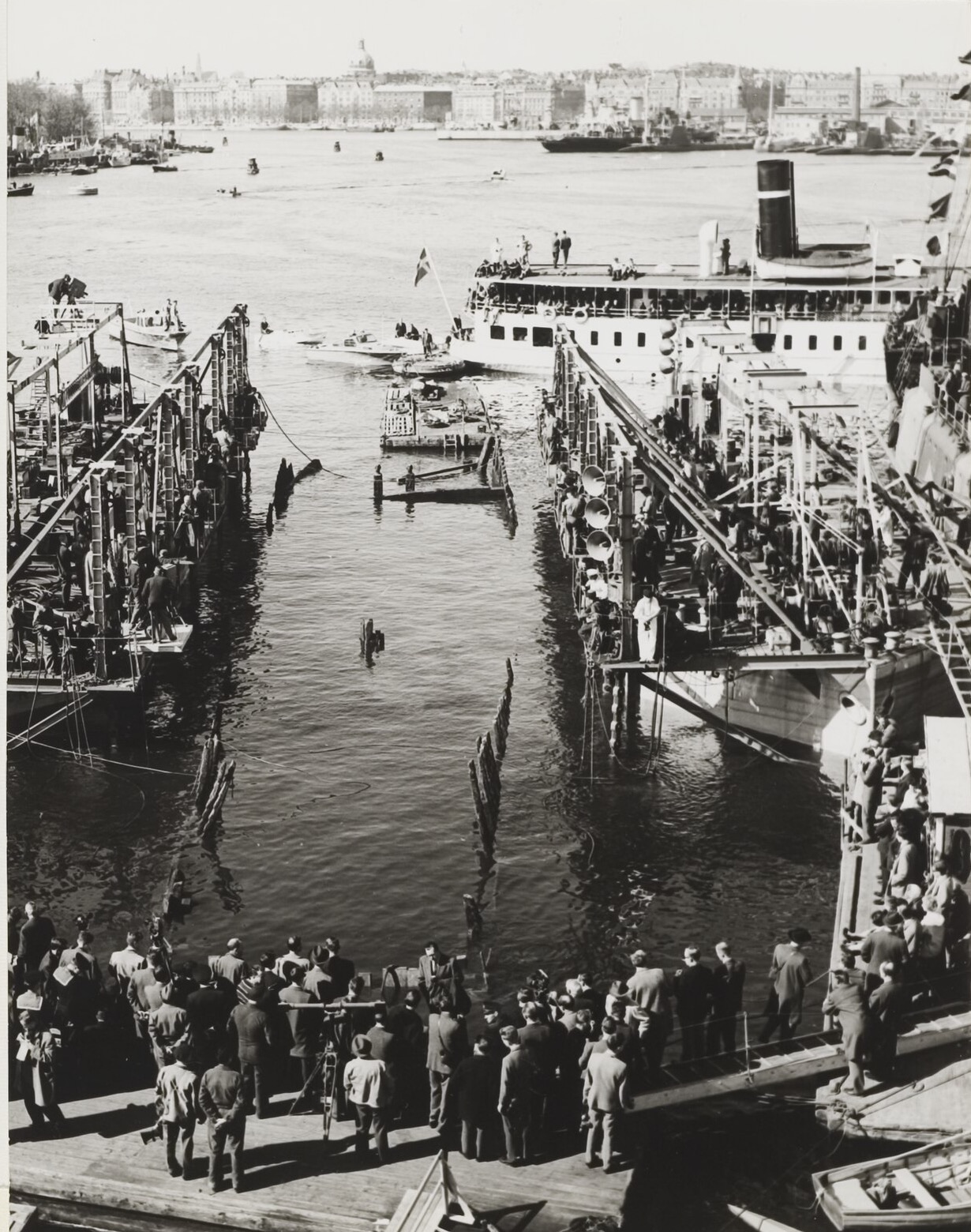
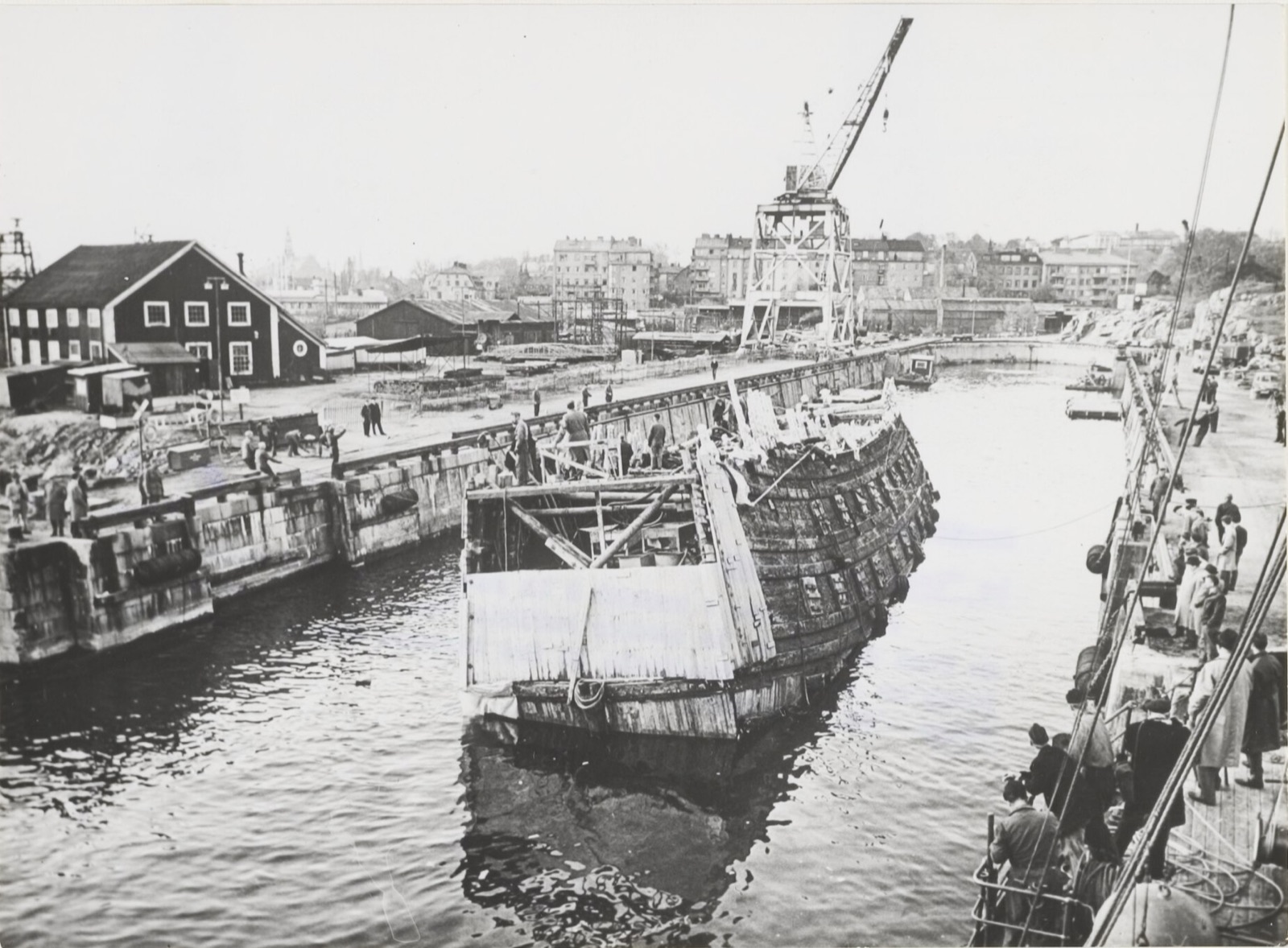
The museum built around her opened in 1990; the ship inside it is ninety-eight per cent original timber. In December 2021 the Museum of Wrecks, surveying the strait at Vaxholm with the navy, found a large wreck with gunports on two levels, and in October 2022 identified it, from its dimensions, its construction and oak felled in 1627 in the same district as the Vasa’s, as the Äpplet, the sister ship Hein Jacobsson was building on the day of the inquest. He had built her a metre wider, 12.6 metres against the Vasa’s 11.5; she served until 1658 and was sunk the next year as part of a barrier across the channel. Researchers can now set the two hulls side by side and see what else he changed.
What it taught
Hocker, asked in 2012 why the ship sank, said that “everybody wants to know why the ship sank, but to me that’s not the most interesting question. Instead, I’d ask, ‘How did the human process of building the ship fail?’” That is the right question for this journal too, and the record answers it.
The instrument gave its reading, and the reading was correct. Thirty men, three runs, one, two and three planks, with the ballast in and the guns not yet aboard: this was a stability test, and the ship failed it. The admiral stopped it, which proves he could read it. The master told him the ship had no belly; the admiral told the master she had too much ballast for her ports. Everyone who mattered understood, at the quay, in the ship’s own terms, the thing the court of experts would say in September and the museum’s own survey would confirm four centuries later. The failure was not that nobody knew. It was that knowing was converted, in the same conversation, into a question about who was in charge. “Would that His Majesty were at home” is the sound of a measurement being handed upward to someone who was not there to receive it.
A test you stop because the result frightens you has still given a result. Fleming ended the test to save the ship at the quay, and in doing so treated the three planks as a hazard of the test rather than as its finding. There is a version of this in every programme with an end date: the trial is cut short, the shortened trial is passed, and the trial that was not run becomes the thing nobody can be blamed for. The inquest asked each man whether he had known the ship was crank; from the master and the captain the honest answer was yes. The question it did not ask was what anybody had been required to do about it.
The constraint was in the design, and loading could not fix it. The experts’ list is a model of what a good inquiry finds. The ballast was too high because the hold was too shallow; the hold was too shallow because the ship had been drawn too sharp and too narrow in the bottom for the weight she carried above; and the weight above was what the king had ordered. Söfring’s answer to the builder, that more ballast would have put the scuppers and the ports under water, shows that the two requirements, enough ballast to stand up and ports high enough to fight, could not both be met in that hull. The master had stowed the ballast by hand with a lantern because he did not trust his men to do it well enough. It made no difference. A design that cannot satisfy its own requirements is not rescued by care in the execution, and it is a mark of such a design that everyone involved in the execution is, like Matsson, blameless.
The inquest measured one thing, and it was the wrong ship. De Besche asked for what the builder should have had: “a master builder ought to make his reckoning, and know how high she ought to stand above the water.” No such reckoning existed, for him or anyone, for another hundred years. But the court had a measurement in front of it in the form of Matsson’s planks and never asked anyone to repeat it, on the Kronan or on the Äpplet then taking shape on the slip. The one measurement it ordered was the height of the Kronan’s gunports, by a captain sent across the harbour with a rule. The inquiry was built to assign fault and not to learn, and when the two builders said that only God knew the cause, the court had no instrument with which to disagree.
A sponsor who has approved the design cannot be the finding. The decisive sentence was de Groote’s: he had told the king her length and breadth, and the king “would have it so.” From then on the court was looking for a verdict that did not name the king and did not name the king’s admiral, and found it in a shipwright who had been dead for eighteen months. The king’s own verdict, “imprudence and carelessness of those who should have governed her”, written before any evidence was heard, said the same thing from the other direction. Both were right about something. The king was right that she was sailed with her ports open, which the museum calls “a fateful decision”; the captain was right that she would have gone over anyway. Neither fact was ever weighed against the other, because weighing them would have meant saying who was responsible for a ship that could not carry her guns.
The deadline was the certificate. “Entirely ready by next Jacobi”, on pain of the king’s displeasure, with an officer sent from the front to see it done: that was the instrument that measured the ship’s readiness, and it measured the calendar. She was a week late. The ordinary cures for a crank ship, lightening her, girdling her at the waterline or taking off a deck, would each have taken months, which is to say they would have taken the ship out of the king’s summer. So the question the test had answered, could she carry her guns to sea, was replaced by the question the deadline could answer, was she rigged, ballasted and armed. She was.
Check the story before you learn from it. The contract is dated 10 January 1625 in the archive and 16 January in some modern accounts. The dead are “about 30” in a councillor’s letter and “over half a hundred” in a diplomat’s report written six days earlier. The distance she sailed is “barely a kilometre” in the museum’s English, “a good kilometre” in its Swedish, and 1,300 metres in most encyclopaedias. The guns weigh 71 tonnes by the arsenal’s book and about 60 by the museum’s. The protocol says “Admiral Fleming” and no more. The famous second gundeck, added on the king’s whim, is in many books and not in the hull. What is not in dispute is the sequence: a specification the king approved, a builder who followed it and widened it a hand’s breadth, a test at the quay that was stopped on the third run, a letter from Prussia with a date in it, and a ship that sailed with her ports open into the first gust that reached her. That is enough to learn from, and all of it was known before she cast off.
Sources
- The protocol of the inquest held at Stockholm Castle on 5 September 1628, in the Vasa Museum’s transcription of the surviving fragment (Riksarkivet; after Georg Hafström’s edition). The thirty men, the three planks, Fleming’s words, the gunport heights, the builders’ and experts’ evidence. English renderings in this entry are the author’s. vasamuseet.se (PDF)
- The interrogation of Captain Söfring Hansson by the Council of the Realm, 11 August 1628, in the museum’s transcription. The sober crew, the “thousand pieces”, the scupper a span from the water, the hundred lasts of ballast. vasamuseet.se (PDF)
- The Council of the Realm to Gustav II Adolf, Stockholm, 12 August 1628, in the museum’s transcription, with its modern Swedish rendering and the scan of the original. The time, the wind, the sails, the salute, the heel at Tegelviken, the sinking by Beckholmen in eighteen fathoms, Bulmer. transcription (PDF), original, page 1 (PDF)
- Gustav II Adolf to the Council, from the camp in Prussia, 1 September 1628, in the museum’s transcription of the Riksregistraturet copy. “Imprudence and carelessness”; Söfring to lead the salvage. transcription (PDF), original (PDF)
- Vasa Museum, “Originaldokument om Vasa”, the page that gathers the documents above. vasamuseet.se
- Georg Hafström, “Örlogsskeppet Wasas undergång 1628” and “Bärgningsförsök och dykningar på Wasa”, Tidskrift i Sjöväsendet, no. 10, 1958, Kungl. Örlogsmannasällskapet. The 1625 contract and its four ships, Fleming’s letters of January and February 1626 on Master Henrik’s timber and illness, the contract of August 1627 for sixty 24-pounders, the arsenal’s list and weights of the guns taken aboard in July 1628, the king’s instruction of 28 April 1628, the Council’s meeting of 20 May, the king’s orders of May and midsummer with the date of 25 July, the composition of the court, Oxenstierna’s and Krabbe’s figures for the dead, the reading of the protocol on 11 September, and the salvage attempts of 1628 and 1629. Quotations from these documents are at second hand from Hafström’s article. koms.se (PDF)
- Vasa Museum, “The Inquest” (and the Swedish “Utredningen”). The seventeen members, Gyllenhielm, the 120 tons of ballast, the test and “If only His Majesty were at home!”, the forty centimetres, the careers afterwards, the “belly”, the “political theatre”. vasamuseet.se, Swedish
- Vasa Museum, “The Disaster”. The families and Vaxholm, the warping to Slussen, four of ten sails, the salute, the gust at Tegelviken, the 32 metres, the 120 metres to Beckholmen, “all but 30”, Hans Jonsson, Erik Jönsson, the century-distant mathematics, the cures for a crank ship, the “fateful decision”. vasamuseet.se
- Vasa Museum, “The Search for Vasa”, “The Salvage” and “The Excavation”. Franzén’s archives and corer, 25 August 1956, Fälting, the six tunnels, the eighteen lifts of 1959, 24 April 1961 at 09.03, the eleven and four skeletons, the 120 tonnes of ballast taken out, the thirty thousand objects. search, salvage, excavation
- Vasa Museum, “Vasa – the machine of war” and “The Ship Yard”. The sixty-four guns and eight empty ports, the broadside, the four hundred workers, the asymmetry. machine of war, ship yard
- Vasa Museum, audio guide text versions: “3. The shipwreck”, “8. The inquiry” and “9. The first salvage efforts”. The 150 aboard and 30 dead, the thirty men and three rounds, Treileben, Peckell, the fifty-five guns and the Italian priest’s diary of 1663. 3, 8, 9
- Vasa Museum, frequently asked questions, “The Ship & its History”. The mast heights, deck heights, hull and displacement weights, the 120 tons of stone, 150 to 200 aboard and 30 to 50 dead, the costs, the 98 per cent, the time of sailing. faq.vasamuseet.se
- Vasa Museum, “Vasa’s sister Äpplet found”, 25 October 2022; and Vrak, Museum of Wrecks, “1628 Vasa” and “Äpplet”. The Äpplet’s discovery in December 2021 and identification, the oak of 1627, her breadth of 12.6 metres, her service to 1658 and sinking in 1659; the Vasa wreck’s depth and the hull’s dimensions. vasamuseet.se, vrak.se, Vasa, vrak.se, Äpplet
- Lucas Laursen, “Vasa’s Curious Imbalance”, Archaeology, July/August 2012. The laser survey of 2007 to 2011 and its eighty thousand points, the Swedish and Amsterdam rulers, “virtually no evidence of change during construction”, and Hocker’s remarks. lucaslaursen.com
- Carl Olof Cederlund and Fred Hocker (ed.), Vasa I: The Archaeology of a Swedish Warship of 1628 (2006), and Fred Hocker, Vasa: A Swedish Warship (2011), the museum’s own accounts, on which its web pages rest. Both are in copyright and were not consulted directly for this entry.
- Figures: the Council’s letter, Riksarkivet, from the museum’s PDF above; the upper deck, Anneli Karlsson for the Vasa Museum, 2010, CC BY-SA 4.0, Wikimedia Commons; the raising and the dock, 1961 press photographs in the collection of the MAS, Collectie Stad Antwerpen (inv. AS.1978.012.368.1-4 and .2-4), carrying the Public Domain Mark on the archive’s asset pages, raising, dock.
