At a quarter to nine on the night of 17 February 1864 the officer of the deck of the United States steam sloop Housatonic, Acting Master John Crosby, saw something on the water about a hundred yards off the starboard beam. The ship lay at anchor in 27 feet of water, five and a half miles east-south-east of Fort Sumter, on the outer line of the blockade of Charleston. The night was clear and bright with moonlight, the sea smooth, the tide half ebb. Crosby told the court of inquiry three weeks later that the thing “at first looked to me like a porpoise, coming up to the surface to blow.” He pointed it out to the quartermaster, who looked through his glass and said he saw nothing but a tide ripple.
Crosby looked again, saw that it was coming towards the ship very fast, and gave the orders to beat to quarters, slip the chain and back the engine. Going forward to see that the chain had gone, he looked over the side and saw, about twenty feet off, “what appeared to me a plank sharp at both ends.” The captain, Charles Pickering, came on deck with a double-barrelled gun loaded with buckshot, jumped on the horse block on the starboard quarter, saw “two projections or knobs about one third of the way from the bows,” and fired at them. The next instant he was blown into the air.
The Housatonic went down by the stern in a few minutes and settled on the bottom with her masts and rigging above the water and most of her people in them. Five did not get there: Ensign Edward Hazeltine, the captain’s clerk Charles Muzzey, Quartermaster John Williams, Fireman John Walsh and Landsman Theodore Parker. The sloop Canandaigua had everyone else off by half past ten.
While he waited in the fore-rigging, a landsman named Robert Flemming, who had been the first man to see the thing and had been told it was a log, watched the Canandaigua come round the wreck. He told the court: “I saw a blue light on the water just ahead of the Canandaigua, and on the starboard quarters of the Housatonic.”
Two days later, at Battery Marshall on Sullivan’s Island, a Confederate lieutenant-colonel reported that the torpedo boat stationed at his post had gone out on the night of the 17th and had not come back, and that “the signals agreed upon to be given in case the boat wished a light to be exposed at this post as a guide for its return were observed and answered.” The boat was the H. L. Hunley, a submarine turned by hand. She carried the name of a man she had drowned four months earlier in nine fathoms of water off the city, with seven others; before that she had drowned five more. The eight men inside her knew this, because the general commanding had ordered that they be told.
Who ran it
Horace Lawson Hunley was born in Tennessee on 29 December 1823 and made his life in New Orleans, where he practised law and sat for Orleans Parish in the state legislature. In the winter before the city fell he put money into a submarine. William Alexander, who built the later boats, set it down plainly in 1902: “Captain Hunley (not Hundley), Captain James McClintock and Baxter Watson were engaged in building a submarine torpedo-boat in the New basin of that city. The city falling into the hands of the Federals before it was completed, the boat was sunk, and these gentlemen came to Mobile.” The Navy’s history calls that first boat, the Pioneer, a privateer, and the licence is the point: a submarine was a private venture aimed at the blockade, and there was money in the blockade.
At Mobile the three men “reported, with their plans, to the Confederate authorities here, who ordered the boat to be built in the machine shops of Parks & Lyons.” Alexander was a soldier of Company B, 21st Alabama, detailed to government work in those shops, and was told to carry out their plans. The second boat, about 25 feet long, “became unmanageable and finally sank” under tow off Fort Morgan early in 1863, “but no lives were lost.”
The third boat was Hunley’s. The Navy’s note on his photograph says she was “built entirely by his means,” and she carried his name.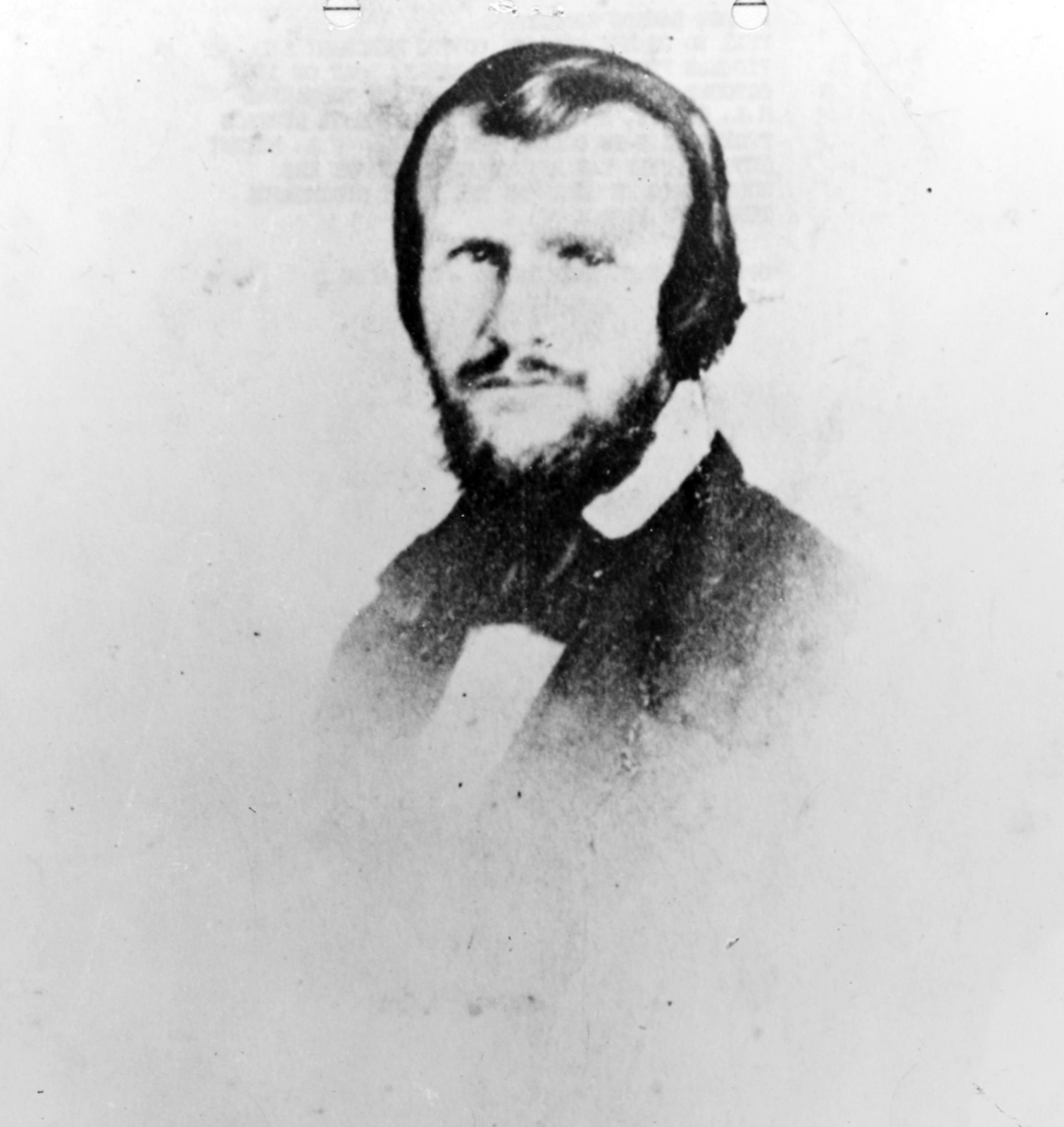
One more man from the 21st Alabama belongs here. George E. Dixon had been an engineer on Mississippi steamboats before the war. At Shiloh on 6 April 1862 he was shot in the thigh; the ball struck a twenty-dollar gold piece in his pocket and bent it, and he had the coin engraved and kept it. Alexander: “Lieutenant George E. Dixon, like myself was a mechanical engineer, and belonged to the same regiment, the Twenty-first Alabama. He had taken great interest in the boats while building, and during their operations in Mobile river.”
The other party was the army at Charleston. General P. G. T. Beauregard commanded the Department of South Carolina, Georgia and Florida, with Brigadier-General Thomas Jordan as his chief of staff. In July 1863 the Union army had landed on Morris Island and begun the bombardment of Fort Wagner and Fort Sumter, while Rear-Admiral John Dahlgren’s South Atlantic Blockading Squadron lay off the harbour: the armoured New Ironsides and the monitors inside the bar, the wooden ships outside. On 7 August 1863 Beauregard telegraphed the railway agents on every line between Charleston and Mobile: “Please expedite transportation of Whitney’s submarine boat from Mobile here. It is much needed.” Whitney was B. A. Whitney, one of the owners, who travelled with her. On 15 August Jordan wrote to him that the Charleston firm of John Fraser and Company would pay $100,000 to whoever destroyed the New Ironsides, the same for the frigate Wabash, and $50,000 for every monitor sunk.
What they were trying to find out
Strip the war away and the boat was a test of two claims. The first was that an iron hull driven by men at cranks could be submerged at will, held at a depth, steered under a ship and brought up on the other side, and that eight or nine men could do this without drowning. The second was that such a boat could deliver a charge of gunpowder against an enemy’s hull and come home.
The first claim was tested in the Mobile River in July 1863, and it passed. The boat dived under an old coal flat towing a torpedo on a line 200 feet long; the torpedo came against the flat and blew it up; the boat came to the surface beyond. Admiral Franklin Buchanan, commanding at Mobile, wrote to Charleston that he was fully satisfied she could blow up one or more of the enemy’s ironclads there.
The second claim was never tested with men inside the boat at the distance the weapon would eventually be fired. The towed torpedo that had worked in a flat river failed in a seaway: in rough water it kept drifting up on the boat. “We then rigged a yellow-pine boom, 22 feet long and tapering; this was attached to the bow, banded and guyed on each side. A socket on the torpedo secured it to the boom.” That was the spar torpedo, the method of the steam torpedo boat David, which had attacked the New Ironsides on the night of 5 October 1863 with a charge on a pole. The David was an open boat with a steam engine. Beauregard described what the charge did to her: “The water, however, being thrown up in large volume, half-filled her little assailant and extinguished its fires.” Her people went over the side; two of them later climbed back in, relit the fire and brought her home. That was the whole body of evidence on what a spar torpedo does to the boat that fires it. The Hunley was a sealed iron tube with no engine and eight men breathing the air they had brought with them.
What they built
Alexander gave the dimensions from memory, and the hull measured in 1996 is close to them. They took “a cylinder boiler which we had on hand, 48 inches in diameter and 25 feet long,” cut it in two lengthwise, inserted strips in her sides, lengthened her with a tapering course at each end and fitted cast bow and stern, “making the boat about 30 feet long, 4 feet wide, and 5 feet deep.” The archaeologists found her 39 feet 5 inches long, 3 feet 10 inches wide and 4 feet 3 inches from the top of the shell to the bottom of the keel ballast.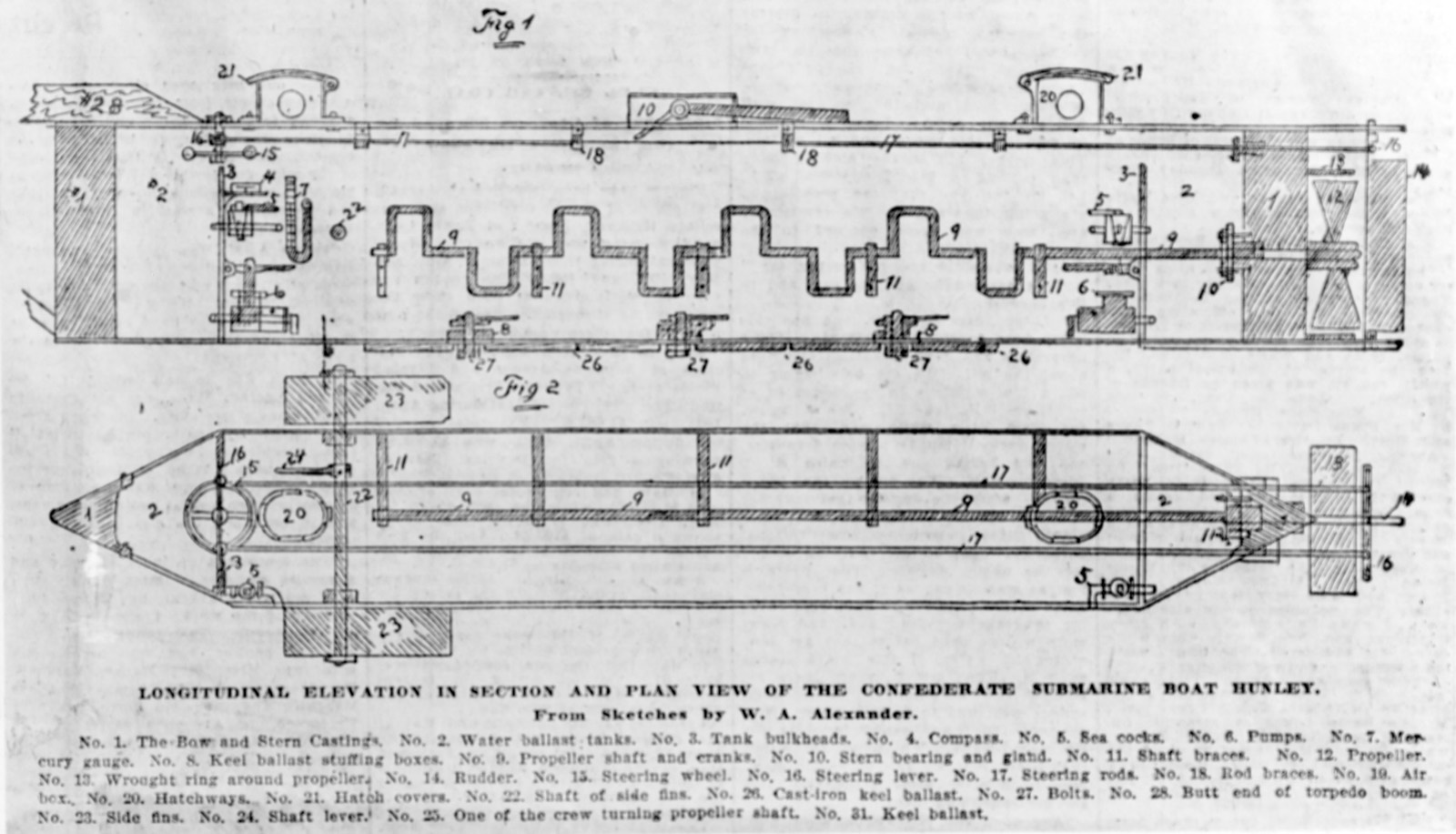
At each end a bulkhead was riveted across to make a water-ballast tank, and Alexander added in brackets the sentence that explains the first crew’s deaths: “unfortunately these were left open on top.” Each tank had a sea cock to let the sea in and a force pump to put it out; a mercury gauge showed the depth; a pair of fins on a shaft through the sides took her down or up under way “as the fins of a fish”; cast-iron keel ballast hung on bolts that could be turned from inside with a wrench “should the necessity arise.” Eight cranks were formed in the propeller shaft, with the men on a bench beside it so close that passing fore and aft “was next to impossible.” The two hatches, 16 inches by 12 with glass lights in their coamings and covers “bolted from the inside,” stood 16 feet 3 inches apart. The torpedo in Mobile was a copper cylinder of ninety pounds of powder. The one she finally carried was a Singer torpedo of 135 pounds with a pressure trigger, on a spar of sixteen feet. The companion piece “The boat” gives Alexander’s description and the 1996 measurements in full.
“All hands aboard and ready, they would fasten the hatch covers down tight, light a candle, then let the water in from the sea into the ballast tanks until the top of the shell was about three inches under water.” The candle was not only the light. It was the only instrument in the boat that measured the air.
She went to Charleston on two flat railway cars and arrived on 12 August 1863.
Nine fathoms
The army did not wait for the owners. Beauregard’s staff lost patience with the pace of McClintock’s trials and put the boat in the hands of the Confederate Navy, under Lieutenant John Payne of the ironclad Chicora, with a volunteer crew; an army board was later told to value her as of the day “she was taken possession of by the military authorities.”
On 29 August 1863 she lay at the wharf at Fort Johnson, ready to go out against the fleet that night. Beauregard, writing fifteen years later, said “a steamer passing close by capsized and sunk it. Lieut. Payne, who at the time was standing in one of the man-holes, jumped out into the water, which, rushing into the two openings, drowned two men then within the body of the boat.” Alexander, writing from Mobile with his notes before him, told it as two swampings and fourteen dead. The Friends of the Hunley, from the navy’s muster rolls, name five: Michael Cane, Nicholas Davis, Frank Doyle, John Kelly and Absolum Williams. Payne, standing on top, jumped clear, and two men got out of the hatches. Whatever the count, the mechanism is not in dispute. The hatches were open, the ballast tanks were open on top inside her, and a boat with three inches of freeboard filled through them in seconds.
On 9 September Jordan ordered Payne relieved. Hunley came from Mobile to claim her, and Beauregard gave her back. He brought Dixon with him, and a crew from the shop that had built her: Hunley himself and Thomas Park of Park and Lyons in charge, with Brockbank, Patterson, McHugh, Marshall, Baird and Sprague by the muster, though Alexander remembered a White among them and nine in all. Alexander was to have been one of them, “but on the eve of that day Mr. Parks prevailed on the writer to let him take his place.”
Dixon, Beauregard wrote, “made repeated descents in the harbor of Charleston, diving under the naval receiving ship which lay at anchor there. But one day when he was absent from the city Mr. Hunley, unfortunately, wishing to handle the boat himself, made the attempt.” Engineer James Tomb of the Confederate Navy remembered Dixon standing beside him on the wharf as she dived. Either way Hunley was at the forward hatch. The Journal of Operations kept at Beauregard’s headquarters records it under 15 October 1863:
“An unfortunate accident occurred this morning with the submarine boat, by which Captain H. L. Hunley and 7 men lost their lives in an attempt to run under the navy receiving ship. The boat left the wharf at 9:25 a.m. and disappeared at 9:35. As soon as she sunk air bubbles were seen to rise to the surface of the water, and from this fact it is supposed the hole in the top of the boat by which the men entered was not properly closed. It was impossible at the time to make any effort to rescue the unfortunate men, as the water was some 9 fathoms.”
A diver found her three days later. Raising her took until 7 November.
Alexander and Dixon had by then offered themselves to Beauregard to raise and work the boat. What Alexander wrote in 1902 about the opening of her is the first forensic report on a submarine. “The boat, when found, was lying on the bottom at an angle of about 35 degrees, the bow deep in the mud. The holding-down bolts of each cover had been removed. When the hatch covers were lifted considerable air and gas escaped. Captain Hunley’s body was forward, with his head in the forward hatchway, his right hand on top of his head (he had been trying, it would seem, to raise the hatch cover). In his left hand was a candle that had never been lighted, the sea cock on the forward end, or Hunley’s ballast tank, was wide open, the cock-wrench not on the plug, but lying on the bottom of the boat. Mr. Parks’ body was found with his head in the after hatchway, his right hand above his head. He also had been trying to raise his hatch cover, but the pressure was too great. The sea cock to his tank was nearly empty. The other bodies were floating in the water. Hunley and Parks were undoubtedly asphyxiated, the others drowned. The bolts that held the iron keel ballast had been partially turned, but not sufficient to release it.”
From that he reconstructed the ten minutes. Hunley opened his sea cock for more ballast as she went down, lost the daylight, and tried to light the candle; while he did, the open-topped tank overflowed into the boat and the bow went into the mud. They tried the keel bolts and did not turn them far enough. Park pumped his own tank dry. Hunley worked his pump, “but he had forgotten that he had not closed his sea-cock.” Beauregard remembered only that “the spectacle was indescribably ghastly.”
The dead were buried at Charleston under a monument. The count of what the boat had cost so far depends on who was counting. Beauregard gave two drowned the first time and all hands the second. Alexander wrote of “three different crews, or twenty-three men.” Two deserters who reached Dahlgren’s flagship in January 1864 told him she “has drowned three crews, one at Mobile and two here, 17 men in all,” and one of them had watched the last dive from thirty yards: “She went down several times but came up again. She would stay under water ten minutes each time, and would come up 75 to 80 yards from where she went down. At last she went down and would not come up again.” Tomb put it at “not less than 33 men.” The muster rolls and the Journal of Operations give thirteen. Every one of those numbers was known to someone with power to stop the boat.
What it looked like from inside
Beauregard’s first answer was to stop her. “After this tragedy I refused to permit the boat to be used again.” Alexander remembered the refusals, and the condition on which they ended: “After many refusals and much dissuasion General Beauregard finally assented to our going aboard the Confederate States navy receiving ship Indian Chief, then lying in the river, and secure volunteers for a crew, strictly enjoining upon us, however, that a full history of the boat in the past, of its having been lost three times and drowning twenty-three men in Charleston, and full explanation of the hazardous nature of the service required of them, was to be given to each man. This was done, a crew shipped, and after a little practice in the river we were ordered to moor the boat off Battery Marshall, on Sullivan’s Island.”
The second condition was in the use. “I consented to its use for this purpose,” Beauregard wrote, “not as a submarine machine, but in the same manner as the David.” The order came on 14 December 1863, as paragraph seven of Special Orders No. 271: Dixon “will take command and direction of the submarine torpedo-boat H. L. Hunley, and proceed to-night to the mouth of the harbor … and will sink and destroy any vessel of the enemy with which he can come in conflict.” She was to run awash, ballasted down until only her hatch coamings showed, with the charge on the spar. The one thing she had been built to do, and the thing that had killed her second crew, she was now forbidden to do.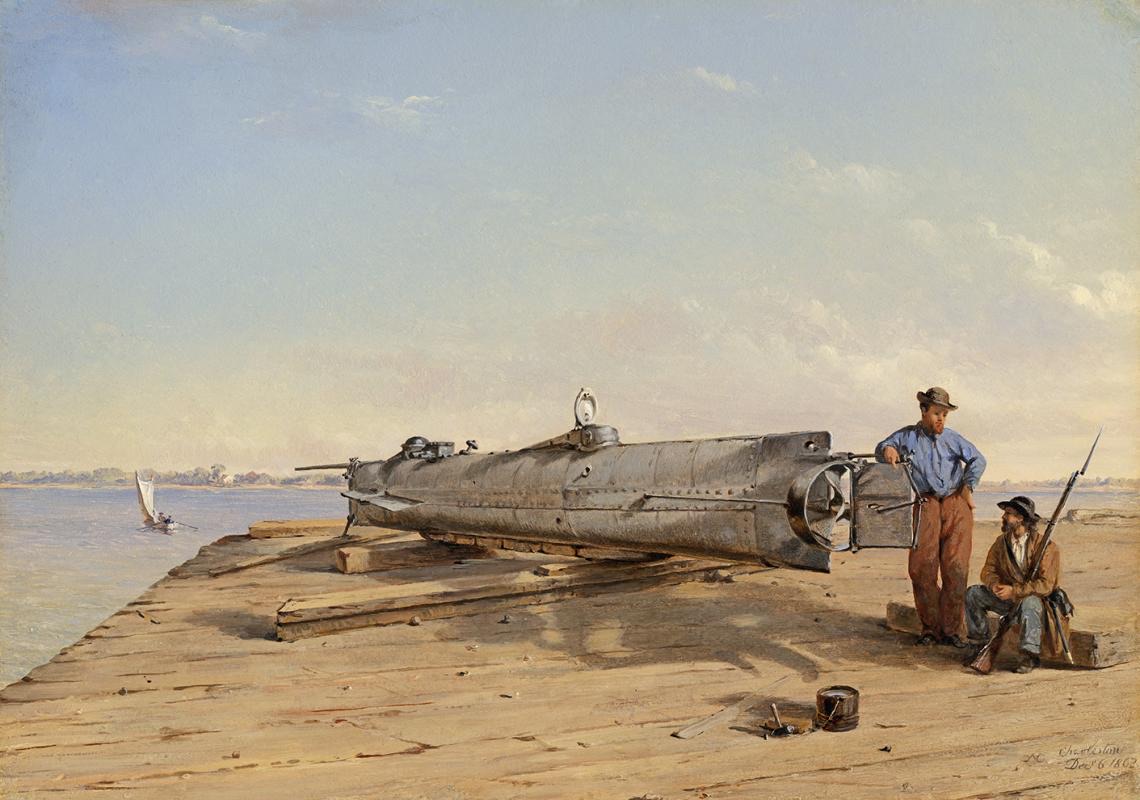
The volunteers came from the receiving ship Indian Chief: Arnold Becker, about twenty and European-born; Lumpkin, in his forties; Frank Collins of Virginia, over six feet; James Wicks, born in North Carolina about 1819, who had been a quartermaster in the United States Navy until 1862; and Joseph Ridgaway of Maryland, a sea captain’s son. Two more, Carlsen and Miller, came later from the German Artillery. The companion piece “The eight” has what is known of each.
Alexander’s account of the winter is the only one from inside the boat. Chain booms had been rigged round the ironclads in the harbour, so the target became the wooden fleet outside, and the nearest of those was the Wabash, about twelve miles off. “In comparatively smooth water and light current the Hunley could make four miles an hour, but in rough water the speed was much slower. It was winter, therefore necessary that we go out with the ebb and come in with the flood tide, a fair wind, and dark moon.” Each afternoon they walked seven miles along the beach from their quarters at Mount Pleasant, drilled the crew for two hours in the back bay, lay on the sand with a compass between them to take the bearing of the nearest blockader as she anchored for the night, went out in the dark, and came back when “the condition of the men, sea, tide, wind, moon, and daylight compelled our return.” “On several occasions we came to the surface for air, opened the cover, and heard the men in the Federal picket boats talking and singing.”
Through November, December and January the wind held against them. They went out four nights a week on average and often turned back after six or seven miles, “and many times it taxed our utmost exertions to keep from drifting out to sea.” Somewhere in those weeks they ran the one experiment on the question that mattered most to a crew that might have to lie hidden under a sinking ship: how long the air would last. They agreed to sink to the bottom of the back bay with everyone cranking equally, and that if any man said “up” the boat would come up. “One evening, after alternately diving and rising many times, Dixon and myself and several of the crew compared watches, noted the time and sank for the test. In twenty-five minutes after I had closed the after manhead and excluded the outer air the candle would not burn.” They cranked on in the dark. “Each man had determined that he would not be the first to say ‘up.’ Not a word was said, except the occasional, ‘How is it,’ between Dixon and myself until it was as the voice of one man, the word ‘up’ came from all nine.” Alexander’s pump would not throw; he pulled seaweed from its valve while “some of the crew almost lost control of themselves.” When he stood up in the open hatch, one soldier was still watching the water where the boat had been. “The sun was shining when we went down, the beach lined with soldiers. It was now quite dark.” They had been on the bottom two hours and thirty-five minutes, two hours and ten of them after the candle died. The soldier told them a message had already gone to Beauregard that the torpedo boat was lost with all hands. Next morning General Rains of the staff doubted the two hours and ten minutes.
Engineer Tomb, who towed her down the harbour behind the David on the orders of Flag-Officer Tucker, had been asked for a report on “her efficiency as well as safety.” The only safe use, he wrote, was the David’s, on the surface. “Should she attempt to use a torpedo as Lieutenant Dixon intended, by submerging the boat and striking from below, the level of the torpedo would be above his own boat, and as she had little buoyancy and no power, the chances were the suction caused by the water passing into the sinking ship would prevent her rising to the surface, besides the possibility of his own boat being disabled.” Tomb liked Dixon, “a very brave and cool-headed man,” who “had every confidence in his boat, but had great trouble when under the water from lack of air and light.” Of the boat he wrote that she “would sink at a moment’s notice and at times without it.”
Dahlgren knew nearly all of it. On 7 January 1864 he warned the squadron of a boat “which is nearly submerged and can be entirely so. It is intended to go under the bottoms of vessels and there operate.” The ironclads were to rig fenders and weighted netting and anchor in shallow water so that “it will be impossible for the diving torpedo to operate except on the sides.” To Washington on the 13th: “So far the trials have been unlucky, having drowned three crews of 17 men in all. Still she does dive.” Dixon, in a letter to Henry Willey of Mobile on 31 January, put it from his side: “The Fleet offshore have drawings of the sub-marine and of course they have taken all precautions that it is possible for Yankee ingenuity to invent, but I hope to Flank them yet.”
That letter is the nearest thing to Dixon’s voice. “There is one thing very evident and that is to catch the Atlantic Ocean smooth during the winter months is considerable of an undertaking and one that I never wish to undertake again. Especially when all parties interested at sitting at home and wondering and criticizing all of my actions and saying why don’t he do something.” He was living on soldier’s rations within sight of the guns firing on Sumter. “I have got a splendid crew of men the best I think I ever seen.”
On 5 February Alexander was ordered to Mobile to build a repeating gun. “This was a terrible blow, both to Dixon and myself, after we had gone through so much together.” Jordan told Dixon he could have two men from the German Artillery in Alexander’s place. “It was thought best not to tell the crew that I was to leave them.” Ridgaway moved to the after hatch.
What happened
The Housatonic was a new ship of 1,240 tons, eleven or twelve guns depending on who counted, and about 155 men. She had lately been anchoring in the north channel off Breach Inlet, closer in than the Wabash, with her chain rigged to slip at one blow of a sledge and her engine ready to go astern. Her precautions, and the testimony of the men who took them, are in the companion piece “The court of inquiry.”
On 17 February 1864 the wind had dropped and the sea was smooth. There was a moon, which Alexander’s rule forbade; Dixon, “who had been waiting so long for a change of wind, took the risk of the moonlight and went out.” A Charleston writer in 1866 said he had promised Battery Marshall two blue lights if he came off safe. The boat left Breach Inlet on the ebb, which carried her out, and the plan was to come back on the flood.
The witnesses on the Housatonic disagree on the clock. Crosby put his first sighting at about 8.45; Flemming, the lookout on the starboard cathead, said 8.25 and two ships’ lengths; the court settled on “between 8:45 and 9 o’clock.” Flemming told the officer of the forecastle what he saw and was told it was a log. “I then told him this was not floating with the tide as a log would, but moving across the tide. He still thought it was a log.” Several muskets were fired at it, and Pickering’s buckshot. Pickering judged it “about two feet, more or less, under water; its position was at right angles to the ship, bows on, and the bows within two or three feet of the ships side, about abreast of the mizzen mast.” The engine had been going astern for about six seconds when the charge went off against the starboard side in a line with the magazine.
The court of inquiry found that the explosion “blew up the after part of the ship, causing her to sink immediately after to the bottom, with her spar deck submerged”; that about three minutes had passed from the first sighting; that no gun could have been brought to bear; that the ship was in all respects prepared; and that “no further military proceedings are necessary.” Pickering said: “If I had had two minutes to work in, I could probably have saved the ship and sunk the Torpedo craft.”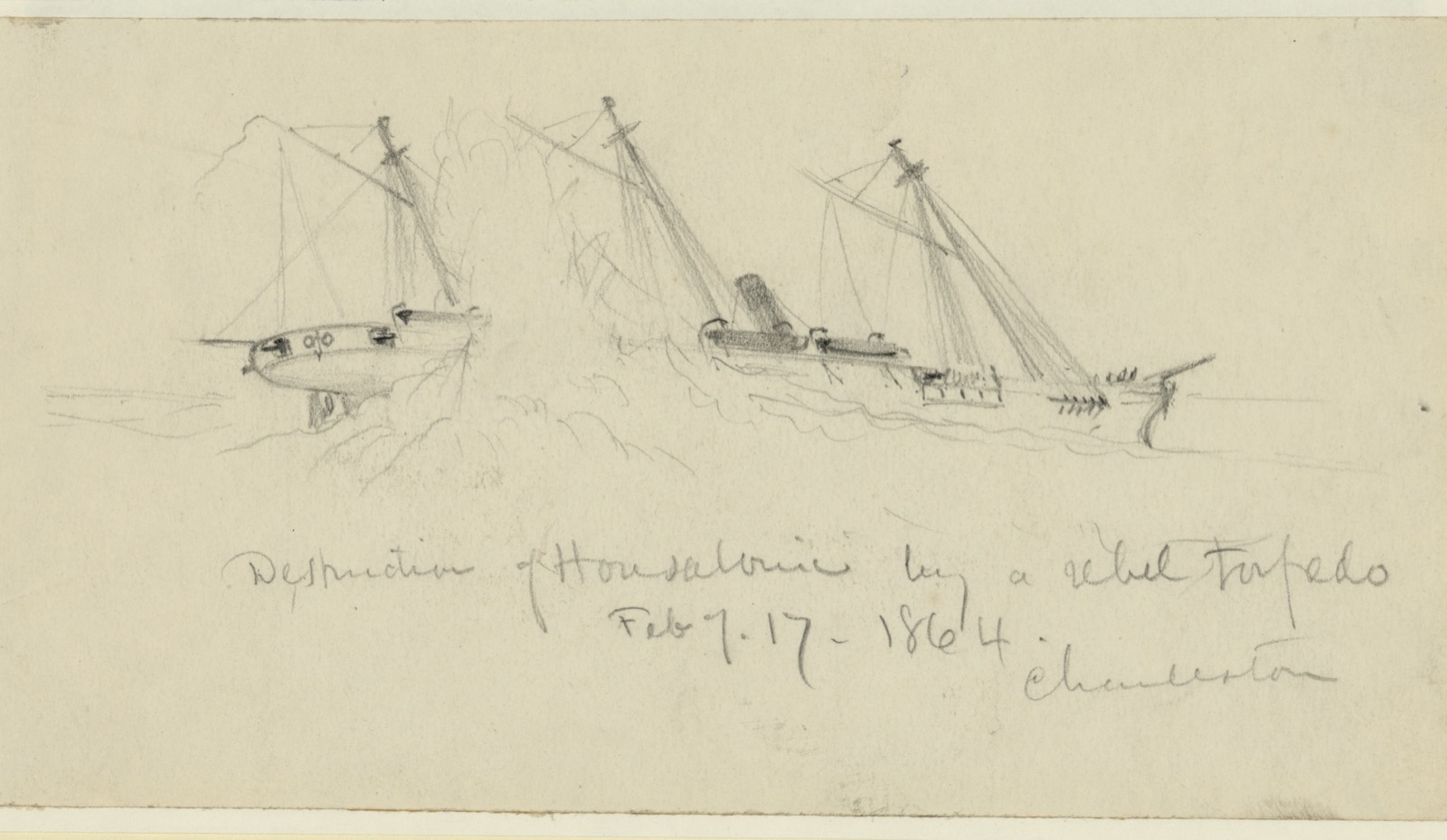
Flemming, from the forecastle, fired his musket at the object “about six or eight feet from the starboard quarter, apparently stationary,” after the explosion. Then, from the rigging, he saw his blue light. No one else is recorded as seeing it.
Dahlgren was at Port Royal when the news reached him. His report to the Navy Department on 19 February is the measure of what had happened: “the whole line of blockade will be infested with these cheap, convenient, and formidable defenses, and we must guard every point.” He proposed a reward of $20,000 or $30,000 for every torpedo boat destroyed: “They are worth more than that to us.” His order to the squadron the same day: vessels at anchor “are not safe, particularly in smooth water, without outriggers and hawsers stretched around with rope netting dropped in the water. Vessels on inside blockade had better take post outside at night and keep underway.” The wooden ships off Charleston went to sea every night after that. One sentence of his was wrong: he assumed the torpedo boat had “passed by the ironclads within the bar,” and so the nettings must have been tried and found sufficient. She had never gone near them.
On the Confederate side the news arrived in pieces. Beauregard endorsed Dantzler’s report on 20 February: “As soon as its fate shall have been ascertained, pay a proper tribute to the gallantry and patriotism of its crew and officers.” On the 21st he telegraphed Richmond that a gunboat had been sunk by the Mobile torpedo boat, “which went out for that purpose, and which I regret to say has not been heard of since.” On the night of the 26th a Confederate picket boat captured a Union picket boat off Sumter, and from the prisoners Charleston learned what ship it had been. “There is little hope of safety of that brave man and his associates, however,” Beauregard telegraphed on the 27th, “as they were not captured.” The Charleston Daily Courier printed the prisoners’ story on the 29th, with the date wrong and the crew doubled, as “this glorious success of our little torpedo boat.” In Mobile, Alexander read the news, noticed that nothing was said of where the boat was, and telegraphed Jordan daily. “Each time came the answer, ‘No news of the torpedo boat.’”
On 29 April the captain in charge of torpedoes at Charleston, answering an enquiry from Mobile, gave his opinion that “the torpedoes being placed at the bow of the boat, she went into the hole made in the Housatonic by explosion of torpedoes and did not have sufficient power to back out, consequently sunk with her.” In November a Union salvage officer had the bottom dragged for 500 yards round the wreck and found “nothing of the torpedo boat.”
After
Beauregard in 1878 and Alexander in 1902 both believed that a diver working on the Housatonic after the war had found the fish boat lying alongside her victim. He had not. Searches that started from that belief, or from the belief that a blue lantern could only have been seen a mile from shore, looked in the wrong place for a century. On 3 May 1995 divers of Clive Cussler’s National Underwater and Marine Agency, Ralph Wilbanks, Wes Hall and Harry Pecorelli, dug through about three feet of sand onto a hatch coaming four miles off Sullivan’s Island, in about 30 feet of water, roughly a thousand feet to seaward of the Housatonic’s remains. She was not between the wreck and the shore. She was beyond it, on the side away from home.
The National Park Service, the Naval Historical Center and the state institute assessed the site in May 1996. The boat lay with her bow pointing almost directly at Sullivan’s Island, “canted about 45° to starboard,” under about a metre of sediment, and intact but for a large hole in the forward hatch coaming where a viewing port should have been, its edges fully encrusted and so “likely contemporaneous with sinking.”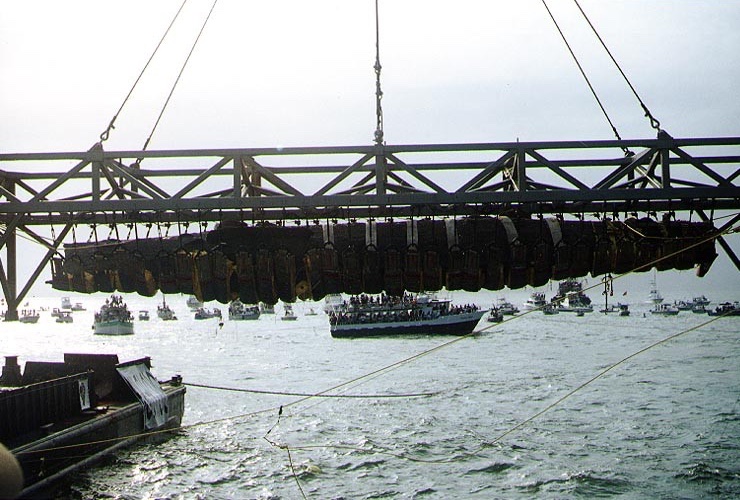
Title passed to the United States Navy, custody to the state of South Carolina, and the raising to a body called the Friends of the Hunley. Oceaneering engineered the lift: a steel truss set on suction piles either side of the hull, and thirty slings tunnelled under the boat one by one and injected with foam that set to her shape. On the morning of 8 August 2000 the whole frame came up out of the water with the boat hanging in it, and was set on a barge and taken to a tank of chilled fresh water at the old Charleston Navy Yard, in a laboratory named for the Friends’ chairman, Warren Lasch.
The excavation of the crew compartment began on 21 January 2001. On 13 April the first skull was found. By the end there were eight men, not nine, each at his place. The Friends’ statement of the evidence is careful: “the crewmembers’ remains were largely found at their stations, with no sign of panic or desperate attempts to escape the submarine,” with “little co-mingling of the remains,” and “no new injuries.” Dixon was under the forward conning tower. On 21 May a lantern was found near him; on 23 May the gold piece, bent, engraved “Shiloh April 6, 1862 My life Preserver G. E. D.” A pocket watch came out of the block of sediment that held his remains in September.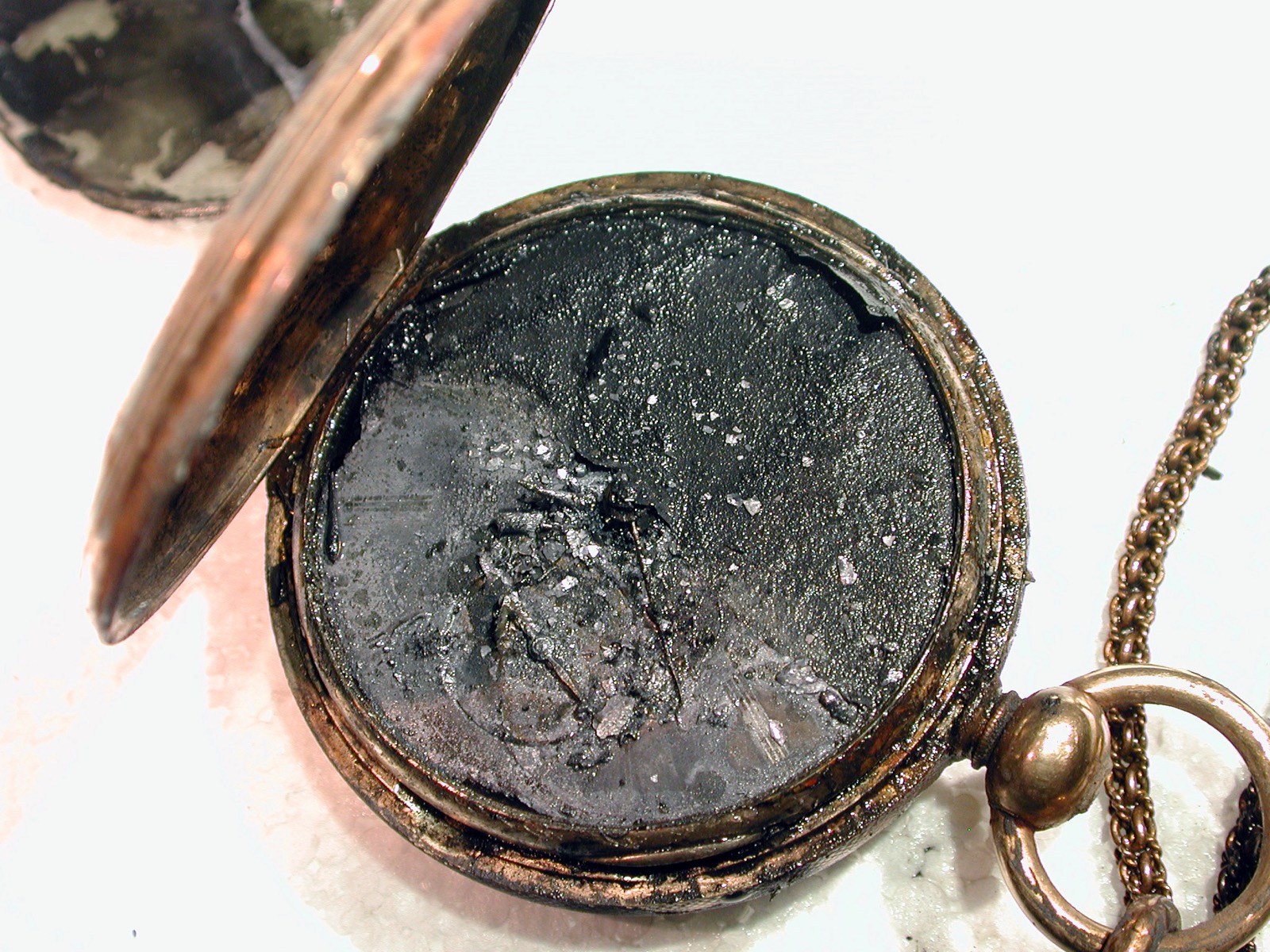
The boat herself gave her evidence slowly, as the conservators took her apart. The ten small deadlights along her top were all shut with their iron covers. The forward hatch was unlatched, the after hatch locked. The pumps were not set to pump the crew compartment. The keel blocks, when they finally came out in 2018, were fastened in place: no one had put a wrench to them. The viewing port in the forward conning tower was missing, leaving “a grapefruit-sized hole,” and a fragment of the iron was found in the lowest sediment at Dixon’s station, so the hole was early, perhaps that night; but Dixon’s skull carried no wound. The two big holes in her side and bow had opened long after she sank; neither let the water in on 17 February.
The eight were buried on 17 April 2004 in Magnolia Cemetery, after a procession through Charleston, beside the men from the two crews of 1863.
The lantern, when it was conserved in 2012, turned out to have a clear glass, and that reopened the question of the blue light. In 1864 “blue light” meant a hand-held flare, carried by every navy ship, and by then the ordnance manuals’ recipe for it burned white and was still called blue; such a light would be seen four miles off, and a lantern with a blue glass would not. What the Confederate record says is only that signals agreed upon were seen and answered. The companion piece “The blue light” sets out the testimony and the argument.
In 2017 Rachel Lance, a biomedical engineer at Duke University, and three colleagues published the first test of the thing the Confederates had never tested. They built a one-sixth-scale hull of mild steel, nicknamed the CSS Tiny, hung a pressure gauge inside it and another in the water alongside, and fired black powder charges at it on a scaled spar. They then scaled the result to 61 kilograms of powder, the Hunley’s 135 pounds, fired less than five metres from her bow. A hull like hers does not need to be breached to kill: the wall flexes, and a secondary wave passes into the air inside. Their estimate of the pressure in the crew compartment gave a risk of fatal lung injury of about 85 per cent and “chances of survival … less than 16% for each crew member.” The conclusion is one sentence: “Based on the analysis above, the crew was instantly killed by primary blast trauma.” The argument from the wreck is the archaeologists’ own list: “If anyone had survived, they may have tried to release the keel ballast weights, set the bilge pumps to pump water, or tried to get out the hatches, but none of these actions were taken.”
The study is a model and a scaling argument, not a measurement of the original, and the Friends of the Hunley still list the blast beside three other theories: that she lay on the bottom to wait for the tide and could not rise, that the Canandaigua ran her down, that a bullet through the forward port disabled Dixon. The hull went into a bath of sodium hydroxide in May 2014, expected to take five to seven years; the Friends’ own account still describes that treatment as under way.
What it taught
The two crews of 1863 were not an unread instrument. They were read, by everyone, and each reader took something different and defensible from them. Dahlgren read “three crews of 17 men” as proof that the boat could dive, and rigged nets and shallow anchorages against the dive; he was right about the diving and was attacked from the surface. Beauregard read them first as a reason to stop and then as a reason to forbid the dive, which was the precise failure of the second sinking; he was right about that too, and the third crew did not drown through an open sea cock. Alexander and Dixon read each death as an error with a name: hatches open at a wharf, a sea cock left open in the dark. Each error was real and each could be fixed, and a boat whose every accident has a correctable cause never accumulates a case against herself.
What none of the readings covered was the weapon. The boat had been designed to tow her charge 200 feet astern and pass under the target, and that was what had been tried in the Mobile River. The sea made towing impossible and the spar was the answer, and the spar put 135 pounds of powder sixteen feet from the crew. The only data on what that did to the boat that fired it was the David’s drenching in October, which was read as a success because the David came home. Tomb’s report named the danger in the last clause of a sentence about something else: “besides the possibility of his own boat being disabled.” Nobody fired a spar torpedo from a sealed iron hull with nothing alive in it before eight men did it on a moonlit night. The test that was never run was run once, on 17 February 1864, and reported 136 years late, in the position of eight skeletons on a bench, with the hatches shut and the pumps unset and every keel bolt tight. Everything the two crews had taught was in order. The men had died of the one thing the two crews could not teach.
The complication is that the consent was honest. Beauregard required that every volunteer be given the full history and the hazard, and the record suggests they were; Dixon called them the best crew he ever saw, and they went out four nights a week all winter knowing what the boat had done. Consent to the known risk was complete, and the known risk was not the one that killed them. An honest warning about the wrong danger is still the wrong warning.
The last count is also an instrument, and it reads the same whichever figures you take. Thirteen of her own in the harbour by the record, seventeen or twenty-three or thirty-three by the men who watched; eight more at sea; five of the enemy’s. The Housatonic was the first warship sunk by a submarine, and the boat that sank her killed, at the lowest count, four of her own people for every one of theirs. Dahlgren’s phrase for what she represented, written two days after she sank, was “cheap, convenient, and formidable.” All three were true, and the third was true of her only on the night she did not come back.
Sources
- Official Records of the Union and Confederate Navies in the War of the Rebellion, series I, volume 15 (Government Printing Office, 1902). Dahlgren’s order of 7 January 1864 and report of 13 January with the deserters’ statements (pp. 226–239); the reports of Rowan, Green and Higginson, Dahlgren’s reports and orders of 19 February, the Canandaigua’s log, the court’s findings of 7 March, Churchill’s diving report of November 1864, Tomb’s notes, Dantzler’s report with Beauregard’s endorsement, Beauregard’s telegrams of 21 and 27 February, the Charleston Daily Courier of 29 February, Feilden’s letter of 10 March and Gray’s letter of 29 April (pp. 327–338); the Journal of Operations for 15 and 18 October 1863 (pp. 692–693); and the plate of Alexander’s drawings. archive.org
- The War of the Rebellion: Official Records of the Union and Confederate Armies, series I, volume 28, part 2 (1890). Beauregard’s telegram of 7 August 1863 (p. 265); Jordan’s letter to Whitney of 15 August on the rewards (p. 285); Jordan’s order of 9 September relieving Payne (p. 351); the board of 24 September to value the boat (p. 376); Special Orders No. 271 of 14 December 1863 (p. 553). archive.org
- W. A. Alexander, “Thrilling Chapter in the History of the Confederate States Navy. Work of Submarine Boats,” written at Mobile in June 1902, printed in the New Orleans Picayune and the Richmond Dispatch of 21 July 1902, and reprinted in Southern Historical Society Papers, volume 30 (1902), pp. 164–174. The building of the three boats, the dimensions and working of the Hunley, the sinkings, the bodies, the winter at Battery Marshall, the test of the air, and his transfer. archive.org
- G. T. Beauregard, “Torpedo Service in the Harbor and Water Defences of Charleston,” Southern Historical Society Papers, volume 5 (1878), pp. 145–161. The David’s attack, the fish boat, Payne’s sinking, Hunley’s death, the refusal and the consent. archive.org
- Proceedings of the naval court of inquiry on the sinking of the Housatonic, convened on the Wabash on 26 February 1864, National Archives, Records of the Judge Advocate General (Navy), microfilm M273, roll 160, case 4345; transcribed from the page images by Rachel Lance and published on Michael Crisafulli’s Vernian Era site. Crosby’s, Flemming’s and Pickering’s testimony. vernianera.com
- Naval History and Heritage Command, Dictionary of American Naval Fighting Ships, H. L. Hunley and Housatonic I; and the catalogue notes to photographs NH 48969, NH 53544 and NH 97356-12-KN. H. L. Hunley, Housatonic I
- National Park Service, Submerged Cultural Resources Unit, with the Naval Historical Center and the South Carolina Institute of Archaeology and Anthropology, H. L. Hunley Site Assessment (1998). The 1995 discovery, the 1996 survey, the hull’s position, dimensions and the hole in the forward hatch coaming. archive.org
- Friends of the Hunley, “The Hunley’s Sinkings,” “History is Made,” “The Search and Recovery,” “The Evidence,” “Top Possible Theories,” “Scientific Timeline,” “Conservation,” “Keel Blocks Offer Key Evidence” (18 July 2018), “Hunley Crew Burial,” and the crew profiles for Dixon, Becker, Lumpkin, Collins, Wicks, Ridgaway, Carlsen and Miller, which carry the forensic findings of Douglas Owsley, Maria Jacobsen and Linda Abrams and the text of Dixon’s letter to Henry Willey. hunley.org, the evidence, keel blocks, Dixon
- Rachel M. Lance, Lucas Stalcup, Brad Wojtylak and Cameron R. Bass, “Air blast injuries killed the crew of the submarine H.L. Hunley,” PLOS ONE 12 (8), e0182244, 23 August 2017. The scale model, the charges, the transmission, the risk figures and the conclusion. journals.plos.org
- Christopher D. Rucker, “The Myth of the H.L. Hunley’s Blue Lantern,” Civil War Monitor, with his citations to the 1861 and 1863 ordnance manuals and the 2012 conservation of the lantern. civilwarmonitor.com
- Brian Hicks, “One-Way Mission of the H. L. Hunley,” Naval History, volume 28, number 1, January 2014, for the Mobile demonstration of July 1863 and the circumstances of Chapman’s sketch. usni.org
- Pictures: Conrad Wise Chapman’s painting, American Civil War Museum, Richmond, via Wikimedia Commons; William Waud’s pencil sketch, Library of Congress, Prints and Photographs Division, ppmsca.21443; the Navy photographs listed above and the Navy’s photograph of the watch, 030307-N-0000X-002, via Wikimedia Commons. Chapman, Waud
