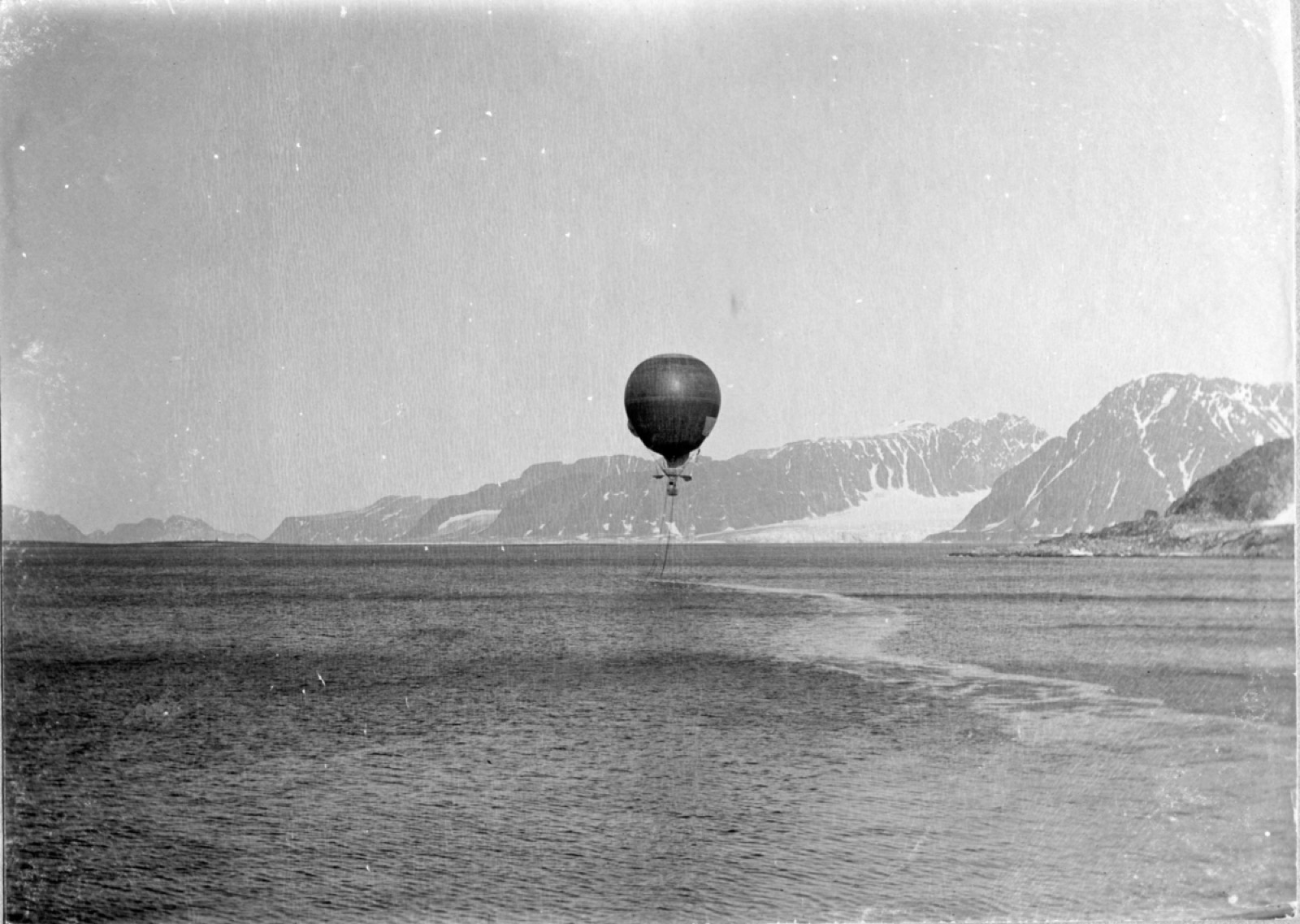
At 1.46 in the afternoon of 11 July 1897, by Greenwich time, three sailors on the floor of a roofless wooden house on Danes Island, at the north-west corner of Spitsbergen, cut three ropes at the same instant. The balloon above them rose out of the house, cleared the beach and went out over Virgo Harbour with three men standing on the roof of its car, cheered by the crew of the Swedish gunboat Svensksund and by three Norwegian sealers sheltering in the bay from a southerly gale. Over the middle of the harbour it began to sink. The car touched the water, or came close to it; the witnesses disagreed. Eight sacks of sand went over the side, and the balloon rebounded, as one of the men on the beach wrote, “like a vast ball”.
Then a sailor shouted. “Look! the drag-lines are lying here on the shore!”
Three heavy ropes lay along the stones below the balloon house, where they had been laid out that morning in a line pointing east. Each was the lower two-thirds of a guide rope that should now have been trailing in the sea behind the balloon. Together they weighed about 530 kilograms. The men who ran to them thought at first that the ropes had snapped. When they picked up the ends they saw that nothing had broken. The ropes had unscrewed.
The balloon was out of sight within the hour. It stayed in the air for sixty-five hours and thirty-three minutes. What happened in that time, and in the eighty-seven days that followed, was not known to anyone for thirty-three years, and then it became known hour by hour, in more detail than almost any failure in the history of exploration, because the three men in the car had written it all down.
Who ran it
Salomon August Andrée was born at Gränna, on Lake Vättern, on 18 October 1854, the son of an apothecary. He trained as an engineer in Stockholm, learned the first principles of ballooning from an old American aeronaut at the Philadelphia exhibition of 1876, and in 1882 and 1883 wintered at Cape Thordsen in Spitsbergen with the Swedish station of the first International Polar Year, in charge of the observations of atmospheric electricity, under a meteorologist named Nils Ekholm. From 1885 he ran the technical department of the Swedish Patent Office. Among his private notes are two lines, one above the other: “The thing is so difficult that it is not worth while attempting it—The thing is so difficult that I cannot help attempting it.”
In 1893 he bought a balloon in Paris, named it Svea, and made nine ascents in it over two years, alone. On 14 July 1894 he fitted it with a sail and with ropes that dragged along the ground, and found that he could make it travel at an angle to the wind. On 29 November 1894 he crossed the Baltic from Gothenburg to Gotland, about 400 kilometres, the last of it in darkness, with the ropes dragging. Those two flights were the experimental basis of everything that followed.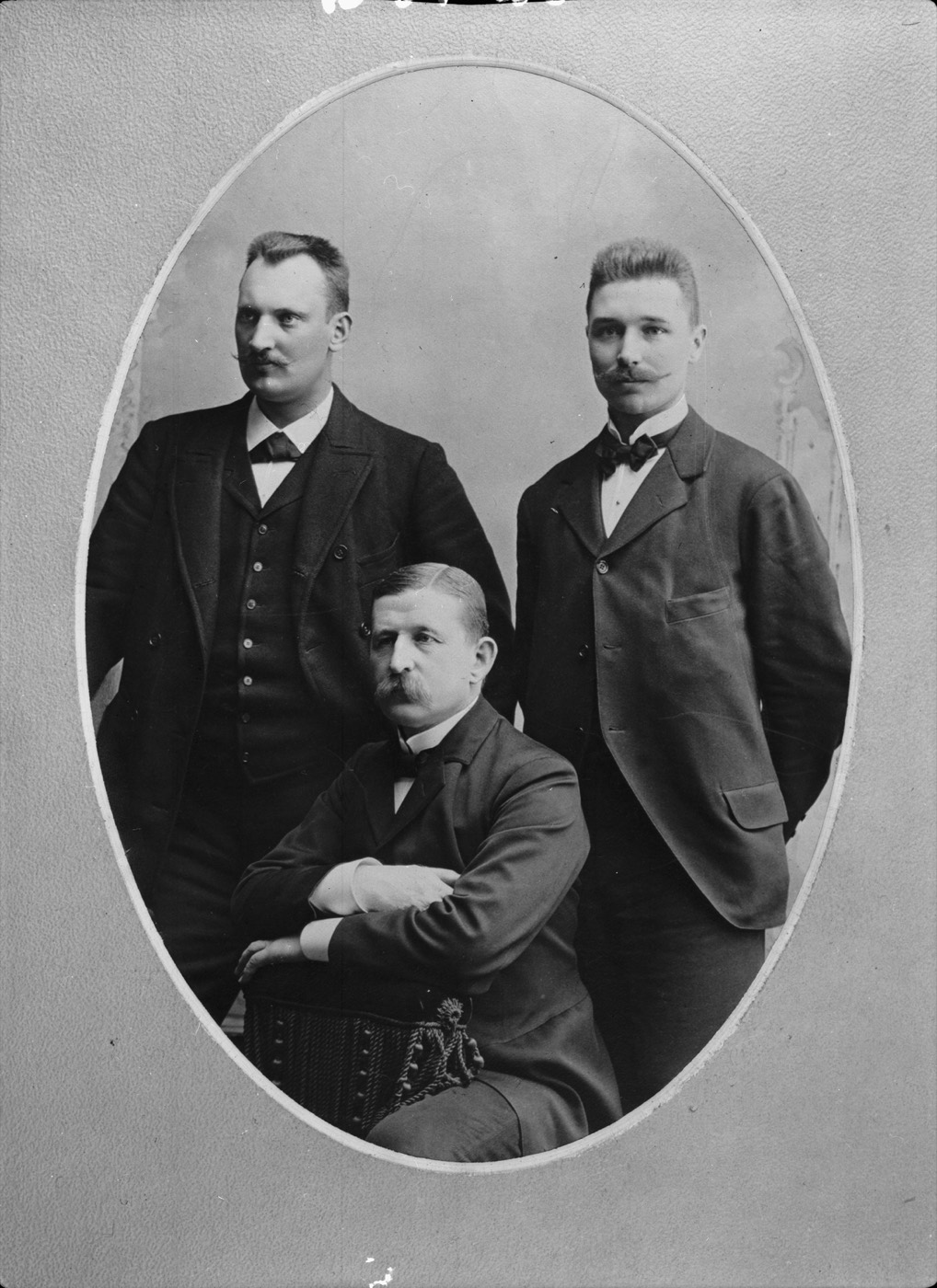
Nils Strindberg was born in Stockholm on 4 September 1872, into the merchant family that also produced the playwright. He was an assistant in physics at the University of Stockholm and had photographed since he was sixteen. When Andrée asked for a third man in 1895, Strindberg applied and was chosen as the best scientist among the candidates. In October 1896, after the first attempt had failed, he became engaged to Anna Charlier, a postmaster’s daughter from Klippan in Scania.
Knut Frænkel was born at Karlstad on 14 February 1870, a railway engineer’s son and a gymnast, qualified as a civil engineer in 1896 and applied in 1897 when a place came free. He was 27 when the balloon left; Strindberg was 24; Andrée was 42. The place Frænkel took had been Ekholm’s.
On 10 May 1895 Alfred Nobel walked into Andrée’s office and offered 20,000 kronor; a week later he raised it to half the cost, on condition the rest was found within two months. King Oscar II and Baron Oscar Dickson gave the next sums, and by 4 June the published budget of 128,800 kronor was covered.
What they were trying to find out
Andrée read his plan to the Royal Swedish Academy of Sciences on 13 February 1895 and, in English, to the Sixth International Geographical Congress in London on 29 July. The London text survives in the Congress report, and it reads as what it was: an engineer’s proof.
Sledges, whether men or dogs pulled them, had “proved failures.” Then: “Still, I venture the assertion that such a balloon is capable of carrying an exploring-party to the pole and home again.” Reaching the Pole, he said, “is not a purely scientific, but a technical problem,” and like a technical problem it reduced to requirements. He gave four. The balloon must lift three men, instruments, four months of food and ballast, about 3,000 kilograms. “The balloon should be of such impermeability that it can be kept afloat for a period of thirty days.” It must be filled in the Arctic. And it “should be steerable to a certain extent.”
The first three he disposed of with other people’s numbers. For the fourth he had only himself. On the Svea, with sail and ropes, he had deviated 27 degrees from the wind on average, and sometimes 40. A free balloon blown from Cork towards Copenhagen could go nowhere but Copenhagen; his could reach any point in a triangle whose corners were Cork, Brussels and Bergen.
So the hypothesis had two parts, and the experiment tested them separately. The first was about material: that a silk bag would hold enough hydrogen for a month. The second was about control: that ropes and a sail would turn a balloon from “a vessel drifting at the mercy of the winds” into something “in a large measure under the control of the aëronaut.” Under both lay an assumption about the Arctic summer: continuous sun, little snow, rare gales, a smooth surface for the ropes. Fog is not in the list. When a questioner raised it, Andrée answered that fog over so large an area “is a mere supposition for which there is no ground.” He also said what the sledges and the boat in the car were for. “It is by balloon the voyage shall be made, and it is to the balloon that the travellers must cling. The life-saving apparatus, therefore, will have no other function to perform than the life-boats and life-buoys on board a ship.”
The discussion in London was the hypothesis argued by the people best placed to argue it. A. Silva White called the project “foolhardy, and not one to be seriously discussed at a meeting of this character.” General Greely, who had commanded the American station of the same Polar Year, went at the first claim: “Let me tell you that a balloon is subject to a minimum loss each day of 1 per cent. of its gas.” Then at the whole: “it may be possible to reach the pole, but it appears impossible for a balloon to come back again.”
Andrée’s reply was arithmetic. “I shall occupy three weeks or thirty days, and shall consequently lose less than 1800 kilogs., as the contents of the balloon is 6000 cubic metres. Its carrying power is 3000 kilogs.; consequently, if the loss is 1 per cent., it will still have 1200 kilogs. buoyancy remaining after thirty days.” And to all of them: “I do not ask for money. I have got the money, and the attempt will be made.”
What they built
The balloon was made by Henri Lachambre in Paris, after Strindberg had tested samples from five makers. It was a sphere of varnished silk of 4,500 cubic metres, smaller than the 5,000 to 6,000 Andrée had named in London, with a hemp net over it and a wicker car slung beneath a bearing ring.
The ropes were the invention. Three guide ropes, about a thousand metres of rope in all and 725 kilograms, were to trail their lower ends on the ice or the sea. If the gas cooled and the balloon sank, more rope came to rest and the balloon grew lighter; if the sun warmed it, it lifted more rope and grew heavier. That was the altitude control. For steering there were three sails, a quarter of the balloon’s cross-section, and a tackle that swung the whole balloon on its ropes so the sails met the wind at an angle.
Each guide rope had a thinner neck near its end, so that if it snagged under the ice it would part there. Critics asked what would happen if a rope that had already parted snagged again. Andrée answered them with a screw joint between the upper and lower sections of each rope, and a winch in the car that could twist the rope until the joint unscrewed. He wrote down what he thought of it. “The fear was expressed that the drag-lines would fasten in something, and that we should never get loose again. That danger formed the kernel of the objection, and it was the obstinacy with which the criticism was continued that induced me to construct the so-called ‘screw-joints’ or threaded splicings—an invention which, perhaps, is not without ingenuity, but which, in my own opinion, is altogether unnecessary, and has no other advantage than that it affords a certain sense of security.”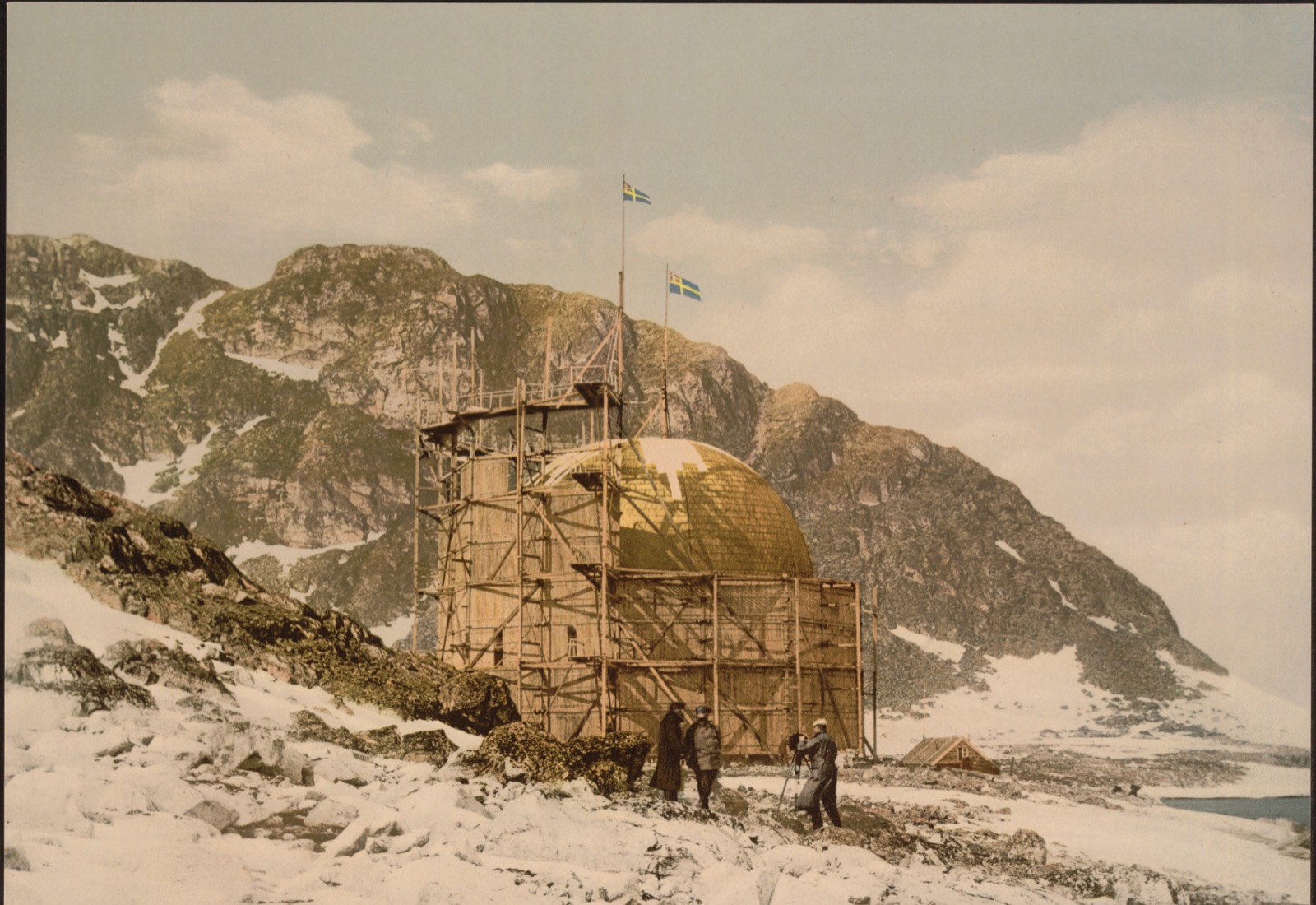
For news there were thirty-six carrier pigeons and thirteen cork buoys with brass cylinders for letters, the largest to be dropped at the Pole. For the journey Andrée hoped never to make there were three sledges, a canvas boat, a tent of balloon cloth, rifles and food for six months. A timber balloon house of five storeys went up on the north shore of Danes Island in the summer of 1896, and the hydrogen was made on the beach from sulphuric acid and iron shavings.
That summer was the first trial. The balloon was filled by 27 July 1896, and then they waited for a south wind. Three weeks of wind came from the north, or none. On 17 August, with the ship’s charter running out, Andrée opened the valves and let the hydrogen go.
The waiting had been an experiment of its own, and Ekholm read the result. The silk held, but the gas went out through the seams, and when one seam was sealed another opened. On 9 August Lachambre recorded that “Ekholm declares that the balloon is losing about 66 lbs. per day; he thinks it able to stand a voyage of from forty to fifty days’ duration.” Thirty kilograms of lift a day is 900 kilograms in thirty days, against a total of about 3,000, before any ballast is spent on cloud, fog or landing. When the expedition reached Sweden, Ekholm resigned. He wrote to Nobel about it, and when Nobel misread him he wrote again, on 21 September 1896, three lines that survive in the National Archives: the meaning had not been to complain, “but only to explain why I could not go along, and to free myself from all responsibility. That I considered my duty.” Strindberg was urged to follow him and would not, because he had given his word. Of the balloon he said to Andrée: “The weather for the flight now is as good as we can ever hope to have, and, in spite of all repairs, the balloon will never be better than it is.”
Over the winter Lachambre enlarged the balloon to about 5,000 cubic metres and varnished it inside and out. In 1897 the Navy lent the gunboat Svensksund, which anchored off Danes Island on 30 May. The balloon was filled between 19 and 22 June, and Lachambre’s representative, Alexis Machuron, hunted its seams for leaks with strips of linen soaked in lead acetate, which escaping gas turned black. On 1 July he calculated that the balloon would carry about 1,700 kilograms of ballast, rope included, and stay up for at least thirty to thirty-five days.
Sixty-five hours
The morning of 11 July 1897 began at three with cat’s-paws from the south-south-west, and by four it was blowing fresh and squally. On the roof of the house Andrée put the question to the others. Frænkel was evasive, then said they should go. Strindberg: “I think we ought to try it.” Andrée said nothing, walked back to the ship, and told the captain: “Well, we have been considering whether to start or not; my companions insist on starting, and as I have no absolutely valid reasons against it I shall agree to it, although with some reluctance. Will you send all hands on shore to begin the work of dismantling the balloon-house?” By Strindberg’s chronometer, reduced to Greenwich time, the balloon rose at 1.46. It was christened Örnen, the Eagle, as it went.
Within two minutes the car had dipped, the sand had gone, and the ropes were on the beach. With 206 kilograms of sand and 530 of rope gone at once, the Eagle climbed to 600 metres within eighteen minutes, four times the height the ropes had been meant to hold it at, and went into a cloud. Machuron, writing that night, saw what had happened and did not see what it meant: “At the start the ropes were caught in some rocks on the shore, and the screws for separating the parts worked. But Andrée is well provided against this loss, so that this accident is not likely to have serious consequences.”
Strindberg’s note in his almanac was two words: “Guide-rope lost.” They spliced a ballast line on to one of the stumps, and at 7.06 Andrée went below to sleep. “We are now travelling horizontally so beautifully,” Strindberg wrote, “that it is a pity we are obliged to breathe as that makes the balloon lighter of course. And so Frænkel and I are spitting, too.” At ten the balloon touched the tops of the clouds and began to sink into their shadow, and they threw out a buoy with a message Andrée had written: “Weather magnificent. In best of humours.” It washed up in Finnmark on 27 August 1900, 1,142 days later.
Twenty minutes after midnight the Eagle passed into the shadow of a bank of altocumulus, and four minutes later the ropes were on the ice. This was the plan at last: the balloon at a hundred metres, the ropes rattling over the floes, the sails up. It did not work. The spliced rope was too short to pull against the ballast lines dragging on the other side of the ring, so the balloon lay the wrong way to the wind and the sails pressed it down. At 1.26 the balloon stopped in a calm. When it moved again it went west, slowly, in fog.
At six minutes past three on the afternoon of 12 July the car hit the ice twice. For an hour they threw out whatever could be spared. At 4.51 the great buoy that was to have been dropped at the Pole went over the side, empty. The car went on striking. Fog lay on the silk and the netting as water, and the water weighed more than anything they could throw. “8 ‘touches’ in 30 minutes,” Andrée noted at 5.14, then a touch every five minutes, then every other minute, each one leaving its mark on the ice, which he described as “stamped”. At ten in the evening the Eagle stopped altogether, dripping, and would not move.
Andrée sent the other two to bed and sat up. At 10.53 he wrote the only passage in all the documents that says what he thought he was doing.
“Although we could have thrown out ballast, and although the wind might, perhaps, carry us to Greenland, we determined to be content with standing still. We have been obliged to throw out a great deal of ballast today, have not had any sleep or been allowed any rest from the repeated bumpings, and we probably could not have stood it much longer. All three of us must have a rest, and I sent Strindg. and Fr. to bed at 11.20 o’cl. (5567), and I mean to let them sleep until 6 or 7 o’cl. if I can manage to keep watch until then. Then I shall try to get some rest myself. If either of them should succumb it might be because I had tired them out.
“It is not a little strange to be floating here above the Polar Sea. To be the first that have floated here in a balloon. How soon, I wonder, shall we have successors? Shall we be thought mad or will our example be followed? I cannot deny that all three of us are dominated by a feeling of pride. We think we can well face death, having done what we have done. Isn’t it all, perhaps, the expression of an extremely strong sense of individuality which cannot bear the thought of living and dying like a man in the ranks, forgotten by coming generations? Is this ambition?
“The rattling of the guide-lines in the snow and the flapping of the sails are the only sounds heard, except the whining in the basket.”
Beside the next date, 13 July, he wrote “Sic!” The balloon stayed where it was for thirteen hours. One of the ropes had caught under a block of ice, and when the wind swung through ninety degrees in the night the rope held like an anchor. At 10.55 in the morning it came free of its own accord. At 1.08 they released four pigeons. One carried, in a parchment cylinder on a tail feather, the only message that reached home while anyone could still have acted on it: “July 13 12.30 midday. Lat. 82° 2’ Long. 15° 5’ E. good speed to E. 10° S. All well on board. This is the third pigeon-post. ANDRÉE.”
By two the fog was back, and this time it froze as hoarfrost on the ropes. At eight they made the decision a crew makes once. Over the side went six small buoys, the winch that would have unscrewed the ropes, 75 kilograms of sand, the barrel that served as a lavatory, and 200 kilograms of food. The Eagle lifted. The sails filled. For a little while, for the only time in the flight, it sailed as it had been designed to. “Altogether, it is quite stately!” Andrée wrote.
At half past ten the car was striking again. At half past eleven the spliced guide rope broke. The notes for 14 July are short. “Touch.” Another “touch.” Then, at 5.28: “the balloon rose to a great height, but we opened both valves and were down again at 5.37.” And at 7.19, in Andrée’s hand, the last words written in the air: “We jumped out of the balloon.”
Strindberg’s almanac has it as “Anchored on an ice-floe 7.30 a.m. July 14.” The place was 82° 56’ north, 29° 52’ east. The Eagle had travelled some 830 kilometres of track to land about 480 kilometres from Danes Island. The balloon lay on the ice half full of gas.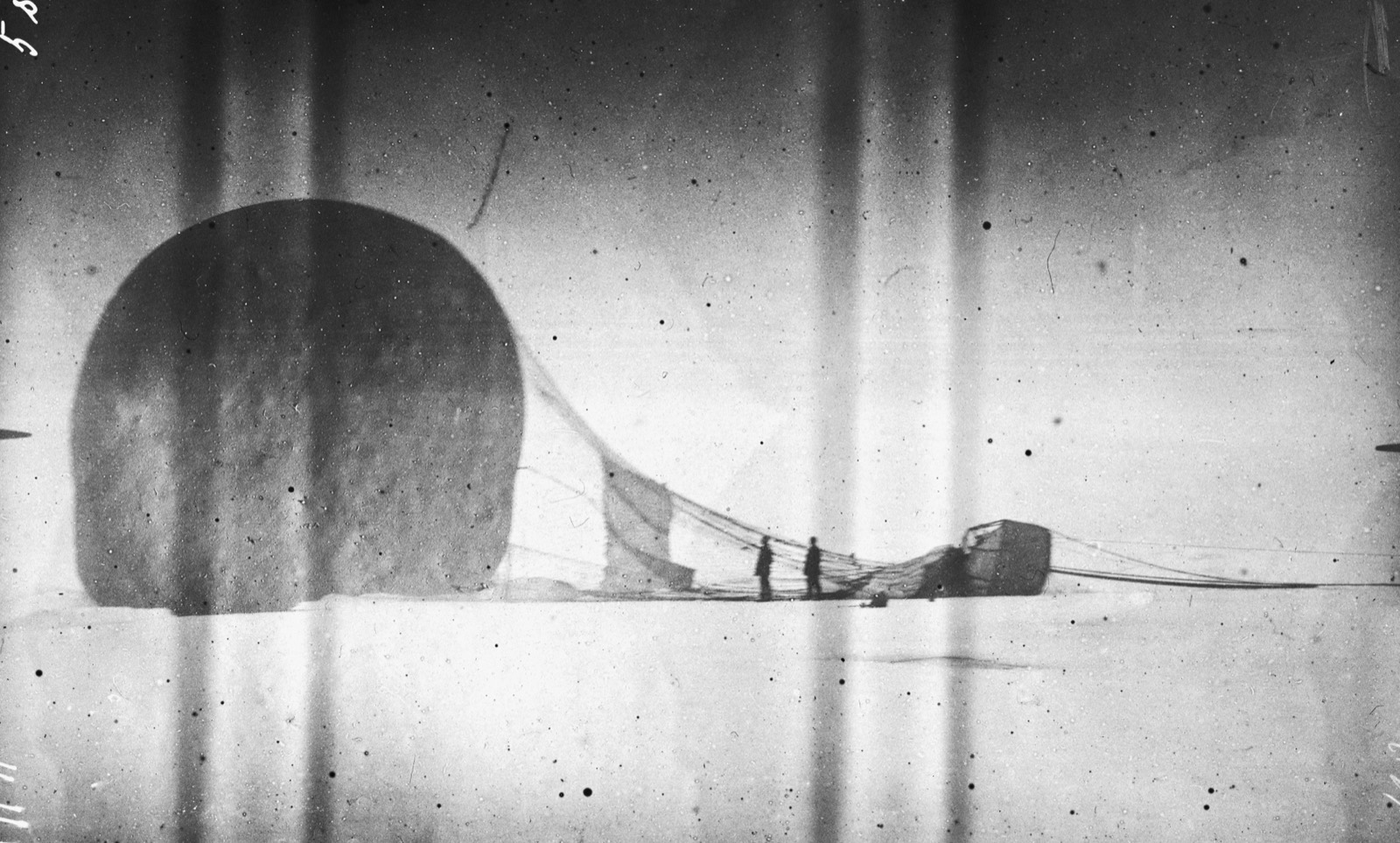
What it looked like from inside
They had come down on drifting pack ice about 290 kilometres from the nearest land. For a week they stayed on the floe, unpacking the car and assembling the sledges. On 15 July Andrée wrote only that they had “determined to set out from the point where we were.” They chose Cape Flora in Franz Josef Land, 340 kilometres to the south-east, where their largest depot lay.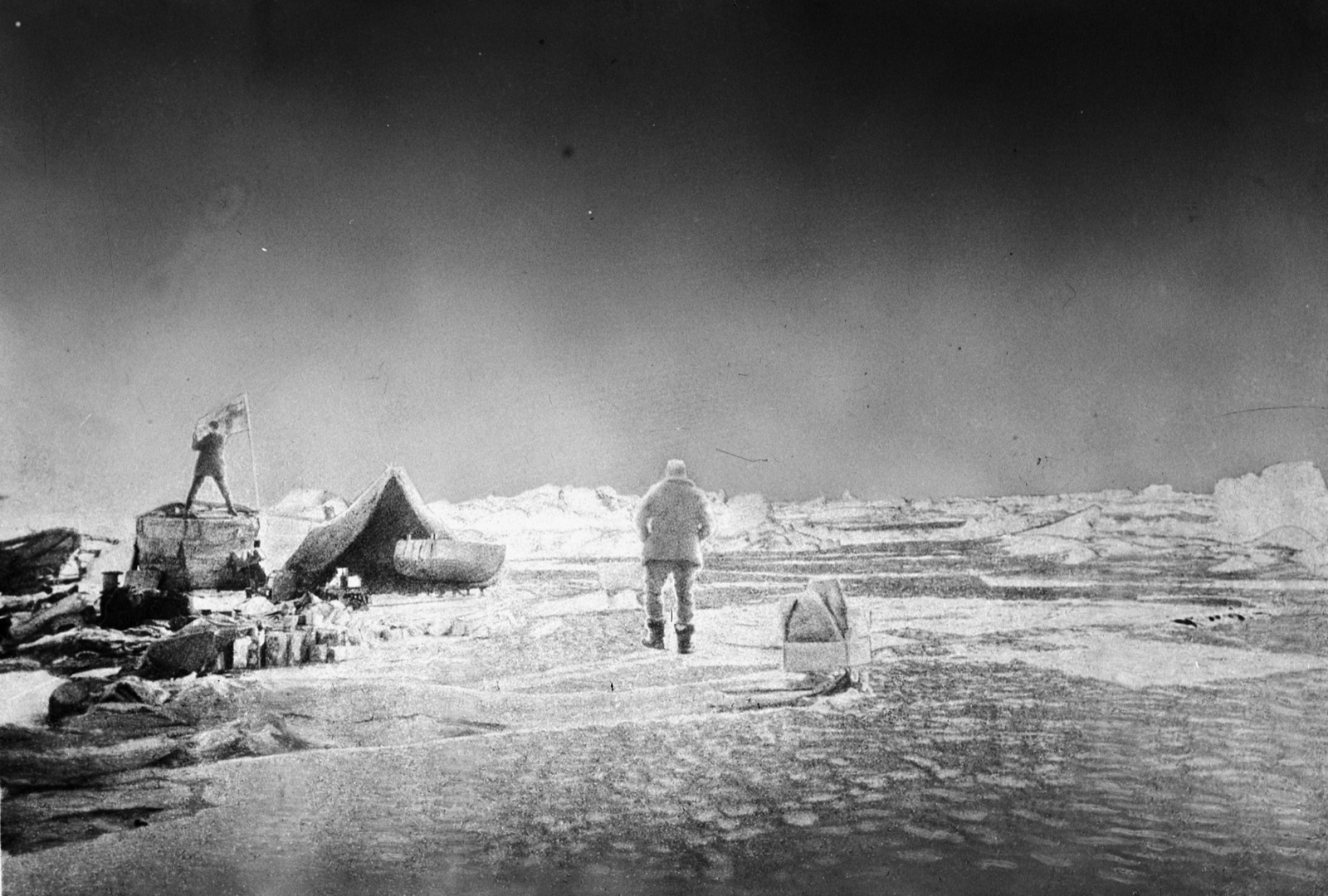
They left on the evening of 22 July. Each sledge weighed between 140 and 200 kilograms, and after three hours they put all three men on one sledge at a time, going back for the others. Strindberg kept the astronomical log, and his fixes said what no one wanted to know: the ice was carrying them back as fast as they walked.
He also wrote to Anna, in shorthand, in the back of his logbook. On 25 July, her birthday, they gave four cheers for her. “Yes, it is strange to think that not even for your next birthday will it be possible for us to be home. And perhaps we shall have to winter here for another year more. We do not know yet.” Two days later they left behind everything they could not pull, keeping food for forty-five days, and went on, each with his own sledge.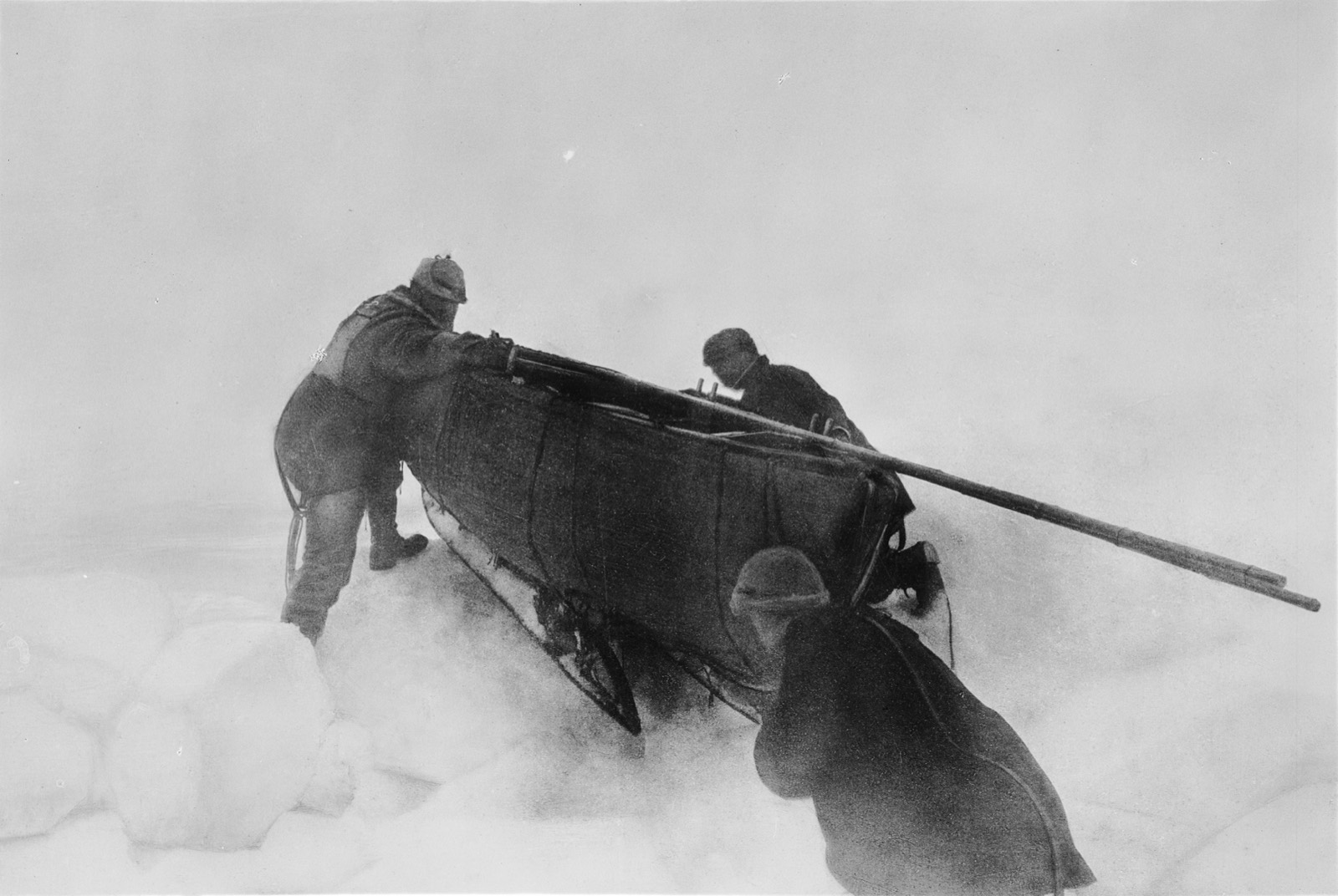
The fix on 3 August put them at 82° 27’ north, 28° 30’ east. In three weeks of the hardest work any of them had done they had made good about 53 kilometres, and that to the south-south-west, not towards Cape Flora at all. At one in the morning of 4 August Andrée searched the horizon with his glass. “In consequence, we determined to abandon our efforts to move eastwards. We can surmount neither the current nor the ice and have absolutely no prospect of doing anything by continuing our tramp to the east. We have therefore decided to begin our next march in the direction of the Seven Islands, which we hope to reach in six or seven weeks.” Then he recorded the thickness of the ice and took a sample of algae from its underside.
August was diarrhoea, bears, leads, and the slow discovery that the Seven Islands were no more reachable than Cape Flora. Frænkel’s foot gave out and he could not pull; the other two went back for his sledge in turns. Between 4 August and 9 September, when the diary stops, the ice carried them about 130 kilometres to the south-south-east, nearly the distance they had hoped to walk to the south-west.
“Since I last wrote in my diary, much has changed, in truth,” Andrée began again on 17 September. “But, above all, we found that the current and the wind irresistibly carried us down into the jaws between North-East Land and Franz Joseph Land and that we had not the least prospect of reaching North-East Land. It was during September 12 and 13, when we were obliged to lie still on account of violent north-west wind, that we at last discovered the necessity of submitting to the inevitable, i.e., wintering on the ice. Our position is not specially good.” The same day: “We have seen land for the first time since July 11. It is undoubtedly New Iceland that we have come in sight of.” New Iceland was one of the sealers’ names for an island east of Spitsbergen that was a single dome of ice with glacier cliffs for a shore. Its other name was White Island.
The floe drifted past its eastern side. On 18 September, the anniversary of King Oscar’s accession, they hoisted the flag and dined on seal steak and ivory gull, with port of 1834 given by the King and the national anthem in unison. On the nineteenth Andrée shot three seals and reckoned they had food to the end of February; on the twentieth Frænkel killed a bear. The same entry ends: “During the last two days the weather has been very pleasant, but, on the other hand, they have not passed without signs of differences arising between us. I hope, however, that this seed will not grow and develop.”
On 28 September they moved into a hut of ice and snow that Strindberg had built, and named it Home. “The evening was as divinely beautiful as one could wish,” Andrée wrote of 1 October. “But then something else happened. At five-thirty o’clock in the morning, we heard a thunderous crash, and water streamed into the hut.” The floe had split under the wall; what was left of it was 25 metres across. The last line of the big diary is: “No one had lost courage; with such comrades, one should be able to manage under, I may say, any circumstances.”
From here the record is Strindberg’s almanac, a word or two a day. 2 October: “Our ice-floe broke close to the snow-hut during the night.” 3 and 4 October: “Exciting situation.” 5 October: “Moved to land.” They had reached White Island. 6 October: “Snow-storm reconnoitring.” 7 October: “Moving.”
Andrée had begun a second notebook. It was found in the inside pocket of his jacket, where the ice had melted and refrozen over it for thirty-three summers, and most of its four and a half pages had rotted to pulp. What survives are the edges: “the hut hung.” “on the island.” The final legible words are “driftwood … to move about a little … (p)ermits.” Frænkel’s weather log stopped on 3 October. Strindberg’s almanac has one more entry, for Sunday 17 October: “home 7.05 a.m.”
What happened
The Svensksund reached Tromsø on 16 July 1897 with news of the start. The Geographical Journal in London thought that the care taken over every eventuality justified “some confidence in its success.” People waited.
The pigeon arrived first. Between one and two in the morning of 15 July, at the ice edge north of Spitsbergen, the helmsman of the Norwegian sealer Alken called his skipper, Ole Hansen, to look at a strange bird on the gaff, chased in by two gulls. It looked like a ptarmigan to Hansen, who climbed the rigging and shot it, against the advice of the harpooner in the crow’s nest, who called it a troll bird. It fell in the sea and no one lowered a boat. Only when another skipper asked later that day whether it might have been one of Andrée’s pigeons did Hansen turn back, put out two boats, and find the bird floating. The Alken did not reach Hammerfest until September. When the message was printed, Petermanns Mitteilungen in Germany called it a probable hoax, since Andrée could hardly have covered only 250 kilometres in two days; in October the Swedish Society for Anthropology and Geography compared the handwriting with his letters and declared it his; and in November Ekholm, who had left the expedition over the balloon, explained to the Society from the weather maps why it had gone so slowly.
Then nothing. The buoys came ashore in 1899 and 1900. On 19 August 1898 a Swedish expedition under Alfred Nathorst landed on the south-west point of White Island, looked round, and left, a few miles short of a camp then less than a year old.
For a generation the story ended there. In the summer of 1930 the snow melted on White Island as it had not in many years, and the sea east of Spitsbergen was almost free of ice. The sealer Bratvaag of Ålesund, Captain Peder Eliassen, carrying a small scientific party under the geologist Gunnar Horn to Franz Josef Land, anchored off the island’s south-west corner on 5 August. On 6 August the sealers went after walrus. Two of them, Olav Salen, seventeen and on his first Arctic voyage, and Karl Tusvik, twenty-four, walked up the beach to find drinking water. They waded a stream, and on the far side picked up an aluminium lid. Looking round, they saw something dark in a snowdrift inland: a canvas boat, half buried, full of gear, with a brass boathook in it.
Many of the objects in the boat were stamped “Andrée’s Pol. Exp. 1896”. About ten metres from it, leaning against the rock, lay a body with a large monogram A sewn inside the jacket and a diary in the inside pocket. Horn’s words when the skipper came quietly aboard were: “They had found Andrée.” In the boat was a book, wet and heavy, that could be opened in places on columns of figures. “It was just as if the notes had been put down in a warm room,” Horn wrote, “and yet the calculations had been made and written during the course of a death-march across the ice.” Its first page read “The Sledge Journey, 1897.” Thirty-five metres north of the camp they found a grave between two rocks, and took the body in it from the initials on its clothes for Strindberg, which it was. They dug the boat out of the ice, built a cairn, and went on to Franz Josef Land, because that was the work they had been sent to do. Horn noted that if the snow had been a couple of feet deeper “everything would have been concealed.”
The news reached Tromsø by another sealer on 22 August. By the time the Bratvaag reached a telephone on 31 August, journalists from every country were waiting, and one of them, Knut Stubbendorff of Dagens Nyheter, had chartered the sealer Isbjørn and was on his way north. He reached White Island on 5 September, when more snow had gone, and found the rest, including, frozen into the ice under the rock, the head and upper body of a man lying on his left side with a hand under his head. That was Frænkel. In his pocket was Strindberg’s almanac, and inside it a fountain pen that still had ink in it.
At Tromsø a Swedish and Norwegian commission dried and read the diaries. The film went to John Hertzberg, a docent in photography in Stockholm, who had almost no hope of it. From 192 exposures on four strips that had lain in the ice for thirty-three years he recovered some fifty frames with traces of an image and about twenty that could be printed. They are the pictures in this entry.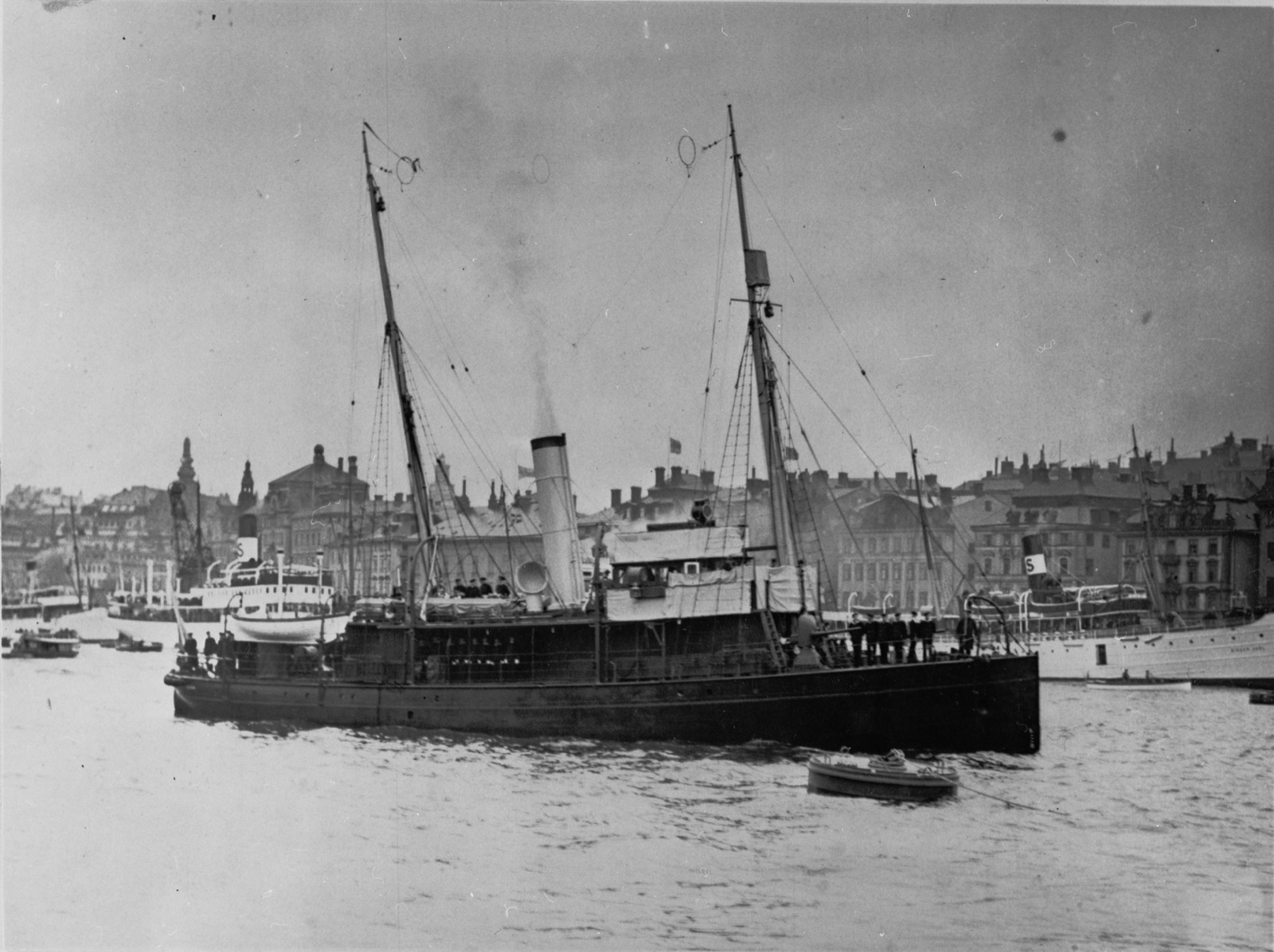
On 5 October 1930 the Svensksund came up the harbour of Stockholm with three coffins on her deck and moored at Skeppsholmen at two o’clock in the rain. King Gustaf met them on the quay. “They went away—they vanished into the horizon. Their own fate but increased the number of the problems. And yet, they have come home again at last!” In the cathedral Archbishop Söderblom began with the words “Welcome home!” and read from the pulpit what Andrée had written in the car on the night of 12 July.
After
What killed them has never been settled. The commission found the camp well stocked: meat on the sledges, ammunition, matches, paraffin. Two bear skins lay unused, and so did the sleeping bag. “I think they died in their sleep!” one of the Isbjørn’s sealers said. “The cold finished them. In any case, they didn’t die of hunger.” Strindberg had died first and been buried by the other two; Andrée and Frænkel seem to have died in the tent at about the same time. In 1952 a Danish physician, Ernst Tryde, reported finding Trichinella larvae in scraps of dried bear meat from the camp, and since then it has been widely said that the men died of trichinosis from the bears they ate. A review of the parasite in the Arctic published in 2022 puts it carefully: “although the hypothesis about Trichinella as the cause of death is intriguing, it has not been proven.” The cold, the fumes of the stove in a closed tent, and more recently a bear, have all been proposed.
What brought the balloon down was settled, by the people who had built it. The Society’s technical committee, Swedenborg among them, went through every note of ballast thrown and every height recorded, and their account is the autopsy of the first claim. Between the start and the landing the Eagle lost about 1,580 kilograms of lift. Gas accounted for perhaps 600 of that, most of it in the first hour, when the loss of the ropes and the sand sent the balloon to 600 metres and the warmed hydrogen blew off through the valve. The rest was water and ice from the fog, which had weighed more than the leak. “Strangely enough,” the committee wrote, “the fog, and the ice deposited by fog, were not taken into calculation.” The meteorologist on the committee was blunter: “Andrée and Ekholm both underestimated the factor of fog.”
The second claim was never tested at all. With the lower ropes gone, the stumps were little longer than the ballast lines, and the balloon could not be swung on them. “Little or no steering could ever have been attempted.” The committee ended: “Nothing remains to be said but that the balloon might have remained aloft for some days more, but, only on two presuppositions: that the guide-ropes had not been lost, and that the balloon had not been weighted down by the fog.”
At the end of his logbook, on the ice, between a recipe for pancakes and the menu for a banquet, Strindberg had written a heading: “Proposals for alterations in the next polar balloon expedition.” Under it are four lines. “The drag-lines to be sheathed in metal. The car in the bearing-ring. The gas to be somewhat heated by boiling water in the car and condensing the steam in a sheet-iron vessel in the balloon. The balloon of the same cloth about 6000 cub. met. in volume.” He had identified, on a drifting floe, both of the failures the committee would confirm thirty-three years later.
What it taught
Andrée framed the Pole as a technical problem, and the strength of the framing was that it could be written as a list. Four requirements, each met by a number or a precedent. Three of them really were met: the balloon lifted the load, it was filled on a beach at 80 degrees north, and the gas, whatever Greely feared, was not what brought it down. The fourth, the steering, had been tested once, on one July afternoon in 1894, with a smaller sail on a smaller balloon, and it was the only requirement that turned a flight into an expedition. The instrument that would have answered it was the three ropes, and the ropes lay on the beach before the balloon had crossed the harbour.
They lay there because of a safety device, and the device was there because of advice. The critics in London had attacked the balloon’s endurance; the critics at home attacked the ropes’ tendency to snag; the part that failed was a joint cut with “only a very few threads” to make the snagging survivable. Andrée built it, he wrote, because of “the obstinacy with which the criticism was continued,” and he was honest enough to record that he did not believe in it. The one time the designer let other people’s fear into the design, it dismantled the design in the first two minutes.
What the balloon then became was an instrument for measuring the variable nobody had put on the list. The fog had not been counted because it had not been seen from Cape Thordsen, and because a meteorologist who had studied the region thought it came a couple of times a summer. It came on the first night and stayed. Everything after that, the stamping of the car across the ice, the Pole buoy thrown away empty, was three men reading off the weight of water on silk in the only units they had, which were sacks of sand.
The complication is that this experiment did report, exactly as its designer had said it should. He had written in 1895 that the notes and photographs should be kept so that “the essential discoveries of the expedition” would survive even if the men could not save the records whole. The men did not survive; the records did, because Strindberg kept a log fit for a warm room, because Andrée kept writing in a tent that was killing him, and because they wrapped the film in brass. Thirty-three years late, the result reached the people who could read it, and they read it as Andrée would have: ballast by ballast, to the kilogram. The last instrument reading of the whole enterprise is Strindberg’s four-line list for the next balloon. There was no next balloon. The answer to the question Andrée asked in the car that night, whether they would be thought mad or followed, is that they were read.
Sources
- S. A. Andrée, “A Plan to Reach the North Pole by Balloon,” and the discussion following it, in Report of the Sixth International Geographical Congress, held in London, 1895 (John Murray, 1896), pp. 211–227. The four requirements, the Cork–Brussels–Bergen triangle, the cost estimate, and every word quoted from Silva White, Greely and Andrée’s reply. archive.org
- Swedish Society for Anthropology and Geography, Andrée’s Story: The Complete Record of His Polar Flight, 1897, from the Diaries and Journals of S. A. Andrée, Nils Strindberg and Knut Frænkel, Found on White Island in the Summer of 1930, translated by Edward Adams-Ray (Viking Press, New York, 1930). The biographies, the planning and funding, the two summers at Danes Island, the hour-by-hour reconstruction of the flight from Andrée’s diary and Strindberg’s almanac, the march, the last fragments, Gunnar Horn’s account of the discovery, Knut Stubbendorff’s of the Isbjørn, Nils Lithberg’s inventory of the camp, John Hertzberg’s note on the films, the journey home, and the technical and meteorological verdicts by Swedenborg, Wallén, Amundson and Malmer. The documents themselves are printed at the back. archive.org
- Henri Lachambre and Alexis Machuron, Andrée’s Balloon Expedition in Search of the North Pole (Archibald Constable, London, 1898). The balloon’s construction and enlargement, the summer of 1896 including Ekholm’s leakage estimate of 9 August, the leak tests of June 1897, the lift and endurance calculations of 1 July, and Machuron’s eyewitness account of the start. archive.org
- Nils Ekholm to Alfred Nobel, Stockholm, 21 September 1896. Alfred Nobel’s archive, Riksarkivet, SE/RA/720020/01/F/F VIII/1; the translation above is mine. Wikimedia Commons
- Gustaf Retzius, “Om den Andréeska dufvopostens äkthet,” Ymer 1897, part 4, pp. 267–279. The doubts in Petermanns Mitteilungen, the Society’s examination of the handwriting on 14 October 1897, Ekholm’s explanation of 19 November, and Mark Aagaard’s report from Hammerfest of 8 November 1897 with Captain Ole Hansen’s own account of shooting the pigeon. archive.org
- The Geographical Journal, vol. 8 (1896), “Mr. S. A. Andrée’s Polar Expedition,” pp. 518–519, summarising Andrée’s report in Ymer on the winds of 1896; vol. 10 (1897), “Herr Andrée’s Balloon Voyage” in the Monthly Record for August, and “Norwegian Andrée Search Expedition” in December. vol. 8, vol. 10
- Antti Oksanen and others, “Epidemiology of Trichinella in the Arctic and subarctic: A review,” Food and Waterborne Parasitology 28 (2022), e00167, for Tryde’s 1952 report and its standing; and Svalbard Museum, “The Andrée Expedition,” for the theories since. PMC, svalbardmuseum.no
- Photographs: Vilhelm Swedenborg’s picture of the start, Grenna Museum, DigitaltMuseum gm.saa1068, released under CC0; Nils Strindberg’s negatives developed by John Hertzberg in 1930, the Florman studio portrait and the Svensksund at Stockholm in 1930, Tekniska museet, DigitaltMuseum TEKA0023163, TEKA0022715, TEKA0017409, TEKA0018088 and TEKA0018087; the photochrom of the balloon house, Detroit Publishing Company, Library of Congress Prints and Photographs Division, LOT 13432, no. 118.