At a quarter to five in the afternoon of 8 December 1903, where the Anacostia runs into the Potomac below the Washington Barracks, a steam tug was holding a houseboat the size of a small warehouse against a strong tide and a wind that shifted through ninety degrees from one gust to the next. The light was going. Blocks of ice several inches thick were drifting past on the water. On a wheeled car on a track on the roof stood a machine of steel tubing and cotton cloth with four wings set in tandem, its two propellers turning at full speed. In a canvas car between the front wings, in a jacket lined with cork, stood a mechanical engineer of twenty-seven named Charles Manly. The machine had cost the War Department fifty thousand dollars and the Smithsonian Institution about twenty-three thousand more. It had never been in the air. Neither had he.
Manly gave the signal. The car ran the length of the track. Something at the rear of the machine dragged, the tail went, the rear wings folded, and the whole thing rose nose first until it stood upright on the thrust of its propellers, hung there a moment, and fell over backwards into the river with Manly underneath it.
The Smithsonian photographer’s fast shutters recorded nothing in that light. A photographer from the Washington Star got one small picture. It shows the machine on end against a grey sky, the rear wings crumpled like wet paper and the front wings, for the moment, whole.
Nine days later, on a sand flat in North Carolina, in a wind of twenty miles an hour, a machine built by two bicycle makers from Dayton, Ohio, ran forty feet along a rail and flew for twelve seconds. On its fourth flight it flew for fifty-nine.
Who ran it
Samuel Pierpont Langley was born on 22 August 1834 in Vernon Street, Roxbury, Massachusetts, the son of a wholesale merchant. He did not go to college. He taught himself civil engineering, and in 1867 became director of the Allegheny Observatory at Pittsburgh, which then consisted of a building, a thirteen-inch telescope and, in the words of his memorialist, “no apparatus whatever, not even a clock.” He stayed twenty years and invented the bolometer, an instrument that read the heat of the sun’s spectrum. In 1887 Spencer Baird brought him to the Smithsonian Institution in Washington as assistant secretary, promising not “in any way to interrupt the progress of your investigations.” Baird died that August, and Langley became the Institution’s third Secretary, with the research he cared about pushed into the hours that were left.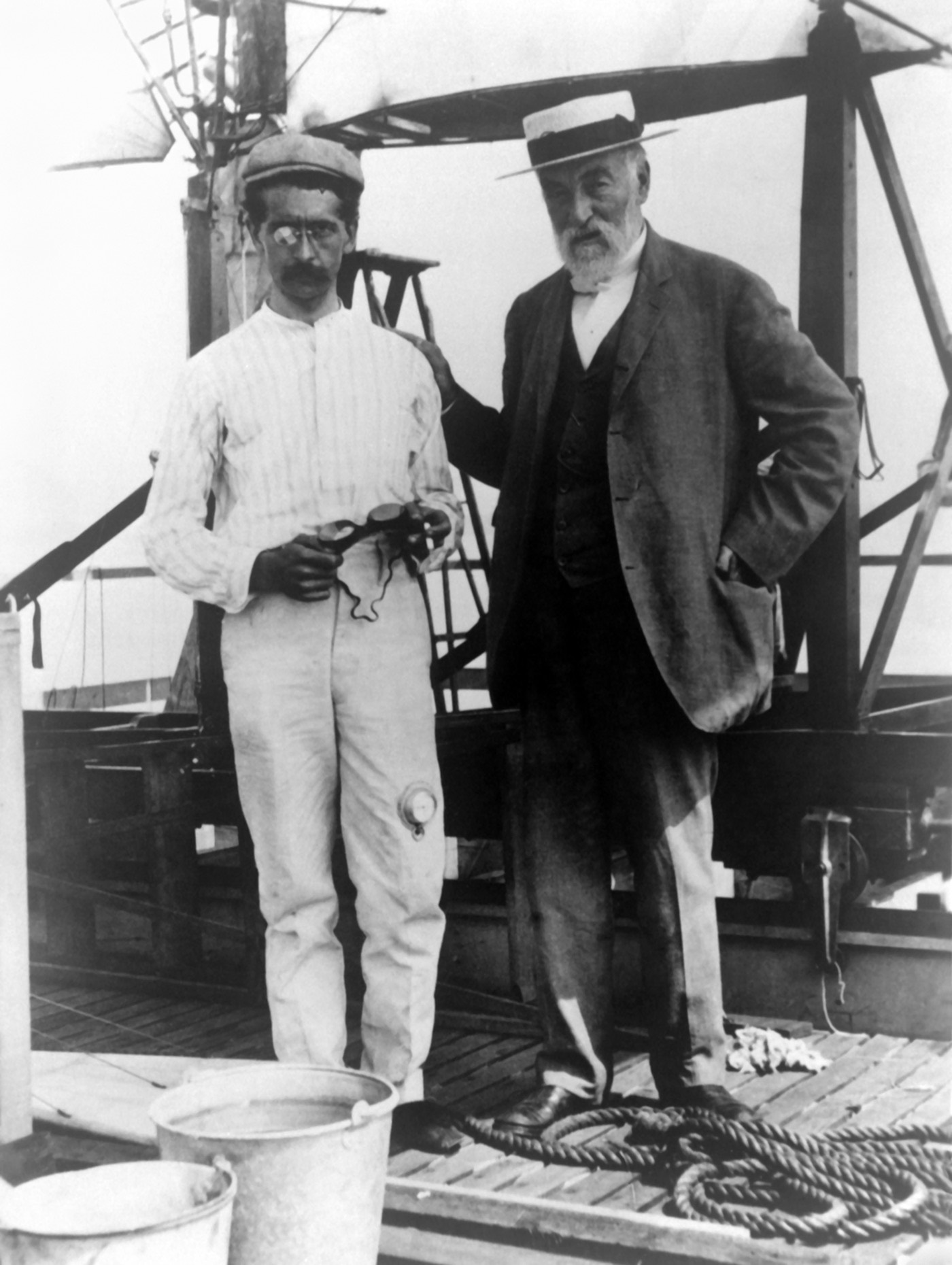
He began building flying models that same year, at fifty-three, and in 1891 he published the results of years at Allegheny with a whirling table, a steam-driven arm that swung flat plates through the air at measured speeds, as Experiments in Aerodynamics. The claim of that book, in his own summary, was “that it was possible to construct machines which would give such a velocity to inclined surfaces that bodies indefinitely heavier than the air could be sustained upon it, and moved through it with great velocity.” One horsepower, he calculated, would carry about two hundred pounds of plane through the air at forty miles an hour. Whether a machine could leave the ground and come back to it in safety he put aside as “the practice of some unexplored art or science which might be termed Aerodromics, but on which I was not then prepared to enter.”
Charles Matthews Manly came in June 1898, on the recommendation of Robert Thurston, the professor of engineering under whom he had studied at Cornell. He was twenty-two, born in Staunton, Virginia, with a new degree in mechanical engineering. Langley was not an engineer and knew it. Manly ran the shops for five years, designed the engine nobody else would build, and in 1903 asked to be the man in the machine. In the Memoir that he finished after Langley’s death he refers to himself throughout as “the writer.”
What he was trying to find out
Langley’s models were called aerodromes, from a Greek word for an air runner. From 1887 they were small and driven by rubber bands; from 1893 they were steel, with steam engines the size of a hand, launched from the roof of a scow moored off Chopawamsic Island in the Potomac, thirty miles below Washington. They failed through 1893, 1894 and 1895, and the field notes record every one. The best of them, in May 1895, drew from Langley’s record book the entry “The whole machine absolutely rising during five or six seconds—a fine spectacle!” before the power gave out.
On 6 May 1896 Langley took Alexander Graham Bell down to the river to watch Aerodrome No. 5. It weighed about twenty-four pounds, spanned about thirteen feet, and carried a one-horsepower engine and no one to steer it. It rose against the wind in great slow curves, and when the steam ran out came down on the water a minute and a half later, undamaged. It flew again that afternoon. Bell wrote to Langley the same day, estimating each course at a little over 900 metres. “It seemed to me,” he ended, “that no one could have witnessed these experiments without being convinced that the possibility of mechanical flight had been demonstrated.” On 28 November 1896 the larger No. 6 flew 4,200 feet in a minute and three-quarters.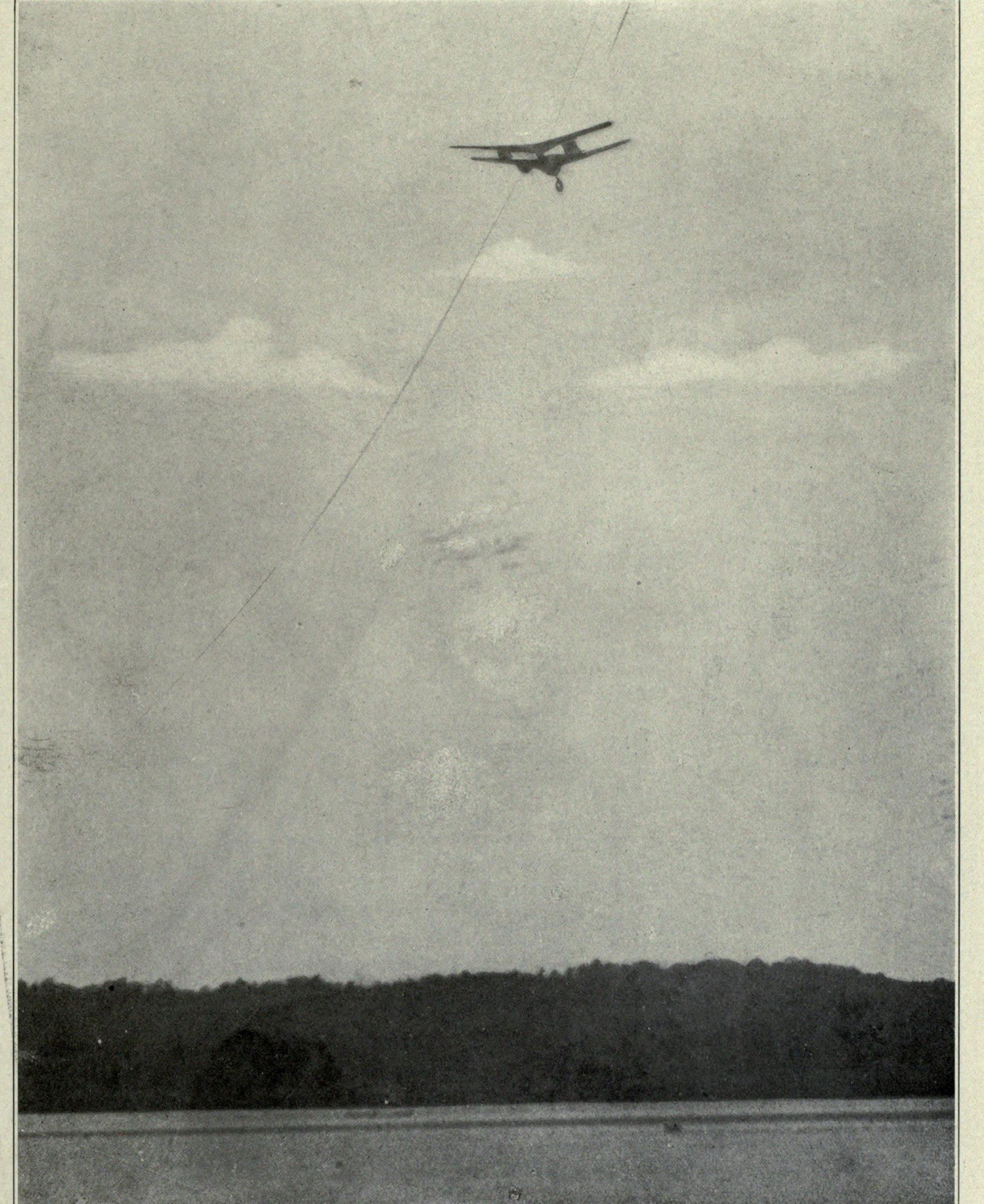
The models had done what he had set out to do, and he said so in print. “I have now brought to a close the portion of the work which seemed to be specially mine,” he wrote in McClure’s Magazine in June 1897, “the demonstration of the practicability of mechanical flight—and for the next stage, which is the commercial and practical development of the idea, it is probable that the world may look to others.”
The others turned out to be the War Department. In the spring of 1898, with war coming with Spain, President McKinley had a board of Army and Navy officers look at the models and say whether a machine of the same design could carry a man and be of any use. It said yes, and the question went to the Board of Ordnance and Fortification, which had money for “implements and engines of war.” On 9 November 1898 the Board allotted $25,000, with the understanding that another $25,000 would follow. Langley wrote to the Board on 12 December 1898 that he had “reason to believe that the cost of the construction will come within the sum of $50,000.00,” and that he agreed with the Board’s wish “that privacy be observed with regard to the work, and only when it reaches a successful completion shall I wish to make public the fact of its success.” The second $25,000 came on 18 December 1899.
So the hypothesis was now a different one, and it had two parts. The first was about scale: that the model which had flown in 1896 could be built four times as large in every dimension, loaded at nearly the same weight for each square foot of wing, and would fly as the model had flown. The second was about the man: that a machine balanced by calculation from the model, launched by a catapult and held steady by the same self-correcting tail that steadied the model, would carry a person who had never been in the air, and would need from him only the small adjustments that a machine could not make for itself.
Manly set this out at the head of his part of the Memoir with a candour that reads differently now than it did in 1911. “In the development of man-carrying flying machines two well-defined paths are open,” he wrote. “First: Starting with gliding machines, in which gravity furnishes the motive power, the operator may by practice acquire sufficient skill in controlling them to warrant the addition of propelling mechanism, and individual skill in control may be gradually replaced by automatic controlling mechanism. Second: From self-propelled models, possessing automatic-equilibrium controlling mechanism, and of a sufficient size to furnish determinative data, one may, by proper modification in size and construction, progress to an automatically controlled man-carrying machine in which, for ideal conditions, no especial skill on the part of the operator is required. Each method has its advantages.” Langley took the second path. Two brothers in Dayton were, from 1899, on the first.
What they built
The engine came first. The models had run on steam, and steam for a man-carrying machine meant water, boilers and a plant too fragile to trust. Langley wanted a petrol engine of twelve horsepower weighing no more than a hundred pounds, and contracted for one with Stephen Balzer of New York. By the spring of 1900 both of Balzer’s engines, the large one and a smaller one for a quarter-size model, had failed to give half the power promised. Langley and Manly went to Europe and asked the engine makers there, who all, Langley reported, “believed it impossible to construct an engine of the necessary power and as light as I required.” So in August 1900 Manly began building it himself in the Smithsonian’s shops, with five cylinders arranged like the spokes of a wheel. By the end of 1901 it ran. On the test stand it gave 52.4 horsepower at 950 revolutions a minute, for ten hours at a stretch on three separate occasions, and weighed, without water and fuel, about a kilogram to the horsepower.
The frame was steel tube, strong enough that four men standing at its middle, supported only at the ends, “simultaneously jumped up and down on it” without measurable deflection. The wings were four, two in front and two behind, each eleven and a half feet by twenty-two and a half, cotton over wooden ribs, 1,040 square feet in all. The ribs were hollow boxes of thin wood, glued, bent to a curve and varnished; a sample had been kept under water for twenty-four hours without the glue softening. The wings were held to shape by piano wire running to a single post above and a single post below the frame at each pair, the posts set 28 per cent of the way back from the leading edge. Ready to fly, with Manly in it, the machine weighed 830 pounds, of which he was 125.
For control there were two hand wheels. One moved the Penaud tail, a dart-shaped surface at the back carried at a negative angle, which was meant to keep the machine level on its own, as the model’s had, and which the aviator could tilt a little to climb or descend. The other moved a small rudder under the frame for steering. There was nothing for the wings to do but stay where they were set, angled slightly upward from the centre so that the machine would right itself if it tipped. “For the preservation of the equilibrium of the aerodrome,” Manly wrote, “though the aviator might assist by such slight movements as he was able to make in the limited space of the aviator’s car, the main reliance was upon the Penaud tail.”
The aviator’s car was a flat-bottomed boat of cloth and steel, about three feet by five, slung between the front wings. He was not strapped in: he was to be free to stand, to sit, and “if agile, even climb from the extreme front of the machine to the rear.” That freedom, Manly observed later, “prevented a fatal accident.”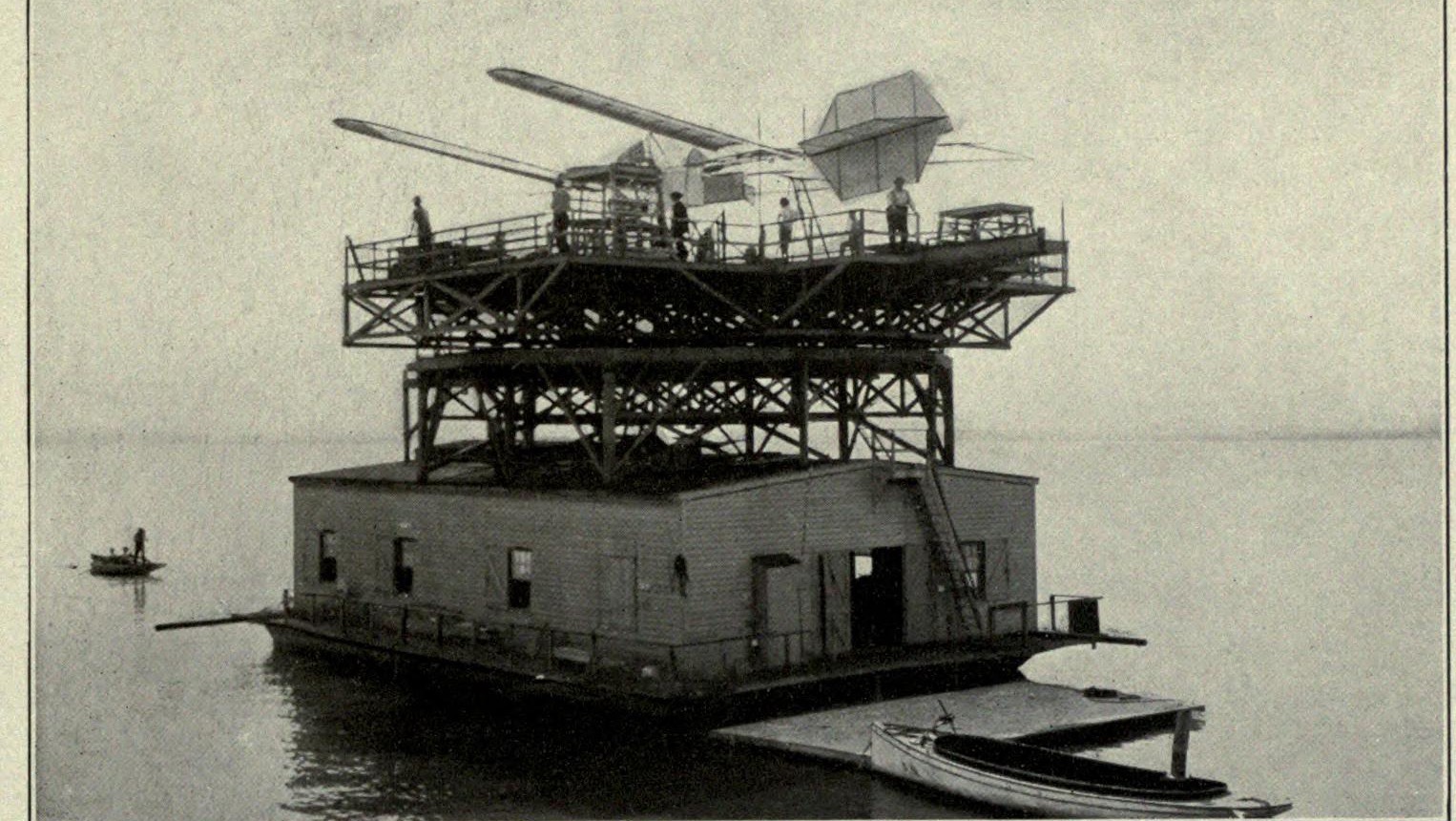
Langley had used a small one for the models and would not consider anything else, “though advised by the writer against doing so.” The new one was built under contract and delivered in May 1899: sixty feet by forty, with workshops inside, and on top a turntable weighing about fifteen tons carrying the launching track, five feet in gauge and eighty feet long, so that the machine could always be pointed into the wind. A spring-driven car held the machine at three points and let go at the end as the track fell away beneath it. It was an enlarged copy of the apparatus that had launched the models more than a dozen times in 1899 without a hitch, “the one appliance,” Langley wrote afterwards, “least likely to mar the experiments.”
What was not built was any means of putting a man into the air before the day the whole machine went. It had been Langley’s plan to launch the full-size aerodrome first with a dummy in the car, since he “felt so apprehensive that the first, and possibly the second test, would be unsuccessful.” By 1903 too much time had gone. Manly offered to take the risk himself, arguing that a hand on the controls could correct an error of balance, and Langley “assented with great reluctance, as he fully realized the danger involved.” There was no glider, no tethered trial, no hour in the air.
On 14 July 1903 the houseboat was towed forty miles down the Potomac and moored in the middle of the river, three miles wide there, opposite Widewater, Virginia, where the machine could come down on water on any side.
The river was not the shop. Fog hung over it for weeks; rust got into the ignition, the dry cells died, and the damp got through the varnish and opened the glued joints of the ribs, which were scraped, reglued and bound with surgeons’ tape. Reporters came down to Widewater and were kept off the boat. On 19 August Langley gave them a statement instead: the trials were “essentially experiments and nothing else,” and “it is the practice of all scientific men, indeed of all prudent men, not to make public the results of their work till these are certain.”
On 8 August the quarter-size model, with a three-horsepower engine Manly had built on the same pattern, went off the track. A workman had overfilled its fuel tank and the engine faltered three times, but it flew about a thousand feet in twenty-seven seconds, rising again each time the engine picked up. Langley called it “the first time in history, so far as I know, that a successful flight of a mechanically sustained flying machine was made in public.” It had been built, Manly wrote, “to find out if the balancing of the large aerodrome, which had been determined by calculation from the results obtained with the steam-driven models, was correct.” No second flight was made. There was not time.
Three seconds
The season ran out. Storms dragged the houseboat on its moorings, and a trial on 3 September failed when the batteries were found dead. Then on 7 October the wind fell to about twelve miles an hour by ten in the morning and kept falling. Major Montgomery Macomb of the Artillery Corps and G. H. Powell, the clerk of the Board of Ordnance and Fortification, were there for the War Department. Langley was in Washington on business. At 12.20 Manly started the engine, brought it to full speed, looked the machine over, and gave the order to release.
He did not see the run down the track, because he was watching his hands. Those who did, he wrote, “have said that the sight was most impressive and majestic.” The car covered sixty feet of track in three seconds and reached about thirty-two feet a second. “Just as the machine reached the end of the track the writer felt a sudden shock, immediately followed by an indescribable sensation of being free in the air, which had hardly been realized before the important fact was intuitively felt that the machine was plunging downward at a very sharp angle.” He threw the tail wheel hard over. Nothing changed. The front wings struck the water and “the tremendous crash of the front wings being completely demolished” was the last thing he heard before he was under the river with the machine. He got clear, surfaced, and sat on the top of the frame where it stuck out of the water. “The first thing that the writer saw after looking around him was a newspaper reporter, his boatman expending the utmost limit of his power in pushing his boat ahead to be the first one to arrive.”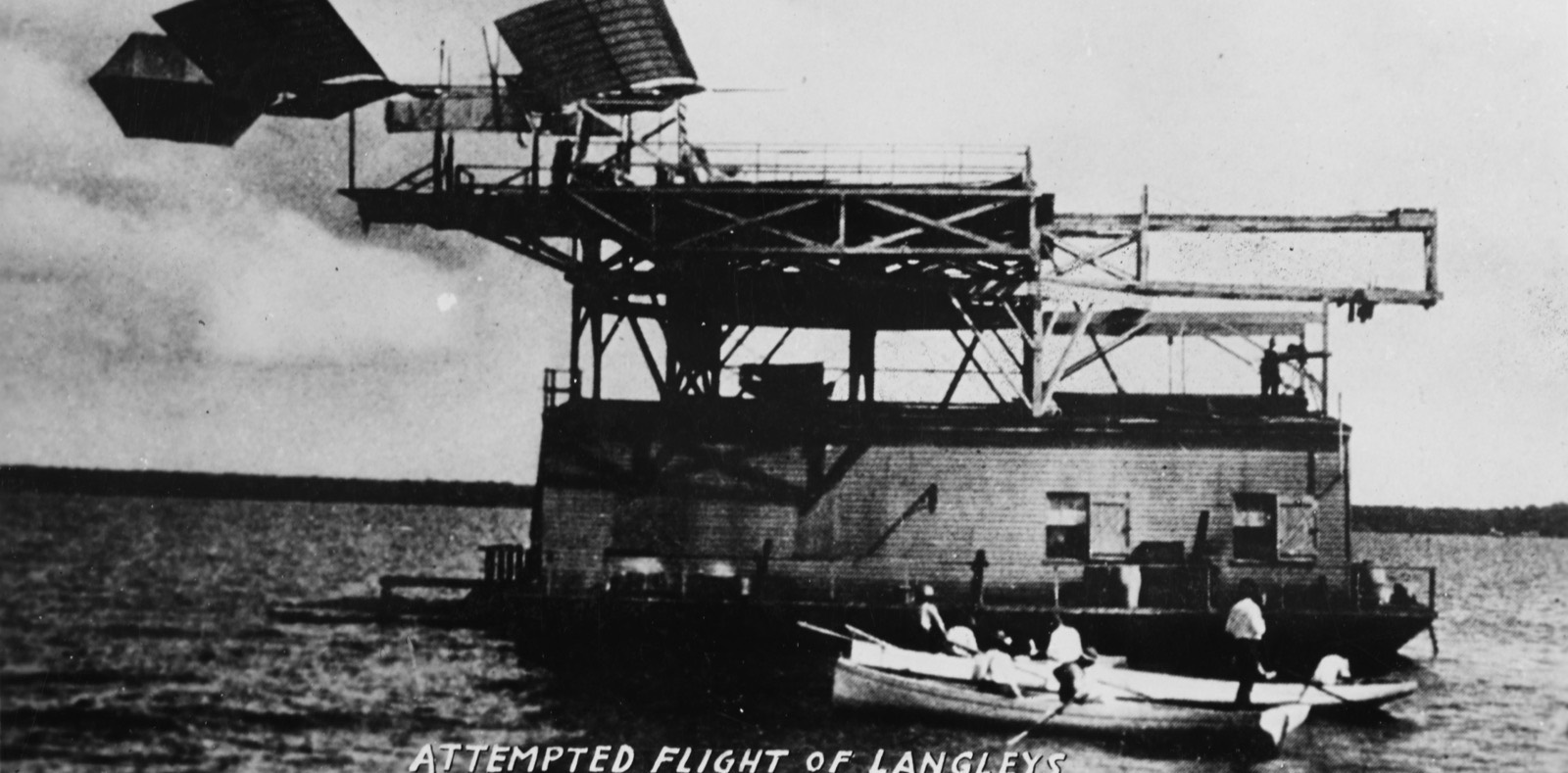
The reporters wanted a statement, and said that if they did not get one they would write their own conclusions. So Manly, in dry clothes, gave the Associated Press this: “It must be understood that the test to-day was entirely an experiment, and the first of its kind ever made. The experiment was unsuccessful. The balancing, upon which depends the success of a flight, was based upon the tests of the models and proved to be incorrect, but only an actual trial of the full-size machine itself could determine this. My confidence in the future success of the work is unchanged. I can give you no further information. I shall make a formal report to Secretary Langley.”
Then the foreman, Reed, went over the launching car, and found the cap of the upright guide at its front stretched out of shape. A small pin on the foot of the front guy post had hung in that cap as the track dropped, and the falling track had pulled the front of the machine down with it, bending the guy post back thirty degrees and twisting the front wings out of their curve. Two photographs taken at the same instant showed the wings twisted before the machine had cleared the boat. Langley gave the press a second statement the next day: the accident was “due wholly to the launching mechanism,” and “the statement that the machine failed for lack of power to fly was wholly a mistaken one.” Macomb’s report to the Board agreed: “The trial was unsuccessful because the front guy-post caught in its support on the launching car.”
That night a storm came up the river, wrecked the boats, and blew the tug so far down the Potomac that nobody could reach the houseboat for three days. It was towed back to Washington on 12 October.
The New York Times had printed its verdict on 9 October, under the heading “Flying Machines Which Do Not Fly.” “The ridiculous fiasco which attended the attempt at aerial navigation in the Langley flying machine was not unexpected,” it began. “It might be assumed that the flying machine which will really fly might be evolved by the combined and continuous efforts of mathematicians and mechanics in from one million to ten million years.” Scientific American, a week later, took the other side, and was sorry “not so much because the aerodrome refused to fly, but because of the adverse newspaper comment which the trial has prompted.”
At Kill Devil Hills, where he and his brother were assembling their own machine, Wilbur Wright read the news and wrote to Octave Chanute on 16 October: “I see that Langley has had his fling, and failed. It seems to be our turn to throw now, and I wonder what our luck will be.”
What it looked like from inside
Manly’s advice to Langley after 7 October was to change nothing, in the machine or the launching apparatus, except to remove the small pin that had caught, so as “to reproduce exactly the conditions which obtained at the time of the previous experiment.” It was ready by the middle of November. The next trial would be close to the city, where the houseboat could lie at its dock until the weather served.
The weather did not serve. The Board’s money had been spent nearly two years before, and Langley would not draw further on the Smithsonian fund that had paid since. On 8 December the wind died by noon, the search for a tug took most of the afternoon, and by the time the houseboat reached the point below the Washington Barracks “darkness was descending and a strong and exceedingly gusty wind had sprung up, and it seemed almost disastrous to attempt an experiment.” Manly wrote the reasoning down in the Memoir: “it was decided that it was practically a case of ‘now or never,’ and although the river was full of large blocks of floating ice several inches thick, which added enormously to the danger involved in the experiment, the writer decided to make the test immediately so that the long-hoped-for success, which seemed so certain, could be finally achieved.” General Randolph and Major Macomb were there for the Board. Hundreds watched from the wharves.
The wings took a long time to fit in a wind of twelve to eighteen miles an hour that would not stay in one quarter. At 4.45 Manly released the car. Facing forward, watching the engine, he saw nothing of what happened behind him. He felt “an extreme swaying motion immediately followed by a tremendous jerk which caused the machine to quiver all over,” and then the bow was rising fast. He threw the tail wheel to its other limit, downward this time. Again nothing. When the machine passed the vertical and began to fall backwards he swung himself round on his arms so as to meet the water feet first.
“The next few moments were for him most intense, for he found himself under the water with the machine on top of him, and with his cork-lined canvas jacket so caught in the fittings of the framework that he could not dive downward, while the floor of the aviator’s car, which was pressing against his head, prevented him from coming upward.” He tore the jacket in two, dived under the frame, and swam under water until he thought he was clear. “Upon rising to the surface his head came in contact with a block of ice, which necessitated another dive to get free of the ice.” A workman named Hewitt had jumped in to look for him under the wreck, and the tug was pushing the houseboat down on both of them until Manly, in the water, ordered it reversed.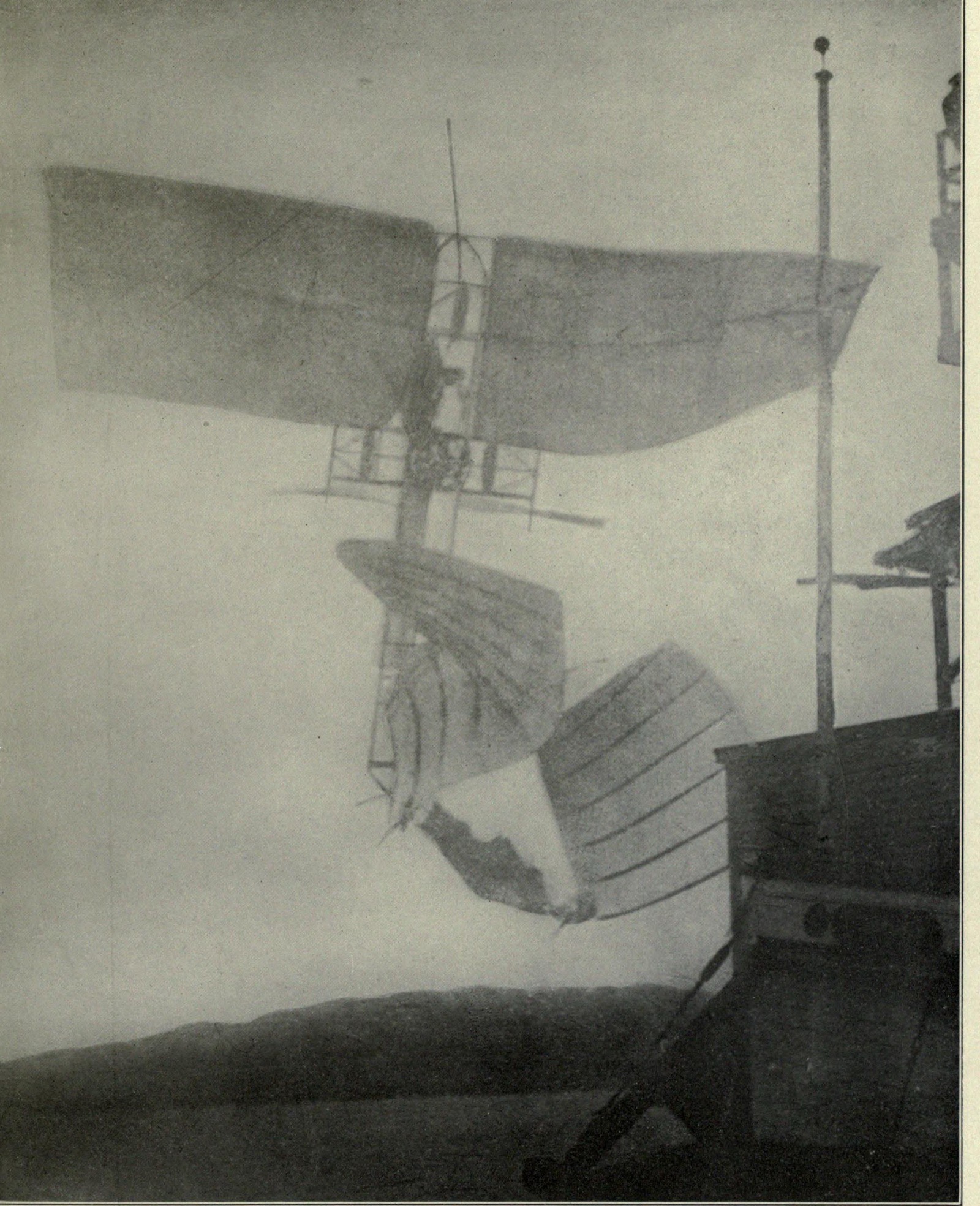
In the dark the tug’s crew put a rope on the tail, pulled the machine the wrong way, and broke the main frame in two.
What had happened on the track was never settled. Reed, at the rear, saw the Penaud tail drop and drag along the cross-pieces about ten feet before the end, and then the whole back of the machine seemed to hang on the car. The Star’s photograph showed the rear wings broken at their roots, but also the starboard front wing broken through its main rib and both front wings pressed up against the frame, which could not have happened “unless the front guy-post had given away either by bending or breaking.” Macomb reported to the Board on 6 January 1904 that “the rear guy-post seemed to drag, bringing the rudder down on the launching ways,” and that the machine “had been wrecked in the launching, just how, it was impossible for me to see.”
Macomb’s report said something else that the Memoir reprinted without comment. “Owing to the necessity of lightness, the weight of the various elements had to be kept at a minimum, and the factor of safety in construction was therefore exceedingly small, so that the machine as a whole was delicate and frail and incapable of sustaining any unusual strain.” And: “these unfortunate accidents have prevented any test of the apparatus in free flight, and the claim that an engine-driven, man-carrying aerodrome has been constructed lacks the proof which actual flight alone can give.”
What happened
On 17 December 1903, at Kill Devil Hills, Orville and Wilbur Wright made four flights in a cold north wind that their anemometer put at twenty and a half miles an hour, with five men watching. Wilbur described the day to Chanute on 28 December. “Four flights were made, the first lasting about 12 seconds and the last 59 seconds.” The machine ran about forty feet along its rail “propelled by the screws alone,” rose, and flew into the wind at about ten miles an hour over the ground. Their controls answered more strongly than on the gliders, so that “we nearly always turned the rudders more than was really necessary and thus kept up a somewhat undulating course.” Then: “Those who understand the real significance of the conditions under which we worked will be surprised rather at the length than the shortness of the flights made with an unfamiliar machine after less than one minute’s practice.”
Less than a minute’s practice in that machine. Behind it lay what Wilbur had told the Western Society of Engineers in Chicago on 18 September 1901. The difficulties of flight were of three kinds, he said: the wings, the engine, and “those relating to the balancing and steering of the machine after it is actually in flight. Of these difficulties two are already to a certain extent solved.” “This inability to balance and steer still confronts students of the flying problem.” “It seemed to us that the main reason why the problem had remained so long unsolved was that no one had been able to obtain any adequate practice. We figured that Lilienthal in five years of time had spent only about five hours in actual gliding through the air. It would not be considered at all safe for a bicycle rider to attempt to ride through a crowded city street after only five hours’ practice.” So they had gone to the Outer Banks for the wind and glided, for hours; by the autumn of 1902 they had made nearly a thousand glides. In the paper’s list of what the first season had taught them, the first item was “that practice is the key to the secret of flying.”
They had read Langley. In the account they wrote in 1908 they named Experiments in Aerodynamics among the books that had set them going in 1896, and said their sympathy had been with the gliding school “partly from impatience at the wasteful extravagance of mounting delicate and costly machinery on wings which no one knew how to manage.” And they had found, by gliding, that on a curved wing the centre of pressure moves backward as the angle flattens, which Langley’s tables did not show and which, the later argument went, is why his guy posts were where they were.
Scientific American put the two events side by side in its review of the year on 2 January 1904. “Langley’s aerodrome scorns its native element, and dives incontinently into the waters of the Potomac. As an offset to the failure of the aerodrome is to be recorded the successful flight of a motor-driven aeroplane built by the brothers Orville and Wilbur Wright—an event of supreme importance in the history of aeronautics.”
In Washington the Aerodrome’s failure was read as the failure of the idea. On 27 January 1904 the House of Representatives took up a resolution from Gilbert Hitchcock of Nebraska demanding to know what the War Department had spent on “flying-machine experiments and construction.” The Appropriations Committee answered with the Board’s figures and moved to lay the resolution on the table. Hitchcock had heard “from the Smithsonian Institution itself, in an indirect way” of another $23,000 from the Institution’s funds, and asked: “if it is going to cost us $73,000 to construct a mud duck that will not fly 50 feet, how much is it going to cost to construct a real flying machine?” James Hemenway, for the committee, made the only argument for the other side that the record contains: “If they could sail up over the enemy’s camp and see what he had there in the way of men and fortifications … that would be an instrument of war that would be more valuable and more formidable than any that the world has ever yet seen.” The resolution was tabled. The point had been made.
On 3 March 1904 the Board of Ordnance and Fortification told Langley that it was not “prepared to make an additional allotment at this time for continuing the work.” Four years later, in November 1908, the Board explained itself: “at the time of the trials the Board was of the opinion that the failure of the aerodrome to successfully operate was in no manner due to the machine itself, but solely to accidents in the launching apparatus,” but it “deemed it advisable, largely in view of the adverse opinions expressed in Congress and elsewhere, to suspend operations in this direction.”
Langley wrote one public account, in the Smithsonian’s report for 1904, and its first sentence is his only verdict. “The experiments undertaken by the Smithsonian Institution upon an aerodrome, or flying machine, capable of carrying a man have been suspended from lack of funds to repair defects in the launching apparatus without the machine ever having been in the air at all.” He drew one lesson from the summer on the river: “the aerodrome should be sheltered by a building, in which it shall be at all times ready for immediate launching.” Manly looked for private money in 1904 and found men willing to pay only if the machine were patented and sold; Langley had never patented anything and would not begin. He died at Aiken, South Carolina, on 27 February 1906, in his seventy-second year. The repaired frame went into a Smithsonian workshop, the engine and the models into the National Museum, and the houseboat was sold.
After
In March 1914 the Smithsonian invited Glenn Curtiss to bring a flying boat to Washington for “Langley Day,” the anniversary of the model’s flight. Curtiss answered, “I would like to put the Langley aeroplane itself in the air.” Two months earlier a federal appeals court had found him an infringer of the Wrights’ patent; a machine that had been capable of flight in 1903 would be an argument in his next suit. Charles Walcott, Langley’s successor as Secretary, agreed, and in April the Aerodrome went by box car to Curtiss’s field at Hammondsport, on Lake Keuka in New York. The Institution’s representative at the trials was Albert Zahm, Curtiss’s expert witness in the patent case.
At Hammondsport the machine was rebuilt. On 28 May 1914, on pontoons, with Curtiss aboard, it “ran easily over the water, rose on level wing, and flew in steady poise 150 feet,” in the words of the Secretary’s report. Then the Langley engine came out and a Curtiss engine of eighty to a hundred horsepower went in, and in the autumn there were runs of up to sixty-five seconds. Zahm’s report said the machine “has demonstrated that, with its original structure and power, it is capable of flying with a pilot and several hundred pounds of useful load. It is the first aeroplane in the history of the world of which this can be truthfully said.”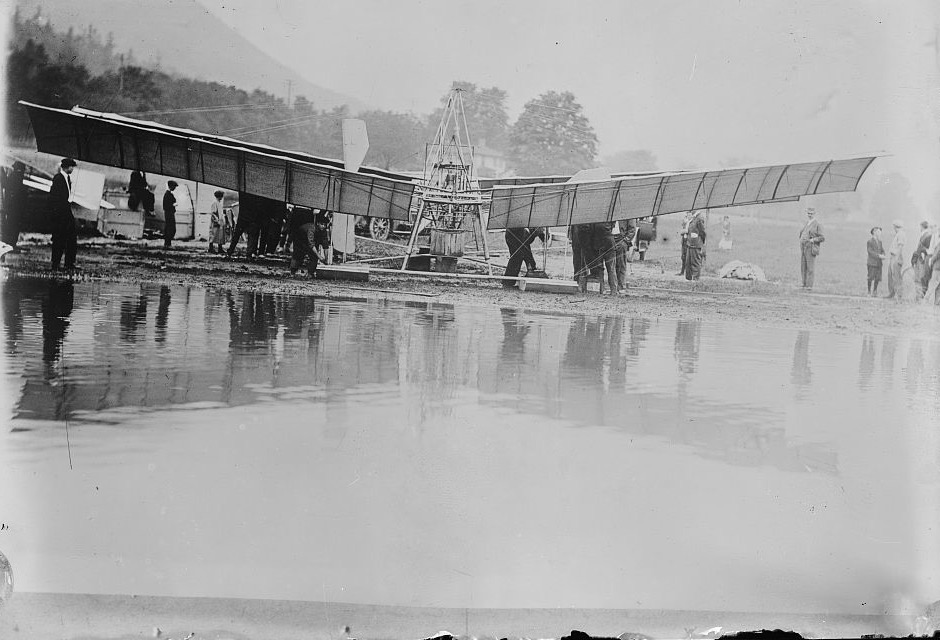
The machine went back to Washington, was restored to something like its 1903 form, and hung in the National Museum from 1918 with a label that by 1921 read: “The first man-carrying aeroplane in the history of the world capable of sustained free flight. Invented, built, and tested over the Potomac River by Samuel Pierpont Langley in 1903. Successfully flown at Hammondsport, N.Y., June 2, 1914.”
Griffith Brewer, an English balloonist and friend of the Wrights, had been at Hammondsport in June 1914. On 20 October 1921 he read a paper to the Royal Aeronautical Society in London, with copies sent in advance to Walcott, Zahm, Manly and Curtiss. His list of what had been changed ran to eighteen items: new wings of a different camber and area; four heavy guy posts under each pair of wings in place of one, with the whole trussing moved thirty inches back towards the real centre of pressure; the broken spars reinforced; the keel removed; a modern carburettor; the rudder used, in Zahm’s own affidavit, “as a vertical aileron,” a system of control “universally used to-day but entirely unknown to Langley”; and then the engine. “No attempt was made at Hammondsport to fly the original Langley machine,” Brewer said. “The Smithsonian Institution was led to believe and falsely proclaim that Langley had succeeded, where in fact Langley knew that he had honourably failed.” He had his own account of 1903: the guy posts braced the wings a quarter of the way back from the leading edge, where the centre of pressure at a flying angle lay nearer two-fifths, and a wing held down on a car at launching speed carried loads it was never designed for. “The breakage of the wings in both tests in 1903 was due to faulty design, and not to a failure of a part of the launching mechanism to perform as it was designed to perform.” Manly’s reply, printed with the paper, did not accept it.
The Smithsonian did not change the label. In 1928 Orville Wright, who had offered the 1903 machine to the Institution in 1910 and been told it preferred a later model, sent it to the Science Museum in London. “I have sent our original 1903 machine to the British National Museum because of the hostile and unfair attitude shown towards us by the officials of the Smithsonian Institution,” he wrote in U.S. Air Services that March. For years, he said, he had kept silent: “I have found silent truth cannot withstand error aided by continued propaganda.” In September 1928 the new Secretary, Charles Abbot, reduced the label to “The original Samuel Pierpont Langley flying machine of 1903, restored.” It was not enough, and the Flyer stayed in London.
It took until 1942. In January of that year Fred Kelly, Orville’s biographer, sent Abbot a table Orville had drawn up in two columns, the machine of 1903 against the machine of 1914, thirty-five items with page references to the Langley Memoir. Abbot printed it entire in the Smithsonian Miscellaneous Collections on 24 October 1942. “It is everywhere acknowledged,” it began, “that the Wright brothers were the first to make sustained flights in a heavier-than-air machine at Kitty Hawk, North Carolina, on December 17, 1903.” The longest time off the water with the Langley engine in 1914, it recorded, “was approximately five seconds.” Then Abbot wrote: “I sincerely regret that the Institution employed to make the tests of 1914 an agent who had been an unsuccessful defendant in patent litigation brought against him by the Wrights.” The 1914 flights, “having been made long after flying had become a common art, and with changes of the machine indicated by Dr. Wright’s comparison, as given above, did not warrant the statements published by the Smithsonian Institution that these tests proved that the large Langley machine of 1903 was capable of sustained flight carrying a man.”
Orville Wright died on 30 January 1948. The Flyer came back from London that year and was hung in the National Museum on 17 December 1948, forty-five years to the day after Kill Devil Hills. The Aerodrome hangs today at the Smithsonian’s annexe beside Dulles airport.
What it taught
Everything about the Aerodrome was tested except the thing it was for. The engine ran ten hours at fifty-two horsepower. Four men jumped on the frame. The ribs went under water for a day and the wings were loaded with sand. The models flew, and the last of them flew in public two months before the first launch. The launching apparatus had worked a dozen times in a row. On the morning of 7 October 1903 the only part of the system that had never been exercised was a man in a machine in the air, and that was the experiment. Manly’s second path, in which “no especial skill on the part of the operator is required,” had removed from the programme the one measurement that would have told them whether the path was real.
The instrument that could have told them was in print. Wilbur Wright had said in Chicago in 1901 that the wings and the engine were solved and that balance and steering were not, and that the way to solve them was to practise “by the hour instead of by the second.” Nobody on the houseboat read the lecture as a result that bore on the Potomac, because a glider on a sand hill did not look like data, and a steam model that flew did. The models measured what a self-balancing machine would do without a man. They could not measure what a man would do with a machine, and in the two attempts the man was given a few seconds of flight in all, both of them ending before his wheel had any effect on anything.
The complication is that the launching apparatus may really have been at fault, both times, and that this does not change the lesson. A pin caught on 7 October; the photographs show it. Something dragged on 8 December; Macomb heard it. Brewer’s answer, that the wings were braced too far forward and could not carry the loads of a catapult launch, is also consistent with the photographs, and the one test that would have decided between them was the test nobody could afford to run again. Langley’s own lesson from the summer, that the machine should be kept in a shed ready to go, was true and beside the point. The Wrights’ rail was a length of wood laid on the sand. Their machine was flown by men who had each spent hours in the air, and when it undulated they knew why.
The date was set by money, not by weather. A programme with fifty thousand dollars of public money, a Board watching and the press in boats has a schedule that a private one does not, and on 8 December the schedule put a machine that could not be launched in a crosswind into a crosswind, in the dark, in ice. Nine days later a programme whose only deadline was Christmas went ahead in a gale too, and the difference was not the weather.
And a failure reported as a verdict is read as one. The Times gave the problem ten million years ten weeks before it was solved. Congress tabled the question with the word “mud duck” on the record. The Board, which believed the machine had never had its trial, closed the work because Congress believed otherwise. Then, from 1914, the Institution that had built the machine rebuilt it with the knowledge of a decade, flew it on floats for five seconds, and read off the result it had wanted in 1903. It took a table in two columns, and the loss of the Flyer to London for twenty years, to make the record say what the photographs had said all along: that on 7 October and 8 December 1903 the Aerodrome did not fly, and that it had not been found out whether it could.
Sources
- Samuel P. Langley and Charles M. Manly, Langley Memoir on Mechanical Flight, Smithsonian Contributions to Knowledge, vol. 27, no. 3 (Smithsonian Institution, 1911). Part I, by Langley, for the 1891 claim, the models, Bell’s letter of 6 May 1896 and the flights of 1896; Part II, by Manly, for the two paths, Langley’s letter to the Board of 12 December 1898, the engine, frame, wings, controls, aviator’s car and houseboat, the plan for a dummy, the quarter-size model, the trials of 7 October and 8 December 1903, Manly’s statement to the Associated Press, Langley’s statements of 19 August and 8 October 1903, Macomb’s report of 6 January 1904, the Board’s reports of 6 October 1904 and 14 November 1908, and plates 21, 38, 95 and 101. archive.org
- S. P. Langley, “Experiments with the Langley Aerodrome,” in Annual Report of the Board of Regents of the Smithsonian Institution for the Year Ending June 30, 1904 (Government Printing Office, 1905), pp. 113–125. Langley’s own account of the engine search, the launching apparatus, the model’s public flight of 8 August 1903, the two trials, and the lesson of the shed. archive.org
- Cyrus Adler, “Samuel Pierpont Langley,” read before the Philosophical Society of Washington, 24 November 1906, reprinted in the Smithsonian Annual Report for 1906, pp. 515–542. Langley’s birth, the Allegheny Observatory, Baird’s letter of 1886 and Langley’s reply, and his death at Aiken. archive.org
- Congressional Record, 58th Congress, 2nd session, vol. 38, 27 January 1904, pp. 1259–1262: House Resolution 160, the Board’s statement of its allotments, and the remarks of Hitchcock, Hemenway and Robinson. archive.org
- “Flying Machines Which Do Not Fly,” editorial, New York Times, 9 October 1903. Wikisource
- Scientific American, “The Failure of Langley’s Aerodrome,” 17 October 1903, p. 272; “Accidents to the Lebaudy and Langley Flying Machines,” 19 December 1903; and “Aerial Navigation” in the review of the year, 2 January 1904. 17 October 1903, 19 December 1903, 2 January 1904
- Wilbur Wright to Octave Chanute, Kill Devil Hills, 16 October 1903, and Dayton, 28 December 1903, in the Wright–Chanute correspondence transcribed by Mississippi State University from the Library of Congress papers. 16 October, 28 December
- Wilbur Wright, “Some Aeronautical Experiments,” presented to the Western Society of Engineers, Chicago, 18 September 1901. The three difficulties, Lilienthal’s five hours, and “practice is the key to the secret of flying.” msstate.edu
- Orville and Wilbur Wright, “The Wright Brothers’ Aëroplane,” The Century Magazine, vol. 76, no. 5, September 1908, pp. 641–650. Their reading of Langley, the two schools, the thousand glides of 1902, the centre of pressure, and the flights of 17 December 1903. archive.org
- Griffith Brewer, “The Langley Machine and the Hammondsport Trials,” read before the Royal Aeronautical Society, 20 October 1921, with the replies of Walcott, Zahm, Manly and Curtiss, The Aeronautical Journal, vol. 25, December 1921, pp. 620–664. The label as it then read, the eighteen changes, and the argument about the guy posts. archive.org
- Albert F. Zahm, “The First Man-Carrying Aeroplane Capable of Sustained Free Flight: Langley’s Success as a Pioneer in Aviation,” and the Secretary’s report, in Annual Report of the Smithsonian Institution for 1914, pp. 9–10 and 217–222. Curtiss’s offer, the flights of 28 May and 2 June 1914, and the claims made for them. archive.org
- Orville Wright, “Why the 1903 Wright Aeroplane Is Sent to a British Museum,” U.S. Air Services, March 1928, as reprinted by the Air & Space Forces Association. airandspaceforces.com
- C. G. Abbot, “The 1914 Tests of the Langley ‘Aerodrome’,” Smithsonian Miscellaneous Collections, vol. 103, no. 8, 24 October 1942. Orville Wright’s comparison in thirty-five items, the labels of 1918 and 1928, and the Institution’s statement of regret. repository.si.edu; transcription in Ann Honious, What Dreams We Have (National Park Service, 2003), appendix C. npshistory.com
- For Manly’s dates and birthplace: the Cornell University Library archives record “Manly, Charles Matthews, 1876-1927,” and the Wikipedia article on him, which cites the Cornell Alumni News of 18 October 1928 and the Brooklyn Daily Eagle of 18 October 1927. archives.library.cornell.edu, en.wikipedia.org
- Photographs: Langley and Manly on the houseboat, 1903, NASA Langley Research Center, image L-1990-04340, GPN-2000-001298; Bell’s instantaneous photograph of 6 May 1896, the houseboat of 1899 and the Washington Star photograph of 8 December 1903, from plates 21, 38 and 101 of the Langley Memoir, scanned by the Internet Archive; the Aerodrome leaving the track on 7 October 1903, a War Department print, via Wikimedia Commons; the machine at Hammondsport in 1914, Bain News Service, Library of Congress, LC-B2-3230-14, no known restrictions.