At sixteen minutes past twelve on Thursday 29 August 1907 a clerk in the Western Union office on lower Broadway, New York, took a telegram from Bernt Berger, assistant to a consulting engineer named Theodore Cooper, and sent it to Phoenixville, Pennsylvania. It said: “Add no more load to bridge till after due consideration of facts. McLure will be over at five o’clock.” It was received at Phoenixville at a quarter past one. The chief engineer of the Phoenix Bridge Company, John Sterling Deans, was in Philadelphia, and found it on his desk at about three. At five the McLure of the telegram arrived from New York, and four men talked about a bridge five hundred miles to the north until they agreed to wait for a letter that would come in the morning. The bridge was the Quebec Bridge, the longest cantilever span ever attempted. By the watch of the timekeeper on the south shore of the St Lawrence it was then 5.31 in the afternoon, and the south half of the bridge was going into the river with eighty-six men on it.
Two days before, at about nine in the morning, an inspector walking along the bottom chord of the anchor arm had seen that its four steel ribs were bent. One of them had been measured a little over a week earlier and found three quarters of an inch out of line. Now it was two and a quarter inches.
Who ran it
The bridge belonged to the Quebec Bridge and Railway Company, chartered by the Dominion Parliament in 1887 and revived in 1897 by a group of Quebec men led by Simon-Napoléon Parent, the mayor of the city and later premier of the province. Its chief engineer was Edward A. Hoare, a railway engineer of long experience with nothing in his record, the Royal Commission would say, “that would indicate that he had the technical knowledge to direct the work in all of its branches.” The Dominion government, which subsidised the bridge in 1900 and guaranteed its bonds in 1903, was represented by Collingwood Schreiber, deputy minister and chief engineer of the Department of Railways and Canals, and by his bridge engineer, Robert C. Douglas, who examined the drawings as they came in.
The consulting engineer was Theodore Cooper of New York, born at Cooper’s Plains, New York, on 12 January 1839, a graduate of the Rensselaer Polytechnic Institute in 1858, a Navy engineer through the Civil War, resident engineer under James Eads on the St Louis bridge, and a consulting engineer since 1879. His General Specifications for Iron Railroad Bridges and Viaducts of 1884 were, his obituary said, “the first authoritative specifications on bridge construction that had been published”, and his system of train loadings became the standard of the continent. He reported on the competing designs for the Quebec Bridge in June 1899 and was appointed consulting engineer to the company in May 1900. In 1907 he was sixty-eight, unmarried, and forbidden by his doctor to travel.
The contractors were the Phoenix Bridge Company of Phoenixville, Pennsylvania, and the Phoenix Iron Company beside it, which rolled and fabricated the steel. David Reeves was president of both; Deans, “its chief business manager” in the Commission’s phrase, was chief engineer; Peter L. Szlapka, trained in Germany and twenty-one years in the post, was designing engineer, and drew the bridge; A. B. Milliken was superintendent of erection. At the site, Benjamin A. Yenser, “an able superintendent” with no technical training, was the foreman in sole charge of the men, and A. H. Birks, a young engineer, was resident engineer of erection. The Quebec Bridge Company’s own men on the ground were Norman R. McLure, a Princeton graduate of 1904 appointed by Cooper, who inspected the erection and wrote to Cooper every week, and E. R. Kinloch, a bridgeman of long practical experience and no technical training, appointed by Hoare, who inspected the workmanship. E. L. Edwards inspected the steel at the mills and in the shops.
The men who found out what had happened were Henry Holgate, a civil engineer of Montreal; John G. G. Kerry, a civil engineer of Campbellford, Ontario; and John Galbraith, dean of the Faculty of Applied Science at the University of Toronto. They were named Royal Commissioners on 30 August 1907, the day after the fall, and signed their report at Montreal on 20 February 1908. C. C. Schneider of Philadelphia recomputed the stresses for the Department of Railways and Canals.
What they were trying to find out
The Quebec Bridge was two experiments on one pair of piers, and a third was hidden inside the arithmetic of both.
The first was an experiment in size. The Forth Bridge, finished in 1890, had cantilever spans of 1,710 feet. The Quebec span would be 1,800. Its lower chords, the great compression members that carried the weight of the arms down to the piers, were built up of four steel ribs latticed together, and no column of that size had ever been tested, because, as Cooper told the Commission, “There is no machine or method existing by which any such tests could be made.” The hypothesis was that a chord of this kind, designed by the formulae that served for ordinary bridges and loaded to stresses that Cooper admitted were “unprecedented in bridge building” except on the Forth, would behave as the formulae said. “This was an exceptional bridge of exceptional length,” he said, “and high strains were justified because the greater weight was that due to the weight of the structure itself.”
The second was an experiment in organisation. One consulting engineer in New York, in failing health, paying his own assistants out of a reduced fee, would examine and approve every drawing a contractor’s designer made, and his signature would stand for the owner, the government and the public. The Commission’s summary of the arrangement was a single sentence: “In effect, after August 15, 1903, instructions given by Mr. Theodore Cooper from time to time were the specifications.”
The third was an assumption. Clause 3 of the specification said: “The dead weight used for calculating stresses must not be less than the actual weight of structure when completed.” The weight assumed in 1904, before the drawings existed, was taken to be the weight of the bridge, and the chords were cut to it.
The instrument that reported on all three was the simplest on the site: a cord stretched taut from one batten plate of a chord to the next, and a rule held from the cord to each rib.
What they built
The company asked for designs in 1898 on a specification that Hoare had copied, mostly, from the Department’s general specification of 1896; Cooper later called it “a ‘scissored’ one”. Tenders came in for a span of 1,600 feet, and in June 1899 Cooper reported that the Phoenix Bridge Company’s cantilever was “a far better design” than the Keystone Company’s and the cheaper. The contract for the steel was signed on 12 April 1900.
Then Cooper lengthened it. The profile of the river showed a gentle slope from the south shore and then a steep one, and the piers for a 1,600-foot span would stand “on or near the crest of the steeper slope”, in deep water, to be sunk by compressed air in the short Canadian season among the ice. On 1 May 1900 he recommended 1,800 feet, so that the piers could stand nearer the shores, and found “that the saving in cost of the piers… was not much exceeded by the increased cost of the superstructure for the additional length.” The company adopted the change on 6 May. The subsidy agreement of 12 November 1900 simply had the figure 1,800 written in where 1,600 had been. “There is no evidence,” the Commission found, “to show that these specifications were reconsidered at this time by the technical advisers of the government.” Cooper told the Commission that he assumed “the full responsibility” for the change. The piers were sunk between 1900 and 1902.
The money for the steel came in 1903, when the National Transcontinental Railway made a bridge at Quebec a national necessity and Parliament guaranteed the company’s bonds. Cooper now rewrote the loads. He cut the wind load, raised the train load, and raised the permitted stresses in the steel, to 24,000 pounds to the square inch under certain combinations, “with the view of keeping the final weight within the limitations.” In Ottawa, Douglas read the amendments and “criticized the high unit stresses that were proposed.” Schreiber proposed to appoint “a competent bridge engineer to examine from time to time the detailed drawings of each part of the bridge as prepared, and to approve of or correct them”, and an order in council of 21 July 1903 authorised him to do it.
Cooper’s reply, on 31 July, is the hinge of the whole affair. “This puts me in the position of a subordinate, which I cannot accept.” Deans wrote to Hoare the same day: “I cannot impress upon you too strongly the necessity of taking immediate action to stop any such plan as suggested by Mr. Schreiber.” Cooper went to Ottawa, and on 15 August 1903 a second order in council accepted his loadings, provided “the efficiency of the structure be fully maintained”, with all plans still to be approved by the chief engineer. In practice, Douglas told the Commission, “The plans were examined first for Mr. Cooper’s signature, that is the principal part of it.” As for the stresses, “There is no checking, there were no computers in the office”.
In Phoenixville, Szlapka was working to a timetable. On 8 April 1904 he advised Hoare that the weight of the bridge “would not be more than five per cent above the estimate, or, say, 62,720,000 pounds.” On 12 May he sent Cooper a diagram of the dead load at every panel point, and Cooper, who had no drawings yet to check it against, “asked Mr. Szlapka when this was presented to me whether it was carefully and properly estimated. He states that he had his best men to carefully estimate the weight at each point”. On 30 June 1904 Cooper approved the stress sheet for the anchor arm, and the drawings of its lower chords went to the shop.
The chords were the heart of the design. Each was about fifty-seven feet long, and consisted of four vertical ribs, fifty-four inches deep, each rib built of four plates and two angles, the four held apart at their ends by cover plates and between the cover plates by a lattice of 4-inch by 3-inch angles riveted across them. The ends were planed square, so that chord bore on chord by contact, and the joints were bolted during erection and riveted when they had closed. Cooper, who would not go to Phoenixville to see the first chord, asked Szlapka what he thought of it; Szlapka “spoke of it in high terms, made no criticism in regard to any part of it, but he said, partly laughing: ‘Mr. David Reeves thinks the lattice bars should be heavier.’”
By early 1905 the anchor arm drawings were complete, and “it was possible to compute the weight of the anchor arm within say two per cent of the actual weight. There is no evidence to show that this was done by the Phoenix Bridge Company or by Mr. Cooper.” The error surfaced on 1 February 1906, in Edwards’s report of the steel delivered for the two anchor arms, when the anchor arm and the main posts were already fabricated and six panels of the arm were standing on their falsework at Quebec. Cooper summed the shipping weights, found the arm heavier than the estimate, and reckoned that the stresses would be about 7 per cent above what he had allowed. “Realizing that there was no remedy and that this 7 per cent was not a fatal increase, I did say to Mr. Szlapka, in effect, that we would have to submit to it.” When the figures were finally revised, on 25 June 1907, the anchor arm that had been designed to carry 13,317,600 pounds of itself weighed 17,318,000, and the whole bridge 73,312,504 pounds against the 62,720,000 promised in 1904.
Cooper did all this for $4,000 a year, half the fee he had first asked, out of which he paid his own assistants. Some time before erection began he told Parent, “I never expect to be able to go to Quebec again; I am under the ban of my physician, and I feel that I ought to be relieved of the responsibility which is upon me”. Parent said, “Mr. Cooper, we never intend to let you go until the bridge is done”. He visited the site while the piers were being built, the shops three times, and the bridge, during its erection, never. “As the event proved,” the Commission wrote, “his connection with the work produced in general a false feeling of security.”
Erection began at the south anchor pier on 22 July 1905, on steel falsework, with a travelling gantry crane that weighed 1,000 tons fully rigged. In April 1905 chord A9L, the ninth lower chord of the anchor arm on the west, or Montreal, side, had fallen while being lifted in the storage yard when a hook broke, one end dropping five feet and the other three; two angles were broken, and it was repaired in July “to the satisfaction of the Quebec Bridge Company.” The anchor arm was all in place by 27 June 1906, the 562-foot cantilever arm by the end of November, and on 13 July 1907 the suspended span, 675 feet of which the south half would be built out from the arm with a smaller traveller, was begun. That summer Kinloch and McLure, the two inspectors, put their names to a souvenir booklet of photographs called The Quebec Bridge: The Longest Single Span Bridge in the World. By August 1907, 34,400,000 pounds of steel had been erected, and the stresses in the chords nearest the main pier were between 17,000 and 19,000 pounds to the square inch.
It was the riveting of the chord joints, left until the joints closed under load, that first brought the chords under close examination. On 6 August McLure reported to Cooper that the inside ribs at a splice in the west truss of the cantilever arm were out of line. Cooper wired Phoenixville: “How did bend occur in both chords?” Deans replied that “the bend was no doubt put in the rib in the shop”; McLure, who had “personally inspected every member yet erected in this bridge thus far”, that “the bend has occurred since the chord has been under stress”. Cooper, on 15 August: “None of the explanations for the bent chord stand the test of logic.” On 26 August: “This only makes the mystery the deeper.” The letters of that month are given in full in the companion piece “The letters”.
Two and a quarter inches
On Tuesday 27 August, at about nine in the morning, Kinloch came round the post at the main pier and looked along chord A9L. “It was a big bend and I was satisfied right off that there was something going on.” Yenser and Birks were below him at the shoe, and he called them up. Yenser “said when he came there: That has never been there before; I have been over this chord too many times.” He would “not put up any more iron till he found out about it.” Birks “kind of laughed at him and said that he had better wait until he found out, that when he was condemning that chord he was condemning the whole bridge, and he said it might have been in there before.” They fetched McLure and measured it: a line stretched taut from batten plate to batten plate, and the distance from the line to each rib, top and bottom. All four ribs were bent the same way, towards the centre of the truss. The chord that McLure had measured a little over a week before and found three quarters of an inch out of line was now two and a quarter inches out.
McLure spent the rest of the day drawing it and writing to Cooper and to Phoenixville. “Although a number of the chords originally had ribs more or less wavy, as I have reported to you from time to time, it is only very recently that these have been in this condition, and their present shape is undoubtedly due to the stress they are now receiving. Only a little over a week ago, I measured one rib of the 9-L chord of anchor arm here shown, and it was only ¾-inch out of line. Now it is 2¼ inches.” “The erection will not proceed until we hear from you and from Phoenixville.” The letter went by the evening mail; “Owing apparently to anxiety already existing among the workmen”, the Commission found, “it was not considered wise to use either telegraph or telephone.” Kinloch and Yenser proposed that McLure and Birks should go to New York and Phoenixville in person; McLure and Birks “did not welcome our suggestion, saying that they would only be laughed at on arrival”. Late that night McLure brought the sketches to Hoare’s house in Quebec. Hoare, “conscious that he was not qualified to give judgment”, approved the journey.
On Wednesday morning at a quarter past seven Kinloch found the men loosening the small traveller to run it forward. He met McLure on the approach span and asked what had happened. “He said: I do not know, only Ben said that he had a dream last night. I said: That is kind of funny. He said: Ben says he has got too many men out.” Yenser had changed his mind in the night, and the traveller moved. McLure told him it was “poor policy”, and nothing more; he and Birks had reckoned that the move would add fifty or seventy pounds to the square inch to the chord, half of one per cent of what it was carrying. Hoare arrived at about eleven. “I requested him to continue,” he wrote to Cooper that night, “as the moral effect of holding up the work would be very bad on all concerned and might also stop the work for this season on account of losing the men.” McLure left for the train at half past twelve. No further measurement of the chord was made by anyone, then or afterwards.
Instead, Birks went down to it and came back with an explanation. “I think I have discovered where we have made big fools out of ourselves,” he told Kinloch. The bend ran into the field splice at the shore end, which had been riveted up in June; so the bend, or part of it, must have been there in June; so the ribs had been bent before the chord went into the bridge, perhaps in its fall in the yard two years before. Birks wrote to Phoenixville that evening: “From the evidence so far, I do not think we are justified in assuming it to be a fact that the ribs of any of the chords have buckled since erection, and Mr. Yenser has come to the same conclusion.” The Commission found that his sketch “shows only his personal idea of the shape and extent of the existing distortion and cannot be considered as furnishing data on which to base engineering conclusions, as no actual measurements were taken.”
On Thursday morning McLure was in Cooper’s office at half past seven, and Cooper was not. At 9.45 a telegram from Birks reached him there: “I do not think we can state positively that chord has buckled since erection; the only definite evidence we have shows the contrary.” At Phoenixville, Deans, Szlapka and Milliken discussed the sketches. “It was finally decided that it was safe for the work to proceed,” and at about half past ten Milliken telephoned Yenser and Deans telephoned Birks: the office approved their continuing, and Birks was to tell Hoare that the bends had been in the chords before they left Phoenixville. Birks met Kinloch on the anchor arm: “Well, it is all right; I have got word from Phoenixville that they have a record that these chords were bent before.” Kinloch “laughed at him and told him that it was not, and he just went on.” Deans also wired Hoare: “McLure has not reported here; the chords are in exact condition they left Phoenixville in and now have much less than maximum load.” Hoare took it to mean A9L. “I felt quite comfortable that day about it. I knew it could not be long before the matter would be taken up.” He spent the day in his office in Quebec preparing papers for the annual meeting of the directors. “From the time that these assurances were received, anxiety at the bridge practically ceased.”
Cooper reached his office at about twenty-five past eleven, read the letter, and called McLure in. He “cross-examined him to find out whether the facts given were actual or whether he had been scared, and satisfying myself that the data there was from actual measurement and actual observation, I said: ‘It is very serious.’” McLure told him the traveller had been moved, “but they are going on this morning to erect more of the work; do you think that is right? I said: By no means right. I said: Is Mr. Milliken on the work?—intending to immediately telegraph orders to Mr. Milliken to stop it. No, he said, Mr. Milliken is not present on the work; there is only a foreman present. Well, I said, I do not know whether a foreman would take a suggestion from me or not; I will have to telegraph immediately to the Phoenix Bridge Company for them to wire to the bridge.” Berger took the telegram to the Western Union office. McLure had promised Kinloch that he would wire him Cooper’s decision at once. He did not. The papers of these three days are in the companion piece “The last three days”.
At the bridge that morning the men laid temporary track stringers to the end of the work; after dinner two sections of the bottom chord of the suspended span’s fourth panel were run out on the track and swung into place. “Just about 15 or 20 minutes before the accident they had this chord straight and in position to put in the bolts. They had a few bolts in on each side.” Kinloch had made his last close inspection of A9L at about four. “I did not notice anything any different.” The wind in the late afternoon was about twenty-five miles an hour. The Commission’s judgment on the day is one sentence long. “It was clear that on that day the greatest bridge in the world was being built without there being a single man within reach who by experience, knowledge and ability was competent to deal with the crisis.”
What it looked like from inside
Joseph Huot, the Phoenix company’s timekeeper, was walking out along the anchor arm and had passed the second panel when the compressed-air pipe that fed the riveting hammers broke beside him on the sidewalk. “I just heard the crack as well as the crack of the bridge collapsing.” He ran. “I saw the portal bending towards the river.” The planks were going under his feet before he reached the approach span, because the anchor arm was already drawing away from it. The Commission timed the fall by his run: “not above 15 seconds.”
D. B. Haley, a signalman, was out on the end of the jib of the top-chord traveller, over the fourth panel of the suspended span, doing a small job in a slack half hour while the gang waited for iron. “I was on the extreme end of it and the first thing I knew I caught myself going through the air. I realized that the iron fell very much faster than I did and left me falling through the air. The next thing I remember I was deep in water.” He came up among planks, held on, and was picked up by a boat twenty minutes later. He had heard nothing: “I was in the water before the noise came.” Kinloch, standing near the office on the shore, saw the end posts of the anchor arm sink straight down in front of him, “as if they were ice pillars whose ends were rapidly melting away.” Several men working on the ground beneath the anchor arm were killed where fifty feet would have saved them.
The cantilever arm and the half-built suspended span fell as one piece, the thousand-ton traveller still at its tip, and the dust and spray hid the rest. Of eighty-six men on the work, eleven survived. The New-York Tribune’s correspondent at Quebec that night put the fall at 5.37 and the dead at eighty-four, and reported that “Most of the labor was furnished by French Canadians from the neighborhood and about forty Indians from Caughnawaga”, the Mohawk ironworkers of Kahnawake, near Montreal. A bridgeman named Splicer had not gone to work that day; he had “felt nervous”, he told the Commission, since about a week before. The night before, seven or eight of the Kahnawake men, who boarded together, had talked in his hearing and his mother’s about a chord “where it was bent, and they were trying to jack it together, and they could not jack the plates together and riveted it up the way it was”. He had made out a list for the Commission, “just the boys that were killed, all the Indian boys”: Solomon Angus, Joe Mitchell, Mitchell Adams, John Jocko, Joseph Dion, Lewis Bibeau and the rest. “Are any of these men living?” “No, sir, none of them.” Yenser and Birks died with them.
At Phoenixville, McLure left the office at about half past five. “Fifteen minutes after he left we had a call from Quebec which we could not understand well,” Deans said, and it took until ten minutes past seven to get the words through. Cooper was called on the long-distance line at nine that evening, “and Mr. McLure reported that the bridge was in the river.” McLure stopped in New York on his way back and saw him for a few minutes. “He said: ‘Well, it’s that chord.’ I only saw him a few minutes; he was not feeling very good.”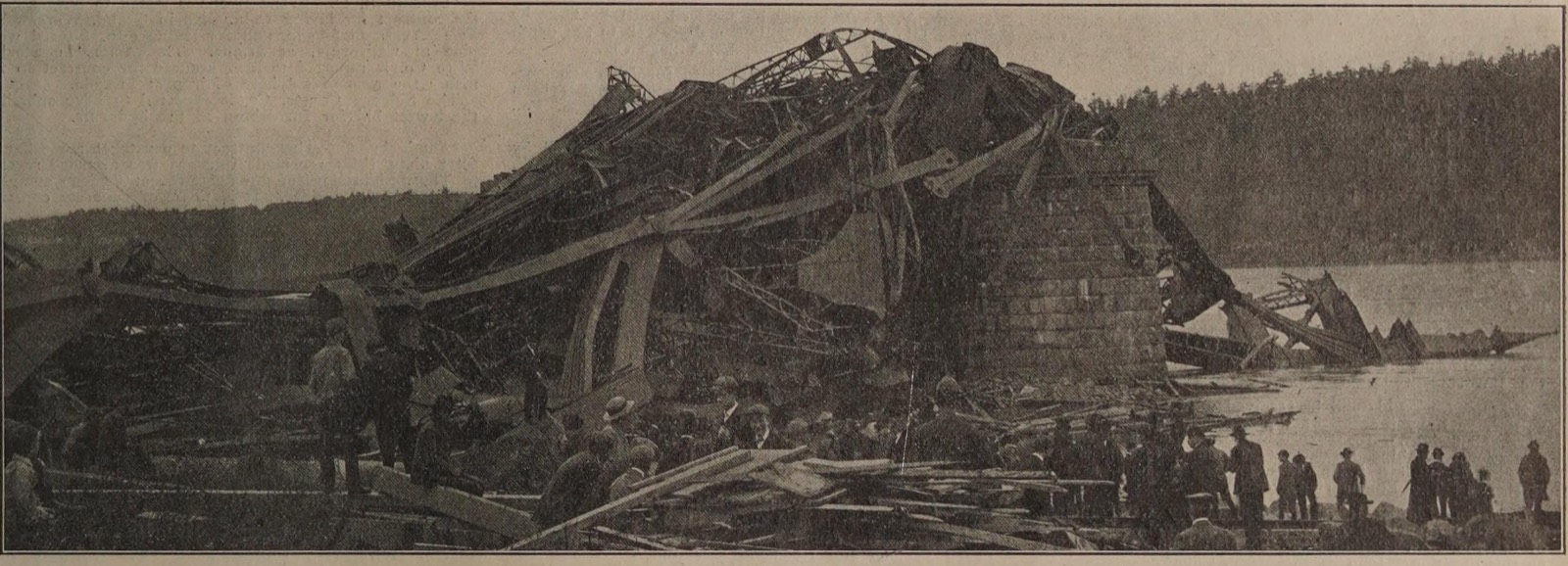
What happened
The commissioners were at Quebec the day after the fall, took evidence there and in Ottawa through September, examined Cooper in New York in October, and spent a month at Phoenixville going through the files and the plans. They had a one-third-scale model of chord A9L, nineteen feet long, built at Phoenixville and loaded in the Phoenix Iron Company’s machine on 21 and 22 November 1907: it carried its load quietly to 25,000 pounds to the square inch and then, at 26,860, “suddenly failed”, by the shearing of the rivets that held its lattice angles. In January 1908 a second model with lattices about twice as strong carried 37,000. “The test of chord No. 1 showed that the lattice system was too light.”
Their report, dated 20 February 1908, made fifteen findings. “The collapse of the Quebec bridge resulted from the failure of the lower chords in the anchor arm near the main pier. The failure of these chords was due to their defective design.” The stresses that caused it “were such as might be expected in the regular course of erection.” The design was Szlapka’s, “examined and officially approved by Mr. Theodore Cooper”, and “The failure cannot be attributed directly to any cause other than errors in judgment on the part of these two engineers”: “The ability of the two engineers was tried in one of the most difficult professional problems of the day and proved to be insufficient for the task.” The unit stresses were “higher than any established by past practice”, and “The specifications were accepted without protest by all interested.” Then the arithmetic: “A grave error was made in assuming the dead load for the calculations at too low a value and not afterwards revising this assumption. This error was of sufficient magnitude to have required the condemnation of the bridge, even if the details of the lower chords had been of sufficient strength”. Schneider, working from the shipping weights, found the stresses in the chords of the anchor arm 11 to 20 per cent above the specification in every panel. The full findings are in the companion piece “The findings”.
On the chord itself the Commission was exact and tentative at once. A9L had failed “under three-quarters of its maximum working load.” The explanation, worked through in an appendix of algebra, was that a chord of four tall thin ribs held together only by light lattice bars could not carry an eccentric load: once the line of thrust was a fraction of an inch off the axis of the chord, the lattice took a shear it was never sized for, the rivets slipped, the ribs were free to bow, and the bow increased the eccentricity. Whatever started it, the two models showed that the lattice could not stop it. “It is not difficult to see that failure was certain and close at hand on August 27th.” And the finding that follows from it: “We do not believe that the fall of the bridge could have been prevented by any action that might have been taken after August 27, 1907.” The next finding is the one the dead were owed. “The loss of life on August 29, 1907, might have been prevented by the exercise of better judgment on the part of those in responsible charge of the work for the Quebec Bridge and Railway Company and for the Phoenix Bridge Company.”
The report named the judgments. Deans “was lacking in judgment and in sense of responsibility when he approved of the action of Mr. Yenser in continuing erection”; Hoare “was fully advised of the facts yet did not order Mr. Yenser to discontinue erection which he had power to do”, and “his failure to take action must be attributed to indecision and to a habit of relying upon Mr. Cooper for instructions.” Cooper himself was excused for the day: “He understood that erection was not proceeding; and without additional load the bridge might have held out for days.” Birks’s confidence in his superiors was “in no way unusual or unreasonable”. And of the man at the centre: “The professional record of Mr. Cooper was such that his selection for the authoritative position that he occupied was warranted, and the complete confidence that was placed in his judgment by the officials of the Dominion government, the Quebec Bridge and Railway Company and the Phoenix Bridge Company was deserved.”
Cooper did not accept the finding that nothing could have been done. The bend “would indicate to any intelligent mind that that chord was less capable of doing the duty that it would have done if in a perfectly straight condition, and I do think that it was perfectly possible by prompt and intelligent action to have stayed that chord and prevented the failure of the bridge.” It could have been done, he said, “by the employment of three hours’ work and $100 worth of timber and bolts”. The commissioners replied that their tests “have satisfied us that no temporary bracing such as that proposed by Mr. Cooper could have long arrested the disaster”. Asked whether he would advise on the rebuilding, Cooper answered: “My responsibilities, gentlemen, end as soon as I have served my duty of aiding you in reaching the truth in regard to the destruction of this bridge… it must be referred to younger and abler men.”
The profession had reached its own verdict before the Commission sat. The Engineering Record of 7 September 1907 reported that Cooper’s telegram “meant nothing more than a warning… Neither he nor his inspector dreamed for a moment that there was any danger of immediate collapse.” A week later it drew the one lesson it thought beyond debate: “the importance of stopping work and ordering men off a structure as soon as any sign of buckling is seen in a compression member.”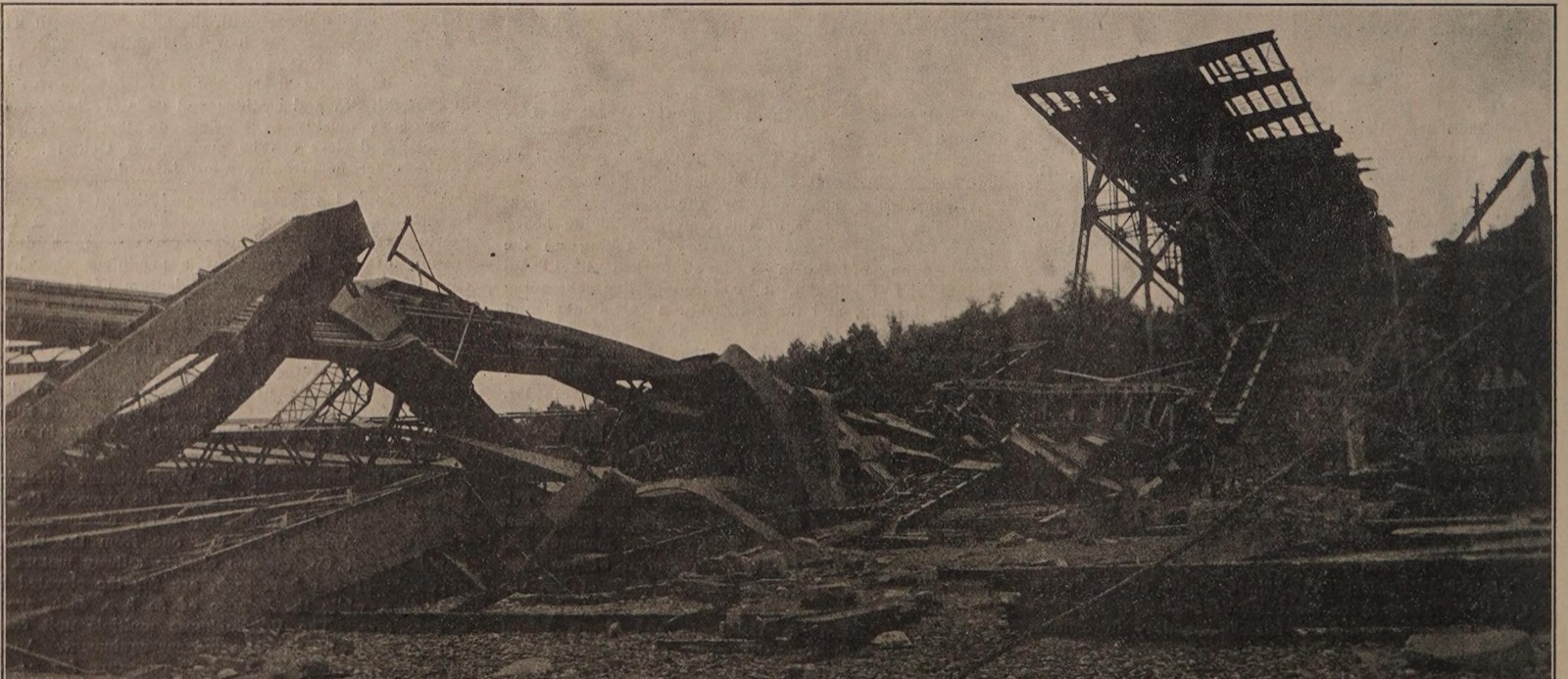
After
The Dominion government took the bridge over and in 1908 appointed a Board of Engineers to design it again: H. E. Vautelet of the Canadian Pacific, Maurice Fitzmaurice of London, who had worked on the Forth, and Ralph Modjeski from the United States. They quarrelled over the design, and in April 1911 the contract went to the St Lawrence Bridge Company, formed by the Dominion and Canadian bridge companies under Phelps Johnson, with G. H. Duggan as chief engineer, on its own design. The new bridge stood on the old piers, with the same 1,800-foot span. Its trusses were 88 feet apart instead of 67, its steel weighed 66,000 tons instead of 38,500, and its suspended span, 640 feet long and 5,000 tons, was built whole on the shore to be floated out and lifted into place. On 11 September 1916, at 10.50 in the morning, a steel casting under one corner of the span broke as it was being hoisted, and the whole span went into the river. A second was built, and on 20 September 1917 it was lifted the 150 feet into place. By 1919 trains were crossing. The government railways’ booklet of 1919 called the bridge “our greatest monument to the vision, the sagacity and constructive skill of Canada.” Of the first bridge it said only that “A New York engineer undertook the designing”. He had retired from practice in 1907. He died at his home on West 57th Street on 24 August 1919, in his eighty-first year.
What it taught
The Quebec Bridge of 1907 is remembered as a failure of a design, and the Commission said so in its first finding. But the record it printed is about something else: how a correct measurement, made by the right man at the right place, travelled through an organisation for sixty hours and arrived nowhere that could act on it.
The instrument was right, and that was not enough. Kinloch saw the bend; McLure measured it; the number, two and a quarter inches, was exact, and the Commission’s algebra afterwards found that on that morning failure “was certain and close at hand.” The reading went by post because the telephone might alarm the men. It went to New York and to Phoenixville, and from each of those places the answer came back to the other. The one man who could have stopped the work by a word, Hoare, was in his office with the papers for the annual meeting, comforted by a telegram. A measurement is a message, and a message has a route; the route at Quebec ran five hundred miles each way and did not pass through anyone with authority to stop a foreman.
Wanting it to be old is not evidence that it is. Birks found that the bend ran into a splice riveted in June, and reasoned backwards to a chord bent in the shop. No one measured the chord a second time between Tuesday morning and Thursday afternoon, and the one piece of evidence offered for the comforting theory, Birks’s sketch, had no measurements in it at all. The men who measured were alarmed; the men who reasoned were reassured; and the reasoning was done by the men whose designs were in question. Like the engineers at One in Seventy-Two, who deferred to the standing of the man who had drawn the deck, everyone at Quebec deferred to the care with which the calculations had been made, and the Commission said in so many words that this was reasonable. It was. That is the problem.
An error in the first sum survives every later check. The dead load of 1904 was an estimate made before the drawings existed. Every stress sheet, every chord section and every approval that followed was computed from it, and all of them were computed correctly. The weight could have been recounted from the drawings in 1905; it was recounted from the shipping invoices in 1906, when there was “no remedy”, and from the finished drawings in June 1907, two months before the fall. A design office that checks its own arithmetic to the pound and never re-asks its first question has checked nothing.
A review by reputation is not a review. Schreiber proposed, in writing, a second engineer to examine every drawing. Cooper refused to be “a subordinate”, Deans called the proposal disastrous, and the government withdrew it. Thereafter Douglas looked at each drawing “first for Mr. Cooper’s signature”, and there were “no computers in the office”. The Commission’s comparison with the great cantilevers of the day ends with one line: “All the bridges included in the table were designed by independent engineers except the Quebec bridge.”
The experiment was on the man. Cooper, at sixty-eight, under his doctor’s ban, with no staff and half a fee, had told his employers he should be relieved and had been told that they would not let him go. The Commission found that he “had no time to investigate the soundness of the data and theories which were being used in the designing, and consequently allowed fundamental errors to pass by him unchallenged”. A structure whose safety rests on one man’s judgment has made that man’s health, his fee and his pride into structural members, and nobody inspects those.
The complication is that the Commission, with every file and five months to think, could not say the bridge was savable, and Cooper, who had designed its loads, could not accept that it was not. Both may be right about different things: the chord as designed was going to fail, and the day it failed was chosen by a traveller that moved on Wednesday morning because a foreman had too many men out. What the record supports is narrower than either. Two inspectors with a cord and a rule found the truth on a Tuesday morning and wrote it down. For sixty hours every engineer who read it looked for a reason it could not be so, while the bridge went on being built, and at 5.31 on the Thursday the last of them, five hundred miles away, agreed to wait for the morning’s post.
Sources
- Royal Commission on the Collapse of the Quebec Bridge (Henry Holgate, J. G. G. Kerry and John Galbraith), Report of the Royal Commission, Quebec Bridge Inquiry, Sessional Paper No. 154, Ottawa, 1908, Vol. I: the report and its fifteen findings; Appendix 6 on the specifications, the orders in council of July and August 1903, Cooper’s letter of 31 July 1903 and Deans’s of the same day; Appendix 7 on the staffs, with the characterisations of Hoare, Cooper, McLure, Kinloch, Deans, Szlapka, Yenser and Birks; Appendix 8 on the designing office and the dead load, with the assumed and the recomputed concentrations and the table of weights; Appendix 11 on the difficulties of erection, with the letters of 6 to 29 August 1907, Hoare’s letters of 28 August and 2 September, Birks’s letter of 28 August, Deans’s telegram and Cooper’s; Appendix 12 on the fallen structure; Appendix 16 on the failure of chord A9L and the two model tests; Appendix 17 comparing the chords with those of other cantilevers; Appendix 19 on the weather; and C. C. Schneider’s Report on Design of Quebec Bridge, January 1908. archive.org
- Royal Commission on the Collapse of the Quebec Bridge, Minutes of Proceedings and Printed Exhibits, Sessional Paper No. 154, Vol. II, Ottawa, 1908. The evidence of Huot, Haley, Splicer, Wilson, Beauvais, Kinloch, McLure, Hoare, Deans, Douglas and Szlapka, and Cooper’s written answers of October 1907, including his account of 29 August, his fee, his health, the 1,800-foot span, the unit stresses, the discovery of the weight in February 1906, and the hundred dollars of timber. archive.org
- E. R. Kinloch and N. R. McLure, The Quebec Bridge: The Longest Single Span Bridge in the World, Crossing the St. Lawrence River Seven Miles Above Quebec, Canada, Quebec Bridge and Railway Company, 1907. The dimensions and the erection as the inspectors described them that summer. archive.org
- The Engineering Record, New York, 7 September 1907, “Notes and Comments”: the first editorial on the collapse and Cooper’s statement about his telegram. archive.org
- The Engineering Record, 14 September 1907, “The Cause of the Quebec Bridge Failure”, with the letter from “Bridge Engineer” on secondary stresses and the six photographs of the wreck on pages 52 and 53, two of which are reproduced here. archive.org
- New-York Tribune, 30 August 1907, pages 1 and 2: “Bridge Collapses. Eighty-four Dead.” The hour of 5.37, the first estimate of the dead, the French Canadians and the “forty Indians from Caughnawaga”, and Barthe’s escape. Chronicling America, Library of Congress. loc.gov
- “Theodore Cooper Dies in Eighty-First Year,” Engineering News-Record, 28 August 1919, p. 437. His birth, education, Navy service, the St Louis bridge, the specifications of 1884, his retirement in 1907 and his death. archive.org
- G. H. Duggan, The Quebec Bridge: Notes on the Work of the St. Lawrence Bridge Company, Canadian Society of Civil Engineers, 1918. The Board of Engineers of 1908, its members and its disputes, and the contract of April 1911. archive.org
- Canadian Government Railways, The Quebec Bridge: An Engineering Triumph in the World’s History, Moncton, 1919. The dimensions of the second bridge, the fall of the span on 11 September 1916, the lift of 20 September 1917 and the traffic of 1919. archive.org
- “Quebec Bridge Suspended Span Collapses,” Engineering News, 14 September 1916, and “What Happened at Quebec,” 21 September 1916. The hour of the 1916 fall and the broken casting. 14 Sept, 21 Sept