On 24 December 1972, in the basement of the Institute of Physics in the Akademgorodok of Krasnoyarsk, on the Yenisei in central Siberia, three people walked through a steel door with a rubber gasket round its edge and had it sealed behind them. They were two men and a woman, an agronomist, an engineer and a doctor, and the engineer, Nikolai Bugreev, would later be the one who had spent longest inside: thirteen months in all, over three winters, by his own institute’s count. The room they had entered was one of four, each about seven metres by four and a half and two and a half high, welded from stainless steel plate, 315 cubic metres in all. Two of the others were full of wheat under xenon lamps that were never switched off. The third held tanks of the green alga Chlorella. They were to stay 180 days, and they came out on 22 June 1973.
From the first day somebody weighed everything that crossed the door. The dried meat passed in through the small airlock once a month was weighed. The samples of air, water and blood passed out for analysis were weighed. The water that condensed off the wheat was metered, and so was the water that went back to the wheat; the faeces were dried, and the dry mass was weighed and stored; the straw was burned and the ash weighed. At the end the record would be reduced to one figure, and the institute would publish that figure in several forms over the next thirty-five years: 50 percent, 70, 80, 91, 93, 95. All of them are true. Which one you read depends on what was being counted, and the story of this experiment is the story of the counting.
Who ran it
The work began with a physicist. Leonid Kirensky, born in Yakutia in 1909, had come to Krasnoyarsk in 1940 to run the physics department of a teachers’ college, and in 1957 he organised an Institute of Physics there for the Siberian Branch of the Academy of Sciences, which now carries his name. One of its departments was biophysics, and the department had two heads: Ivan Terskov, a physicist born in a village of the Yenisei province in 1918 who had turned to the physics of blood, and Josef Gitelson, born in Samara in 1928, a biologist and physician who had worked as a haematologist before joining Terskov’s laboratory in 1957. The two had begun biophysics in Krasnoyarsk together in 1949. From 1961 Gitelson ran the laboratory of photobiology.
In that year, by the institute’s own account, the closed-ecosystem work began, and it began with a sponsor from outside science. Gitelson and his colleagues wrote in 1989 that it “was guided from the very beginning by academician L.V. Kirensky with the project originally sponsored by academician S.P. Korolyov.” Sergei Korolev was the chief designer of the Soviet rocket programme, the man who had put Sputnik and Gagarin into orbit, and the idea he was paying for went back to Tsiolkovsky at the start of the century: that people who lived long enough away from the Earth would have to regenerate their air, water and food by the same means the Earth does, with plants. Korolev died in 1966, Kirensky in 1969. The department went on. In 1981 it became an Institute of Biophysics in its own right, with Terskov as director until 1984 and Gitelson from 1984 to 1996, and by then, Gitelson later told an American colleague, nearly a hundred researchers and staff had worked on the project at one time or another.
Three others matter to what follows. Boris Kovrov, a physicist who became a biologist, was the chief designer of all three of the sealed systems the institute built, and the Siberian Branch’s own tribute to Gitelson calls his contribution to the third “enormous”. Genry Lisovsky, an agronomist, was the one who proposed, when the algae turned out to be inedible, that the crews should grow what people actually eat, and who then bred a dwarf wheat to do it; he was still the institute’s chief scientist when the first full account appeared in English in 1997. And Yuri Okladnikov, a physician, was responsible for the crews’ health from the mid-1960s, with a laboratory set up in Krasnoyarsk by the Institute of Biomedical Problems in Moscow for the purpose.
Moscow had been first. In 1960 and 1961 Yevgeny Shepelev and Gana Meleshko at the Institute of Aerospace Medicine had put people into sealed chambers whose air was regenerated by Chlorella. Krasnoyarsk took the problem from there. What it did before 1972, in two smaller systems called Bios-1 and Bios-2, is in Chlorella.
What they were trying to find out
The hypothesis is stated in the opening of the 1989 paper, which is the institute’s own account of the last run and the one this entry leans on most. “The analysis of the problem shows that the optimal solution for long-operating inhabited space objects is the creation of essentially closed ecological systems with substances turnover. The basis for these closed systems is photosynthesis of plants using the energy of sunlight.” Then the sentence that makes it an experiment rather than a design: “Since there are no complete analogues of these systems, neither in nature nor in technology, the possibility of their implementation makes theoretical analysis and experimental proof necessary.”
There are two claims folded in there, and they are worth separating. The first is that a small volume of plants under lamps can take the carbon dioxide and water vapour that two or three people give off and return oxygen, drinking water and food, continuously, for as long as the lamps burn. That is a claim about mass balance, and it can be tested by weighing. The second is that such a system can be run by the people inside it. The 1989 paper puts this as the thing that set Bios apart: “The crews planted crops, cultivated and harvested them, processed the harvest, and operated the complex in all other ways. This made the ‘BIOS’ complex different from all the other similar experimental life-support systems in which all these jobs are done by the auxiliary personnel outside the complex.” That claim is about control, and the balance sheet cannot test it, because a balance that holds with people adjusting it every day does not say what would happen if they stopped.
Three things were decided in advance not to be closed, and written down. Meat would be brought in. The crews were to have about a quarter of their food, by mass, as animal products, freeze-dried and passed through the airlock once a month; the 1997 paper records the reasoning and the phrase that went with it, that the alternative of a vegetarian crew “was virtually never considered in the Bios-3 experiments”, because “Siberians must have their meat!” Faeces would not be recycled; they would be dried for their water and stored. And the straw and other inedible biomass, which is half or more of what a wheat field makes, would be burned, for the carbon dioxide, and the ash taken out. The experiment, in other words, was designed to be nearly closed and to say exactly where it was not. That decision is the hinge of the story.
One more thing was decided on paper and not tested first. The air inside would be allowed to hold about one percent carbon dioxide, some thirty times the outside level, because that suited the wheat. A reinterpretation of the crews’ blood chemistry published as a preprint in 2025 argues that the designers “tried to justify the claim that a carbon dioxide concentration of 1% will be safe for any length of time” from the literature alone. We will come back to it.
What they built
Bios-3 was built between 1965 and 1972, and by one institute account was ready in 1971. It is entirely underground, reached by a passage from the institute’s main building, and it cost about a million roubles, then roughly a million dollars, not counting the labour. The structure is 14 metres by 9 by 2.5, welded from stainless steel plates to make a hermetic seal, and divided into four equal compartments. Each compartment has three doors, sealed with rubber gaskets, and the gaskets are the only rubber in the building; the cable insulation and every other seal is silicone. One door in each compartment opens to the outside, and the crew could be out in twenty seconds; the need never arose. Any compartment can be sealed on its own or joined to any other, which is why the phytotrons could be shut off from the crew while a crop was changed. There are round windows in some of the doors and large portholes in the living compartment.
The living compartment holds three single cabins, a kitchen, a lavatory, a control room, and a work area with the equipment to thresh and mill wheat, to deal with inedible biomass, to make repairs, and to weigh and measure. Bugreev described his cabin in 2016 as five square metres, with a table, a bed and a shelf for clothes.
The other three compartments were the farm. In the early years one of them held the algal cultivators, with capacity to keep three people in oxygen on their own; when the algae were given up, all three became phytotrons, the Krasnoyarsk word for a sealed room of crops under controlled light, heat and air, and the growing area reached 63 square metres. Each phytotron had twenty vertical xenon lamps of six kilowatts, each in a glass water jacket set through a hole in the ceiling, so that a lamp could be changed from outside without breaking the seal. The whole installation drew about 400 kilowatts, which came from a hydroelectric station on the Yenisei thirty kilometres away, and the river also supplied the water that carried the heat of the lamps out. At the plants the light was about 130 to 180 watts of photosynthetically active radiation per square metre, around half of full sunlight, and it never went off: the lamps ran twenty-four hours a day, which suited wheat and did not suit tomatoes and potatoes.
The wheat grew on plastic racks with its roots wetted by nutrient solution, the vegetables in hydroponics, and every crop was grown as a conveyor, with plantings of two to ten different ages at once, so that something was always at the stage of maximum photosynthesis and the oxygen came off evenly. Wheat went in at one end and came out at the other every few weeks; a 2005 newspaper account has three harvests a month. Lisovsky’s breeding programme raised the harvest index of the wheat, the edible fraction of the whole plant, from about 28 to 32 percent to 38 to 42.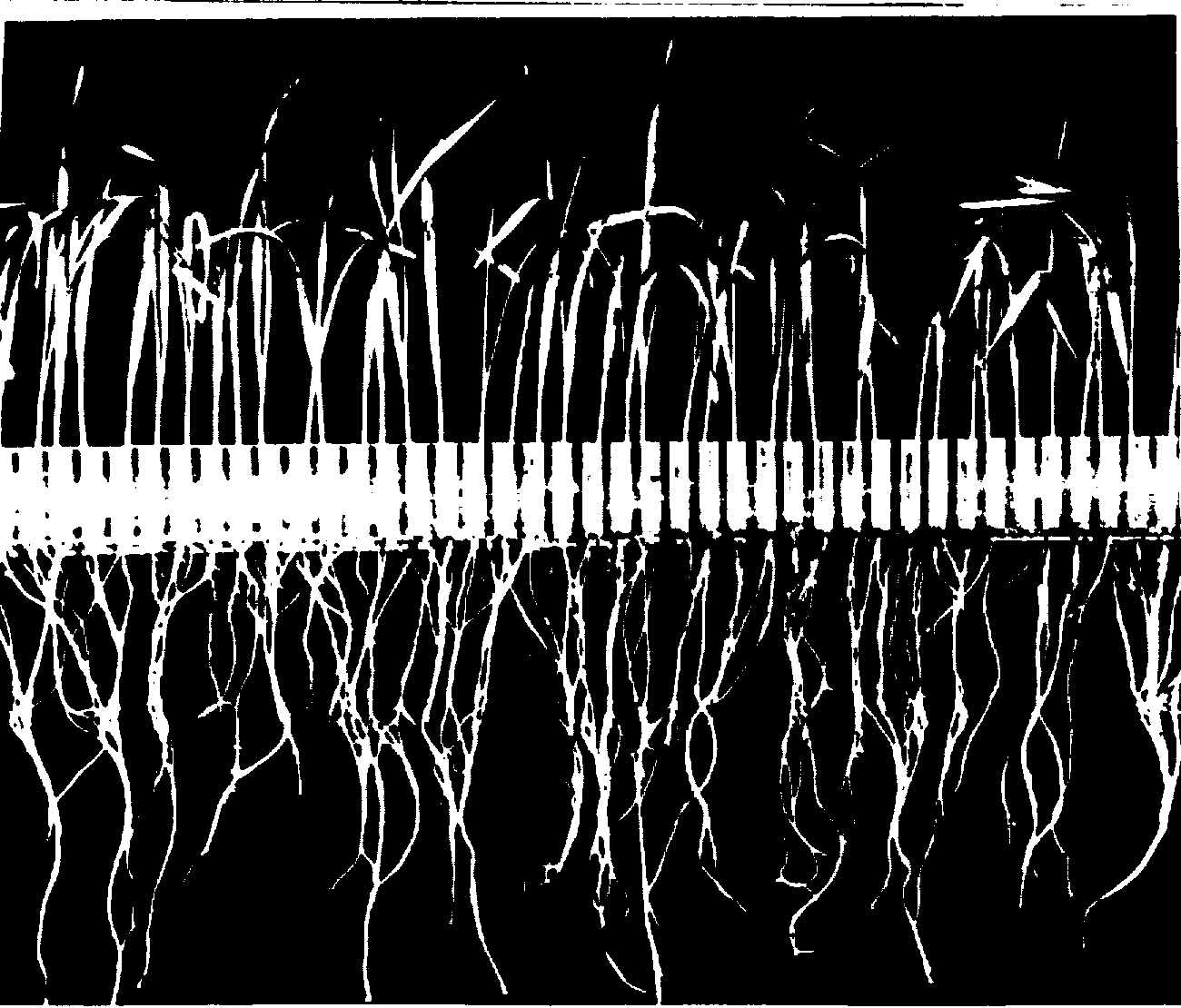
Air from the crew compartment was blown into the phytotrons, where the plants took out the carbon dioxide and some of everything else, and blown back. “The plants did not clean the circulating air completely,” the 1989 paper says, “and a thermocatalytic filter was used to combust all the organic admixtures.” The filter heated the air to 600 to 650 degrees over a catalyst and burned whatever the people, the cooking and the machinery gave off to carbon dioxide and water. The water supply was the wheat’s transpiration, condensed off the air in the phytotrons: most of it went back into the nutrient solutions, some was boiled for washing, and the drinking water went through ion-exchange filters and had iodide and fluoride added for health and a little salt for taste. Two air tanks outside the structure took in air when the pressure inside rose and gave it back when it fell, so the seal was never pushed from either side.
Before the third run the engineers measured the leak by holding the inside at a slight overpressure and metering what they had to pump in to keep it there. On days of low outside pressure the leak reached 150 to 240 litres a day; on average it was 60 to 80 litres, which is 0.020 to 0.026 percent of the volume a day. That number deserves a moment beside another one. Biosphere 2, the glass building in Arizona that this entry’s companion Two Years Under Glass is about, leaked less than ten percent of its air a year, which is about 0.027 percent a day. A steel box in a Siberian basement and three acres of glazing in the desert, built twenty years apart by people who had never met, were sealed to the same standard. The difference between them is not the seal. It is what was counted.
Ninety-one percent
The number in the title is from the abstract of the 1989 paper, and it describes the last run, the winter of 1983 to 1984, two men, five months, 63 square metres of crops: “The total closure of material turnover constituted 91%.” The sentence before it defines what was closed and what was not. “Water exchange of ecosystem, as well as gas exchange, was fully closed excluding liquids and gas samples taken for chemical analysis outside the system.”
Behind the figure is a table, which the paper prints and the 1997 paper reprints with one line changed. It lists what one crew member needs each day from outside. Without recycling: 924 grams of dry food, 1,220 grams of oxygen (1,283 in the later version), 5,133 grams of drinking water, 5,696 grams of water for washing, 9.5 grams of soap and the like, 28 grams of salt; 13,010.5 grams in all, a little over thirteen kilograms. With recycling, as in Bios-3: 208 grams of dry food, 350 grams of chemicals for the plants’ nutrient solution, 9.5 grams of sanitary materials, 2.7 grams of absorbent for water purification, 28 grams of salt; 598.2 grams. Oxygen and water do not appear in the second column at all, because they were made inside. The paper’s own summary is that the crew’s daily needs “was met 95% (in weight) with the resources inside the system”, and that only five percent, “animal products, sodium chloride for man and nutrients for plants, as well as personal hygiene requirements”, had been stored in advance. A footnote says what the table leaves out: “The sampling of a substance for investigation outside the system isn’t presented in this table.”
So the first thing the balance sheet shows is that closure, as a single number, is mostly water. Of the thirteen kilograms a person needs a day, nearly eleven are water and more than one is oxygen, and the wheat made all of both. Food, at 924 grams dry, is seven percent of the mass and most of the difficulty, and the 95 percent figure would be nearly as high if the crew had grown nothing to eat at all.
The second table in the 1989 paper is about the food, and it is the honest one. Over a month of the run the two men ate 27,716 grams of dry matter, and the plants supplied 21,484 of it: 77.5 percent. By component the shares were 95.4 percent of the carbohydrate, 65.2 percent of the protein, 35.3 percent of the fat, and 69.8 percent of the calories. The missing fat and protein were the meat, and the meat had been counted out from the start.
The third set of numbers is the one the engineers had designed to. Under the lamps they used, the 1989 paper says, “13 m² area occupied by plants is sufficient for a continuous supply of one man’s oxygen, water (at the expense of transpirational moisture condensate) and for 40-45% of his food.” To push the food higher they had, in one run, given each person thirty square metres, and the paper is plain about what that bought: “But it resulted in an excess of oxygen in the atmosphere and accumulation of a lot of inedible plant biomass.” Their conclusion is a sentence that could stand as the whole lesson of the experiment: “A system that completely provides man with oxygen and water but provides only 40-45% of food is more advantageous energetically than a system providing 95% of man’s food needs.” The 1997 paper tabulates the trade: 85 percent closure needs 13 square metres of crops per person, 95 percent needs 30, 99 needs 56. Every point of closure past the air and the water costs more than the last.
Then there is the rest of the ledger, the part that did not make the abstract. The 1997 paper has a section headed “Balance-sheet studies for Bios-3”, and it begins: “Careful records were kept of most mass exchanges taking place inside Bios-3.” The scientists, it says, “were aware of such apparently minor problems as the water introduced with canned meat (when it was used) and the water and various mineral elements removed with samples passed through the airlock for testing.” Twenty elements were followed in every liquid and solid that moved, analysed once or twice a month. For the major nutrients the books balanced “within the limits of error of analysis techniques (i.e., 10-15%)”. For nitrogen closure was about 40 percent and for minerals as a whole about 20, because what went out in the dried faeces, the kitchen waste, the ash and the samples was not put back. “For the microelements, however, output exceeded input.” The system was slowly losing copper, zinc, manganese and the rest to its own waste stream, and nothing in it was making more.
And some things were gaining. In the second run the nickel, aluminium, chromium and lead in the plants and the nutrient solutions were ten to twenty times higher at the end than at the start, and tin, titanium and zinc two to four times. The paper traces each to its source: solder, “especially the solder applied to the steel net used to collect the sewage water”; new untreated steel; a porous water filter; the catalysts in the air filter. The building was in the balance sheet. It was not corroding; the 2008 retrospective by Gitelson and Lisovsky says the metals were mobilised “due to the diverse biochemical activities of the microflora exhibiting versatile aggressiveness”, which is to say microbes at work on the solder. None of it reached harmful levels and the plants did not seem to mind. But it was there, and it had not been in the design.
The 1997 paper gives these leaks a name. “Deadlock substances” are “elements and molecules that may be unavoidably and irretrievably removed from the system. If such removal is inevitable, as it must be, then a bioregenerative life-support system can never achieve complete closure or total stability.” The meat going in and the ash going out were deadlocks by decision. The trace metals leaving in the samples and arriving from the solder were deadlocks by discovery. The gas balance, meanwhile, was being held by a filter at 650 degrees that burned the air’s organic load without anyone needing to know what it was; the 2008 paper plots ammonia, acetic acid, acrolein, aldehydes, alcohols, hydrogen sulphide, mercaptans and carbon monoxide across the 180 days and reports that they “varied around the average values, remaining, on the average, parallel to the time axis, which confirmed that the atmosphere was in a state of dynamic equilibrium.” Equilibrium is the word a balance sheet uses for a flow it has decided not to follow. The full tables, and what each of the six published percentages is a percentage of, are set out in The ledger.
What it looked like from inside
The crews were chosen on four grounds, which the 1997 paper lists: they had helped build the system, “and, therefore, had a meaningful interest in the experiment”; they had “desirable personal merits, including conscientiousness, efficiency, disposition, and the ability to prevent or avoid conflicts”; they knew the programme; and they had passed a medical board. They were monitored for six weeks to two months beforehand on the parameters that would be measured inside, spent five days in quarantine, and were watched for a month afterwards. “All three closure experiments in Bios-3 were initiated during early winter to minimize pathogen invasion from the outside.” In a Siberian winter the air outside the institute carries very little that is alive.
Inside, the day was farming. The crews sowed, tended, harvested, threshed, milled and cooked, ran the filters and the pumps, took the samples, and kept the records. They ate four meals a day on a menu that repeated every five days, and they ate what the phytotrons gave them. “The crew members found that they could not predict vegetable production accurately,” the 1997 paper says, “but they were challenged by the experimenters to eat all that they produced.” The 2005 account from the Krasnoyarsk correspondent of Rossiyskaya Gazeta has onions, tomatoes and cucumbers ripening in rotation and the crew baking bread, buns and pancakes in turn. Their weights held within 830 grams of where they started; the paper sets that against the Biosphere 2 crew, who lost on the order of ten kilograms each. Waste went out through a double airlock, dried.
The medical watch was continuous. Sensors on the crew’s bodies fed through purpose-built sockets in the wall to the doctors outside, and at night, Bugreev told a reporter, the doctors monitored them through the wires while they slept. They could pull the blinds in their cabins to watch television in private. They spoke to the outside by telephone, and through the portholes; Bugreev’s relatives came on weekends and looked in. The institute’s 2008 paper adds the one detail from the follow-up that reads like a boast and is meant as a result: the subjects, all of them researchers at the institute, went back to their work afterwards, “presented dissertations, gave birth to children, i.e. lived the lives of ordinary people”, and ten to fifteen years of observation found no illness that could be tied to their time inside.
The air they lived in would not have passed as office air. Carbon dioxide ran between 0.5 percent, when the crops were doing well, and a little over 2 percent, and averaged above one percent, and the oxygen sat at about 19 percent. The crews breathed faster, and their haemoglobin and blood pressure changed insignificantly, by the institute’s 1975 monograph as the 2025 preprint reports it. The 1997 paper remarks, in a sentence that reads differently now than it did then, “Surprisingly, humans, which must expel carbon dioxide, easily tolerate levels that are well above those that are best for plants, which utilize carbon dioxide.” Okladnikov, who had by 1992 spent twenty-six years studying the crews, summed up the medicine for the American co-author in one line: “In no respect did the crew members deviate from the norm.”
What the microbiologists saw was less tidy. Margarita Rerberg’s group followed the bacteria, fungi and yeasts on the plants, in the solutions, and on and in the crew, and found that “although stability was never achieved, populations of various microflora never exceeded the normal limits encountered outside of Bios-3.” Weakened plants carried ten to thirty times the microorganisms of healthy ones. Staphylococci were found on the crew’s skin, “which indicates that human existence in the system could have been endangered.” The flora of the crew’s skin, mouths and guts changed significantly over six months, without consequence. Nobody developed an allergy. Nobody fell ill.
What happened
The first winter, 1972 to 1973. The crew of three went in on 24 December 1972 with two phytotrons running and the algal compartment sealed off. For the first two months the wheat and vegetables, on 41 square metres, supplied all of their oxygen and, by the 1997 paper’s count, about a fifth of their calories; the institute’s 1976 paper, as NASA’s Raymond Wheeler reports it, has the two phytotrons producing 117 kilograms of dry plant matter in those two months, 37.4 of them edible. Then the configuration was changed. One phytotron was shut off, the algal room was opened to the crew quarters to carry the oxygen load, and the agronomist was replaced by an algal specialist; two months before the end the agronomist came back and the phytotron was refilled with vegetables. There were always three people inside, and they came out on 22 June 1973, after 180 days, into a crowd of doctors, wearing respiratory masks. The 2008 paper reproduces the photograph. The institute’s claim for this run, in the same paper, is the largest of all its claims: “The atmosphere and water were regenerated completely while food regeneration amounted to 93%.” The table under it, of the daily yields of eleven crops on 39.4 square metres, carries the note that the total “comprises only vegetables”. The 93 percent is of the plant part of the diet. The meat was outside it.
The second winter, 1976 to 1977. This was the run that pushed. Its purpose, the 1997 paper says, “was to test the ability of the enclosure to supply food”, and by the sequence of the institute’s papers this is the run in which the crew was given up to thirty square metres a head and fed only on what the plants produced, so far as the plant part of the diet went. Three men went in; one left during the experiment, for reasons the published record does not give. It lasted four months. Washing water and the crew’s urine, untreated, went into the wheat’s nutrient solution, and the 1989 paper gives the result to the percentage point: the wheat’s needs were met “59% in nitrogen, 28% in sulphur, 19% in potassium, 17% in phosphorus and 19% in magnesium” from the crew’s own waste, the rest from the salts in store. With thirty square metres a head the oxygen rose and the straw piled up, and the crew burned it, inside, to put the carbon back into the air. The institute’s chart of the run, figure 5 of the 1997 paper, shows carbon dioxide and oxygen as mirror images, with the sharp spikes of the second half explained in the caption: “Sharp changes during the second half of the run were caused by the burning of inedible plant wastes.” The 1979 monograph on the run, as the 2025 preprint reads it, records episodes when the oxygen fell. This was also the run in which the trace metals climbed, and in which the microflora frightened the microbiologists enough to change the rules: the crew stopped washing linen and wore clean linen from store instead, the phytotrons and the air were treated with ultraviolet before closure, the crew wore gauze masks to work among the plants, and the thermocatalytic converter was put in. “The increases had the potential of stopping the system,” the 1997 paper says of the microbial blooms. It did not stop. A later paper from the institute names the three reasons plants in a closed run grew worse than the same plants in an open phytotron: the long reuse of one nutrient solution, the grey water put into it, and closure itself, through “accumulation of volatile substances” in the air. The filter at 650 degrees was the answer to the third.
The third winter, 1983 to 1984. Two men went in in November 1983 and came out in April 1984, after five months; the facility then grew plants for another month unsealed. This was the run the 1989 paper describes, the one with 63 square metres in three phytotrons, the 91 percent, the 598 grams. Most of what the second run had taught was applied. The converter was modified, the steel nets and the solders were changed, no new steel went in, and the inside was held at a slight positive pressure so that nothing could leak inward; by the end “there was no accumulation of elements in the plants.” For 103 days the crew’s entire urine output, 210.7 litres, went into the wheat solution; the sodium in it stabilised at 0.9 to 1.65 grams a litre and “had no marked effect on wheat production”, and the water closure went up by 15.7 percent. The wheat, on 39.6 square metres, yielded 496 grams of grain a day, 12.5 grams per square metre against 13 expected. Chufa, a sedge grown for the oil in its tubers, brought the crops’ assimilation quotient, the ratio of oxygen out to carbon dioxide in, up to 0.95, close to the crew’s respiratory quotient, which is how the oxygen was kept level without burning anything. The mineral closure was about 20 percent. “A 5-months period did not affect their health.”
Then it stopped. The 1997 paper counts “only three full-scale experiments (i.e., with humans inside)” in Bios-3, with the total time of human closure across all three Krasnoyarsk systems exceeding a year; the institute’s website counts ten crewed closures in Bios-3 with one to three people, the longest the 180 days. Both can be true if the ten include the short runs and the partial closures that the papers do not describe. What both agree on is that nobody has lived sealed in Bios-3 since April 1984.
After
In 1988, at the COSPAR assembly in Espoo, Gitelson and ten co-authors read the paper on the last run to a session that NASA’s life-support programme had helped to establish, and NASA printed it the next year in a conference publication, which is why this entry can quote it at length. In 1989 a NASA delegation went to Krasnoyarsk: Mel Averner from headquarters, Robert MacElroy from Ames, who ran the agency’s closed-ecosystem programme, Frank Salisbury from Utah State, the astronaut Ellen Baker, and seven others. Salisbury would write the 1997 account with Gitelson and Lisovsky, when Gitelson held a National Research Council post at Ames, and Gitelson, Lisovsky and MacElroy would publish the full book, Manmade Closed Ecological Systems, in 2003.
The 1997 paper ends with a wish and a refusal. “Provided that the technology can be modernized, Bios-3 would be well suited for such experiments. Regretfully, the current economic situation in Russia makes this research impossible.” By then the Soviet Union had been gone for six years. In 1991 the institute had made Bios-3 the core of an International Center for Closed Ecosystem Studies and doubled the lamps in one phytotron, and then the money stopped; the Krasnoyarsk Science Center’s own account says the facility was mothballed in the perestroika years, and the 2005 newspaper account has the institute without electricity, water or heating. When the reporter found Bugreev that year the gaskets were about to be renewed and the seal restored, and he said: “A renaissance! A complete renaissance! We waited twenty years for this!”
The money came in pieces. From 2005 the institute worked with the European Space Agency on waste processing and plant growth. From June 2011 to May 2013 a European Union project called BIOSMHARS used Bios-3 “as an analogue to the International Space Station” to calibrate a model of how bacteria and fungi move through the air of a sealed habitat; the budget was 742,342 euros. When Russian television came in 2016 Bugreev was seventy-four and showed them his five square metres. In April 2021 the institute’s director, Andrei Degermendzhi, put a proposal to the general meeting of the Siberian Branch for a Bios-4 that would close the food cycle too. “It remains to combine all the available technologies into one system and make BIOS-4.” Gitelson died in Moscow on 25 September 2022, at ninety-four. The steel rooms are still there, and still empty of people.
Two things have happened to the numbers since. The first is that the institute’s summaries have drifted upward while its papers have not. The Siberian Branch’s tribute to Gitelson in 2003 says the Bios-3 runs reached “full closure of the system for gas and water and reproduction of food up to 80% of the crew’s needs”, and adds that “this result has to this day not been repeated by any of the scientific teams working in this direction”. The 1989 paper, which is the measurement, says 77.5 percent of the dry food in the best-documented run. The second is a preprint from the Krasnoyarsk State Medical University in 2025, which went back to the crews’ published blood chemistry from the 1975 and 1976 reports and argues that the readings at one percent carbon dioxide show something the designers did not look for: that the crews’ metabolism shifted toward burning fat, that this lowered the carbon dioxide they breathed out, and that the shift was itself part of what held the gas balance level. “This equilibrium was not predicted in advance when designing the life support system, but fortunately, the BIOS-3 project was successful.” That is one reading of old data by two authors and has not been reviewed. But it is the kind of thing a balance sheet cannot contain: the ledger recorded that the air stayed level; it could not record that the people had changed to keep it so.
What it taught
Start with what it was not. It was not a failure, by any measure its designers set: three crews lived for four, five and six months on air and water their wheat made, and came out as well as they went in. It was not a demonstration that food can be closed; the institute never claimed more than the plant part of the diet, and said so. And it was not, as it is sometimes told, the Soviet system that quietly succeeded where the American one loudly failed. The Siberian seal and the Arizona seal were equally tight. What differed was that Krasnoyarsk wrote its exceptions down before the door closed, and Oracle did not.
Closure is a sum, and the sum hides its terms. Ninety-five percent by weight is a sentence about water. Ninety-one percent of material turnover, 93 percent of the vegetable diet, 77.5 percent of dry food, 70 percent of calories, 40 percent of nitrogen, 20 percent of minerals: every one of these is in the institute’s own papers, every one is true, and they describe the same two men in the same steel box. Whoever reports a closed system with one number has chosen which flow to report, and it will be the largest and the easiest. Ask for the ledger. The entry that matters is the smallest line in it.
The exceptions you declare are the ones that will not hurt you. The meat through the airlock, the dried faeces, the ash: all were deadlocks by decision, published in advance, and the 91 percent was reported with them subtracted. Biosphere 2’s carbon dioxide scrubber was in its engineering papers from the start and became a scandal anyway, because the public had been told a story in which it could not exist. Krasnoyarsk’s air filter at 650 degrees did a comparable job and nobody has ever called it cheating. An experiment that publishes its rules and its exceptions is judged on what it learned. A demonstration is judged on whether it kept a promise, and the promise is always more closed than the box.
The unmeasured sink is the building. Biosphere 2 lost its oxygen to curing concrete; Bios-3 gained lead and nickel from the solder on a sewage screen and the catalysts in its own air filter. Both were found by the same means, a balance that would not close, and both were materials chosen for their job that turned out to be participants. In a sealed system there are no inert parts. The lesson is not that the engineers should have known. It is that the first thing a closure experiment measures is its own fabric, and the budget should expect it.
A balance that people hold every day cannot show what would happen if they stopped. The crews burned straw when the oxygen climbed, swapped an agronomist for an algal specialist when the configuration changed, cut linen-washing when the microbes bloomed, and ate whatever the beds produced because they were told to. Gitelson’s own statement of the main result is careful about this: the system could be kept stable “on the condition that it is obligatorily controlled by the human intellect”. That is a true finding, and it is also the boundary of the finding. Three people managing a farm for six months proves that three people can manage a farm for six months. The 2008 paper is candid that the system never failed for a biological reason and that “all damages were the fault of technical devices”; it is equally candid that the microflora never reached a steady state and that the trace elements were “a hardly controllable process”. Stability was the people.
What an experiment that reports its own balances can show, and what it cannot. It can show, to the precision of its instruments, that the flows it chose to follow closed for as long as it ran: that is a great deal, and almost nobody else has done it. It cannot show anything about the flows it did not follow, or what happens past the end of the run. The volatile organics were burned, not identified; the mineral balance was good to ten or fifteen percent, which is the size of the drift it was looking for; the crews’ blood chemistry was filed and read differently fifty years later by people who were not there. And the institute’s claim that its result has not been repeated by anyone is a claim of priority that is also a confession: no one, including the institute, has checked it since 1984. A measurement nobody has repeated in forty years is a measurement, not a law.
Check the story before you learn from it. The facility was finished in 1972 by most accounts and 1971 by one of the institute’s own. There were three full-scale closures by the 1997 paper and ten crewed ones by the institute’s website. Bugreev spent eleven months inside by the 1997 paper and thirteen by the institute’s later accounts and his own. The volume is 315 cubic metres in every description, including the 1989 abstract, and “about 300” in that paper’s text. A crew member’s daily oxygen is 1,220 grams in the 1989 table and 1,283 in the 1997 reprint of it. The food figure is 50 percent on one institute page and 80 on another, 93 in the 2008 paper, 77.5 in the 1989 table, 40 to 45 at the design point. The run held at positive pressure is the four-month one in the 2008 paper and the five-month one in the 1997 paper. What the record supports without argument is the 180 days, the 63 square metres, the 598 grams, the mirror-image chart of the burning straw, the metals in the solder, and three crews who walked out on time. That is enough to learn from.
Sources
- I. I. Gitelson, I. A. Terskov, B. G. Kovrov, G. M. Lisovskii, Yu. N. Okladnikov, F. Ya. Sid’ko, I. N. Trubachev, M. P. Shilenko, S. S. Alekseev, I. M. Pan’kova and L. S. Tirranen, “Long-term experiments on man’s stay in biological life-support system”, in R. D. MacElroy, B. G. Thompson, T. W. Tibbitts and T. Volk (eds), Controlled Ecological Life Support Systems: Natural and Artificial Ecosystems, NASA Conference Publication 10040, December 1989, pages 61–66; the papers of the COSPAR meeting at Espoo, 18–29 July 1988; also printed in Advances in Space Research 9 (8), 65–71, 1989. The hypothesis, Kirensky and Korolev, the six-week algal runs, the 1972 to 1984 series, the thermocatalytic filter, 13 square metres and 40 to 45 percent, the thirty-square-metre run and its burning straw, the urine figures for wheat, the drying of wastes, the 91 percent, the 95 percent, and Tables 1 and 2. Read in full in the NASA scan, which NTRS marks “Work of the US Gov. Public Use Permitted”. ntrs.nasa.gov, PDF
- Frank B. Salisbury, Josef I. Gitelson and Genry M. Lisovsky, “Bios-3: Siberian experiments in bioregenerative life support”, BioScience 47 (9), 575–585, October 1997. The history from Moscow and Bios-1 onward, Kovrov and Lisovsky, the structure and its gaskets, lamps, power and leak rate, the three runs and their crews and dates, the crew selection and monitoring, “Siberians must have their meat!”, the 830 grams, the carbon dioxide range, the balance-sheet section, the trace metals and their sources, “deadlock substances”, the microflora, figure 5 and Tables 1 to 3. Read in full in the PDF at simoc.space; NASA holds the reprint. simoc.space, ntrs.nasa.gov
- Iosef I. Gitelson and Genry M. Lisovsky, “Creation of closed ecological life support systems: results, critical problems and potentials”, Journal of Siberian Federal University, Biology 1 (1), 19–39, 2008. Bios-1 and Bios-2, the 93 percent and its table, the thirteen months, the “dynamic equilibrium” of the toxic gases and its chart, the follow-up of the crews, the main result “controlled by the human intellect”, the failures of technical devices, the trace elements and the microflora. Read in full. elib.sfu-kras.ru
- Institute of Biophysics, Siberian Branch of the Russian Academy of Sciences, “BIOS-3” and “History” pages. The construction dates 1965 to 1972, the 400 kilowatts, the ten crewed closures, the 50 percent and the 80 percent, the 1991 centre and the 2005 ESA work. ibp.ru/science/bios3.php, ibp.ru/history/info01_eng.php
- Krasnoyarsk Science Center of the Siberian Branch, “The basis of a lunar base should be a closed life support system of a new type”, 12 April 2021, and “Krasnoyarsk biophysicists told the Vesti TV channel about the legendary project BIOS”, 16 April 2021. The dates 24 December 1972 to 22 June 1973, Degermendzhi’s Bios-4 proposal of 8 April 2021 and his words, and the mothballing. ksc.krasn.ru, ksc.krasn.ru
- “Zhizn’ v nauke” (A life in science), Nauka v Sibiri 26, July 2003, the Siberian Branch’s tribute on Gitelson’s seventy-fifth birthday, in Russian. Kirensky, Terskov and Gitelson founding the centre, “in 1971 the experimental complex Bios-3 was created”, Kovrov’s “enormous” contribution, the 80 percent, and “not repeated by any of the scientific teams”; translations are mine. prometeus.nsc.ru
- Raymond M. Wheeler, “Agriculture for space: people and places paving the way”, Open Agriculture 2, 14–32, 2017, CC BY-NC-ND. The 1976 Acta Astronautica figures for the first run (41 square metres, 117 kilograms, 37.4 edible, 20.6 of salts), the algae’s toxic volatiles, the hundred staff, the 6,000 to 24,000 parts per million, and the 1989 NASA delegation in its figure 2. sciences.ucf.edu
- J. I. Gitelson, L. S. Tirranen, E. V. Borodina and V. Ye. Rygalov, “Impaired growth of plants cultivated in a closed system: possible reasons”, Advances in Space Research 20 (10), 1927–1930, 1997; G. M. Lisovsky, J. I. Gitelson, M. P. Shilenko, I. V. Gribovskaya and I. N. Trubachev, “Direct utilization of human liquid wastes by plants in a closed ecosystem”, same volume, 1801–1804; I. V. Gribovskaya, Yu. A. Kudenko and J. I. Gitelson, “Element exchange in a water- and gas-closed biological life support system”, same volume, 2045–2048; J. I. Gitelson and Yu. N. Okladnikov, “Consistency of gas exchange of man and plants in a closed ecological system”, Advances in Space Research 18 (1–2), 205–210, 1996. Paywalled; the abstracts, read on PubMed, give the three reasons for impaired growth, the 103 days and 210.7 litres, the 24 percent mineral closure, and the matching of respiratory and assimilation quotients. pubmed 11542571, pubmed 11542553, pubmed 11542588, pubmed 11538965
- D. A. Semyonov and A. A. Semyonova, “A new hope for long space flights: hypercapnia demonstrated suppression of metabolic acidosis in an experiment with prolonged stay of people in a closed life support system”, arXiv 2504.18551, April 2025, a preprint from the Krasnoyarsk State Medical University. The one-percent decision, the 19 percent oxygen and faster breathing from the 1975 monograph, the fat metabolism from Vlasova and colleagues in Voprosy Pitaniya 1976, the oxygen dips from the 1979 monograph, and “not predicted in advance”. arxiv.org
- Zolik Milman, “Krasnoyarskie biofiziki otkryvayut makro- i mikrokosmos”, Rossiyskaya Gazeta, 1 July 2005, in Russian. Bugreev as mechanical engineer and “bionaut” from 1972, three winters and thirteen months, the three wheat harvests a month, the baking, the airlock, the institute without power or heat, and “Renaissance!”; translations are mine. rg.ru
- “Life on Mars? Siberian scientists create ‘micro-Earth’”, RT, 22 May 2016, and “Siberian scientists create station allowing humans to live on Mars”, Sputnik, 23 May 2016. Bugreev at seventy-four, the five square metres, the telephone, the weekend visits and the overnight monitoring, quoted from an interview with the Siberian Times that I could not reach; the first crew as an agronomist, an engineer and a doctor; and Egor Zadereev on the facility’s prospects. rt.com, sputnikglobe.com
- European Commission, CORDIS, project 263076, BIOSMHARS, 1 June 2011 to 31 May 2013. The partners, the budget and “an analogue to the International Space Station”. cordis.europa.eu
- Biographical dates for Kirensky (1909–1969), Terskov (1918–1989) and Gitelson (1928–2022) from the Russian and English Wikipedia articles on each, checked against the Siberian Branch tribute above. ru.wikipedia.org, en.wikipedia.org
- Not read, and cited here as the institute cites them: I. I. Gitelson, B. G. Kovrov, G. M. Lisovsky, Yu. N. Okladnikov, M. S. Rerberg, F. Ya. Sidko and I. A. Terskov, Experimental Ecological Systems Including Man (Problems of Space Biology 28), Nauka, Moscow, 1975; G. M. Lisovsky (ed.), Closed System: Man–Higher Plants, Nauka, Novosibirsk, 1979, the monograph on the four-month run, which the 1997 paper says exists as a NASA technical translation of 1981 that I could not find on NTRS; J. I. Gitelson and others, “Life-support systems with autonomous control employing plant photosynthesis”, Acta Astronautica 3 (9–10), 633–650, 1976; B. G. Kovrov and others, “Artificial closed ecosystems ‘man–plants’ with a full regeneration of atmosphere, water and ration vegetable part”, 36th International Astronautical Congress, Stockholm, 1985; J. I. Gitelson, G. M. Lisovsky and R. D. MacElroy, Manmade Closed Ecological Systems, Taylor & Francis, 2003.
- William F. Dempster, “Tightly closed ecological systems reveal atmospheric subtleties”, Advances in Space Research 42, 1951–1956, 2008, for Biosphere 2’s leak rate of under ten percent a year, as used in Two Years Under Glass; and that entry’s companion Biosphere 1, which gives Bios-3 a page and which this entry was written to go beyond. ecotechnics.edu