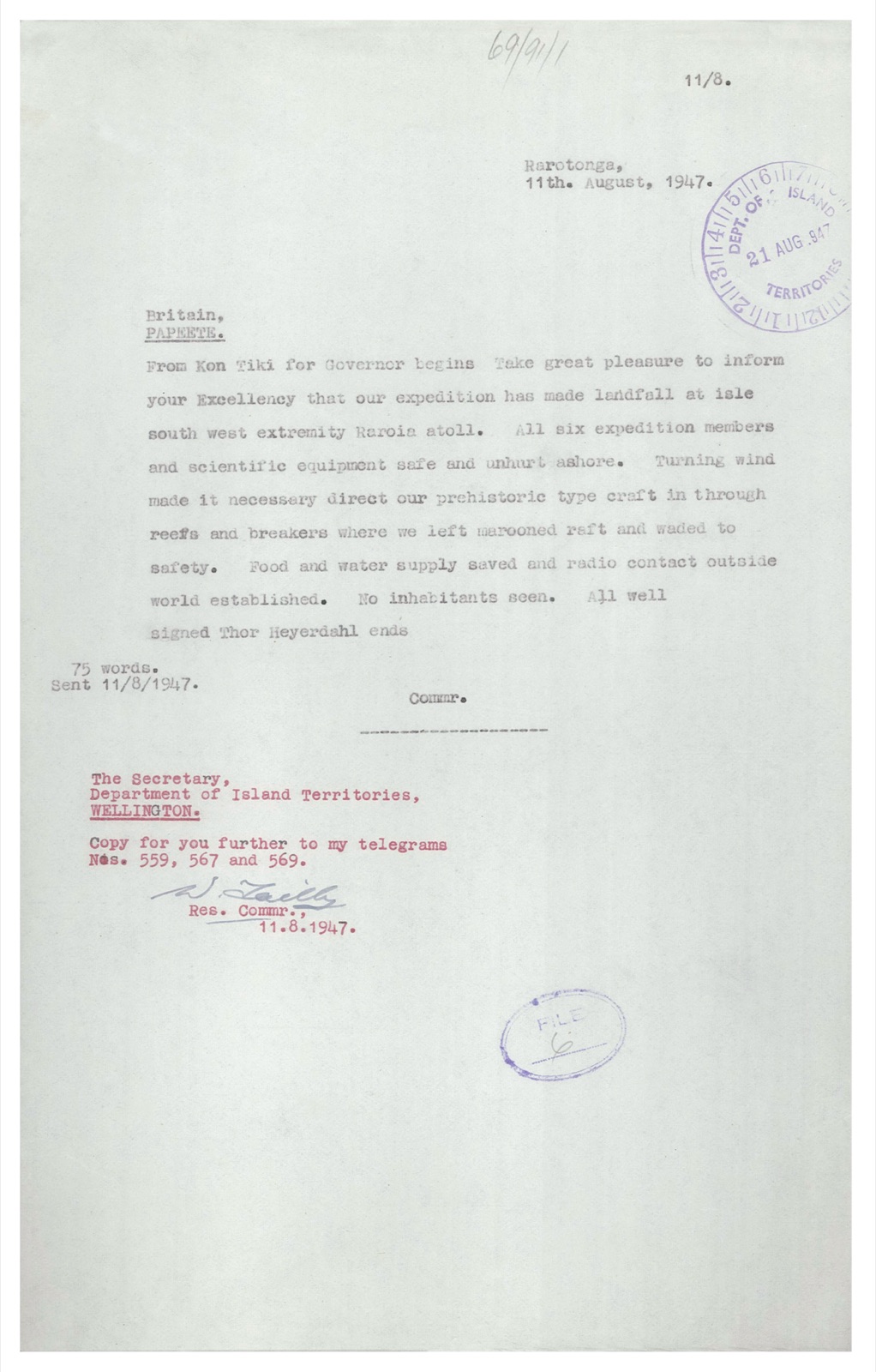
On 11 August 1947 the Resident Commissioner of the Cook Islands, at Rarotonga, sent a cable to Papeete for the Governor of French Oceania. It had come to him by amateur wireless from an atoll in the Tuamotus, far to the east, and it ran, between its “begins” and its “ends”, to seventy-five words:
“Take great pleasure to inform your Excellency that our expedition has made landfall at isle south west extremity Raroia atoll. All six expedition members and scientific equipment safe and unhurt ashore. Turning wind made it necessary direct our prehistoric type craft in through reefs and breakers where we left marooned raft and waded to safety. Food and water supply saved and radio contact outside world established. No inhabitants seen. All well signed Thor Heyerdahl.”
The same day the agencies had it in New York. The Brisbane Telegraph printed the Australian Associated Press version on 12 August: the expedition “ended its voyage on Raroia Reef in the Tuamotu Islands when, after three days trying to get around the reef, it finally was drawn on to a coral reef where it grounded.” Ten days later the Adelaide Chronicle ran a longer piece from New York under the headline “History Believed Verified By Raft Crash”. The raftsmen, it said, “feel that they accidentally carried historical accuracy to extremes by crashing on to Raroia reef”, since “that was probably the way the first Peruvian explorers of the Pacific area ended up 1,500 years ago.”
Seventy-five words had said what had happened. The headline said what it meant. The distance between the two is the subject of this entry.
Who ran it
Thor Heyerdahl was born at Larvik, on the coast south of Oslo, on 6 October 1914, and began studying zoology and geography at the University of Oslo in 1933. On Christmas Day 1936, the day after his wedding, he and his wife Liv sailed for the Marquesas, and spent the better part of a year on Fatu Hiva, the easternmost high island of Polynesia, collecting animals and living, as he wrote, in a hut on piles under the palms. There, by his own account, an old man named Tei Tetua told him by a fire that it was Tiki, both god and chief, who had brought the islanders’ ancestors across the sea from a big country beyond it; and there, on the windward beach, he watched the surf arrive from the east, night after night, from a coast 4,300 sea miles away. He came home, gave his jars of beetles and fish to the Zoological Museum, and gave up animals for the question of where the Polynesians had come from. He was in British Columbia, among the carvings of the Northwest Coast Indians, when Germany invaded Norway in 1940. He spent the war in the Norwegian forces in exile, went through wireless school and parachute training, and served in Finnmark.
The manuscript he carried to New York after the war was called “Polynesia and America; a Study of Prehistoric Relations”, and nobody would read it. The museum’s own account names the man who sent him away: in the spring of 1946 the American anthropologist Herbert Spinden told him, in the museum’s wording, “Sure, see how far you get yourself sailing from Peru to the South Pacific on a balsa raft!” Heyerdahl’s book has the old man say it more quietly, after explaining that the peoples of South America could not have reached the islands because “They had no boats!”: “Well, you can try a trip from Peru to the Pacific islands on a balsa-wood raft.”
In the Geographical Journal in 1950 Heyerdahl called himself “one who was not even an amateur sailor”. The five men he gathered were chosen, he wrote, not to be sailors, so that nobody could say afterwards that the thing had come off because the crew were better seamen than the raft-builders of Peru. Herman Watzinger was a Norwegian engineer whom he met in New York; he became second in command and, in the Geographical Journal’s word, the “architect” of the raft, and he took the expedition’s hydrographic and meteorological measurements. Erik Hesselberg, a painter who had been through navigation school and sailed round the world before settling down with a brush, was the one man aboard who could use a sextant; he was the navigator and the only member with sea experience. Knut Haugland and Torstein Raaby were the wireless operators, both parachuted into occupied Norway during the war: Haugland had been the radio operator of the heavy-water sabotage at Rjukan, and Raaby had spent ten months beside the battleship Tirpitz sending nightly reports to England. The sixth place went to a Swede who knocked on Heyerdahl’s hotel door in Lima: Bengt Danielsson of Uppsala, an ethnologist just out of the Amazon, who asked to come because he was “interested in the migration theory”. He was the only one who spoke Spanish, and on the raft he was the steward. A seventh passenger, a green parrot, came aboard in a cage at Callao.
The money was a story of its own. A syndicate of backers in New York agreed to raise the capital against newspaper articles and lectures afterwards, fell ill and powerless at the critical moment, and was dissolved by agreement. “No chewing-gum or coca-cola backing,” Watzinger said, and they held to it. What carried them was a private loan begun with a cheque from Colonel Otto Munthe-Kaas, the Norwegian military attaché in Washington, and followed by others. The equipment was lent for testing. Through the Explorers Club the equipment laboratory of the United States Air Materiel Command sent what Heyerdahl asked for; the Quartermaster General’s experimental laboratory, after a conference at the Pentagon, supplied field rations, sleeping bags, stoves and water cans, and a hesitant chief approved them with the words, as Heyerdahl recorded them, “Courage and enterprise count too”; the British Military Mission in Washington flew over a selection of British equipment, including a shark powder whose efficacy, its medical officer admitted, was “just what we want to find out ourselves”. Admiral Glover of the Navy’s hydrographic office gave them the current charts of the Pacific and told his officers to help them check them. The Peruvian government under President José Bustamante y Rivero gave them the naval dockyard at Callao to build in and a naval tug to take them out. The expedition’s secretary was Gerd Vold of the Norwegian embassy in Washington. Watzinger, having calculated what the Quartermaster’s gift amounted to, announced that it included 684 boxes of pineapple.
What they were trying to find out
Heyerdahl’s theory, in the form he published in the Geographical Journal in 1950, was that Polynesia had been settled from America in two waves: first by a pre-Inca people from Peru, sun-worshippers who left under a mythical king and sun-god called Kon-Tiki and built the stone statues of Easter Island, and some five hundred years later by Indians of the Northwest Coast of America, who came by way of Hawaii in great double canoes. The evidence he listed ran across every department: the sweet potato, which is American and was grown in Polynesia under its Quechua name, kumara; the bottle gourd; megaliths and stepped platforms; trepanning; the sling, the feather cloak and the nose flute; fair skin, tall stature and aquiline noses; the names of places round Lake Titicaca; and the Inca legend of a white, bearded god who had been driven from the lake and had gone westward into the Pacific. The Polynesian language, he asserted, was “only remotely related to the Malay tongues”. And every time he put this to a specialist, the specialist had one answer that ended the conversation. The South Americans could not have gone, because they had nothing to go in.
That was the one objection a raft could answer, and Heyerdahl was precise about what answering it would do. In his book he reports a friend asking what he could gain by the voyage. “Destroy one of the weightiest arguments against the theory,” he says. “But if things go wrong?” “Then I shan’t have proved anything.” The Geographical Journal paper puts it in the voice of a report: “To study the behaviour of this little-known American craft and to test the feasibility of a prehistoric voyage from Peru to the Polynesian islands, I organized the ‘Kon-Tiki Expedition’ in 1947.” He listed the reasons the balsa raft had been dismissed. Balsa absorbs sea water and sinks; a raft held together with rope would chafe itself apart in a swell; a deck with eighteen inches of freeboard would be permanently awash; the logs would be crushed between two waves; the crew would be swept off in the first storm; and a log raft “would be hardly navigable, would make very little progress through the water, and the crew would perish from thirst and starvation long before the elements tossed them ashore on the distant beaches of Polynesia.”
So the experiment had a hypothesis in two parts, and only one of them could be tested at sea. The first was that a balsa raft of the ancient type could carry men alive from Peru to Polynesia. The second was that people from Peru had done so, and were the ancestors of the Polynesians. The raft could answer the first. For the second, the relevant evidence had been in print for a century. In 1846 Horatio Hale, the philologist of the United States Exploring Expedition, had written that “the Polynesians belong to the same race as that which peoples the East Indian Islands is, at present, universally admitted,” and that the work of Wilhelm von Humboldt would have settled any remaining doubt. The sweet potato had been argued over since Roland Dixon’s paper of 1932, and Dixon had concluded by 1934 that Polynesian canoes had fetched it from Peru. Heyerdahl’s reply to all of that was that the specialists had never looked at the raft. That reply was true, and the raft was built to make it unanswerable.
What they built
The old rafts were known from the Spanish chroniclers and from the drawings of Juan and Ulloa, Humboldt and Paris. Balsa does not grow on the desert coast of Peru, so the Incas had fetched their logs from Ecuador, and Heyerdahl and Watzinger did the same, cutting giant trees in the Ecuadorian jungle and bringing them down to the coast. Under the auspices of the Peruvian government the raft was put together in the naval dockyard at Callao. Watzinger cracked the topmost bone of his neck in the surf near Lima while the timber was arriving, was hung by a strap round his head for half an hour while the doctors turned the vertebra back into place, and went back to the dockyard blue, green and stiff.
The raft was nine balsa logs, each about two feet thick, laid loose in the water so that they could find their own floating position and then lashed side by side with separate lengths of hemp rope, about three hundred of them, each knotted. The longest log, 45 feet, went in the middle and projected at both ends; the logs shortened towards the sides, which were 30 feet, so that the bow was blunt and stepped, like the pipes of an organ. Across them went nine lighter balsa cross-beams at intervals of about three feet, and on those a deck of split bamboo, raised about eighteen inches above the water. Aft, the three middle logs carried a thick block of balsa with tholepins for a long steering oar of mangrove wood. Forward of a small open hut of bamboo canes, roofed with banana leaves, stood two masts of mangrove, side by side and lashed together at the top, carrying a square sail on a yard of bamboo. There was no nail, spike, peg or wire in the whole construction; everything, hut and masts included, was held together with rope. More than half of each log was under water.
Pushed down into the chinks between the logs, “scattered about without system”, as Heyerdahl put it, were five planks of fir, an inch thick, two feet wide and six feet deep, standing on edge in the water beneath the raft and held with wedges and ropes. The Spaniards had called them guaras. Heyerdahl’s book describes them as “tiny parallel keels or centreboards”, put there “to prevent the flat wooden rafts from drifting sideways with wind and sea”. That was what he knew them for. What else they were for, nobody on board knew.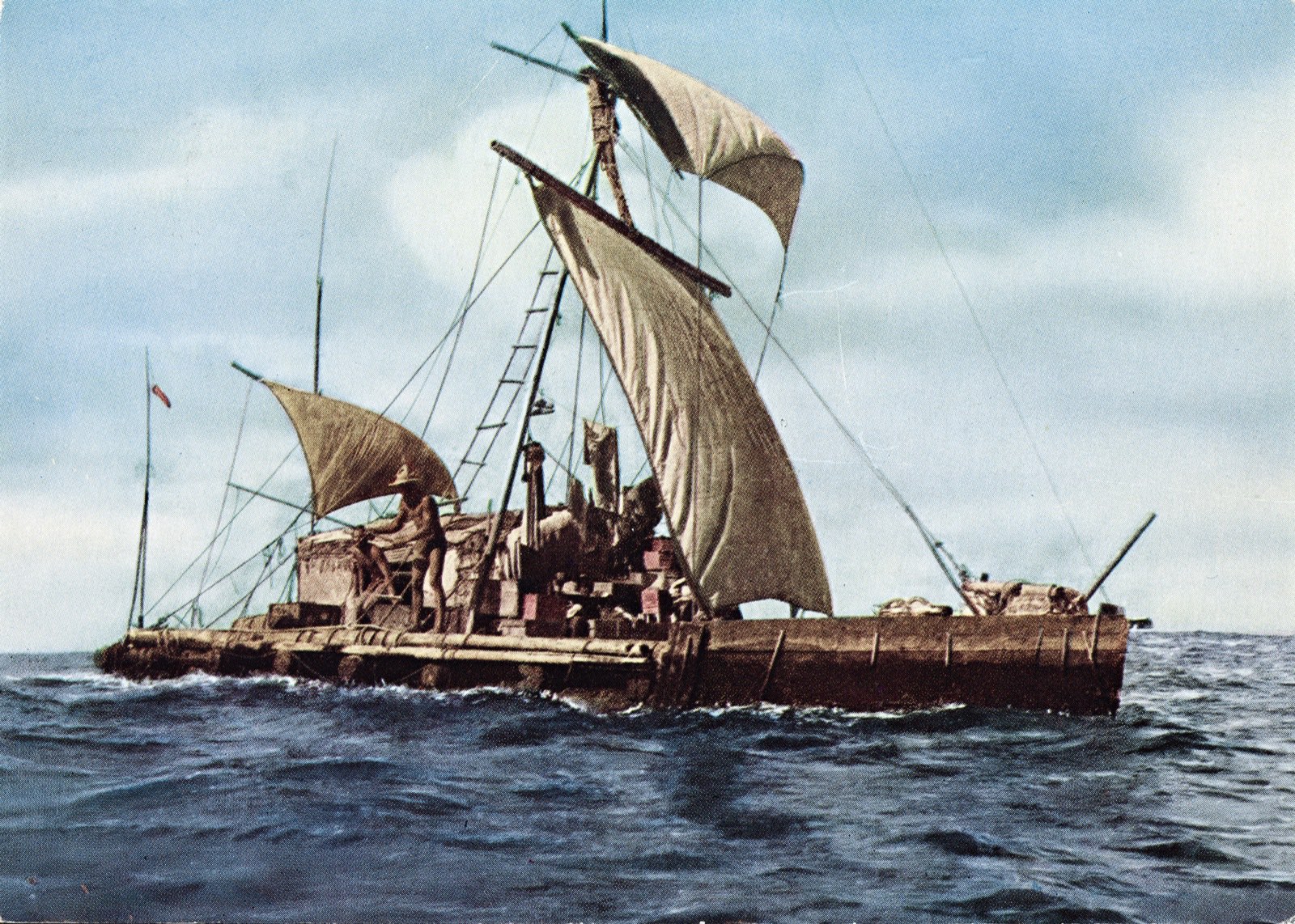
On top of the logs at the bow they lashed low splashboards to keep spray off the baskets of crop plants they meant to carry to Polynesia: sweet potatoes, gourds and some two hundred coconuts. In the hut, behind a partition, went the wireless: short-wave transmitters built for the purpose and sabotage sets left over from the war, with the call sign LI2B, to be worked by Haugland and Raaby on schedules that American radio amateurs had agreed to listen for. Watzinger had argued Heyerdahl into the wireless as a safety precaution that “won’t have any effect on your theory so long as we don’t send out any SOS for help.” The raft was named for the sun-god. She flew the flags of Norway and the United States, and the flag of the Explorers Club of New York.
The Kon-Tiki was towed out of Callao on the afternoon of 28 April 1947 by the Peruvian naval tug Guardian Rios, which the Minister of Marine had ordered to take her clear of the coastal traffic. The tug came hours early, the leader was alone on the raft with the parrot, and a boat had to go back for the others. The tug kept the raft in tow overnight and cast her off the next morning about 50 sea miles north-west of Callao, with thirty-five men at the rail waving; the first agency despatch, printed in Australia on 14 May, has the tug towing the raft “150 miles to the south along the coast”, which is a different story and not the crew’s. Then the tug’s smoke went below the horizon. “Now we’ll have to start the engine, boys,” Raaby said.
Within a day the wind had settled in the south-east and the Humboldt Current had taken them, and the first lesson of raft navigation was that there was no going back. “Once a balsa-raft has ventured too far away from the sheltered coast,” Heyerdahl wrote in 1950, “its destiny is settled, unless the crew is large enough to paddle it back.” The centreboards acted as a keel, and the sail could be trimmed to hold a course at an angle to the wind, but not against it or even across it. Turning the bow towards Peru, the raft went backwards just as readily. The current carried them north-north-west at up to 71 nautical miles a day until, some 400 miles south of the Galápagos, it turned west and became the South Equatorial Current, and the sea went from green to blue.
Raroia
The raft did everything its critics had said it could not. The logs, cut green with the sap in them, did not get waterlogged. The ropes, instead of chafing, wore themselves grooves in the soft wood. Each sea that came up astern lifted the stern first, and the raft rode the crest, Heyerdahl wrote, “like a sea-bird”; what broke over her ran out through the gaps between the logs “as through the prongs of a fork”. The baskets at the bow stayed dry. After the fourth day there was no day without fish: flying fish on deck every morning, dolphin-fish in the raft’s shadow, pilot fish, remoras, sharks, and twice at night a snake mackerel, a fish then known to science only from skeletons, which jumped into the hut. The average progress was 42.5 miles a day. On 19 June the wireless reported a drift of 132 miles in two days, and a Queensland paper noted that the raft was “already ahead of schedule”: a hundred days to Tahiti instead of the 120 estimated at Callao.
Some way past the middle of the voyage, with more than 2,000 sea miles of ocean behind them, they found out what the five boards were for. Heyerdahl’s book is the only account of the moment, and it is worth following closely. The Spaniards had said that the Indians “steered” their rafts with “certain centreboards which they pushed down into the chinks between the timbers”, and this, he wrote, “sounded incomprehensible both to us and to all who had occupied themselves with the problem”, since a board jammed in a chink could not be turned like a rudder. One of the boards had worked loose and been lost under the raft; Watzinger and Haugland dived under her and recovered it. With the wind steady and the oar lashed, they pushed it down into a chink aft, and the Kon-Tiki at once altered course several degrees from west towards north-west and held the new course. Pulled up again, she swung back. Pulled halfway, she swung halfway. The raft was a balance with the mast as its fixed point: more board in the water aft, and the stern held while the bow fell off downwind; more forward, and the bow held. “By simply raising and lowering the centreboard we could effect changes of course and keep to them without touching the steering oar.” It was, he wrote, “something which no one has understood since the Indians themselves gave up this forgotten sport.”
And then they put the discovery away. “We could certainly have continued our voyage by making the steersman stand and pull a centreboard up and down in a chink instead of hauling sidewise on the ropes of the steering oar, but we had now grown so accustomed to the steering oar that we just set a general course with the centreboards and preferred to steer with the oar.” The Geographical Journal has the finding in one sentence, with the oar described as a device whose superfluity they discovered “only through experiment”. What the boards could do when a raft was sailed against the wind, which was the question the old accounts actually raised, they did not try.
On 21 July, after eleven weeks at sea, Watzinger fell overboard reaching for a sleeping bag. A raft before the wind cannot stop or turn, and a man in the water cannot catch it; Haugland went in after him with a lifeline and brought him back. The same day the first full storm hit them, and a second followed and lasted five days. The sail tore before it could be lowered, the steering oar broke, and the lashings on all five centreboards burst. The raft went on westward, in Heyerdahl’s phrase, “as stubbornly as usual”, but the boards were never again properly fixed. The crew could not dive under her to re-lash them, because by then sharks followed her closely, and the loose boards hung down under the logs like blunt fins. On 18 July Lima radio had announced, and the agencies had repeated, that the six Norwegians “successfully completed the crossing of the South Pacific by reaching the Marquesas”. They had done no such thing; they had passed south of the Marquesas, out of sight of land, and the islands they were being carried towards were the atolls of the Tuamotus.
On the ninety-third day they sighted Pukapuka, the easternmost of them, and could not reach it. On 3 August, the ninety-seventh day, which was the figure Heyerdahl had once calculated in New York as the theoretical minimum for the crossing, they drifted all day along the reef of Angatau, close enough for islanders to paddle out in canoes and try to tow the raft in through the passage. The raft would not be towed against the wind, and the sun went down with the island astern. “Landing or no landing,” Heyerdahl wrote, “we had reached Polynesia anyway”. Ahead now lay the reefs of Takume and Raroia, forty to fifty miles of coral across their path, and the wind went round to the north and then back to the east while they tried to get past the southern end.
When night came on 6 August they had been a hundred days at sea. At dawn on the 7th Raaby came down from the masthead with the news that there was a line of palm-clad islets ahead, and by half past seven they ran along the whole western horizon: the ring of Raroia, an oval atoll some twenty-five miles across, with the reef that joins its islets lying like a mole along its eastern side. The raft was drifting diagonally in towards it. “With fixed centreboards we should still have had some hope of steering clear,” Heyerdahl wrote. “But sharks were following close astern, so that it was impossible to dive under the raft and tighten up the loose centreboards with fresh guy-ropes.” They put on shoes for the first time in a hundred days, packed the films and papers in watertight bags, lashed everything down, and cut away the ropes that held the centreboards so that the raft would wash over the reef rather than catch on it. Raaby had reached, the day before, an amateur on Rarotonga in the Cook Islands, and arranged an extra schedule.
The log for the morning survives in the book. At 8.15: “We are slowly approaching land.” At 9.45: “The wind is taking us straight towards the last island but one we see behind the reef.” At 9.50: “Very close now. Drifting along the reef. Only a hundred yards or so away. Torstein is talking to the man on Rarotonga. All clear. Must pack up log now. All in good spirits; it looks bad, but we shall make it!” A home-made anchor, water cans filled with dead batteries, held them for a few minutes stern-on to the breakers while Raaby got the message through: the raft was drifting on to the Raroia reef, Rarotonga should listen every hour, and if nothing was heard for thirty-six hours the Norwegian embassy in Washington should be told. His last words on the key were “O.K. 50 yards left. Here we go. Good-bye.” Then the anchor rope was cut.
The order was to hold on to the raft, whatever happened, and let the nine logs take the reef. The first sea lifted the Kon-Tiki and ran her in; the second came after them like a wall of green glass and buried everyone. The hut was crushed, the mast went, the steering oar went, the cross-logs at bow and stern broke adrift. The nine main logs held together, and the men held on to them, and when the raft lay fast on the coral the six of them, by the New York despatch’s count, crossed “the last 500 yards” of reef to the islet. Heyerdahl’s own count, in the Geographical Journal: 101 days, 4,300 miles of open ocean, every man and the cargo saved, the sweet potatoes lost on the reef, and the coconuts and gourd seeds planted on the beach where they came ashore.
What it looked like from inside
They were alone on a palm islet at the south-west of the lagoon, with rats, parakeets, thrushes and doves and almost no insects, under two flags. The Kon-Tiki lay on the reef with the sea working her higher at each tide. Raaby and Haugland got the wireless going again, and the message that opens this entry went out through Rarotonga; the Resident Commissioner’s covering note says that it followed three earlier telegrams, which were presumably the Rarotonga amateur’s first news. Within the week the agencies carried Heyerdahl’s claim, sent over the same link, that his two operators had set “a world record for battery-operated transmitters” by raising Norway direct from the raft, three days before the reef, from “an exact antipodal position on the earth’s surface”, on cells rebuilt from the insides of a 45-volt battery.
After some days canoes came across the lagoon from the village, with Danielsson waving his hat in the first of them, and the village of Raroia, 120 people under a chief named Tepiuraiarii Teriifaatau, who said they might call him Teka, took them in. The chief had been to school in Tahiti, asked after Bing Crosby, and told them that three foreign vessels had called at Raroia in ten years. His first request was to see the boat that had brought them over the reef alive. When the villagers saw the logs they stopped and shouted, all at once, that this was not a boat: “That’s not a boat, it’s a pae-pae!” Pae-pae, Heyerdahl explained, is the word across Polynesia for a raft or a platform, and on Easter Island for the islanders’ canoes; the chief said that such rafts no longer existed but that the oldest men could tell traditions of them. The villagers admired the balsa logs and turned up their noses at the hemp ropes; their own outrigger lashings, plaited from coconut fibre, were good for five years at sea. The raft was got off the reef and brought into the lagoon, to the islet where the six had come ashore, which was named Kon-Tiki Island. The crew were given Polynesian names and adopted as citizens of Raroia.
The governor of French Oceania, on instructions from Paris, sent the government schooner Tamara for them, and she took the Kon-Tiki in tow for Tahiti. The raft broke two tow-ropes on the way, which the agencies reported as “more trouble than in all its 4000-odd miles of voyaging under its own power”. At Papeete the chief Teriieroo, who had adopted Heyerdahl on his first visit to Tahiti, met him on the quay. “You come late,” Heyerdahl reports him saying, “but you come with good news. Your pae-pae has in truth brought blue sky to Tahiti, for now we know where our fathers came from.” The Norwegian shipowner Lars Christensen ordered the 4,000-ton Thor I from Samoa to fetch the expedition and its raft, and she sailed for San Francisco on 14 September. On 4 October President Truman received the six in Washington and accepted the American flag that had flown from the raft’s mast; he asked for the Norwegian one too, and suggested the two should hang together in Washington. Heyerdahl had already told the press at Papeete that he meant to “endeavour to substantiate the Polynesian ancestry theory”.
What happened
The results were set out formally in the Geographical Journal for March 1950, in a paper of twenty-two pages with an appendix listing the Peruvian parallels. On the raft, the paper is exact and is quoted above. On the hypothesis, it draws its own conclusion in one sentence: “The purpose of the expedition had been fully attained, the feasibility of Peruvian settlement in Polynesian territory had been established.” The paper ends with a proposal to add “sea-bridge” to the vocabulary of anthropology, meaning an ocean on which wind and water run from one coast to another like “a perpetually moving escalator able to drop off at one end whatever it has picked up at the other”, and with the claim that the strongest sea-bridge in the Pacific “has carried Indians out of America, and held all Malays back on their own shores.”
It also contains, on page 30, a sentence and a footnote that the rest of the paper does not reckon with. “A primitive craft capable of drifting westward to an island 4300 miles away, was unable to push eastward to a neighbouring island within sight.” The footnote reads: “This conclusion is based on our own experience. It may be that the early raftmen used the sails and centre-boards in other ways and attained a larger freedom of navigation. This is suggested in the narratives of Juan and Ulloa.” Jorge Juan and Antonio de Ulloa were the two Spanish naval officers who had accompanied the French academicians to Quito in the 1730s, and their account of the balsa rafts of Guayaquil had been in English since 1758. “The greatest singularity of this floating vehicle,” they wrote, “is, that it sails, tacks, and works as well in contrary winds, as ships with a keel, and makes very little lee-way.” The advantage came from “some boards, three or four yards in length and half a yard in breadth, called Guaras”, set vertically between the logs at bow and stern, “and by thrusting some of these deep in the water, and raising others, they bear away, luff up, tack, lay to, and perform all the other motions of a regular ship.” Juan had added a memoir explaining why, and noted that the Indians sometimes used “five or six Guaras”. The companion piece “The five boards” prints the whole passage.
So the instrument that would have said what an Inca raft could really do had been on board, five of them, and described in a book that Heyerdahl cited. The raft had been steered by an oar of the kind Ecuadorian fishermen used, and the boards had been used as a keel, then discovered as a rudder, then set aside. In his reply to his critics the next year Heyerdahl said it plainly: “Our raft was undermanned for paddling and its crew had never seen one before, nor a guara (centre-board).” He also said what he thought the raft had shown, and it was less than the headline: “Polynesia lay within easy range for exploring parties or accidental drift voyagers from early South America in the craft available to them.” And he said what it had not shown. The drift, he wrote, “neither proves nor even indicates that a journey in the opposite direction and in a different craft would have been as readily achieved.”
The critics had meanwhile answered the hypothesis, not the raft. Robert Heine-Geldern, professor of ethnography at Vienna, took the March paper apart in the December issue of the same journal, beginning with the words that Heyerdahl’s “courage and spirit of enterprise and his brilliant achievement in crossing the Pacific with the raft Kon-Tiki deserve of the highest admiration”, and that his hypothesis “should not be allowed to pass unchallenged.” On language: the Polynesian tongues were related, however remotely, to those of Indonesia, “whereas no such link exists between the languages of Polynesia and America”, and one Quechua word in Polynesia, the name of the sweet potato, proved “that some contacts have taken place between the two regions, but no more.” On the stone tools, which were his own field: “Not a single specimen of any of the characteristic South American types of stone axes has ever been found in Polynesia. On the other hand, the various kinds of Polynesian stone adzes all belong to well-known east Asiatic types.” On the megaliths, the calendar, the sling and the nose flute, that each occurred in Indonesia as well. His summary of the method was that it consisted “in listing various cultural traits found in Polynesia, as well as in America, omitting however to mention that these same traits occur also in Indonesia or eastern Asia.” And then the sentence the rest of the century would repeat: “Of course, the fact that he proved that sailing with a balsa raft from Peru to Polynesia was technically possible does not yet prove that Peruvians actually came to Polynesia.”
Heine-Geldern drew his own conclusion from the raft, and it was the opposite of Heyerdahl’s: if a raft could cross from Peru, a Polynesian canoe could have gone to Peru and come back with the sweet potato, as Dixon had argued, and the Kon-Tiki “disposes once and for all” of the objection that a return voyage was impossible. Heyerdahl, in March 1951, refused the tribute. His voyage, he said, had been “emphatically due to the geographical location of our starting-point and to that specific type of craft”, and “it can never be sufficiently stressed that primitive oceanic migrations cannot be judged in miles or inches, but only in centuries and days.” The two men were now arguing about which way the escalator ran, and the raft could not tell them.
None of this reached the public in the form it reached the journal. The book, The Kon-Tiki Expedition, appeared in Norwegian in 1948 and in English in 1950, and has since been translated, by the museum’s count, into more than seventy languages. The documentary cut from the expedition’s own sixteen-millimetre film won the Academy Award for documentary feature for 1951. The Kon-Tiki Museum opened in a temporary building at Bygdøy, Oslo, in 1950, with the raft in it, and moved into its own premises in 1957. American Indians in the Pacific, Heyerdahl’s full statement of the theory, came out in 1952. Heyerdahl went on to the Galápagos in 1953, to Easter Island in 1955, and on to the Atlantic in the reed boats Ra and Ra II in 1969 and 1970. He died at Colla Micheri in Italy on 18 April 2002 and was given a state funeral in Oslo.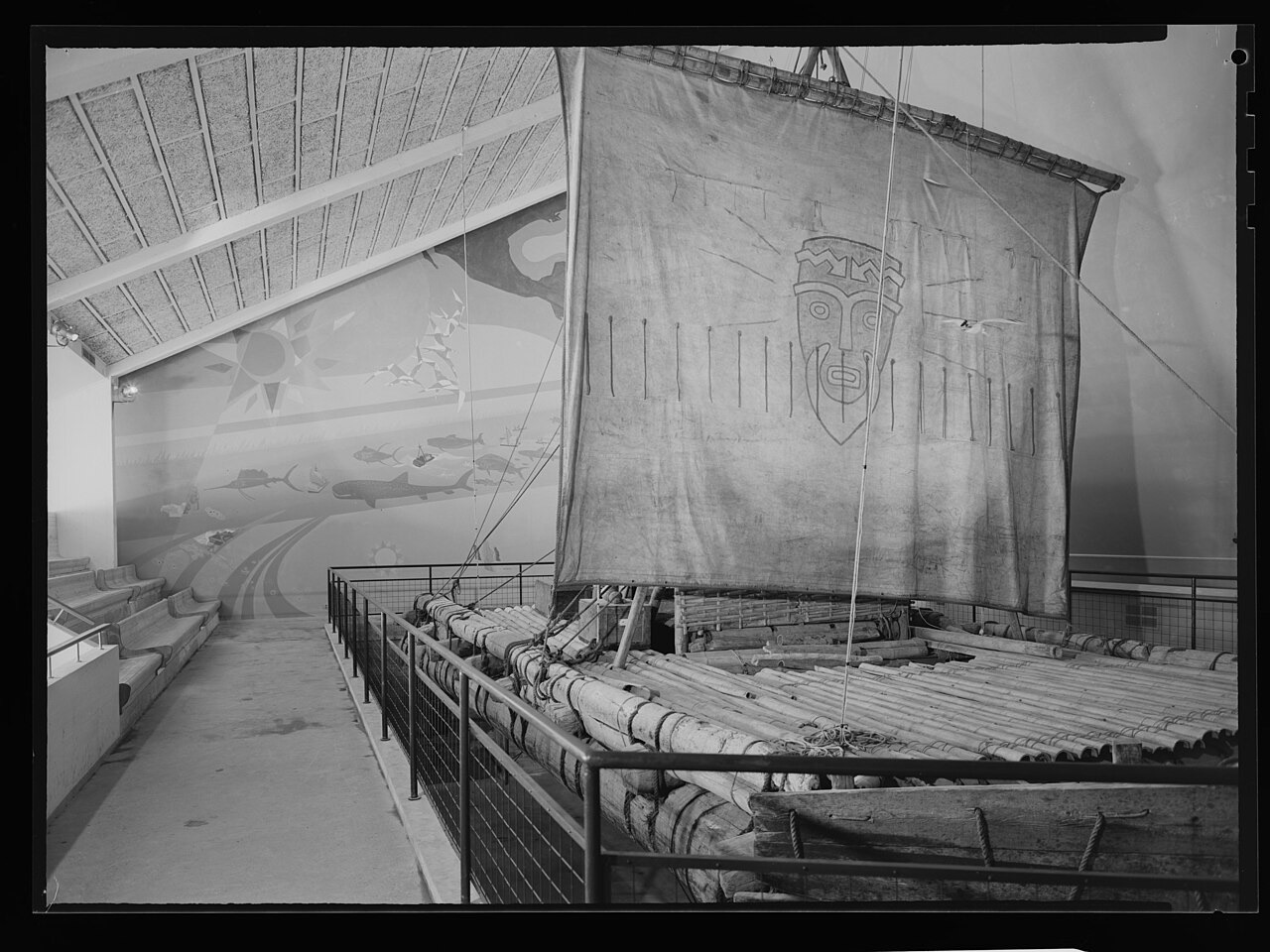
After
The second half of the hypothesis was tested by other people with other instruments, and the companion piece “The tests since” goes through them. In brief: the languages of Polynesia belong to the Austronesian family, as Hale had said in 1846; the adzes, as Heine-Geldern said in 1950, are East Asian types; a review of 1,434 radiocarbon dates published in 2011 put the first settlement of the Society Islands at about 1025 to 1120 and the dispersal to every other group of East Polynesia, Easter Island and New Zealand included, in one pulse between about 1190 and 1290, which left no millennium for a Peruvian first wave. The sweet potato remains the strongest piece of Heyerdahl’s evidence and is still argued over: a study of herbarium specimens in 2013 found “strong support for prehistoric transfer(s) of sweet potato from South America (Peru-Ecuador region) into Polynesia”, and a genomic study in 2018 found evidence that the plant “was present in Polynesia in pre-human times” and needed no human carrier.
Then the genomes. In 2014 a study of twenty-seven living Easter Islanders found genome-wide signs of Native American ancestry and dated the mixing to between 1280 and 1495; in 2017 five ancient individuals from the island showed no substantial Native American ancestry, which suggested the signal was colonial. In July 2020 Alexander Ioannidis and his colleagues published in Nature an analysis of 807 people from seventeen Pacific islands and fifteen Native American groups of the Pacific coast, and found what they called “conclusive evidence for prehistoric contact of Polynesian individuals with Native American individuals (around AD 1200)”, a single event in eastern Polynesia, before Easter Island was settled, with “a Native American group most closely related to the indigenous inhabitants of present-day Colombia”. The islands that carried the signal were the Marquesas, Mangareva, the Palliser group of the Tuamotus and Easter Island; the earliest estimate, about 1150, was for Fatu Hiva, the island where Heyerdahl had sat by Tei Tetua’s fire. In 2024 the same journal published fifteen ancient genomes from Easter Island itself, which carry about ten per cent Native American ancestry dated to between about 1250 and 1430, and which are Polynesian.
That is a real finding, and it is a different claim from Heyerdahl’s. The people who met the Americans were Polynesians, already there, speaking an Austronesian language and carrying East Asian adzes; the Americans were few, and related to the peoples of the forested coast of Colombia and Ecuador where balsa rafts were built, not sun-worshippers from the desert of Peru; the date is some seven centuries later than the “1500 years ago” of the 1947 despatches; and the genes do not say whether a raft went west or a canoe went east, a question the paper leaves open. The 2020 paper notes that drift simulations from Ecuador and Colombia land most often in the South Marquesas and then in the Tuamotus, where the Kon-Tiki landed. Its authors describe Heyerdahl’s suggestion as controversial and leave it there.
What it taught
The experiment was designed to remove one objection, and it removed it. Everything the specialists had said a balsa raft could not do, the raft did, for 101 days and 4,300 miles, with six landsmen aboard, and then came through a reef that would have broken any boat. The report was honest about its limits, and so was its author in the journal, where the hearing was small. The feasibility of a voyage from Peru had been established. Nothing about who had made it had been.
The complication is in the instrument. The raft carried, in its five fir boards, the one device that could have measured what an Inca raft was capable of, and the measurement had been published two centuries before: that with the guaras the rafts of Guayaquil could sail, tack and work “in contrary winds, as ships with a keel”. The crew discovered half of it in mid-ocean, by chance, when a lost board was recovered and pushed into a chink aft, and preferred the oar. At the reef the boards were cut loose. So the raft’s own verdict on itself, that it “was unable to push eastward to a neighbouring island within sight”, was a verdict on six men who had never seen a guara, and Heyerdahl’s footnote says so. What the Kon-Tiki showed was that a raft could drift to Polynesia. What it did not test was whether a raft could be sailed there, and back, which is the question the old accounts had raised and the one that would have mattered to any Peruvian who meant to go.
The other half of the lesson is about reading. The seventy-five words from Rarotonga said that six men and their equipment were safe on an islet. Within ten days the headline was that history had been verified, and the chief at Papeete said that now they knew where their fathers came from, and the book and the film carried the same reading to more people than any journal has ever reached. Heine-Geldern’s one sentence, that proving a thing possible “does not yet prove” that it happened, was printed in December 1950 for the readers of a learned journal, and it was right, and it did not matter to the result. A demonstration that something is possible is the easiest kind of experiment to misread, because it is spectacular, it has a date and a distance, and the thing it does not show is invisible. The tests that could settle the hypothesis were slow and unspectacular, in languages, adzes, radiocarbon and genomes, and when they came they found something smaller and stranger than the raft had been built to prove: that around the year 1200 a few Americans and a few Polynesians met, somewhere near the islands where the raft came ashore, and that their descendants are still there.
Sources
- Thor Heyerdahl, “The Voyage of the Raft Kon-Tiki: An Argument for American-Polynesian Diffusion,” The Geographical Journal 115 (March 1950), pp. 20–41. The hypothesis as put to the Royal Geographical Society; the objections to the balsa raft; the raft’s dimensions (30-foot side logs, 45-foot centre log, 2-foot cross section, 18-inch freeboard, five centreboards 2 feet by 6); the departure on 28 April 1947; the crew; the drift of up to 71 nautical miles a day and the 42.5-mile average; the discovery that raising and lowering the centreboards altered course; the fish; 21 July; Pukapuka after 93 days and Angatau four days later; the landing on 7 August; 101 days and 4,300 miles; “the feasibility of Peruvian settlement in Polynesian territory had been established”; the “sea-bridge” and the sentence and footnote about Juan and Ulloa on page 30. In copyright; quoted briefly. archive.org
- Robert Heine-Geldern, “Heyerdahl’s Hypothesis of Polynesian Origins: A Criticism,” The Geographical Journal 116 (December 1950), pp. 183–192. The linguistic objection, the adzes, the megaliths, the summary of Heyerdahl’s method, and “does not yet prove that Peruvians actually came to Polynesia.” In copyright; quoted briefly. archive.org
- Thor Heyerdahl, “Voyaging Distance and Voyaging Time in Pacific Migration,” The Geographical Journal 117 (March 1951), pp. 69–77. The reply: the crew “had never seen one before, nor a guara”, “neither proves nor even indicates”, “within easy range”, and “centuries and days”. In copyright; quoted briefly. archive.org
- Thor Heyerdahl, The Kon-Tiki Expedition: By Raft across the South Seas, translated by F. H. Lyon (George Allen and Unwin, London, 1950; first published in Norwegian, 1948). Fatu Hiva and Tei Tetua; the museum interview and “you can try a trip”; the crew and how each was found; the backers, the loan, the Pentagon, the Quartermaster, the British equipment and the Hydrographic Office; the building of the raft at Callao and the centreboards “scattered about without system”; the tow out and the cast-off 50 sea miles north-west of Callao; the halfway discovery of the centreboards and the preference for the oar; Angatau on the ninety-seventh day; the approach to Raroia, the loose centreboards, the log entries of 7 August and Raaby’s last words; the village, chief Teka, “pae-pae”, the Tamara, the Maoae, Teriieroo and the Thor I. In copyright; quoted in short phrases only. archive.org
- Thor Heyerdahl, American Indians in the Pacific: The Theory behind the Kon-Tiki Expedition (George Allen and Unwin, London, 1952). The full statement of the theory, including a long treatment of the balsa raft and the guaras, from which the chapter on Juan and Ulloa was checked against the 1758 edition. In copyright; not quoted. archive.org
- George Juan and Antonio de Ulloa, A Voyage to South-America, translated from the Spanish (London, 1758), vol. 1, Book IV, chapter IX, pp. 195–198. The balsas of Guayaquil, their construction, and the guaras: “it sails, tacks, and works as well in contrary winds, as ships with a keel”. Read on the page images. archive.org
- Horatio Hale, Ethnography and Philology, United States Exploring Expedition, vol. 6 (Philadelphia, 1846), “Origin of the Polynesians”, p. 194: “That the Polynesians belong to the same race as that which peoples the East Indian Islands is, at present, universally admitted.” archive.org
- Archives New Zealand, Island Territories Department, “Letter from Thor Heyerdahl (1947)”, ACGA 8280 IT1 427/EX69/91/1: the seventy-five-word message relayed from Rarotonga on 11 August 1947, read from the document. Released on Flickr under CC BY-SA 2.0. Wikimedia Commons
- The Kon-Tiki Museum, Oslo: “Kon-Tiki, 1947” (the 28 April departure, Spinden’s challenge as the museum words it, the crew’s roles, Gerd Vold, 101 days, the book in more than seventy languages and the Academy Award); “About Thor Heyerdahl” (birth at Larvik on 6 October 1914, the University of Oslo from 1933, the marriage and departure of December 1936, the later expeditions, death at Colla Micheri on 18 April 2002 and the state funeral); “About the museum” (opened 1950, present building 1957). Kon-Tiki, 1947, About Thor Heyerdahl, About the museum
- The Australian press of 1947 through Trove, all from New York agency copy: Sunraysia Daily (Mildura), 14 May, the first delayed report, “seeking to prove by a 4000-mile drift”, and the tug “150 miles to the south”; Daily Mercury (Mackay), 21 June, 132 miles in two days and “ahead of schedule”; The Sun (Sydney), 19 July, “reaching the Marquesas Islands”; Morning Bulletin (Rockhampton), 23 July, 300 miles from Pukapuka and “trying to prove by duplicating the feat”; Warwick Daily News, 7 August, Pukapuka and Angatau; The Telegraph (Brisbane), 12 August, “ended its voyage on Raroia Reef”; The West Australian, 15 August, the wireless record and the operators’ war records; Chronicle (Adelaide), 21 August, “History Believed Verified By Raft Crash”; Newcastle Morning Herald, 29 August and 4 September, the tow and Papeete; The West Australian, 6 October, President Truman and the flags. 14 May, 21 June, 19 July, 23 July, 7 August, 12 August, 15 August, 21 August, 29 August, 4 September, 6 October
- The New Zealand press of 1947 through Papers Past: Northern Advocate, 19 July, the Lima radio report of a Marquesas landfall and “sailed from Callao on April 29”; Central Hawke’s Bay Press, 12 August, the stranding; Otago Daily Times, 24 September, the Thor I. 19 July, 12 August, 24 September
- Janet M. Wilmshurst, Terry L. Hunt, Carl P. Lipo and Atholl J. Anderson, “High-precision radiocarbon dating shows recent and rapid initial human colonization of East Polynesia,” Proceedings of the National Academy of Sciences 108 (2011), pp. 1815–1820. The 1,434 dates, the Society Islands at about 1025 to 1120 and the pulse of about 1190 to 1290. doi.org
- Caroline Roullier, Laure Benoit, Doyle B. McKey and Vincent Lebot, “Historical collections reveal patterns of diffusion of sweet potato in Oceania obscured by modern plant movements and recombination,” PNAS 110 (2013), pp. 2205–2210; and Pablo Muñoz-Rodríguez and others, “Reconciling Conflicting Phylogenies in the Origin of Sweet Potato and Dispersal to Polynesia,” Current Biology 28 (2018), pp. 1246–1256. The two findings quoted on the sweet potato; the second is behind a paywall and is quoted from its abstract. Roullier, Muñoz-Rodríguez
- Alice A. Storey and others, “Radiocarbon and DNA evidence for a pre-Columbian introduction of Polynesian chickens to Chile,” PNAS 104 (2007), pp. 10335–10339; Jaime Gongora and others, “Indo-European and Asian origins for Chilean and Pacific chickens revealed by mtDNA,” PNAS 105 (2008), pp. 10308–10313. The chicken bone and the challenge. Storey, Gongora
- J. Víctor Moreno-Mayar and others, “Genome-wide ancestry patterns in Rapanui suggest pre-European admixture with Native Americans,” Current Biology 24 (2014), pp. 2518–2525; Lars Fehren-Schmitz and others, “Genetic Ancestry of Rapanui before and after European Contact,” Current Biology 27 (2017), pp. 3209–3215. The 2014 dating to 1280 to 1495 and the 2017 rejection from ancient samples; both behind paywalls and quoted from their abstracts. 2014, 2017
- Alexander G. Ioannidis and others, “Native American gene flow into Polynesia predating Easter Island settlement,” Nature 583 (8 July 2020), pp. 572–577. The 807 individuals, the contact around 1200, the single event before the settlement of Rapa Nui, the Colombian affinity, the island-by-island dates (Fatu Hiva about 1150, the Marquesas, Palliser and Mangareva 1200 to 1230) and the drift simulations. The published article is behind a paywall; the abstract is open, and the author manuscript is open at PubMed Central. doi.org, Europe PMC
- J. Víctor Moreno-Mayar and others, “Ancient Rapanui genomes reveal resilience and pre-European contact with the Americas,” Nature 633 (2024), pp. 389–397. Fifteen ancient genomes, about ten per cent Native American admixture, dated to about 1250 to 1430. Open access. doi.org
- Thor Heyerdahl, “Guara Navigation: Indigenous Sailing off the Andean Coast,” Southwestern Journal of Anthropology 13 (1957), pp. 134–143: the later paper on the boards, cited here for its existence; behind a paywall and not read. doi.org
- Photographs: the 1947 Mittet postcard of the raft under sail, photographer unknown, National Library of Norway, blds_05860, released on the Library’s Flickr account under CC BY 2.0; the Rarotonga message, Archives New Zealand, CC BY-SA 2.0; the raft at Bygdøy, Mittet & Co., before 1957, National Library of Norway, public domain. postcard, message, museum


